
The Great Famine (An Gorta Mór) was a devastating period...
 History28 views·Updated Jun 22, 2026·6 pages
The Irish Potato Famine: Causes and Impact
1 / 6
1
of 6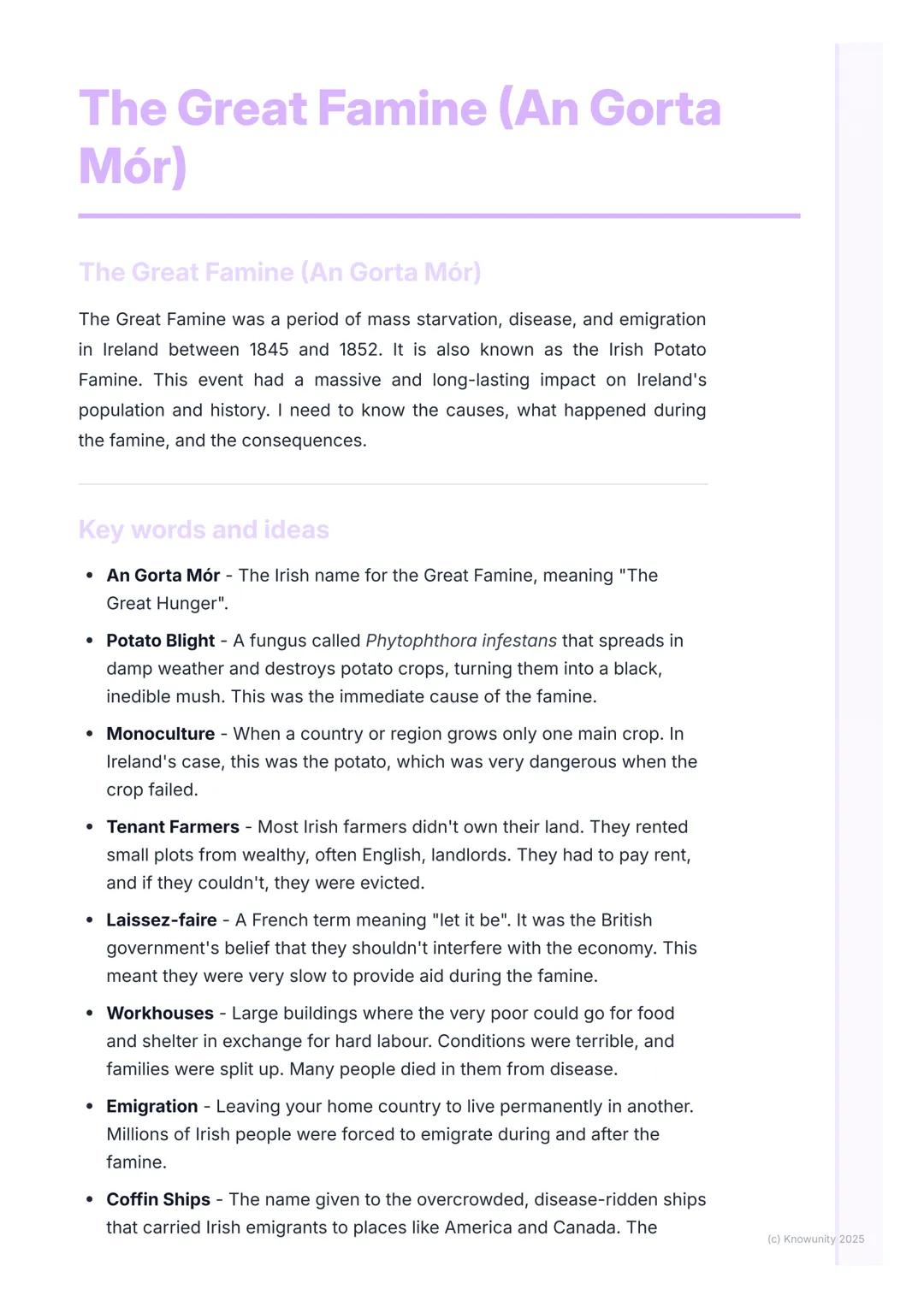
The Great Famine: An Introduction
The Great Famine, or "An Gorta Mór" in Irish (meaning "The Great Hunger"), struck Ireland between 1845-1852 and completely transformed the country. During this devastating period, approximately one million people died and another million were forced to leave Ireland.
The famine wasn't just a natural disaster—it was made much worse by political decisions. While Irish people were starving, food was still being exported from Ireland to England, a fact that continues to cause anger and debate today.
Several key terms help us understand this tragedy. Potato blight was the fungus that destroyed the crops. Most Irish were tenant farmers who didn't own their land but rented from wealthy landlords. The British government followed a laissez-faire approach, believing they shouldn't interfere with the economy even during this crisis.
Did you know? The death rate on "coffin ships"—the overcrowded vessels carrying Irish emigrants to North America—was so high that the waters near Canada's Grosse Île quarantine station are still considered an Irish burial ground.
2
of 6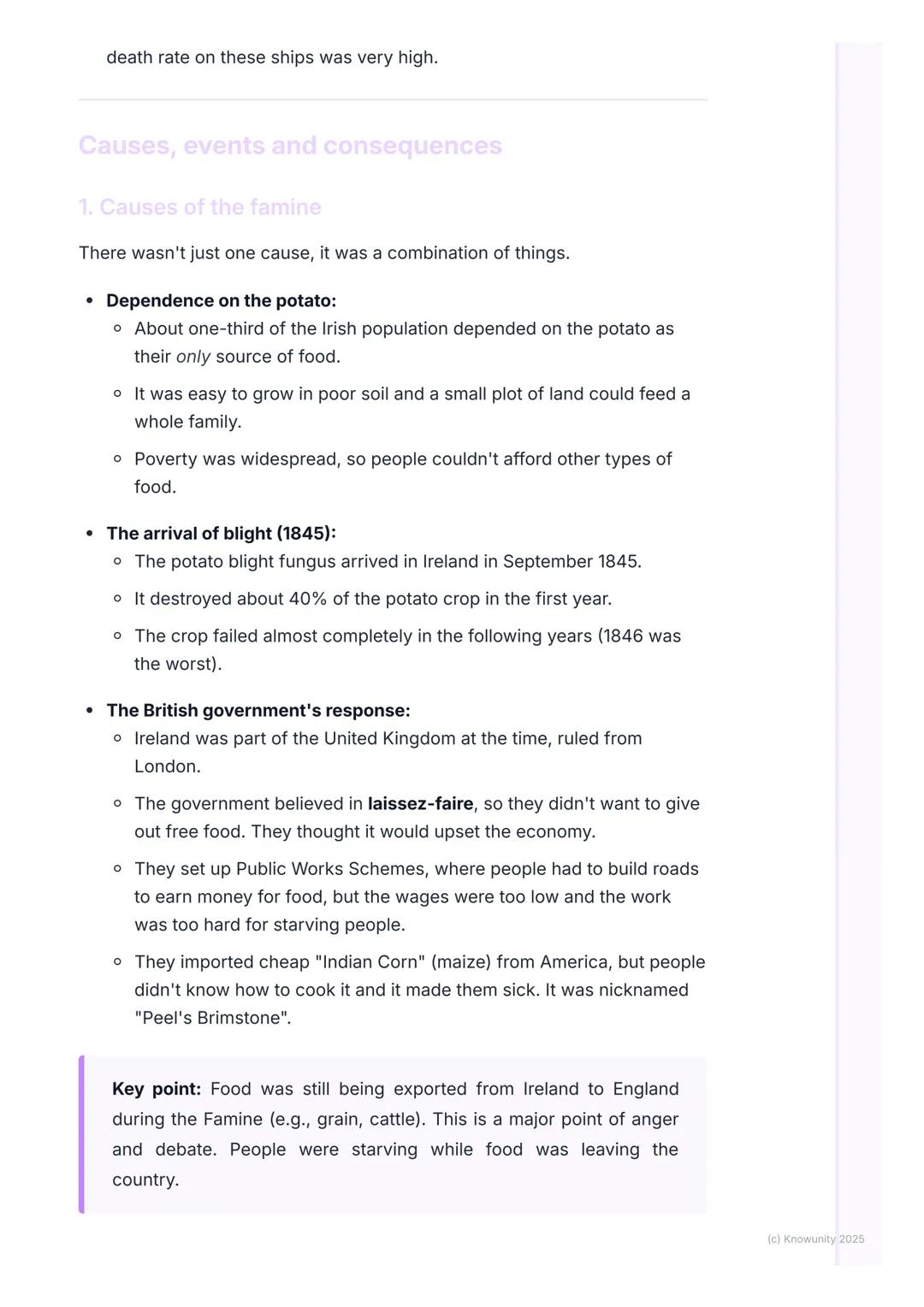
Causes of the Famine
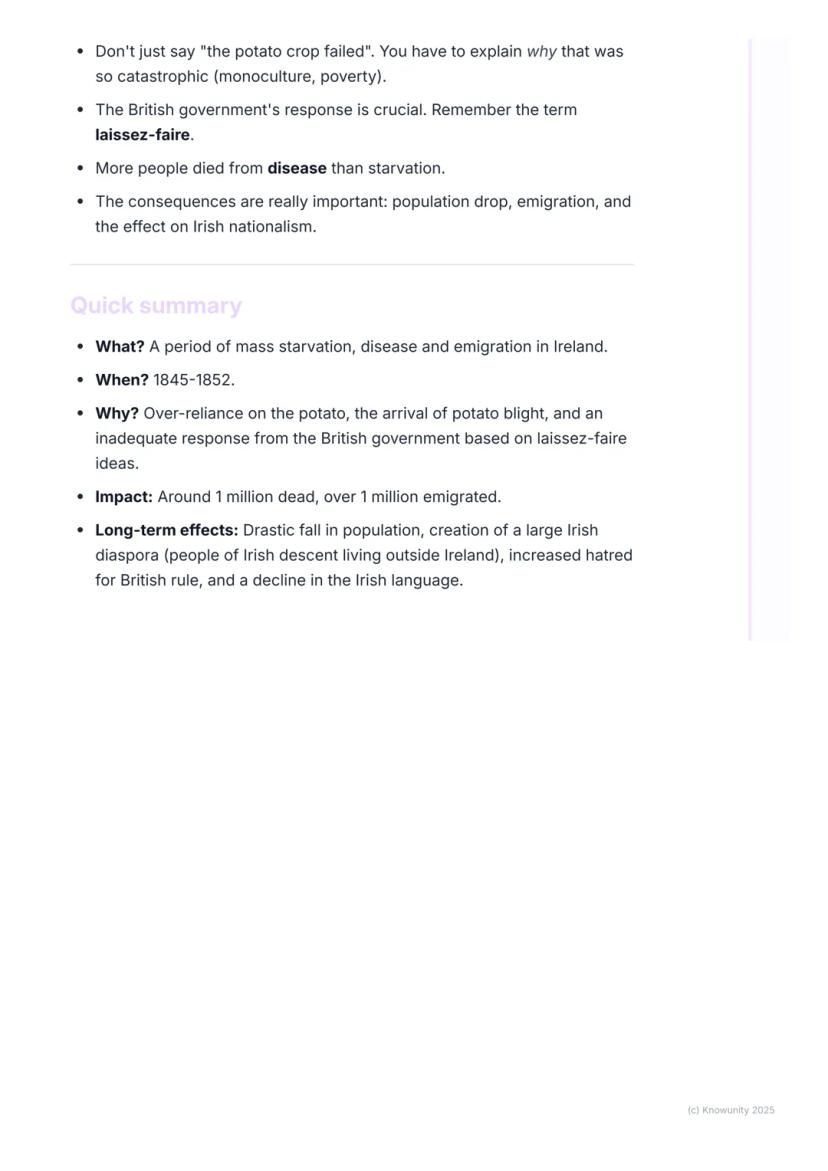
Why did so many people die in a country that was actually producing enough food? The answer lies in a perfect storm of problems that came together with devastating results.
Most Irish families depended entirely on potatoes for survival. A single acre of potatoes could feed a family of six for a year, making it perfect for poor farmers with small plots of land. When the potato blight arrived in 1845, it destroyed about 40% of the crop, and by 1846 (the worst year), almost the entire crop failed. Without potatoes, millions had nothing to eat.
The British government's response made everything worse. Following their laissez-faire economic policy, they refused to give out free food, believing it would disrupt the market. They set up Public Works Schemes where starving people had to build roads to earn money for food, but the wages were too low and the work too hard for people who were already weak from hunger.
Remember this: While Irish people were starving, other foods like grain and cattle were still being exported from Ireland to England. This fact is central to understanding why many Irish people viewed the famine as a form of genocide rather than just a natural disaster.
3
of 6
Life During the Famine
Daily life during the famine was a desperate struggle for survival that's hard for us to imagine today. Families who had lived in the same cottage for generations suddenly found themselves homeless and starving.
Starvation and disease ravaged the population. While many died from hunger, even more died from diseases like typhus, cholera, and dysentery that spread rapidly among weakened people. When tenant farmers couldn't pay their rent (because their crops had failed), landlords evicted them from their homes, often destroying their cottages so they couldn't return.
The desperate poor went to workhouses, which were deliberately made harsh to discourage people from using them. Families were separated, with men, women, and children all kept in different sections. Charitable organizations, especially the Quakers, set up soup kitchens to provide free food. The government eventually created its own soup kitchen scheme in 1847, but shut it down too early.
Important fact: The famine hit the poorest areas in western Ireland hardest, which were mainly Irish-speaking regions. This led to a severe decline in the Irish language, as many speakers died or emigrated.
4
of 6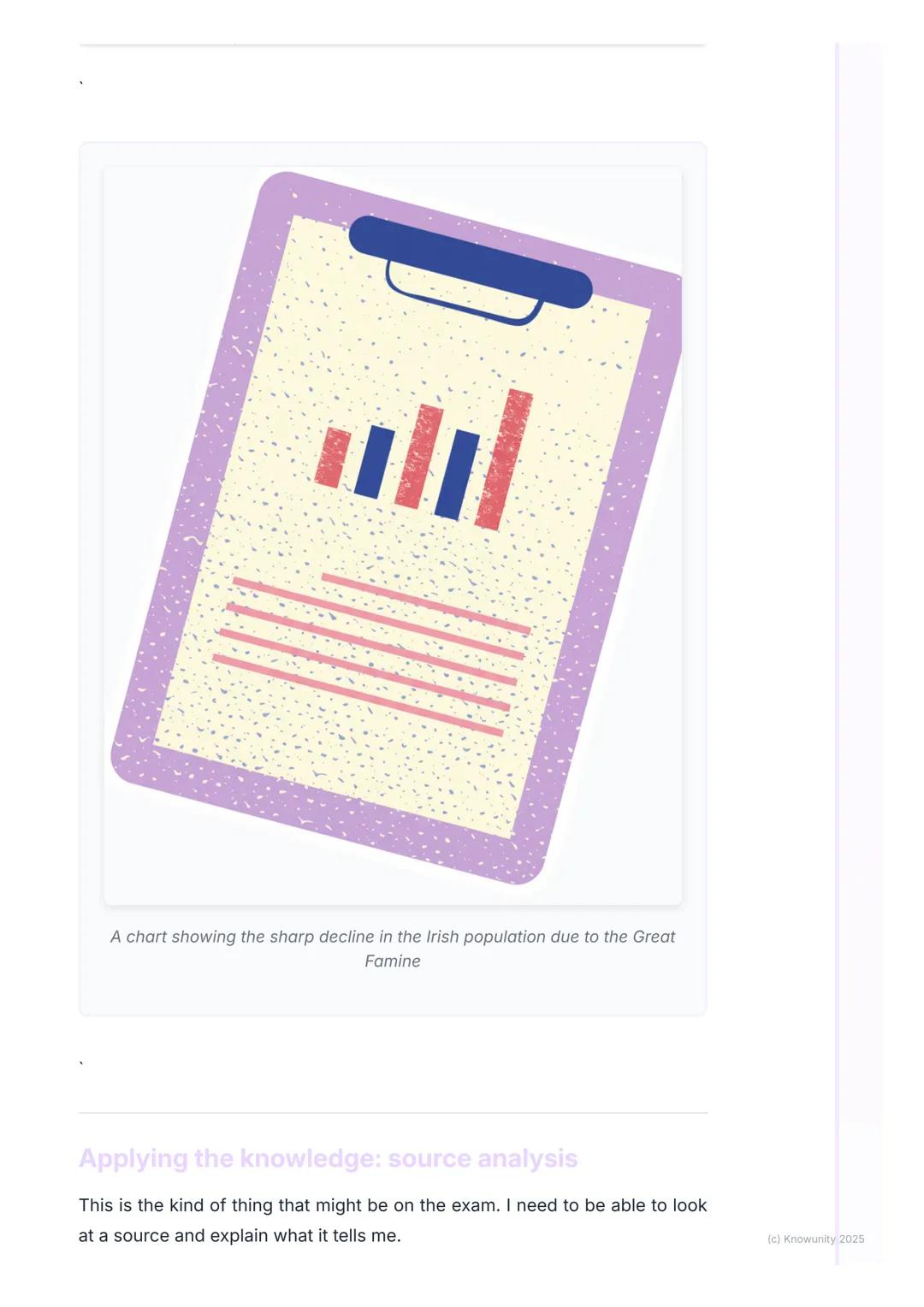
Consequences of the Famine
The Great Famine's effects continue to shape Ireland and Irish identity even today. It was more than a temporary disaster—it permanently changed the country's path.
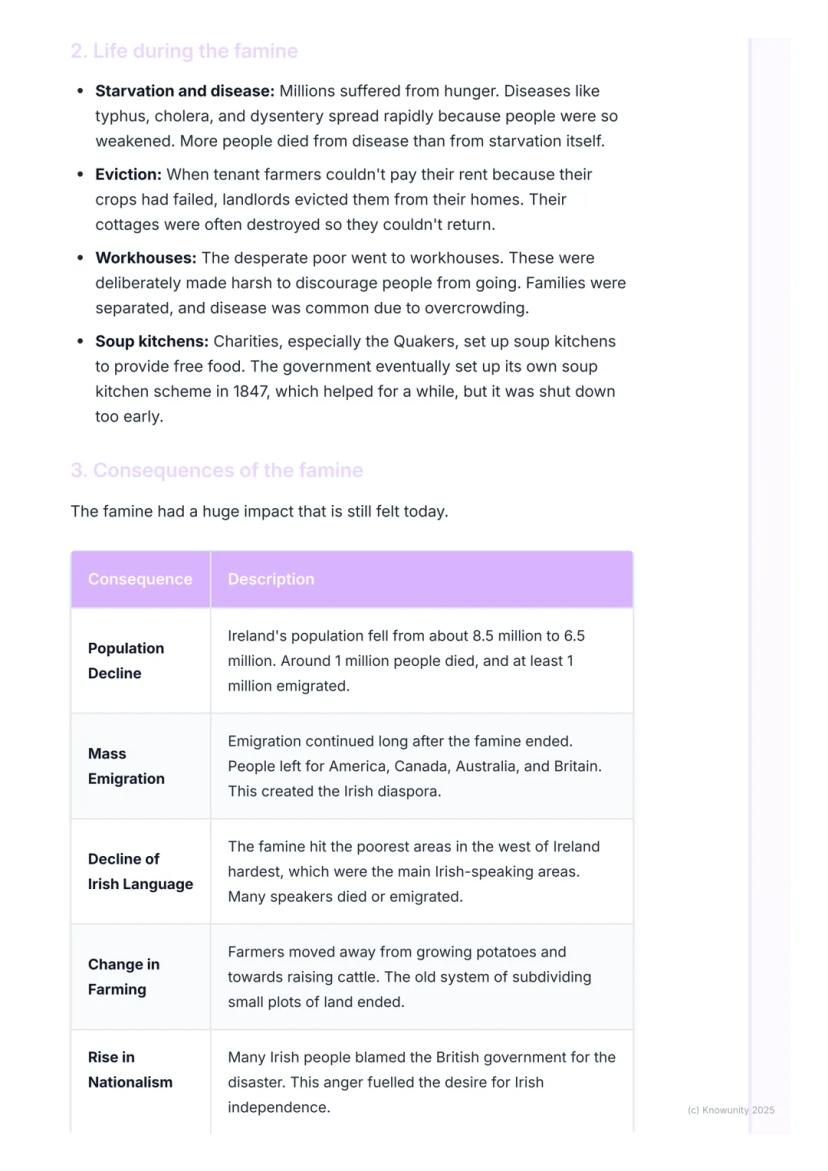
Ireland's population collapsed from about 8.5 million to 6.5 million people in just a few years. About 1 million died, and at least 1 million emigrated to America, Canada, Australia, and Britain. This mass emigration continued long after the famine ended, creating the large Irish diaspora around the world. Even today, Ireland's population (about 5 million) has never recovered to pre-famine levels.
Farming practices changed dramatically after the famine. Farmers moved away from growing potatoes toward raising cattle, and the old system of subdividing small plots of land ended. Perhaps most importantly, the famine fuelled the rise in Irish nationalism. Many Irish people blamed the British government for the disaster, intensifying the desire for independence.
Think about this: How might Irish history have been different if the population had continued growing instead of collapsing? Ireland might have become one of Europe's more populous nations instead of one of its smallest.
5
of 6
Analyzing Historical Sources
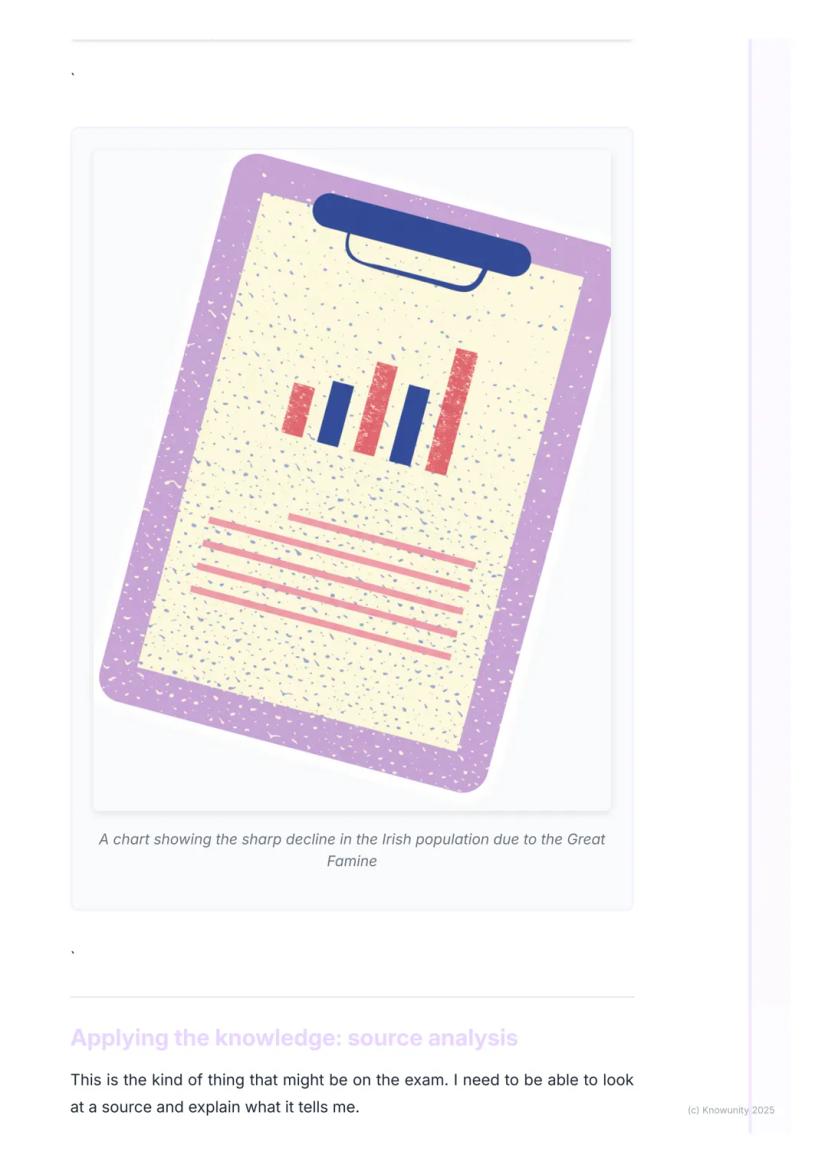
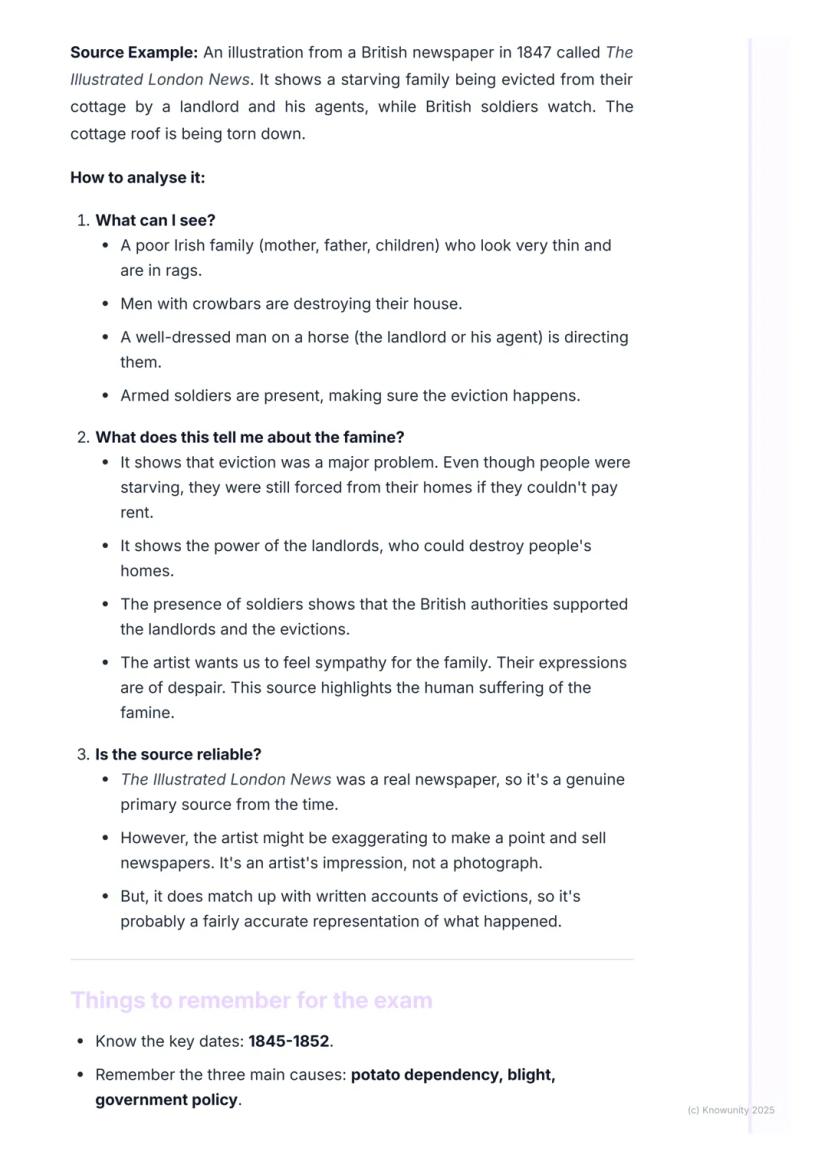
Being able to analyze historical sources about the famine is an important skill for exams. Let's look at how you might approach a source like the illustration from The Illustrated London News (1847) showing an eviction.
When analyzing any source, start by carefully observing what you can see. In this eviction illustration, note the starving family in rags, men destroying their cottage, a well-dressed landlord directing the operation, and British soldiers ensuring it happens. These details reveal the power imbalance during the famine—even as people starved, authorities prioritized property rights over human life.
Consider the reliability of your source. The Illustrated London News was a legitimate newspaper, making this a genuine primary source from the time. However, remember that artists might exaggerate for emotional impact. Compare the illustration with written accounts to check its accuracy.
Always connect your analysis to the broader historical context. This eviction scene demonstrates how British policies worsened the famine's impact and shows why many Irish viewed British rule as oppressive and unjust.
Exam tip: When analyzing sources in exams, always mention both what the source explicitly shows AND what it implies about attitudes or conditions at the time. This demonstrates deeper historical thinking!
6
of 6
Exam Preparation Tips
Preparing for an exam on the Great Famine means focusing on key dates, causes, consequences, and the ability to analyze historical sources critically.
Make sure you can explain the three main causes clearly: the dependence on potatoes (monoculture), the arrival of the blight, and the British government's inadequate response based on laissez-faire economics. Don't just state that "the potato crop failed"—explain why that failure was so catastrophic for Ireland specifically.
Remember that the famine's consequences were far-reaching and long-lasting. The dramatic population decline (from 8.5 to 6.5 million) changed Ireland forever. The creation of a global Irish diaspora spread Irish culture worldwide. The famine also intensified anti-British sentiment, fuelling the movement for Irish independence that eventually succeeded decades later.
When answering exam questions, use specific examples and statistics to support your points. Mentioning that food exports continued during the famine, that workhouses separated families, or that the government's relief efforts were intentionally limited will demonstrate your detailed knowledge.
You've got this! The Great Famine might seem like a complex topic with many aspects to remember, but if you understand the core causes and consequences, you can tackle any exam question on this subject confidently.
We thought you’d never ask...
What is the Knowunity AI companion?
Our AI Companion is a student-focused AI tool that offers more than just answers. Built on millions of Knowunity resources, it provides relevant information, personalised study plans, quizzes, and content directly in the chat, adapting to your individual learning journey.
Where can I download the Knowunity app?
You can download the app from Google Play Store and Apple App Store.
Is Knowunity really free of charge?
That's right! Enjoy free access to study content, connect with fellow students, and get instant help – all at your fingertips.
Most popular content in History
9HistoryThe renaissance
junior cert renaissance summary
1st Year361
HistoryCauses and Consequences of World War II
This subtopic covers the origins of the Second World War, its global scale, and its devastating human and political consequences, including the atomic bomb.
3rd Year152
HistoryAmerican revolution
junior cert american revolution summary
1st Year442
HistoryThe 1798 Rebellion in Ireland
Learning about the causes, events, and aftermath of the United Irishmen's rebellion against British rule, inspired by revolutionary ideals.
3rd Year211
HistoryThe Great Famine (An Gorta Mór)
This critical subtopic examines the causes, devastating impact, and long-term consequences of the potato famine on Irish society, population, and emigration.
3rd Year140
HistoryThe Renaissance
Students will learn about a time of 'rebirth' in Europe, where new ideas in art, science, and literature flourished.
1st Year140
History1916 Rising Revison Sheet
revision sheet
3rd Year211
HistoryThe American Revolution
Exploring the causes and consequences of the American colonies' fight for independence from British rule and its global significance.
3rd Year180
HistoryHome Rule Crisis and World War I
Exploring the political tensions surrounding Home Rule, the rise of paramilitary groups like the UVF and Irish Volunteers, and Ireland's involvement in the First World War.
3rd Year110
Most popular content
9 English
Key Quotes : Sive
Key Quotes and explanations: Sive
6th Year2842
 Irish
IrishIrish oral questions and answers
Questions and answers for the leaving cert oral
5th Year4264
 Physics
Balanced and Unbalanced Forces
Students will explore how balanced forces result in no change in motion, while unbalanced forces cause an object to accelerate or change direction.
2nd Year562
IrishIníon- le hÁine Durkin
Aine Durkin’s poem, Iníon: Themes & summary
5th Year890
EnglishCultural Context : Shawshank Redemption : Sive : Small Things Like These
Comparative Study : Cultural Context : Shawshank Redemption, Sive and Small Things Like These
6th Year1430
IrishLC HL notes- Iníon (poem)
Includes poem in English and Irish, theme, key words & phrases
5th Year2314
IrishIrish oral questions
Outline of oral questions
5th Year2055
IrishMo Ghrá-sa (Idir Lúibíní)
Notes on mo ghrá-sa
5th Year380
IrishAn Gaeilge Aiste
Irish Language essay
6th Year1320
Can't find what you're looking for? Explore other subjects.
Students love us — and so will you.
4.6/5App Store
4.7/5Google Play
The app is very easy to use and well designed. I have found everything I was looking for so far and have been able to learn a lot from the presentations! I will definitely use the app for a class assignment! And of course it also helps a lot as an inspiration.
Stefan SiOS user
This app is really great. There are so many study notes and help [...]. My problem subject is French, for example, and the app has so many options for help. Thanks to this app, I have improved my French. I would recommend it to anyone.
Samantha KlichAndroid user
Wow, I am really amazed. I just tried the app because I've seen it advertised many times and was absolutely stunned. This app is THE HELP you want for school and above all, it offers so many things, such as workouts and fact sheets, which have been VERY helpful to me personally.
AnnaiOS user
History28 views·Updated Jun 22, 2026·6 pagesThe Irish Potato Famine: Causes and Impact
The Great Famine (An Gorta Mór) was a devastating period of mass starvation, disease, and emigration that gripped Ireland between 1845 and 1852. This catastrophic event reduced Ireland's population by about 2 million people through death and emigration, forever changing...
1
of 6
Sign up to see the content. It's free!
- Access to all documents
- Improve your grades
- Join milions of students
The Great Famine: An Introduction
The Great Famine, or "An Gorta Mór" in Irish (meaning "The Great Hunger"), struck Ireland between 1845-1852 and completely transformed the country. During this devastating period, approximately one million people died and another million were forced to leave Ireland.
The famine wasn't just a natural disaster—it was made much worse by political decisions. While Irish people were starving, food was still being exported from Ireland to England, a fact that continues to cause anger and debate today.
Several key terms help us understand this tragedy. Potato blight was the fungus that destroyed the crops. Most Irish were tenant farmers who didn't own their land but rented from wealthy landlords. The British government followed a laissez-faire approach, believing they shouldn't interfere with the economy even during this crisis.
Did you know? The death rate on "coffin ships"—the overcrowded vessels carrying Irish emigrants to North America—was so high that the waters near Canada's Grosse Île quarantine station are still considered an Irish burial ground.
2
of 6Sign up to see the content. It's free!
- Access to all documents
- Improve your grades
- Join milions of students
Causes of the Famine
Why did so many people die in a country that was actually producing enough food? The answer lies in a perfect storm of problems that came together with devastating results.
Most Irish families depended entirely on potatoes for survival. A single acre of potatoes could feed a family of six for a year, making it perfect for poor farmers with small plots of land. When the potato blight arrived in 1845, it destroyed about 40% of the crop, and by 1846 (the worst year), almost the entire crop failed. Without potatoes, millions had nothing to eat.
The British government's response made everything worse. Following their laissez-faire economic policy, they refused to give out free food, believing it would disrupt the market. They set up Public Works Schemes where starving people had to build roads to earn money for food, but the wages were too low and the work too hard for people who were already weak from hunger.
Remember this: While Irish people were starving, other foods like grain and cattle were still being exported from Ireland to England. This fact is central to understanding why many Irish people viewed the famine as a form of genocide rather than just a natural disaster.
3
of 6Sign up to see the content. It's free!
- Access to all documents
- Improve your grades
- Join milions of students
Life During the Famine
Daily life during the famine was a desperate struggle for survival that's hard for us to imagine today. Families who had lived in the same cottage for generations suddenly found themselves homeless and starving.
Starvation and disease ravaged the population. While many died from hunger, even more died from diseases like typhus, cholera, and dysentery that spread rapidly among weakened people. When tenant farmers couldn't pay their rent (because their crops had failed), landlords evicted them from their homes, often destroying their cottages so they couldn't return.
The desperate poor went to workhouses, which were deliberately made harsh to discourage people from using them. Families were separated, with men, women, and children all kept in different sections. Charitable organizations, especially the Quakers, set up soup kitchens to provide free food. The government eventually created its own soup kitchen scheme in 1847, but shut it down too early.
Important fact: The famine hit the poorest areas in western Ireland hardest, which were mainly Irish-speaking regions. This led to a severe decline in the Irish language, as many speakers died or emigrated.
4
of 6Sign up to see the content. It's free!
- Access to all documents
- Improve your grades
- Join milions of students
Consequences of the Famine
The Great Famine's effects continue to shape Ireland and Irish identity even today. It was more than a temporary disaster—it permanently changed the country's path.
Ireland's population collapsed from about 8.5 million to 6.5 million people in just a few years. About 1 million died, and at least 1 million emigrated to America, Canada, Australia, and Britain. This mass emigration continued long after the famine ended, creating the large Irish diaspora around the world. Even today, Ireland's population (about 5 million) has never recovered to pre-famine levels.
Farming practices changed dramatically after the famine. Farmers moved away from growing potatoes toward raising cattle, and the old system of subdividing small plots of land ended. Perhaps most importantly, the famine fuelled the rise in Irish nationalism. Many Irish people blamed the British government for the disaster, intensifying the desire for independence.
Think about this: How might Irish history have been different if the population had continued growing instead of collapsing? Ireland might have become one of Europe's more populous nations instead of one of its smallest.
5
of 6Sign up to see the content. It's free!
- Access to all documents
- Improve your grades
- Join milions of students
Analyzing Historical Sources
Being able to analyze historical sources about the famine is an important skill for exams. Let's look at how you might approach a source like the illustration from The Illustrated London News (1847) showing an eviction.
When analyzing any source, start by carefully observing what you can see. In this eviction illustration, note the starving family in rags, men destroying their cottage, a well-dressed landlord directing the operation, and British soldiers ensuring it happens. These details reveal the power imbalance during the famine—even as people starved, authorities prioritized property rights over human life.
Consider the reliability of your source. The Illustrated London News was a legitimate newspaper, making this a genuine primary source from the time. However, remember that artists might exaggerate for emotional impact. Compare the illustration with written accounts to check its accuracy.
Always connect your analysis to the broader historical context. This eviction scene demonstrates how British policies worsened the famine's impact and shows why many Irish viewed British rule as oppressive and unjust.
Exam tip: When analyzing sources in exams, always mention both what the source explicitly shows AND what it implies about attitudes or conditions at the time. This demonstrates deeper historical thinking!
6
of 6Sign up to see the content. It's free!
- Access to all documents
- Improve your grades
- Join milions of students
Exam Preparation Tips
Preparing for an exam on the Great Famine means focusing on key dates, causes, consequences, and the ability to analyze historical sources critically.
Make sure you can explain the three main causes clearly: the dependence on potatoes (monoculture), the arrival of the blight, and the British government's inadequate response based on laissez-faire economics. Don't just state that "the potato crop failed"—explain why that failure was so catastrophic for Ireland specifically.
Remember that the famine's consequences were far-reaching and long-lasting. The dramatic population decline (from 8.5 to 6.5 million) changed Ireland forever. The creation of a global Irish diaspora spread Irish culture worldwide. The famine also intensified anti-British sentiment, fuelling the movement for Irish independence that eventually succeeded decades later.
When answering exam questions, use specific examples and statistics to support your points. Mentioning that food exports continued during the famine, that workhouses separated families, or that the government's relief efforts were intentionally limited will demonstrate your detailed knowledge.
You've got this! The Great Famine might seem like a complex topic with many aspects to remember, but if you understand the core causes and consequences, you can tackle any exam question on this subject confidently.
We thought you’d never ask...
What is the Knowunity AI companion?
Our AI Companion is a student-focused AI tool that offers more than just answers. Built on millions of Knowunity resources, it provides relevant information, personalised study plans, quizzes, and content directly in the chat, adapting to your individual learning journey.
Where can I download the Knowunity app?
You can download the app from Google Play Store and Apple App Store.
Is Knowunity really free of charge?
That's right! Enjoy free access to study content, connect with fellow students, and get instant help – all at your fingertips.
Most popular content in History
9HistoryThe renaissance
junior cert renaissance summary
1st Year361
HistoryCauses and Consequences of World War II
This subtopic covers the origins of the Second World War, its global scale, and its devastating human and political consequences, including the atomic bomb.
3rd Year152
HistoryAmerican revolution
junior cert american revolution summary
1st Year442
HistoryThe 1798 Rebellion in Ireland
Learning about the causes, events, and aftermath of the United Irishmen's rebellion against British rule, inspired by revolutionary ideals.
3rd Year211
HistoryThe Great Famine (An Gorta Mór)
This critical subtopic examines the causes, devastating impact, and long-term consequences of the potato famine on Irish society, population, and emigration.
3rd Year140
HistoryThe Renaissance
Students will learn about a time of 'rebirth' in Europe, where new ideas in art, science, and literature flourished.
1st Year140
History1916 Rising Revison Sheet
revision sheet
3rd Year211
HistoryThe American Revolution
Exploring the causes and consequences of the American colonies' fight for independence from British rule and its global significance.
3rd Year180
HistoryHome Rule Crisis and World War I
Exploring the political tensions surrounding Home Rule, the rise of paramilitary groups like the UVF and Irish Volunteers, and Ireland's involvement in the First World War.
3rd Year110
Most popular content
9EnglishKey Quotes : Sive
Key Quotes and explanations: Sive
6th Year2842
IrishIrish oral questions and answers
Questions and answers for the leaving cert oral
5th Year4264
PhysicsBalanced and Unbalanced Forces
Students will explore how balanced forces result in no change in motion, while unbalanced forces cause an object to accelerate or change direction.
2nd Year562
IrishIníon- le hÁine Durkin
Aine Durkin’s poem, Iníon: Themes & summary
5th Year890
EnglishCultural Context : Shawshank Redemption : Sive : Small Things Like These
Comparative Study : Cultural Context : Shawshank Redemption, Sive and Small Things Like These
6th Year1430
IrishLC HL notes- Iníon (poem)
Includes poem in English and Irish, theme, key words & phrases
5th Year2314
IrishIrish oral questions
Outline of oral questions
5th Year2055
IrishMo Ghrá-sa (Idir Lúibíní)
Notes on mo ghrá-sa
5th Year380
IrishAn Gaeilge Aiste
Irish Language essay
6th Year1320
Can't find what you're looking for? Explore other subjects.
Students love us — and so will you.
4.6/5App Store
4.7/5Google Play
The app is very easy to use and well designed. I have found everything I was looking for so far and have been able to learn a lot from the presentations! I will definitely use the app for a class assignment! And of course it also helps a lot as an inspiration.
Stefan SiOS user
This app is really great. There are so many study notes and help [...]. My problem subject is French, for example, and the app has so many options for help. Thanks to this app, I have improved my French. I would recommend it to anyone.
Samantha KlichAndroid user
Wow, I am really amazed. I just tried the app because I've seen it advertised many times and was absolutely stunned. This app is THE HELP you want for school and above all, it offers so many things, such as workouts and fact sheets, which have been VERY helpful to me personally.
AnnaiOS user