Open the App

Subjects

MathsMaths1,816 views·Updated Jun 18, 2026·24 pages

Understanding PEMDAS and BODMAS: Easy Math Tricks for GCD and LCM

user profile picture
Ruby@ruby123456789

Hey there! Want to know about PEMDAS and BODMAS? Learn fun math tricks like finding GCD (Greatest Common Divisor) and LCM (Least Common Multiple) with simple algorithms. Discover how to break down numbers using factorization, understand prime and composite numbers, and learn cool Euclid algorithm stuff. Explore prime number tables and more math goodies, all explained just for you!

1
of 10
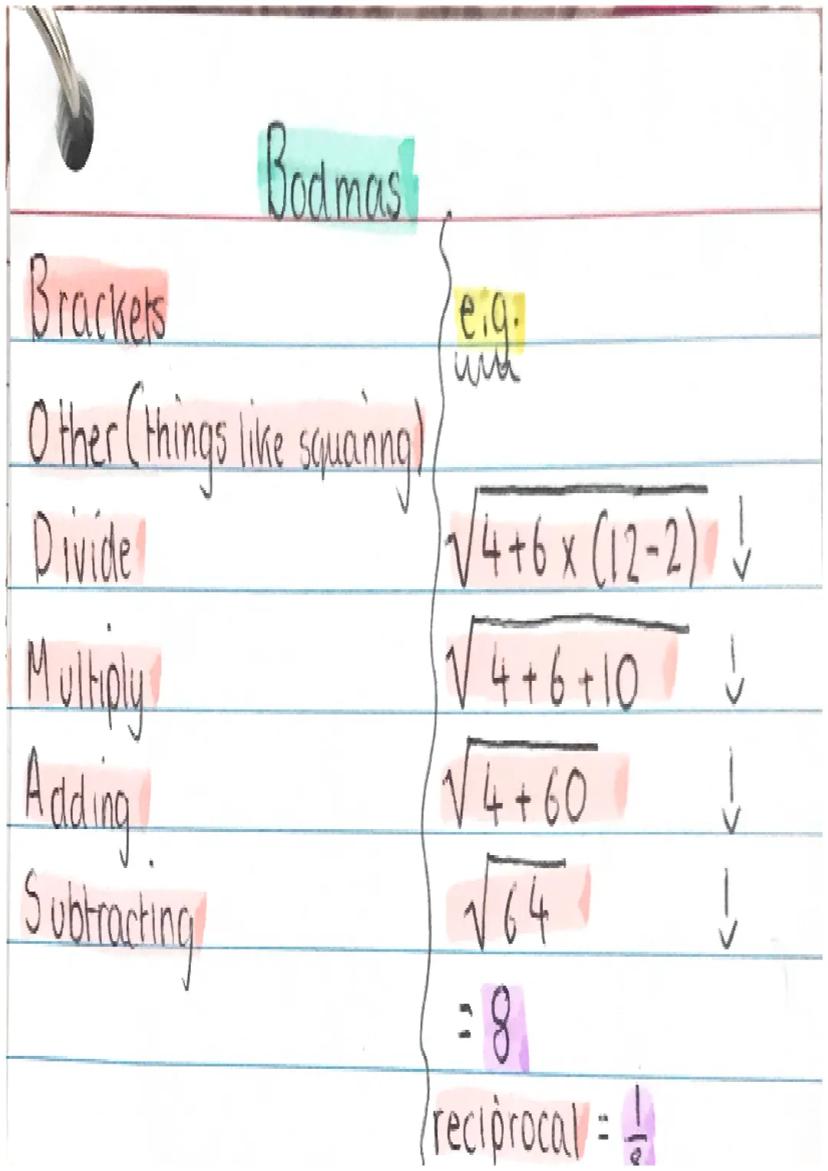
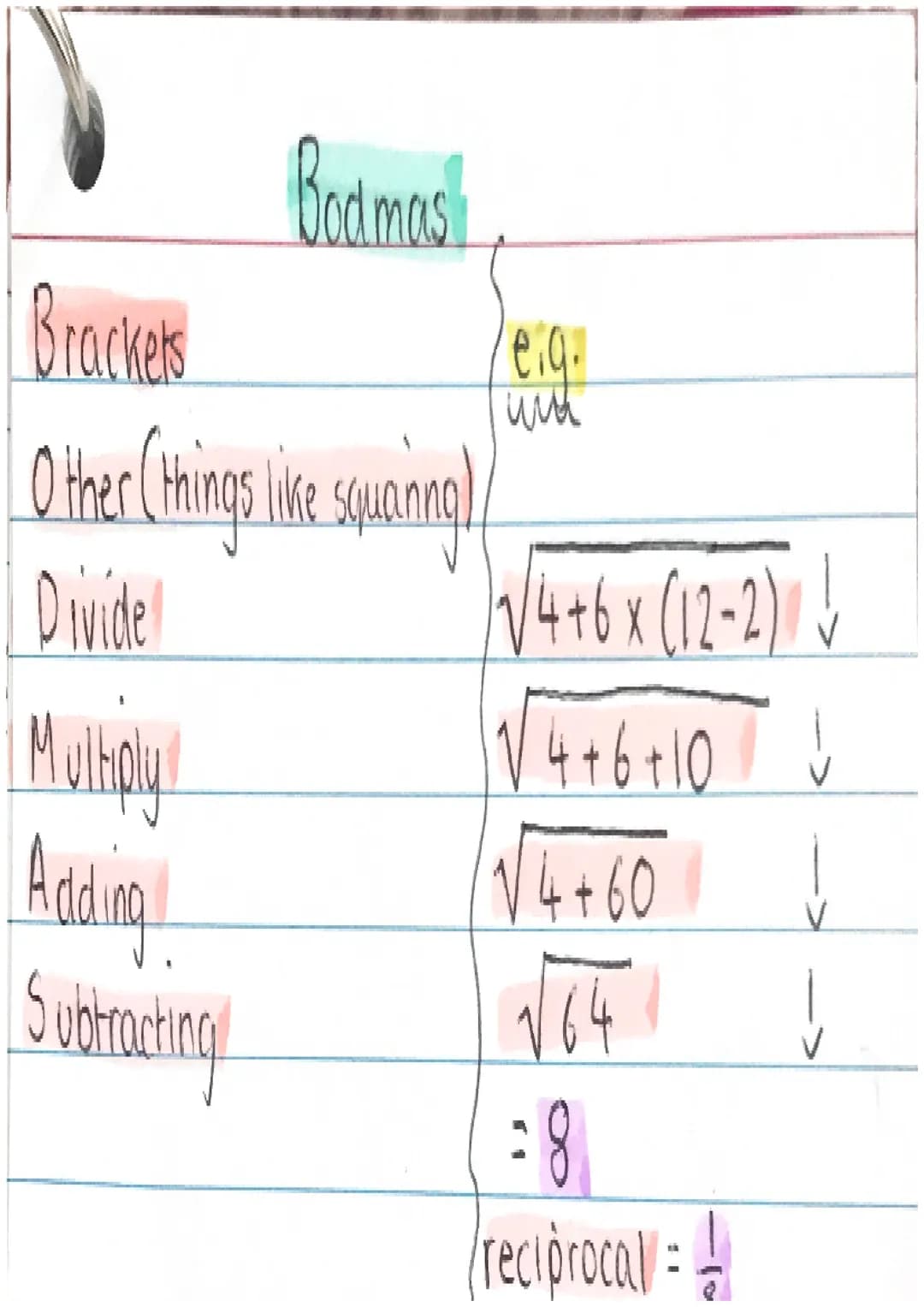
Bodmas

Brackets

Other (things like squang).

e.g.

Divide
$
\sqrt{4+6x (12-2)}\downarrow$

Multiply
$
\sqrt{4+6+10}\downarrow$

Adding
$
\

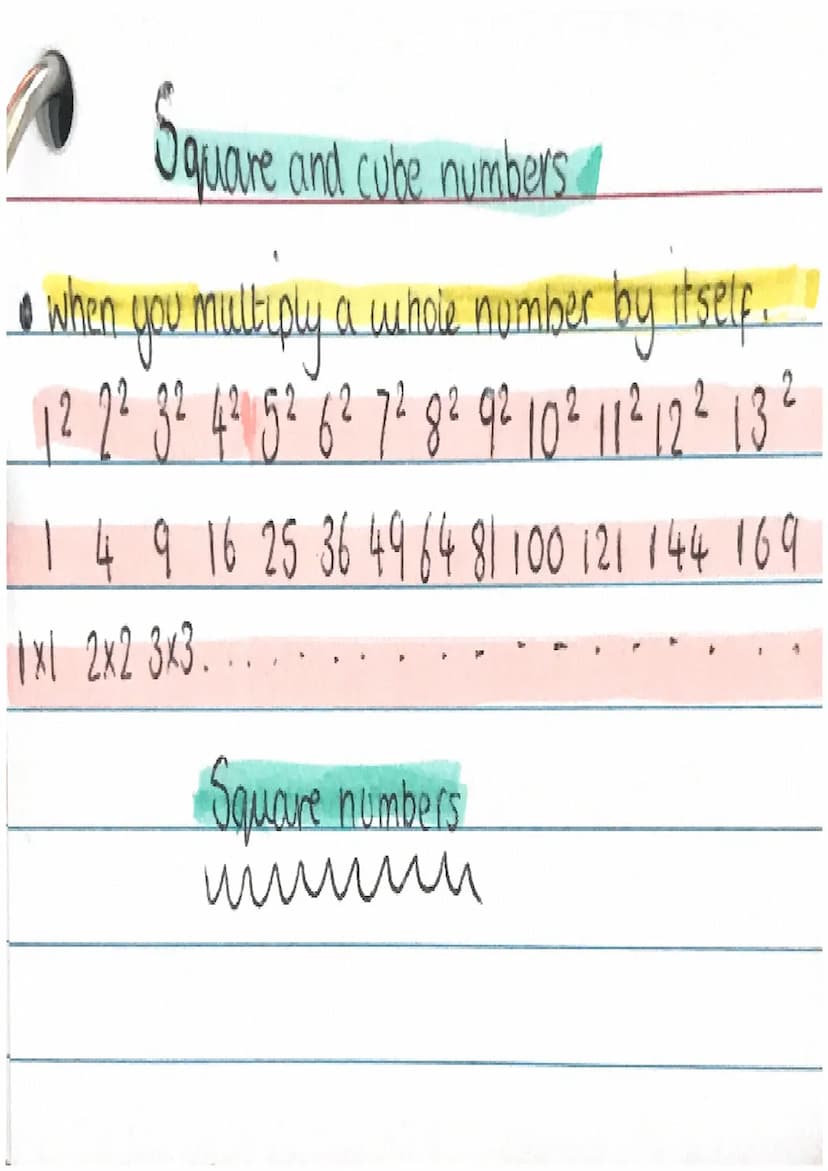
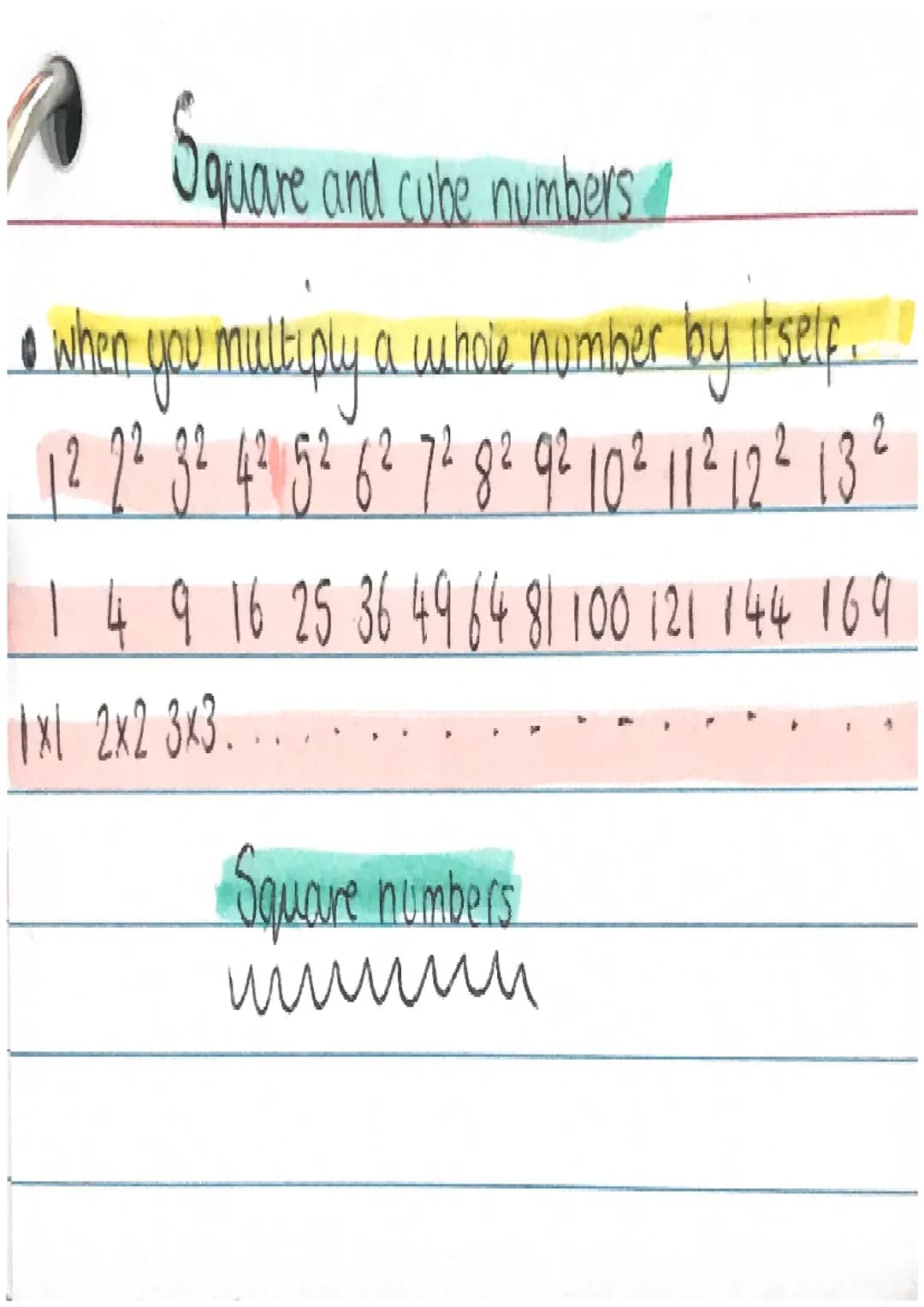
Square and Cube Numbers

This page focuses on square numbers, which are the result of multiplying a whole number by itself. It provides a list of square numbers from 1² to 13².

Definition: A square number is the product of a whole number multiplied by itself.

The page presents a table of square numbers:

1² = 1 2² = 4 3² = 9 4² = 16 5² = 25 6² = 36 7² = 49 8² = 64 9² = 81 10² = 100 11² = 121 12² = 144 13² = 169

Highlight: Memorizing common square numbers can be helpful for mental math and problem-solving in various mathematical contexts.

This information is particularly useful for students preparing for Maths revision notes for BODMAS and prime numbers KS2 exams and looking for How to find square and cube numbers in maths worksheets.
2
of 10
Bodmas

Brackets

Other (things like squang).

e.g.

Divide
$
\sqrt{4+6x (12-2)}\downarrow$

Multiply
$
\sqrt{4+6+10}\downarrow$

Adding
$
\

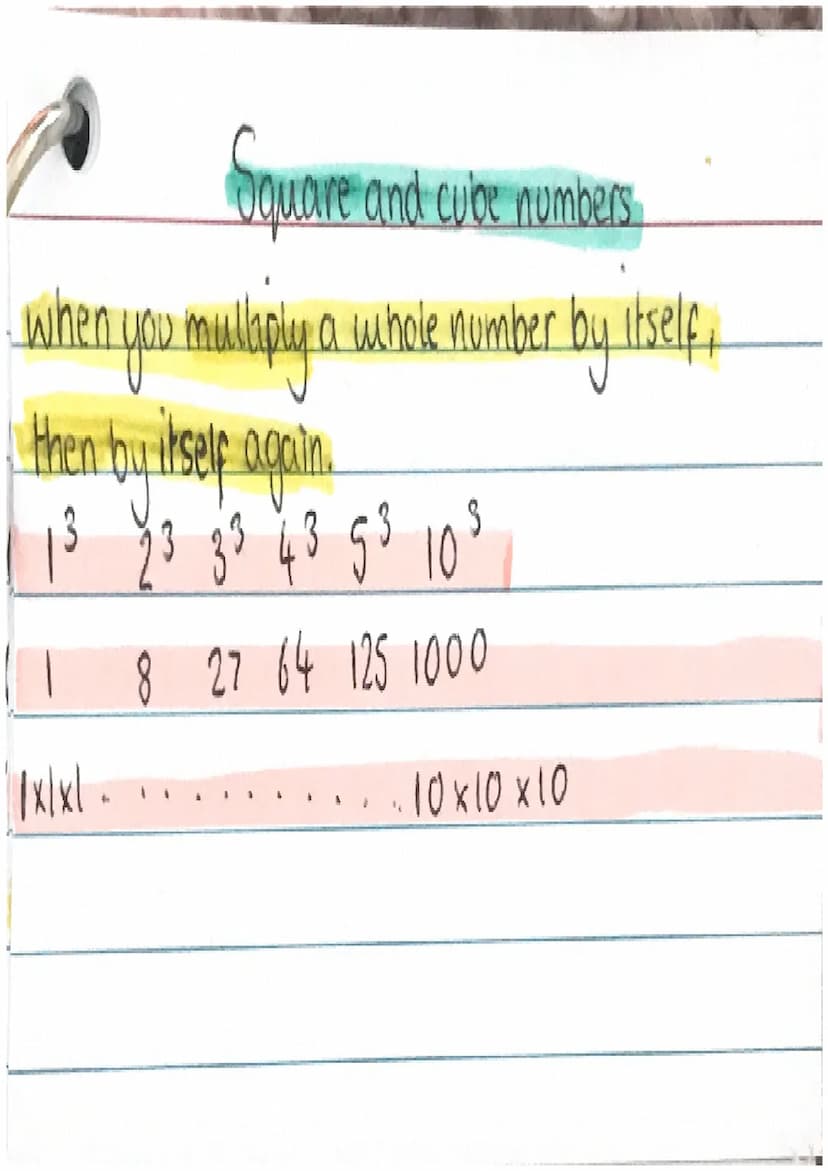
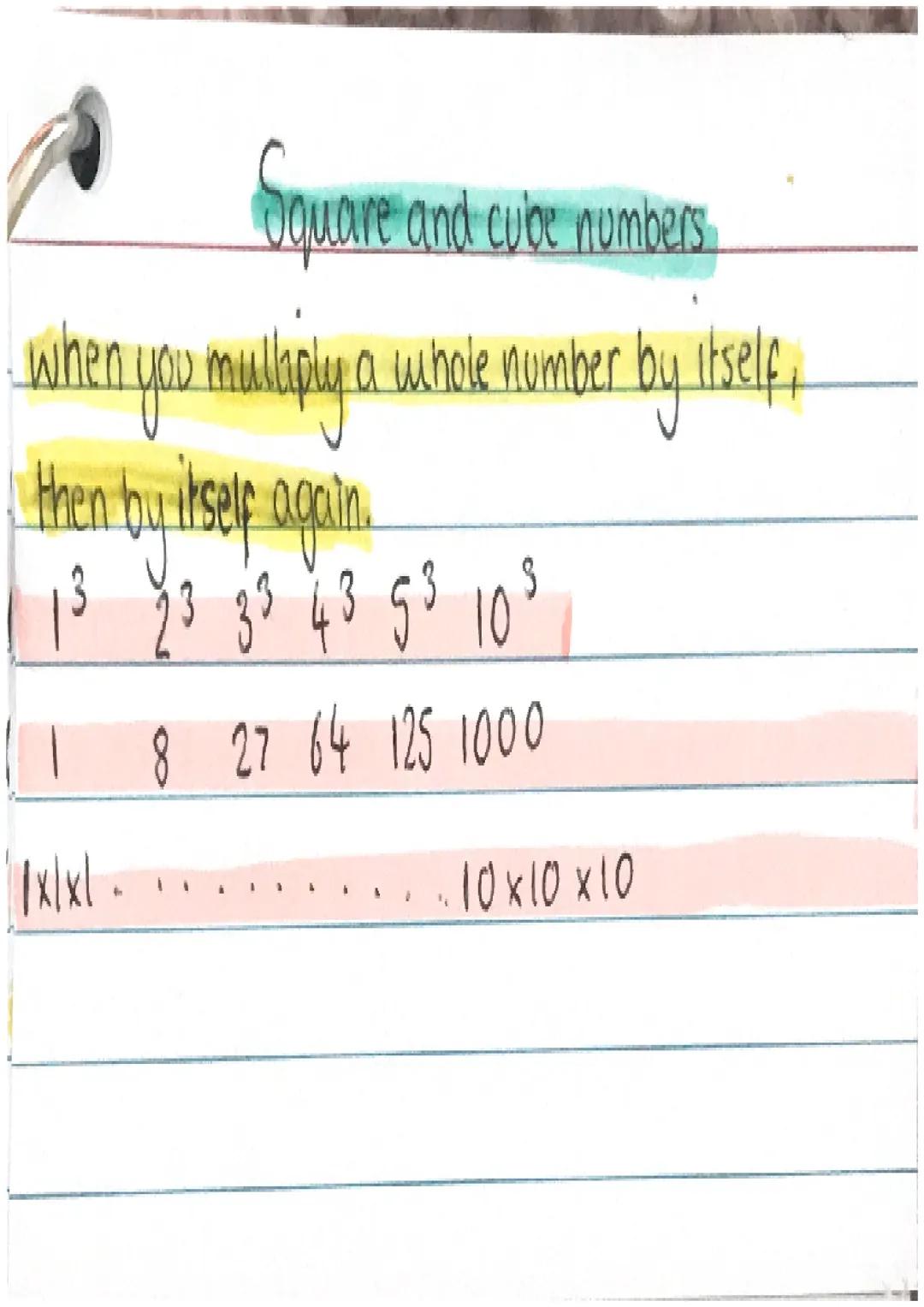
Cube Numbers

This page extends the concept of square numbers to cube numbers, which are the result of multiplying a whole number by itself twice.

Definition: A cube number is the product of a whole number multiplied by itself three times.

The page provides a list of cube numbers from 1³ to 10³:

1³ = 1 2³ = 8 3³ = 27 4³ = 64 5³ = 125 10³ = 1000

Example: 10³ = 10 x 10 x 10 = 1000

Understanding cube numbers is essential for various mathematical applications and is often included in How to find square and cube numbers in maths KS2 curricula.

Highlight: Recognizing patterns in cube numbers can help students quickly identify and calculate them mentally.

3
of 10
Bodmas

Brackets

Other (things like squang).

e.g.

Divide
$
\sqrt{4+6x (12-2)}\downarrow$

Multiply
$
\sqrt{4+6+10}\downarrow$

Adding
$
\

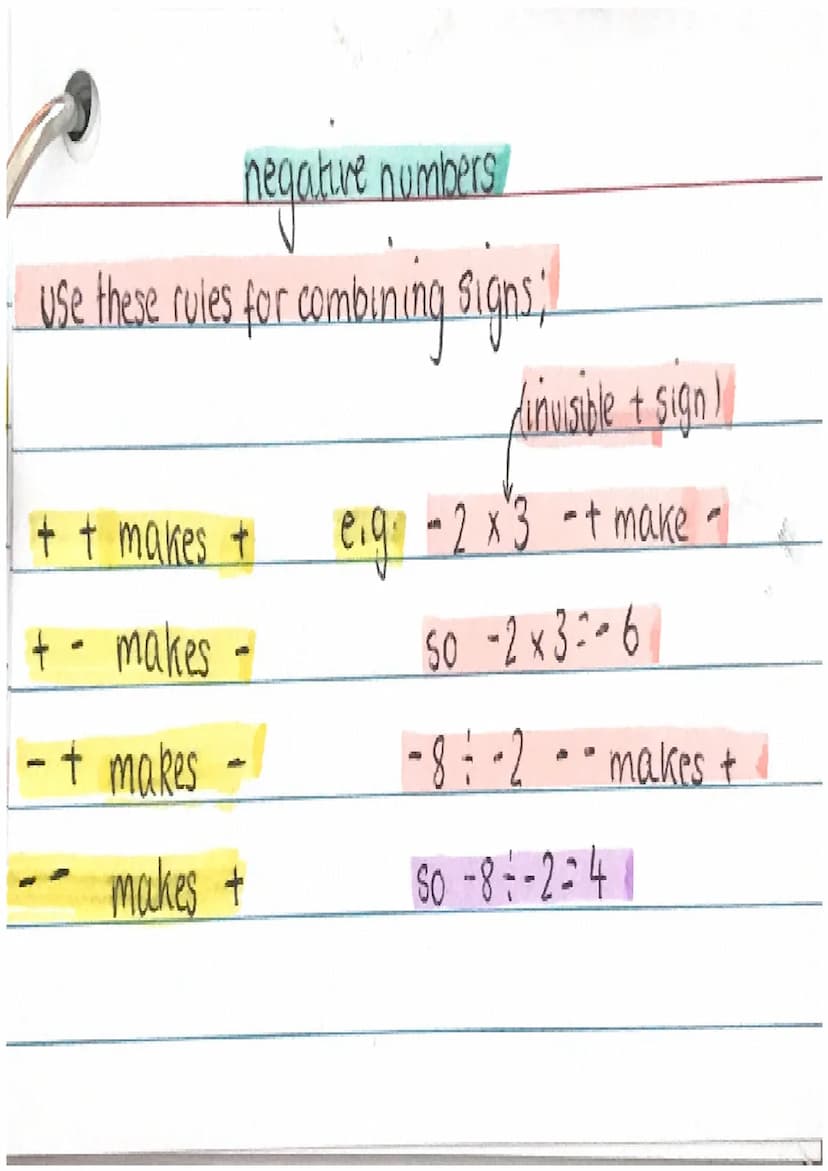
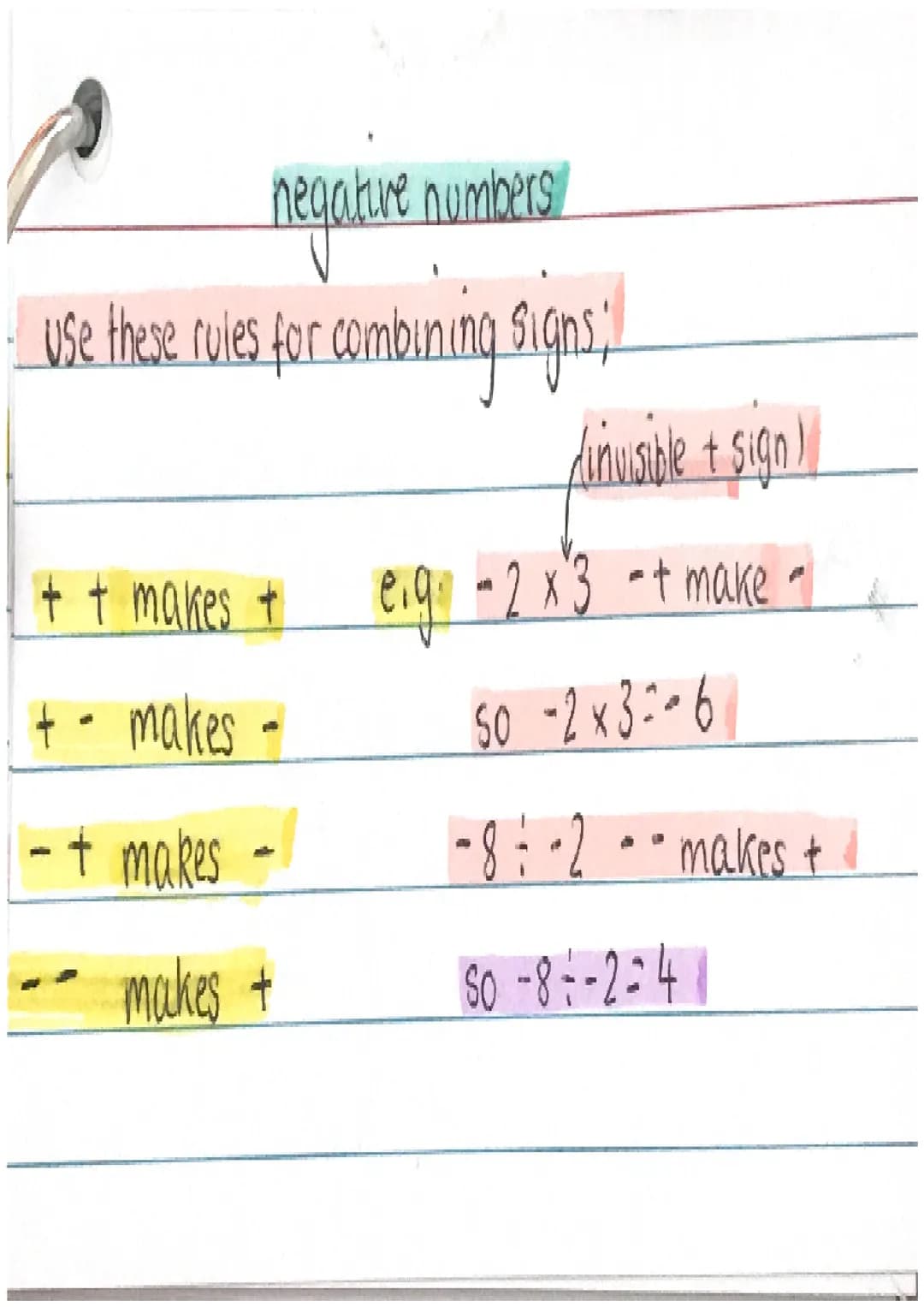
Negative Numbers

This page introduces the concept of negative numbers and provides rules for combining signs in mathematical operations.

Definition: Negative numbers are numbers less than zero and are represented with a minus sign (-) in front of them.

The page outlines the following rules for combining signs:

      • makes +
      • makes -
      • makes -
      • makes +

Example: -2 x 3 = -6 (negative multiplied by positive equals negative)

The page also provides an example of division with negative numbers:

Example: -8 ÷ -2 = 4 (negative divided by negative equals positive)

Understanding these rules is crucial for solving equations involving negative numbers and is often tested in BIDMAS worksheet with answers PDF resources.

4
of 10
Bodmas

Brackets

Other (things like squang).

e.g.

Divide
$
\sqrt{4+6x (12-2)}\downarrow$

Multiply
$
\sqrt{4+6+10}\downarrow$

Adding
$
\

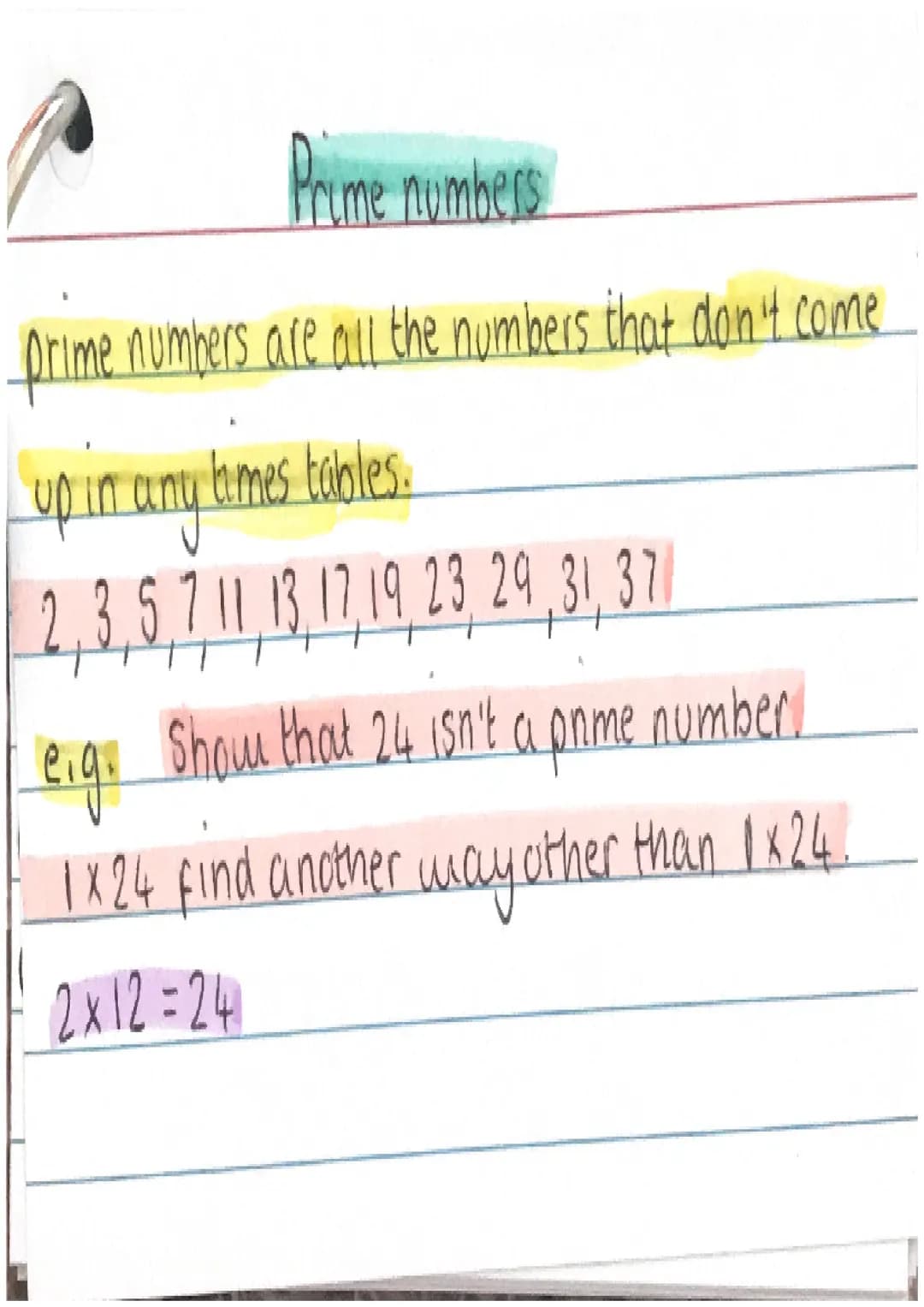
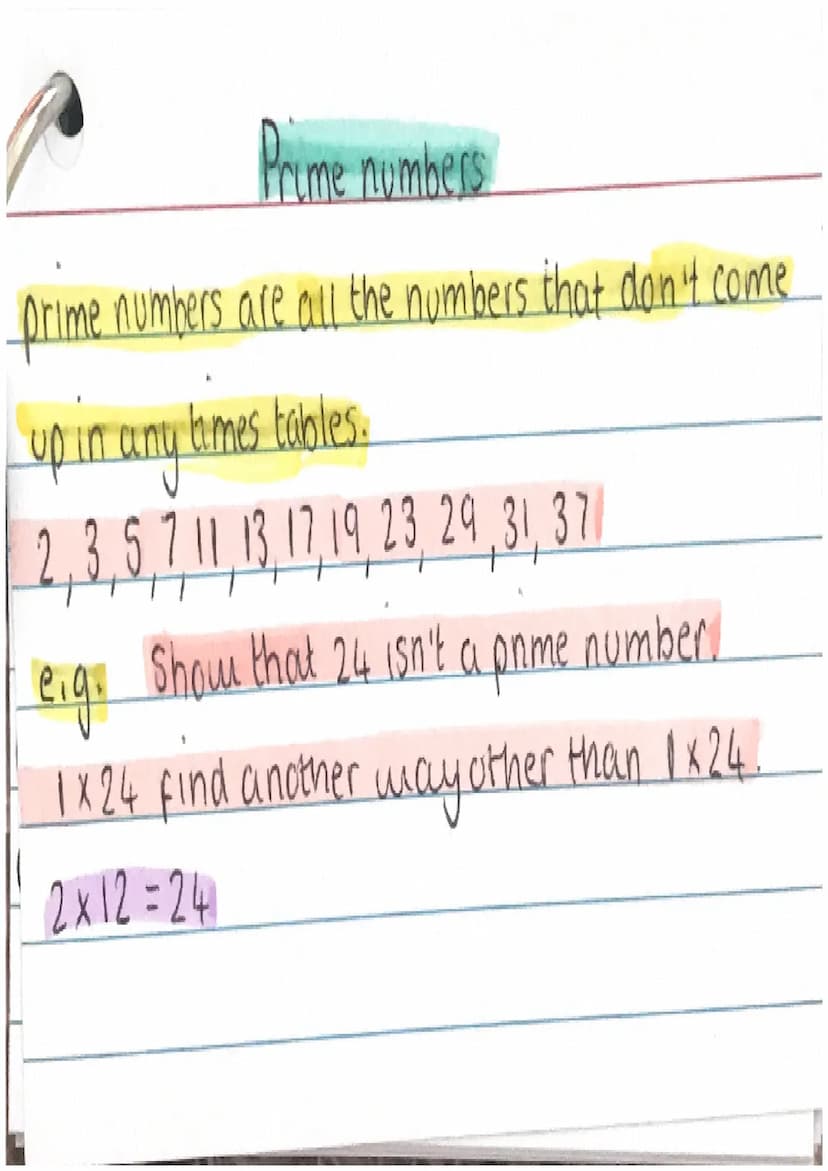
Prime Numbers

This page introduces the concept of prime numbers and provides a list of the first few prime numbers.

Definition: Prime numbers are numbers that have exactly two factors: 1 and themselves.

The page lists the following prime numbers:

2, 3, 5, 7, 11, 13, 17, 19, 23, 29, 31, 37

Example: To show that 24 isn't a prime number, find factors other than 1 and 24. For instance, 2 x 12 = 24.

This information is essential for students studying Prime number questions and answers and Prime factors GCSE questions and answers.

5
of 10
Bodmas

Brackets

Other (things like squang).

e.g.

Divide
$
\sqrt{4+6x (12-2)}\downarrow$

Multiply
$
\sqrt{4+6+10}\downarrow$

Adding
$
\

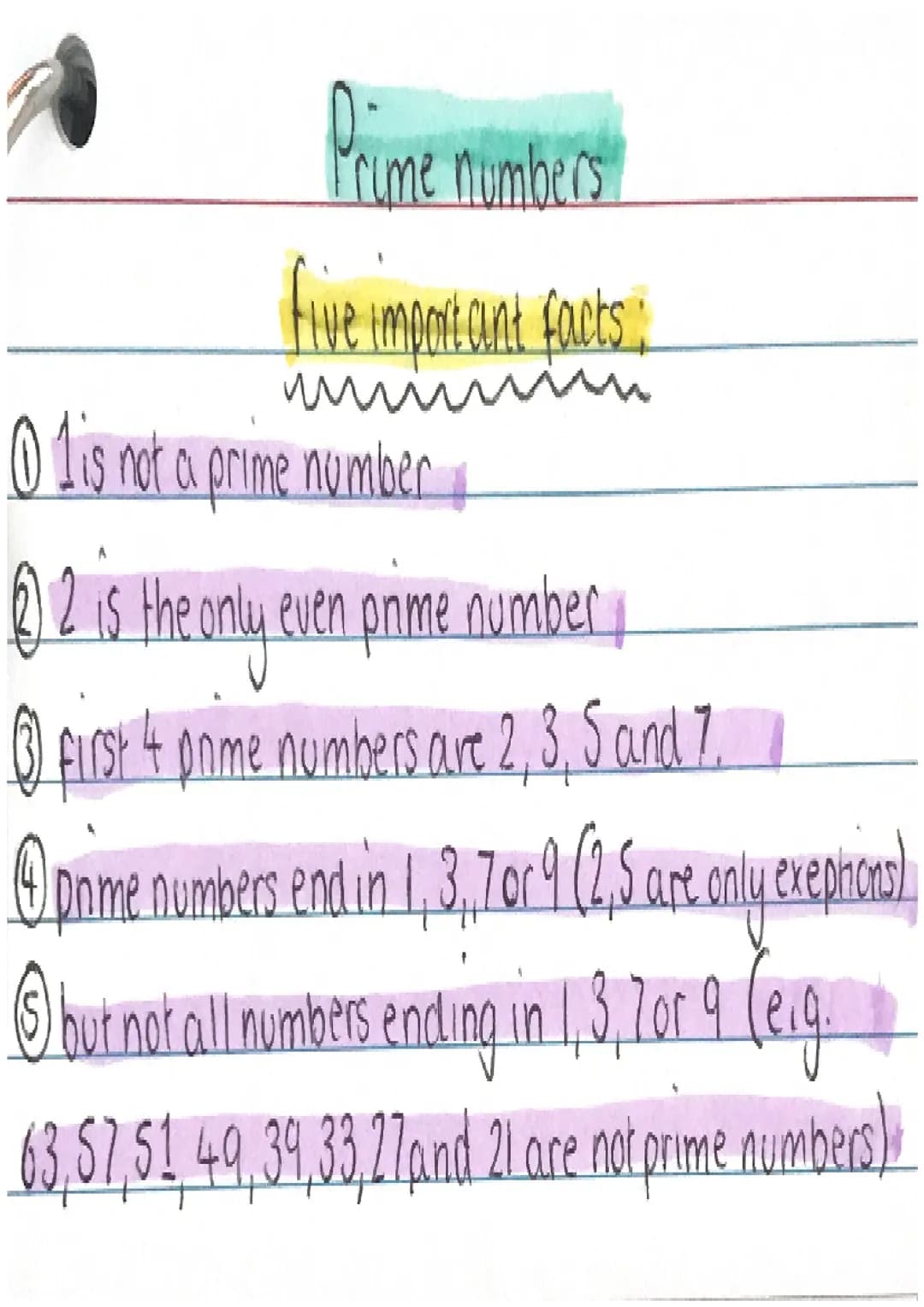
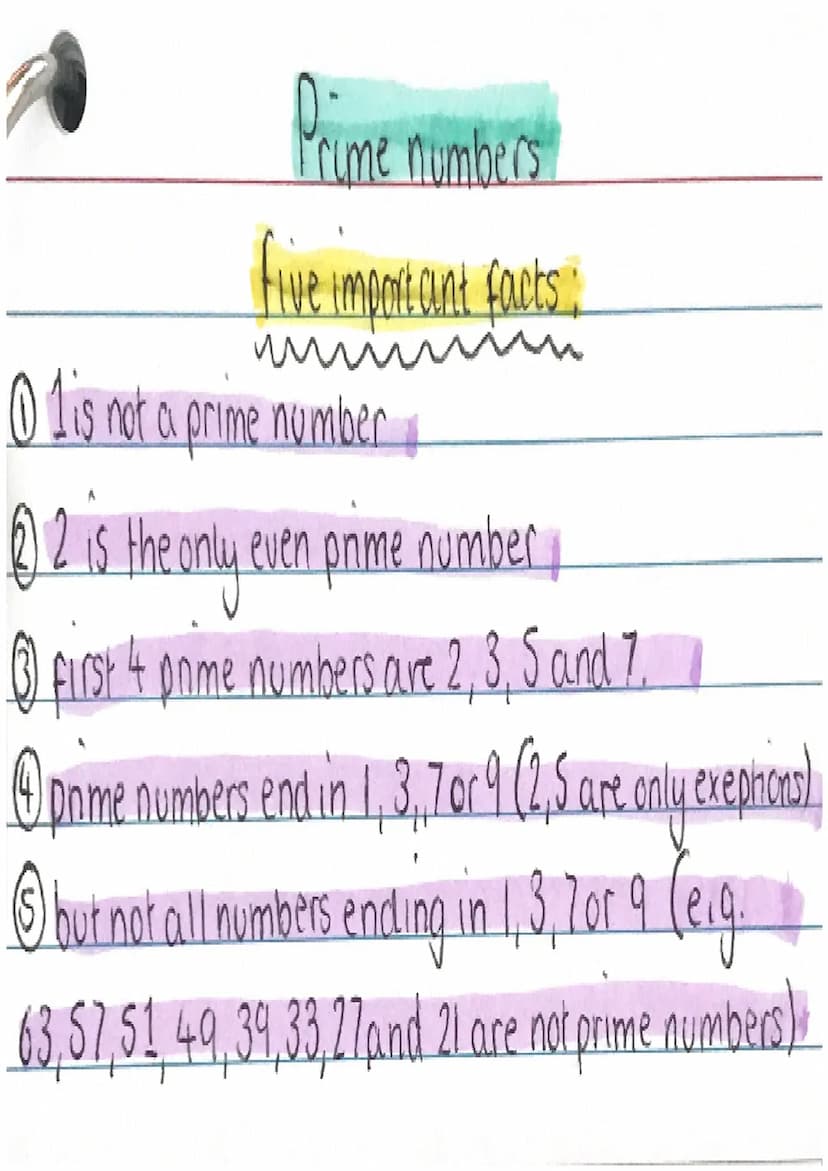
Important Facts About Prime Numbers

This page presents five crucial facts about prime numbers that students should remember.

  1. 1 is not a prime number.
  2. 2 is the only even prime number.
  3. The first four prime numbers are 2, 3, 5, and 7.
  4. Prime numbers (except 2 and 5) end in 1, 3, 7, or 9.
  5. Not all numbers ending in 1, 3, 7, or 9 are prime (e.g., 21, 27, 33, 49, 51, 57, 63 are not prime).

Highlight: Understanding these facts can help students quickly identify prime numbers and solve problems related to them.

This information is particularly useful for students preparing for Prime number questions and answers in exams and quizzes.

6
of 10
Bodmas

Brackets

Other (things like squang).

e.g.

Divide
$
\sqrt{4+6x (12-2)}\downarrow$

Multiply
$
\sqrt{4+6+10}\downarrow$

Adding
$
\

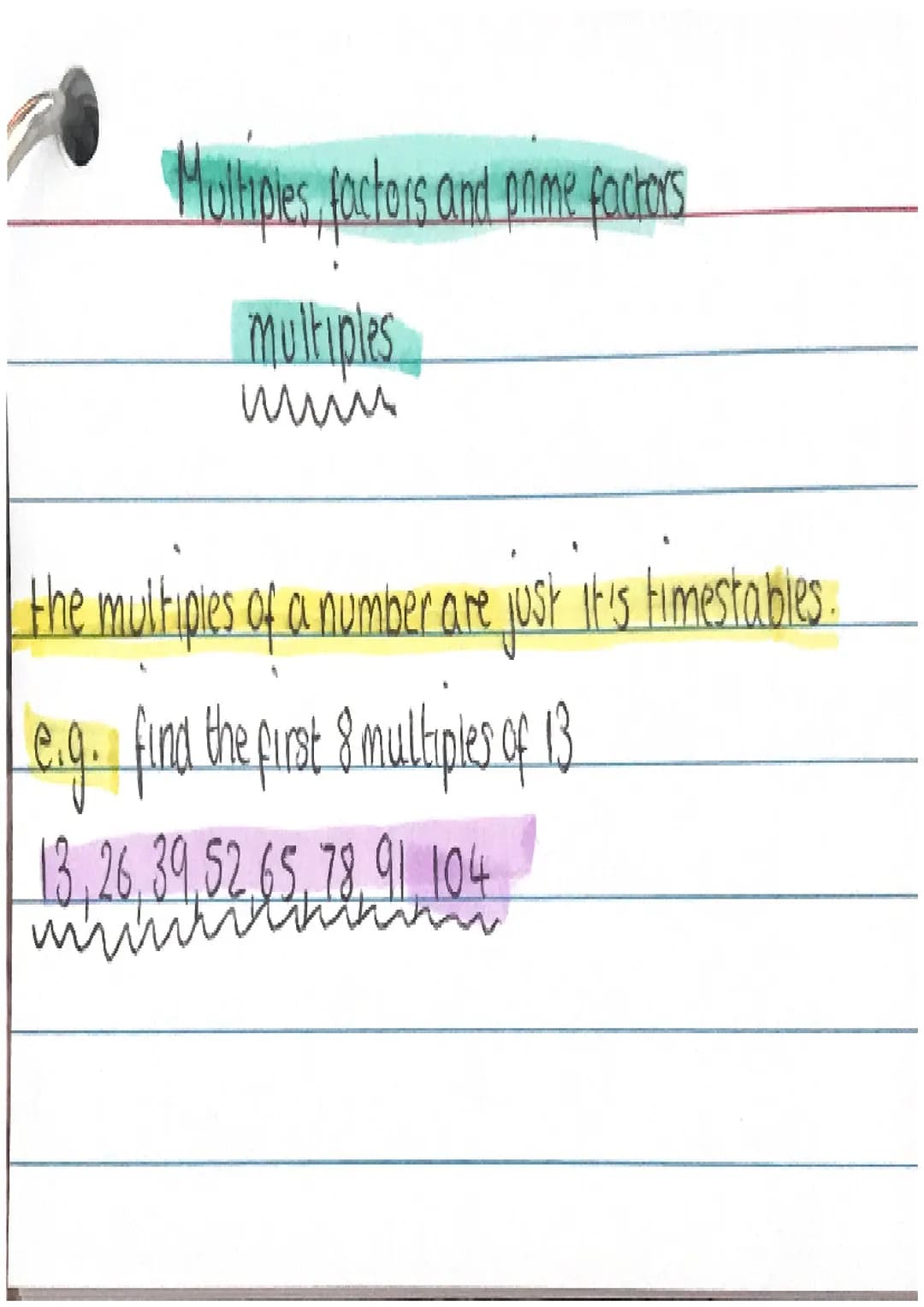
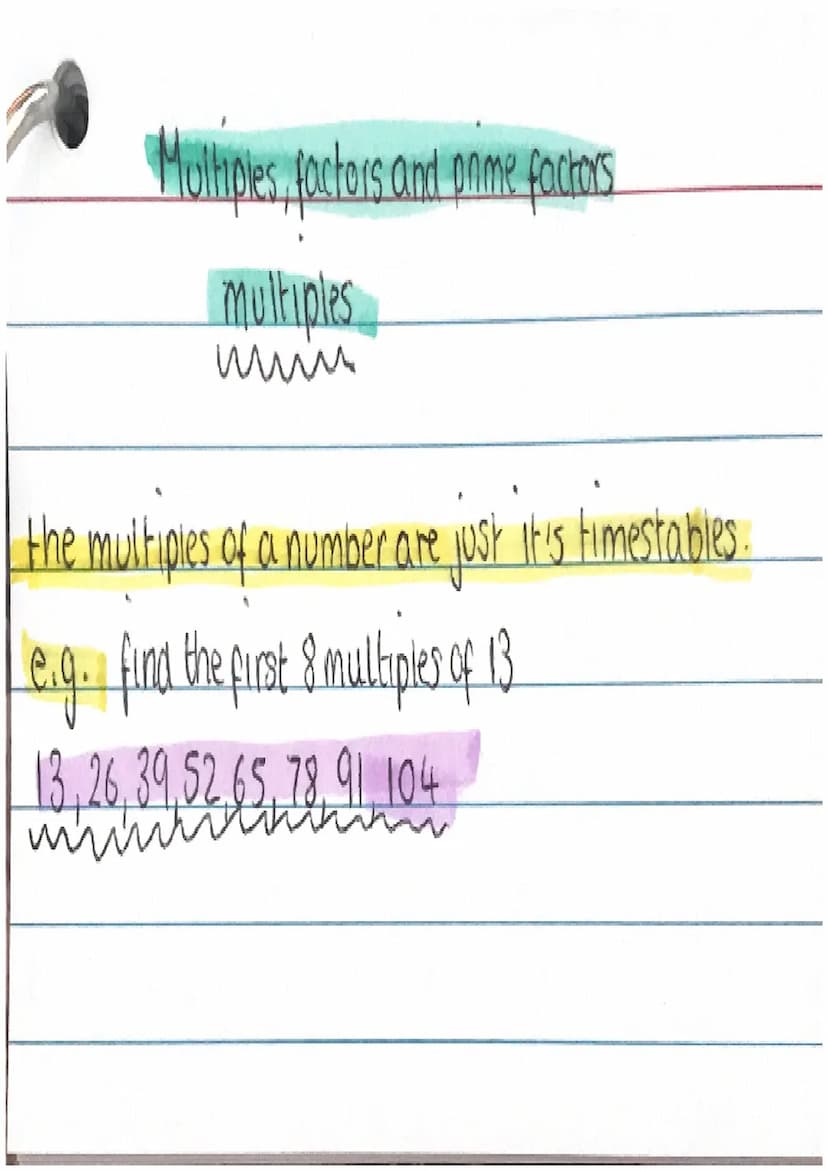
Multiples, Factors, and Prime Factors

This page introduces the concepts of multiples and factors, which are fundamental to understanding number relationships.

Definition: Multiples of a number are the products of that number and whole numbers.

Example: The first 8 multiples of 13 are 13, 26, 39, 52, 65, 78, 91, 104.

Understanding multiples is crucial for solving problems related to LCM and HCF worksheet with answers PDF.

7
of 10
Bodmas

Brackets

Other (things like squang).

e.g.

Divide
$
\sqrt{4+6x (12-2)}\downarrow$

Multiply
$
\sqrt{4+6+10}\downarrow$

Adding
$
\

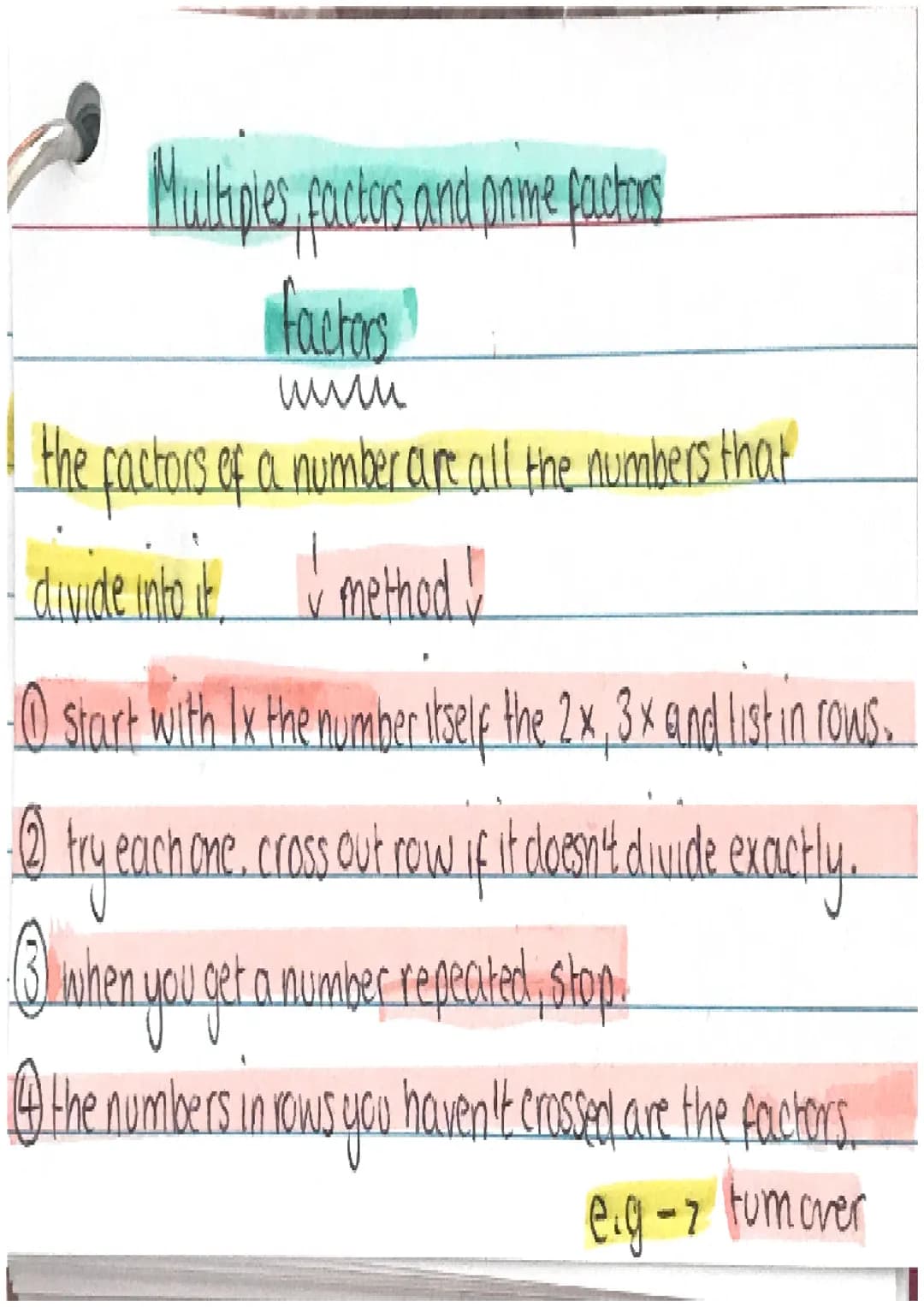
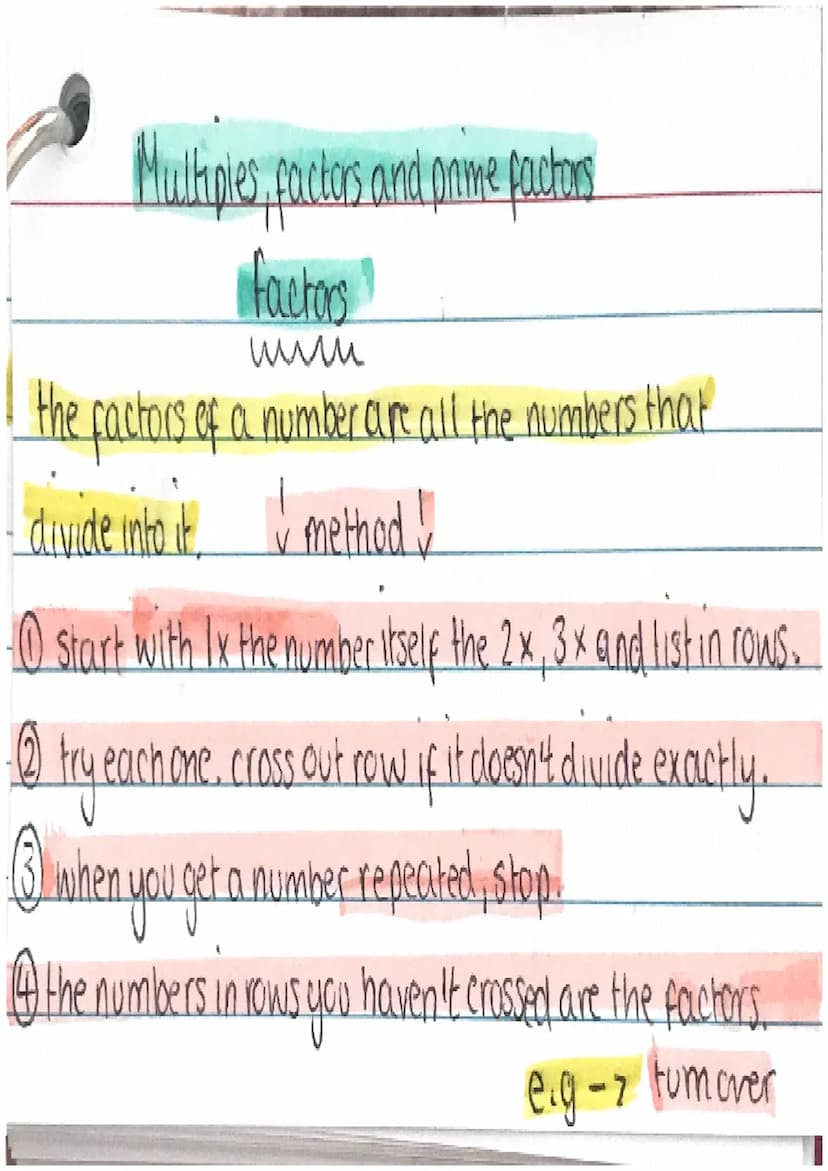
Factors

This page explains the concept of factors and provides a method for finding all factors of a number.

Definition: Factors of a number are all the numbers that divide into it without a remainder.

The page outlines a systematic method for finding factors:

  1. Start with 1 x the number itself.
  2. Try dividing by 2, 3, and so on, listing the results in rows.
  3. Cross out rows if they don't divide exactly.
  4. Stop when you get a repeated number.
  5. The numbers in the rows you haven't crossed out are the factors.

This method is particularly useful for solving HCF and LCM examples and HCF and LCM GCSE questions and answers.

8
of 10
Bodmas

Brackets

Other (things like squang).

e.g.

Divide
$
\sqrt{4+6x (12-2)}\downarrow$

Multiply
$
\sqrt{4+6+10}\downarrow$

Adding
$
\

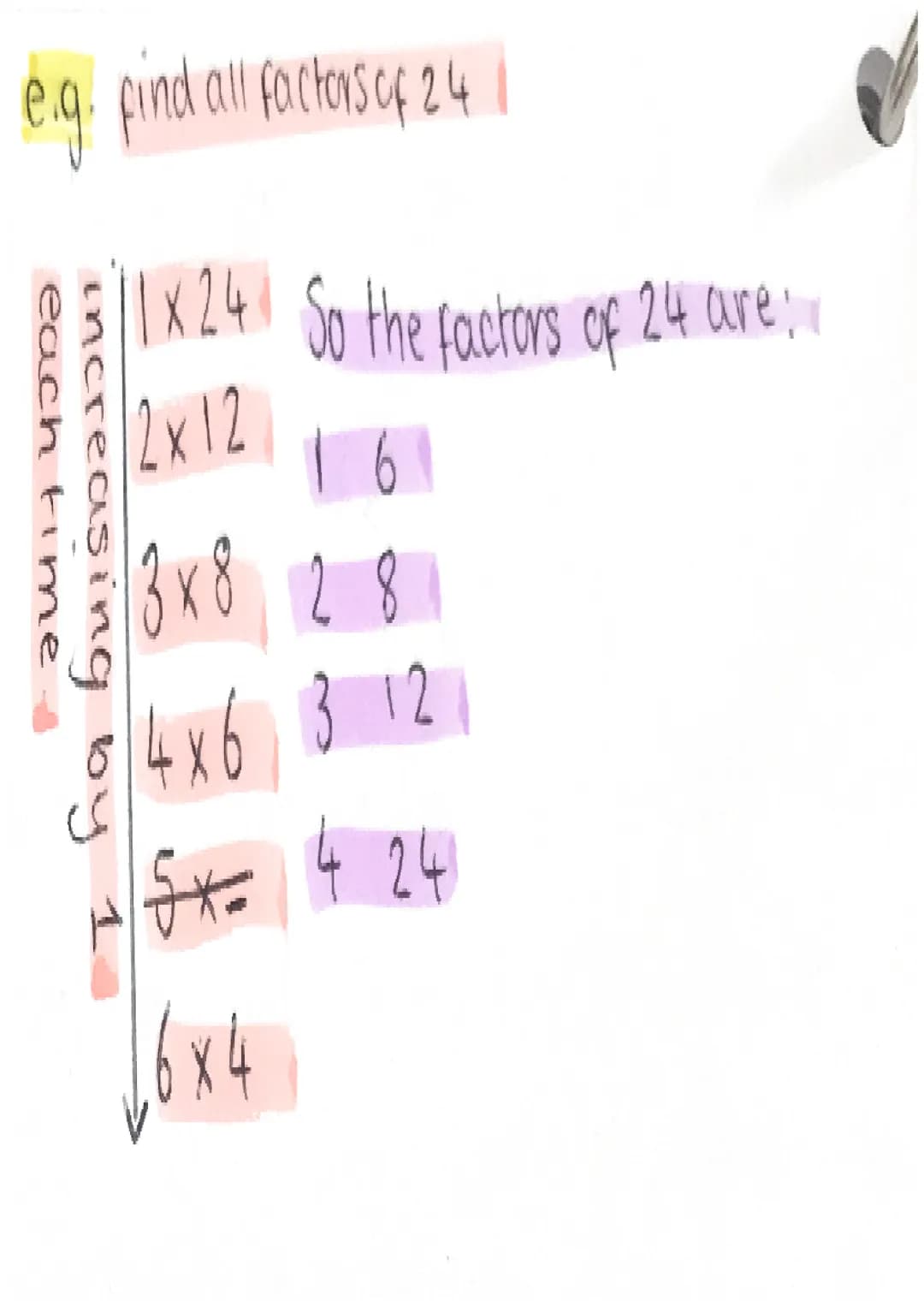
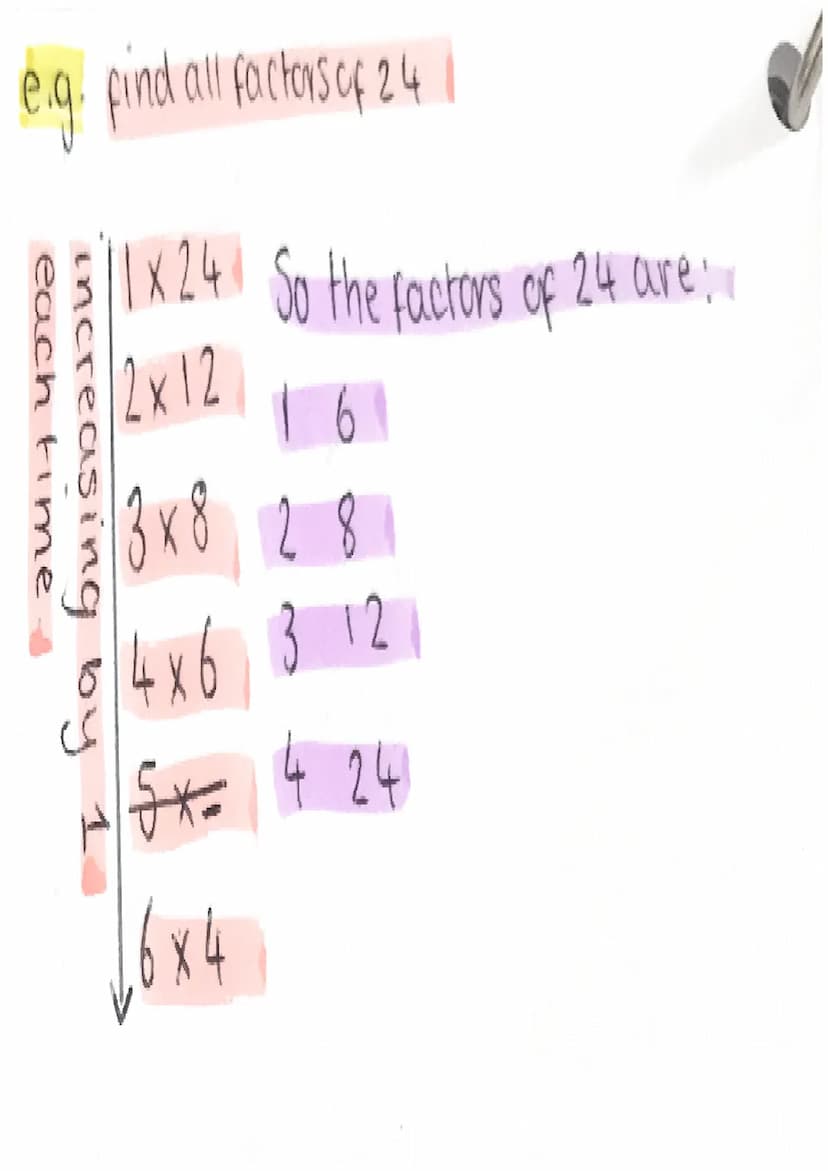
Finding Factors Example

This page provides a detailed example of how to find all factors of 24 using the method described on the previous page.

Example: Find all factors of 24

1 x 24 2 x 12 3 x 8 4 x 6

Therefore, the factors of 24 are 1, 2, 3, 4, 6, 8, 12, and 24.

This example demonstrates the practical application of the factor-finding method and is useful for students working on HCF and LCM worksheet problems.

9
of 10
Bodmas

Brackets

Other (things like squang).

e.g.

Divide
$
\sqrt{4+6x (12-2)}\downarrow$

Multiply
$
\sqrt{4+6+10}\downarrow$

Adding
$
\

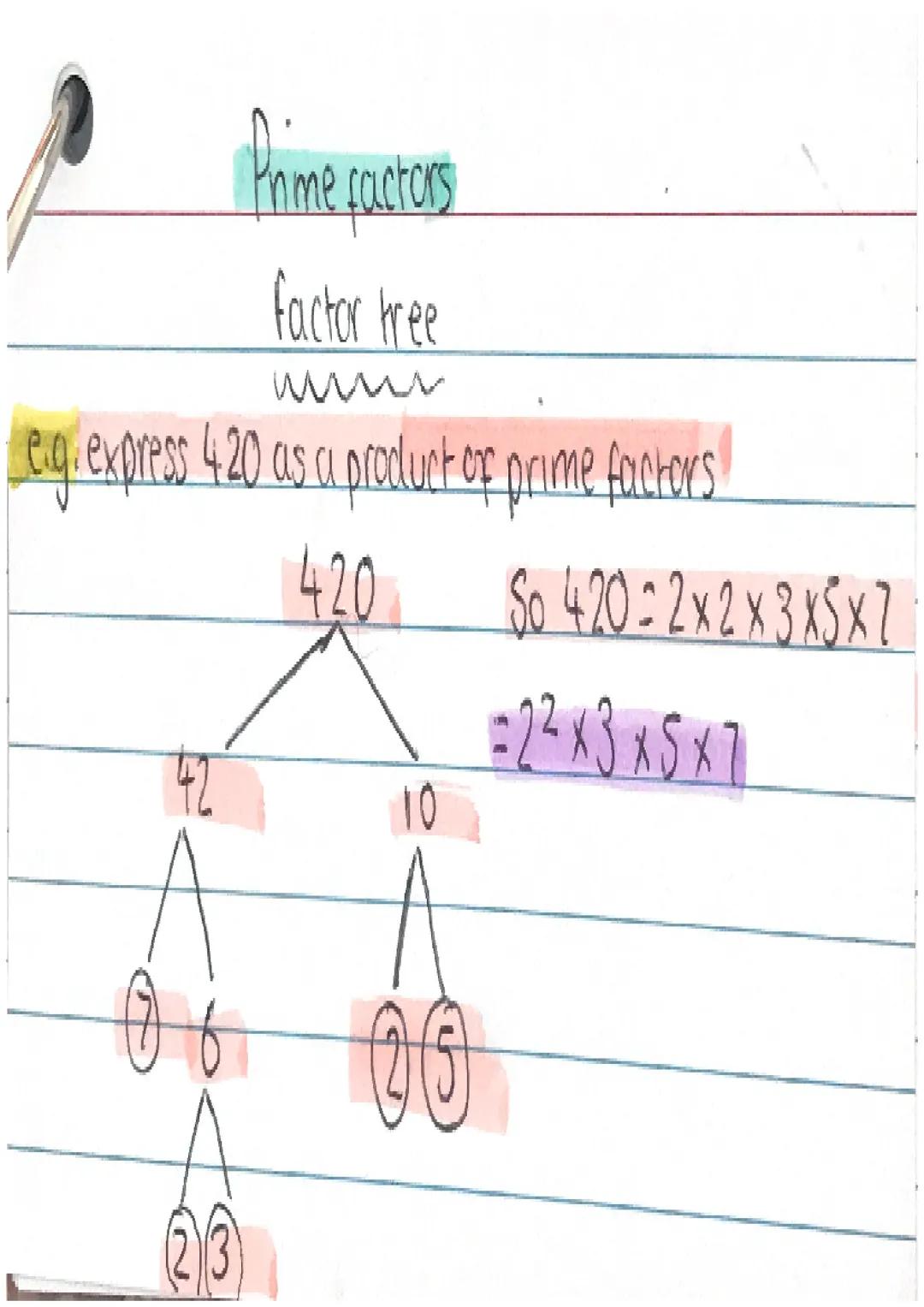
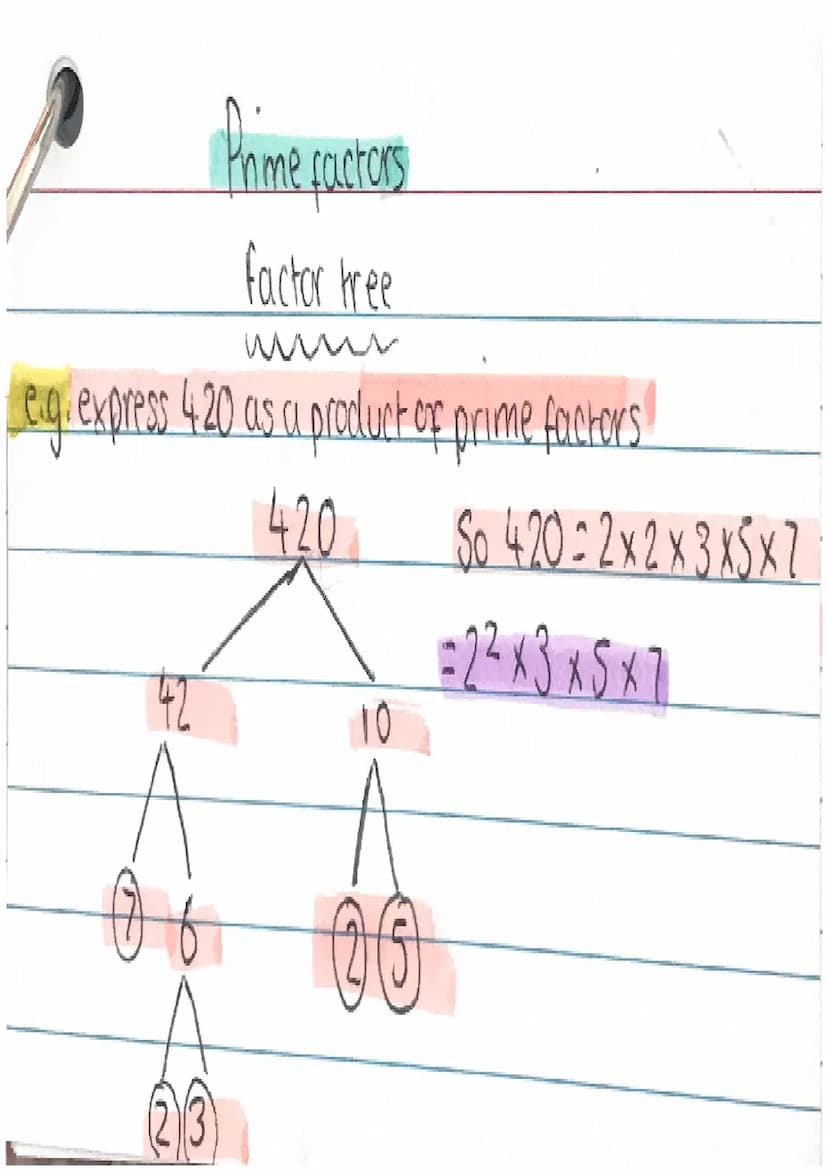
Prime Factors

This page introduces the concept of prime factors and demonstrates how to express a number as a product of its prime factors using a factor tree.

Definition: Prime factors are the prime numbers that, when multiplied together, produce the original number.

Example: Express 420 as a product of prime factors.

The page shows a factor tree for 420:

420 = 2 x 210 210 = 2 x 10⁵ 105 = 3 x 35 35 = 5 x 7

Therefore, 420 = 2 x 2 x 3 x 5 x 7

Understanding prime factors is essential for solving Prime factors GCSE questions and answers and is often included in Maths revision notes for BODMAS and prime numbers PDF free resources.

10
of 10
Bodmas

Brackets

Other (things like squang).

e.g.

Divide
$
\sqrt{4+6x (12-2)}\downarrow$

Multiply
$
\sqrt{4+6+10}\downarrow$

Adding
$
\

LCM and HCF

This page introduces the concepts of Lowest Common Multiple (LCM) and Highest Common Factor (HCF).

Definition: LCM (Lowest Common Multiple) is the smallest number that will divide by all the given numbers.

The page outlines a method for finding the LCM:

  1. List the multiples of all the numbers.
  2. Find the smallest number that appears in all the lists.

This method is particularly useful for solving problems in LCM and HCF worksheet with answers PDF and HCF and LCM examples.

We thought you’d never ask...

What is the Knowunity AI companion?

Our AI Companion is a student-focused AI tool that offers more than just answers. Built on millions of Knowunity resources, it provides relevant information, personalised study plans, quizzes, and content directly in the chat, adapting to your individual learning journey.

Where can I download the Knowunity app?

You can download the app from Google Play Store and Apple App Store.

Is Knowunity really free of charge?

That's right! Enjoy free access to study content, connect with fellow students, and get instant help – all at your fingertips.

Similar content

Most popular content in Maths

9
MathsMaths

Comprehensive Maths Concepts

Explore essential mathematical concepts including powers, geometry, statistics, and probability. This resource features 65 pages of detailed explanations, diagrams, and examples to enhance your understanding of topics such as right triangles, volume calculations, and data representation. Ideal for students seeking to strengthen their numeracy skills and grasp complex mathematical principles.

1080,0236,321
MathsMaths

GCSE Maths (Higher) // Revision Guide

The only GCSE maths (higher) revision guide you need to get a grade 9! Contains every topic, each with all potential question types and their solutions.

102,56860
M
MathsMaths

Medium Level alerbra

Master challenging maths concepts with this medium level flashcard set designed for grade 7/8 students. Strengthen your problem-solving skills and boost your confidence in maths!

78283
M
MathsMaths

Mastering Maths: Essential Concepts for Grade 10

Boost your math skills with this comprehensive flashcard set covering key concepts for grade 10. Perfect for exam preparation and building a strong foundation in mathematics.

105411
M
MathsMaths

Mastering Medium-Level Maths: Essential Flashcards for Grade 11 Students

Boost your Maths skills with this comprehensive set of flashcards designed specifically for Grade 11 students. Covering medium-level topics, these cards will help you ace your exams and build a solid foundation for advanced Maths.

119553
MathsMaths

Comprehensive Maths Concepts

Explore essential mathematical concepts including polynomial theorems, logarithmic properties, trigonometric functions, and integration techniques. This resource covers everything from solving inequalities to understanding exponential functions, providing a solid foundation for A-level mathematics. Ideal for students aiming for top grades.

1222,0161,817
P
MathsMaths

Percentage,fractions and decimals

how well do you know percentages,fractions and decimals

73093
M
MathsMaths

Maths Made Easy: Essential Concepts for Grade 7

Master key mathematical concepts with this comprehensive flashcard set designed specifically for 13-year-old students. Strengthen your understanding and ace your exams!

77512
M
MathsMaths

maths SOHCAHTOA

Trigonometric ratios SOHCAHTOA for calculating angles and sides in right-angled triangles.

112210

Most popular content

9
SociologySociology

Sociology of Education Overview

Explore comprehensive A-Level Sociology notes on the education system, covering key theories, policies, and sociological perspectives. This resource includes insights on marketisation, gender roles, cultural deprivation, and educational inequalities, providing a thorough understanding of how education shapes social stratification and individual achievement. Ideal for exam preparation and in-depth study.

12102,8353,040
SociologySociology

Sociology of Families: Comprehensive Revision

Dive into an extensive overview of family dynamics, perspectives, and patterns in sociology. This resource covers key concepts such as family diversity, gender roles, marriage, and the impact of social policies on family structures. Perfect for A-Level Sociology students preparing for Paper 2.

1273,6302,306
CriminologyCriminology

Criminology: Crime & Punishment Overview

Comprehensive mindmaps covering key concepts in the Crime and Punishment topic for WJEC Criminology Unit 4. This resource includes detailed insights into the Criminal Justice System, crime prevention strategies, sentencing models, and the roles of various agencies. Ideal for A-Level revision, ensuring you grasp essential theories and legislative processes to excel in your exams.

1254,8581,059
SociologySociology

Comprehensive Crime & Deviance Overview

Explore an extensive revision of crime and deviance topics, including theories, types of crime, and the impact of media. This resource covers key concepts such as Marxism, functionalism, gender and crime, and the influence of globalization on criminal behavior. Ideal for students seeking a thorough understanding of criminology and its various theories. Type: Full Topic Revision.

1251,6391,399
C
BiologyBiology

Cell Biology and Cell structure

cell structures

93,2100
English LiteratureEnglish Literature

An Inspector Calls: Character Insights

Explore in-depth analysis and key quotes for characters in J.B. Priestley's 'An Inspector Calls'. This resource covers Gerald Croft, Inspector Goole, Sheila Birling, Mrs. Birling, Eric Birling, and Eva Smith, focusing on themes of class, gender roles, and social responsibility. Ideal for students aiming for Grade 8 and above.

1025,418907
CriminologyCriminology

WJEC Unit 4 Criminology

Criminology unit 4 detailed revision note

127,146125
CriminologyCriminology

Criminology Theories Overview

Explore key criminology theories and their implications on crime and deviance. This comprehensive summary covers biological, psychological, and sociological perspectives, including labelling theory, right realism, and the impact of social campaigns on policy development. Ideal for A-Level criminology students seeking to understand the complexities of criminal behaviour and the factors influencing crime prevention strategies.

129,757210
English LiteratureEnglish Literature

Romeo and Juliet: Key themes

Key Romeo and Juliet themes and analysed quotes

106,698198

Can't find what you're looking for? Explore other subjects.

Students love us — and so will you.

4.6/5App Store
4.7/5Google Play

The app is very easy to use and well designed. I have found everything I was looking for so far and have been able to learn a lot from the presentations! I will definitely use the app for a class assignment! And of course it also helps a lot as an inspiration.

Stefan SiOS user

This app is really great. There are so many study notes and help [...]. My problem subject is French, for example, and the app has so many options for help. Thanks to this app, I have improved my French. I would recommend it to anyone.

Samantha KlichAndroid user

Wow, I am really amazed. I just tried the app because I've seen it advertised many times and was absolutely stunned. This app is THE HELP you want for school and above all, it offers so many things, such as workouts and fact sheets, which have been VERY helpful to me personally.

AnnaiOS user

MathsMaths1,816 views·Updated Jun 18, 2026·24 pages

Understanding PEMDAS and BODMAS: Easy Math Tricks for GCD and LCM

user profile picture
Ruby@ruby123456789

Hey there! Want to know about PEMDAS and BODMAS? Learn fun math tricks like finding GCD (Greatest Common Divisor) and LCM (Least Common Multiple) with simple algorithms. Discover how to break down numbers using factorization, understand prime and composite numbers, and learn cool Euclid algorithm stuff. Explore prime number tables and more math goodies, all explained just for you!

1
of 10
Bodmas

Brackets

Other (things like squang).

e.g.

Divide
$
\sqrt{4+6x (12-2)}\downarrow$

Multiply
$
\sqrt{4+6+10}\downarrow$

Adding
$
\

Sign up to see the content. It's free!

  • Access to all documents
  • Improve your grades
  • Join milions of students

Square and Cube Numbers

This page focuses on square numbers, which are the result of multiplying a whole number by itself. It provides a list of square numbers from 1² to 13².

Definition: A square number is the product of a whole number multiplied by itself.

The page presents a table of square numbers:

1² = 1 2² = 4 3² = 9 4² = 16 5² = 25 6² = 36 7² = 49 8² = 64 9² = 81 10² = 100 11² = 121 12² = 144 13² = 169

Highlight: Memorizing common square numbers can be helpful for mental math and problem-solving in various mathematical contexts.

This information is particularly useful for students preparing for Maths revision notes for BODMAS and prime numbers KS2 exams and looking for How to find square and cube numbers in maths worksheets.
2
of 10
Bodmas

Brackets

Other (things like squang).

e.g.

Divide
$
\sqrt{4+6x (12-2)}\downarrow$

Multiply
$
\sqrt{4+6+10}\downarrow$

Adding
$
\

Sign up to see the content. It's free!

  • Access to all documents
  • Improve your grades
  • Join milions of students

Cube Numbers

This page extends the concept of square numbers to cube numbers, which are the result of multiplying a whole number by itself twice.

Definition: A cube number is the product of a whole number multiplied by itself three times.

The page provides a list of cube numbers from 1³ to 10³:

1³ = 1 2³ = 8 3³ = 27 4³ = 64 5³ = 125 10³ = 1000

Example: 10³ = 10 x 10 x 10 = 1000

Understanding cube numbers is essential for various mathematical applications and is often included in How to find square and cube numbers in maths KS2 curricula.

Highlight: Recognizing patterns in cube numbers can help students quickly identify and calculate them mentally.

3
of 10
Bodmas

Brackets

Other (things like squang).

e.g.

Divide
$
\sqrt{4+6x (12-2)}\downarrow$

Multiply
$
\sqrt{4+6+10}\downarrow$

Adding
$
\

Sign up to see the content. It's free!

  • Access to all documents
  • Improve your grades
  • Join milions of students

Negative Numbers

This page introduces the concept of negative numbers and provides rules for combining signs in mathematical operations.

Definition: Negative numbers are numbers less than zero and are represented with a minus sign (-) in front of them.

The page outlines the following rules for combining signs:

      • makes +
      • makes -
      • makes -
      • makes +

Example: -2 x 3 = -6 (negative multiplied by positive equals negative)

The page also provides an example of division with negative numbers:

Example: -8 ÷ -2 = 4 (negative divided by negative equals positive)

Understanding these rules is crucial for solving equations involving negative numbers and is often tested in BIDMAS worksheet with answers PDF resources.

4
of 10
Bodmas

Brackets

Other (things like squang).

e.g.

Divide
$
\sqrt{4+6x (12-2)}\downarrow$

Multiply
$
\sqrt{4+6+10}\downarrow$

Adding
$
\

Sign up to see the content. It's free!

  • Access to all documents
  • Improve your grades
  • Join milions of students

Prime Numbers

This page introduces the concept of prime numbers and provides a list of the first few prime numbers.

Definition: Prime numbers are numbers that have exactly two factors: 1 and themselves.

The page lists the following prime numbers:

2, 3, 5, 7, 11, 13, 17, 19, 23, 29, 31, 37

Example: To show that 24 isn't a prime number, find factors other than 1 and 24. For instance, 2 x 12 = 24.

This information is essential for students studying Prime number questions and answers and Prime factors GCSE questions and answers.

5
of 10
Bodmas

Brackets

Other (things like squang).

e.g.

Divide
$
\sqrt{4+6x (12-2)}\downarrow$

Multiply
$
\sqrt{4+6+10}\downarrow$

Adding
$
\

Sign up to see the content. It's free!

  • Access to all documents
  • Improve your grades
  • Join milions of students

Important Facts About Prime Numbers

This page presents five crucial facts about prime numbers that students should remember.

  1. 1 is not a prime number.
  2. 2 is the only even prime number.
  3. The first four prime numbers are 2, 3, 5, and 7.
  4. Prime numbers (except 2 and 5) end in 1, 3, 7, or 9.
  5. Not all numbers ending in 1, 3, 7, or 9 are prime (e.g., 21, 27, 33, 49, 51, 57, 63 are not prime).

Highlight: Understanding these facts can help students quickly identify prime numbers and solve problems related to them.

This information is particularly useful for students preparing for Prime number questions and answers in exams and quizzes.

6
of 10
Bodmas

Brackets

Other (things like squang).

e.g.

Divide
$
\sqrt{4+6x (12-2)}\downarrow$

Multiply
$
\sqrt{4+6+10}\downarrow$

Adding
$
\

Sign up to see the content. It's free!

  • Access to all documents
  • Improve your grades
  • Join milions of students

Multiples, Factors, and Prime Factors

This page introduces the concepts of multiples and factors, which are fundamental to understanding number relationships.

Definition: Multiples of a number are the products of that number and whole numbers.

Example: The first 8 multiples of 13 are 13, 26, 39, 52, 65, 78, 91, 104.

Understanding multiples is crucial for solving problems related to LCM and HCF worksheet with answers PDF.

7
of 10
Bodmas

Brackets

Other (things like squang).

e.g.

Divide
$
\sqrt{4+6x (12-2)}\downarrow$

Multiply
$
\sqrt{4+6+10}\downarrow$

Adding
$
\

Sign up to see the content. It's free!

  • Access to all documents
  • Improve your grades
  • Join milions of students

Factors

This page explains the concept of factors and provides a method for finding all factors of a number.

Definition: Factors of a number are all the numbers that divide into it without a remainder.

The page outlines a systematic method for finding factors:

  1. Start with 1 x the number itself.
  2. Try dividing by 2, 3, and so on, listing the results in rows.
  3. Cross out rows if they don't divide exactly.
  4. Stop when you get a repeated number.
  5. The numbers in the rows you haven't crossed out are the factors.

This method is particularly useful for solving HCF and LCM examples and HCF and LCM GCSE questions and answers.

8
of 10
Bodmas

Brackets

Other (things like squang).

e.g.

Divide
$
\sqrt{4+6x (12-2)}\downarrow$

Multiply
$
\sqrt{4+6+10}\downarrow$

Adding
$
\

Sign up to see the content. It's free!

  • Access to all documents
  • Improve your grades
  • Join milions of students

Finding Factors Example

This page provides a detailed example of how to find all factors of 24 using the method described on the previous page.

Example: Find all factors of 24

1 x 24 2 x 12 3 x 8 4 x 6

Therefore, the factors of 24 are 1, 2, 3, 4, 6, 8, 12, and 24.

This example demonstrates the practical application of the factor-finding method and is useful for students working on HCF and LCM worksheet problems.

9
of 10
Bodmas

Brackets

Other (things like squang).

e.g.

Divide
$
\sqrt{4+6x (12-2)}\downarrow$

Multiply
$
\sqrt{4+6+10}\downarrow$

Adding
$
\

Sign up to see the content. It's free!

  • Access to all documents
  • Improve your grades
  • Join milions of students

Prime Factors

This page introduces the concept of prime factors and demonstrates how to express a number as a product of its prime factors using a factor tree.

Definition: Prime factors are the prime numbers that, when multiplied together, produce the original number.

Example: Express 420 as a product of prime factors.

The page shows a factor tree for 420:

420 = 2 x 210 210 = 2 x 10⁵ 105 = 3 x 35 35 = 5 x 7

Therefore, 420 = 2 x 2 x 3 x 5 x 7

Understanding prime factors is essential for solving Prime factors GCSE questions and answers and is often included in Maths revision notes for BODMAS and prime numbers PDF free resources.

10
of 10
Bodmas

Brackets

Other (things like squang).

e.g.

Divide
$
\sqrt{4+6x (12-2)}\downarrow$

Multiply
$
\sqrt{4+6+10}\downarrow$

Adding
$
\

Sign up to see the content. It's free!

  • Access to all documents
  • Improve your grades
  • Join milions of students

LCM and HCF

This page introduces the concepts of Lowest Common Multiple (LCM) and Highest Common Factor (HCF).

Definition: LCM (Lowest Common Multiple) is the smallest number that will divide by all the given numbers.

The page outlines a method for finding the LCM:

  1. List the multiples of all the numbers.
  2. Find the smallest number that appears in all the lists.

This method is particularly useful for solving problems in LCM and HCF worksheet with answers PDF and HCF and LCM examples.

We thought you’d never ask...

What is the Knowunity AI companion?

Our AI Companion is a student-focused AI tool that offers more than just answers. Built on millions of Knowunity resources, it provides relevant information, personalised study plans, quizzes, and content directly in the chat, adapting to your individual learning journey.

Where can I download the Knowunity app?

You can download the app from Google Play Store and Apple App Store.

Is Knowunity really free of charge?

That's right! Enjoy free access to study content, connect with fellow students, and get instant help – all at your fingertips.

Similar content

Most popular content in Maths

9
MathsMaths

Comprehensive Maths Concepts

Explore essential mathematical concepts including powers, geometry, statistics, and probability. This resource features 65 pages of detailed explanations, diagrams, and examples to enhance your understanding of topics such as right triangles, volume calculations, and data representation. Ideal for students seeking to strengthen their numeracy skills and grasp complex mathematical principles.

1080,0236,321
MathsMaths

GCSE Maths (Higher) // Revision Guide

The only GCSE maths (higher) revision guide you need to get a grade 9! Contains every topic, each with all potential question types and their solutions.

102,56860
M
MathsMaths

Medium Level alerbra

Master challenging maths concepts with this medium level flashcard set designed for grade 7/8 students. Strengthen your problem-solving skills and boost your confidence in maths!

78283
M
MathsMaths

Mastering Maths: Essential Concepts for Grade 10

Boost your math skills with this comprehensive flashcard set covering key concepts for grade 10. Perfect for exam preparation and building a strong foundation in mathematics.

105411
M
MathsMaths

Mastering Medium-Level Maths: Essential Flashcards for Grade 11 Students

Boost your Maths skills with this comprehensive set of flashcards designed specifically for Grade 11 students. Covering medium-level topics, these cards will help you ace your exams and build a solid foundation for advanced Maths.

119553
MathsMaths

Comprehensive Maths Concepts

Explore essential mathematical concepts including polynomial theorems, logarithmic properties, trigonometric functions, and integration techniques. This resource covers everything from solving inequalities to understanding exponential functions, providing a solid foundation for A-level mathematics. Ideal for students aiming for top grades.

1222,0161,817
P
MathsMaths

Percentage,fractions and decimals

how well do you know percentages,fractions and decimals

73093
M
MathsMaths

Maths Made Easy: Essential Concepts for Grade 7

Master key mathematical concepts with this comprehensive flashcard set designed specifically for 13-year-old students. Strengthen your understanding and ace your exams!

77512
M
MathsMaths

maths SOHCAHTOA

Trigonometric ratios SOHCAHTOA for calculating angles and sides in right-angled triangles.

112210

Most popular content

9
SociologySociology

Sociology of Education Overview

Explore comprehensive A-Level Sociology notes on the education system, covering key theories, policies, and sociological perspectives. This resource includes insights on marketisation, gender roles, cultural deprivation, and educational inequalities, providing a thorough understanding of how education shapes social stratification and individual achievement. Ideal for exam preparation and in-depth study.

12102,8353,040
SociologySociology

Sociology of Families: Comprehensive Revision

Dive into an extensive overview of family dynamics, perspectives, and patterns in sociology. This resource covers key concepts such as family diversity, gender roles, marriage, and the impact of social policies on family structures. Perfect for A-Level Sociology students preparing for Paper 2.

1273,6302,306
CriminologyCriminology

Criminology: Crime & Punishment Overview

Comprehensive mindmaps covering key concepts in the Crime and Punishment topic for WJEC Criminology Unit 4. This resource includes detailed insights into the Criminal Justice System, crime prevention strategies, sentencing models, and the roles of various agencies. Ideal for A-Level revision, ensuring you grasp essential theories and legislative processes to excel in your exams.

1254,8581,059
SociologySociology

Comprehensive Crime & Deviance Overview

Explore an extensive revision of crime and deviance topics, including theories, types of crime, and the impact of media. This resource covers key concepts such as Marxism, functionalism, gender and crime, and the influence of globalization on criminal behavior. Ideal for students seeking a thorough understanding of criminology and its various theories. Type: Full Topic Revision.

1251,6391,399
C
BiologyBiology

Cell Biology and Cell structure

cell structures

93,2100
English LiteratureEnglish Literature

An Inspector Calls: Character Insights

Explore in-depth analysis and key quotes for characters in J.B. Priestley's 'An Inspector Calls'. This resource covers Gerald Croft, Inspector Goole, Sheila Birling, Mrs. Birling, Eric Birling, and Eva Smith, focusing on themes of class, gender roles, and social responsibility. Ideal for students aiming for Grade 8 and above.

1025,418907
CriminologyCriminology

WJEC Unit 4 Criminology

Criminology unit 4 detailed revision note

127,146125
CriminologyCriminology

Criminology Theories Overview

Explore key criminology theories and their implications on crime and deviance. This comprehensive summary covers biological, psychological, and sociological perspectives, including labelling theory, right realism, and the impact of social campaigns on policy development. Ideal for A-Level criminology students seeking to understand the complexities of criminal behaviour and the factors influencing crime prevention strategies.

129,757210
English LiteratureEnglish Literature

Romeo and Juliet: Key themes

Key Romeo and Juliet themes and analysed quotes

106,698198

Can't find what you're looking for? Explore other subjects.

Students love us — and so will you.

4.6/5App Store
4.7/5Google Play

The app is very easy to use and well designed. I have found everything I was looking for so far and have been able to learn a lot from the presentations! I will definitely use the app for a class assignment! And of course it also helps a lot as an inspiration.

Stefan SiOS user

This app is really great. There are so many study notes and help [...]. My problem subject is French, for example, and the app has so many options for help. Thanks to this app, I have improved my French. I would recommend it to anyone.

Samantha KlichAndroid user

Wow, I am really amazed. I just tried the app because I've seen it advertised many times and was absolutely stunned. This app is THE HELP you want for school and above all, it offers so many things, such as workouts and fact sheets, which have been VERY helpful to me personally.

AnnaiOS user