
Enzymes are biological catalysts that play a crucial role in... Show more
 Biology138 views·Updated Jun 1, 2026·2 pages
How Temperature and Helpers Affect Enzyme Actions

Amala Seth@amala_seth
1
of 2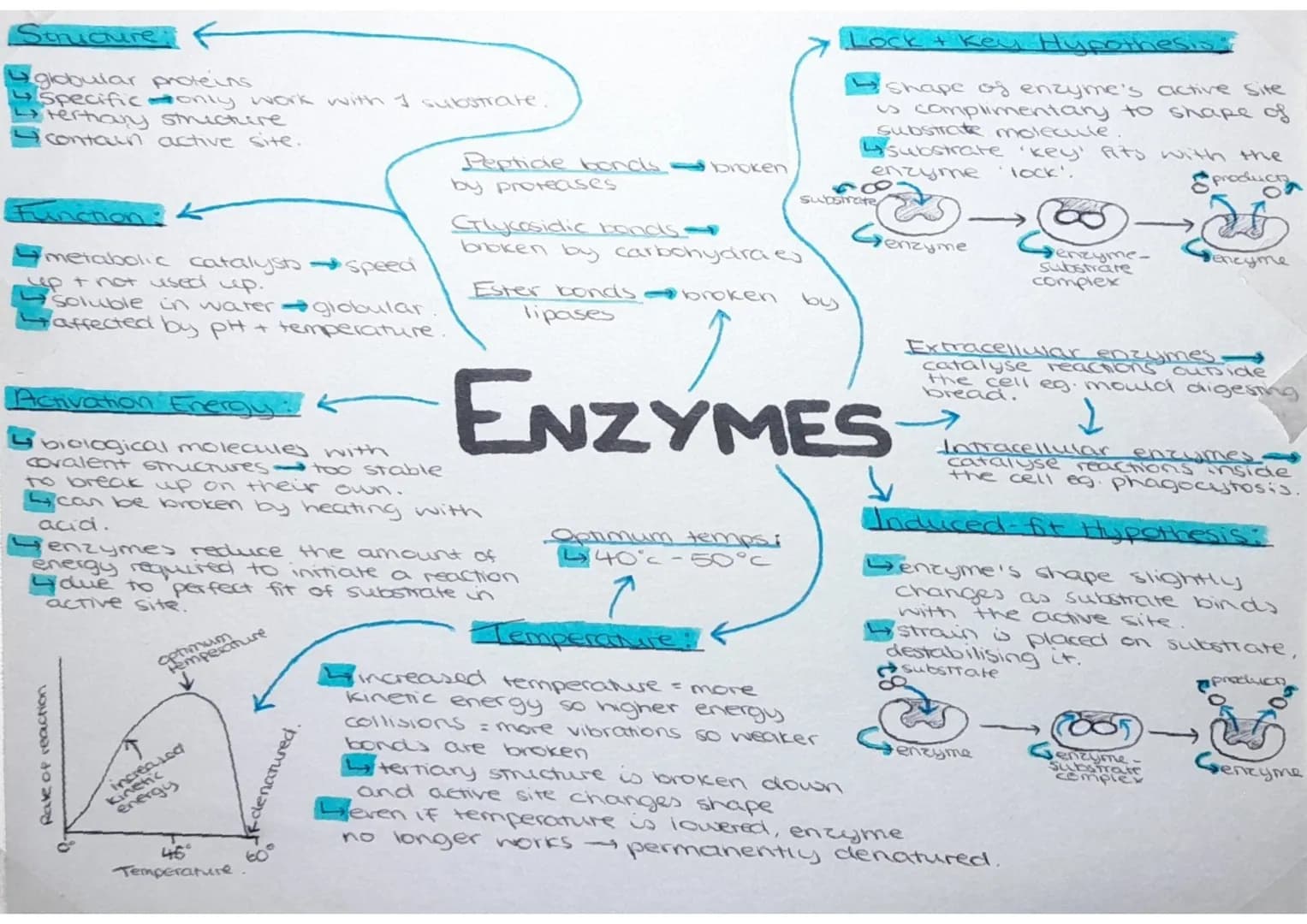
Page 2: Enzyme Inhibition and Cofactors
The second page delves into enzyme inhibition mechanisms and the role of cofactors in enzymatic reactions. It presents a detailed comparison between competitive and non-competitive inhibition, along with their effects on reaction rates.
Definition: Cofactors are small molecules that bind with enzymes to improve the shape of the active site.
Highlight: Competitive inhibitors can be overcome by increasing substrate concentration, while non-competitive inhibition cannot be reversed this way.
Example: Chloride ions act as cofactors for salivary amylase, improving how well starch fits into the active site.
Vocabulary:
- Competitive inhibition: When molecules similar to the substrate block the active site
- Non-competitive inhibition: When molecules bind away from the active site but change the enzyme's structure
The page emphasizes that while competitive inhibition is usually reversible, non-competitive inhibition typically results in permanent denaturation of the enzyme.
2
of 2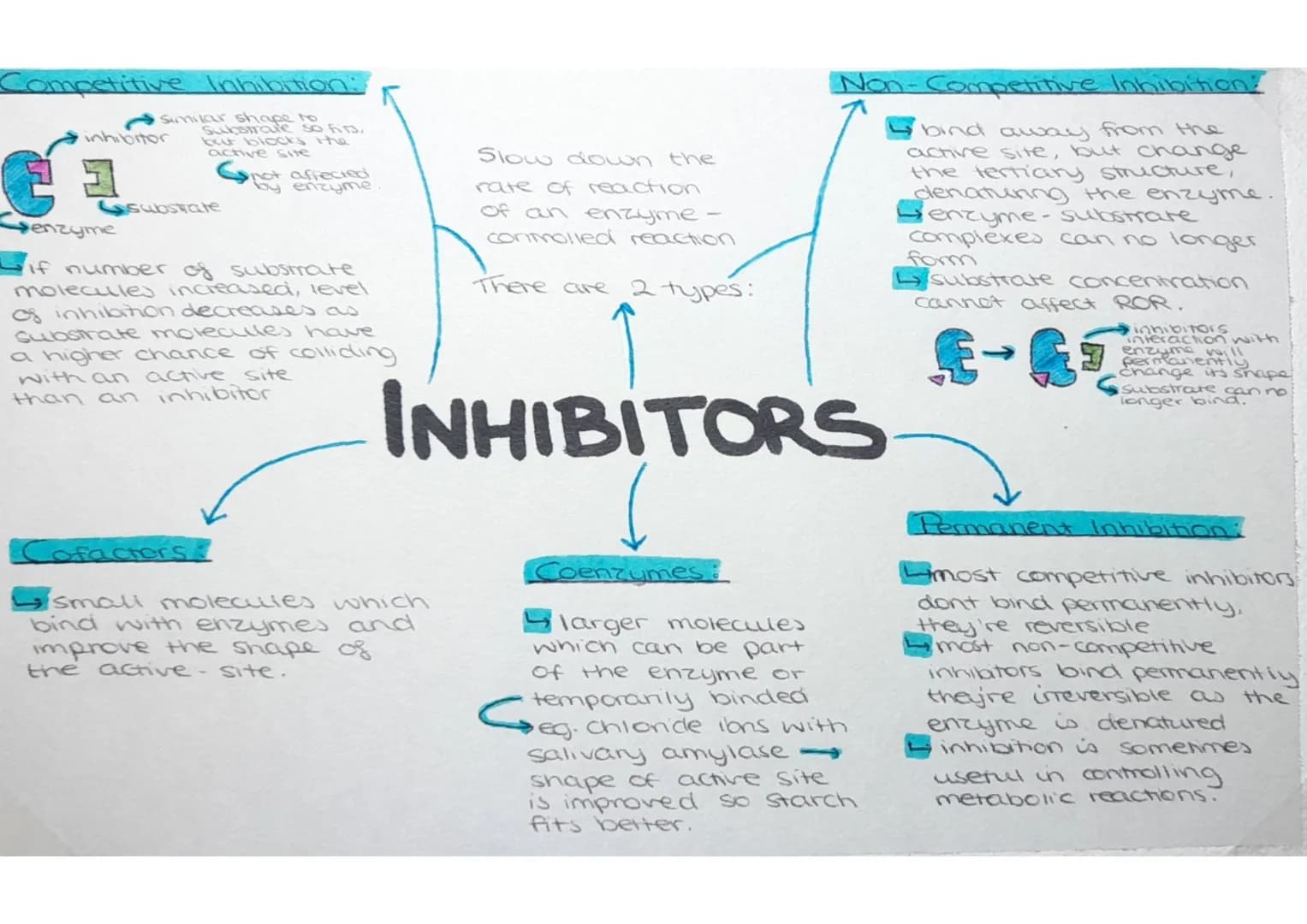
Page 1: Enzyme Structure and Function
The first page explores the fundamental aspects of enzyme structure and their catalytic function. Enzymes are described as globular proteins with specific tertiary structures containing active sites. These biological catalysts are soluble in water and their activity is influenced by both pH and temperature.
Definition: Enzymes are metabolic catalysts that speed up reactions without being consumed in the process.
Highlight: The optimal temperature range for most enzymes is 40-50°C, beyond which denaturation occurs.
Example: Different types of bonds are broken by specific enzymes - peptide bonds by proteases, glycosidic bonds by carbohydrases, and ester bonds by lipases.
Vocabulary: Denaturation refers to the process where an enzyme's tertiary structure breaks down, rendering it non-functional.
The page also details two main theories of enzyme-substrate interaction:
- Lock-and-Key Hypothesis: Where the enzyme's active site perfectly matches the substrate
- Induced-fit Hypothesis: Where the enzyme's shape slightly adjusts as the substrate binds
We thought you’d never ask...
What is the Knowunity AI companion?
Our AI Companion is a student-focused AI tool that offers more than just answers. Built on millions of Knowunity resources, it provides relevant information, personalised study plans, quizzes, and content directly in the chat, adapting to your individual learning journey.
Where can I download the Knowunity app?
You can download the app from Google Play Store and Apple App Store.
Is Knowunity really free of charge?
That's right! Enjoy free access to study content, connect with fellow students, and get instant help – all at your fingertips.
Similar content
Most popular content: Enzymes
9Most popular content in Biology
9Most popular content
9Can't find what you're looking for? Explore other subjects.
Students love us — and so will you.
4.6/5App Store
4.7/5Google Play
The app is very easy to use and well designed. I have found everything I was looking for so far and have been able to learn a lot from the presentations! I will definitely use the app for a class assignment! And of course it also helps a lot as an inspiration.
Stefan SiOS user
This app is really great. There are so many study notes and help [...]. My problem subject is French, for example, and the app has so many options for help. Thanks to this app, I have improved my French. I would recommend it to anyone.
Samantha KlichAndroid user
Wow, I am really amazed. I just tried the app because I've seen it advertised many times and was absolutely stunned. This app is THE HELP you want for school and above all, it offers so many things, such as workouts and fact sheets, which have been VERY helpful to me personally.
AnnaiOS user
Biology138 views·Updated Jun 1, 2026·2 pagesHow Temperature and Helpers Affect Enzyme Actions
Amala Seth@amala_seth
Enzymes are biological catalysts that play a crucial role in metabolic processes, featuring specific structures and functions that enable them to speed up chemical reactions without being consumed.
- The effect of temperature on enzyme activityis significant, with optimal function... Show more
1
of 2Sign up to see the content. It's free!
- Access to all documents
- Improve your grades
- Join milions of students
Page 2: Enzyme Inhibition and Cofactors
The second page delves into enzyme inhibition mechanisms and the role of cofactors in enzymatic reactions. It presents a detailed comparison between competitive and non-competitive inhibition, along with their effects on reaction rates.
Definition: Cofactors are small molecules that bind with enzymes to improve the shape of the active site.
Highlight: Competitive inhibitors can be overcome by increasing substrate concentration, while non-competitive inhibition cannot be reversed this way.
Example: Chloride ions act as cofactors for salivary amylase, improving how well starch fits into the active site.
Vocabulary:
- Competitive inhibition: When molecules similar to the substrate block the active site
- Non-competitive inhibition: When molecules bind away from the active site but change the enzyme's structure
The page emphasizes that while competitive inhibition is usually reversible, non-competitive inhibition typically results in permanent denaturation of the enzyme.
2
of 2Sign up to see the content. It's free!
- Access to all documents
- Improve your grades
- Join milions of students
Page 1: Enzyme Structure and Function
The first page explores the fundamental aspects of enzyme structure and their catalytic function. Enzymes are described as globular proteins with specific tertiary structures containing active sites. These biological catalysts are soluble in water and their activity is influenced by both pH and temperature.
Definition: Enzymes are metabolic catalysts that speed up reactions without being consumed in the process.
Highlight: The optimal temperature range for most enzymes is 40-50°C, beyond which denaturation occurs.
Example: Different types of bonds are broken by specific enzymes - peptide bonds by proteases, glycosidic bonds by carbohydrases, and ester bonds by lipases.
Vocabulary: Denaturation refers to the process where an enzyme's tertiary structure breaks down, rendering it non-functional.
The page also details two main theories of enzyme-substrate interaction:
- Lock-and-Key Hypothesis: Where the enzyme's active site perfectly matches the substrate
- Induced-fit Hypothesis: Where the enzyme's shape slightly adjusts as the substrate binds
We thought you’d never ask...
What is the Knowunity AI companion?
Our AI Companion is a student-focused AI tool that offers more than just answers. Built on millions of Knowunity resources, it provides relevant information, personalised study plans, quizzes, and content directly in the chat, adapting to your individual learning journey.
Where can I download the Knowunity app?
You can download the app from Google Play Store and Apple App Store.
Is Knowunity really free of charge?
That's right! Enjoy free access to study content, connect with fellow students, and get instant help – all at your fingertips.
Similar content
Most popular content: Enzymes
9Most popular content in Biology
9Most popular content
9Can't find what you're looking for? Explore other subjects.
Students love us — and so will you.
4.6/5App Store
4.7/5Google Play
The app is very easy to use and well designed. I have found everything I was looking for so far and have been able to learn a lot from the presentations! I will definitely use the app for a class assignment! And of course it also helps a lot as an inspiration.
Stefan SiOS user
This app is really great. There are so many study notes and help [...]. My problem subject is French, for example, and the app has so many options for help. Thanks to this app, I have improved my French. I would recommend it to anyone.
Samantha KlichAndroid user
Wow, I am really amazed. I just tried the app because I've seen it advertised many times and was absolutely stunned. This app is THE HELP you want for school and above all, it offers so many things, such as workouts and fact sheets, which have been VERY helpful to me personally.
AnnaiOS user