
When police interview witnesses to crimes, the way they ask...
 Psychology85 views·Updated 13 Jul 2026·4 pages
A-Level Psychology: Cognitive Interview Techniques
N
Nyla🌟@nylamalik

1 / 4
1
of 4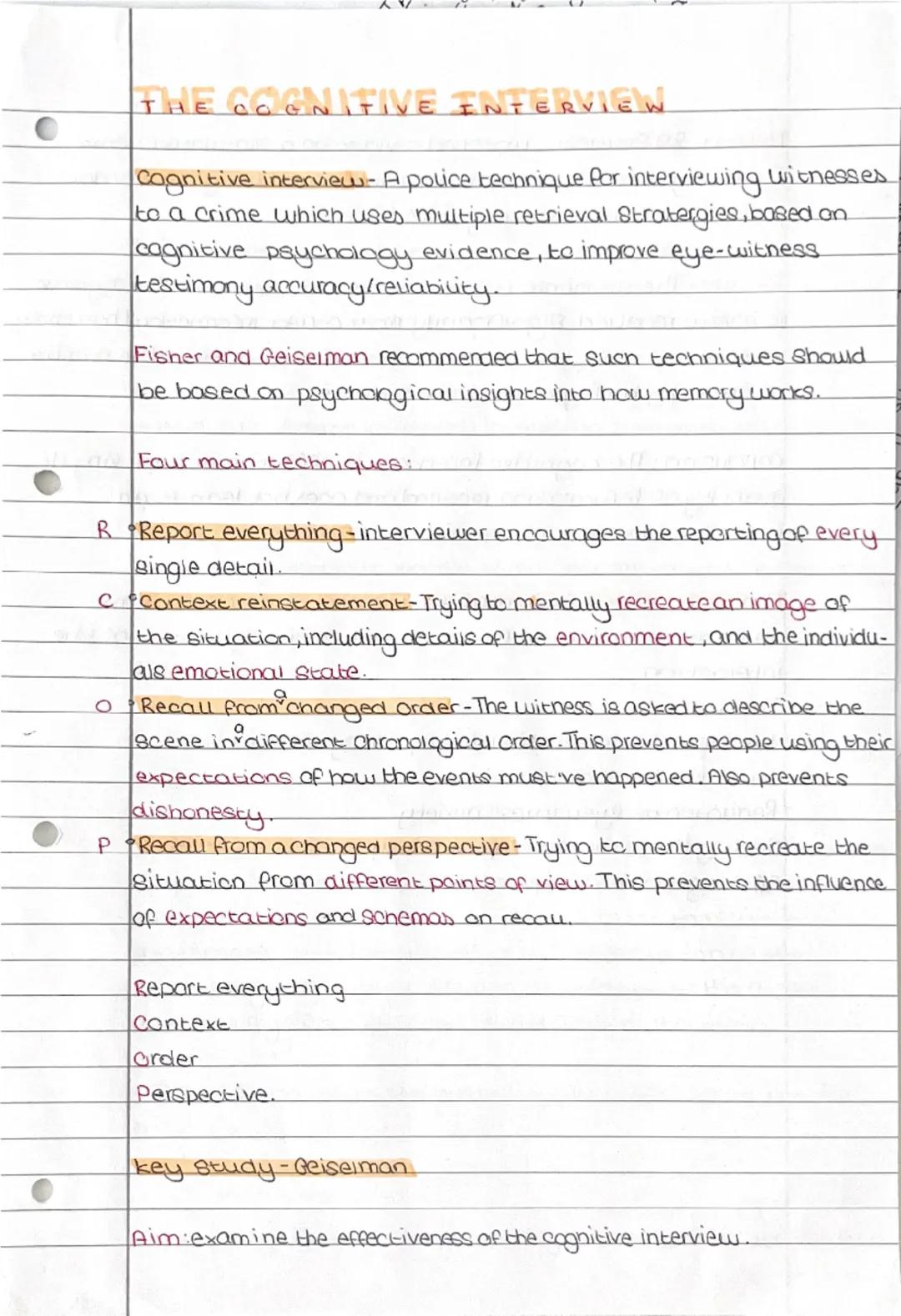
The Cognitive Interview Technique
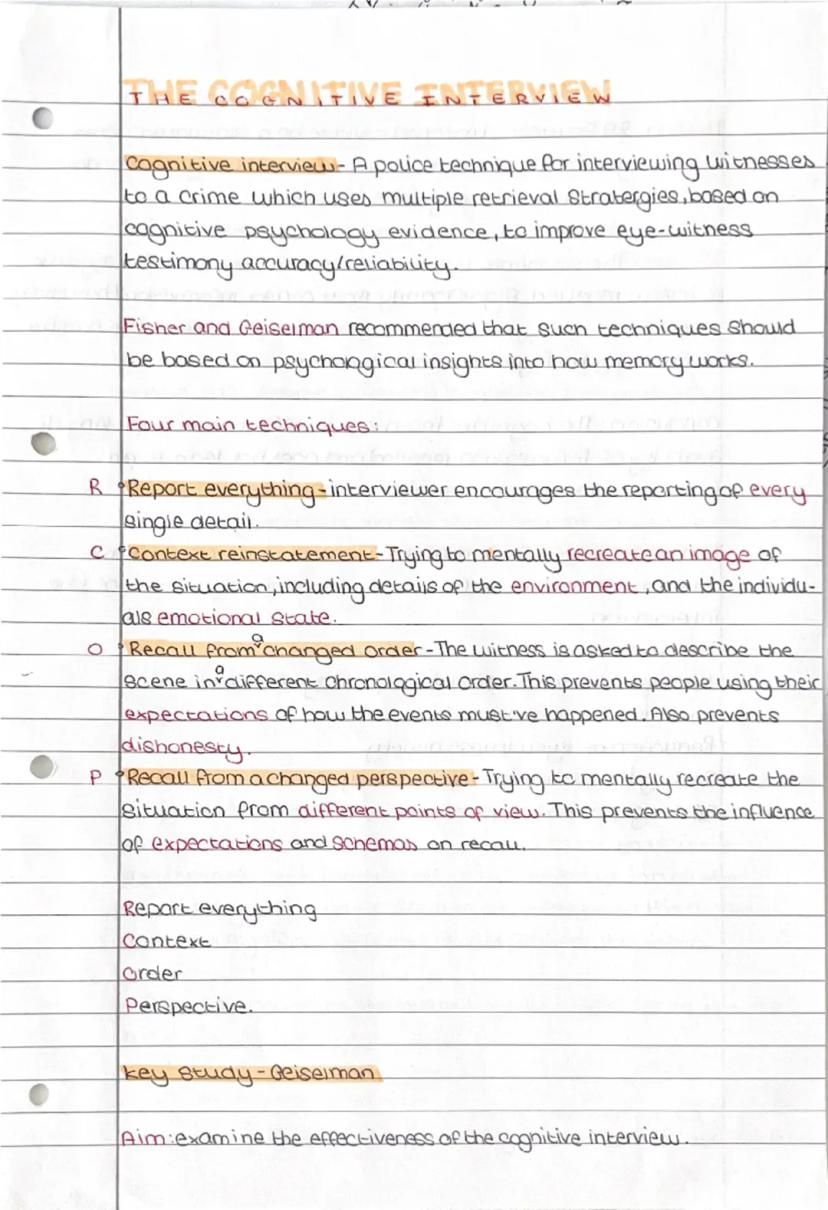
Ever wondered why you remember more details when someone asks the right questions? The cognitive interview is a clever police technique that uses four specific strategies to help witnesses recall more accurate information about crimes they've seen.
The technique relies on four main methods that you can remember with the acronym RCOP. Report everything encourages witnesses to share even the smallest details that might seem unimportant. Context reinstatement involves mentally recreating the crime scene, including sounds, smells, and emotions from that moment.
Recall from changed order means describing events backwards or from the middle, which stops people from filling in gaps with what they think "must have happened." Finally, recall from changed perspective asks witnesses to describe what someone else at the scene might have seen, helping to unlock different memory pathways.
Quick Tip: These techniques work because they give your brain multiple "routes" to access the same memory, just like having several different paths to the same destination.
2
of 4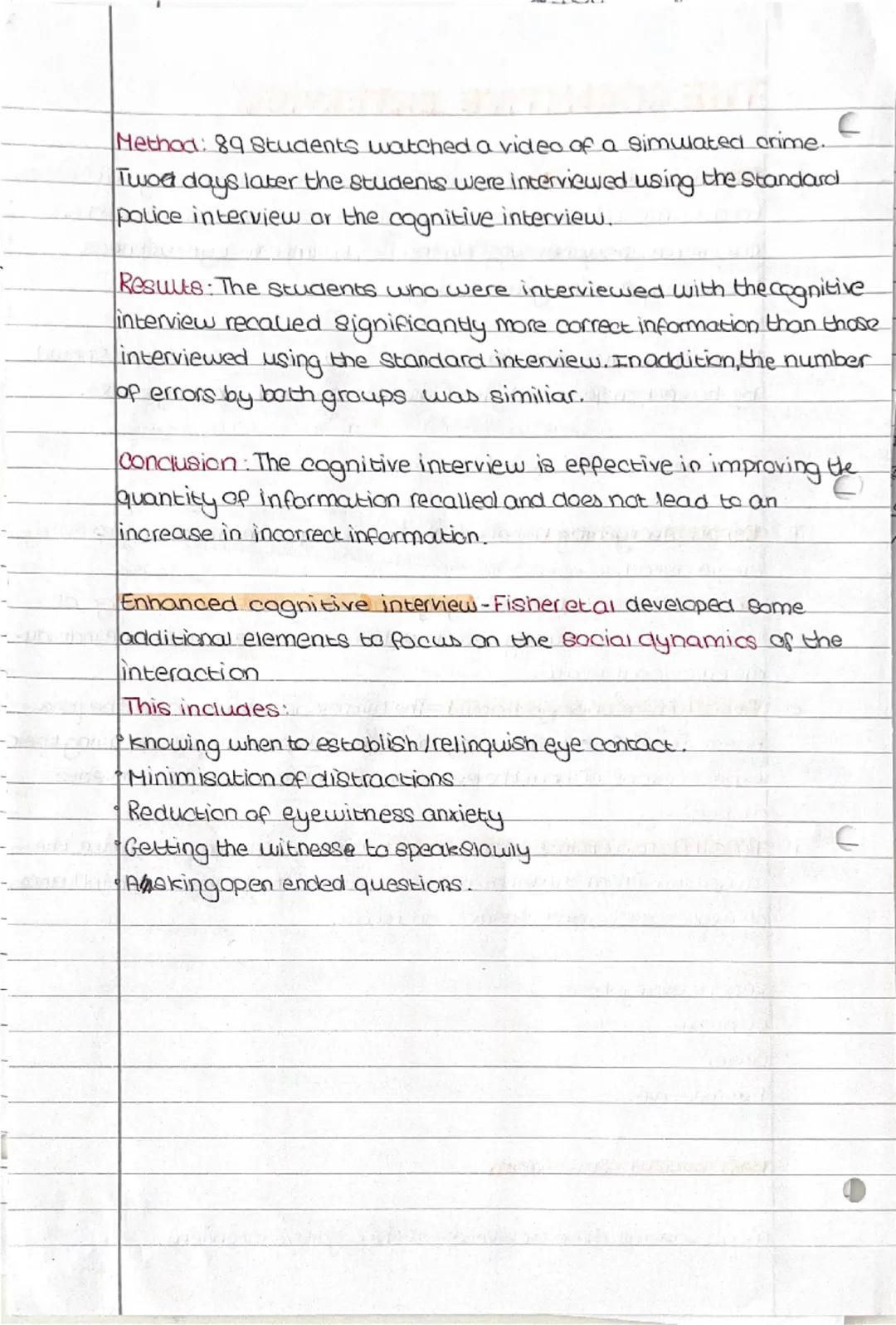
Research Evidence and Enhanced Techniques
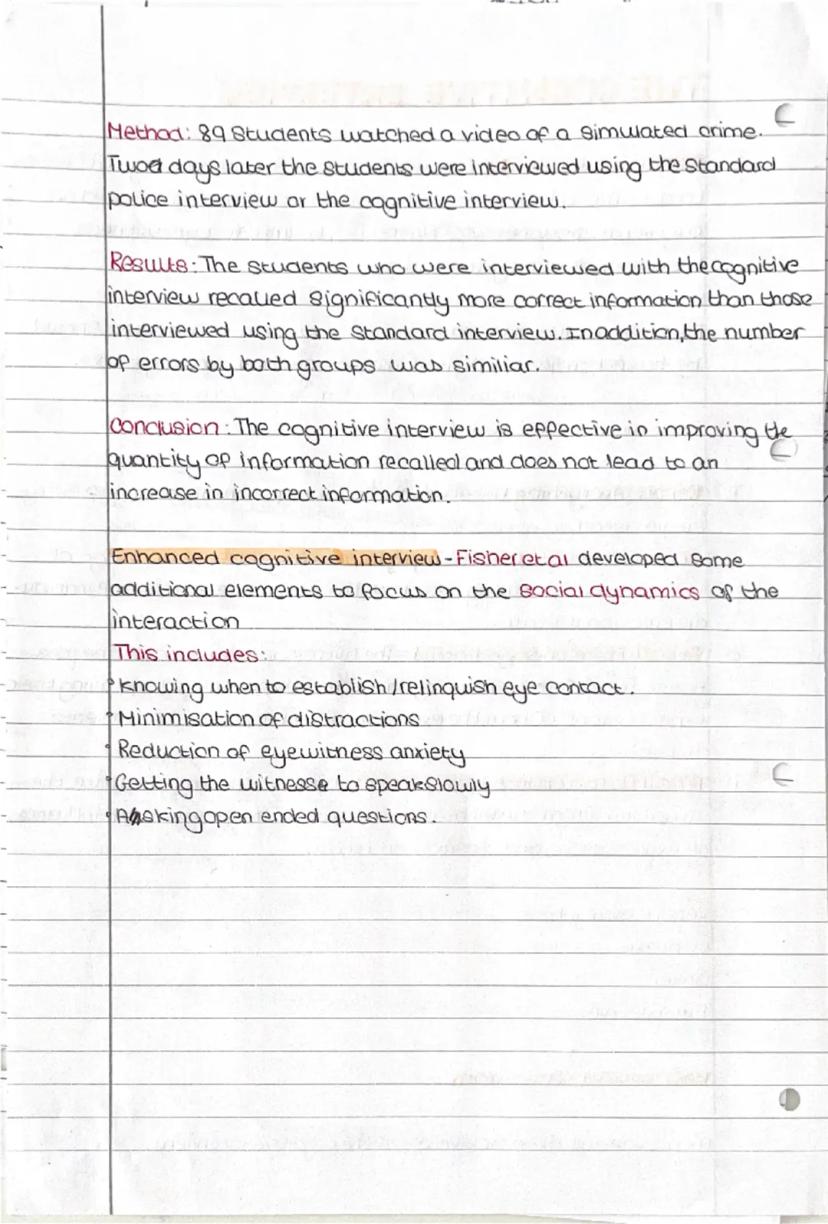
Geiselman's key study put the cognitive interview to the test with impressive results. 89 students watched a simulated crime video, then were interviewed two days later using either standard police techniques or the cognitive interview method.
The results were clear: students using the cognitive interview recalled significantly more correct information without increasing the number of errors. This proves the technique actually works in practice, not just in theory.
Researchers later developed the enhanced cognitive interview, which focuses on the social side of interviewing. This includes knowing when to make eye contact, reducing distractions, calming anxious witnesses, encouraging slow speech, and asking open-ended questions that don't lead witnesses toward specific answers.
Remember: The enhanced version recognises that memory isn't just about mental techniques - the interview environment and relationship between interviewer and witness matters too.
3
of 4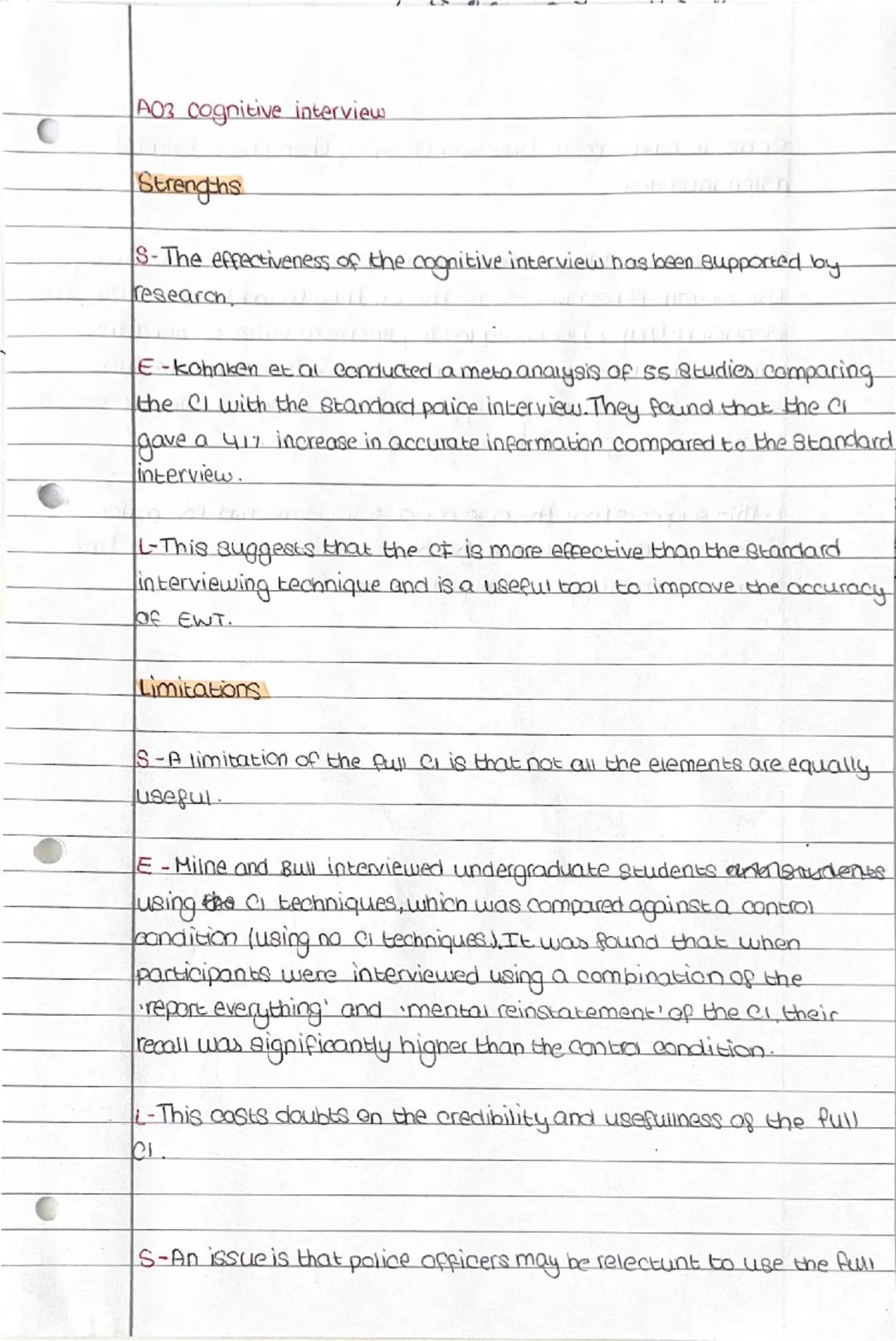
Strengths of the Cognitive Interview
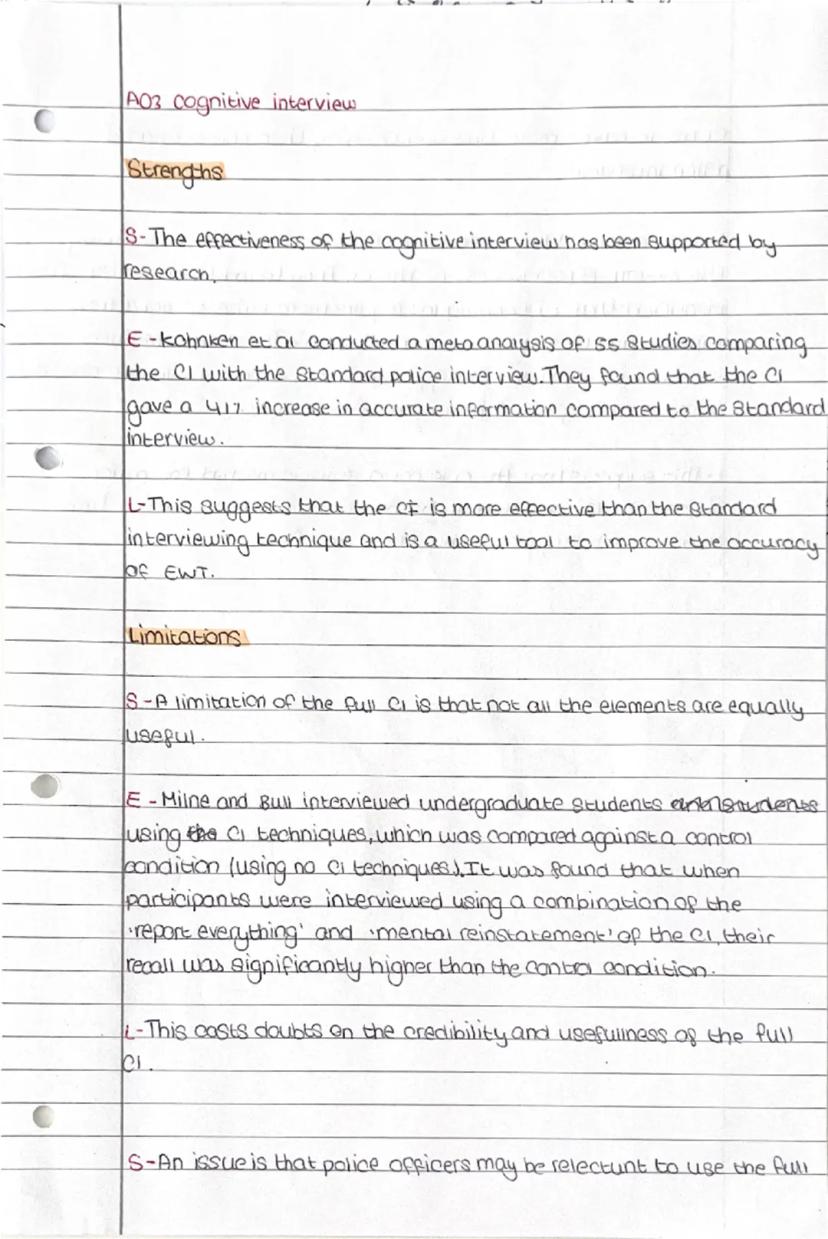
The cognitive interview has solid research backing that you can confidently cite in exams. Köhnken's meta-analysis of 55 studies found that the cognitive interview produced a 41% increase in accurate information compared to standard police interviews - that's a massive improvement.
This research strength means the cognitive interview isn't just a theoretical idea; it's a proven tool that genuinely helps improve eyewitness testimony accuracy. The consistency of results across multiple studies makes it particularly reliable evidence.
However, not all parts of the technique are equally useful. Milne and Bull's research discovered that just combining "report everything" with "mental reinstatement" gave most of the benefits, suggesting the full four-part technique might be unnecessarily complex.
Exam Tip: This research gives you concrete statistics to use in evaluation points - the 41% improvement figure is particularly impressive to include in essays.
4
of 4
Limitations and Real-World Challenges
Despite its effectiveness, the cognitive interview faces practical problems in real police work. Kebbell and Wagstaff identified that the technique requires specialist training and significantly more time than standard interviews, which many police forces simply can't afford.
Police officers often feel reluctant to use the full cognitive interview because it's more demanding than their usual methods. Building rapport with witnesses and helping them relax takes time that busy officers may not have, especially when dealing with multiple cases.
This creates a gap between what works in research and what's realistic in practice. Many experts now suggest that focusing on just the most effective elements - like "report everything" and "context reinstatement" - might be a better compromise than abandoning the technique entirely.
Real-World Reality: The best interview technique is worthless if police officers don't have the time, training, or resources to use it properly.
We thought you’d never ask...
Our AI Companion is a student-focused AI tool that offers more than just answers. Built on millions of Knowunity resources, it provides relevant information, personalised study plans, quizzes, and content directly in the chat, adapting to your individual learning journey.
You can download the app from Google Play Store and Apple App Store.
That's right! Enjoy free access to study content, connect with fellow students, and get instant help – all at your fingertips.
Most popular content in Psychology
9PsychologySocial Influence Overview
Explore key concepts in social influence, including conformity, obedience, and minority influence. This comprehensive summary covers essential studies such as Milgram's experiment, Asch's conformity tests, and the Stanford prison experiment, providing insights into the psychological mechanisms behind social behavior. Ideal for A-Level revision.
127,489320
PsychologyAQA A Level Sociology Research Methods
Includes all research methods
122,15068
PsychologyIssues and Debates
AQA paper 3 alevel psychology topic 9 - issues and debates - full active recall questions - notion.
121,08526
PsychologyComprehensive Research Methods
Explore essential research methods in psychology, including experimental designs, types of experiments, observations, interviews, and ethical considerations. This summary covers key concepts such as independent and dependent variables, validity, reliability, and statistical significance, tailored for A Level AQA Psychology students.
1214,439719
PsychologyBiopsychology Key Concepts
Explore essential biopsychology concepts including circadian rhythms, brain structure, and neurobiology. This comprehensive summary covers the nervous system, hormonal coordination, and the impact of brain plasticity on behavior. Ideal for AQA A Level Psychology revision.
1212,969612
PsychologyPsychopathology
Condensed notes from textbook
125547
PsychologyForensic Psychology Overview
Comprehensive revision notes covering key concepts in forensic psychology for AQA A Level Psychology. Explore topics such as offender profiling, criminal personality, behavioral approaches, and the impact of socialization on criminal behavior. Ideal for students preparing for exams and seeking a deeper understanding of the psychological aspects of crime and punishment.
126,946283
PsychologyTheories of Romantic Relationships
Explore key theories and concepts in romantic relationships, including Social Exchange Theory, Equity Theory, and Duck's Phase Model. Understand factors affecting attraction such as self-disclosure, physical attractiveness, and the dynamics of virtual and parasocial relationships. This comprehensive summary is essential for AQA A Level Psychology students.
124,759163
PsychologyA Level AQA Biopsychology Content Mindmap
Biopsychology Content Mind Maps, DOES NOT CONTAIN RESEARCH OR EVALUATION
122,07946
Most popular content
9 Sociology
Sociology of Education Overview
Explore comprehensive A-Level Sociology notes on the education system, covering key theories, policies, and sociological perspectives. This resource includes insights on marketisation, gender roles, cultural deprivation, and educational inequalities, providing a thorough understanding of how education shapes social stratification and individual achievement. Ideal for exam preparation and in-depth study.
12102,9363,041
SociologySociology of Families: Comprehensive Revision
Dive into an extensive overview of family dynamics, perspectives, and patterns in sociology. This resource covers key concepts such as family diversity, gender roles, marriage, and the impact of social policies on family structures. Perfect for A-Level Sociology students preparing for Paper 2.
1273,7402,307
CriminologyCriminology: Crime & Punishment Overview
Comprehensive mindmaps covering key concepts in the Crime and Punishment topic for WJEC Criminology Unit 4. This resource includes detailed insights into the Criminal Justice System, crime prevention strategies, sentencing models, and the roles of various agencies. Ideal for A-Level revision, ensuring you grasp essential theories and legislative processes to excel in your exams.
1254,8921,060
SociologyComprehensive Crime & Deviance Overview
Explore an extensive revision of crime and deviance topics, including theories, types of crime, and the impact of media. This resource covers key concepts such as Marxism, functionalism, gender and crime, and the influence of globalization on criminal behavior. Ideal for students seeking a thorough understanding of criminology and its various theories. Type: Full Topic Revision.
1251,6681,400
C
 Biology
Cell Biology and Cell structure
cell structures
93,2730
CriminologyWJEC Unit 4 Criminology
Criminology unit 4 detailed revision note
127,174125
SociologySociological Theories Overview
Comprehensive revision of key sociological theories including Functionalism, Marxism, Feminism, and Interpretivism. Explore concepts like value freedom, identity formation, and the critique of social control. Ideal for AQA A-Level Sociology students preparing for exams. This summary covers essential theories and their implications in sociology, providing a clear understanding of each perspective.
1231,475846
T
BiologyThe functions of subcellular structures - B1 Biology
Flashcards on the different functions of subcellular structures: cell membrane, nucleus, mitochondria, ribosomes, cytoplasm, permant vacuole, chloroplasts and cell wall.
102,8215
1
Biology1.cells Gcse biology question cards
combined science higher biology
92,3604
Students love us — and so will you.
4.6/5App Store
4.7/5Google Play
The app is very easy to use and well designed. I have found everything I was looking for so far and have been able to learn a lot from the presentations! I will definitely use the app for a class assignment! And of course it also helps a lot as an inspiration.
Stefan SiOS user
This app is really great. There are so many study notes and help [...]. My problem subject is French, for example, and the app has so many options for help. Thanks to this app, I have improved my French. I would recommend it to anyone.
Samantha KlichAndroid user
Wow, I am really amazed. I just tried the app because I've seen it advertised many times and was absolutely stunned. This app is THE HELP you want for school and above all, it offers so many things, such as workouts and fact sheets, which have been VERY helpful to me personally.
AnnaiOS user
Psychology85 views·Updated 13 Jul 2026·4 pagesA-Level Psychology: Cognitive Interview Techniques
N
Nyla🌟@nylamalik
When police interview witnesses to crimes, the way they ask questions can dramatically affect how much accurate information they get. The cognitive interview is a scientifically-backed technique that helps witnesses remember more details by working with how our brains naturally...
1
of 4
Sign up to see the content. It's free!
- Access to all documents
- Improve your grades
- Join milions of students
By signing up you accept Terms of Service and Privacy Policy
The Cognitive Interview Technique
Ever wondered why you remember more details when someone asks the right questions? The cognitive interview is a clever police technique that uses four specific strategies to help witnesses recall more accurate information about crimes they've seen.
The technique relies on four main methods that you can remember with the acronym RCOP. Report everything encourages witnesses to share even the smallest details that might seem unimportant. Context reinstatement involves mentally recreating the crime scene, including sounds, smells, and emotions from that moment.
Recall from changed order means describing events backwards or from the middle, which stops people from filling in gaps with what they think "must have happened." Finally, recall from changed perspective asks witnesses to describe what someone else at the scene might have seen, helping to unlock different memory pathways.
Quick Tip: These techniques work because they give your brain multiple "routes" to access the same memory, just like having several different paths to the same destination.
2
of 4Sign up to see the content. It's free!
- Access to all documents
- Improve your grades
- Join milions of students
By signing up you accept Terms of Service and Privacy Policy
Research Evidence and Enhanced Techniques
Geiselman's key study put the cognitive interview to the test with impressive results. 89 students watched a simulated crime video, then were interviewed two days later using either standard police techniques or the cognitive interview method.
The results were clear: students using the cognitive interview recalled significantly more correct information without increasing the number of errors. This proves the technique actually works in practice, not just in theory.
Researchers later developed the enhanced cognitive interview, which focuses on the social side of interviewing. This includes knowing when to make eye contact, reducing distractions, calming anxious witnesses, encouraging slow speech, and asking open-ended questions that don't lead witnesses toward specific answers.
Remember: The enhanced version recognises that memory isn't just about mental techniques - the interview environment and relationship between interviewer and witness matters too.
3
of 4Sign up to see the content. It's free!
- Access to all documents
- Improve your grades
- Join milions of students
By signing up you accept Terms of Service and Privacy Policy
Strengths of the Cognitive Interview
The cognitive interview has solid research backing that you can confidently cite in exams. Köhnken's meta-analysis of 55 studies found that the cognitive interview produced a 41% increase in accurate information compared to standard police interviews - that's a massive improvement.
This research strength means the cognitive interview isn't just a theoretical idea; it's a proven tool that genuinely helps improve eyewitness testimony accuracy. The consistency of results across multiple studies makes it particularly reliable evidence.
However, not all parts of the technique are equally useful. Milne and Bull's research discovered that just combining "report everything" with "mental reinstatement" gave most of the benefits, suggesting the full four-part technique might be unnecessarily complex.
Exam Tip: This research gives you concrete statistics to use in evaluation points - the 41% improvement figure is particularly impressive to include in essays.
4
of 4Sign up to see the content. It's free!
- Access to all documents
- Improve your grades
- Join milions of students
By signing up you accept Terms of Service and Privacy Policy
Limitations and Real-World Challenges
Despite its effectiveness, the cognitive interview faces practical problems in real police work. Kebbell and Wagstaff identified that the technique requires specialist training and significantly more time than standard interviews, which many police forces simply can't afford.
Police officers often feel reluctant to use the full cognitive interview because it's more demanding than their usual methods. Building rapport with witnesses and helping them relax takes time that busy officers may not have, especially when dealing with multiple cases.
This creates a gap between what works in research and what's realistic in practice. Many experts now suggest that focusing on just the most effective elements - like "report everything" and "context reinstatement" - might be a better compromise than abandoning the technique entirely.
Real-World Reality: The best interview technique is worthless if police officers don't have the time, training, or resources to use it properly.
We thought you’d never ask...
Our AI Companion is a student-focused AI tool that offers more than just answers. Built on millions of Knowunity resources, it provides relevant information, personalised study plans, quizzes, and content directly in the chat, adapting to your individual learning journey.
You can download the app from Google Play Store and Apple App Store.
That's right! Enjoy free access to study content, connect with fellow students, and get instant help – all at your fingertips.
Most popular content in Psychology
9PsychologySocial Influence Overview
Explore key concepts in social influence, including conformity, obedience, and minority influence. This comprehensive summary covers essential studies such as Milgram's experiment, Asch's conformity tests, and the Stanford prison experiment, providing insights into the psychological mechanisms behind social behavior. Ideal for A-Level revision.
127,489320
PsychologyAQA A Level Sociology Research Methods
Includes all research methods
122,15068
PsychologyIssues and Debates
AQA paper 3 alevel psychology topic 9 - issues and debates - full active recall questions - notion.
121,08526
PsychologyComprehensive Research Methods
Explore essential research methods in psychology, including experimental designs, types of experiments, observations, interviews, and ethical considerations. This summary covers key concepts such as independent and dependent variables, validity, reliability, and statistical significance, tailored for A Level AQA Psychology students.
1214,439719
PsychologyBiopsychology Key Concepts
Explore essential biopsychology concepts including circadian rhythms, brain structure, and neurobiology. This comprehensive summary covers the nervous system, hormonal coordination, and the impact of brain plasticity on behavior. Ideal for AQA A Level Psychology revision.
1212,969612
PsychologyPsychopathology
Condensed notes from textbook
125547
PsychologyForensic Psychology Overview
Comprehensive revision notes covering key concepts in forensic psychology for AQA A Level Psychology. Explore topics such as offender profiling, criminal personality, behavioral approaches, and the impact of socialization on criminal behavior. Ideal for students preparing for exams and seeking a deeper understanding of the psychological aspects of crime and punishment.
126,946283
PsychologyTheories of Romantic Relationships
Explore key theories and concepts in romantic relationships, including Social Exchange Theory, Equity Theory, and Duck's Phase Model. Understand factors affecting attraction such as self-disclosure, physical attractiveness, and the dynamics of virtual and parasocial relationships. This comprehensive summary is essential for AQA A Level Psychology students.
124,759163
PsychologyA Level AQA Biopsychology Content Mindmap
Biopsychology Content Mind Maps, DOES NOT CONTAIN RESEARCH OR EVALUATION
122,07946
Most popular content
9SociologySociology of Education Overview
Explore comprehensive A-Level Sociology notes on the education system, covering key theories, policies, and sociological perspectives. This resource includes insights on marketisation, gender roles, cultural deprivation, and educational inequalities, providing a thorough understanding of how education shapes social stratification and individual achievement. Ideal for exam preparation and in-depth study.
12102,9363,041
SociologySociology of Families: Comprehensive Revision
Dive into an extensive overview of family dynamics, perspectives, and patterns in sociology. This resource covers key concepts such as family diversity, gender roles, marriage, and the impact of social policies on family structures. Perfect for A-Level Sociology students preparing for Paper 2.
1273,7402,307
CriminologyCriminology: Crime & Punishment Overview
Comprehensive mindmaps covering key concepts in the Crime and Punishment topic for WJEC Criminology Unit 4. This resource includes detailed insights into the Criminal Justice System, crime prevention strategies, sentencing models, and the roles of various agencies. Ideal for A-Level revision, ensuring you grasp essential theories and legislative processes to excel in your exams.
1254,8921,060
SociologyComprehensive Crime & Deviance Overview
Explore an extensive revision of crime and deviance topics, including theories, types of crime, and the impact of media. This resource covers key concepts such as Marxism, functionalism, gender and crime, and the influence of globalization on criminal behavior. Ideal for students seeking a thorough understanding of criminology and its various theories. Type: Full Topic Revision.
1251,6681,400
C
BiologyCell Biology and Cell structure
cell structures
93,2730
CriminologyWJEC Unit 4 Criminology
Criminology unit 4 detailed revision note
127,174125
SociologySociological Theories Overview
Comprehensive revision of key sociological theories including Functionalism, Marxism, Feminism, and Interpretivism. Explore concepts like value freedom, identity formation, and the critique of social control. Ideal for AQA A-Level Sociology students preparing for exams. This summary covers essential theories and their implications in sociology, providing a clear understanding of each perspective.
1231,475846
T
BiologyThe functions of subcellular structures - B1 Biology
Flashcards on the different functions of subcellular structures: cell membrane, nucleus, mitochondria, ribosomes, cytoplasm, permant vacuole, chloroplasts and cell wall.
102,8215
1
Biology1.cells Gcse biology question cards
combined science higher biology
92,3604
Students love us — and so will you.
4.6/5App Store
4.7/5Google Play
The app is very easy to use and well designed. I have found everything I was looking for so far and have been able to learn a lot from the presentations! I will definitely use the app for a class assignment! And of course it also helps a lot as an inspiration.
Stefan SiOS user
This app is really great. There are so many study notes and help [...]. My problem subject is French, for example, and the app has so many options for help. Thanks to this app, I have improved my French. I would recommend it to anyone.
Samantha KlichAndroid user
Wow, I am really amazed. I just tried the app because I've seen it advertised many times and was absolutely stunned. This app is THE HELP you want for school and above all, it offers so many things, such as workouts and fact sheets, which have been VERY helpful to me personally.
AnnaiOS user