
Physics is all about understanding how our universe works, from... Show more
Sign up to see the contentIt's free!
Access to all documents
Improve your grades
Join milions of students
By signing up you accept Terms of Service and Privacy Policy

Maths

Chemistry

Biology

English Lang.

History
Responding to change (a2 only)
Energy transfers (a2 only)
Infection and response
Homeostasis and response
Cell biology
Organisms respond to changes in their internal and external environments (a-level only)
Biological molecules
Organisation
Substance exchange
Bioenergetics
Genetic information & variation
Inheritance, variation and evolution
Genetics & ecosystems (a2 only)
Ecology
Cells
Show all topics
1l the quest for political stability: germany, 1871-1991
Medieval period: 1066 -1509
The cold war
Inter-war germany
2d religious conflict and the church in england, c1529-c1570
2o democracy and nazism: germany, 1918-1945
1f industrialisation and the people: britain, c1783-1885
1c the tudors: england, 1485-1603
Britain & the wider world: 1745 -1901
2m wars and welfare: britain in transition, 1906-1957
World war two & the holocaust
2n revolution and dictatorship: russia, 1917-1953
2s the making of modern britain, 1951-2007
World war one
Britain: 1509 -1745
Show all topics
13
0

Amy Neill
24/11/2025
Physics
Our Dynamic Earth - Higher Physics Notes
566
•
24 Nov 2025
•
Amy Neill
@amyneill
Physics is all about understanding how our universe works, from... Show more

Welcome to Higher Physics! "Our Dynamic Universe" explores how objects move and interact, from dropping a pencil to satellites orbiting Earth. These concepts form the foundation for understanding how our universe operates on both small and massive scales.
The physics of motion helps explain everything from car safety systems to how galaxies move through space. You'll discover that the same principles apply whether you're calculating how a football travels through the air or how stars orbit the center of our galaxy.
Throughout these notes, we'll build your understanding step by step, moving from simple motion concepts to the mind-bending ideas of Einstein's relativity. By mastering these principles, you'll develop powerful analytical skills useful in many future careers.
Did you know? The physics principles you'll learn in this section explain both why your phone falls when you drop it and why our universe is expanding!

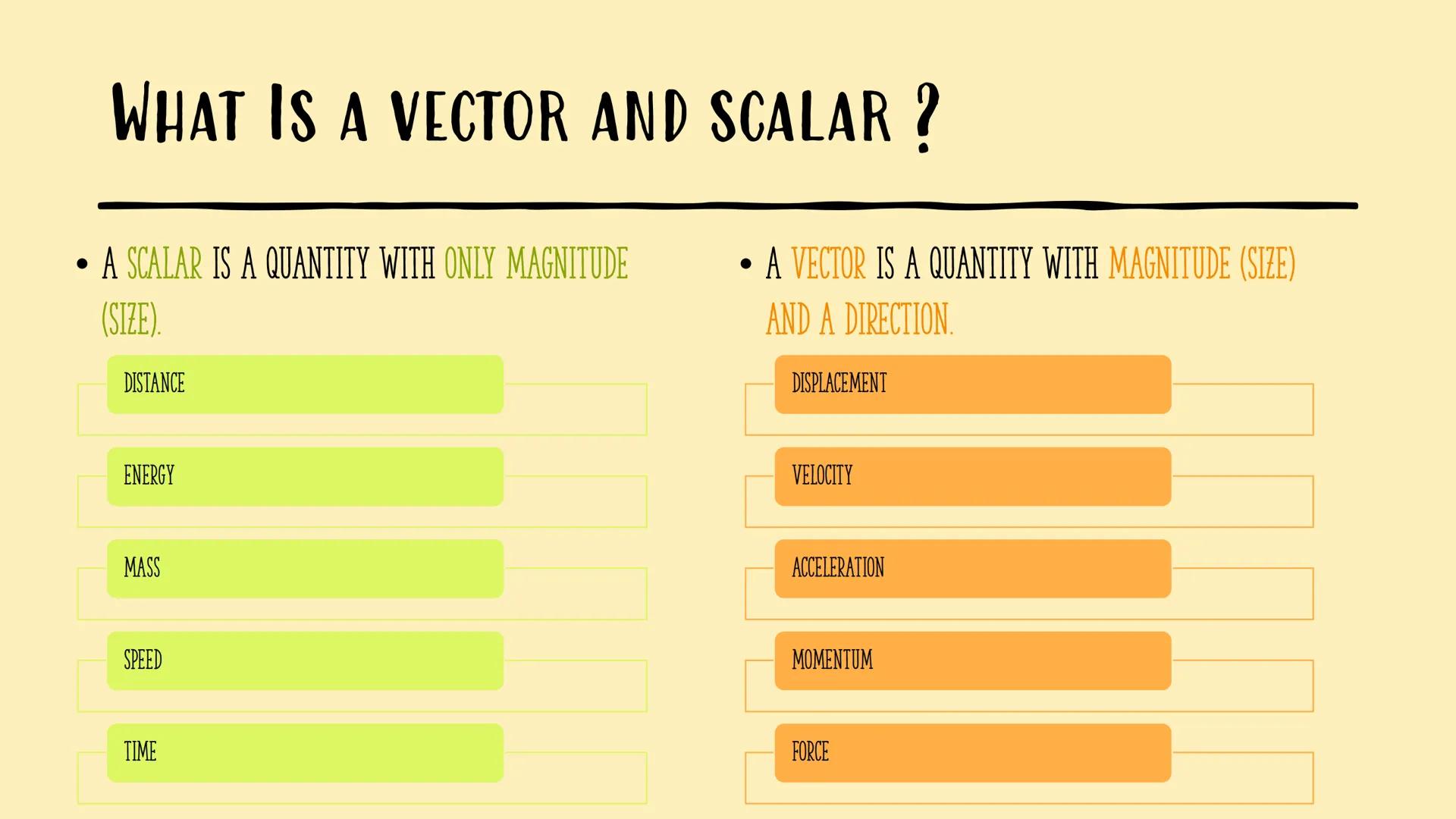
When describing physical quantities in physics, we need to be precise about whether direction matters. This is where the distinction between vectors and scalars becomes crucial.
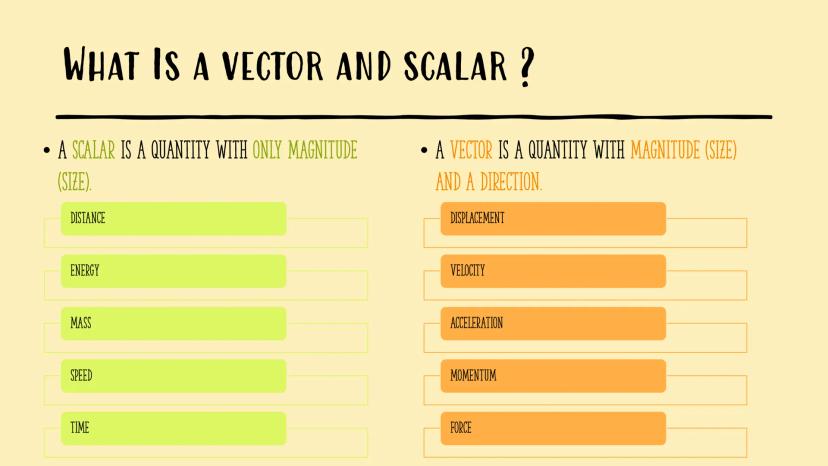
Physical quantities come in two types. Scalars are quantities that only have magnitude (size) - like distance, energy, mass, speed, and time. For example, saying "I ran 5 kilometers" or "The temperature is 20°C" provides complete information because these quantities don't need direction to be fully described.
Vectors, on the other hand, have both magnitude and direction. Displacement, velocity, acceleration, momentum, and force are all vector quantities. If someone says "I walked 5 kilometers east," they're giving you a vector - both how far and in which direction.
This distinction isn't just technical - it affects how we calculate with these quantities. When adding scalars, simple arithmetic works . But adding vectors requires considering their directions, which we'll explore in coming pages.
Remember: When you see a vector quantity in a problem, always look for information about direction - it's essential for solving correctly!
You might think distance and displacement are the same thing, but in physics, they represent different concepts that are crucial to understand.
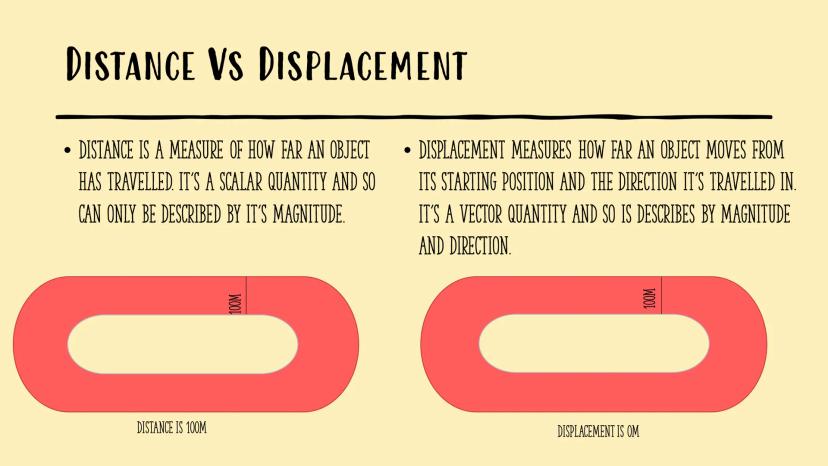
Distance is the total length of the path traveled, regardless of direction. It's a scalar quantity that only tells you how far something has moved in total. For example, if you walk 50m east, then 50m west, your total distance traveled is 100m.
Displacement is the straight-line distance from the starting point to the final position, including direction. As a vector quantity, it tells you how far out of place something is from where it started. In our example, walking 50m east then 50m west gives a displacement of 0m because you ended up back at your starting point.
This distinction becomes important in practical applications. When calculating fuel consumption, you need the total distance traveled. But when determining how far you are from home, displacement is what matters.
Think about it: You could walk for hours and cover a large distance, but if you end up where you started, your displacement is zero!
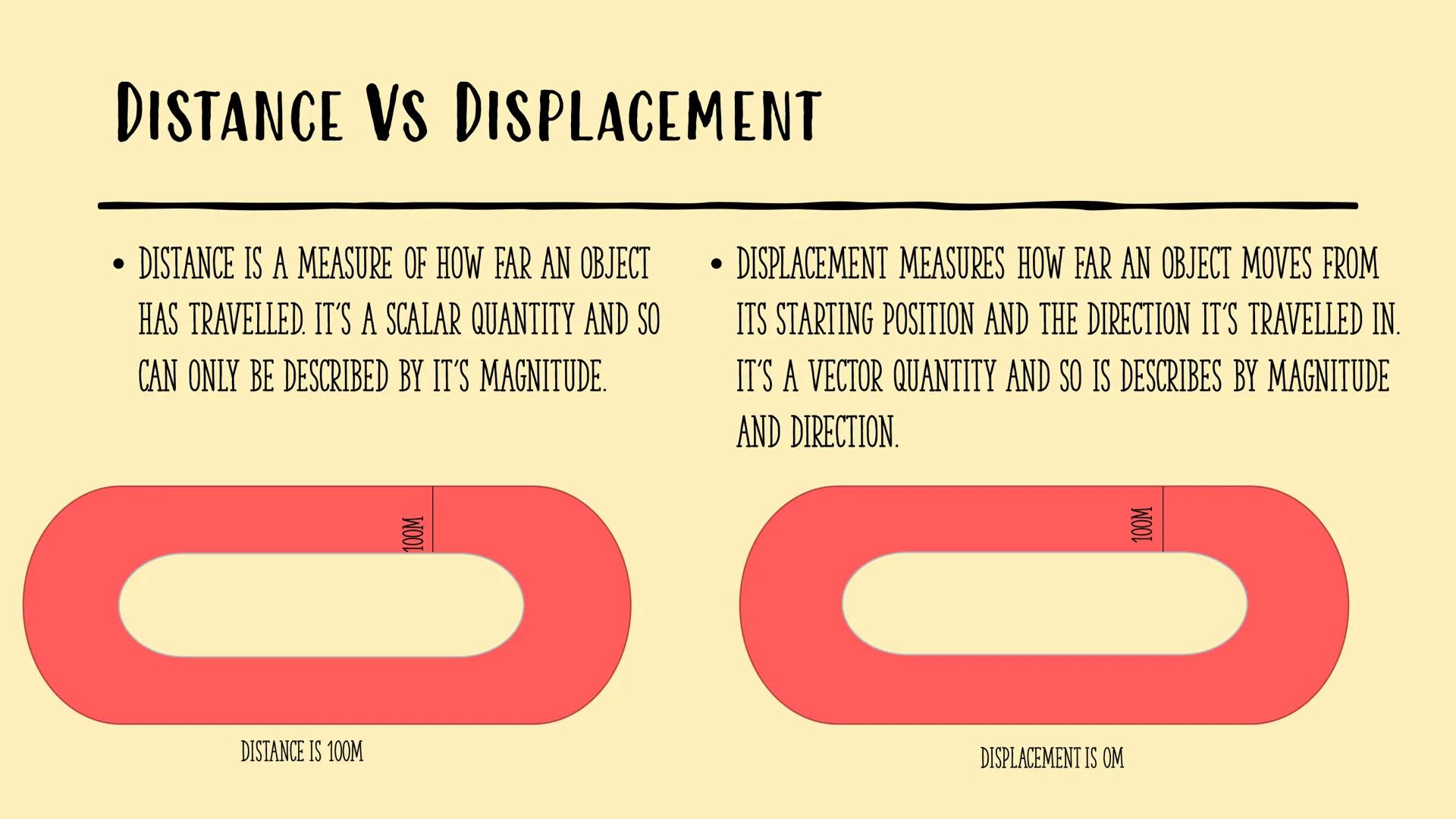
The difference between speed and velocity parallels the distinction between distance and displacement - and understanding this difference is vital for solving physics problems correctly.
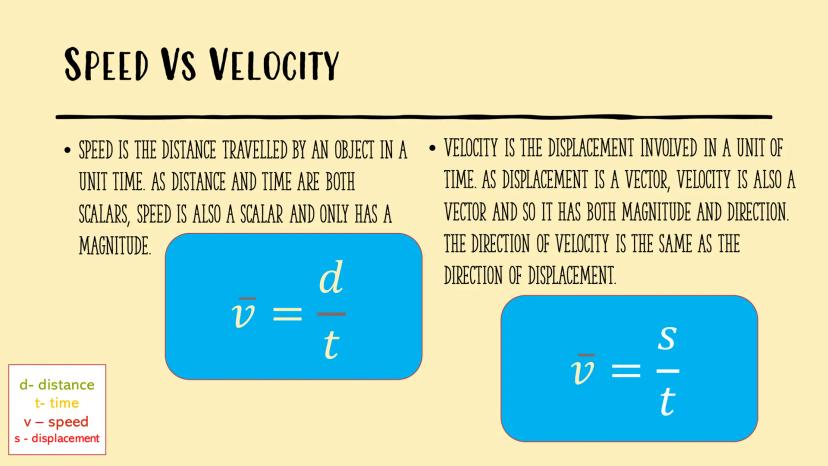
Speed tells you how fast an object is moving regardless of direction. It's calculated by dividing distance by time: v = d/t. Since both distance and time are scalars, speed is also a scalar quantity. If a car travels 60 kilometers in 1 hour, its speed is 60 km/h, regardless of which direction it's traveling.
Velocity combines speed with direction, making it a vector quantity. It's calculated using displacement instead of distance: v = s/t. For example, "60 km/h east" is a velocity. Two objects might have the same speed but different velocities if they're moving in different directions.
When an object moves in a straight line without changing direction, the magnitude of its velocity equals its speed. However, if the object changes direction (like a car going around a curve), its speed might remain constant while its velocity changes.
Exam tip: If a question asks about velocity, make sure your answer includes direction. If it asks about speed, direction isn't needed.
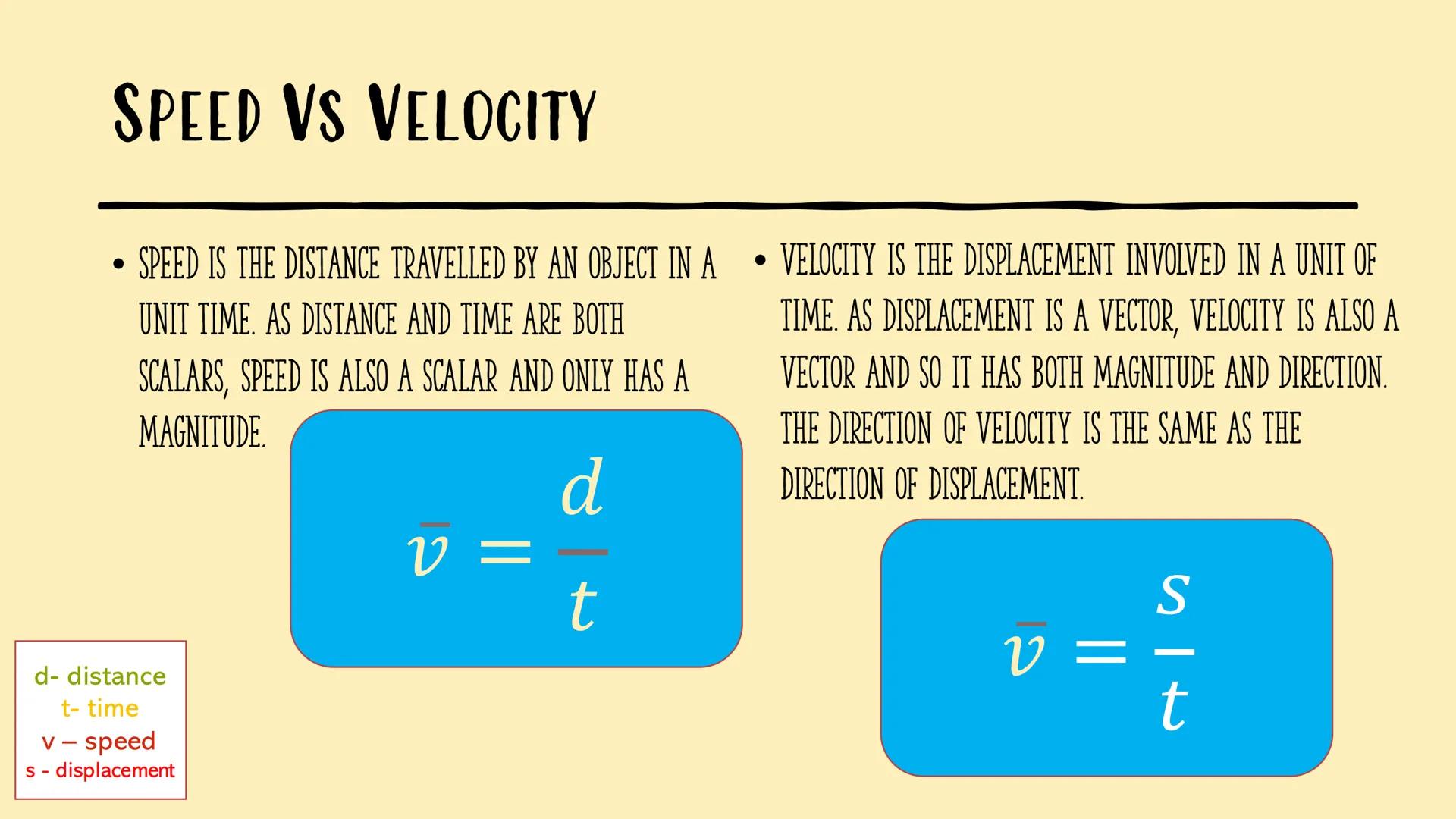
Acceleration occurs whenever an object's velocity changes - whether it speeds up, slows down, or changes direction. As a vector quantity, acceleration has both magnitude and direction.
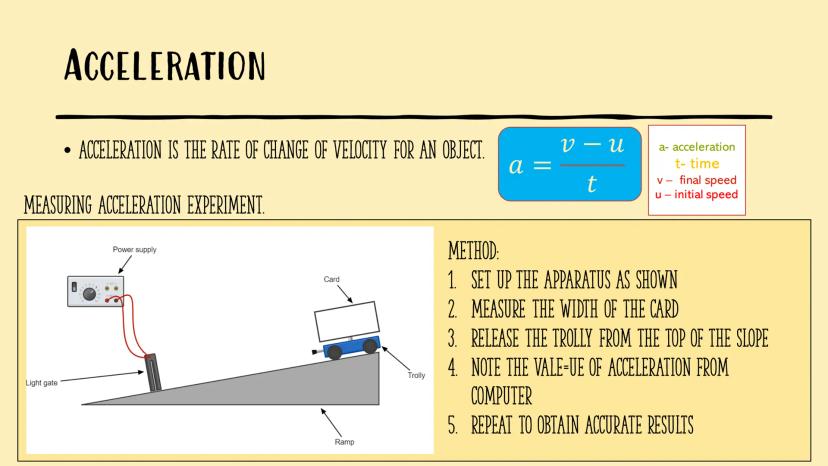
The formula for calculating acceleration is: a = /t where a is acceleration, v is final velocity, u is initial velocity, and t is time. The unit of acceleration is meters per second squared .
You can measure acceleration experimentally using light gates and a trolley on a ramp. When you release the trolley from the top of the ramp, it accelerates down the slope. The light gates record the time taken for a card attached to the trolley to pass through, allowing you to calculate its acceleration.
Understanding acceleration is crucial in many real-world applications. For example, car manufacturers measure acceleration to evaluate performance, while engineers use acceleration calculations when designing roller coasters to ensure the forces experienced by riders remain safe.
Important: Remember that deceleration is just acceleration in the opposite direction to motion. In physics, we typically use "negative acceleration" rather than "deceleration."
Unlike scalars that add together directly, vectors must be combined using their magnitude and direction. This becomes especially important when dealing with vectors in two dimensions.
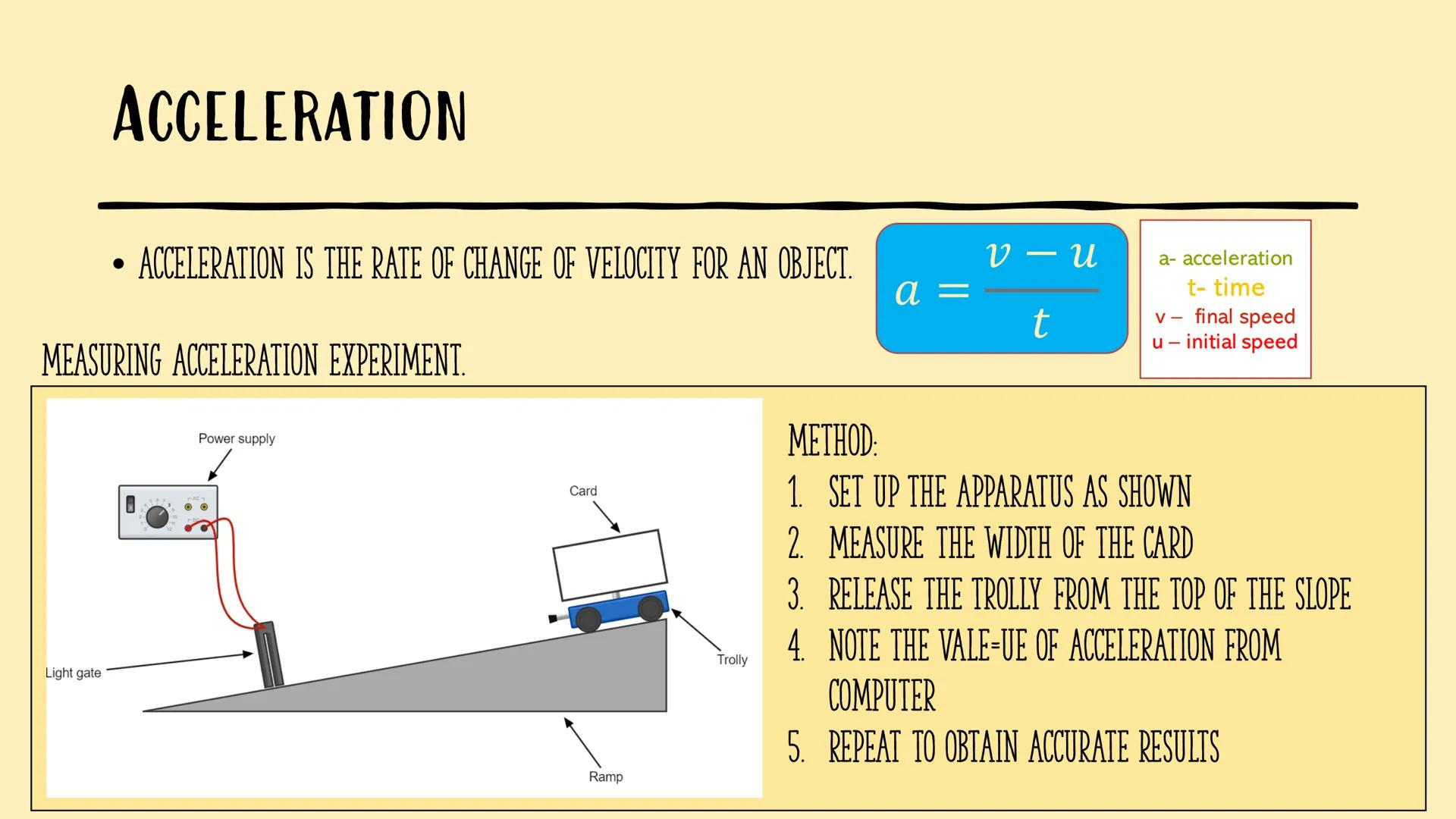
When adding vectors, we use the "tip-to-tail" method, where the tail of one vector connects to the tip of another. The resultant vector is drawn from the starting point to the final tip. The order of addition doesn't matter - you'll get the same resultant either way.
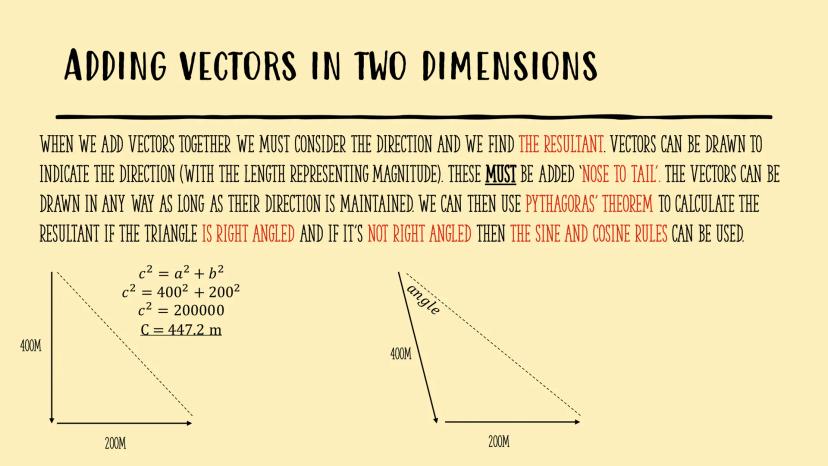
For vectors at right angles, we can use Pythagoras' theorem to calculate the magnitude of the resultant: c² = a² + b²
For example, if you walk 400m east then 200m north, your resultant displacement can be calculated: c² = 400² + 200² c² = 200,000 c = 447.2m
For vectors that aren't at right angles, we need to use the sine and cosine rules from trigonometry. This approach allows us to add any vectors regardless of their directions.
Practical application: Navigation systems use vector addition constantly to calculate your position as you move in different directions.
Motion-time graphs are powerful visual tools that show how an object's position, velocity, and acceleration change over time. These graphs make it easier to understand motion patterns that might be difficult to describe in words alone.
Different types of motion-time graphs reveal different aspects of an object's journey. They allow us to quickly identify when an object is speeding up, slowing down, or moving at constant speed, as well as determining important quantities like displacement and acceleration.
By analyzing the shapes, slopes, and areas of these graphs, you can extract considerable information about an object's motion. In the coming pages, we'll explore the three main types of motion-time graphs: displacement-time, velocity-time, and acceleration-time graphs.
Learning to interpret these graphs is an essential physics skill that will help you solve complex motion problems more easily. They're also frequently used in exam questions, so mastering them will boost your confidence significantly.
Pro tip: When you see a motion graph in an exam, first identify what type it is , as this tells you what information you can directly extract from it.
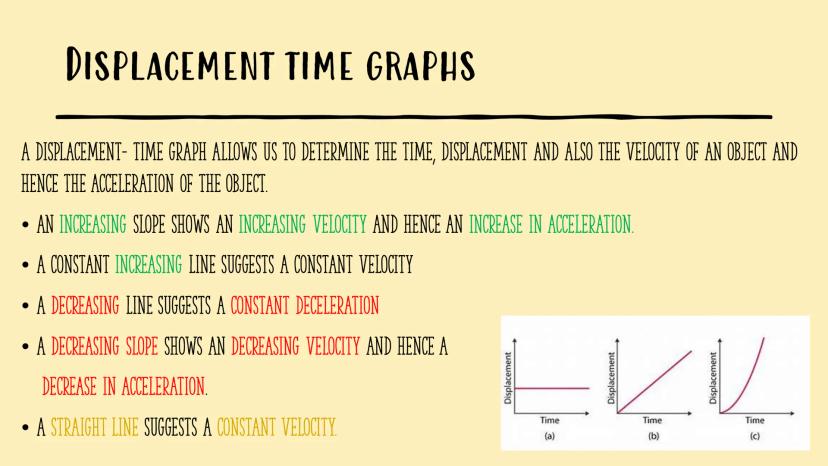
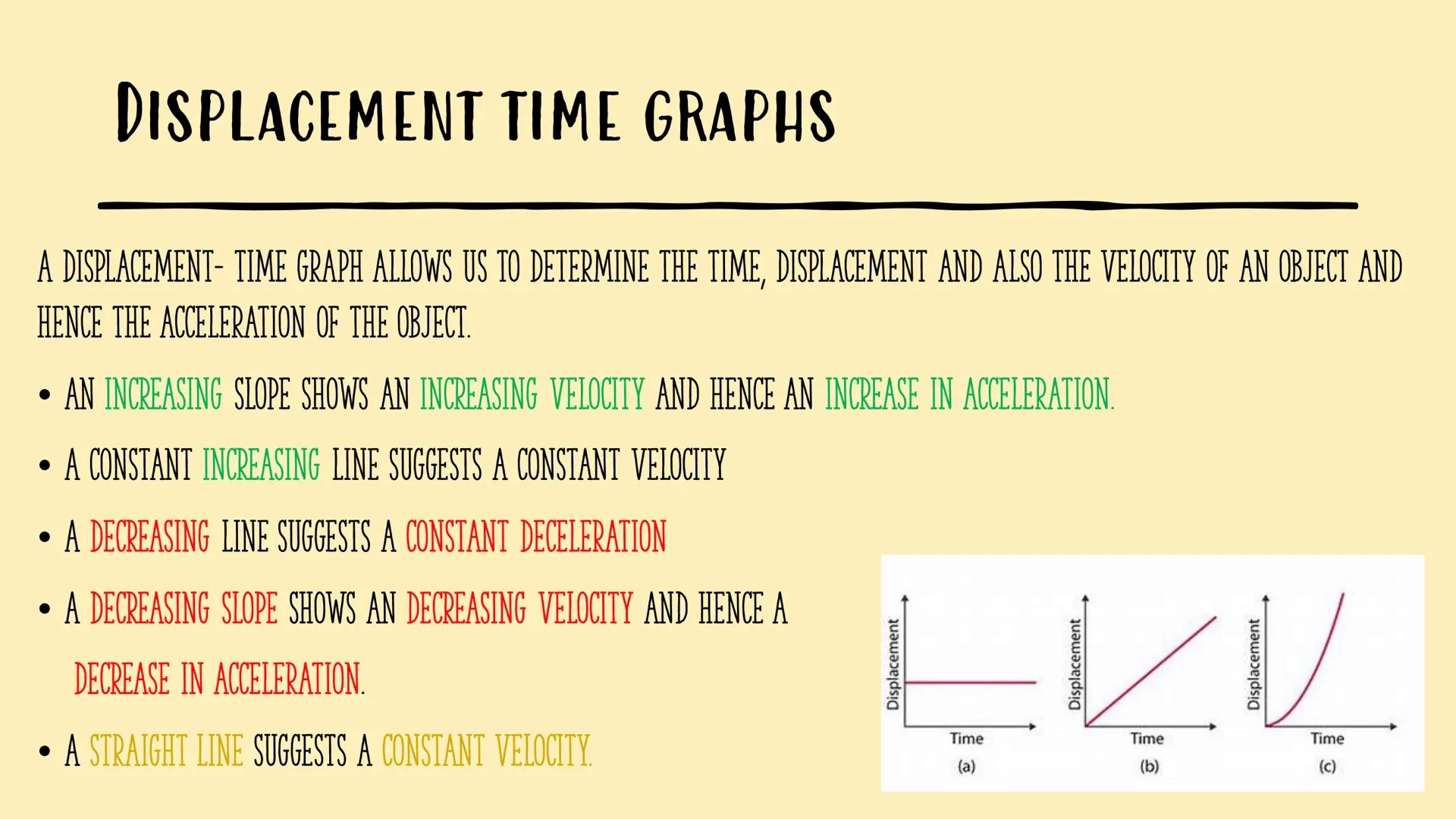
Displacement-time graphs show an object's position relative to its starting point over time. By analyzing the shape of this graph, you can determine both the velocity and acceleration of the object at any moment.
The slope (gradient) of a displacement-time graph represents velocity. A steep slope indicates high velocity, while a shallow slope shows low velocity. When the slope is positive, the object moves in the positive direction; when negative, it moves in the negative direction.
Different line patterns reveal different motion types:
You can determine the velocity at any point by finding the gradient of the tangent to the curve at that point.
Visualization tip: Think of displacement-time graphs as "where" graphs - they tell you where an object is at each moment in time.
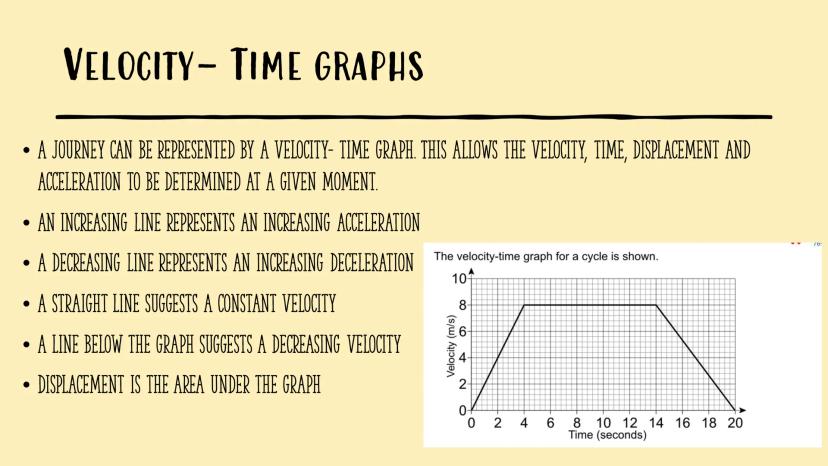
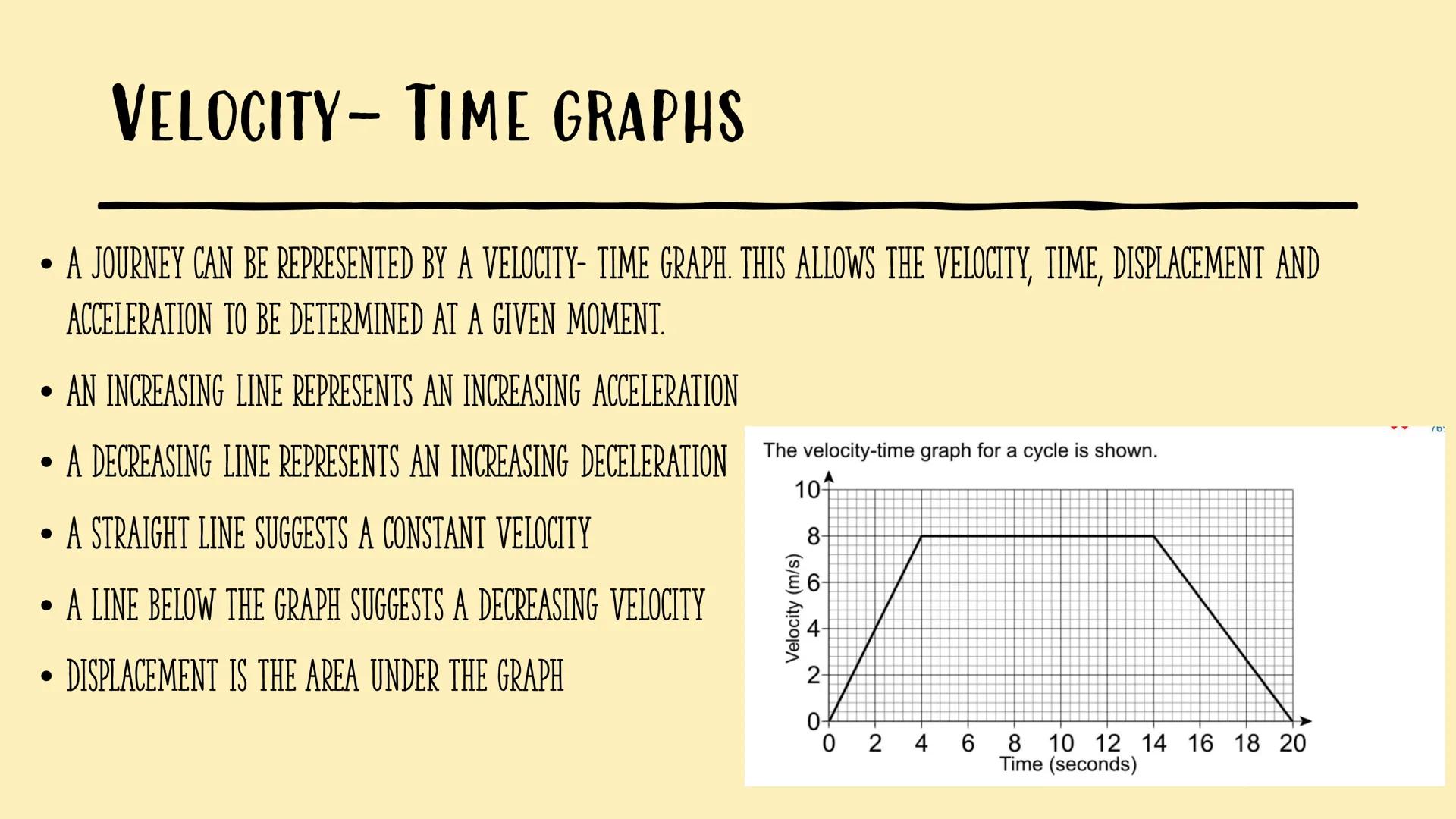
Velocity-time graphs provide a clear picture of how an object's speed and direction change over time. These graphs are particularly useful because they reveal multiple aspects of motion simultaneously.
The slope of a velocity-time graph represents acceleration. A steep positive slope indicates rapid acceleration, a negative slope shows deceleration, and a horizontal line (zero slope) means constant velocity with no acceleration.
The area under the curve between two time points represents displacement - how far the object has moved during that time interval. This is a powerful feature of velocity-time graphs that makes them especially useful for complex motion problems.
Line patterns have specific meanings:
Remember: In velocity-time graphs, both position (area) and acceleration (slope) can be determined from a single graph.
Acceleration-time graphs show how an object's acceleration changes throughout its journey. These graphs complement velocity-time and displacement-time graphs to provide a complete picture of motion.
On an acceleration-time graph, the y-axis shows acceleration , and the x-axis shows time. A positive value indicates acceleration in the positive direction, while a negative value shows acceleration in the negative direction (often called deceleration).
The area under the curve between any two time points represents the change in velocity during that time interval. This allows you to determine how much the object's velocity has increased or decreased.
Acceleration-time graphs are often derived from velocity-time graphs by calculating the gradient at each point. A horizontal line on an acceleration-time graph represents constant acceleration, which would appear as a straight sloped line on a velocity-time graph.
Connecting the graphs: If you're given one type of motion graph , you can derive the others through mathematical operations - differentiation or integration.
Our AI Companion is a student-focused AI tool that offers more than just answers. Built on millions of Knowunity resources, it provides relevant information, personalised study plans, quizzes, and content directly in the chat, adapting to your individual learning journey.
You can download the app from Google Play Store and Apple App Store.
That's right! Enjoy free access to study content, connect with fellow students, and get instant help – all at your fingertips.
App Store
Google Play
The app is very easy to use and well designed. I have found everything I was looking for so far and have been able to learn a lot from the presentations! I will definitely use the app for a class assignment! And of course it also helps a lot as an inspiration.
Stefan S
iOS user
This app is really great. There are so many study notes and help [...]. My problem subject is French, for example, and the app has so many options for help. Thanks to this app, I have improved my French. I would recommend it to anyone.
Samantha Klich
Android user
Wow, I am really amazed. I just tried the app because I've seen it advertised many times and was absolutely stunned. This app is THE HELP you want for school and above all, it offers so many things, such as workouts and fact sheets, which have been VERY helpful to me personally.
Anna
iOS user
Best app on earth! no words because it’s too good
Thomas R
iOS user
Just amazing. Let's me revise 10x better, this app is a quick 10/10. I highly recommend it to anyone. I can watch and search for notes. I can save them in the subject folder. I can revise it any time when I come back. If you haven't tried this app, you're really missing out.
Basil
Android user
This app has made me feel so much more confident in my exam prep, not only through boosting my own self confidence through the features that allow you to connect with others and feel less alone, but also through the way the app itself is centred around making you feel better. It is easy to navigate, fun to use, and helpful to anyone struggling in absolutely any way.
David K
iOS user
The app's just great! All I have to do is enter the topic in the search bar and I get the response real fast. I don't have to watch 10 YouTube videos to understand something, so I'm saving my time. Highly recommended!
Sudenaz Ocak
Android user
In school I was really bad at maths but thanks to the app, I am doing better now. I am so grateful that you made the app.
Greenlight Bonnie
Android user
very reliable app to help and grow your ideas of Maths, English and other related topics in your works. please use this app if your struggling in areas, this app is key for that. wish I'd of done a review before. and it's also free so don't worry about that.
Rohan U
Android user
I know a lot of apps use fake accounts to boost their reviews but this app deserves it all. Originally I was getting 4 in my English exams and this time I got a grade 7. I didn’t even know about this app three days until the exam and it has helped A LOT. Please actually trust me and use it as I’m sure you too will see developments.
Xander S
iOS user
THE QUIZES AND FLASHCARDS ARE SO USEFUL AND I LOVE THE SCHOOLGPT. IT ALSO IS LITREALLY LIKE CHATGPT BUT SMARTER!! HELPED ME WITH MY MASCARA PROBLEMS TOO!! AS WELL AS MY REAL SUBJECTS ! DUHHH 😍😁😲🤑💗✨🎀😮
Elisha
iOS user
This apps acc the goat. I find revision so boring but this app makes it so easy to organize it all and then you can ask the freeeee ai to test yourself so good and you can easily upload your own stuff. highly recommend as someone taking mocks now
Paul T
iOS user
The app is very easy to use and well designed. I have found everything I was looking for so far and have been able to learn a lot from the presentations! I will definitely use the app for a class assignment! And of course it also helps a lot as an inspiration.
Stefan S
iOS user
This app is really great. There are so many study notes and help [...]. My problem subject is French, for example, and the app has so many options for help. Thanks to this app, I have improved my French. I would recommend it to anyone.
Samantha Klich
Android user
Wow, I am really amazed. I just tried the app because I've seen it advertised many times and was absolutely stunned. This app is THE HELP you want for school and above all, it offers so many things, such as workouts and fact sheets, which have been VERY helpful to me personally.
Anna
iOS user
Best app on earth! no words because it’s too good
Thomas R
iOS user
Just amazing. Let's me revise 10x better, this app is a quick 10/10. I highly recommend it to anyone. I can watch and search for notes. I can save them in the subject folder. I can revise it any time when I come back. If you haven't tried this app, you're really missing out.
Basil
Android user
This app has made me feel so much more confident in my exam prep, not only through boosting my own self confidence through the features that allow you to connect with others and feel less alone, but also through the way the app itself is centred around making you feel better. It is easy to navigate, fun to use, and helpful to anyone struggling in absolutely any way.
David K
iOS user
The app's just great! All I have to do is enter the topic in the search bar and I get the response real fast. I don't have to watch 10 YouTube videos to understand something, so I'm saving my time. Highly recommended!
Sudenaz Ocak
Android user
In school I was really bad at maths but thanks to the app, I am doing better now. I am so grateful that you made the app.
Greenlight Bonnie
Android user
very reliable app to help and grow your ideas of Maths, English and other related topics in your works. please use this app if your struggling in areas, this app is key for that. wish I'd of done a review before. and it's also free so don't worry about that.
Rohan U
Android user
I know a lot of apps use fake accounts to boost their reviews but this app deserves it all. Originally I was getting 4 in my English exams and this time I got a grade 7. I didn’t even know about this app three days until the exam and it has helped A LOT. Please actually trust me and use it as I’m sure you too will see developments.
Xander S
iOS user
THE QUIZES AND FLASHCARDS ARE SO USEFUL AND I LOVE THE SCHOOLGPT. IT ALSO IS LITREALLY LIKE CHATGPT BUT SMARTER!! HELPED ME WITH MY MASCARA PROBLEMS TOO!! AS WELL AS MY REAL SUBJECTS ! DUHHH 😍😁😲🤑💗✨🎀😮
Elisha
iOS user
This apps acc the goat. I find revision so boring but this app makes it so easy to organize it all and then you can ask the freeeee ai to test yourself so good and you can easily upload your own stuff. highly recommend as someone taking mocks now
Paul T
iOS user
Amy Neill
@amyneill
Physics is all about understanding how our universe works, from the motion of everyday objects to the expansion of galaxies. These Higher Physics notes focus on "Our Dynamic Universe," covering essential concepts from vectors and motion to Einstein's relativity and... Show more
Access to all documents
Improve your grades
Join milions of students
By signing up you accept Terms of Service and Privacy Policy
Welcome to Higher Physics! "Our Dynamic Universe" explores how objects move and interact, from dropping a pencil to satellites orbiting Earth. These concepts form the foundation for understanding how our universe operates on both small and massive scales.
The physics of motion helps explain everything from car safety systems to how galaxies move through space. You'll discover that the same principles apply whether you're calculating how a football travels through the air or how stars orbit the center of our galaxy.
Throughout these notes, we'll build your understanding step by step, moving from simple motion concepts to the mind-bending ideas of Einstein's relativity. By mastering these principles, you'll develop powerful analytical skills useful in many future careers.
Did you know? The physics principles you'll learn in this section explain both why your phone falls when you drop it and why our universe is expanding!
Access to all documents
Improve your grades
Join milions of students
By signing up you accept Terms of Service and Privacy Policy
When describing physical quantities in physics, we need to be precise about whether direction matters. This is where the distinction between vectors and scalars becomes crucial.
Physical quantities come in two types. Scalars are quantities that only have magnitude (size) - like distance, energy, mass, speed, and time. For example, saying "I ran 5 kilometers" or "The temperature is 20°C" provides complete information because these quantities don't need direction to be fully described.
Vectors, on the other hand, have both magnitude and direction. Displacement, velocity, acceleration, momentum, and force are all vector quantities. If someone says "I walked 5 kilometers east," they're giving you a vector - both how far and in which direction.
This distinction isn't just technical - it affects how we calculate with these quantities. When adding scalars, simple arithmetic works . But adding vectors requires considering their directions, which we'll explore in coming pages.
Remember: When you see a vector quantity in a problem, always look for information about direction - it's essential for solving correctly!
Access to all documents
Improve your grades
Join milions of students
By signing up you accept Terms of Service and Privacy Policy
You might think distance and displacement are the same thing, but in physics, they represent different concepts that are crucial to understand.
Distance is the total length of the path traveled, regardless of direction. It's a scalar quantity that only tells you how far something has moved in total. For example, if you walk 50m east, then 50m west, your total distance traveled is 100m.
Displacement is the straight-line distance from the starting point to the final position, including direction. As a vector quantity, it tells you how far out of place something is from where it started. In our example, walking 50m east then 50m west gives a displacement of 0m because you ended up back at your starting point.
This distinction becomes important in practical applications. When calculating fuel consumption, you need the total distance traveled. But when determining how far you are from home, displacement is what matters.
Think about it: You could walk for hours and cover a large distance, but if you end up where you started, your displacement is zero!
Access to all documents
Improve your grades
Join milions of students
By signing up you accept Terms of Service and Privacy Policy
The difference between speed and velocity parallels the distinction between distance and displacement - and understanding this difference is vital for solving physics problems correctly.
Speed tells you how fast an object is moving regardless of direction. It's calculated by dividing distance by time: v = d/t. Since both distance and time are scalars, speed is also a scalar quantity. If a car travels 60 kilometers in 1 hour, its speed is 60 km/h, regardless of which direction it's traveling.
Velocity combines speed with direction, making it a vector quantity. It's calculated using displacement instead of distance: v = s/t. For example, "60 km/h east" is a velocity. Two objects might have the same speed but different velocities if they're moving in different directions.
When an object moves in a straight line without changing direction, the magnitude of its velocity equals its speed. However, if the object changes direction (like a car going around a curve), its speed might remain constant while its velocity changes.
Exam tip: If a question asks about velocity, make sure your answer includes direction. If it asks about speed, direction isn't needed.
Access to all documents
Improve your grades
Join milions of students
By signing up you accept Terms of Service and Privacy Policy
Acceleration occurs whenever an object's velocity changes - whether it speeds up, slows down, or changes direction. As a vector quantity, acceleration has both magnitude and direction.
The formula for calculating acceleration is: a = /t where a is acceleration, v is final velocity, u is initial velocity, and t is time. The unit of acceleration is meters per second squared .
You can measure acceleration experimentally using light gates and a trolley on a ramp. When you release the trolley from the top of the ramp, it accelerates down the slope. The light gates record the time taken for a card attached to the trolley to pass through, allowing you to calculate its acceleration.
Understanding acceleration is crucial in many real-world applications. For example, car manufacturers measure acceleration to evaluate performance, while engineers use acceleration calculations when designing roller coasters to ensure the forces experienced by riders remain safe.
Important: Remember that deceleration is just acceleration in the opposite direction to motion. In physics, we typically use "negative acceleration" rather than "deceleration."
Access to all documents
Improve your grades
Join milions of students
By signing up you accept Terms of Service and Privacy Policy
Unlike scalars that add together directly, vectors must be combined using their magnitude and direction. This becomes especially important when dealing with vectors in two dimensions.
When adding vectors, we use the "tip-to-tail" method, where the tail of one vector connects to the tip of another. The resultant vector is drawn from the starting point to the final tip. The order of addition doesn't matter - you'll get the same resultant either way.
For vectors at right angles, we can use Pythagoras' theorem to calculate the magnitude of the resultant: c² = a² + b²
For example, if you walk 400m east then 200m north, your resultant displacement can be calculated: c² = 400² + 200² c² = 200,000 c = 447.2m
For vectors that aren't at right angles, we need to use the sine and cosine rules from trigonometry. This approach allows us to add any vectors regardless of their directions.
Practical application: Navigation systems use vector addition constantly to calculate your position as you move in different directions.
Access to all documents
Improve your grades
Join milions of students
By signing up you accept Terms of Service and Privacy Policy
Motion-time graphs are powerful visual tools that show how an object's position, velocity, and acceleration change over time. These graphs make it easier to understand motion patterns that might be difficult to describe in words alone.
Different types of motion-time graphs reveal different aspects of an object's journey. They allow us to quickly identify when an object is speeding up, slowing down, or moving at constant speed, as well as determining important quantities like displacement and acceleration.
By analyzing the shapes, slopes, and areas of these graphs, you can extract considerable information about an object's motion. In the coming pages, we'll explore the three main types of motion-time graphs: displacement-time, velocity-time, and acceleration-time graphs.
Learning to interpret these graphs is an essential physics skill that will help you solve complex motion problems more easily. They're also frequently used in exam questions, so mastering them will boost your confidence significantly.
Pro tip: When you see a motion graph in an exam, first identify what type it is , as this tells you what information you can directly extract from it.
Access to all documents
Improve your grades
Join milions of students
By signing up you accept Terms of Service and Privacy Policy
Displacement-time graphs show an object's position relative to its starting point over time. By analyzing the shape of this graph, you can determine both the velocity and acceleration of the object at any moment.
The slope (gradient) of a displacement-time graph represents velocity. A steep slope indicates high velocity, while a shallow slope shows low velocity. When the slope is positive, the object moves in the positive direction; when negative, it moves in the negative direction.
Different line patterns reveal different motion types:
You can determine the velocity at any point by finding the gradient of the tangent to the curve at that point.
Visualization tip: Think of displacement-time graphs as "where" graphs - they tell you where an object is at each moment in time.
Access to all documents
Improve your grades
Join milions of students
By signing up you accept Terms of Service and Privacy Policy
Velocity-time graphs provide a clear picture of how an object's speed and direction change over time. These graphs are particularly useful because they reveal multiple aspects of motion simultaneously.
The slope of a velocity-time graph represents acceleration. A steep positive slope indicates rapid acceleration, a negative slope shows deceleration, and a horizontal line (zero slope) means constant velocity with no acceleration.
The area under the curve between two time points represents displacement - how far the object has moved during that time interval. This is a powerful feature of velocity-time graphs that makes them especially useful for complex motion problems.
Line patterns have specific meanings:
Remember: In velocity-time graphs, both position (area) and acceleration (slope) can be determined from a single graph.
Access to all documents
Improve your grades
Join milions of students
By signing up you accept Terms of Service and Privacy Policy
Acceleration-time graphs show how an object's acceleration changes throughout its journey. These graphs complement velocity-time and displacement-time graphs to provide a complete picture of motion.
On an acceleration-time graph, the y-axis shows acceleration , and the x-axis shows time. A positive value indicates acceleration in the positive direction, while a negative value shows acceleration in the negative direction (often called deceleration).
The area under the curve between any two time points represents the change in velocity during that time interval. This allows you to determine how much the object's velocity has increased or decreased.
Acceleration-time graphs are often derived from velocity-time graphs by calculating the gradient at each point. A horizontal line on an acceleration-time graph represents constant acceleration, which would appear as a straight sloped line on a velocity-time graph.
Connecting the graphs: If you're given one type of motion graph , you can derive the others through mathematical operations - differentiation or integration.
Our AI Companion is a student-focused AI tool that offers more than just answers. Built on millions of Knowunity resources, it provides relevant information, personalised study plans, quizzes, and content directly in the chat, adapting to your individual learning journey.
You can download the app from Google Play Store and Apple App Store.
That's right! Enjoy free access to study content, connect with fellow students, and get instant help – all at your fingertips.
13
Smart Tools NEW
Transform this note into: ✓ 50+ Practice Questions ✓ Interactive Flashcards ✓ Full Mock Exam ✓ Essay Outlines
Explore key concepts in Mechanics for A-Level Physics (AQA). This summary covers essential topics such as Newton's Laws, conservation of energy and momentum, kinematics, projectile motion, and work-energy principles. Ideal for exam preparation and understanding fundamental mechanics principles.
 Physics
Comprehensive study material covering key concepts in Mechanics for AQA A Level Physics. Explore scalar and vector quantities, free fall, projectile motion, forces, energy conservation, and Newton's Laws. Ideal for exam preparation and understanding fundamental principles of motion and mechanics.
PhysicsExplore key concepts in Circular Motion and Simple Harmonic Motion (SHM) including centripetal force, acceleration, kinetic and potential energy, and equilibrium position. This summary provides essential formulas and principles for A Level Physics (AQA) students, focusing on the relationships between energy types and motion dynamics.
PhysicsExplore detailed solutions to the OCR A Level Physics June 2018 paper, covering key concepts such as Newtonian Mechanics, Circular Motion, Gravitational Fields, and more. This comprehensive resource includes worked examples and explanations for each question, making it an essential study tool for mastering physics concepts and exam preparation.
PhysicsExplore the fundamentals of centripetal motion in this A Level Physics summary. Understand key concepts such as centripetal acceleration, angular velocity, and the forces involved in circular motion. Ideal for AQA students preparing for exams, this resource covers essential equations and principles of rotational dynamics.
PhysicsExplore the principles of moments and motion in this detailed summary. Learn about the moment of a force, couples, equilibrium, and key kinematic concepts such as speed, displacement, velocity, and acceleration. Ideal for A-Level Physics students seeking to grasp these fundamental mechanics topics.
PhysicsApp Store
Google Play
The app is very easy to use and well designed. I have found everything I was looking for so far and have been able to learn a lot from the presentations! I will definitely use the app for a class assignment! And of course it also helps a lot as an inspiration.
Stefan S
iOS user
This app is really great. There are so many study notes and help [...]. My problem subject is French, for example, and the app has so many options for help. Thanks to this app, I have improved my French. I would recommend it to anyone.
Samantha Klich
Android user
Wow, I am really amazed. I just tried the app because I've seen it advertised many times and was absolutely stunned. This app is THE HELP you want for school and above all, it offers so many things, such as workouts and fact sheets, which have been VERY helpful to me personally.
Anna
iOS user
Best app on earth! no words because it’s too good
Thomas R
iOS user
Just amazing. Let's me revise 10x better, this app is a quick 10/10. I highly recommend it to anyone. I can watch and search for notes. I can save them in the subject folder. I can revise it any time when I come back. If you haven't tried this app, you're really missing out.
Basil
Android user
This app has made me feel so much more confident in my exam prep, not only through boosting my own self confidence through the features that allow you to connect with others and feel less alone, but also through the way the app itself is centred around making you feel better. It is easy to navigate, fun to use, and helpful to anyone struggling in absolutely any way.
David K
iOS user
The app's just great! All I have to do is enter the topic in the search bar and I get the response real fast. I don't have to watch 10 YouTube videos to understand something, so I'm saving my time. Highly recommended!
Sudenaz Ocak
Android user
In school I was really bad at maths but thanks to the app, I am doing better now. I am so grateful that you made the app.
Greenlight Bonnie
Android user
very reliable app to help and grow your ideas of Maths, English and other related topics in your works. please use this app if your struggling in areas, this app is key for that. wish I'd of done a review before. and it's also free so don't worry about that.
Rohan U
Android user
I know a lot of apps use fake accounts to boost their reviews but this app deserves it all. Originally I was getting 4 in my English exams and this time I got a grade 7. I didn’t even know about this app three days until the exam and it has helped A LOT. Please actually trust me and use it as I’m sure you too will see developments.
Xander S
iOS user
THE QUIZES AND FLASHCARDS ARE SO USEFUL AND I LOVE THE SCHOOLGPT. IT ALSO IS LITREALLY LIKE CHATGPT BUT SMARTER!! HELPED ME WITH MY MASCARA PROBLEMS TOO!! AS WELL AS MY REAL SUBJECTS ! DUHHH 😍😁😲🤑💗✨🎀😮
Elisha
iOS user
This apps acc the goat. I find revision so boring but this app makes it so easy to organize it all and then you can ask the freeeee ai to test yourself so good and you can easily upload your own stuff. highly recommend as someone taking mocks now
Paul T
iOS user
The app is very easy to use and well designed. I have found everything I was looking for so far and have been able to learn a lot from the presentations! I will definitely use the app for a class assignment! And of course it also helps a lot as an inspiration.
Stefan S
iOS user
This app is really great. There are so many study notes and help [...]. My problem subject is French, for example, and the app has so many options for help. Thanks to this app, I have improved my French. I would recommend it to anyone.
Samantha Klich
Android user
Wow, I am really amazed. I just tried the app because I've seen it advertised many times and was absolutely stunned. This app is THE HELP you want for school and above all, it offers so many things, such as workouts and fact sheets, which have been VERY helpful to me personally.
Anna
iOS user
Best app on earth! no words because it’s too good
Thomas R
iOS user
Just amazing. Let's me revise 10x better, this app is a quick 10/10. I highly recommend it to anyone. I can watch and search for notes. I can save them in the subject folder. I can revise it any time when I come back. If you haven't tried this app, you're really missing out.
Basil
Android user
This app has made me feel so much more confident in my exam prep, not only through boosting my own self confidence through the features that allow you to connect with others and feel less alone, but also through the way the app itself is centred around making you feel better. It is easy to navigate, fun to use, and helpful to anyone struggling in absolutely any way.
David K
iOS user
The app's just great! All I have to do is enter the topic in the search bar and I get the response real fast. I don't have to watch 10 YouTube videos to understand something, so I'm saving my time. Highly recommended!
Sudenaz Ocak
Android user
In school I was really bad at maths but thanks to the app, I am doing better now. I am so grateful that you made the app.
Greenlight Bonnie
Android user
very reliable app to help and grow your ideas of Maths, English and other related topics in your works. please use this app if your struggling in areas, this app is key for that. wish I'd of done a review before. and it's also free so don't worry about that.
Rohan U
Android user
I know a lot of apps use fake accounts to boost their reviews but this app deserves it all. Originally I was getting 4 in my English exams and this time I got a grade 7. I didn’t even know about this app three days until the exam and it has helped A LOT. Please actually trust me and use it as I’m sure you too will see developments.
Xander S
iOS user
THE QUIZES AND FLASHCARDS ARE SO USEFUL AND I LOVE THE SCHOOLGPT. IT ALSO IS LITREALLY LIKE CHATGPT BUT SMARTER!! HELPED ME WITH MY MASCARA PROBLEMS TOO!! AS WELL AS MY REAL SUBJECTS ! DUHHH 😍😁😲🤑💗✨🎀😮
Elisha
iOS user
This apps acc the goat. I find revision so boring but this app makes it so easy to organize it all and then you can ask the freeeee ai to test yourself so good and you can easily upload your own stuff. highly recommend as someone taking mocks now
Paul T
iOS user