Essential Graphs and Equations
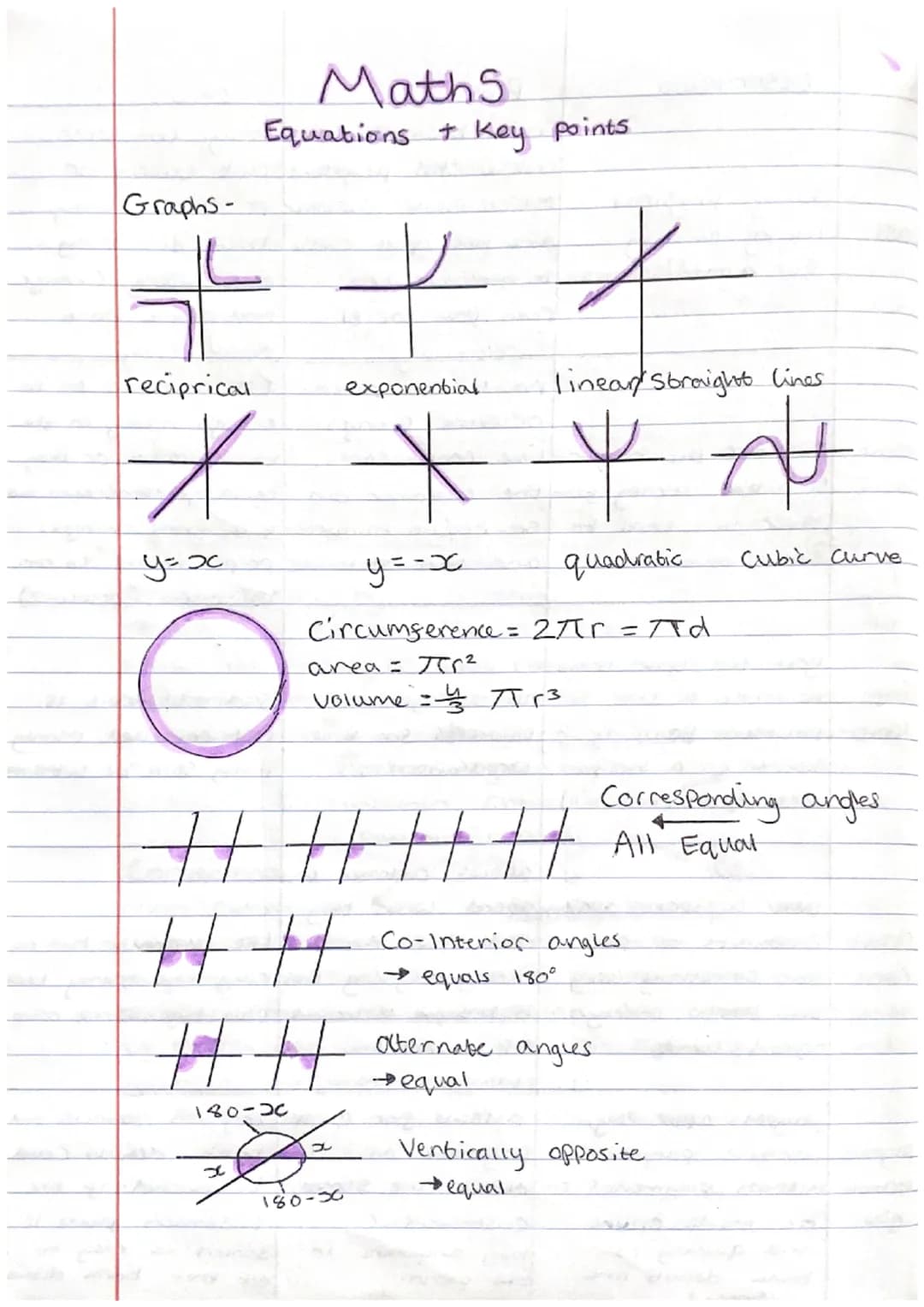
Different types of graphs have distinct shapes that you'll recognise instantly once you know what to look for. Linear graphs create straight lines - the simplest examples being y = x (a diagonal line going up) and y = -x (a diagonal line going down).
Quadratic equations produce curved graphs called parabolas, whilst exponential graphs show dramatic curves that either shoot upwards or level off. Reciprocal graphs create distinctive hyperbolas with two separate curved sections.
For circles, you've got two crucial formulas to memorise: circumference = 2πr = πd and area = πr². There's also a volume formula mentioned (⅓πr³), though this seems to be mixing up different shapes - typical maths confusion that happens to everyone!
Quick tip: Sketch these graph shapes in your notes - visual memory is your best friend for recognising them in exams.
Angle Relationships Made Simple
Corresponding angles are always equal when you've got parallel lines cut by a transversal - think of them as being in matching positions. Alternate angles also equal each other, but they're on opposite sides of the transversal in a Z-pattern.
Co-interior angles work differently - they always add up to 180° instead of being equal. Vertically opposite angles are the pairs that face each other when two lines cross, and these are always identical.
The key trick is spotting these relationships quickly in diagrams. Once you can identify which type of angle pair you're dealing with, the rest becomes straightforward calculation.
Remember: When lines are parallel, corresponding and alternate angles are equal, but co-interior angles sum to 180°.


 Sociology