
After Germany's defeat in World War I, the country went... Show more
 Sociology
 English Literature
 Biology
Sign up to see the contentIt's free!
Access to all documents
Improve your grades
Join milions of students
Knowunity AI
Subjects
Triangle Congruence and Similarity Theorems
Triangle Properties and Classification
Linear Equations and Graphs
Geometric Angle Relationships
Trigonometric Functions and Identities
Equation Solving Techniques
Circle Geometry Fundamentals
Division Operations and Methods
Basic Differentiation Rules
Exponent and Logarithm Properties
Show all topics
Human Organ Systems
Reproductive Cell Cycles
Biological Sciences Subdisciplines
Cellular Energy Metabolism
Autotrophic Energy Processes
Inheritance Patterns and Principles
Biomolecular Structure and Organization
Cell Cycle and Division Mechanics
Cellular Organization and Development
Biological Structural Organization
Show all topics
Chemical Sciences and Applications
Atomic Structure and Composition
Molecular Electron Structure Representation
Atomic Electron Behavior
Matter Properties and Water
Mole Concept and Calculations
Gas Laws and Behavior
Periodic Table Organization
Chemical Thermodynamics Fundamentals
Chemical Bond Types and Properties
Show all topics
European Renaissance and Enlightenment
European Cultural Movements 800-1920
American Revolution Era 1763-1797
American Civil War 1861-1865
Global Imperial Systems
Mongol and Chinese Dynasties
U.S. Presidents and World Leaders
Historical Sources and Documentation
World Wars Era and Impact
World Religious Systems
Show all topics
Classic and Contemporary Novels
Literary Character Analysis
Rhetorical Theory and Practice
Classic Literary Narratives
Reading Analysis and Interpretation
Narrative Structure and Techniques
English Language Components
Influential English-Language Authors
Basic Sentence Structure
Narrative Voice and Perspective
Show all topics
476
•
Updated Apr 5, 2026
•

huda
@hihudaa
After Germany's defeat in World War I, the country went... Show more
Ever wondered how a whole country can completely change its government overnight? That's exactly what happened to Germany at the end of WWI when everything fell apart spectacularly.
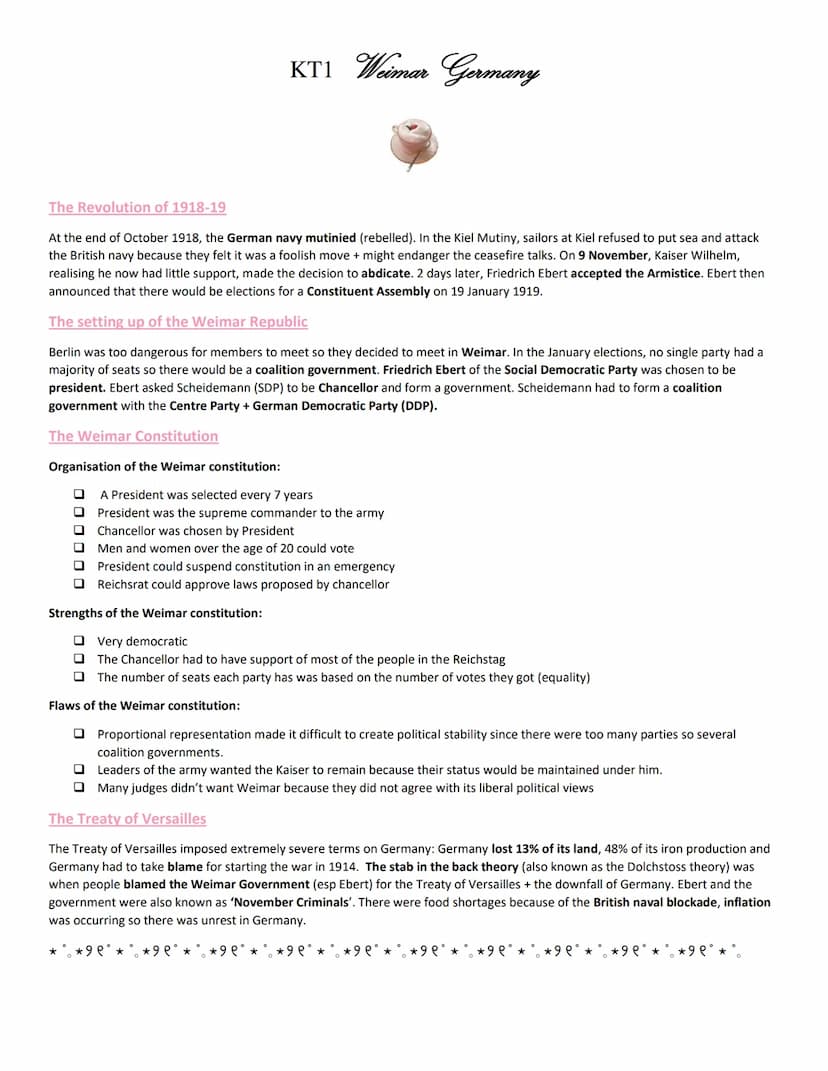
It all started with the Kiel Mutiny in October 1918, when German sailors basically said "nope" to attacking the British navy because they thought it was a suicide mission. Within days, Kaiser Wilhelm realised nobody wanted him anymore and abdicated on 9 November. Friedrich Ebert then accepted the Armistice and announced elections for January 1919.
The new government couldn't even meet in Berlin because it was too dangerous, so they gathered in the town of Weimar instead (hence the name). Since no party won enough seats, Ebert became president and had to form a coalition government with multiple parties working together.
Quick Tip: Remember that the Weimar Republic got its name simply because that's where politicians felt safe enough to meet!
The new Weimar Constitution looked brilliant on paper - it gave votes to everyone over 20 (including women!), but it had a fatal flaw. Proportional representation meant loads of small parties got seats, making stable government nearly impossible. Meanwhile, the Treaty of Versailles made Germans furious as they lost 13% of their land and had to accept all blame for the war. Many Germans blamed the new government for this disaster, calling them the "November Criminals".
The new Weimar government was like a goalkeeper facing penalty shots from both left-wing and right-wing extremists - and they had to save every single one to survive.
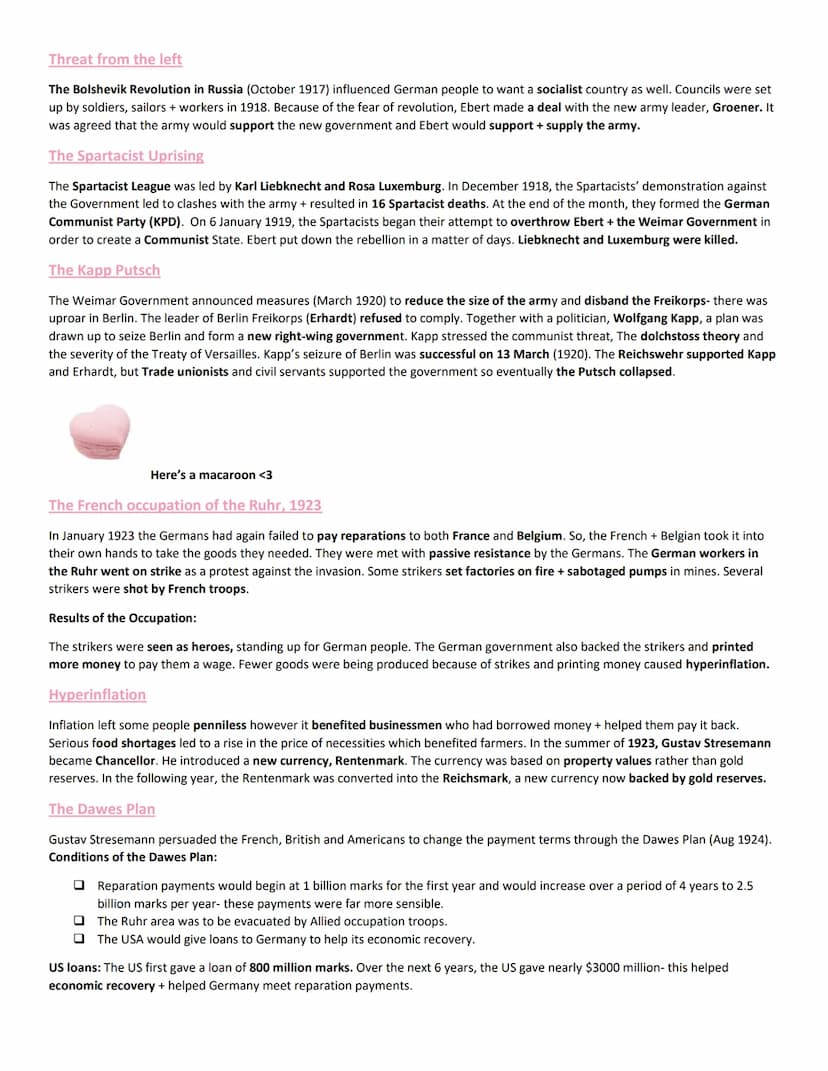
The Spartacist Uprising in January 1919 was the first major threat. Led by Karl Liebknecht and Rosa Luxemburg, these communists tried to overthrow the government and create a communist state like Russia. Ebert crushed the rebellion within days, and both leaders were killed. This showed that even Germany's new democracy would fight dirty when threatened.
From the opposite side came the Kapp Putsch in March 1920. Right-wing politician Wolfgang Kapp and the Freikorps seized Berlin, hoping to create a new right-wing government. They complained about the communist threat and the harsh Treaty of Versailles. Although the regular army supported Kapp, trade unions and civil servants backed the government with strikes, eventually forcing the putsch to collapse.
Key Point: The Weimar Republic survived these early years only because it made tough alliances and ordinary workers supported democracy over extremism.
The worst crisis came in 1923 when Germany couldn't pay war reparations, so France and Belgium occupied the Ruhr (Germany's industrial heartland). German workers went on strike in protest, but the government kept paying them by printing more money. This created hyperinflation so severe that people needed wheelbarrows full of cash to buy bread. Chancellor Gustav Stresemann finally ended this madness by introducing a new currency, the Rentenmark.
Just when Germany seemed doomed to chaos forever, Gustav Stresemann pulled off what many consider a political miracle that transformed the country's fortunes.
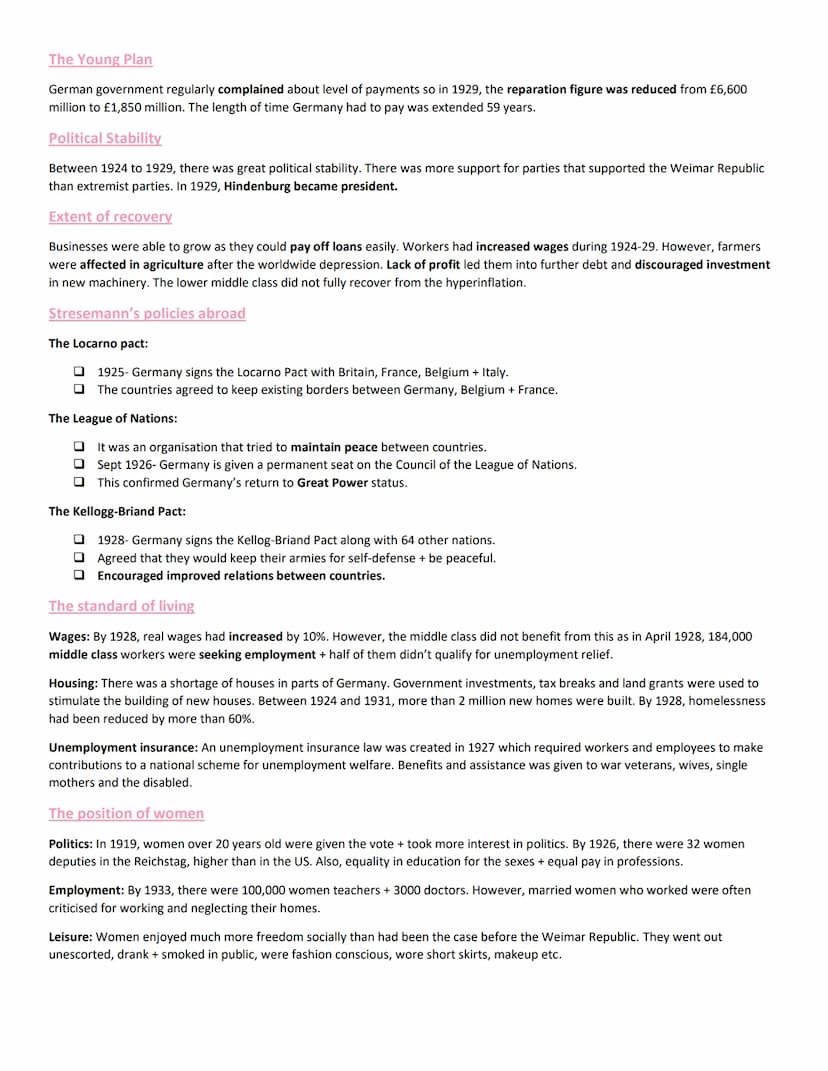
The Dawes Plan in 1924 was Stresemann's masterstroke. He convinced America, Britain, and France to make reparation payments more reasonable - starting at 1 billion marks and building up gradually. More importantly, the USA lent Germany nearly $3,000 million over six years, kick-starting economic recovery. The Young Plan in 1929 reduced total reparations from £6,600 million to £1,850 million, giving Germany much more breathing room.
Internationally, Germany was welcomed back into the community of nations. The Locarno Pact (1925) saw Germany agree to respect its borders with France and Belgium. Germany joined the League of Nations in 1926 with a permanent seat, confirming its return to great power status. The Kellogg-Briand Pact (1928) saw 64 nations, including Germany, promise to keep armies only for self-defence.
Success Story: By 1928, real wages had increased by 10%, over 2 million new homes were built, and homelessness dropped by 60% - proving democracy could deliver prosperity.
Life genuinely improved for most Germans. The government introduced unemployment insurance in 1927, providing a safety net for workers. Women gained incredible freedoms - they could vote, work as teachers and doctors, and enjoy social lives that would have scandalised previous generations. However, farmers struggled with debt, and the middle class never fully recovered from hyperinflation, creating underlying tensions.
While politicians were rebuilding Germany's economy and international reputation, artists and writers were creating a cultural explosion that would influence the world for decades.
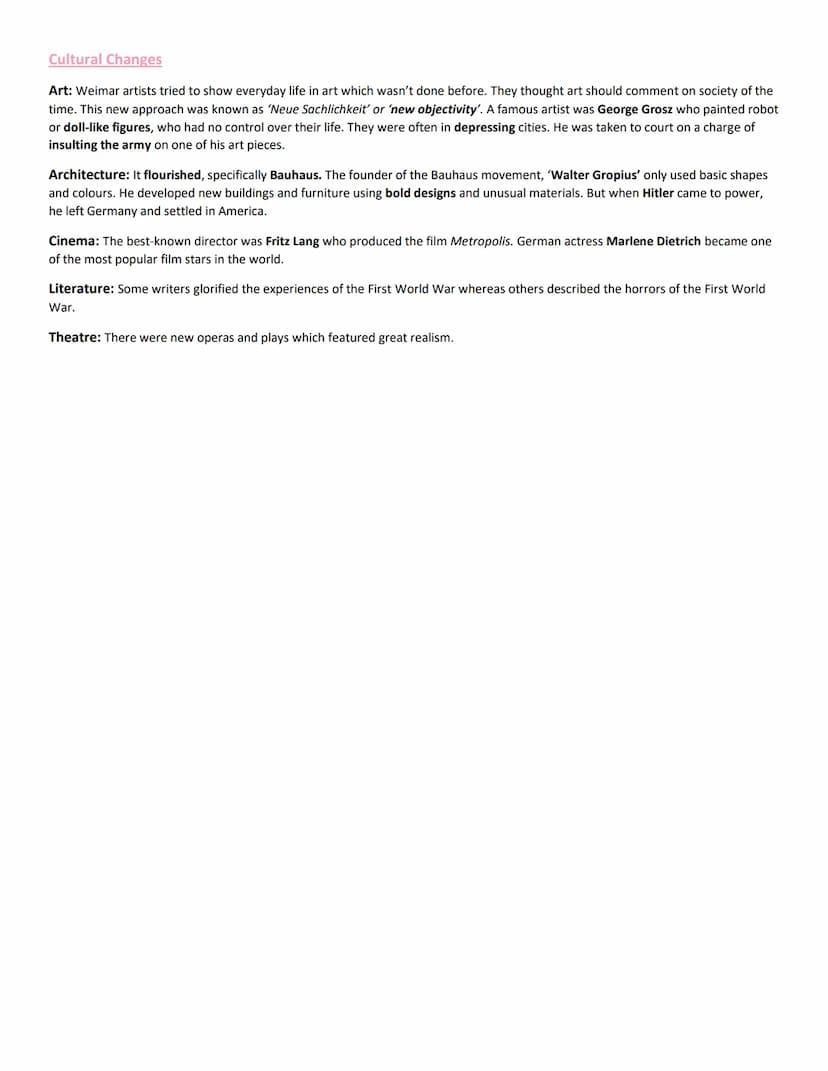
German culture embraced "Neue Sachlichkeit" (new objectivity), where artists showed real everyday life instead of romantic fantasy. George Grosz painted disturbing robot-like figures in depressing cities, commenting on modern society so brutally that he was taken to court for insulting the army. The Bauhaus movement, led by Walter Gropius, revolutionised architecture and design with bold shapes, basic colours, and unusual materials that looked completely different from traditional styles.
Cinema became Germany's calling card to the world. Fritz Lang created the groundbreaking film Metropolis, while actress Marlene Dietrich became a global superstar. German directors pushed the boundaries of what films could achieve, creating techniques still used today.
Cultural Impact: Many Bauhaus artists and filmmakers later fled to America when Hitler rose to power, taking their revolutionary ideas with them and influencing Hollywood and modern design.
Literature and theatre also flourished with new realism. Some writers glorified WWI experiences while others exposed its horrors, creating heated debates about Germany's past and future. This cultural renaissance showed that democracy wasn't just about politics - it unleashed creativity and freedom of expression that authoritarian regimes had suppressed.
However, this cultural freedom also created backlash from conservative Germans who felt traditional values were under attack, setting the stage for future political conflicts.
Our AI Companion is a student-focused AI tool that offers more than just answers. Built on millions of Knowunity resources, it provides relevant information, personalised study plans, quizzes, and content directly in the chat, adapting to your individual learning journey.
You can download the app from Google Play Store and Apple App Store.
That's right! Enjoy free access to study content, connect with fellow students, and get instant help – all at your fingertips.
App Store
Google Play
The app is very easy to use and well designed. I have found everything I was looking for so far and have been able to learn a lot from the presentations! I will definitely use the app for a class assignment! And of course it also helps a lot as an inspiration.
Stefan S
iOS user
This app is really great. There are so many study notes and help [...]. My problem subject is French, for example, and the app has so many options for help. Thanks to this app, I have improved my French. I would recommend it to anyone.
Samantha Klich
Android user
Wow, I am really amazed. I just tried the app because I've seen it advertised many times and was absolutely stunned. This app is THE HELP you want for school and above all, it offers so many things, such as workouts and fact sheets, which have been VERY helpful to me personally.
Anna
iOS user
Best app on earth! no words because it’s too good
Thomas R
iOS user
Just amazing. Let's me revise 10x better, this app is a quick 10/10. I highly recommend it to anyone. I can watch and search for notes. I can save them in the subject folder. I can revise it any time when I come back. If you haven't tried this app, you're really missing out.
Basil
Android user
This app has made me feel so much more confident in my exam prep, not only through boosting my own self confidence through the features that allow you to connect with others and feel less alone, but also through the way the app itself is centred around making you feel better. It is easy to navigate, fun to use, and helpful to anyone struggling in absolutely any way.
David K
iOS user
The app's just great! All I have to do is enter the topic in the search bar and I get the response real fast. I don't have to watch 10 YouTube videos to understand something, so I'm saving my time. Highly recommended!
Sudenaz Ocak
Android user
In school I was really bad at maths but thanks to the app, I am doing better now. I am so grateful that you made the app.
Greenlight Bonnie
Android user
very reliable app to help and grow your ideas of Maths, English and other related topics in your works. please use this app if your struggling in areas, this app is key for that. wish I'd of done a review before. and it's also free so don't worry about that.
Rohan U
Android user
I know a lot of apps use fake accounts to boost their reviews but this app deserves it all. Originally I was getting 4 in my English exams and this time I got a grade 7. I didn’t even know about this app three days until the exam and it has helped A LOT. Please actually trust me and use it as I’m sure you too will see developments.
Xander S
iOS user
THE QUIZES AND FLASHCARDS ARE SO USEFUL AND I LOVE Knowunity AI. IT ALSO IS LITREALLY LIKE CHATGPT BUT SMARTER!! HELPED ME WITH MY MASCARA PROBLEMS TOO!! AS WELL AS MY REAL SUBJECTS ! DUHHH 😍😁😲🤑💗✨🎀😮
Elisha
iOS user
This apps acc the goat. I find revision so boring but this app makes it so easy to organize it all and then you can ask the freeeee ai to test yourself so good and you can easily upload your own stuff. highly recommend as someone taking mocks now
Paul T
iOS user
The app is very easy to use and well designed. I have found everything I was looking for so far and have been able to learn a lot from the presentations! I will definitely use the app for a class assignment! And of course it also helps a lot as an inspiration.
Stefan S
iOS user
This app is really great. There are so many study notes and help [...]. My problem subject is French, for example, and the app has so many options for help. Thanks to this app, I have improved my French. I would recommend it to anyone.
Samantha Klich
Android user
Wow, I am really amazed. I just tried the app because I've seen it advertised many times and was absolutely stunned. This app is THE HELP you want for school and above all, it offers so many things, such as workouts and fact sheets, which have been VERY helpful to me personally.
Anna
iOS user
Best app on earth! no words because it’s too good
Thomas R
iOS user
Just amazing. Let's me revise 10x better, this app is a quick 10/10. I highly recommend it to anyone. I can watch and search for notes. I can save them in the subject folder. I can revise it any time when I come back. If you haven't tried this app, you're really missing out.
Basil
Android user
This app has made me feel so much more confident in my exam prep, not only through boosting my own self confidence through the features that allow you to connect with others and feel less alone, but also through the way the app itself is centred around making you feel better. It is easy to navigate, fun to use, and helpful to anyone struggling in absolutely any way.
David K
iOS user
The app's just great! All I have to do is enter the topic in the search bar and I get the response real fast. I don't have to watch 10 YouTube videos to understand something, so I'm saving my time. Highly recommended!
Sudenaz Ocak
Android user
In school I was really bad at maths but thanks to the app, I am doing better now. I am so grateful that you made the app.
Greenlight Bonnie
Android user
very reliable app to help and grow your ideas of Maths, English and other related topics in your works. please use this app if your struggling in areas, this app is key for that. wish I'd of done a review before. and it's also free so don't worry about that.
Rohan U
Android user
I know a lot of apps use fake accounts to boost their reviews but this app deserves it all. Originally I was getting 4 in my English exams and this time I got a grade 7. I didn’t even know about this app three days until the exam and it has helped A LOT. Please actually trust me and use it as I’m sure you too will see developments.
Xander S
iOS user
THE QUIZES AND FLASHCARDS ARE SO USEFUL AND I LOVE Knowunity AI. IT ALSO IS LITREALLY LIKE CHATGPT BUT SMARTER!! HELPED ME WITH MY MASCARA PROBLEMS TOO!! AS WELL AS MY REAL SUBJECTS ! DUHHH 😍😁😲🤑💗✨🎀😮
Elisha
iOS user
This apps acc the goat. I find revision so boring but this app makes it so easy to organize it all and then you can ask the freeeee ai to test yourself so good and you can easily upload your own stuff. highly recommend as someone taking mocks now
Paul T
iOS user
huda
@hihudaa
After Germany's defeat in World War I, the country went through massive political upheaval that led to the creation of the Weimar Republic. This new democratic government faced constant challenges from extremist groups, economic disasters, and the harsh Treaty of... Show more
Access to all documents
Improve your grades
Join milions of students
Ever wondered how a whole country can completely change its government overnight? That's exactly what happened to Germany at the end of WWI when everything fell apart spectacularly.
It all started with the Kiel Mutiny in October 1918, when German sailors basically said "nope" to attacking the British navy because they thought it was a suicide mission. Within days, Kaiser Wilhelm realised nobody wanted him anymore and abdicated on 9 November. Friedrich Ebert then accepted the Armistice and announced elections for January 1919.
The new government couldn't even meet in Berlin because it was too dangerous, so they gathered in the town of Weimar instead (hence the name). Since no party won enough seats, Ebert became president and had to form a coalition government with multiple parties working together.
Quick Tip: Remember that the Weimar Republic got its name simply because that's where politicians felt safe enough to meet!
The new Weimar Constitution looked brilliant on paper - it gave votes to everyone over 20 (including women!), but it had a fatal flaw. Proportional representation meant loads of small parties got seats, making stable government nearly impossible. Meanwhile, the Treaty of Versailles made Germans furious as they lost 13% of their land and had to accept all blame for the war. Many Germans blamed the new government for this disaster, calling them the "November Criminals".
Access to all documents
Improve your grades
Join milions of students
The new Weimar government was like a goalkeeper facing penalty shots from both left-wing and right-wing extremists - and they had to save every single one to survive.
The Spartacist Uprising in January 1919 was the first major threat. Led by Karl Liebknecht and Rosa Luxemburg, these communists tried to overthrow the government and create a communist state like Russia. Ebert crushed the rebellion within days, and both leaders were killed. This showed that even Germany's new democracy would fight dirty when threatened.
From the opposite side came the Kapp Putsch in March 1920. Right-wing politician Wolfgang Kapp and the Freikorps seized Berlin, hoping to create a new right-wing government. They complained about the communist threat and the harsh Treaty of Versailles. Although the regular army supported Kapp, trade unions and civil servants backed the government with strikes, eventually forcing the putsch to collapse.
Key Point: The Weimar Republic survived these early years only because it made tough alliances and ordinary workers supported democracy over extremism.
The worst crisis came in 1923 when Germany couldn't pay war reparations, so France and Belgium occupied the Ruhr (Germany's industrial heartland). German workers went on strike in protest, but the government kept paying them by printing more money. This created hyperinflation so severe that people needed wheelbarrows full of cash to buy bread. Chancellor Gustav Stresemann finally ended this madness by introducing a new currency, the Rentenmark.
Access to all documents
Improve your grades
Join milions of students
Just when Germany seemed doomed to chaos forever, Gustav Stresemann pulled off what many consider a political miracle that transformed the country's fortunes.
The Dawes Plan in 1924 was Stresemann's masterstroke. He convinced America, Britain, and France to make reparation payments more reasonable - starting at 1 billion marks and building up gradually. More importantly, the USA lent Germany nearly $3,000 million over six years, kick-starting economic recovery. The Young Plan in 1929 reduced total reparations from £6,600 million to £1,850 million, giving Germany much more breathing room.
Internationally, Germany was welcomed back into the community of nations. The Locarno Pact (1925) saw Germany agree to respect its borders with France and Belgium. Germany joined the League of Nations in 1926 with a permanent seat, confirming its return to great power status. The Kellogg-Briand Pact (1928) saw 64 nations, including Germany, promise to keep armies only for self-defence.
Success Story: By 1928, real wages had increased by 10%, over 2 million new homes were built, and homelessness dropped by 60% - proving democracy could deliver prosperity.
Life genuinely improved for most Germans. The government introduced unemployment insurance in 1927, providing a safety net for workers. Women gained incredible freedoms - they could vote, work as teachers and doctors, and enjoy social lives that would have scandalised previous generations. However, farmers struggled with debt, and the middle class never fully recovered from hyperinflation, creating underlying tensions.
Access to all documents
Improve your grades
Join milions of students
While politicians were rebuilding Germany's economy and international reputation, artists and writers were creating a cultural explosion that would influence the world for decades.
German culture embraced "Neue Sachlichkeit" (new objectivity), where artists showed real everyday life instead of romantic fantasy. George Grosz painted disturbing robot-like figures in depressing cities, commenting on modern society so brutally that he was taken to court for insulting the army. The Bauhaus movement, led by Walter Gropius, revolutionised architecture and design with bold shapes, basic colours, and unusual materials that looked completely different from traditional styles.
Cinema became Germany's calling card to the world. Fritz Lang created the groundbreaking film Metropolis, while actress Marlene Dietrich became a global superstar. German directors pushed the boundaries of what films could achieve, creating techniques still used today.
Cultural Impact: Many Bauhaus artists and filmmakers later fled to America when Hitler rose to power, taking their revolutionary ideas with them and influencing Hollywood and modern design.
Literature and theatre also flourished with new realism. Some writers glorified WWI experiences while others exposed its horrors, creating heated debates about Germany's past and future. This cultural renaissance showed that democracy wasn't just about politics - it unleashed creativity and freedom of expression that authoritarian regimes had suppressed.
However, this cultural freedom also created backlash from conservative Germans who felt traditional values were under attack, setting the stage for future political conflicts.
Our AI Companion is a student-focused AI tool that offers more than just answers. Built on millions of Knowunity resources, it provides relevant information, personalised study plans, quizzes, and content directly in the chat, adapting to your individual learning journey.
You can download the app from Google Play Store and Apple App Store.
That's right! Enjoy free access to study content, connect with fellow students, and get instant help – all at your fingertips.
16
Smart Tools NEW
Transform this note into: ✓ 50+ Practice Questions ✓ Interactive Flashcards ✓ Full Mock Exam ✓ Essay Outlines
Explore the pivotal events of the German Revolution (1918-19) including Kaiser Wilhelm II's abdication, the declaration of the German Republic, and the establishment of the Council of People's Representatives. This summary provides key insights into the political upheaval following World War I and the transition to the Weimar Republic.
 History
Explore the Kapp Putsch of March 1920, a significant right-wing uprising against the Weimar Republic led by Dr. Wolfgang Kapp. This summary covers the causes, key events, and the government's response, highlighting the impact on the political landscape of post-World War I Germany. Ideal for GCSE history students studying the Weimar Republic and its challenges.
HistoryExplore the factors contributing to the unpopularity of the Weimar Republic, including the Treaty of Versailles, the war guilt clause, and the stab-in-the-back myth. This summary delves into how these elements shaped public perception and political challenges in post-World War I Germany.
HistoryExplore the successes and failures of the League of Nations through key events such as the Corfu Incident, Vilna Crisis, and the Aaland Islands dispute. This summary highlights the League's challenges in enforcing justice and maintaining peace during the interwar period, providing insights into its effectiveness and limitations. Ideal for students studying post-World War I international relations.
HistoryExplore the significant consequences of the Treaty of Versailles on Germany post-World War I. This summary covers territorial losses, reparations, and military restrictions imposed on Germany, highlighting the political and social unrest that followed. Ideal for GCSE history students studying the Weimar Republic and its challenges.
HistoryExplore the key elements of the Treaty of Versailles, including its impact on Germany post-World War I, the involved nations, and the significant reparations and territorial changes. This summary highlights the war guilt clause and the differing perspectives of leaders like Georges Clemenceau, David Lloyd George, and Woodrow Wilson.
HistoryApp Store
Google Play
The app is very easy to use and well designed. I have found everything I was looking for so far and have been able to learn a lot from the presentations! I will definitely use the app for a class assignment! And of course it also helps a lot as an inspiration.
Stefan S
iOS user
This app is really great. There are so many study notes and help [...]. My problem subject is French, for example, and the app has so many options for help. Thanks to this app, I have improved my French. I would recommend it to anyone.
Samantha Klich
Android user
Wow, I am really amazed. I just tried the app because I've seen it advertised many times and was absolutely stunned. This app is THE HELP you want for school and above all, it offers so many things, such as workouts and fact sheets, which have been VERY helpful to me personally.
Anna
iOS user
Best app on earth! no words because it’s too good
Thomas R
iOS user
Just amazing. Let's me revise 10x better, this app is a quick 10/10. I highly recommend it to anyone. I can watch and search for notes. I can save them in the subject folder. I can revise it any time when I come back. If you haven't tried this app, you're really missing out.
Basil
Android user
This app has made me feel so much more confident in my exam prep, not only through boosting my own self confidence through the features that allow you to connect with others and feel less alone, but also through the way the app itself is centred around making you feel better. It is easy to navigate, fun to use, and helpful to anyone struggling in absolutely any way.
David K
iOS user
The app's just great! All I have to do is enter the topic in the search bar and I get the response real fast. I don't have to watch 10 YouTube videos to understand something, so I'm saving my time. Highly recommended!
Sudenaz Ocak
Android user
In school I was really bad at maths but thanks to the app, I am doing better now. I am so grateful that you made the app.
Greenlight Bonnie
Android user
very reliable app to help and grow your ideas of Maths, English and other related topics in your works. please use this app if your struggling in areas, this app is key for that. wish I'd of done a review before. and it's also free so don't worry about that.
Rohan U
Android user
I know a lot of apps use fake accounts to boost their reviews but this app deserves it all. Originally I was getting 4 in my English exams and this time I got a grade 7. I didn’t even know about this app three days until the exam and it has helped A LOT. Please actually trust me and use it as I’m sure you too will see developments.
Xander S
iOS user
THE QUIZES AND FLASHCARDS ARE SO USEFUL AND I LOVE Knowunity AI. IT ALSO IS LITREALLY LIKE CHATGPT BUT SMARTER!! HELPED ME WITH MY MASCARA PROBLEMS TOO!! AS WELL AS MY REAL SUBJECTS ! DUHHH 😍😁😲🤑💗✨🎀😮
Elisha
iOS user
This apps acc the goat. I find revision so boring but this app makes it so easy to organize it all and then you can ask the freeeee ai to test yourself so good and you can easily upload your own stuff. highly recommend as someone taking mocks now
Paul T
iOS user
The app is very easy to use and well designed. I have found everything I was looking for so far and have been able to learn a lot from the presentations! I will definitely use the app for a class assignment! And of course it also helps a lot as an inspiration.
Stefan S
iOS user
This app is really great. There are so many study notes and help [...]. My problem subject is French, for example, and the app has so many options for help. Thanks to this app, I have improved my French. I would recommend it to anyone.
Samantha Klich
Android user
Wow, I am really amazed. I just tried the app because I've seen it advertised many times and was absolutely stunned. This app is THE HELP you want for school and above all, it offers so many things, such as workouts and fact sheets, which have been VERY helpful to me personally.
Anna
iOS user
Best app on earth! no words because it’s too good
Thomas R
iOS user
Just amazing. Let's me revise 10x better, this app is a quick 10/10. I highly recommend it to anyone. I can watch and search for notes. I can save them in the subject folder. I can revise it any time when I come back. If you haven't tried this app, you're really missing out.
Basil
Android user
This app has made me feel so much more confident in my exam prep, not only through boosting my own self confidence through the features that allow you to connect with others and feel less alone, but also through the way the app itself is centred around making you feel better. It is easy to navigate, fun to use, and helpful to anyone struggling in absolutely any way.
David K
iOS user
The app's just great! All I have to do is enter the topic in the search bar and I get the response real fast. I don't have to watch 10 YouTube videos to understand something, so I'm saving my time. Highly recommended!
Sudenaz Ocak
Android user
In school I was really bad at maths but thanks to the app, I am doing better now. I am so grateful that you made the app.
Greenlight Bonnie
Android user
very reliable app to help and grow your ideas of Maths, English and other related topics in your works. please use this app if your struggling in areas, this app is key for that. wish I'd of done a review before. and it's also free so don't worry about that.
Rohan U
Android user
I know a lot of apps use fake accounts to boost their reviews but this app deserves it all. Originally I was getting 4 in my English exams and this time I got a grade 7. I didn’t even know about this app three days until the exam and it has helped A LOT. Please actually trust me and use it as I’m sure you too will see developments.
Xander S
iOS user
THE QUIZES AND FLASHCARDS ARE SO USEFUL AND I LOVE Knowunity AI. IT ALSO IS LITREALLY LIKE CHATGPT BUT SMARTER!! HELPED ME WITH MY MASCARA PROBLEMS TOO!! AS WELL AS MY REAL SUBJECTS ! DUHHH 😍😁😲🤑💗✨🎀😮
Elisha
iOS user
This apps acc the goat. I find revision so boring but this app makes it so easy to organize it all and then you can ask the freeeee ai to test yourself so good and you can easily upload your own stuff. highly recommend as someone taking mocks now
Paul T
iOS user