
Your body is constantly working behind the scenes to keep... Show more
 Sociology
Sign up to see the contentIt's free!
Access to all documents
Improve your grades
Join milions of students
By signing up you accept Terms of Service and Privacy Policy
Subjects

Maths

Chemistry

Biology

English Language

History
Responding to change (a2 only)
Infection and response
Homeostasis and response
Energy transfers (a2 only)
Cell biology
Organisms respond to changes in their internal and external environments (a-level only)
Biological molecules
Organisation
Substance exchange
Bioenergetics
Genetic information & variation
Inheritance, variation and evolution
Genetics & ecosystems (a2 only)
Ecology
Cells
Show all topics
Britain & the wider world: 1745 -1901
1l the quest for political stability: germany, 1871-1991
The cold war
Inter-war germany
Medieval period: 1066 -1509
2d religious conflict and the church in england, c1529-c1570
2o democracy and nazism: germany, 1918-1945
1f industrialisation and the people: britain, c1783-1885
1c the tudors: england, 1485-1603
2m wars and welfare: britain in transition, 1906-1957
World war two & the holocaust
2n revolution and dictatorship: russia, 1917-1953
2s the making of modern britain, 1951-2007
World war one
Britain: 1509 -1745
Show all topics
10
0
vanessa
30/11/2025
Biology
THE WHOLE OF AQA HOMEOSTAIS AND RESPONSE REVISION NOTES
581
•
30 Nov 2025
•
vanessa
@vanessaxx_
Your body is constantly working behind the scenes to keep... Show more
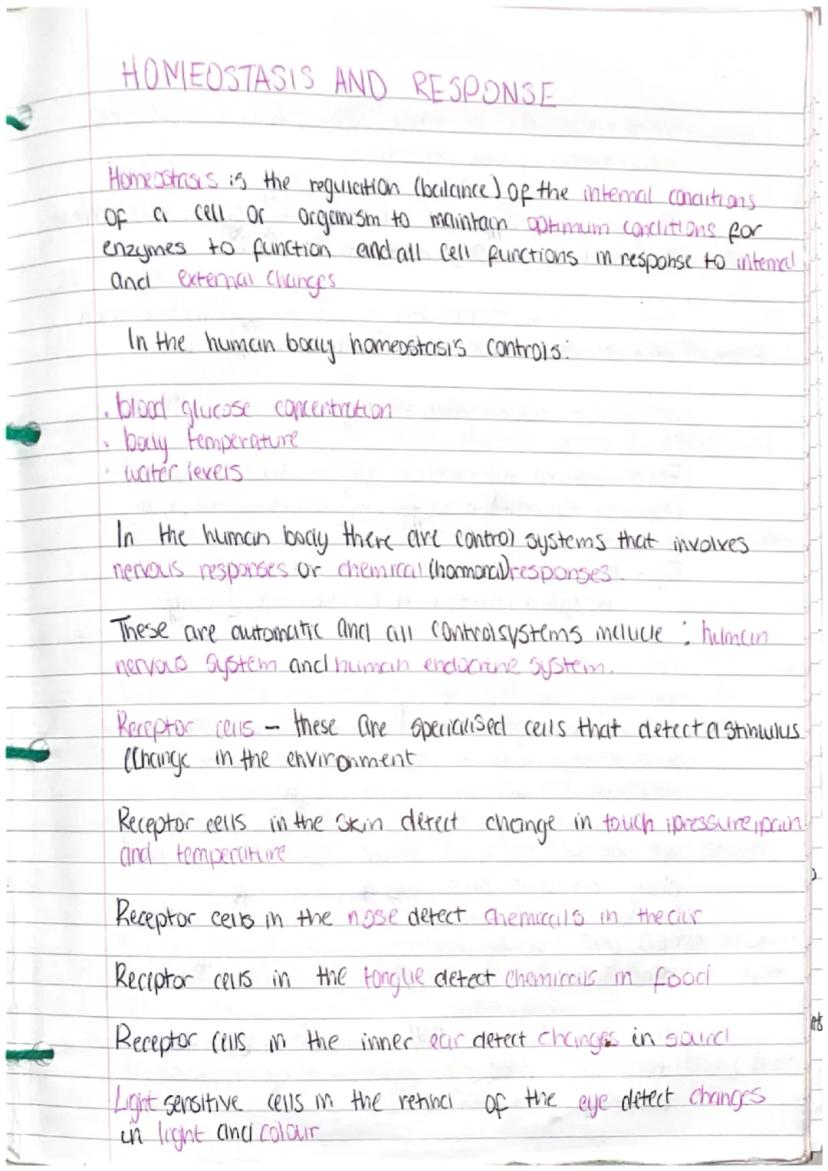
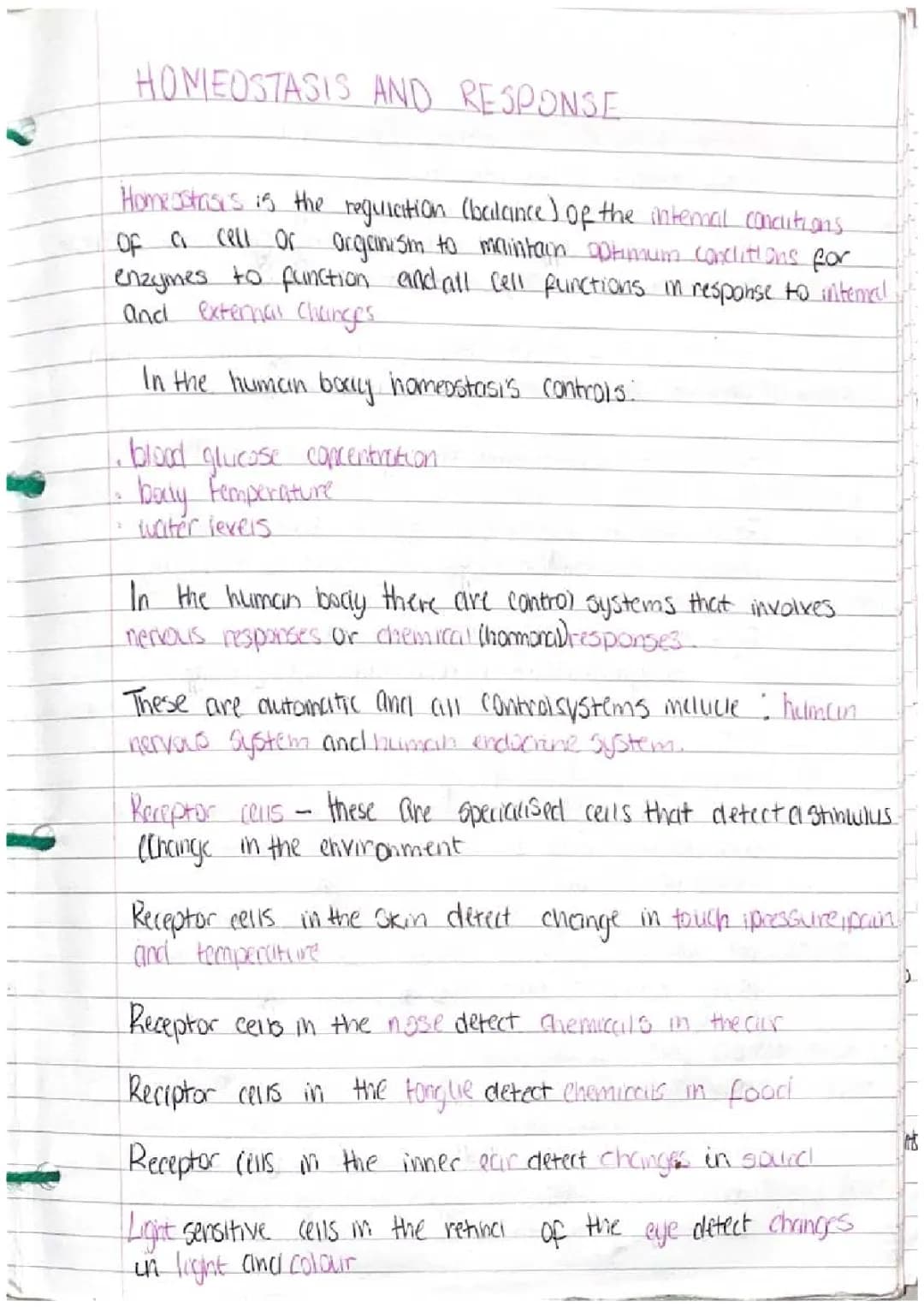
Ever wonder why you don't have to consciously think about maintaining your body temperature or blood sugar levels? That's homeostasis - your body's clever way of keeping internal conditions perfectly balanced so your cells can function properly.
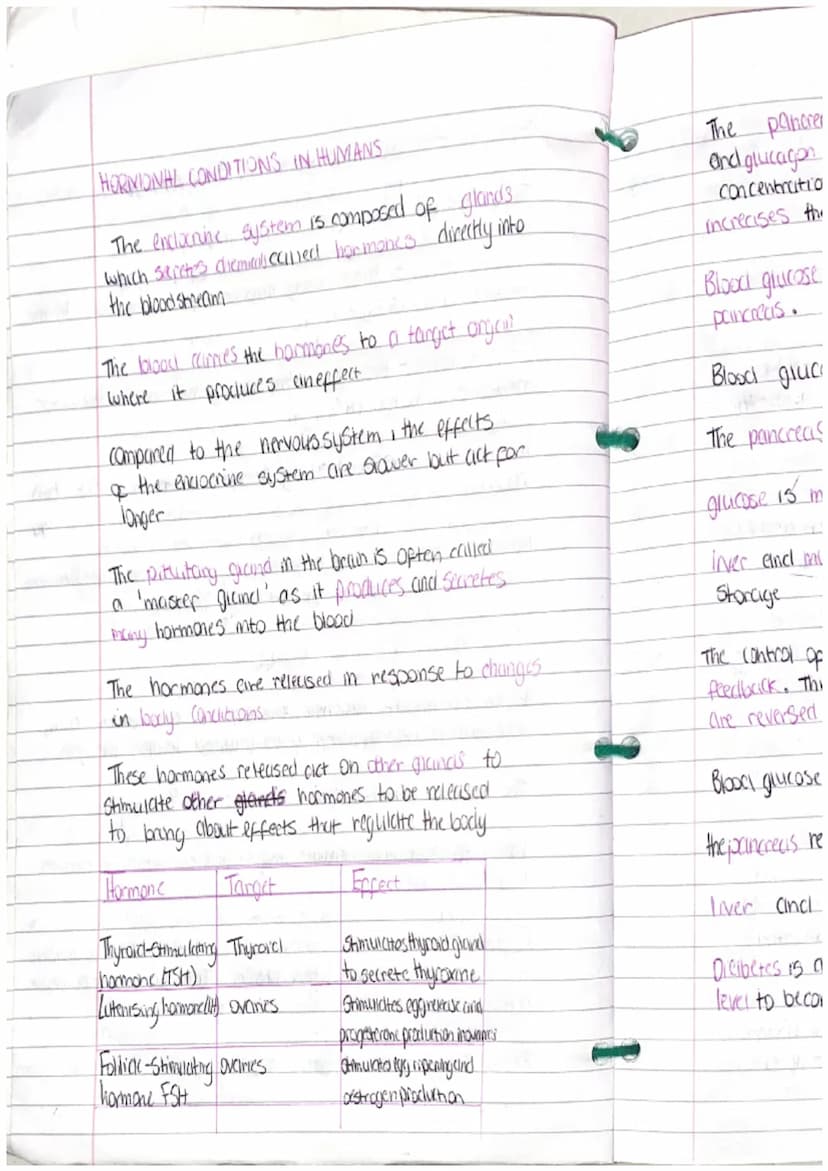
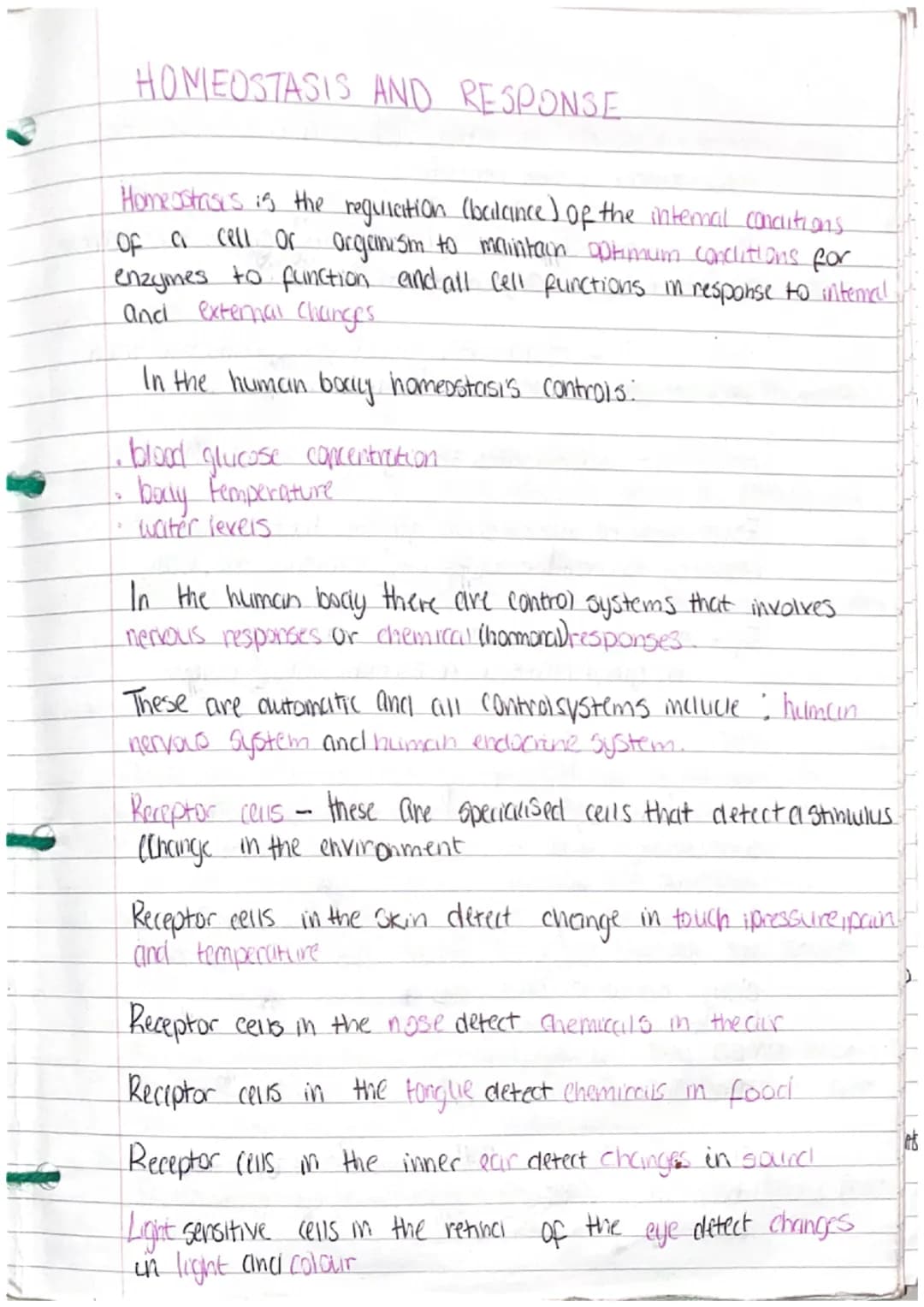
Your body controls three main things automatically: blood glucose concentration, body temperature, and water levels. It does this using two control systems - your nervous system (which sends electrical signals) and your endocrine system (which uses chemical messengers called hormones).
The first step in any response is detection, and that's where receptor cells come in. These specialised cells are like your body's security cameras, constantly monitoring for changes. You've got receptors in your skin detecting touch and temperature, in your nose and tongue detecting chemicals, in your ears detecting sound, and in your eyes detecting light changes.
Quick Tip: Remember that receptors are just detectors - they spot changes but don't actually do anything about them yet!
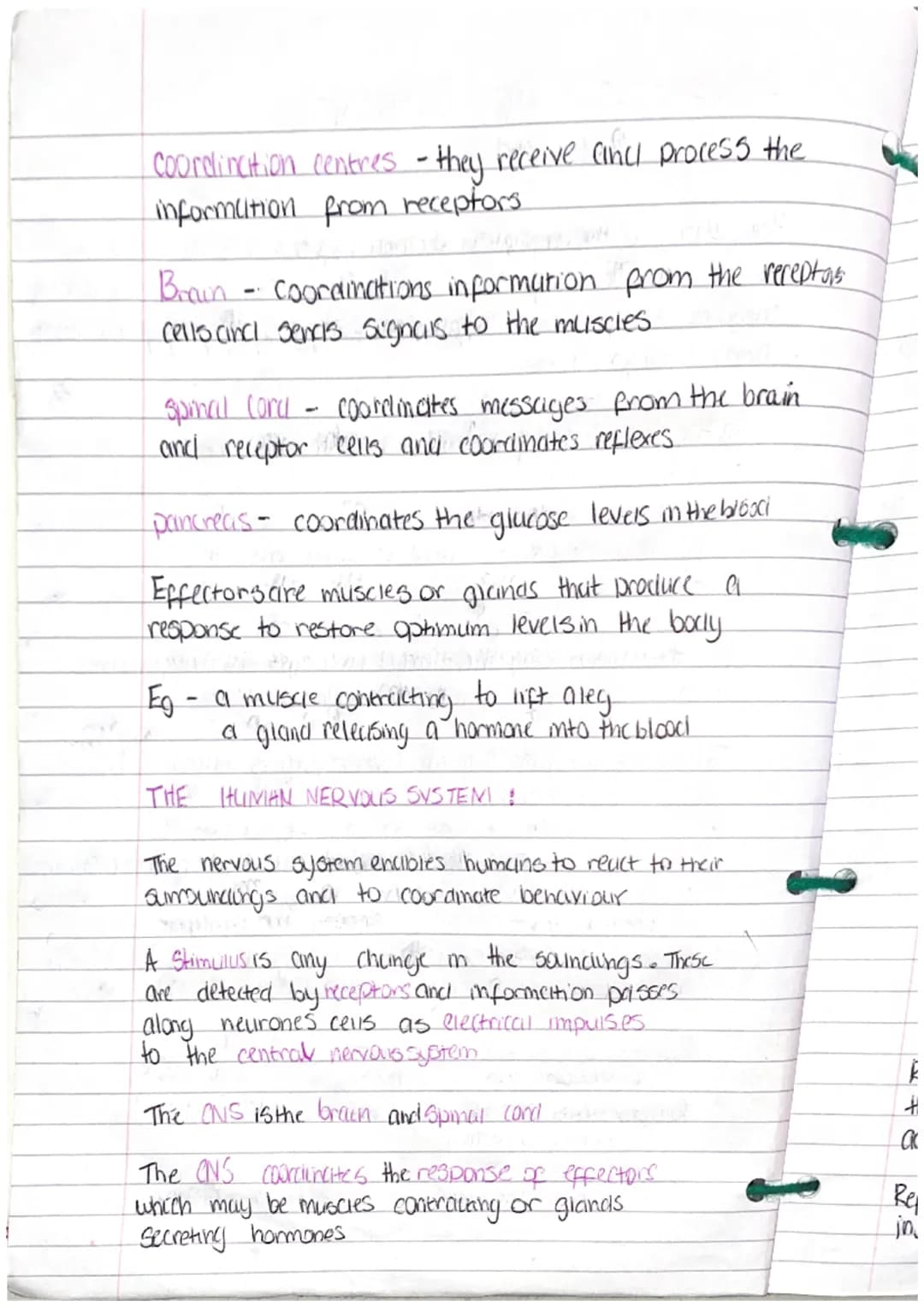
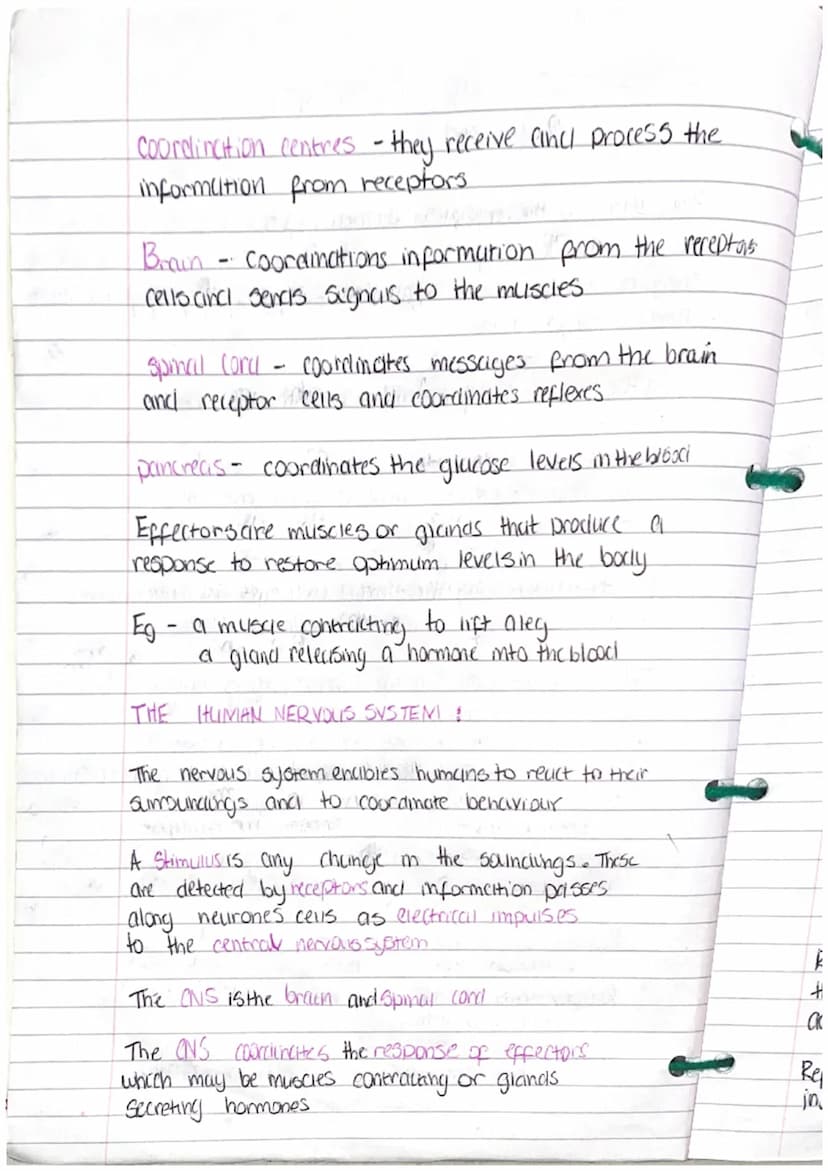
Once receptor cells detect a change, the information needs to go somewhere to be processed - that's where coordination centres step in. Your brain acts like mission control, processing information and sending signals to muscles. Your spinal cord handles messages between the brain and receptors, whilst your pancreas specifically coordinates blood glucose levels.
After processing the information, effectors (muscles or glands) spring into action to restore balance. Think of a muscle contracting to move your hand away from something hot, or a gland releasing hormones into your bloodstream.
The nervous system is your body's rapid response team, enabling you to react quickly to your surroundings. When receptors detect a stimulus (any change in your environment), information travels as electrical impulses along specialised cells called neurones to your central nervous system (CNS) - that's your brain and spinal cord.
Remember: The CNS coordinates responses by telling effectors what to do - muscles to contract or glands to secrete hormones.
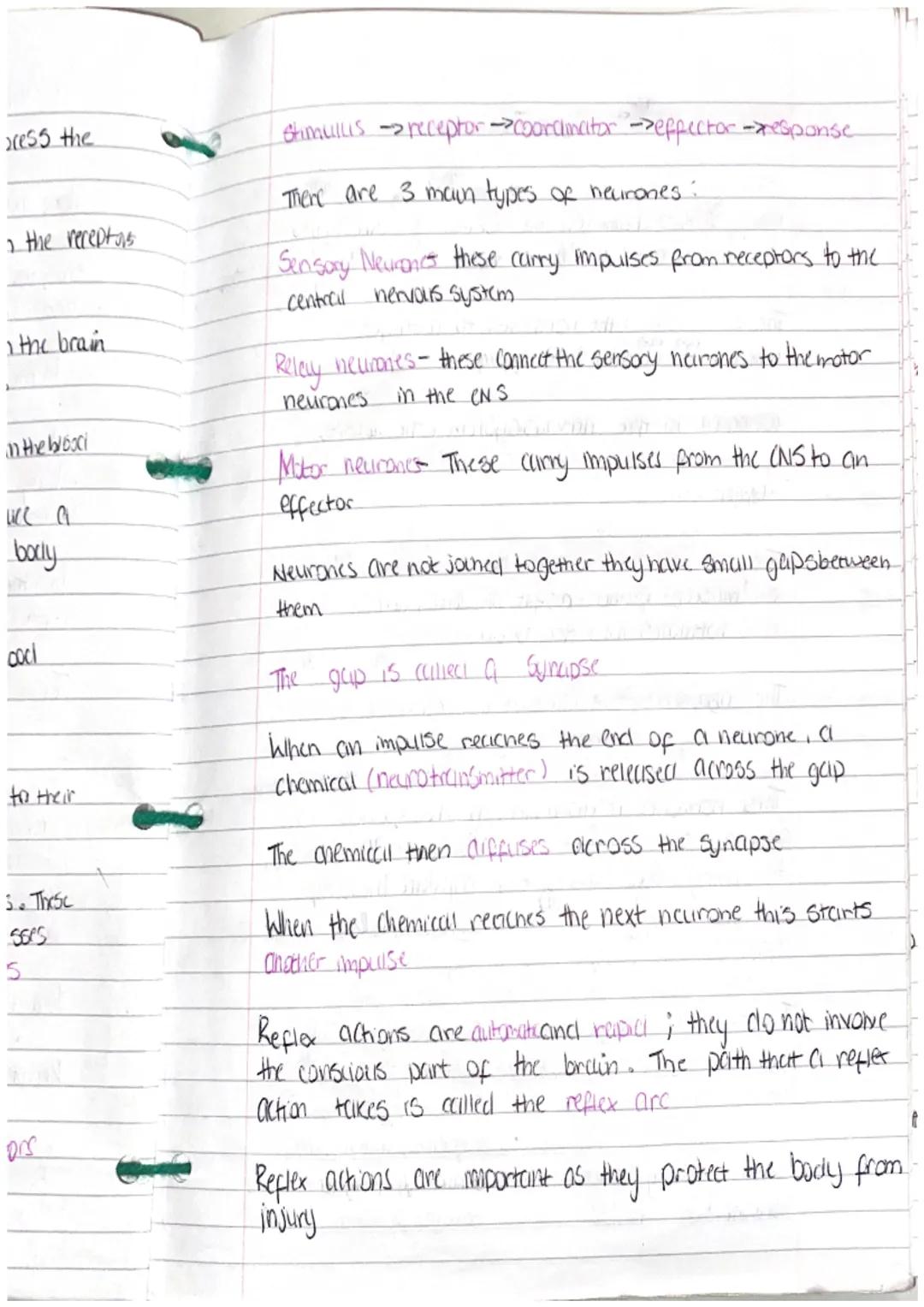
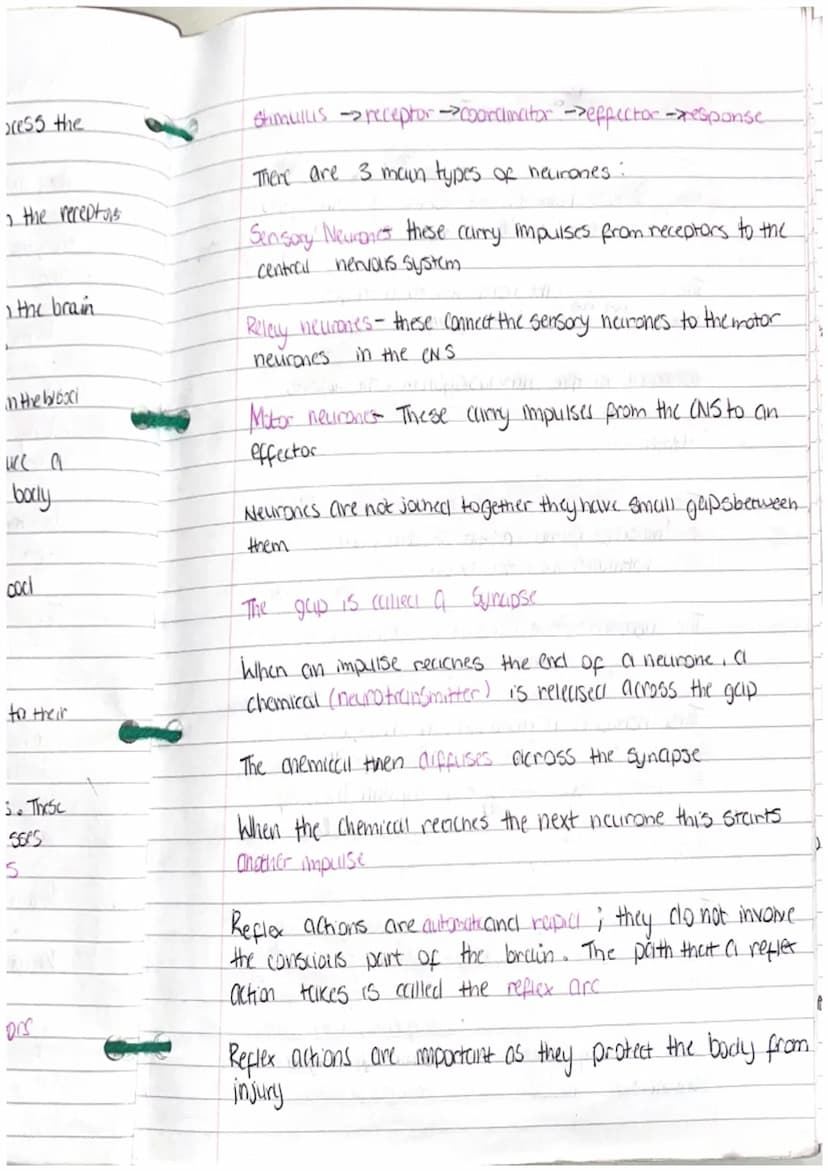
The pathway from detection to response follows a simple pattern: Stimulus → Receptor → Coordinator → Effector → Response. This happens through three types of neurones working as a team.
Sensory neurones carry messages from receptors to your CNS, relay neurones connect sensory and motor neurones within the CNS, and motor neurones carry instructions from the CNS to effectors. These neurones aren't actually joined together - they have tiny gaps called synapses between them.
When an electrical impulse reaches a synapse, it triggers the release of chemical messengers called neurotransmitters. These chemicals diffuse across the gap and start a new electrical impulse in the next neurone - like passing a baton in a relay race.
Reflex actions are your body's emergency responses - they're automatic, rapid, and crucially, they don't involve the conscious part of your brain. The pathway these take is called the reflex arc, and it's designed to protect you from injury by reacting faster than you can think.
Exam Focus: Make sure you can draw and label the reflex arc pathway - it's a common exam question!
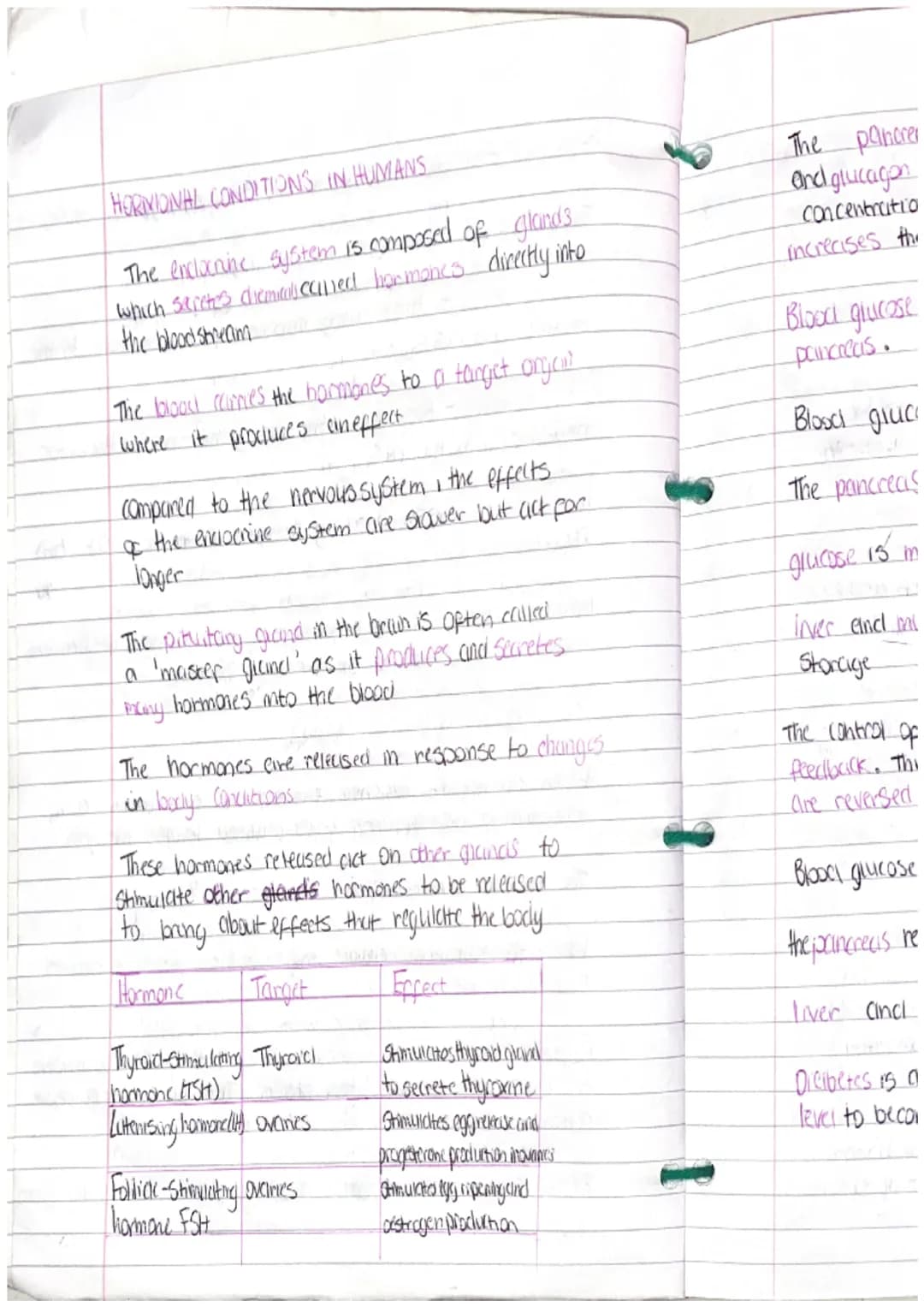
Whilst your nervous system handles rapid responses, your endocrine system takes care of longer-term control using chemical messengers called hormones. Think of it as the difference between sending a text (nervous system) and posting a letter (endocrine system) - hormones are slower but their effects last much longer.
Glands secrete hormones directly into your bloodstream, and these chemicals travel to target organs where they produce specific effects. The pituitary gland in your brain is nicknamed the 'master gland' because it produces many different hormones that control other glands throughout your body.
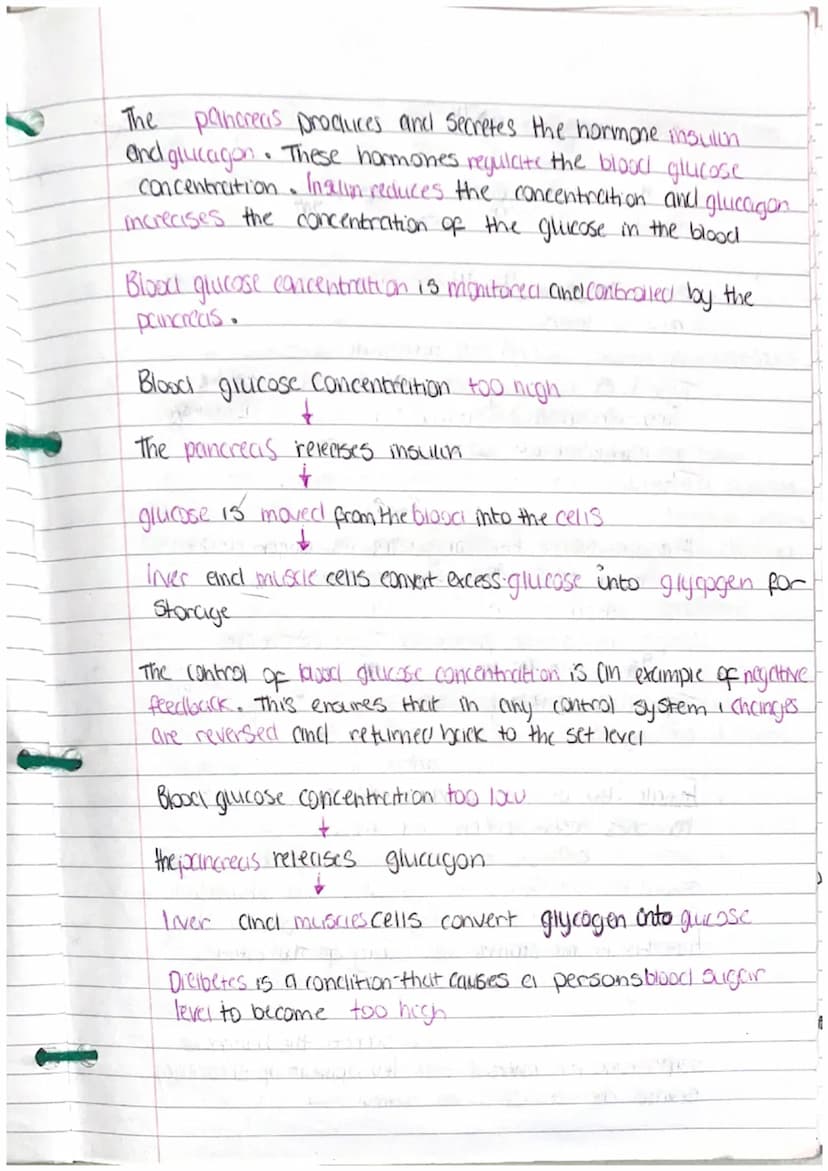
Your pancreas plays a crucial role by producing insulin and glucagon - two hormones that work like a seesaw to control your blood glucose concentration. When glucose levels change, the pancreas responds automatically to bring them back to normal.
This process demonstrates how your endocrine and nervous systems work together to maintain homeostasis, with hormones being released in response to changes detected by your body's monitoring systems.
Key Point: The endocrine system's effects are slower than the nervous system but last much longer - perfect for maintaining long-term balance.
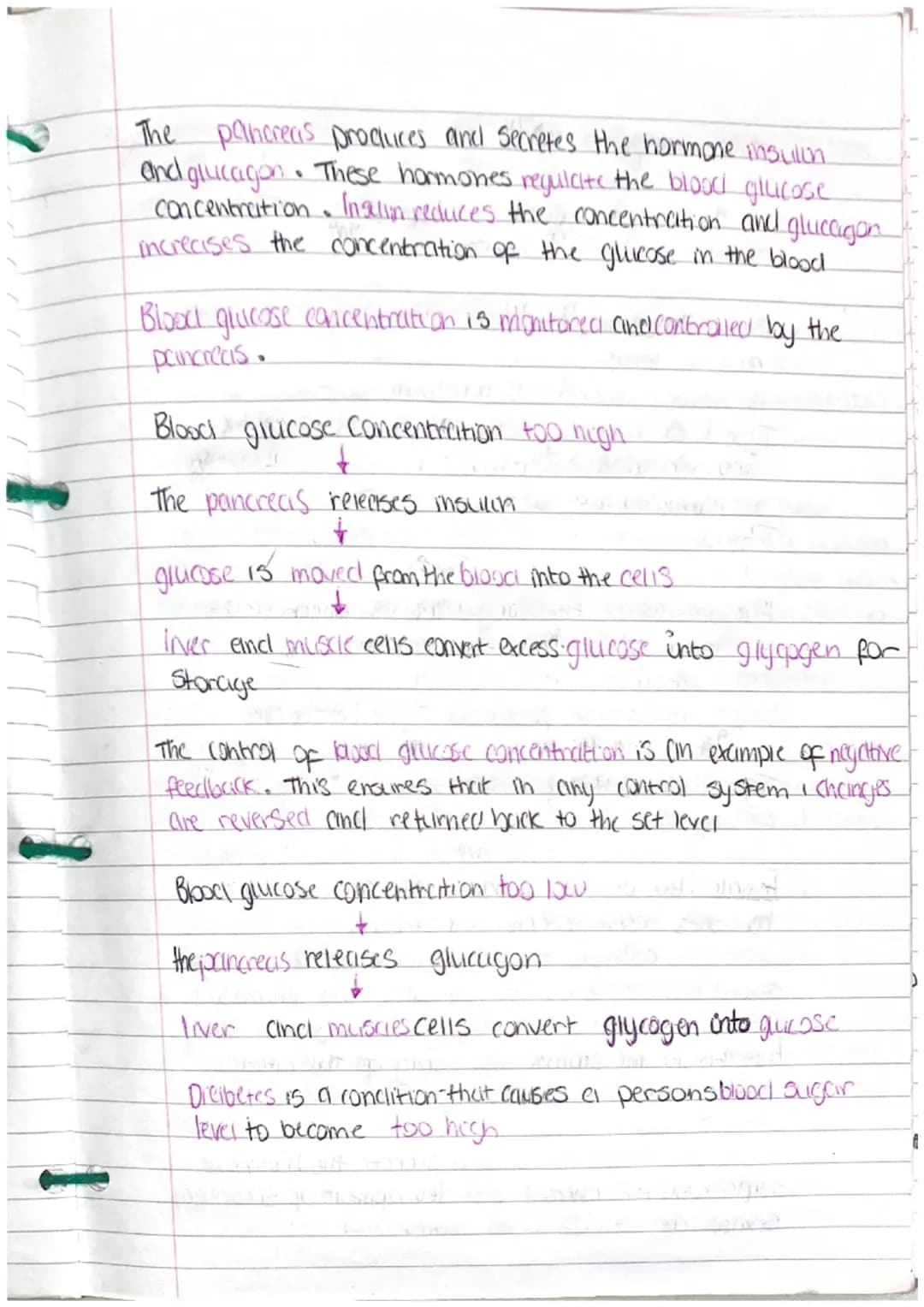
Your pancreas constantly monitors your blood glucose levels and responds like a thermostat. When glucose levels get too high (perhaps after eating), it releases insulin, which tells your cells to absorb glucose from the blood and converts excess glucose into glycogen for storage in your liver and muscles.
When blood glucose drops too low (maybe between meals), your pancreas switches tactics and releases glucagon. This hormone does the opposite - it tells your liver and muscle cells to convert stored glycogen back into glucose and release it into your bloodstream.
This system is a perfect example of negative feedback - when something changes from normal, your body automatically triggers responses that reverse the change and restore the original level. It's like having an automatic pilot that constantly corrects course.
Diabetes occurs when this glucose control system goes wrong, causing dangerously high blood sugar levels. Understanding how normal glucose control works helps explain why diabetes is such a serious condition that requires careful management.
Real-World Connection: This glucose control system is why athletes often eat energy bars - they need quick glucose that insulin can help their muscles absorb rapidly.
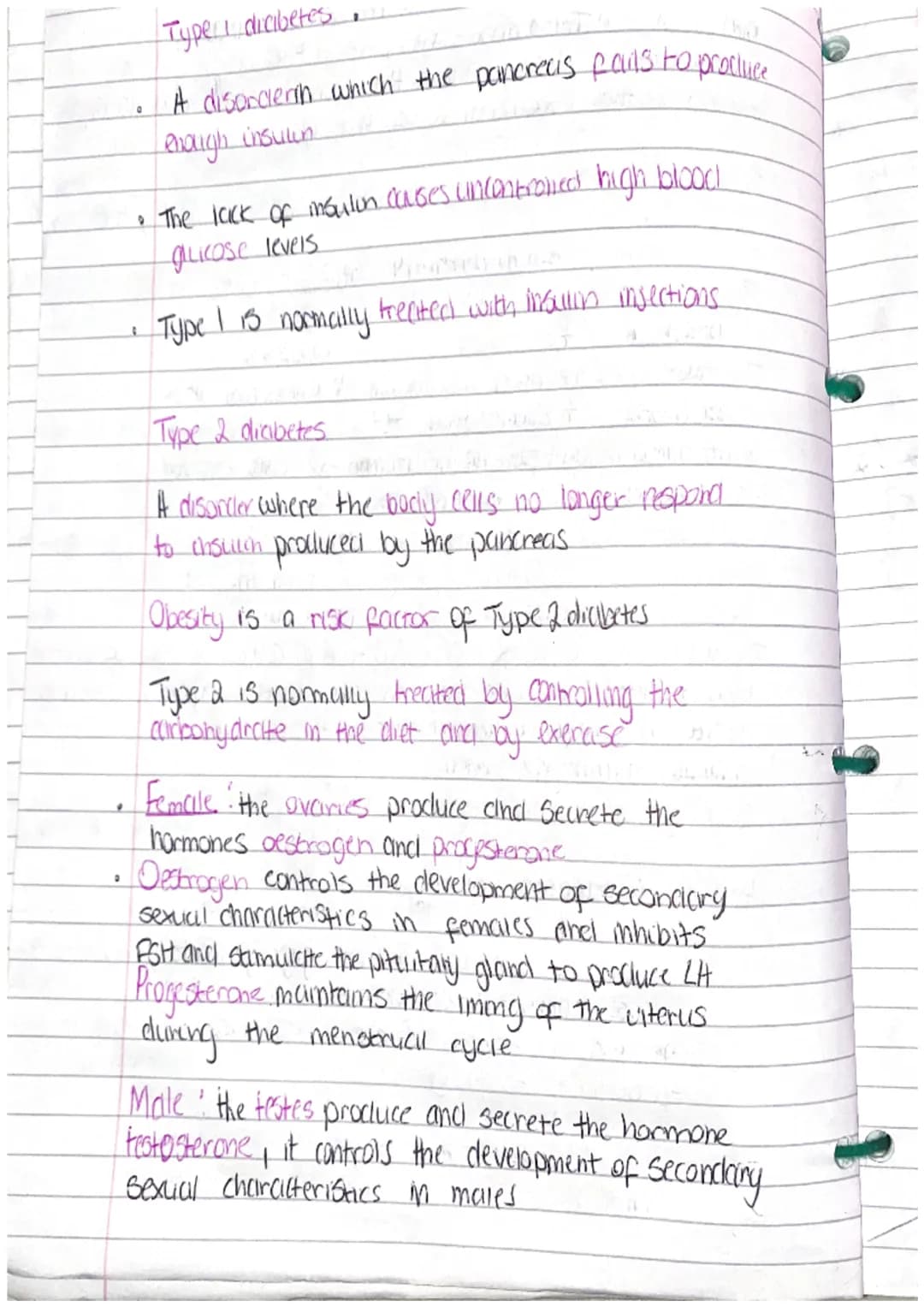
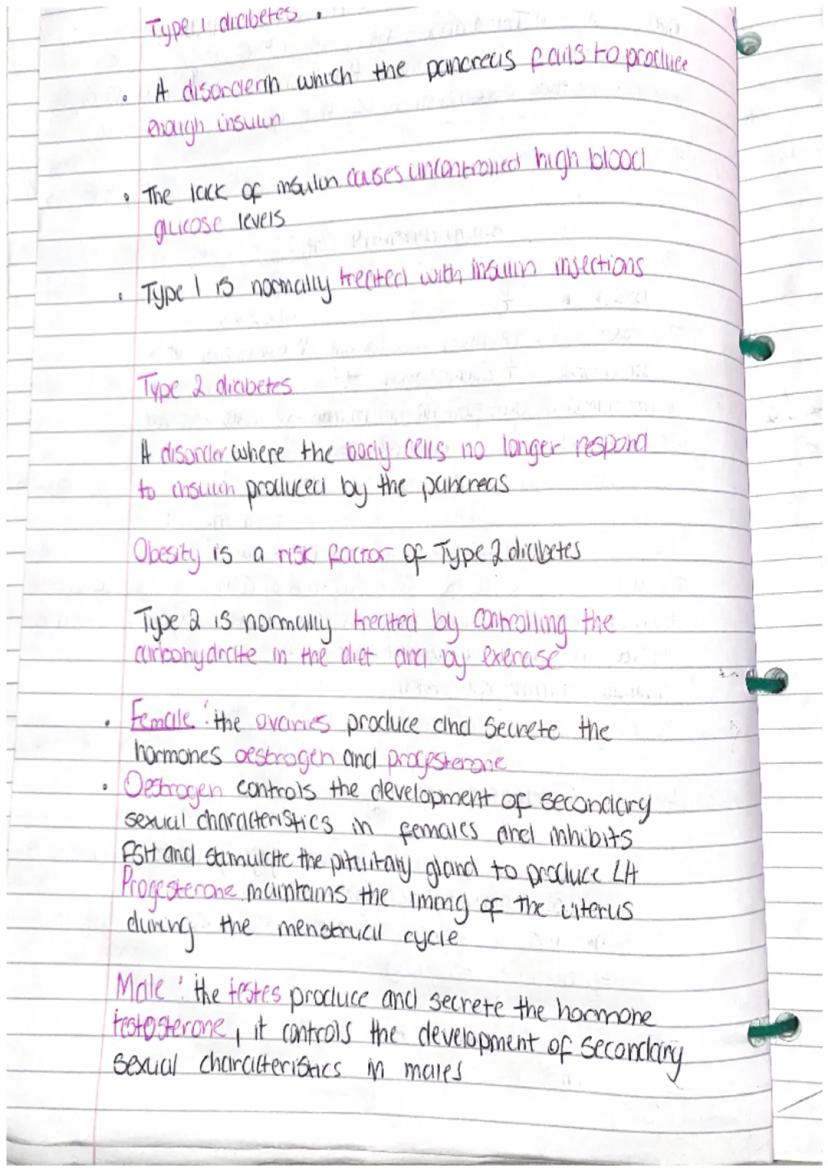
There are two main types of diabetes, each with different causes and treatments. Type 1 diabetes happens when your pancreas fails to produce enough insulin - it's like having a broken glucose control system. People with Type 1 need insulin injections to replace what their pancreas can't make.
Type 2 diabetes occurs when your body's cells stop responding to insulin properly, even though the pancreas still produces it. Obesity significantly increases the risk of developing Type 2, which is usually managed through controlling carbohydrate intake and regular exercise rather than injections.
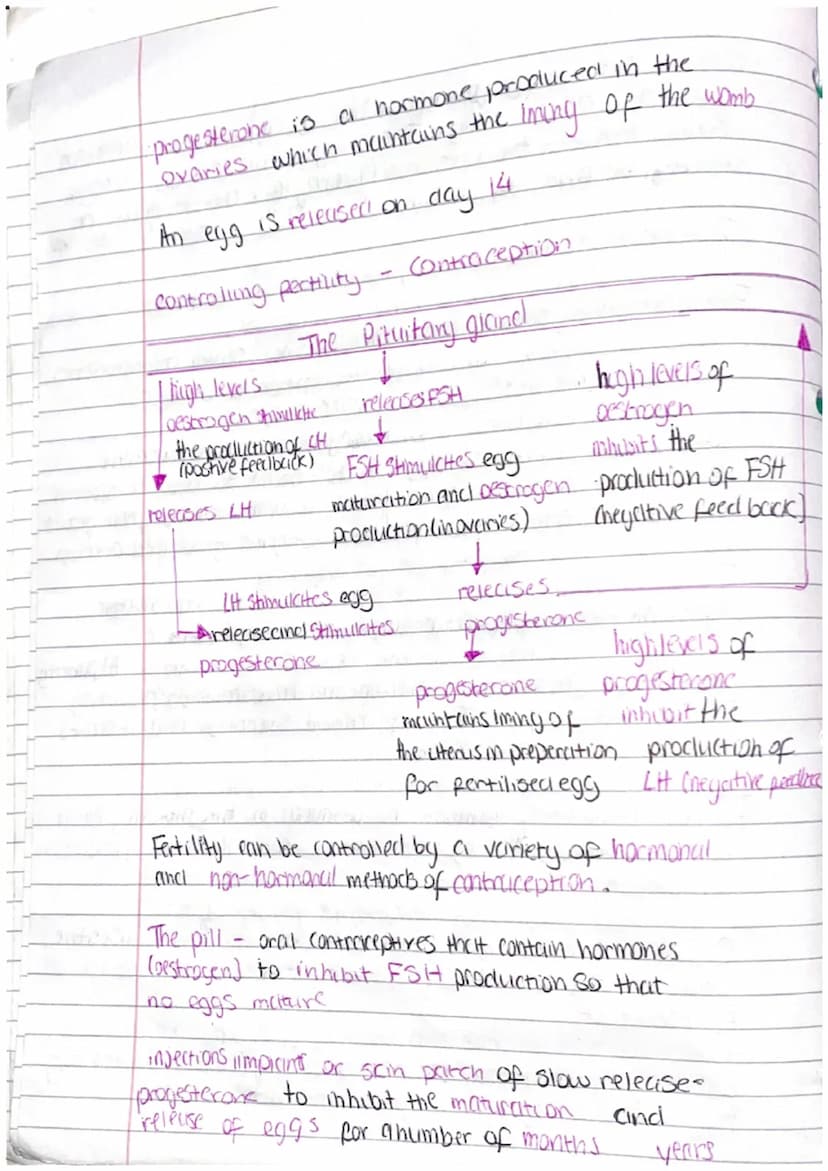
Your body also produces sex hormones that control development and reproduction. In females, the ovaries produce oestrogen (which controls secondary sexual characteristics and inhibits FSH whilst stimulating LH production) and progesterone (which maintains the lining of the uterus).
In males, the testes produce testosterone, which controls the development of male secondary sexual characteristics like voice deepening and increased muscle mass.
Health Tip: Type 2 diabetes is often preventable through maintaining a healthy weight and staying active - lifestyle choices really matter!
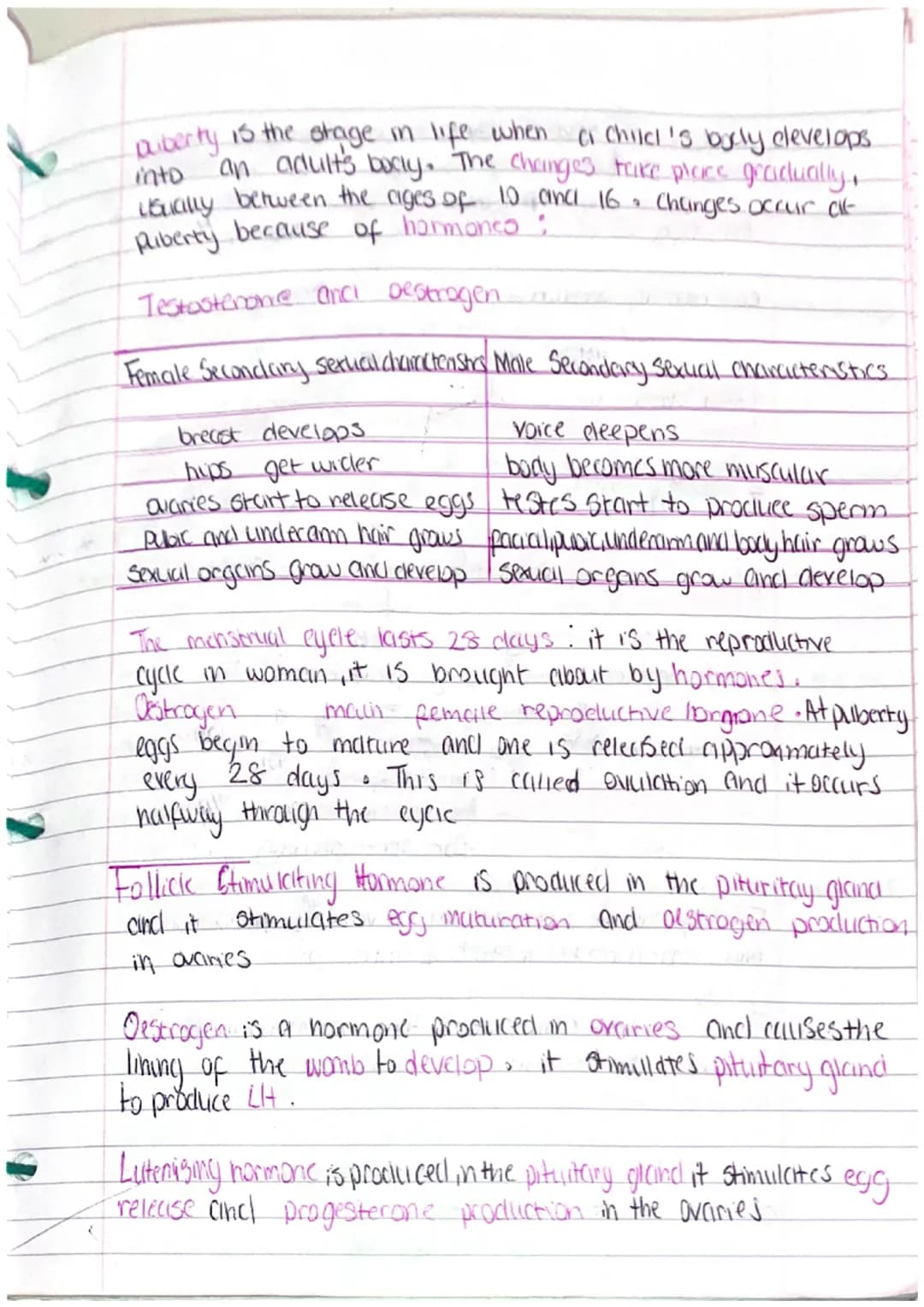
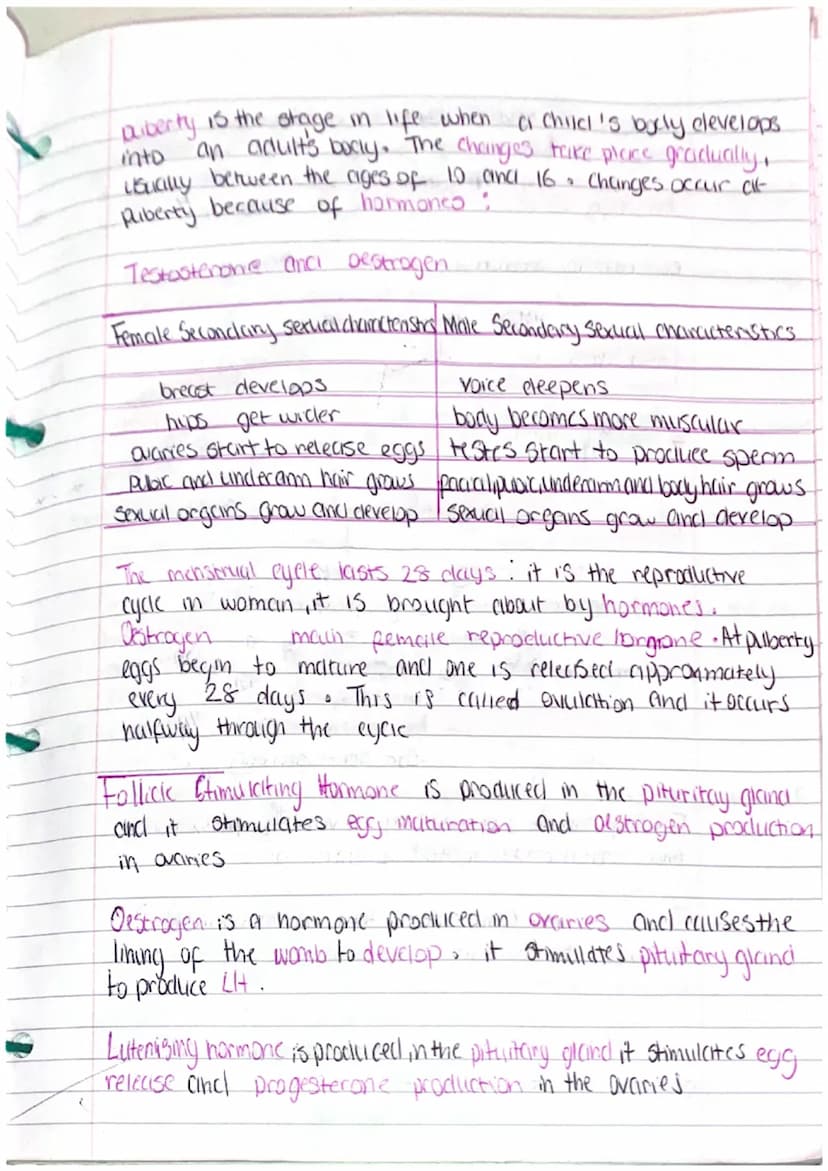
Puberty is when your body transforms from child to adult, typically between ages 10-16, triggered by sex hormones like testosterone and oestrogen. In females, changes include breast development, wider hips, and the start of egg release, whilst males experience voice deepening, increased muscularity, and sperm production.
The menstrual cycle is a 28-day reproductive cycle controlled by four key hormones working in coordination. Follicle Stimulating Hormone (FSH) from the pituitary gland kicks things off by stimulating egg maturation and oestrogen production in the ovaries.
Oestrogen then causes the womb lining to thicken and stimulates the pituitary to produce Luteinising Hormone (LH). LH triggers ovulation (egg release) around day 14 and stimulates progesterone production. Finally, progesterone maintains the womb lining in case pregnancy occurs.
This cycle repeats monthly, with each hormone playing its specific role in the carefully orchestrated sequence. If pregnancy doesn't occur, hormone levels drop, the womb lining is shed (menstruation), and the cycle starts again.
Memory Trick: Remember FSH = Follicle Stimulating (starts the cycle), LH = Lets go (releases the egg)!
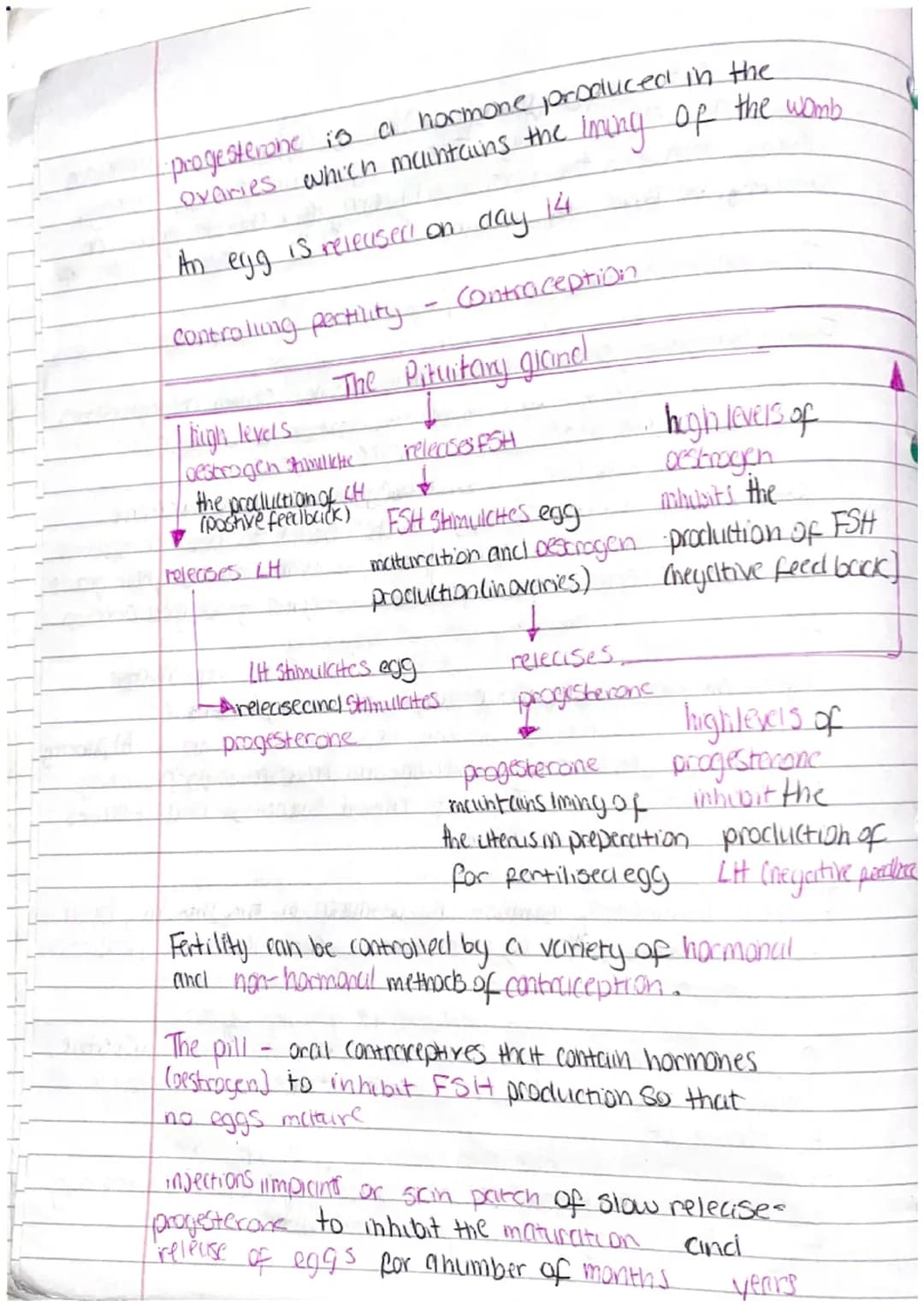
The menstrual cycle involves complex feedback loops between hormones. High oestrogen levels trigger positive feedback, stimulating more LH release for ovulation. However, high levels of oestrogen and progesterone create negative feedback, inhibiting FSH and LH production to prevent multiple eggs maturing simultaneously.
Hormonal contraception cleverly exploits these feedback mechanisms. The contraceptive pill contains oestrogen that inhibits FSH production, preventing eggs from maturing - no eggs means no pregnancy. Other methods include progesterone injections, implants, or skin patches that inhibit egg maturation and release for months or years.
These hormonal methods work by essentially tricking your body into thinking it's already pregnant, so it stops preparing for pregnancy. The artificial hormones override your natural cycle, providing reliable contraception when used correctly.
Understanding how your natural cycle works makes it easier to see why these contraceptive methods are so effective - they interrupt the hormonal signals needed for ovulation to occur.
Science Fact: The contraceptive pill was one of the first medicines designed specifically to prevent a natural process rather than treat a disease.
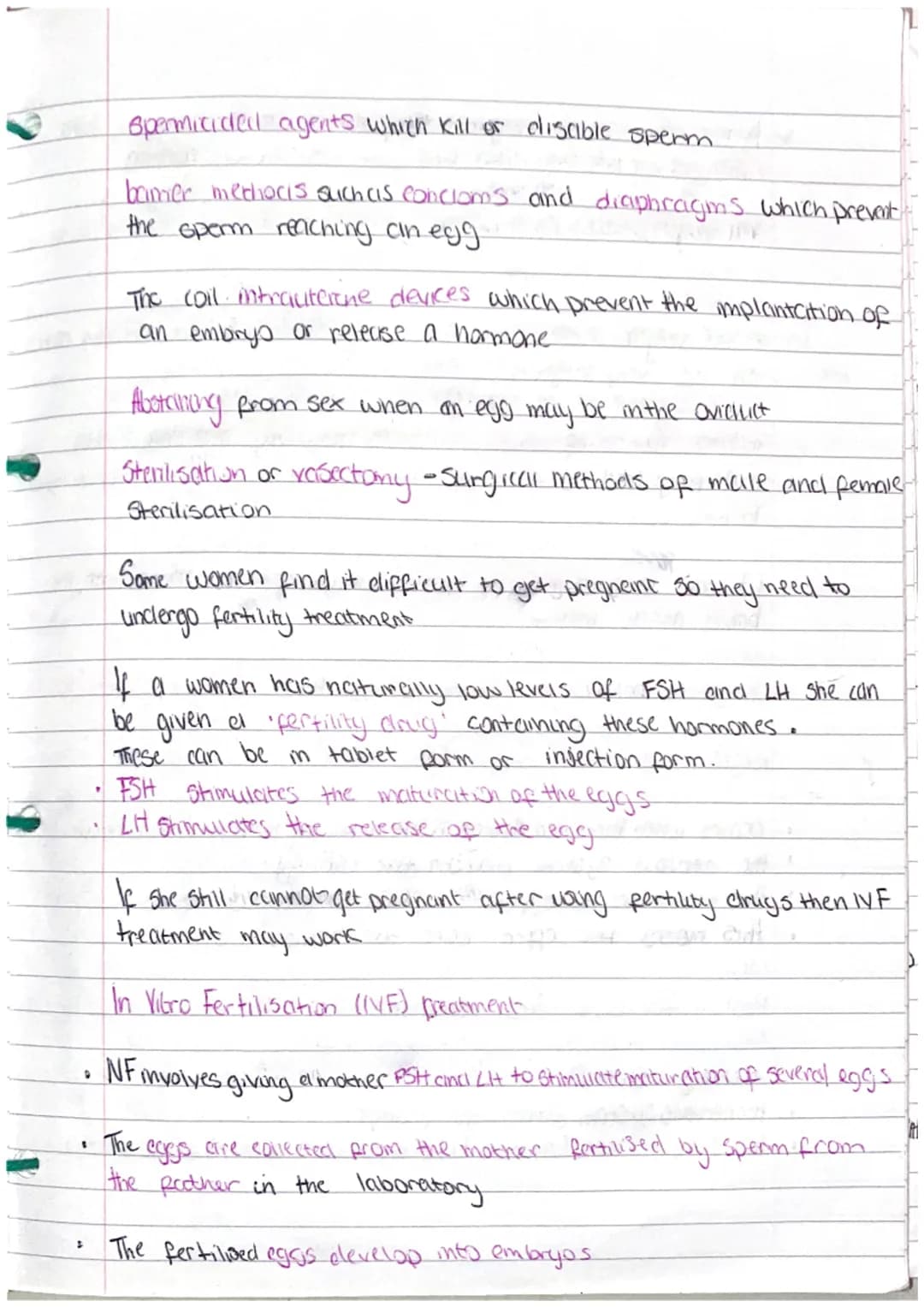
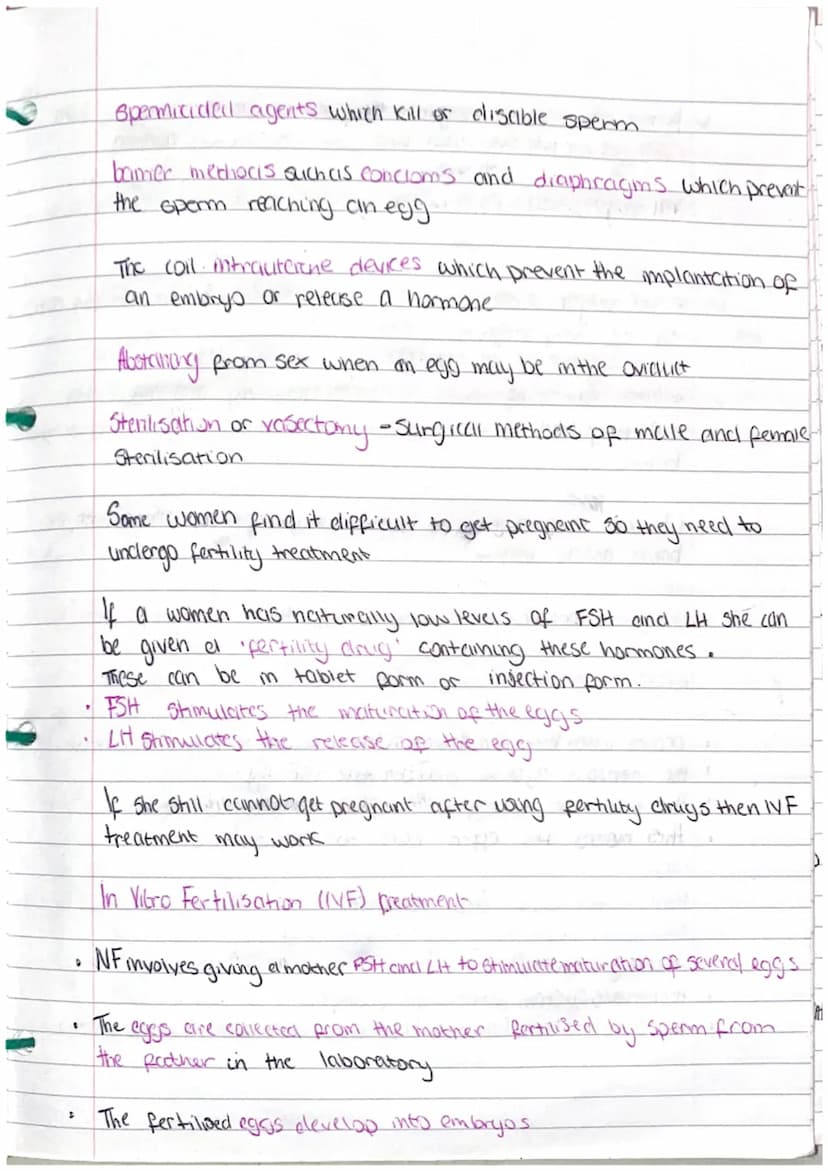
Not all contraception relies on hormones. Barrier methods like condoms and diaphragms physically prevent sperm from reaching eggs, whilst spermicidal agents kill or disable sperm. Intrauterine devices (coils) prevent embryo implantation or release hormones locally, and sterilisation involves surgical procedures to permanently prevent pregnancy.
Some couples struggle with fertility and need medical help to conceive. Women with naturally low FSH and LH levels can receive fertility drugs containing these hormones - FSH stimulates egg maturation whilst LH triggers egg release.
If fertility drugs don't work, In Vitro Fertilisation (IVF) might be the next step. This involves giving the mother FSH and LH to mature several eggs, collecting these eggs, fertilising them with sperm in a laboratory, and then transferring the resulting embryos back into the womb.
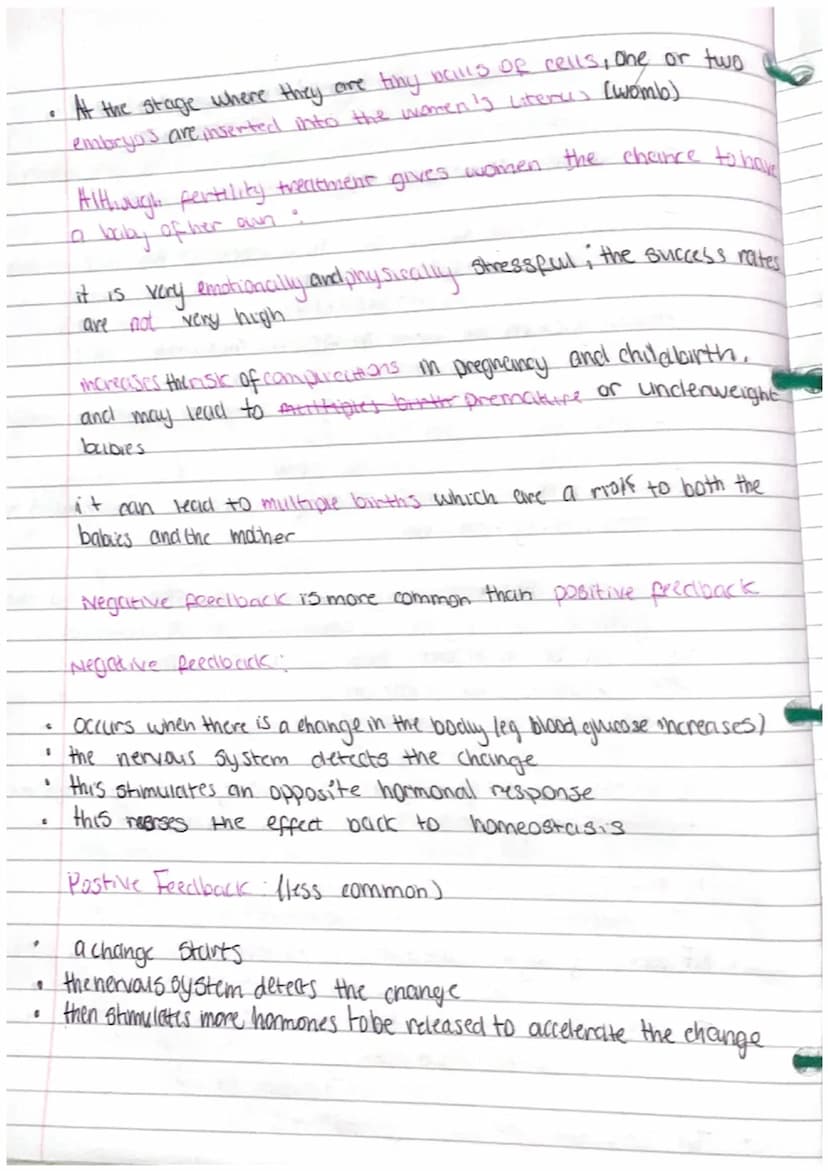
Whilst IVF treatment offers hope for couples wanting children, it's emotionally and physically demanding with relatively low success rates and increased risks of complications or multiple births.
Consideration Point: Fertility treatments raise important ethical questions about how far we should go to help people have children.
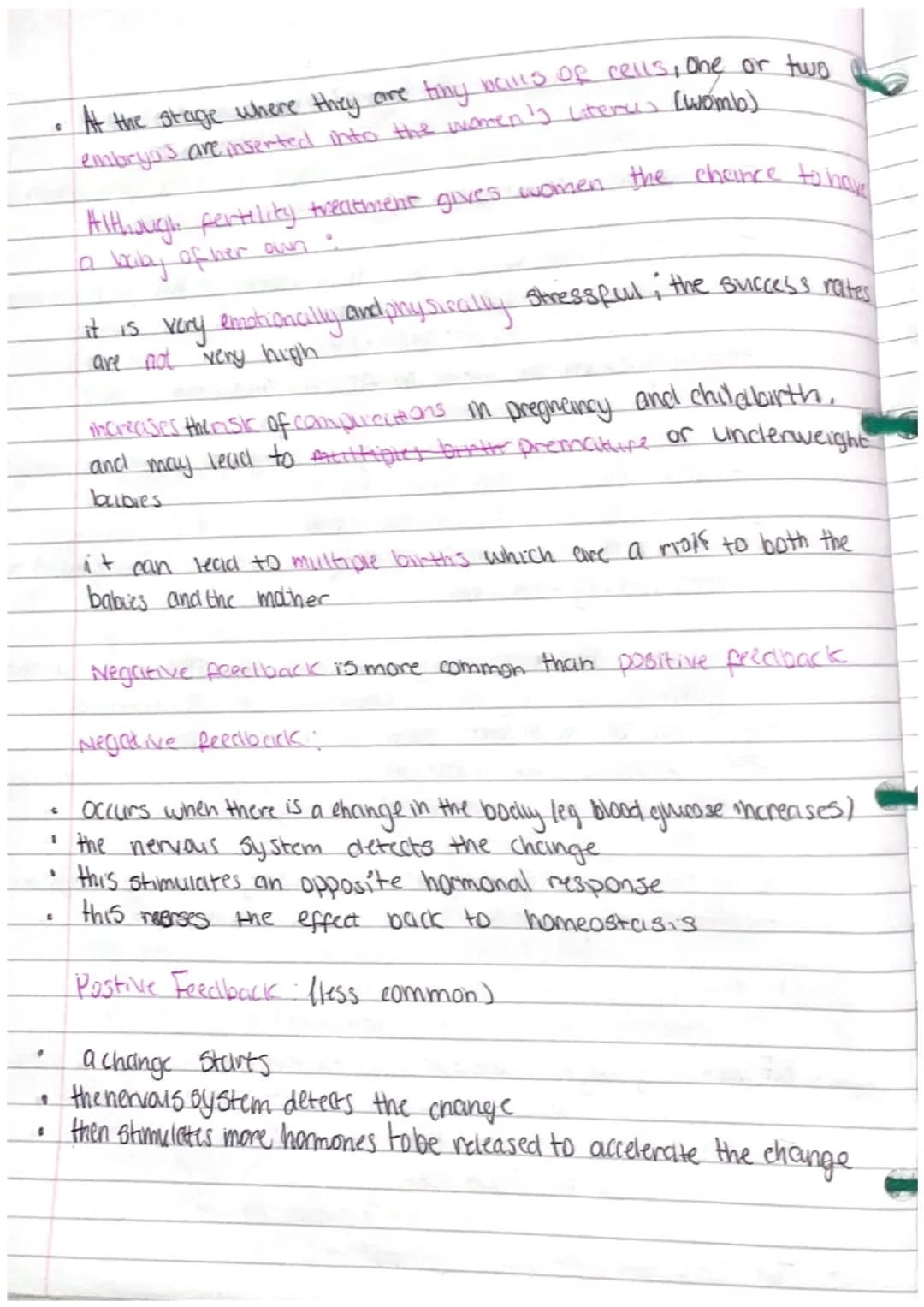
Negative feedback is your body's main way of maintaining stability - it's like having a thermostat that automatically corrects deviations from normal. When blood glucose increases, your nervous system detects this change and stimulates an opposite hormonal response (insulin release) that reverses the effect back to normal levels.
This type of feedback system keeps your body in homeostasis by constantly making small adjustments. Most of your body's control systems work this way - temperature regulation, water balance, and hormone levels all use negative feedback to stay within safe limits.
Positive feedback is much less common but occurs in specific situations where you want to accelerate a change rather than reverse it. During childbirth, for example, contractions trigger the release of more hormones that cause stronger contractions, speeding up the delivery process.
Understanding feedback systems helps explain why your body is so remarkably stable despite constantly changing internal and external conditions. These automatic responses happen without conscious thought, keeping you healthy and alive.
Exam Success: Remember that negative feedback reverses changes (most common), whilst positive feedback accelerates them (rare but important in specific processes).
Our AI Companion is a student-focused AI tool that offers more than just answers. Built on millions of Knowunity resources, it provides relevant information, personalised study plans, quizzes, and content directly in the chat, adapting to your individual learning journey.
You can download the app from Google Play Store and Apple App Store.
That's right! Enjoy free access to study content, connect with fellow students, and get instant help – all at your fingertips.
App Store
Google Play
The app is very easy to use and well designed. I have found everything I was looking for so far and have been able to learn a lot from the presentations! I will definitely use the app for a class assignment! And of course it also helps a lot as an inspiration.
Stefan S
iOS user
This app is really great. There are so many study notes and help [...]. My problem subject is French, for example, and the app has so many options for help. Thanks to this app, I have improved my French. I would recommend it to anyone.
Samantha Klich
Android user
Wow, I am really amazed. I just tried the app because I've seen it advertised many times and was absolutely stunned. This app is THE HELP you want for school and above all, it offers so many things, such as workouts and fact sheets, which have been VERY helpful to me personally.
Anna
iOS user
Best app on earth! no words because it’s too good
Thomas R
iOS user
Just amazing. Let's me revise 10x better, this app is a quick 10/10. I highly recommend it to anyone. I can watch and search for notes. I can save them in the subject folder. I can revise it any time when I come back. If you haven't tried this app, you're really missing out.
Basil
Android user
This app has made me feel so much more confident in my exam prep, not only through boosting my own self confidence through the features that allow you to connect with others and feel less alone, but also through the way the app itself is centred around making you feel better. It is easy to navigate, fun to use, and helpful to anyone struggling in absolutely any way.
David K
iOS user
The app's just great! All I have to do is enter the topic in the search bar and I get the response real fast. I don't have to watch 10 YouTube videos to understand something, so I'm saving my time. Highly recommended!
Sudenaz Ocak
Android user
In school I was really bad at maths but thanks to the app, I am doing better now. I am so grateful that you made the app.
Greenlight Bonnie
Android user
very reliable app to help and grow your ideas of Maths, English and other related topics in your works. please use this app if your struggling in areas, this app is key for that. wish I'd of done a review before. and it's also free so don't worry about that.
Rohan U
Android user
I know a lot of apps use fake accounts to boost their reviews but this app deserves it all. Originally I was getting 4 in my English exams and this time I got a grade 7. I didn’t even know about this app three days until the exam and it has helped A LOT. Please actually trust me and use it as I’m sure you too will see developments.
Xander S
iOS user
THE QUIZES AND FLASHCARDS ARE SO USEFUL AND I LOVE THE SCHOOLGPT. IT ALSO IS LITREALLY LIKE CHATGPT BUT SMARTER!! HELPED ME WITH MY MASCARA PROBLEMS TOO!! AS WELL AS MY REAL SUBJECTS ! DUHHH 😍😁😲🤑💗✨🎀😮
Elisha
iOS user
This apps acc the goat. I find revision so boring but this app makes it so easy to organize it all and then you can ask the freeeee ai to test yourself so good and you can easily upload your own stuff. highly recommend as someone taking mocks now
Paul T
iOS user
The app is very easy to use and well designed. I have found everything I was looking for so far and have been able to learn a lot from the presentations! I will definitely use the app for a class assignment! And of course it also helps a lot as an inspiration.
Stefan S
iOS user
This app is really great. There are so many study notes and help [...]. My problem subject is French, for example, and the app has so many options for help. Thanks to this app, I have improved my French. I would recommend it to anyone.
Samantha Klich
Android user
Wow, I am really amazed. I just tried the app because I've seen it advertised many times and was absolutely stunned. This app is THE HELP you want for school and above all, it offers so many things, such as workouts and fact sheets, which have been VERY helpful to me personally.
Anna
iOS user
Best app on earth! no words because it’s too good
Thomas R
iOS user
Just amazing. Let's me revise 10x better, this app is a quick 10/10. I highly recommend it to anyone. I can watch and search for notes. I can save them in the subject folder. I can revise it any time when I come back. If you haven't tried this app, you're really missing out.
Basil
Android user
This app has made me feel so much more confident in my exam prep, not only through boosting my own self confidence through the features that allow you to connect with others and feel less alone, but also through the way the app itself is centred around making you feel better. It is easy to navigate, fun to use, and helpful to anyone struggling in absolutely any way.
David K
iOS user
The app's just great! All I have to do is enter the topic in the search bar and I get the response real fast. I don't have to watch 10 YouTube videos to understand something, so I'm saving my time. Highly recommended!
Sudenaz Ocak
Android user
In school I was really bad at maths but thanks to the app, I am doing better now. I am so grateful that you made the app.
Greenlight Bonnie
Android user
very reliable app to help and grow your ideas of Maths, English and other related topics in your works. please use this app if your struggling in areas, this app is key for that. wish I'd of done a review before. and it's also free so don't worry about that.
Rohan U
Android user
I know a lot of apps use fake accounts to boost their reviews but this app deserves it all. Originally I was getting 4 in my English exams and this time I got a grade 7. I didn’t even know about this app three days until the exam and it has helped A LOT. Please actually trust me and use it as I’m sure you too will see developments.
Xander S
iOS user
THE QUIZES AND FLASHCARDS ARE SO USEFUL AND I LOVE THE SCHOOLGPT. IT ALSO IS LITREALLY LIKE CHATGPT BUT SMARTER!! HELPED ME WITH MY MASCARA PROBLEMS TOO!! AS WELL AS MY REAL SUBJECTS ! DUHHH 😍😁😲🤑💗✨🎀😮
Elisha
iOS user
This apps acc the goat. I find revision so boring but this app makes it so easy to organize it all and then you can ask the freeeee ai to test yourself so good and you can easily upload your own stuff. highly recommend as someone taking mocks now
Paul T
iOS user
vanessa
@vanessaxx_
Your body is constantly working behind the scenes to keep everything balanced and functioning properly - this is called homeostasis. Think of it like your body's internal autopilot system that maintains the perfect conditions for you to survive and thrive,... Show more
Access to all documents
Improve your grades
Join milions of students
By signing up you accept Terms of Service and Privacy Policy
Ever wonder why you don't have to consciously think about maintaining your body temperature or blood sugar levels? That's homeostasis - your body's clever way of keeping internal conditions perfectly balanced so your cells can function properly.
Your body controls three main things automatically: blood glucose concentration, body temperature, and water levels. It does this using two control systems - your nervous system (which sends electrical signals) and your endocrine system (which uses chemical messengers called hormones).
The first step in any response is detection, and that's where receptor cells come in. These specialised cells are like your body's security cameras, constantly monitoring for changes. You've got receptors in your skin detecting touch and temperature, in your nose and tongue detecting chemicals, in your ears detecting sound, and in your eyes detecting light changes.
Quick Tip: Remember that receptors are just detectors - they spot changes but don't actually do anything about them yet!
Access to all documents
Improve your grades
Join milions of students
By signing up you accept Terms of Service and Privacy Policy
Once receptor cells detect a change, the information needs to go somewhere to be processed - that's where coordination centres step in. Your brain acts like mission control, processing information and sending signals to muscles. Your spinal cord handles messages between the brain and receptors, whilst your pancreas specifically coordinates blood glucose levels.
After processing the information, effectors (muscles or glands) spring into action to restore balance. Think of a muscle contracting to move your hand away from something hot, or a gland releasing hormones into your bloodstream.
The nervous system is your body's rapid response team, enabling you to react quickly to your surroundings. When receptors detect a stimulus (any change in your environment), information travels as electrical impulses along specialised cells called neurones to your central nervous system (CNS) - that's your brain and spinal cord.
Remember: The CNS coordinates responses by telling effectors what to do - muscles to contract or glands to secrete hormones.
Access to all documents
Improve your grades
Join milions of students
By signing up you accept Terms of Service and Privacy Policy
The pathway from detection to response follows a simple pattern: Stimulus → Receptor → Coordinator → Effector → Response. This happens through three types of neurones working as a team.
Sensory neurones carry messages from receptors to your CNS, relay neurones connect sensory and motor neurones within the CNS, and motor neurones carry instructions from the CNS to effectors. These neurones aren't actually joined together - they have tiny gaps called synapses between them.
When an electrical impulse reaches a synapse, it triggers the release of chemical messengers called neurotransmitters. These chemicals diffuse across the gap and start a new electrical impulse in the next neurone - like passing a baton in a relay race.
Reflex actions are your body's emergency responses - they're automatic, rapid, and crucially, they don't involve the conscious part of your brain. The pathway these take is called the reflex arc, and it's designed to protect you from injury by reacting faster than you can think.
Exam Focus: Make sure you can draw and label the reflex arc pathway - it's a common exam question!
Access to all documents
Improve your grades
Join milions of students
By signing up you accept Terms of Service and Privacy Policy
Whilst your nervous system handles rapid responses, your endocrine system takes care of longer-term control using chemical messengers called hormones. Think of it as the difference between sending a text (nervous system) and posting a letter (endocrine system) - hormones are slower but their effects last much longer.
Glands secrete hormones directly into your bloodstream, and these chemicals travel to target organs where they produce specific effects. The pituitary gland in your brain is nicknamed the 'master gland' because it produces many different hormones that control other glands throughout your body.
Your pancreas plays a crucial role by producing insulin and glucagon - two hormones that work like a seesaw to control your blood glucose concentration. When glucose levels change, the pancreas responds automatically to bring them back to normal.
This process demonstrates how your endocrine and nervous systems work together to maintain homeostasis, with hormones being released in response to changes detected by your body's monitoring systems.
Key Point: The endocrine system's effects are slower than the nervous system but last much longer - perfect for maintaining long-term balance.
Access to all documents
Improve your grades
Join milions of students
By signing up you accept Terms of Service and Privacy Policy
Your pancreas constantly monitors your blood glucose levels and responds like a thermostat. When glucose levels get too high (perhaps after eating), it releases insulin, which tells your cells to absorb glucose from the blood and converts excess glucose into glycogen for storage in your liver and muscles.
When blood glucose drops too low (maybe between meals), your pancreas switches tactics and releases glucagon. This hormone does the opposite - it tells your liver and muscle cells to convert stored glycogen back into glucose and release it into your bloodstream.
This system is a perfect example of negative feedback - when something changes from normal, your body automatically triggers responses that reverse the change and restore the original level. It's like having an automatic pilot that constantly corrects course.
Diabetes occurs when this glucose control system goes wrong, causing dangerously high blood sugar levels. Understanding how normal glucose control works helps explain why diabetes is such a serious condition that requires careful management.
Real-World Connection: This glucose control system is why athletes often eat energy bars - they need quick glucose that insulin can help their muscles absorb rapidly.
Access to all documents
Improve your grades
Join milions of students
By signing up you accept Terms of Service and Privacy Policy
There are two main types of diabetes, each with different causes and treatments. Type 1 diabetes happens when your pancreas fails to produce enough insulin - it's like having a broken glucose control system. People with Type 1 need insulin injections to replace what their pancreas can't make.
Type 2 diabetes occurs when your body's cells stop responding to insulin properly, even though the pancreas still produces it. Obesity significantly increases the risk of developing Type 2, which is usually managed through controlling carbohydrate intake and regular exercise rather than injections.
Your body also produces sex hormones that control development and reproduction. In females, the ovaries produce oestrogen (which controls secondary sexual characteristics and inhibits FSH whilst stimulating LH production) and progesterone (which maintains the lining of the uterus).
In males, the testes produce testosterone, which controls the development of male secondary sexual characteristics like voice deepening and increased muscle mass.
Health Tip: Type 2 diabetes is often preventable through maintaining a healthy weight and staying active - lifestyle choices really matter!
Access to all documents
Improve your grades
Join milions of students
By signing up you accept Terms of Service and Privacy Policy
Puberty is when your body transforms from child to adult, typically between ages 10-16, triggered by sex hormones like testosterone and oestrogen. In females, changes include breast development, wider hips, and the start of egg release, whilst males experience voice deepening, increased muscularity, and sperm production.
The menstrual cycle is a 28-day reproductive cycle controlled by four key hormones working in coordination. Follicle Stimulating Hormone (FSH) from the pituitary gland kicks things off by stimulating egg maturation and oestrogen production in the ovaries.
Oestrogen then causes the womb lining to thicken and stimulates the pituitary to produce Luteinising Hormone (LH). LH triggers ovulation (egg release) around day 14 and stimulates progesterone production. Finally, progesterone maintains the womb lining in case pregnancy occurs.
This cycle repeats monthly, with each hormone playing its specific role in the carefully orchestrated sequence. If pregnancy doesn't occur, hormone levels drop, the womb lining is shed (menstruation), and the cycle starts again.
Memory Trick: Remember FSH = Follicle Stimulating (starts the cycle), LH = Lets go (releases the egg)!
Access to all documents
Improve your grades
Join milions of students
By signing up you accept Terms of Service and Privacy Policy
The menstrual cycle involves complex feedback loops between hormones. High oestrogen levels trigger positive feedback, stimulating more LH release for ovulation. However, high levels of oestrogen and progesterone create negative feedback, inhibiting FSH and LH production to prevent multiple eggs maturing simultaneously.
Hormonal contraception cleverly exploits these feedback mechanisms. The contraceptive pill contains oestrogen that inhibits FSH production, preventing eggs from maturing - no eggs means no pregnancy. Other methods include progesterone injections, implants, or skin patches that inhibit egg maturation and release for months or years.
These hormonal methods work by essentially tricking your body into thinking it's already pregnant, so it stops preparing for pregnancy. The artificial hormones override your natural cycle, providing reliable contraception when used correctly.
Understanding how your natural cycle works makes it easier to see why these contraceptive methods are so effective - they interrupt the hormonal signals needed for ovulation to occur.
Science Fact: The contraceptive pill was one of the first medicines designed specifically to prevent a natural process rather than treat a disease.
Access to all documents
Improve your grades
Join milions of students
By signing up you accept Terms of Service and Privacy Policy
Not all contraception relies on hormones. Barrier methods like condoms and diaphragms physically prevent sperm from reaching eggs, whilst spermicidal agents kill or disable sperm. Intrauterine devices (coils) prevent embryo implantation or release hormones locally, and sterilisation involves surgical procedures to permanently prevent pregnancy.
Some couples struggle with fertility and need medical help to conceive. Women with naturally low FSH and LH levels can receive fertility drugs containing these hormones - FSH stimulates egg maturation whilst LH triggers egg release.
If fertility drugs don't work, In Vitro Fertilisation (IVF) might be the next step. This involves giving the mother FSH and LH to mature several eggs, collecting these eggs, fertilising them with sperm in a laboratory, and then transferring the resulting embryos back into the womb.
Whilst IVF treatment offers hope for couples wanting children, it's emotionally and physically demanding with relatively low success rates and increased risks of complications or multiple births.
Consideration Point: Fertility treatments raise important ethical questions about how far we should go to help people have children.
Access to all documents
Improve your grades
Join milions of students
By signing up you accept Terms of Service and Privacy Policy
Negative feedback is your body's main way of maintaining stability - it's like having a thermostat that automatically corrects deviations from normal. When blood glucose increases, your nervous system detects this change and stimulates an opposite hormonal response (insulin release) that reverses the effect back to normal levels.
This type of feedback system keeps your body in homeostasis by constantly making small adjustments. Most of your body's control systems work this way - temperature regulation, water balance, and hormone levels all use negative feedback to stay within safe limits.
Positive feedback is much less common but occurs in specific situations where you want to accelerate a change rather than reverse it. During childbirth, for example, contractions trigger the release of more hormones that cause stronger contractions, speeding up the delivery process.
Understanding feedback systems helps explain why your body is so remarkably stable despite constantly changing internal and external conditions. These automatic responses happen without conscious thought, keeping you healthy and alive.
Exam Success: Remember that negative feedback reverses changes (most common), whilst positive feedback accelerates them (rare but important in specific processes).
Our AI Companion is a student-focused AI tool that offers more than just answers. Built on millions of Knowunity resources, it provides relevant information, personalised study plans, quizzes, and content directly in the chat, adapting to your individual learning journey.
You can download the app from Google Play Store and Apple App Store.
That's right! Enjoy free access to study content, connect with fellow students, and get instant help – all at your fingertips.
10
Smart Tools NEW
Transform this note into: ✓ 50+ Practice Questions ✓ Interactive Flashcards ✓ Full Mock Exam ✓ Essay Outlines
Explore the key concepts of homeostasis, hormonal control, and the menstrual cycle in this comprehensive study resource. Understand the roles of the nervous and endocrine systems, blood glucose regulation, and various contraception methods. Ideal for GCSE Combined Science students preparing for exams.
BiologyExplore the essential roles of plant hormones in growth and responses to environmental stimuli, alongside the mechanisms of hormonal coordination in humans. This summary covers key concepts such as tropisms, the endocrine system, blood sugar regulation, and the importance of homeostasis in both plants and animals. Ideal for AQA Biology revision.
BiologyExplore key concepts in biology including cell structure, photosynthesis, eye anatomy, immunology, and the nervous system. This comprehensive summary covers essential topics for AQA GCSE, focusing on human hormones, kidney function, disease prevention, and more. Ideal for students preparing for exams.
BiologyExplore the intricate mechanisms of homeostasis and hormonal regulation in AQA Biology GCSE. This comprehensive study note covers plant and human hormones, feedback systems, the nervous system, and key processes like the menstrual cycle and blood glucose regulation. Ideal for students preparing for their exams, this resource provides clear explanations and essential concepts for mastering Topic 5.
BiologyExplore the intricate mechanisms of hormonal control and homeostasis in the human body. This summary covers key concepts such as the roles of the adrenal and pituitary glands, blood glucose regulation, and the differences between Type 1 and Type 2 diabetes. Understand how the nervous and endocrine systems work together to maintain internal balance, featuring automatic control systems and reflex arcs. Ideal for biology students preparing for exams.
BiologyExplore the mechanisms of blood glucose regulation, focusing on the roles of insulin and glucagon produced by the pancreas. This summary covers how these hormones maintain normal blood sugar levels, the processes involved in storing and releasing glucose, and their significance in conditions like diabetes. Ideal for students studying human hormones and hormonal control.
BiologyApp Store
Google Play
The app is very easy to use and well designed. I have found everything I was looking for so far and have been able to learn a lot from the presentations! I will definitely use the app for a class assignment! And of course it also helps a lot as an inspiration.
Stefan S
iOS user
This app is really great. There are so many study notes and help [...]. My problem subject is French, for example, and the app has so many options for help. Thanks to this app, I have improved my French. I would recommend it to anyone.
Samantha Klich
Android user
Wow, I am really amazed. I just tried the app because I've seen it advertised many times and was absolutely stunned. This app is THE HELP you want for school and above all, it offers so many things, such as workouts and fact sheets, which have been VERY helpful to me personally.
Anna
iOS user
Best app on earth! no words because it’s too good
Thomas R
iOS user
Just amazing. Let's me revise 10x better, this app is a quick 10/10. I highly recommend it to anyone. I can watch and search for notes. I can save them in the subject folder. I can revise it any time when I come back. If you haven't tried this app, you're really missing out.
Basil
Android user
This app has made me feel so much more confident in my exam prep, not only through boosting my own self confidence through the features that allow you to connect with others and feel less alone, but also through the way the app itself is centred around making you feel better. It is easy to navigate, fun to use, and helpful to anyone struggling in absolutely any way.
David K
iOS user
The app's just great! All I have to do is enter the topic in the search bar and I get the response real fast. I don't have to watch 10 YouTube videos to understand something, so I'm saving my time. Highly recommended!
Sudenaz Ocak
Android user
In school I was really bad at maths but thanks to the app, I am doing better now. I am so grateful that you made the app.
Greenlight Bonnie
Android user
very reliable app to help and grow your ideas of Maths, English and other related topics in your works. please use this app if your struggling in areas, this app is key for that. wish I'd of done a review before. and it's also free so don't worry about that.
Rohan U
Android user
I know a lot of apps use fake accounts to boost their reviews but this app deserves it all. Originally I was getting 4 in my English exams and this time I got a grade 7. I didn’t even know about this app three days until the exam and it has helped A LOT. Please actually trust me and use it as I’m sure you too will see developments.
Xander S
iOS user
THE QUIZES AND FLASHCARDS ARE SO USEFUL AND I LOVE THE SCHOOLGPT. IT ALSO IS LITREALLY LIKE CHATGPT BUT SMARTER!! HELPED ME WITH MY MASCARA PROBLEMS TOO!! AS WELL AS MY REAL SUBJECTS ! DUHHH 😍😁😲🤑💗✨🎀😮
Elisha
iOS user
This apps acc the goat. I find revision so boring but this app makes it so easy to organize it all and then you can ask the freeeee ai to test yourself so good and you can easily upload your own stuff. highly recommend as someone taking mocks now
Paul T
iOS user
The app is very easy to use and well designed. I have found everything I was looking for so far and have been able to learn a lot from the presentations! I will definitely use the app for a class assignment! And of course it also helps a lot as an inspiration.
Stefan S
iOS user
This app is really great. There are so many study notes and help [...]. My problem subject is French, for example, and the app has so many options for help. Thanks to this app, I have improved my French. I would recommend it to anyone.
Samantha Klich
Android user
Wow, I am really amazed. I just tried the app because I've seen it advertised many times and was absolutely stunned. This app is THE HELP you want for school and above all, it offers so many things, such as workouts and fact sheets, which have been VERY helpful to me personally.
Anna
iOS user
Best app on earth! no words because it’s too good
Thomas R
iOS user
Just amazing. Let's me revise 10x better, this app is a quick 10/10. I highly recommend it to anyone. I can watch and search for notes. I can save them in the subject folder. I can revise it any time when I come back. If you haven't tried this app, you're really missing out.
Basil
Android user
This app has made me feel so much more confident in my exam prep, not only through boosting my own self confidence through the features that allow you to connect with others and feel less alone, but also through the way the app itself is centred around making you feel better. It is easy to navigate, fun to use, and helpful to anyone struggling in absolutely any way.
David K
iOS user
The app's just great! All I have to do is enter the topic in the search bar and I get the response real fast. I don't have to watch 10 YouTube videos to understand something, so I'm saving my time. Highly recommended!
Sudenaz Ocak
Android user
In school I was really bad at maths but thanks to the app, I am doing better now. I am so grateful that you made the app.
Greenlight Bonnie
Android user
very reliable app to help and grow your ideas of Maths, English and other related topics in your works. please use this app if your struggling in areas, this app is key for that. wish I'd of done a review before. and it's also free so don't worry about that.
Rohan U
Android user
I know a lot of apps use fake accounts to boost their reviews but this app deserves it all. Originally I was getting 4 in my English exams and this time I got a grade 7. I didn’t even know about this app three days until the exam and it has helped A LOT. Please actually trust me and use it as I’m sure you too will see developments.
Xander S
iOS user
THE QUIZES AND FLASHCARDS ARE SO USEFUL AND I LOVE THE SCHOOLGPT. IT ALSO IS LITREALLY LIKE CHATGPT BUT SMARTER!! HELPED ME WITH MY MASCARA PROBLEMS TOO!! AS WELL AS MY REAL SUBJECTS ! DUHHH 😍😁😲🤑💗✨🎀😮
Elisha
iOS user
This apps acc the goat. I find revision so boring but this app makes it so easy to organize it all and then you can ask the freeeee ai to test yourself so good and you can easily upload your own stuff. highly recommend as someone taking mocks now
Paul T
iOS user