
Ever wondered why you look like your parents but not... Show more
 Biology
 Sociology
 English Literature
Sign up to see the contentIt's free!
Access to all documents
Improve your grades
Join milions of students
Knowunity AI
Subjects
Triangle Congruence and Similarity Theorems
Triangle Properties and Classification
Linear Equations and Graphs
Geometric Angle Relationships
Trigonometric Functions and Identities
Equation Solving Techniques
Circle Geometry Fundamentals
Division Operations and Methods
Basic Differentiation Rules
Exponent and Logarithm Properties
Show all topics
Human Organ Systems
Reproductive Cell Cycles
Biological Sciences Subdisciplines
Cellular Energy Metabolism
Autotrophic Energy Processes
Inheritance Patterns and Principles
Biomolecular Structure and Organization
Cell Cycle and Division Mechanics
Cellular Organization and Development
Biological Structural Organization
Show all topics
Chemical Sciences and Applications
Atomic Structure and Composition
Molecular Electron Structure Representation
Atomic Electron Behavior
Matter Properties and Water
Mole Concept and Calculations
Gas Laws and Behavior
Periodic Table Organization
Chemical Thermodynamics Fundamentals
Chemical Bond Types and Properties
Show all topics
European Renaissance and Enlightenment
European Cultural Movements 800-1920
American Revolution Era 1763-1797
American Civil War 1861-1865
Global Imperial Systems
Mongol and Chinese Dynasties
U.S. Presidents and World Leaders
Historical Sources and Documentation
World Wars Era and Impact
World Religious Systems
Show all topics
Classic and Contemporary Novels
Literary Character Analysis
Rhetorical Theory and Practice
Classic Literary Narratives
Reading Analysis and Interpretation
Narrative Structure and Techniques
English Language Components
Influential English-Language Authors
Basic Sentence Structure
Narrative Voice and Perspective
Show all topics
45
•
Updated May 11, 2026
•

jazmin
@jazmin_ot49c
Ever wondered why you look like your parents but not... Show more
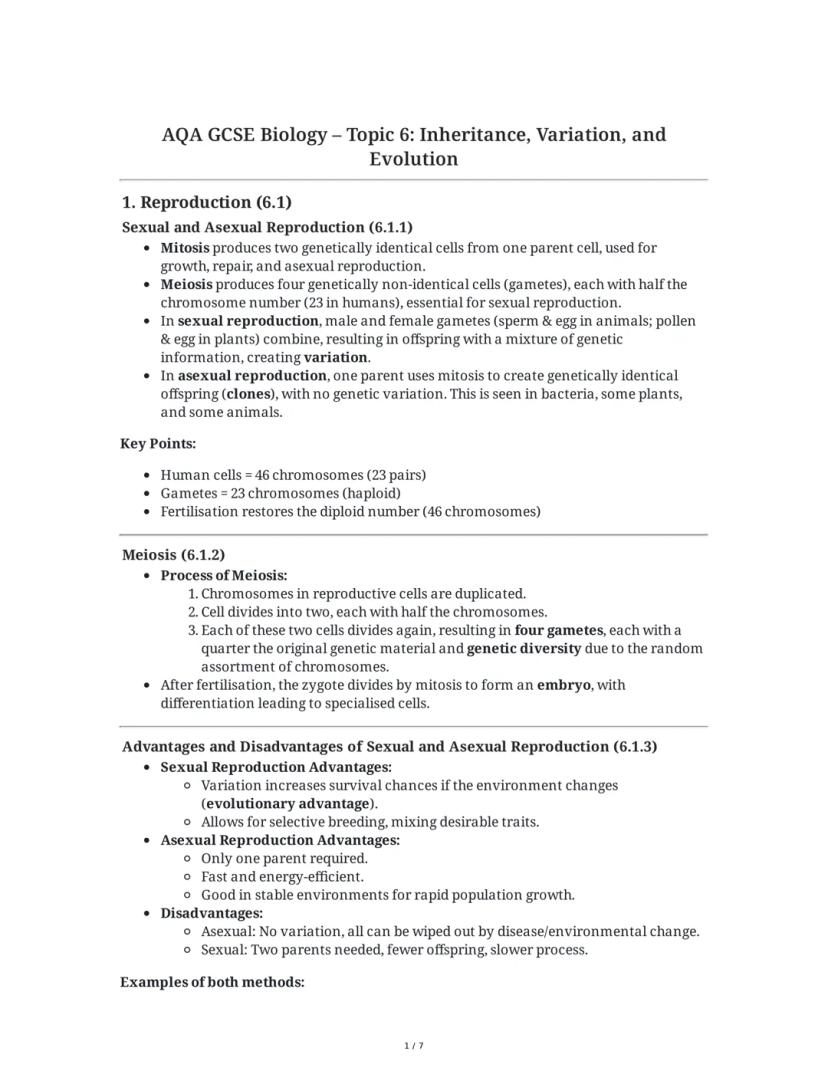
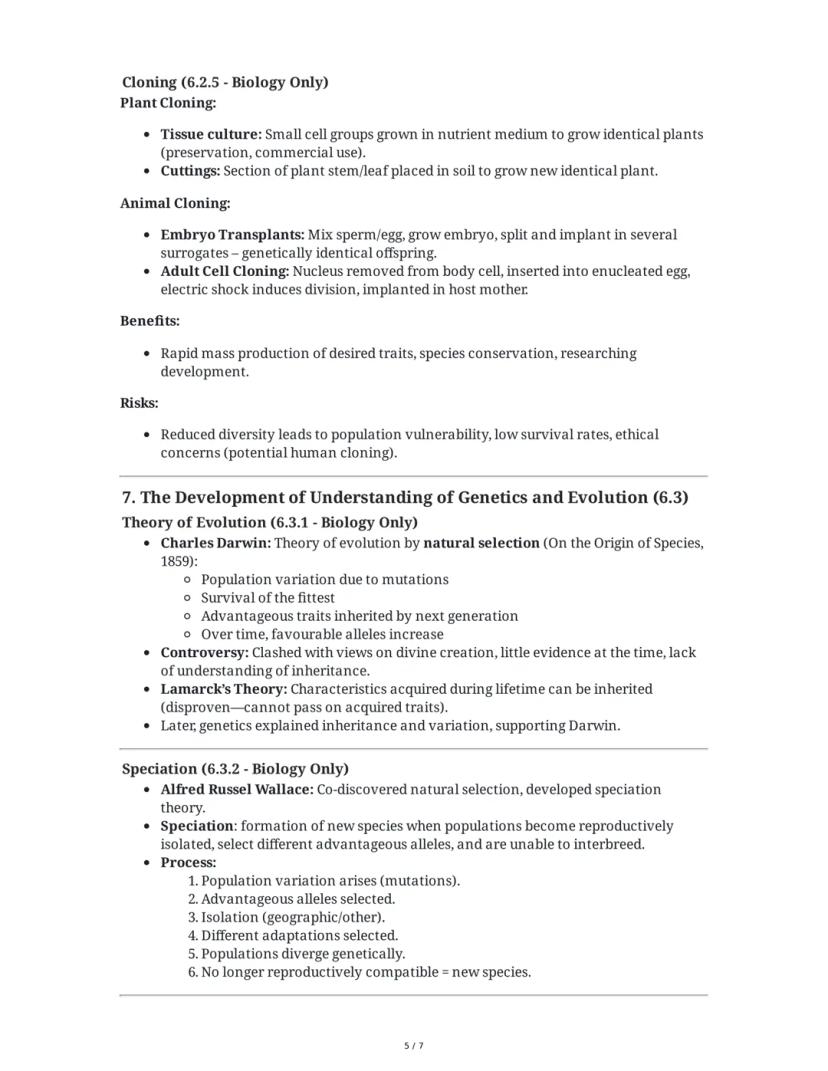

You've probably heard that every human has 46 chromosomes, but did you know your sex cells (gametes) only have 23? This is where mitosis and meiosis come into play - two completely different types of cell division that serve different purposes.
Mitosis creates two identical cells from one parent cell. Think of it as nature's photocopier - perfect for growth, healing cuts, and asexual reproduction. Meiosis, however, is far more interesting because it creates four genetically unique gametes (sperm or egg cells), each with only half the chromosomes.
Sexual reproduction happens when male and female gametes combine, mixing genetic information to create variation in offspring. Asexual reproduction uses mitosis to create genetic clones - faster and more efficient, but with zero genetic variation.
Quick Tip: Remember that fertilisation restores the full chromosome count - 23 from mum + 23 from dad = 46 total!
Sexual reproduction gives evolutionary advantages through variation, whilst asexual reproduction wins on speed and efficiency. However, if a disease strikes, asexually reproducing populations can be wiped out entirely since they're all genetically identical.
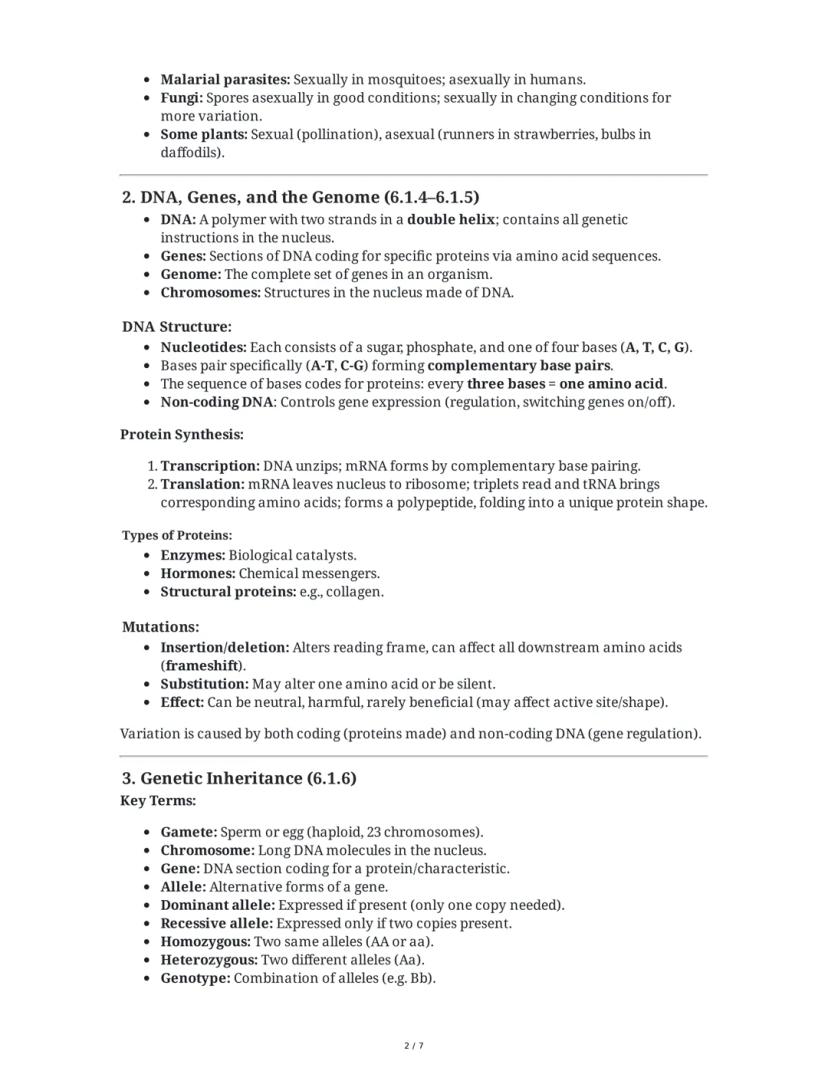
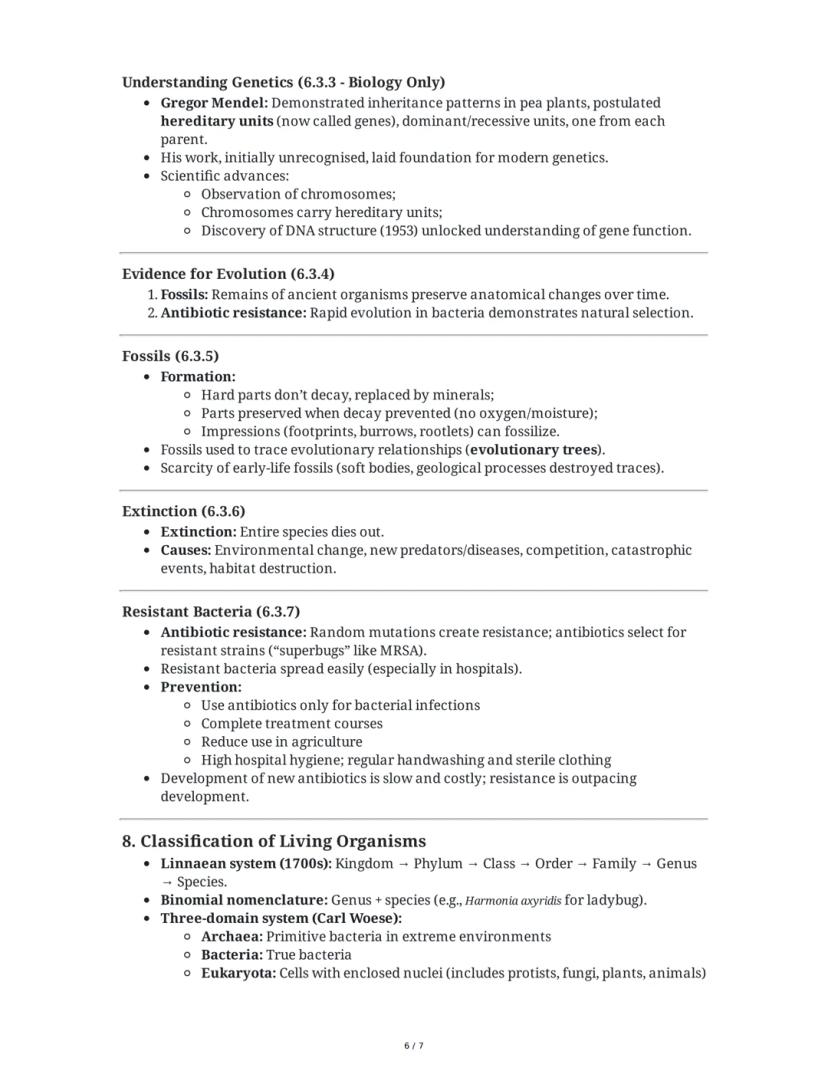
Your DNA is like a twisted ladder (double helix) containing all the instructions for making you. Each rung of this ladder consists of complementary base pairs - A pairs with T, and C pairs with G. The genome represents your complete genetic instruction manual.
Genes are specific sections of DNA that code for proteins through sequences of amino acids. Every three bases codes for one amino acid - think of it as a genetic recipe book where each recipe (gene) makes a different protein.
Protein synthesis happens in two stages: transcription (DNA instructions copied to mRNA) and translation (mRNA read by ribosomes to build proteins). These proteins become enzymes, hormones, or structural components like collagen.
Remember: Non-coding DNA isn't junk - it controls when genes switch on and off!
Mutations occur when DNA sequences change randomly. Most have little effect, but insertions or deletions can shift the entire reading frame, potentially altering every amino acid that follows. Substitutions might change just one amino acid or have no effect at all.
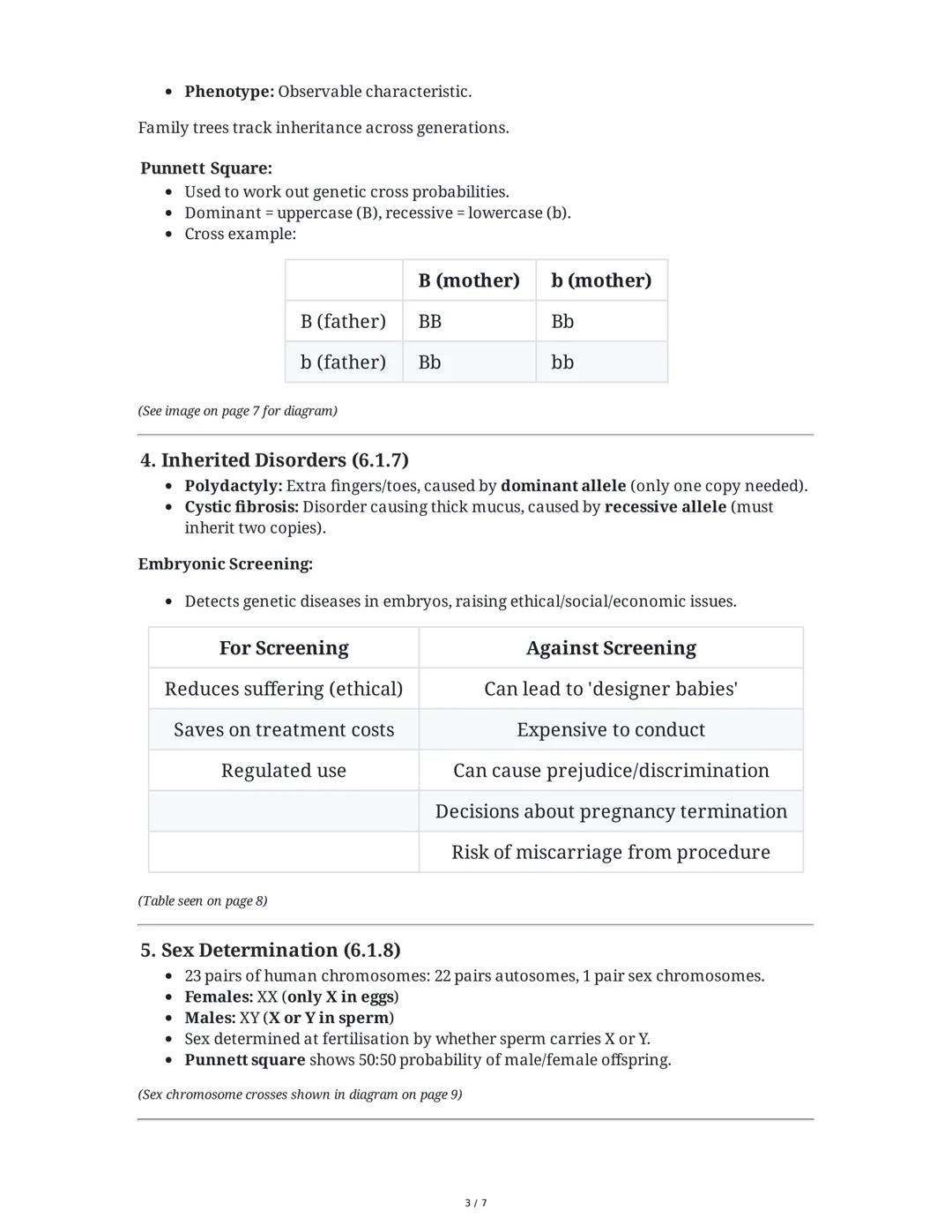
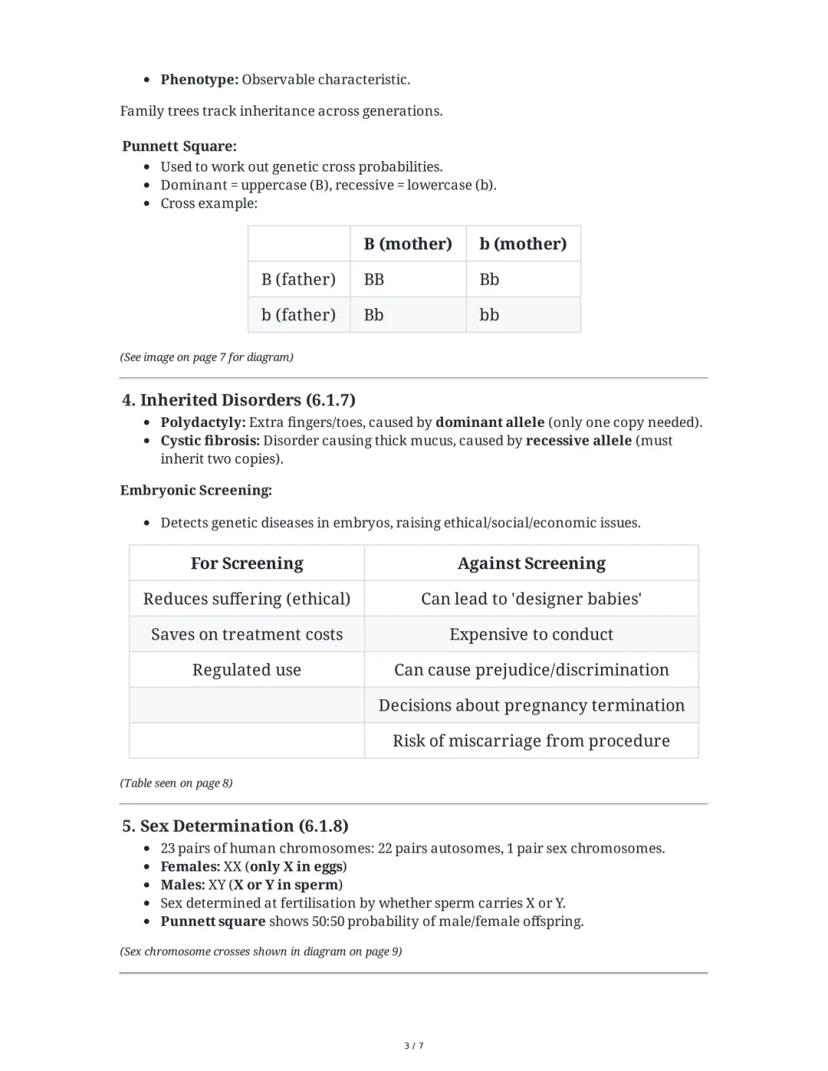
Understanding inheritance patterns becomes much easier once you grasp the key terminology. Alleles are different versions of the same gene, whilst dominant alleles need only one copy to be expressed and recessive alleles need two copies.
Punnett squares help predict inheritance patterns by showing all possible genetic combinations. If you're homozygous, you have two identical alleles (AA or aa). If you're heterozygous, you have two different alleles (Aa). Your genotype is your genetic makeup, whilst your phenotype is what you actually look like.
Some inherited disorders follow predictable patterns. Polydactyly is caused by a dominant allele, so you only need one copy from either parent. Cystic fibrosis is recessive, requiring two copies of the faulty allele.
Key Point: Embryonic screening can detect genetic disorders early but raises complex ethical questions about 'designer babies' and discrimination.
Sex determination works through the X and Y chromosomes. Females are XX, males are XY. Since males contribute either X or Y sperm, they determine the baby's sex - always a 50:50 chance.
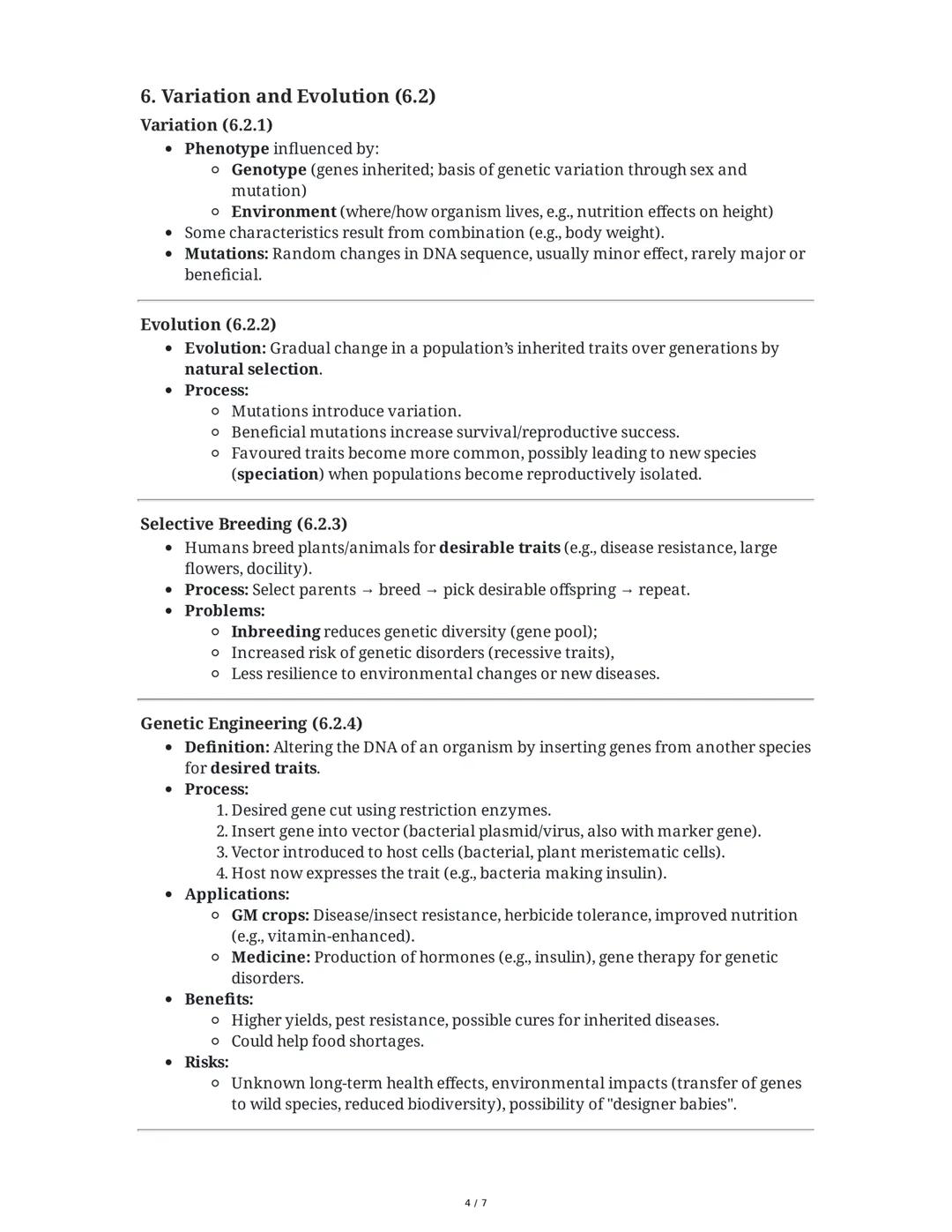
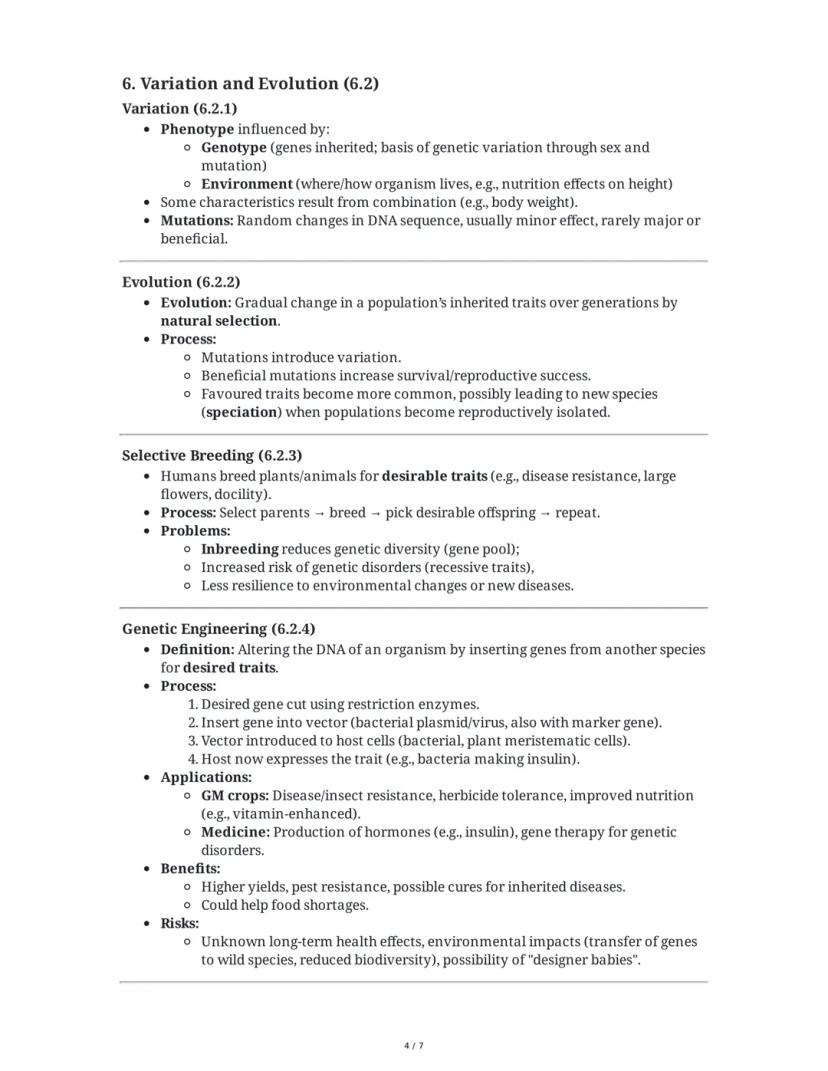
Variation results from both your genes (genotype) and your environment. Height, for example, depends on genetic potential plus nutrition and health. Evolution occurs when beneficial mutations increase survival chances, gradually changing population characteristics over generations.
Selective breeding lets humans choose desirable traits in plants and animals. However, this reduces genetic diversity and increases vulnerability to diseases - a classic trade-off between desired characteristics and genetic health.
Genetic engineering takes this further by inserting genes from different species. Restriction enzymes cut out desired genes, which are then inserted into vectors (like bacterial plasmids) and introduced into host cells. This creates GM crops with pest resistance or bacteria that produce human insulin.
Think About It: GM technology could solve world hunger, but what about unknown long-term effects on health and the environment?
The benefits include higher crop yields and potential cures for genetic diseases. The risks involve unknown health effects, environmental impacts, and reduced biodiversity. It's a powerful technology that requires careful consideration of both promises and perils.
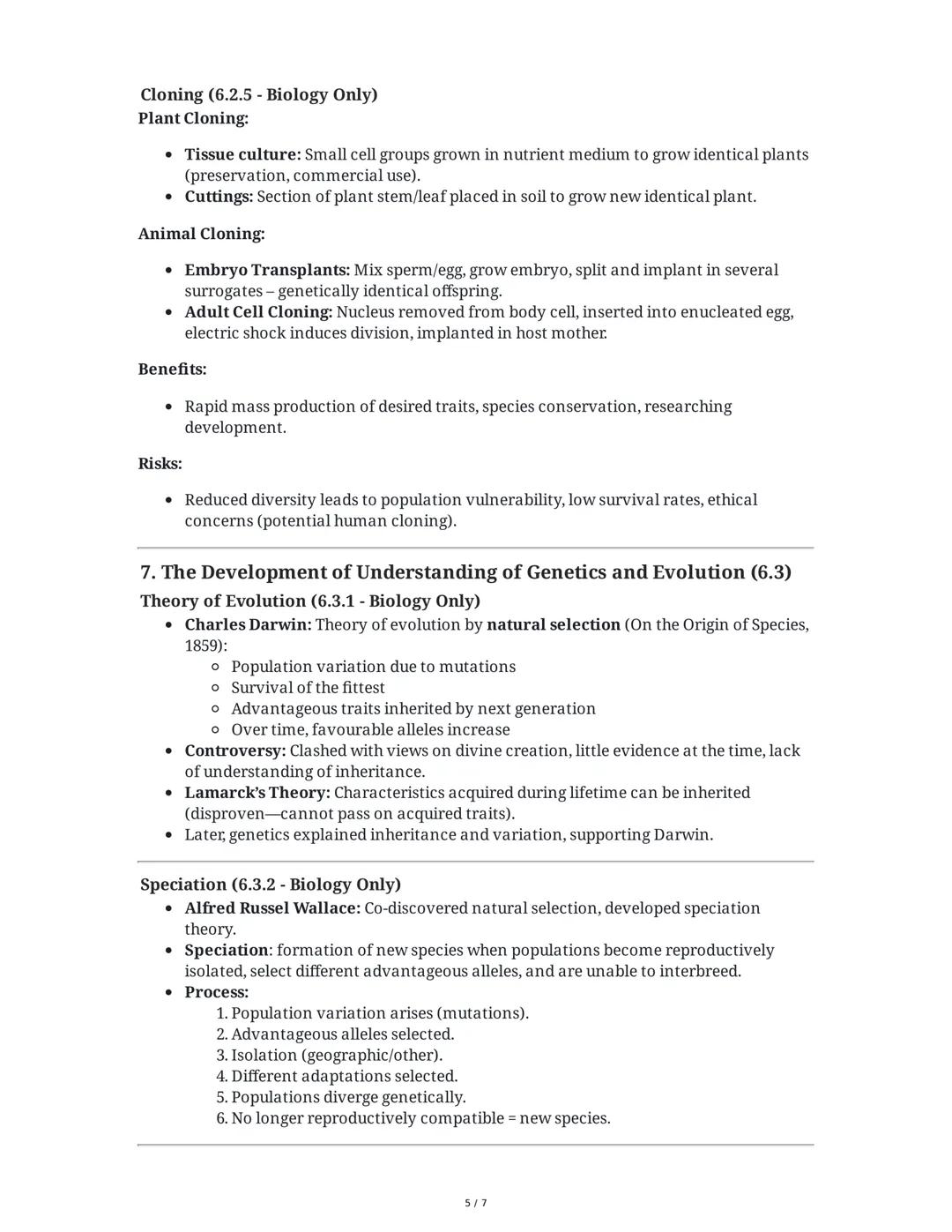
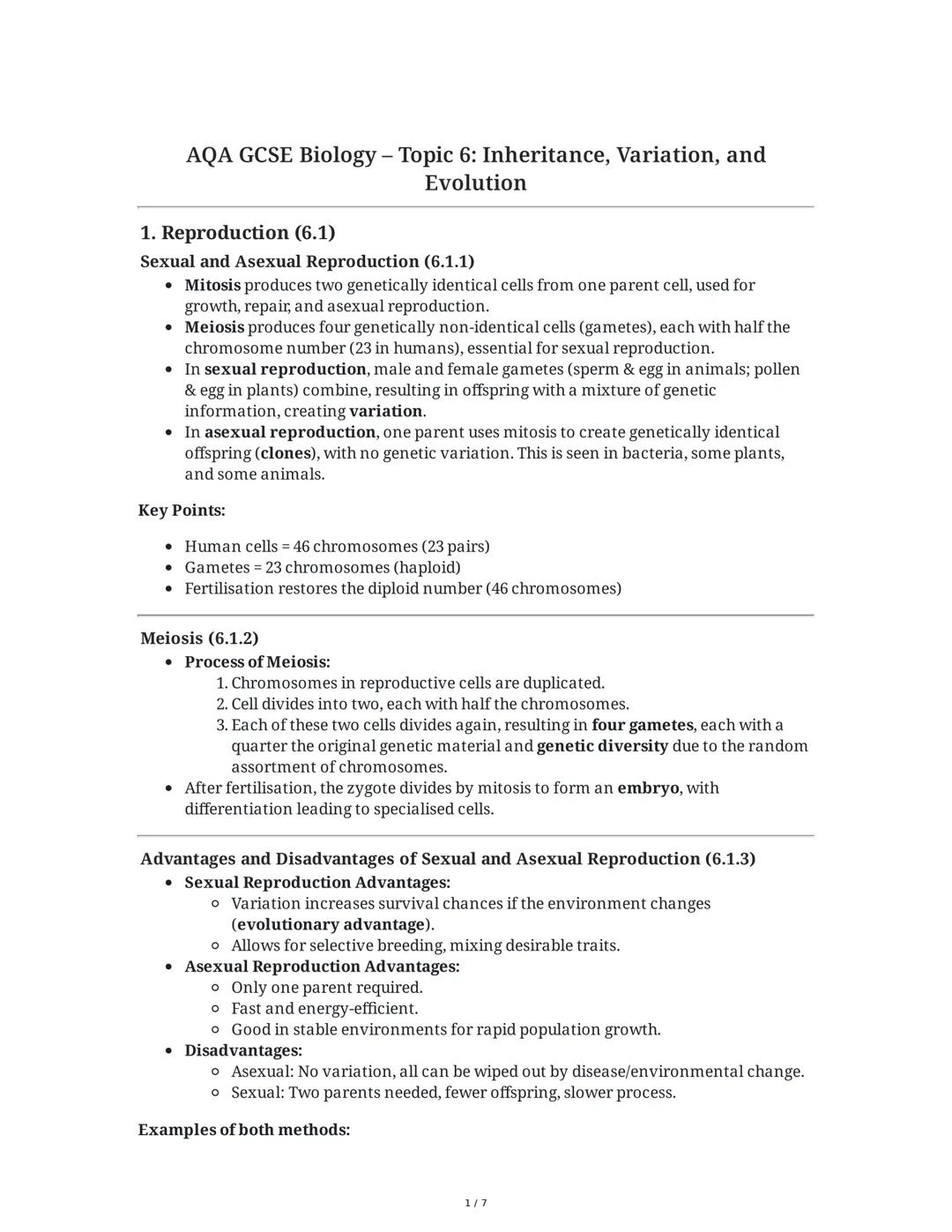
Cloning creates genetically identical organisms through various methods. Plant tissue culture grows identical plants from small cell groups, whilst animal cloning involves either embryo transplants or adult cell cloning (like Dolly the sheep).
The benefits include rapid production of desired traits and species conservation. However, reduced genetic diversity makes populations vulnerable, and success rates remain disappointingly low for animal cloning.
Charles Darwin's theory of evolution by natural selection revolutionised biology. Population variation, survival of the fittest, and inheritance of advantageous traits explain how species change over time. Initially controversial due to religious objections and limited evidence, genetics later provided the missing pieces.
Historical Note: Alfred Russel Wallace co-discovered natural selection and explained how new species form through reproductive isolation.
Speciation occurs when populations become isolated and adapt to different environments. Over time, genetic differences accumulate until populations can no longer interbreed - creating entirely new species. This process explains the incredible diversity of life on Earth.
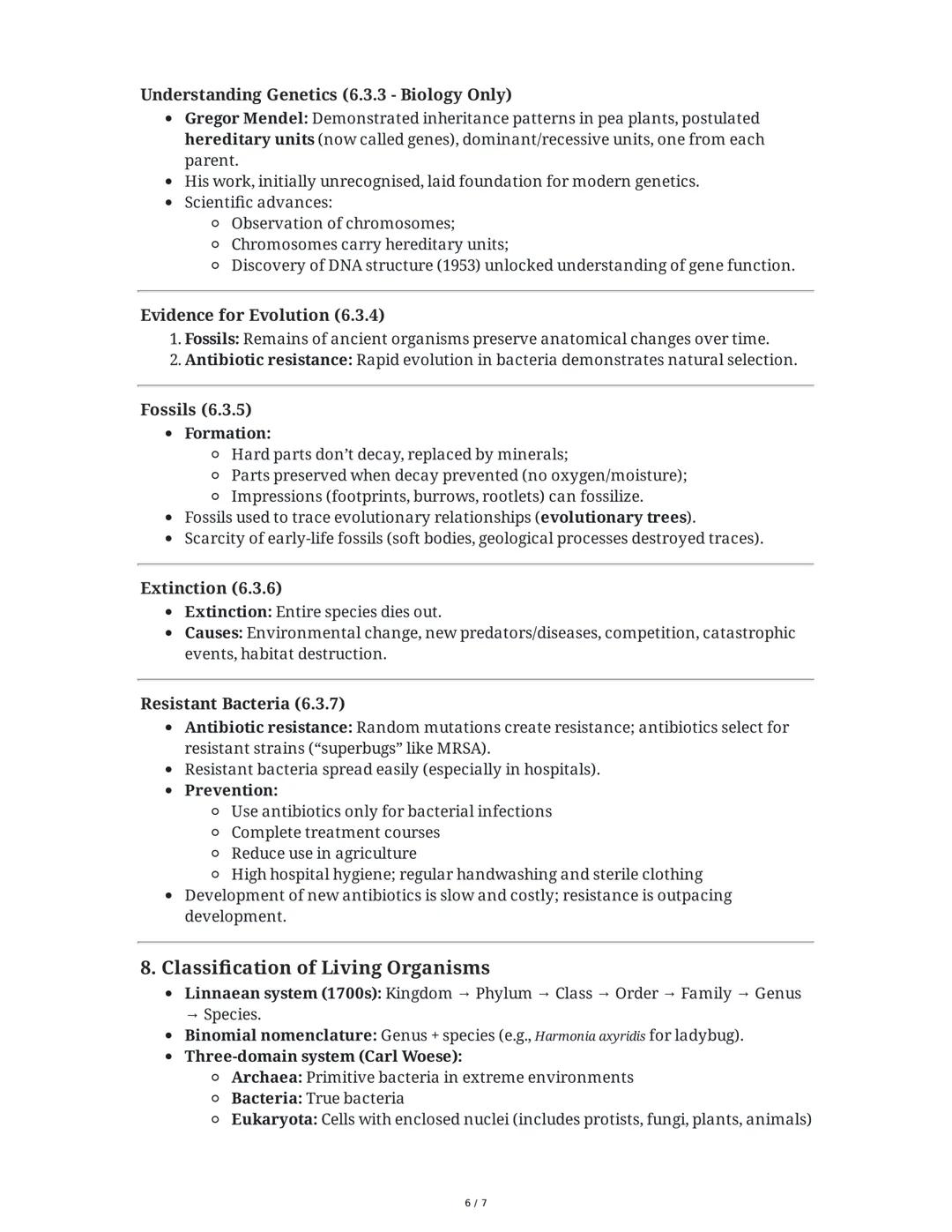
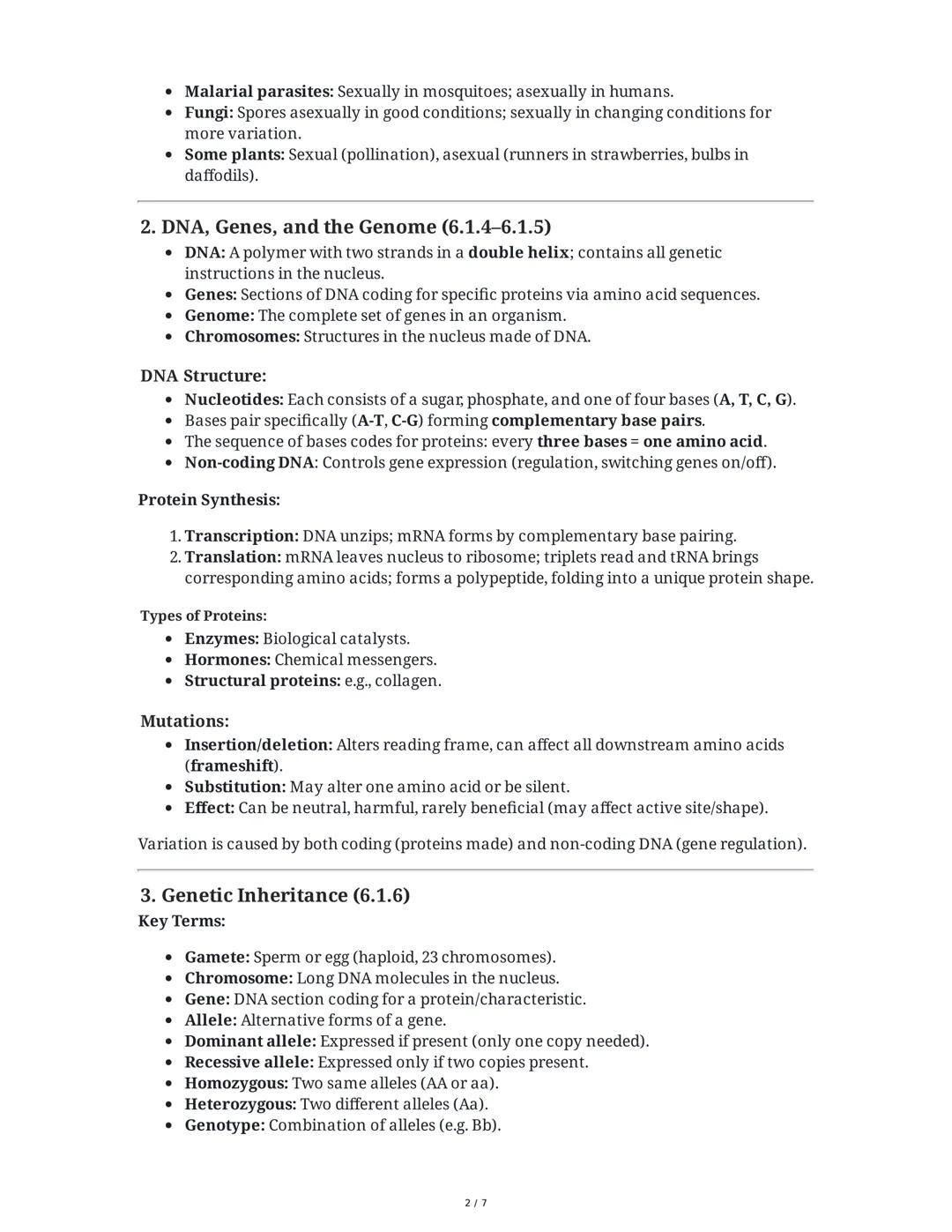
Gregor Mendel's pea plant experiments revealed inheritance patterns and the concept of dominant/recessive traits. Though initially ignored, his work laid the foundation for modern genetics when combined with discoveries about chromosomes and DNA structure.
Multiple lines of evidence support evolution. Fossils preserve ancient life forms and show anatomical changes over time. Antibiotic resistance demonstrates natural selection in action - bacteria with resistance mutations survive whilst others die.
Fossil formation requires specific conditions where hard parts are replaced by minerals or soft parts are preserved without oxygen. Early life fossils are rare because soft bodies decompose and geological processes destroy evidence.
Modern Crisis: Antibiotic resistance is outpacing new drug development, creating 'superbugs' like MRSA.
Extinction occurs when entire species disappear due to environmental changes, new diseases, competition, or catastrophic events. Resistant bacteria evolve rapidly because antibiotics create strong selection pressure for resistance mutations.
Prevention strategies include using antibiotics only for bacterial infections, completing full courses, maintaining hospital hygiene, and developing new drugs - though this process is frustratingly slow and expensive.

Scientists organise life using classification systems that reflect evolutionary relationships. The traditional Linnaean system uses Kingdom, Phylum, Class, Order, Family, Genus, and Species - like a filing system for all life on Earth.
Binomial nomenclature gives each species a two-part scientific name , ensuring universal understanding regardless of local common names. The three-domain system represents a more modern approach, dividing life into Archaea, Bacteria, and Eukaryota based on fundamental cellular differences.
Evolutionary trees diagram relationships between species, showing how they're connected through common ancestors. These visual representations help scientists understand biodiversity patterns and make predictions about evolutionary history.
Remember: Classification systems aren't just academic exercises - they help us understand disease patterns, conservation needs, and evolutionary relationships that affect everything from medicine to agriculture.
Our AI Companion is a student-focused AI tool that offers more than just answers. Built on millions of Knowunity resources, it provides relevant information, personalised study plans, quizzes, and content directly in the chat, adapting to your individual learning journey.
You can download the app from Google Play Store and Apple App Store.
That's right! Enjoy free access to study content, connect with fellow students, and get instant help – all at your fingertips.
App Store
Google Play
The app is very easy to use and well designed. I have found everything I was looking for so far and have been able to learn a lot from the presentations! I will definitely use the app for a class assignment! And of course it also helps a lot as an inspiration.
Stefan S
iOS user
This app is really great. There are so many study notes and help [...]. My problem subject is French, for example, and the app has so many options for help. Thanks to this app, I have improved my French. I would recommend it to anyone.
Samantha Klich
Android user
Wow, I am really amazed. I just tried the app because I've seen it advertised many times and was absolutely stunned. This app is THE HELP you want for school and above all, it offers so many things, such as workouts and fact sheets, which have been VERY helpful to me personally.
Anna
iOS user
Best app on earth! no words because it’s too good
Thomas R
iOS user
Just amazing. Let's me revise 10x better, this app is a quick 10/10. I highly recommend it to anyone. I can watch and search for notes. I can save them in the subject folder. I can revise it any time when I come back. If you haven't tried this app, you're really missing out.
Basil
Android user
This app has made me feel so much more confident in my exam prep, not only through boosting my own self confidence through the features that allow you to connect with others and feel less alone, but also through the way the app itself is centred around making you feel better. It is easy to navigate, fun to use, and helpful to anyone struggling in absolutely any way.
David K
iOS user
The app's just great! All I have to do is enter the topic in the search bar and I get the response real fast. I don't have to watch 10 YouTube videos to understand something, so I'm saving my time. Highly recommended!
Sudenaz Ocak
Android user
In school I was really bad at maths but thanks to the app, I am doing better now. I am so grateful that you made the app.
Greenlight Bonnie
Android user
very reliable app to help and grow your ideas of Maths, English and other related topics in your works. please use this app if your struggling in areas, this app is key for that. wish I'd of done a review before. and it's also free so don't worry about that.
Rohan U
Android user
I know a lot of apps use fake accounts to boost their reviews but this app deserves it all. Originally I was getting 4 in my English exams and this time I got a grade 7. I didn’t even know about this app three days until the exam and it has helped A LOT. Please actually trust me and use it as I’m sure you too will see developments.
Xander S
iOS user
THE QUIZES AND FLASHCARDS ARE SO USEFUL AND I LOVE Knowunity AI. IT ALSO IS LITREALLY LIKE CHATGPT BUT SMARTER!! HELPED ME WITH MY MASCARA PROBLEMS TOO!! AS WELL AS MY REAL SUBJECTS ! DUHHH 😍😁😲🤑💗✨🎀😮
Elisha
iOS user
This apps acc the goat. I find revision so boring but this app makes it so easy to organize it all and then you can ask the freeeee ai to test yourself so good and you can easily upload your own stuff. highly recommend as someone taking mocks now
Paul T
iOS user
The app is very easy to use and well designed. I have found everything I was looking for so far and have been able to learn a lot from the presentations! I will definitely use the app for a class assignment! And of course it also helps a lot as an inspiration.
Stefan S
iOS user
This app is really great. There are so many study notes and help [...]. My problem subject is French, for example, and the app has so many options for help. Thanks to this app, I have improved my French. I would recommend it to anyone.
Samantha Klich
Android user
Wow, I am really amazed. I just tried the app because I've seen it advertised many times and was absolutely stunned. This app is THE HELP you want for school and above all, it offers so many things, such as workouts and fact sheets, which have been VERY helpful to me personally.
Anna
iOS user
Best app on earth! no words because it’s too good
Thomas R
iOS user
Just amazing. Let's me revise 10x better, this app is a quick 10/10. I highly recommend it to anyone. I can watch and search for notes. I can save them in the subject folder. I can revise it any time when I come back. If you haven't tried this app, you're really missing out.
Basil
Android user
This app has made me feel so much more confident in my exam prep, not only through boosting my own self confidence through the features that allow you to connect with others and feel less alone, but also through the way the app itself is centred around making you feel better. It is easy to navigate, fun to use, and helpful to anyone struggling in absolutely any way.
David K
iOS user
The app's just great! All I have to do is enter the topic in the search bar and I get the response real fast. I don't have to watch 10 YouTube videos to understand something, so I'm saving my time. Highly recommended!
Sudenaz Ocak
Android user
In school I was really bad at maths but thanks to the app, I am doing better now. I am so grateful that you made the app.
Greenlight Bonnie
Android user
very reliable app to help and grow your ideas of Maths, English and other related topics in your works. please use this app if your struggling in areas, this app is key for that. wish I'd of done a review before. and it's also free so don't worry about that.
Rohan U
Android user
I know a lot of apps use fake accounts to boost their reviews but this app deserves it all. Originally I was getting 4 in my English exams and this time I got a grade 7. I didn’t even know about this app three days until the exam and it has helped A LOT. Please actually trust me and use it as I’m sure you too will see developments.
Xander S
iOS user
THE QUIZES AND FLASHCARDS ARE SO USEFUL AND I LOVE Knowunity AI. IT ALSO IS LITREALLY LIKE CHATGPT BUT SMARTER!! HELPED ME WITH MY MASCARA PROBLEMS TOO!! AS WELL AS MY REAL SUBJECTS ! DUHHH 😍😁😲🤑💗✨🎀😮
Elisha
iOS user
This apps acc the goat. I find revision so boring but this app makes it so easy to organize it all and then you can ask the freeeee ai to test yourself so good and you can easily upload your own stuff. highly recommend as someone taking mocks now
Paul T
iOS user
jazmin
@jazmin_ot49c
Ever wondered why you look like your parents but not exactly like them? This fascinating topic explores how life reproduces, passes on traits, and evolves over time - knowledge that's essential for understanding everything from genetic diseases to antibiotic resistance.
Access to all documents
Improve your grades
Join milions of students
You've probably heard that every human has 46 chromosomes, but did you know your sex cells (gametes) only have 23? This is where mitosis and meiosis come into play - two completely different types of cell division that serve different purposes.
Mitosis creates two identical cells from one parent cell. Think of it as nature's photocopier - perfect for growth, healing cuts, and asexual reproduction. Meiosis, however, is far more interesting because it creates four genetically unique gametes (sperm or egg cells), each with only half the chromosomes.
Sexual reproduction happens when male and female gametes combine, mixing genetic information to create variation in offspring. Asexual reproduction uses mitosis to create genetic clones - faster and more efficient, but with zero genetic variation.
Quick Tip: Remember that fertilisation restores the full chromosome count - 23 from mum + 23 from dad = 46 total!
Sexual reproduction gives evolutionary advantages through variation, whilst asexual reproduction wins on speed and efficiency. However, if a disease strikes, asexually reproducing populations can be wiped out entirely since they're all genetically identical.
Access to all documents
Improve your grades
Join milions of students
Your DNA is like a twisted ladder (double helix) containing all the instructions for making you. Each rung of this ladder consists of complementary base pairs - A pairs with T, and C pairs with G. The genome represents your complete genetic instruction manual.
Genes are specific sections of DNA that code for proteins through sequences of amino acids. Every three bases codes for one amino acid - think of it as a genetic recipe book where each recipe (gene) makes a different protein.
Protein synthesis happens in two stages: transcription (DNA instructions copied to mRNA) and translation (mRNA read by ribosomes to build proteins). These proteins become enzymes, hormones, or structural components like collagen.
Remember: Non-coding DNA isn't junk - it controls when genes switch on and off!
Mutations occur when DNA sequences change randomly. Most have little effect, but insertions or deletions can shift the entire reading frame, potentially altering every amino acid that follows. Substitutions might change just one amino acid or have no effect at all.
Access to all documents
Improve your grades
Join milions of students
Understanding inheritance patterns becomes much easier once you grasp the key terminology. Alleles are different versions of the same gene, whilst dominant alleles need only one copy to be expressed and recessive alleles need two copies.
Punnett squares help predict inheritance patterns by showing all possible genetic combinations. If you're homozygous, you have two identical alleles (AA or aa). If you're heterozygous, you have two different alleles (Aa). Your genotype is your genetic makeup, whilst your phenotype is what you actually look like.
Some inherited disorders follow predictable patterns. Polydactyly is caused by a dominant allele, so you only need one copy from either parent. Cystic fibrosis is recessive, requiring two copies of the faulty allele.
Key Point: Embryonic screening can detect genetic disorders early but raises complex ethical questions about 'designer babies' and discrimination.
Sex determination works through the X and Y chromosomes. Females are XX, males are XY. Since males contribute either X or Y sperm, they determine the baby's sex - always a 50:50 chance.
Access to all documents
Improve your grades
Join milions of students
Variation results from both your genes (genotype) and your environment. Height, for example, depends on genetic potential plus nutrition and health. Evolution occurs when beneficial mutations increase survival chances, gradually changing population characteristics over generations.
Selective breeding lets humans choose desirable traits in plants and animals. However, this reduces genetic diversity and increases vulnerability to diseases - a classic trade-off between desired characteristics and genetic health.
Genetic engineering takes this further by inserting genes from different species. Restriction enzymes cut out desired genes, which are then inserted into vectors (like bacterial plasmids) and introduced into host cells. This creates GM crops with pest resistance or bacteria that produce human insulin.
Think About It: GM technology could solve world hunger, but what about unknown long-term effects on health and the environment?
The benefits include higher crop yields and potential cures for genetic diseases. The risks involve unknown health effects, environmental impacts, and reduced biodiversity. It's a powerful technology that requires careful consideration of both promises and perils.
Access to all documents
Improve your grades
Join milions of students
Cloning creates genetically identical organisms through various methods. Plant tissue culture grows identical plants from small cell groups, whilst animal cloning involves either embryo transplants or adult cell cloning (like Dolly the sheep).
The benefits include rapid production of desired traits and species conservation. However, reduced genetic diversity makes populations vulnerable, and success rates remain disappointingly low for animal cloning.
Charles Darwin's theory of evolution by natural selection revolutionised biology. Population variation, survival of the fittest, and inheritance of advantageous traits explain how species change over time. Initially controversial due to religious objections and limited evidence, genetics later provided the missing pieces.
Historical Note: Alfred Russel Wallace co-discovered natural selection and explained how new species form through reproductive isolation.
Speciation occurs when populations become isolated and adapt to different environments. Over time, genetic differences accumulate until populations can no longer interbreed - creating entirely new species. This process explains the incredible diversity of life on Earth.
Access to all documents
Improve your grades
Join milions of students
Gregor Mendel's pea plant experiments revealed inheritance patterns and the concept of dominant/recessive traits. Though initially ignored, his work laid the foundation for modern genetics when combined with discoveries about chromosomes and DNA structure.
Multiple lines of evidence support evolution. Fossils preserve ancient life forms and show anatomical changes over time. Antibiotic resistance demonstrates natural selection in action - bacteria with resistance mutations survive whilst others die.
Fossil formation requires specific conditions where hard parts are replaced by minerals or soft parts are preserved without oxygen. Early life fossils are rare because soft bodies decompose and geological processes destroy evidence.
Modern Crisis: Antibiotic resistance is outpacing new drug development, creating 'superbugs' like MRSA.
Extinction occurs when entire species disappear due to environmental changes, new diseases, competition, or catastrophic events. Resistant bacteria evolve rapidly because antibiotics create strong selection pressure for resistance mutations.
Prevention strategies include using antibiotics only for bacterial infections, completing full courses, maintaining hospital hygiene, and developing new drugs - though this process is frustratingly slow and expensive.
Access to all documents
Improve your grades
Join milions of students
Scientists organise life using classification systems that reflect evolutionary relationships. The traditional Linnaean system uses Kingdom, Phylum, Class, Order, Family, Genus, and Species - like a filing system for all life on Earth.
Binomial nomenclature gives each species a two-part scientific name , ensuring universal understanding regardless of local common names. The three-domain system represents a more modern approach, dividing life into Archaea, Bacteria, and Eukaryota based on fundamental cellular differences.
Evolutionary trees diagram relationships between species, showing how they're connected through common ancestors. These visual representations help scientists understand biodiversity patterns and make predictions about evolutionary history.
Remember: Classification systems aren't just academic exercises - they help us understand disease patterns, conservation needs, and evolutionary relationships that affect everything from medicine to agriculture.
Our AI Companion is a student-focused AI tool that offers more than just answers. Built on millions of Knowunity resources, it provides relevant information, personalised study plans, quizzes, and content directly in the chat, adapting to your individual learning journey.
You can download the app from Google Play Store and Apple App Store.
That's right! Enjoy free access to study content, connect with fellow students, and get instant help – all at your fingertips.
0
Smart Tools NEW
Transform this note into: ✓ 50+ Practice Questions ✓ Interactive Flashcards ✓ Full Mock Exam ✓ Essay Outlines
App Store
Google Play
The app is very easy to use and well designed. I have found everything I was looking for so far and have been able to learn a lot from the presentations! I will definitely use the app for a class assignment! And of course it also helps a lot as an inspiration.
Stefan S
iOS user
This app is really great. There are so many study notes and help [...]. My problem subject is French, for example, and the app has so many options for help. Thanks to this app, I have improved my French. I would recommend it to anyone.
Samantha Klich
Android user
Wow, I am really amazed. I just tried the app because I've seen it advertised many times and was absolutely stunned. This app is THE HELP you want for school and above all, it offers so many things, such as workouts and fact sheets, which have been VERY helpful to me personally.
Anna
iOS user
Best app on earth! no words because it’s too good
Thomas R
iOS user
Just amazing. Let's me revise 10x better, this app is a quick 10/10. I highly recommend it to anyone. I can watch and search for notes. I can save them in the subject folder. I can revise it any time when I come back. If you haven't tried this app, you're really missing out.
Basil
Android user
This app has made me feel so much more confident in my exam prep, not only through boosting my own self confidence through the features that allow you to connect with others and feel less alone, but also through the way the app itself is centred around making you feel better. It is easy to navigate, fun to use, and helpful to anyone struggling in absolutely any way.
David K
iOS user
The app's just great! All I have to do is enter the topic in the search bar and I get the response real fast. I don't have to watch 10 YouTube videos to understand something, so I'm saving my time. Highly recommended!
Sudenaz Ocak
Android user
In school I was really bad at maths but thanks to the app, I am doing better now. I am so grateful that you made the app.
Greenlight Bonnie
Android user
very reliable app to help and grow your ideas of Maths, English and other related topics in your works. please use this app if your struggling in areas, this app is key for that. wish I'd of done a review before. and it's also free so don't worry about that.
Rohan U
Android user
I know a lot of apps use fake accounts to boost their reviews but this app deserves it all. Originally I was getting 4 in my English exams and this time I got a grade 7. I didn’t even know about this app three days until the exam and it has helped A LOT. Please actually trust me and use it as I’m sure you too will see developments.
Xander S
iOS user
THE QUIZES AND FLASHCARDS ARE SO USEFUL AND I LOVE Knowunity AI. IT ALSO IS LITREALLY LIKE CHATGPT BUT SMARTER!! HELPED ME WITH MY MASCARA PROBLEMS TOO!! AS WELL AS MY REAL SUBJECTS ! DUHHH 😍😁😲🤑💗✨🎀😮
Elisha
iOS user
This apps acc the goat. I find revision so boring but this app makes it so easy to organize it all and then you can ask the freeeee ai to test yourself so good and you can easily upload your own stuff. highly recommend as someone taking mocks now
Paul T
iOS user
The app is very easy to use and well designed. I have found everything I was looking for so far and have been able to learn a lot from the presentations! I will definitely use the app for a class assignment! And of course it also helps a lot as an inspiration.
Stefan S
iOS user
This app is really great. There are so many study notes and help [...]. My problem subject is French, for example, and the app has so many options for help. Thanks to this app, I have improved my French. I would recommend it to anyone.
Samantha Klich
Android user
Wow, I am really amazed. I just tried the app because I've seen it advertised many times and was absolutely stunned. This app is THE HELP you want for school and above all, it offers so many things, such as workouts and fact sheets, which have been VERY helpful to me personally.
Anna
iOS user
Best app on earth! no words because it’s too good
Thomas R
iOS user
Just amazing. Let's me revise 10x better, this app is a quick 10/10. I highly recommend it to anyone. I can watch and search for notes. I can save them in the subject folder. I can revise it any time when I come back. If you haven't tried this app, you're really missing out.
Basil
Android user
This app has made me feel so much more confident in my exam prep, not only through boosting my own self confidence through the features that allow you to connect with others and feel less alone, but also through the way the app itself is centred around making you feel better. It is easy to navigate, fun to use, and helpful to anyone struggling in absolutely any way.
David K
iOS user
The app's just great! All I have to do is enter the topic in the search bar and I get the response real fast. I don't have to watch 10 YouTube videos to understand something, so I'm saving my time. Highly recommended!
Sudenaz Ocak
Android user
In school I was really bad at maths but thanks to the app, I am doing better now. I am so grateful that you made the app.
Greenlight Bonnie
Android user
very reliable app to help and grow your ideas of Maths, English and other related topics in your works. please use this app if your struggling in areas, this app is key for that. wish I'd of done a review before. and it's also free so don't worry about that.
Rohan U
Android user
I know a lot of apps use fake accounts to boost their reviews but this app deserves it all. Originally I was getting 4 in my English exams and this time I got a grade 7. I didn’t even know about this app three days until the exam and it has helped A LOT. Please actually trust me and use it as I’m sure you too will see developments.
Xander S
iOS user
THE QUIZES AND FLASHCARDS ARE SO USEFUL AND I LOVE Knowunity AI. IT ALSO IS LITREALLY LIKE CHATGPT BUT SMARTER!! HELPED ME WITH MY MASCARA PROBLEMS TOO!! AS WELL AS MY REAL SUBJECTS ! DUHHH 😍😁😲🤑💗✨🎀😮
Elisha
iOS user
This apps acc the goat. I find revision so boring but this app makes it so easy to organize it all and then you can ask the freeeee ai to test yourself so good and you can easily upload your own stuff. highly recommend as someone taking mocks now
Paul T
iOS user