
Understanding how the UK government works is crucial for grasping... Show more
 Humanities
 English Literature
 Sociology
 Biology
Sign up to see the contentIt's free!
Access to all documents
Improve your grades
Join milions of students
Knowunity AI
Subjects
Triangle Congruence and Similarity Theorems
Triangle Properties and Classification
Linear Equations and Graphs
Geometric Angle Relationships
Trigonometric Functions and Identities
Equation Solving Techniques
Circle Geometry Fundamentals
Division Operations and Methods
Basic Differentiation Rules
Exponent and Logarithm Properties
Show all topics
Human Organ Systems
Reproductive Cell Cycles
Biological Sciences Subdisciplines
Cellular Energy Metabolism
Autotrophic Energy Processes
Inheritance Patterns and Principles
Biomolecular Structure and Organization
Cell Cycle and Division Mechanics
Cellular Organization and Development
Biological Structural Organization
Show all topics
Chemical Sciences and Applications
Atomic Structure and Composition
Molecular Electron Structure Representation
Atomic Electron Behavior
Matter Properties and Water
Mole Concept and Calculations
Gas Laws and Behavior
Periodic Table Organization
Chemical Thermodynamics Fundamentals
Chemical Bond Types and Properties
Show all topics
European Renaissance and Enlightenment
European Cultural Movements 800-1920
American Revolution Era 1763-1797
American Civil War 1861-1865
Global Imperial Systems
Mongol and Chinese Dynasties
U.S. Presidents and World Leaders
Historical Sources and Documentation
World Wars Era and Impact
World Religious Systems
Show all topics
Classic and Contemporary Novels
Literary Character Analysis
Rhetorical Theory and Practice
Classic Literary Narratives
Reading Analysis and Interpretation
Narrative Structure and Techniques
English Language Components
Influential English-Language Authors
Basic Sentence Structure
Narrative Voice and Perspective
Show all topics
341
•
Updated Mar 13, 2026
•

Work n get them A*s
@akeoswell_boaa
Understanding how the UK government works is crucial for grasping... Show more


Ever wondered who actually runs the country day-to-day? The executive (also called "the Government") is the decision-making powerhouse at the heart of UK politics, led by the Prime Minister and Cabinet.
The Prime Minister holds massive power - they appoint all Cabinet members, can create or scrap entire government departments, and essentially organise how the state functions. Think of them as the ultimate boss of UK politics.
The Cabinet consists of 22 senior ministers, each with the title 'Secretary of State'. These ministers run major departments like Defence or Education, helping deliver government policies and providing administrative support. Each department handles specific policy areas - so the Defence Secretary deals with military matters whilst the Transport Secretary oversees things like the DVLA.
Key Point: The executive doesn't just make decisions - they're responsible for everything from the NHS to welfare benefits to the criminal justice system. That's why understanding their role matters for every aspect of British life.

The executive has three main jobs that directly affect your life. First, they propose legislation - introducing new laws or changing existing ones. However, Parliament can vote these down, and whilst party manifestos hint at their plans, they're not legally bound to stick to them.
Second, the Chancellor proposes the annual budget in consultation with the PM. This determines how much tax you'll pay and where government money gets spent - from schools to hospitals to defence. The annual budget statement reveals the government's spending priorities.
Finally, they make policy decisions that shape the country's direction. For example, the 2010-15 coalition allowed parents and voluntary groups to set up schools without council permission - a major shift in education policy.
Remember: Every government service you use, from student loans to the NHS, exists because of executive decisions and spending choices.

Why does the PM seem so powerful compared to other politicians? Their authority comes from four main sources. As leader of the ruling party, they carry the support of MPs and party members who won the right to govern.
The royal prerogative gives them powers traditionally held by the monarch - like commanding armed forces. Since we can't have an unelected monarch wielding real power in a democracy, these get delegated to the PM.
The PM also has a popular mandate - whilst voters choose MPs and parties, they know they're effectively choosing a Prime Minister too. Many didn't vote Labour in 2019 simply because they disliked Jeremy Corbyn.
However, the PM's power isn't unlimited. If their party loses its parliamentary majority (the Conservatives won 365 seats in 2019 but have lost seats since), their authority gets seriously undermined. Strong personalities like Margaret Thatcher can enhance their power, but unpopular leaders quickly find their influence waning.
Think About It: The PM's power depends heavily on party support - lose that, and even the most ambitious leader becomes vulnerable to challenges and rebellions.

The Prime Minister wields significant patronage - appointing ministers, reshuffling cabinets, dismissing ministers, and even creating Lords. However, senior colleagues demand inclusion in specific posts, and botched reshuffles can create leadership rivals.
As party leader, the PM enjoys majority support in Commons and sets the political agenda. Yet this support isn't unconditional - backbench rebellions can seriously damage their authority, and they must keep party members onside.
The PM's public standing gives them a high profile as the government's chief communicator and international representative. During crises, they become the nation's focal point. But unpopularity with voters undermines everything, and media criticism can be devastating.
In policy-making, the PM directs government policy and sets agendas, taking key roles during crises. However, they face time constraints, lack detailed departmental knowledge, and have limited resources compared to full government departments.
Reality Check: Being PM looks glamorous, but the role involves constant balancing acts between competing demands, personalities, and crises that can emerge at any moment.

Collective responsibility keeps the government united through three key principles. Secrecy means ministers can't leak cabinet details or reveal disagreements - though Gordon Brown's cabinet was notorious for anonymous leaks about his leadership style in 2008.
Binding decisions require ministers to support cabinet choices or resign. If they can't accept decisions, they must go - like the mass resignations from Boris Johnson's cabinet in 2022, starting with Rishi Sunak and Sajid Javid, followed by 55 others in two days.
Confidence voting means if Parliament loses confidence in the government, everyone must resign and trigger a general election. Theresa May survived such a vote in January 2019 after her Brexit deal failures.
Individual responsibility means ministers take blame for personal mistakes or departmental failures. Recent examples include Andrew Mitchell insulting police (2012), Priti Patel's secret Israeli meetings (2017), and Suella Braverman sending official documents via personal email (2022).
Key Insight: These responsibility rules aren't just tradition - they're what keeps government functioning and accountable to Parliament and voters.

Meet the civil servants - the permanent workforce who actually implement government policies. They run prisons, issue driving licences, provide benefits and pensions, and handle countless daily government functions that keep society running.
Around 520,000 civil servants were employed in 2010 (the highest since 2008's recession). Critics like Dominic Cummings argued the civil service lacks specialised senior staff, with only 7% leaving each year, creating stagnation.
Civil servants work in government departments as permanent bureaucrats. When the government wants to buy tanks or reform the NHS, civil servants handle the practical implementation. Each department is led by a Permanent Secretary who works with Cabinet ministers.
The civil service provides two crucial functions: advising ministers on policies and implementing government decisions. This system emerged from the 1854 report on permanent civil service organisation.
Behind the Scenes: While politicians grab headlines, civil servants are the ones actually making government work - from processing your passport application to managing nuclear submarines.
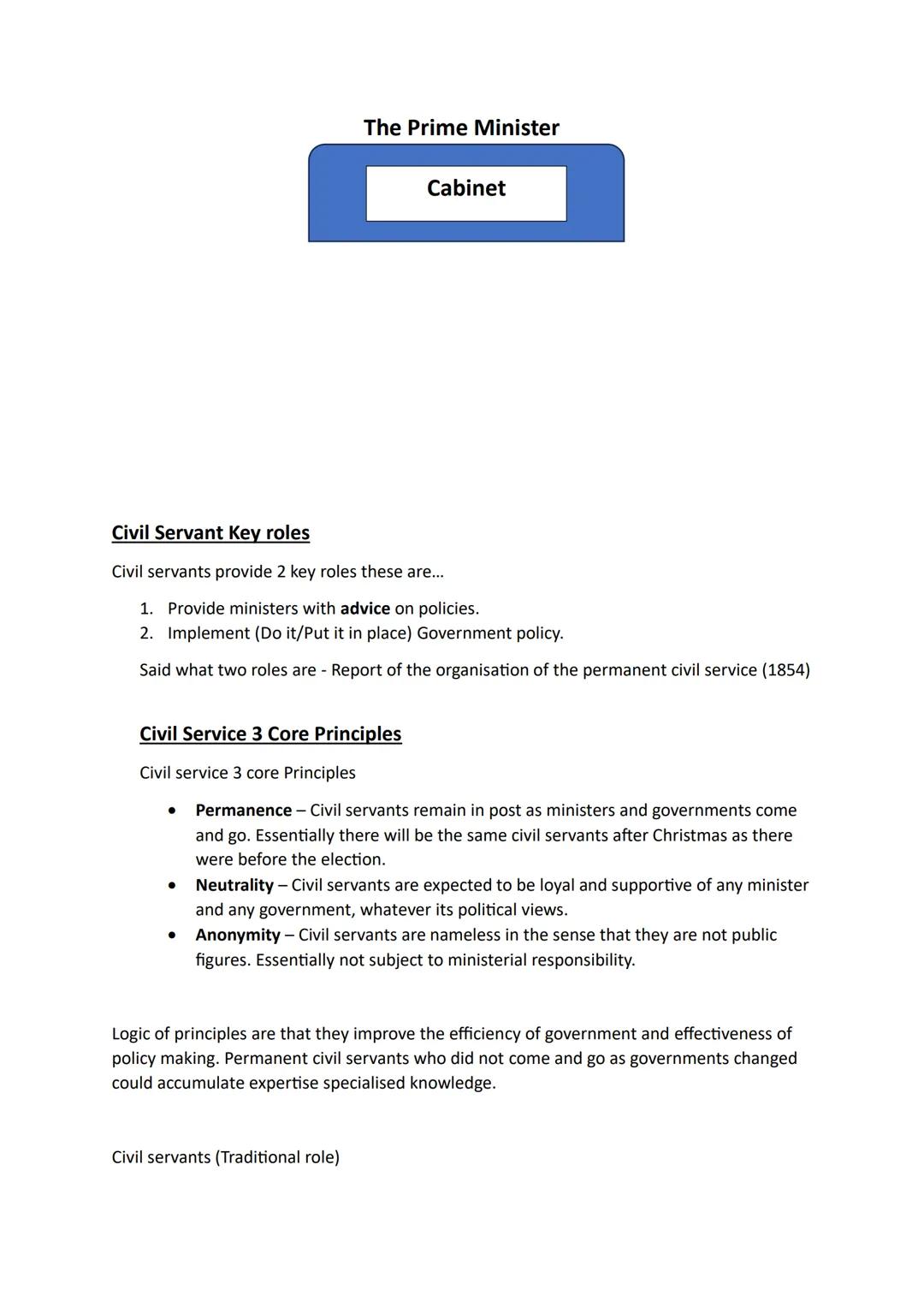
The civil service operates on three core principles that shape how government really works. Permanence means civil servants stay in post whilst ministers and governments change - the same staff will be there after elections, maintaining continuity.
Neutrality requires civil servants to loyally serve any minister and government, regardless of political views. They must support Conservative, Labour, or any other party equally when in power.
Anonymity keeps civil servants as behind-the-scenes figures, not public personalities. They're not subject to the same scrutiny as ministers, allowing them to focus on practical implementation rather than political positioning.
These principles aim to improve government efficiency by creating permanent expertise. However, critics argue civil servants may have political bias - Labour accused them of being uncaring elites, whilst Conservatives like Thatcher saw them as empire-building careerists opposed to reducing state size.
Double-Edged Sword: Permanent, neutral civil servants provide stability and expertise, but some argue this system can resist political change and democratic accountability.

Parliament is bicameral - having two chambers (Commons and Lords) with distinct roles. Looking at the 2019 election results, England voted largely Conservative, Scotland went SNP, and Liberal Democrats held parts of northern Scotland.
Parliament has three main functions that directly impact your life. Passing legislation is their most important job - they have supreme authority to make and change laws on any subject. The Commons alone can approve taxation laws, whilst the Lords can only amend and delay (not block) legislation for up to a year.
Scrutinising the executive means holding the government accountable through questions, select committees, and debates. Opposition parties expose government errors and failures, whilst ministers must defend their decisions to Parliament.
Finally, Parliament provides ministers - almost all government ministers come from either Commons or Lords, maintaining the link between legislative and executive branches.
Power Balance: Parliament can vote down government proposals (like Boris Johnson's laws being rejected three times in 2019), showing that even powerful PMs aren't guaranteed success.
The House of Commons uniquely represents the electorate as the only chamber directly elected by British voters. MPs participate in representative democracy - they're elected for their judgement and vote according to their opinions, not taking direct instructions from constituents.
However, First Past the Post (FPTP) ties MPs closely to their constituencies. During Brexit, many MPs voted according to how their local area voted in the referendum, showing how electoral systems influence representation.
The legislative process involves multiple stages: preparatory work, first reading, second reading, committee stage, report stage, third reading, then the "other place" (Lords). White papers outline government policy proposals, whilst green papers are consultation documents where you can provide feedback through your MP.
Parliament's scrutiny role operates through various mechanisms - ministers must answer questions, appear before select committees, and defend their decisions in debates. Most senior ministers come from Commons, with junior ministers from Lords, ensuring scrutiny in both chambers.
Your Voice Matters: Through your MP and consultation processes, you can actually influence the laws that govern your life - it's not just about voting every few years.

The current makeup of the House of Lords creates interesting dynamics for government legislation. Take the Rwanda Bill - the Lords can delay it for up to a year, frustrating Commons plans for quick implementation.
Whilst the Conservative majority in Commons makes passing laws easier there, the Lords' different political composition means left-wing peers might unite against government proposals, creating legislative bottlenecks.
Parliamentary privilege protects MPs and Lords, allowing them to speak freely without fear of prosecution for what they say in Parliament. This principle ensures democratic debate can happen without external pressure or legal threats.
The tension between representative democracy and direct democracy becomes clearer during major issues like Brexit, where MPs must balance their own judgement against constituent wishes and party loyalty - not always an easy balance to strike.
Looking Ahead: Understanding these parliamentary processes helps you grasp why some policies take years to implement and why political change often moves slower than election promises suggest.
Our AI Companion is a student-focused AI tool that offers more than just answers. Built on millions of Knowunity resources, it provides relevant information, personalised study plans, quizzes, and content directly in the chat, adapting to your individual learning journey.
You can download the app from Google Play Store and Apple App Store.
That's right! Enjoy free access to study content, connect with fellow students, and get instant help – all at your fingertips.
App Store
Google Play
The app is very easy to use and well designed. I have found everything I was looking for so far and have been able to learn a lot from the presentations! I will definitely use the app for a class assignment! And of course it also helps a lot as an inspiration.
Stefan S
iOS user
This app is really great. There are so many study notes and help [...]. My problem subject is French, for example, and the app has so many options for help. Thanks to this app, I have improved my French. I would recommend it to anyone.
Samantha Klich
Android user
Wow, I am really amazed. I just tried the app because I've seen it advertised many times and was absolutely stunned. This app is THE HELP you want for school and above all, it offers so many things, such as workouts and fact sheets, which have been VERY helpful to me personally.
Anna
iOS user
Best app on earth! no words because it’s too good
Thomas R
iOS user
Just amazing. Let's me revise 10x better, this app is a quick 10/10. I highly recommend it to anyone. I can watch and search for notes. I can save them in the subject folder. I can revise it any time when I come back. If you haven't tried this app, you're really missing out.
Basil
Android user
This app has made me feel so much more confident in my exam prep, not only through boosting my own self confidence through the features that allow you to connect with others and feel less alone, but also through the way the app itself is centred around making you feel better. It is easy to navigate, fun to use, and helpful to anyone struggling in absolutely any way.
David K
iOS user
The app's just great! All I have to do is enter the topic in the search bar and I get the response real fast. I don't have to watch 10 YouTube videos to understand something, so I'm saving my time. Highly recommended!
Sudenaz Ocak
Android user
In school I was really bad at maths but thanks to the app, I am doing better now. I am so grateful that you made the app.
Greenlight Bonnie
Android user
very reliable app to help and grow your ideas of Maths, English and other related topics in your works. please use this app if your struggling in areas, this app is key for that. wish I'd of done a review before. and it's also free so don't worry about that.
Rohan U
Android user
I know a lot of apps use fake accounts to boost their reviews but this app deserves it all. Originally I was getting 4 in my English exams and this time I got a grade 7. I didn’t even know about this app three days until the exam and it has helped A LOT. Please actually trust me and use it as I’m sure you too will see developments.
Xander S
iOS user
THE QUIZES AND FLASHCARDS ARE SO USEFUL AND I LOVE Knowunity AI. IT ALSO IS LITREALLY LIKE CHATGPT BUT SMARTER!! HELPED ME WITH MY MASCARA PROBLEMS TOO!! AS WELL AS MY REAL SUBJECTS ! DUHHH 😍😁😲🤑💗✨🎀😮
Elisha
iOS user
This apps acc the goat. I find revision so boring but this app makes it so easy to organize it all and then you can ask the freeeee ai to test yourself so good and you can easily upload your own stuff. highly recommend as someone taking mocks now
Paul T
iOS user
The app is very easy to use and well designed. I have found everything I was looking for so far and have been able to learn a lot from the presentations! I will definitely use the app for a class assignment! And of course it also helps a lot as an inspiration.
Stefan S
iOS user
This app is really great. There are so many study notes and help [...]. My problem subject is French, for example, and the app has so many options for help. Thanks to this app, I have improved my French. I would recommend it to anyone.
Samantha Klich
Android user
Wow, I am really amazed. I just tried the app because I've seen it advertised many times and was absolutely stunned. This app is THE HELP you want for school and above all, it offers so many things, such as workouts and fact sheets, which have been VERY helpful to me personally.
Anna
iOS user
Best app on earth! no words because it’s too good
Thomas R
iOS user
Just amazing. Let's me revise 10x better, this app is a quick 10/10. I highly recommend it to anyone. I can watch and search for notes. I can save them in the subject folder. I can revise it any time when I come back. If you haven't tried this app, you're really missing out.
Basil
Android user
This app has made me feel so much more confident in my exam prep, not only through boosting my own self confidence through the features that allow you to connect with others and feel less alone, but also through the way the app itself is centred around making you feel better. It is easy to navigate, fun to use, and helpful to anyone struggling in absolutely any way.
David K
iOS user
The app's just great! All I have to do is enter the topic in the search bar and I get the response real fast. I don't have to watch 10 YouTube videos to understand something, so I'm saving my time. Highly recommended!
Sudenaz Ocak
Android user
In school I was really bad at maths but thanks to the app, I am doing better now. I am so grateful that you made the app.
Greenlight Bonnie
Android user
very reliable app to help and grow your ideas of Maths, English and other related topics in your works. please use this app if your struggling in areas, this app is key for that. wish I'd of done a review before. and it's also free so don't worry about that.
Rohan U
Android user
I know a lot of apps use fake accounts to boost their reviews but this app deserves it all. Originally I was getting 4 in my English exams and this time I got a grade 7. I didn’t even know about this app three days until the exam and it has helped A LOT. Please actually trust me and use it as I’m sure you too will see developments.
Xander S
iOS user
THE QUIZES AND FLASHCARDS ARE SO USEFUL AND I LOVE Knowunity AI. IT ALSO IS LITREALLY LIKE CHATGPT BUT SMARTER!! HELPED ME WITH MY MASCARA PROBLEMS TOO!! AS WELL AS MY REAL SUBJECTS ! DUHHH 😍😁😲🤑💗✨🎀😮
Elisha
iOS user
This apps acc the goat. I find revision so boring but this app makes it so easy to organize it all and then you can ask the freeeee ai to test yourself so good and you can easily upload your own stuff. highly recommend as someone taking mocks now
Paul T
iOS user
Work n get them A*s
@akeoswell_boaa
Understanding how the UK government works is crucial for grasping current politics and your A-level studies. This covers the core executive (Prime Minister and Cabinet), Parliament's structure, and how civil servants keep everything running behind the scenes.
Access to all documents
Improve your grades
Join milions of students
Ever wondered who actually runs the country day-to-day? The executive (also called "the Government") is the decision-making powerhouse at the heart of UK politics, led by the Prime Minister and Cabinet.
The Prime Minister holds massive power - they appoint all Cabinet members, can create or scrap entire government departments, and essentially organise how the state functions. Think of them as the ultimate boss of UK politics.
The Cabinet consists of 22 senior ministers, each with the title 'Secretary of State'. These ministers run major departments like Defence or Education, helping deliver government policies and providing administrative support. Each department handles specific policy areas - so the Defence Secretary deals with military matters whilst the Transport Secretary oversees things like the DVLA.
Key Point: The executive doesn't just make decisions - they're responsible for everything from the NHS to welfare benefits to the criminal justice system. That's why understanding their role matters for every aspect of British life.
Access to all documents
Improve your grades
Join milions of students
The executive has three main jobs that directly affect your life. First, they propose legislation - introducing new laws or changing existing ones. However, Parliament can vote these down, and whilst party manifestos hint at their plans, they're not legally bound to stick to them.
Second, the Chancellor proposes the annual budget in consultation with the PM. This determines how much tax you'll pay and where government money gets spent - from schools to hospitals to defence. The annual budget statement reveals the government's spending priorities.
Finally, they make policy decisions that shape the country's direction. For example, the 2010-15 coalition allowed parents and voluntary groups to set up schools without council permission - a major shift in education policy.
Remember: Every government service you use, from student loans to the NHS, exists because of executive decisions and spending choices.
Access to all documents
Improve your grades
Join milions of students
Why does the PM seem so powerful compared to other politicians? Their authority comes from four main sources. As leader of the ruling party, they carry the support of MPs and party members who won the right to govern.
The royal prerogative gives them powers traditionally held by the monarch - like commanding armed forces. Since we can't have an unelected monarch wielding real power in a democracy, these get delegated to the PM.
The PM also has a popular mandate - whilst voters choose MPs and parties, they know they're effectively choosing a Prime Minister too. Many didn't vote Labour in 2019 simply because they disliked Jeremy Corbyn.
However, the PM's power isn't unlimited. If their party loses its parliamentary majority (the Conservatives won 365 seats in 2019 but have lost seats since), their authority gets seriously undermined. Strong personalities like Margaret Thatcher can enhance their power, but unpopular leaders quickly find their influence waning.
Think About It: The PM's power depends heavily on party support - lose that, and even the most ambitious leader becomes vulnerable to challenges and rebellions.
Access to all documents
Improve your grades
Join milions of students
The Prime Minister wields significant patronage - appointing ministers, reshuffling cabinets, dismissing ministers, and even creating Lords. However, senior colleagues demand inclusion in specific posts, and botched reshuffles can create leadership rivals.
As party leader, the PM enjoys majority support in Commons and sets the political agenda. Yet this support isn't unconditional - backbench rebellions can seriously damage their authority, and they must keep party members onside.
The PM's public standing gives them a high profile as the government's chief communicator and international representative. During crises, they become the nation's focal point. But unpopularity with voters undermines everything, and media criticism can be devastating.
In policy-making, the PM directs government policy and sets agendas, taking key roles during crises. However, they face time constraints, lack detailed departmental knowledge, and have limited resources compared to full government departments.
Reality Check: Being PM looks glamorous, but the role involves constant balancing acts between competing demands, personalities, and crises that can emerge at any moment.
Access to all documents
Improve your grades
Join milions of students
Collective responsibility keeps the government united through three key principles. Secrecy means ministers can't leak cabinet details or reveal disagreements - though Gordon Brown's cabinet was notorious for anonymous leaks about his leadership style in 2008.
Binding decisions require ministers to support cabinet choices or resign. If they can't accept decisions, they must go - like the mass resignations from Boris Johnson's cabinet in 2022, starting with Rishi Sunak and Sajid Javid, followed by 55 others in two days.
Confidence voting means if Parliament loses confidence in the government, everyone must resign and trigger a general election. Theresa May survived such a vote in January 2019 after her Brexit deal failures.
Individual responsibility means ministers take blame for personal mistakes or departmental failures. Recent examples include Andrew Mitchell insulting police (2012), Priti Patel's secret Israeli meetings (2017), and Suella Braverman sending official documents via personal email (2022).
Key Insight: These responsibility rules aren't just tradition - they're what keeps government functioning and accountable to Parliament and voters.
Access to all documents
Improve your grades
Join milions of students
Meet the civil servants - the permanent workforce who actually implement government policies. They run prisons, issue driving licences, provide benefits and pensions, and handle countless daily government functions that keep society running.
Around 520,000 civil servants were employed in 2010 (the highest since 2008's recession). Critics like Dominic Cummings argued the civil service lacks specialised senior staff, with only 7% leaving each year, creating stagnation.
Civil servants work in government departments as permanent bureaucrats. When the government wants to buy tanks or reform the NHS, civil servants handle the practical implementation. Each department is led by a Permanent Secretary who works with Cabinet ministers.
The civil service provides two crucial functions: advising ministers on policies and implementing government decisions. This system emerged from the 1854 report on permanent civil service organisation.
Behind the Scenes: While politicians grab headlines, civil servants are the ones actually making government work - from processing your passport application to managing nuclear submarines.
Access to all documents
Improve your grades
Join milions of students
The civil service operates on three core principles that shape how government really works. Permanence means civil servants stay in post whilst ministers and governments change - the same staff will be there after elections, maintaining continuity.
Neutrality requires civil servants to loyally serve any minister and government, regardless of political views. They must support Conservative, Labour, or any other party equally when in power.
Anonymity keeps civil servants as behind-the-scenes figures, not public personalities. They're not subject to the same scrutiny as ministers, allowing them to focus on practical implementation rather than political positioning.
These principles aim to improve government efficiency by creating permanent expertise. However, critics argue civil servants may have political bias - Labour accused them of being uncaring elites, whilst Conservatives like Thatcher saw them as empire-building careerists opposed to reducing state size.
Double-Edged Sword: Permanent, neutral civil servants provide stability and expertise, but some argue this system can resist political change and democratic accountability.
Access to all documents
Improve your grades
Join milions of students
Parliament is bicameral - having two chambers (Commons and Lords) with distinct roles. Looking at the 2019 election results, England voted largely Conservative, Scotland went SNP, and Liberal Democrats held parts of northern Scotland.
Parliament has three main functions that directly impact your life. Passing legislation is their most important job - they have supreme authority to make and change laws on any subject. The Commons alone can approve taxation laws, whilst the Lords can only amend and delay (not block) legislation for up to a year.
Scrutinising the executive means holding the government accountable through questions, select committees, and debates. Opposition parties expose government errors and failures, whilst ministers must defend their decisions to Parliament.
Finally, Parliament provides ministers - almost all government ministers come from either Commons or Lords, maintaining the link between legislative and executive branches.
Power Balance: Parliament can vote down government proposals (like Boris Johnson's laws being rejected three times in 2019), showing that even powerful PMs aren't guaranteed success.
Access to all documents
Improve your grades
Join milions of students
The House of Commons uniquely represents the electorate as the only chamber directly elected by British voters. MPs participate in representative democracy - they're elected for their judgement and vote according to their opinions, not taking direct instructions from constituents.
However, First Past the Post (FPTP) ties MPs closely to their constituencies. During Brexit, many MPs voted according to how their local area voted in the referendum, showing how electoral systems influence representation.
The legislative process involves multiple stages: preparatory work, first reading, second reading, committee stage, report stage, third reading, then the "other place" (Lords). White papers outline government policy proposals, whilst green papers are consultation documents where you can provide feedback through your MP.
Parliament's scrutiny role operates through various mechanisms - ministers must answer questions, appear before select committees, and defend their decisions in debates. Most senior ministers come from Commons, with junior ministers from Lords, ensuring scrutiny in both chambers.
Your Voice Matters: Through your MP and consultation processes, you can actually influence the laws that govern your life - it's not just about voting every few years.
Access to all documents
Improve your grades
Join milions of students
The current makeup of the House of Lords creates interesting dynamics for government legislation. Take the Rwanda Bill - the Lords can delay it for up to a year, frustrating Commons plans for quick implementation.
Whilst the Conservative majority in Commons makes passing laws easier there, the Lords' different political composition means left-wing peers might unite against government proposals, creating legislative bottlenecks.
Parliamentary privilege protects MPs and Lords, allowing them to speak freely without fear of prosecution for what they say in Parliament. This principle ensures democratic debate can happen without external pressure or legal threats.
The tension between representative democracy and direct democracy becomes clearer during major issues like Brexit, where MPs must balance their own judgement against constituent wishes and party loyalty - not always an easy balance to strike.
Looking Ahead: Understanding these parliamentary processes helps you grasp why some policies take years to implement and why political change often moves slower than election promises suggest.
Our AI Companion is a student-focused AI tool that offers more than just answers. Built on millions of Knowunity resources, it provides relevant information, personalised study plans, quizzes, and content directly in the chat, adapting to your individual learning journey.
You can download the app from Google Play Store and Apple App Store.
That's right! Enjoy free access to study content, connect with fellow students, and get instant help – all at your fingertips.
9
Smart Tools NEW
Transform this note into: ✓ 50+ Practice Questions ✓ Interactive Flashcards ✓ Full Mock Exam ✓ Essay Outlines
Explore the effectiveness of executive scrutiny in the UK and US through a detailed essay plan. This resource covers key concepts such as the separation of powers, parliamentary powers, and the roles of the Senate and House of Commons in holding the executive accountable. Ideal for students preparing for essays on political structures and governance.
 Politics
Explore the critical arguments surrounding the need for reform in the House of Lords. This essay examines the undemocratic appointment process, the lack of representation, and the implications for British democracy. Key concepts include parliamentary powers, the UK political system, and constitutional comparisons.
PoliticsExplore the evolving dynamics between the UK Parliament and the Executive since the 1960s. This summary highlights key constitutional reforms, the impact of the Fixed-term Parliaments Act, and the role of select committees in enhancing parliamentary scrutiny. Understand how recent changes have influenced the balance of power and the challenges faced by both branches. Ideal for A-level Politics students.
PoliticsExplore the distinct functions of the House of Commons and the House of Lords in the UK Parliament. This summary covers key roles such as scrutiny, legislative processes, representation, and the unique powers of each chamber. Ideal for students studying UK politics and the parliamentary system.
PoliticsExplore the strengths and weaknesses of the House of Commons in the UK political system. This summary covers key concepts such as parliamentary law making, the role of whips, legislative committees, and the powers of the House of Commons. Understand how these elements influence the legislative process and the accountability of MPs to their constituents. Ideal for CCEA AS Level Government and Politics students.
PoliticsExplore the comparative analysis of First-Past-The-Post (FPTP) and Additional Members System (AMS) electoral systems. This essay plan outlines key arguments for and against each system, focusing on representation, voter choice, and political impact. Ideal for A-level Politics students seeking to understand electoral systems and their implications for modern UK politics.
PoliticsApp Store
Google Play
The app is very easy to use and well designed. I have found everything I was looking for so far and have been able to learn a lot from the presentations! I will definitely use the app for a class assignment! And of course it also helps a lot as an inspiration.
Stefan S
iOS user
This app is really great. There are so many study notes and help [...]. My problem subject is French, for example, and the app has so many options for help. Thanks to this app, I have improved my French. I would recommend it to anyone.
Samantha Klich
Android user
Wow, I am really amazed. I just tried the app because I've seen it advertised many times and was absolutely stunned. This app is THE HELP you want for school and above all, it offers so many things, such as workouts and fact sheets, which have been VERY helpful to me personally.
Anna
iOS user
Best app on earth! no words because it’s too good
Thomas R
iOS user
Just amazing. Let's me revise 10x better, this app is a quick 10/10. I highly recommend it to anyone. I can watch and search for notes. I can save them in the subject folder. I can revise it any time when I come back. If you haven't tried this app, you're really missing out.
Basil
Android user
This app has made me feel so much more confident in my exam prep, not only through boosting my own self confidence through the features that allow you to connect with others and feel less alone, but also through the way the app itself is centred around making you feel better. It is easy to navigate, fun to use, and helpful to anyone struggling in absolutely any way.
David K
iOS user
The app's just great! All I have to do is enter the topic in the search bar and I get the response real fast. I don't have to watch 10 YouTube videos to understand something, so I'm saving my time. Highly recommended!
Sudenaz Ocak
Android user
In school I was really bad at maths but thanks to the app, I am doing better now. I am so grateful that you made the app.
Greenlight Bonnie
Android user
very reliable app to help and grow your ideas of Maths, English and other related topics in your works. please use this app if your struggling in areas, this app is key for that. wish I'd of done a review before. and it's also free so don't worry about that.
Rohan U
Android user
I know a lot of apps use fake accounts to boost their reviews but this app deserves it all. Originally I was getting 4 in my English exams and this time I got a grade 7. I didn’t even know about this app three days until the exam and it has helped A LOT. Please actually trust me and use it as I’m sure you too will see developments.
Xander S
iOS user
THE QUIZES AND FLASHCARDS ARE SO USEFUL AND I LOVE Knowunity AI. IT ALSO IS LITREALLY LIKE CHATGPT BUT SMARTER!! HELPED ME WITH MY MASCARA PROBLEMS TOO!! AS WELL AS MY REAL SUBJECTS ! DUHHH 😍😁😲🤑💗✨🎀😮
Elisha
iOS user
This apps acc the goat. I find revision so boring but this app makes it so easy to organize it all and then you can ask the freeeee ai to test yourself so good and you can easily upload your own stuff. highly recommend as someone taking mocks now
Paul T
iOS user
The app is very easy to use and well designed. I have found everything I was looking for so far and have been able to learn a lot from the presentations! I will definitely use the app for a class assignment! And of course it also helps a lot as an inspiration.
Stefan S
iOS user
This app is really great. There are so many study notes and help [...]. My problem subject is French, for example, and the app has so many options for help. Thanks to this app, I have improved my French. I would recommend it to anyone.
Samantha Klich
Android user
Wow, I am really amazed. I just tried the app because I've seen it advertised many times and was absolutely stunned. This app is THE HELP you want for school and above all, it offers so many things, such as workouts and fact sheets, which have been VERY helpful to me personally.
Anna
iOS user
Best app on earth! no words because it’s too good
Thomas R
iOS user
Just amazing. Let's me revise 10x better, this app is a quick 10/10. I highly recommend it to anyone. I can watch and search for notes. I can save them in the subject folder. I can revise it any time when I come back. If you haven't tried this app, you're really missing out.
Basil
Android user
This app has made me feel so much more confident in my exam prep, not only through boosting my own self confidence through the features that allow you to connect with others and feel less alone, but also through the way the app itself is centred around making you feel better. It is easy to navigate, fun to use, and helpful to anyone struggling in absolutely any way.
David K
iOS user
The app's just great! All I have to do is enter the topic in the search bar and I get the response real fast. I don't have to watch 10 YouTube videos to understand something, so I'm saving my time. Highly recommended!
Sudenaz Ocak
Android user
In school I was really bad at maths but thanks to the app, I am doing better now. I am so grateful that you made the app.
Greenlight Bonnie
Android user
very reliable app to help and grow your ideas of Maths, English and other related topics in your works. please use this app if your struggling in areas, this app is key for that. wish I'd of done a review before. and it's also free so don't worry about that.
Rohan U
Android user
I know a lot of apps use fake accounts to boost their reviews but this app deserves it all. Originally I was getting 4 in my English exams and this time I got a grade 7. I didn’t even know about this app three days until the exam and it has helped A LOT. Please actually trust me and use it as I’m sure you too will see developments.
Xander S
iOS user
THE QUIZES AND FLASHCARDS ARE SO USEFUL AND I LOVE Knowunity AI. IT ALSO IS LITREALLY LIKE CHATGPT BUT SMARTER!! HELPED ME WITH MY MASCARA PROBLEMS TOO!! AS WELL AS MY REAL SUBJECTS ! DUHHH 😍😁😲🤑💗✨🎀😮
Elisha
iOS user
This apps acc the goat. I find revision so boring but this app makes it so easy to organize it all and then you can ask the freeeee ai to test yourself so good and you can easily upload your own stuff. highly recommend as someone taking mocks now
Paul T
iOS user