
Static electricityfundamentals and applications in physics, exploring how charged... Show more
 Physics274 views·Updated Jun 3, 2026·6 pages
Fun with Static Electricity: Insulators, Conductors, and More!
A
aesthetic_notes4u@aesthetic_notes4u
1 / 6
1
of 6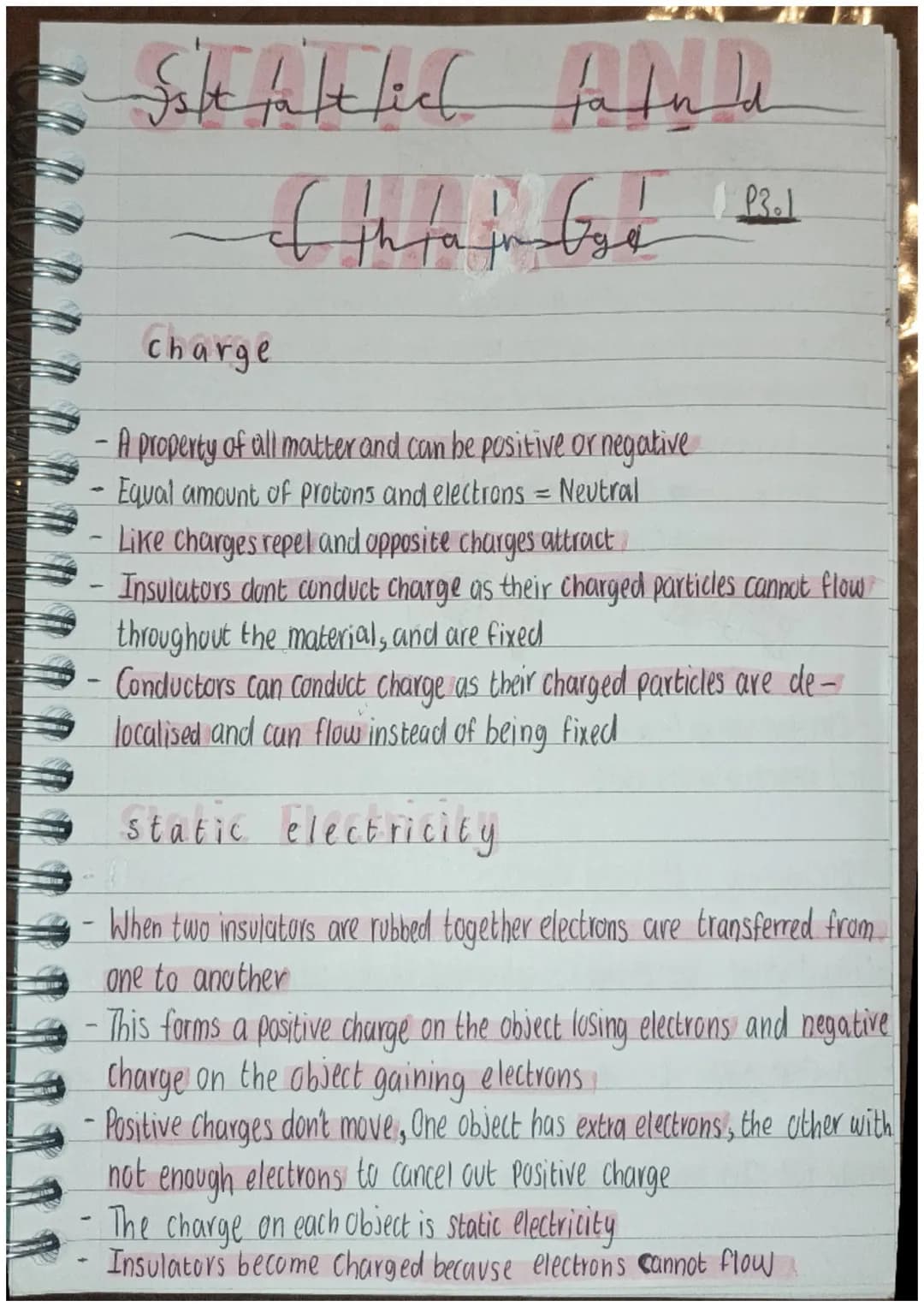
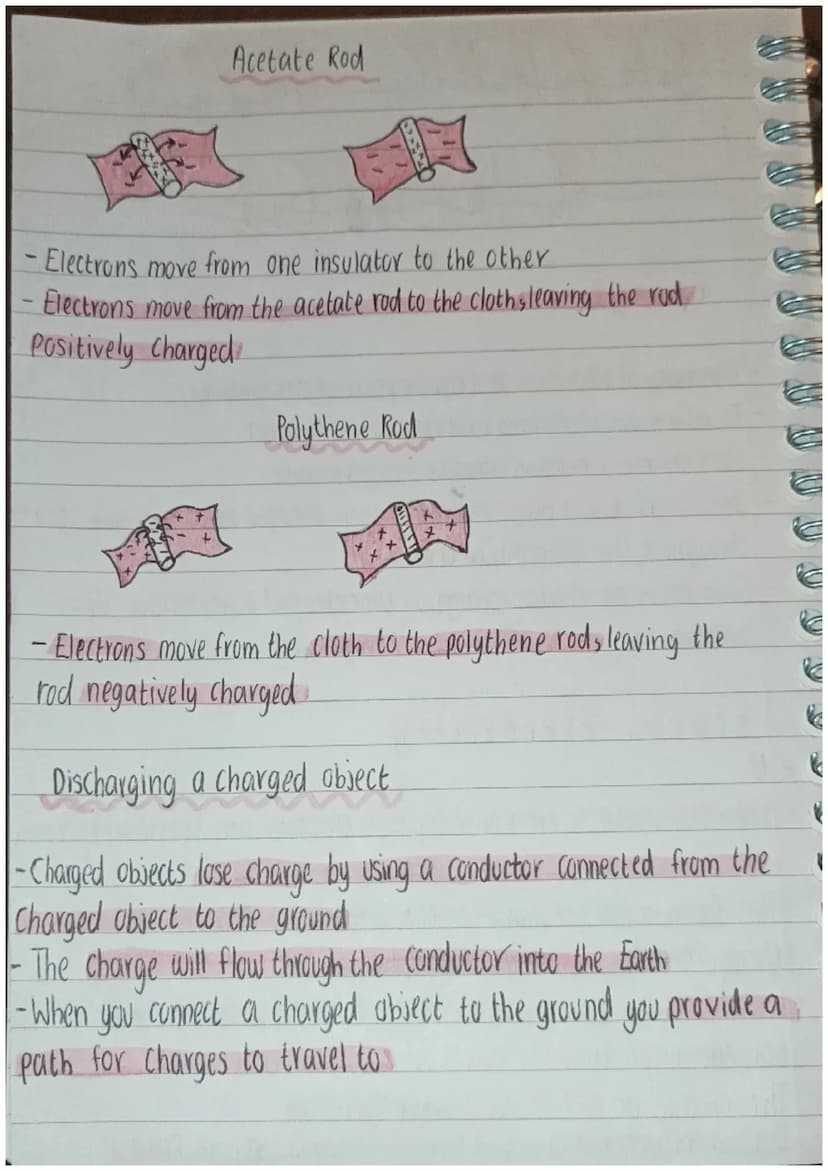
Page 2: Charging and Discharging Processes
This page details specific examples of charging processes using acetate and polythene rods, along with the mechanism of discharging charged objects.
Example: When an acetate rod is rubbed with cloth, electrons move from the rod to the cloth, leaving the rod positively charged.
Definition: Discharging occurs when a charged object is connected to the ground through a conductor, allowing excess charge to flow away.
Highlight: The Earth acts as a massive reservoir for accepting or supplying electrons during the discharging process.
2
of 6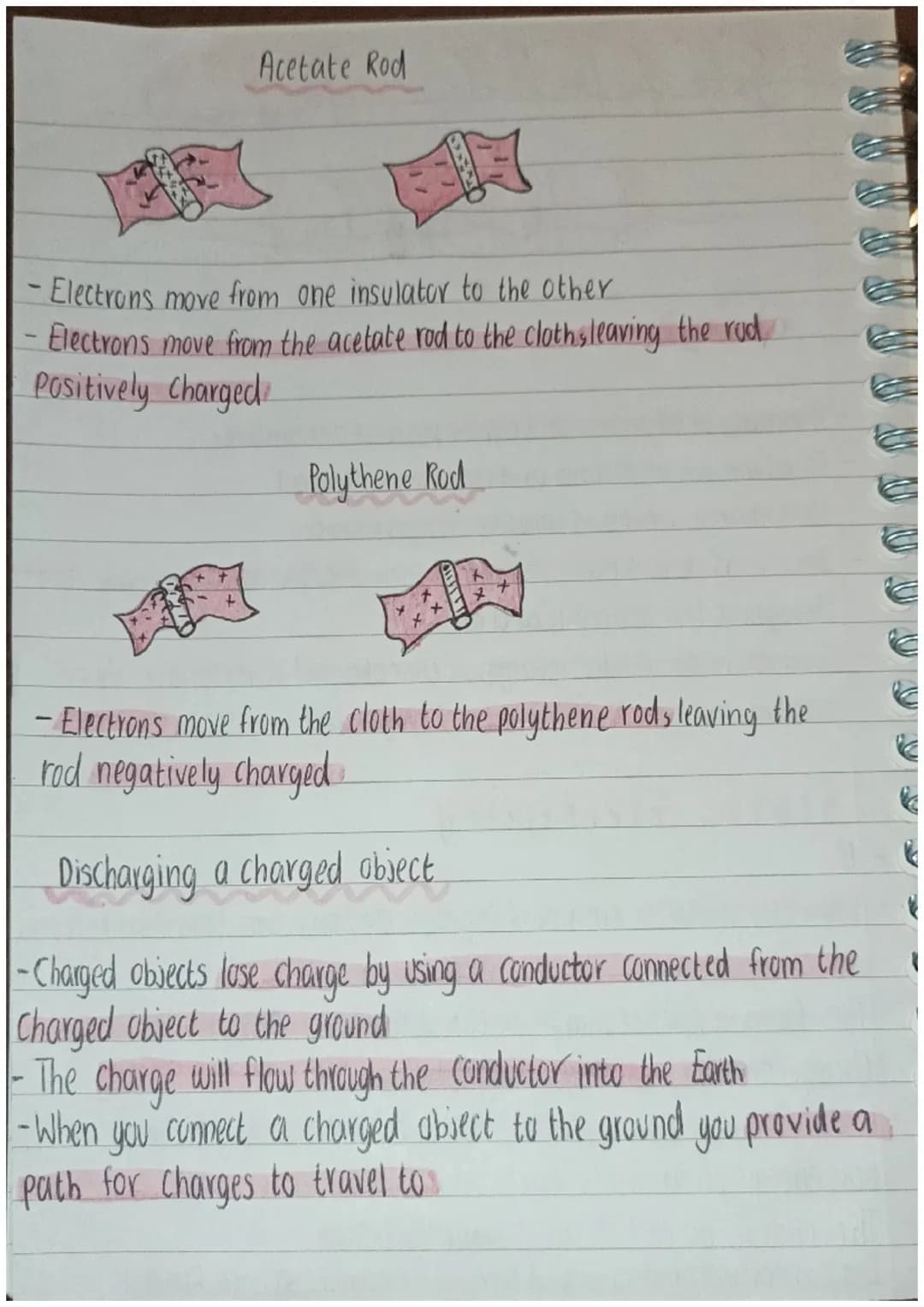
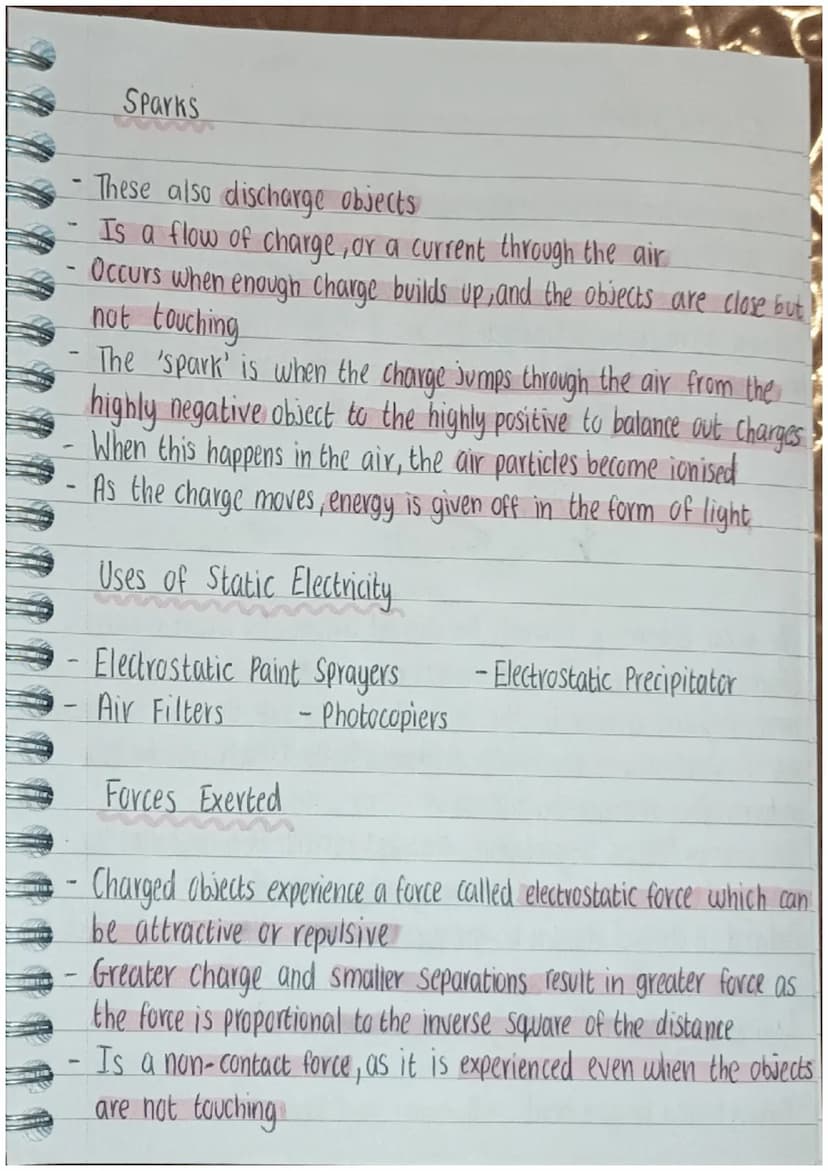
Page 3: Sparks and Applications
This section covers the phenomenon of sparking and practical applications of static electricity in various technologies.
Definition: A spark is a flow of charge through air, occurring when sufficient charge builds up between objects.
Example: Applications include electrostatic paint sprayers, air filters, photocopiers, and electrostatic precipitators.
Highlight: Electrostatic force strength is inversely proportional to the square of the distance between charged objects.
3
of 6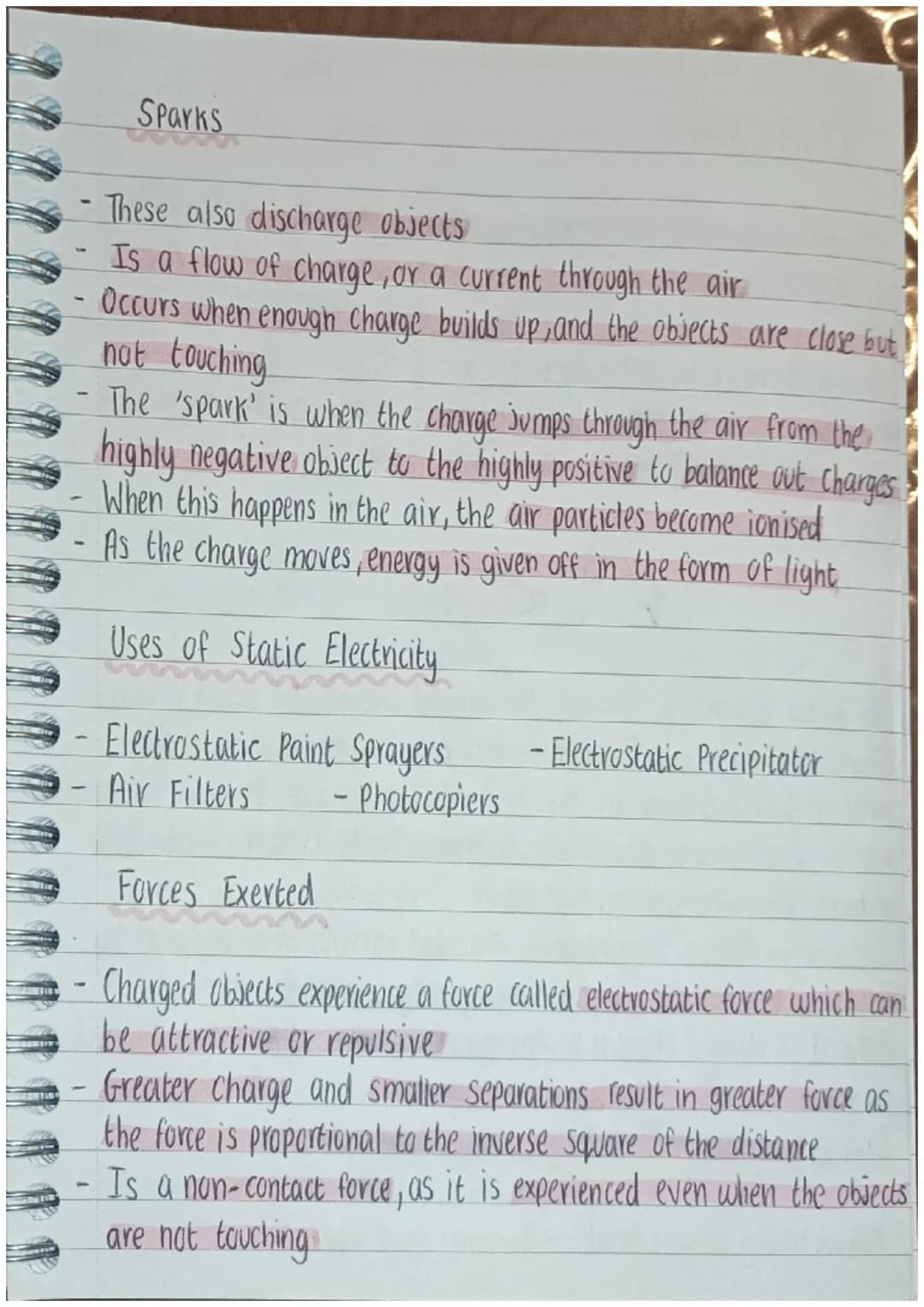
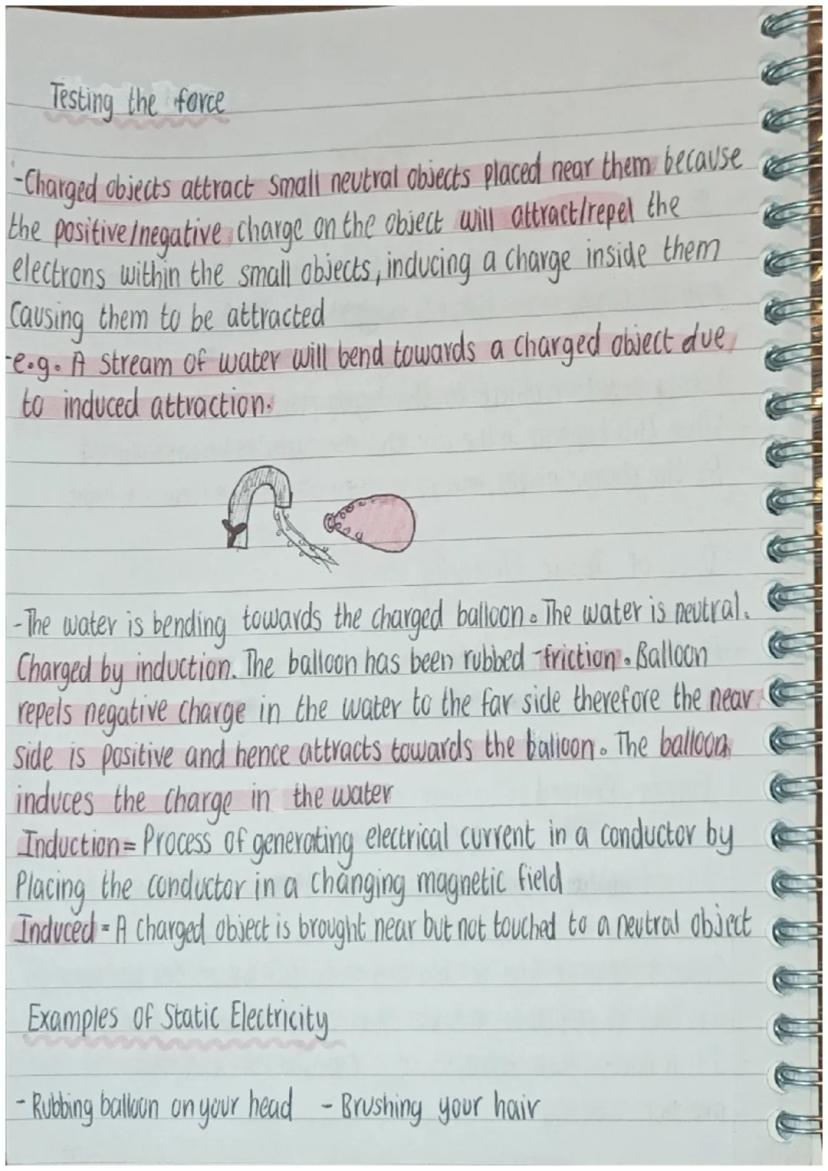
Page 4: Force Testing and Induction
This page explores how charged objects interact with neutral objects and explains the process of charging by induction.
Example: A stream of water bending towards a charged balloon demonstrates induced attraction.
Definition: Induction is the process of generating electrical current in a conductor by placing it in a changing magnetic field.
Vocabulary: Charging by induction occurs when a charged object influences charge distribution in a nearby neutral object without direct contact.
4
of 6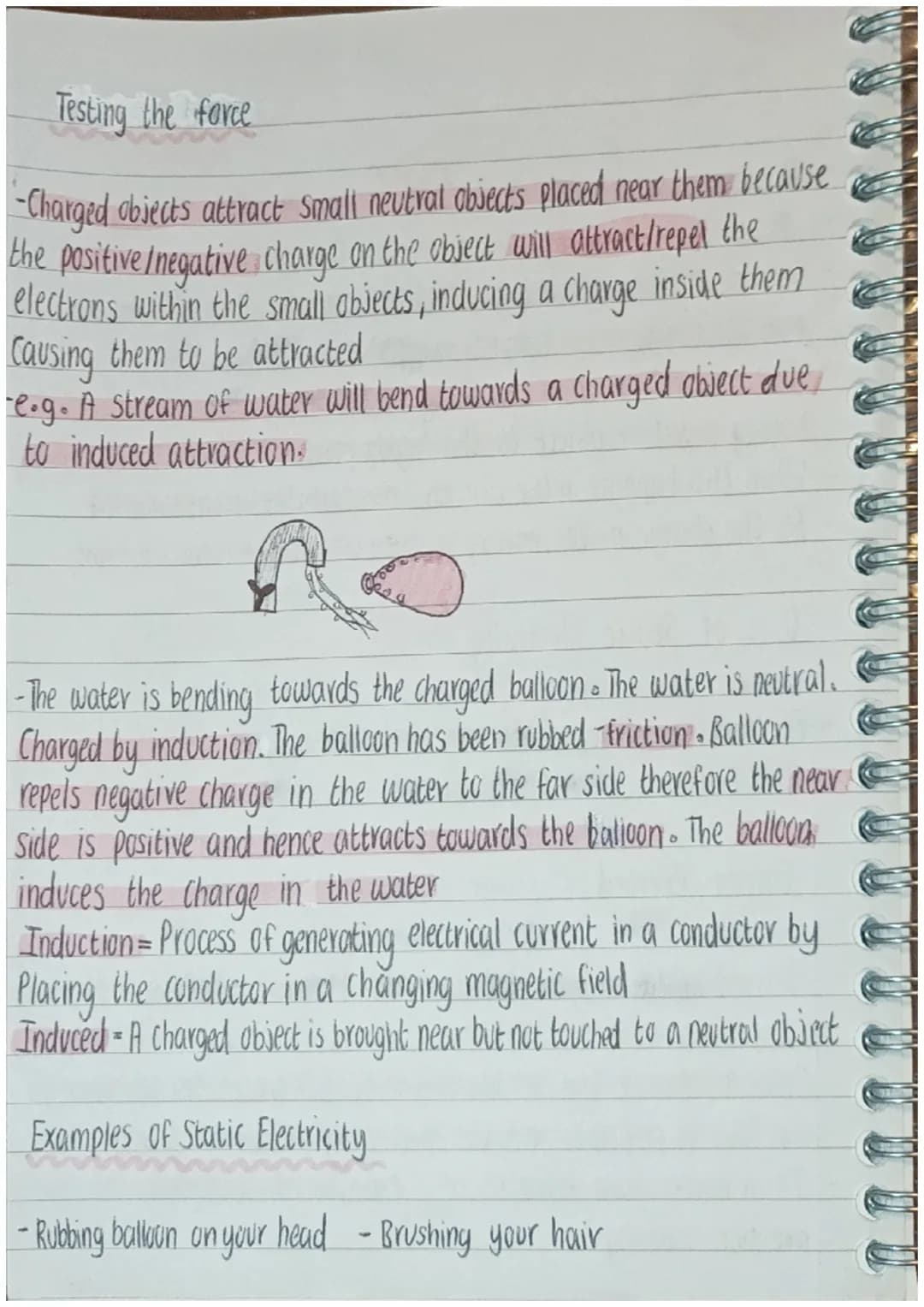
Page 5: Units and Electric Fields
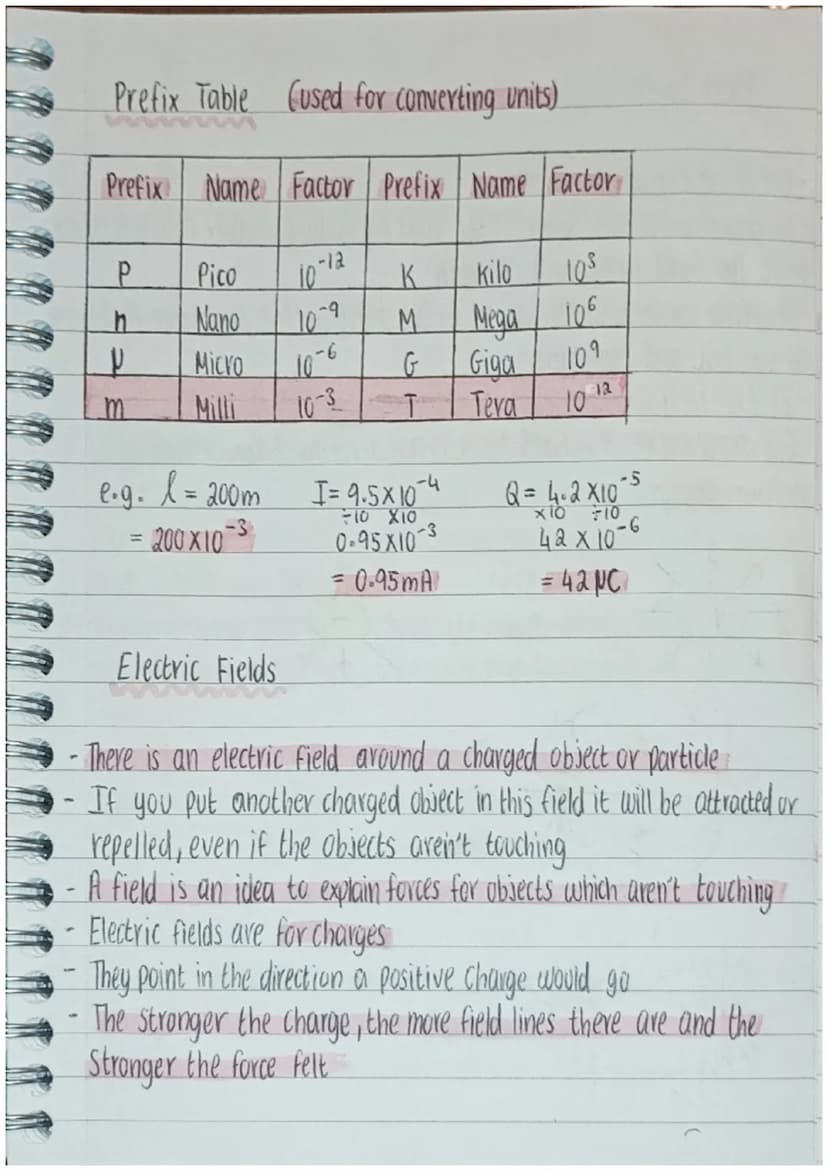
This section covers unit conversions and introduces the concept of electric fields around charged objects.
Highlight: Electric fields explain how forces act between objects that aren't touching.
Definition: Electric fields point in the direction a positive charge would move.
Example: Field strength is indicated by the density of field lines, with more lines indicating stronger fields.
5
of 6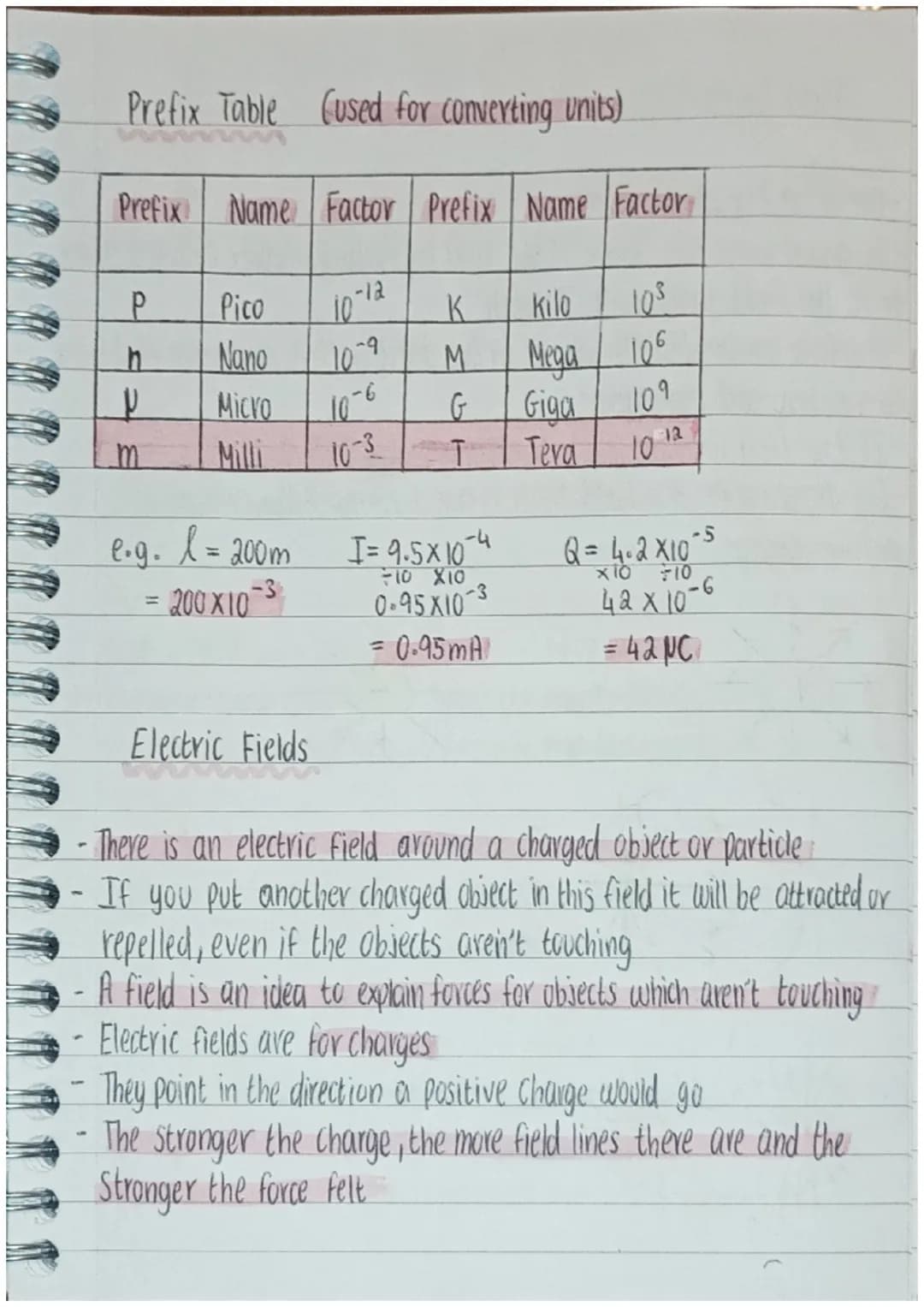
Page 6: Field Line Properties
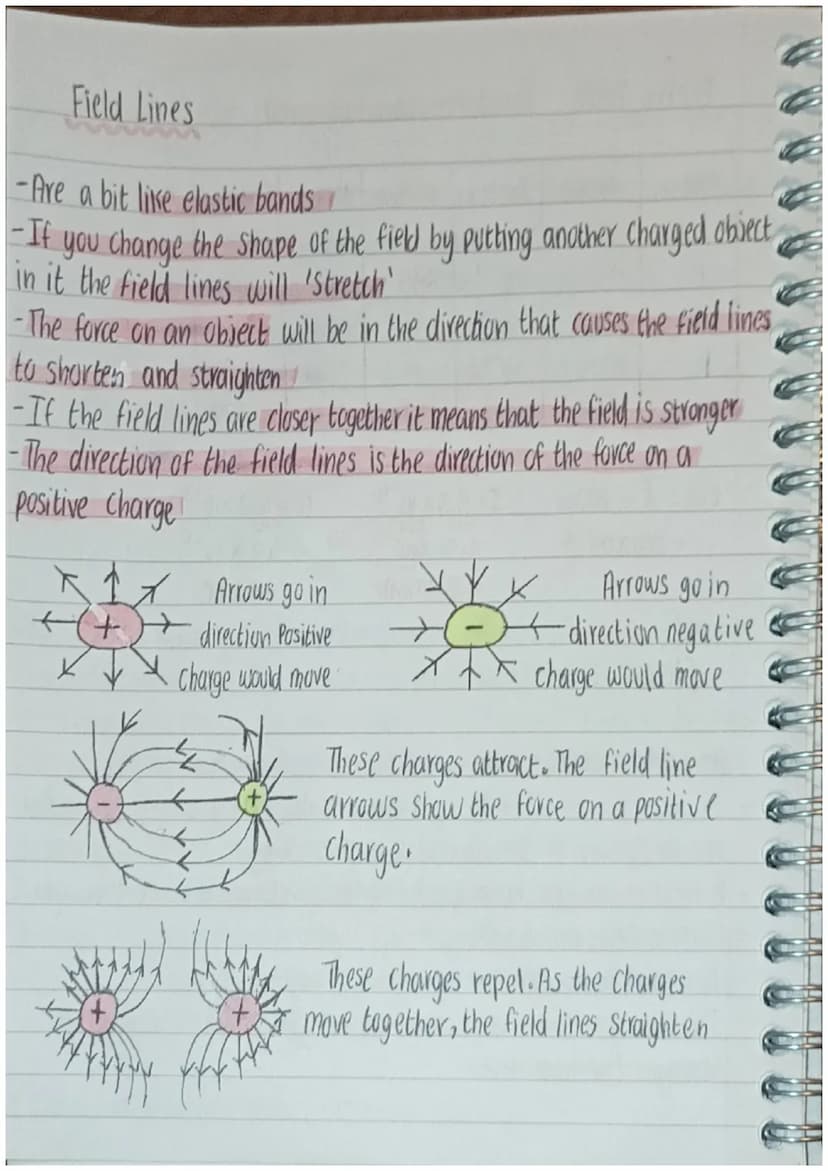
The final page details the characteristics and behavior of electric field lines.
Definition: Field lines behave like elastic bands, stretching and straightening based on charge interactions.
Highlight: Field line density indicates field strength - closer lines mean stronger fields.
Example: Field lines between opposite charges show attraction, while lines between like charges demonstrate repulsion.
6
of 6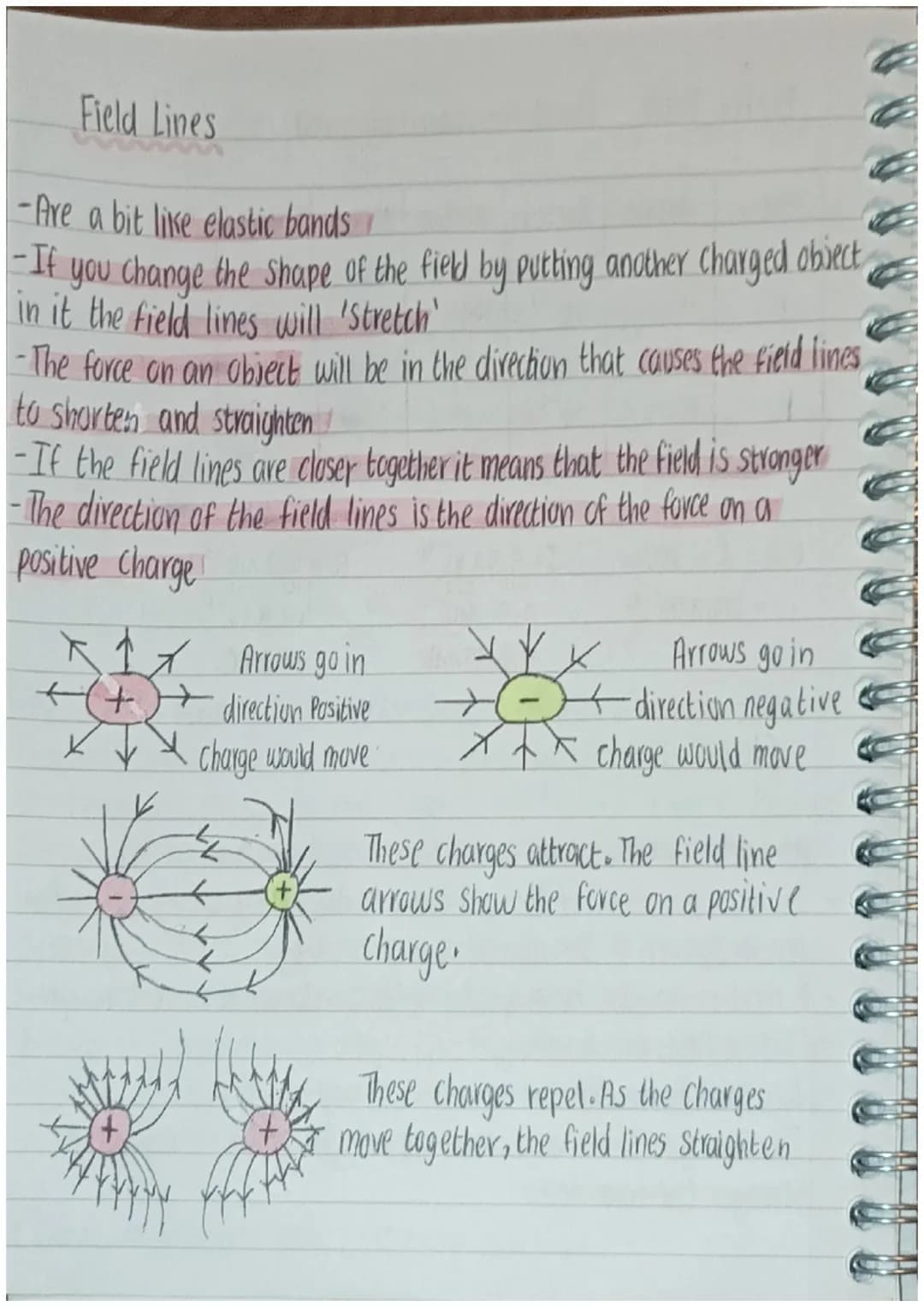
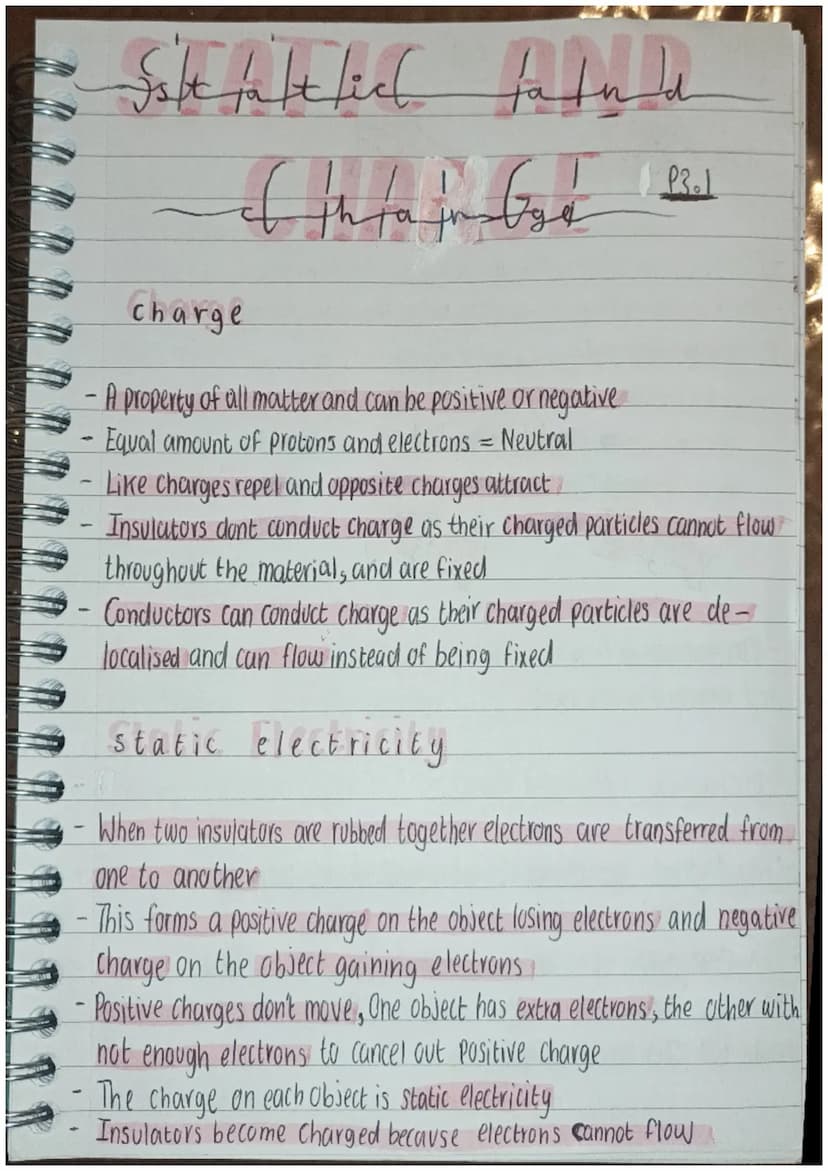
Page 1: Understanding Charge and Static Electricity
This page introduces fundamental concepts of electrical charge and static electricity. Charge is explained as a fundamental property of matter that can be either positive or negative, with neutral objects having equal amounts of protons and electrons.
Definition: Static electricity occurs when electrons transfer between insulators through rubbing, creating opposite charges on the objects.
Highlight: Like charges repel while opposite charges attract, a fundamental principle of electrostatics.
Vocabulary: Insulators are materials where charged particles cannot flow freely, while conductors allow charge movement through delocalized particles.
We thought you’d never ask...
What is the Knowunity AI companion?
Our AI Companion is a student-focused AI tool that offers more than just answers. Built on millions of Knowunity resources, it provides relevant information, personalised study plans, quizzes, and content directly in the chat, adapting to your individual learning journey.
Where can I download the Knowunity app?
You can download the app from Google Play Store and Apple App Store.
Is Knowunity really free of charge?
That's right! Enjoy free access to study content, connect with fellow students, and get instant help – all at your fingertips.
Similar content
Most popular content: Static Electricity
1Most popular content in Physics
9PhysicsForces and Motion Overview
Explore key concepts in Forces and Motion, including Hooke's Law, velocity, acceleration, and the principles of moments. This summary covers essential topics such as the relationship between force and extension, terminal velocity, and the impact of safety devices in physics. Ideal for AQA Physics Unit 5 revision.
109,157871
G
PhysicsGCSE Physics - Energy stores and Systems
Pl-Energy topic to revise for GCSE
101,3042
PhysicsPhysics Paper 2 Essentials
Master key concepts for AQA Combined Physics Paper 2, including electromagnetic waves, mechanics, forces, and motion. This comprehensive summary covers essential topics like wave properties, Newton's laws, and the motor effect, ensuring you're well-prepared for your exam.
1116,061940
C
PhysicsConservation of energy- energy types and stores
Build a strong foundation in physics with these easy flashcards covering key concepts and principles.
95971
PhysicsGCSE Physics Practical Experiments
Explore essential GCSE Physics practicals for AQA, covering key concepts such as Hooke's Law, wave properties, thermal insulation, and electrical circuits. This comprehensive guide includes step-by-step procedures, variables, and safety considerations for each experiment, ensuring a thorough understanding of practical applications in physics.
1011,403477
P
PhysicsPhysics Made Easy: Essential Concepts for Grade 10 Students
Master the fundamentals of physics with this comprehensive flashcard set designed specifically for grade 10 students. Learn key concepts and principles in an easy and engaging way!
104491
P
Physicsphysics equations Paper 1
quick key active recall of physics equations you need to learn for the GCSEs. many questions use to equations in one question in the paper therefore knowing all is beneficial. here the quiz teaches you about the units and the formula for the equations.
116823
 Chemistry
BTEC Applied Science Unit 1 Overview
Comprehensive resource for Year 12 students pursuing a Level 3 Diploma in Applied Science. This booklet covers essential topics including cell structure, chemical properties, and wave theory, providing clear explanations and key concepts to aid in your studies and exam preparation.
125,348122
P
PhysicsPhysics Quiz - Current, Charge and Power
AQA physics quiz.
111,0142
Most popular content
9 Sociology
Sociology of Education Overview
Explore comprehensive A-Level Sociology notes on the education system, covering key theories, policies, and sociological perspectives. This resource includes insights on marketisation, gender roles, cultural deprivation, and educational inequalities, providing a thorough understanding of how education shapes social stratification and individual achievement. Ideal for exam preparation and in-depth study.
12102,8013,040
SociologySociology of Families: Comprehensive Revision
Dive into an extensive overview of family dynamics, perspectives, and patterns in sociology. This resource covers key concepts such as family diversity, gender roles, marriage, and the impact of social policies on family structures. Perfect for A-Level Sociology students preparing for Paper 2.
1273,5512,306
CriminologyCriminology: Crime & Punishment Overview
Comprehensive mindmaps covering key concepts in the Crime and Punishment topic for WJEC Criminology Unit 4. This resource includes detailed insights into the Criminal Justice System, crime prevention strategies, sentencing models, and the roles of various agencies. Ideal for A-Level revision, ensuring you grasp essential theories and legislative processes to excel in your exams.
1254,8511,059
SociologyComprehensive Crime & Deviance Overview
Explore an extensive revision of crime and deviance topics, including theories, types of crime, and the impact of media. This resource covers key concepts such as Marxism, functionalism, gender and crime, and the influence of globalization on criminal behavior. Ideal for students seeking a thorough understanding of criminology and its various theories. Type: Full Topic Revision.
1251,6291,399
 English Literature
An Inspector Calls: Character Insights
Explore in-depth analysis and key quotes for characters in J.B. Priestley's 'An Inspector Calls'. This resource covers Gerald Croft, Inspector Goole, Sheila Birling, Mrs. Birling, Eric Birling, and Eva Smith, focusing on themes of class, gender roles, and social responsibility. Ideal for students aiming for Grade 8 and above.
1025,410907
CriminologyWJEC Unit 4 Criminology
Criminology unit 4 detailed revision note
127,144124
C
 Biology
Cell Biology and Cell structure
cell structures
93,1770
CriminologyCriminology Theories Overview
Explore key criminology theories and their implications on crime and deviance. This comprehensive summary covers biological, psychological, and sociological perspectives, including labelling theory, right realism, and the impact of social campaigns on policy development. Ideal for A-Level criminology students seeking to understand the complexities of criminal behaviour and the factors influencing crime prevention strategies.
129,753210
English LiteratureRomeo and Juliet: Key themes
Key Romeo and Juliet themes and analysed quotes
106,695198
Can't find what you're looking for? Explore other subjects.
Students love us — and so will you.
4.6/5App Store
4.7/5Google Play
The app is very easy to use and well designed. I have found everything I was looking for so far and have been able to learn a lot from the presentations! I will definitely use the app for a class assignment! And of course it also helps a lot as an inspiration.
Stefan SiOS user
This app is really great. There are so many study notes and help [...]. My problem subject is French, for example, and the app has so many options for help. Thanks to this app, I have improved my French. I would recommend it to anyone.
Samantha KlichAndroid user
Wow, I am really amazed. I just tried the app because I've seen it advertised many times and was absolutely stunned. This app is THE HELP you want for school and above all, it offers so many things, such as workouts and fact sheets, which have been VERY helpful to me personally.
AnnaiOS user
Physics274 views·Updated Jun 3, 2026·6 pagesFun with Static Electricity: Insulators, Conductors, and More!
A
aesthetic_notes4u@aesthetic_notes4u
Static electricity fundamentals and applications in physics, exploring how charged particles interact and create electric fields.
- Static electricity insulators and conductors play crucial roles in charge transfer and storage
- Electrostatic force applications range from paint spraying to photocopiers
- Electric fields... Show more
1
of 6Sign up to see the content. It's free!
- Access to all documents
- Improve your grades
- Join milions of students
Page 2: Charging and Discharging Processes
This page details specific examples of charging processes using acetate and polythene rods, along with the mechanism of discharging charged objects.
Example: When an acetate rod is rubbed with cloth, electrons move from the rod to the cloth, leaving the rod positively charged.
Definition: Discharging occurs when a charged object is connected to the ground through a conductor, allowing excess charge to flow away.
Highlight: The Earth acts as a massive reservoir for accepting or supplying electrons during the discharging process.
2
of 6Sign up to see the content. It's free!
- Access to all documents
- Improve your grades
- Join milions of students
Page 3: Sparks and Applications
This section covers the phenomenon of sparking and practical applications of static electricity in various technologies.
Definition: A spark is a flow of charge through air, occurring when sufficient charge builds up between objects.
Example: Applications include electrostatic paint sprayers, air filters, photocopiers, and electrostatic precipitators.
Highlight: Electrostatic force strength is inversely proportional to the square of the distance between charged objects.
3
of 6Sign up to see the content. It's free!
- Access to all documents
- Improve your grades
- Join milions of students
Page 4: Force Testing and Induction
This page explores how charged objects interact with neutral objects and explains the process of charging by induction.
Example: A stream of water bending towards a charged balloon demonstrates induced attraction.
Definition: Induction is the process of generating electrical current in a conductor by placing it in a changing magnetic field.
Vocabulary: Charging by induction occurs when a charged object influences charge distribution in a nearby neutral object without direct contact.
4
of 6Sign up to see the content. It's free!
- Access to all documents
- Improve your grades
- Join milions of students
Page 5: Units and Electric Fields
This section covers unit conversions and introduces the concept of electric fields around charged objects.
Highlight: Electric fields explain how forces act between objects that aren't touching.
Definition: Electric fields point in the direction a positive charge would move.
Example: Field strength is indicated by the density of field lines, with more lines indicating stronger fields.
5
of 6Sign up to see the content. It's free!
- Access to all documents
- Improve your grades
- Join milions of students
Page 6: Field Line Properties
The final page details the characteristics and behavior of electric field lines.
Definition: Field lines behave like elastic bands, stretching and straightening based on charge interactions.
Highlight: Field line density indicates field strength - closer lines mean stronger fields.
Example: Field lines between opposite charges show attraction, while lines between like charges demonstrate repulsion.
6
of 6Sign up to see the content. It's free!
- Access to all documents
- Improve your grades
- Join milions of students
Page 1: Understanding Charge and Static Electricity
This page introduces fundamental concepts of electrical charge and static electricity. Charge is explained as a fundamental property of matter that can be either positive or negative, with neutral objects having equal amounts of protons and electrons.
Definition: Static electricity occurs when electrons transfer between insulators through rubbing, creating opposite charges on the objects.
Highlight: Like charges repel while opposite charges attract, a fundamental principle of electrostatics.
Vocabulary: Insulators are materials where charged particles cannot flow freely, while conductors allow charge movement through delocalized particles.
We thought you’d never ask...
What is the Knowunity AI companion?
Our AI Companion is a student-focused AI tool that offers more than just answers. Built on millions of Knowunity resources, it provides relevant information, personalised study plans, quizzes, and content directly in the chat, adapting to your individual learning journey.
Where can I download the Knowunity app?
You can download the app from Google Play Store and Apple App Store.
Is Knowunity really free of charge?
That's right! Enjoy free access to study content, connect with fellow students, and get instant help – all at your fingertips.
Similar content
Most popular content: Static Electricity
1Most popular content in Physics
9PhysicsForces and Motion Overview
Explore key concepts in Forces and Motion, including Hooke's Law, velocity, acceleration, and the principles of moments. This summary covers essential topics such as the relationship between force and extension, terminal velocity, and the impact of safety devices in physics. Ideal for AQA Physics Unit 5 revision.
109,157871
G
PhysicsGCSE Physics - Energy stores and Systems
Pl-Energy topic to revise for GCSE
101,3042
PhysicsPhysics Paper 2 Essentials
Master key concepts for AQA Combined Physics Paper 2, including electromagnetic waves, mechanics, forces, and motion. This comprehensive summary covers essential topics like wave properties, Newton's laws, and the motor effect, ensuring you're well-prepared for your exam.
1116,061940
C
PhysicsConservation of energy- energy types and stores
Build a strong foundation in physics with these easy flashcards covering key concepts and principles.
95971
PhysicsGCSE Physics Practical Experiments
Explore essential GCSE Physics practicals for AQA, covering key concepts such as Hooke's Law, wave properties, thermal insulation, and electrical circuits. This comprehensive guide includes step-by-step procedures, variables, and safety considerations for each experiment, ensuring a thorough understanding of practical applications in physics.
1011,403477
P
PhysicsPhysics Made Easy: Essential Concepts for Grade 10 Students
Master the fundamentals of physics with this comprehensive flashcard set designed specifically for grade 10 students. Learn key concepts and principles in an easy and engaging way!
104491
P
Physicsphysics equations Paper 1
quick key active recall of physics equations you need to learn for the GCSEs. many questions use to equations in one question in the paper therefore knowing all is beneficial. here the quiz teaches you about the units and the formula for the equations.
116823
ChemistryBTEC Applied Science Unit 1 Overview
Comprehensive resource for Year 12 students pursuing a Level 3 Diploma in Applied Science. This booklet covers essential topics including cell structure, chemical properties, and wave theory, providing clear explanations and key concepts to aid in your studies and exam preparation.
125,348122
P
PhysicsPhysics Quiz - Current, Charge and Power
AQA physics quiz.
111,0142
Most popular content
9SociologySociology of Education Overview
Explore comprehensive A-Level Sociology notes on the education system, covering key theories, policies, and sociological perspectives. This resource includes insights on marketisation, gender roles, cultural deprivation, and educational inequalities, providing a thorough understanding of how education shapes social stratification and individual achievement. Ideal for exam preparation and in-depth study.
12102,8013,040
SociologySociology of Families: Comprehensive Revision
Dive into an extensive overview of family dynamics, perspectives, and patterns in sociology. This resource covers key concepts such as family diversity, gender roles, marriage, and the impact of social policies on family structures. Perfect for A-Level Sociology students preparing for Paper 2.
1273,5512,306
CriminologyCriminology: Crime & Punishment Overview
Comprehensive mindmaps covering key concepts in the Crime and Punishment topic for WJEC Criminology Unit 4. This resource includes detailed insights into the Criminal Justice System, crime prevention strategies, sentencing models, and the roles of various agencies. Ideal for A-Level revision, ensuring you grasp essential theories and legislative processes to excel in your exams.
1254,8511,059
SociologyComprehensive Crime & Deviance Overview
Explore an extensive revision of crime and deviance topics, including theories, types of crime, and the impact of media. This resource covers key concepts such as Marxism, functionalism, gender and crime, and the influence of globalization on criminal behavior. Ideal for students seeking a thorough understanding of criminology and its various theories. Type: Full Topic Revision.
1251,6291,399
English LiteratureAn Inspector Calls: Character Insights
Explore in-depth analysis and key quotes for characters in J.B. Priestley's 'An Inspector Calls'. This resource covers Gerald Croft, Inspector Goole, Sheila Birling, Mrs. Birling, Eric Birling, and Eva Smith, focusing on themes of class, gender roles, and social responsibility. Ideal for students aiming for Grade 8 and above.
1025,410907
CriminologyWJEC Unit 4 Criminology
Criminology unit 4 detailed revision note
127,144124
C
BiologyCell Biology and Cell structure
cell structures
93,1770
CriminologyCriminology Theories Overview
Explore key criminology theories and their implications on crime and deviance. This comprehensive summary covers biological, psychological, and sociological perspectives, including labelling theory, right realism, and the impact of social campaigns on policy development. Ideal for A-Level criminology students seeking to understand the complexities of criminal behaviour and the factors influencing crime prevention strategies.
129,753210
English LiteratureRomeo and Juliet: Key themes
Key Romeo and Juliet themes and analysed quotes
106,695198
Can't find what you're looking for? Explore other subjects.
Students love us — and so will you.
4.6/5App Store
4.7/5Google Play
The app is very easy to use and well designed. I have found everything I was looking for so far and have been able to learn a lot from the presentations! I will definitely use the app for a class assignment! And of course it also helps a lot as an inspiration.
Stefan SiOS user
This app is really great. There are so many study notes and help [...]. My problem subject is French, for example, and the app has so many options for help. Thanks to this app, I have improved my French. I would recommend it to anyone.
Samantha KlichAndroid user
Wow, I am really amazed. I just tried the app because I've seen it advertised many times and was absolutely stunned. This app is THE HELP you want for school and above all, it offers so many things, such as workouts and fact sheets, which have been VERY helpful to me personally.
AnnaiOS user