
A comprehensive exploration of High-speed electric train physics problemsdemonstrates... Show more
 Physics108 views·Updated May 30, 2026·20 pages
Fun Physics Problems: High-Speed Electric Train and Motor Power!

Los@los


1 / 10
1
of 10
Understanding High-Speed Electric Train Physics: Power, Force, and Acceleration
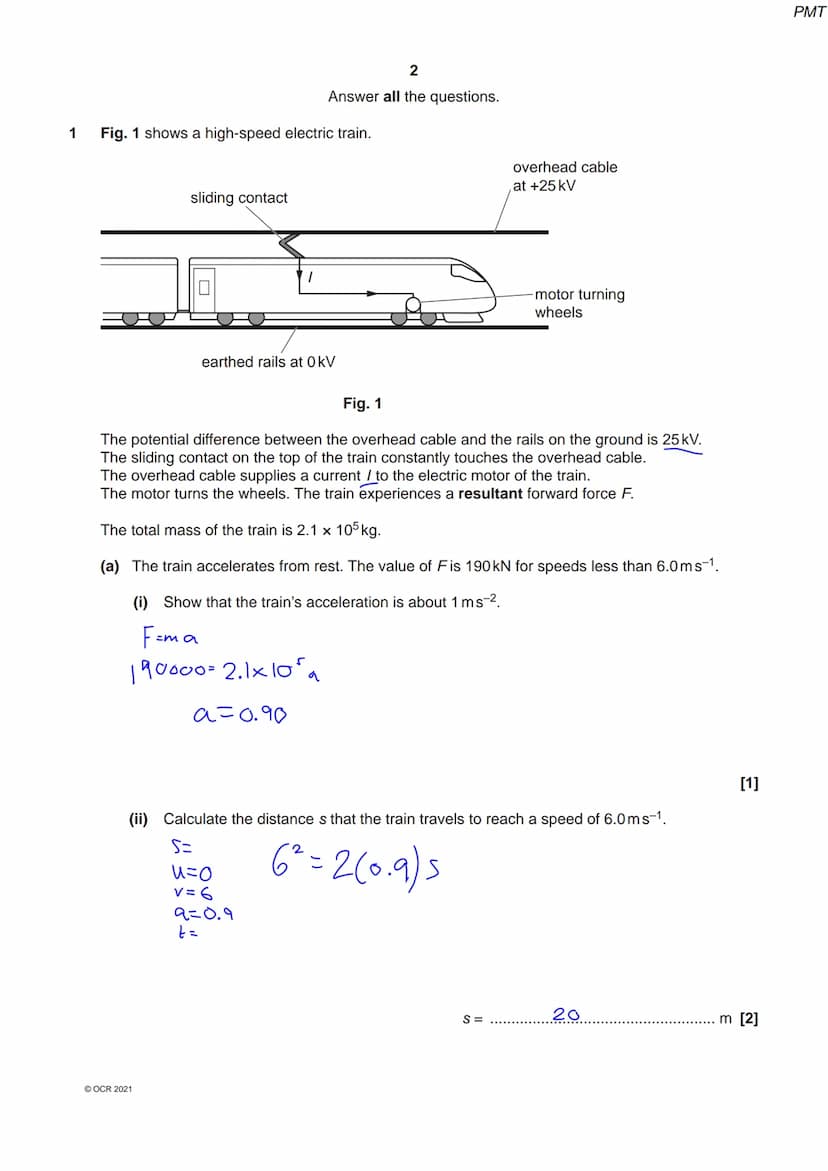
A comprehensive analysis of a High-speed electric train physics problem demonstrates the intricate relationships between electrical and mechanical systems. The train system operates with a 25 kV potential difference between the overhead cable and earthed rails, utilizing a sliding contact mechanism for power transmission.
When examining the train's acceleration characteristics, we observe that with a mass of 2.1 × 10⁵ kg and an applied force of 190 kN, the train achieves an acceleration of approximately 1 ms⁻². This relationship exemplifies Newton's Second Law of Motion in real-world applications, where the resultant force produces proportional acceleration in massive objects.
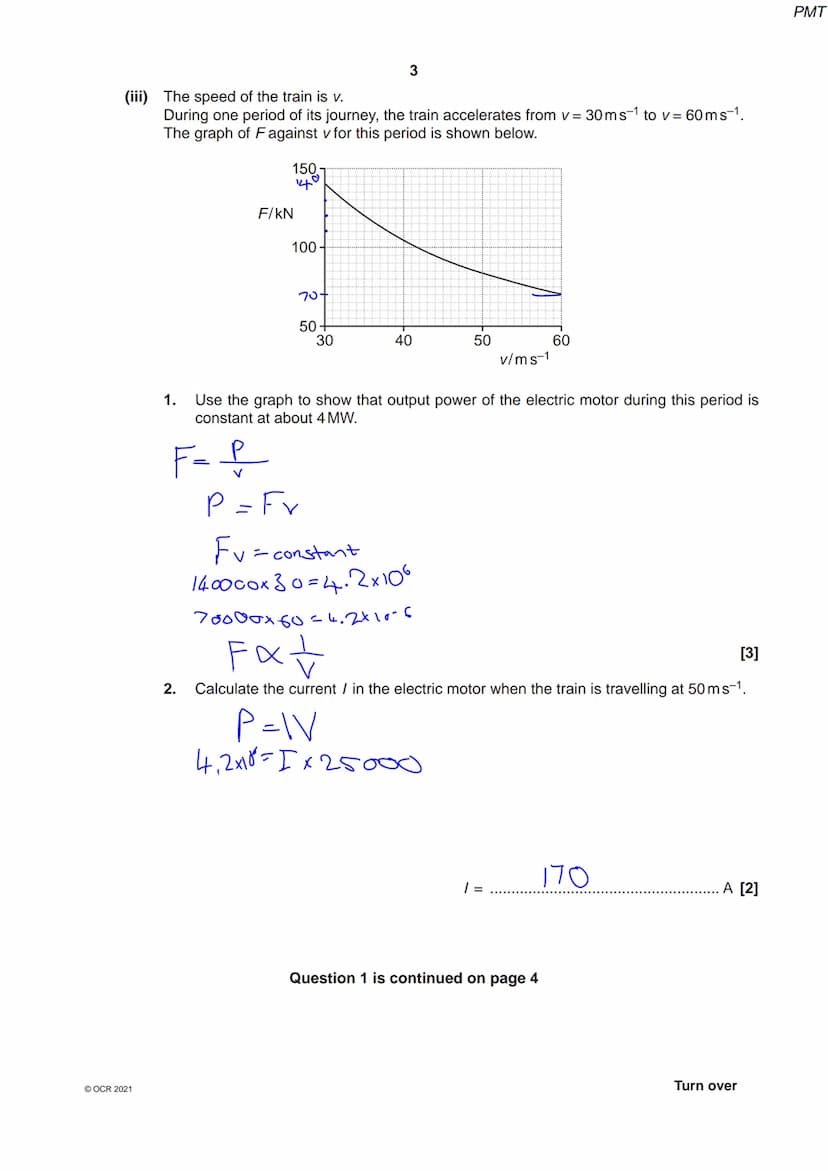
Definition: The power output of an electric motor is calculated as the product of force and velocity , measured in watts (W) or megawatts (MW) for large systems like trains.
The analysis of the train's performance during acceleration from 30 ms⁻¹ to 60 ms⁻¹ reveals fascinating insights into power consumption. The graphical relationship between force and velocity demonstrates that the motor maintains a constant power output of approximately 4 MW throughout this speed range, showcasing the efficient energy conversion capabilities of modern electric train systems.
2
of 10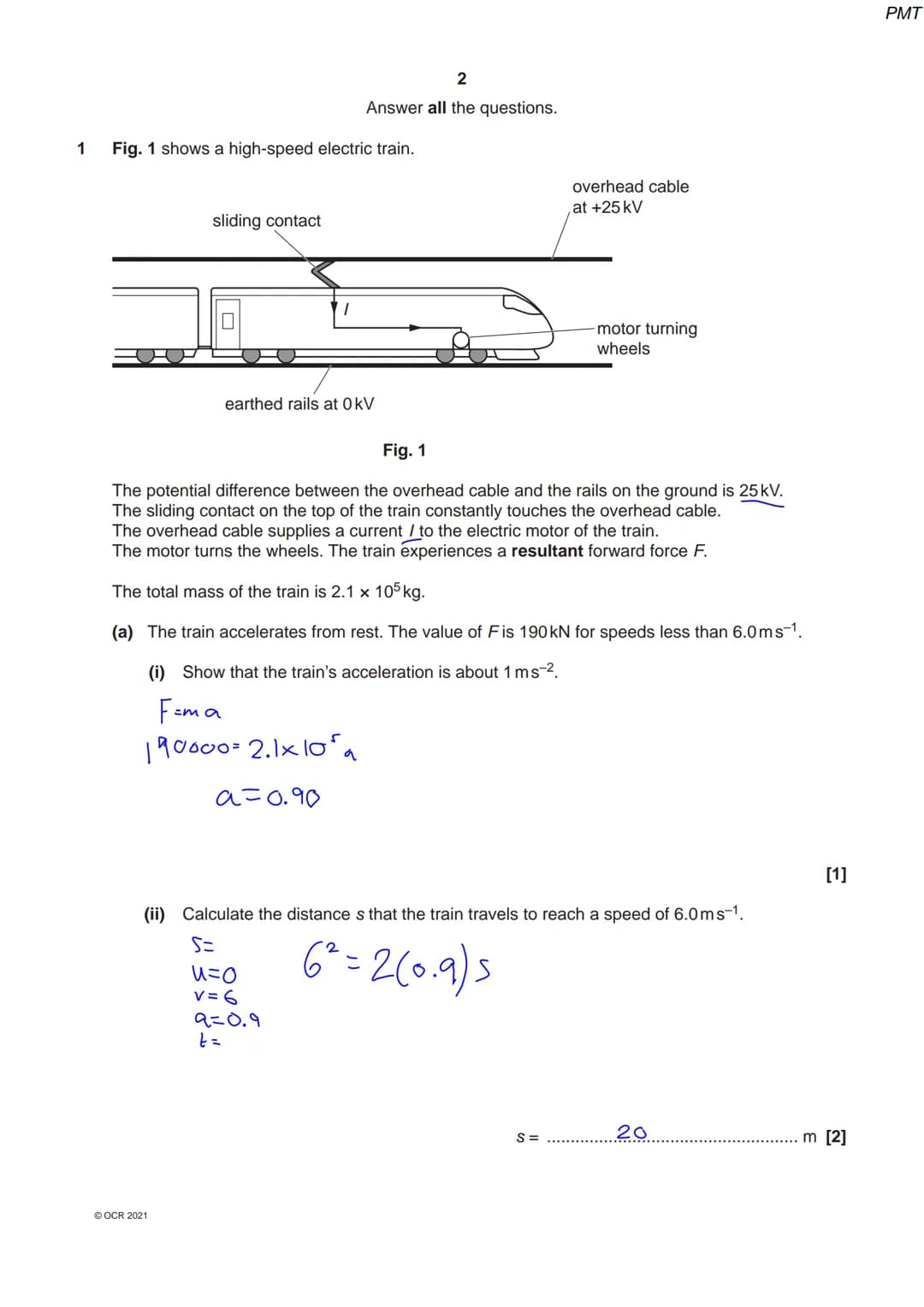
Advanced Calculations in Train Electromechanics
Calculating train motor output power requires understanding the relationship between mechanical and electrical parameters. When analyzing the current draw at 50 ms⁻¹, we must consider the 25 kV supply voltage and the 4.2 MW power requirement, demonstrating how electrical power converts to mechanical motion.
Example: To calculate current at 50 ms⁻¹:
- Power (P) = Current (I) × Voltage (V)
- 4.2 × 10⁶ = I × 25,000
- Current = 168 amperes
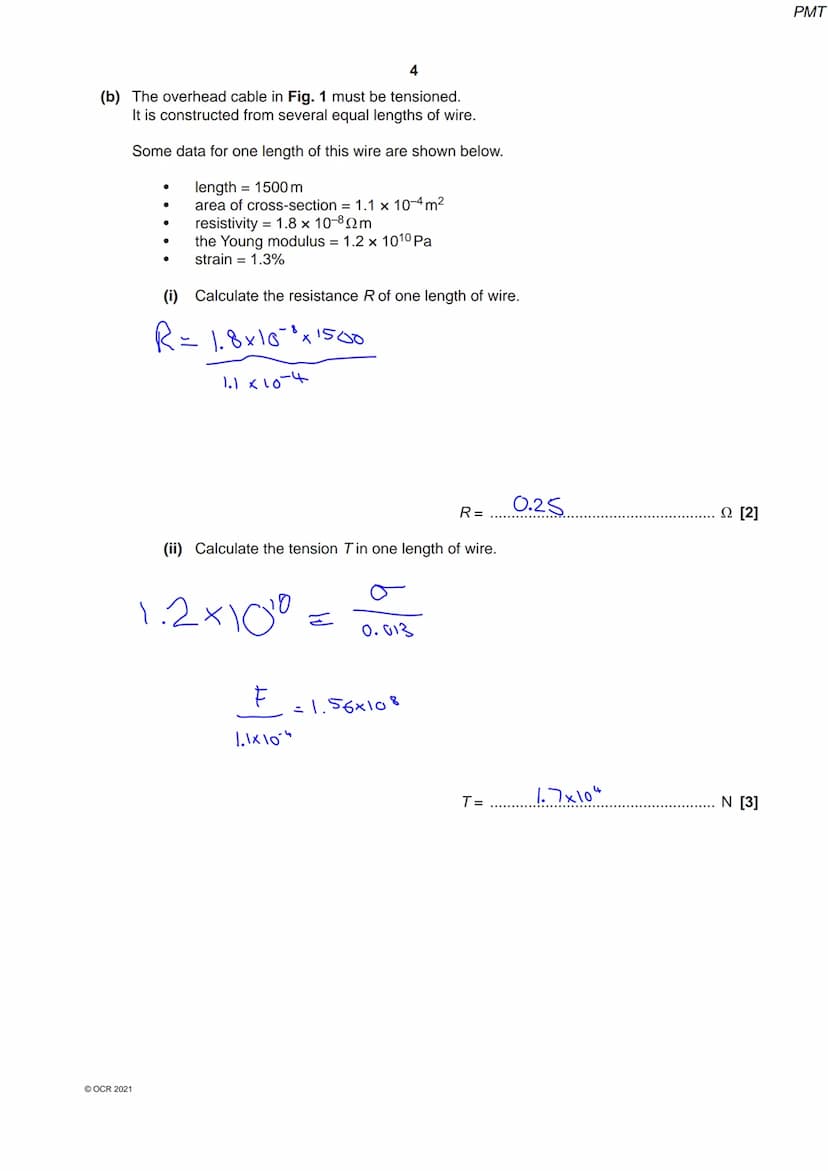
The overhead cable system presents an interesting study in materials science and electrical engineering. With a cross-sectional area of 1.1 × 10⁻⁴ m² and resistivity of 1.8 × 10⁻⁸ Ωm, the cable must balance electrical conductivity with mechanical strength.
3
of 10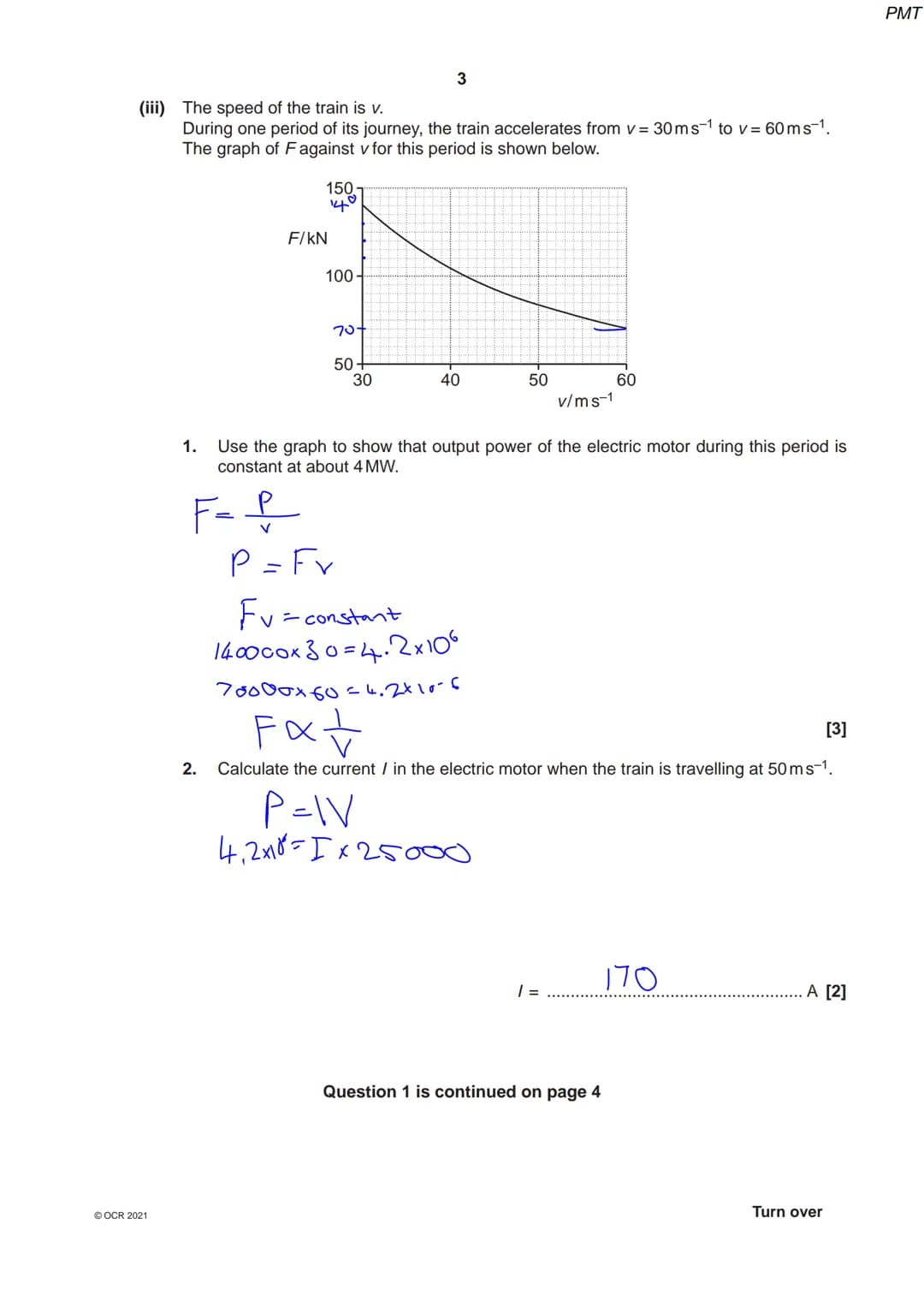
Engineering Analysis of Overhead Power Systems
The mechanical properties of the overhead cable system demonstrate the complex engineering considerations in railway power distribution. The cable's Young's modulus of 1.2 × 10¹⁰ Pa and strain of 1.3% indicate careful design to maintain both electrical efficiency and mechanical stability.
Highlight: The tension calculation in overhead cables combines electrical and mechanical engineering principles, ensuring reliable power delivery while maintaining structural integrity.
These calculations represent typical problems found in A Level Physics exam questions, combining multiple physics concepts including electricity, mechanics, and materials science. Understanding these relationships is crucial for engineering applications in modern transportation systems.
4
of 10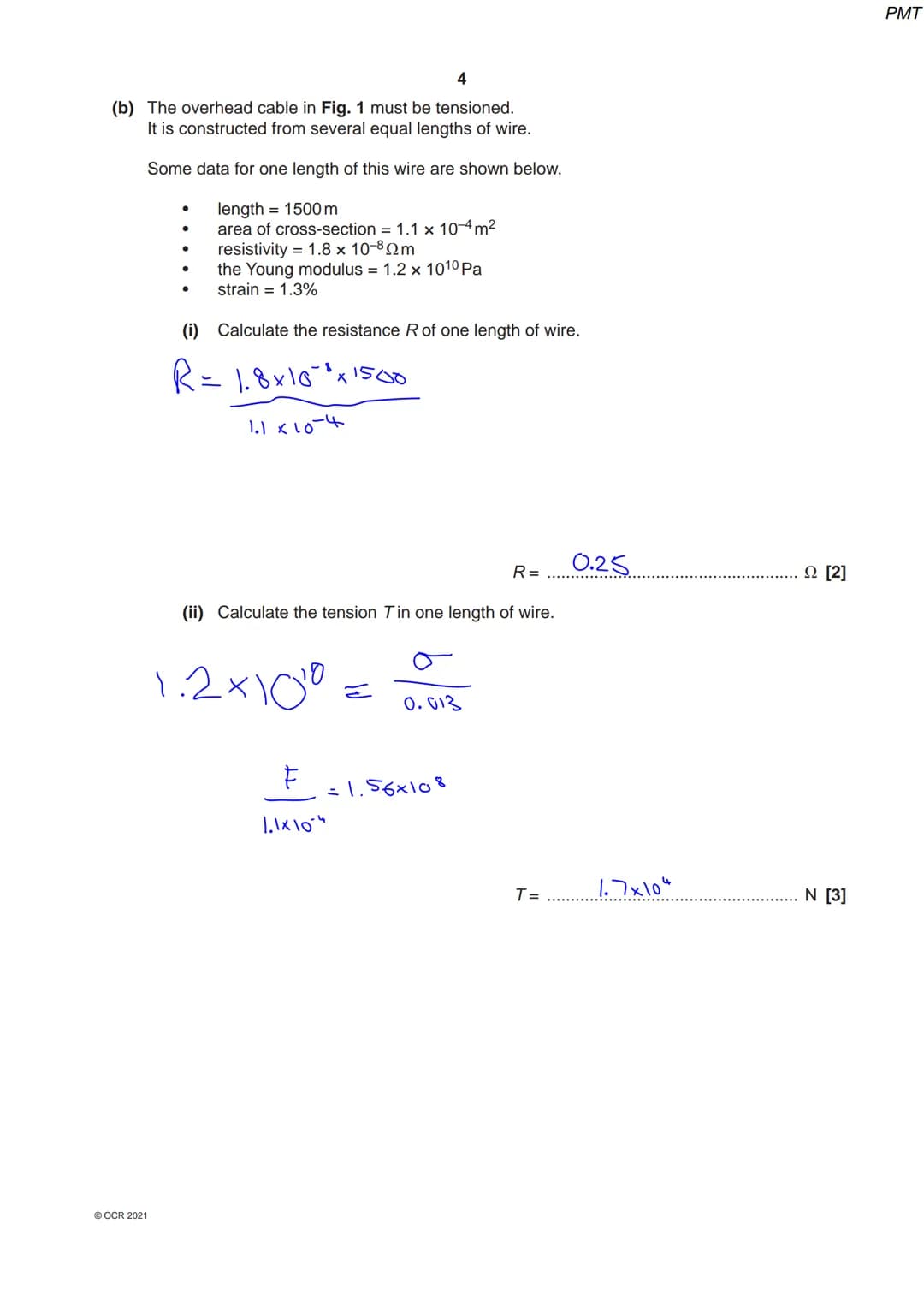
Practical Applications in Railway Engineering
The practical implementation of theoretical physics concepts in railway systems showcases the importance of integrated engineering solutions. The overhead cable system must maintain specific tension while providing consistent electrical conductivity, demonstrating how multiple physical parameters interact in real-world applications.
Vocabulary: Young's modulus - A measure of a material's stiffness, defined as the ratio of stress to strain within the elastic limit.
The resistance calculations for the overhead cable, yielding approximately 0.25 Ω per length, illustrate the importance of minimizing power losses in high-voltage transmission systems. This optimization balances mechanical requirements with electrical efficiency, a crucial consideration in modern railway design.
5
of 10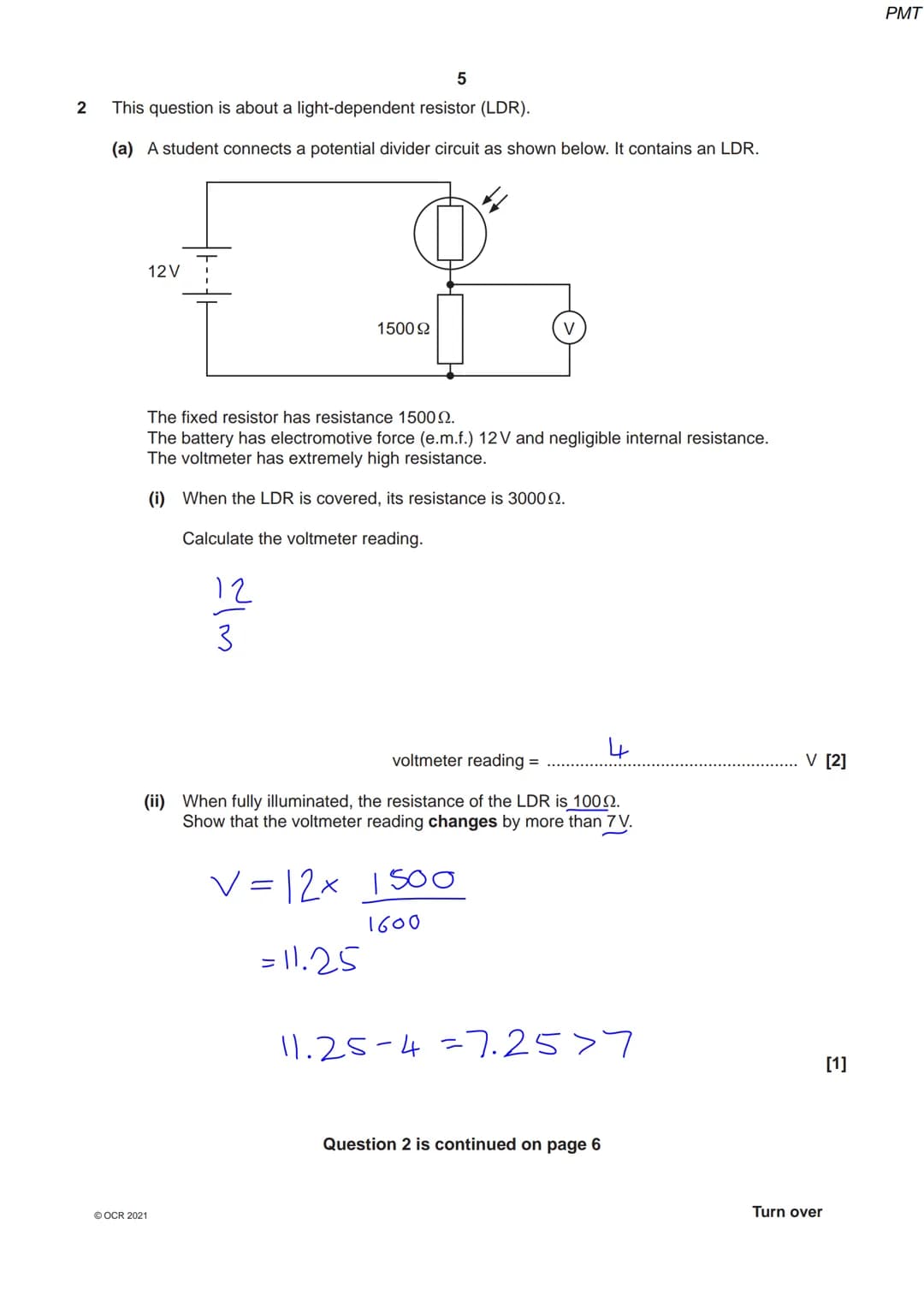
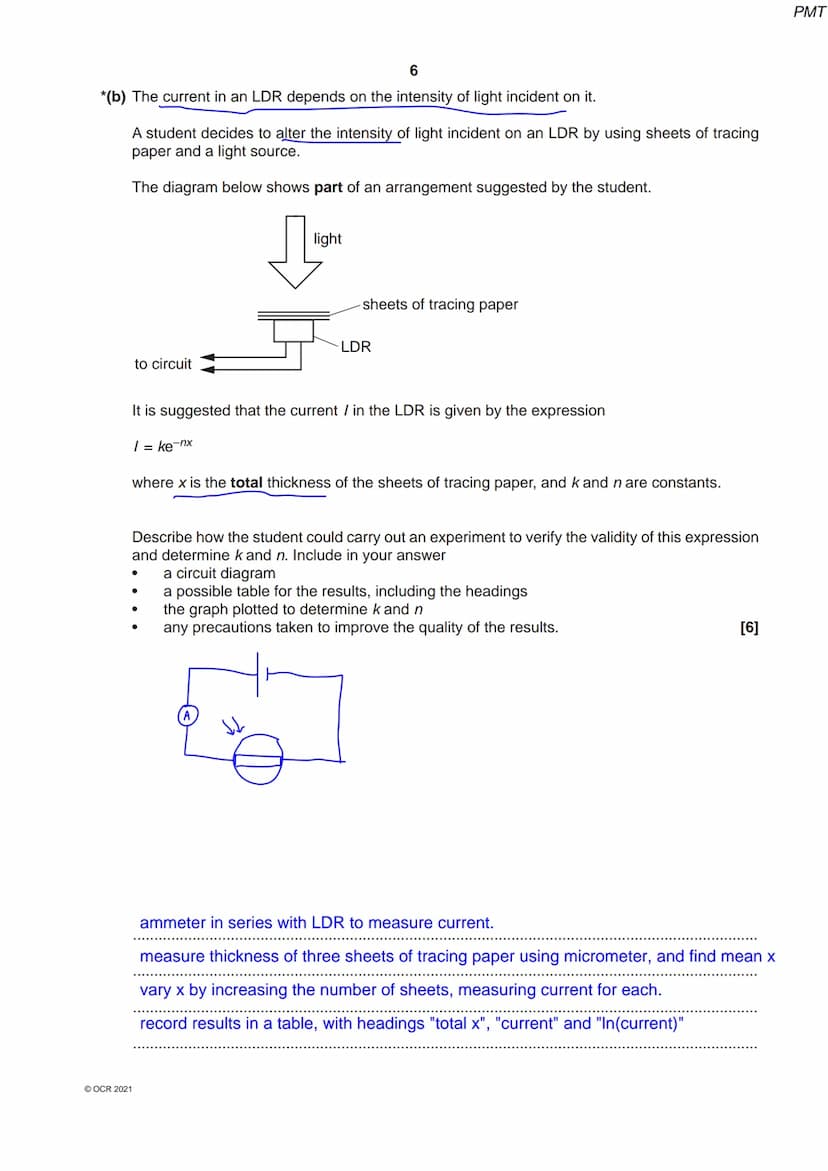
Understanding Light-Dependent Resistors (LDR) in Circuit Analysis
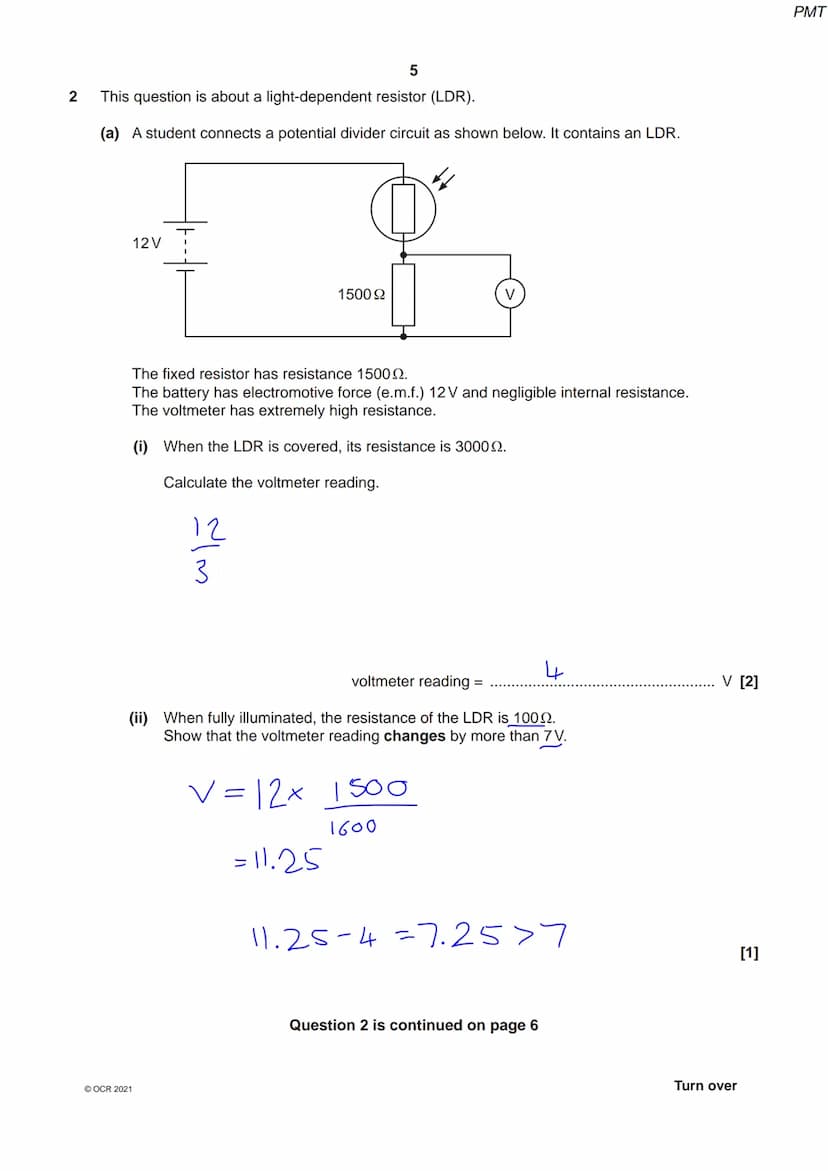
A light-dependent resistor (LDR) serves as a crucial component in electronic circuits where light detection is necessary. In this detailed examination, we'll explore how LDRs function within potential divider circuits and analyze their behavior under different lighting conditions.
Definition: A light-dependent resistor (LDR) is a component whose resistance varies with the intensity of light falling on its surface. Higher light intensity results in lower resistance, while darkness increases resistance.
When examining a potential divider circuit containing an LDR and a fixed resistor of 1500Ω connected to a 12V battery, we can observe fascinating voltage variations. With the LDR covered (resistance 3000Ω), the voltmeter reading can be calculated using the potential divider formula. This setup demonstrates how light intensity directly affects circuit behavior.
The relationship between light intensity and LDR current follows an exponential pattern, expressed as I = ke^, where x represents the thickness of light-filtering material. This mathematical model helps us understand the precise nature of how LDRs respond to varying light conditions.
Example: In practical applications, when the LDR is fully illuminated with a resistance of 1000Ω, the voltage change across the circuit can exceed 7V, demonstrating the component's high sensitivity to light variations.
6
of 10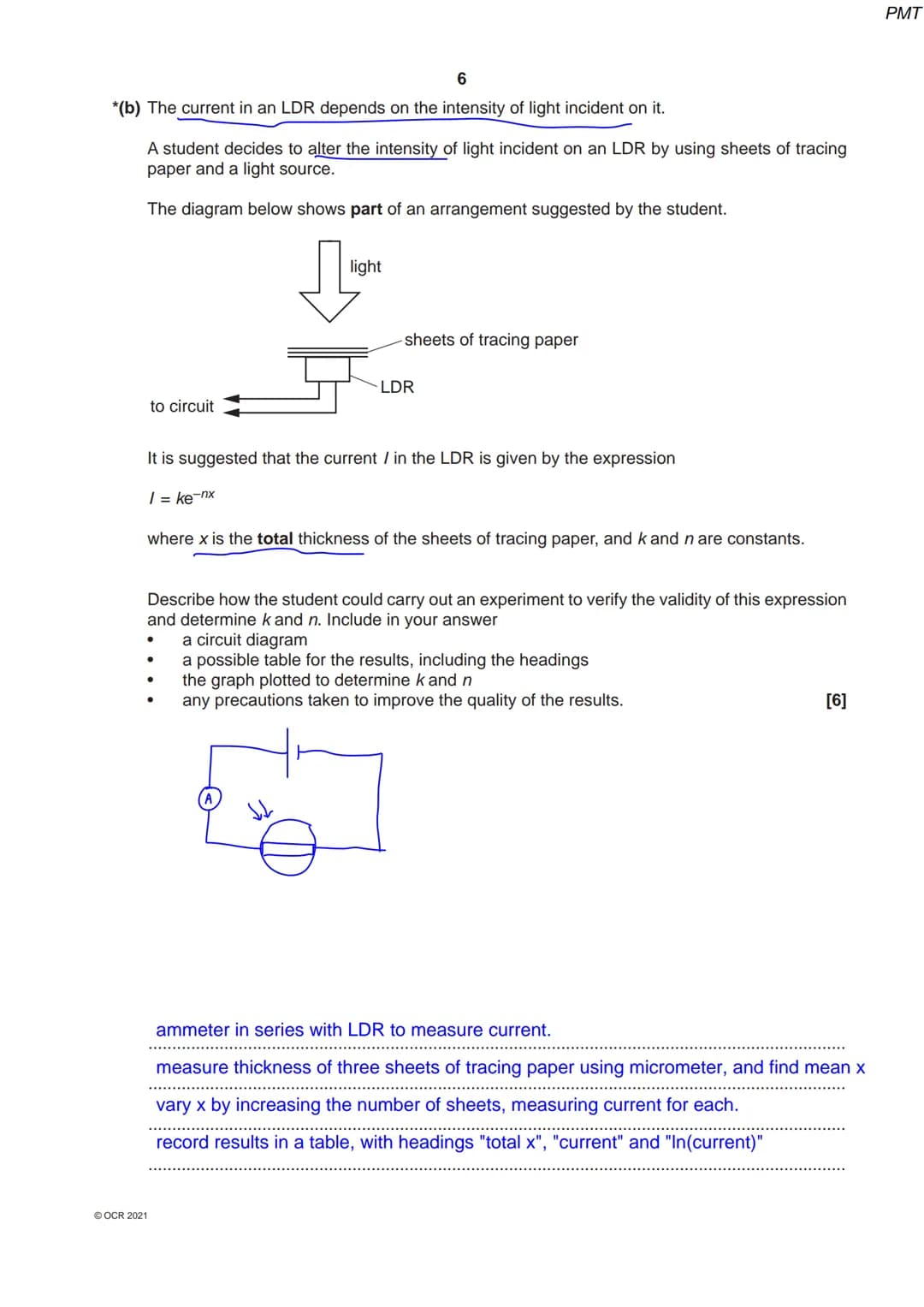
Experimental Design for LDR Characteristics
A systematic approach to studying LDR behavior involves careful experimental design and precise measurements. The setup requires basic circuit components and light-filtering materials like tracing paper to control light intensity.
Highlight: Key experimental components include:
- An ammeter connected in series with the LDR
- Multiple sheets of tracing paper as light filters
- A stable light source
- Accurate thickness measurement tools
The experimental procedure involves incrementally adding sheets of tracing paper while measuring current flow through the circuit. This methodical approach allows for the verification of the exponential relationship between light intensity and current.
Recording data requires careful attention to variables such as total paper thickness (x), current measurements, and calculating natural logarithms of current values. This data collection enables the creation of a logarithmic plot to determine the constants k and n in the exponential relationship.
Vocabulary: The natural logarithm of current plotted against paper thickness should yield a straight line with slope -n and y-intercept ln(k), confirming the exponential model.
7
of 10
Space Probe Orbital Energy Analysis
Understanding the energy dynamics of space probes requires careful consideration of both gravitational potential energy and kinetic energy. For a space probe orbiting the Sun, these energy components are intricately related through fundamental physical principles.
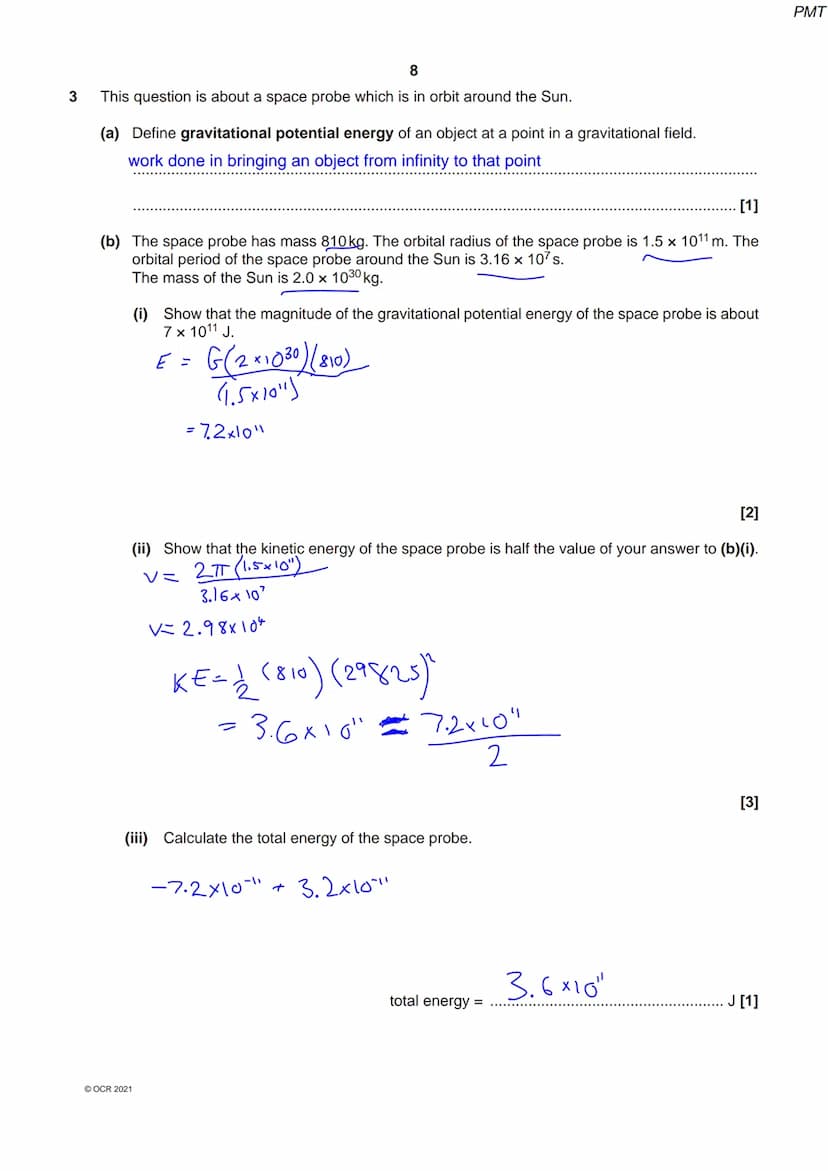
Definition: Gravitational potential energy represents the work done in moving an object from infinity to a specific point in a gravitational field.
For a space probe with mass 810 kg orbiting at 1.5 × 10¹¹ m from the Sun, the gravitational potential energy reaches approximately 7 × 10¹¹ J. This substantial energy value reflects the strong gravitational influence of the Sun's 2.0 × 10³⁰ kg mass.
The kinetic energy of the orbiting probe maintains a precise relationship with its potential energy, specifically being exactly half the magnitude. This relationship is a fundamental principle of orbital mechanics and helps verify the stability of the orbit.
8
of 10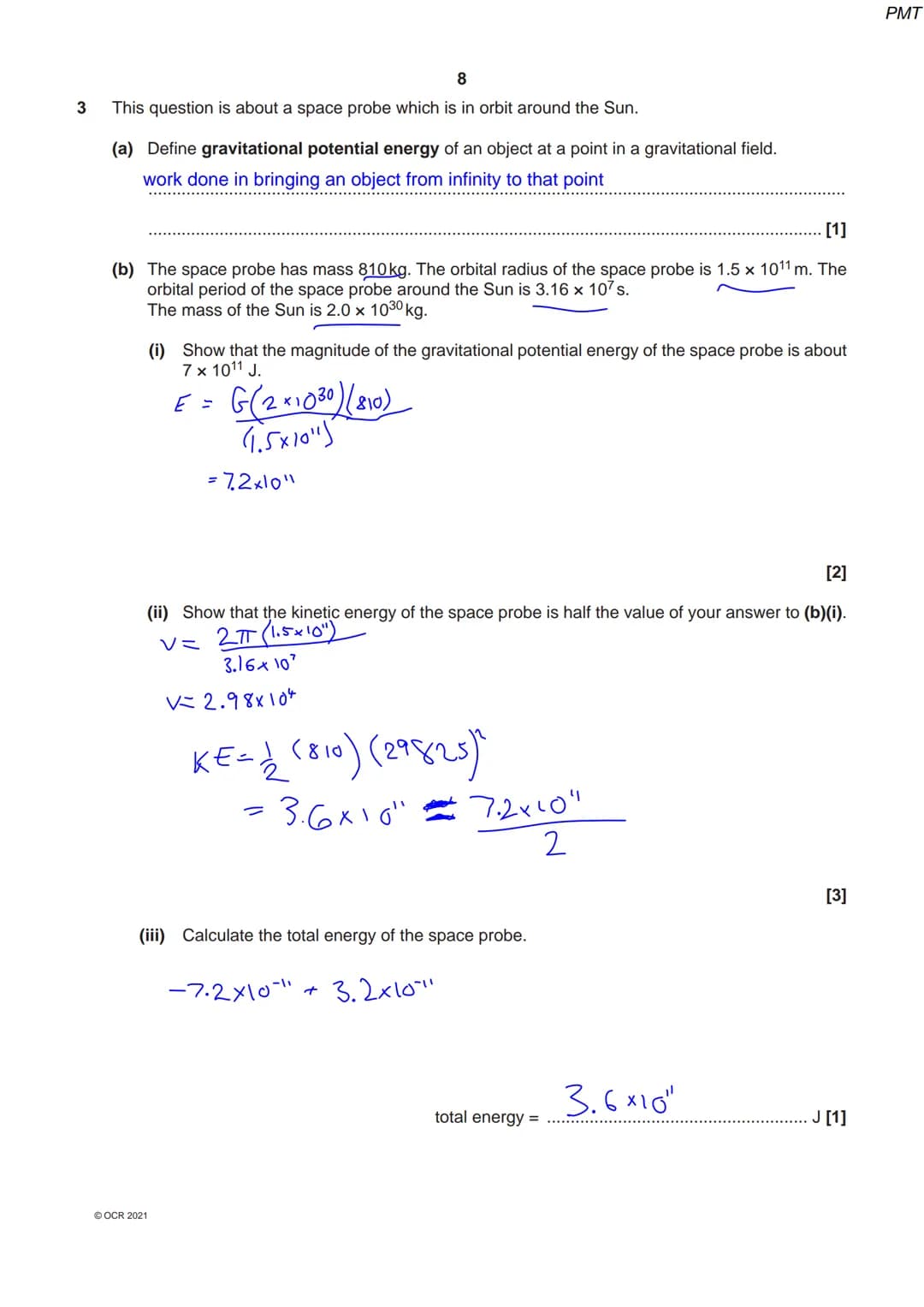
Power Systems in Space Exploration
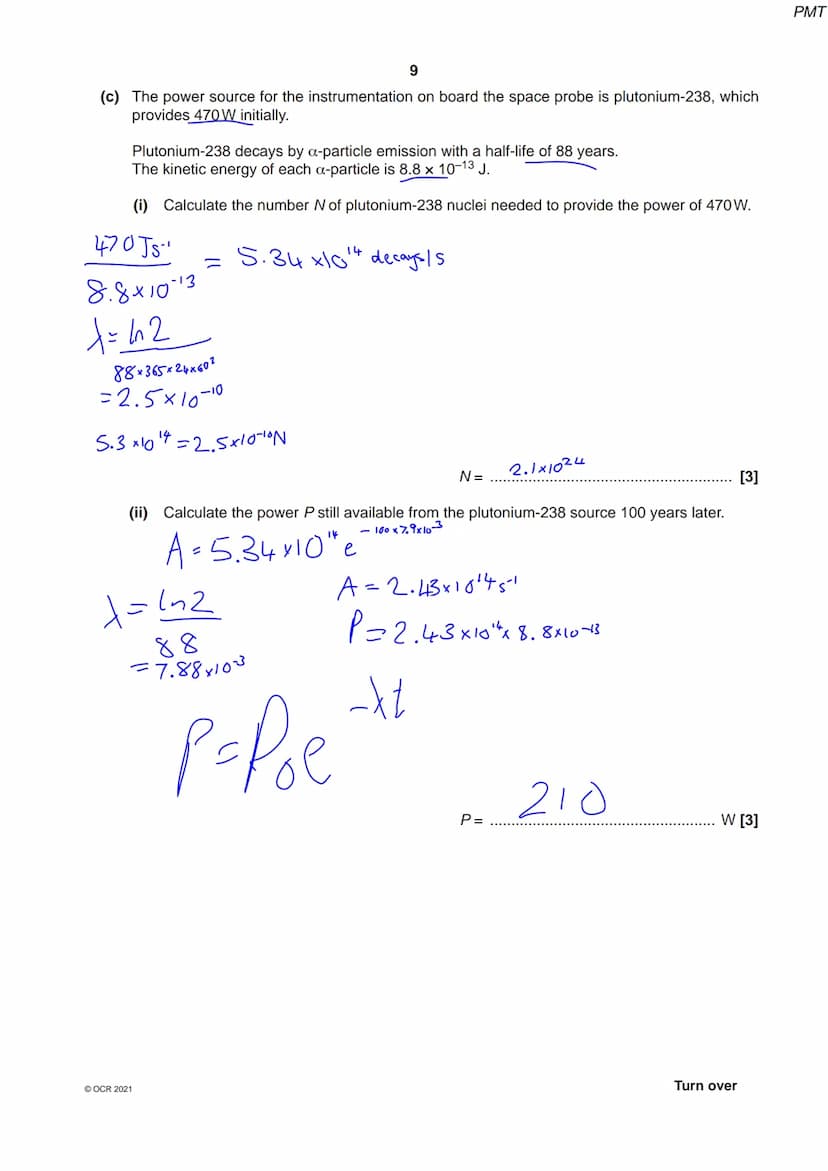
Space probe power systems rely on sophisticated nuclear power sources, particularly plutonium-238, which provides consistent energy through radioactive decay. The initial power output of 470 W demonstrates the efficiency of nuclear power for long-term space missions.
Example: Plutonium-238 decay produces α-particles with kinetic energy of 8.8 × 10⁻¹³ J each, requiring precise calculations to determine the number of nuclei needed for sustained power generation.
The half-life of 88 years for plutonium-238 affects long-term mission planning, as power output gradually decreases over time. After 100 years, the available power reduces significantly, following exponential decay principles.
Understanding these power dynamics is crucial for planning extended space missions, as equipment reliability depends on consistent power supply throughout the mission duration.
9
of 10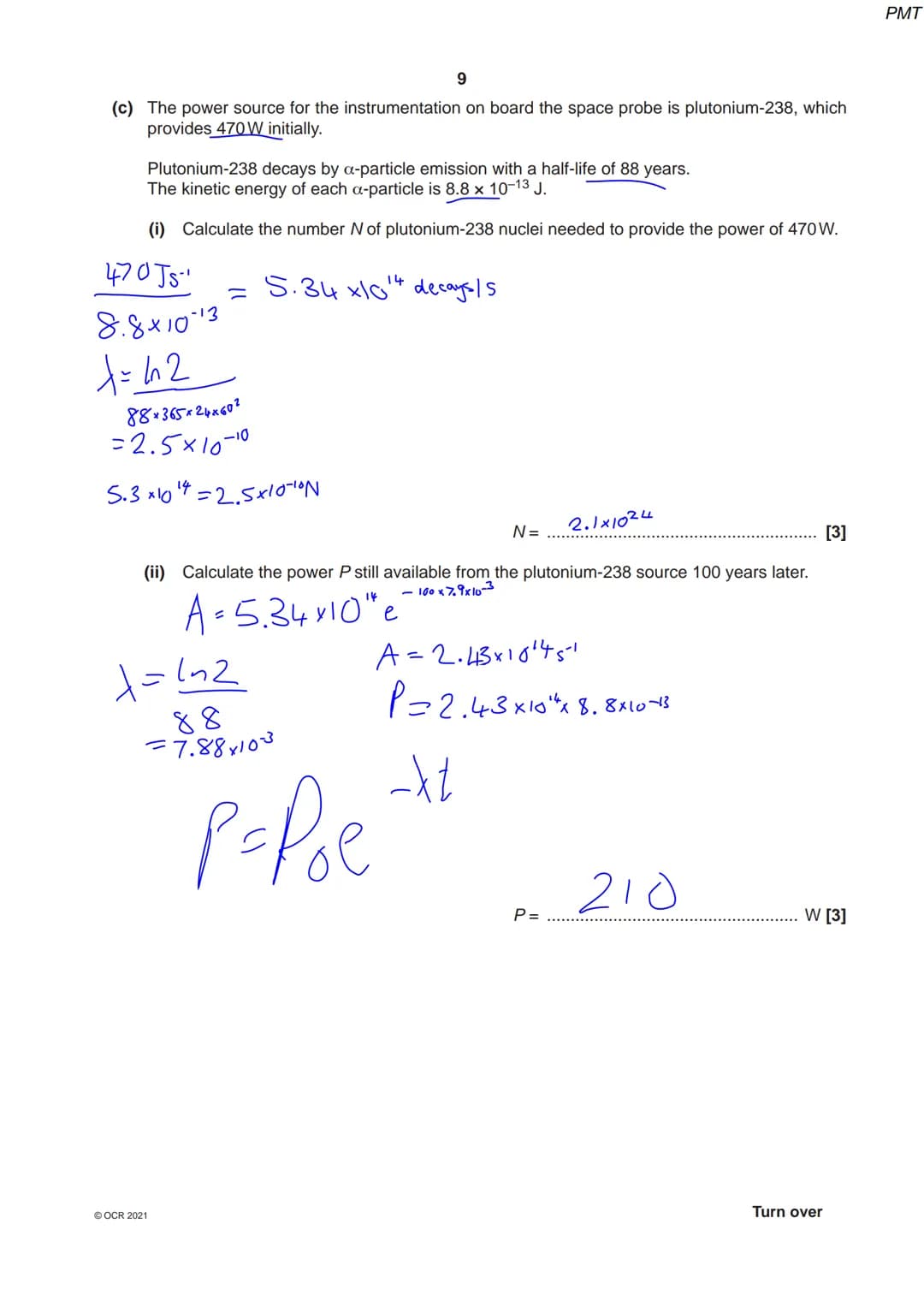
Understanding Air Pressure and Temperature in Electric Ovens: A Physics Analysis
When examining the behavior of air molecules inside an electric oven, we encounter fascinating principles of kinetic theory and thermodynamics. In this detailed analysis, we'll explore how temperature changes affect the internal energy of air in an unsealed oven maintained at atmospheric pressure.
Definition: Internal energy in an ideal gas system represents the total kinetic energy of all molecules in random motion.
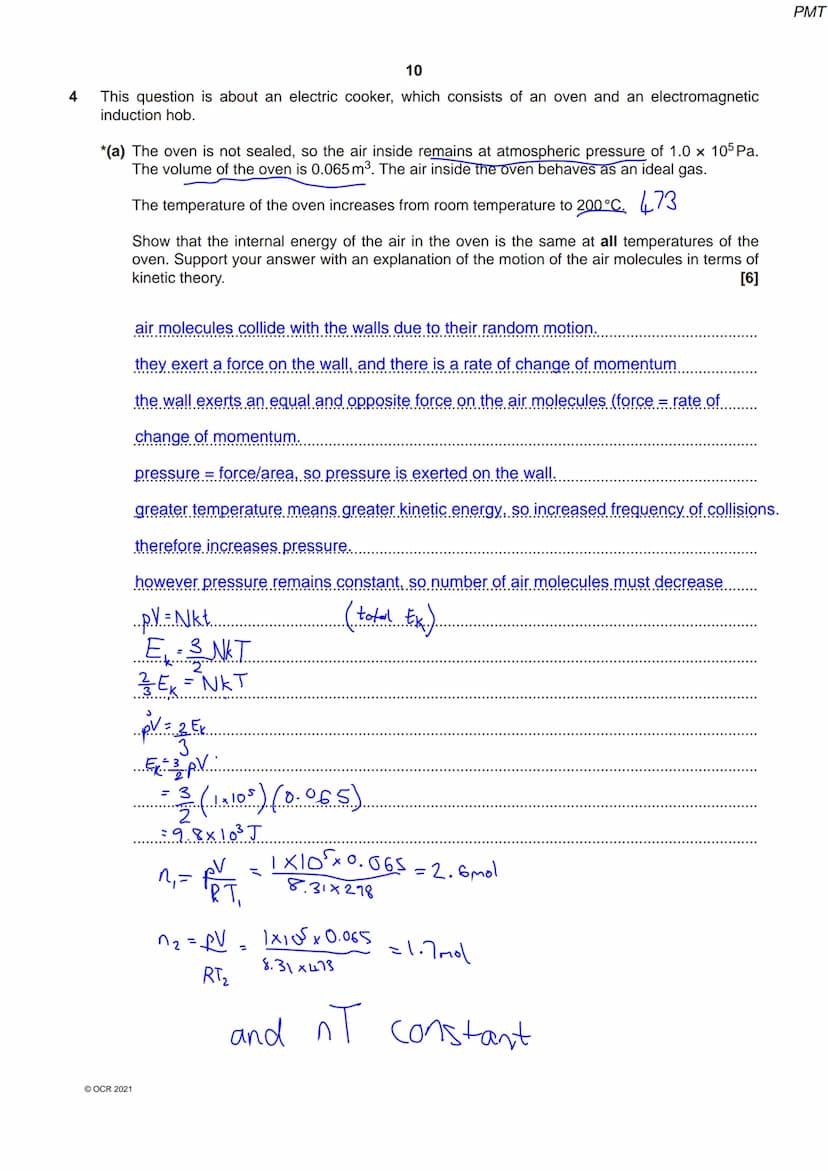
The relationship between temperature and molecular behavior in an oven system follows precise physical laws. When air molecules move randomly within the oven's 0.065 m³ volume, they continuously collide with the oven walls. These collisions create pressure through the rate of change of momentum, with the walls exerting equal and opposite forces back on the molecules. This fundamental interaction maintains the constant atmospheric pressure of 1.0 × 10⁵ Pa.
As the oven temperature rises from room temperature to 200°C (473K), the air molecules gain kinetic energy, resulting in more frequent and energetic collisions. However, since the oven isn't sealed, a fascinating phenomenon occurs - the number of air molecules inside decreases to maintain constant pressure. This relationship is governed by the ideal gas equation PV = NkT, where the internal energy E = (3/2)NkT remains constant despite temperature changes.
Example: At room temperature (278K), the oven contains approximately 2.6 moles of air. When heated to 473K, this reduces to 1.7 moles, maintaining the same internal energy of 9.8 × 10³ J.
10
of 10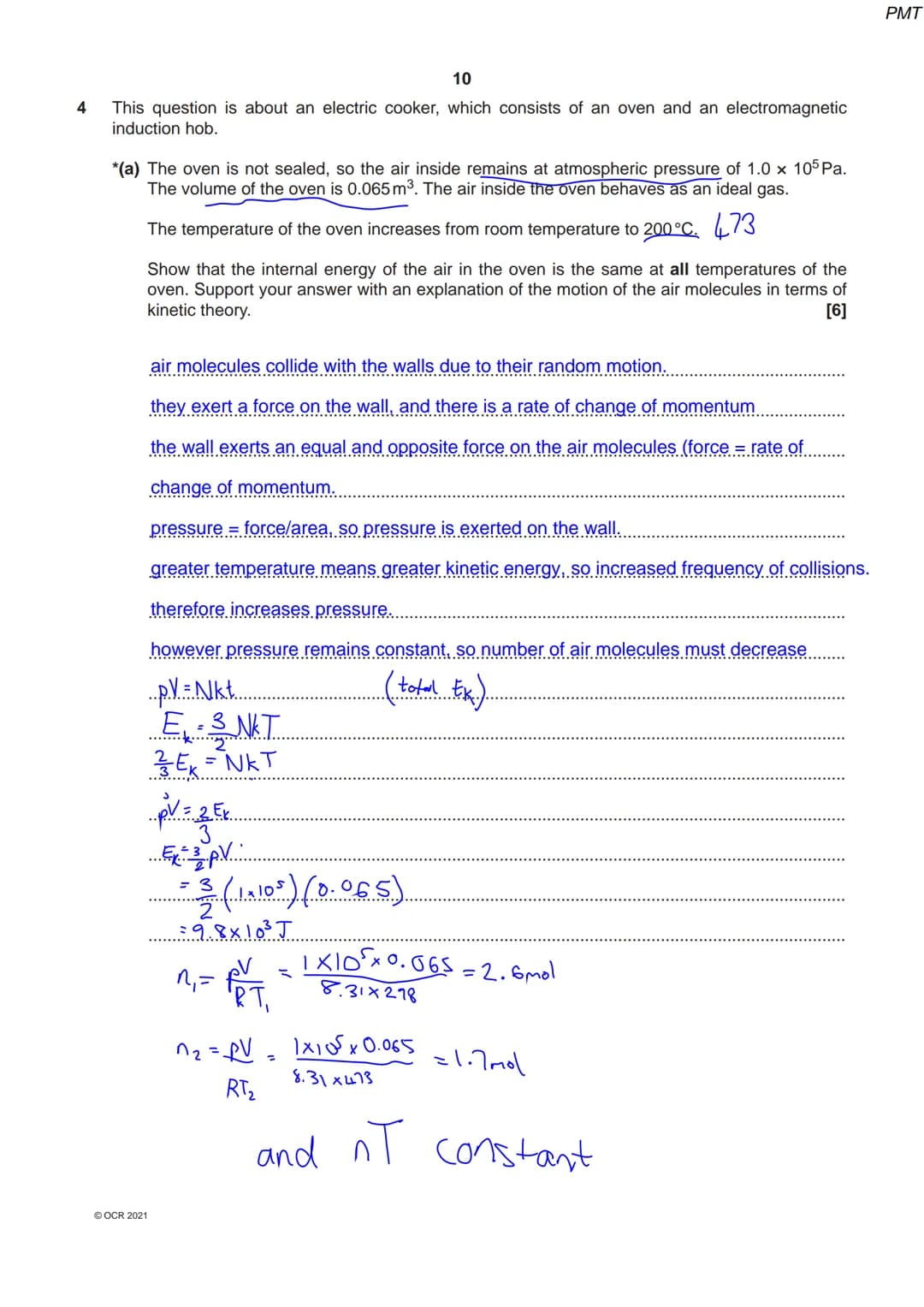
Practical Applications of Thermodynamics in Kitchen Appliances
Understanding the physics behind everyday appliances like electric ovens helps us appreciate the sophisticated engineering involved in their design. The constant internal energy principle demonstrates how unsealed ovens maintain cooking efficiency while allowing for pressure regulation.
The behavior of air molecules in the oven illustrates key concepts in kinetic theory. When molecules gain thermal energy, their average kinetic energy increases proportionally with absolute temperature. This relationship directly affects cooking performance and energy efficiency in modern kitchen appliances.
Highlight: The maintenance of constant internal energy, despite temperature changes, is crucial for consistent cooking results and safety in unsealed ovens.
Engineers apply these principles when designing ventilation systems and temperature controls in cooking appliances. The careful balance between pressure, volume, and temperature ensures optimal cooking conditions while maintaining safety and efficiency. This understanding of molecular behavior and thermodynamics continues to influence the development of advanced kitchen technology.
We thought you’d never ask...
What is the Knowunity AI companion?
Our AI Companion is a student-focused AI tool that offers more than just answers. Built on millions of Knowunity resources, it provides relevant information, personalised study plans, quizzes, and content directly in the chat, adapting to your individual learning journey.
Where can I download the Knowunity app?
You can download the app from Google Play Store and Apple App Store.
Is Knowunity really free of charge?
That's right! Enjoy free access to study content, connect with fellow students, and get instant help – all at your fingertips.
Similar content
Most popular content: Resistance
9Most popular content in Physics
9Most popular content
9Can't find what you're looking for? Explore other subjects.
Students love us — and so will you.
4.6/5App Store
4.7/5Google Play
The app is very easy to use and well designed. I have found everything I was looking for so far and have been able to learn a lot from the presentations! I will definitely use the app for a class assignment! And of course it also helps a lot as an inspiration.
Stefan SiOS user
This app is really great. There are so many study notes and help [...]. My problem subject is French, for example, and the app has so many options for help. Thanks to this app, I have improved my French. I would recommend it to anyone.
Samantha KlichAndroid user
Wow, I am really amazed. I just tried the app because I've seen it advertised many times and was absolutely stunned. This app is THE HELP you want for school and above all, it offers so many things, such as workouts and fact sheets, which have been VERY helpful to me personally.
AnnaiOS user
Physics108 views·Updated May 30, 2026·20 pagesFun Physics Problems: High-Speed Electric Train and Motor Power!
Los@los
A comprehensive exploration of High-speed electric train physics problems demonstrates how to calculate power, energy, and efficiency in transportation systems.
The analysis begins with understanding how to determine the train motor output powerrequired to maintain constant velocity against opposing... Show more
1
of 10Sign up to see the content. It's free!
- Access to all documents
- Improve your grades
- Join milions of students
Understanding High-Speed Electric Train Physics: Power, Force, and Acceleration
A comprehensive analysis of a High-speed electric train physics problem demonstrates the intricate relationships between electrical and mechanical systems. The train system operates with a 25 kV potential difference between the overhead cable and earthed rails, utilizing a sliding contact mechanism for power transmission.
When examining the train's acceleration characteristics, we observe that with a mass of 2.1 × 10⁵ kg and an applied force of 190 kN, the train achieves an acceleration of approximately 1 ms⁻². This relationship exemplifies Newton's Second Law of Motion in real-world applications, where the resultant force produces proportional acceleration in massive objects.
Definition: The power output of an electric motor is calculated as the product of force and velocity , measured in watts (W) or megawatts (MW) for large systems like trains.
The analysis of the train's performance during acceleration from 30 ms⁻¹ to 60 ms⁻¹ reveals fascinating insights into power consumption. The graphical relationship between force and velocity demonstrates that the motor maintains a constant power output of approximately 4 MW throughout this speed range, showcasing the efficient energy conversion capabilities of modern electric train systems.
2
of 10Sign up to see the content. It's free!
- Access to all documents
- Improve your grades
- Join milions of students
Advanced Calculations in Train Electromechanics
Calculating train motor output power requires understanding the relationship between mechanical and electrical parameters. When analyzing the current draw at 50 ms⁻¹, we must consider the 25 kV supply voltage and the 4.2 MW power requirement, demonstrating how electrical power converts to mechanical motion.
Example: To calculate current at 50 ms⁻¹:
- Power (P) = Current (I) × Voltage (V)
- 4.2 × 10⁶ = I × 25,000
- Current = 168 amperes
The overhead cable system presents an interesting study in materials science and electrical engineering. With a cross-sectional area of 1.1 × 10⁻⁴ m² and resistivity of 1.8 × 10⁻⁸ Ωm, the cable must balance electrical conductivity with mechanical strength.
3
of 10Sign up to see the content. It's free!
- Access to all documents
- Improve your grades
- Join milions of students
Engineering Analysis of Overhead Power Systems
The mechanical properties of the overhead cable system demonstrate the complex engineering considerations in railway power distribution. The cable's Young's modulus of 1.2 × 10¹⁰ Pa and strain of 1.3% indicate careful design to maintain both electrical efficiency and mechanical stability.
Highlight: The tension calculation in overhead cables combines electrical and mechanical engineering principles, ensuring reliable power delivery while maintaining structural integrity.
These calculations represent typical problems found in A Level Physics exam questions, combining multiple physics concepts including electricity, mechanics, and materials science. Understanding these relationships is crucial for engineering applications in modern transportation systems.
4
of 10Sign up to see the content. It's free!
- Access to all documents
- Improve your grades
- Join milions of students
Practical Applications in Railway Engineering
The practical implementation of theoretical physics concepts in railway systems showcases the importance of integrated engineering solutions. The overhead cable system must maintain specific tension while providing consistent electrical conductivity, demonstrating how multiple physical parameters interact in real-world applications.
Vocabulary: Young's modulus - A measure of a material's stiffness, defined as the ratio of stress to strain within the elastic limit.
The resistance calculations for the overhead cable, yielding approximately 0.25 Ω per length, illustrate the importance of minimizing power losses in high-voltage transmission systems. This optimization balances mechanical requirements with electrical efficiency, a crucial consideration in modern railway design.
5
of 10Sign up to see the content. It's free!
- Access to all documents
- Improve your grades
- Join milions of students
Understanding Light-Dependent Resistors (LDR) in Circuit Analysis
A light-dependent resistor (LDR) serves as a crucial component in electronic circuits where light detection is necessary. In this detailed examination, we'll explore how LDRs function within potential divider circuits and analyze their behavior under different lighting conditions.
Definition: A light-dependent resistor (LDR) is a component whose resistance varies with the intensity of light falling on its surface. Higher light intensity results in lower resistance, while darkness increases resistance.
When examining a potential divider circuit containing an LDR and a fixed resistor of 1500Ω connected to a 12V battery, we can observe fascinating voltage variations. With the LDR covered (resistance 3000Ω), the voltmeter reading can be calculated using the potential divider formula. This setup demonstrates how light intensity directly affects circuit behavior.
The relationship between light intensity and LDR current follows an exponential pattern, expressed as I = ke^, where x represents the thickness of light-filtering material. This mathematical model helps us understand the precise nature of how LDRs respond to varying light conditions.
Example: In practical applications, when the LDR is fully illuminated with a resistance of 1000Ω, the voltage change across the circuit can exceed 7V, demonstrating the component's high sensitivity to light variations.
6
of 10Sign up to see the content. It's free!
- Access to all documents
- Improve your grades
- Join milions of students
Experimental Design for LDR Characteristics
A systematic approach to studying LDR behavior involves careful experimental design and precise measurements. The setup requires basic circuit components and light-filtering materials like tracing paper to control light intensity.
Highlight: Key experimental components include:
- An ammeter connected in series with the LDR
- Multiple sheets of tracing paper as light filters
- A stable light source
- Accurate thickness measurement tools
The experimental procedure involves incrementally adding sheets of tracing paper while measuring current flow through the circuit. This methodical approach allows for the verification of the exponential relationship between light intensity and current.
Recording data requires careful attention to variables such as total paper thickness (x), current measurements, and calculating natural logarithms of current values. This data collection enables the creation of a logarithmic plot to determine the constants k and n in the exponential relationship.
Vocabulary: The natural logarithm of current plotted against paper thickness should yield a straight line with slope -n and y-intercept ln(k), confirming the exponential model.
7
of 10Sign up to see the content. It's free!
- Access to all documents
- Improve your grades
- Join milions of students
Space Probe Orbital Energy Analysis
Understanding the energy dynamics of space probes requires careful consideration of both gravitational potential energy and kinetic energy. For a space probe orbiting the Sun, these energy components are intricately related through fundamental physical principles.
Definition: Gravitational potential energy represents the work done in moving an object from infinity to a specific point in a gravitational field.
For a space probe with mass 810 kg orbiting at 1.5 × 10¹¹ m from the Sun, the gravitational potential energy reaches approximately 7 × 10¹¹ J. This substantial energy value reflects the strong gravitational influence of the Sun's 2.0 × 10³⁰ kg mass.
The kinetic energy of the orbiting probe maintains a precise relationship with its potential energy, specifically being exactly half the magnitude. This relationship is a fundamental principle of orbital mechanics and helps verify the stability of the orbit.
8
of 10Sign up to see the content. It's free!
- Access to all documents
- Improve your grades
- Join milions of students
Power Systems in Space Exploration
Space probe power systems rely on sophisticated nuclear power sources, particularly plutonium-238, which provides consistent energy through radioactive decay. The initial power output of 470 W demonstrates the efficiency of nuclear power for long-term space missions.
Example: Plutonium-238 decay produces α-particles with kinetic energy of 8.8 × 10⁻¹³ J each, requiring precise calculations to determine the number of nuclei needed for sustained power generation.
The half-life of 88 years for plutonium-238 affects long-term mission planning, as power output gradually decreases over time. After 100 years, the available power reduces significantly, following exponential decay principles.
Understanding these power dynamics is crucial for planning extended space missions, as equipment reliability depends on consistent power supply throughout the mission duration.
9
of 10Sign up to see the content. It's free!
- Access to all documents
- Improve your grades
- Join milions of students
Understanding Air Pressure and Temperature in Electric Ovens: A Physics Analysis
When examining the behavior of air molecules inside an electric oven, we encounter fascinating principles of kinetic theory and thermodynamics. In this detailed analysis, we'll explore how temperature changes affect the internal energy of air in an unsealed oven maintained at atmospheric pressure.
Definition: Internal energy in an ideal gas system represents the total kinetic energy of all molecules in random motion.
The relationship between temperature and molecular behavior in an oven system follows precise physical laws. When air molecules move randomly within the oven's 0.065 m³ volume, they continuously collide with the oven walls. These collisions create pressure through the rate of change of momentum, with the walls exerting equal and opposite forces back on the molecules. This fundamental interaction maintains the constant atmospheric pressure of 1.0 × 10⁵ Pa.
As the oven temperature rises from room temperature to 200°C (473K), the air molecules gain kinetic energy, resulting in more frequent and energetic collisions. However, since the oven isn't sealed, a fascinating phenomenon occurs - the number of air molecules inside decreases to maintain constant pressure. This relationship is governed by the ideal gas equation PV = NkT, where the internal energy E = (3/2)NkT remains constant despite temperature changes.
Example: At room temperature (278K), the oven contains approximately 2.6 moles of air. When heated to 473K, this reduces to 1.7 moles, maintaining the same internal energy of 9.8 × 10³ J.
10
of 10Sign up to see the content. It's free!
- Access to all documents
- Improve your grades
- Join milions of students
Practical Applications of Thermodynamics in Kitchen Appliances
Understanding the physics behind everyday appliances like electric ovens helps us appreciate the sophisticated engineering involved in their design. The constant internal energy principle demonstrates how unsealed ovens maintain cooking efficiency while allowing for pressure regulation.
The behavior of air molecules in the oven illustrates key concepts in kinetic theory. When molecules gain thermal energy, their average kinetic energy increases proportionally with absolute temperature. This relationship directly affects cooking performance and energy efficiency in modern kitchen appliances.
Highlight: The maintenance of constant internal energy, despite temperature changes, is crucial for consistent cooking results and safety in unsealed ovens.
Engineers apply these principles when designing ventilation systems and temperature controls in cooking appliances. The careful balance between pressure, volume, and temperature ensures optimal cooking conditions while maintaining safety and efficiency. This understanding of molecular behavior and thermodynamics continues to influence the development of advanced kitchen technology.
We thought you’d never ask...
What is the Knowunity AI companion?
Our AI Companion is a student-focused AI tool that offers more than just answers. Built on millions of Knowunity resources, it provides relevant information, personalised study plans, quizzes, and content directly in the chat, adapting to your individual learning journey.
Where can I download the Knowunity app?
You can download the app from Google Play Store and Apple App Store.
Is Knowunity really free of charge?
That's right! Enjoy free access to study content, connect with fellow students, and get instant help – all at your fingertips.
Similar content
Most popular content: Resistance
9Most popular content in Physics
9Most popular content
9Can't find what you're looking for? Explore other subjects.
Students love us — and so will you.
4.6/5App Store
4.7/5Google Play
The app is very easy to use and well designed. I have found everything I was looking for so far and have been able to learn a lot from the presentations! I will definitely use the app for a class assignment! And of course it also helps a lot as an inspiration.
Stefan SiOS user
This app is really great. There are so many study notes and help [...]. My problem subject is French, for example, and the app has so many options for help. Thanks to this app, I have improved my French. I would recommend it to anyone.
Samantha KlichAndroid user
Wow, I am really amazed. I just tried the app because I've seen it advertised many times and was absolutely stunned. This app is THE HELP you want for school and above all, it offers so many things, such as workouts and fact sheets, which have been VERY helpful to me personally.
AnnaiOS user