Open the App

Subjects

HistoryHistory2,549 views·Updated 22 Aug 2026·5 pages

Crime and Punishment History: Easy Summary for Kids

user profile picture
Evelyn Ridley@ev_alice

A comprehensive Crime and Punishment historical summarycovering medieval law...

1
of 5
Crime and punishment  – page 1

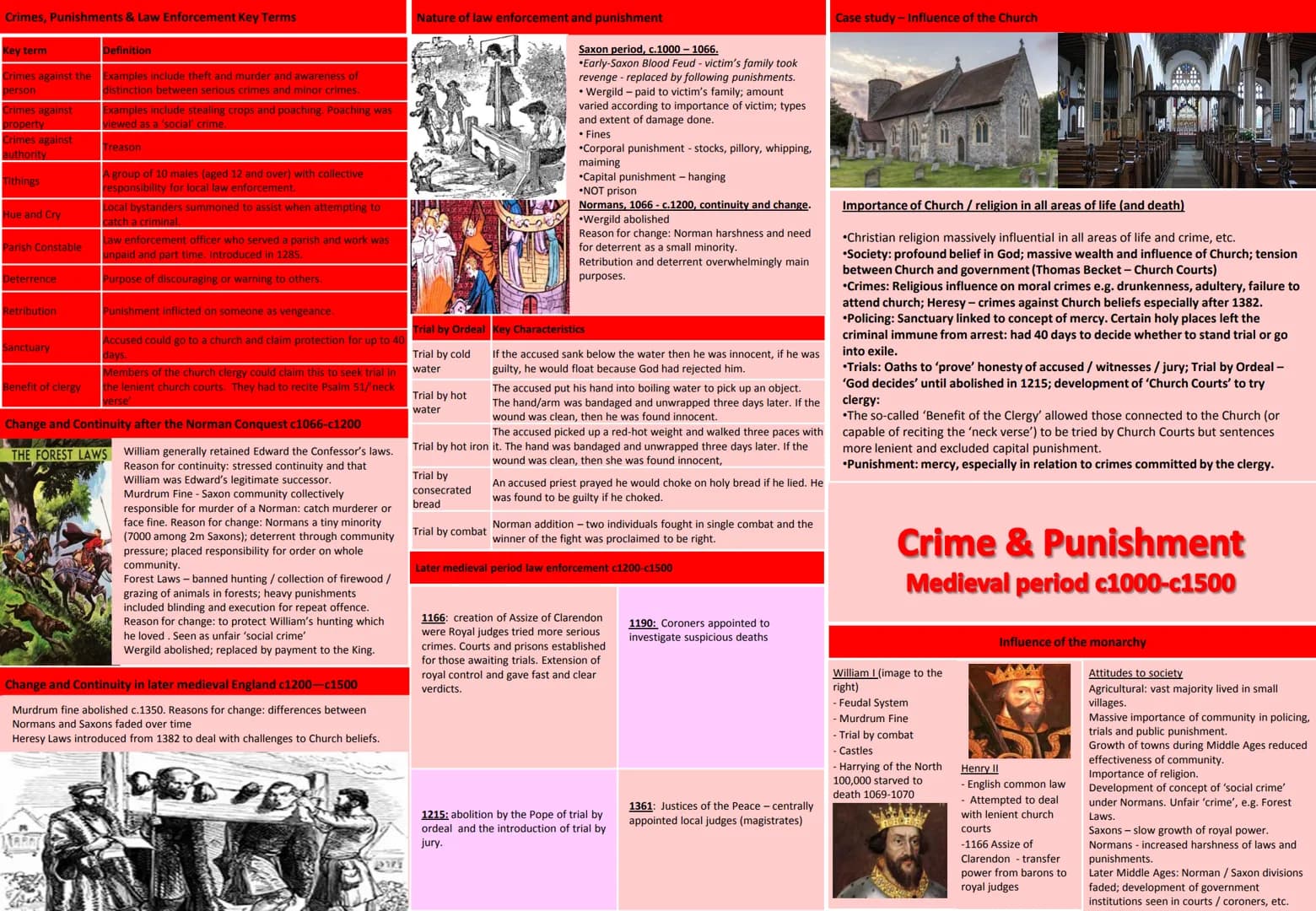
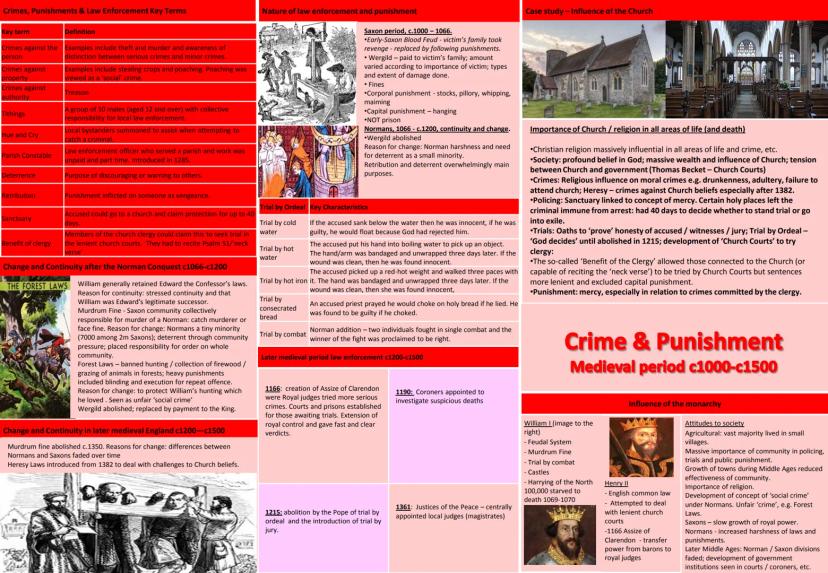
Change and Continuity in later medieval England c1200-c1500

This page details further developments in the English legal system during the later medieval period, showcasing the evolution of laws and punishments.

The abolition of the Murdrum fine around 1350 reflected the fading distinctions between Normans and Saxons over time. New laws were introduced to address emerging concerns:

Example: Heresy Laws were introduced from 1382 to deal with challenges to Church beliefs, demonstrating the continued influence of religion on the legal system.

The nature of law enforcement and punishment evolved significantly during this period. The page provides a comprehensive overview of various trial methods used in medieval England:

  • Trial by cold water
  • Trial by hot water
  • Trial by hot iron
  • Trial by consecrated bread
  • Trial by combat (a Norman addition)

Highlight: In the trial by cold water, if the accused sank, they were considered innocent, while floating indicated guilt as it was believed God had rejected them.

These trial methods reflect the strong religious influence on the medieval justice system and the belief in divine judgment.

Later medieval period law enforcement c1200-1500

This section outlines key developments in law enforcement during the later medieval period, showcasing the gradual centralization and formalization of the English legal system.

Significant milestones include:

  1. 1166: Creation of the Assize of Clarendon, establishing royal judges to try serious crimes
  2. 1190: Appointment of Coroners to investigate suspicious deaths
  3. 1215: Abolition of trial by ordeal and introduction of trial by jury
  4. 1361: Introduction of Justices of the Peace as centrally appointed local judges

Highlight: The creation of the Assize of Clarendon in 1166 led to the establishment of courts and prisons for those awaiting trials, marking an extension of royal control over the legal system.

These developments demonstrate a clear trend towards a more centralized and standardized system of law enforcement and justice administration in medieval England.

2
of 5
Crime and punishment  – page 2

Case study-Influence of the Church

This page examines the profound influence of the Church on various aspects of medieval life, particularly in relation to crime and punishment. The Church's role extended to shaping moral standards, defining crimes, and influencing legal procedures.

Highlight: The Christian religion was massively influential in all areas of life, including crime and punishment, reflecting the deep integration of religious beliefs in medieval society.

Key areas of Church influence included:

  1. Society: The Church's wealth and influence often led to tensions with the government, as exemplified by the conflict involving Thomas Becket and Church Courts.

  2. Crimes: Religious influence was evident in the definition of moral crimes such as drunkenness, adultery, and failure to attend church. Heresy became a significant crime, especially after 1382.

  3. Policing: The concept of sanctuary allowed criminals to seek temporary immunity from arrest in certain holy places, reflecting the Church's emphasis on mercy.

  4. Trials: Religious elements were incorporated into legal procedures, such as the use of oaths and trial by ordeal (until its abolition in 1215).

  5. Punishment: The Church promoted the concept of mercy in sentencing.

Example: The 'Benefit of Clergy' allowed those connected to the Church or capable of reciting the 'neck verse' to be tried in more lenient Church Courts, which excluded capital punishment.

This case study highlights the pervasive influence of the Church on the medieval crime and punishment system, demonstrating how religious beliefs and institutions shaped legal practices and societal norms throughout the period.

3
of 5
Crime and punishment  – page 3

Page 4: Church Influence

This section examines the profound impact of the Church on medieval law and justice systems.

Highlight: The Church's influence extended to all aspects of medieval justice, from defining crimes to administering punishments.

Example: Religious crimes included heresy, drunkenness, and failure to attend church.

Definition: Sanctuary provided criminals 40 days of protection in holy places to decide between trial or exile.

The Church's role in medieval justice was comprehensive, affecting everything from trial procedures to punishment methods.

4
of 5
Crime and punishment  – page 4

Page 5: Benefit of Clergy

The final section focuses on the special legal privileges granted to clergy members and their impact on medieval justice.

Definition: Benefit of Clergy allowed religious officials to be tried in more lenient Church courts rather than secular courts.

Highlight: Church courts notably excluded capital punishment, offering more merciful sentences.

Example: The 'neck verse' (Psalm 51) could be recited to claim clergy status and access Church courts.

This system demonstrated the significant power of the Church in medieval legal proceedings and its ability to influence justice outcomes.

5
of 5
Crime and punishment  – page 5

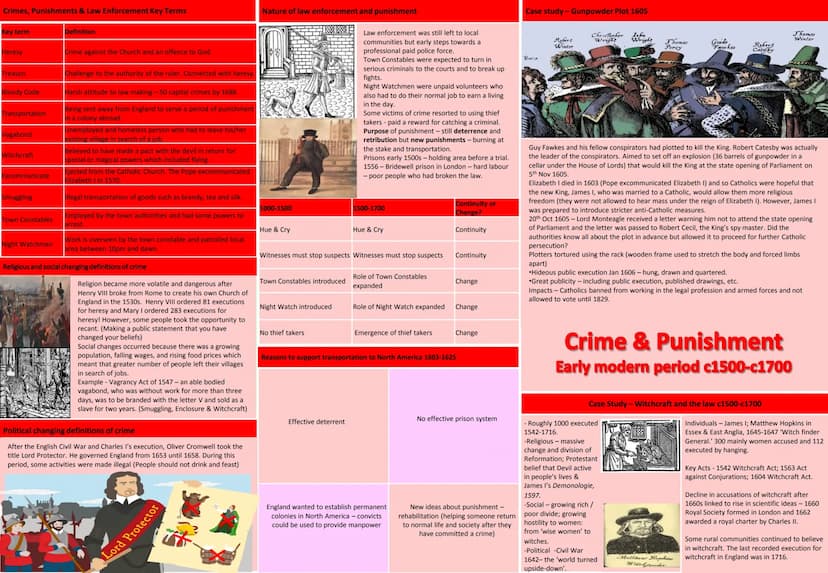
Crimes, Punishments & Law Enforcement Key Terms

This page provides essential definitions and concepts related to medieval laws and punishments. It covers various types of crimes, law enforcement methods, and key legal terms used in medieval England.

Definition: Crimes against the person included theft and murder, with a distinction made between serious and minor offenses.

Definition: Crimes against property encompassed activities like stealing crops and poaching, with poaching often viewed as a 'social crime'.

Vocabulary: Tithings were groups of 10 males aged 12 and over who shared collective responsibility for local law enforcement.

The page also introduces important legal concepts such as deterrence and retribution, as well as specific medieval practices like sanctuary and benefit of clergy.

Highlight: The "hue and cry" system involved local bystanders being summoned to assist in catching criminals, demonstrating community involvement in law enforcement.

The introduction of the parish constable in 1285 marked a significant development in local law enforcement structures.

Change and Continuity after the Norman Conquest c1066-c1200

This section explores the legal changes implemented following the Norman Conquest, highlighting both continuities and changes in the English legal system.

Example: The Forest Laws, introduced by William the Conqueror, banned hunting, collection of firewood, and grazing of animals in forests. Punishments for violating these laws were severe, including blinding and execution for repeat offenses.

The Murdrum Fine was a notable change, making Saxon communities collectively responsible for the murder of Normans. This served as a deterrent and placed responsibility for maintaining order on the entire community.

Highlight: William generally retained many of Edward the Confessor's laws to stress continuity and legitimize his succession.

The abolition of wergild and its replacement with payments to the King marked a significant shift in the purpose and beneficiary of legal compensation.


We thought you’d never ask...

Our AI Companion is a student-focused AI tool that offers more than just answers. Built on millions of Knowunity resources, it provides relevant information, personalised study plans, quizzes, and content directly in the chat, adapting to your individual learning journey.

You can download the app from Google Play Store and Apple App Store.

That's right! Enjoy free access to study content, connect with fellow students, and get instant help – all at your fingertips.

Similar content

Most popular content: Medieval Law Enforcement

9
HistoryHistory

Criminal Justice Evolution

Explore the transformation of crime and punishment from medieval times to the Victorian era. This comprehensive overview covers key concepts such as law enforcement, the criminal justice system, significant historical events like the Gunpowder Plot, and the impact of Tudor religious changes. Ideal for students studying the history of crime and punishment in England, this resource provides essential insights into the development of legal frameworks and societal responses to crime.

106419
HistoryHistory

Edexcel GCSE History Crime and Punishment Revision Booklet

Contains keywords+definitions, answer structures, model questions, revision resources

105398
HistoryHistory

Evolution of Crime & Punishment

Explore the historical development of crime and punishment, focusing on the transition from community-based law enforcement to centralized police forces. This summary covers key concepts such as types of crime, societal attitudes towards punishment, and the impact of technology on law enforcement. Ideal for students studying the evolution of legal systems and societal changes over the past millennium.

111492
HistoryHistory

Medieval Period - Crime and Punishment GCSE - Edexcel

Anglo Saxons, Normans and Medieval England

111531
HistoryHistory

Historical Crime & Punishment

Explore key concepts of crime and punishment from the Anglo-Saxon period to modern times. This comprehensive overview covers significant changes in law enforcement, notable cases, and the evolution of punishments, including the impact of the Industrial Revolution and religious conflicts. Ideal for history students preparing for exams or seeking a deeper understanding of societal shifts in crime and justice.

1110,247400
HistoryHistory

Evolution of Crime Punishment

Explore the historical progression of crime and punishment from medieval England to modern law enforcement. This summary covers key concepts such as the abolition of the death penalty, the establishment of police forces, and various forms of punishment including transportation and corporal punishment. Ideal for students studying the history of law and justice.

113249
HistoryHistory

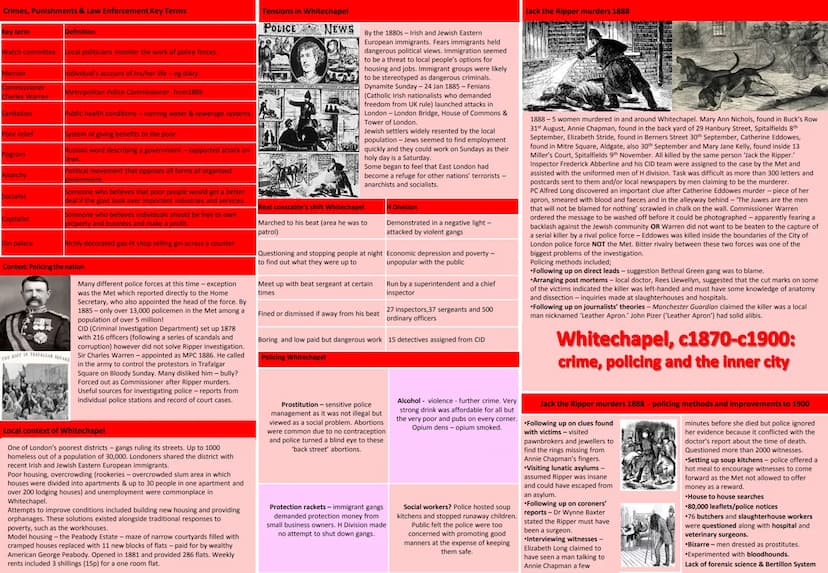
Jack the Ripper Investigation

Explore the complexities of the Jack the Ripper case, including police failures, investigative methods, and the socio-political context of crime and punishment in Victorian London. This summary delves into the challenges faced by law enforcement and the historical background of medieval law enforcement practices. Ideal for students studying crime history and law enforcement evolution.

1137216
HistoryHistory

Crime & Punishment Terminology

Explore essential terminology related to crime and punishment across various historical periods. This summary covers key concepts such as anarchism, rehabilitation, hate crimes, and the roles of law enforcement. Ideal for students studying the evolution of criminal justice and societal responses to crime.

1166616
HistoryHistory

Medieval Crime & Punishment

Explore the evolution of crime and punishment in medieval England, focusing on key concepts such as authority crimes, community enforcement, and the role of religion. This summary covers significant changes in societal norms, legal practices, and the impact of the Norman Conquest on law enforcement. Ideal for students studying Norman and medieval history.

111612

Most popular content in History

9
HistoryHistory

History OCR B - Making of America

This is everything you need to know for the making of America paper seriously this is such a vital resource it literally gave me the highest level responses with very little writing. I found it really hard but now it's my fav, I hope you enjoy this:)

1127411
HistoryHistory

Weimar Republic Overview

Explore the key events and challenges of the Weimar Republic (1918-1929), including the November Revolution, Treaty of Versailles, economic crises, and the rise of political extremism. This summary covers the establishment of the Weimar Constitution, the impact of hyperinflation, and the cultural developments during the Golden Twenties. Ideal for students studying Weimar Germany and its historical significance.

112,01441
HistoryHistory

The Rise of Hitler and the Nazi Party

Trace the steps by which Hitler became Chancellor in 1933, including the impact of the Great Depression and Nazi propaganda.

91651
HistoryHistory

Nazi Germany Overview

Explore key concepts of Nazi Germany, including Hitler's rise to power, the impact of the Nuremberg Laws, and the role of propaganda. This comprehensive summary covers the Weimar Republic's challenges, economic policies, and societal changes under Nazi rule, making it essential for Edexcel GCSE History students. Type: Revision Summary.

1015,5021,426
HistoryHistory

GCSE Edexcel Weimar and Nazi Germany

a summary of the course

121,20226
HistoryHistory

Evolution of Medicine

Explore the comprehensive timeline of medical advancements from medieval practices to modern healthcare. This revision resource covers key topics such as the Great Plague, Germ Theory, the development of antibiotics, and the evolution of public health reforms. Ideal for Edexcel GCSE History students seeking a thorough understanding of the progression of medical knowledge and practices.

1116,291720
HistoryHistory

History Weimar and Nazi Germany

History Edexcel Weimar and Nazi Germany all notes on the specification

1174818
HistoryHistory

Cold War Dynamics

Explore the key events and ideologies of the Cold War, including the arms race, nuclear tensions, and the policies of expansionism and containment. This summary highlights the pivotal moments from the Cuban Missile Crisis to the shifting relations between superpowers, providing insights into the global impact of Cold War conflicts. Ideal for history revision and exam preparation.

113185
HistoryHistory

Weimar & Nazi Germany Overview

Explore the key events and challenges of the Weimar Republic and the rise of Nazi Germany. This comprehensive summary covers the Treaty of Versailles, hyperinflation, political violence, and the pivotal role of figures like Gustav Stresemann. Ideal for GCSE history students aiming for grade 7 and above.

112,40170

Most popular content

9
SociologySociology

Comprehensive Crime & Deviance Overview

Explore an extensive revision of crime and deviance topics, including theories, types of crime, and the impact of media. This resource covers key concepts such as Marxism, functionalism, gender and crime, and the influence of globalization on criminal behavior. Ideal for students seeking a thorough understanding of criminology and its various theories. Type: Full Topic Revision.

1251,7881,406
SociologySociology

Sociological Theories Overview

Comprehensive revision of key sociological theories including Functionalism, Marxism, Feminism, and Interpretivism. Explore concepts like value freedom, identity formation, and the critique of social control. Ideal for AQA A-Level Sociology students preparing for exams. This summary covers essential theories and their implications in sociology, providing a clear understanding of each perspective.

1231,620848
SociologySociology

Sociology of Families: Comprehensive Revision

Dive into an extensive overview of family dynamics, perspectives, and patterns in sociology. This resource covers key concepts such as family diversity, gender roles, marriage, and the impact of social policies on family structures. Perfect for A-Level Sociology students preparing for Paper 2.

1274,0292,306
SociologySociology

Sociology of Education Overview

Explore comprehensive A-Level Sociology notes on the education system, covering key theories, policies, and sociological perspectives. This resource includes insights on marketisation, gender roles, cultural deprivation, and educational inequalities, providing a thorough understanding of how education shapes social stratification and individual achievement. Ideal for exam preparation and in-depth study.

12103,1853,044
SociologySociology

Crime and Deviance AQA A-level sociology

AQA A-level crime and deviance topic notes

1290019
ChemistryChemistry

Chemistry paper 2

Chem paper 2 notes

1173414
BiologyBiology

A-Level Biology Year 1 Overview

Comprehensive summary of AQA A-Level Biology Year 1, covering key topics such as cellular structure, protein synthesis, immune response, gas exchange, and more. Ideal for exam preparation and understanding biological concepts. Includes detailed insights into cellular processes, biological classification, and the circulatory system.

1215,152701
BiologyBiology

AQA Biology: Key Concepts

Explore essential AQA Biology topics including Photosynthesis, Respiration, Homeostasis, Genetics, and Ecology. This comprehensive knowledge organizer covers key concepts such as energy transfer, hormonal control, and genetic variation, providing a solid foundation for your studies. Ideal for exam preparation and understanding biological processes.

109,141311
BiologyBiology

Biology P2: Evolution & Adaptation

Explore key concepts in AQA GCSE Biology P2, focusing on evolution, natural selection, genetic engineering, and adaptations in organisms. This summary covers essential topics such as DNA structure, speciation, and the impact of environmental changes on biodiversity. Ideal for exam preparation and understanding complex biological processes.

111,24422

Students love us — and so will you.

4.6/5App Store
4.7/5Google Play

The app is very easy to use and well designed. I have found everything I was looking for so far and have been able to learn a lot from the presentations! I will definitely use the app for a class assignment! And of course it also helps a lot as an inspiration.

Stefan SiOS user

This app is really great. There are so many study notes and help [...]. My problem subject is French, for example, and the app has so many options for help. Thanks to this app, I have improved my French. I would recommend it to anyone.

Samantha KlichAndroid user

Wow, I am really amazed. I just tried the app because I've seen it advertised many times and was absolutely stunned. This app is THE HELP you want for school and above all, it offers so many things, such as workouts and fact sheets, which have been VERY helpful to me personally.

AnnaiOS user

HistoryHistory2,549 views·Updated 22 Aug 2026·5 pages

Crime and Punishment History: Easy Summary for Kids

user profile picture
Evelyn Ridley@ev_alice

A comprehensive Crime and Punishment historical summary covering medieval law enforcement and justice systems from Saxon to Norman periods. The evolution of legal systems, punishments, and law enforcement methods reflects significant social and political changes throughout medieval England.

Key points:...

1
of 5
Crime and punishment  – page 1

Sign up to see the content. It's free!

  • Access to all documents
  • Improve your grades
  • Join milions of students

By signing up you accept Terms of Service and Privacy Policy

Change and Continuity in later medieval England c1200-c1500

This page details further developments in the English legal system during the later medieval period, showcasing the evolution of laws and punishments.

The abolition of the Murdrum fine around 1350 reflected the fading distinctions between Normans and Saxons over time. New laws were introduced to address emerging concerns:

Example: Heresy Laws were introduced from 1382 to deal with challenges to Church beliefs, demonstrating the continued influence of religion on the legal system.

The nature of law enforcement and punishment evolved significantly during this period. The page provides a comprehensive overview of various trial methods used in medieval England:

  • Trial by cold water
  • Trial by hot water
  • Trial by hot iron
  • Trial by consecrated bread
  • Trial by combat (a Norman addition)

Highlight: In the trial by cold water, if the accused sank, they were considered innocent, while floating indicated guilt as it was believed God had rejected them.

These trial methods reflect the strong religious influence on the medieval justice system and the belief in divine judgment.

Later medieval period law enforcement c1200-1500

This section outlines key developments in law enforcement during the later medieval period, showcasing the gradual centralization and formalization of the English legal system.

Significant milestones include:

  1. 1166: Creation of the Assize of Clarendon, establishing royal judges to try serious crimes
  2. 1190: Appointment of Coroners to investigate suspicious deaths
  3. 1215: Abolition of trial by ordeal and introduction of trial by jury
  4. 1361: Introduction of Justices of the Peace as centrally appointed local judges

Highlight: The creation of the Assize of Clarendon in 1166 led to the establishment of courts and prisons for those awaiting trials, marking an extension of royal control over the legal system.

These developments demonstrate a clear trend towards a more centralized and standardized system of law enforcement and justice administration in medieval England.

2
of 5
Crime and punishment  – page 2

Sign up to see the content. It's free!

  • Access to all documents
  • Improve your grades
  • Join milions of students

By signing up you accept Terms of Service and Privacy Policy

Case study-Influence of the Church

This page examines the profound influence of the Church on various aspects of medieval life, particularly in relation to crime and punishment. The Church's role extended to shaping moral standards, defining crimes, and influencing legal procedures.

Highlight: The Christian religion was massively influential in all areas of life, including crime and punishment, reflecting the deep integration of religious beliefs in medieval society.

Key areas of Church influence included:

  1. Society: The Church's wealth and influence often led to tensions with the government, as exemplified by the conflict involving Thomas Becket and Church Courts.

  2. Crimes: Religious influence was evident in the definition of moral crimes such as drunkenness, adultery, and failure to attend church. Heresy became a significant crime, especially after 1382.

  3. Policing: The concept of sanctuary allowed criminals to seek temporary immunity from arrest in certain holy places, reflecting the Church's emphasis on mercy.

  4. Trials: Religious elements were incorporated into legal procedures, such as the use of oaths and trial by ordeal (until its abolition in 1215).

  5. Punishment: The Church promoted the concept of mercy in sentencing.

Example: The 'Benefit of Clergy' allowed those connected to the Church or capable of reciting the 'neck verse' to be tried in more lenient Church Courts, which excluded capital punishment.

This case study highlights the pervasive influence of the Church on the medieval crime and punishment system, demonstrating how religious beliefs and institutions shaped legal practices and societal norms throughout the period.

3
of 5
Crime and punishment  – page 3

Sign up to see the content. It's free!

  • Access to all documents
  • Improve your grades
  • Join milions of students

By signing up you accept Terms of Service and Privacy Policy

Page 4: Church Influence

This section examines the profound impact of the Church on medieval law and justice systems.

Highlight: The Church's influence extended to all aspects of medieval justice, from defining crimes to administering punishments.

Example: Religious crimes included heresy, drunkenness, and failure to attend church.

Definition: Sanctuary provided criminals 40 days of protection in holy places to decide between trial or exile.

The Church's role in medieval justice was comprehensive, affecting everything from trial procedures to punishment methods.

4
of 5
Crime and punishment  – page 4

Sign up to see the content. It's free!

  • Access to all documents
  • Improve your grades
  • Join milions of students

By signing up you accept Terms of Service and Privacy Policy

Page 5: Benefit of Clergy

The final section focuses on the special legal privileges granted to clergy members and their impact on medieval justice.

Definition: Benefit of Clergy allowed religious officials to be tried in more lenient Church courts rather than secular courts.

Highlight: Church courts notably excluded capital punishment, offering more merciful sentences.

Example: The 'neck verse' (Psalm 51) could be recited to claim clergy status and access Church courts.

This system demonstrated the significant power of the Church in medieval legal proceedings and its ability to influence justice outcomes.

5
of 5
Crime and punishment  – page 5

Sign up to see the content. It's free!

  • Access to all documents
  • Improve your grades
  • Join milions of students

By signing up you accept Terms of Service and Privacy Policy

Crimes, Punishments & Law Enforcement Key Terms

This page provides essential definitions and concepts related to medieval laws and punishments. It covers various types of crimes, law enforcement methods, and key legal terms used in medieval England.

Definition: Crimes against the person included theft and murder, with a distinction made between serious and minor offenses.

Definition: Crimes against property encompassed activities like stealing crops and poaching, with poaching often viewed as a 'social crime'.

Vocabulary: Tithings were groups of 10 males aged 12 and over who shared collective responsibility for local law enforcement.

The page also introduces important legal concepts such as deterrence and retribution, as well as specific medieval practices like sanctuary and benefit of clergy.

Highlight: The "hue and cry" system involved local bystanders being summoned to assist in catching criminals, demonstrating community involvement in law enforcement.

The introduction of the parish constable in 1285 marked a significant development in local law enforcement structures.

Change and Continuity after the Norman Conquest c1066-c1200

This section explores the legal changes implemented following the Norman Conquest, highlighting both continuities and changes in the English legal system.

Example: The Forest Laws, introduced by William the Conqueror, banned hunting, collection of firewood, and grazing of animals in forests. Punishments for violating these laws were severe, including blinding and execution for repeat offenses.

The Murdrum Fine was a notable change, making Saxon communities collectively responsible for the murder of Normans. This served as a deterrent and placed responsibility for maintaining order on the entire community.

Highlight: William generally retained many of Edward the Confessor's laws to stress continuity and legitimize his succession.

The abolition of wergild and its replacement with payments to the King marked a significant shift in the purpose and beneficiary of legal compensation.
We thought you’d never ask...

Our AI Companion is a student-focused AI tool that offers more than just answers. Built on millions of Knowunity resources, it provides relevant information, personalised study plans, quizzes, and content directly in the chat, adapting to your individual learning journey.

You can download the app from Google Play Store and Apple App Store.

That's right! Enjoy free access to study content, connect with fellow students, and get instant help – all at your fingertips.

Similar content

Most popular content: Medieval Law Enforcement

9
HistoryHistory

Criminal Justice Evolution

Explore the transformation of crime and punishment from medieval times to the Victorian era. This comprehensive overview covers key concepts such as law enforcement, the criminal justice system, significant historical events like the Gunpowder Plot, and the impact of Tudor religious changes. Ideal for students studying the history of crime and punishment in England, this resource provides essential insights into the development of legal frameworks and societal responses to crime.

106419
HistoryHistory

Edexcel GCSE History Crime and Punishment Revision Booklet

Contains keywords+definitions, answer structures, model questions, revision resources

105398
HistoryHistory

Evolution of Crime & Punishment

Explore the historical development of crime and punishment, focusing on the transition from community-based law enforcement to centralized police forces. This summary covers key concepts such as types of crime, societal attitudes towards punishment, and the impact of technology on law enforcement. Ideal for students studying the evolution of legal systems and societal changes over the past millennium.

111492
HistoryHistory

Medieval Period - Crime and Punishment GCSE - Edexcel

Anglo Saxons, Normans and Medieval England

111531
HistoryHistory

Historical Crime & Punishment

Explore key concepts of crime and punishment from the Anglo-Saxon period to modern times. This comprehensive overview covers significant changes in law enforcement, notable cases, and the evolution of punishments, including the impact of the Industrial Revolution and religious conflicts. Ideal for history students preparing for exams or seeking a deeper understanding of societal shifts in crime and justice.

1110,247400
HistoryHistory

Evolution of Crime Punishment

Explore the historical progression of crime and punishment from medieval England to modern law enforcement. This summary covers key concepts such as the abolition of the death penalty, the establishment of police forces, and various forms of punishment including transportation and corporal punishment. Ideal for students studying the history of law and justice.

113249
HistoryHistory

Jack the Ripper Investigation

Explore the complexities of the Jack the Ripper case, including police failures, investigative methods, and the socio-political context of crime and punishment in Victorian London. This summary delves into the challenges faced by law enforcement and the historical background of medieval law enforcement practices. Ideal for students studying crime history and law enforcement evolution.

1137216
HistoryHistory

Crime & Punishment Terminology

Explore essential terminology related to crime and punishment across various historical periods. This summary covers key concepts such as anarchism, rehabilitation, hate crimes, and the roles of law enforcement. Ideal for students studying the evolution of criminal justice and societal responses to crime.

1166616
HistoryHistory

Medieval Crime & Punishment

Explore the evolution of crime and punishment in medieval England, focusing on key concepts such as authority crimes, community enforcement, and the role of religion. This summary covers significant changes in societal norms, legal practices, and the impact of the Norman Conquest on law enforcement. Ideal for students studying Norman and medieval history.

111612

Most popular content in History

9
HistoryHistory

History OCR B - Making of America

This is everything you need to know for the making of America paper seriously this is such a vital resource it literally gave me the highest level responses with very little writing. I found it really hard but now it's my fav, I hope you enjoy this:)

1127411
HistoryHistory

Weimar Republic Overview

Explore the key events and challenges of the Weimar Republic (1918-1929), including the November Revolution, Treaty of Versailles, economic crises, and the rise of political extremism. This summary covers the establishment of the Weimar Constitution, the impact of hyperinflation, and the cultural developments during the Golden Twenties. Ideal for students studying Weimar Germany and its historical significance.

112,01441
HistoryHistory

The Rise of Hitler and the Nazi Party

Trace the steps by which Hitler became Chancellor in 1933, including the impact of the Great Depression and Nazi propaganda.

91651
HistoryHistory

Nazi Germany Overview

Explore key concepts of Nazi Germany, including Hitler's rise to power, the impact of the Nuremberg Laws, and the role of propaganda. This comprehensive summary covers the Weimar Republic's challenges, economic policies, and societal changes under Nazi rule, making it essential for Edexcel GCSE History students. Type: Revision Summary.

1015,5021,426
HistoryHistory

GCSE Edexcel Weimar and Nazi Germany

a summary of the course

121,20226
HistoryHistory

Evolution of Medicine

Explore the comprehensive timeline of medical advancements from medieval practices to modern healthcare. This revision resource covers key topics such as the Great Plague, Germ Theory, the development of antibiotics, and the evolution of public health reforms. Ideal for Edexcel GCSE History students seeking a thorough understanding of the progression of medical knowledge and practices.

1116,291720
HistoryHistory

History Weimar and Nazi Germany

History Edexcel Weimar and Nazi Germany all notes on the specification

1174818
HistoryHistory

Cold War Dynamics

Explore the key events and ideologies of the Cold War, including the arms race, nuclear tensions, and the policies of expansionism and containment. This summary highlights the pivotal moments from the Cuban Missile Crisis to the shifting relations between superpowers, providing insights into the global impact of Cold War conflicts. Ideal for history revision and exam preparation.

113185
HistoryHistory

Weimar & Nazi Germany Overview

Explore the key events and challenges of the Weimar Republic and the rise of Nazi Germany. This comprehensive summary covers the Treaty of Versailles, hyperinflation, political violence, and the pivotal role of figures like Gustav Stresemann. Ideal for GCSE history students aiming for grade 7 and above.

112,40170

Most popular content

9
SociologySociology

Comprehensive Crime & Deviance Overview

Explore an extensive revision of crime and deviance topics, including theories, types of crime, and the impact of media. This resource covers key concepts such as Marxism, functionalism, gender and crime, and the influence of globalization on criminal behavior. Ideal for students seeking a thorough understanding of criminology and its various theories. Type: Full Topic Revision.

1251,7881,406
SociologySociology

Sociological Theories Overview

Comprehensive revision of key sociological theories including Functionalism, Marxism, Feminism, and Interpretivism. Explore concepts like value freedom, identity formation, and the critique of social control. Ideal for AQA A-Level Sociology students preparing for exams. This summary covers essential theories and their implications in sociology, providing a clear understanding of each perspective.

1231,620848
SociologySociology

Sociology of Families: Comprehensive Revision

Dive into an extensive overview of family dynamics, perspectives, and patterns in sociology. This resource covers key concepts such as family diversity, gender roles, marriage, and the impact of social policies on family structures. Perfect for A-Level Sociology students preparing for Paper 2.

1274,0292,306
SociologySociology

Sociology of Education Overview

Explore comprehensive A-Level Sociology notes on the education system, covering key theories, policies, and sociological perspectives. This resource includes insights on marketisation, gender roles, cultural deprivation, and educational inequalities, providing a thorough understanding of how education shapes social stratification and individual achievement. Ideal for exam preparation and in-depth study.

12103,1853,044
SociologySociology

Crime and Deviance AQA A-level sociology

AQA A-level crime and deviance topic notes

1290019
ChemistryChemistry

Chemistry paper 2

Chem paper 2 notes

1173414
BiologyBiology

A-Level Biology Year 1 Overview

Comprehensive summary of AQA A-Level Biology Year 1, covering key topics such as cellular structure, protein synthesis, immune response, gas exchange, and more. Ideal for exam preparation and understanding biological concepts. Includes detailed insights into cellular processes, biological classification, and the circulatory system.

1215,152701
BiologyBiology

AQA Biology: Key Concepts

Explore essential AQA Biology topics including Photosynthesis, Respiration, Homeostasis, Genetics, and Ecology. This comprehensive knowledge organizer covers key concepts such as energy transfer, hormonal control, and genetic variation, providing a solid foundation for your studies. Ideal for exam preparation and understanding biological processes.

109,141311
BiologyBiology

Biology P2: Evolution & Adaptation

Explore key concepts in AQA GCSE Biology P2, focusing on evolution, natural selection, genetic engineering, and adaptations in organisms. This summary covers essential topics such as DNA structure, speciation, and the impact of environmental changes on biodiversity. Ideal for exam preparation and understanding complex biological processes.

111,24422

Students love us — and so will you.

4.6/5App Store
4.7/5Google Play

The app is very easy to use and well designed. I have found everything I was looking for so far and have been able to learn a lot from the presentations! I will definitely use the app for a class assignment! And of course it also helps a lot as an inspiration.

Stefan SiOS user

This app is really great. There are so many study notes and help [...]. My problem subject is French, for example, and the app has so many options for help. Thanks to this app, I have improved my French. I would recommend it to anyone.

Samantha KlichAndroid user

Wow, I am really amazed. I just tried the app because I've seen it advertised many times and was absolutely stunned. This app is THE HELP you want for school and above all, it offers so many things, such as workouts and fact sheets, which have been VERY helpful to me personally.

AnnaiOS user