
The Treaty of Versaillesand the Paris Peace Conference of... Show more
 English Literature
 Sociology
 Biology
Sign up to see the contentIt's free!
Access to all documents
Improve your grades
Join milions of students
By signing up you accept Terms of Service and Privacy Policy
Subjects
Classic Dramatic Literature
Modern Lyric Poetry
Influential English-Language Authors
Classic and Contemporary Novels
Literary Character Analysis
Romantic and Love Poetry
Reading Analysis and Interpretation
Evidence Analysis and Integration
Author's Stylistic Elements
Figurative Language and Rhetoric
Show all topics
Human Organ Systems
Cellular Organization and Development
Biomolecular Structure and Organization
Enzyme Structure and Regulation
Cellular Organization Types
Biological Homeostatic Processes
Cellular Membrane Structure
Autotrophic Energy Processes
Environmental Sustainability and Impact
Neural Communication Systems
Show all topics
Social Sciences Research & Practice
Social Structure and Mobility
Classic Social Influence Experiments
Social Systems Theories
Family and Relationship Dynamics
Memory Systems and Processes
Neural Bases of Behavior
Social Influence and Attraction
Psychotherapeutic Approaches
Human Agency and Responsibility
Show all topics
Chemical Sciences and Applications
Chemical Bond Types and Properties
Organic Functional Groups
Atomic Structure and Composition
Chromatographic Separation Principles
Chemical Compound Classifications
Electrochemical Cell Systems
Periodic Table Organization
Chemical Reaction Kinetics
Chemical Equation Conservation
Show all topics
Nazi Germany and Holocaust 1933-1945
World Wars and Peace Treaties
European Monarchs and Statesmen
Cold War Global Tensions
Medieval Institutions and Systems
European Renaissance and Enlightenment
Modern Global Environmental-Health Challenges
Modern Military Conflicts
Medieval Migration and Invasions
World Wars Era and Impact
Show all topics
2,527
•
Updated 22 Feb 2026
•

olivia 🫶🏻
@oliviastudies_
The Treaty of Versaillesand the Paris Peace Conference of... Show more
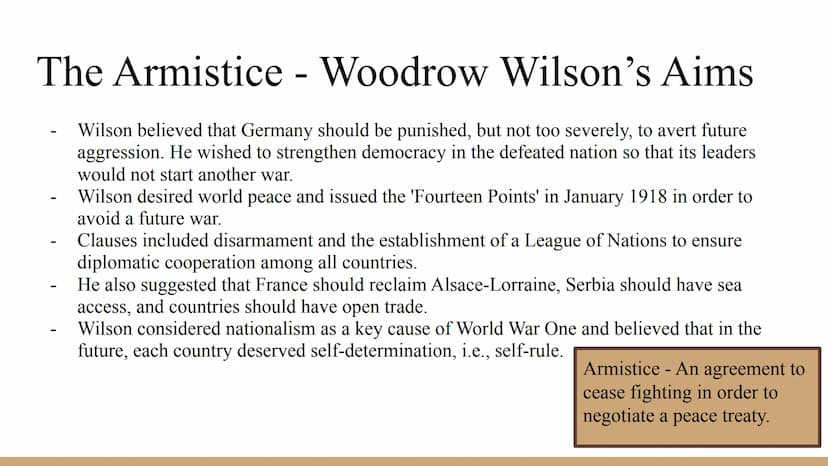
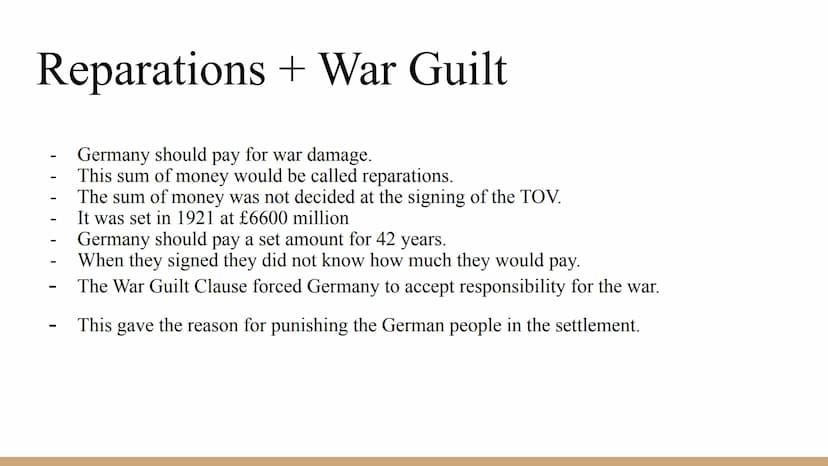
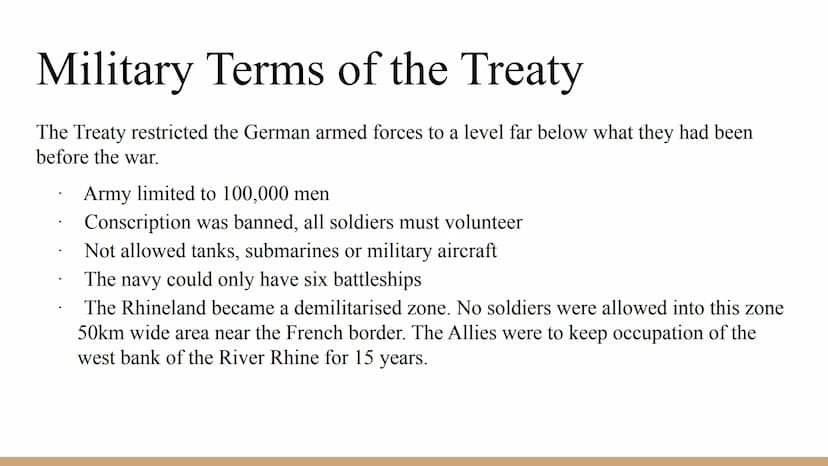
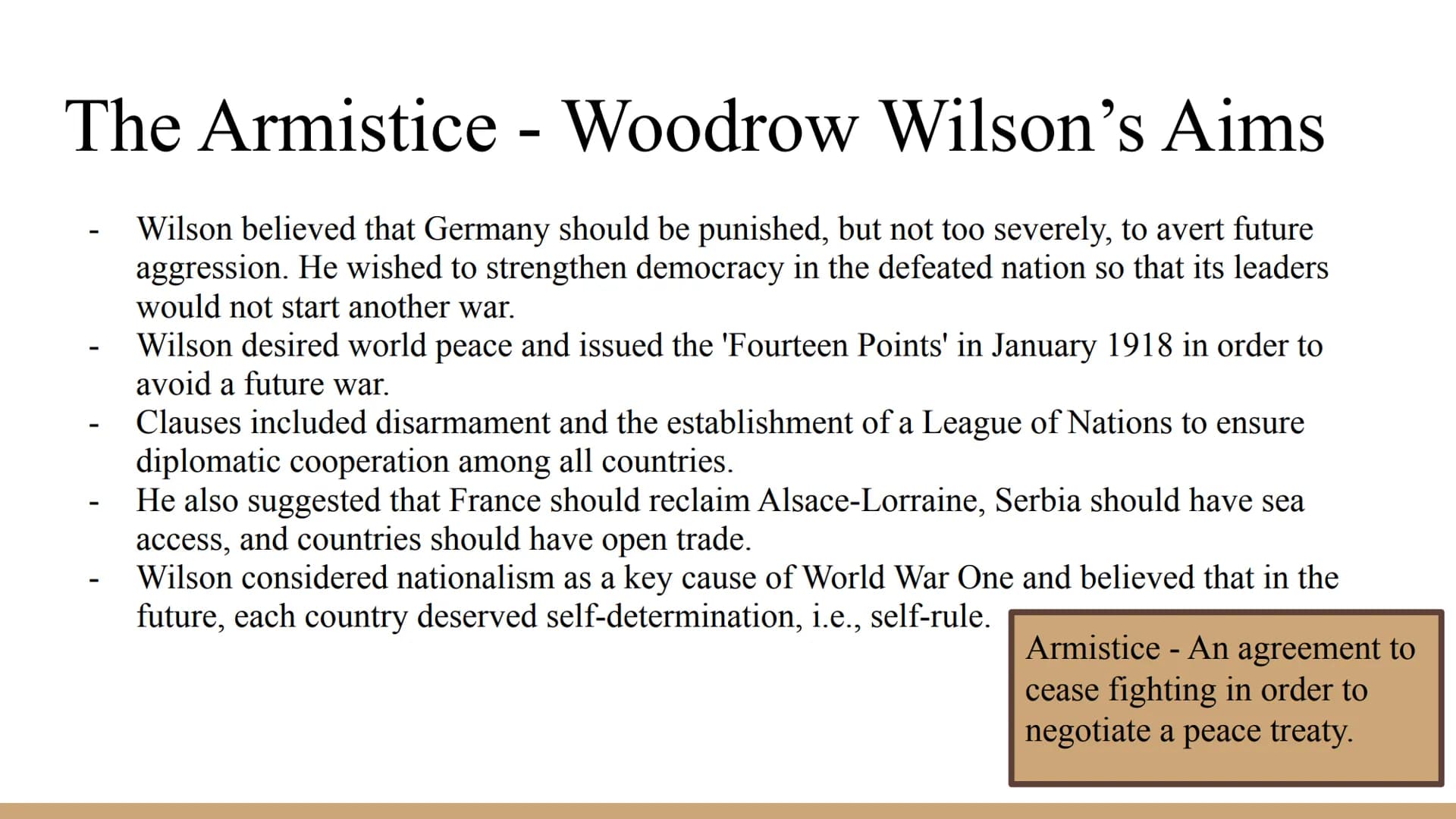
American President Woodrow Wilson approached the peace negotiations with a vision of creating a more stable and democratic world order. His aims were rooted in the belief that while Germany should face consequences for its actions, excessive punishment could lead to future conflicts.
Wilson's primary objectives included:
Definition: Self-determination refers to the right of a people to determine their own political status and shape their future without external interference.
Wilson's Fourteen Points also addressed specific territorial issues, such as the return of Alsace-Lorraine to France and ensuring Serbia's access to the sea. He emphasized the importance of open trade between nations as a means to promote peace and prosperity.
Highlight: Wilson viewed nationalism as a key cause of World War I and believed that granting nations self-determination could help prevent future conflicts.
The American president's vision for peace was idealistic and forward-thinking, aiming to address the root causes of the war and create a framework for lasting international cooperation.
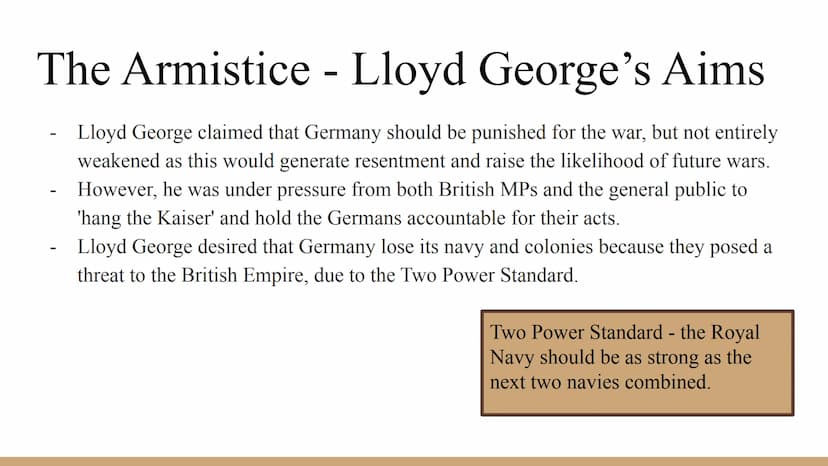
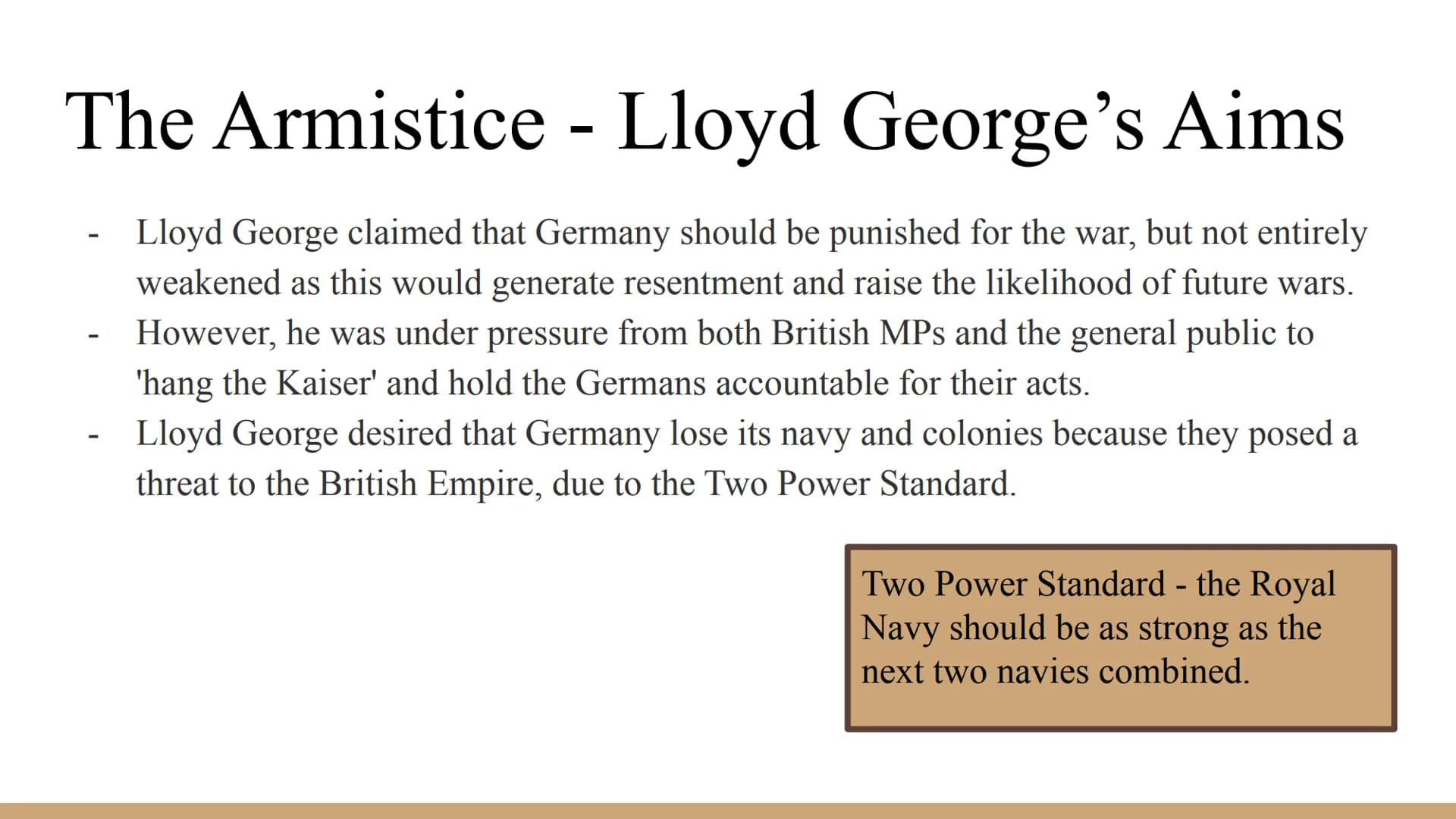
British Prime Minister David Lloyd George approached the peace negotiations with a more pragmatic stance, balancing the desire for German accountability with concerns about long-term stability in Europe. His aims reflected both domestic political pressures and strategic considerations for the British Empire.
Lloyd George's key objectives included:
Vocabulary: Two Power Standard - A naval policy stating that the Royal Navy should be as strong as the next two largest navies combined.
Lloyd George was particularly concerned about maintaining Britain's naval supremacy, which was crucial for protecting its vast empire. By advocating for the reduction of Germany's navy and the loss of its colonies, he aimed to eliminate potential threats to British global dominance.
Highlight: Lloyd George had to balance public demands for harsh punishment with his own concerns about the long-term consequences of overly severe peace terms.
The British Prime Minister's approach demonstrated the complex interplay between domestic politics, imperial interests, and the desire for a stable post-war order. His position often put him at odds with both Wilson's idealism and Clemenceau's demand for stringent punitive measures against Germany.
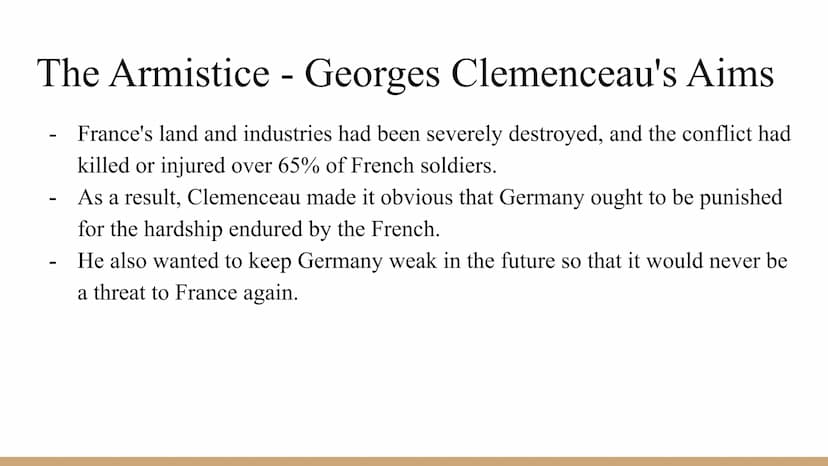
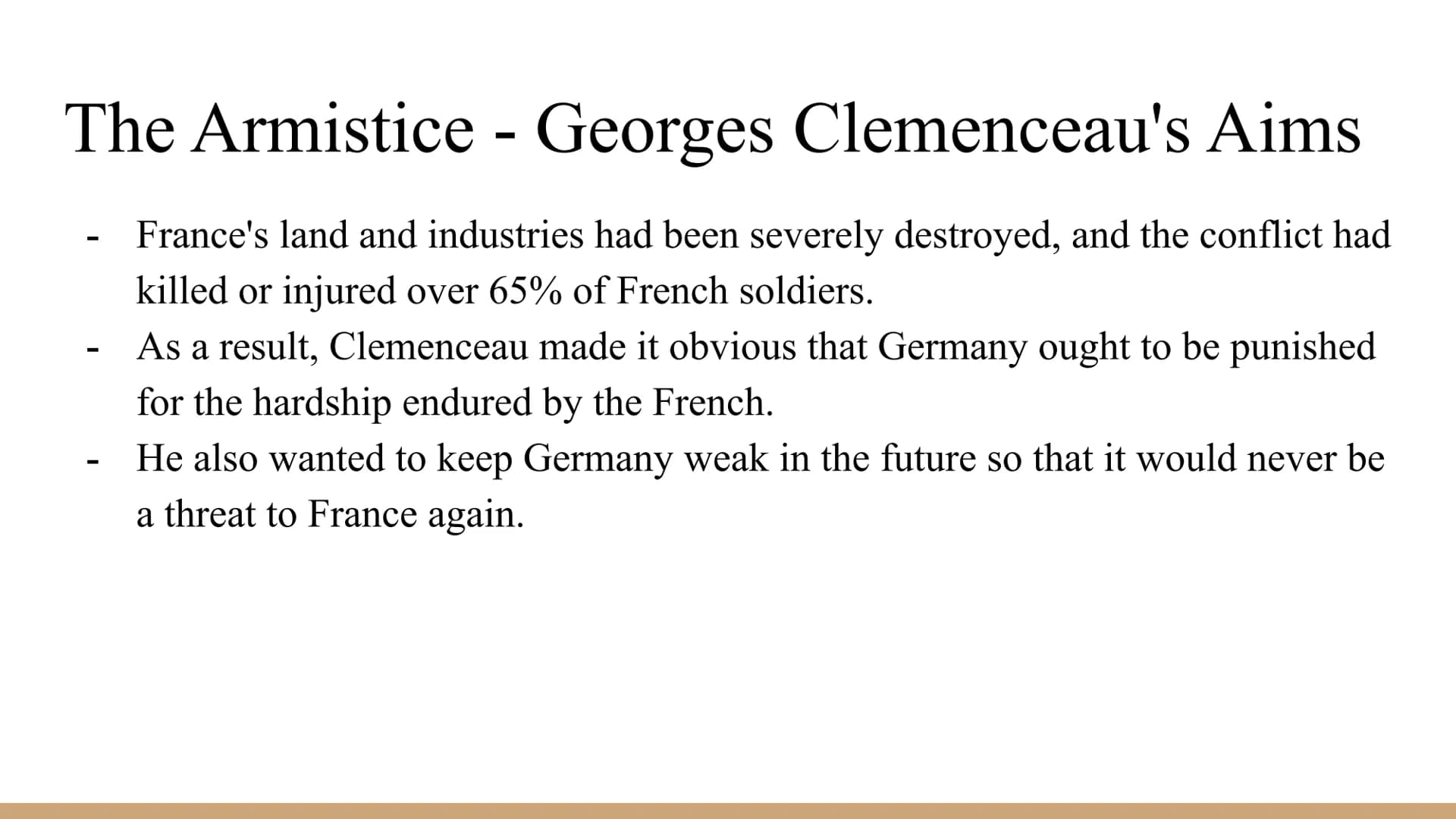
French Prime Minister Georges Clemenceau approached the peace negotiations with a firm determination to ensure France's security and to exact punishment on Germany for the devastation caused during the war. His aims were heavily influenced by France's experience of the conflict and fears of future German aggression.
Clemenceau's primary objectives included:
Highlight: Over 65% of French soldiers had been killed or injured during the war, significantly impacting Clemenceau's stance on peace terms.
The extent of France's suffering during the war was a crucial factor in shaping Clemenceau's approach. The country had endured extensive damage to its infrastructure and industry, particularly in the northeastern regions where much of the fighting had taken place.
Example: The destruction of French coal mines, factories, and farmland in the war zones left a lasting economic impact that Clemenceau sought to address through the peace terms.
Clemenceau's insistence on harsh terms for Germany was not solely motivated by a desire for revenge. He genuinely believed that a weakened Germany was essential for France's future security. This stance put him at odds with both Wilson's more conciliatory approach and Lloyd George's concerns about the long-term stability of Europe.
The French Prime Minister's aims reflected a deep-seated fear of German resurgence and a determination to prevent France from ever again facing the level of destruction it had experienced during World War I.
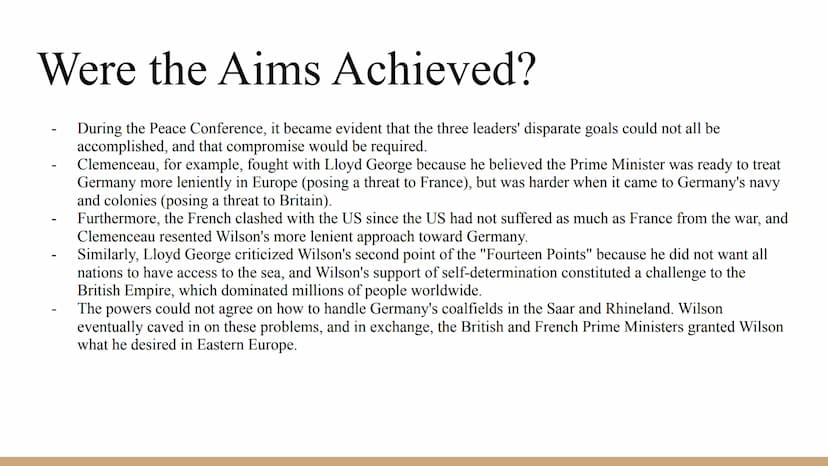
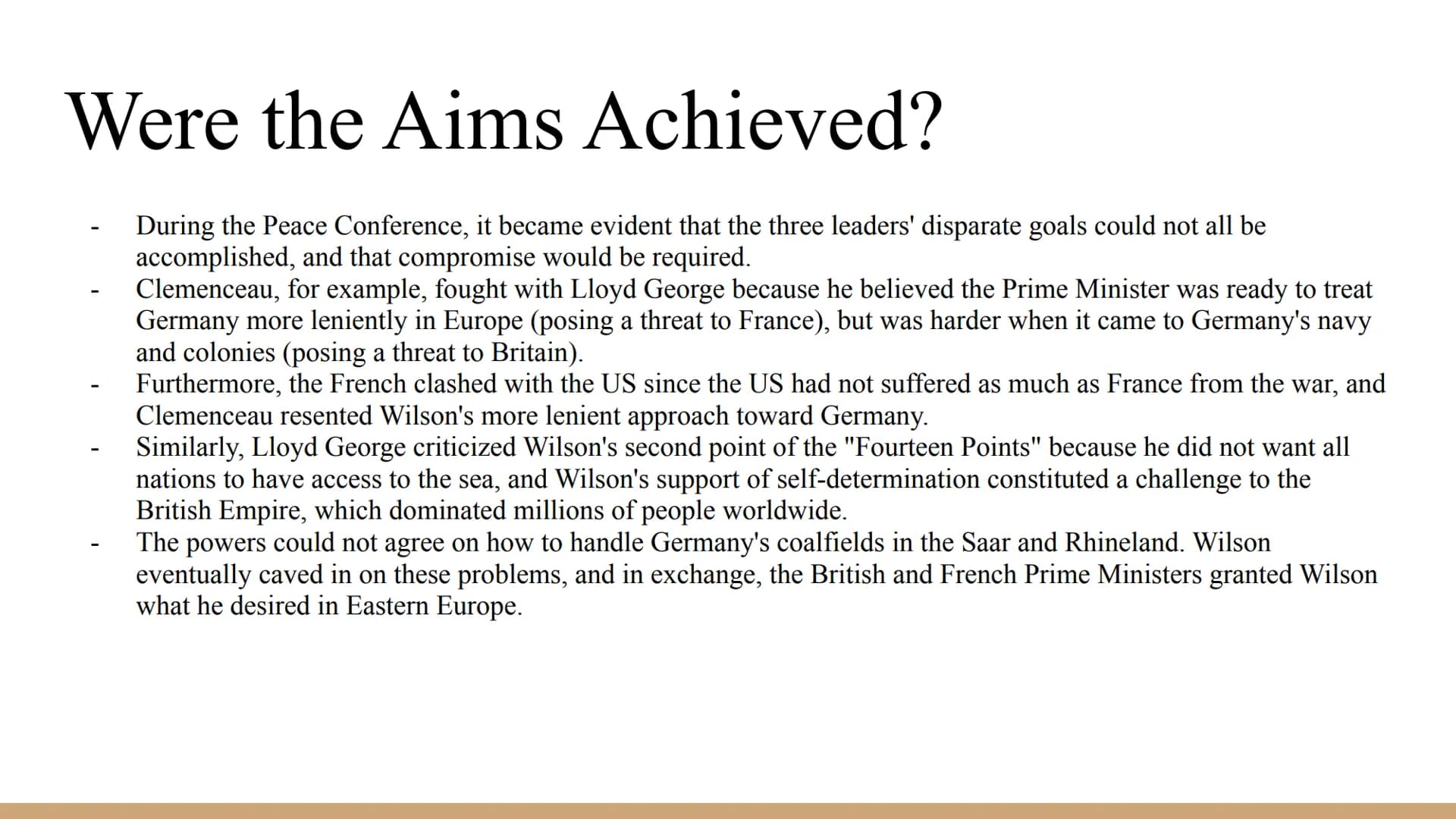
The Paris Peace Conference revealed significant tensions between the aims of the three main Allied leaders: Woodrow Wilson, David Lloyd George, and Georges Clemenceau. Their divergent goals and national interests led to a series of compromises that would ultimately shape the Treaty of Versailles.
Key areas of conflict included:
Treatment of Germany: Clemenceau's desire for harsh punishment clashed with Lloyd George's more moderate approach and Wilson's emphasis on fairness.
Colonial and naval issues: Lloyd George's focus on British imperial interests conflicted with Wilson's principles of self-determination and open seas.
European territorial arrangements: Disagreements arose over the handling of German coalfields in the Saar and Rhineland regions.
Example: Clemenceau and Lloyd George clashed over the treatment of Germany in Europe versus its colonies, reflecting their different national security concerns.
The negotiations also highlighted the differing experiences of the war among the Allied nations. France's extensive suffering led Clemenceau to push for harsher terms, while the United States, having entered the war later and suffered fewer losses, advocated for a more lenient approach.
Highlight: Wilson's support for self-determination posed a challenge to the British Empire, which controlled vast territories around the world.
Ultimately, compromises were reached through a process of give-and-take. Wilson conceded on some European territorial issues in exchange for British and French support for his plans in Eastern Europe and the establishment of the League of Nations.
These compromises, while necessary for reaching an agreement, would later be criticized for creating a peace settlement that satisfied no one completely and laid the groundwork for future conflicts.
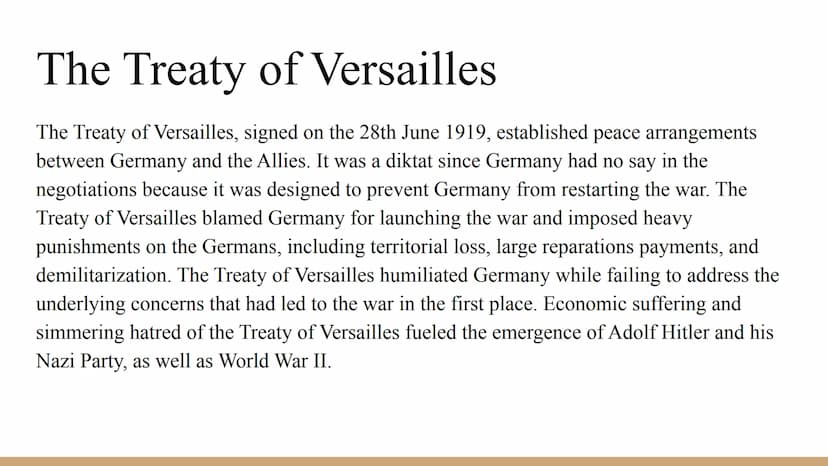
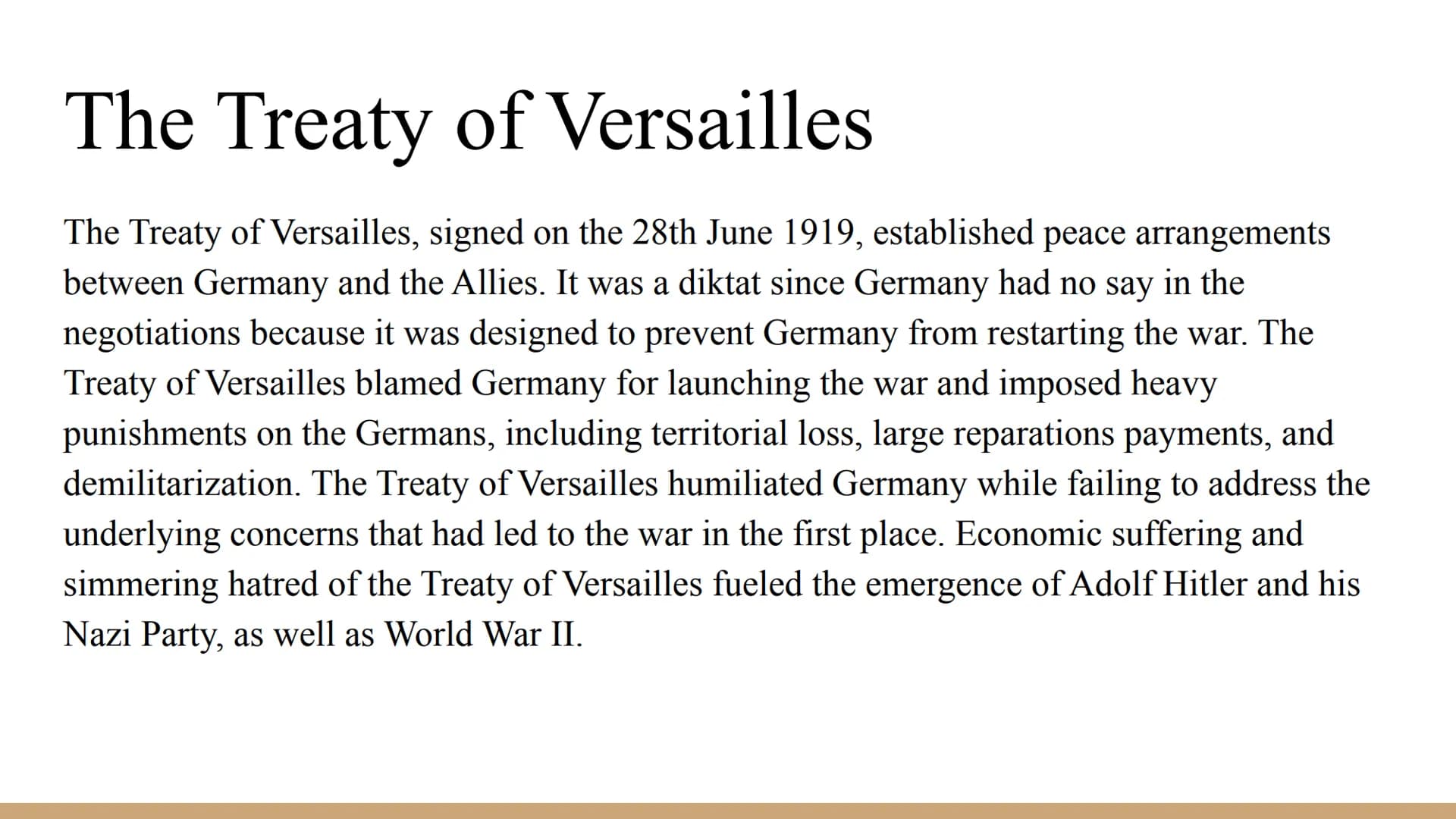
The Treaty of Versailles, signed on June 28, 1919, was the culmination of the Paris Peace Conference and established the peace terms between Germany and the Allied Powers. This treaty would have far-reaching consequences for Europe and the world.
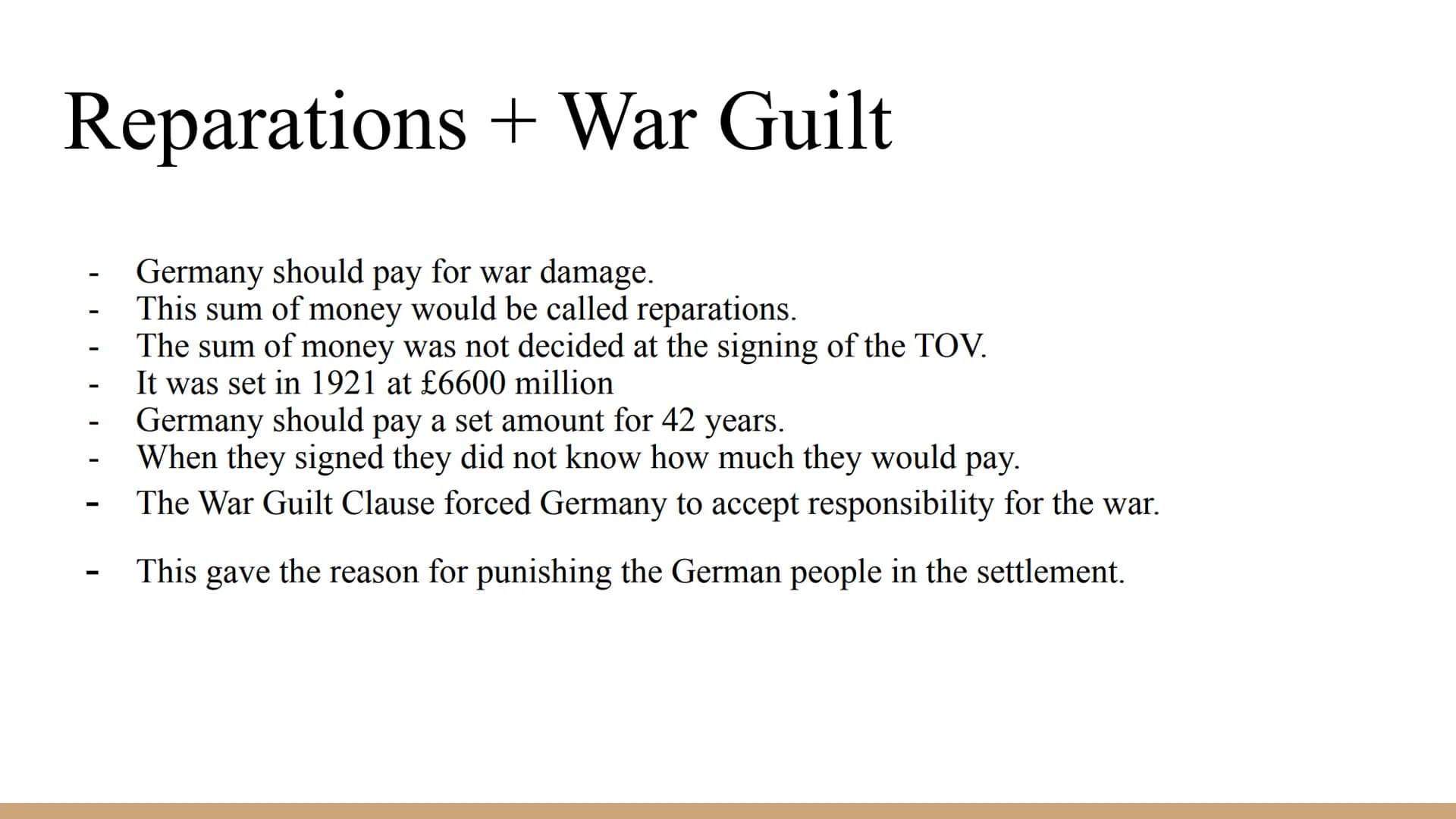
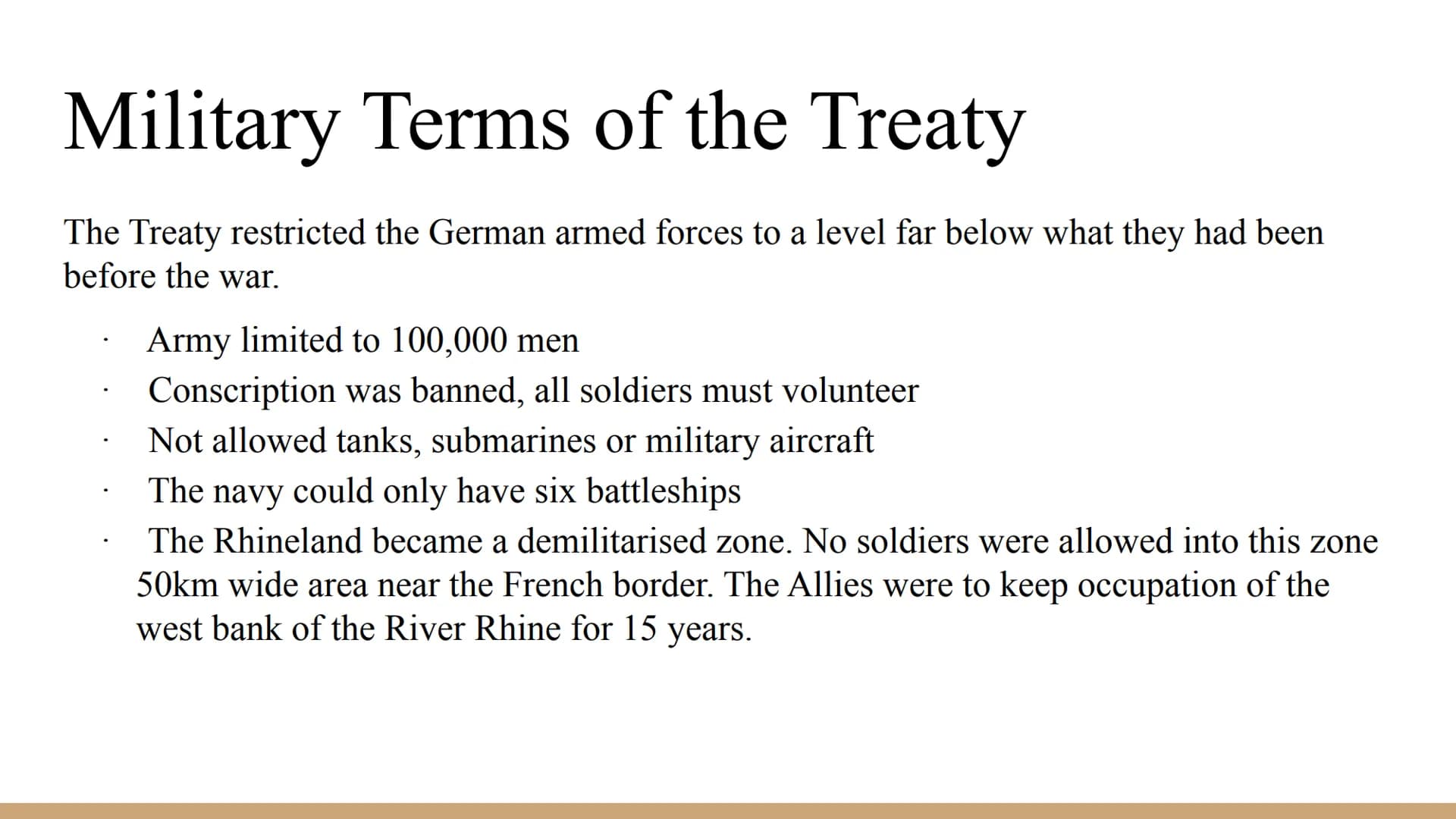
Key aspects of the Treaty of Versailles included:
Vocabulary: Diktat - A harsh settlement imposed on a defeated party without negotiation.
The treaty's terms were designed to prevent Germany from restarting the war, but they had several unintended consequences:
Highlight: The Treaty of Versailles' harsh terms and the resulting economic hardship in Germany contributed to the rise of Adolf Hitler and the Nazi Party.
The impact of the Treaty of Versailles was profound and long-lasting. It reshaped the map of Europe, created new nations, and attempted to establish a new international order through the League of Nations. However, its punitive approach towards Germany and failure to create a sustainable peace would ultimately contribute to the outbreak of World War II two decades later.
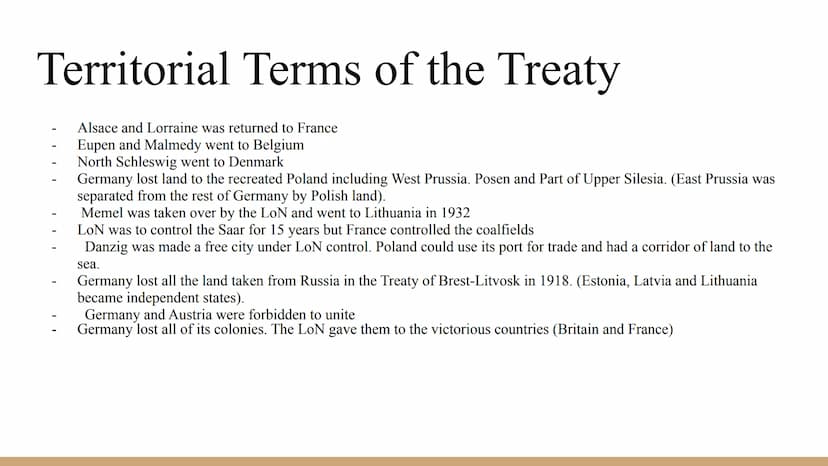
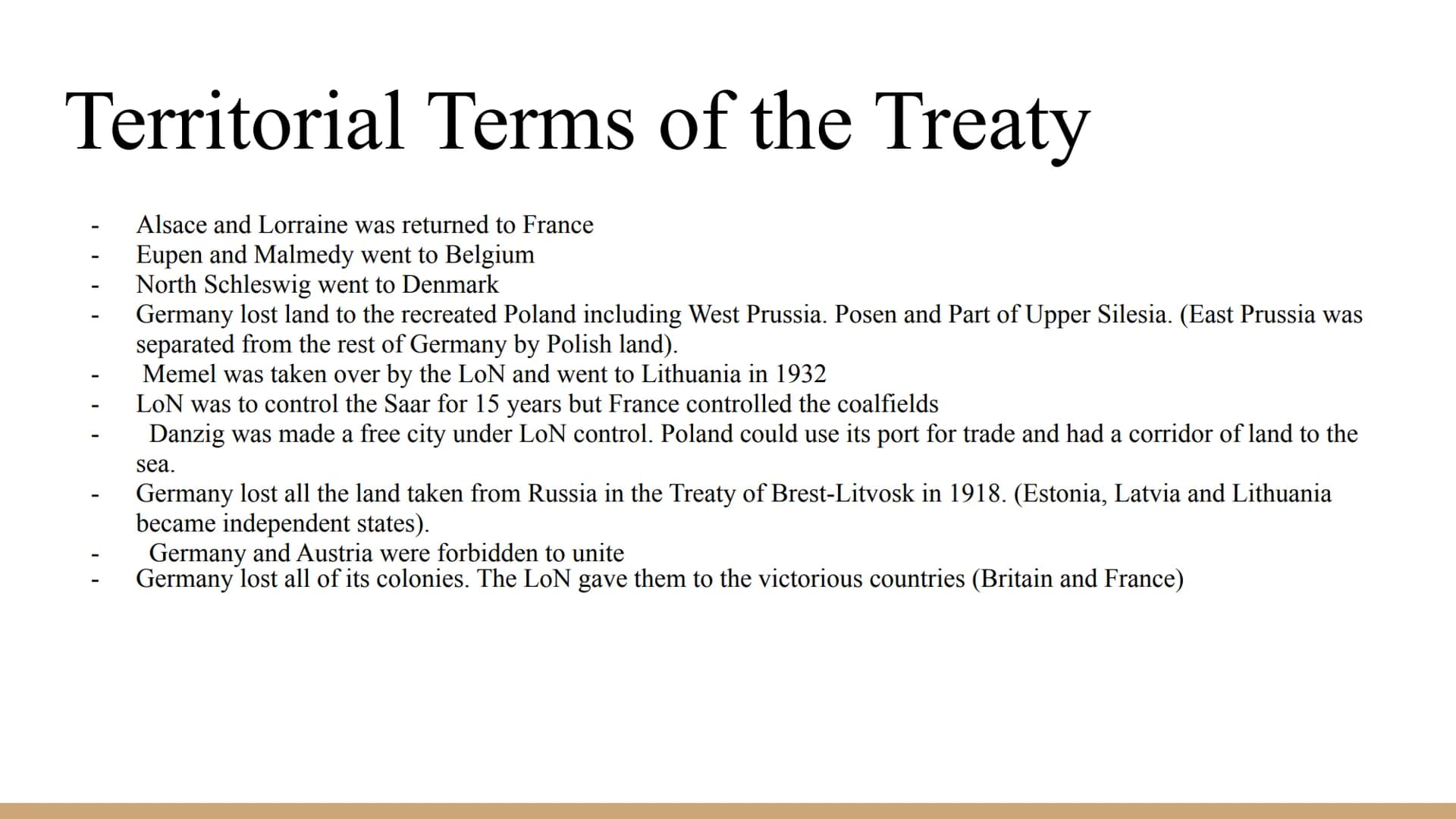
The Treaty of Versailles imposed significant territorial changes on Germany, redrawing the map of Europe and stripping Germany of its overseas colonies. These territorial terms were designed to weaken Germany's strategic position and address the nationalist aspirations of various European peoples.
Key territorial changes included:
Highlight: The loss of West Prussia to Poland resulted in East Prussia being separated from the rest of Germany, creating a "Polish Corridor" to the Baltic Sea.
These territorial changes had significant implications:
Example: The return of Alsace-Lorraine to France was particularly symbolic, as it had been a major point of contention since the Franco-Prussian War of 1870-71.
The territorial terms of the Treaty of Versailles aimed to address the principle of self-determination championed by Woodrow Wilson, but they also reflected the strategic interests of the victorious powers. These changes would become a source of resentment in Germany and contribute to the instability of the interwar period.
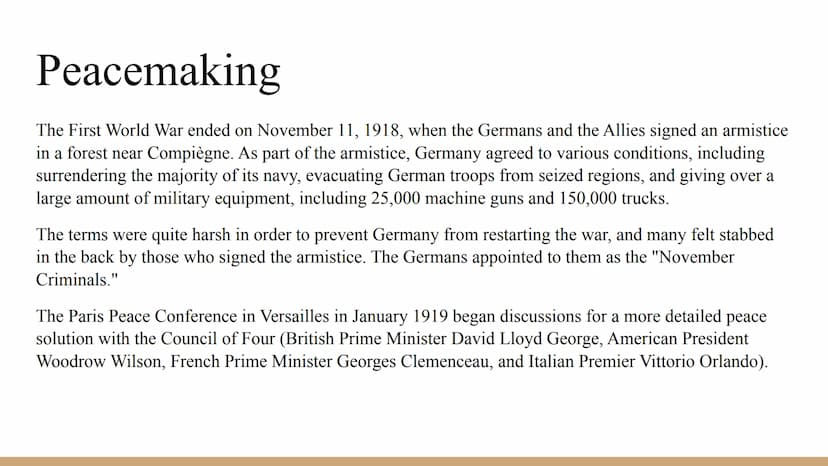
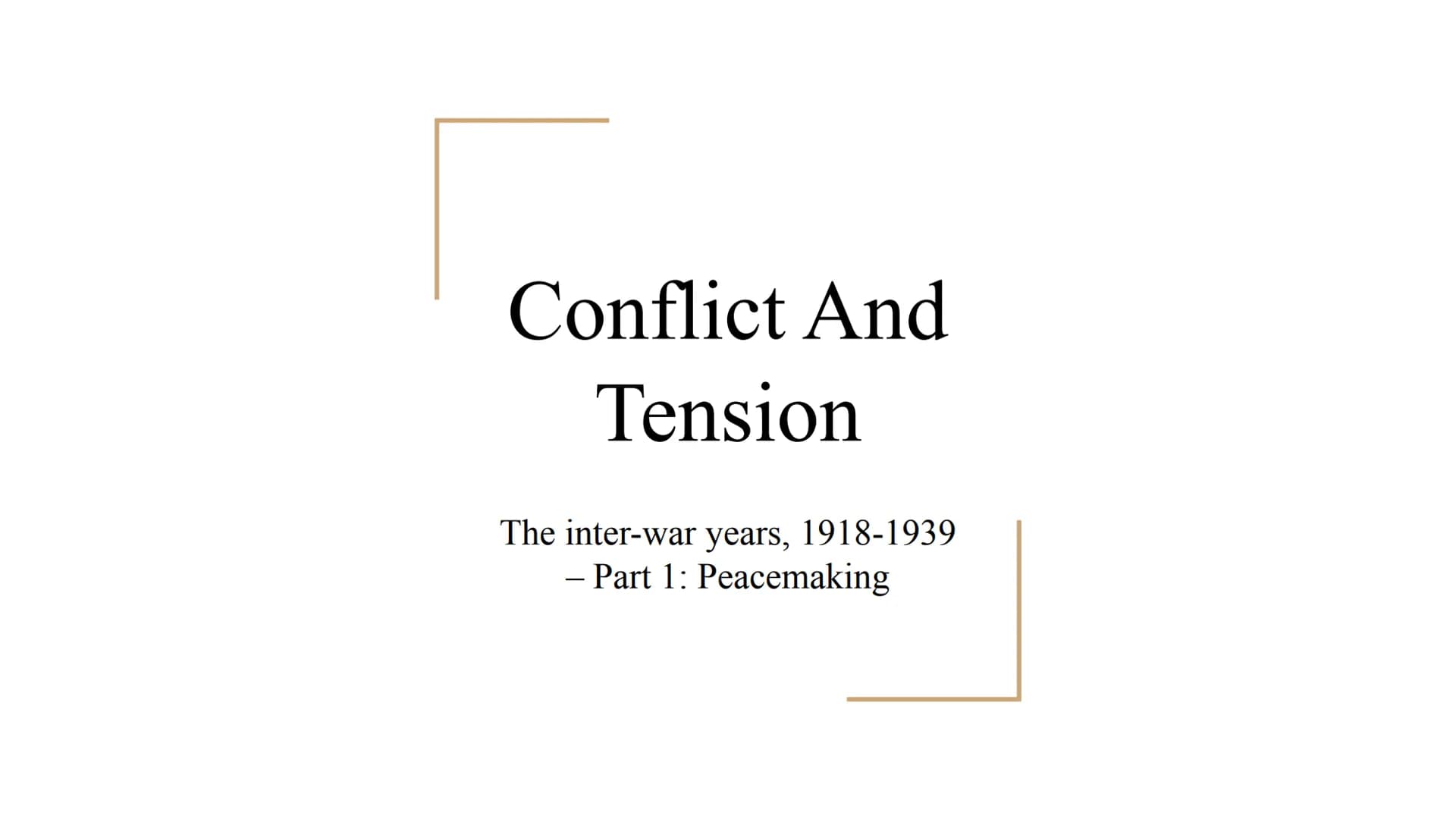
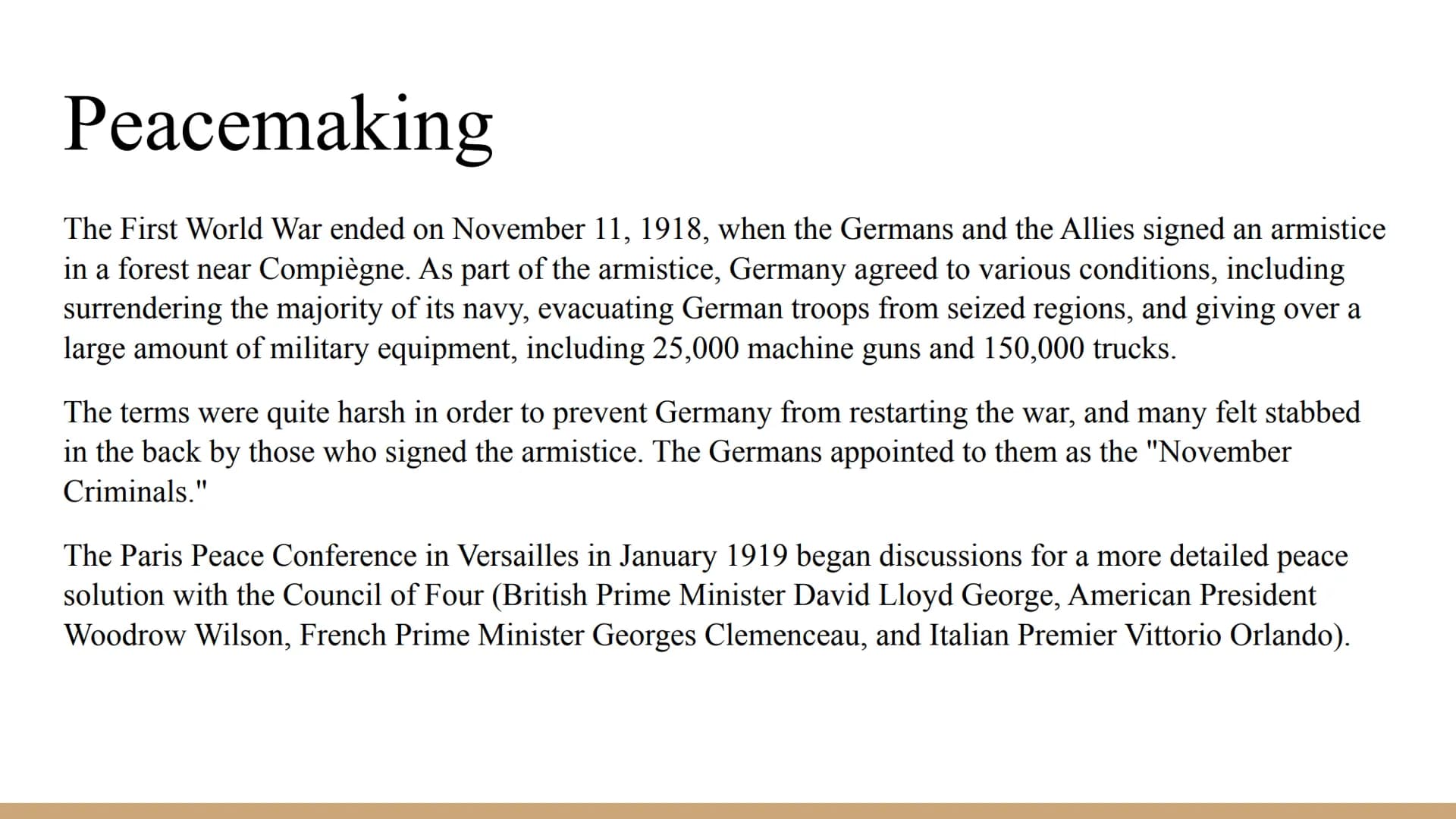
The First World War concluded on November 11, 1918, with the signing of an armistice between Germany and the Allies. This momentous event took place in a forest near Compiègne, marking the end of four years of devastating conflict. The armistice terms were deliberately harsh to prevent Germany from reigniting the war. These conditions included the surrender of most of Germany's navy, the evacuation of German troops from occupied territories, and the handover of substantial military equipment.
Highlight: The armistice required Germany to surrender 25,000 machine guns and 150,000 trucks, among other military assets.
The severity of these terms led to resentment among many Germans, who felt betrayed by their leaders. This sentiment gave rise to the notion of the "November Criminals," a term used to describe those who signed the armistice.
Vocabulary: Armistice - An agreement to cease fighting in order to negotiate a peace treaty.
The stage was set for more comprehensive peace negotiations, which began in January 1919 at the Paris Peace Conference in Versailles. The Council of Four, consisting of British Prime Minister David Lloyd George, American President Woodrow Wilson, French Prime Minister Georges Clemenceau, and Italian Premier Vittorio Orlando, led these discussions to shape the post-war world order.
Our AI Companion is a student-focused AI tool that offers more than just answers. Built on millions of Knowunity resources, it provides relevant information, personalised study plans, quizzes, and content directly in the chat, adapting to your individual learning journey.
You can download the app from Google Play Store and Apple App Store.
That's right! Enjoy free access to study content, connect with fellow students, and get instant help – all at your fingertips.
App Store
Google Play
The app is very easy to use and well designed. I have found everything I was looking for so far and have been able to learn a lot from the presentations! I will definitely use the app for a class assignment! And of course it also helps a lot as an inspiration.
Stefan S
iOS user
This app is really great. There are so many study notes and help [...]. My problem subject is French, for example, and the app has so many options for help. Thanks to this app, I have improved my French. I would recommend it to anyone.
Samantha Klich
Android user
Wow, I am really amazed. I just tried the app because I've seen it advertised many times and was absolutely stunned. This app is THE HELP you want for school and above all, it offers so many things, such as workouts and fact sheets, which have been VERY helpful to me personally.
Anna
iOS user
Best app on earth! no words because it’s too good
Thomas R
iOS user
Just amazing. Let's me revise 10x better, this app is a quick 10/10. I highly recommend it to anyone. I can watch and search for notes. I can save them in the subject folder. I can revise it any time when I come back. If you haven't tried this app, you're really missing out.
Basil
Android user
This app has made me feel so much more confident in my exam prep, not only through boosting my own self confidence through the features that allow you to connect with others and feel less alone, but also through the way the app itself is centred around making you feel better. It is easy to navigate, fun to use, and helpful to anyone struggling in absolutely any way.
David K
iOS user
The app's just great! All I have to do is enter the topic in the search bar and I get the response real fast. I don't have to watch 10 YouTube videos to understand something, so I'm saving my time. Highly recommended!
Sudenaz Ocak
Android user
In school I was really bad at maths but thanks to the app, I am doing better now. I am so grateful that you made the app.
Greenlight Bonnie
Android user
very reliable app to help and grow your ideas of Maths, English and other related topics in your works. please use this app if your struggling in areas, this app is key for that. wish I'd of done a review before. and it's also free so don't worry about that.
Rohan U
Android user
I know a lot of apps use fake accounts to boost their reviews but this app deserves it all. Originally I was getting 4 in my English exams and this time I got a grade 7. I didn’t even know about this app three days until the exam and it has helped A LOT. Please actually trust me and use it as I’m sure you too will see developments.
Xander S
iOS user
THE QUIZES AND FLASHCARDS ARE SO USEFUL AND I LOVE Knowunity AI. IT ALSO IS LITREALLY LIKE CHATGPT BUT SMARTER!! HELPED ME WITH MY MASCARA PROBLEMS TOO!! AS WELL AS MY REAL SUBJECTS ! DUHHH 😍😁😲🤑💗✨🎀😮
Elisha
iOS user
This apps acc the goat. I find revision so boring but this app makes it so easy to organize it all and then you can ask the freeeee ai to test yourself so good and you can easily upload your own stuff. highly recommend as someone taking mocks now
Paul T
iOS user
The app is very easy to use and well designed. I have found everything I was looking for so far and have been able to learn a lot from the presentations! I will definitely use the app for a class assignment! And of course it also helps a lot as an inspiration.
Stefan S
iOS user
This app is really great. There are so many study notes and help [...]. My problem subject is French, for example, and the app has so many options for help. Thanks to this app, I have improved my French. I would recommend it to anyone.
Samantha Klich
Android user
Wow, I am really amazed. I just tried the app because I've seen it advertised many times and was absolutely stunned. This app is THE HELP you want for school and above all, it offers so many things, such as workouts and fact sheets, which have been VERY helpful to me personally.
Anna
iOS user
Best app on earth! no words because it’s too good
Thomas R
iOS user
Just amazing. Let's me revise 10x better, this app is a quick 10/10. I highly recommend it to anyone. I can watch and search for notes. I can save them in the subject folder. I can revise it any time when I come back. If you haven't tried this app, you're really missing out.
Basil
Android user
This app has made me feel so much more confident in my exam prep, not only through boosting my own self confidence through the features that allow you to connect with others and feel less alone, but also through the way the app itself is centred around making you feel better. It is easy to navigate, fun to use, and helpful to anyone struggling in absolutely any way.
David K
iOS user
The app's just great! All I have to do is enter the topic in the search bar and I get the response real fast. I don't have to watch 10 YouTube videos to understand something, so I'm saving my time. Highly recommended!
Sudenaz Ocak
Android user
In school I was really bad at maths but thanks to the app, I am doing better now. I am so grateful that you made the app.
Greenlight Bonnie
Android user
very reliable app to help and grow your ideas of Maths, English and other related topics in your works. please use this app if your struggling in areas, this app is key for that. wish I'd of done a review before. and it's also free so don't worry about that.
Rohan U
Android user
I know a lot of apps use fake accounts to boost their reviews but this app deserves it all. Originally I was getting 4 in my English exams and this time I got a grade 7. I didn’t even know about this app three days until the exam and it has helped A LOT. Please actually trust me and use it as I’m sure you too will see developments.
Xander S
iOS user
THE QUIZES AND FLASHCARDS ARE SO USEFUL AND I LOVE Knowunity AI. IT ALSO IS LITREALLY LIKE CHATGPT BUT SMARTER!! HELPED ME WITH MY MASCARA PROBLEMS TOO!! AS WELL AS MY REAL SUBJECTS ! DUHHH 😍😁😲🤑💗✨🎀😮
Elisha
iOS user
This apps acc the goat. I find revision so boring but this app makes it so easy to organize it all and then you can ask the freeeee ai to test yourself so good and you can easily upload your own stuff. highly recommend as someone taking mocks now
Paul T
iOS user
olivia 🫶🏻
@oliviastudies_
The Treaty of Versaillesand the Paris Peace Conference of 1919 were pivotal events in shaping the post-World War I landscape. This summary explores the key aspects of peacemaking after WWI, focusing on the aims of major leaders and the... Show more
Access to all documents
Improve your grades
Join milions of students
By signing up you accept Terms of Service and Privacy Policy
American President Woodrow Wilson approached the peace negotiations with a vision of creating a more stable and democratic world order. His aims were rooted in the belief that while Germany should face consequences for its actions, excessive punishment could lead to future conflicts.
Wilson's primary objectives included:
Definition: Self-determination refers to the right of a people to determine their own political status and shape their future without external interference.
Wilson's Fourteen Points also addressed specific territorial issues, such as the return of Alsace-Lorraine to France and ensuring Serbia's access to the sea. He emphasized the importance of open trade between nations as a means to promote peace and prosperity.
Highlight: Wilson viewed nationalism as a key cause of World War I and believed that granting nations self-determination could help prevent future conflicts.
The American president's vision for peace was idealistic and forward-thinking, aiming to address the root causes of the war and create a framework for lasting international cooperation.
Access to all documents
Improve your grades
Join milions of students
By signing up you accept Terms of Service and Privacy Policy
British Prime Minister David Lloyd George approached the peace negotiations with a more pragmatic stance, balancing the desire for German accountability with concerns about long-term stability in Europe. His aims reflected both domestic political pressures and strategic considerations for the British Empire.
Lloyd George's key objectives included:
Vocabulary: Two Power Standard - A naval policy stating that the Royal Navy should be as strong as the next two largest navies combined.
Lloyd George was particularly concerned about maintaining Britain's naval supremacy, which was crucial for protecting its vast empire. By advocating for the reduction of Germany's navy and the loss of its colonies, he aimed to eliminate potential threats to British global dominance.
Highlight: Lloyd George had to balance public demands for harsh punishment with his own concerns about the long-term consequences of overly severe peace terms.
The British Prime Minister's approach demonstrated the complex interplay between domestic politics, imperial interests, and the desire for a stable post-war order. His position often put him at odds with both Wilson's idealism and Clemenceau's demand for stringent punitive measures against Germany.
Access to all documents
Improve your grades
Join milions of students
By signing up you accept Terms of Service and Privacy Policy
French Prime Minister Georges Clemenceau approached the peace negotiations with a firm determination to ensure France's security and to exact punishment on Germany for the devastation caused during the war. His aims were heavily influenced by France's experience of the conflict and fears of future German aggression.
Clemenceau's primary objectives included:
Highlight: Over 65% of French soldiers had been killed or injured during the war, significantly impacting Clemenceau's stance on peace terms.
The extent of France's suffering during the war was a crucial factor in shaping Clemenceau's approach. The country had endured extensive damage to its infrastructure and industry, particularly in the northeastern regions where much of the fighting had taken place.
Example: The destruction of French coal mines, factories, and farmland in the war zones left a lasting economic impact that Clemenceau sought to address through the peace terms.
Clemenceau's insistence on harsh terms for Germany was not solely motivated by a desire for revenge. He genuinely believed that a weakened Germany was essential for France's future security. This stance put him at odds with both Wilson's more conciliatory approach and Lloyd George's concerns about the long-term stability of Europe.
The French Prime Minister's aims reflected a deep-seated fear of German resurgence and a determination to prevent France from ever again facing the level of destruction it had experienced during World War I.
Access to all documents
Improve your grades
Join milions of students
By signing up you accept Terms of Service and Privacy Policy
The Paris Peace Conference revealed significant tensions between the aims of the three main Allied leaders: Woodrow Wilson, David Lloyd George, and Georges Clemenceau. Their divergent goals and national interests led to a series of compromises that would ultimately shape the Treaty of Versailles.
Key areas of conflict included:
Treatment of Germany: Clemenceau's desire for harsh punishment clashed with Lloyd George's more moderate approach and Wilson's emphasis on fairness.
Colonial and naval issues: Lloyd George's focus on British imperial interests conflicted with Wilson's principles of self-determination and open seas.
European territorial arrangements: Disagreements arose over the handling of German coalfields in the Saar and Rhineland regions.
Example: Clemenceau and Lloyd George clashed over the treatment of Germany in Europe versus its colonies, reflecting their different national security concerns.
The negotiations also highlighted the differing experiences of the war among the Allied nations. France's extensive suffering led Clemenceau to push for harsher terms, while the United States, having entered the war later and suffered fewer losses, advocated for a more lenient approach.
Highlight: Wilson's support for self-determination posed a challenge to the British Empire, which controlled vast territories around the world.
Ultimately, compromises were reached through a process of give-and-take. Wilson conceded on some European territorial issues in exchange for British and French support for his plans in Eastern Europe and the establishment of the League of Nations.
These compromises, while necessary for reaching an agreement, would later be criticized for creating a peace settlement that satisfied no one completely and laid the groundwork for future conflicts.
Access to all documents
Improve your grades
Join milions of students
By signing up you accept Terms of Service and Privacy Policy
The Treaty of Versailles, signed on June 28, 1919, was the culmination of the Paris Peace Conference and established the peace terms between Germany and the Allied Powers. This treaty would have far-reaching consequences for Europe and the world.
Key aspects of the Treaty of Versailles included:
Vocabulary: Diktat - A harsh settlement imposed on a defeated party without negotiation.
The treaty's terms were designed to prevent Germany from restarting the war, but they had several unintended consequences:
Highlight: The Treaty of Versailles' harsh terms and the resulting economic hardship in Germany contributed to the rise of Adolf Hitler and the Nazi Party.
The impact of the Treaty of Versailles was profound and long-lasting. It reshaped the map of Europe, created new nations, and attempted to establish a new international order through the League of Nations. However, its punitive approach towards Germany and failure to create a sustainable peace would ultimately contribute to the outbreak of World War II two decades later.
Access to all documents
Improve your grades
Join milions of students
By signing up you accept Terms of Service and Privacy Policy
The Treaty of Versailles imposed significant territorial changes on Germany, redrawing the map of Europe and stripping Germany of its overseas colonies. These territorial terms were designed to weaken Germany's strategic position and address the nationalist aspirations of various European peoples.
Key territorial changes included:
Highlight: The loss of West Prussia to Poland resulted in East Prussia being separated from the rest of Germany, creating a "Polish Corridor" to the Baltic Sea.
These territorial changes had significant implications:
Example: The return of Alsace-Lorraine to France was particularly symbolic, as it had been a major point of contention since the Franco-Prussian War of 1870-71.
The territorial terms of the Treaty of Versailles aimed to address the principle of self-determination championed by Woodrow Wilson, but they also reflected the strategic interests of the victorious powers. These changes would become a source of resentment in Germany and contribute to the instability of the interwar period.
Access to all documents
Improve your grades
Join milions of students
By signing up you accept Terms of Service and Privacy Policy
The First World War concluded on November 11, 1918, with the signing of an armistice between Germany and the Allies. This momentous event took place in a forest near Compiègne, marking the end of four years of devastating conflict. The armistice terms were deliberately harsh to prevent Germany from reigniting the war. These conditions included the surrender of most of Germany's navy, the evacuation of German troops from occupied territories, and the handover of substantial military equipment.
Highlight: The armistice required Germany to surrender 25,000 machine guns and 150,000 trucks, among other military assets.
The severity of these terms led to resentment among many Germans, who felt betrayed by their leaders. This sentiment gave rise to the notion of the "November Criminals," a term used to describe those who signed the armistice.
Vocabulary: Armistice - An agreement to cease fighting in order to negotiate a peace treaty.
The stage was set for more comprehensive peace negotiations, which began in January 1919 at the Paris Peace Conference in Versailles. The Council of Four, consisting of British Prime Minister David Lloyd George, American President Woodrow Wilson, French Prime Minister Georges Clemenceau, and Italian Premier Vittorio Orlando, led these discussions to shape the post-war world order.
Access to all documents
Improve your grades
Join milions of students
By signing up you accept Terms of Service and Privacy Policy
Access to all documents
Improve your grades
Join milions of students
By signing up you accept Terms of Service and Privacy Policy
Access to all documents
Improve your grades
Join milions of students
By signing up you accept Terms of Service and Privacy Policy
Our AI Companion is a student-focused AI tool that offers more than just answers. Built on millions of Knowunity resources, it provides relevant information, personalised study plans, quizzes, and content directly in the chat, adapting to your individual learning journey.
You can download the app from Google Play Store and Apple App Store.
That's right! Enjoy free access to study content, connect with fellow students, and get instant help – all at your fingertips.
69
Smart Tools NEW
Transform this note into: ✓ 50+ Practice Questions ✓ Interactive Flashcards ✓ Full Mock Exam ✓ Essay Outlines
Explore the significant consequences of the Treaty of Versailles on Germany post-World War I. This summary covers territorial losses, reparations, and military restrictions imposed on Germany, highlighting the political and social unrest that followed. Ideal for GCSE history students studying the Weimar Republic and its challenges.
 History
Explore the key elements of the Treaty of Versailles, including its impact on Germany post-World War I, the involved nations, and the significant reparations and territorial changes. This summary highlights the war guilt clause and the differing perspectives of leaders like Georges Clemenceau, David Lloyd George, and Woodrow Wilson.
HistoryExplore the factors contributing to the unpopularity of the Weimar Republic, including the Treaty of Versailles, the war guilt clause, and the stab-in-the-back myth. This summary delves into how these elements shaped public perception and political challenges in post-World War I Germany.
HistoryExplore the successes and failures of the League of Nations through key events such as the Corfu Incident, Vilna Crisis, and the Aaland Islands dispute. This summary highlights the League's challenges in enforcing justice and maintaining peace during the interwar period, providing insights into its effectiveness and limitations. Ideal for students studying post-World War I international relations.
HistoryExplore a comprehensive overview of Nazi Germany, covering key events, the rise of Hitler, the role of the Gestapo, and the impact of the Holocaust. This summary provides essential insights for AQA GCSE History students, highlighting significant political, social, and economic changes during this tumultuous period. Ideal for exam preparation and understanding the complexities of Nazi rule.
HistoryExplore the key events, individuals, and policies that shaped Weimar and Nazi Germany from 1918 to 1939. This summary covers the formation of the Weimar Republic, the rise of Hitler, the establishment of a Nazi dictatorship, and the impact of Nazi policies on society. Ideal for GCSE History students seeking a concise understanding of this critical period.
HistoryApp Store
Google Play
The app is very easy to use and well designed. I have found everything I was looking for so far and have been able to learn a lot from the presentations! I will definitely use the app for a class assignment! And of course it also helps a lot as an inspiration.
Stefan S
iOS user
This app is really great. There are so many study notes and help [...]. My problem subject is French, for example, and the app has so many options for help. Thanks to this app, I have improved my French. I would recommend it to anyone.
Samantha Klich
Android user
Wow, I am really amazed. I just tried the app because I've seen it advertised many times and was absolutely stunned. This app is THE HELP you want for school and above all, it offers so many things, such as workouts and fact sheets, which have been VERY helpful to me personally.
Anna
iOS user
Best app on earth! no words because it’s too good
Thomas R
iOS user
Just amazing. Let's me revise 10x better, this app is a quick 10/10. I highly recommend it to anyone. I can watch and search for notes. I can save them in the subject folder. I can revise it any time when I come back. If you haven't tried this app, you're really missing out.
Basil
Android user
This app has made me feel so much more confident in my exam prep, not only through boosting my own self confidence through the features that allow you to connect with others and feel less alone, but also through the way the app itself is centred around making you feel better. It is easy to navigate, fun to use, and helpful to anyone struggling in absolutely any way.
David K
iOS user
The app's just great! All I have to do is enter the topic in the search bar and I get the response real fast. I don't have to watch 10 YouTube videos to understand something, so I'm saving my time. Highly recommended!
Sudenaz Ocak
Android user
In school I was really bad at maths but thanks to the app, I am doing better now. I am so grateful that you made the app.
Greenlight Bonnie
Android user
very reliable app to help and grow your ideas of Maths, English and other related topics in your works. please use this app if your struggling in areas, this app is key for that. wish I'd of done a review before. and it's also free so don't worry about that.
Rohan U
Android user
I know a lot of apps use fake accounts to boost their reviews but this app deserves it all. Originally I was getting 4 in my English exams and this time I got a grade 7. I didn’t even know about this app three days until the exam and it has helped A LOT. Please actually trust me and use it as I’m sure you too will see developments.
Xander S
iOS user
THE QUIZES AND FLASHCARDS ARE SO USEFUL AND I LOVE Knowunity AI. IT ALSO IS LITREALLY LIKE CHATGPT BUT SMARTER!! HELPED ME WITH MY MASCARA PROBLEMS TOO!! AS WELL AS MY REAL SUBJECTS ! DUHHH 😍😁😲🤑💗✨🎀😮
Elisha
iOS user
This apps acc the goat. I find revision so boring but this app makes it so easy to organize it all and then you can ask the freeeee ai to test yourself so good and you can easily upload your own stuff. highly recommend as someone taking mocks now
Paul T
iOS user
The app is very easy to use and well designed. I have found everything I was looking for so far and have been able to learn a lot from the presentations! I will definitely use the app for a class assignment! And of course it also helps a lot as an inspiration.
Stefan S
iOS user
This app is really great. There are so many study notes and help [...]. My problem subject is French, for example, and the app has so many options for help. Thanks to this app, I have improved my French. I would recommend it to anyone.
Samantha Klich
Android user
Wow, I am really amazed. I just tried the app because I've seen it advertised many times and was absolutely stunned. This app is THE HELP you want for school and above all, it offers so many things, such as workouts and fact sheets, which have been VERY helpful to me personally.
Anna
iOS user
Best app on earth! no words because it’s too good
Thomas R
iOS user
Just amazing. Let's me revise 10x better, this app is a quick 10/10. I highly recommend it to anyone. I can watch and search for notes. I can save them in the subject folder. I can revise it any time when I come back. If you haven't tried this app, you're really missing out.
Basil
Android user
This app has made me feel so much more confident in my exam prep, not only through boosting my own self confidence through the features that allow you to connect with others and feel less alone, but also through the way the app itself is centred around making you feel better. It is easy to navigate, fun to use, and helpful to anyone struggling in absolutely any way.
David K
iOS user
The app's just great! All I have to do is enter the topic in the search bar and I get the response real fast. I don't have to watch 10 YouTube videos to understand something, so I'm saving my time. Highly recommended!
Sudenaz Ocak
Android user
In school I was really bad at maths but thanks to the app, I am doing better now. I am so grateful that you made the app.
Greenlight Bonnie
Android user
very reliable app to help and grow your ideas of Maths, English and other related topics in your works. please use this app if your struggling in areas, this app is key for that. wish I'd of done a review before. and it's also free so don't worry about that.
Rohan U
Android user
I know a lot of apps use fake accounts to boost their reviews but this app deserves it all. Originally I was getting 4 in my English exams and this time I got a grade 7. I didn’t even know about this app three days until the exam and it has helped A LOT. Please actually trust me and use it as I’m sure you too will see developments.
Xander S
iOS user
THE QUIZES AND FLASHCARDS ARE SO USEFUL AND I LOVE Knowunity AI. IT ALSO IS LITREALLY LIKE CHATGPT BUT SMARTER!! HELPED ME WITH MY MASCARA PROBLEMS TOO!! AS WELL AS MY REAL SUBJECTS ! DUHHH 😍😁😲🤑💗✨🎀😮
Elisha
iOS user
This apps acc the goat. I find revision so boring but this app makes it so easy to organize it all and then you can ask the freeeee ai to test yourself so good and you can easily upload your own stuff. highly recommend as someone taking mocks now
Paul T
iOS user