Knowunity AI

Open the App

Subjects

2,291

Updated Mar 16, 2026

14 pages

Tectonic Hazards and Plate Boundaries: A Fun Geography Guide

user profile picture

aleena<3

@sandor4life

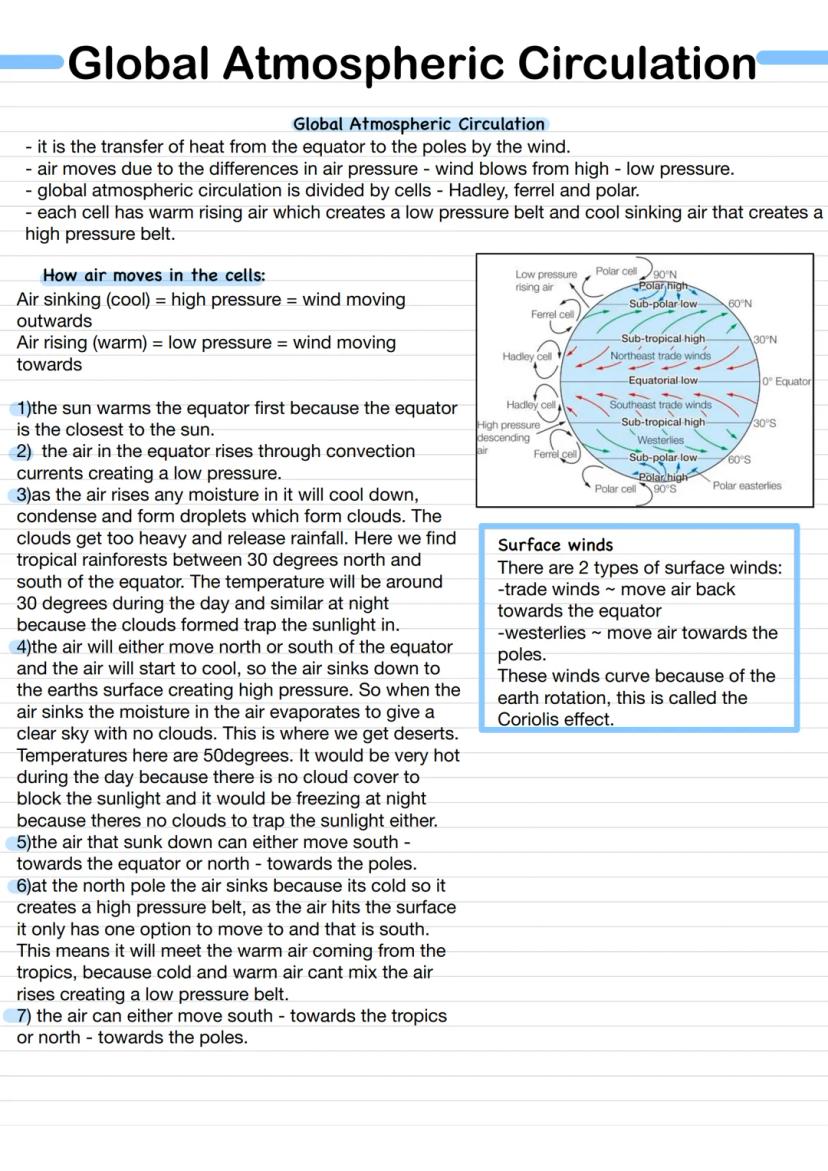
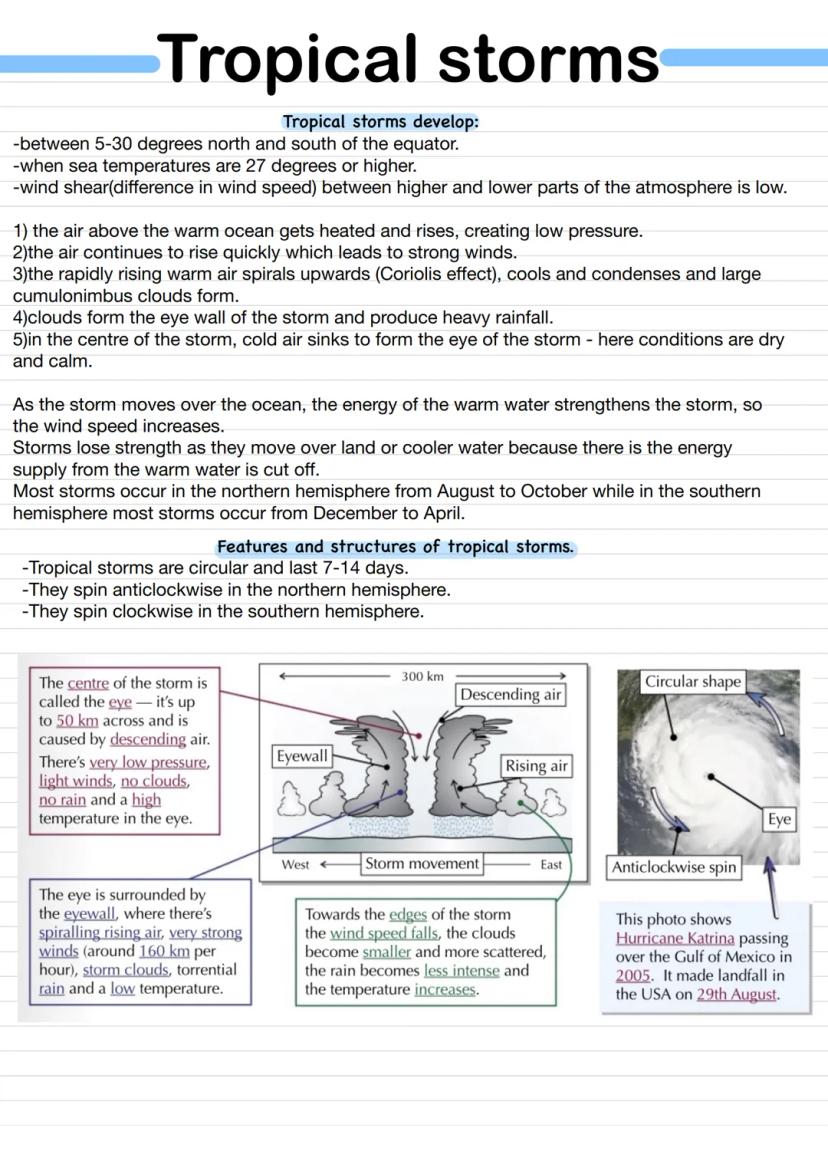
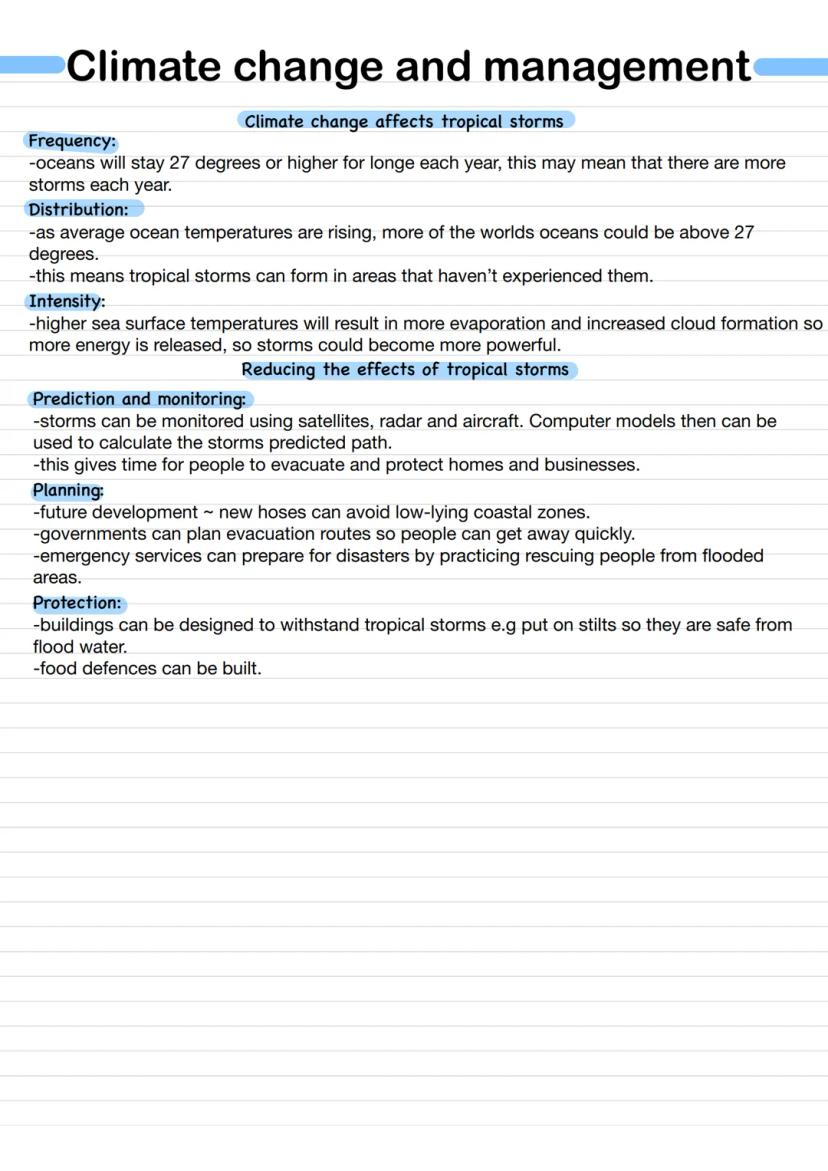
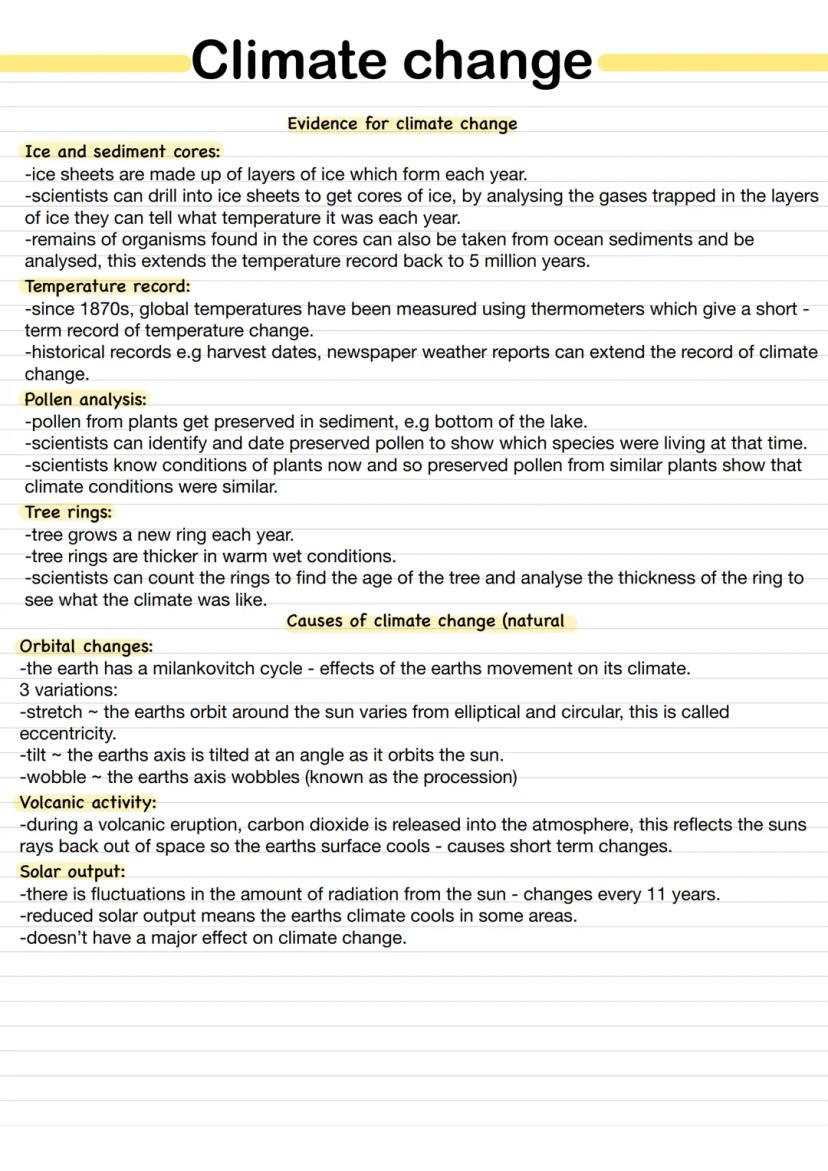
Hey there! Want to learn about tectonic hazards and natural hazards? Dive into this cool guide for GCSE Geography. Discover 4 types of plate boundaries: constructive, destructive, divergent, and transform. Find out what happens at each, with examples and diagrams. Learn about plate tectonics, the map of plate margins, and what happens at constructive and conservative plate margins. Explore 5 examples of tectonic hazards and more!
Page 1
Page 2
Page 3
Page 4
Page 5
Page 6
Page 7
Page 8
Page 9
Page 10
1 / 10
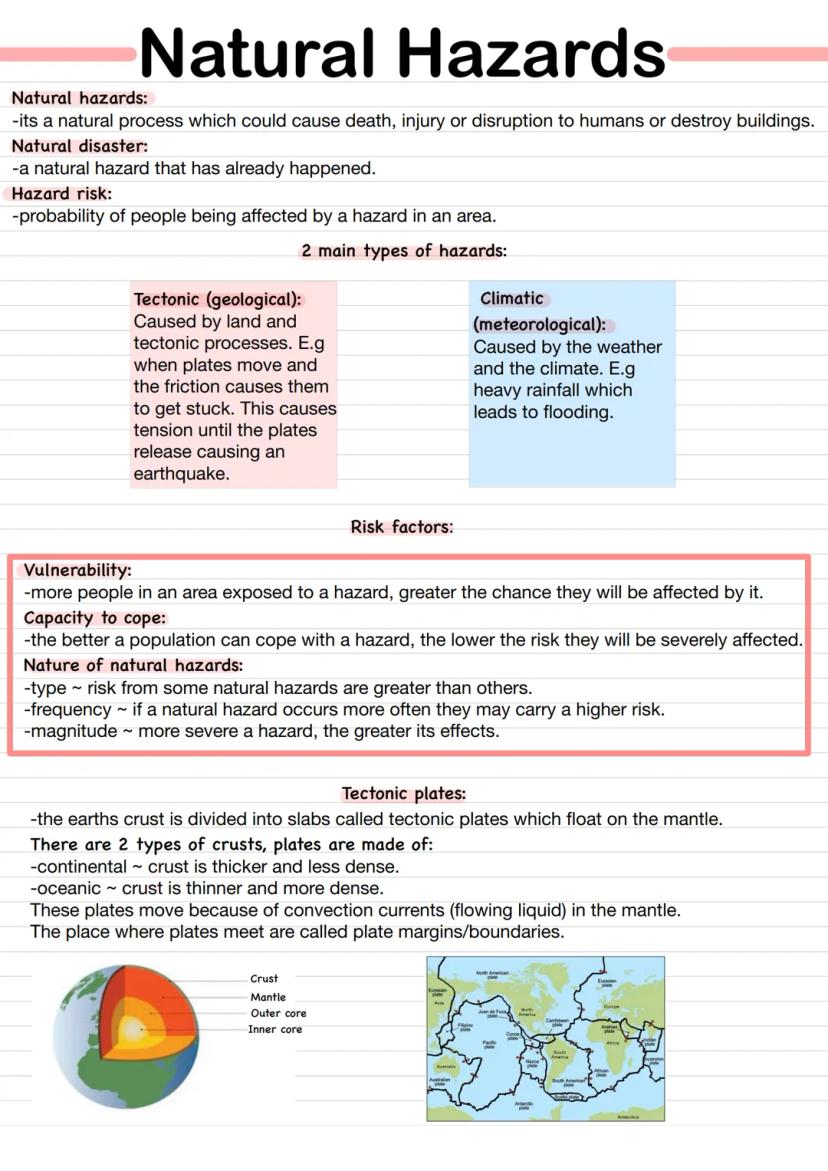
# Natural Hazards

Natural hazards:
-its a natural process which could cause death, injury or disruption to humans or destroy buildings.

Na

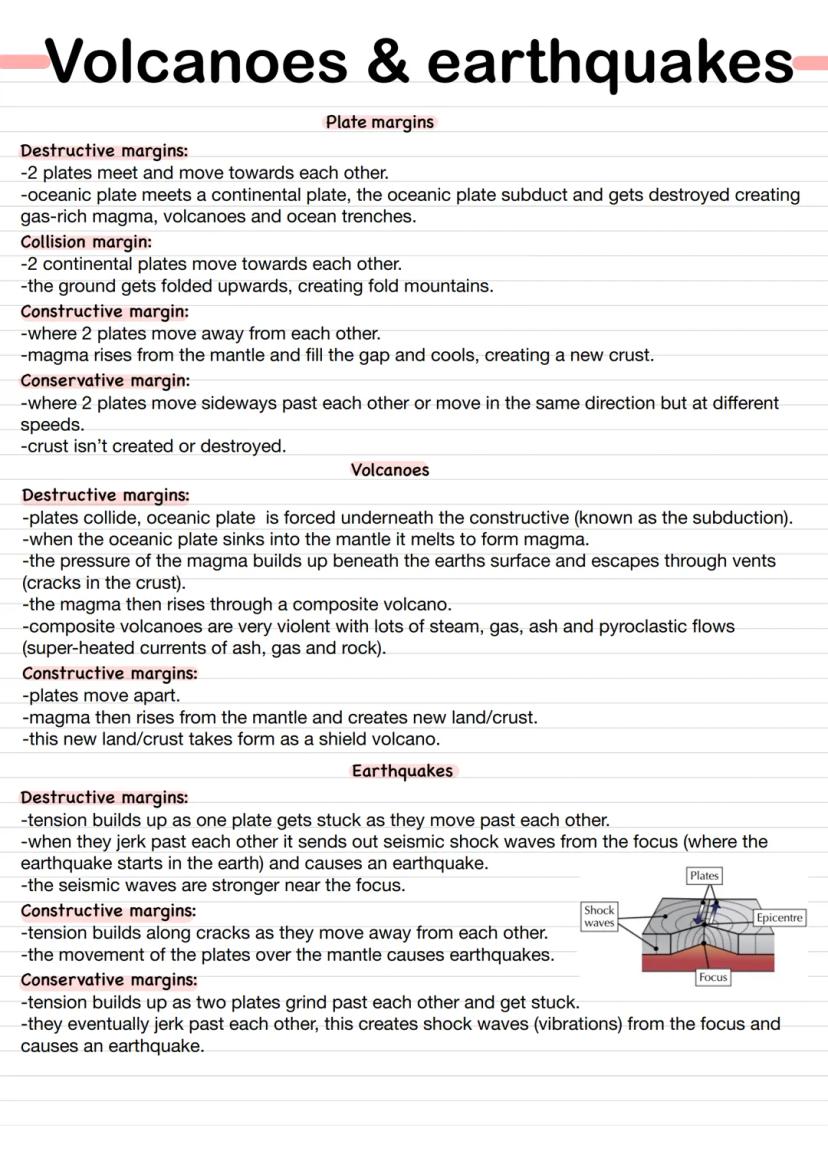
Plate Margins and Tectonic Processes

This page delves into the different types of plate margins and their associated tectonic processes, which are fundamental to understanding tectonic hazards in GCSE Geography.

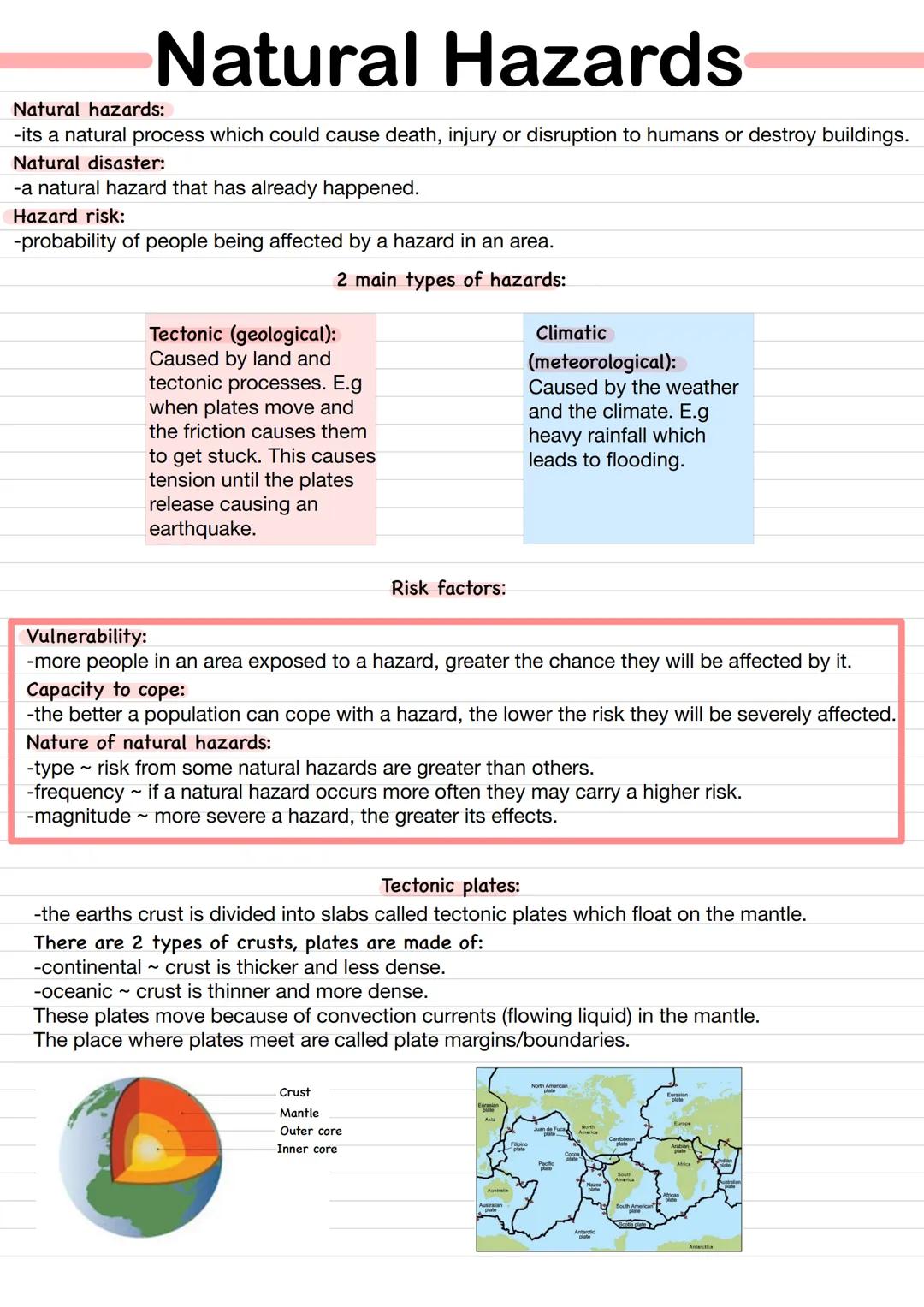
There are four main types of plate boundaries:

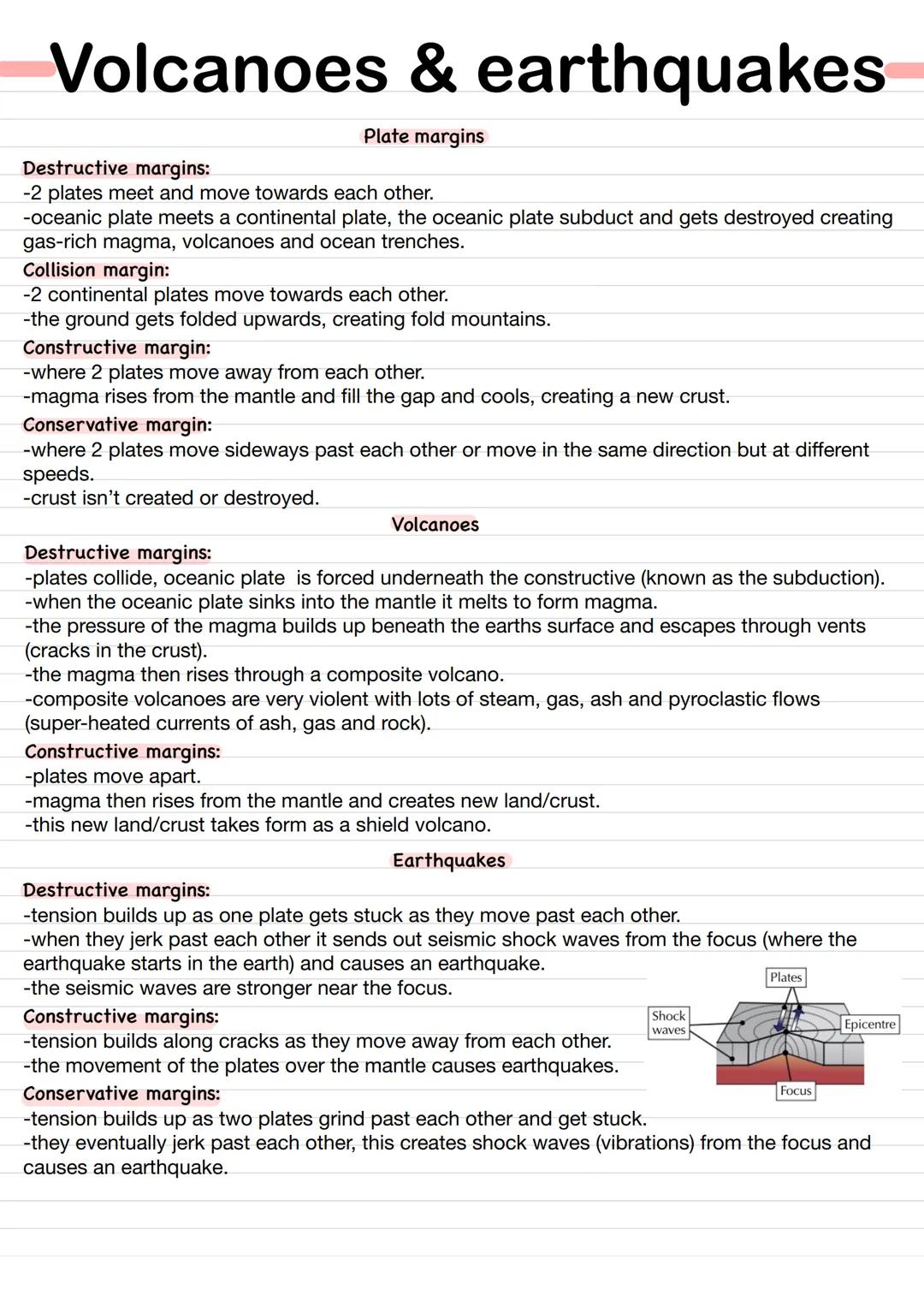
  1. Destructive plate boundary: Two plates move towards each other. When an oceanic plate meets a continental plate, the denser oceanic plate subducts, creating gas-rich magma, volcanoes, and ocean trenches.

  2. Collision margin: Two continental plates collide, resulting in the formation of fold mountains.

  3. Constructive plate boundary: Two plates move away from each other, allowing magma to rise and create new crust.

  4. Transform plate boundary (Conservative margin): Plates move sideways past each other or in the same direction at different speeds, without creating or destroying crust.

Example: The boundary between the Pacific Plate and the North American Plate is a destructive plate boundary, where the Pacific Plate is subducting beneath North America, creating the Cascade Range of volcanoes.

These plate interactions lead to the formation of volcanoes and earthquakes:

  • Volcanoes at destructive margins form as composite volcanoes, characterized by violent eruptions with steam, gas, ash, and pyroclastic flows.
  • Volcanoes at constructive margins form as shield volcanoes, created by rising magma as plates move apart.
  • Earthquakes occur at all types of plate margins due to the buildup and release of tension between plates.

Highlight: Understanding the processes at different plate boundaries is crucial for predicting and preparing for tectonic hazards such as volcanic eruptions and earthquakes.

# Natural Hazards

Natural hazards:
-its a natural process which could cause death, injury or disruption to humans or destroy buildings.

Na

Earthquakes: Measurement and Impact

This page focuses on the measurement of earthquakes and their impact on human populations, which is a critical aspect of studying tectonic hazards in GCSE Geography.

Earthquakes are measured using two main scales:

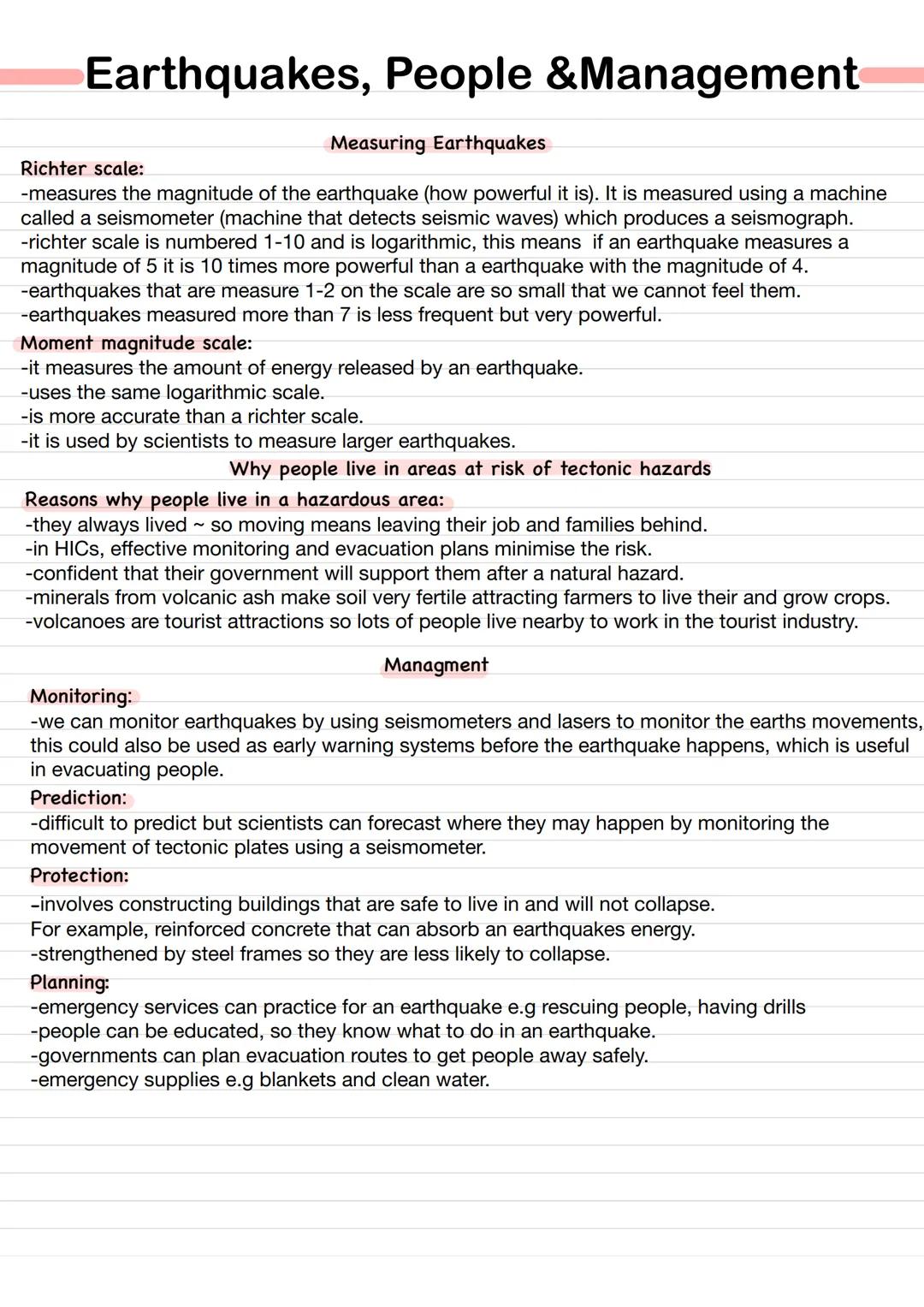
  1. Richter scale:

    • Measures the magnitude (power) of an earthquake
    • Uses a seismometer to detect seismic waves
    • Numbered 1-10 on a logarithmic scale
    • Earthquakes measuring 1-2 are imperceptible to humans
    • Earthquakes above magnitude 7 are less frequent but very powerful
  2. Moment magnitude scale:

    • Measures the energy released by an earthquake
    • Uses the same logarithmic scale as the Richter scale
    • More accurate for measuring larger earthquakes
    • Preferred by scientists for its precision

Vocabulary: A seismometer is a machine that detects seismic waves, producing a seismograph which is used to determine the magnitude of an earthquake.

Despite the risks, people continue to live in areas prone to tectonic hazards for various reasons:

  • Long-standing residence and community ties
  • Effective monitoring and evacuation plans in High-Income Countries (HICs)
  • Confidence in government support after a hazard event
  • Fertile soil from volcanic ash attracting farmers
  • Economic opportunities in tourism around volcanic areas

Highlight: The management of tectonic hazards involves monitoring techniques such as using seismometers and lasers to track ground movements and predict potential earthquakes or volcanic eruptions.

Understanding why people live in hazardous areas and how these risks are managed is crucial for developing effective strategies to mitigate the impacts of tectonic hazards.

# Natural Hazards

Natural hazards:
-its a natural process which could cause death, injury or disruption to humans or destroy buildings.

Na

Tectonic Hazard Management and Preparedness

This page explores strategies for managing and preparing for tectonic hazards, which is an essential component of GCSE Geography studies on natural hazards.

Effective management of tectonic hazards involves several key approaches:

  1. Monitoring:

    • Use of seismometers and lasers to track ground movements
    • Satellite imagery to observe changes in volcanic activity
    • Gas sensors to detect increases in volcanic emissions
  2. Prediction:

    • Analysis of historical data to identify patterns and potential hazard occurrences
    • Use of computer models to forecast earthquake probabilities
    • Monitoring of precursor events, such as foreshocks or ground deformation
  3. Protection:

    • Implementation of building codes to ensure structures can withstand earthquakes
    • Construction of levees and flood barriers in areas prone to tsunami risks
    • Development of early warning systems for rapid evacuation
  4. Planning:

    • Creation of hazard maps to identify high-risk areas
    • Establishment of emergency response protocols
    • Regular drills and public education programs to improve preparedness

Example: Japan's earthquake early warning system can detect the initial seismic waves of an earthquake and broadcast warnings seconds before the more damaging waves arrive, allowing people to take immediate protective action.

Highlight: The effectiveness of tectonic hazard management often depends on the level of economic development in a country. High-Income Countries (HICs) typically have more resources for advanced monitoring and protection measures compared to Low-Income Countries (LICs).

Understanding and implementing these management strategies is crucial for reducing the potential impacts of tectonic hazards on human populations and infrastructure.

# Natural Hazards

Natural hazards:
-its a natural process which could cause death, injury or disruption to humans or destroy buildings.

Na

Case Studies: Tectonic Hazard Events

This page presents case studies of significant tectonic hazard events, providing real-world examples of the concepts covered in GCSE Geography on natural hazards.

  1. 2011 Tōhoku Earthquake and Tsunami, Japan:

    • Magnitude 9.0 earthquake off the coast of Japan
    • Triggered a massive tsunami with waves up to 40 meters high
    • Caused a nuclear disaster at the Fukushima Daiichi power plant
    • Demonstrated the cascading effects of tectonic hazards
  2. 2010 Haiti Earthquake:

    • Magnitude 7.0 earthquake near Port-au-Prince
    • Severe impact due to poor building standards and lack of preparedness
    • Highlighted the vulnerability of Low-Income Countries to tectonic hazards
  3. 1980 Mount St. Helens Eruption, USA:

    • Massive lateral blast and debris avalanche
    • Largest landslide in recorded history
    • Showcased the power of volcanic eruptions and their far-reaching effects
  4. 2004 Indian Ocean Earthquake and Tsunami:

    • Magnitude 9.1-9.3 earthquake off the coast of Sumatra
    • Generated a tsunami affecting 14 countries around the Indian Ocean
    • Led to the development of improved tsunami warning systems in the region

Quote: "The 2011 Tōhoku event was a stark reminder that even the most prepared nations can be overwhelmed by the sheer power of nature." - Seismologist Dr. Lucy Jones

Highlight: These case studies illustrate the diverse impacts of tectonic hazards across different geographical and socio-economic contexts, emphasizing the importance of tailored management strategies.

Analyzing these events provides valuable insights into the challenges and opportunities in tectonic hazard management and preparedness.

# Natural Hazards

Natural hazards:
-its a natural process which could cause death, injury or disruption to humans or destroy buildings.

Na

Comparing Tectonic Hazard Impacts

This page focuses on comparing the impacts of tectonic hazards in different parts of the world, a key topic in GCSE Geography for understanding the varied effects of natural hazards.

Factors influencing the impact of tectonic hazards:

  1. Level of economic development:

    • High-Income Countries (HICs) often have better infrastructure and resources for hazard management
    • Low-Income Countries (LICs) may lack robust building standards and emergency response capabilities
  2. Population density:

    • Densely populated areas are at higher risk of casualties and property damage
    • Rural areas may have fewer immediate impacts but can face challenges in recovery due to isolation
  3. Preparedness:

    • Countries with frequent exposure to hazards may have more developed response systems
    • Regions with infrequent events may be less prepared, leading to potentially greater impacts
  4. Type and magnitude of the hazard:

    • Different types of tectonic hazards (earthquakes, volcanic eruptions, tsunamis) have varied impacts
    • The magnitude of the event significantly influences its potential for destruction

Example: The 2010 Haiti earthquake (magnitude 7.0) caused widespread devastation and over 200,000 deaths, while the 2010 Chile earthquake (magnitude 8.8) resulted in far fewer casualties despite its greater magnitude, largely due to Chile's better preparedness and building standards.

Comparing impacts across different events:

  1. Short-term impacts:

    • Immediate loss of life and property damage
    • Disruption to essential services and infrastructure
  2. Long-term impacts:

    • Economic recovery and reconstruction efforts
    • Changes in land use and settlement patterns
    • Psychological effects on affected populations
  3. Social and cultural impacts:

    • Displacement of communities
    • Changes in social structures and support systems
  4. Environmental impacts:

    • Alterations to landscapes and ecosystems
    • Long-term effects on biodiversity and natural resources

Highlight: Understanding the varied impacts of tectonic hazards across different contexts is crucial for developing effective, context-specific management strategies and improving global resilience to these natural events.

# Natural Hazards

Natural hazards:
-its a natural process which could cause death, injury or disruption to humans or destroy buildings.

Na

Future Challenges in Tectonic Hazard Management

This page explores the future challenges and emerging strategies in managing tectonic hazards, an important consideration for advanced GCSE Geography studies on natural hazards.

Key challenges in future tectonic hazard management:

  1. Climate change interactions:

    • Potential increase in secondary hazards like landslides due to changing weather patterns
    • Need for integrated approaches to manage both tectonic and climate-related risks
  2. Urbanization and population growth:

    • Increasing number of people living in hazard-prone areas
    • Challenge of retrofitting existing infrastructure in rapidly growing cities
  3. Technological advancements:

    • Integration of artificial intelligence and machine learning in hazard prediction
    • Development of more resilient building materials and construction techniques
  4. Global cooperation and data sharing:

    • Importance of international collaboration in hazard monitoring and early warning systems
    • Challenges in standardizing data collection and sharing across borders

Emerging strategies and innovations:

  1. Advanced early warning systems:

    • Development of more accurate and faster earthquake early warning technologies
    • Improved tsunami detection and warning networks
  2. Resilient urban planning:

    • Integration of hazard risk assessments in urban development plans
    • Design of multi-functional infrastructure that serves daily needs and hazard mitigation
  3. Community-based disaster risk reduction:

    • Empowering local communities with knowledge and resources for hazard preparedness
    • Incorporating indigenous knowledge in hazard management strategies
  4. Satellite and remote sensing technologies:

    • Use of high-resolution satellite imagery for real-time monitoring of volcanic activity
    • Application of InSAR (Interferometric Synthetic Aperture Radar) for detecting ground deformation

Example: The ShakeAlert system in the United States uses a network of seismic sensors to provide seconds of warning before earthquake shaking arrives, allowing for automated responses like slowing trains or opening fire station doors.

Highlight: The future of tectonic hazard management lies in integrating cutting-edge technology with community-based approaches and sustainable urban planning to create more resilient societies.

Understanding these future challenges and emerging strategies is crucial for developing comprehensive and adaptive approaches to managing tectonic hazards in an ever-changing world.

# Natural Hazards

Natural hazards:
-its a natural process which could cause death, injury or disruption to humans or destroy buildings.

Na

Tectonic Hazards and Sustainable Development

This page examines the relationship between tectonic hazards and sustainable development, a critical aspect of modern GCSE Geography curricula focusing on the intersection of natural hazards and human development.

Key considerations in linking tectonic hazards to sustainable development:

  1. Risk-informed development:

    • Integrating hazard risk assessments into development planning
    • Ensuring new infrastructure and settlements are resilient to potential tectonic hazards
  2. Economic resilience:

    • Developing diverse economies that can withstand the shocks of major hazard events
    • Investing in insurance and risk transfer mechanisms to support recovery
  3. Environmental sustainability:

    • Balancing hazard mitigation with environmental conservation
    • Exploring nature-based solutions for hazard protection
  4. Social equity:

    • Addressing the disproportionate impacts of tectonic hazards on vulnerable populations
    • Ensuring equitable access to hazard information and protection measures

Sustainable Development Goals (SDGs) and tectonic hazards:

  1. SDG 11 (Sustainable Cities and Communities):

    • Making cities resilient to tectonic hazards through improved urban planning and building standards
  2. SDG 13 (Climate Action):

    • Integrating tectonic hazard management with climate change adaptation strategies
  3. SDG 9 (Industry, Innovation, and Infrastructure):

    • Developing hazard-resistant infrastructure and promoting innovative solutions for risk reduction
  4. SDG 4 (Quality Education):

    • Enhancing public awareness and education about tectonic hazards and preparedness

Quote: "Disaster risk reduction is an integral part of social and economic development, and is essential if development is to be sustainable for the future." - United Nations Office for Disaster Risk Reduction

Challenges and opportunities:

  1. Balancing short-term development needs with long-term hazard resilience
  2. Incorporating traditional knowledge with modern scientific approaches
  3. Developing flexible and adaptive management strategies that can evolve with changing risks
  4. Promoting international cooperation and knowledge sharing in hazard management

Highlight: Achieving sustainable development in areas prone to tectonic hazards requires a holistic approach that balances economic growth, social equity, and environmental protection while building resilience to natural disasters.

Understanding the complex relationship between tectonic hazards and sustainable development is crucial for creating a safer, more resilient future for communities around the world.

# Natural Hazards

Natural hazards:
-its a natural process which could cause death, injury or disruption to humans or destroy buildings.

Na

The Role of Technology in Tectonic Hazard Management

This page explores the crucial role of technology in managing tectonic hazards, an essential topic in modern GCSE Geography studies on natural hazards and their mitigation.

Key technological advancements in tectonic hazard management:

  1. Satellite-based monitoring:

    • Use of InSAR (Interferometric Synthetic Aperture Radar) for detecting ground deformation
    • High-resolution imagery for tracking changes in volcanic landscapes
    • GPS networks for measuring plate movements and crustal deformation
  2. Artificial Intelligence and Machine Learning:

    • Predictive modeling of earthquake occurrences and volcanic eruptions
    • Rapid analysis of seismic data for faster hazard assessments
    • Automated early warning systems with improved accuracy
  3. Internet of Things (IoT) and sensor networks:

    • Deployment of dense networks of low-cost sensors for real-time monitoring
    • Integration of data from multiple sources for comprehensive hazard analysis
    • Smart building technologies that respond to seismic activity
  4. Drone technology:

    • Aerial surveys of hazard-prone areas for risk assessment and mapping
    • Post-disaster damage assessment and search and rescue operations
    • Monitoring of inaccessible or dangerous volcanic sites
  5. Virtual and Augmented Reality:

    • Simulation of hazard scenarios for training and public education
    • Visualization of complex geological data for better understanding of hazard risks
    • Enhanced situational awareness during emergency response

Example: The USGS uses a combination of satellite data, ground-based GPS stations, and seismometers to monitor the Yellowstone supervolcano, providing real-time data on ground deformation and seismic activity.

Challenges and considerations:

  1. Data management and integration:

    • Handling large volumes of data from diverse sources
    • Ensuring data quality and reliability for accurate hazard assessments
  2. Accessibility and equity:

    • Ensuring that technological solutions are accessible to all communities, including those in Low-Income Countries
    • Bridging the digital divide in hazard information and early warning systems
  3. Privacy and security:

    • Balancing the need for detailed monitoring with privacy concerns
    • Protecting critical infrastructure information from potential misuse
  4. Technological dependence:

    • Ensuring redundancy and resilience in technology-based systems
    • Maintaining traditional knowledge and non-technological approaches as backups

Highlight: While technology plays a crucial role in managing tectonic hazards, it is most effective when combined with community-based approaches, traditional knowledge, and robust policy frameworks.

Understanding the potential and limitations of technology in tectonic hazard management is essential for developing comprehensive and effective strategies to mitigate the impacts of these natural events.

# Natural Hazards

Natural hazards:
-its a natural process which could cause death, injury or disruption to humans or destroy buildings.

Na

Tectonic Hazards and Climate Change Interactions

This page examines the complex interactions between tectonic hazards and climate change, an emerging area of study in GCSE Geography that highlights the interconnectedness of Earth's systems.

Key interactions between tectonic hazards and climate change:

  1. Glacial isostatic adjustment:

    • Melting ice sheets and glaciers can lead to crustal rebound, potentially affecting seismic activity
    • Changes in crustal loading may influence volcanic activity in some regions
  2. Sea level rise and coastal hazards:

    • Increased risk of tsunami impacts due to higher sea levels
    • Potential for more severe coastal flooding when tectonic events coincide with extreme weather
  3. Landslide risk:

    • Changes in precipitation patterns may increase the likelihood of landslides in tectonically active areas
    • Thawing permafrost in mountainous regions can destabilize slopes, exacerbating earthquake-induced landslides
  4. Volcanic influences on climate:

    • Major volcanic eruptions can have short-term cooling effects on global climate
    • Increased volcanic activity could potentially offset some warming effects of climate change
  5. Methane release:

    • Warming oceans may destabilize methane hydrates, potentially triggering submarine landslides and tsunamis

Example: The 1980 eruption of Mount St. Helens released about 10 million tons of CO2 into the atmosphere, highlighting the potential for volcanic activity to contribute to greenhouse gas emissions.

Challenges in managing combined risks:

  1. Uncertainty in predictions:

    • Difficulty in modeling complex interactions between tectonic and climatic processes
    • Need for interdisciplinary approaches to understand and predict combined hazards
  2. Adaptation strategies:

    • Developing flexible hazard management plans that account for both tectonic and climate-related risks
    • Integrating climate change considerations into long-term tectonic hazard mitigation strategies
  3. Resource allocation:

    • Balancing investments between immediate tectonic hazard preparedness and long-term climate adaptation
    • Addressing compound risks in resource-limited settings
  4. Public awareness and education:

    • Communicating complex, interrelated risks to the public and policymakers
    • Promoting holistic understanding of Earth system interactions

Highlight: The study of interactions between tectonic hazards and climate change underscores the need for integrated approaches to Earth system science and hazard management.

Understanding these interactions is crucial for developing comprehensive risk assessment and management strategies that address the full spectrum of natural hazards in a changing climate.

# Natural Hazards

Natural hazards:
-its a natural process which could cause death, injury or disruption to humans or destroy buildings.

Na

Tectonic Hazards and Ecosystem Impacts

This page explores the impacts of tectonic hazards on ecosystems and biodiversity, an important aspect of GCSE Geography that highlights the interconnectedness of geological and biological systems.

Key ecosystem impacts of tectonic hazards:

  1. Volcanic eruptions:

    • Destruction of habitats through lava flows, ash fall, and pyroclastic flows
    • Creation of new habitats and landforms, promoting ecological succession
    • Nutrient enrichment of soils through volcanic ash deposition
  2. Earthquakes:

    • Alteration of landscapes through landslides and ground ruptures
    • Disruption of aquatic ecosystems through changes in water courses and quality
    • Potential for creating new habitats through uplift or subsidence
  3. Tsunamis:

    • Destruction of coastal and marine ecosystems
    • Saltwater intrusion into freshwater systems
    • Long-term changes in coastal geomorphology affecting habitat distribution
  4. Secondary effects:

    • Wildfires triggered by volcanic activity or earthquakes
    • Changes in local climate patterns due to large-scale landscape alterations

Example: The 1883 eruption of Krakatoa in Indonesia completely destroyed the island's ecosystem, but also created new habitats that have since undergone remarkable ecological succession.

Ecological responses and adaptations:

  1. Resilience and recovery:

    • Some ecosystems show remarkable ability to recover from tectonic disturbances
    • Importance of nearby undisturbed areas as sources for recolonization
  2. Evolutionary adaptations:

    • Species in tectonically active regions may develop adaptations to frequent disturbances
    • Potential for rapid evolution in response to new environmental conditions
  3. Biodiversity impacts:

    • Tectonic events can lead to both loss and creation of biodiversity
    • Isolation of populations due to landscape changes can promote speciation
  4. Ecosystem services:

    • Disruption of ecosystem services such as water purification and soil stability
    • Potential for enhanced services in the long term, such as improved soil fertility

Highlight: While tectonic hazards can have devastating short-term impacts on ecosystems, they also play a crucial role in shaping biodiversity and driving evolutionary processes over geological timescales.

Management and conservation considerations:

  1. Integrating hazard risk into conservation planning
  2. Developing strategies for rapid ecological assessment and response following tectonic events
  3. Balancing human safety with ecosystem protection in hazard-prone areas
  4. Studying tectonic impacts on ecosystems to inform climate change adaptation strategies

Understanding the complex relationships between tectonic hazards and ecosystems is essential for developing holistic approaches to both hazard management and biodiversity conservation.


We thought you’d never ask...

What is the Knowunity AI companion?

Our AI Companion is a student-focused AI tool that offers more than just answers. Built on millions of Knowunity resources, it provides relevant information, personalised study plans, quizzes, and content directly in the chat, adapting to your individual learning journey.

Where can I download the Knowunity app?

You can download the app from Google Play Store and Apple App Store.

Is Knowunity really free of charge?

That's right! Enjoy free access to study content, connect with fellow students, and get instant help – all at your fingertips.

Most popular content: Climate Change

Most popular content in Geography

Most popular content

Can't find what you're looking for? Explore other subjects.

Students love us — and so will you.

4.6/5

App Store

4.7/5

Google Play

The app is very easy to use and well designed. I have found everything I was looking for so far and have been able to learn a lot from the presentations! I will definitely use the app for a class assignment! And of course it also helps a lot as an inspiration.

Stefan S

iOS user

This app is really great. There are so many study notes and help [...]. My problem subject is French, for example, and the app has so many options for help. Thanks to this app, I have improved my French. I would recommend it to anyone.

Samantha Klich

Android user

Wow, I am really amazed. I just tried the app because I've seen it advertised many times and was absolutely stunned. This app is THE HELP you want for school and above all, it offers so many things, such as workouts and fact sheets, which have been VERY helpful to me personally.

Anna

iOS user

Best app on earth! no words because it’s too good

Thomas R

iOS user

Just amazing. Let's me revise 10x better, this app is a quick 10/10. I highly recommend it to anyone. I can watch and search for notes. I can save them in the subject folder. I can revise it any time when I come back. If you haven't tried this app, you're really missing out.

Basil

Android user

This app has made me feel so much more confident in my exam prep, not only through boosting my own self confidence through the features that allow you to connect with others and feel less alone, but also through the way the app itself is centred around making you feel better. It is easy to navigate, fun to use, and helpful to anyone struggling in absolutely any way.

David K

iOS user

The app's just great! All I have to do is enter the topic in the search bar and I get the response real fast. I don't have to watch 10 YouTube videos to understand something, so I'm saving my time. Highly recommended!

Sudenaz Ocak

Android user

In school I was really bad at maths but thanks to the app, I am doing better now. I am so grateful that you made the app.

Greenlight Bonnie

Android user

very reliable app to help and grow your ideas of Maths, English and other related topics in your works. please use this app if your struggling in areas, this app is key for that. wish I'd of done a review before. and it's also free so don't worry about that.

Rohan U

Android user

I know a lot of apps use fake accounts to boost their reviews but this app deserves it all. Originally I was getting 4 in my English exams and this time I got a grade 7. I didn’t even know about this app three days until the exam and it has helped A LOT. Please actually trust me and use it as I’m sure you too will see developments.

Xander S

iOS user

THE QUIZES AND FLASHCARDS ARE SO USEFUL AND I LOVE Knowunity AI. IT ALSO IS LITREALLY LIKE CHATGPT BUT SMARTER!! HELPED ME WITH MY MASCARA PROBLEMS TOO!! AS WELL AS MY REAL SUBJECTS ! DUHHH 😍😁😲🤑💗✨🎀😮

Elisha

iOS user

This apps acc the goat. I find revision so boring but this app makes it so easy to organize it all and then you can ask the freeeee ai to test yourself so good and you can easily upload your own stuff. highly recommend as someone taking mocks now

Paul T

iOS user

The app is very easy to use and well designed. I have found everything I was looking for so far and have been able to learn a lot from the presentations! I will definitely use the app for a class assignment! And of course it also helps a lot as an inspiration.

Stefan S

iOS user

This app is really great. There are so many study notes and help [...]. My problem subject is French, for example, and the app has so many options for help. Thanks to this app, I have improved my French. I would recommend it to anyone.

Samantha Klich

Android user

Wow, I am really amazed. I just tried the app because I've seen it advertised many times and was absolutely stunned. This app is THE HELP you want for school and above all, it offers so many things, such as workouts and fact sheets, which have been VERY helpful to me personally.

Anna

iOS user

Best app on earth! no words because it’s too good

Thomas R

iOS user

Just amazing. Let's me revise 10x better, this app is a quick 10/10. I highly recommend it to anyone. I can watch and search for notes. I can save them in the subject folder. I can revise it any time when I come back. If you haven't tried this app, you're really missing out.

Basil

Android user

This app has made me feel so much more confident in my exam prep, not only through boosting my own self confidence through the features that allow you to connect with others and feel less alone, but also through the way the app itself is centred around making you feel better. It is easy to navigate, fun to use, and helpful to anyone struggling in absolutely any way.

David K

iOS user

The app's just great! All I have to do is enter the topic in the search bar and I get the response real fast. I don't have to watch 10 YouTube videos to understand something, so I'm saving my time. Highly recommended!

Sudenaz Ocak

Android user

In school I was really bad at maths but thanks to the app, I am doing better now. I am so grateful that you made the app.

Greenlight Bonnie

Android user

very reliable app to help and grow your ideas of Maths, English and other related topics in your works. please use this app if your struggling in areas, this app is key for that. wish I'd of done a review before. and it's also free so don't worry about that.

Rohan U

Android user

I know a lot of apps use fake accounts to boost their reviews but this app deserves it all. Originally I was getting 4 in my English exams and this time I got a grade 7. I didn’t even know about this app three days until the exam and it has helped A LOT. Please actually trust me and use it as I’m sure you too will see developments.

Xander S

iOS user

THE QUIZES AND FLASHCARDS ARE SO USEFUL AND I LOVE Knowunity AI. IT ALSO IS LITREALLY LIKE CHATGPT BUT SMARTER!! HELPED ME WITH MY MASCARA PROBLEMS TOO!! AS WELL AS MY REAL SUBJECTS ! DUHHH 😍😁😲🤑💗✨🎀😮

Elisha

iOS user

This apps acc the goat. I find revision so boring but this app makes it so easy to organize it all and then you can ask the freeeee ai to test yourself so good and you can easily upload your own stuff. highly recommend as someone taking mocks now

Paul T

iOS user


Geography

2,291

Updated Mar 16, 2026

14 pages

Tectonic Hazards and Plate Boundaries: A Fun Geography Guide

user profile picture

aleena<3

@sandor4life

Hey there! Want to learn about tectonic hazards and natural hazards? Dive into this cool guide for GCSE Geography. Discover 4 types of plate boundaries: constructive, destructive, divergent, and transform. Find out what happens at each, with examples and diagrams. Learn about plate tectonics, the map of plate margins, and what happens at constructive and conservative plate margins. Explore 5 examples of tectonic hazards and more!
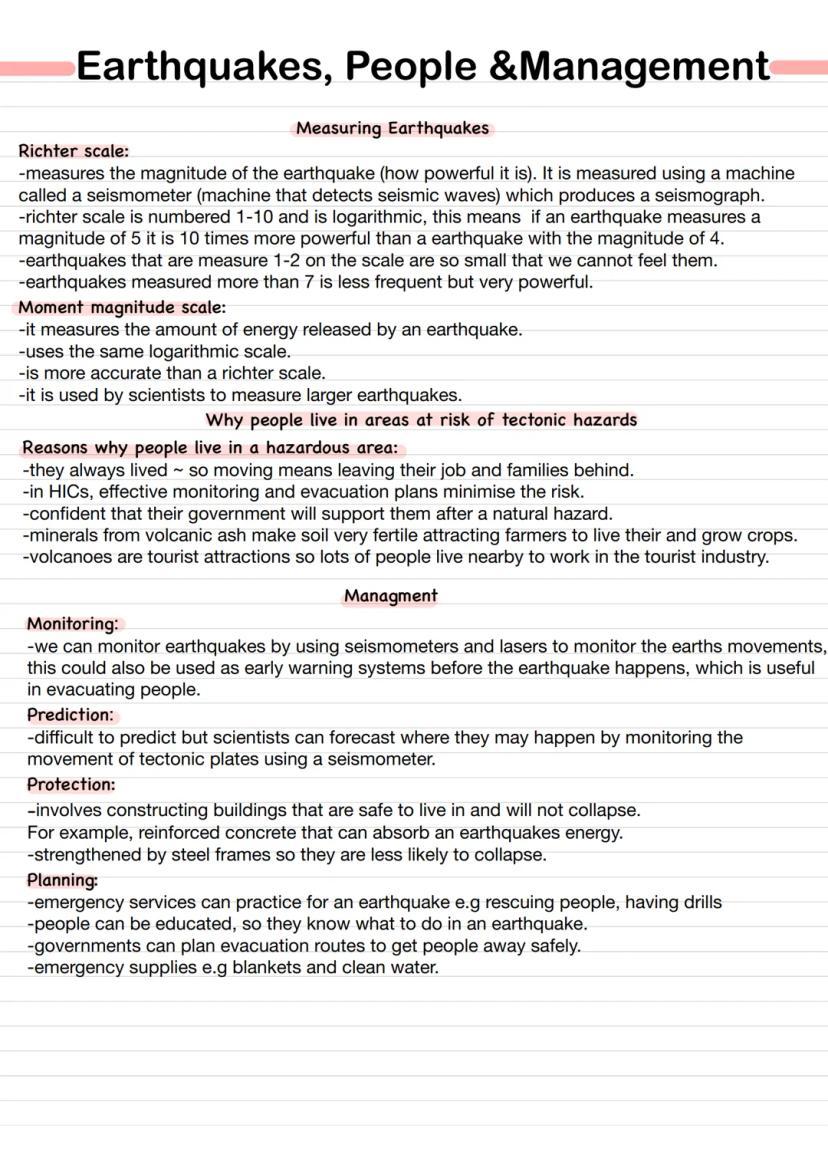
# Natural Hazards

Natural hazards:
-its a natural process which could cause death, injury or disruption to humans or destroy buildings.

Na

Sign up to see the contentIt's free!

Access to all documents

Improve your grades

Join milions of students

Plate Margins and Tectonic Processes

This page delves into the different types of plate margins and their associated tectonic processes, which are fundamental to understanding tectonic hazards in GCSE Geography.

There are four main types of plate boundaries:

  1. Destructive plate boundary: Two plates move towards each other. When an oceanic plate meets a continental plate, the denser oceanic plate subducts, creating gas-rich magma, volcanoes, and ocean trenches.

  2. Collision margin: Two continental plates collide, resulting in the formation of fold mountains.

  3. Constructive plate boundary: Two plates move away from each other, allowing magma to rise and create new crust.

  4. Transform plate boundary (Conservative margin): Plates move sideways past each other or in the same direction at different speeds, without creating or destroying crust.

Example: The boundary between the Pacific Plate and the North American Plate is a destructive plate boundary, where the Pacific Plate is subducting beneath North America, creating the Cascade Range of volcanoes.

These plate interactions lead to the formation of volcanoes and earthquakes:

  • Volcanoes at destructive margins form as composite volcanoes, characterized by violent eruptions with steam, gas, ash, and pyroclastic flows.
  • Volcanoes at constructive margins form as shield volcanoes, created by rising magma as plates move apart.
  • Earthquakes occur at all types of plate margins due to the buildup and release of tension between plates.

Highlight: Understanding the processes at different plate boundaries is crucial for predicting and preparing for tectonic hazards such as volcanic eruptions and earthquakes.

# Natural Hazards

Natural hazards:
-its a natural process which could cause death, injury or disruption to humans or destroy buildings.

Na

Sign up to see the contentIt's free!

Access to all documents

Improve your grades

Join milions of students

Earthquakes: Measurement and Impact

This page focuses on the measurement of earthquakes and their impact on human populations, which is a critical aspect of studying tectonic hazards in GCSE Geography.

Earthquakes are measured using two main scales:

  1. Richter scale:

    • Measures the magnitude (power) of an earthquake
    • Uses a seismometer to detect seismic waves
    • Numbered 1-10 on a logarithmic scale
    • Earthquakes measuring 1-2 are imperceptible to humans
    • Earthquakes above magnitude 7 are less frequent but very powerful
  2. Moment magnitude scale:

    • Measures the energy released by an earthquake
    • Uses the same logarithmic scale as the Richter scale
    • More accurate for measuring larger earthquakes
    • Preferred by scientists for its precision

Vocabulary: A seismometer is a machine that detects seismic waves, producing a seismograph which is used to determine the magnitude of an earthquake.

Despite the risks, people continue to live in areas prone to tectonic hazards for various reasons:

  • Long-standing residence and community ties
  • Effective monitoring and evacuation plans in High-Income Countries (HICs)
  • Confidence in government support after a hazard event
  • Fertile soil from volcanic ash attracting farmers
  • Economic opportunities in tourism around volcanic areas

Highlight: The management of tectonic hazards involves monitoring techniques such as using seismometers and lasers to track ground movements and predict potential earthquakes or volcanic eruptions.

Understanding why people live in hazardous areas and how these risks are managed is crucial for developing effective strategies to mitigate the impacts of tectonic hazards.

# Natural Hazards

Natural hazards:
-its a natural process which could cause death, injury or disruption to humans or destroy buildings.

Na

Sign up to see the contentIt's free!

Access to all documents

Improve your grades

Join milions of students

Tectonic Hazard Management and Preparedness

This page explores strategies for managing and preparing for tectonic hazards, which is an essential component of GCSE Geography studies on natural hazards.

Effective management of tectonic hazards involves several key approaches:

  1. Monitoring:

    • Use of seismometers and lasers to track ground movements
    • Satellite imagery to observe changes in volcanic activity
    • Gas sensors to detect increases in volcanic emissions
  2. Prediction:

    • Analysis of historical data to identify patterns and potential hazard occurrences
    • Use of computer models to forecast earthquake probabilities
    • Monitoring of precursor events, such as foreshocks or ground deformation
  3. Protection:

    • Implementation of building codes to ensure structures can withstand earthquakes
    • Construction of levees and flood barriers in areas prone to tsunami risks
    • Development of early warning systems for rapid evacuation
  4. Planning:

    • Creation of hazard maps to identify high-risk areas
    • Establishment of emergency response protocols
    • Regular drills and public education programs to improve preparedness

Example: Japan's earthquake early warning system can detect the initial seismic waves of an earthquake and broadcast warnings seconds before the more damaging waves arrive, allowing people to take immediate protective action.

Highlight: The effectiveness of tectonic hazard management often depends on the level of economic development in a country. High-Income Countries (HICs) typically have more resources for advanced monitoring and protection measures compared to Low-Income Countries (LICs).

Understanding and implementing these management strategies is crucial for reducing the potential impacts of tectonic hazards on human populations and infrastructure.

# Natural Hazards

Natural hazards:
-its a natural process which could cause death, injury or disruption to humans or destroy buildings.

Na

Sign up to see the contentIt's free!

Access to all documents

Improve your grades

Join milions of students

Case Studies: Tectonic Hazard Events

This page presents case studies of significant tectonic hazard events, providing real-world examples of the concepts covered in GCSE Geography on natural hazards.

  1. 2011 Tōhoku Earthquake and Tsunami, Japan:

    • Magnitude 9.0 earthquake off the coast of Japan
    • Triggered a massive tsunami with waves up to 40 meters high
    • Caused a nuclear disaster at the Fukushima Daiichi power plant
    • Demonstrated the cascading effects of tectonic hazards
  2. 2010 Haiti Earthquake:

    • Magnitude 7.0 earthquake near Port-au-Prince
    • Severe impact due to poor building standards and lack of preparedness
    • Highlighted the vulnerability of Low-Income Countries to tectonic hazards
  3. 1980 Mount St. Helens Eruption, USA:

    • Massive lateral blast and debris avalanche
    • Largest landslide in recorded history
    • Showcased the power of volcanic eruptions and their far-reaching effects
  4. 2004 Indian Ocean Earthquake and Tsunami:

    • Magnitude 9.1-9.3 earthquake off the coast of Sumatra
    • Generated a tsunami affecting 14 countries around the Indian Ocean
    • Led to the development of improved tsunami warning systems in the region

Quote: "The 2011 Tōhoku event was a stark reminder that even the most prepared nations can be overwhelmed by the sheer power of nature." - Seismologist Dr. Lucy Jones

Highlight: These case studies illustrate the diverse impacts of tectonic hazards across different geographical and socio-economic contexts, emphasizing the importance of tailored management strategies.

Analyzing these events provides valuable insights into the challenges and opportunities in tectonic hazard management and preparedness.

# Natural Hazards

Natural hazards:
-its a natural process which could cause death, injury or disruption to humans or destroy buildings.

Na

Sign up to see the contentIt's free!

Access to all documents

Improve your grades

Join milions of students

Comparing Tectonic Hazard Impacts

This page focuses on comparing the impacts of tectonic hazards in different parts of the world, a key topic in GCSE Geography for understanding the varied effects of natural hazards.

Factors influencing the impact of tectonic hazards:

  1. Level of economic development:

    • High-Income Countries (HICs) often have better infrastructure and resources for hazard management
    • Low-Income Countries (LICs) may lack robust building standards and emergency response capabilities
  2. Population density:

    • Densely populated areas are at higher risk of casualties and property damage
    • Rural areas may have fewer immediate impacts but can face challenges in recovery due to isolation
  3. Preparedness:

    • Countries with frequent exposure to hazards may have more developed response systems
    • Regions with infrequent events may be less prepared, leading to potentially greater impacts
  4. Type and magnitude of the hazard:

    • Different types of tectonic hazards (earthquakes, volcanic eruptions, tsunamis) have varied impacts
    • The magnitude of the event significantly influences its potential for destruction

Example: The 2010 Haiti earthquake (magnitude 7.0) caused widespread devastation and over 200,000 deaths, while the 2010 Chile earthquake (magnitude 8.8) resulted in far fewer casualties despite its greater magnitude, largely due to Chile's better preparedness and building standards.

Comparing impacts across different events:

  1. Short-term impacts:

    • Immediate loss of life and property damage
    • Disruption to essential services and infrastructure
  2. Long-term impacts:

    • Economic recovery and reconstruction efforts
    • Changes in land use and settlement patterns
    • Psychological effects on affected populations
  3. Social and cultural impacts:

    • Displacement of communities
    • Changes in social structures and support systems
  4. Environmental impacts:

    • Alterations to landscapes and ecosystems
    • Long-term effects on biodiversity and natural resources

Highlight: Understanding the varied impacts of tectonic hazards across different contexts is crucial for developing effective, context-specific management strategies and improving global resilience to these natural events.

# Natural Hazards

Natural hazards:
-its a natural process which could cause death, injury or disruption to humans or destroy buildings.

Na

Sign up to see the contentIt's free!

Access to all documents

Improve your grades

Join milions of students

Future Challenges in Tectonic Hazard Management

This page explores the future challenges and emerging strategies in managing tectonic hazards, an important consideration for advanced GCSE Geography studies on natural hazards.

Key challenges in future tectonic hazard management:

  1. Climate change interactions:

    • Potential increase in secondary hazards like landslides due to changing weather patterns
    • Need for integrated approaches to manage both tectonic and climate-related risks
  2. Urbanization and population growth:

    • Increasing number of people living in hazard-prone areas
    • Challenge of retrofitting existing infrastructure in rapidly growing cities
  3. Technological advancements:

    • Integration of artificial intelligence and machine learning in hazard prediction
    • Development of more resilient building materials and construction techniques
  4. Global cooperation and data sharing:

    • Importance of international collaboration in hazard monitoring and early warning systems
    • Challenges in standardizing data collection and sharing across borders

Emerging strategies and innovations:

  1. Advanced early warning systems:

    • Development of more accurate and faster earthquake early warning technologies
    • Improved tsunami detection and warning networks
  2. Resilient urban planning:

    • Integration of hazard risk assessments in urban development plans
    • Design of multi-functional infrastructure that serves daily needs and hazard mitigation
  3. Community-based disaster risk reduction:

    • Empowering local communities with knowledge and resources for hazard preparedness
    • Incorporating indigenous knowledge in hazard management strategies
  4. Satellite and remote sensing technologies:

    • Use of high-resolution satellite imagery for real-time monitoring of volcanic activity
    • Application of InSAR (Interferometric Synthetic Aperture Radar) for detecting ground deformation

Example: The ShakeAlert system in the United States uses a network of seismic sensors to provide seconds of warning before earthquake shaking arrives, allowing for automated responses like slowing trains or opening fire station doors.

Highlight: The future of tectonic hazard management lies in integrating cutting-edge technology with community-based approaches and sustainable urban planning to create more resilient societies.

Understanding these future challenges and emerging strategies is crucial for developing comprehensive and adaptive approaches to managing tectonic hazards in an ever-changing world.

# Natural Hazards

Natural hazards:
-its a natural process which could cause death, injury or disruption to humans or destroy buildings.

Na

Sign up to see the contentIt's free!

Access to all documents

Improve your grades

Join milions of students

Tectonic Hazards and Sustainable Development

This page examines the relationship between tectonic hazards and sustainable development, a critical aspect of modern GCSE Geography curricula focusing on the intersection of natural hazards and human development.

Key considerations in linking tectonic hazards to sustainable development:

  1. Risk-informed development:

    • Integrating hazard risk assessments into development planning
    • Ensuring new infrastructure and settlements are resilient to potential tectonic hazards
  2. Economic resilience:

    • Developing diverse economies that can withstand the shocks of major hazard events
    • Investing in insurance and risk transfer mechanisms to support recovery
  3. Environmental sustainability:

    • Balancing hazard mitigation with environmental conservation
    • Exploring nature-based solutions for hazard protection
  4. Social equity:

    • Addressing the disproportionate impacts of tectonic hazards on vulnerable populations
    • Ensuring equitable access to hazard information and protection measures

Sustainable Development Goals (SDGs) and tectonic hazards:

  1. SDG 11 (Sustainable Cities and Communities):

    • Making cities resilient to tectonic hazards through improved urban planning and building standards
  2. SDG 13 (Climate Action):

    • Integrating tectonic hazard management with climate change adaptation strategies
  3. SDG 9 (Industry, Innovation, and Infrastructure):

    • Developing hazard-resistant infrastructure and promoting innovative solutions for risk reduction
  4. SDG 4 (Quality Education):

    • Enhancing public awareness and education about tectonic hazards and preparedness

Quote: "Disaster risk reduction is an integral part of social and economic development, and is essential if development is to be sustainable for the future." - United Nations Office for Disaster Risk Reduction

Challenges and opportunities:

  1. Balancing short-term development needs with long-term hazard resilience
  2. Incorporating traditional knowledge with modern scientific approaches
  3. Developing flexible and adaptive management strategies that can evolve with changing risks
  4. Promoting international cooperation and knowledge sharing in hazard management

Highlight: Achieving sustainable development in areas prone to tectonic hazards requires a holistic approach that balances economic growth, social equity, and environmental protection while building resilience to natural disasters.

Understanding the complex relationship between tectonic hazards and sustainable development is crucial for creating a safer, more resilient future for communities around the world.

# Natural Hazards

Natural hazards:
-its a natural process which could cause death, injury or disruption to humans or destroy buildings.

Na

Sign up to see the contentIt's free!

Access to all documents

Improve your grades

Join milions of students

The Role of Technology in Tectonic Hazard Management

This page explores the crucial role of technology in managing tectonic hazards, an essential topic in modern GCSE Geography studies on natural hazards and their mitigation.

Key technological advancements in tectonic hazard management:

  1. Satellite-based monitoring:

    • Use of InSAR (Interferometric Synthetic Aperture Radar) for detecting ground deformation
    • High-resolution imagery for tracking changes in volcanic landscapes
    • GPS networks for measuring plate movements and crustal deformation
  2. Artificial Intelligence and Machine Learning:

    • Predictive modeling of earthquake occurrences and volcanic eruptions
    • Rapid analysis of seismic data for faster hazard assessments
    • Automated early warning systems with improved accuracy
  3. Internet of Things (IoT) and sensor networks:

    • Deployment of dense networks of low-cost sensors for real-time monitoring
    • Integration of data from multiple sources for comprehensive hazard analysis
    • Smart building technologies that respond to seismic activity
  4. Drone technology:

    • Aerial surveys of hazard-prone areas for risk assessment and mapping
    • Post-disaster damage assessment and search and rescue operations
    • Monitoring of inaccessible or dangerous volcanic sites
  5. Virtual and Augmented Reality:

    • Simulation of hazard scenarios for training and public education
    • Visualization of complex geological data for better understanding of hazard risks
    • Enhanced situational awareness during emergency response

Example: The USGS uses a combination of satellite data, ground-based GPS stations, and seismometers to monitor the Yellowstone supervolcano, providing real-time data on ground deformation and seismic activity.

Challenges and considerations:

  1. Data management and integration:

    • Handling large volumes of data from diverse sources
    • Ensuring data quality and reliability for accurate hazard assessments
  2. Accessibility and equity:

    • Ensuring that technological solutions are accessible to all communities, including those in Low-Income Countries
    • Bridging the digital divide in hazard information and early warning systems
  3. Privacy and security:

    • Balancing the need for detailed monitoring with privacy concerns
    • Protecting critical infrastructure information from potential misuse
  4. Technological dependence:

    • Ensuring redundancy and resilience in technology-based systems
    • Maintaining traditional knowledge and non-technological approaches as backups

Highlight: While technology plays a crucial role in managing tectonic hazards, it is most effective when combined with community-based approaches, traditional knowledge, and robust policy frameworks.

Understanding the potential and limitations of technology in tectonic hazard management is essential for developing comprehensive and effective strategies to mitigate the impacts of these natural events.

# Natural Hazards

Natural hazards:
-its a natural process which could cause death, injury or disruption to humans or destroy buildings.

Na

Sign up to see the contentIt's free!

Access to all documents

Improve your grades

Join milions of students

Tectonic Hazards and Climate Change Interactions

This page examines the complex interactions between tectonic hazards and climate change, an emerging area of study in GCSE Geography that highlights the interconnectedness of Earth's systems.

Key interactions between tectonic hazards and climate change:

  1. Glacial isostatic adjustment:

    • Melting ice sheets and glaciers can lead to crustal rebound, potentially affecting seismic activity
    • Changes in crustal loading may influence volcanic activity in some regions
  2. Sea level rise and coastal hazards:

    • Increased risk of tsunami impacts due to higher sea levels
    • Potential for more severe coastal flooding when tectonic events coincide with extreme weather
  3. Landslide risk:

    • Changes in precipitation patterns may increase the likelihood of landslides in tectonically active areas
    • Thawing permafrost in mountainous regions can destabilize slopes, exacerbating earthquake-induced landslides
  4. Volcanic influences on climate:

    • Major volcanic eruptions can have short-term cooling effects on global climate
    • Increased volcanic activity could potentially offset some warming effects of climate change
  5. Methane release:

    • Warming oceans may destabilize methane hydrates, potentially triggering submarine landslides and tsunamis

Example: The 1980 eruption of Mount St. Helens released about 10 million tons of CO2 into the atmosphere, highlighting the potential for volcanic activity to contribute to greenhouse gas emissions.

Challenges in managing combined risks:

  1. Uncertainty in predictions:

    • Difficulty in modeling complex interactions between tectonic and climatic processes
    • Need for interdisciplinary approaches to understand and predict combined hazards
  2. Adaptation strategies:

    • Developing flexible hazard management plans that account for both tectonic and climate-related risks
    • Integrating climate change considerations into long-term tectonic hazard mitigation strategies
  3. Resource allocation:

    • Balancing investments between immediate tectonic hazard preparedness and long-term climate adaptation
    • Addressing compound risks in resource-limited settings
  4. Public awareness and education:

    • Communicating complex, interrelated risks to the public and policymakers
    • Promoting holistic understanding of Earth system interactions

Highlight: The study of interactions between tectonic hazards and climate change underscores the need for integrated approaches to Earth system science and hazard management.

Understanding these interactions is crucial for developing comprehensive risk assessment and management strategies that address the full spectrum of natural hazards in a changing climate.

# Natural Hazards

Natural hazards:
-its a natural process which could cause death, injury or disruption to humans or destroy buildings.

Na

Sign up to see the contentIt's free!

Access to all documents

Improve your grades

Join milions of students

Tectonic Hazards and Ecosystem Impacts

This page explores the impacts of tectonic hazards on ecosystems and biodiversity, an important aspect of GCSE Geography that highlights the interconnectedness of geological and biological systems.

Key ecosystem impacts of tectonic hazards:

  1. Volcanic eruptions:

    • Destruction of habitats through lava flows, ash fall, and pyroclastic flows
    • Creation of new habitats and landforms, promoting ecological succession
    • Nutrient enrichment of soils through volcanic ash deposition
  2. Earthquakes:

    • Alteration of landscapes through landslides and ground ruptures
    • Disruption of aquatic ecosystems through changes in water courses and quality
    • Potential for creating new habitats through uplift or subsidence
  3. Tsunamis:

    • Destruction of coastal and marine ecosystems
    • Saltwater intrusion into freshwater systems
    • Long-term changes in coastal geomorphology affecting habitat distribution
  4. Secondary effects:

    • Wildfires triggered by volcanic activity or earthquakes
    • Changes in local climate patterns due to large-scale landscape alterations

Example: The 1883 eruption of Krakatoa in Indonesia completely destroyed the island's ecosystem, but also created new habitats that have since undergone remarkable ecological succession.

Ecological responses and adaptations:

  1. Resilience and recovery:

    • Some ecosystems show remarkable ability to recover from tectonic disturbances
    • Importance of nearby undisturbed areas as sources for recolonization
  2. Evolutionary adaptations:

    • Species in tectonically active regions may develop adaptations to frequent disturbances
    • Potential for rapid evolution in response to new environmental conditions
  3. Biodiversity impacts:

    • Tectonic events can lead to both loss and creation of biodiversity
    • Isolation of populations due to landscape changes can promote speciation
  4. Ecosystem services:

    • Disruption of ecosystem services such as water purification and soil stability
    • Potential for enhanced services in the long term, such as improved soil fertility

Highlight: While tectonic hazards can have devastating short-term impacts on ecosystems, they also play a crucial role in shaping biodiversity and driving evolutionary processes over geological timescales.

Management and conservation considerations:

  1. Integrating hazard risk into conservation planning
  2. Developing strategies for rapid ecological assessment and response following tectonic events
  3. Balancing human safety with ecosystem protection in hazard-prone areas
  4. Studying tectonic impacts on ecosystems to inform climate change adaptation strategies

Understanding the complex relationships between tectonic hazards and ecosystems is essential for developing holistic approaches to both hazard management and biodiversity conservation.

We thought you’d never ask...

What is the Knowunity AI companion?

Our AI Companion is a student-focused AI tool that offers more than just answers. Built on millions of Knowunity resources, it provides relevant information, personalised study plans, quizzes, and content directly in the chat, adapting to your individual learning journey.

Where can I download the Knowunity app?

You can download the app from Google Play Store and Apple App Store.

Is Knowunity really free of charge?

That's right! Enjoy free access to study content, connect with fellow students, and get instant help – all at your fingertips.

177

Smart Tools NEW

Transform this note into: ✓ 50+ Practice Questions ✓ Interactive Flashcards ✓ Full Mock Exam ✓ Essay Outlines

Mock Exam
Quiz
Flashcards
Essay

Most popular content: Climate Change

Most popular content in Geography

Most popular content

Can't find what you're looking for? Explore other subjects.

Students love us — and so will you.

4.6/5

App Store

4.7/5

Google Play

The app is very easy to use and well designed. I have found everything I was looking for so far and have been able to learn a lot from the presentations! I will definitely use the app for a class assignment! And of course it also helps a lot as an inspiration.

Stefan S

iOS user

This app is really great. There are so many study notes and help [...]. My problem subject is French, for example, and the app has so many options for help. Thanks to this app, I have improved my French. I would recommend it to anyone.

Samantha Klich

Android user

Wow, I am really amazed. I just tried the app because I've seen it advertised many times and was absolutely stunned. This app is THE HELP you want for school and above all, it offers so many things, such as workouts and fact sheets, which have been VERY helpful to me personally.

Anna

iOS user

Best app on earth! no words because it’s too good

Thomas R

iOS user

Just amazing. Let's me revise 10x better, this app is a quick 10/10. I highly recommend it to anyone. I can watch and search for notes. I can save them in the subject folder. I can revise it any time when I come back. If you haven't tried this app, you're really missing out.

Basil

Android user

This app has made me feel so much more confident in my exam prep, not only through boosting my own self confidence through the features that allow you to connect with others and feel less alone, but also through the way the app itself is centred around making you feel better. It is easy to navigate, fun to use, and helpful to anyone struggling in absolutely any way.

David K

iOS user

The app's just great! All I have to do is enter the topic in the search bar and I get the response real fast. I don't have to watch 10 YouTube videos to understand something, so I'm saving my time. Highly recommended!

Sudenaz Ocak

Android user

In school I was really bad at maths but thanks to the app, I am doing better now. I am so grateful that you made the app.

Greenlight Bonnie

Android user

very reliable app to help and grow your ideas of Maths, English and other related topics in your works. please use this app if your struggling in areas, this app is key for that. wish I'd of done a review before. and it's also free so don't worry about that.

Rohan U

Android user

I know a lot of apps use fake accounts to boost their reviews but this app deserves it all. Originally I was getting 4 in my English exams and this time I got a grade 7. I didn’t even know about this app three days until the exam and it has helped A LOT. Please actually trust me and use it as I’m sure you too will see developments.

Xander S

iOS user

THE QUIZES AND FLASHCARDS ARE SO USEFUL AND I LOVE Knowunity AI. IT ALSO IS LITREALLY LIKE CHATGPT BUT SMARTER!! HELPED ME WITH MY MASCARA PROBLEMS TOO!! AS WELL AS MY REAL SUBJECTS ! DUHHH 😍😁😲🤑💗✨🎀😮

Elisha

iOS user

This apps acc the goat. I find revision so boring but this app makes it so easy to organize it all and then you can ask the freeeee ai to test yourself so good and you can easily upload your own stuff. highly recommend as someone taking mocks now

Paul T

iOS user

The app is very easy to use and well designed. I have found everything I was looking for so far and have been able to learn a lot from the presentations! I will definitely use the app for a class assignment! And of course it also helps a lot as an inspiration.

Stefan S

iOS user

This app is really great. There are so many study notes and help [...]. My problem subject is French, for example, and the app has so many options for help. Thanks to this app, I have improved my French. I would recommend it to anyone.

Samantha Klich

Android user

Wow, I am really amazed. I just tried the app because I've seen it advertised many times and was absolutely stunned. This app is THE HELP you want for school and above all, it offers so many things, such as workouts and fact sheets, which have been VERY helpful to me personally.

Anna

iOS user

Best app on earth! no words because it’s too good

Thomas R

iOS user

Just amazing. Let's me revise 10x better, this app is a quick 10/10. I highly recommend it to anyone. I can watch and search for notes. I can save them in the subject folder. I can revise it any time when I come back. If you haven't tried this app, you're really missing out.

Basil

Android user

This app has made me feel so much more confident in my exam prep, not only through boosting my own self confidence through the features that allow you to connect with others and feel less alone, but also through the way the app itself is centred around making you feel better. It is easy to navigate, fun to use, and helpful to anyone struggling in absolutely any way.

David K

iOS user

The app's just great! All I have to do is enter the topic in the search bar and I get the response real fast. I don't have to watch 10 YouTube videos to understand something, so I'm saving my time. Highly recommended!

Sudenaz Ocak

Android user

In school I was really bad at maths but thanks to the app, I am doing better now. I am so grateful that you made the app.

Greenlight Bonnie

Android user

very reliable app to help and grow your ideas of Maths, English and other related topics in your works. please use this app if your struggling in areas, this app is key for that. wish I'd of done a review before. and it's also free so don't worry about that.

Rohan U

Android user

I know a lot of apps use fake accounts to boost their reviews but this app deserves it all. Originally I was getting 4 in my English exams and this time I got a grade 7. I didn’t even know about this app three days until the exam and it has helped A LOT. Please actually trust me and use it as I’m sure you too will see developments.

Xander S

iOS user

THE QUIZES AND FLASHCARDS ARE SO USEFUL AND I LOVE Knowunity AI. IT ALSO IS LITREALLY LIKE CHATGPT BUT SMARTER!! HELPED ME WITH MY MASCARA PROBLEMS TOO!! AS WELL AS MY REAL SUBJECTS ! DUHHH 😍😁😲🤑💗✨🎀😮

Elisha

iOS user

This apps acc the goat. I find revision so boring but this app makes it so easy to organize it all and then you can ask the freeeee ai to test yourself so good and you can easily upload your own stuff. highly recommend as someone taking mocks now

Paul T

iOS user