
The dark and supernatural elements of Shakespeare's Macbeth create an... Show more
 English Literature
 Sociology
 Biology
Sign up to see the contentIt's free!
Access to all documents
Improve your grades
Join milions of students
Knowunity AI
Subjects
Triangle Congruence and Similarity Theorems
Triangle Properties and Classification
Linear Equations and Graphs
Geometric Angle Relationships
Trigonometric Functions and Identities
Equation Solving Techniques
Circle Geometry Fundamentals
Division Operations and Methods
Basic Differentiation Rules
Exponent and Logarithm Properties
Show all topics
Human Organ Systems
Reproductive Cell Cycles
Biological Sciences Subdisciplines
Cellular Energy Metabolism
Autotrophic Energy Processes
Inheritance Patterns and Principles
Biomolecular Structure and Organization
Cell Cycle and Division Mechanics
Cellular Organization and Development
Biological Structural Organization
Show all topics
Chemical Sciences and Applications
Atomic Structure and Composition
Molecular Electron Structure Representation
Atomic Electron Behavior
Matter Properties and Water
Mole Concept and Calculations
Gas Laws and Behavior
Periodic Table Organization
Chemical Thermodynamics Fundamentals
Chemical Bond Types and Properties
Show all topics
European Renaissance and Enlightenment
European Cultural Movements 800-1920
American Revolution Era 1763-1797
American Civil War 1861-1865
Global Imperial Systems
Mongol and Chinese Dynasties
U.S. Presidents and World Leaders
Historical Sources and Documentation
World Wars Era and Impact
World Religious Systems
Show all topics
Classic and Contemporary Novels
Literary Character Analysis
Rhetorical Theory and Practice
Classic Literary Narratives
Reading Analysis and Interpretation
Narrative Structure and Techniques
English Language Components
Influential English-Language Authors
Basic Sentence Structure
Narrative Voice and Perspective
Show all topics
194
•
Updated Mar 16, 2026
•

Leni
@inholeni.5926
The dark and supernatural elements of Shakespeare's Macbeth create an... Show more
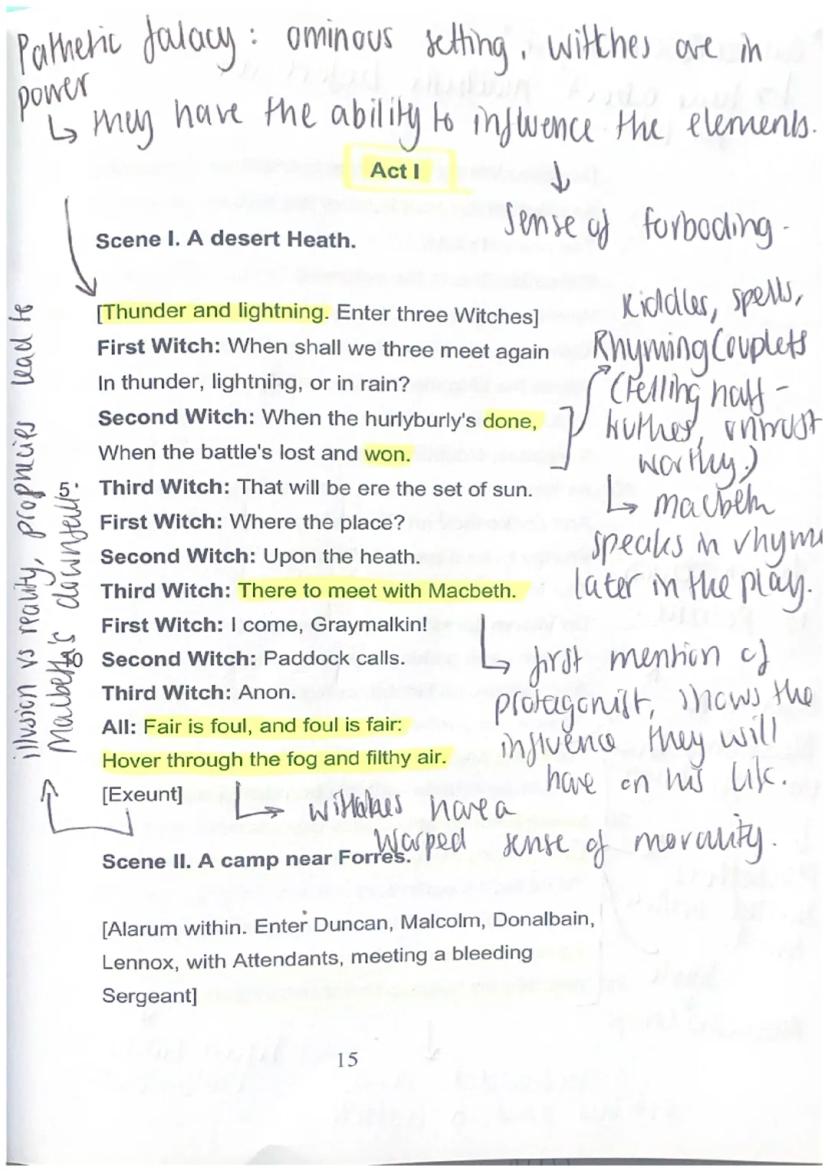

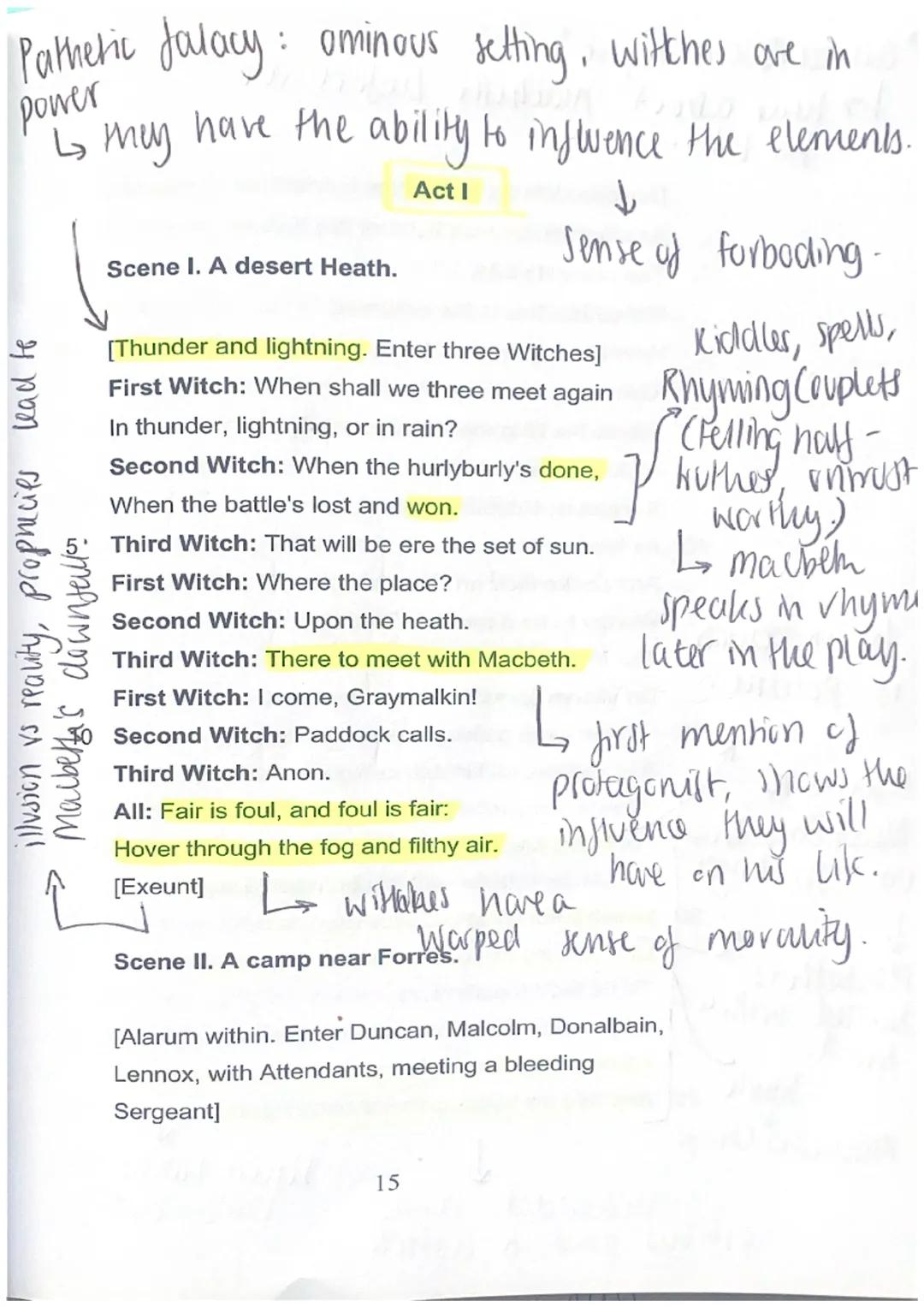
The opening scene of Macbeth establishes a dark and foreboding atmosphere through its Macbeth ominous setting on a desolate heath during a thunderstorm. The three witches in Macbeth immediately demonstrate their supernatural power over the elements, setting the tone for the entire play. Their ability to control weather and predict future events positions them as powerful agents of fate who will influence the tragic events to come.
The witches' dialogue is structured in rhyming couplets, creating an eerie musical quality that emphasizes their otherworldly nature. Their famous paradox "Fair is foul, and foul is fair" introduces the play's central theme of moral ambiguity and deception. This cryptic statement foreshadows how appearances will prove deceptive throughout the play, particularly in relation to Macbeth's character development.
Definition: The heath setting represents a liminal space between civilization and wilderness, where supernatural forces hold sway and moral boundaries become blurred.
Their planned meeting with Macbeth establishes him as their chosen target before he even appears on stage. The witches' influence over natural elements - thunder, lightning, and rain - symbolizes their ability to disrupt both the natural order and human affairs, setting in motion the tragedy that will unfold.
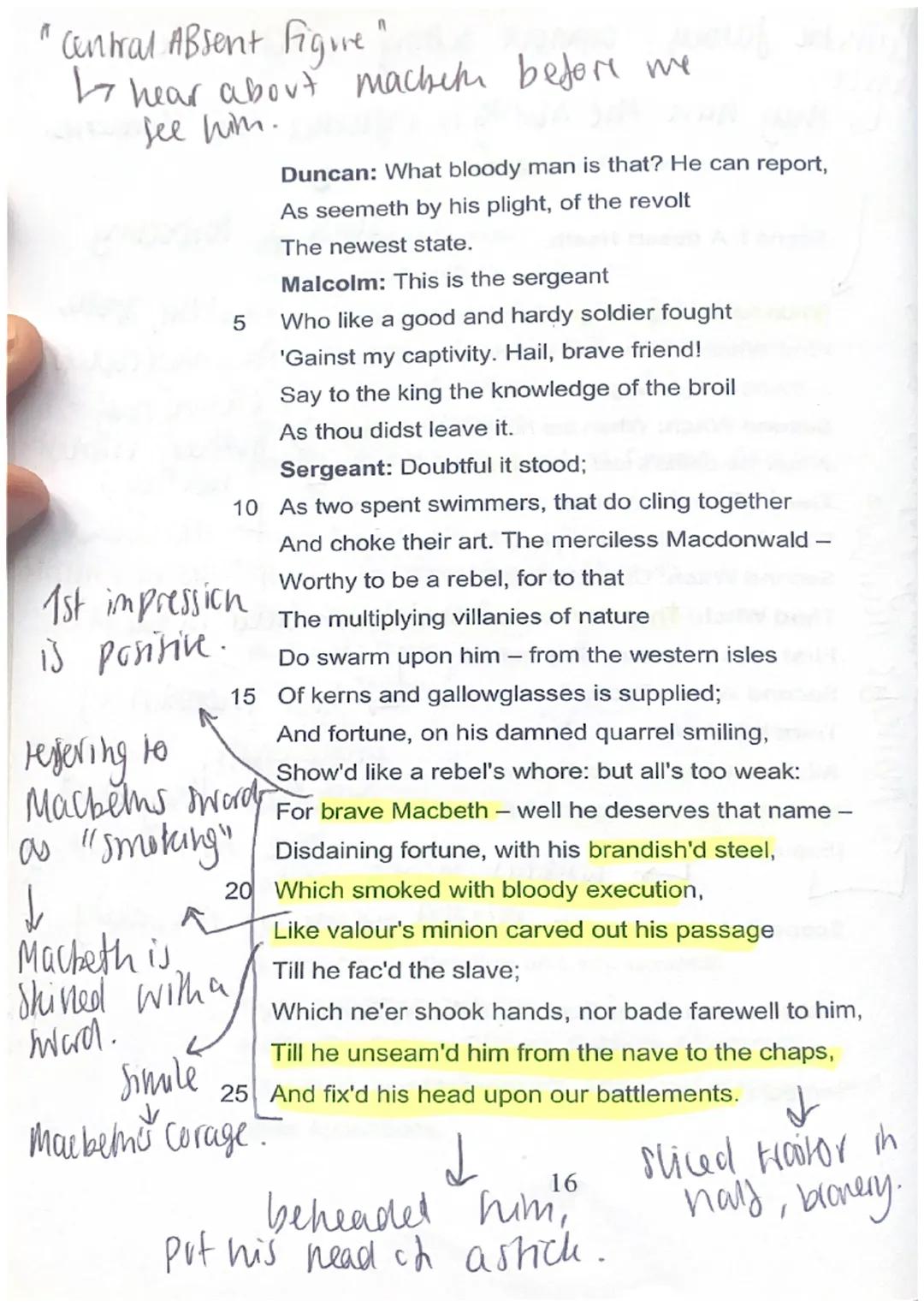
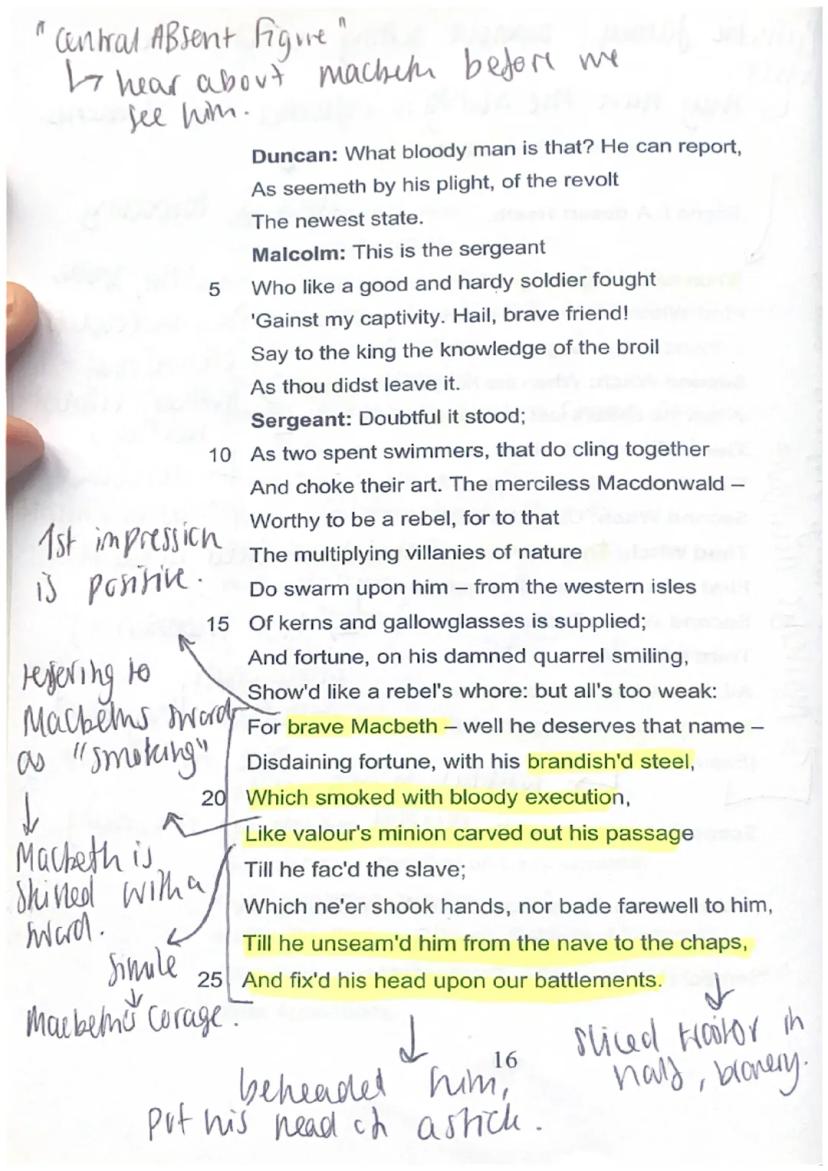
The Macbeth first impression summary presents him as a valiant warrior and loyal subject through others' accounts before his physical appearance. This delayed introduction builds anticipation and allows Shakespeare to establish Macbeth's reputation through the perspectives of other characters, particularly through the wounded sergeant's vivid battlefield report.
Highlight: Macbeth is initially portrayed as a hero through his military prowess and loyalty to King Duncan, making his later transformation more dramatic.
The sergeant's graphic description of Macbeth's victory over the rebel Macdonwald paints him as a fearsome warrior who "carved out his passage" with his "brandished steel." The imagery of smoking swords and severed heads creates a visceral picture of Macbeth's military prowess while also foreshadowing his future violence. This positive initial characterization makes his eventual moral decline even more striking.
The contrast between Macbeth's heroic introduction and his later actions serves as a powerful dramatic device, showing how ambition can corrupt even the most virtuous character. King Duncan's decision to reward Macbeth with the traitor Cawdor's title ironically sets up Macbeth's own future betrayal.
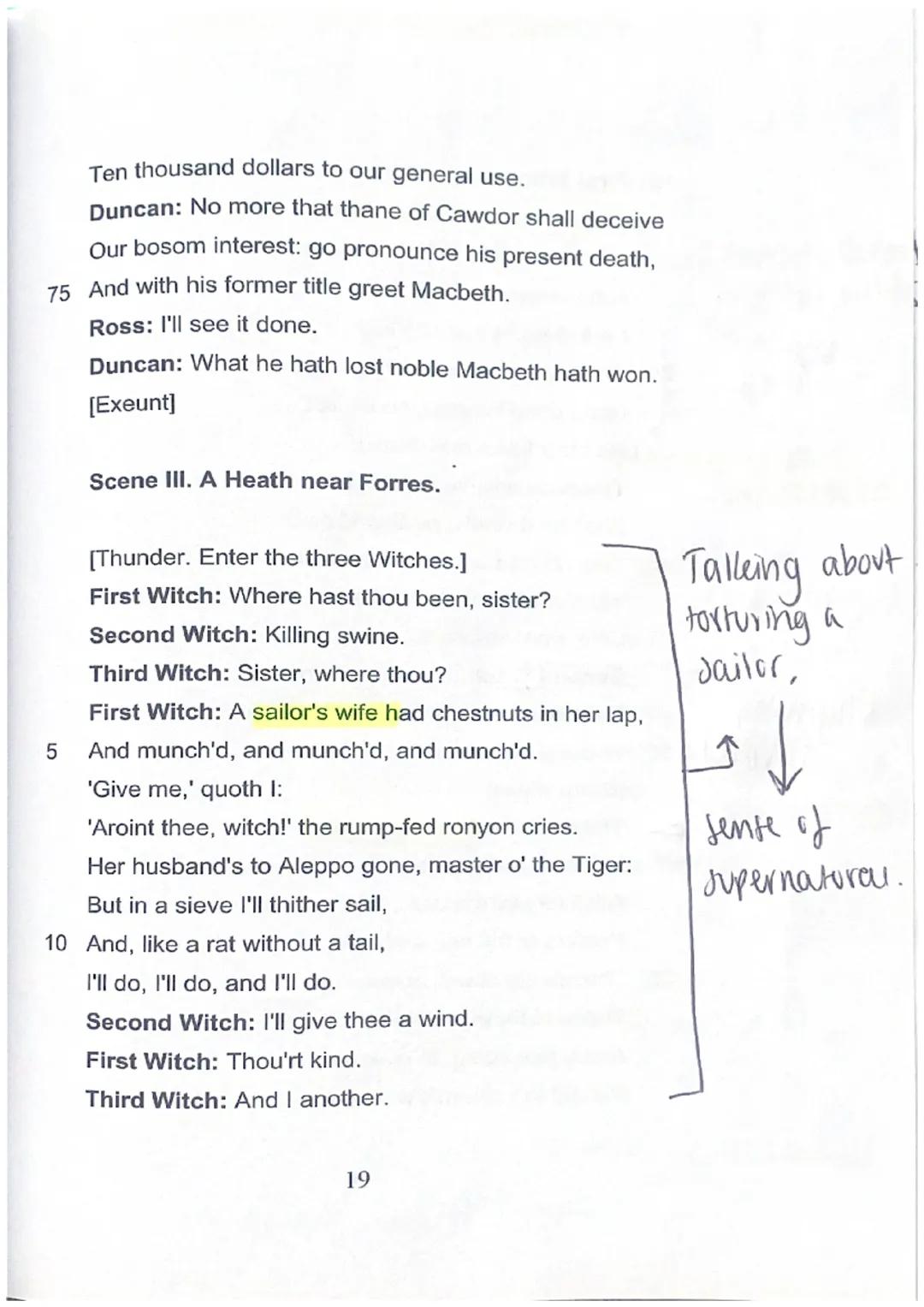
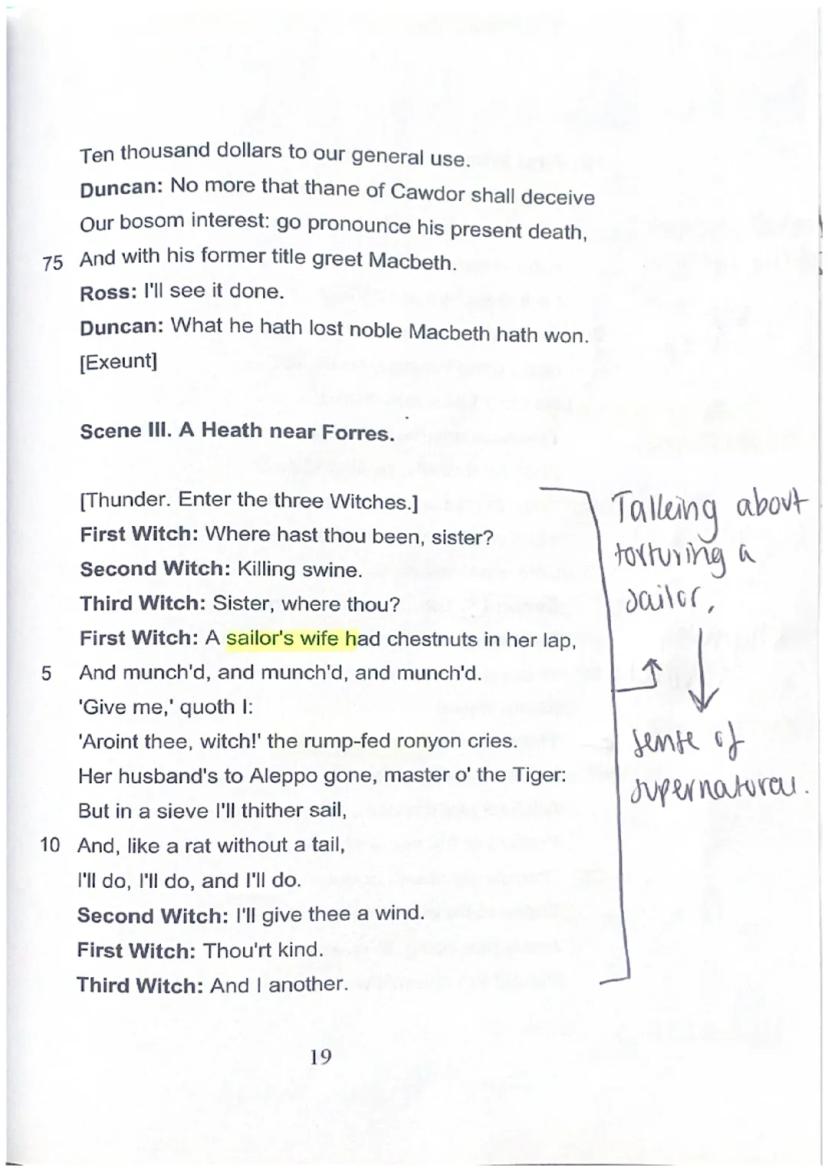
The third scene returns to the witches, revealing their malevolent nature through their casual discussion of cruel acts. Their conversation about tormenting sailors and killing swine demonstrates their casual relationship with evil and their power to inflict suffering on ordinary people. The witches' supernatural abilities extend beyond controlling weather to include cursing individuals and causing prolonged suffering.
Example: The First Witch's ability to sail in a sieve and torment a sailor demonstrates the extent of their supernatural powers and their arbitrary cruelty.
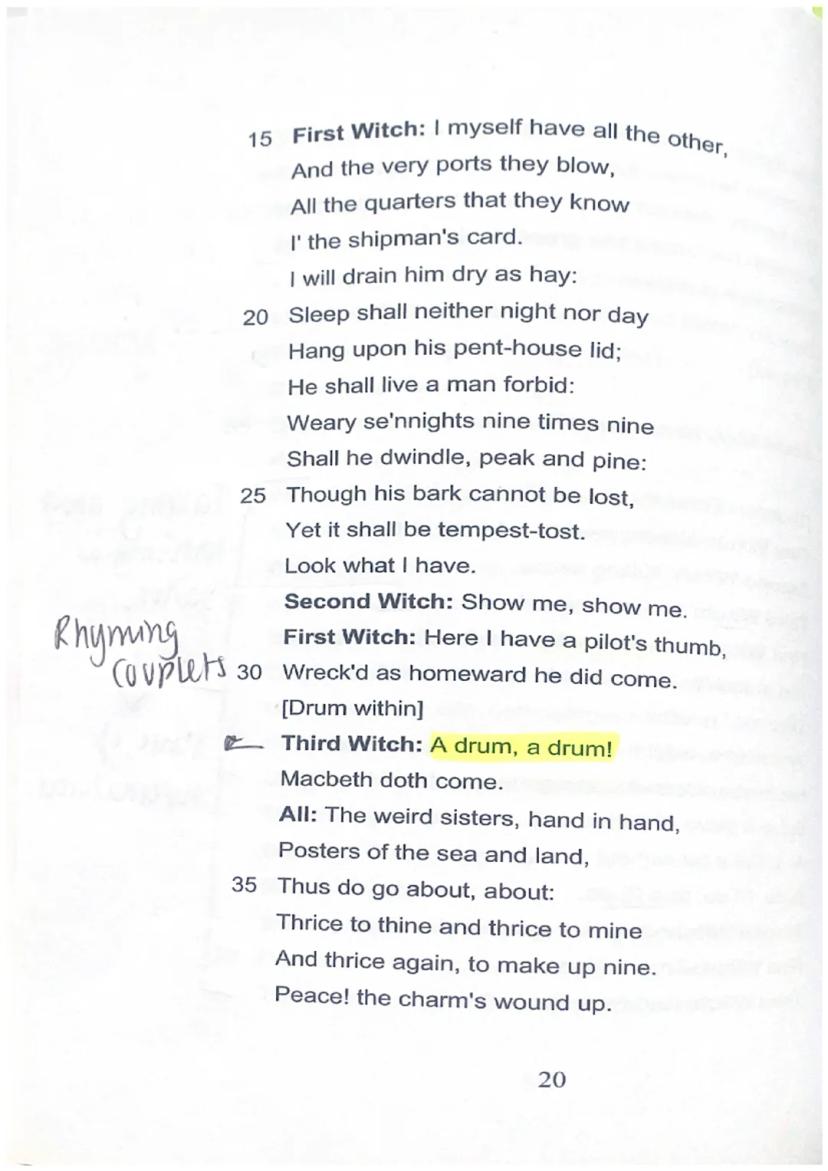
Their ritualistic language and use of magical numbers (particularly three and nine) emphasizes their connection to dark forces. The witches' chanting and circular movements create a sense of building supernatural energy as they prepare for Macbeth's arrival. Their coordinated actions suggest a well-organized force of evil rather than random mischief-makers.
The presence of grotesque elements, like the pilot's thumb, adds to the horror and reinforces their connection to death and dismemberment. This foreshadows the violence that will characterize Macbeth's reign.
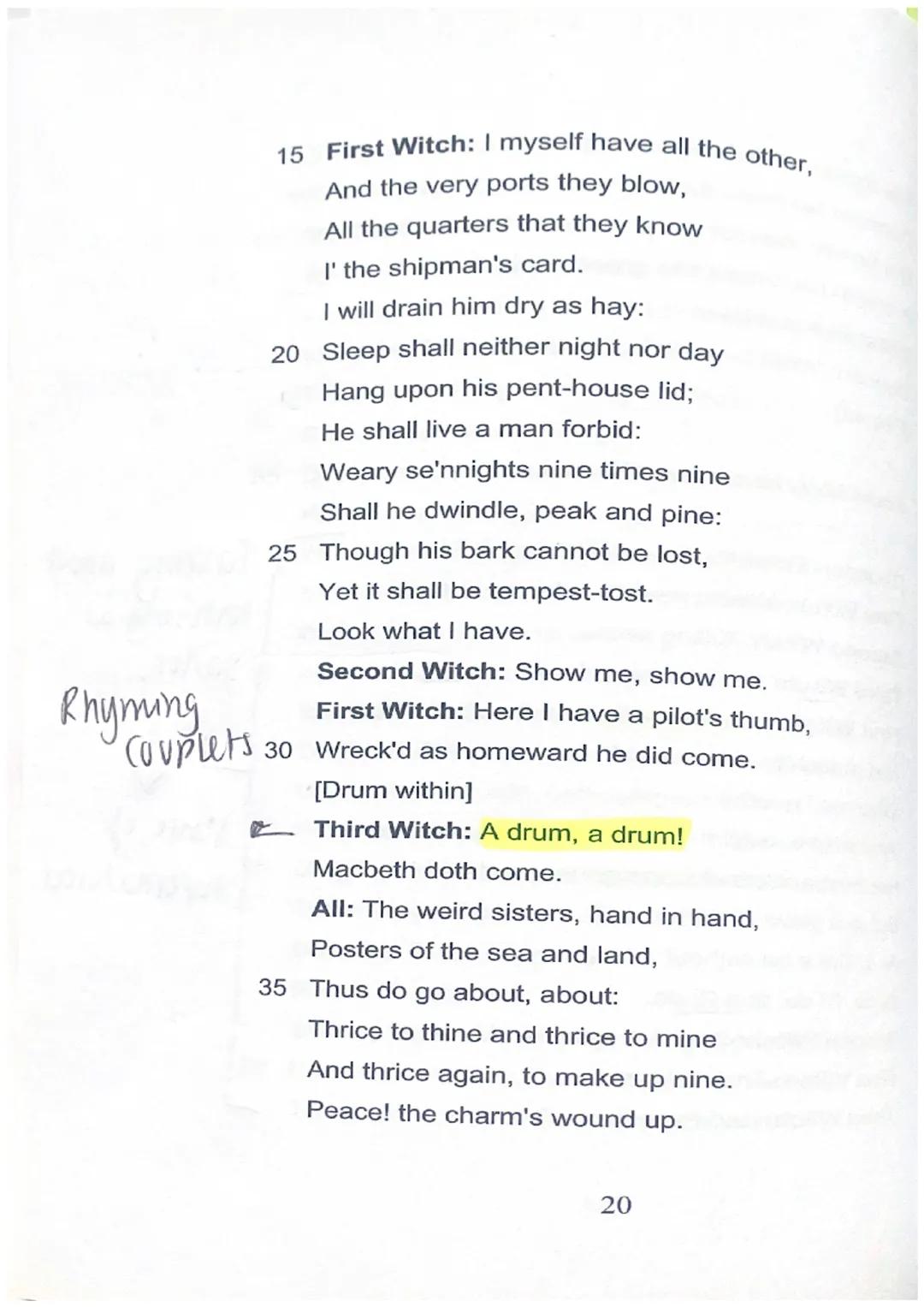
The final section builds tension through the witches' preparation for Macbeth's arrival. Their ritualistic chanting and coordinated movements create a sense of dark ceremony, suggesting the significance of their upcoming encounter with Macbeth. The repetition of numbers and circular movements emphasizes the magical nature of their preparation.
Quote: "The weird sisters, hand in hand, / Posters of the sea and land, / Thus do go about, about"
Their synchronized actions and shared purpose indicate they function as a unified force of destiny rather than individual characters. The drumbeat announcing Macbeth's approach adds dramatic tension and suggests his arrival is part of a larger supernatural design. The phrase "the charm's wound up" indicates their preparation is complete and sets the stage for the pivotal meeting that will trigger the play's tragic events.
The witches' anticipation of Macbeth's arrival suggests they have specifically chosen him as their target, raising questions about fate versus free will that will resonate throughout the play. Their power to influence both natural elements and human affairs positions them as catalysts for the tragedy that follows.
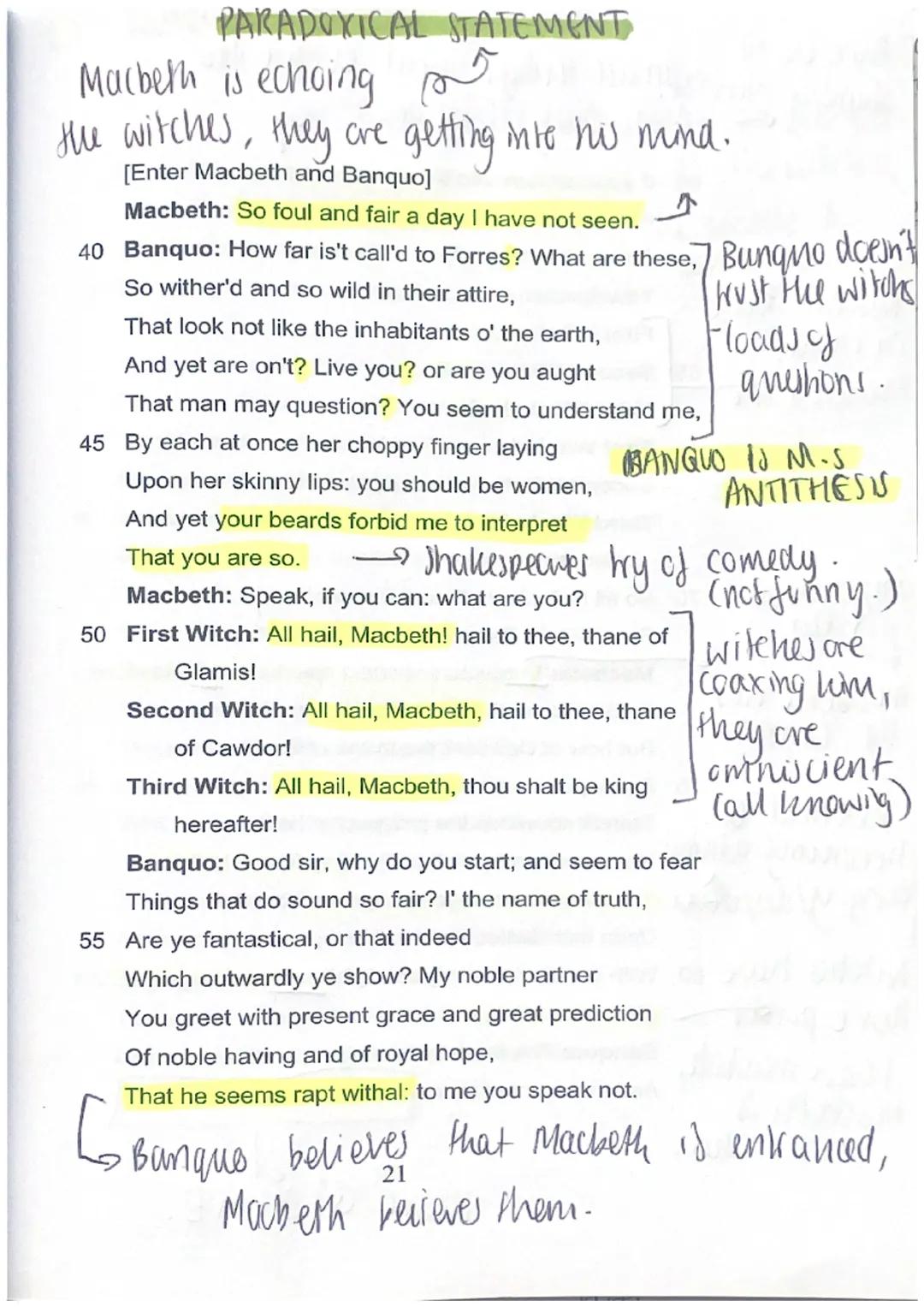
The pivotal scene where Macbeth and Banquo first encounter the witches establishes the dark, supernatural tone that permeates the entire play. In this crucial moment, the Macbeth ominous setting of the blasted heath serves as the perfect backdrop for this fateful meeting. The witches' appearance immediately creates an atmosphere of unease and mystery.
Definition: The "blasted heath" refers to a barren, desolate landscape that symbolizes the moral wasteland the play will become.
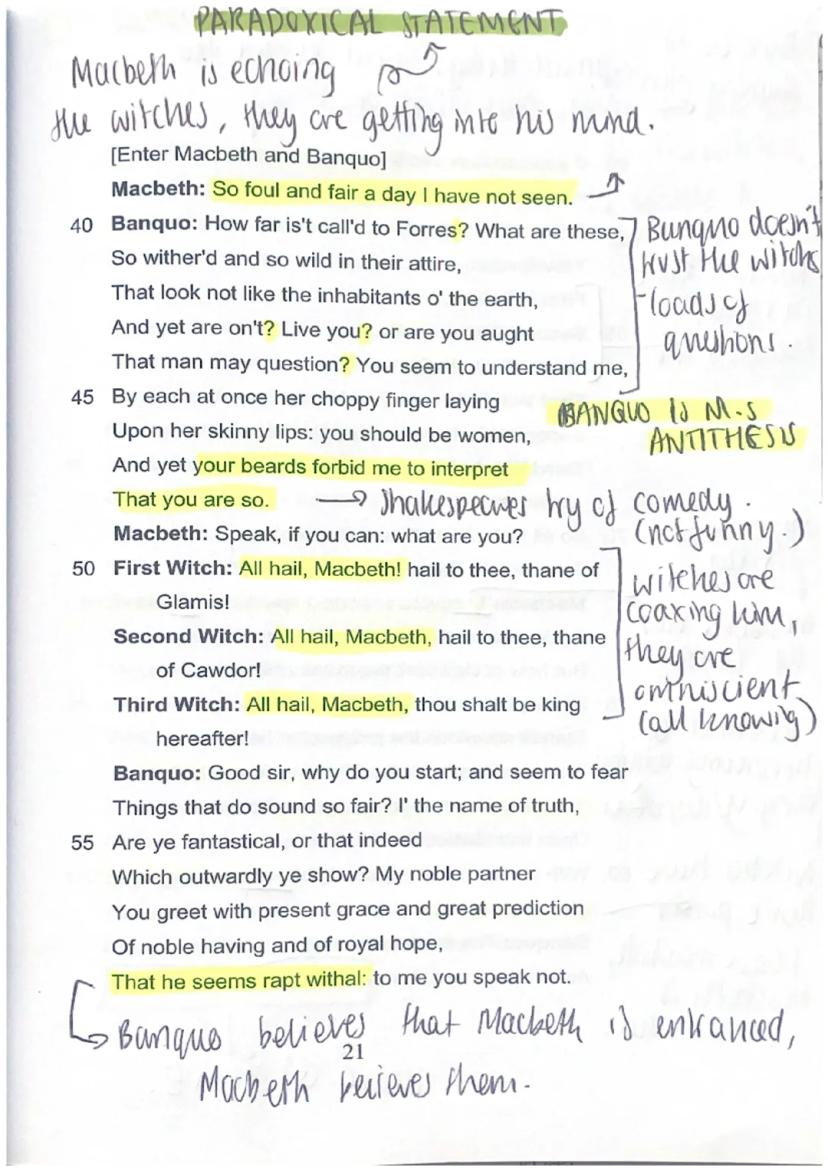
When Macbeth first speaks, he unknowingly echoes the witches' earlier words: "So foul and fair a day I have not seen." This parallel suggests the witches already have a supernatural connection to him. Banquo's reaction provides a stark contrast to Macbeth's, as he approaches the strange creatures with cautious curiosity rather than immediate belief. His description of the witches as being neither clearly male nor female, with their wild attire and beards, emphasizes their otherworldly nature.
The witches in Macbeth analysis reveals their careful manipulation through language. They address Macbeth with three prophecies, each building upon the last: Thane of Glamis (his current title), Thane of Cawdor (a surprise promotion), and finally king. Their method is calculated - they begin with a truth Macbeth already knows, then add a soon-to-be-verified prediction, making the final prophecy about kingship seem more credible.
Highlight: The witches' prophecies are delivered in a way that exploits Macbeth's ambition while maintaining plausible deniability about their true intentions.
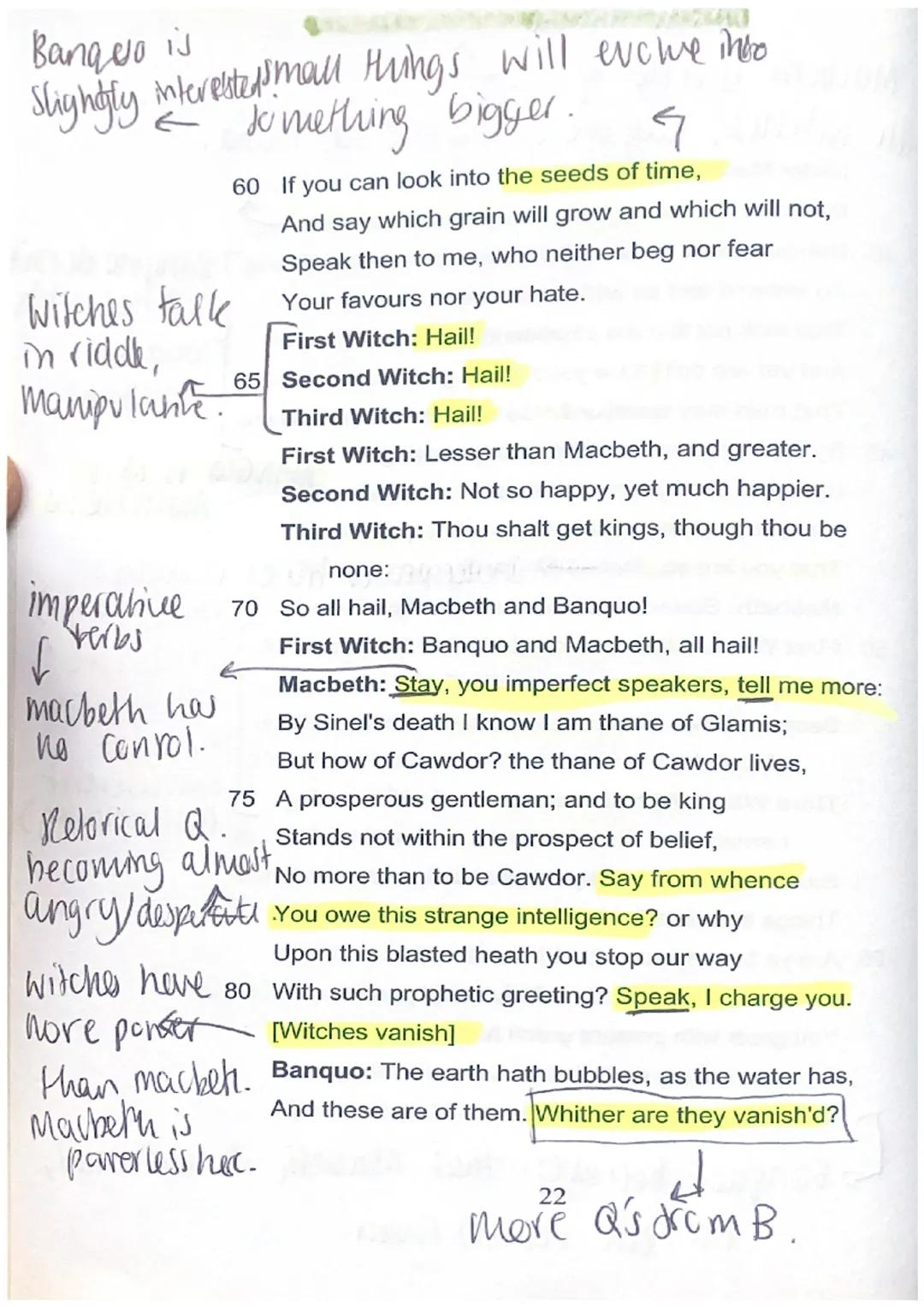
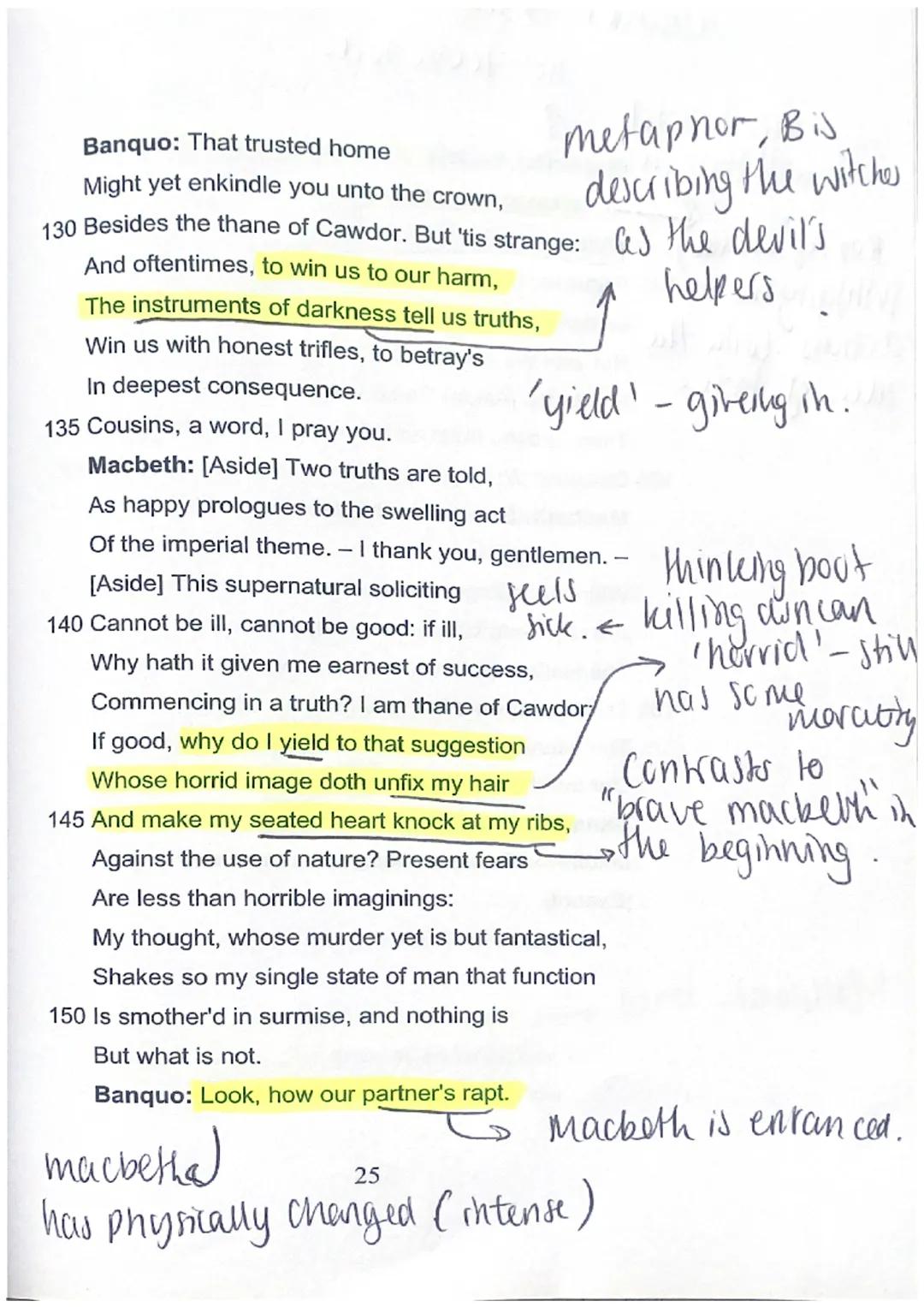
The Macbeth first impression summary shows his immediate and intense reaction to the prophecies. Unlike Banquo, who maintains skepticism, Macbeth becomes visibly shaken and absorbed by the possibilities presented. His response reveals his underlying ambition and susceptibility to supernatural influence.
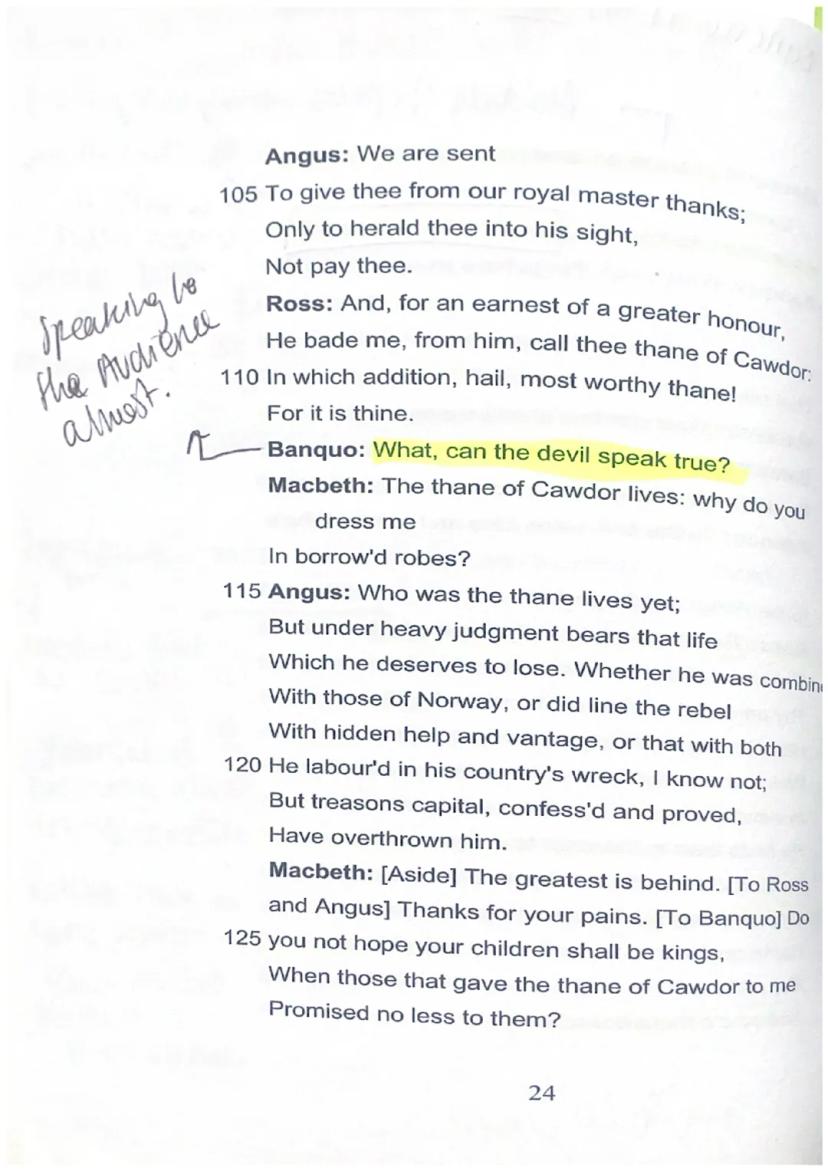
When Ross and Angus arrive to announce Macbeth's promotion to Thane of Cawdor, the immediate fulfillment of the second prophecy has a profound psychological effect. This verification transforms Macbeth's abstract ambitions into concrete possibilities, leading to his first aside where he contemplates regicide.
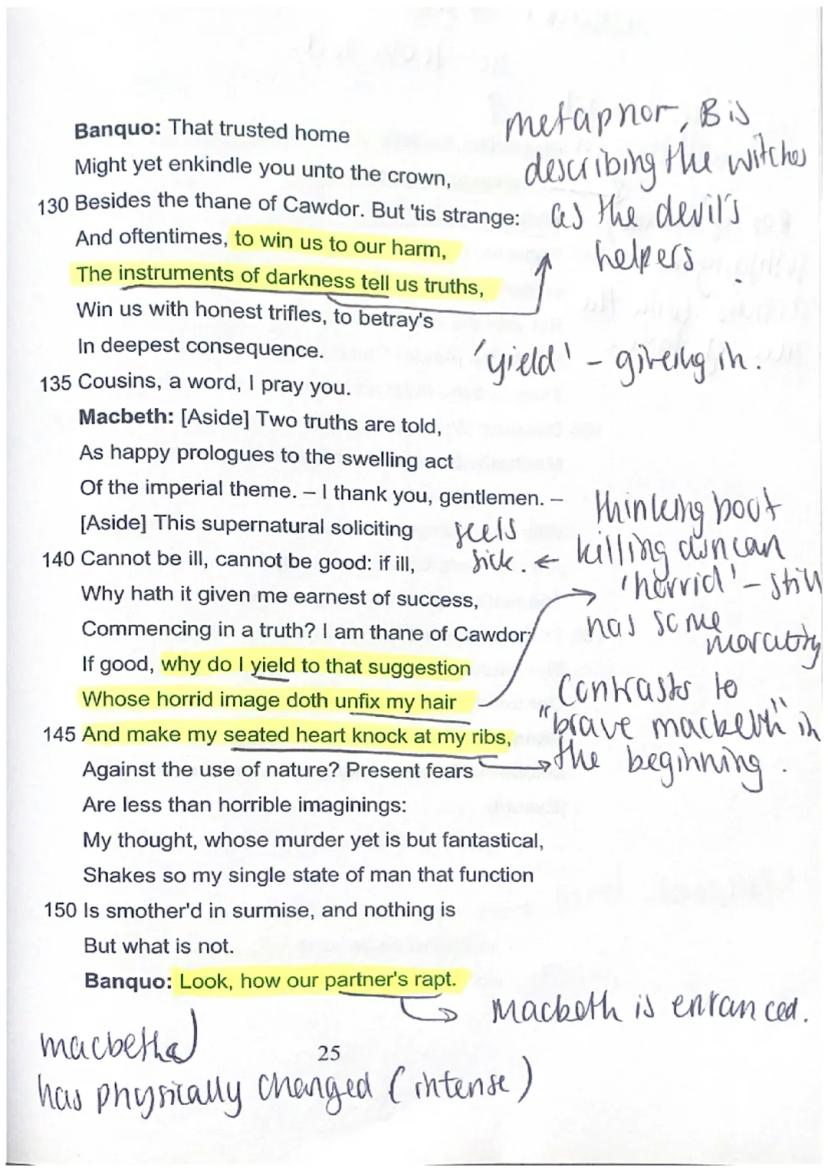
Quote: "If good, why do I yield to that suggestion whose horrid image doth unfix my hair and make my seated heart knock at my ribs, against the use of nature?"
The scene demonstrates Macbeth's rapid moral deterioration. His soliloquy reveals that merely thinking about murdering Duncan causes him physical distress, yet he cannot dismiss the thought. This internal conflict between ambition and conscience becomes the driving force of his character development.
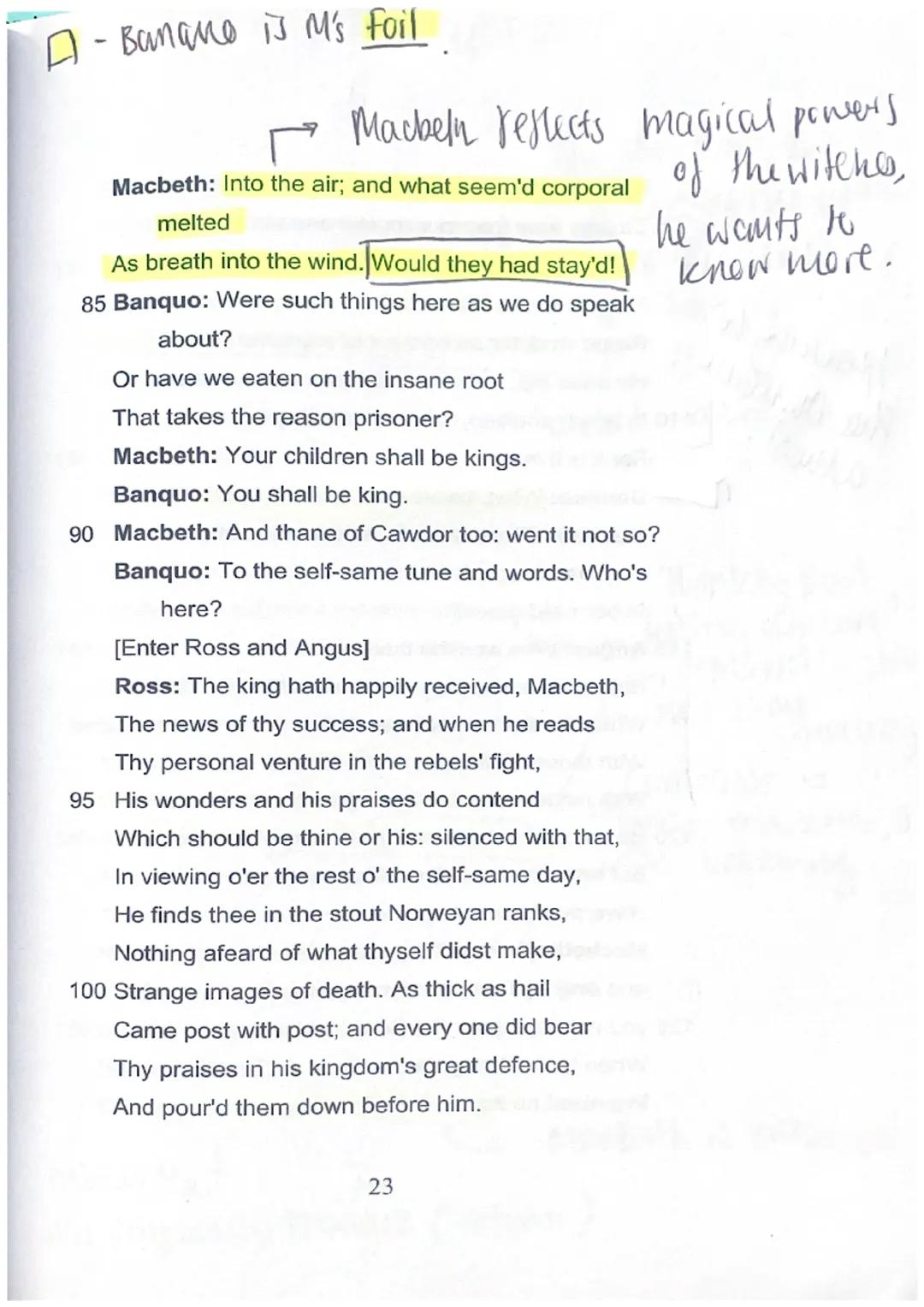
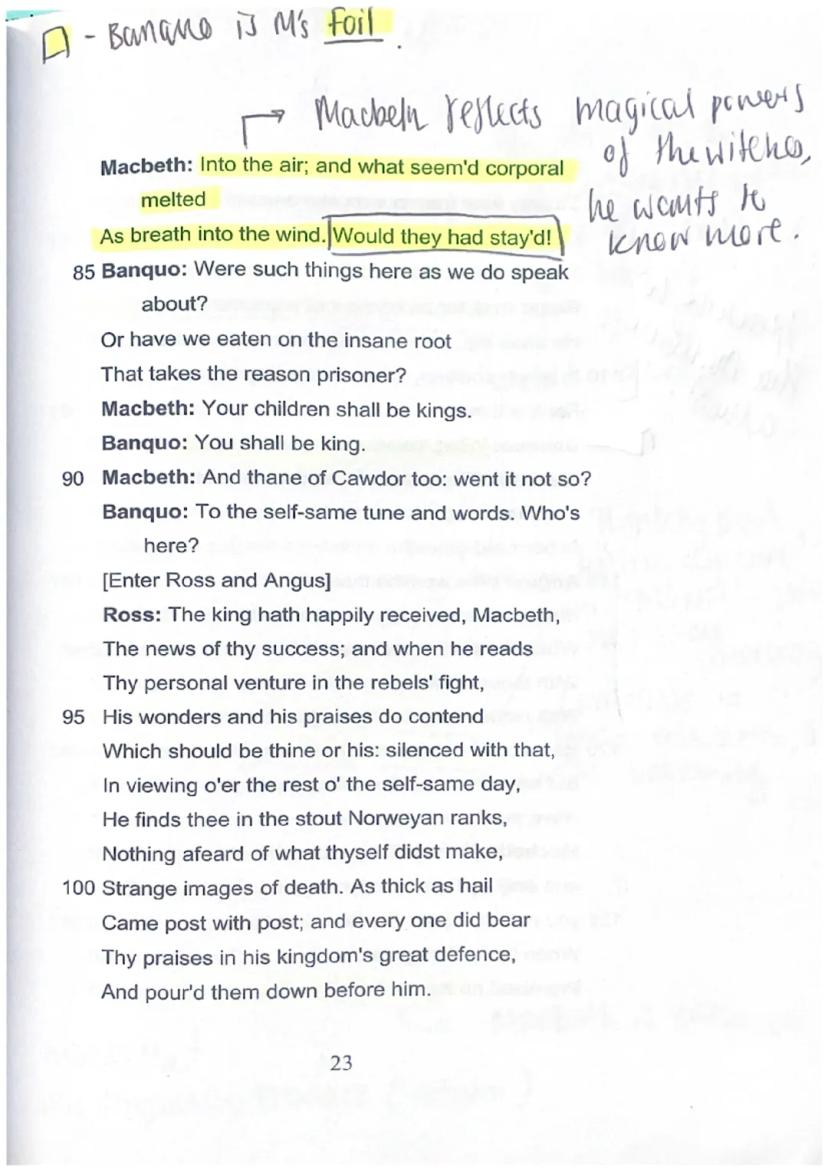
Banquo serves as a moral foil to Macbeth throughout this scene. While both men receive prophecies, their reactions establish their contrasting characters. Banquo approaches the supernatural with rational skepticism, warning Macbeth about the dangers of trusting in "instruments of darkness."
Example: Banquo's warning that "oftentimes, to win us to our harm, the instruments of darkness tell us truths" demonstrates his wisdom and moral clarity.
The witches' prophecy for Banquo - that he will father kings but not be one himself - creates an interesting dynamic. Unlike Macbeth, he doesn't immediately fixate on the prediction or consider taking action to fulfill it. This restraint highlights Macbeth's moral weakness and susceptibility to temptation.
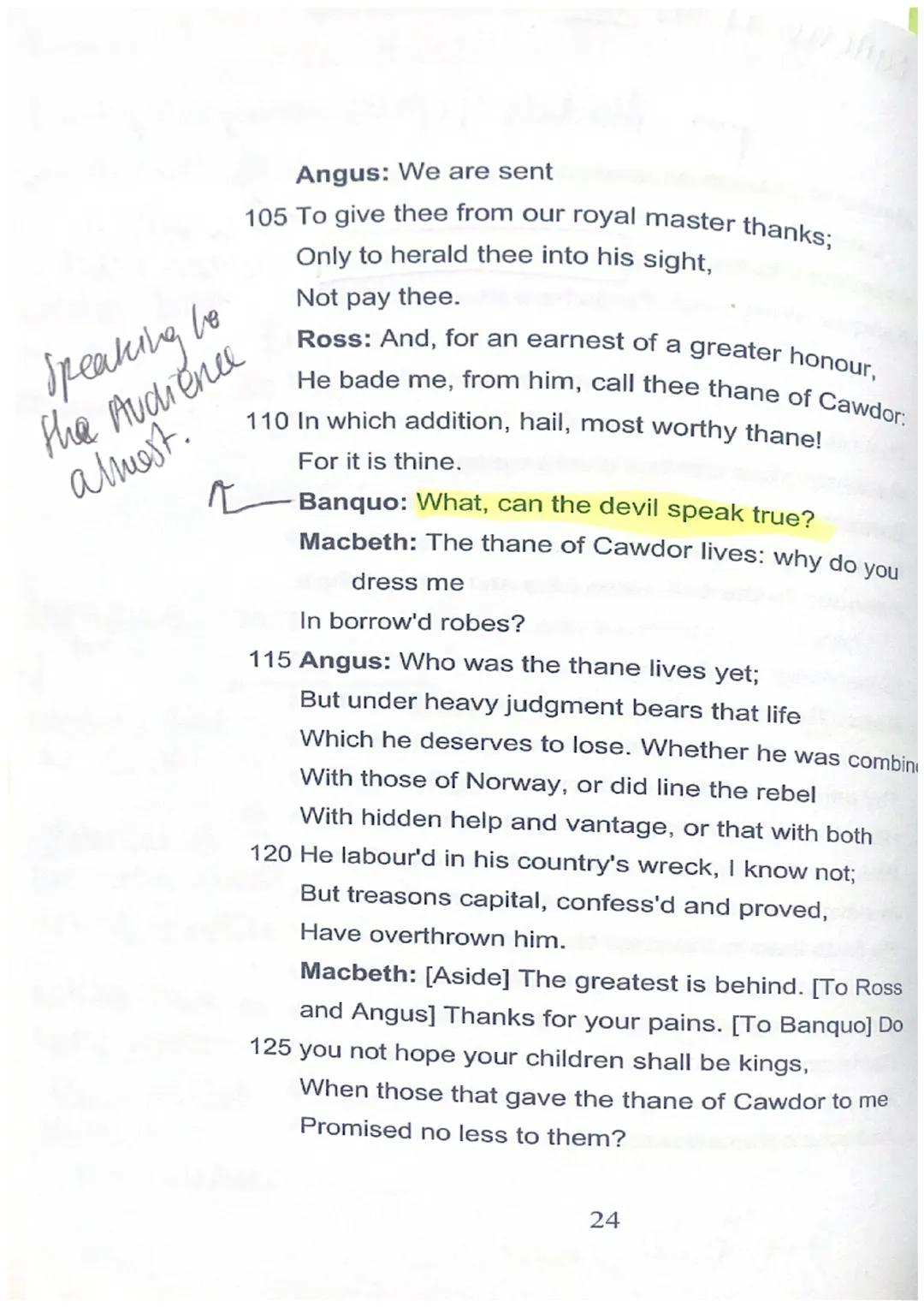
The supernatural elements in this scene establish major themes that resonate throughout the play. The witches represent fate, free will, and moral corruption, while their prophecies serve as catalysts for the tragedy that unfolds.
The physical description of the witches and their sudden vanishing emphasize their otherworldly nature. Banquo's metaphor comparing them to "bubbles" that rise from earth suggests their ethereal quality while hinting at their deceptive nature.
Vocabulary: The term "supernatural soliciting" used by Macbeth refers to the temptation presented by the witches' prophecies, highlighting the intersection of fate and free will in the play.
The scene's conclusion shows Macbeth already transformed by the encounter. His final soliloquy reveals his mind turning toward "horrible imaginings," foreshadowing the violent path he will choose. The contrast between his earlier heroic reputation and this new, contemplative state marks the beginning of his tragic descent.
The Macbeth first impression summary reveals a pivotal moment where the protagonist grapples with the prophecy of becoming king. In this scene, Macbeth's internal struggle manifests through his aside speeches, showing his immediate attraction to the idea of kingship while attempting to maintain an appearance of loyalty.
The Macbeth ominous setting creates a perfect backdrop for this crucial scene. As Macbeth processes the witches' prophecy, he speaks in metaphors about "strange garments" that don't quite fit, suggesting his discomfort with his potential future role. The natural environment, with its misty hills and wild landscape, mirrors the turbulent thoughts in Macbeth's mind as he contemplates the possibility of becoming king.
Definition: An aside in theater is a dramatic device where a character speaks their private thoughts directly to the audience, while other characters on stage cannot hear them.
The interaction between Macbeth and Banquo demonstrates their contrasting reactions to the supernatural predictions. While Banquo remains cautious and observant, noting how "new honours come upon him," Macbeth already shows signs of ambition taking root. His famous line "Time and the hour runs through the roughest day" reveals his willingness to wait for destiny to unfold, though his subsequent actions will prove otherwise.
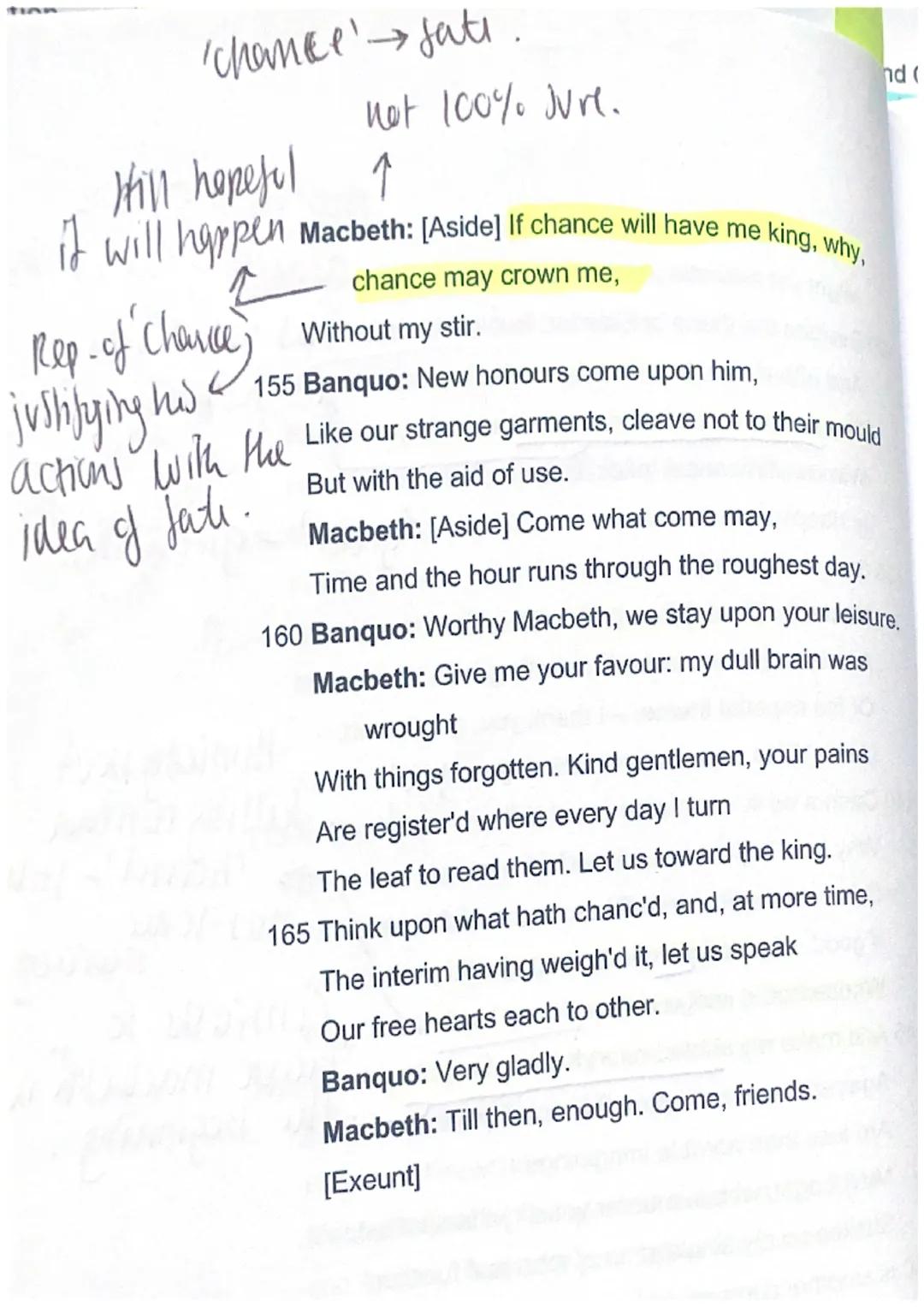
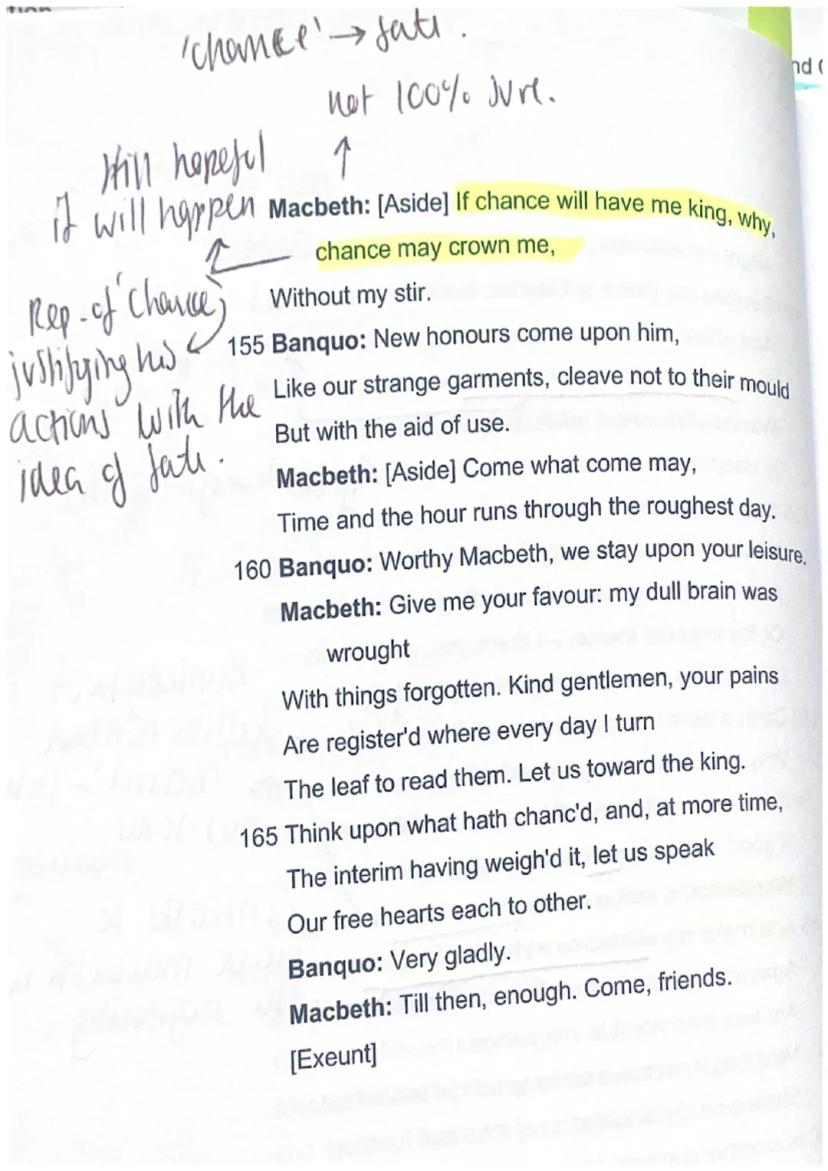
The witches in Macbeth analysis shows how their prophecy serves as a catalyst for Macbeth's transformation. Their predictions don't force his actions but rather awaken his dormant ambitions. The scene demonstrates how Macbeth begins justifying potential future actions by attributing them to fate rather than personal choice.
Highlight: Macbeth's reliance on chance and fate ("If chance will have me king, why chance may crown me") reveals his early attempts to absolve himself of responsibility for his future actions.
The psychological complexity of this scene is evident in Macbeth's behavior toward Banquo and other nobles. His statement about his "dull brain" being "wrought with things forgotten" shows his attempt to cover his preoccupation with the prophecy. This diplomatic facade contrasts sharply with his private thoughts, revealing the beginning of his journey toward deception and betrayal.
The scene concludes with Macbeth suggesting a future discussion with Banquo about the events, though his true intentions remain unclear. This moment marks the beginning of the play's exploration of appearance versus reality, as Macbeth starts to develop his public persona while harboring private ambitions.
Quote: "Think upon what hath chanc'd, and, at more time, The interim having weigh'd it, let us speak Our free hearts each to other."
Our AI Companion is a student-focused AI tool that offers more than just answers. Built on millions of Knowunity resources, it provides relevant information, personalised study plans, quizzes, and content directly in the chat, adapting to your individual learning journey.
You can download the app from Google Play Store and Apple App Store.
That's right! Enjoy free access to study content, connect with fellow students, and get instant help – all at your fingertips.
App Store
Google Play
The app is very easy to use and well designed. I have found everything I was looking for so far and have been able to learn a lot from the presentations! I will definitely use the app for a class assignment! And of course it also helps a lot as an inspiration.
Stefan S
iOS user
This app is really great. There are so many study notes and help [...]. My problem subject is French, for example, and the app has so many options for help. Thanks to this app, I have improved my French. I would recommend it to anyone.
Samantha Klich
Android user
Wow, I am really amazed. I just tried the app because I've seen it advertised many times and was absolutely stunned. This app is THE HELP you want for school and above all, it offers so many things, such as workouts and fact sheets, which have been VERY helpful to me personally.
Anna
iOS user
Best app on earth! no words because it’s too good
Thomas R
iOS user
Just amazing. Let's me revise 10x better, this app is a quick 10/10. I highly recommend it to anyone. I can watch and search for notes. I can save them in the subject folder. I can revise it any time when I come back. If you haven't tried this app, you're really missing out.
Basil
Android user
This app has made me feel so much more confident in my exam prep, not only through boosting my own self confidence through the features that allow you to connect with others and feel less alone, but also through the way the app itself is centred around making you feel better. It is easy to navigate, fun to use, and helpful to anyone struggling in absolutely any way.
David K
iOS user
The app's just great! All I have to do is enter the topic in the search bar and I get the response real fast. I don't have to watch 10 YouTube videos to understand something, so I'm saving my time. Highly recommended!
Sudenaz Ocak
Android user
In school I was really bad at maths but thanks to the app, I am doing better now. I am so grateful that you made the app.
Greenlight Bonnie
Android user
very reliable app to help and grow your ideas of Maths, English and other related topics in your works. please use this app if your struggling in areas, this app is key for that. wish I'd of done a review before. and it's also free so don't worry about that.
Rohan U
Android user
I know a lot of apps use fake accounts to boost their reviews but this app deserves it all. Originally I was getting 4 in my English exams and this time I got a grade 7. I didn’t even know about this app three days until the exam and it has helped A LOT. Please actually trust me and use it as I’m sure you too will see developments.
Xander S
iOS user
THE QUIZES AND FLASHCARDS ARE SO USEFUL AND I LOVE Knowunity AI. IT ALSO IS LITREALLY LIKE CHATGPT BUT SMARTER!! HELPED ME WITH MY MASCARA PROBLEMS TOO!! AS WELL AS MY REAL SUBJECTS ! DUHHH 😍😁😲🤑💗✨🎀😮
Elisha
iOS user
This apps acc the goat. I find revision so boring but this app makes it so easy to organize it all and then you can ask the freeeee ai to test yourself so good and you can easily upload your own stuff. highly recommend as someone taking mocks now
Paul T
iOS user
The app is very easy to use and well designed. I have found everything I was looking for so far and have been able to learn a lot from the presentations! I will definitely use the app for a class assignment! And of course it also helps a lot as an inspiration.
Stefan S
iOS user
This app is really great. There are so many study notes and help [...]. My problem subject is French, for example, and the app has so many options for help. Thanks to this app, I have improved my French. I would recommend it to anyone.
Samantha Klich
Android user
Wow, I am really amazed. I just tried the app because I've seen it advertised many times and was absolutely stunned. This app is THE HELP you want for school and above all, it offers so many things, such as workouts and fact sheets, which have been VERY helpful to me personally.
Anna
iOS user
Best app on earth! no words because it’s too good
Thomas R
iOS user
Just amazing. Let's me revise 10x better, this app is a quick 10/10. I highly recommend it to anyone. I can watch and search for notes. I can save them in the subject folder. I can revise it any time when I come back. If you haven't tried this app, you're really missing out.
Basil
Android user
This app has made me feel so much more confident in my exam prep, not only through boosting my own self confidence through the features that allow you to connect with others and feel less alone, but also through the way the app itself is centred around making you feel better. It is easy to navigate, fun to use, and helpful to anyone struggling in absolutely any way.
David K
iOS user
The app's just great! All I have to do is enter the topic in the search bar and I get the response real fast. I don't have to watch 10 YouTube videos to understand something, so I'm saving my time. Highly recommended!
Sudenaz Ocak
Android user
In school I was really bad at maths but thanks to the app, I am doing better now. I am so grateful that you made the app.
Greenlight Bonnie
Android user
very reliable app to help and grow your ideas of Maths, English and other related topics in your works. please use this app if your struggling in areas, this app is key for that. wish I'd of done a review before. and it's also free so don't worry about that.
Rohan U
Android user
I know a lot of apps use fake accounts to boost their reviews but this app deserves it all. Originally I was getting 4 in my English exams and this time I got a grade 7. I didn’t even know about this app three days until the exam and it has helped A LOT. Please actually trust me and use it as I’m sure you too will see developments.
Xander S
iOS user
THE QUIZES AND FLASHCARDS ARE SO USEFUL AND I LOVE Knowunity AI. IT ALSO IS LITREALLY LIKE CHATGPT BUT SMARTER!! HELPED ME WITH MY MASCARA PROBLEMS TOO!! AS WELL AS MY REAL SUBJECTS ! DUHHH 😍😁😲🤑💗✨🎀😮
Elisha
iOS user
This apps acc the goat. I find revision so boring but this app makes it so easy to organize it all and then you can ask the freeeee ai to test yourself so good and you can easily upload your own stuff. highly recommend as someone taking mocks now
Paul T
iOS user
Leni
@inholeni.5926
The dark and supernatural elements of Shakespeare's Macbeth create an atmosphere of evil and foreboding that shapes the entire tragedy.
The witches in Macbeth analysisreveals how these mysterious creatures serve as catalysts for Macbeth's downfall. Meeting on a desolate... Show more
Access to all documents
Improve your grades
Join milions of students
The opening scene of Macbeth establishes a dark and foreboding atmosphere through its Macbeth ominous setting on a desolate heath during a thunderstorm. The three witches in Macbeth immediately demonstrate their supernatural power over the elements, setting the tone for the entire play. Their ability to control weather and predict future events positions them as powerful agents of fate who will influence the tragic events to come.
The witches' dialogue is structured in rhyming couplets, creating an eerie musical quality that emphasizes their otherworldly nature. Their famous paradox "Fair is foul, and foul is fair" introduces the play's central theme of moral ambiguity and deception. This cryptic statement foreshadows how appearances will prove deceptive throughout the play, particularly in relation to Macbeth's character development.
Definition: The heath setting represents a liminal space between civilization and wilderness, where supernatural forces hold sway and moral boundaries become blurred.
Their planned meeting with Macbeth establishes him as their chosen target before he even appears on stage. The witches' influence over natural elements - thunder, lightning, and rain - symbolizes their ability to disrupt both the natural order and human affairs, setting in motion the tragedy that will unfold.
Access to all documents
Improve your grades
Join milions of students
The Macbeth first impression summary presents him as a valiant warrior and loyal subject through others' accounts before his physical appearance. This delayed introduction builds anticipation and allows Shakespeare to establish Macbeth's reputation through the perspectives of other characters, particularly through the wounded sergeant's vivid battlefield report.
Highlight: Macbeth is initially portrayed as a hero through his military prowess and loyalty to King Duncan, making his later transformation more dramatic.
The sergeant's graphic description of Macbeth's victory over the rebel Macdonwald paints him as a fearsome warrior who "carved out his passage" with his "brandished steel." The imagery of smoking swords and severed heads creates a visceral picture of Macbeth's military prowess while also foreshadowing his future violence. This positive initial characterization makes his eventual moral decline even more striking.
The contrast between Macbeth's heroic introduction and his later actions serves as a powerful dramatic device, showing how ambition can corrupt even the most virtuous character. King Duncan's decision to reward Macbeth with the traitor Cawdor's title ironically sets up Macbeth's own future betrayal.
Access to all documents
Improve your grades
Join milions of students
The third scene returns to the witches, revealing their malevolent nature through their casual discussion of cruel acts. Their conversation about tormenting sailors and killing swine demonstrates their casual relationship with evil and their power to inflict suffering on ordinary people. The witches' supernatural abilities extend beyond controlling weather to include cursing individuals and causing prolonged suffering.
Example: The First Witch's ability to sail in a sieve and torment a sailor demonstrates the extent of their supernatural powers and their arbitrary cruelty.
Their ritualistic language and use of magical numbers (particularly three and nine) emphasizes their connection to dark forces. The witches' chanting and circular movements create a sense of building supernatural energy as they prepare for Macbeth's arrival. Their coordinated actions suggest a well-organized force of evil rather than random mischief-makers.
The presence of grotesque elements, like the pilot's thumb, adds to the horror and reinforces their connection to death and dismemberment. This foreshadows the violence that will characterize Macbeth's reign.
Access to all documents
Improve your grades
Join milions of students
The final section builds tension through the witches' preparation for Macbeth's arrival. Their ritualistic chanting and coordinated movements create a sense of dark ceremony, suggesting the significance of their upcoming encounter with Macbeth. The repetition of numbers and circular movements emphasizes the magical nature of their preparation.
Quote: "The weird sisters, hand in hand, / Posters of the sea and land, / Thus do go about, about"
Their synchronized actions and shared purpose indicate they function as a unified force of destiny rather than individual characters. The drumbeat announcing Macbeth's approach adds dramatic tension and suggests his arrival is part of a larger supernatural design. The phrase "the charm's wound up" indicates their preparation is complete and sets the stage for the pivotal meeting that will trigger the play's tragic events.
The witches' anticipation of Macbeth's arrival suggests they have specifically chosen him as their target, raising questions about fate versus free will that will resonate throughout the play. Their power to influence both natural elements and human affairs positions them as catalysts for the tragedy that follows.
Access to all documents
Improve your grades
Join milions of students
The pivotal scene where Macbeth and Banquo first encounter the witches establishes the dark, supernatural tone that permeates the entire play. In this crucial moment, the Macbeth ominous setting of the blasted heath serves as the perfect backdrop for this fateful meeting. The witches' appearance immediately creates an atmosphere of unease and mystery.
Definition: The "blasted heath" refers to a barren, desolate landscape that symbolizes the moral wasteland the play will become.
When Macbeth first speaks, he unknowingly echoes the witches' earlier words: "So foul and fair a day I have not seen." This parallel suggests the witches already have a supernatural connection to him. Banquo's reaction provides a stark contrast to Macbeth's, as he approaches the strange creatures with cautious curiosity rather than immediate belief. His description of the witches as being neither clearly male nor female, with their wild attire and beards, emphasizes their otherworldly nature.
The witches in Macbeth analysis reveals their careful manipulation through language. They address Macbeth with three prophecies, each building upon the last: Thane of Glamis (his current title), Thane of Cawdor (a surprise promotion), and finally king. Their method is calculated - they begin with a truth Macbeth already knows, then add a soon-to-be-verified prediction, making the final prophecy about kingship seem more credible.
Highlight: The witches' prophecies are delivered in a way that exploits Macbeth's ambition while maintaining plausible deniability about their true intentions.
Access to all documents
Improve your grades
Join milions of students
The Macbeth first impression summary shows his immediate and intense reaction to the prophecies. Unlike Banquo, who maintains skepticism, Macbeth becomes visibly shaken and absorbed by the possibilities presented. His response reveals his underlying ambition and susceptibility to supernatural influence.
When Ross and Angus arrive to announce Macbeth's promotion to Thane of Cawdor, the immediate fulfillment of the second prophecy has a profound psychological effect. This verification transforms Macbeth's abstract ambitions into concrete possibilities, leading to his first aside where he contemplates regicide.
Quote: "If good, why do I yield to that suggestion whose horrid image doth unfix my hair and make my seated heart knock at my ribs, against the use of nature?"
The scene demonstrates Macbeth's rapid moral deterioration. His soliloquy reveals that merely thinking about murdering Duncan causes him physical distress, yet he cannot dismiss the thought. This internal conflict between ambition and conscience becomes the driving force of his character development.
Access to all documents
Improve your grades
Join milions of students
Banquo serves as a moral foil to Macbeth throughout this scene. While both men receive prophecies, their reactions establish their contrasting characters. Banquo approaches the supernatural with rational skepticism, warning Macbeth about the dangers of trusting in "instruments of darkness."
Example: Banquo's warning that "oftentimes, to win us to our harm, the instruments of darkness tell us truths" demonstrates his wisdom and moral clarity.
The witches' prophecy for Banquo - that he will father kings but not be one himself - creates an interesting dynamic. Unlike Macbeth, he doesn't immediately fixate on the prediction or consider taking action to fulfill it. This restraint highlights Macbeth's moral weakness and susceptibility to temptation.
Access to all documents
Improve your grades
Join milions of students
The supernatural elements in this scene establish major themes that resonate throughout the play. The witches represent fate, free will, and moral corruption, while their prophecies serve as catalysts for the tragedy that unfolds.
The physical description of the witches and their sudden vanishing emphasize their otherworldly nature. Banquo's metaphor comparing them to "bubbles" that rise from earth suggests their ethereal quality while hinting at their deceptive nature.
Vocabulary: The term "supernatural soliciting" used by Macbeth refers to the temptation presented by the witches' prophecies, highlighting the intersection of fate and free will in the play.
The scene's conclusion shows Macbeth already transformed by the encounter. His final soliloquy reveals his mind turning toward "horrible imaginings," foreshadowing the violent path he will choose. The contrast between his earlier heroic reputation and this new, contemplative state marks the beginning of his tragic descent.
Access to all documents
Improve your grades
Join milions of students
The Macbeth first impression summary reveals a pivotal moment where the protagonist grapples with the prophecy of becoming king. In this scene, Macbeth's internal struggle manifests through his aside speeches, showing his immediate attraction to the idea of kingship while attempting to maintain an appearance of loyalty.
The Macbeth ominous setting creates a perfect backdrop for this crucial scene. As Macbeth processes the witches' prophecy, he speaks in metaphors about "strange garments" that don't quite fit, suggesting his discomfort with his potential future role. The natural environment, with its misty hills and wild landscape, mirrors the turbulent thoughts in Macbeth's mind as he contemplates the possibility of becoming king.
Definition: An aside in theater is a dramatic device where a character speaks their private thoughts directly to the audience, while other characters on stage cannot hear them.
The interaction between Macbeth and Banquo demonstrates their contrasting reactions to the supernatural predictions. While Banquo remains cautious and observant, noting how "new honours come upon him," Macbeth already shows signs of ambition taking root. His famous line "Time and the hour runs through the roughest day" reveals his willingness to wait for destiny to unfold, though his subsequent actions will prove otherwise.
Access to all documents
Improve your grades
Join milions of students
The witches in Macbeth analysis shows how their prophecy serves as a catalyst for Macbeth's transformation. Their predictions don't force his actions but rather awaken his dormant ambitions. The scene demonstrates how Macbeth begins justifying potential future actions by attributing them to fate rather than personal choice.
Highlight: Macbeth's reliance on chance and fate ("If chance will have me king, why chance may crown me") reveals his early attempts to absolve himself of responsibility for his future actions.
The psychological complexity of this scene is evident in Macbeth's behavior toward Banquo and other nobles. His statement about his "dull brain" being "wrought with things forgotten" shows his attempt to cover his preoccupation with the prophecy. This diplomatic facade contrasts sharply with his private thoughts, revealing the beginning of his journey toward deception and betrayal.
The scene concludes with Macbeth suggesting a future discussion with Banquo about the events, though his true intentions remain unclear. This moment marks the beginning of the play's exploration of appearance versus reality, as Macbeth starts to develop his public persona while harboring private ambitions.
Quote: "Think upon what hath chanc'd, and, at more time, The interim having weigh'd it, let us speak Our free hearts each to other."
Our AI Companion is a student-focused AI tool that offers more than just answers. Built on millions of Knowunity resources, it provides relevant information, personalised study plans, quizzes, and content directly in the chat, adapting to your individual learning journey.
You can download the app from Google Play Store and Apple App Store.
That's right! Enjoy free access to study content, connect with fellow students, and get instant help – all at your fingertips.
8
Smart Tools NEW
Transform this note into: ✓ 50+ Practice Questions ✓ Interactive Flashcards ✓ Full Mock Exam ✓ Essay Outlines
App Store
Google Play
The app is very easy to use and well designed. I have found everything I was looking for so far and have been able to learn a lot from the presentations! I will definitely use the app for a class assignment! And of course it also helps a lot as an inspiration.
Stefan S
iOS user
This app is really great. There are so many study notes and help [...]. My problem subject is French, for example, and the app has so many options for help. Thanks to this app, I have improved my French. I would recommend it to anyone.
Samantha Klich
Android user
Wow, I am really amazed. I just tried the app because I've seen it advertised many times and was absolutely stunned. This app is THE HELP you want for school and above all, it offers so many things, such as workouts and fact sheets, which have been VERY helpful to me personally.
Anna
iOS user
Best app on earth! no words because it’s too good
Thomas R
iOS user
Just amazing. Let's me revise 10x better, this app is a quick 10/10. I highly recommend it to anyone. I can watch and search for notes. I can save them in the subject folder. I can revise it any time when I come back. If you haven't tried this app, you're really missing out.
Basil
Android user
This app has made me feel so much more confident in my exam prep, not only through boosting my own self confidence through the features that allow you to connect with others and feel less alone, but also through the way the app itself is centred around making you feel better. It is easy to navigate, fun to use, and helpful to anyone struggling in absolutely any way.
David K
iOS user
The app's just great! All I have to do is enter the topic in the search bar and I get the response real fast. I don't have to watch 10 YouTube videos to understand something, so I'm saving my time. Highly recommended!
Sudenaz Ocak
Android user
In school I was really bad at maths but thanks to the app, I am doing better now. I am so grateful that you made the app.
Greenlight Bonnie
Android user
very reliable app to help and grow your ideas of Maths, English and other related topics in your works. please use this app if your struggling in areas, this app is key for that. wish I'd of done a review before. and it's also free so don't worry about that.
Rohan U
Android user
I know a lot of apps use fake accounts to boost their reviews but this app deserves it all. Originally I was getting 4 in my English exams and this time I got a grade 7. I didn’t even know about this app three days until the exam and it has helped A LOT. Please actually trust me and use it as I’m sure you too will see developments.
Xander S
iOS user
THE QUIZES AND FLASHCARDS ARE SO USEFUL AND I LOVE Knowunity AI. IT ALSO IS LITREALLY LIKE CHATGPT BUT SMARTER!! HELPED ME WITH MY MASCARA PROBLEMS TOO!! AS WELL AS MY REAL SUBJECTS ! DUHHH 😍😁😲🤑💗✨🎀😮
Elisha
iOS user
This apps acc the goat. I find revision so boring but this app makes it so easy to organize it all and then you can ask the freeeee ai to test yourself so good and you can easily upload your own stuff. highly recommend as someone taking mocks now
Paul T
iOS user
The app is very easy to use and well designed. I have found everything I was looking for so far and have been able to learn a lot from the presentations! I will definitely use the app for a class assignment! And of course it also helps a lot as an inspiration.
Stefan S
iOS user
This app is really great. There are so many study notes and help [...]. My problem subject is French, for example, and the app has so many options for help. Thanks to this app, I have improved my French. I would recommend it to anyone.
Samantha Klich
Android user
Wow, I am really amazed. I just tried the app because I've seen it advertised many times and was absolutely stunned. This app is THE HELP you want for school and above all, it offers so many things, such as workouts and fact sheets, which have been VERY helpful to me personally.
Anna
iOS user
Best app on earth! no words because it’s too good
Thomas R
iOS user
Just amazing. Let's me revise 10x better, this app is a quick 10/10. I highly recommend it to anyone. I can watch and search for notes. I can save them in the subject folder. I can revise it any time when I come back. If you haven't tried this app, you're really missing out.
Basil
Android user
This app has made me feel so much more confident in my exam prep, not only through boosting my own self confidence through the features that allow you to connect with others and feel less alone, but also through the way the app itself is centred around making you feel better. It is easy to navigate, fun to use, and helpful to anyone struggling in absolutely any way.
David K
iOS user
The app's just great! All I have to do is enter the topic in the search bar and I get the response real fast. I don't have to watch 10 YouTube videos to understand something, so I'm saving my time. Highly recommended!
Sudenaz Ocak
Android user
In school I was really bad at maths but thanks to the app, I am doing better now. I am so grateful that you made the app.
Greenlight Bonnie
Android user
very reliable app to help and grow your ideas of Maths, English and other related topics in your works. please use this app if your struggling in areas, this app is key for that. wish I'd of done a review before. and it's also free so don't worry about that.
Rohan U
Android user
I know a lot of apps use fake accounts to boost their reviews but this app deserves it all. Originally I was getting 4 in my English exams and this time I got a grade 7. I didn’t even know about this app three days until the exam and it has helped A LOT. Please actually trust me and use it as I’m sure you too will see developments.
Xander S
iOS user
THE QUIZES AND FLASHCARDS ARE SO USEFUL AND I LOVE Knowunity AI. IT ALSO IS LITREALLY LIKE CHATGPT BUT SMARTER!! HELPED ME WITH MY MASCARA PROBLEMS TOO!! AS WELL AS MY REAL SUBJECTS ! DUHHH 😍😁😲🤑💗✨🎀😮
Elisha
iOS user
This apps acc the goat. I find revision so boring but this app makes it so easy to organize it all and then you can ask the freeeee ai to test yourself so good and you can easily upload your own stuff. highly recommend as someone taking mocks now
Paul T
iOS user