
Python Coding Guide: Operators, Variables, and Programming Concepts
This comprehensive...
Chat
Subjects
Triangle Congruence and Similarity Theorems
Triangle Properties and Classification
Linear Equations and Graphs
Geometric Angle Relationships
Trigonometric Functions and Identities
Equation Solving Techniques
Circle Geometry Fundamentals
Division Operations and Methods
Basic Differentiation Rules
Exponent and Logarithm Properties
Show all topics
Human Organ Systems
Reproductive Cell Cycles
Biological Sciences Subdisciplines
Cellular Energy Metabolism
Autotrophic Energy Processes
Inheritance Patterns and Principles
Biomolecular Structure and Organization
Cell Cycle and Division Mechanics
Cellular Organization and Development
Biological Structural Organization
Show all topics
Chemical Sciences and Applications
Atomic Structure and Composition
Molecular Electron Structure Representation
Atomic Electron Behavior
Matter Properties and Water
Mole Concept and Calculations
Gas Laws and Behavior
Periodic Table Organization
Chemical Thermodynamics Fundamentals
Chemical Bond Types and Properties
Show all topics
European Renaissance and Enlightenment
European Cultural Movements 800-1920
American Revolution Era 1763-1797
American Civil War 1861-1865
Global Imperial Systems
Mongol and Chinese Dynasties
U.S. Presidents and World Leaders
Historical Sources and Documentation
World Wars Era and Impact
World Religious Systems
Show all topics
Classic and Contemporary Novels
Literary Character Analysis
Rhetorical Theory and Practice
Classic Literary Narratives
Reading Analysis and Interpretation
Narrative Structure and Techniques
English Language Components
Influential English-Language Authors
Basic Sentence Structure
Narrative Voice and Perspective
Show all topics
 Computer Science350 views·Updated Jun 9, 2026·2 pages
Python Coding Guide: Operators, Variables, and Programming Concepts
This comprehensive...
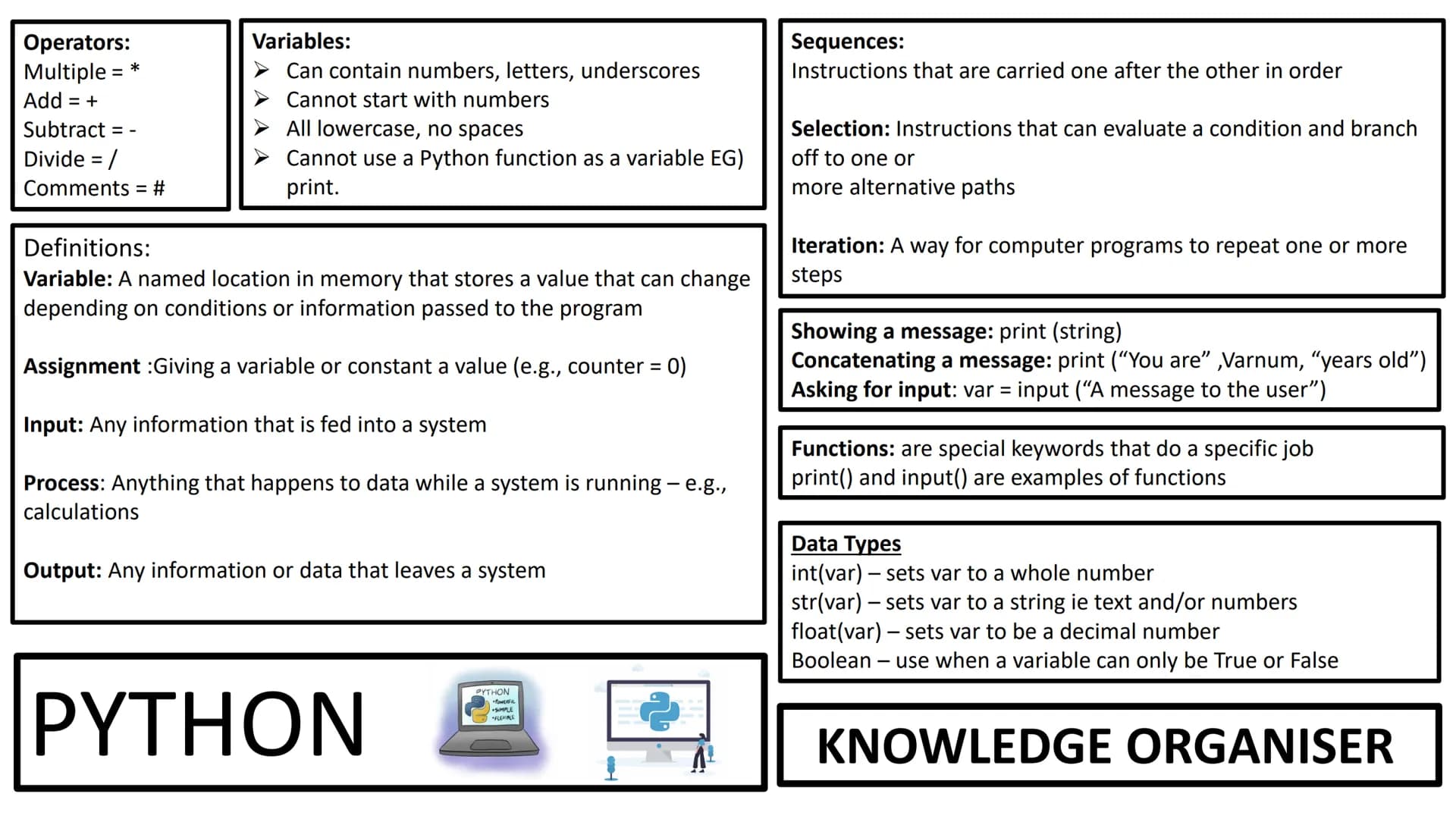
This page delves deeper into Python programming concepts, focusing on loops and conditional statements. It provides practical examples of count-controlled loops, selection statements, and conditional looping in Python.
The page begins by explaining count-controlled loops, also known as definite iteration:
Definition: Count-controlled loops are when a set of instructions is repeated a specific number of times.
Example: A for loop example is provided:
for number in range(0, 10):
    print(number)
The page then moves on to selection examples, demonstrating the use of if-elif-else statements:
Example: A speed check program is shown:
speed = int(input("Enter driver's speed: "))
if speed >= 75:
    print("Issue fine")
elif speed > 70:
    print("Warning")
elif speed == 70:
    print("Perfect speed")
else:
    print("No action")
The guide also covers conditional looping, providing two examples:
Highlight: The page emphasizes the importance of initializing variables before using them in loops.
Finally, the page explores various forms of count-controlled iteration, demonstrating:
Example: A program that calculates squares up to a user-specified number:
num = int(input("Up to what number do you want the square of: "))
for counter in range(1, num+1):
    print(counter, "squared is", counter*counter)
This comprehensive guide provides a solid foundation for understanding Python data types and functions, as well as sequencing, selection, and iteration in Python, making it an invaluable resource for beginners learning Python programming.
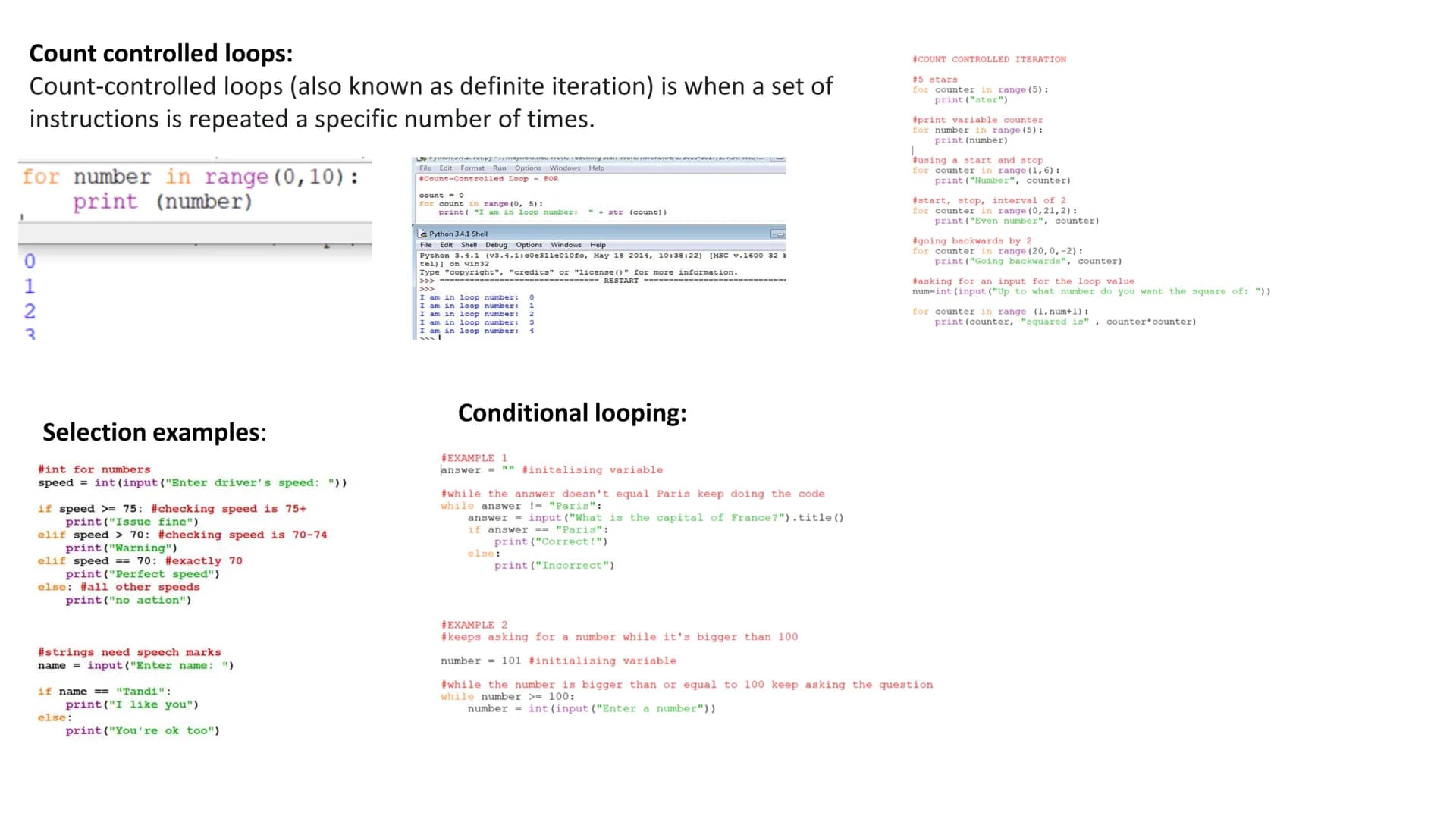
This page introduces essential Python coding operators and variables, along with fundamental programming concepts. It covers various operators, variable naming conventions, and key programming structures.
Vocabulary: Variables are defined as named locations in memory that store values that can change depending on conditions or information passed to the program.
The page outlines important Python operators, including:
It also provides guidelines for naming variables in Python, emphasizing that they can contain numbers, letters, and underscores, but cannot start with numbers or use Python functions as names.
Highlight: Python is described as powerful, simple, and flexible.
The page introduces core programming concepts:
It then explains three fundamental programming structures:
Example: The page demonstrates how to show messages using the
print()function and how to concatenate messages:print("You are", Varnum, "years old")
Lastly, it covers data types in Python, including:
Definition: Functions are defined as special keywords that perform a specific job, with
print()andinput()given as examples.
Our AI Companion is a student-focused AI tool that offers more than just answers. Built on millions of Knowunity resources, it provides relevant information, personalised study plans, quizzes, and content directly in the chat, adapting to your individual learning journey.
You can download the app from Google Play Store and Apple App Store.
That's right! Enjoy free access to study content, connect with fellow students, and get instant help – all at your fingertips.
Computer ScienceComprehensive study material for OCR GCSE Computer Science covering key topics such as computer architecture, network security, programming techniques, and ethical considerations. Ideal for exam preparation, this resource includes essential concepts, exam questions, and definitions to enhance understanding and retention.
Computer SciencePurpose, Components and functions of CPU. Also von neuman architecture
Computer ScienceComprehensive revision notes for OCR GCSE Computer Science Component 1 (J277). Covers key topics including networking, cybersecurity, data compression, computer architecture, and ethical issues. Ideal for exam preparation and understanding core concepts. Access original slides for further details.
Computer ScienceConcise revision notes for the GCSE OCR computer science specification (J277). Contains all the info needed for paper 1. Paper 2 is in my bio.
Computer Sciencegood luck
Computer Sciencethis will help you revise for when you are next tested on these questions this will also help you to remember
Computer ScienceComprehensive overview of algorithms for AQA GCSE Computer Science Paper 1, covering key concepts such as sorting (Bubble Sort, Merge Sort), searching (Linear and Binary Search), and essential programming principles like data types, pseudocode, and flowcharts. Ideal for exam preparation and understanding algorithm efficiency.
Computer ScienceComprehensive revision notes covering the AQA GCSE Computer Science curriculum, including key topics such as computer memory, cybersecurity, programming concepts, network protocols, and data representation. Ideal for exam preparation and understanding core concepts in computing.
Computer ScienceConcise revision notes for the GCSE OCR computer science specification (J277). Contains all the info needed for paper 2. Paper 1 is in my bio.
 Sociology
Explore comprehensive A-Level Sociology notes on the education system, covering key theories, policies, and sociological perspectives. This resource includes insights on marketisation, gender roles, cultural deprivation, and educational inequalities, providing a thorough understanding of how education shapes social stratification and individual achievement. Ideal for exam preparation and in-depth study.
SociologyDive into an extensive overview of family dynamics, perspectives, and patterns in sociology. This resource covers key concepts such as family diversity, gender roles, marriage, and the impact of social policies on family structures. Perfect for A-Level Sociology students preparing for Paper 2.
CriminologyComprehensive mindmaps covering key concepts in the Crime and Punishment topic for WJEC Criminology Unit 4. This resource includes detailed insights into the Criminal Justice System, crime prevention strategies, sentencing models, and the roles of various agencies. Ideal for A-Level revision, ensuring you grasp essential theories and legislative processes to excel in your exams.
SociologyExplore an extensive revision of crime and deviance topics, including theories, types of crime, and the impact of media. This resource covers key concepts such as Marxism, functionalism, gender and crime, and the influence of globalization on criminal behavior. Ideal for students seeking a thorough understanding of criminology and its various theories. Type: Full Topic Revision.
 English Literature
Explore in-depth analysis and key quotes for characters in J.B. Priestley's 'An Inspector Calls'. This resource covers Gerald Croft, Inspector Goole, Sheila Birling, Mrs. Birling, Eric Birling, and Eva Smith, focusing on themes of class, gender roles, and social responsibility. Ideal for students aiming for Grade 8 and above.
CriminologyCriminology unit 4 detailed revision note
 Biology
cell structures
CriminologyExplore key criminology theories and their implications on crime and deviance. This comprehensive summary covers biological, psychological, and sociological perspectives, including labelling theory, right realism, and the impact of social campaigns on policy development. Ideal for A-Level criminology students seeking to understand the complexities of criminal behaviour and the factors influencing crime prevention strategies.
English LiteratureKey Romeo and Juliet themes and analysed quotes
The app is very easy to use and well designed. I have found everything I was looking for so far and have been able to learn a lot from the presentations! I will definitely use the app for a class assignment! And of course it also helps a lot as an inspiration.
This app is really great. There are so many study notes and help [...]. My problem subject is French, for example, and the app has so many options for help. Thanks to this app, I have improved my French. I would recommend it to anyone.
Wow, I am really amazed. I just tried the app because I've seen it advertised many times and was absolutely stunned. This app is THE HELP you want for school and above all, it offers so many things, such as workouts and fact sheets, which have been VERY helpful to me personally.
Computer Science350 views·Updated Jun 9, 2026·2 pagesPython Coding Guide: Operators, Variables, and Programming Concepts
This comprehensive guide covers essential Python coding operators and variables, as well as fundamental programming concepts. It provides an in-depth look at various operators, variable naming conventions, and key programming structures...
This page delves deeper into Python programming concepts, focusing on loops and conditional statements. It provides practical examples of count-controlled loops, selection statements, and conditional looping in Python.
The page begins by explaining count-controlled loops, also known as definite iteration:
Definition: Count-controlled loops are when a set of instructions is repeated a specific number of times.
Example: A for loop example is provided:
for number in range(0, 10):
    print(number)
The page then moves on to selection examples, demonstrating the use of if-elif-else statements:
Example: A speed check program is shown:
speed = int(input("Enter driver's speed: "))
if speed >= 75:
    print("Issue fine")
elif speed > 70:
    print("Warning")
elif speed == 70:
    print("Perfect speed")
else:
    print("No action")
The guide also covers conditional looping, providing two examples:
Highlight: The page emphasizes the importance of initializing variables before using them in loops.
Finally, the page explores various forms of count-controlled iteration, demonstrating:
Example: A program that calculates squares up to a user-specified number:
num = int(input("Up to what number do you want the square of: "))
for counter in range(1, num+1):
    print(counter, "squared is", counter*counter)
This comprehensive guide provides a solid foundation for understanding Python data types and functions, as well as sequencing, selection, and iteration in Python, making it an invaluable resource for beginners learning Python programming.
This page introduces essential Python coding operators and variables, along with fundamental programming concepts. It covers various operators, variable naming conventions, and key programming structures.
Vocabulary: Variables are defined as named locations in memory that store values that can change depending on conditions or information passed to the program.
The page outlines important Python operators, including:
It also provides guidelines for naming variables in Python, emphasizing that they can contain numbers, letters, and underscores, but cannot start with numbers or use Python functions as names.
Highlight: Python is described as powerful, simple, and flexible.
The page introduces core programming concepts:
It then explains three fundamental programming structures:
Example: The page demonstrates how to show messages using the
print()function and how to concatenate messages:print("You are", Varnum, "years old")
Lastly, it covers data types in Python, including:
Definition: Functions are defined as special keywords that perform a specific job, with
print()andinput()given as examples.
Our AI Companion is a student-focused AI tool that offers more than just answers. Built on millions of Knowunity resources, it provides relevant information, personalised study plans, quizzes, and content directly in the chat, adapting to your individual learning journey.
You can download the app from Google Play Store and Apple App Store.
That's right! Enjoy free access to study content, connect with fellow students, and get instant help – all at your fingertips.
Computer ScienceComprehensive study material for OCR GCSE Computer Science covering key topics such as computer architecture, network security, programming techniques, and ethical considerations. Ideal for exam preparation, this resource includes essential concepts, exam questions, and definitions to enhance understanding and retention.
Computer SciencePurpose, Components and functions of CPU. Also von neuman architecture
Computer ScienceComprehensive revision notes for OCR GCSE Computer Science Component 1 (J277). Covers key topics including networking, cybersecurity, data compression, computer architecture, and ethical issues. Ideal for exam preparation and understanding core concepts. Access original slides for further details.
Computer ScienceConcise revision notes for the GCSE OCR computer science specification (J277). Contains all the info needed for paper 1. Paper 2 is in my bio.
Computer Sciencegood luck
Computer Sciencethis will help you revise for when you are next tested on these questions this will also help you to remember
Computer ScienceComprehensive overview of algorithms for AQA GCSE Computer Science Paper 1, covering key concepts such as sorting (Bubble Sort, Merge Sort), searching (Linear and Binary Search), and essential programming principles like data types, pseudocode, and flowcharts. Ideal for exam preparation and understanding algorithm efficiency.
Computer ScienceComprehensive revision notes covering the AQA GCSE Computer Science curriculum, including key topics such as computer memory, cybersecurity, programming concepts, network protocols, and data representation. Ideal for exam preparation and understanding core concepts in computing.
Computer ScienceConcise revision notes for the GCSE OCR computer science specification (J277). Contains all the info needed for paper 2. Paper 1 is in my bio.
SociologyExplore comprehensive A-Level Sociology notes on the education system, covering key theories, policies, and sociological perspectives. This resource includes insights on marketisation, gender roles, cultural deprivation, and educational inequalities, providing a thorough understanding of how education shapes social stratification and individual achievement. Ideal for exam preparation and in-depth study.
SociologyDive into an extensive overview of family dynamics, perspectives, and patterns in sociology. This resource covers key concepts such as family diversity, gender roles, marriage, and the impact of social policies on family structures. Perfect for A-Level Sociology students preparing for Paper 2.
CriminologyComprehensive mindmaps covering key concepts in the Crime and Punishment topic for WJEC Criminology Unit 4. This resource includes detailed insights into the Criminal Justice System, crime prevention strategies, sentencing models, and the roles of various agencies. Ideal for A-Level revision, ensuring you grasp essential theories and legislative processes to excel in your exams.
SociologyExplore an extensive revision of crime and deviance topics, including theories, types of crime, and the impact of media. This resource covers key concepts such as Marxism, functionalism, gender and crime, and the influence of globalization on criminal behavior. Ideal for students seeking a thorough understanding of criminology and its various theories. Type: Full Topic Revision.
English LiteratureExplore in-depth analysis and key quotes for characters in J.B. Priestley's 'An Inspector Calls'. This resource covers Gerald Croft, Inspector Goole, Sheila Birling, Mrs. Birling, Eric Birling, and Eva Smith, focusing on themes of class, gender roles, and social responsibility. Ideal for students aiming for Grade 8 and above.
CriminologyCriminology unit 4 detailed revision note
Biologycell structures
CriminologyExplore key criminology theories and their implications on crime and deviance. This comprehensive summary covers biological, psychological, and sociological perspectives, including labelling theory, right realism, and the impact of social campaigns on policy development. Ideal for A-Level criminology students seeking to understand the complexities of criminal behaviour and the factors influencing crime prevention strategies.
English LiteratureKey Romeo and Juliet themes and analysed quotes
The app is very easy to use and well designed. I have found everything I was looking for so far and have been able to learn a lot from the presentations! I will definitely use the app for a class assignment! And of course it also helps a lot as an inspiration.
This app is really great. There are so many study notes and help [...]. My problem subject is French, for example, and the app has so many options for help. Thanks to this app, I have improved my French. I would recommend it to anyone.
Wow, I am really amazed. I just tried the app because I've seen it advertised many times and was absolutely stunned. This app is THE HELP you want for school and above all, it offers so many things, such as workouts and fact sheets, which have been VERY helpful to me personally.
