
A comprehensive guide to AQA Physics A-Level measurements and errors... Show more
 Physics511 views·Updated Jun 5, 2026·6 pages
Easy A-Level Physics: Fixing Errors and Measuring Right!

Knowunity Cyborg@knowunitycyborg
1 / 6
1
of 6
Page 2: SI Units and Prefixes
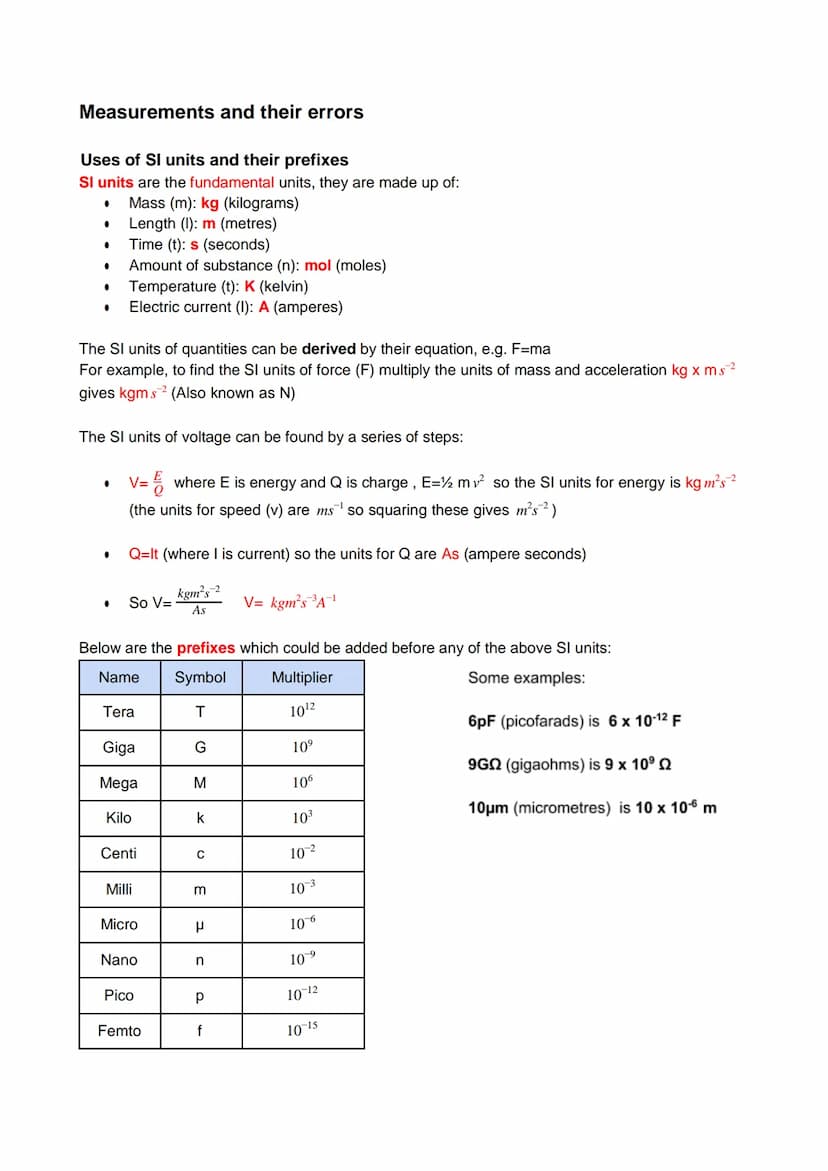
This page provides a detailed breakdown of SI units and their prefixes. The fundamental SI units are explained, including mass (kg), length (m), time (s), amount of substance (mol), temperature (K), and electric current (A). The page also demonstrates how to derive units using equations.
Definition: SI units are the fundamental units of measurement in physics.
Example: The derivation of voltage units (V) is shown as kgm²s⁻³A⁻¹.
Vocabulary: Prefixes such as Tera (T), Giga (G), and Mega (M) represent different powers of 10.
2
of 6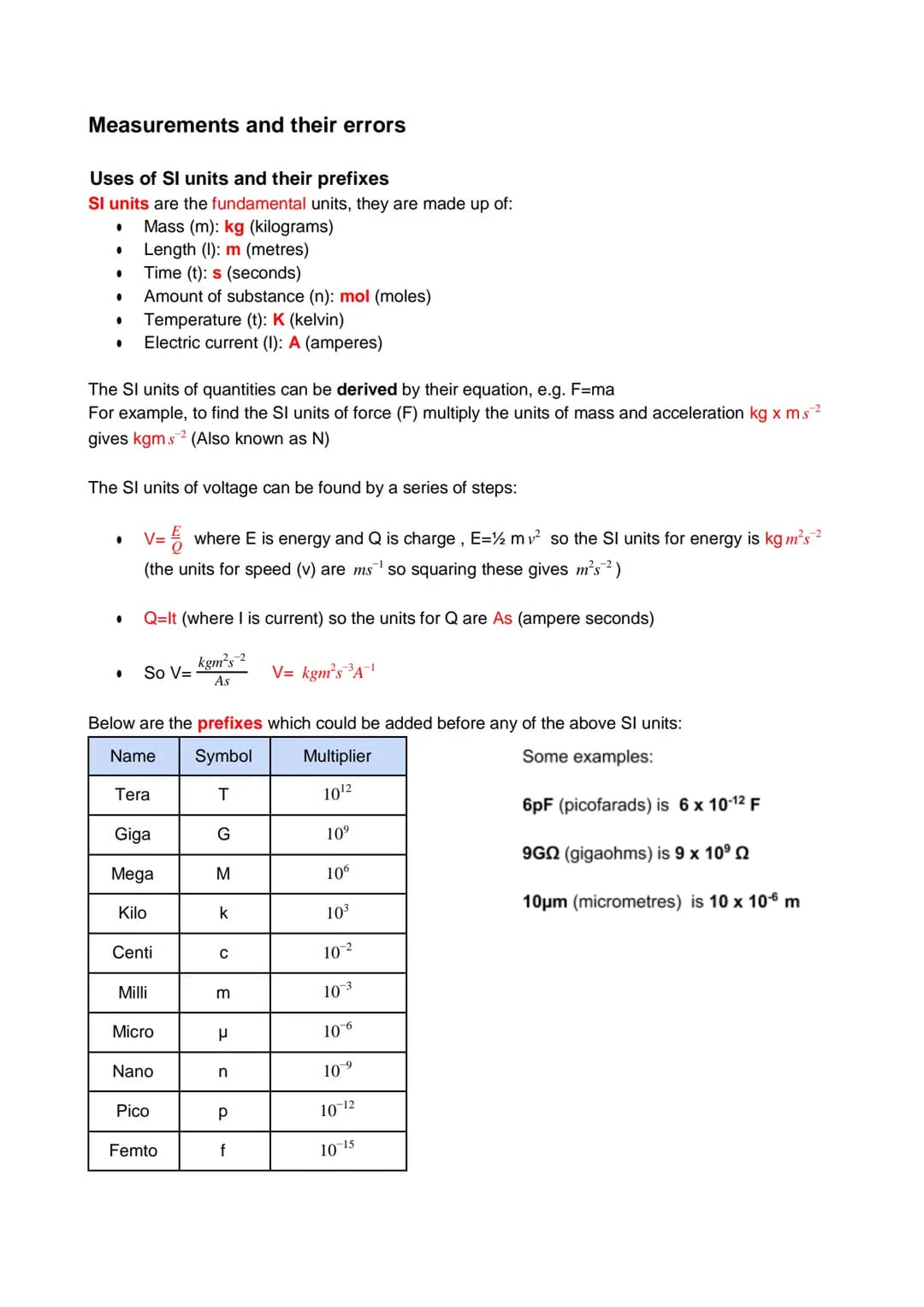
Page 3: Unit Conversions and Measurement Limitations
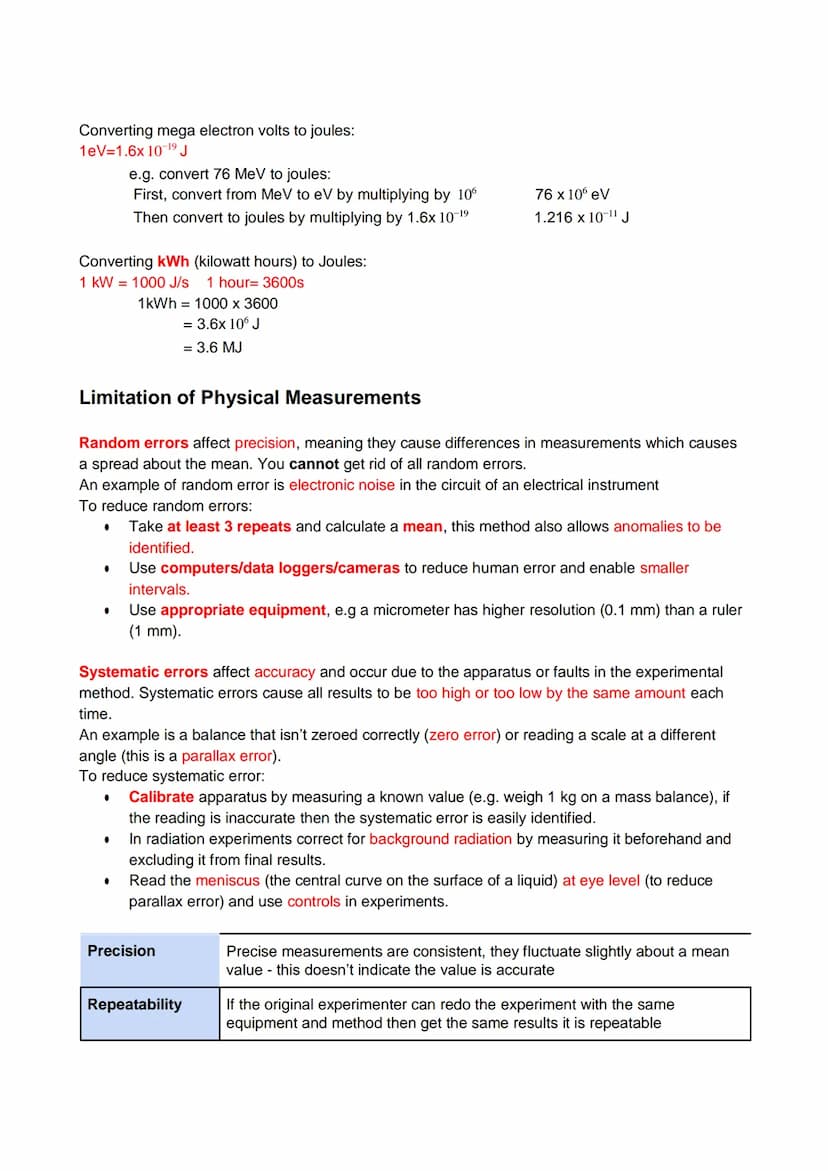
This page covers the conversion between different units and discusses measurement limitations. It includes detailed explanations of random and systematic errors, along with methods to reduce them.
Example: Converting 76 MeV to joules involves first converting to eV (76 × 10⁶) then multiplying by 1.6 × 10⁻¹⁹ J.
Highlight: Random errors affect precision while systematic errors affect accuracy.
Definition: Random errors cause measurements to spread around a mean value, while systematic errors consistently skew results in one direction.
3
of 6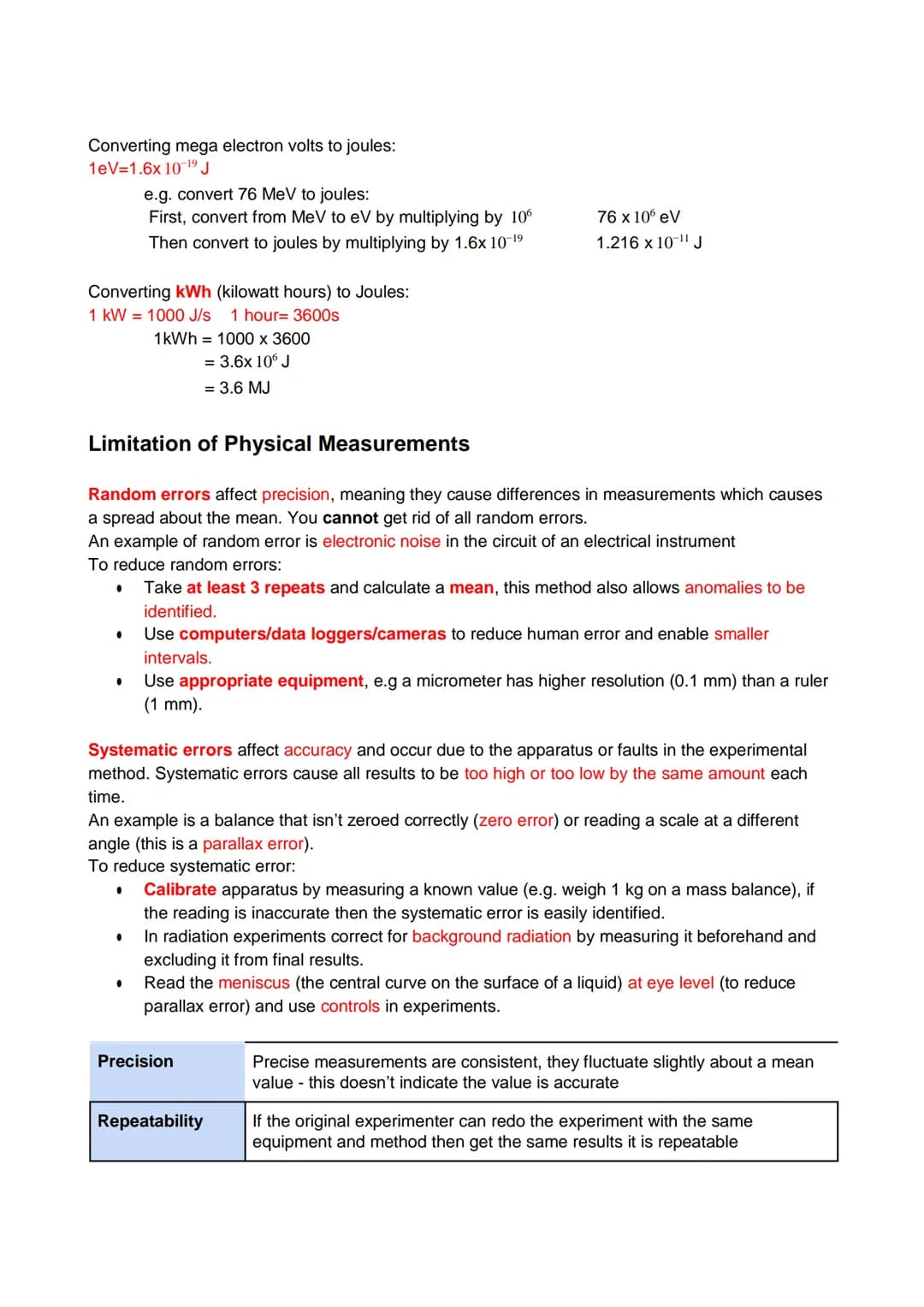
Page 4: Measurement Quality and Uncertainty
This page explores various aspects of measurement quality including precision, repeatability, reproducibility, resolution, and accuracy. It provides detailed information about different types of uncertainty and methods to calculate them.
Definition: Precision refers to the consistency of measurements, while accuracy indicates how close measurements are to the true value.
Example: For a thermometer with 1°C divisions, the uncertainty in a reading is ±0.5°C.
Highlight: The uncertainty in measurements can be reduced by measuring larger quantities.
Vocabulary: Resolution refers to the smallest measurable change in a quantity that produces a detectable change in the reading.
4
of 6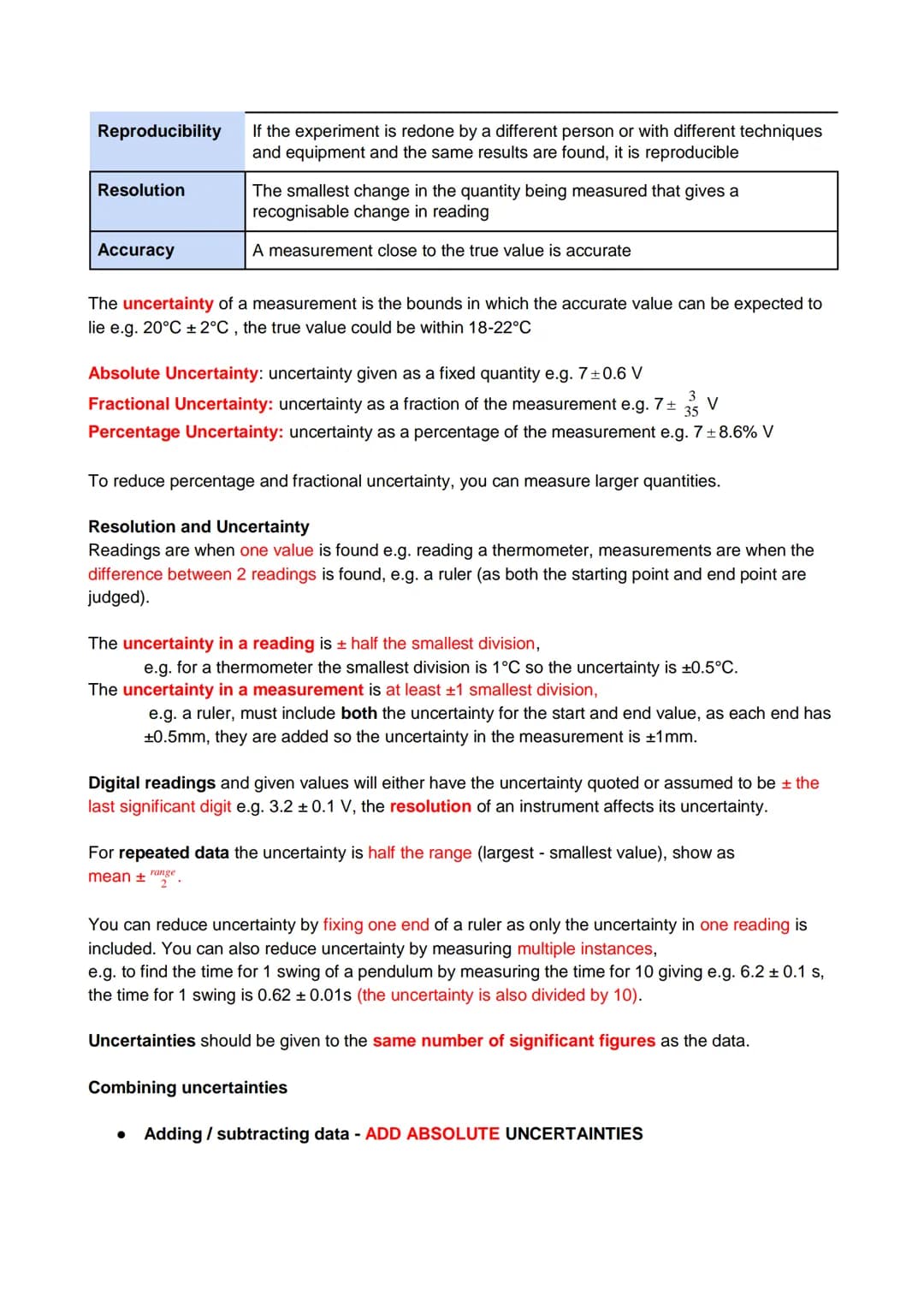
Page 4: Measurement Characteristics
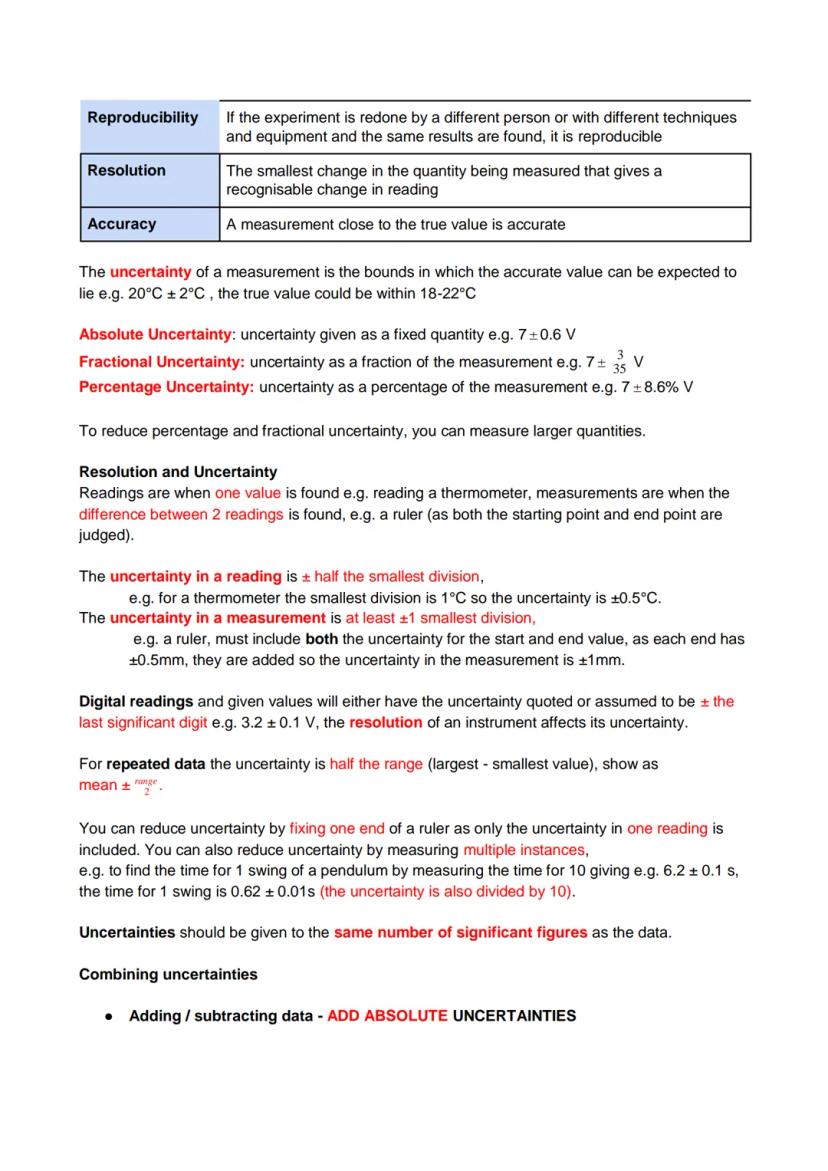
This page explores key concepts in measurement quality including reproducibility, resolution, and accuracy. It provides detailed explanations of different types of uncertainty representations.
Definition: Reproducibility refers to the ability to obtain consistent results when experiments are repeated under different conditions.
Vocabulary: Resolution is the smallest measurable change in a quantity that can be detected by an instrument.
Example: A measurement of 7±0.6 V demonstrates absolute uncertainty.
5
of 6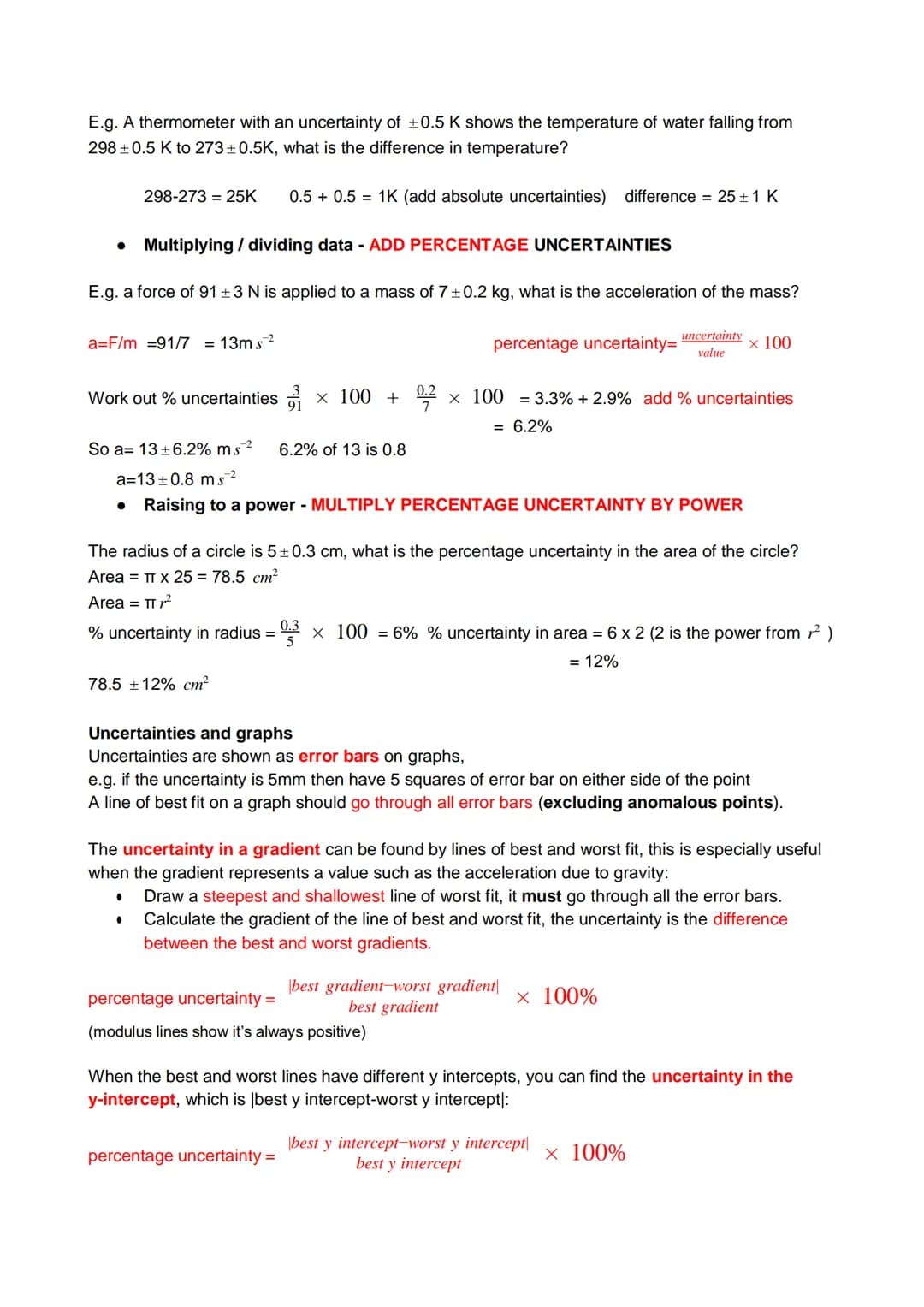
Page 5: Uncertainty Calculations
This page provides detailed instructions for calculating uncertainties in various mathematical operations. It includes worked examples for both simple and complex calculations.
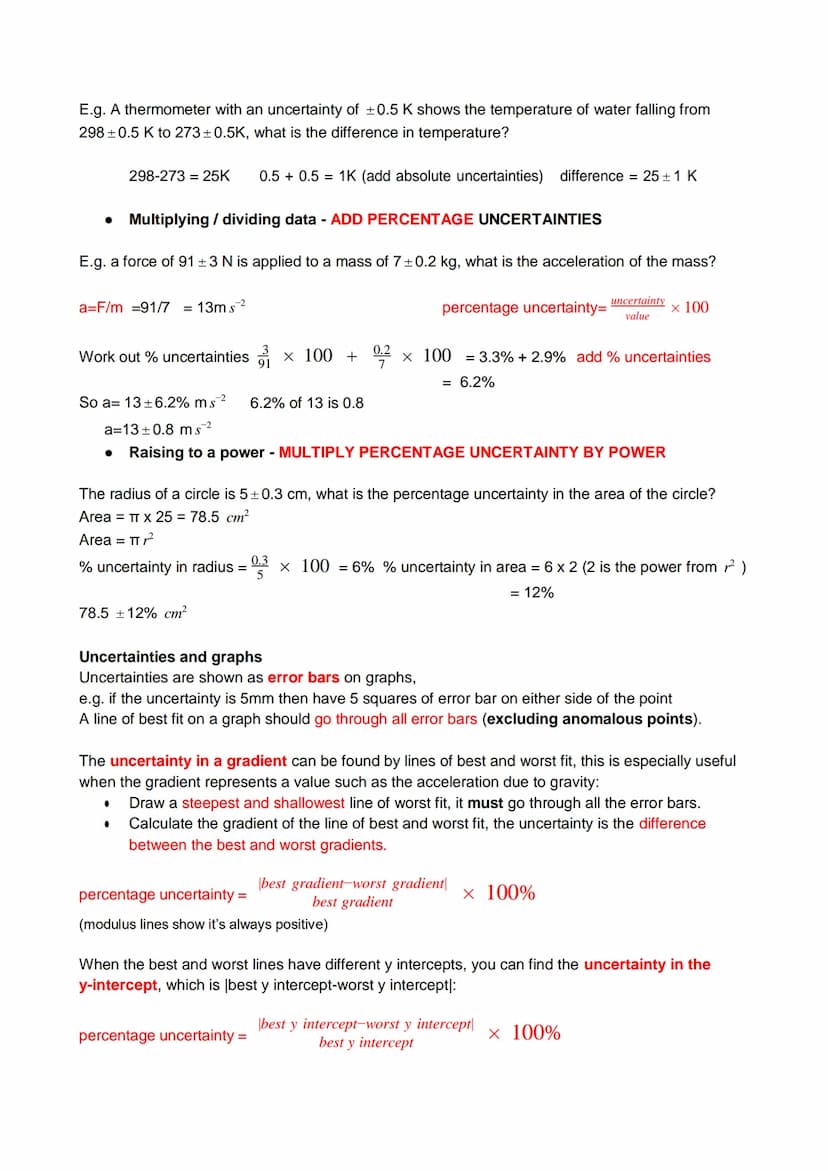
Example: For temperature change from 298±0.5 K to 273±0.5 K, the difference is 25±1 K
Highlight: When multiplying or dividing measurements, percentage uncertainties are added.
6
of 6
Page 1: Introduction to AQA Physics Measurements
This page introduces the fundamental concepts of measurements and errors in AQA Physics A-Level curriculum. The title page sets the context for the comprehensive study of physical measurements and their associated uncertainties.
Highlight: This document serves as essential revision material for AQA Physics A-Level students studying measurements and errors.
We thought you’d never ask...
What is the Knowunity AI companion?
Our AI Companion is a student-focused AI tool that offers more than just answers. Built on millions of Knowunity resources, it provides relevant information, personalised study plans, quizzes, and content directly in the chat, adapting to your individual learning journey.
Where can I download the Knowunity app?
You can download the app from Google Play Store and Apple App Store.
Is Knowunity really free of charge?
That's right! Enjoy free access to study content, connect with fellow students, and get instant help – all at your fingertips.
Most popular content: Scientific Investigation
2Most popular content in Physics
9Most popular content
9Can't find what you're looking for? Explore other subjects.
Students love us — and so will you.
4.6/5App Store
4.7/5Google Play
The app is very easy to use and well designed. I have found everything I was looking for so far and have been able to learn a lot from the presentations! I will definitely use the app for a class assignment! And of course it also helps a lot as an inspiration.
Stefan SiOS user
This app is really great. There are so many study notes and help [...]. My problem subject is French, for example, and the app has so many options for help. Thanks to this app, I have improved my French. I would recommend it to anyone.
Samantha KlichAndroid user
Wow, I am really amazed. I just tried the app because I've seen it advertised many times and was absolutely stunned. This app is THE HELP you want for school and above all, it offers so many things, such as workouts and fact sheets, which have been VERY helpful to me personally.
AnnaiOS user
Physics511 views·Updated Jun 5, 2026·6 pagesEasy A-Level Physics: Fixing Errors and Measuring Right!
Knowunity Cyborg@knowunitycyborg
A comprehensive guide to AQA Physics A-Level measurements and errors revision notes, focusing on SI units, measurement uncertainties, and error analysis.
- Essential coverage of SI base units and their derived quantities
- Detailed explanations of unit conversions, including Converting electron... Show more
1
of 6Sign up to see the content. It's free!
- Access to all documents
- Improve your grades
- Join milions of students
Page 2: SI Units and Prefixes
This page provides a detailed breakdown of SI units and their prefixes. The fundamental SI units are explained, including mass (kg), length (m), time (s), amount of substance (mol), temperature (K), and electric current (A). The page also demonstrates how to derive units using equations.
Definition: SI units are the fundamental units of measurement in physics.
Example: The derivation of voltage units (V) is shown as kgm²s⁻³A⁻¹.
Vocabulary: Prefixes such as Tera (T), Giga (G), and Mega (M) represent different powers of 10.
2
of 6Sign up to see the content. It's free!
- Access to all documents
- Improve your grades
- Join milions of students
Page 3: Unit Conversions and Measurement Limitations
This page covers the conversion between different units and discusses measurement limitations. It includes detailed explanations of random and systematic errors, along with methods to reduce them.
Example: Converting 76 MeV to joules involves first converting to eV (76 × 10⁶) then multiplying by 1.6 × 10⁻¹⁹ J.
Highlight: Random errors affect precision while systematic errors affect accuracy.
Definition: Random errors cause measurements to spread around a mean value, while systematic errors consistently skew results in one direction.
3
of 6Sign up to see the content. It's free!
- Access to all documents
- Improve your grades
- Join milions of students
Page 4: Measurement Quality and Uncertainty
This page explores various aspects of measurement quality including precision, repeatability, reproducibility, resolution, and accuracy. It provides detailed information about different types of uncertainty and methods to calculate them.
Definition: Precision refers to the consistency of measurements, while accuracy indicates how close measurements are to the true value.
Example: For a thermometer with 1°C divisions, the uncertainty in a reading is ±0.5°C.
Highlight: The uncertainty in measurements can be reduced by measuring larger quantities.
Vocabulary: Resolution refers to the smallest measurable change in a quantity that produces a detectable change in the reading.
4
of 6Sign up to see the content. It's free!
- Access to all documents
- Improve your grades
- Join milions of students
Page 4: Measurement Characteristics
This page explores key concepts in measurement quality including reproducibility, resolution, and accuracy. It provides detailed explanations of different types of uncertainty representations.
Definition: Reproducibility refers to the ability to obtain consistent results when experiments are repeated under different conditions.
Vocabulary: Resolution is the smallest measurable change in a quantity that can be detected by an instrument.
Example: A measurement of 7±0.6 V demonstrates absolute uncertainty.
5
of 6Sign up to see the content. It's free!
- Access to all documents
- Improve your grades
- Join milions of students
Page 5: Uncertainty Calculations
This page provides detailed instructions for calculating uncertainties in various mathematical operations. It includes worked examples for both simple and complex calculations.
Example: For temperature change from 298±0.5 K to 273±0.5 K, the difference is 25±1 K
Highlight: When multiplying or dividing measurements, percentage uncertainties are added.
6
of 6Sign up to see the content. It's free!
- Access to all documents
- Improve your grades
- Join milions of students
Page 1: Introduction to AQA Physics Measurements
This page introduces the fundamental concepts of measurements and errors in AQA Physics A-Level curriculum. The title page sets the context for the comprehensive study of physical measurements and their associated uncertainties.
Highlight: This document serves as essential revision material for AQA Physics A-Level students studying measurements and errors.
We thought you’d never ask...
What is the Knowunity AI companion?
Our AI Companion is a student-focused AI tool that offers more than just answers. Built on millions of Knowunity resources, it provides relevant information, personalised study plans, quizzes, and content directly in the chat, adapting to your individual learning journey.
Where can I download the Knowunity app?
You can download the app from Google Play Store and Apple App Store.
Is Knowunity really free of charge?
That's right! Enjoy free access to study content, connect with fellow students, and get instant help – all at your fingertips.
Most popular content: Scientific Investigation
2Most popular content in Physics
9Most popular content
9Can't find what you're looking for? Explore other subjects.
Students love us — and so will you.
4.6/5App Store
4.7/5Google Play
The app is very easy to use and well designed. I have found everything I was looking for so far and have been able to learn a lot from the presentations! I will definitely use the app for a class assignment! And of course it also helps a lot as an inspiration.
Stefan SiOS user
This app is really great. There are so many study notes and help [...]. My problem subject is French, for example, and the app has so many options for help. Thanks to this app, I have improved my French. I would recommend it to anyone.
Samantha KlichAndroid user
Wow, I am really amazed. I just tried the app because I've seen it advertised many times and was absolutely stunned. This app is THE HELP you want for school and above all, it offers so many things, such as workouts and fact sheets, which have been VERY helpful to me personally.
AnnaiOS user