
Diving into alkanes and haloalkanes, this topic explores how crude... Show more
 Chemistry125 views·Updated Jun 4, 2026·2 pages
Understanding Alkanes and Haloalkanes: Fractional Distillation and Cracking Explained

Aasiyah Rahman@aasiyahrahman
1
of 2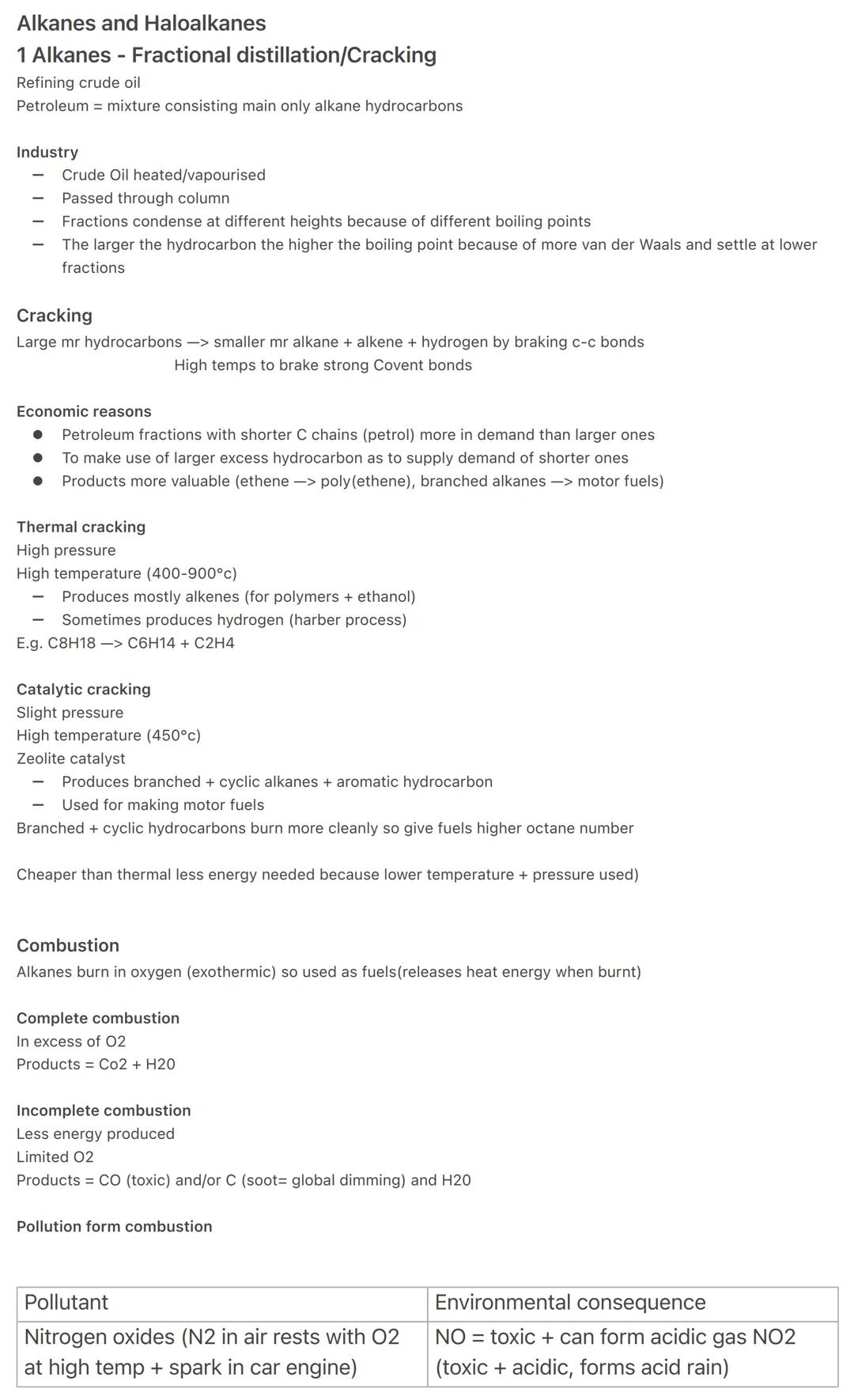
Crude Oil Refining and Cracking
Ever wondered how we get petrol from crude oil? It starts with fractional distillation, where crude oil (mainly alkane hydrocarbons) is heated and passed through a column. Different fractions condense at different heights based on their boiling points. Larger hydrocarbons have higher boiling points due to stronger van der Waals forces, so they settle in lower fractions.
When there's too much of the larger hydrocarbons and not enough of the smaller ones, we use cracking to break C-C bonds. This converts large hydrocarbons into smaller, more valuable products. Thermal cracking uses high temperatures and pressure to produce mainly alkenes for polymers, while catalytic cracking uses a zeolite catalyst at lower temperatures (450°C) to produce branched and cyclic hydrocarbons for cleaner-burning motor fuels.
The combustion of alkanes releases heat energy, making them excellent fuels. Complete combustion (with excess oxygen) produces CO₂ and H₂O, while incomplete combustion produces less energy and forms carbon monoxide, soot, and water. This is why proper air flow is crucial when burning fuels.
Did you know? Branched and cyclic hydrocarbons have higher octane numbers, making them better for engines as they burn more cleanly and efficiently.
2
of 2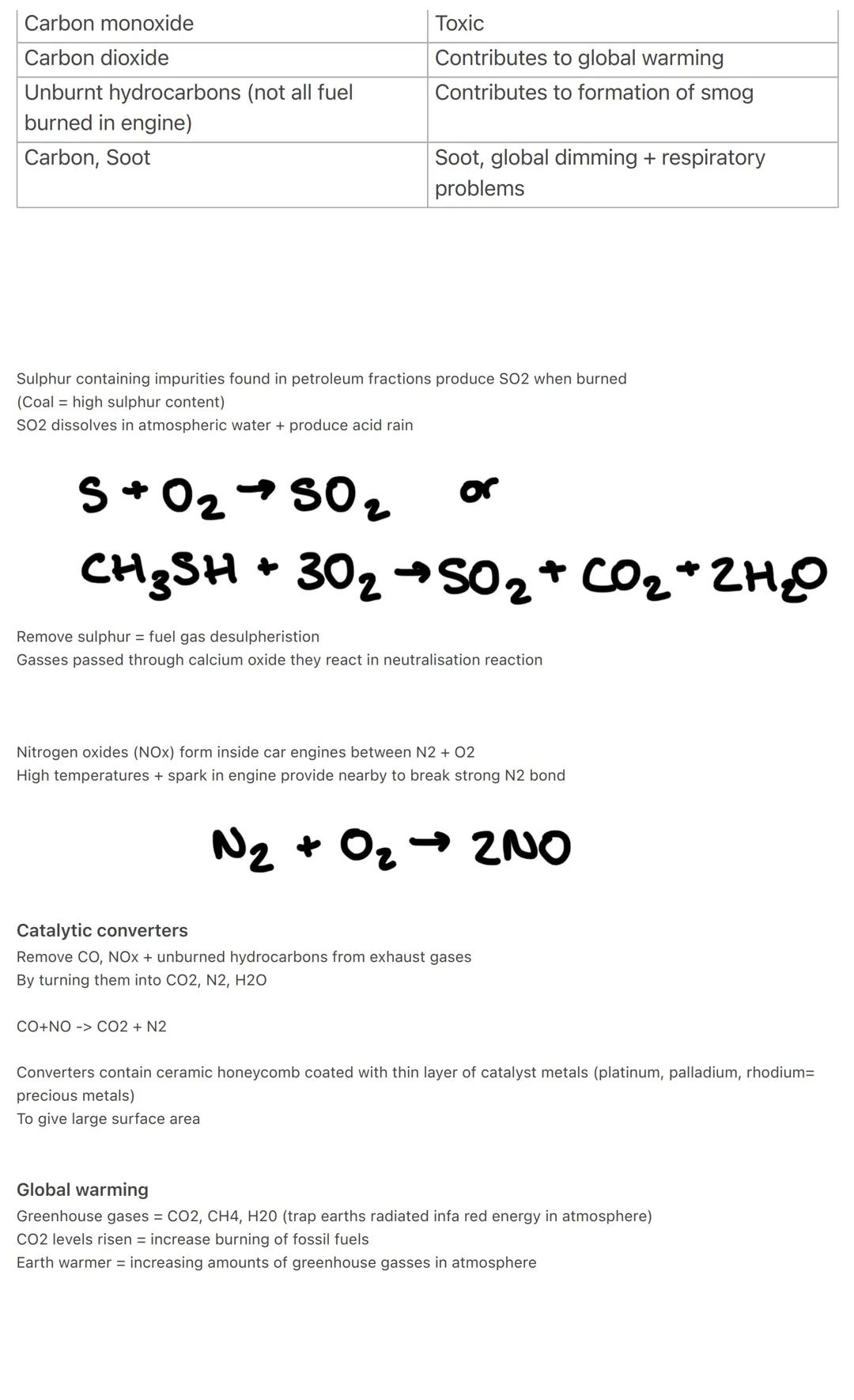
Environmental Impact of Combustion
Burning hydrocarbons isn't without consequences. Nitrogen oxides form when atmospheric nitrogen reacts with oxygen at high temperatures inside engines, creating toxic compounds that contribute to acid rain. Similarly, sulphur impurities in fuels produce SO₂ when burned, which dissolves in atmospheric water to form acid rain.
To combat these pollutants, modern vehicles use catalytic converters containing precious metals like platinum and palladium. These converters have a honeycomb structure coated with catalysts that transform harmful exhaust gases (CO, NOₓ, unburned hydrocarbons) into less harmful substances like CO₂, N₂, and H₂O.
The combustion of fossil fuels has significantly increased greenhouse gases like CO₂ in our atmosphere. These gases trap Earth's radiated infrared energy, leading to global warming. Carbon monoxide (toxic), carbon dioxide (greenhouse gas), unburnt hydrocarbons (smog formation), and soot (respiratory problems and global dimming) are all pollutants resulting from hydrocarbon combustion.
Important connection: Understanding the chemistry of fuel combustion helps explain why electric vehicles and renewable energy sources are becoming increasingly important in combating climate change.
We thought you’d never ask...
What is the Knowunity AI companion?
Our AI Companion is a student-focused AI tool that offers more than just answers. Built on millions of Knowunity resources, it provides relevant information, personalised study plans, quizzes, and content directly in the chat, adapting to your individual learning journey.
Where can I download the Knowunity app?
You can download the app from Google Play Store and Apple App Store.
Is Knowunity really free of charge?
That's right! Enjoy free access to study content, connect with fellow students, and get instant help – all at your fingertips.
Similar content
Most popular content: Hydrocarbons
9ChemistryHydrocarbon Structures & Properties
Explore the essential concepts of hydrocarbons, including the structures and properties of alkanes and alkenes, the significance of crude oil, and the process of fractional distillation. This summary provides a clear understanding of saturated and unsaturated hydrocarbons, ideal for GCSE Chemistry students.
1137013
ChemistryUnderstanding Alkanes and Hydrocarbons
Explore the fundamentals of hydrocarbons, focusing on alkanes, their properties, nomenclature, and the concept of homologous series. This summary covers key definitions, structural representations, and the significance of isomers in organic chemistry.
1167214
ChemistryCrude Oil Formation & Distillation
Explore the formation of crude oil from marine organisms and the process of fractional distillation. This summary covers key concepts such as hydrocarbons, boiling points, viscosity, and the characteristics of different fractions. Ideal for students studying organic chemistry.
114904
ChemistryOrganic Chemistry Essentials
Explore key concepts in Organic Chemistry for AQA GCSE, including fractional distillation, hydrocarbon properties, and the cracking process. This summary covers the homologous series, alkanes, and their applications in fuels. Ideal for exam preparation.
102,03272
ChemistryHydrocarbons Overview
Explore the essential concepts of hydrocarbons, including the properties and nomenclature of alkanes and alkenes, their structures, and the significance of homologous series in organic chemistry. This summary provides a clear understanding of saturated and unsaturated hydrocarbons, along with key reactions such as hydrogenation and halogenation.
S415210
ChemistryHydrocarbons & Cracking
Explore the fundamentals of hydrocarbons, their combustion properties, and the processes of hydrocarbon cracking. This summary covers alkanes, alkenes, and the significance of fractional distillation in the petrochemical industry. Ideal for students studying organic chemistry.
114294
ChemistryAlkanes vs Alkenes
Explore the key differences between alkanes and alkenes, including their structures, properties, and general formulas. This summary covers the homologous series, unsaturated vs saturated hydrocarbons, and the significance of carbon bonding. Ideal for chemistry students preparing for exams.
113375
ChemistryUnderstanding Crude Oil & Alkanes
Explore the composition and properties of crude oil and alkanes in this detailed summary. Learn about the fractional distillation process, the general formula for alkanes, and the significance of hydrocarbons in fossil fuels. Ideal for AQA GCSE Chemistry students preparing for Paper 2 in Combined Science.
102162
ChemistryUnderstanding Hydrocarbons
Explore the formation and structure of hydrocarbons, including alkanes like methane, ethane, and propane. This summary covers key concepts such as crude oil, hydrocarbon composition, and the general formula for alkanes (CnH2n+2). Ideal for AQA GCSE students preparing for exams.
112474
Most popular content in Chemistry
9G
ChemistryGCSE AQA Chemistry Topic 1- The Atom
The Atom
101,2140
Chemistrychem paper 1
higher
112,03242
ChemistryA-level OCR A Chemistry summary sheets
Everything from snaprevise for OCR chemistry a-level
122,24978
ChemistryEssential Chemistry Practicals
Explore key AQA GCSE Chemistry practicals, including flame tests, titration, and gas identification. This resource covers essential techniques for analyzing ions, making salts, and understanding reaction kinetics. Perfect for students preparing for exams and practical assessments.
1011,964902
C
Chemistrychem paper 1
Unlock the secrets of chemical reactions with this comprehensive flashcard set designed to help you conquer complex concepts and ace your Chemistry exams.
117001
A
ChemistryAQA GCSE Chemistry 4.4 Chemical changes
4.4 Reactions of acids with bases or carbonates
97311
ChemistryChemistry paper 2
Chem paper 2 notes
1171613
G
ChemistryGCSE AQA Chemistry Topic 1
Quiz covering all of topic 1
101,7083
F
ChemistryFundamentals of Atomic Structure
Practice identifying subatomic particles, calculating neutrons, and defining isotopes and atomic/mass numbers.
123460
Most popular content
9 Sociology
Sociology of Education Overview
Explore comprehensive A-Level Sociology notes on the education system, covering key theories, policies, and sociological perspectives. This resource includes insights on marketisation, gender roles, cultural deprivation, and educational inequalities, providing a thorough understanding of how education shapes social stratification and individual achievement. Ideal for exam preparation and in-depth study.
12102,7733,040
SociologySociology of Families: Comprehensive Revision
Dive into an extensive overview of family dynamics, perspectives, and patterns in sociology. This resource covers key concepts such as family diversity, gender roles, marriage, and the impact of social policies on family structures. Perfect for A-Level Sociology students preparing for Paper 2.
1273,5252,306
CriminologyCriminology: Crime & Punishment Overview
Comprehensive mindmaps covering key concepts in the Crime and Punishment topic for WJEC Criminology Unit 4. This resource includes detailed insights into the Criminal Justice System, crime prevention strategies, sentencing models, and the roles of various agencies. Ideal for A-Level revision, ensuring you grasp essential theories and legislative processes to excel in your exams.
1254,8511,059
SociologyComprehensive Crime & Deviance Overview
Explore an extensive revision of crime and deviance topics, including theories, types of crime, and the impact of media. This resource covers key concepts such as Marxism, functionalism, gender and crime, and the influence of globalization on criminal behavior. Ideal for students seeking a thorough understanding of criminology and its various theories. Type: Full Topic Revision.
1251,6261,399
 English Literature
An Inspector Calls: Character Insights
Explore in-depth analysis and key quotes for characters in J.B. Priestley's 'An Inspector Calls'. This resource covers Gerald Croft, Inspector Goole, Sheila Birling, Mrs. Birling, Eric Birling, and Eva Smith, focusing on themes of class, gender roles, and social responsibility. Ideal for students aiming for Grade 8 and above.
1025,398907
CriminologyWJEC Unit 4 Criminology
Criminology unit 4 detailed revision note
127,142124
C
 Biology
Cell Biology and Cell structure
cell structures
93,1550
CriminologyCriminology Theories Overview
Explore key criminology theories and their implications on crime and deviance. This comprehensive summary covers biological, psychological, and sociological perspectives, including labelling theory, right realism, and the impact of social campaigns on policy development. Ideal for A-Level criminology students seeking to understand the complexities of criminal behaviour and the factors influencing crime prevention strategies.
129,753210
English LiteratureRomeo and Juliet: Key themes
Key Romeo and Juliet themes and analysed quotes
106,694198
Can't find what you're looking for? Explore other subjects.
Students love us — and so will you.
4.6/5App Store
4.7/5Google Play
The app is very easy to use and well designed. I have found everything I was looking for so far and have been able to learn a lot from the presentations! I will definitely use the app for a class assignment! And of course it also helps a lot as an inspiration.
Stefan SiOS user
This app is really great. There are so many study notes and help [...]. My problem subject is French, for example, and the app has so many options for help. Thanks to this app, I have improved my French. I would recommend it to anyone.
Samantha KlichAndroid user
Wow, I am really amazed. I just tried the app because I've seen it advertised many times and was absolutely stunned. This app is THE HELP you want for school and above all, it offers so many things, such as workouts and fact sheets, which have been VERY helpful to me personally.
AnnaiOS user
Chemistry125 views·Updated Jun 4, 2026·2 pagesUnderstanding Alkanes and Haloalkanes: Fractional Distillation and Cracking Explained
Aasiyah Rahman@aasiyahrahman
Diving into alkanes and haloalkanes, this topic explores how crude oil is processed into useful products and the environmental impacts of hydrocarbon combustion. Understanding these concepts is essential for chemistry students as they connect directly to energy production, environmental concerns,... Show more
1
of 2Sign up to see the content. It's free!
- Access to all documents
- Improve your grades
- Join milions of students
Crude Oil Refining and Cracking
Ever wondered how we get petrol from crude oil? It starts with fractional distillation, where crude oil (mainly alkane hydrocarbons) is heated and passed through a column. Different fractions condense at different heights based on their boiling points. Larger hydrocarbons have higher boiling points due to stronger van der Waals forces, so they settle in lower fractions.
When there's too much of the larger hydrocarbons and not enough of the smaller ones, we use cracking to break C-C bonds. This converts large hydrocarbons into smaller, more valuable products. Thermal cracking uses high temperatures and pressure to produce mainly alkenes for polymers, while catalytic cracking uses a zeolite catalyst at lower temperatures (450°C) to produce branched and cyclic hydrocarbons for cleaner-burning motor fuels.
The combustion of alkanes releases heat energy, making them excellent fuels. Complete combustion (with excess oxygen) produces CO₂ and H₂O, while incomplete combustion produces less energy and forms carbon monoxide, soot, and water. This is why proper air flow is crucial when burning fuels.
Did you know? Branched and cyclic hydrocarbons have higher octane numbers, making them better for engines as they burn more cleanly and efficiently.
2
of 2Sign up to see the content. It's free!
- Access to all documents
- Improve your grades
- Join milions of students
Environmental Impact of Combustion
Burning hydrocarbons isn't without consequences. Nitrogen oxides form when atmospheric nitrogen reacts with oxygen at high temperatures inside engines, creating toxic compounds that contribute to acid rain. Similarly, sulphur impurities in fuels produce SO₂ when burned, which dissolves in atmospheric water to form acid rain.
To combat these pollutants, modern vehicles use catalytic converters containing precious metals like platinum and palladium. These converters have a honeycomb structure coated with catalysts that transform harmful exhaust gases (CO, NOₓ, unburned hydrocarbons) into less harmful substances like CO₂, N₂, and H₂O.
The combustion of fossil fuels has significantly increased greenhouse gases like CO₂ in our atmosphere. These gases trap Earth's radiated infrared energy, leading to global warming. Carbon monoxide (toxic), carbon dioxide (greenhouse gas), unburnt hydrocarbons (smog formation), and soot (respiratory problems and global dimming) are all pollutants resulting from hydrocarbon combustion.
Important connection: Understanding the chemistry of fuel combustion helps explain why electric vehicles and renewable energy sources are becoming increasingly important in combating climate change.
We thought you’d never ask...
What is the Knowunity AI companion?
Our AI Companion is a student-focused AI tool that offers more than just answers. Built on millions of Knowunity resources, it provides relevant information, personalised study plans, quizzes, and content directly in the chat, adapting to your individual learning journey.
Where can I download the Knowunity app?
You can download the app from Google Play Store and Apple App Store.
Is Knowunity really free of charge?
That's right! Enjoy free access to study content, connect with fellow students, and get instant help – all at your fingertips.
Similar content
Most popular content: Hydrocarbons
9ChemistryHydrocarbon Structures & Properties
Explore the essential concepts of hydrocarbons, including the structures and properties of alkanes and alkenes, the significance of crude oil, and the process of fractional distillation. This summary provides a clear understanding of saturated and unsaturated hydrocarbons, ideal for GCSE Chemistry students.
1137013
ChemistryUnderstanding Alkanes and Hydrocarbons
Explore the fundamentals of hydrocarbons, focusing on alkanes, their properties, nomenclature, and the concept of homologous series. This summary covers key definitions, structural representations, and the significance of isomers in organic chemistry.
1167214
ChemistryCrude Oil Formation & Distillation
Explore the formation of crude oil from marine organisms and the process of fractional distillation. This summary covers key concepts such as hydrocarbons, boiling points, viscosity, and the characteristics of different fractions. Ideal for students studying organic chemistry.
114904
ChemistryOrganic Chemistry Essentials
Explore key concepts in Organic Chemistry for AQA GCSE, including fractional distillation, hydrocarbon properties, and the cracking process. This summary covers the homologous series, alkanes, and their applications in fuels. Ideal for exam preparation.
102,03272
ChemistryHydrocarbons Overview
Explore the essential concepts of hydrocarbons, including the properties and nomenclature of alkanes and alkenes, their structures, and the significance of homologous series in organic chemistry. This summary provides a clear understanding of saturated and unsaturated hydrocarbons, along with key reactions such as hydrogenation and halogenation.
S415210
ChemistryHydrocarbons & Cracking
Explore the fundamentals of hydrocarbons, their combustion properties, and the processes of hydrocarbon cracking. This summary covers alkanes, alkenes, and the significance of fractional distillation in the petrochemical industry. Ideal for students studying organic chemistry.
114294
ChemistryAlkanes vs Alkenes
Explore the key differences between alkanes and alkenes, including their structures, properties, and general formulas. This summary covers the homologous series, unsaturated vs saturated hydrocarbons, and the significance of carbon bonding. Ideal for chemistry students preparing for exams.
113375
ChemistryUnderstanding Crude Oil & Alkanes
Explore the composition and properties of crude oil and alkanes in this detailed summary. Learn about the fractional distillation process, the general formula for alkanes, and the significance of hydrocarbons in fossil fuels. Ideal for AQA GCSE Chemistry students preparing for Paper 2 in Combined Science.
102162
ChemistryUnderstanding Hydrocarbons
Explore the formation and structure of hydrocarbons, including alkanes like methane, ethane, and propane. This summary covers key concepts such as crude oil, hydrocarbon composition, and the general formula for alkanes (CnH2n+2). Ideal for AQA GCSE students preparing for exams.
112474
Most popular content in Chemistry
9G
ChemistryGCSE AQA Chemistry Topic 1- The Atom
The Atom
101,2140
Chemistrychem paper 1
higher
112,03242
ChemistryA-level OCR A Chemistry summary sheets
Everything from snaprevise for OCR chemistry a-level
122,24978
ChemistryEssential Chemistry Practicals
Explore key AQA GCSE Chemistry practicals, including flame tests, titration, and gas identification. This resource covers essential techniques for analyzing ions, making salts, and understanding reaction kinetics. Perfect for students preparing for exams and practical assessments.
1011,964902
C
Chemistrychem paper 1
Unlock the secrets of chemical reactions with this comprehensive flashcard set designed to help you conquer complex concepts and ace your Chemistry exams.
117001
A
ChemistryAQA GCSE Chemistry 4.4 Chemical changes
4.4 Reactions of acids with bases or carbonates
97311
ChemistryChemistry paper 2
Chem paper 2 notes
1171613
G
ChemistryGCSE AQA Chemistry Topic 1
Quiz covering all of topic 1
101,7083
F
ChemistryFundamentals of Atomic Structure
Practice identifying subatomic particles, calculating neutrons, and defining isotopes and atomic/mass numbers.
123460
Most popular content
9SociologySociology of Education Overview
Explore comprehensive A-Level Sociology notes on the education system, covering key theories, policies, and sociological perspectives. This resource includes insights on marketisation, gender roles, cultural deprivation, and educational inequalities, providing a thorough understanding of how education shapes social stratification and individual achievement. Ideal for exam preparation and in-depth study.
12102,7733,040
SociologySociology of Families: Comprehensive Revision
Dive into an extensive overview of family dynamics, perspectives, and patterns in sociology. This resource covers key concepts such as family diversity, gender roles, marriage, and the impact of social policies on family structures. Perfect for A-Level Sociology students preparing for Paper 2.
1273,5252,306
CriminologyCriminology: Crime & Punishment Overview
Comprehensive mindmaps covering key concepts in the Crime and Punishment topic for WJEC Criminology Unit 4. This resource includes detailed insights into the Criminal Justice System, crime prevention strategies, sentencing models, and the roles of various agencies. Ideal for A-Level revision, ensuring you grasp essential theories and legislative processes to excel in your exams.
1254,8511,059
SociologyComprehensive Crime & Deviance Overview
Explore an extensive revision of crime and deviance topics, including theories, types of crime, and the impact of media. This resource covers key concepts such as Marxism, functionalism, gender and crime, and the influence of globalization on criminal behavior. Ideal for students seeking a thorough understanding of criminology and its various theories. Type: Full Topic Revision.
1251,6261,399
English LiteratureAn Inspector Calls: Character Insights
Explore in-depth analysis and key quotes for characters in J.B. Priestley's 'An Inspector Calls'. This resource covers Gerald Croft, Inspector Goole, Sheila Birling, Mrs. Birling, Eric Birling, and Eva Smith, focusing on themes of class, gender roles, and social responsibility. Ideal for students aiming for Grade 8 and above.
1025,398907
CriminologyWJEC Unit 4 Criminology
Criminology unit 4 detailed revision note
127,142124
C
BiologyCell Biology and Cell structure
cell structures
93,1550
CriminologyCriminology Theories Overview
Explore key criminology theories and their implications on crime and deviance. This comprehensive summary covers biological, psychological, and sociological perspectives, including labelling theory, right realism, and the impact of social campaigns on policy development. Ideal for A-Level criminology students seeking to understand the complexities of criminal behaviour and the factors influencing crime prevention strategies.
129,753210
English LiteratureRomeo and Juliet: Key themes
Key Romeo and Juliet themes and analysed quotes
106,694198
Can't find what you're looking for? Explore other subjects.
Students love us — and so will you.
4.6/5App Store
4.7/5Google Play
The app is very easy to use and well designed. I have found everything I was looking for so far and have been able to learn a lot from the presentations! I will definitely use the app for a class assignment! And of course it also helps a lot as an inspiration.
Stefan SiOS user
This app is really great. There are so many study notes and help [...]. My problem subject is French, for example, and the app has so many options for help. Thanks to this app, I have improved my French. I would recommend it to anyone.
Samantha KlichAndroid user
Wow, I am really amazed. I just tried the app because I've seen it advertised many times and was absolutely stunned. This app is THE HELP you want for school and above all, it offers so many things, such as workouts and fact sheets, which have been VERY helpful to me personally.
AnnaiOS user