
Key Concepts in Chemistry: Separation and Purification Techniques
This guide...
Subjects
Classic Dramatic Literature
Modern Lyric Poetry
Influential English-Language Authors
Classic and Contemporary Novels
Literary Character Analysis
Romantic and Love Poetry
Reading Analysis and Interpretation
Evidence Analysis and Integration
Author's Stylistic Elements
Figurative Language and Rhetoric
Show all topics
Human Organ Systems
Cellular Organization and Development
Biomolecular Structure and Organization
Enzyme Structure and Regulation
Cellular Organization Types
Biological Homeostatic Processes
Cellular Membrane Structure
Autotrophic Energy Processes
Environmental Sustainability and Impact
Neural Communication Systems
Show all topics
Social Sciences Research & Practice
Social Structure and Mobility
Classic Social Influence Experiments
Social Systems Theories
Family and Relationship Dynamics
Memory Systems and Processes
Neural Bases of Behavior
Social Influence and Attraction
Psychotherapeutic Approaches
Human Agency and Responsibility
Show all topics
Chemical Sciences and Applications
Chemical Bond Types and Properties
Organic Functional Groups
Atomic Structure and Composition
Chromatographic Separation Principles
Chemical Compound Classifications
Electrochemical Cell Systems
Periodic Table Organization
Chemical Reaction Kinetics
Chemical Equation Conservation
Show all topics
Nazi Germany and Holocaust 1933-1945
World Wars and Peace Treaties
European Monarchs and Statesmen
Cold War Global Tensions
Medieval Institutions and Systems
European Renaissance and Enlightenment
Modern Global Environmental-Health Challenges
Modern Military Conflicts
Medieval Migration and Invasions
World Wars Era and Impact
Show all topics
 Chemistry681 views·Updated 25 Jul 2026·5 pages
Key Concepts in Chemistry: Separation and Purification Techniques
This guide...
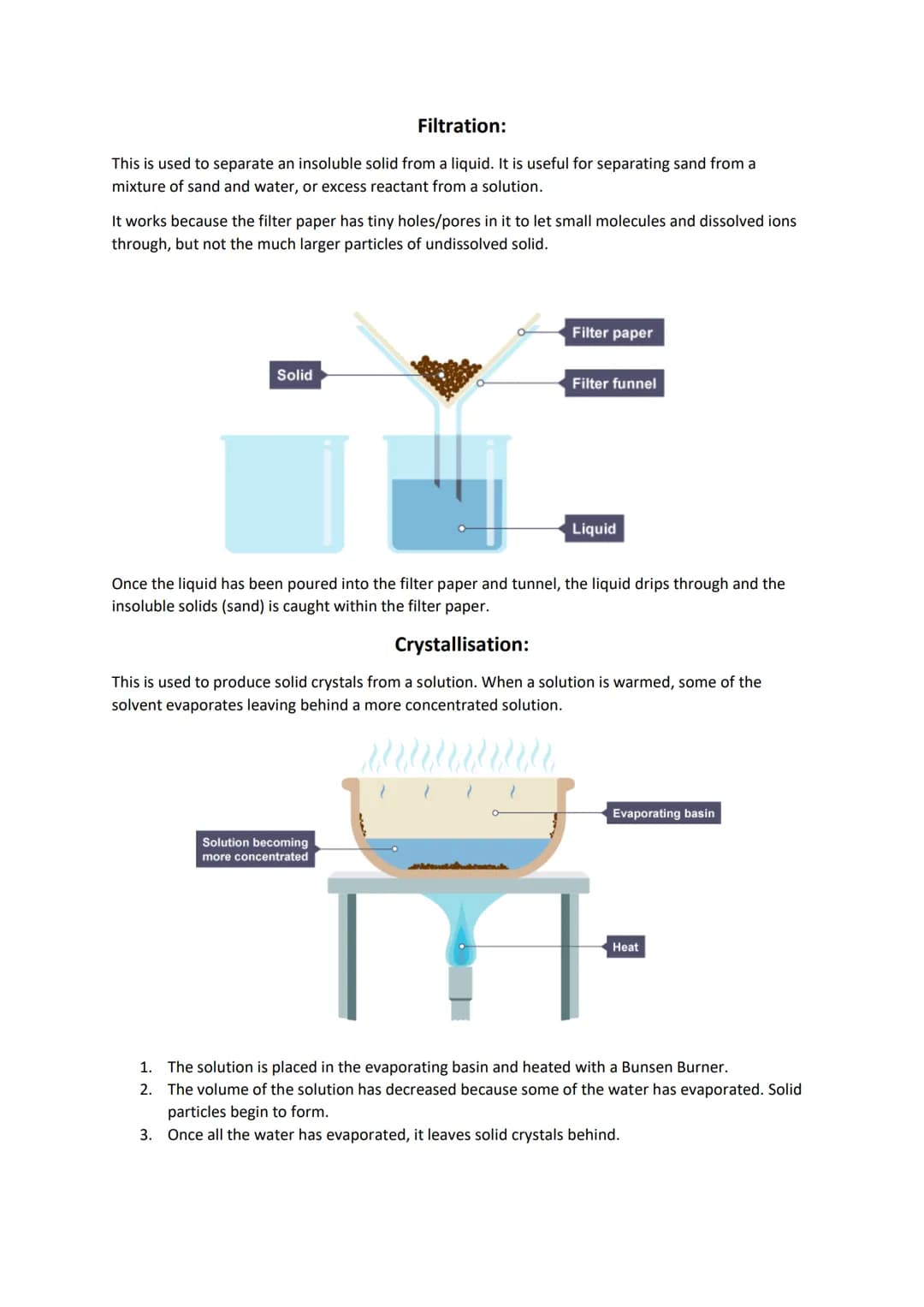
This page covers two important separation techniques: filtration and crystallisation, which are essential for Edexcel key concepts in chemistry separation and purification questions.
Filtration
The text explains the process of filtration:
Definition: Filtration is used to separate an insoluble solid from a liquid.
Example: Separating sand from a mixture of sand and water, or excess reactant from a solution.
The explanation includes how filtration works:
Highlight: Filter paper has tiny holes/pores that allow small molecules and dissolved ions to pass through, but not larger particles of undissolved solid.
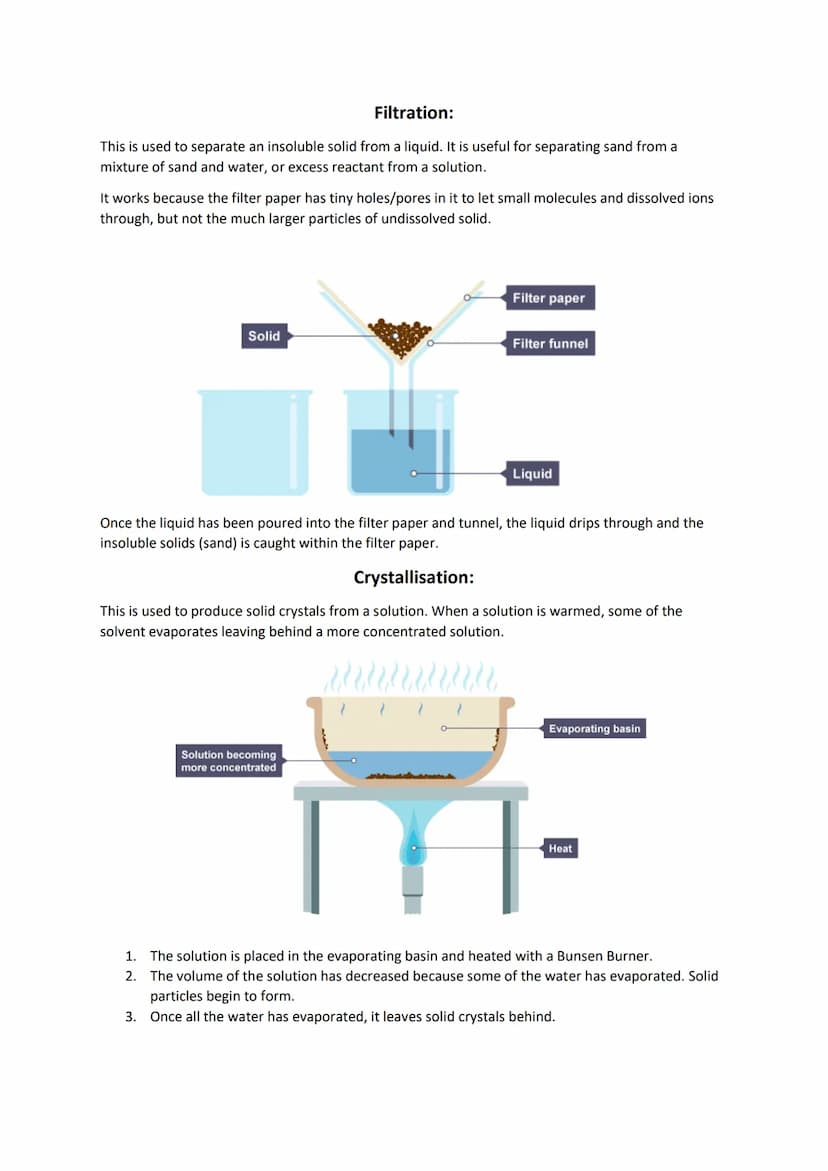
A diagram illustrates the filtration setup, showing how the liquid passes through the filter paper while the solid remains trapped.
Crystallisation
The page then describes the crystallisation process:
Definition: Crystallisation is used to produce solid crystals from a solution.
The text outlines the steps involved:
This information is particularly useful for students preparing for filtration and crystallisation exam questions in chemistry.
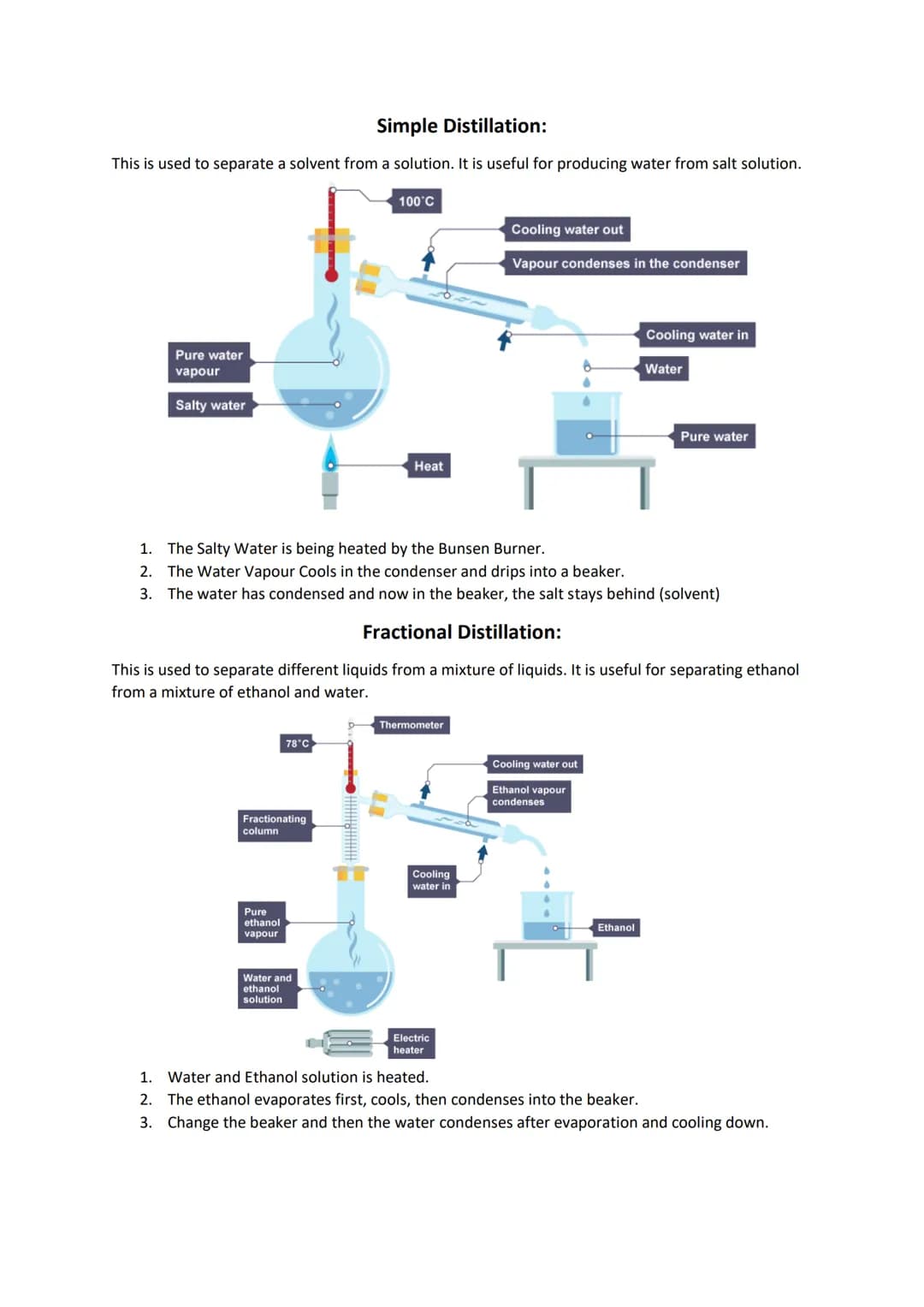
This page covers two types of distillation processes: simple distillation and fractional distillation, which are crucial for understanding Edexcel distillation Core Practical experiments.
Simple Distillation
The text explains the purpose and application of simple distillation:
Definition: Simple distillation is used to separate a solvent from a solution.
Example: Producing water from a salt solution.
The process is described in three steps:
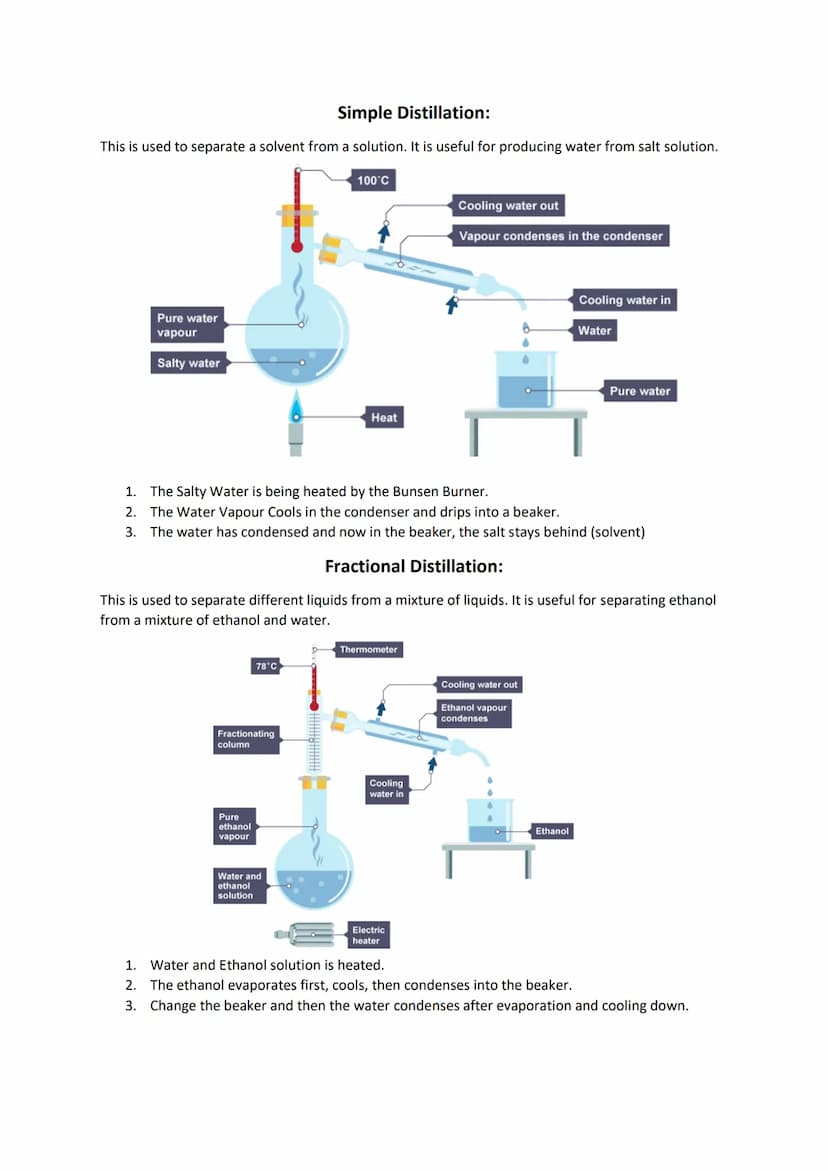
A diagram illustrates the setup, showing the key components such as the heating source, condenser, and collection beaker.
Fractional Distillation
The page then explains fractional distillation:
Definition: Fractional distillation is used to separate different liquids from a mixture of liquids.
Example: Separating ethanol from a mixture of ethanol and water.
The process is described in three steps:
A detailed diagram shows the fractional distillation apparatus, including the fractionating column, condenser, and collection beakers.
This information is essential for students studying step by step simple distillation process for chemistry with diagram and preparing for related exam questions.
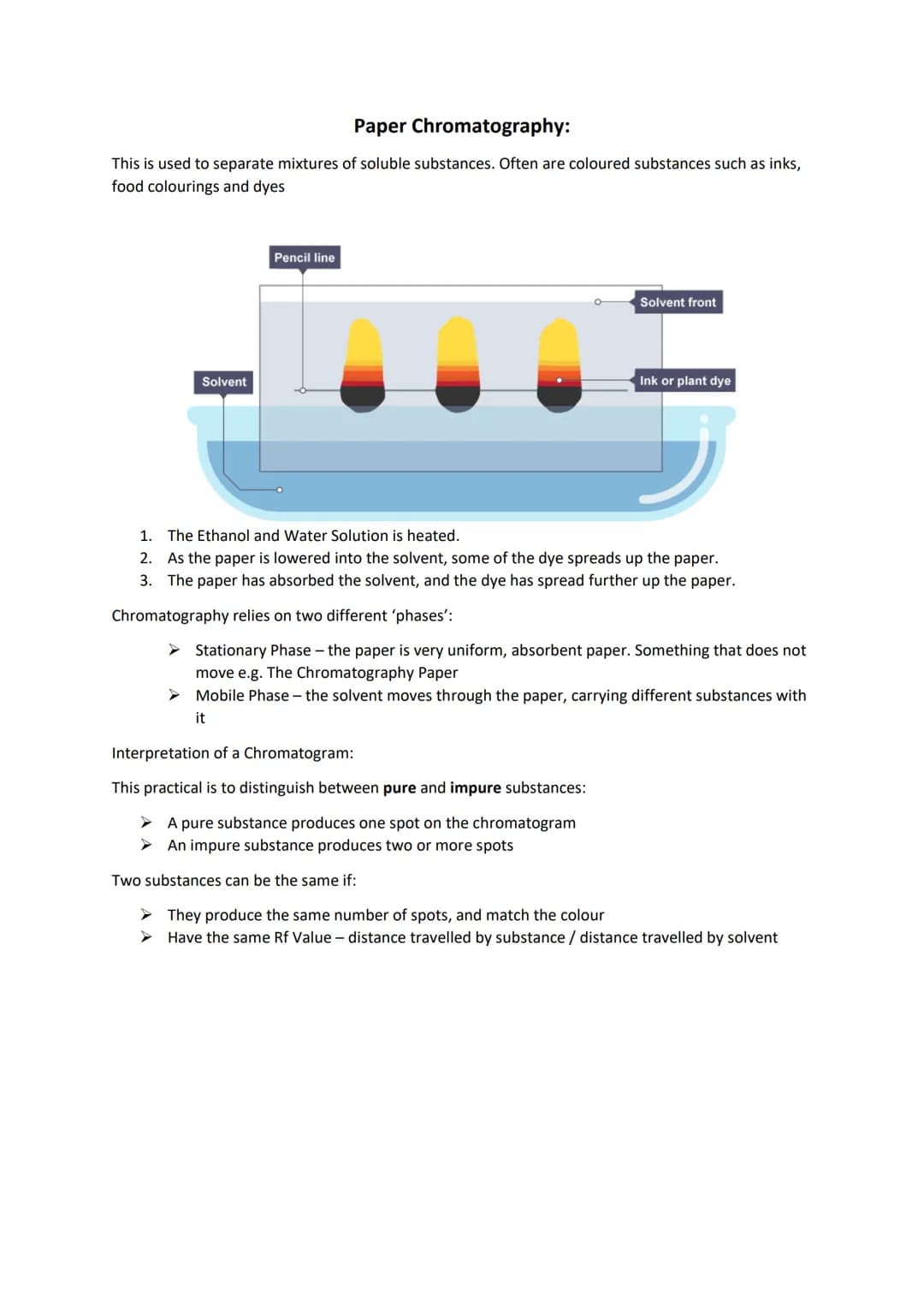
This page focuses on paper chromatography, an important technique for separating mixtures of soluble substances, which is a key topic in Edexcel Chemistry GCSE separating and purifying substances.
Paper Chromatography Process
The text explains the application of paper chromatography:
Definition: Paper chromatography is used to separate mixtures of soluble substances, often colored substances such as inks, food colorings, and dyes.
The process is described in three steps:
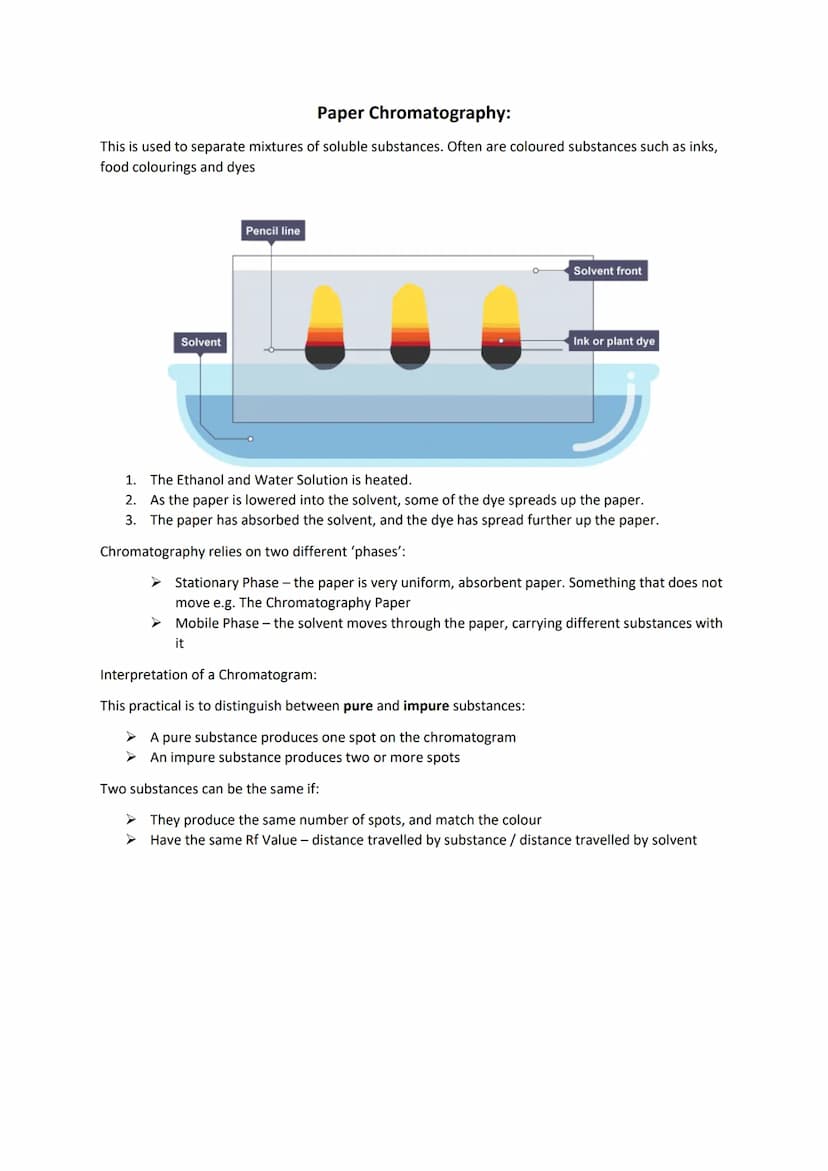
A diagram illustrates the setup, showing the solvent, pencil line, and progression of the dye up the paper.
Interpretation of a Chromatogram
The page explains how to interpret chromatography results:
Highlight: A pure substance produces one spot on the chromatogram, while an impure substance produces two or more spots.
The text introduces two important concepts in chromatography:
Vocabulary: • Stationary Phase: The paper that does not move (e.g., chromatography paper) • Mobile Phase: The solvent that moves through the paper, carrying different substances with it
Comparing Substances
The page provides criteria for comparing substances using chromatography:
Highlight: Two substances can be the same if: • They produce the same number of spots and match in color • They have the same Rf Value (distance traveled by substance / distance traveled by solvent)
This information is crucial for students studying mixtures BBC Bitesize Edexcel and preparing for related exam questions.
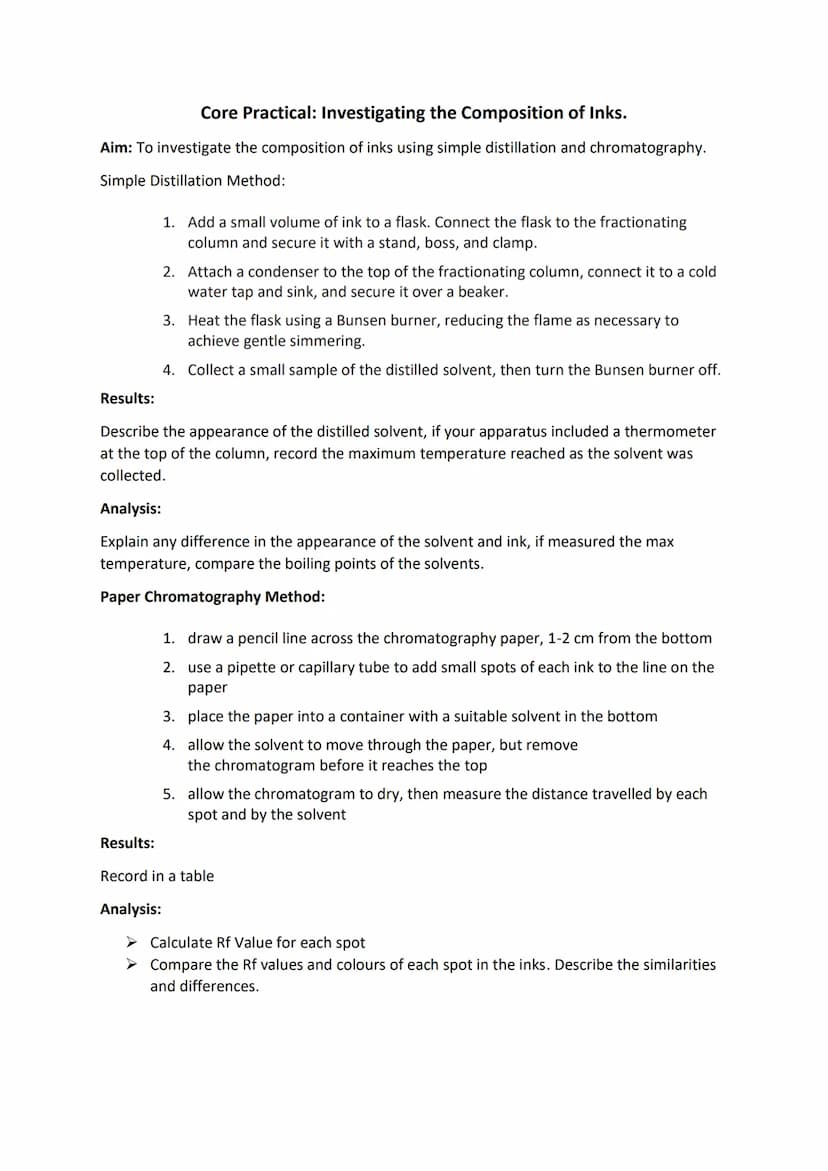
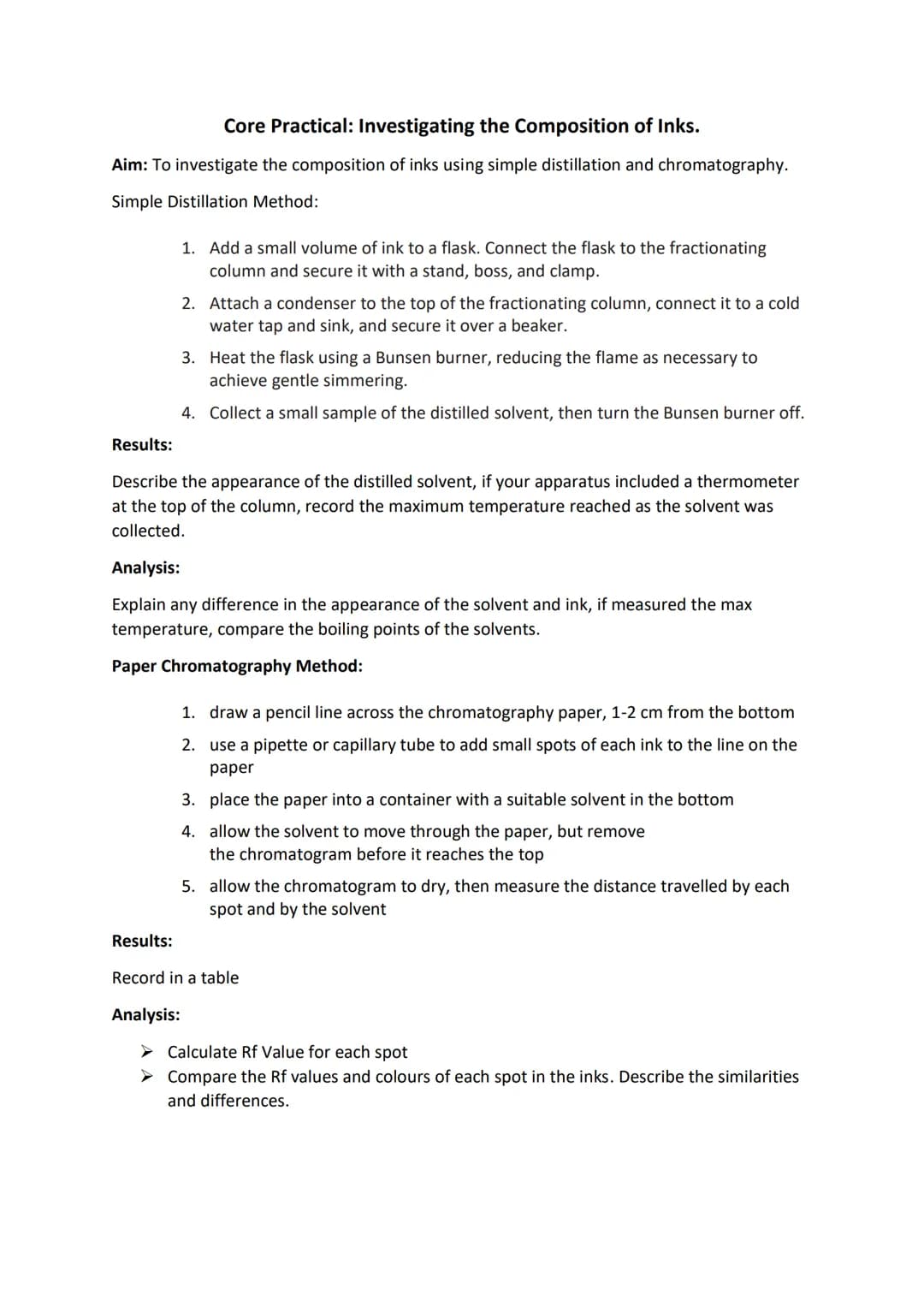
This page outlines a core practical experiment for investigating ink composition using simple distillation and chromatography, which is essential for Edexcel key concepts in chemistry separation and purification qui.
Simple Distillation Method
The text provides a step-by-step procedure for simple distillation:
Highlight: Students are instructed to describe the appearance of the distilled solvent and record the maximum temperature reached if a thermometer was used.
Paper Chromatography Method
The page also outlines the procedure for paper chromatography:
This practical experiment helps students understand the simple distillation procedure step-by-step and apply chromatography techniques, which are crucial for mastering separation and purification concepts in chemistry.
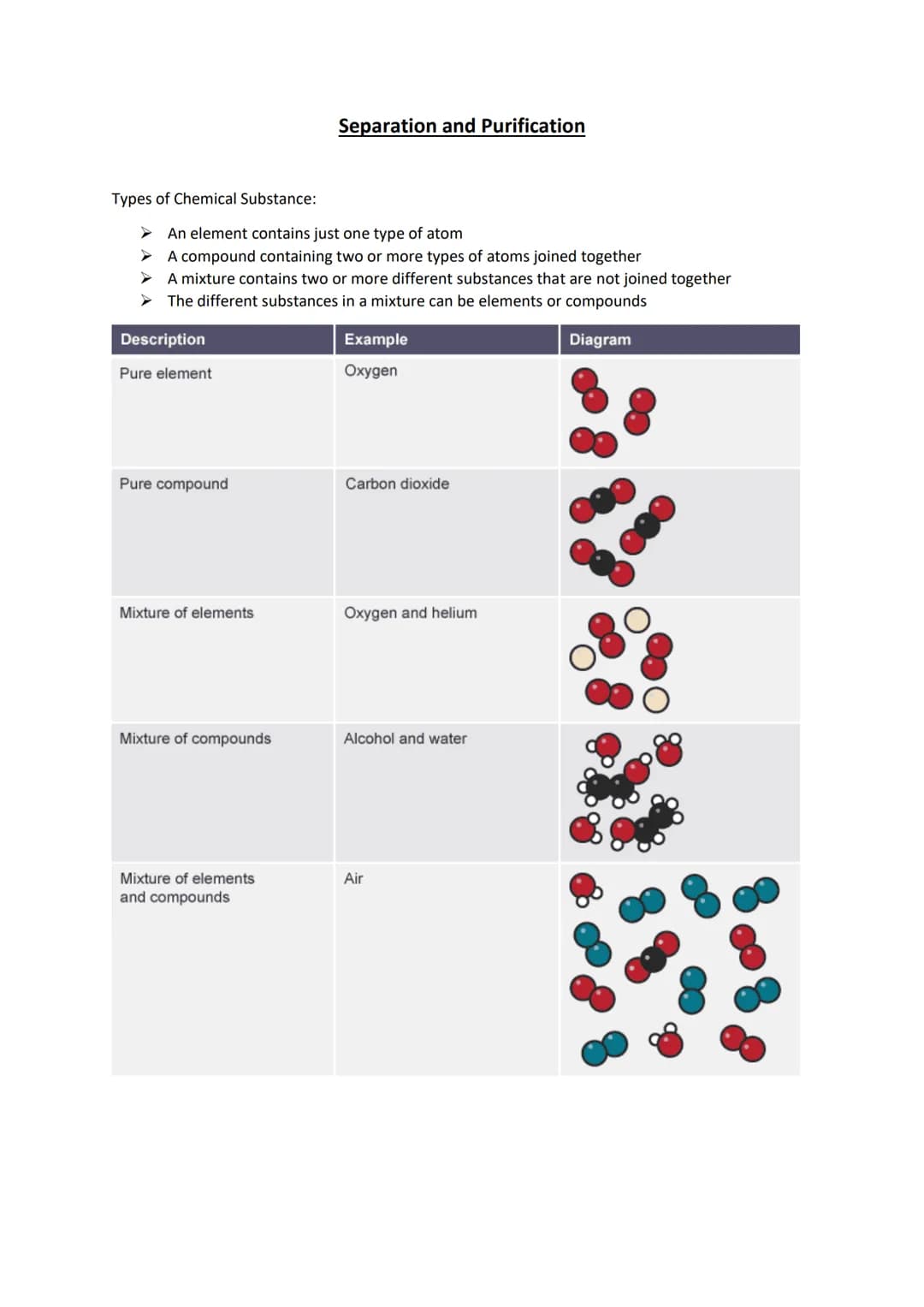
This section introduces the fundamental types of chemical substances, providing a clear foundation for understanding separation techniques.
Elements, Compounds, and Mixtures
The page defines and distinguishes between elements, compounds, and mixtures:
Definition: An element contains just one type of atom, while a compound contains two or more types of atoms joined together.
Definition: A mixture contains two or more different substances that are not joined together. These substances can be elements or compounds.
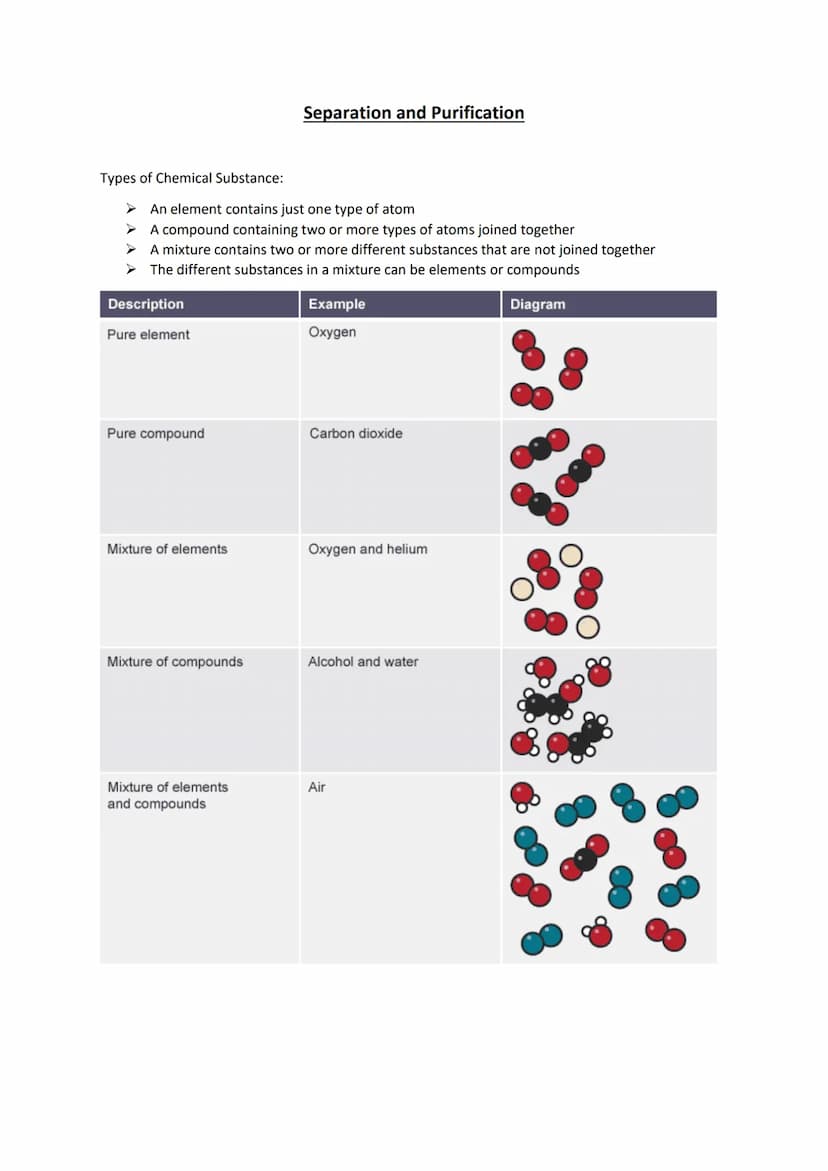
The text is accompanied by a diagram illustrating examples of each type:
Example: • Pure element: Oxygen • Pure compound: Carbon dioxide • Mixture of elements: Oxygen and helium • Mixture of compounds: Alcohol and water • Mixture of elements and compounds: Air
This visual representation helps students grasp the concept of different chemical substances, which is crucial for understanding separation and purification techniques in Edexcel Chemistry GCSE.
ChemistryExplore key concepts in Chemistry Paper 1, including atomic structure, bonding types, chemical equations, and practical laboratory techniques. This summary covers the law of conservation of mass, separation methods like distillation and chromatography, and acid-base reactions. Ideal for students preparing for OCR Gateway exams.
ChemistryExplore key GCSE chemistry practicals including electrochemical cells, chromatography techniques, and methods for making soluble and insoluble salts. This summary covers essential experiments such as distillation, gas identification, and reaction rates, providing a comprehensive overview for students preparing for their exams.
ChemistryExplore essential physical separation techniques including Filtration and Crystallisation. This summary covers the apparatus, step-by-step procedures, and applications of each method, providing a clear understanding of how to separate mixtures effectively. Ideal for students studying laboratory techniques and separation methods.
ChemistryExplore the essential processes of simple and fractional distillation, including step-by-step methods for purifying liquids from mixtures. This summary covers key concepts such as the distillation process, types of mixtures, and practical applications. Ideal for students studying separation methods in chemistry.
ChemistryExplore the process of fractional distillation, a key method for separating crude oil into valuable fractions based on boiling points. This summary covers the principles of distillation, the characteristics of different hydrocarbons, and the various useful products derived from crude oil, including petrol, diesel, and bitumen. Ideal for GCSE higher tier students.
ChemistryExplore the fundamentals of atomic structure, ionic bonding, and the periodic table in this comprehensive study resource. Covering key concepts such as subatomic particles, pure substances, and separation methods, this material is essential for understanding chemistry at the foundational level. Ideal for AQA Chemistry Paper 1 preparation.
ChemistryExplore the essential methods of distillation in chemistry, including simple and fractional distillation processes. This summary covers the setup, techniques, and key concepts involved in separating mixtures, complete with labeled diagrams for clarity. Ideal for KS3-KS4 students.
ChemistryExplore essential separation techniques in chemistry, including chromatography, filtration, crystallisation, and distillation methods. This summary provides clear explanations and practical applications for GCSE AQA Chemistry students, enhancing your understanding of how to separate mixtures effectively.
ChemistryExplore essential laboratory techniques in Advanced Higher Chemistry, including titration, chromatography, and gravimetric analysis. This resource covers key concepts such as standard solutions, percent yield, and stoichiometry, providing practical insights for experiments like the preparation of benzoic acid and the determination of aspirin content. Ideal for students seeking to enhance their understanding of chemical analysis and practical skills.
ChemistryThe Atom
Chemistryhigher
ChemistryEverything from snaprevise for OCR chemistry a-level
ChemistryUnlock the secrets of chemical reactions with this comprehensive flashcard set designed to help you conquer complex concepts and ace your Chemistry exams.
ChemistryChem paper 2 notes
Chemistry4.4 Reactions of acids with bases or carbonates
ChemistryExplore key AQA GCSE Chemistry practicals, including flame tests, titration, and gas identification. This resource covers essential techniques for analyzing ions, making salts, and understanding reaction kinetics. Perfect for students preparing for exams and practical assessments.
ChemistryCalculate the number of protons, neutrons, and electrons for different elements and isotopes.
ChemistryPractice identifying subatomic particles, calculating neutrons, and defining isotopes and atomic/mass numbers.
 Sociology
Explore comprehensive A-Level Sociology notes on the education system, covering key theories, policies, and sociological perspectives. This resource includes insights on marketisation, gender roles, cultural deprivation, and educational inequalities, providing a thorough understanding of how education shapes social stratification and individual achievement. Ideal for exam preparation and in-depth study.
SociologyDive into an extensive overview of family dynamics, perspectives, and patterns in sociology. This resource covers key concepts such as family diversity, gender roles, marriage, and the impact of social policies on family structures. Perfect for A-Level Sociology students preparing for Paper 2.
CriminologyComprehensive mindmaps covering key concepts in the Crime and Punishment topic for WJEC Criminology Unit 4. This resource includes detailed insights into the Criminal Justice System, crime prevention strategies, sentencing models, and the roles of various agencies. Ideal for A-Level revision, ensuring you grasp essential theories and legislative processes to excel in your exams.
SociologyExplore an extensive revision of crime and deviance topics, including theories, types of crime, and the impact of media. This resource covers key concepts such as Marxism, functionalism, gender and crime, and the influence of globalization on criminal behavior. Ideal for students seeking a thorough understanding of criminology and its various theories. Type: Full Topic Revision.
 Biology
cell structures
BiologyFlashcards on the different functions of subcellular structures: cell membrane, nucleus, mitochondria, ribosomes, cytoplasm, permant vacuole, chloroplasts and cell wall.
SociologyComprehensive revision of key sociological theories including Functionalism, Marxism, Feminism, and Interpretivism. Explore concepts like value freedom, identity formation, and the critique of social control. Ideal for AQA A-Level Sociology students preparing for exams. This summary covers essential theories and their implications in sociology, providing a clear understanding of each perspective.
CriminologyCriminology unit 4 detailed revision note
Biologycombined science higher biology
The app is very easy to use and well designed. I have found everything I was looking for so far and have been able to learn a lot from the presentations! I will definitely use the app for a class assignment! And of course it also helps a lot as an inspiration.
This app is really great. There are so many study notes and help [...]. My problem subject is French, for example, and the app has so many options for help. Thanks to this app, I have improved my French. I would recommend it to anyone.
Wow, I am really amazed. I just tried the app because I've seen it advertised many times and was absolutely stunned. This app is THE HELP you want for school and above all, it offers so many things, such as workouts and fact sheets, which have been VERY helpful to me personally.
Chemistry681 views·Updated 25 Jul 2026·5 pagesKey Concepts in Chemistry: Separation and Purification Techniques
This guide covers essential separation and purification methods in chemistry, including filtration, crystallization, distillation, and chromatography. It provides detailed explanations and diagrams for each technique, making it ideal for students studying Edexcel...
By signing up you accept Terms of Service and Privacy Policy
This page covers two important separation techniques: filtration and crystallisation, which are essential for Edexcel key concepts in chemistry separation and purification questions.
Filtration
The text explains the process of filtration:
Definition: Filtration is used to separate an insoluble solid from a liquid.
Example: Separating sand from a mixture of sand and water, or excess reactant from a solution.
The explanation includes how filtration works:
Highlight: Filter paper has tiny holes/pores that allow small molecules and dissolved ions to pass through, but not larger particles of undissolved solid.
A diagram illustrates the filtration setup, showing how the liquid passes through the filter paper while the solid remains trapped.
Crystallisation
The page then describes the crystallisation process:
Definition: Crystallisation is used to produce solid crystals from a solution.
The text outlines the steps involved:
This information is particularly useful for students preparing for filtration and crystallisation exam questions in chemistry.
By signing up you accept Terms of Service and Privacy Policy
This page covers two types of distillation processes: simple distillation and fractional distillation, which are crucial for understanding Edexcel distillation Core Practical experiments.
Simple Distillation
The text explains the purpose and application of simple distillation:
Definition: Simple distillation is used to separate a solvent from a solution.
Example: Producing water from a salt solution.
The process is described in three steps:
A diagram illustrates the setup, showing the key components such as the heating source, condenser, and collection beaker.
Fractional Distillation
The page then explains fractional distillation:
Definition: Fractional distillation is used to separate different liquids from a mixture of liquids.
Example: Separating ethanol from a mixture of ethanol and water.
The process is described in three steps:
A detailed diagram shows the fractional distillation apparatus, including the fractionating column, condenser, and collection beakers.
This information is essential for students studying step by step simple distillation process for chemistry with diagram and preparing for related exam questions.
By signing up you accept Terms of Service and Privacy Policy
This page focuses on paper chromatography, an important technique for separating mixtures of soluble substances, which is a key topic in Edexcel Chemistry GCSE separating and purifying substances.
Paper Chromatography Process
The text explains the application of paper chromatography:
Definition: Paper chromatography is used to separate mixtures of soluble substances, often colored substances such as inks, food colorings, and dyes.
The process is described in three steps:
A diagram illustrates the setup, showing the solvent, pencil line, and progression of the dye up the paper.
Interpretation of a Chromatogram
The page explains how to interpret chromatography results:
Highlight: A pure substance produces one spot on the chromatogram, while an impure substance produces two or more spots.
The text introduces two important concepts in chromatography:
Vocabulary: • Stationary Phase: The paper that does not move (e.g., chromatography paper) • Mobile Phase: The solvent that moves through the paper, carrying different substances with it
Comparing Substances
The page provides criteria for comparing substances using chromatography:
Highlight: Two substances can be the same if: • They produce the same number of spots and match in color • They have the same Rf Value (distance traveled by substance / distance traveled by solvent)
This information is crucial for students studying mixtures BBC Bitesize Edexcel and preparing for related exam questions.
By signing up you accept Terms of Service and Privacy Policy
This page outlines a core practical experiment for investigating ink composition using simple distillation and chromatography, which is essential for Edexcel key concepts in chemistry separation and purification qui.
Simple Distillation Method
The text provides a step-by-step procedure for simple distillation:
Highlight: Students are instructed to describe the appearance of the distilled solvent and record the maximum temperature reached if a thermometer was used.
Paper Chromatography Method
The page also outlines the procedure for paper chromatography:
This practical experiment helps students understand the simple distillation procedure step-by-step and apply chromatography techniques, which are crucial for mastering separation and purification concepts in chemistry.
By signing up you accept Terms of Service and Privacy Policy
This section introduces the fundamental types of chemical substances, providing a clear foundation for understanding separation techniques.
Elements, Compounds, and Mixtures
The page defines and distinguishes between elements, compounds, and mixtures:
Definition: An element contains just one type of atom, while a compound contains two or more types of atoms joined together.
Definition: A mixture contains two or more different substances that are not joined together. These substances can be elements or compounds.
The text is accompanied by a diagram illustrating examples of each type:
Example: • Pure element: Oxygen • Pure compound: Carbon dioxide • Mixture of elements: Oxygen and helium • Mixture of compounds: Alcohol and water • Mixture of elements and compounds: Air
This visual representation helps students grasp the concept of different chemical substances, which is crucial for understanding separation and purification techniques in Edexcel Chemistry GCSE.
ChemistryExplore key concepts in Chemistry Paper 1, including atomic structure, bonding types, chemical equations, and practical laboratory techniques. This summary covers the law of conservation of mass, separation methods like distillation and chromatography, and acid-base reactions. Ideal for students preparing for OCR Gateway exams.
ChemistryExplore key GCSE chemistry practicals including electrochemical cells, chromatography techniques, and methods for making soluble and insoluble salts. This summary covers essential experiments such as distillation, gas identification, and reaction rates, providing a comprehensive overview for students preparing for their exams.
ChemistryExplore essential physical separation techniques including Filtration and Crystallisation. This summary covers the apparatus, step-by-step procedures, and applications of each method, providing a clear understanding of how to separate mixtures effectively. Ideal for students studying laboratory techniques and separation methods.
ChemistryExplore the essential processes of simple and fractional distillation, including step-by-step methods for purifying liquids from mixtures. This summary covers key concepts such as the distillation process, types of mixtures, and practical applications. Ideal for students studying separation methods in chemistry.
ChemistryExplore the process of fractional distillation, a key method for separating crude oil into valuable fractions based on boiling points. This summary covers the principles of distillation, the characteristics of different hydrocarbons, and the various useful products derived from crude oil, including petrol, diesel, and bitumen. Ideal for GCSE higher tier students.
ChemistryExplore the fundamentals of atomic structure, ionic bonding, and the periodic table in this comprehensive study resource. Covering key concepts such as subatomic particles, pure substances, and separation methods, this material is essential for understanding chemistry at the foundational level. Ideal for AQA Chemistry Paper 1 preparation.
ChemistryExplore the essential methods of distillation in chemistry, including simple and fractional distillation processes. This summary covers the setup, techniques, and key concepts involved in separating mixtures, complete with labeled diagrams for clarity. Ideal for KS3-KS4 students.
ChemistryExplore essential separation techniques in chemistry, including chromatography, filtration, crystallisation, and distillation methods. This summary provides clear explanations and practical applications for GCSE AQA Chemistry students, enhancing your understanding of how to separate mixtures effectively.
ChemistryExplore essential laboratory techniques in Advanced Higher Chemistry, including titration, chromatography, and gravimetric analysis. This resource covers key concepts such as standard solutions, percent yield, and stoichiometry, providing practical insights for experiments like the preparation of benzoic acid and the determination of aspirin content. Ideal for students seeking to enhance their understanding of chemical analysis and practical skills.
ChemistryThe Atom
Chemistryhigher
ChemistryEverything from snaprevise for OCR chemistry a-level
ChemistryUnlock the secrets of chemical reactions with this comprehensive flashcard set designed to help you conquer complex concepts and ace your Chemistry exams.
ChemistryChem paper 2 notes
Chemistry4.4 Reactions of acids with bases or carbonates
ChemistryExplore key AQA GCSE Chemistry practicals, including flame tests, titration, and gas identification. This resource covers essential techniques for analyzing ions, making salts, and understanding reaction kinetics. Perfect for students preparing for exams and practical assessments.
ChemistryCalculate the number of protons, neutrons, and electrons for different elements and isotopes.
ChemistryPractice identifying subatomic particles, calculating neutrons, and defining isotopes and atomic/mass numbers.
SociologyExplore comprehensive A-Level Sociology notes on the education system, covering key theories, policies, and sociological perspectives. This resource includes insights on marketisation, gender roles, cultural deprivation, and educational inequalities, providing a thorough understanding of how education shapes social stratification and individual achievement. Ideal for exam preparation and in-depth study.
SociologyDive into an extensive overview of family dynamics, perspectives, and patterns in sociology. This resource covers key concepts such as family diversity, gender roles, marriage, and the impact of social policies on family structures. Perfect for A-Level Sociology students preparing for Paper 2.
CriminologyComprehensive mindmaps covering key concepts in the Crime and Punishment topic for WJEC Criminology Unit 4. This resource includes detailed insights into the Criminal Justice System, crime prevention strategies, sentencing models, and the roles of various agencies. Ideal for A-Level revision, ensuring you grasp essential theories and legislative processes to excel in your exams.
SociologyExplore an extensive revision of crime and deviance topics, including theories, types of crime, and the impact of media. This resource covers key concepts such as Marxism, functionalism, gender and crime, and the influence of globalization on criminal behavior. Ideal for students seeking a thorough understanding of criminology and its various theories. Type: Full Topic Revision.
Biologycell structures
BiologyFlashcards on the different functions of subcellular structures: cell membrane, nucleus, mitochondria, ribosomes, cytoplasm, permant vacuole, chloroplasts and cell wall.
SociologyComprehensive revision of key sociological theories including Functionalism, Marxism, Feminism, and Interpretivism. Explore concepts like value freedom, identity formation, and the critique of social control. Ideal for AQA A-Level Sociology students preparing for exams. This summary covers essential theories and their implications in sociology, providing a clear understanding of each perspective.
CriminologyCriminology unit 4 detailed revision note
Biologycombined science higher biology
The app is very easy to use and well designed. I have found everything I was looking for so far and have been able to learn a lot from the presentations! I will definitely use the app for a class assignment! And of course it also helps a lot as an inspiration.
This app is really great. There are so many study notes and help [...]. My problem subject is French, for example, and the app has so many options for help. Thanks to this app, I have improved my French. I would recommend it to anyone.
Wow, I am really amazed. I just tried the app because I've seen it advertised many times and was absolutely stunned. This app is THE HELP you want for school and above all, it offers so many things, such as workouts and fact sheets, which have been VERY helpful to me personally.
