
The Group 7 halogensrepresent a crucial family of elements... Show more
 Chemistry555 views·Updated May 23, 2026·7 pages
Fun with Group 7 Halogens: AQA A Level Chemistry Required Practical 7

Maya A@maya.ah
1 / 7
1
of 7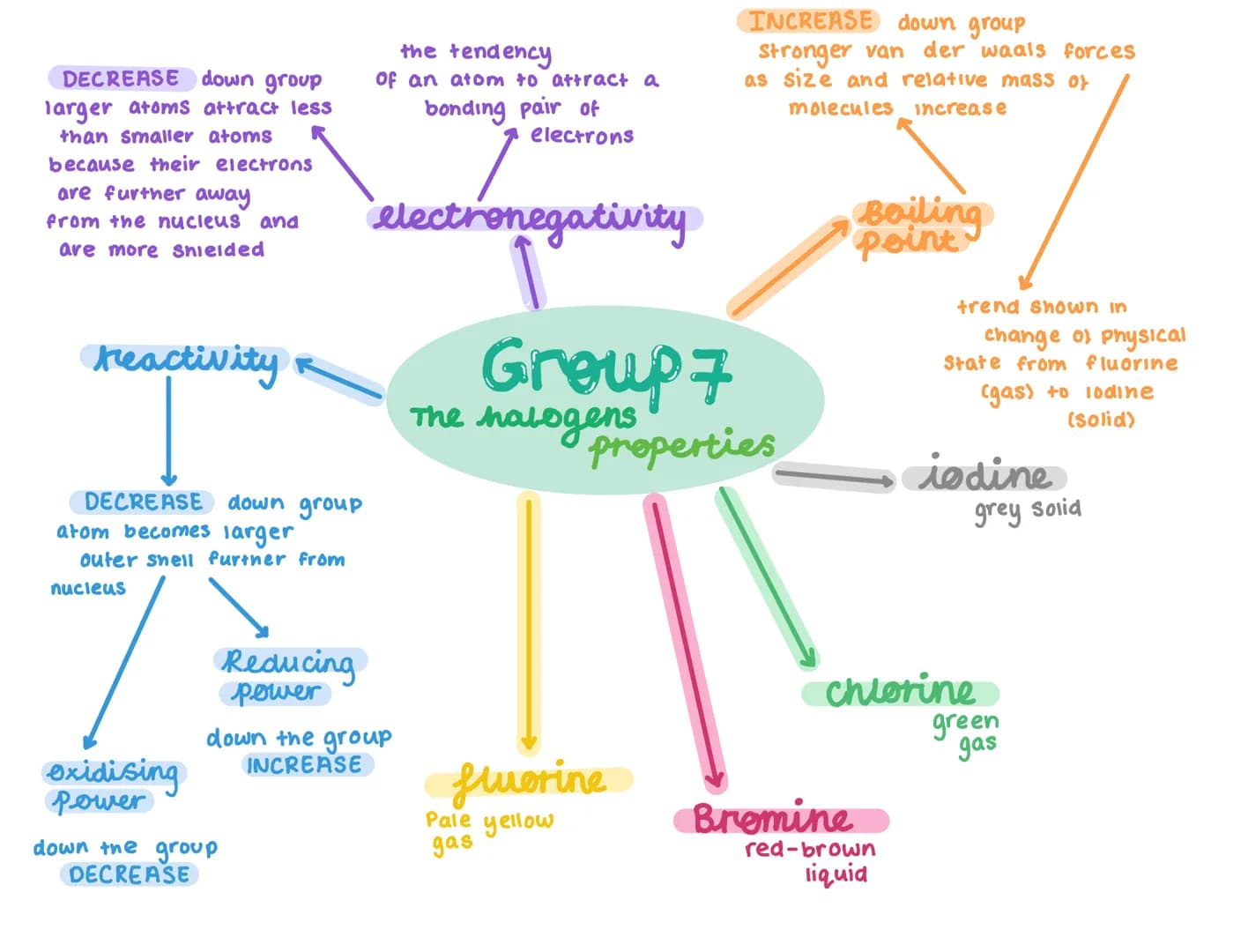
Group 7 Reactions and Displacement
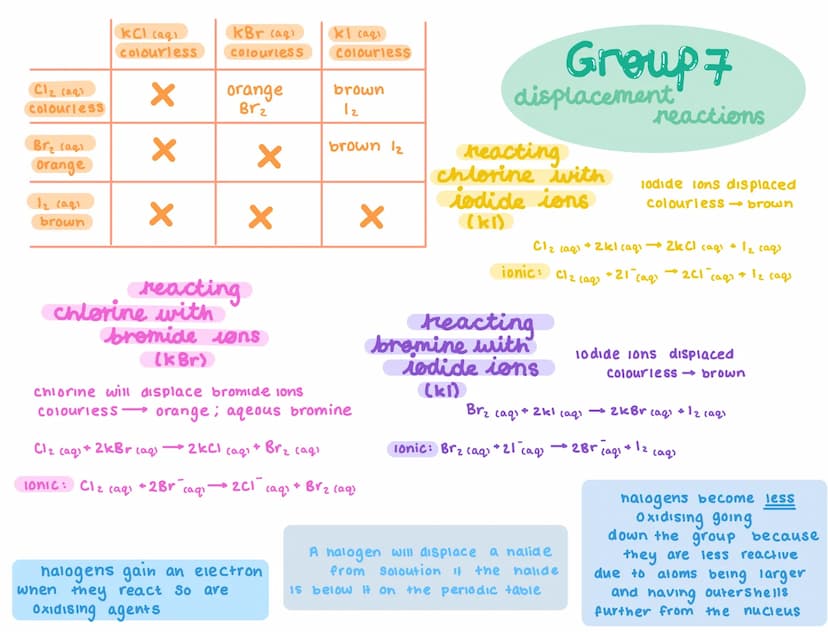
Understanding the reactions and displacement properties of Group 7 elements is crucial for AQA A Level Chemistry Required Practical 7 write up. This knowledge forms the basis for many practical experiments and theoretical concepts in halogen chemistry.
Halogens act as oxidizing agents, gaining an electron when they react. The oxidizing power decreases down the group, which is reflected in their displacement reactions.
Definition: Displacement reaction - A reaction where a more reactive element displaces a less reactive element from its compound.
Key displacement reactions include:
-
Chlorine displacing bromide ions: Cl₂ (aq) + 2KBr (aq) → 2KCl (aq) + Br₂ (aq)
-
Chlorine displacing iodide ions: Cl₂ (aq) + 2KI (aq) → 2KCl (aq) + I₂ (aq)
-
Bromine displacing iodide ions: Br₂ (aq) + 2KI (aq) → 2KBr (aq) + I₂ (aq)
Highlight: A halogen will displace a halide from solution if the halide is below it on the periodic table.
These reactions are essential for understanding the reactivity of halogens and answering questions about why reactivity decreases down group 7 in A Level Chemistry. The color changes observed in these reactions (e.g., colorless to orange or brown) are important indicators used in practical experiments and should be noted in your AQA A Level Chemistry Required Practical 7 results table.
2
of 7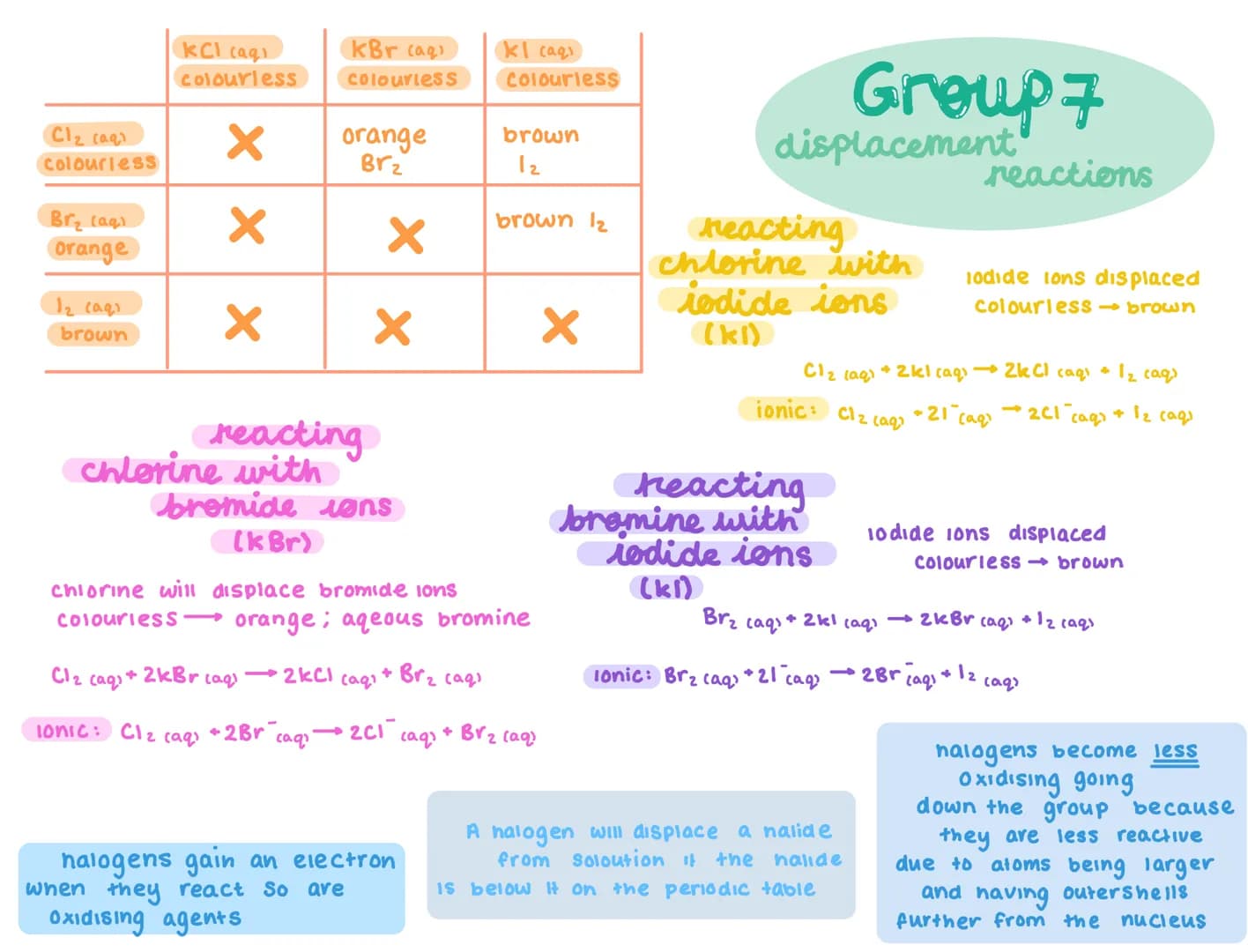
Chlorine and Water Treatment
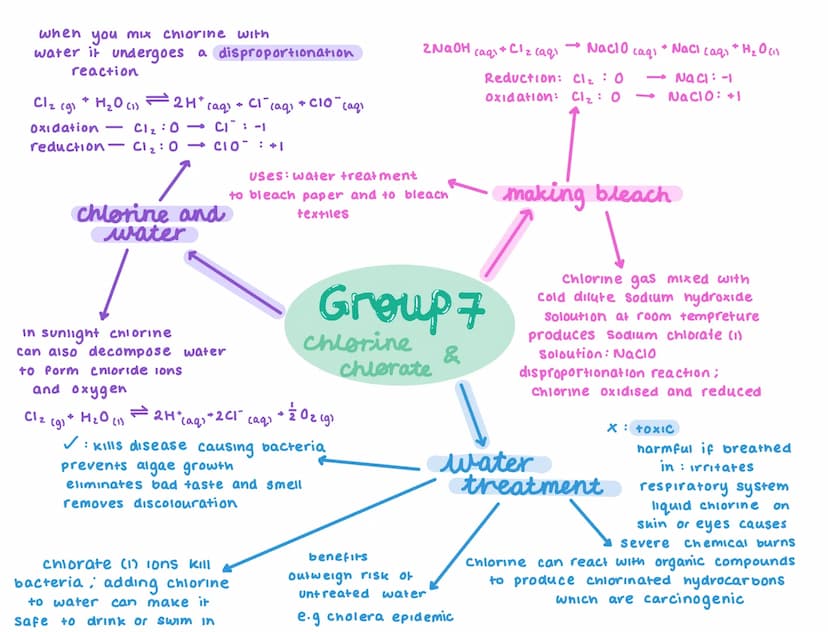
Chlorine plays a significant role in water treatment, which is an important application of Group 7 elements. Understanding these reactions is crucial for AQA A Level Chemistry Required Practical 7 risk assessment and real-world applications of halogen chemistry.
When chlorine is mixed with water, it undergoes a disproportionation reaction:
Cl₂ (g) + H₂O (l) → 2H⁺ (aq) + Cl⁻ (aq) + ClO⁻ (aq)
Vocabulary: Disproportionation reaction - A reaction in which a single element is both oxidized and reduced.
In sunlight, chlorine can also decompose water to form chloride ions and oxygen:
Cl₂ (g) + H₂O (l) → 2H⁺ (aq) + 2Cl⁻ (aq) + ½O₂ (g)
The benefits of using chlorine in water treatment include:
- Killing disease-causing bacteria
- Preventing algae growth
- Eliminating bad taste and smell
- Removing discoloration
Highlight: Chlorate(I) ions produced in these reactions are responsible for killing bacteria, making water safe for drinking and swimming.
Chlorine is also used in the production of bleach:
2NaOH (aq) + Cl₂ (aq) → NaClO (aq) + NaCl (aq) + H₂O (l)
While chlorine treatment offers significant benefits, it's important to note its potential risks:
- Toxicity if breathed in
- Irritation to the respiratory system
- Severe chemical burns from liquid chlorine on skin or eyes
- Potential formation of carcinogenic chlorinated hydrocarbons
Understanding these reactions and their implications is essential for Group 7 A Level Chemistry OCR and other exam boards, as well as for practical applications in water treatment and chemical industry.
3
of 7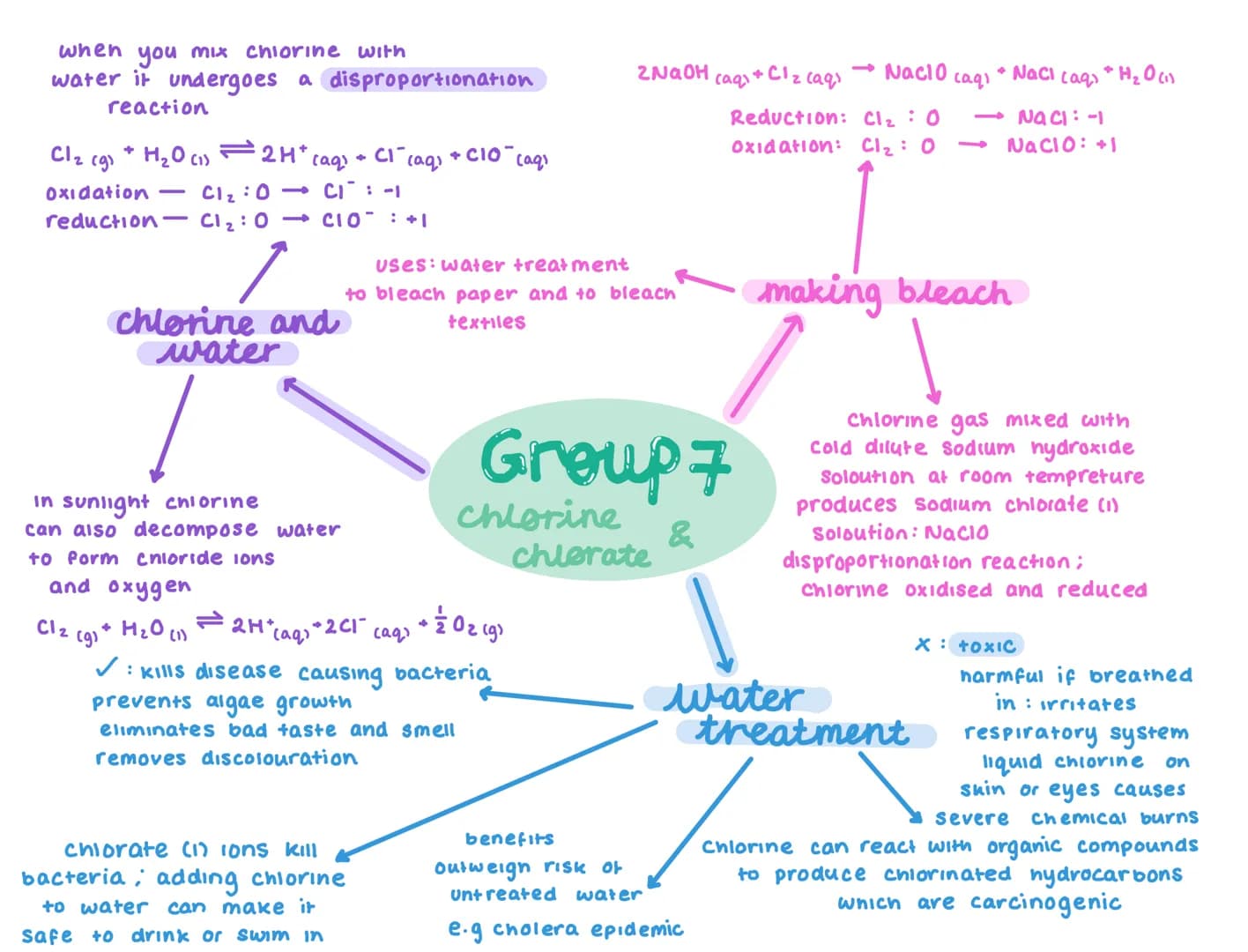
Testing for Ammonium and Carbonate Ions
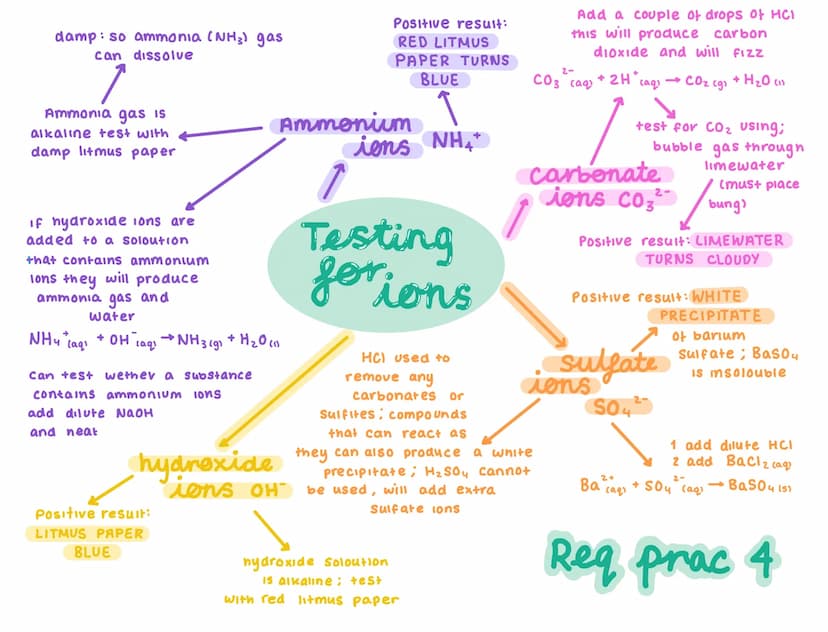
Identifying various ions is a crucial skill in chemistry, particularly for AQA A Level Chemistry Required Practical 7. This section focuses on testing for ammonium and carbonate ions, which are important in many chemical processes.
Testing for Ammonium Ions (NH₄⁺):
- Add dilute NaOH to the sample.
- Heat gently.
- Test the gas produced with damp red litmus paper.
Highlight: A positive result for ammonium ions is indicated when the red litmus paper turns blue.
The reaction occurring is:
NH₄⁺ (aq) + OH⁻ (aq) → NH₃ (g) + H₂O (l)
Testing for Carbonate Ions (CO₃²⁻):
- Add a few drops of dilute HCl to the sample.
- Observe for effervescence (fizzing).
- Test the gas produced by bubbling it through limewater.
Highlight: A positive result for carbonate ions is indicated when limewater turns cloudy.
The reactions occurring are:
CO₃²⁻ (aq) + 2H⁺ (aq) → CO₂ (g) + H₂O (l) Ca(OH)₂ (aq) + CO₂ (g) → CaCO₃ (s) + H₂O (l)
These tests are essential for Required Practical 7a Chemistry AQA A level variables and form a crucial part of qualitative analysis in chemistry. Understanding these reactions and their indicators is vital for success in practical exams and theoretical questions related to ion identification.
4
of 7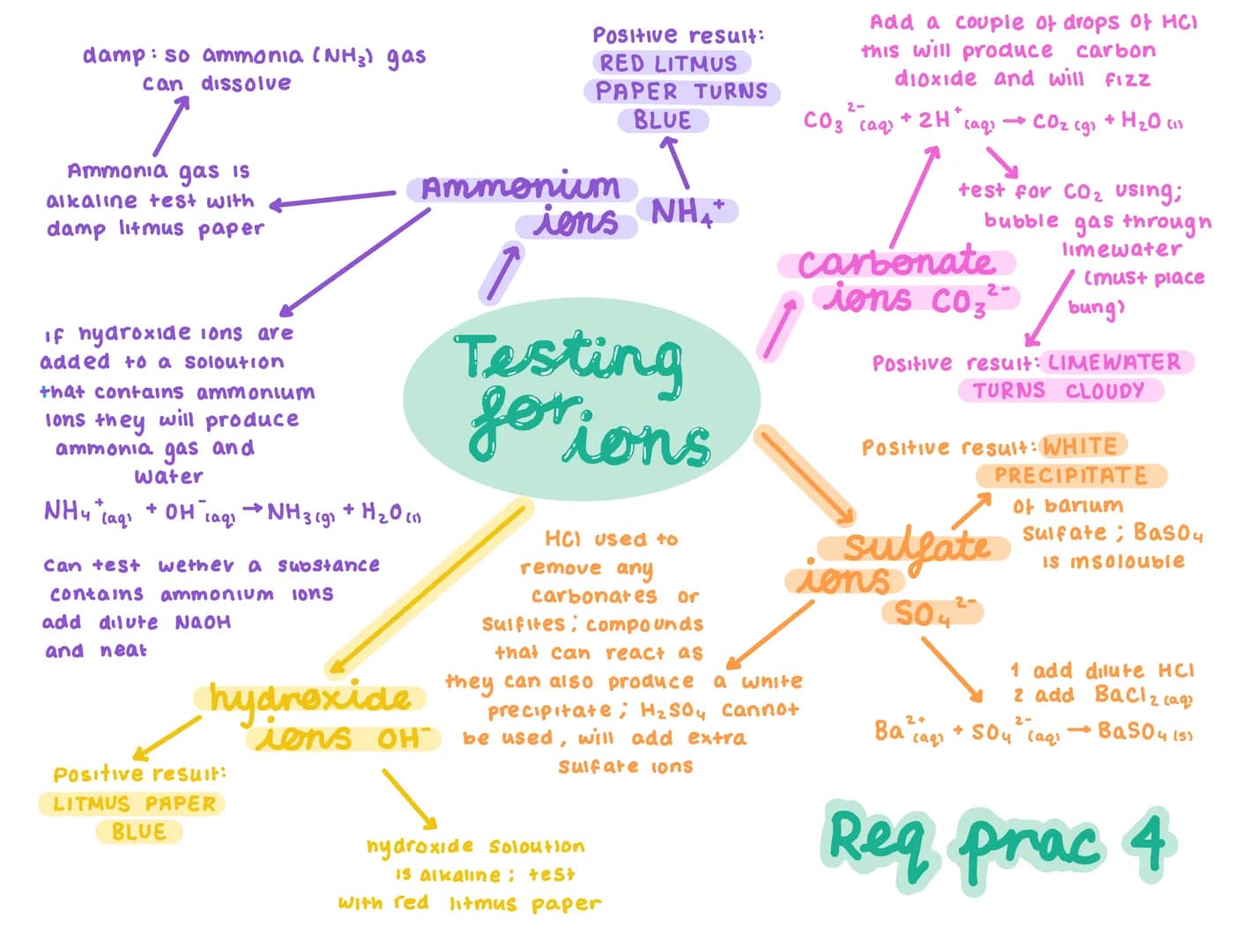
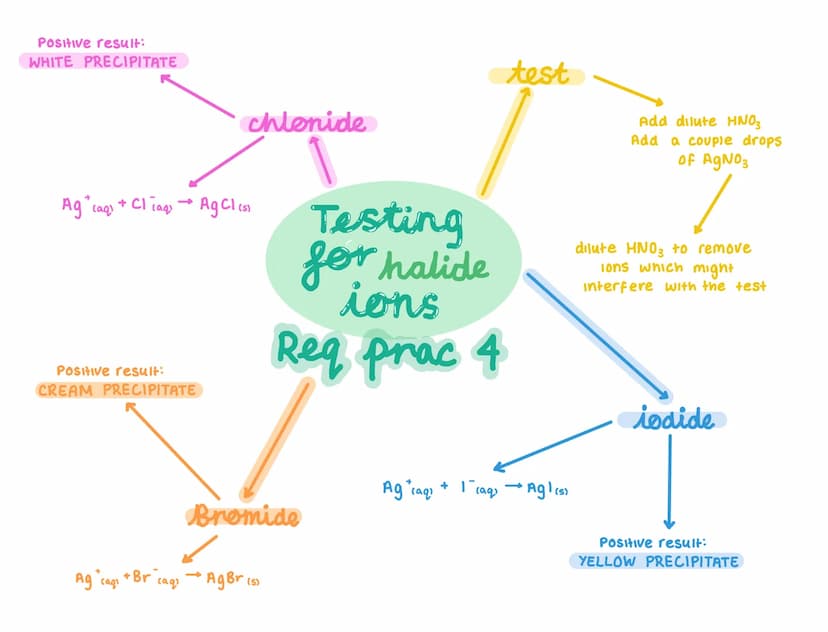
Testing for Sulfate and Halide Ions
Identifying sulfate and halide ions is a crucial skill in analytical chemistry and forms an important part of AQA A Level Chemistry Required Practical 7. This knowledge is essential for answering Group 7 A Level Chemistry Questions and performing practical experiments.
Testing for Sulfate Ions (SO₄²⁻):
- Add dilute HCl to the sample.
- Add barium chloride solution (BaCl₂).
Highlight: A positive result for sulfate ions is indicated by the formation of a white precipitate of barium sulfate (BaSO₄).
The reaction occurring is:
Ba²⁺ (aq) + SO₄²⁻ (aq) → BaSO₄ (s)
Testing for Halide Ions (Cl⁻, Br⁻, I⁻):
- Add dilute nitric acid (HNO₃) to the sample.
- Add a few drops of silver nitrate solution (AgNO₃).
Highlight: The color of the precipitate formed indicates the specific halide ion present.
- Chloride ions (Cl⁻): White precipitate
- Bromide ions (Br⁻): Cream precipitate
- Iodide ions (I⁻): Yellow precipitate
The general reaction is:
Ag⁺ (aq) + X⁻ (aq) → AgX (s) (where X is Cl, Br, or I)
These tests are crucial for creating a Group 7 halogens ion testing mindmap and answering questions related to halide identification. Understanding the colors and solubilities of these precipitates is essential for success in practical exams and theoretical questions about halogen chemistry.
5
of 7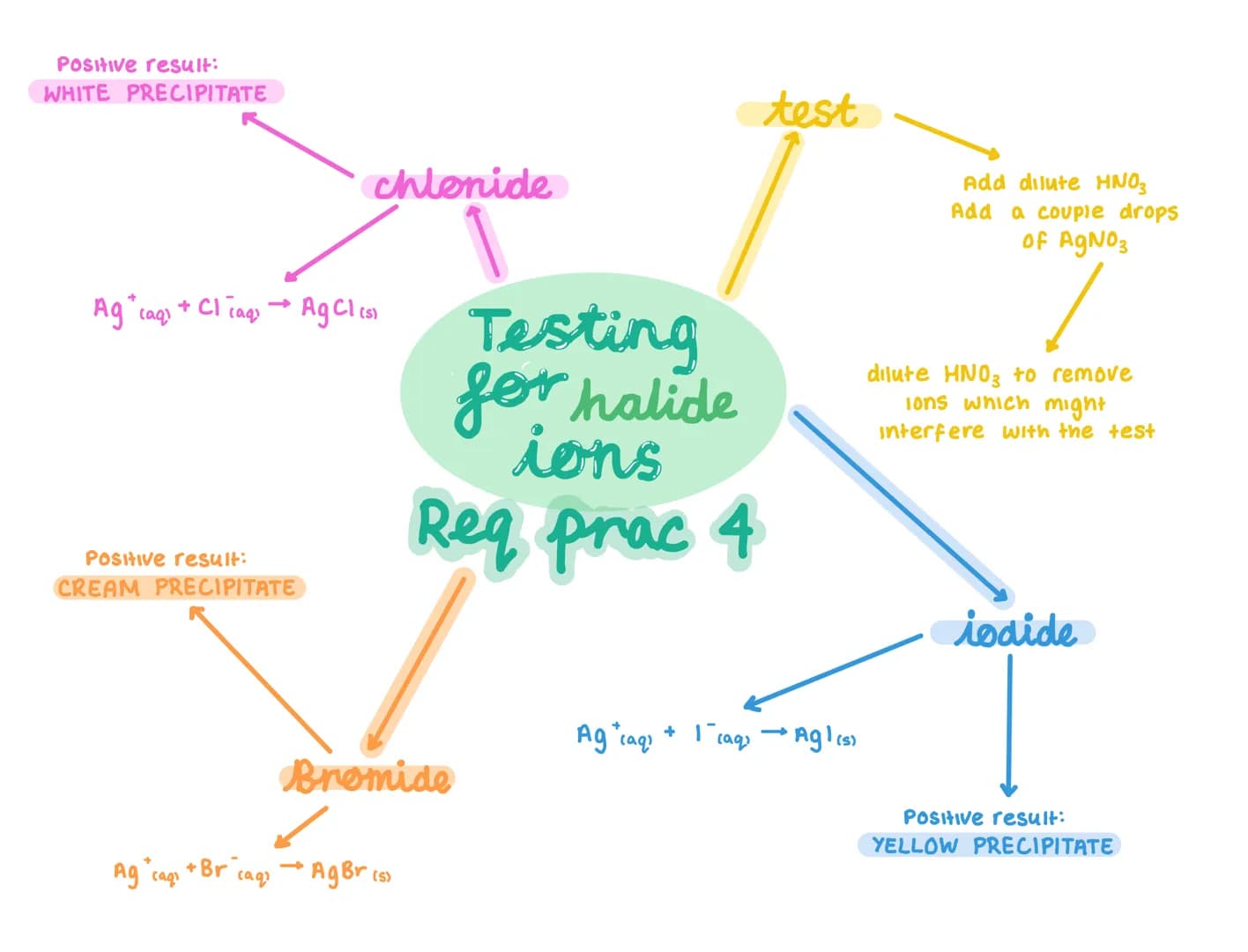
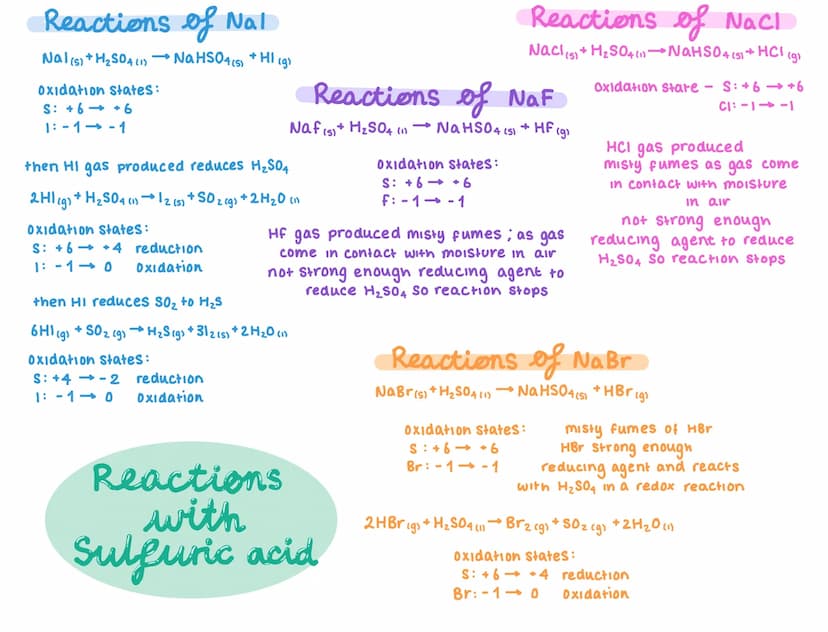
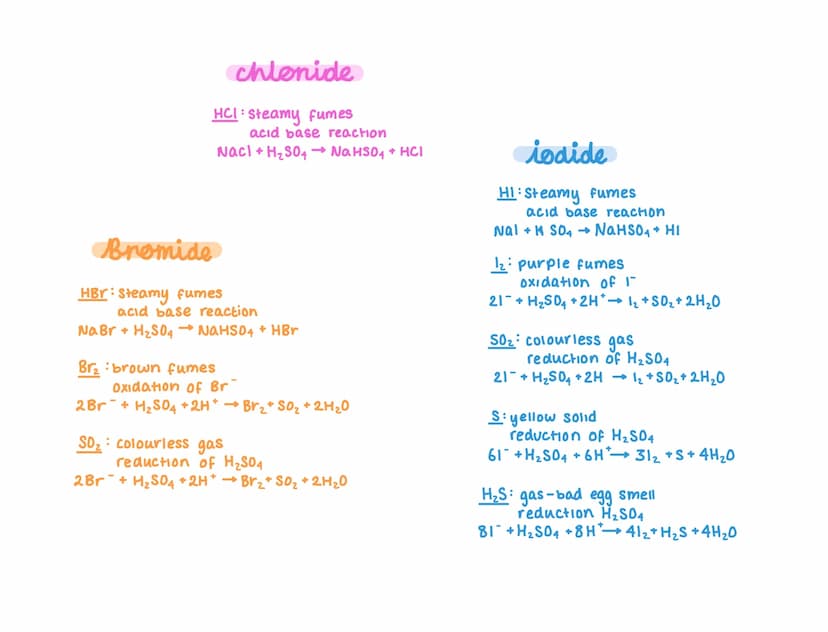
Reactions of Sodium Halides with Sulfuric Acid
Understanding the reactions of sodium halides with sulfuric acid is crucial for AQA A Level Chemistry Required Practical 7 and forms an important part of Group 7 chemistry. These reactions demonstrate the varying reactivity of halogens and the concept of redox reactions.
Reaction of Sodium Iodide (NaI):
NaI (s) + H₂SO₄ (l) → NaHSO₄ (s) + HI (g)
The HI gas produced then reduces H₂SO₄:
2HI (g) + H₂SO₄ (l) → I₂ (s) + SO₂ (g) + 2H₂O (l)
Further reduction of SO₂ by HI:
6HI (g) + SO₂ (g) → H₂S (g) + 3I₂ (s) + 2H₂O (l)
Highlight: These reactions demonstrate the reducing power of hydrogen iodide and the oxidizing power of sulfuric acid.
Reaction of Sodium Fluoride (NaF):
NaF (s) + H₂SO₄ (l) → NaHSO₄ (s) + HF (g)
Vocabulary: Redox reaction - A reaction involving the transfer of electrons, resulting in changes in oxidation states.
Reaction of Sodium Chloride (NaCl):
NaCl (s) + H₂SO₄ (l) → NaHSO₄ (s) + HCl (g)
Example: The HF gas produced in the reaction with NaF creates misty fumes when it comes into contact with moist air.
These reactions illustrate the varying reactivity of halogens and are essential for understanding why reactivity decreases down group 7 in A Level Chemistry. They also demonstrate important concepts such as oxidation states and redox reactions, which are crucial for answering Group 7 AQA A Level Chemistry Questions and creating comprehensive Group 7 A Level Chemistry Flashcards.
6
of 7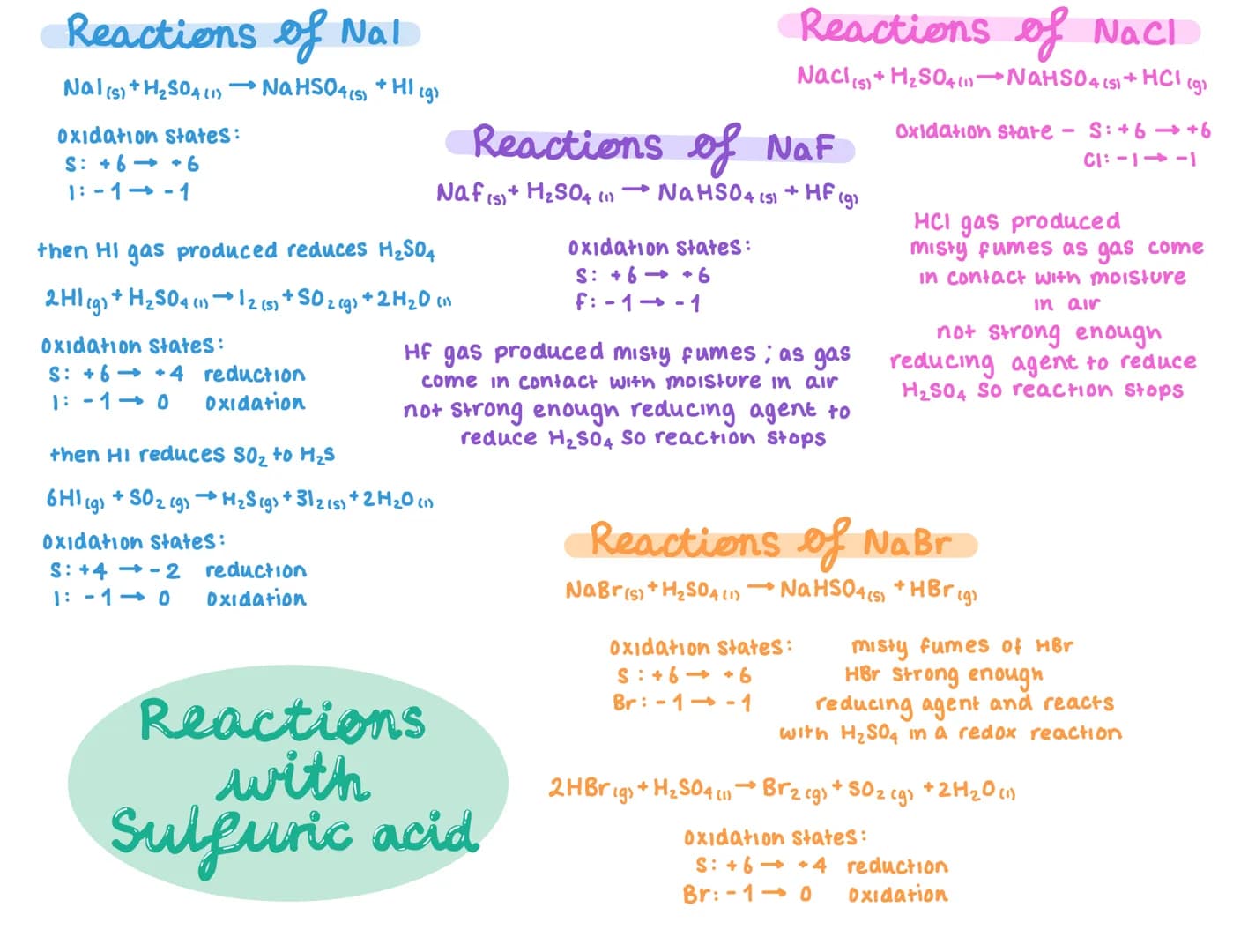
Practical Applications and Safety
The final section addresses practical considerations and safety measures when working with halogens.
Highlight: Proper ventilation and protective equipment are essential when handling halogen compounds.
Vocabulary: Misty fumes form when certain halogen gases come into contact with moisture in the air.
7
of 7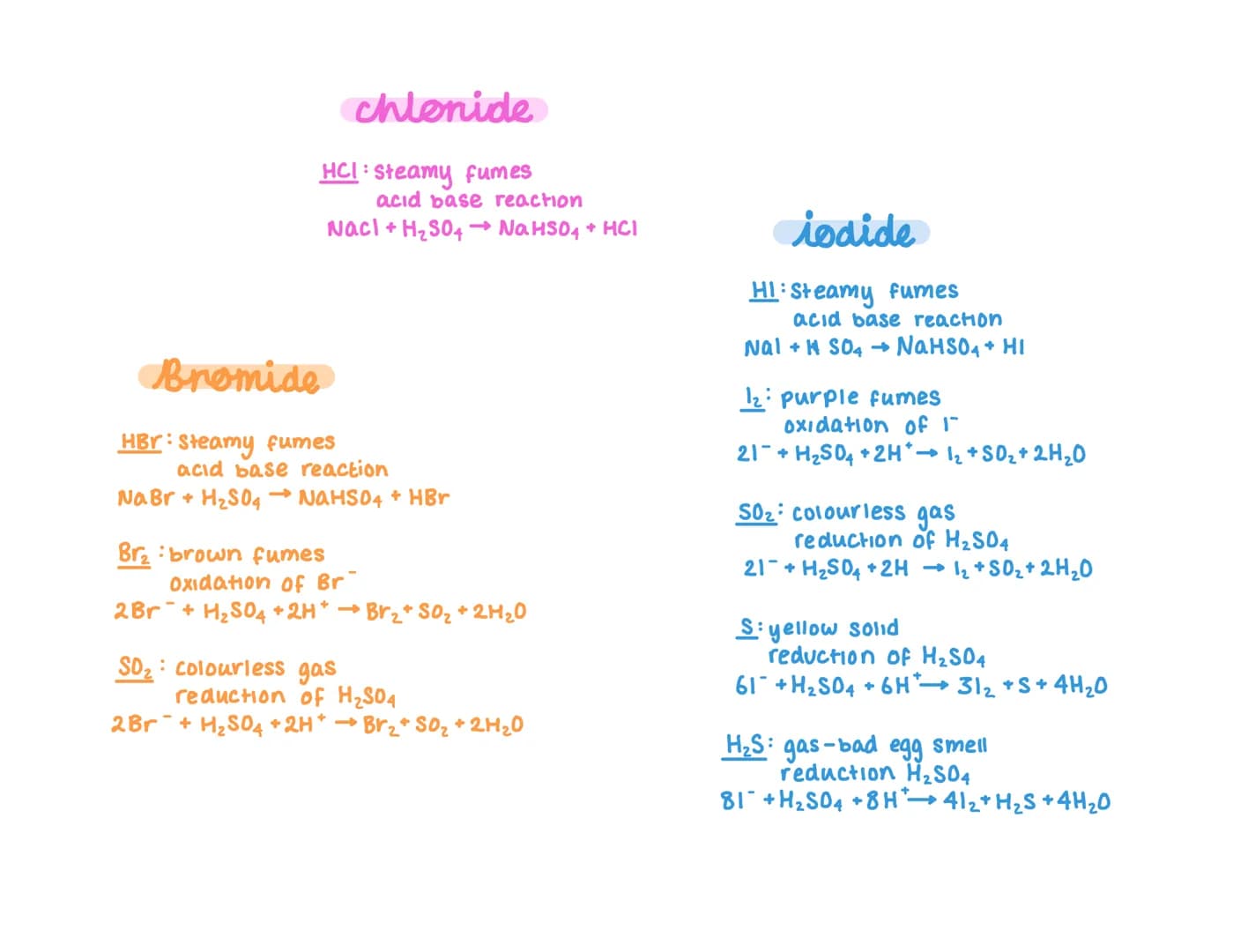
Group 7 Halogens: Properties and Trends
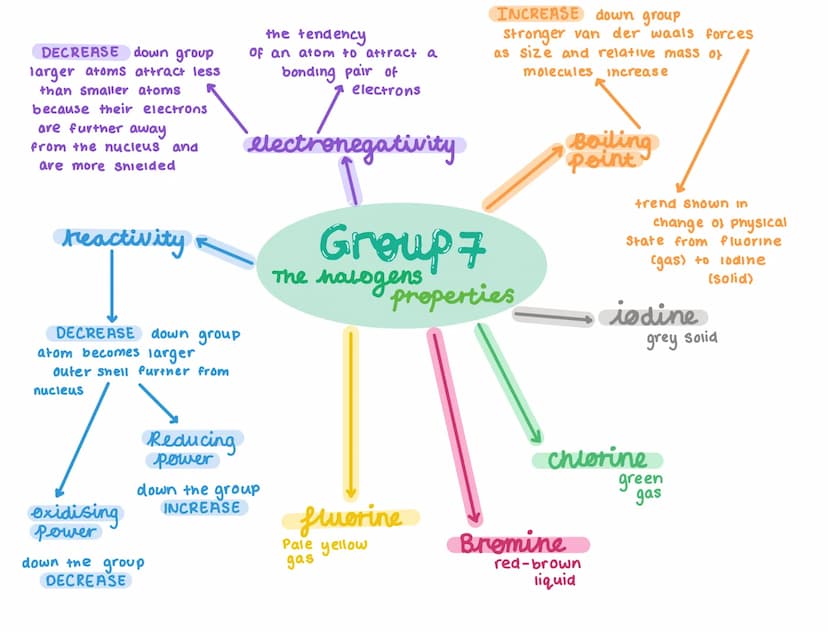
Group 7 elements, known as halogens, display distinct trends in their properties as you move down the periodic table. These trends are crucial for understanding their behavior in chemical reactions and their applications in various fields.
Highlight: The reactivity of halogens decreases as you move down Group 7 in the periodic table.
The decrease in reactivity is attributed to the increasing size of atoms and the greater distance between the outer shell electrons and the nucleus. This results in weaker attraction between the nucleus and the electrons, making the atoms less reactive.
Vocabulary: Electronegativity - The tendency of an atom to attract a bonding pair of electrons.
Electronegativity decreases down the group, while the boiling point increases. This trend is evident in the physical states of the halogens:
- Fluorine: Pale yellow gas
- Chlorine: Green gas
- Bromine: Red-brown liquid
- Iodine: Grey solid
Example: The change in physical state from fluorine (gas) to iodine (solid) demonstrates the increasing boiling point trend.
The increasing boiling points are due to stronger van der Waals forces between larger molecules with greater relative mass. This knowledge is essential for answering Group 7 AQA A Level Chemistry Questions and understanding the reactivity trends in group 7 halogens.
We thought you’d never ask...
What is the Knowunity AI companion?
Our AI Companion is a student-focused AI tool that offers more than just answers. Built on millions of Knowunity resources, it provides relevant information, personalised study plans, quizzes, and content directly in the chat, adapting to your individual learning journey.
Where can I download the Knowunity app?
You can download the app from Google Play Store and Apple App Store.
Is Knowunity really free of charge?
That's right! Enjoy free access to study content, connect with fellow students, and get instant help – all at your fingertips.
Similar content
Most popular content: Precipitation Reaction
3ChemistryEssential Chemistry Practicals
Explore key AQA GCSE Chemistry practicals, including flame tests, titration, and gas identification. This resource covers essential techniques for analyzing ions, making salts, and understanding reaction kinetics. Perfect for students preparing for exams and practical assessments.
1011,809902
ChemistryIdentifying Cations and Anions
Explore essential laboratory techniques for identifying cations and anions through test tube reactions. This practical guide covers precipitation reactions, ionic equations, and safety protocols, focusing on the analysis of metal ions and halides. Ideal for AQA chemistry students aiming to master chemical analysis and laboratory skills.
131,37839
ChemistryChemical analysis
aqa triple science chemical analysis
111053
Most popular content in Chemistry
9G
ChemistryGCSE AQA Chemistry Topic 1- The Atom
The Atom
101,0220
Chemistrychem paper 1
higher
111,85637
ChemistryA-level OCR A Chemistry summary sheets
Everything from snaprevise for OCR chemistry a-level
122,17678
ChemistryEssential Chemistry Practicals
Explore key AQA GCSE Chemistry practicals, including flame tests, titration, and gas identification. This resource covers essential techniques for analyzing ions, making salts, and understanding reaction kinetics. Perfect for students preparing for exams and practical assessments.
1011,809902
G
ChemistryGCSE AQA Chemistry Topic 1
Quiz covering all of topic 1
101,6723
C
Chemistrychem paper 1
Unlock the secrets of chemical reactions with this comprehensive flashcard set designed to help you conquer complex concepts and ace your Chemistry exams.
116211
A
ChemistryAQA GCSE Chemistry 4.4 Chemical changes
4.4 Reactions of acids with bases or carbonates
95941
F
ChemistryFundamentals of Atomic Structure
Practice identifying subatomic particles, calculating neutrons, and defining isotopes and atomic/mass numbers.
123400
A
ChemistryAtomic Mass and Atomic Number Calculations
Calculate the number of protons, neutrons, and electrons for different elements and isotopes.
S34790
Most popular content
9 Sociology
Sociology of Education Overview
Explore comprehensive A-Level Sociology notes on the education system, covering key theories, policies, and sociological perspectives. This resource includes insights on marketisation, gender roles, cultural deprivation, and educational inequalities, providing a thorough understanding of how education shapes social stratification and individual achievement. Ideal for exam preparation and in-depth study.
12102,3893,038
CriminologyCriminology: Crime & Punishment Overview
Comprehensive mindmaps covering key concepts in the Crime and Punishment topic for WJEC Criminology Unit 4. This resource includes detailed insights into the Criminal Justice System, crime prevention strategies, sentencing models, and the roles of various agencies. Ideal for A-Level revision, ensuring you grasp essential theories and legislative processes to excel in your exams.
1254,8131,059
SociologySociology of Families: Comprehensive Revision
Dive into an extensive overview of family dynamics, perspectives, and patterns in sociology. This resource covers key concepts such as family diversity, gender roles, marriage, and the impact of social policies on family structures. Perfect for A-Level Sociology students preparing for Paper 2.
1273,2392,304
 English Literature
An Inspector Calls: Character Insights
Explore in-depth analysis and key quotes for characters in J.B. Priestley's 'An Inspector Calls'. This resource covers Gerald Croft, Inspector Goole, Sheila Birling, Mrs. Birling, Eric Birling, and Eva Smith, focusing on themes of class, gender roles, and social responsibility. Ideal for students aiming for Grade 8 and above.
1025,231901
CriminologyWJEC Unit 4 Criminology
Criminology unit 4 detailed revision note
127,120124
CriminologyCriminology Theories Overview
Explore key criminology theories and their implications on crime and deviance. This comprehensive summary covers biological, psychological, and sociological perspectives, including labelling theory, right realism, and the impact of social campaigns on policy development. Ideal for A-Level criminology students seeking to understand the complexities of criminal behaviour and the factors influencing crime prevention strategies.
129,746211
English LiteratureRomeo and Juliet: Key themes
Key Romeo and Juliet themes and analysed quotes
106,619197
C
 Biology
Cell Biology and Cell structure
cell structures
92,6740
English LiteratureMacbeth: Guilt and Ambition
Explore the complex themes of guilt and ambition in Shakespeare's 'Macbeth'. This analysis covers key characters, including Macbeth and Lady Macbeth, their moral dilemmas, and the tragic consequences of their ambition. Ideal for students studying character motivations, thematic elements, and the psychological impact of power. Includes insights on the natural order, manipulation, and the descent into madness.
918,818392
Can't find what you're looking for? Explore other subjects.
Students love us — and so will you.
4.6/5App Store
4.7/5Google Play
The app is very easy to use and well designed. I have found everything I was looking for so far and have been able to learn a lot from the presentations! I will definitely use the app for a class assignment! And of course it also helps a lot as an inspiration.
Stefan SiOS user
This app is really great. There are so many study notes and help [...]. My problem subject is French, for example, and the app has so many options for help. Thanks to this app, I have improved my French. I would recommend it to anyone.
Samantha KlichAndroid user
Wow, I am really amazed. I just tried the app because I've seen it advertised many times and was absolutely stunned. This app is THE HELP you want for school and above all, it offers so many things, such as workouts and fact sheets, which have been VERY helpful to me personally.
AnnaiOS user
Chemistry555 views·Updated May 23, 2026·7 pagesFun with Group 7 Halogens: AQA A Level Chemistry Required Practical 7
Maya A@maya.ah
The Group 7 halogens represent a crucial family of elements with distinctive patterns in reactivity and properties, showing clear trends down the group in terms of physical states, oxidizing power, and displacement reactions.
Key points:
- Reactivity decreases down the group... Show more
1
of 7Sign up to see the content. It's free!
- Access to all documents
- Improve your grades
- Join milions of students
Group 7 Reactions and Displacement
Understanding the reactions and displacement properties of Group 7 elements is crucial for AQA A Level Chemistry Required Practical 7 write up. This knowledge forms the basis for many practical experiments and theoretical concepts in halogen chemistry.
Halogens act as oxidizing agents, gaining an electron when they react. The oxidizing power decreases down the group, which is reflected in their displacement reactions.
Definition: Displacement reaction - A reaction where a more reactive element displaces a less reactive element from its compound.
Key displacement reactions include:
-
Chlorine displacing bromide ions: Cl₂ (aq) + 2KBr (aq) → 2KCl (aq) + Br₂ (aq)
-
Chlorine displacing iodide ions: Cl₂ (aq) + 2KI (aq) → 2KCl (aq) + I₂ (aq)
-
Bromine displacing iodide ions: Br₂ (aq) + 2KI (aq) → 2KBr (aq) + I₂ (aq)
Highlight: A halogen will displace a halide from solution if the halide is below it on the periodic table.
These reactions are essential for understanding the reactivity of halogens and answering questions about why reactivity decreases down group 7 in A Level Chemistry. The color changes observed in these reactions (e.g., colorless to orange or brown) are important indicators used in practical experiments and should be noted in your AQA A Level Chemistry Required Practical 7 results table.
2
of 7Sign up to see the content. It's free!
- Access to all documents
- Improve your grades
- Join milions of students
Chlorine and Water Treatment
Chlorine plays a significant role in water treatment, which is an important application of Group 7 elements. Understanding these reactions is crucial for AQA A Level Chemistry Required Practical 7 risk assessment and real-world applications of halogen chemistry.
When chlorine is mixed with water, it undergoes a disproportionation reaction:
Cl₂ (g) + H₂O (l) → 2H⁺ (aq) + Cl⁻ (aq) + ClO⁻ (aq)
Vocabulary: Disproportionation reaction - A reaction in which a single element is both oxidized and reduced.
In sunlight, chlorine can also decompose water to form chloride ions and oxygen:
Cl₂ (g) + H₂O (l) → 2H⁺ (aq) + 2Cl⁻ (aq) + ½O₂ (g)
The benefits of using chlorine in water treatment include:
- Killing disease-causing bacteria
- Preventing algae growth
- Eliminating bad taste and smell
- Removing discoloration
Highlight: Chlorate(I) ions produced in these reactions are responsible for killing bacteria, making water safe for drinking and swimming.
Chlorine is also used in the production of bleach:
2NaOH (aq) + Cl₂ (aq) → NaClO (aq) + NaCl (aq) + H₂O (l)
While chlorine treatment offers significant benefits, it's important to note its potential risks:
- Toxicity if breathed in
- Irritation to the respiratory system
- Severe chemical burns from liquid chlorine on skin or eyes
- Potential formation of carcinogenic chlorinated hydrocarbons
Understanding these reactions and their implications is essential for Group 7 A Level Chemistry OCR and other exam boards, as well as for practical applications in water treatment and chemical industry.
3
of 7Sign up to see the content. It's free!
- Access to all documents
- Improve your grades
- Join milions of students
Testing for Ammonium and Carbonate Ions
Identifying various ions is a crucial skill in chemistry, particularly for AQA A Level Chemistry Required Practical 7. This section focuses on testing for ammonium and carbonate ions, which are important in many chemical processes.
Testing for Ammonium Ions (NH₄⁺):
- Add dilute NaOH to the sample.
- Heat gently.
- Test the gas produced with damp red litmus paper.
Highlight: A positive result for ammonium ions is indicated when the red litmus paper turns blue.
The reaction occurring is:
NH₄⁺ (aq) + OH⁻ (aq) → NH₃ (g) + H₂O (l)
Testing for Carbonate Ions (CO₃²⁻):
- Add a few drops of dilute HCl to the sample.
- Observe for effervescence (fizzing).
- Test the gas produced by bubbling it through limewater.
Highlight: A positive result for carbonate ions is indicated when limewater turns cloudy.
The reactions occurring are:
CO₃²⁻ (aq) + 2H⁺ (aq) → CO₂ (g) + H₂O (l) Ca(OH)₂ (aq) + CO₂ (g) → CaCO₃ (s) + H₂O (l)
These tests are essential for Required Practical 7a Chemistry AQA A level variables and form a crucial part of qualitative analysis in chemistry. Understanding these reactions and their indicators is vital for success in practical exams and theoretical questions related to ion identification.
4
of 7Sign up to see the content. It's free!
- Access to all documents
- Improve your grades
- Join milions of students
Testing for Sulfate and Halide Ions
Identifying sulfate and halide ions is a crucial skill in analytical chemistry and forms an important part of AQA A Level Chemistry Required Practical 7. This knowledge is essential for answering Group 7 A Level Chemistry Questions and performing practical experiments.
Testing for Sulfate Ions (SO₄²⁻):
- Add dilute HCl to the sample.
- Add barium chloride solution (BaCl₂).
Highlight: A positive result for sulfate ions is indicated by the formation of a white precipitate of barium sulfate (BaSO₄).
The reaction occurring is:
Ba²⁺ (aq) + SO₄²⁻ (aq) → BaSO₄ (s)
Testing for Halide Ions (Cl⁻, Br⁻, I⁻):
- Add dilute nitric acid (HNO₃) to the sample.
- Add a few drops of silver nitrate solution (AgNO₃).
Highlight: The color of the precipitate formed indicates the specific halide ion present.
- Chloride ions (Cl⁻): White precipitate
- Bromide ions (Br⁻): Cream precipitate
- Iodide ions (I⁻): Yellow precipitate
The general reaction is:
Ag⁺ (aq) + X⁻ (aq) → AgX (s) (where X is Cl, Br, or I)
These tests are crucial for creating a Group 7 halogens ion testing mindmap and answering questions related to halide identification. Understanding the colors and solubilities of these precipitates is essential for success in practical exams and theoretical questions about halogen chemistry.
5
of 7Sign up to see the content. It's free!
- Access to all documents
- Improve your grades
- Join milions of students
Reactions of Sodium Halides with Sulfuric Acid
Understanding the reactions of sodium halides with sulfuric acid is crucial for AQA A Level Chemistry Required Practical 7 and forms an important part of Group 7 chemistry. These reactions demonstrate the varying reactivity of halogens and the concept of redox reactions.
Reaction of Sodium Iodide (NaI):
NaI (s) + H₂SO₄ (l) → NaHSO₄ (s) + HI (g)
The HI gas produced then reduces H₂SO₄:
2HI (g) + H₂SO₄ (l) → I₂ (s) + SO₂ (g) + 2H₂O (l)
Further reduction of SO₂ by HI:
6HI (g) + SO₂ (g) → H₂S (g) + 3I₂ (s) + 2H₂O (l)
Highlight: These reactions demonstrate the reducing power of hydrogen iodide and the oxidizing power of sulfuric acid.
Reaction of Sodium Fluoride (NaF):
NaF (s) + H₂SO₄ (l) → NaHSO₄ (s) + HF (g)
Vocabulary: Redox reaction - A reaction involving the transfer of electrons, resulting in changes in oxidation states.
Reaction of Sodium Chloride (NaCl):
NaCl (s) + H₂SO₄ (l) → NaHSO₄ (s) + HCl (g)
Example: The HF gas produced in the reaction with NaF creates misty fumes when it comes into contact with moist air.
These reactions illustrate the varying reactivity of halogens and are essential for understanding why reactivity decreases down group 7 in A Level Chemistry. They also demonstrate important concepts such as oxidation states and redox reactions, which are crucial for answering Group 7 AQA A Level Chemistry Questions and creating comprehensive Group 7 A Level Chemistry Flashcards.
6
of 7Sign up to see the content. It's free!
- Access to all documents
- Improve your grades
- Join milions of students
Practical Applications and Safety
The final section addresses practical considerations and safety measures when working with halogens.
Highlight: Proper ventilation and protective equipment are essential when handling halogen compounds.
Vocabulary: Misty fumes form when certain halogen gases come into contact with moisture in the air.
7
of 7Sign up to see the content. It's free!
- Access to all documents
- Improve your grades
- Join milions of students
Group 7 Halogens: Properties and Trends
Group 7 elements, known as halogens, display distinct trends in their properties as you move down the periodic table. These trends are crucial for understanding their behavior in chemical reactions and their applications in various fields.
Highlight: The reactivity of halogens decreases as you move down Group 7 in the periodic table.
The decrease in reactivity is attributed to the increasing size of atoms and the greater distance between the outer shell electrons and the nucleus. This results in weaker attraction between the nucleus and the electrons, making the atoms less reactive.
Vocabulary: Electronegativity - The tendency of an atom to attract a bonding pair of electrons.
Electronegativity decreases down the group, while the boiling point increases. This trend is evident in the physical states of the halogens:
- Fluorine: Pale yellow gas
- Chlorine: Green gas
- Bromine: Red-brown liquid
- Iodine: Grey solid
Example: The change in physical state from fluorine (gas) to iodine (solid) demonstrates the increasing boiling point trend.
The increasing boiling points are due to stronger van der Waals forces between larger molecules with greater relative mass. This knowledge is essential for answering Group 7 AQA A Level Chemistry Questions and understanding the reactivity trends in group 7 halogens.
We thought you’d never ask...
What is the Knowunity AI companion?
Our AI Companion is a student-focused AI tool that offers more than just answers. Built on millions of Knowunity resources, it provides relevant information, personalised study plans, quizzes, and content directly in the chat, adapting to your individual learning journey.
Where can I download the Knowunity app?
You can download the app from Google Play Store and Apple App Store.
Is Knowunity really free of charge?
That's right! Enjoy free access to study content, connect with fellow students, and get instant help – all at your fingertips.
Similar content
Most popular content: Precipitation Reaction
3ChemistryEssential Chemistry Practicals
Explore key AQA GCSE Chemistry practicals, including flame tests, titration, and gas identification. This resource covers essential techniques for analyzing ions, making salts, and understanding reaction kinetics. Perfect for students preparing for exams and practical assessments.
1011,809902
ChemistryIdentifying Cations and Anions
Explore essential laboratory techniques for identifying cations and anions through test tube reactions. This practical guide covers precipitation reactions, ionic equations, and safety protocols, focusing on the analysis of metal ions and halides. Ideal for AQA chemistry students aiming to master chemical analysis and laboratory skills.
131,37839
ChemistryChemical analysis
aqa triple science chemical analysis
111053
Most popular content in Chemistry
9G
ChemistryGCSE AQA Chemistry Topic 1- The Atom
The Atom
101,0220
Chemistrychem paper 1
higher
111,85637
ChemistryA-level OCR A Chemistry summary sheets
Everything from snaprevise for OCR chemistry a-level
122,17678
ChemistryEssential Chemistry Practicals
Explore key AQA GCSE Chemistry practicals, including flame tests, titration, and gas identification. This resource covers essential techniques for analyzing ions, making salts, and understanding reaction kinetics. Perfect for students preparing for exams and practical assessments.
1011,809902
G
ChemistryGCSE AQA Chemistry Topic 1
Quiz covering all of topic 1
101,6723
C
Chemistrychem paper 1
Unlock the secrets of chemical reactions with this comprehensive flashcard set designed to help you conquer complex concepts and ace your Chemistry exams.
116211
A
ChemistryAQA GCSE Chemistry 4.4 Chemical changes
4.4 Reactions of acids with bases or carbonates
95941
F
ChemistryFundamentals of Atomic Structure
Practice identifying subatomic particles, calculating neutrons, and defining isotopes and atomic/mass numbers.
123400
A
ChemistryAtomic Mass and Atomic Number Calculations
Calculate the number of protons, neutrons, and electrons for different elements and isotopes.
S34790
Most popular content
9SociologySociology of Education Overview
Explore comprehensive A-Level Sociology notes on the education system, covering key theories, policies, and sociological perspectives. This resource includes insights on marketisation, gender roles, cultural deprivation, and educational inequalities, providing a thorough understanding of how education shapes social stratification and individual achievement. Ideal for exam preparation and in-depth study.
12102,3893,038
CriminologyCriminology: Crime & Punishment Overview
Comprehensive mindmaps covering key concepts in the Crime and Punishment topic for WJEC Criminology Unit 4. This resource includes detailed insights into the Criminal Justice System, crime prevention strategies, sentencing models, and the roles of various agencies. Ideal for A-Level revision, ensuring you grasp essential theories and legislative processes to excel in your exams.
1254,8131,059
SociologySociology of Families: Comprehensive Revision
Dive into an extensive overview of family dynamics, perspectives, and patterns in sociology. This resource covers key concepts such as family diversity, gender roles, marriage, and the impact of social policies on family structures. Perfect for A-Level Sociology students preparing for Paper 2.
1273,2392,304
English LiteratureAn Inspector Calls: Character Insights
Explore in-depth analysis and key quotes for characters in J.B. Priestley's 'An Inspector Calls'. This resource covers Gerald Croft, Inspector Goole, Sheila Birling, Mrs. Birling, Eric Birling, and Eva Smith, focusing on themes of class, gender roles, and social responsibility. Ideal for students aiming for Grade 8 and above.
1025,231901
CriminologyWJEC Unit 4 Criminology
Criminology unit 4 detailed revision note
127,120124
CriminologyCriminology Theories Overview
Explore key criminology theories and their implications on crime and deviance. This comprehensive summary covers biological, psychological, and sociological perspectives, including labelling theory, right realism, and the impact of social campaigns on policy development. Ideal for A-Level criminology students seeking to understand the complexities of criminal behaviour and the factors influencing crime prevention strategies.
129,746211
English LiteratureRomeo and Juliet: Key themes
Key Romeo and Juliet themes and analysed quotes
106,619197
C
BiologyCell Biology and Cell structure
cell structures
92,6740
English LiteratureMacbeth: Guilt and Ambition
Explore the complex themes of guilt and ambition in Shakespeare's 'Macbeth'. This analysis covers key characters, including Macbeth and Lady Macbeth, their moral dilemmas, and the tragic consequences of their ambition. Ideal for students studying character motivations, thematic elements, and the psychological impact of power. Includes insights on the natural order, manipulation, and the descent into madness.
918,818392
Can't find what you're looking for? Explore other subjects.
Students love us — and so will you.
4.6/5App Store
4.7/5Google Play
The app is very easy to use and well designed. I have found everything I was looking for so far and have been able to learn a lot from the presentations! I will definitely use the app for a class assignment! And of course it also helps a lot as an inspiration.
Stefan SiOS user
This app is really great. There are so many study notes and help [...]. My problem subject is French, for example, and the app has so many options for help. Thanks to this app, I have improved my French. I would recommend it to anyone.
Samantha KlichAndroid user
Wow, I am really amazed. I just tried the app because I've seen it advertised many times and was absolutely stunned. This app is THE HELP you want for school and above all, it offers so many things, such as workouts and fact sheets, which have been VERY helpful to me personally.
AnnaiOS user