
Chemistry might seem complicated, but it's actually about understanding the... Show more
 Chemistry223 views·Updated May 22, 2026·6 pages
Introduction to General Chemistry

evie@e777
1 / 6
1
of 6
General Chemistry
Welcome to the fascinating world of general chemistry! This is your foundation for understanding how matter behaves and interacts. Think of chemistry as the science that explains why things happen - from why your food cooks to how your body digests it.
You'll be exploring atoms, reactions, and the patterns that govern everything in the universe. Don't worry if it seems overwhelming at first - chemistry follows logical rules that you can master with practice.
Remember: Chemistry is everywhere in your daily life, so the concepts you learn will help you understand the world around you better.
2
of 6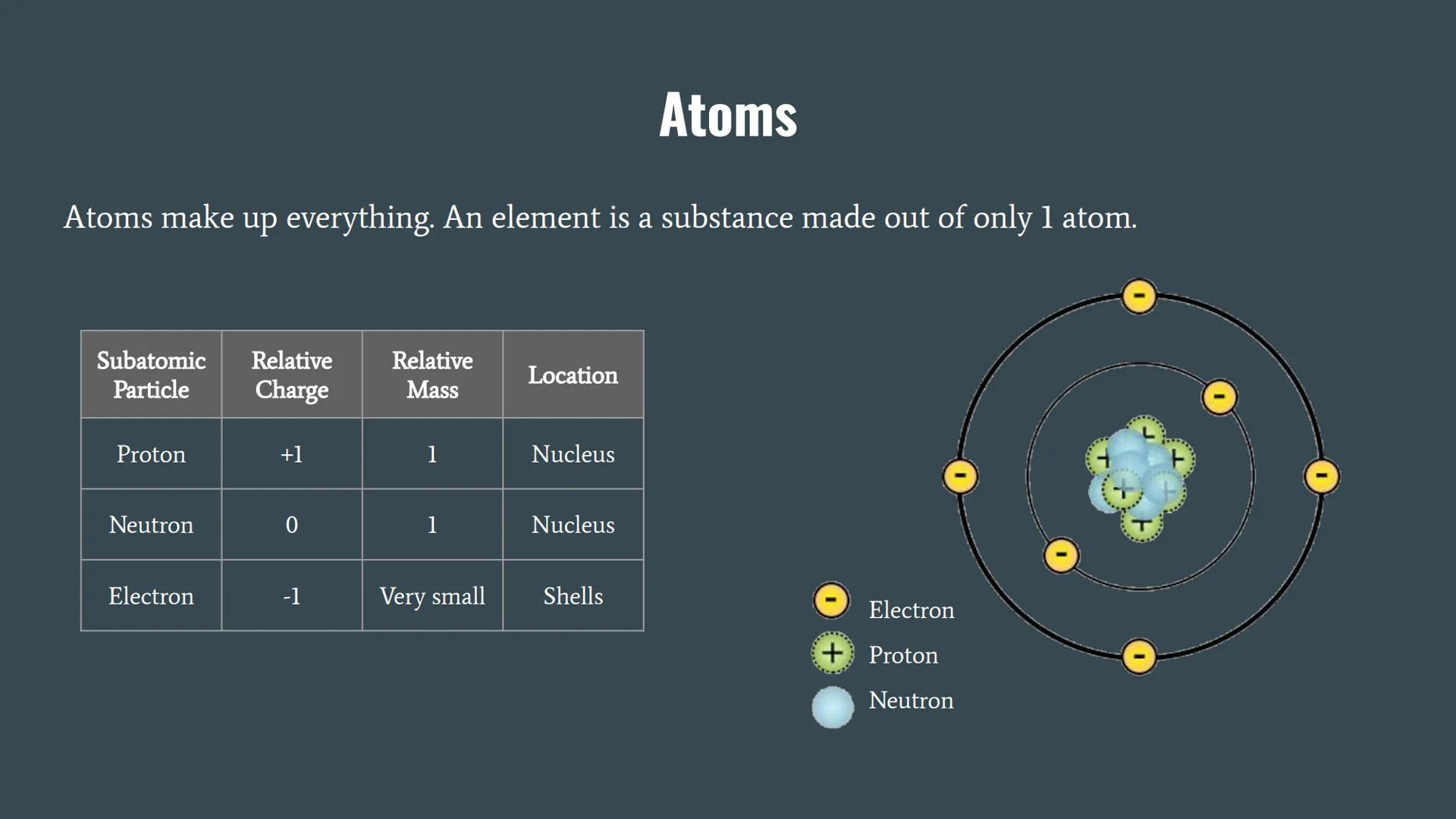
Atoms
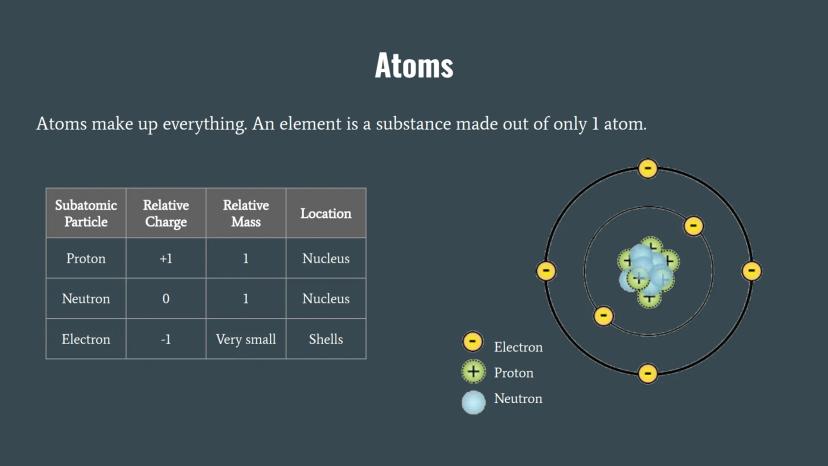
Every single thing you can touch is made of atoms - they're like the LEGO blocks of the universe! An element is simply a substance made from just one type of atom, like pure gold or oxygen.
Atoms contain three key particles that you need to know. Protons carry a positive charge and live in the nucleus (the centre), along with neutrons which have no charge. Electrons zoom around the outside in shells and have a negative charge.
Here's the clever bit: protons and neutrons are much heavier than electrons. That's why most of an atom's mass comes from its nucleus, even though electrons take up most of the space!
Top tip: Remember that atoms are mostly empty space - if an atom were the size of a football stadium, the nucleus would be like a marble in the centre!
3
of 6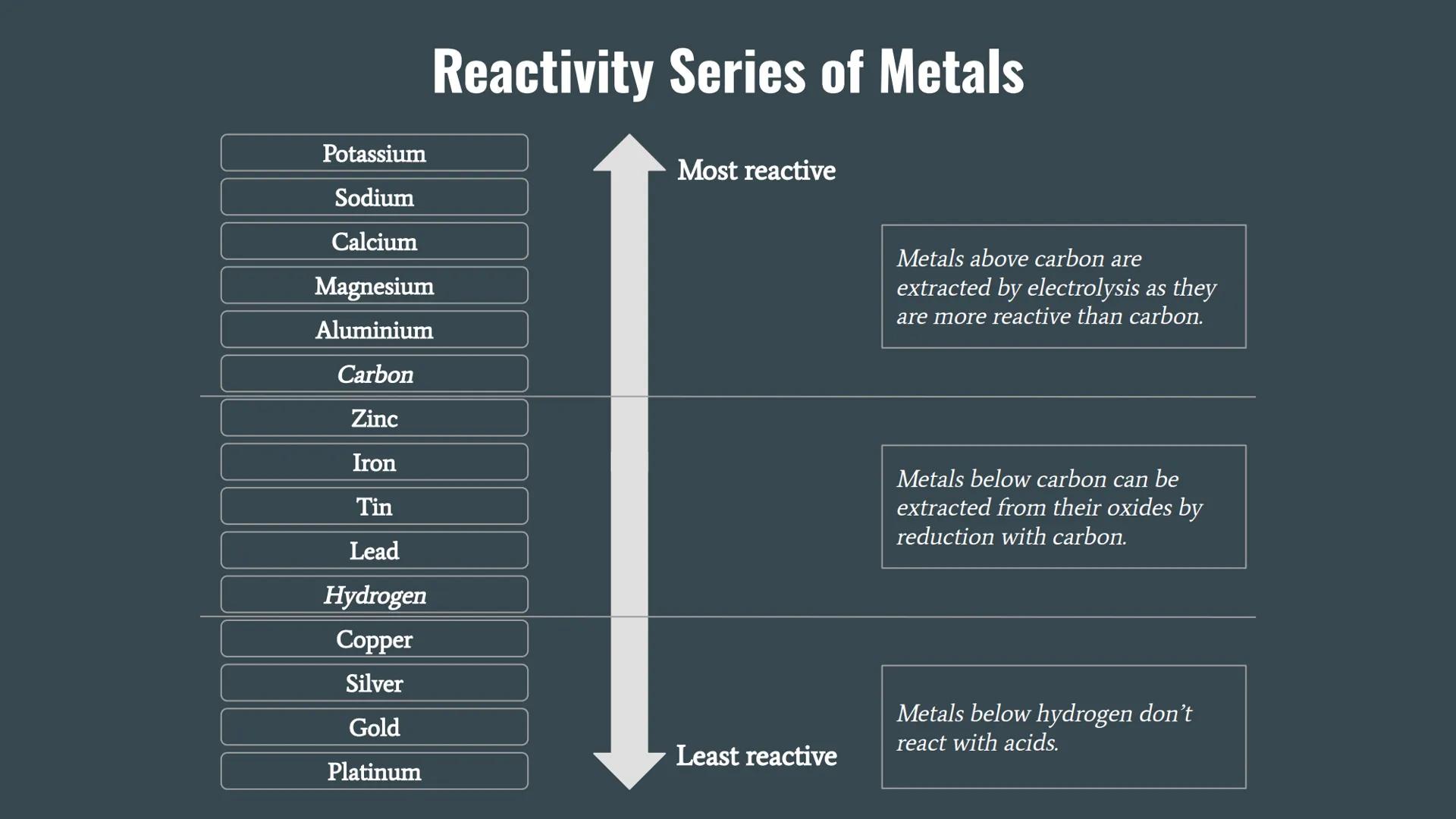
Reactivity Series of Metals
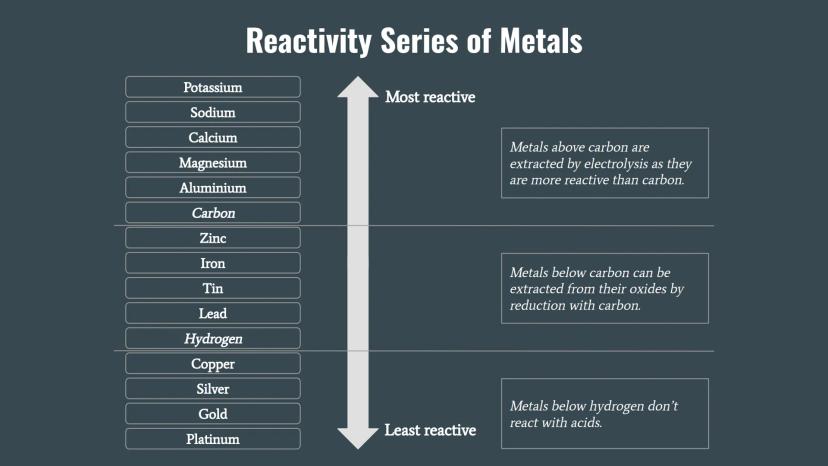
The reactivity series is basically a league table showing which metals are the most aggressive! Potassium sits at the top as the most reactive (it literally explodes in water), while platinum chills at the bottom, barely reacting with anything.
This isn't just random information - it's incredibly useful for predicting what will happen in reactions. Metals above carbon in the series need electrolysis to extract them from their ores because they're too reactive for simple heating.
Meanwhile, metals below carbon can be extracted by heating with carbon. The really unreactive ones below hydrogen won't even fizz when you add acid to them!
Exam hack: Learn the phrase "Please Stop Calling Me A Careless Zebra, Instead Try Learning How Copper Saves Gold Permanently" to remember the order!
4
of 6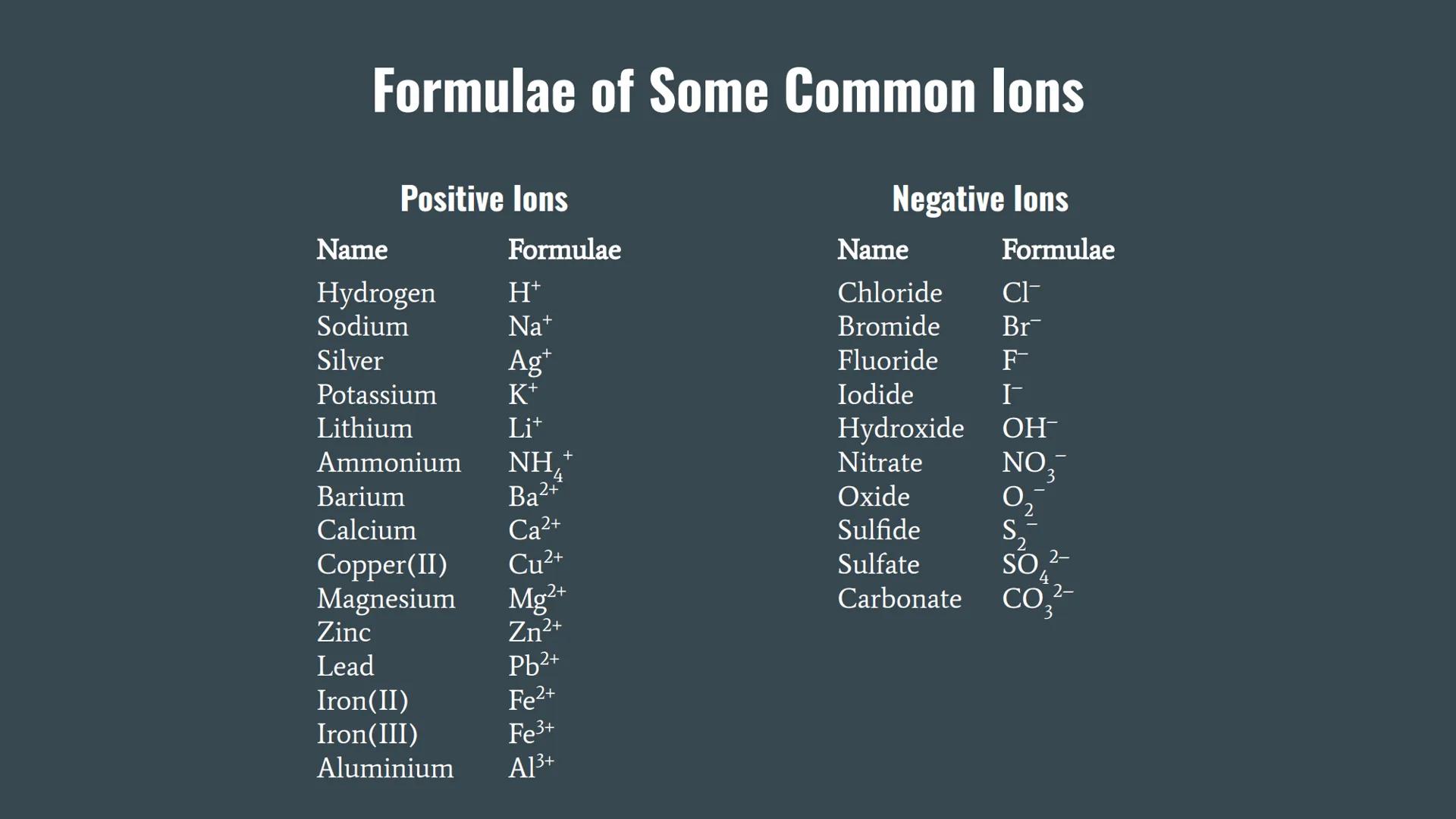
Common Ion Formulae
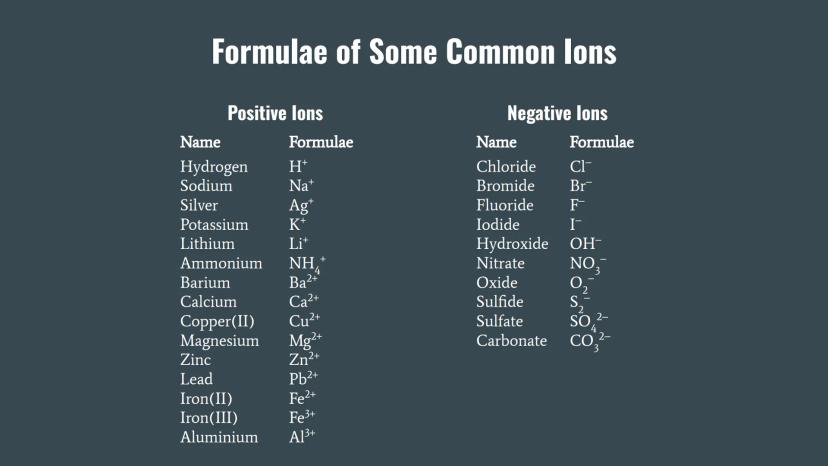
Ions are atoms that have gained or lost electrons, giving them an electric charge. Think of them as atoms that have become either greedy (negative ions) or generous (positive ions) with their electrons!
Positive ions include everyday elements like sodium $Na^+$ and calcium $Ca^{2+}$. Notice how some have different charges - this tells you how many electrons they've lost. The higher the number, the more electrons have gone walkabout.
Negative ions like chloride $Cl^-$ and sulfate $SO_4^{2-}$ have grabbed extra electrons. Some are single atoms, whilst others like carbonate $CO_3^{2-}$ are groups of atoms working together.
Memory trick: Positive ions are called "cat-ions" because they're attracted to the negative cathode (think of cats being attracted to something!).
5
of 6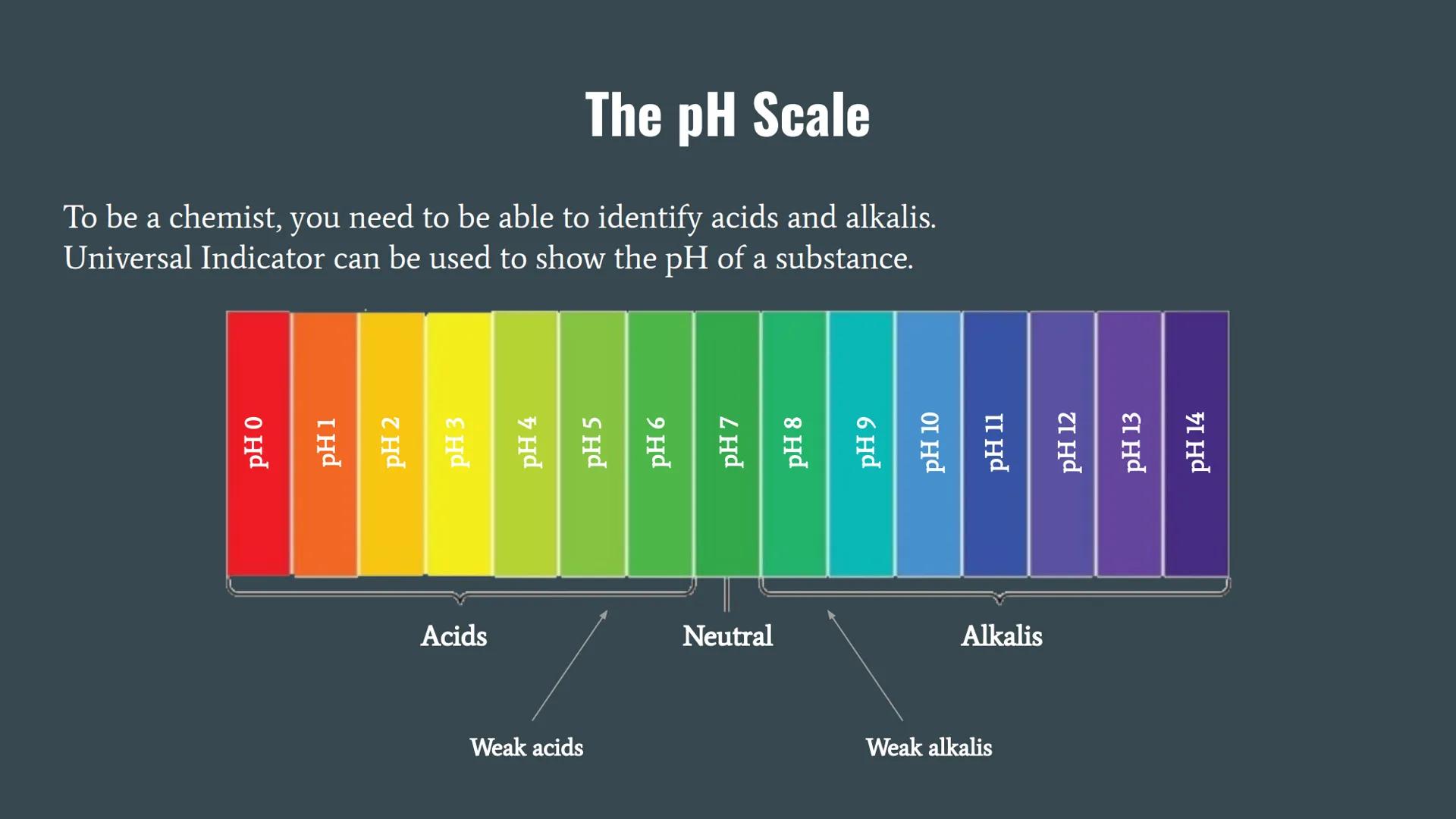
The pH Scale
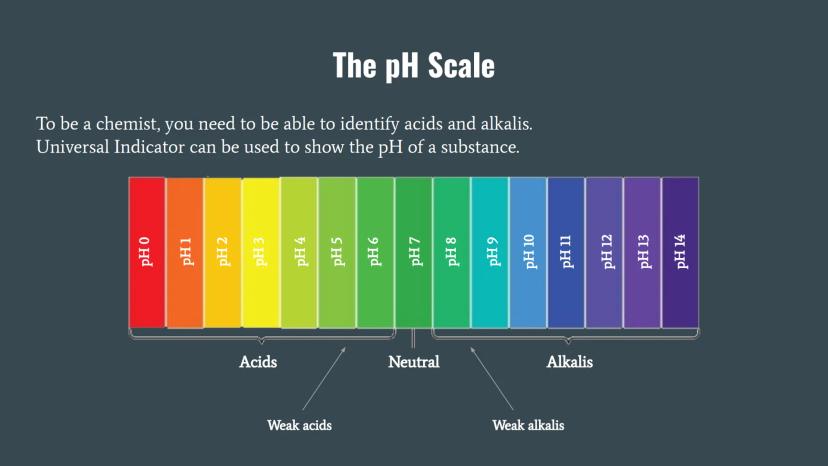
The pH scale is like a mood meter for chemicals - it tells you whether something is acidic, neutral, or alkaline. Universal indicator is your detective tool that changes colour to reveal a substance's true chemical personality!
Acids have a pH below 7 and include things like lemon juice and vinegar. Alkalis score above 7 on the pH scale - think soap and bleach. Right in the middle at pH 7 sits pure water, being perfectly neutral and diplomatic.
Weak acids and weak alkalis hover closer to 7, whilst the strong ones live at the extreme ends. Battery acid is around pH 1, whilst household bleach reaches pH 12-13.
Real-world connection: Your stomach acid has a pH of about 1.5 - acidic enough to dissolve metal, but your body handles it perfectly!
6
of 6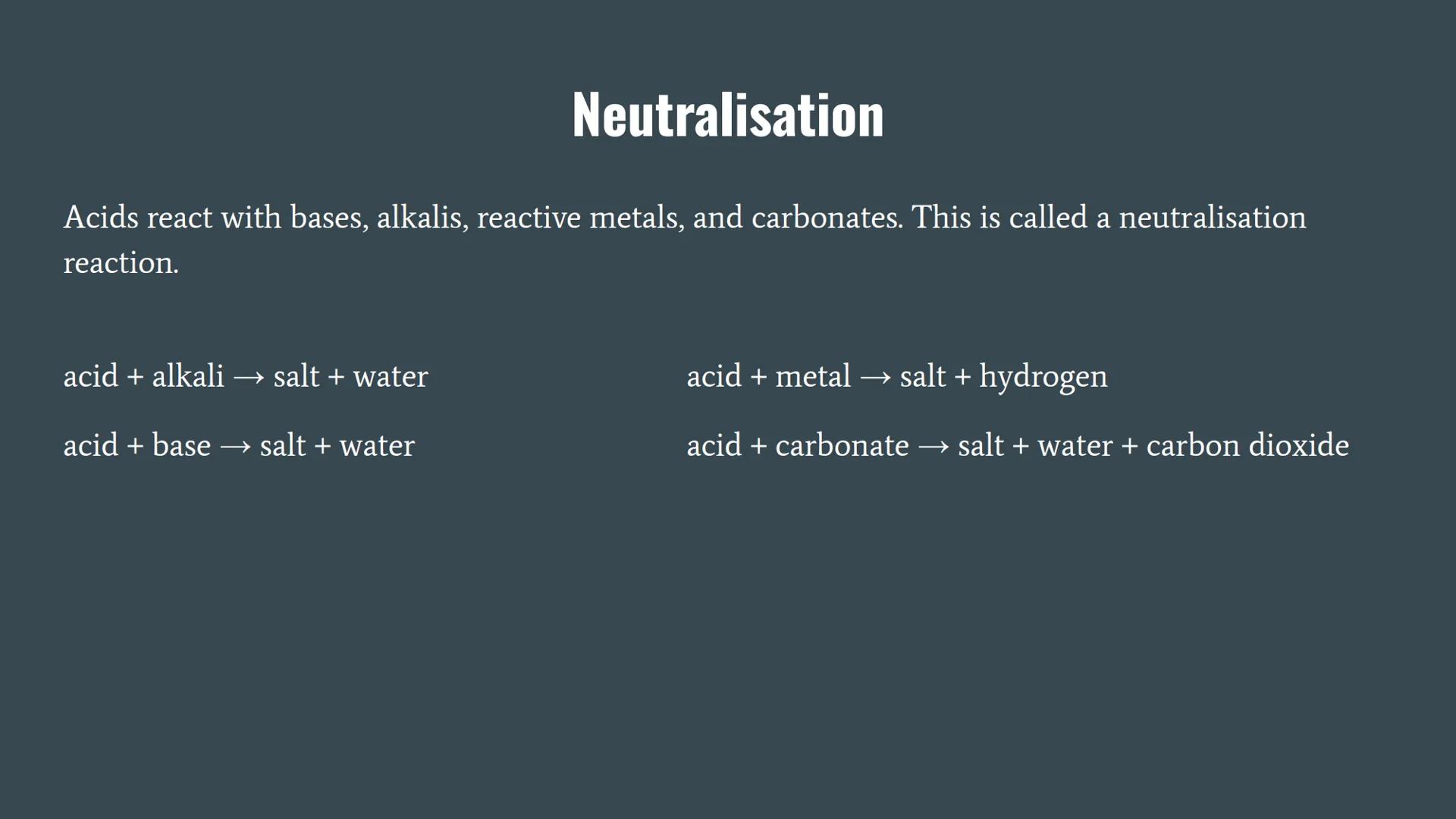
Neutralisation
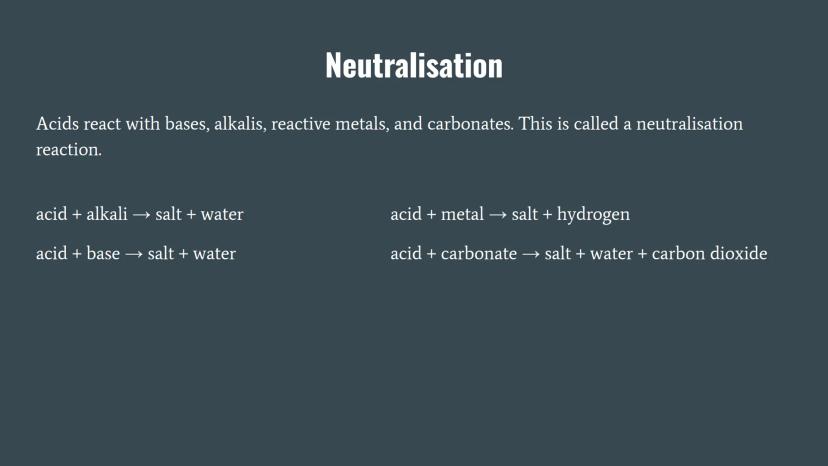
Neutralisation reactions happen when acids meet their opposite - it's like a chemical peace treaty! These reactions follow predictable patterns that make chemistry much easier once you spot them.
When acids react with alkalis, you get salt plus water. It's that simple! Add a metal to an acid and you'll produce salt plus hydrogen gas. Carbonates are the most dramatic - they fizz and bubble, releasing carbon dioxide.
The key word here is "neutralisation" because the acid and alkali cancel each other out. Think of it like hot and cold water mixing to become lukewarm - the extreme properties balance out.
Lab safety note: These reactions can be vigorous, especially with reactive metals, so always follow safety procedures when experimenting!
We thought you’d never ask...
What is the Knowunity AI companion?
Our AI Companion is a student-focused AI tool that offers more than just answers. Built on millions of Knowunity resources, it provides relevant information, personalised study plans, quizzes, and content directly in the chat, adapting to your individual learning journey.
Where can I download the Knowunity app?
You can download the app from Google Play Store and Apple App Store.
Is Knowunity really free of charge?
That's right! Enjoy free access to study content, connect with fellow students, and get instant help – all at your fingertips.
Similar content
Most popular content: Acid-base Reaction
4ChemistryGCSE Chemistry Practical Techniques
Explore essential practical techniques for AQA GCSE Chemistry, including methods for making salts, investigating temperature changes in reactions, electrolysis, and neutralization titrations. This summary covers key procedures, safety precautions, and equipment needed for successful experiments. Ideal for students preparing for Paper 1.
101,17515
ChemistryAcid-Base Reactions Overview
Explore the fundamentals of acid-base reactions, including neutralization, titration techniques, and the reactivity of metals. This summary covers key concepts such as making salts, pH indicators, and the differences between strong and weak acids. Ideal for AQA GCSE Chemistry revision.
91,22148
ChemistryAcids, Bases & pH Overview
Explore the essential concepts of acids and alkalis, including neutralization reactions, the pH scale, and the process of making salts. This summary sheet features key equations, diagrams of pH indicators, and hazard symbols for safe handling. Ideal for Year 8 science students preparing for exams.
756960
ChemistryAcid-Base Reactions Overview
Explore the fundamentals of acid-base chemistry with this comprehensive summary. Understand key concepts such as strong and weak acids, neutralization reactions, net ionic equations, and the formation of salts. Ideal for BTEC Applied Science, Unit 5 Chemistry students seeking to master acid-base interactions and ionic equations.
131795
Most popular content in Chemistry
9G
ChemistryGCSE AQA Chemistry Topic 1- The Atom
The Atom
109340
Chemistrychem paper 1
higher
111,80037
ChemistryA-level OCR A Chemistry summary sheets
Everything from snaprevise for OCR chemistry a-level
122,00677
G
ChemistryGCSE AQA Chemistry Topic 1
Quiz covering all of topic 1
101,6593
ChemistryEssential Chemistry Practicals
Explore key AQA GCSE Chemistry practicals, including flame tests, titration, and gas identification. This resource covers essential techniques for analyzing ions, making salts, and understanding reaction kinetics. Perfect for students preparing for exams and practical assessments.
1011,777902
C
Chemistrychem paper 1
Unlock the secrets of chemical reactions with this comprehensive flashcard set designed to help you conquer complex concepts and ace your Chemistry exams.
115861
A
ChemistryAQA GCSE Chemistry 4.2 Bonding, structure and the Properties of Matter
4.2 Metals and Alloys
96740
A
ChemistryAQA GCSE Chemistry 4.4 Chemical changes
4.4 Reactions of acids with bases or carbonates
95561
F
ChemistryFundamentals of Atomic Structure
Practice identifying subatomic particles, calculating neutrons, and defining isotopes and atomic/mass numbers.
123400
Most popular content
9 Sociology
Sociology of Education Overview
Explore comprehensive A-Level Sociology notes on the education system, covering key theories, policies, and sociological perspectives. This resource includes insights on marketisation, gender roles, cultural deprivation, and educational inequalities, providing a thorough understanding of how education shapes social stratification and individual achievement. Ideal for exam preparation and in-depth study.
12101,9843,036
SociologySociology of Families: Comprehensive Revision
Dive into an extensive overview of family dynamics, perspectives, and patterns in sociology. This resource covers key concepts such as family diversity, gender roles, marriage, and the impact of social policies on family structures. Perfect for A-Level Sociology students preparing for Paper 2.
1271,7822,285
CriminologyCriminology: Crime & Punishment Overview
Comprehensive mindmaps covering key concepts in the Crime and Punishment topic for WJEC Criminology Unit 4. This resource includes detailed insights into the Criminal Justice System, crime prevention strategies, sentencing models, and the roles of various agencies. Ideal for A-Level revision, ensuring you grasp essential theories and legislative processes to excel in your exams.
1251,8941,028
 English Literature
An Inspector Calls: Character Insights
Explore in-depth analysis and key quotes for characters in J.B. Priestley's 'An Inspector Calls'. This resource covers Gerald Croft, Inspector Goole, Sheila Birling, Mrs. Birling, Eric Birling, and Eva Smith, focusing on themes of class, gender roles, and social responsibility. Ideal for students aiming for Grade 8 and above.
1025,056896
CriminologyWJEC Unit 4 Criminology
Criminology unit 4 detailed revision note
126,427119
CriminologyCriminology Theories Overview
Explore key criminology theories and their implications on crime and deviance. This comprehensive summary covers biological, psychological, and sociological perspectives, including labelling theory, right realism, and the impact of social campaigns on policy development. Ideal for A-Level criminology students seeking to understand the complexities of criminal behaviour and the factors influencing crime prevention strategies.
129,732211
English LiteratureRomeo and Juliet: Key themes
Key Romeo and Juliet themes and analysed quotes
106,565193
English LiteratureMacbeth: Guilt and Ambition
Explore the complex themes of guilt and ambition in Shakespeare's 'Macbeth'. This analysis covers key characters, including Macbeth and Lady Macbeth, their moral dilemmas, and the tragic consequences of their ambition. Ideal for students studying character motivations, thematic elements, and the psychological impact of power. Includes insights on the natural order, manipulation, and the descent into madness.
918,677387
C
 Biology
Cell Biology and Cell structure
cell structures
92,4210
Can't find what you're looking for? Explore other subjects.
Students love us — and so will you.
4.6/5App Store
4.7/5Google Play
The app is very easy to use and well designed. I have found everything I was looking for so far and have been able to learn a lot from the presentations! I will definitely use the app for a class assignment! And of course it also helps a lot as an inspiration.
Stefan SiOS user
This app is really great. There are so many study notes and help [...]. My problem subject is French, for example, and the app has so many options for help. Thanks to this app, I have improved my French. I would recommend it to anyone.
Samantha KlichAndroid user
Wow, I am really amazed. I just tried the app because I've seen it advertised many times and was absolutely stunned. This app is THE HELP you want for school and above all, it offers so many things, such as workouts and fact sheets, which have been VERY helpful to me personally.
AnnaiOS user
Chemistry223 views·Updated May 22, 2026·6 pagesIntroduction to General Chemistry
evie@e777
Chemistry might seem complicated, but it's actually about understanding the building blocks that make up everything around you. From the atoms in your phone to the reactions happening when you brush your teeth, chemistry explains how our world works at... Show more
1
of 6Sign up to see the content. It's free!
- Access to all documents
- Improve your grades
- Join milions of students
General Chemistry
Welcome to the fascinating world of general chemistry! This is your foundation for understanding how matter behaves and interacts. Think of chemistry as the science that explains why things happen - from why your food cooks to how your body digests it.
You'll be exploring atoms, reactions, and the patterns that govern everything in the universe. Don't worry if it seems overwhelming at first - chemistry follows logical rules that you can master with practice.
Remember: Chemistry is everywhere in your daily life, so the concepts you learn will help you understand the world around you better.
2
of 6Sign up to see the content. It's free!
- Access to all documents
- Improve your grades
- Join milions of students
Atoms
Every single thing you can touch is made of atoms - they're like the LEGO blocks of the universe! An element is simply a substance made from just one type of atom, like pure gold or oxygen.
Atoms contain three key particles that you need to know. Protons carry a positive charge and live in the nucleus (the centre), along with neutrons which have no charge. Electrons zoom around the outside in shells and have a negative charge.
Here's the clever bit: protons and neutrons are much heavier than electrons. That's why most of an atom's mass comes from its nucleus, even though electrons take up most of the space!
Top tip: Remember that atoms are mostly empty space - if an atom were the size of a football stadium, the nucleus would be like a marble in the centre!
3
of 6Sign up to see the content. It's free!
- Access to all documents
- Improve your grades
- Join milions of students
Reactivity Series of Metals
The reactivity series is basically a league table showing which metals are the most aggressive! Potassium sits at the top as the most reactive (it literally explodes in water), while platinum chills at the bottom, barely reacting with anything.
This isn't just random information - it's incredibly useful for predicting what will happen in reactions. Metals above carbon in the series need electrolysis to extract them from their ores because they're too reactive for simple heating.
Meanwhile, metals below carbon can be extracted by heating with carbon. The really unreactive ones below hydrogen won't even fizz when you add acid to them!
Exam hack: Learn the phrase "Please Stop Calling Me A Careless Zebra, Instead Try Learning How Copper Saves Gold Permanently" to remember the order!
4
of 6Sign up to see the content. It's free!
- Access to all documents
- Improve your grades
- Join milions of students
Common Ion Formulae
Ions are atoms that have gained or lost electrons, giving them an electric charge. Think of them as atoms that have become either greedy (negative ions) or generous (positive ions) with their electrons!
Positive ions include everyday elements like sodium $Na^+$ and calcium $Ca^{2+}$. Notice how some have different charges - this tells you how many electrons they've lost. The higher the number, the more electrons have gone walkabout.
Negative ions like chloride $Cl^-$ and sulfate $SO_4^{2-}$ have grabbed extra electrons. Some are single atoms, whilst others like carbonate $CO_3^{2-}$ are groups of atoms working together.
Memory trick: Positive ions are called "cat-ions" because they're attracted to the negative cathode (think of cats being attracted to something!).
5
of 6Sign up to see the content. It's free!
- Access to all documents
- Improve your grades
- Join milions of students
The pH Scale
The pH scale is like a mood meter for chemicals - it tells you whether something is acidic, neutral, or alkaline. Universal indicator is your detective tool that changes colour to reveal a substance's true chemical personality!
Acids have a pH below 7 and include things like lemon juice and vinegar. Alkalis score above 7 on the pH scale - think soap and bleach. Right in the middle at pH 7 sits pure water, being perfectly neutral and diplomatic.
Weak acids and weak alkalis hover closer to 7, whilst the strong ones live at the extreme ends. Battery acid is around pH 1, whilst household bleach reaches pH 12-13.
Real-world connection: Your stomach acid has a pH of about 1.5 - acidic enough to dissolve metal, but your body handles it perfectly!
6
of 6Sign up to see the content. It's free!
- Access to all documents
- Improve your grades
- Join milions of students
Neutralisation
Neutralisation reactions happen when acids meet their opposite - it's like a chemical peace treaty! These reactions follow predictable patterns that make chemistry much easier once you spot them.
When acids react with alkalis, you get salt plus water. It's that simple! Add a metal to an acid and you'll produce salt plus hydrogen gas. Carbonates are the most dramatic - they fizz and bubble, releasing carbon dioxide.
The key word here is "neutralisation" because the acid and alkali cancel each other out. Think of it like hot and cold water mixing to become lukewarm - the extreme properties balance out.
Lab safety note: These reactions can be vigorous, especially with reactive metals, so always follow safety procedures when experimenting!
We thought you’d never ask...
What is the Knowunity AI companion?
Our AI Companion is a student-focused AI tool that offers more than just answers. Built on millions of Knowunity resources, it provides relevant information, personalised study plans, quizzes, and content directly in the chat, adapting to your individual learning journey.
Where can I download the Knowunity app?
You can download the app from Google Play Store and Apple App Store.
Is Knowunity really free of charge?
That's right! Enjoy free access to study content, connect with fellow students, and get instant help – all at your fingertips.
Similar content
Most popular content: Acid-base Reaction
4ChemistryGCSE Chemistry Practical Techniques
Explore essential practical techniques for AQA GCSE Chemistry, including methods for making salts, investigating temperature changes in reactions, electrolysis, and neutralization titrations. This summary covers key procedures, safety precautions, and equipment needed for successful experiments. Ideal for students preparing for Paper 1.
101,17515
ChemistryAcid-Base Reactions Overview
Explore the fundamentals of acid-base reactions, including neutralization, titration techniques, and the reactivity of metals. This summary covers key concepts such as making salts, pH indicators, and the differences between strong and weak acids. Ideal for AQA GCSE Chemistry revision.
91,22148
ChemistryAcids, Bases & pH Overview
Explore the essential concepts of acids and alkalis, including neutralization reactions, the pH scale, and the process of making salts. This summary sheet features key equations, diagrams of pH indicators, and hazard symbols for safe handling. Ideal for Year 8 science students preparing for exams.
756960
ChemistryAcid-Base Reactions Overview
Explore the fundamentals of acid-base chemistry with this comprehensive summary. Understand key concepts such as strong and weak acids, neutralization reactions, net ionic equations, and the formation of salts. Ideal for BTEC Applied Science, Unit 5 Chemistry students seeking to master acid-base interactions and ionic equations.
131795
Most popular content in Chemistry
9G
ChemistryGCSE AQA Chemistry Topic 1- The Atom
The Atom
109340
Chemistrychem paper 1
higher
111,80037
ChemistryA-level OCR A Chemistry summary sheets
Everything from snaprevise for OCR chemistry a-level
122,00677
G
ChemistryGCSE AQA Chemistry Topic 1
Quiz covering all of topic 1
101,6593
ChemistryEssential Chemistry Practicals
Explore key AQA GCSE Chemistry practicals, including flame tests, titration, and gas identification. This resource covers essential techniques for analyzing ions, making salts, and understanding reaction kinetics. Perfect for students preparing for exams and practical assessments.
1011,777902
C
Chemistrychem paper 1
Unlock the secrets of chemical reactions with this comprehensive flashcard set designed to help you conquer complex concepts and ace your Chemistry exams.
115861
A
ChemistryAQA GCSE Chemistry 4.2 Bonding, structure and the Properties of Matter
4.2 Metals and Alloys
96740
A
ChemistryAQA GCSE Chemistry 4.4 Chemical changes
4.4 Reactions of acids with bases or carbonates
95561
F
ChemistryFundamentals of Atomic Structure
Practice identifying subatomic particles, calculating neutrons, and defining isotopes and atomic/mass numbers.
123400
Most popular content
9SociologySociology of Education Overview
Explore comprehensive A-Level Sociology notes on the education system, covering key theories, policies, and sociological perspectives. This resource includes insights on marketisation, gender roles, cultural deprivation, and educational inequalities, providing a thorough understanding of how education shapes social stratification and individual achievement. Ideal for exam preparation and in-depth study.
12101,9843,036
SociologySociology of Families: Comprehensive Revision
Dive into an extensive overview of family dynamics, perspectives, and patterns in sociology. This resource covers key concepts such as family diversity, gender roles, marriage, and the impact of social policies on family structures. Perfect for A-Level Sociology students preparing for Paper 2.
1271,7822,285
CriminologyCriminology: Crime & Punishment Overview
Comprehensive mindmaps covering key concepts in the Crime and Punishment topic for WJEC Criminology Unit 4. This resource includes detailed insights into the Criminal Justice System, crime prevention strategies, sentencing models, and the roles of various agencies. Ideal for A-Level revision, ensuring you grasp essential theories and legislative processes to excel in your exams.
1251,8941,028
English LiteratureAn Inspector Calls: Character Insights
Explore in-depth analysis and key quotes for characters in J.B. Priestley's 'An Inspector Calls'. This resource covers Gerald Croft, Inspector Goole, Sheila Birling, Mrs. Birling, Eric Birling, and Eva Smith, focusing on themes of class, gender roles, and social responsibility. Ideal for students aiming for Grade 8 and above.
1025,056896
CriminologyWJEC Unit 4 Criminology
Criminology unit 4 detailed revision note
126,427119
CriminologyCriminology Theories Overview
Explore key criminology theories and their implications on crime and deviance. This comprehensive summary covers biological, psychological, and sociological perspectives, including labelling theory, right realism, and the impact of social campaigns on policy development. Ideal for A-Level criminology students seeking to understand the complexities of criminal behaviour and the factors influencing crime prevention strategies.
129,732211
English LiteratureRomeo and Juliet: Key themes
Key Romeo and Juliet themes and analysed quotes
106,565193
English LiteratureMacbeth: Guilt and Ambition
Explore the complex themes of guilt and ambition in Shakespeare's 'Macbeth'. This analysis covers key characters, including Macbeth and Lady Macbeth, their moral dilemmas, and the tragic consequences of their ambition. Ideal for students studying character motivations, thematic elements, and the psychological impact of power. Includes insights on the natural order, manipulation, and the descent into madness.
918,677387
C
BiologyCell Biology and Cell structure
cell structures
92,4210
Can't find what you're looking for? Explore other subjects.
Students love us — and so will you.
4.6/5App Store
4.7/5Google Play
The app is very easy to use and well designed. I have found everything I was looking for so far and have been able to learn a lot from the presentations! I will definitely use the app for a class assignment! And of course it also helps a lot as an inspiration.
Stefan SiOS user
This app is really great. There are so many study notes and help [...]. My problem subject is French, for example, and the app has so many options for help. Thanks to this app, I have improved my French. I would recommend it to anyone.
Samantha KlichAndroid user
Wow, I am really amazed. I just tried the app because I've seen it advertised many times and was absolutely stunned. This app is THE HELP you want for school and above all, it offers so many things, such as workouts and fact sheets, which have been VERY helpful to me personally.
AnnaiOS user