
Understanding chemical bonding and structure is fundamental to mastering GCSE... Show more
 Chemistry
 Sociology
 English Literature
 Biology
Sign up to see the contentIt's free!
Access to all documents
Improve your grades
Join milions of students
Knowunity AI
Subjects
Triangle Congruence and Similarity Theorems
Triangle Properties and Classification
Linear Equations and Graphs
Geometric Angle Relationships
Trigonometric Functions and Identities
Equation Solving Techniques
Circle Geometry Fundamentals
Division Operations and Methods
Basic Differentiation Rules
Exponent and Logarithm Properties
Show all topics
Human Organ Systems
Reproductive Cell Cycles
Biological Sciences Subdisciplines
Cellular Energy Metabolism
Autotrophic Energy Processes
Inheritance Patterns and Principles
Biomolecular Structure and Organization
Cell Cycle and Division Mechanics
Cellular Organization and Development
Biological Structural Organization
Show all topics
Chemical Sciences and Applications
Atomic Structure and Composition
Molecular Electron Structure Representation
Atomic Electron Behavior
Matter Properties and Water
Mole Concept and Calculations
Gas Laws and Behavior
Periodic Table Organization
Chemical Thermodynamics Fundamentals
Chemical Bond Types and Properties
Show all topics
European Renaissance and Enlightenment
European Cultural Movements 800-1920
American Revolution Era 1763-1797
American Civil War 1861-1865
Global Imperial Systems
Mongol and Chinese Dynasties
U.S. Presidents and World Leaders
Historical Sources and Documentation
World Wars Era and Impact
World Religious Systems
Show all topics
Classic and Contemporary Novels
Literary Character Analysis
Rhetorical Theory and Practice
Classic Literary Narratives
Reading Analysis and Interpretation
Narrative Structure and Techniques
English Language Components
Influential English-Language Authors
Basic Sentence Structure
Narrative Voice and Perspective
Show all topics
7,125
•
Updated Apr 2, 2026
•
Alice Stevens
@alicestevens_idux
Understanding chemical bonding and structure is fundamental to mastering GCSE... Show more
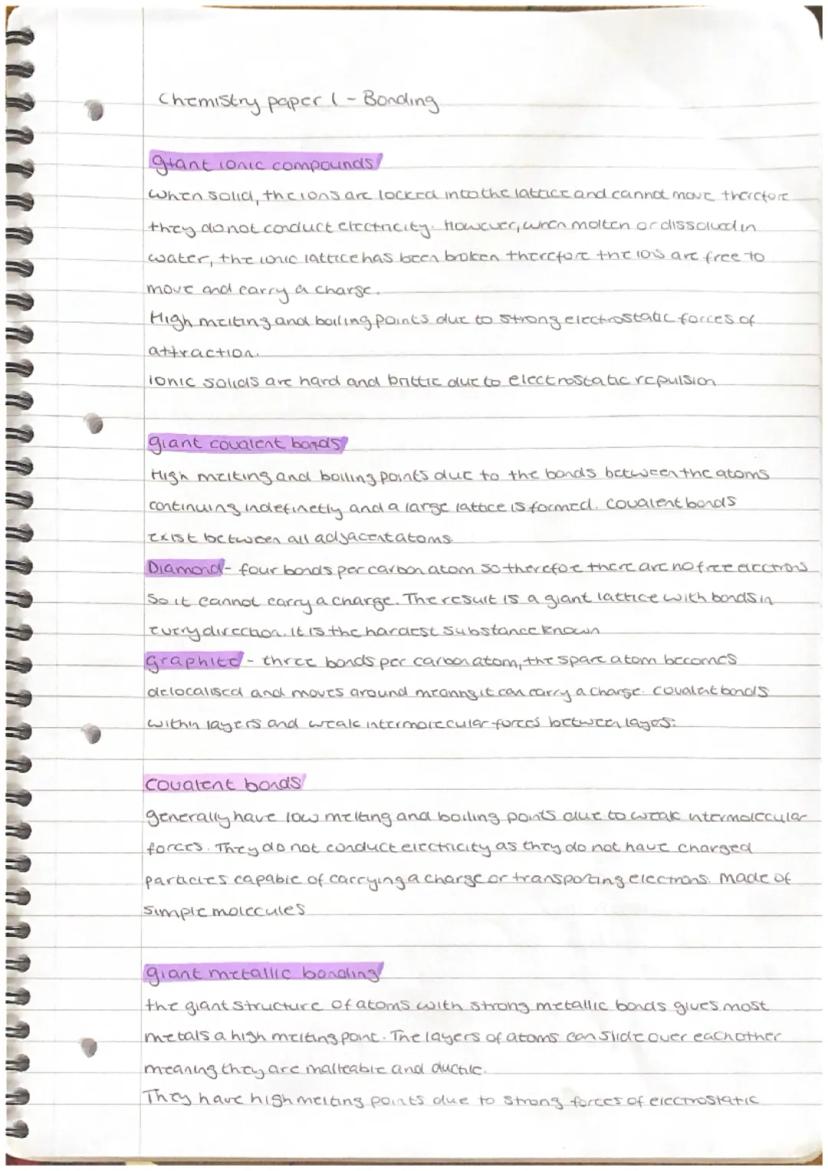
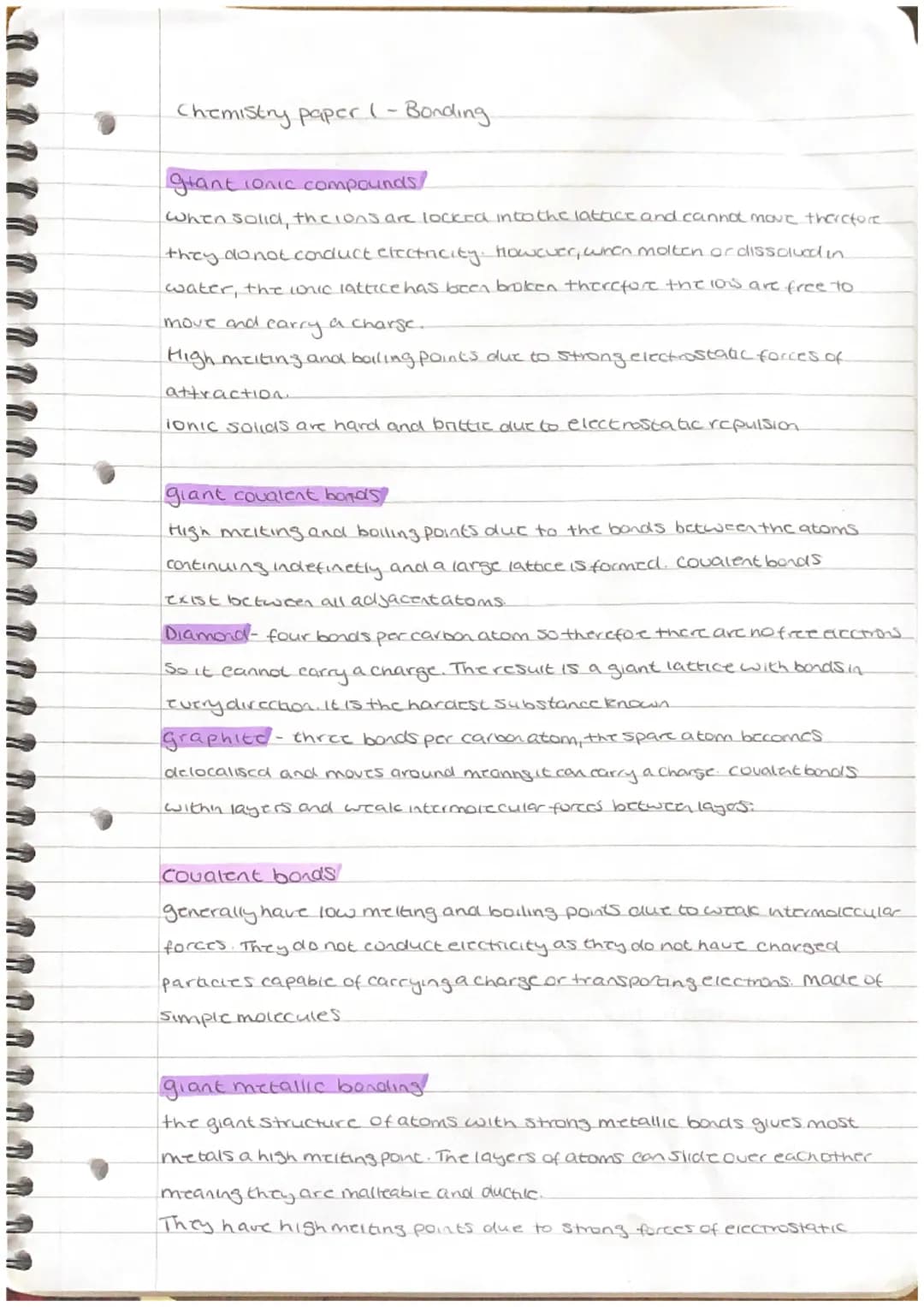
Ionic compounds demonstrate unique properties based on their bonding structure. In solid form, ions remain fixed within the crystal lattice, preventing electrical conductivity. However, when these compounds melt or dissolve in water, the ions become mobile and can conduct electricity effectively. The strong electrostatic forces between oppositely charged ions result in characteristically high melting and boiling points.
Giant covalent structures exhibit remarkable properties due to their extensive atomic networks. Diamond, with its tetrahedral arrangement of carbon atoms forming four covalent bonds, creates an incredibly strong three-dimensional structure. This arrangement makes diamond the hardest natural substance but prevents electrical conductivity due to the absence of free electrons. In contrast, graphite's layered structure, with three bonds per carbon atom, allows for electrical conductivity through delocalized electrons.
Simple molecular substances formed through covalent bonding typically display lower melting and boiling points due to weak intermolecular forces between molecules. These compounds generally don't conduct electricity because they lack charged particles or free electrons for charge transport.
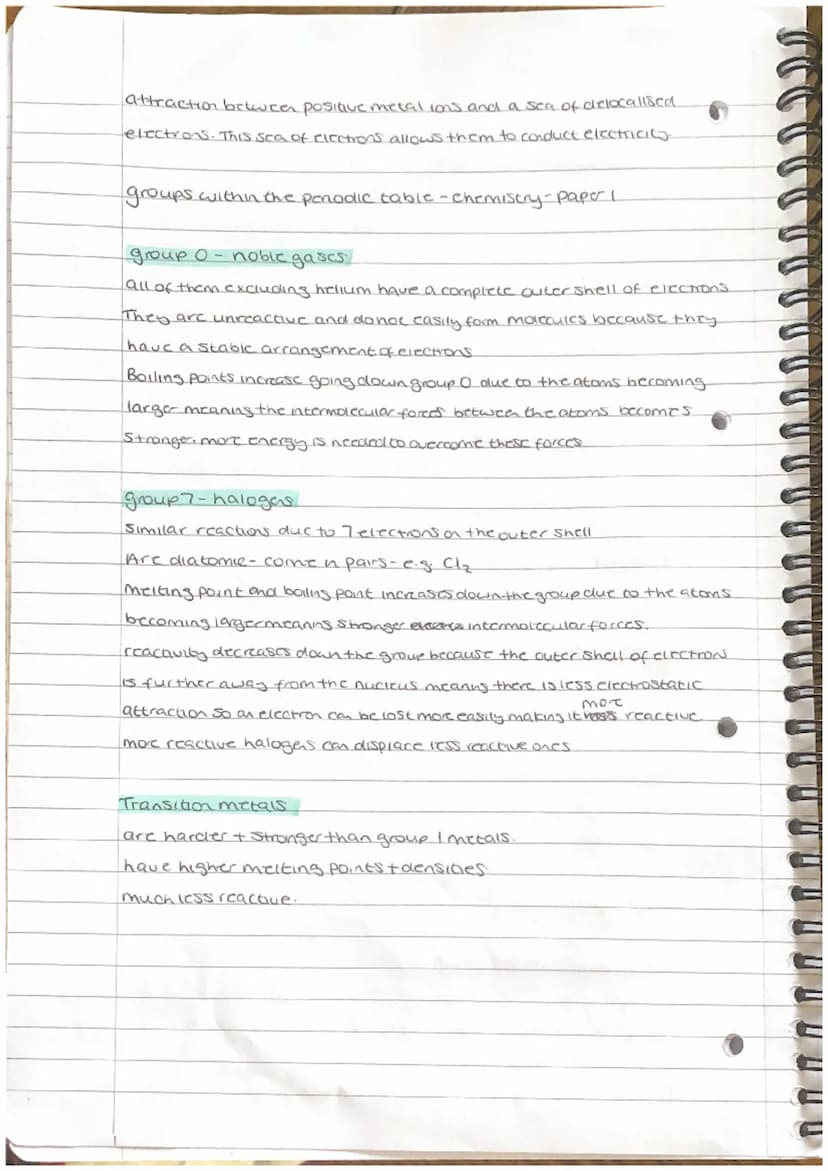
Definition: Metallic bonding involves a regular arrangement of positive metal ions surrounded by a sea of delocalized electrons, resulting in unique properties like malleability and electrical conductivity.
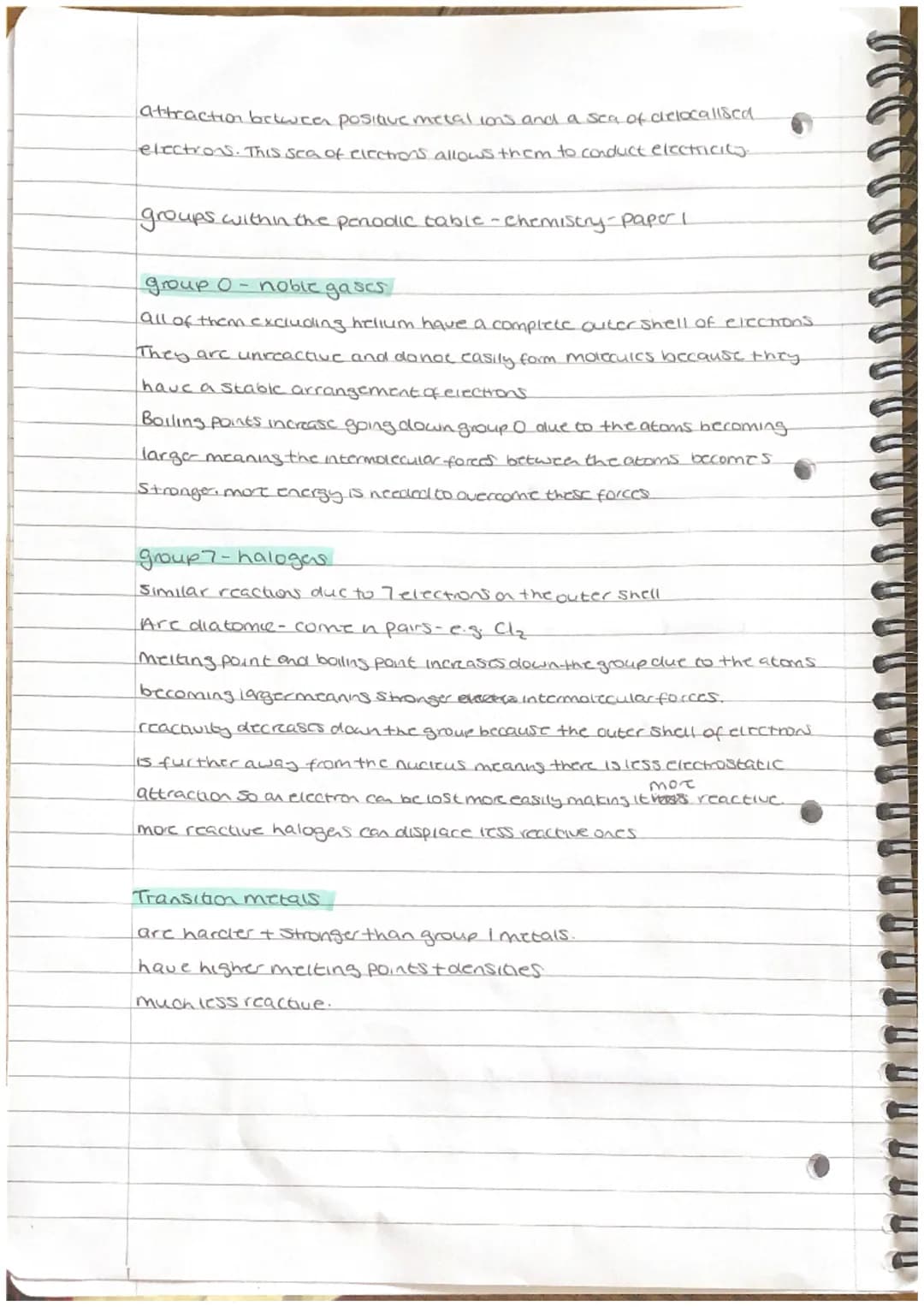
The periodic table's organization reveals important patterns in elemental properties. Group 0 (noble gases) exhibits minimal reactivity due to their complete outer electron shells. Their boiling points increase down the group as atomic size and intermolecular forces increase.
Group 7 (halogens) demonstrates consistent chemical behavior due to their seven outer electrons. These elements exist as diatomic molecules and show decreasing reactivity down the group as atomic size increases and electron attraction decreases.
Highlight: Transition metals display distinct characteristics including:
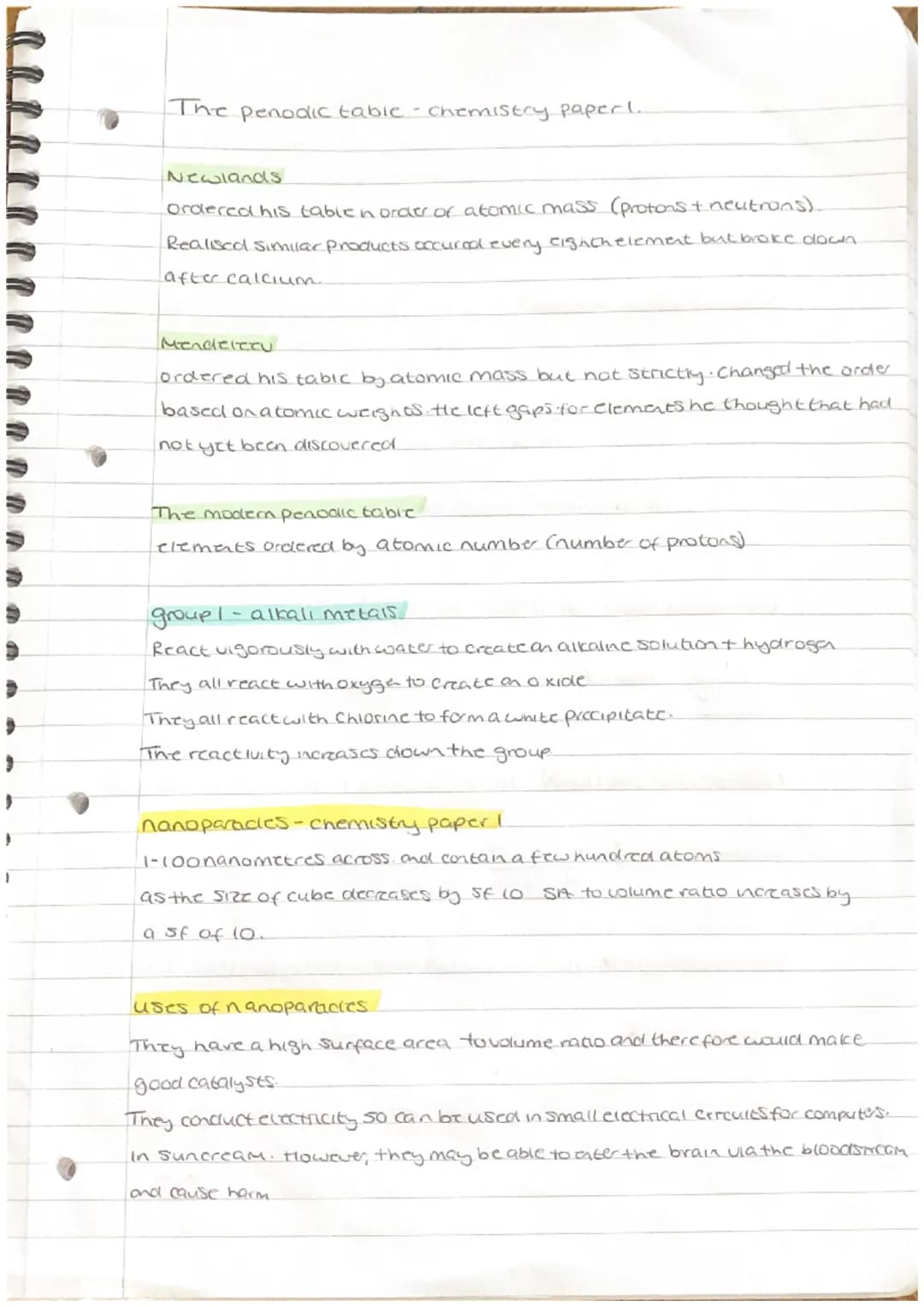
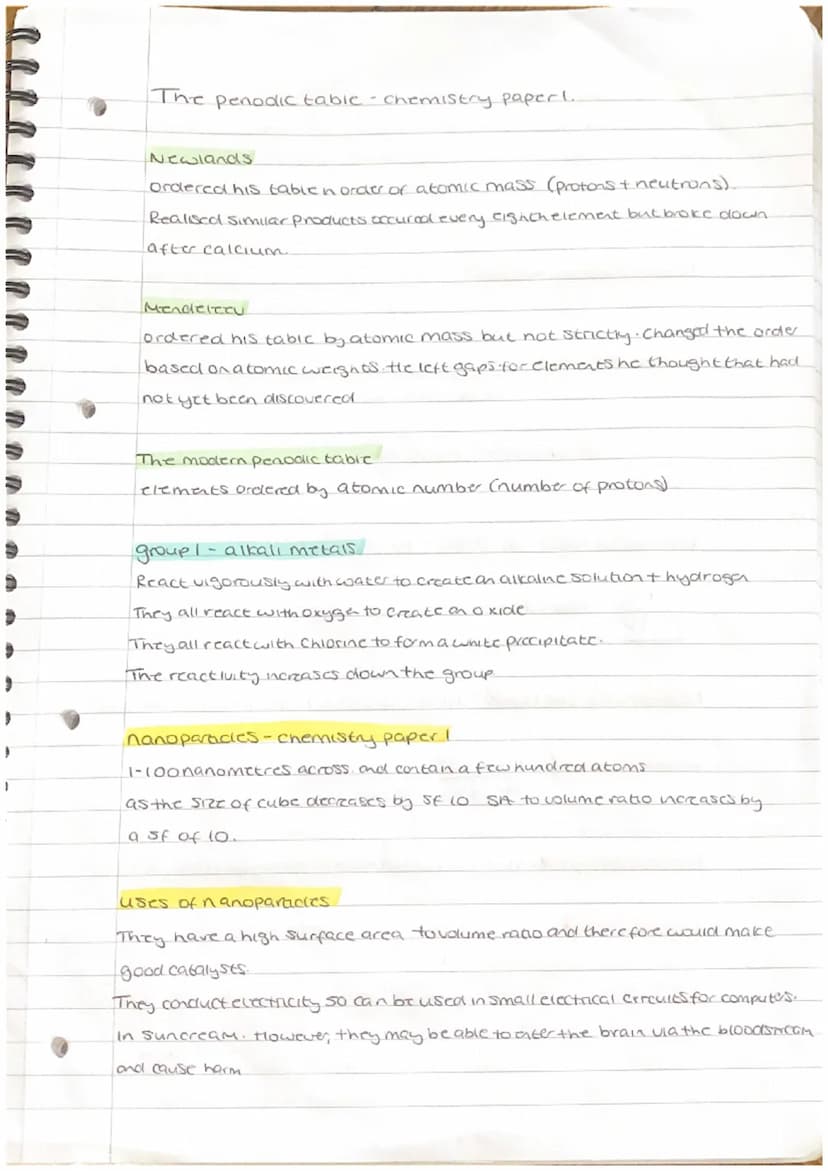
The modern periodic table evolved through significant contributions. Newlands first recognized patterns in element properties, noting similarities every eighth element. Mendeleev advanced this by arranging elements by atomic mass while leaving gaps for undiscovered elements.
Today's periodic table organizes elements by atomic number (proton count). Group 1 (alkali metals) exemplifies clear trends:
Example: Nanoparticles demonstrate unique properties:
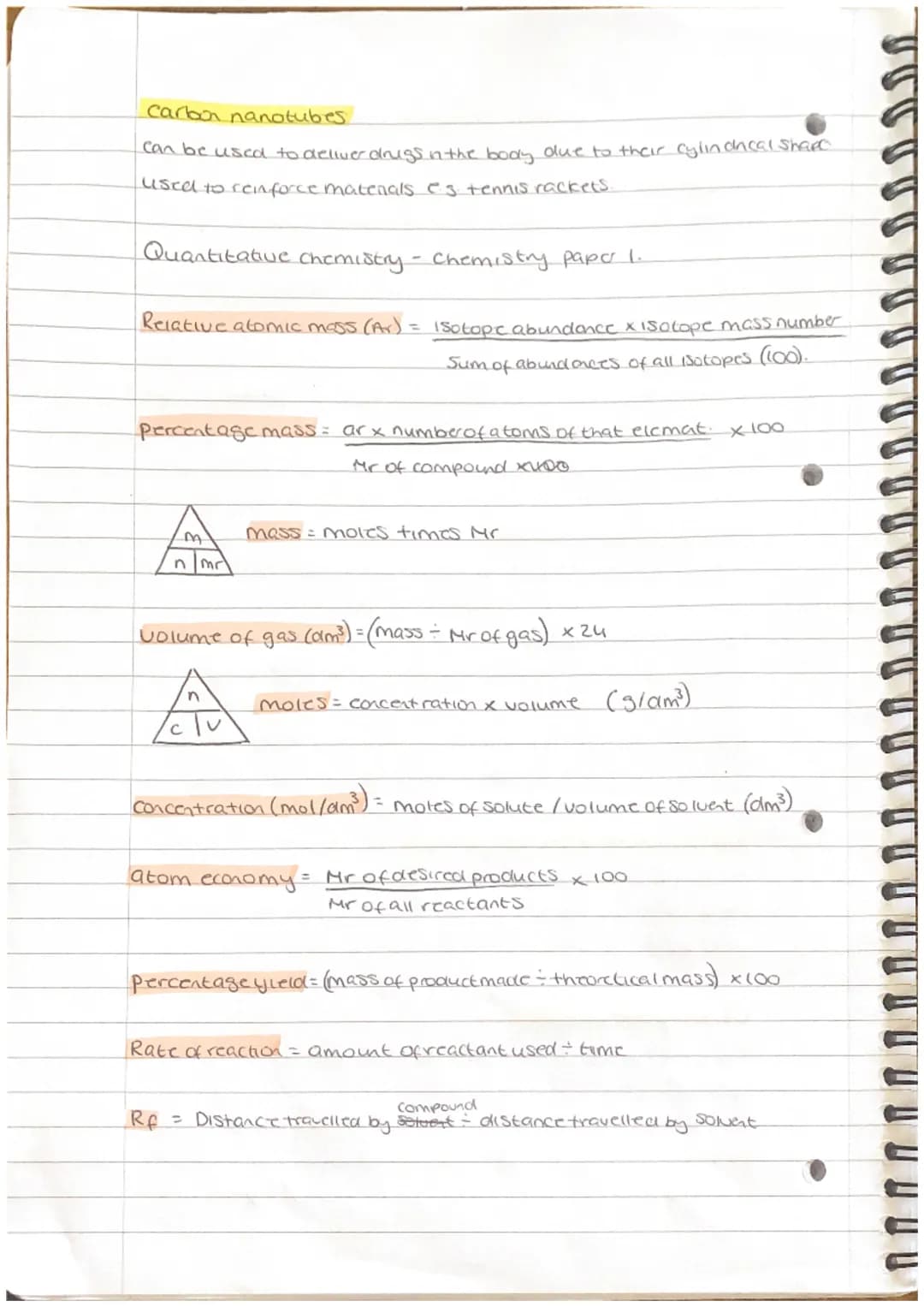
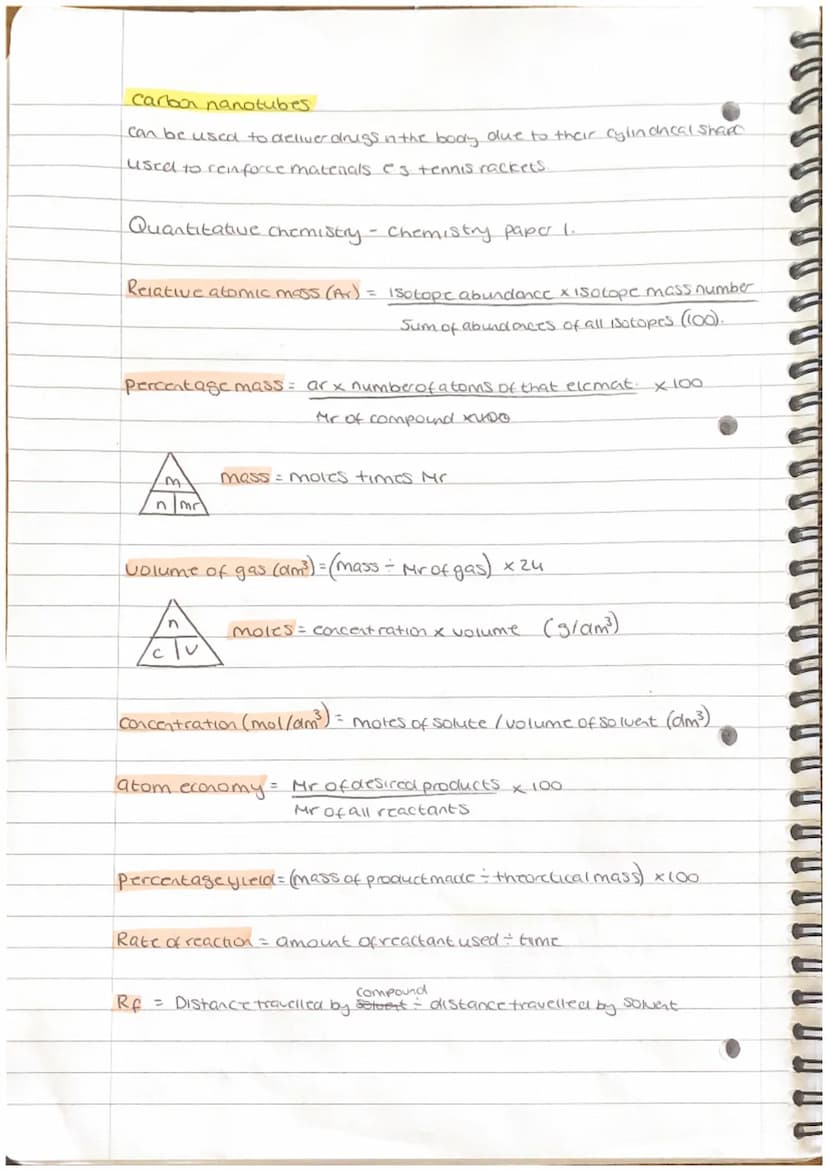
Understanding quantitative relationships in chemistry requires mastery of several key calculations:
Relative atomic mass calculations incorporate isotope abundance: (Isotope abundance × mass number) ÷ total abundance
Concentration and mole relationships follow specific formulas:
Vocabulary: Key terms include:
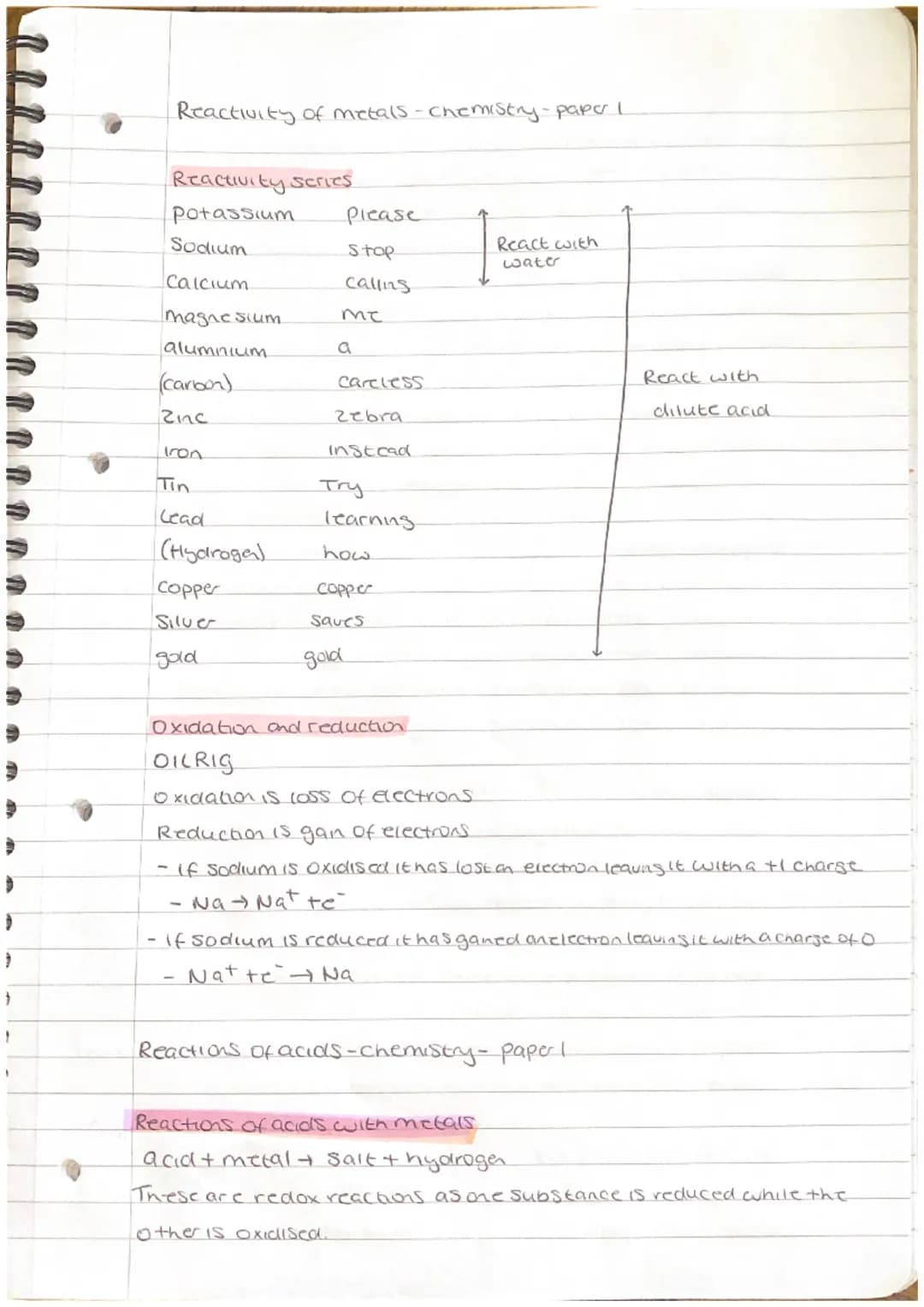
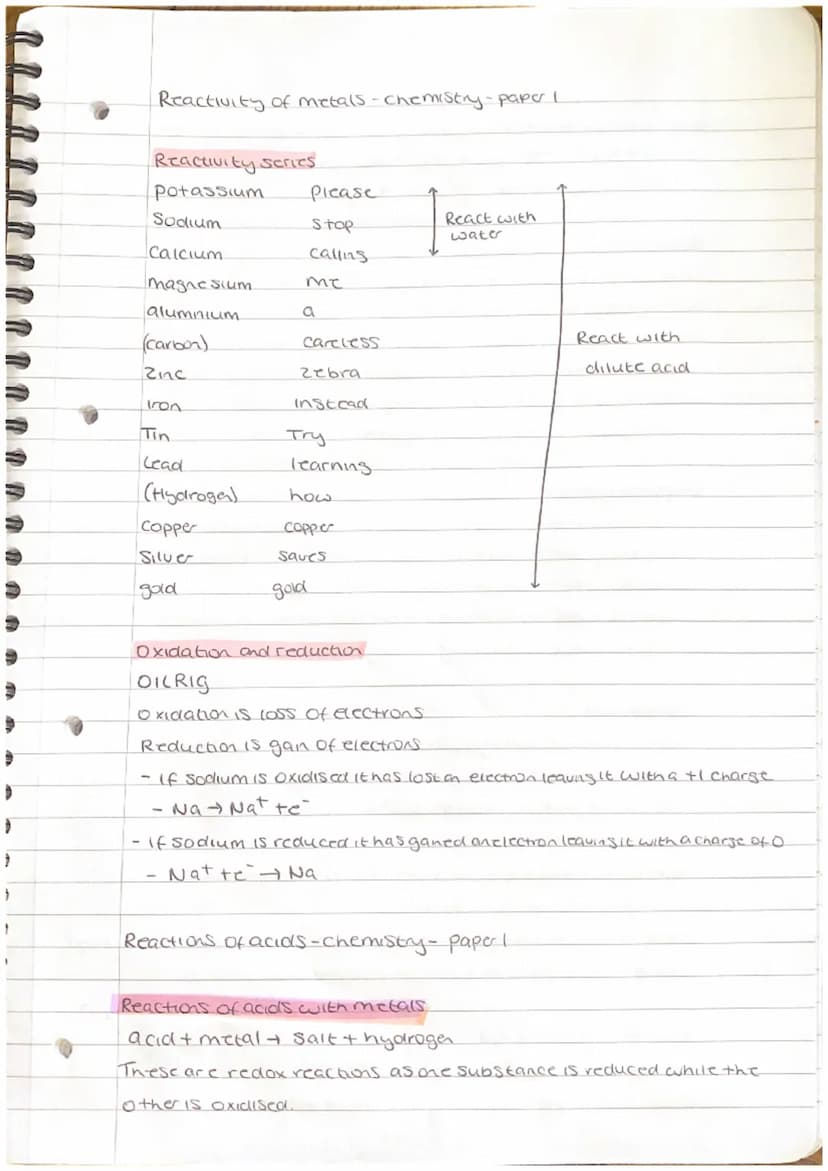
The reactivity series in chemistry forms a fundamental framework for understanding how different metals react. From most reactive to least reactive, the series progresses from potassium through sodium, calcium, magnesium, aluminum, zinc, iron, tin, lead, and finally to the noble metals copper, silver, and gold.
Definition: OILRIG (Oxidation Is Loss, Reduction Is Gain) is a key memory device for understanding electron transfer in chemical reactions.
Understanding oxidation and reduction reactions is crucial for GCSE Chemistry structure and bonding questions. When sodium undergoes oxidation, it loses an electron to form Na+, while reduction involves gaining an electron to return to its neutral state. These concepts are frequently tested in AQA GCSE Chemistry structure and bonding past papers.
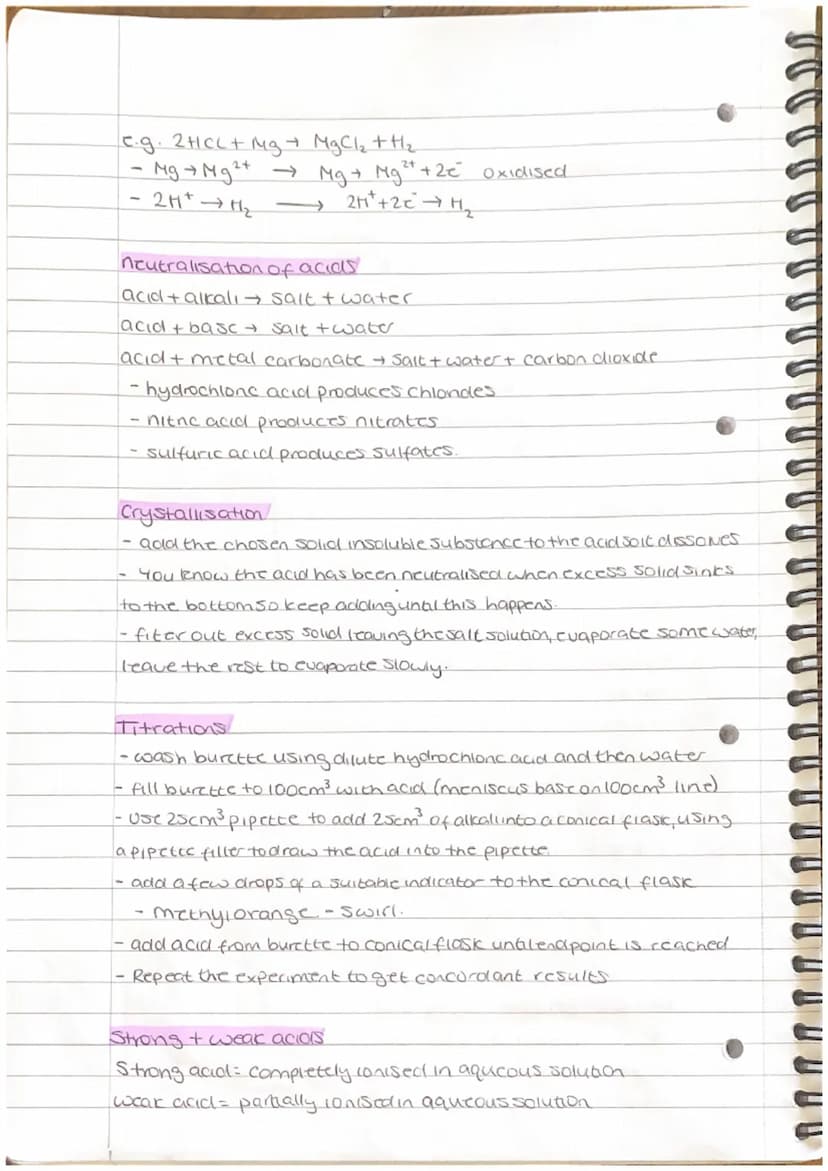
The reactions of acids with metals produce predictable results following the pattern: acid + metal → salt + hydrogen. These are redox reactions where one substance reduces while another oxidizes, making them important topics in Chemistry bonding questions and answers pdf resources.
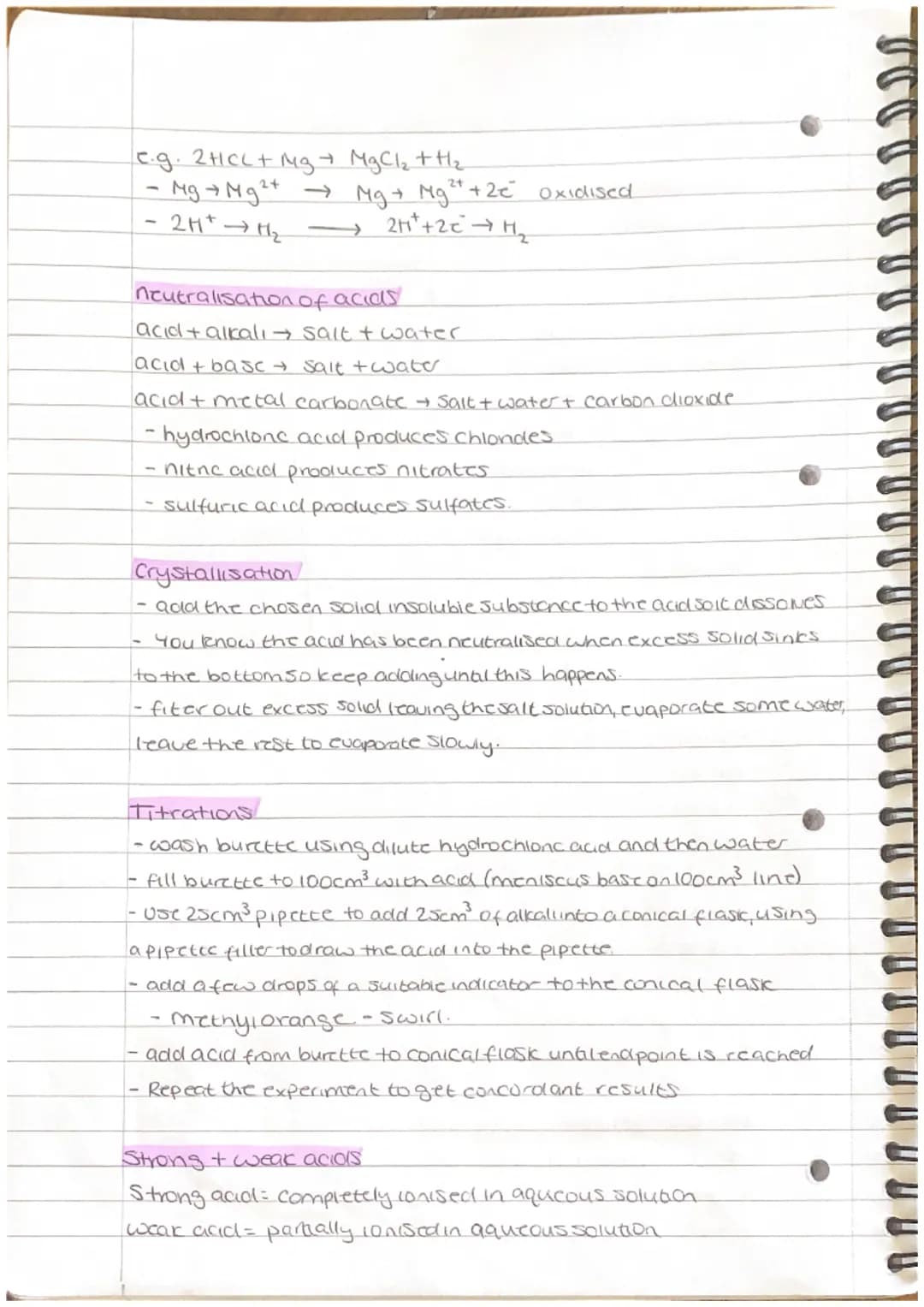
Neutralization reactions follow specific patterns that are essential to understand for AQA chemistry paper 1 bonding and ionic compounds questions. The three main types are:
Example: Different acids produce specific salts:
The crystallization process, crucial for obtaining pure salts, involves careful steps of dissolution, filtration, and controlled evaporation. This process appears frequently in Structure and bonding GCSE Chemistry questions.
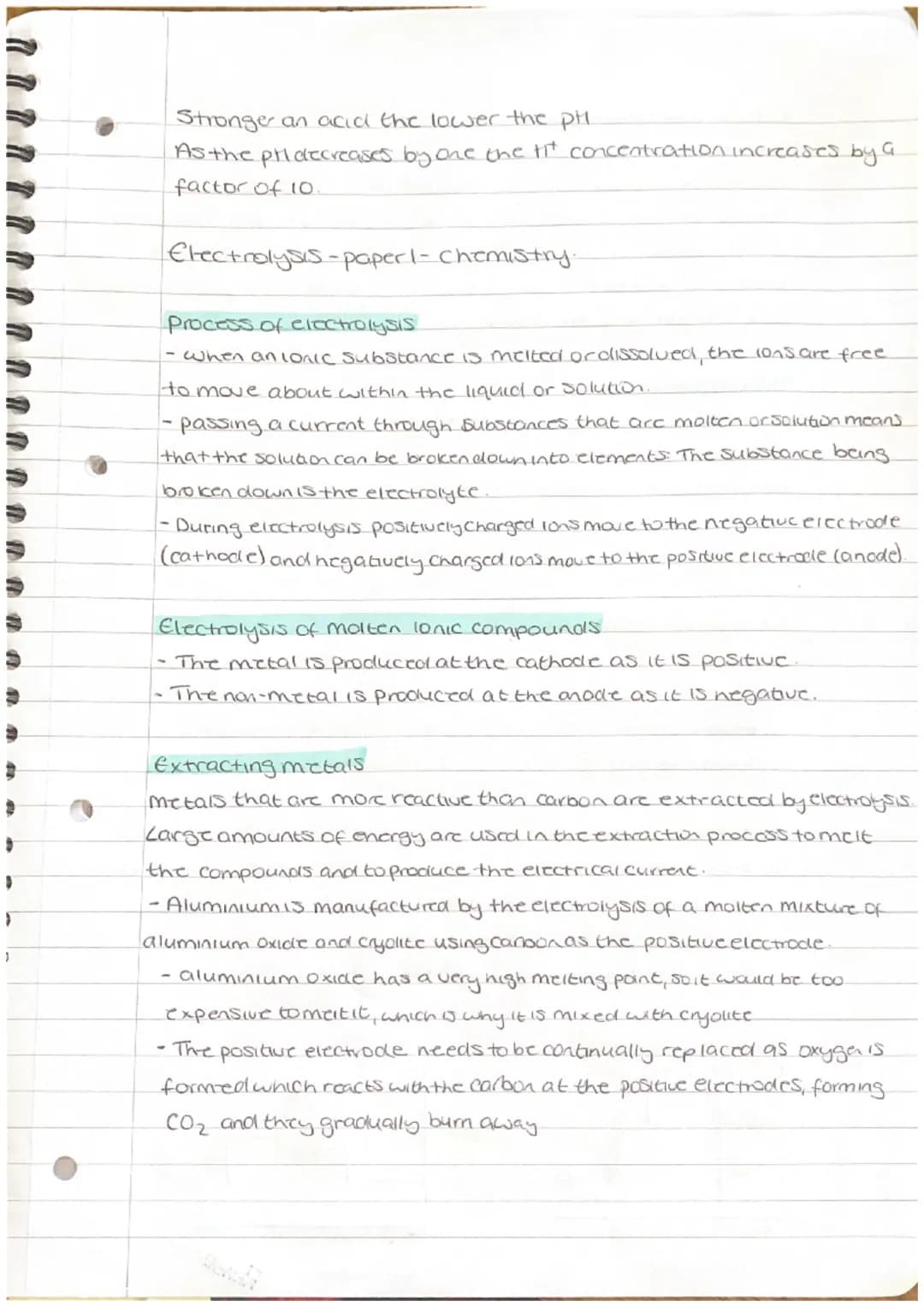
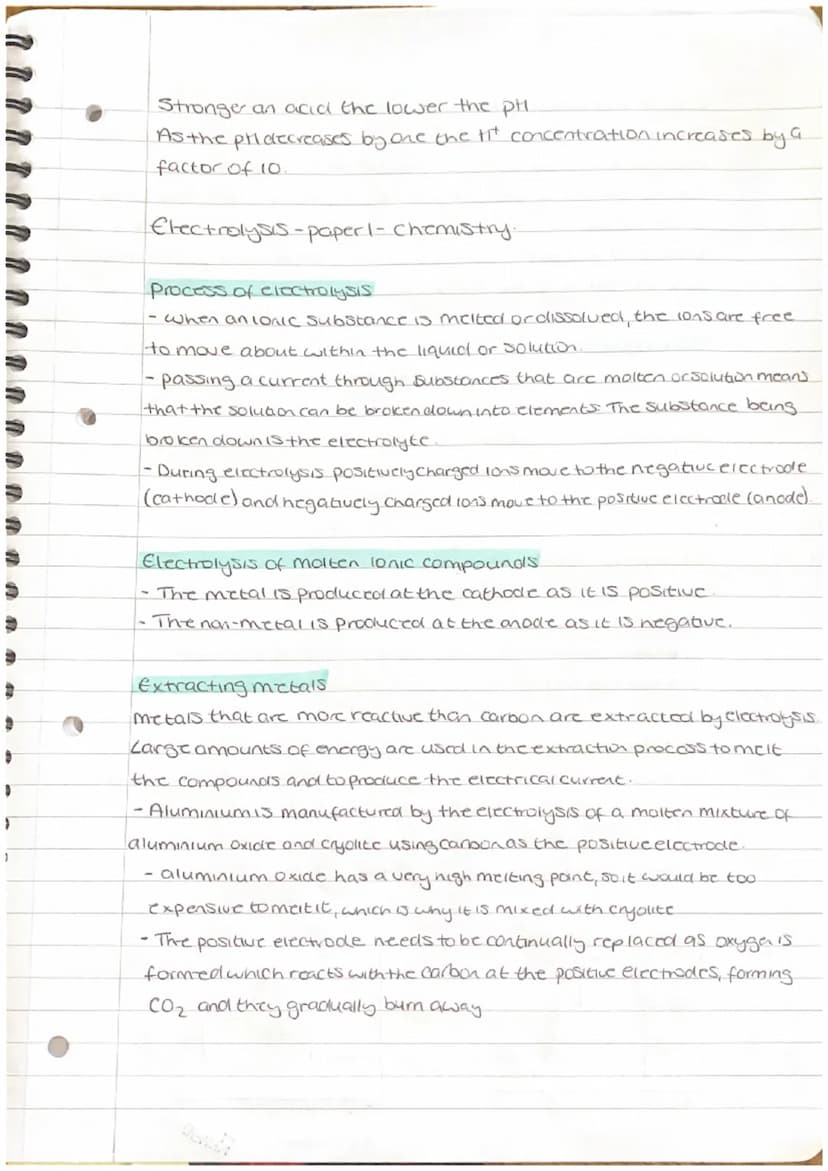
Electrolysis represents a crucial process in chemistry where electrical current breaks down ionic substances. This topic frequently appears in AQA chemistry paper 1 metallic and covalent bonding comparison questions.
Highlight: During electrolysis:
The extraction of reactive metals through electrolysis is particularly important for industrial processes. Aluminum extraction, for example, requires a mixture of aluminum oxide and cryolite, demonstrating practical applications of Ionic bonding GCSE questions pdf concepts.
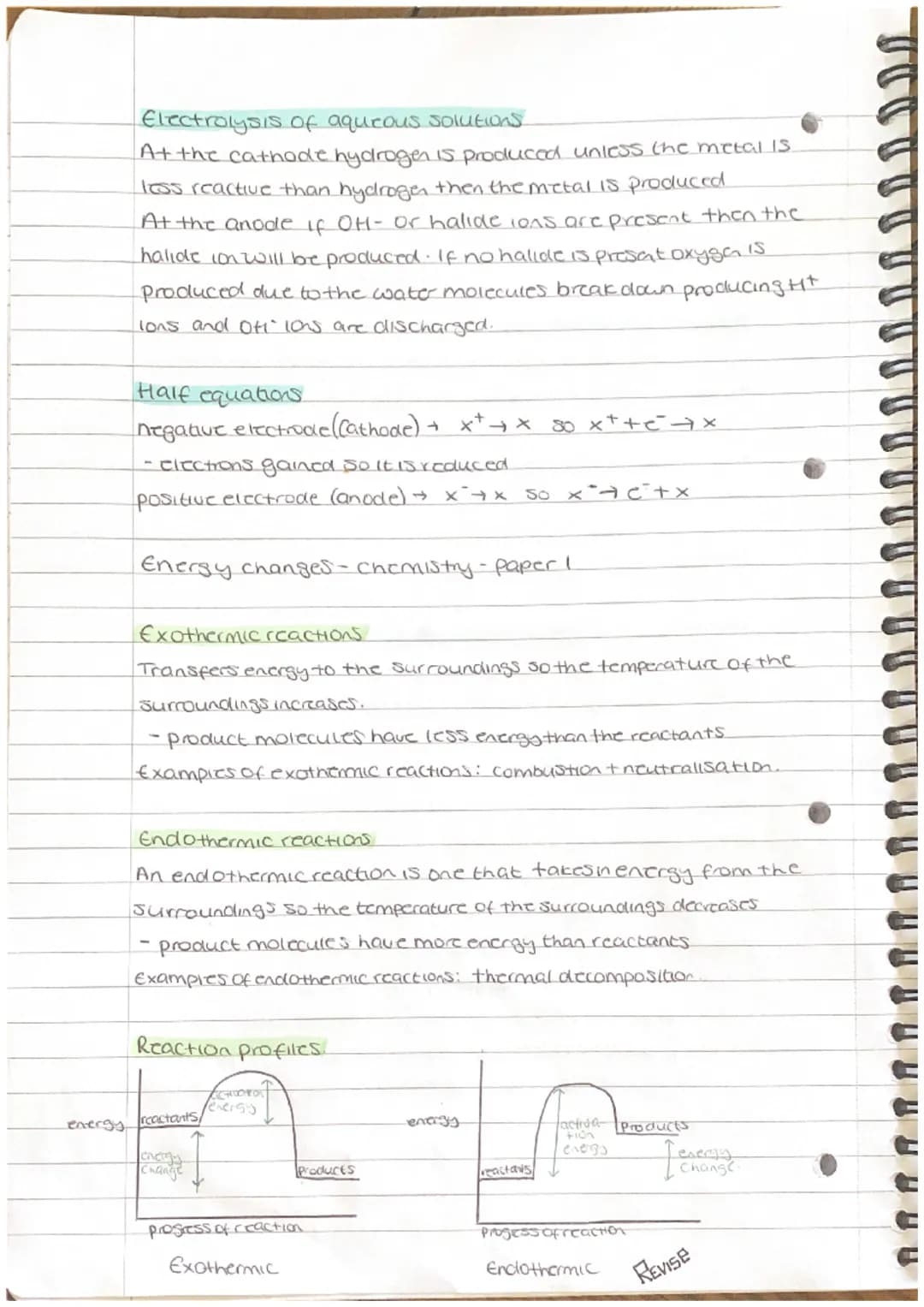
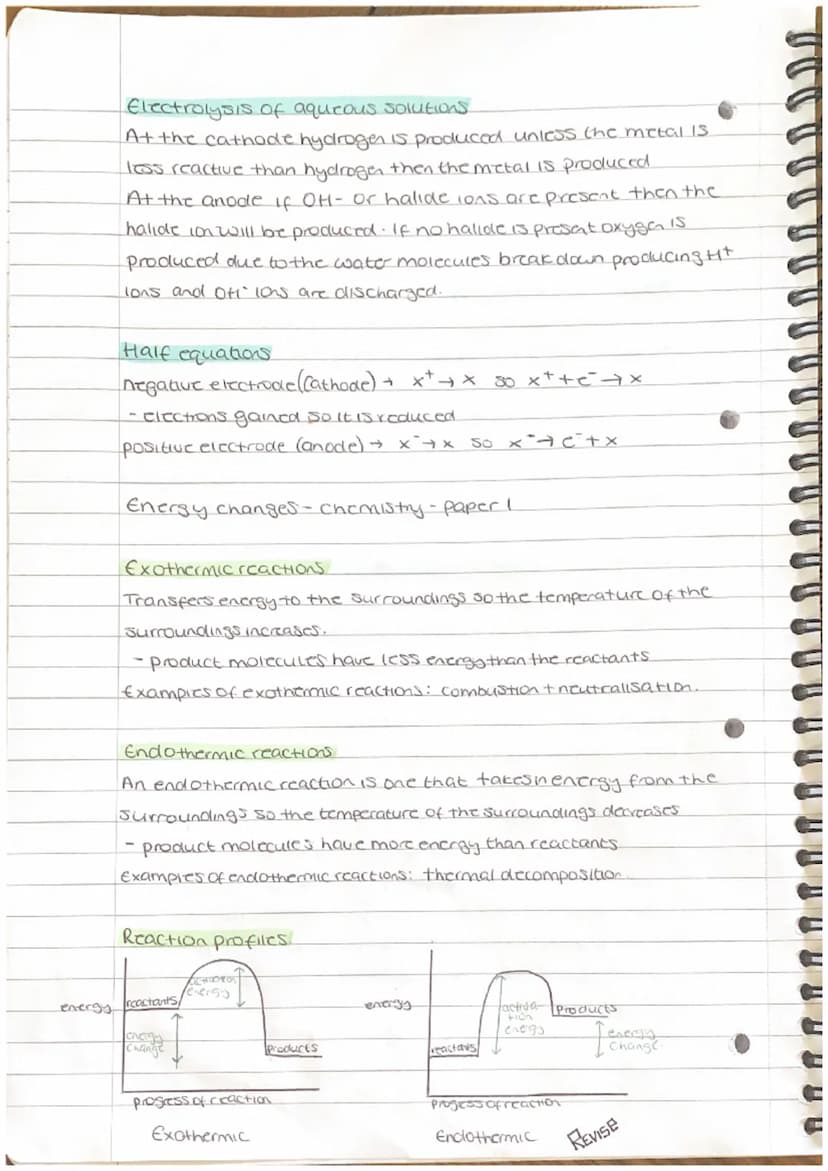
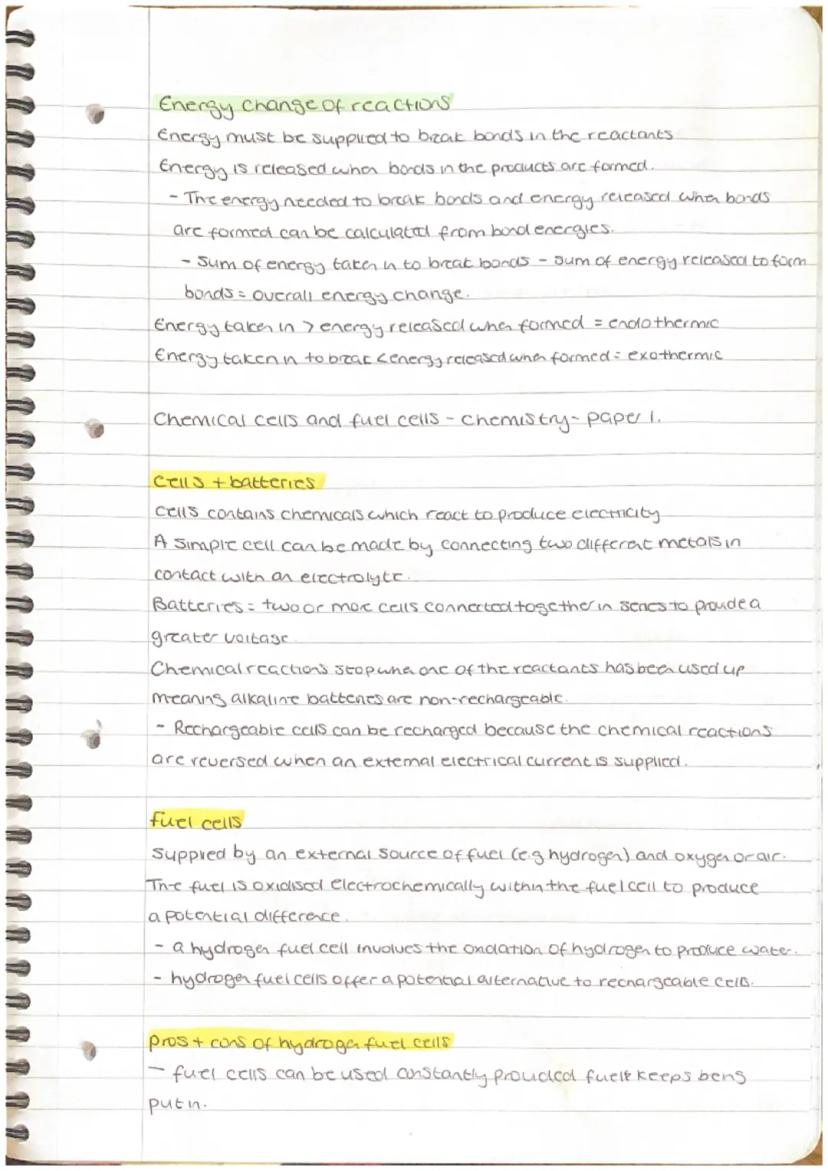
Understanding energy changes in chemical reactions is fundamental to AQA Chemistry Paper 1 success. Exothermic reactions release energy to surroundings, while endothermic reactions absorb energy.
Vocabulary:
Chemical cells and fuel cells represent practical applications of electrochemical principles. Hydrogen fuel cells, which produce electricity through hydrogen oxidation, demonstrate modern applications of bonding, structure and the properties of matter past papers concepts.
The energy changes in reactions can be calculated using bond energies:
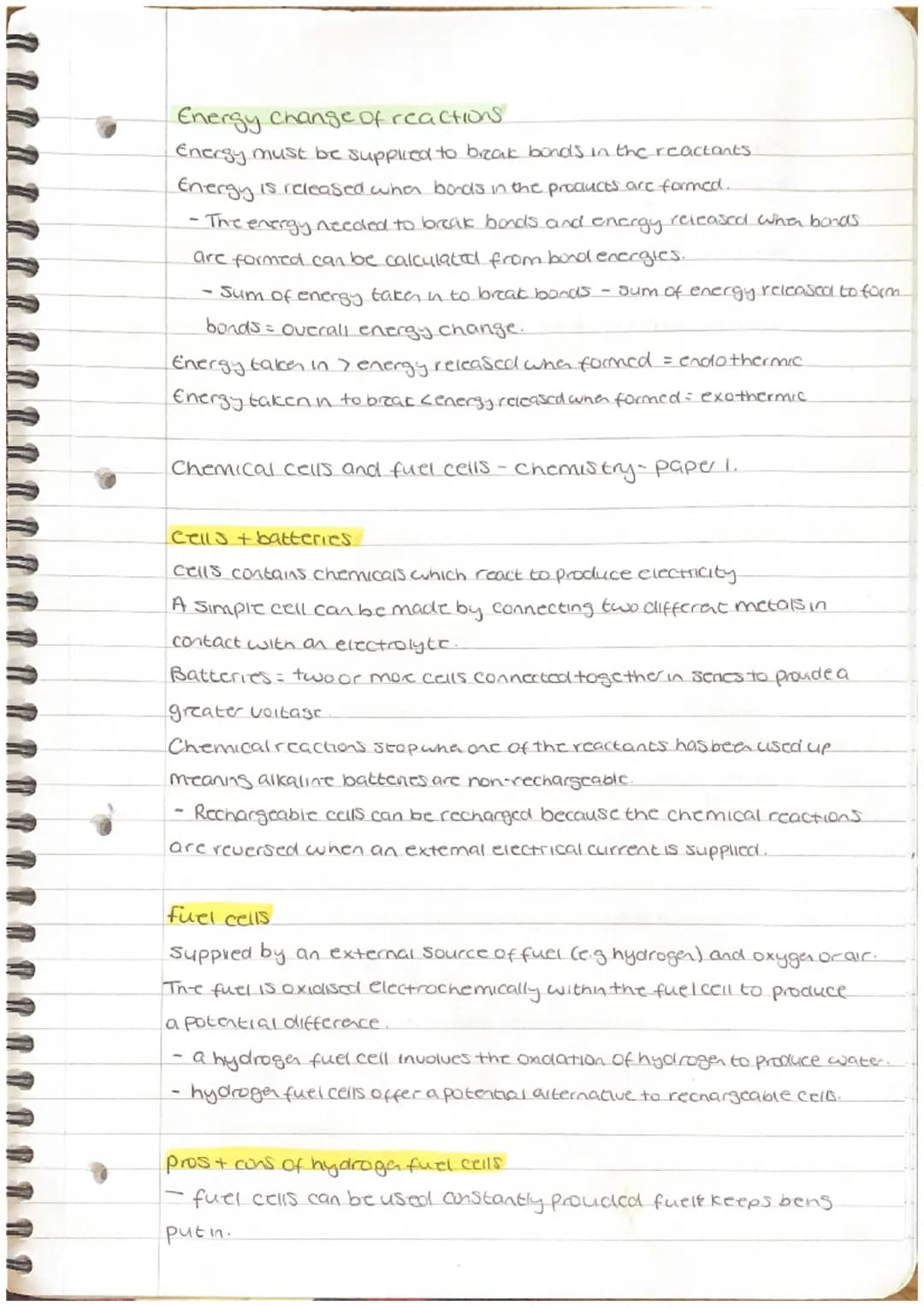
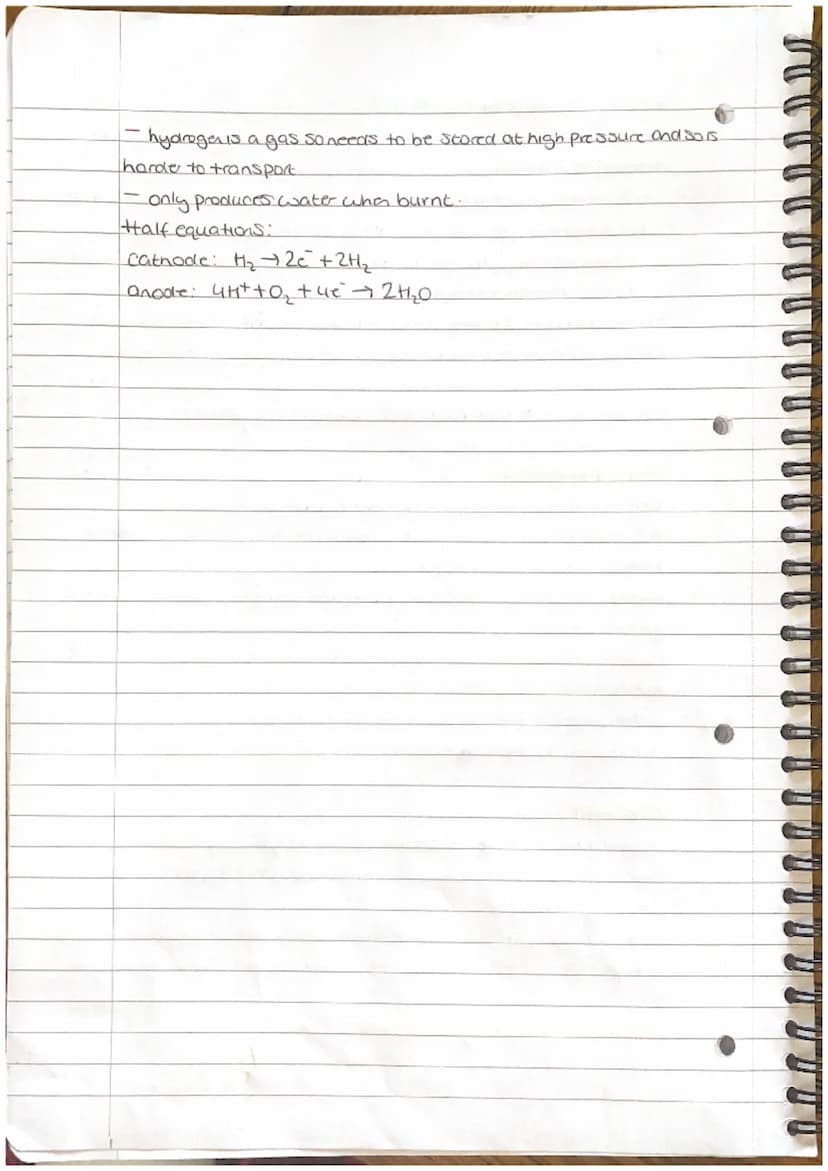
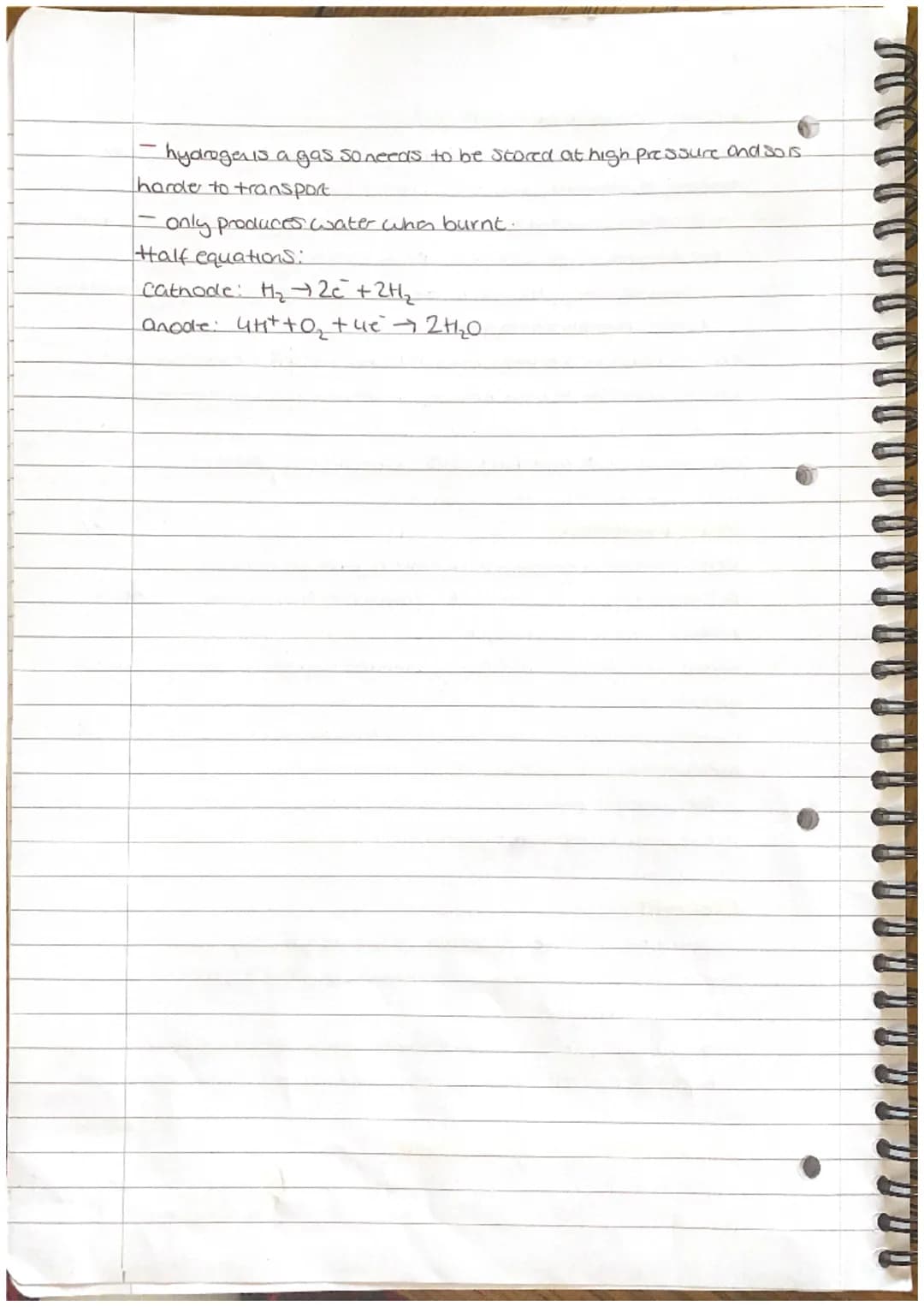
The storage and transportation of hydrogen presents unique challenges in Chemistry bonding questions and answers. As a gas at room temperature, hydrogen must be compressed under high pressure for practical storage and transportation purposes. This compression requirement adds complexity and cost to hydrogen fuel infrastructure, though the environmental benefit of producing only water as a byproduct makes it an attractive clean energy source.
When examining the chemical reactions in hydrogen fuel cells, we must understand the half equations that occur at both electrodes. At the cathode, hydrogen gas (H₂) undergoes oxidation, releasing electrons and forming hydrogen ions (H⁺). This process can be represented by the half equation: H₂ → 2H⁺ + 2e⁻. The electrons travel through an external circuit, providing useful electrical energy.
Definition: Half equations show the separate oxidation and reduction processes occurring at each electrode in an electrochemical cell.
At the anode, oxygen gas combines with hydrogen ions and electrons in a reduction reaction, producing water as the only product. This reaction is represented by: 4H⁺ + O₂ + 4e⁻ → 2H₂O. Understanding these half equations is crucial for GCSE Chemistry structure and Bonding questions and Answers, as they demonstrate how hydrogen fuel cells convert chemical energy into electrical energy without producing harmful emissions.
The efficiency of hydrogen fuel cells relies heavily on understanding Structure and bonding GCSE Chemistry questions related to electrode materials and reaction kinetics. The electrodes must be designed with specific properties to facilitate the half reactions while maintaining structural integrity under operating conditions.
The cathode material must effectively catalyze the hydrogen oxidation reaction, typically using platinum or platinum-based alloys. This relates directly to Chemistry bonding questions and answers pdf content, as the interaction between the electrode surface and hydrogen molecules determines the reaction rate and overall cell efficiency.
Highlight: The choice of electrode materials significantly impacts fuel cell performance and is based on understanding chemical bonding principles.
The anode material must similarly catalyze the oxygen reduction reaction while resisting corrosion from the acidic environment created by the hydrogen ions. This connects to AQA GCSE Chemistry structure and bonding past papers topics, demonstrating how theoretical knowledge of bonding translates into practical applications in sustainable energy technology.
Our AI Companion is a student-focused AI tool that offers more than just answers. Built on millions of Knowunity resources, it provides relevant information, personalised study plans, quizzes, and content directly in the chat, adapting to your individual learning journey.
You can download the app from Google Play Store and Apple App Store.
That's right! Enjoy free access to study content, connect with fellow students, and get instant help – all at your fingertips.
App Store
Google Play
The app is very easy to use and well designed. I have found everything I was looking for so far and have been able to learn a lot from the presentations! I will definitely use the app for a class assignment! And of course it also helps a lot as an inspiration.
Stefan S
iOS user
This app is really great. There are so many study notes and help [...]. My problem subject is French, for example, and the app has so many options for help. Thanks to this app, I have improved my French. I would recommend it to anyone.
Samantha Klich
Android user
Wow, I am really amazed. I just tried the app because I've seen it advertised many times and was absolutely stunned. This app is THE HELP you want for school and above all, it offers so many things, such as workouts and fact sheets, which have been VERY helpful to me personally.
Anna
iOS user
Best app on earth! no words because it’s too good
Thomas R
iOS user
Just amazing. Let's me revise 10x better, this app is a quick 10/10. I highly recommend it to anyone. I can watch and search for notes. I can save them in the subject folder. I can revise it any time when I come back. If you haven't tried this app, you're really missing out.
Basil
Android user
This app has made me feel so much more confident in my exam prep, not only through boosting my own self confidence through the features that allow you to connect with others and feel less alone, but also through the way the app itself is centred around making you feel better. It is easy to navigate, fun to use, and helpful to anyone struggling in absolutely any way.
David K
iOS user
The app's just great! All I have to do is enter the topic in the search bar and I get the response real fast. I don't have to watch 10 YouTube videos to understand something, so I'm saving my time. Highly recommended!
Sudenaz Ocak
Android user
In school I was really bad at maths but thanks to the app, I am doing better now. I am so grateful that you made the app.
Greenlight Bonnie
Android user
very reliable app to help and grow your ideas of Maths, English and other related topics in your works. please use this app if your struggling in areas, this app is key for that. wish I'd of done a review before. and it's also free so don't worry about that.
Rohan U
Android user
I know a lot of apps use fake accounts to boost their reviews but this app deserves it all. Originally I was getting 4 in my English exams and this time I got a grade 7. I didn’t even know about this app three days until the exam and it has helped A LOT. Please actually trust me and use it as I’m sure you too will see developments.
Xander S
iOS user
THE QUIZES AND FLASHCARDS ARE SO USEFUL AND I LOVE Knowunity AI. IT ALSO IS LITREALLY LIKE CHATGPT BUT SMARTER!! HELPED ME WITH MY MASCARA PROBLEMS TOO!! AS WELL AS MY REAL SUBJECTS ! DUHHH 😍😁😲🤑💗✨🎀😮
Elisha
iOS user
This apps acc the goat. I find revision so boring but this app makes it so easy to organize it all and then you can ask the freeeee ai to test yourself so good and you can easily upload your own stuff. highly recommend as someone taking mocks now
Paul T
iOS user
The app is very easy to use and well designed. I have found everything I was looking for so far and have been able to learn a lot from the presentations! I will definitely use the app for a class assignment! And of course it also helps a lot as an inspiration.
Stefan S
iOS user
This app is really great. There are so many study notes and help [...]. My problem subject is French, for example, and the app has so many options for help. Thanks to this app, I have improved my French. I would recommend it to anyone.
Samantha Klich
Android user
Wow, I am really amazed. I just tried the app because I've seen it advertised many times and was absolutely stunned. This app is THE HELP you want for school and above all, it offers so many things, such as workouts and fact sheets, which have been VERY helpful to me personally.
Anna
iOS user
Best app on earth! no words because it’s too good
Thomas R
iOS user
Just amazing. Let's me revise 10x better, this app is a quick 10/10. I highly recommend it to anyone. I can watch and search for notes. I can save them in the subject folder. I can revise it any time when I come back. If you haven't tried this app, you're really missing out.
Basil
Android user
This app has made me feel so much more confident in my exam prep, not only through boosting my own self confidence through the features that allow you to connect with others and feel less alone, but also through the way the app itself is centred around making you feel better. It is easy to navigate, fun to use, and helpful to anyone struggling in absolutely any way.
David K
iOS user
The app's just great! All I have to do is enter the topic in the search bar and I get the response real fast. I don't have to watch 10 YouTube videos to understand something, so I'm saving my time. Highly recommended!
Sudenaz Ocak
Android user
In school I was really bad at maths but thanks to the app, I am doing better now. I am so grateful that you made the app.
Greenlight Bonnie
Android user
very reliable app to help and grow your ideas of Maths, English and other related topics in your works. please use this app if your struggling in areas, this app is key for that. wish I'd of done a review before. and it's also free so don't worry about that.
Rohan U
Android user
I know a lot of apps use fake accounts to boost their reviews but this app deserves it all. Originally I was getting 4 in my English exams and this time I got a grade 7. I didn’t even know about this app three days until the exam and it has helped A LOT. Please actually trust me and use it as I’m sure you too will see developments.
Xander S
iOS user
THE QUIZES AND FLASHCARDS ARE SO USEFUL AND I LOVE Knowunity AI. IT ALSO IS LITREALLY LIKE CHATGPT BUT SMARTER!! HELPED ME WITH MY MASCARA PROBLEMS TOO!! AS WELL AS MY REAL SUBJECTS ! DUHHH 😍😁😲🤑💗✨🎀😮
Elisha
iOS user
This apps acc the goat. I find revision so boring but this app makes it so easy to organize it all and then you can ask the freeeee ai to test yourself so good and you can easily upload your own stuff. highly recommend as someone taking mocks now
Paul T
iOS user
Alice Stevens
@alicestevens_idux
Understanding chemical bonding and structure is fundamental to mastering GCSE Chemistry structure and Bonding questions and Answers.
The periodic table forms the foundation for understanding how elements interact and form bonds. In Atomic structure and the periodic table question... Show more
Access to all documents
Improve your grades
Join milions of students
Ionic compounds demonstrate unique properties based on their bonding structure. In solid form, ions remain fixed within the crystal lattice, preventing electrical conductivity. However, when these compounds melt or dissolve in water, the ions become mobile and can conduct electricity effectively. The strong electrostatic forces between oppositely charged ions result in characteristically high melting and boiling points.
Giant covalent structures exhibit remarkable properties due to their extensive atomic networks. Diamond, with its tetrahedral arrangement of carbon atoms forming four covalent bonds, creates an incredibly strong three-dimensional structure. This arrangement makes diamond the hardest natural substance but prevents electrical conductivity due to the absence of free electrons. In contrast, graphite's layered structure, with three bonds per carbon atom, allows for electrical conductivity through delocalized electrons.
Simple molecular substances formed through covalent bonding typically display lower melting and boiling points due to weak intermolecular forces between molecules. These compounds generally don't conduct electricity because they lack charged particles or free electrons for charge transport.
Definition: Metallic bonding involves a regular arrangement of positive metal ions surrounded by a sea of delocalized electrons, resulting in unique properties like malleability and electrical conductivity.
Access to all documents
Improve your grades
Join milions of students
The periodic table's organization reveals important patterns in elemental properties. Group 0 (noble gases) exhibits minimal reactivity due to their complete outer electron shells. Their boiling points increase down the group as atomic size and intermolecular forces increase.
Group 7 (halogens) demonstrates consistent chemical behavior due to their seven outer electrons. These elements exist as diatomic molecules and show decreasing reactivity down the group as atomic size increases and electron attraction decreases.
Highlight: Transition metals display distinct characteristics including:
Access to all documents
Improve your grades
Join milions of students
The modern periodic table evolved through significant contributions. Newlands first recognized patterns in element properties, noting similarities every eighth element. Mendeleev advanced this by arranging elements by atomic mass while leaving gaps for undiscovered elements.
Today's periodic table organizes elements by atomic number (proton count). Group 1 (alkali metals) exemplifies clear trends:
Example: Nanoparticles demonstrate unique properties:
Access to all documents
Improve your grades
Join milions of students
Understanding quantitative relationships in chemistry requires mastery of several key calculations:
Relative atomic mass calculations incorporate isotope abundance: (Isotope abundance × mass number) ÷ total abundance
Concentration and mole relationships follow specific formulas:
Vocabulary: Key terms include:
Access to all documents
Improve your grades
Join milions of students
The reactivity series in chemistry forms a fundamental framework for understanding how different metals react. From most reactive to least reactive, the series progresses from potassium through sodium, calcium, magnesium, aluminum, zinc, iron, tin, lead, and finally to the noble metals copper, silver, and gold.
Definition: OILRIG (Oxidation Is Loss, Reduction Is Gain) is a key memory device for understanding electron transfer in chemical reactions.
Understanding oxidation and reduction reactions is crucial for GCSE Chemistry structure and bonding questions. When sodium undergoes oxidation, it loses an electron to form Na+, while reduction involves gaining an electron to return to its neutral state. These concepts are frequently tested in AQA GCSE Chemistry structure and bonding past papers.
The reactions of acids with metals produce predictable results following the pattern: acid + metal → salt + hydrogen. These are redox reactions where one substance reduces while another oxidizes, making them important topics in Chemistry bonding questions and answers pdf resources.
Access to all documents
Improve your grades
Join milions of students
Neutralization reactions follow specific patterns that are essential to understand for AQA chemistry paper 1 bonding and ionic compounds questions. The three main types are:
Example: Different acids produce specific salts:
The crystallization process, crucial for obtaining pure salts, involves careful steps of dissolution, filtration, and controlled evaporation. This process appears frequently in Structure and bonding GCSE Chemistry questions.
Access to all documents
Improve your grades
Join milions of students
Electrolysis represents a crucial process in chemistry where electrical current breaks down ionic substances. This topic frequently appears in AQA chemistry paper 1 metallic and covalent bonding comparison questions.
Highlight: During electrolysis:
The extraction of reactive metals through electrolysis is particularly important for industrial processes. Aluminum extraction, for example, requires a mixture of aluminum oxide and cryolite, demonstrating practical applications of Ionic bonding GCSE questions pdf concepts.
Access to all documents
Improve your grades
Join milions of students
Understanding energy changes in chemical reactions is fundamental to AQA Chemistry Paper 1 success. Exothermic reactions release energy to surroundings, while endothermic reactions absorb energy.
Vocabulary:
Chemical cells and fuel cells represent practical applications of electrochemical principles. Hydrogen fuel cells, which produce electricity through hydrogen oxidation, demonstrate modern applications of bonding, structure and the properties of matter past papers concepts.
The energy changes in reactions can be calculated using bond energies:
Access to all documents
Improve your grades
Join milions of students
The storage and transportation of hydrogen presents unique challenges in Chemistry bonding questions and answers. As a gas at room temperature, hydrogen must be compressed under high pressure for practical storage and transportation purposes. This compression requirement adds complexity and cost to hydrogen fuel infrastructure, though the environmental benefit of producing only water as a byproduct makes it an attractive clean energy source.
When examining the chemical reactions in hydrogen fuel cells, we must understand the half equations that occur at both electrodes. At the cathode, hydrogen gas (H₂) undergoes oxidation, releasing electrons and forming hydrogen ions (H⁺). This process can be represented by the half equation: H₂ → 2H⁺ + 2e⁻. The electrons travel through an external circuit, providing useful electrical energy.
Definition: Half equations show the separate oxidation and reduction processes occurring at each electrode in an electrochemical cell.
At the anode, oxygen gas combines with hydrogen ions and electrons in a reduction reaction, producing water as the only product. This reaction is represented by: 4H⁺ + O₂ + 4e⁻ → 2H₂O. Understanding these half equations is crucial for GCSE Chemistry structure and Bonding questions and Answers, as they demonstrate how hydrogen fuel cells convert chemical energy into electrical energy without producing harmful emissions.
Access to all documents
Improve your grades
Join milions of students
The efficiency of hydrogen fuel cells relies heavily on understanding Structure and bonding GCSE Chemistry questions related to electrode materials and reaction kinetics. The electrodes must be designed with specific properties to facilitate the half reactions while maintaining structural integrity under operating conditions.
The cathode material must effectively catalyze the hydrogen oxidation reaction, typically using platinum or platinum-based alloys. This relates directly to Chemistry bonding questions and answers pdf content, as the interaction between the electrode surface and hydrogen molecules determines the reaction rate and overall cell efficiency.
Highlight: The choice of electrode materials significantly impacts fuel cell performance and is based on understanding chemical bonding principles.
The anode material must similarly catalyze the oxygen reduction reaction while resisting corrosion from the acidic environment created by the hydrogen ions. This connects to AQA GCSE Chemistry structure and bonding past papers topics, demonstrating how theoretical knowledge of bonding translates into practical applications in sustainable energy technology.
Our AI Companion is a student-focused AI tool that offers more than just answers. Built on millions of Knowunity resources, it provides relevant information, personalised study plans, quizzes, and content directly in the chat, adapting to your individual learning journey.
You can download the app from Google Play Store and Apple App Store.
That's right! Enjoy free access to study content, connect with fellow students, and get instant help – all at your fingertips.
294
Smart Tools NEW
Transform this note into: ✓ 50+ Practice Questions ✓ Interactive Flashcards ✓ Full Mock Exam ✓ Essay Outlines
App Store
Google Play
The app is very easy to use and well designed. I have found everything I was looking for so far and have been able to learn a lot from the presentations! I will definitely use the app for a class assignment! And of course it also helps a lot as an inspiration.
Stefan S
iOS user
This app is really great. There are so many study notes and help [...]. My problem subject is French, for example, and the app has so many options for help. Thanks to this app, I have improved my French. I would recommend it to anyone.
Samantha Klich
Android user
Wow, I am really amazed. I just tried the app because I've seen it advertised many times and was absolutely stunned. This app is THE HELP you want for school and above all, it offers so many things, such as workouts and fact sheets, which have been VERY helpful to me personally.
Anna
iOS user
Best app on earth! no words because it’s too good
Thomas R
iOS user
Just amazing. Let's me revise 10x better, this app is a quick 10/10. I highly recommend it to anyone. I can watch and search for notes. I can save them in the subject folder. I can revise it any time when I come back. If you haven't tried this app, you're really missing out.
Basil
Android user
This app has made me feel so much more confident in my exam prep, not only through boosting my own self confidence through the features that allow you to connect with others and feel less alone, but also through the way the app itself is centred around making you feel better. It is easy to navigate, fun to use, and helpful to anyone struggling in absolutely any way.
David K
iOS user
The app's just great! All I have to do is enter the topic in the search bar and I get the response real fast. I don't have to watch 10 YouTube videos to understand something, so I'm saving my time. Highly recommended!
Sudenaz Ocak
Android user
In school I was really bad at maths but thanks to the app, I am doing better now. I am so grateful that you made the app.
Greenlight Bonnie
Android user
very reliable app to help and grow your ideas of Maths, English and other related topics in your works. please use this app if your struggling in areas, this app is key for that. wish I'd of done a review before. and it's also free so don't worry about that.
Rohan U
Android user
I know a lot of apps use fake accounts to boost their reviews but this app deserves it all. Originally I was getting 4 in my English exams and this time I got a grade 7. I didn’t even know about this app three days until the exam and it has helped A LOT. Please actually trust me and use it as I’m sure you too will see developments.
Xander S
iOS user
THE QUIZES AND FLASHCARDS ARE SO USEFUL AND I LOVE Knowunity AI. IT ALSO IS LITREALLY LIKE CHATGPT BUT SMARTER!! HELPED ME WITH MY MASCARA PROBLEMS TOO!! AS WELL AS MY REAL SUBJECTS ! DUHHH 😍😁😲🤑💗✨🎀😮
Elisha
iOS user
This apps acc the goat. I find revision so boring but this app makes it so easy to organize it all and then you can ask the freeeee ai to test yourself so good and you can easily upload your own stuff. highly recommend as someone taking mocks now
Paul T
iOS user
The app is very easy to use and well designed. I have found everything I was looking for so far and have been able to learn a lot from the presentations! I will definitely use the app for a class assignment! And of course it also helps a lot as an inspiration.
Stefan S
iOS user
This app is really great. There are so many study notes and help [...]. My problem subject is French, for example, and the app has so many options for help. Thanks to this app, I have improved my French. I would recommend it to anyone.
Samantha Klich
Android user
Wow, I am really amazed. I just tried the app because I've seen it advertised many times and was absolutely stunned. This app is THE HELP you want for school and above all, it offers so many things, such as workouts and fact sheets, which have been VERY helpful to me personally.
Anna
iOS user
Best app on earth! no words because it’s too good
Thomas R
iOS user
Just amazing. Let's me revise 10x better, this app is a quick 10/10. I highly recommend it to anyone. I can watch and search for notes. I can save them in the subject folder. I can revise it any time when I come back. If you haven't tried this app, you're really missing out.
Basil
Android user
This app has made me feel so much more confident in my exam prep, not only through boosting my own self confidence through the features that allow you to connect with others and feel less alone, but also through the way the app itself is centred around making you feel better. It is easy to navigate, fun to use, and helpful to anyone struggling in absolutely any way.
David K
iOS user
The app's just great! All I have to do is enter the topic in the search bar and I get the response real fast. I don't have to watch 10 YouTube videos to understand something, so I'm saving my time. Highly recommended!
Sudenaz Ocak
Android user
In school I was really bad at maths but thanks to the app, I am doing better now. I am so grateful that you made the app.
Greenlight Bonnie
Android user
very reliable app to help and grow your ideas of Maths, English and other related topics in your works. please use this app if your struggling in areas, this app is key for that. wish I'd of done a review before. and it's also free so don't worry about that.
Rohan U
Android user
I know a lot of apps use fake accounts to boost their reviews but this app deserves it all. Originally I was getting 4 in my English exams and this time I got a grade 7. I didn’t even know about this app three days until the exam and it has helped A LOT. Please actually trust me and use it as I’m sure you too will see developments.
Xander S
iOS user
THE QUIZES AND FLASHCARDS ARE SO USEFUL AND I LOVE Knowunity AI. IT ALSO IS LITREALLY LIKE CHATGPT BUT SMARTER!! HELPED ME WITH MY MASCARA PROBLEMS TOO!! AS WELL AS MY REAL SUBJECTS ! DUHHH 😍😁😲🤑💗✨🎀😮
Elisha
iOS user
This apps acc the goat. I find revision so boring but this app makes it so easy to organize it all and then you can ask the freeeee ai to test yourself so good and you can easily upload your own stuff. highly recommend as someone taking mocks now
Paul T
iOS user