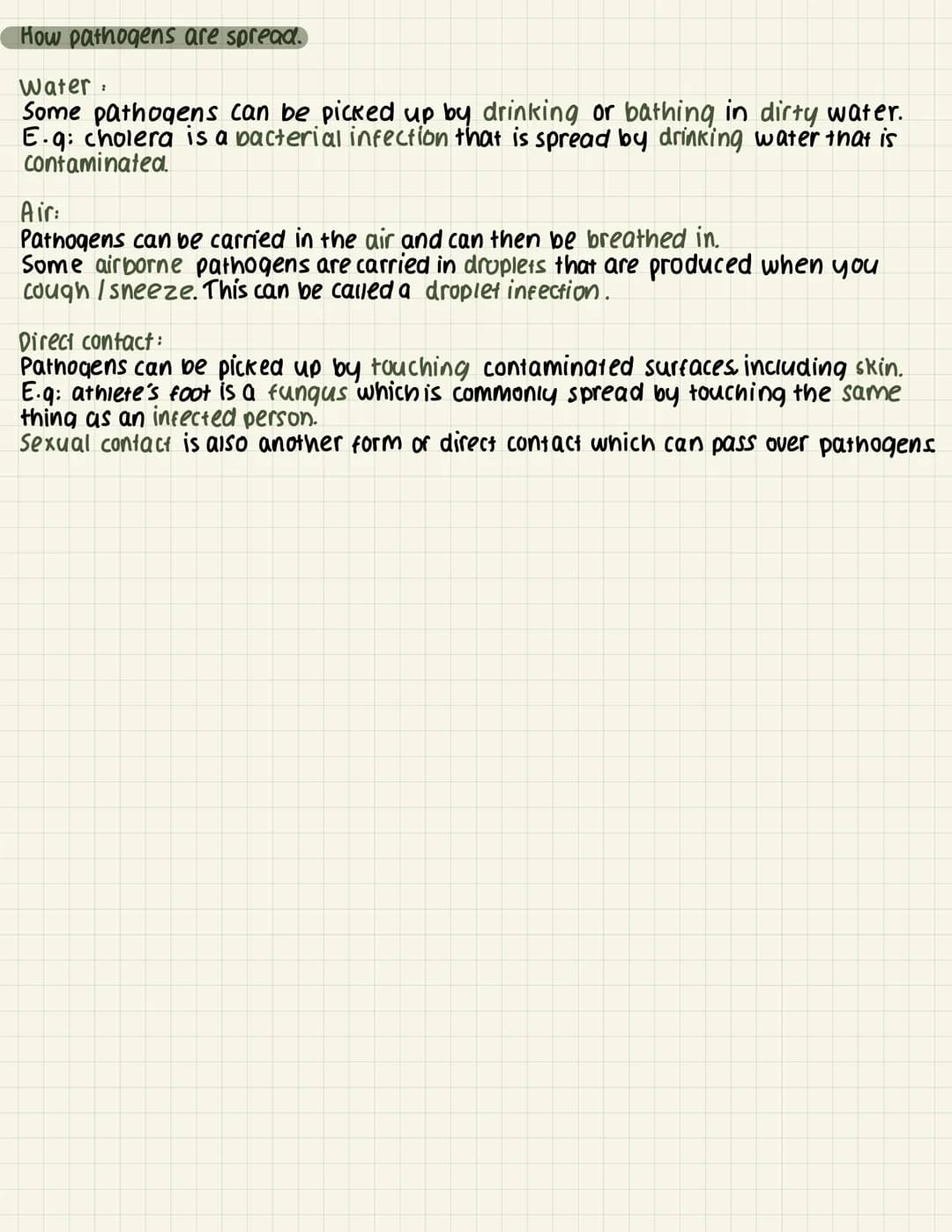
Communicable diseases are infectious illnesses caused by pathogensthat can...
What Are Communicable Diseases and How They Spread

Transmission of Communicable Diseases
This page discusses the various routes of transmission for communicable diseases, highlighting how pathogens spread from one host to another.
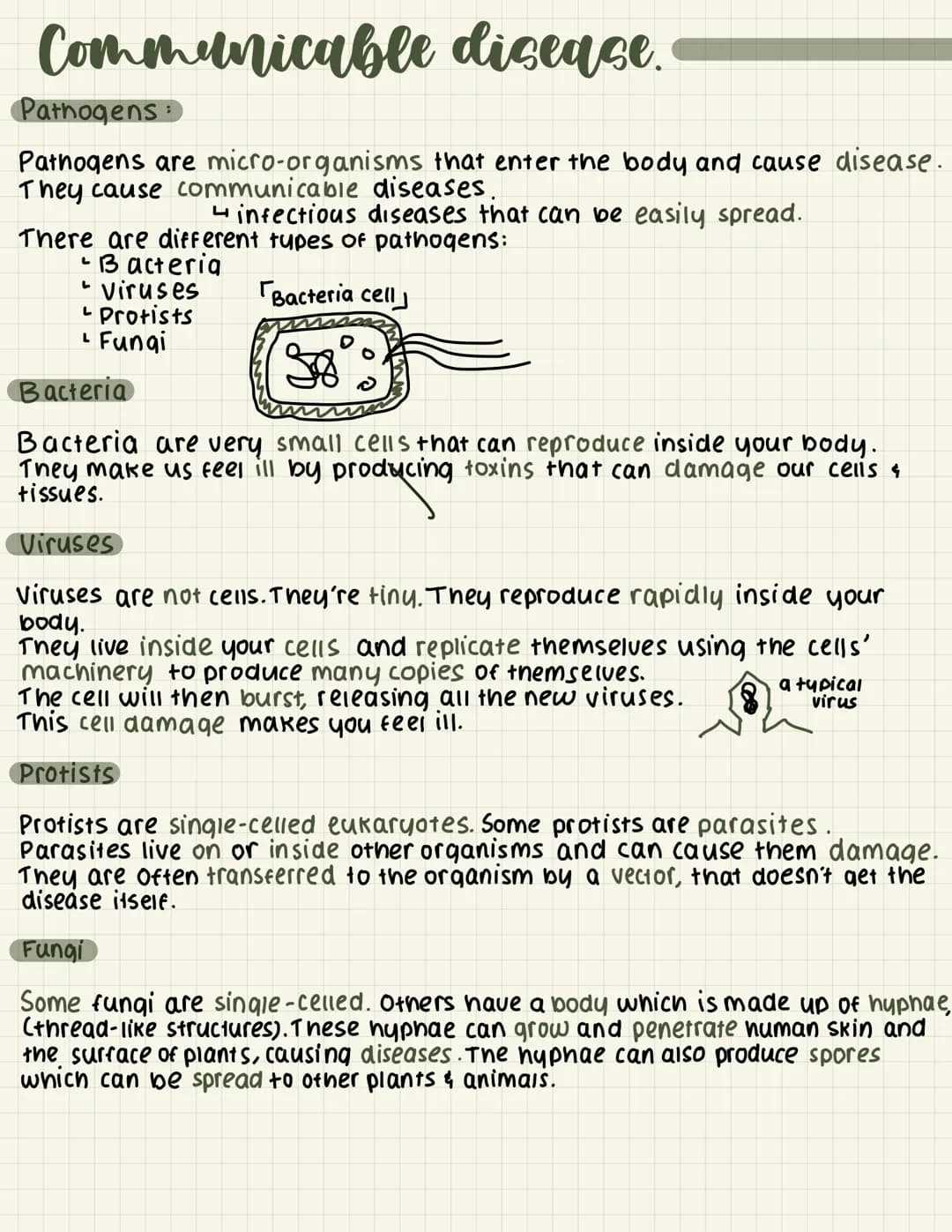
Water-borne transmission occurs when pathogens are picked up by drinking or bathing in contaminated water.
Example: Cholera, a bacterial infection, is spread through drinking water contaminated with the cholera bacterium.
Airborne transmission involves pathogens carried in the air, which can be breathed in by potential hosts. Some airborne pathogens are carried in droplets produced when an infected person coughs or sneezes, known as droplet infection.
Vocabulary: Droplet infection refers to the spread of pathogens through small liquid particles expelled from an infected person's respiratory tract.
Direct contact transmission happens when pathogens are transferred through touching contaminated surfaces, including skin.
Example: Athlete's foot, a fungal infection, is commonly spread by direct contact with contaminated surfaces.
Sexual contact is another form of direct contact that can transmit pathogens between individuals.
Understanding these transmission routes is essential for implementing effective prevention strategies and controlling the spread of communicable diseases. By identifying the specific transmission method for each pathogen, public health measures can be tailored to interrupt the chain of infection and protect populations from disease outbreaks.

Types of Pathogens and Their Characteristics
Communicable diseases are caused by various types of pathogens, each with unique characteristics and methods of causing illness. This page explores the four main categories of pathogens: bacteria, viruses, protists, and fungi.
Bacteria are very small cells that can reproduce inside the human body. They cause illness by producing toxins that damage cells and tissues.
Vocabulary: Toxins are poisonous substances produced by living organisms.
Viruses are not cells but are extremely tiny particles that reproduce rapidly inside the body. They invade host cells and use the cell's machinery to replicate themselves.
Example: When a virus-infected cell bursts, it releases many new viruses, causing cell damage and illness.
Protists are single-celled eukaryotes, some of which are parasites. These parasites live on or inside other organisms and can cause damage to their hosts.
Definition: A vector is an organism that transfers a pathogen to another organism without getting the disease itself.
Fungi can be single-celled or have a body made up of hyphae, which are thread-like structures. These hyphae can penetrate human skin and plant surfaces, causing diseases.
Highlight: Fungi can produce spores, which are reproductive units that can spread to other plants and animals, potentially causing infection.
Understanding the differences between bacteria, viruses, fungi, and parasites is crucial in health and social care settings, as each type of pathogen requires different prevention and treatment approaches.
We thought you’d never ask...
Similar content
Most popular content: Pathogen
9Infection & Response Overview
Explore key concepts in infection and response, including the immune system, vaccination, and disease prevention. This comprehensive summary covers plant and human diseases, the role of pathogens, and the mechanisms of monoclonal antibodies. Ideal for AQA Biology students preparing for exams.
GCSE triple biology paper 1 - B5
biology paper 1 higher topic B5 (communicable diseases)
Infection & Response
Biology Paper 1 topic - detailed mind map of full topic areas within infection and response (biology combined higher GCSE)
Understanding Pathogens
Explore the key concepts of pathogens, including their types (viruses, bacteria, fungi, protozoa, and worms), entry routes into the body, and the human immune system's defenses. This summary provides essential insights into biological defenses and infectious diseases, making it a valuable resource for students studying general pathophysiology.
Infectious Diseases Overview
Explore the key concepts of infectious diseases, including pathogens, transmission methods, symptoms, and prevention strategies. This summary covers various pathogens such as bacteria, viruses, and fungi, along with specific diseases like malaria, salmonella, and measles. Ideal for AQA Biology Paper 1 revision.
Infection & Response Overview
Explore key concepts in infection and response, including vaccination, monoclonal antibodies, and plant defenses. This comprehensive summary covers the immune system, antibiotic resistance, and disease prevention strategies, making it essential for AQA GCSE Biology students. Ideal for exam preparation and understanding biological responses to pathogens.
Understanding Pathogens and Viral Diseases
Explore the role of pathogens in infectious diseases, focusing on viral infections such as measles and HIV/AIDS. This summary covers transmission methods, symptoms, and prevention strategies, including hygiene practices and vaccinations. Ideal for students studying biology and health sciences.
Infection & Immune Response
Explore the mechanisms of infection and the immune response in this comprehensive overview. Learn about different types of pathogens, drug development, vaccination processes, and the role of monoclonal antibodies in treatment. This summary covers key concepts such as antibiotics, drug testing, and plant disease defenses, making it essential for biology students preparing for exams.
Infection & Immune Response
Explore the mechanisms of infection and the immune response in this comprehensive study note. Covering key concepts such as pathogens, biological defenses, the role of vaccines, and antibiotic resistance, this resource is essential for understanding how the body fights diseases. Ideal for AQA Combined Science students preparing for exams.
Most popular content in Biology
9A-Level Biology Year 1 Overview
Comprehensive summary of AQA A-Level Biology Year 1, covering key topics such as cellular structure, protein synthesis, immune response, gas exchange, and more. Ideal for exam preparation and understanding biological concepts. Includes detailed insights into cellular processes, biological classification, and the circulatory system.
AQA Biology: Key Concepts
Explore essential AQA Biology topics including Photosynthesis, Respiration, Homeostasis, Genetics, and Ecology. This comprehensive knowledge organizer covers key concepts such as energy transfer, hormonal control, and genetic variation, providing a solid foundation for your studies. Ideal for exam preparation and understanding biological processes.
Biology P2: Evolution & Adaptation
Explore key concepts in AQA GCSE Biology P2, focusing on evolution, natural selection, genetic engineering, and adaptations in organisms. This summary covers essential topics such as DNA structure, speciation, and the impact of environmental changes on biodiversity. Ideal for exam preparation and understanding complex biological processes.
A-Level Biology Year 2 Overview
Comprehensive study notes covering key concepts in AQA A-Level Biology Year 2, including neuronal communication, genetic modification, nutrient cycles, and hormonal control. This resource is designed to aid understanding of complex topics such as action potentials, photosynthesis, and speciation. Ideal for exam preparation and revision.
biology paper 1
all notes
Biology Paper 1 Overview
Comprehensive study notes covering key concepts in cellular biology, human digestion, respiration, photosynthesis, and the circulatory system. This resource includes detailed explanations of cell structures, enzyme functions, nutrient absorption, and the impact of environmental factors on biological processes. Ideal for students preparing for Biology Paper 1 exams.
Biology paper 1 foundation & higher
Pages from the revision guide summarised in a set of words and a brief explanation
KS3 Biology
KS3 Biology revision document.
Paper 2 chemistry mindmaps
Condesnsed aqa triple higher
Most popular content
9Comprehensive Crime & Deviance Overview
Explore an extensive revision of crime and deviance topics, including theories, types of crime, and the impact of media. This resource covers key concepts such as Marxism, functionalism, gender and crime, and the influence of globalization on criminal behavior. Ideal for students seeking a thorough understanding of criminology and its various theories. Type: Full Topic Revision.
Sociological Theories Overview
Comprehensive revision of key sociological theories including Functionalism, Marxism, Feminism, and Interpretivism. Explore concepts like value freedom, identity formation, and the critique of social control. Ideal for AQA A-Level Sociology students preparing for exams. This summary covers essential theories and their implications in sociology, providing a clear understanding of each perspective.
Sociology of Families: Comprehensive Revision
Dive into an extensive overview of family dynamics, perspectives, and patterns in sociology. This resource covers key concepts such as family diversity, gender roles, marriage, and the impact of social policies on family structures. Perfect for A-Level Sociology students preparing for Paper 2.
Sociology of Education Overview
Explore comprehensive A-Level Sociology notes on the education system, covering key theories, policies, and sociological perspectives. This resource includes insights on marketisation, gender roles, cultural deprivation, and educational inequalities, providing a thorough understanding of how education shapes social stratification and individual achievement. Ideal for exam preparation and in-depth study.
Crime and Deviance AQA A-level sociology
AQA A-level crime and deviance topic notes
Chemistry paper 2
Chem paper 2 notes
A-Level Biology Year 1 Overview
Comprehensive summary of AQA A-Level Biology Year 1, covering key topics such as cellular structure, protein synthesis, immune response, gas exchange, and more. Ideal for exam preparation and understanding biological concepts. Includes detailed insights into cellular processes, biological classification, and the circulatory system.
AQA Biology: Key Concepts
Explore essential AQA Biology topics including Photosynthesis, Respiration, Homeostasis, Genetics, and Ecology. This comprehensive knowledge organizer covers key concepts such as energy transfer, hormonal control, and genetic variation, providing a solid foundation for your studies. Ideal for exam preparation and understanding biological processes.
Biology P2: Evolution & Adaptation
Explore key concepts in AQA GCSE Biology P2, focusing on evolution, natural selection, genetic engineering, and adaptations in organisms. This summary covers essential topics such as DNA structure, speciation, and the impact of environmental changes on biodiversity. Ideal for exam preparation and understanding complex biological processes.
Students love us — and so will you.
The app is very easy to use and well designed. I have found everything I was looking for so far and have been able to learn a lot from the presentations! I will definitely use the app for a class assignment! And of course it also helps a lot as an inspiration.
This app is really great. There are so many study notes and help [...]. My problem subject is French, for example, and the app has so many options for help. Thanks to this app, I have improved my French. I would recommend it to anyone.
Wow, I am really amazed. I just tried the app because I've seen it advertised many times and was absolutely stunned. This app is THE HELP you want for school and above all, it offers so many things, such as workouts and fact sheets, which have been VERY helpful to me personally.
What Are Communicable Diseases and How They Spread
Communicable diseases are infectious illnesses caused by pathogens that can easily spread from one person to another. This summary explores the types of pathogens and diseases they cause, their characteristics, and transmission methods.
- Pathogensare micro-organisms that enter the...

Transmission of Communicable Diseases
This page discusses the various routes of transmission for communicable diseases, highlighting how pathogens spread from one host to another.
Water-borne transmission occurs when pathogens are picked up by drinking or bathing in contaminated water.
Example: Cholera, a bacterial infection, is spread through drinking water contaminated with the cholera bacterium.
Airborne transmission involves pathogens carried in the air, which can be breathed in by potential hosts. Some airborne pathogens are carried in droplets produced when an infected person coughs or sneezes, known as droplet infection.
Vocabulary: Droplet infection refers to the spread of pathogens through small liquid particles expelled from an infected person's respiratory tract.
Direct contact transmission happens when pathogens are transferred through touching contaminated surfaces, including skin.
Example: Athlete's foot, a fungal infection, is commonly spread by direct contact with contaminated surfaces.
Sexual contact is another form of direct contact that can transmit pathogens between individuals.
Understanding these transmission routes is essential for implementing effective prevention strategies and controlling the spread of communicable diseases. By identifying the specific transmission method for each pathogen, public health measures can be tailored to interrupt the chain of infection and protect populations from disease outbreaks.

Types of Pathogens and Their Characteristics
Communicable diseases are caused by various types of pathogens, each with unique characteristics and methods of causing illness. This page explores the four main categories of pathogens: bacteria, viruses, protists, and fungi.
Bacteria are very small cells that can reproduce inside the human body. They cause illness by producing toxins that damage cells and tissues.
Vocabulary: Toxins are poisonous substances produced by living organisms.
Viruses are not cells but are extremely tiny particles that reproduce rapidly inside the body. They invade host cells and use the cell's machinery to replicate themselves.
Example: When a virus-infected cell bursts, it releases many new viruses, causing cell damage and illness.
Protists are single-celled eukaryotes, some of which are parasites. These parasites live on or inside other organisms and can cause damage to their hosts.
Definition: A vector is an organism that transfers a pathogen to another organism without getting the disease itself.
Fungi can be single-celled or have a body made up of hyphae, which are thread-like structures. These hyphae can penetrate human skin and plant surfaces, causing diseases.
Highlight: Fungi can produce spores, which are reproductive units that can spread to other plants and animals, potentially causing infection.
Understanding the differences between bacteria, viruses, fungi, and parasites is crucial in health and social care settings, as each type of pathogen requires different prevention and treatment approaches.
We thought you’d never ask...
Similar content
Most popular content: Pathogen
9Infection & Response Overview
Explore key concepts in infection and response, including the immune system, vaccination, and disease prevention. This comprehensive summary covers plant and human diseases, the role of pathogens, and the mechanisms of monoclonal antibodies. Ideal for AQA Biology students preparing for exams.
GCSE triple biology paper 1 - B5
biology paper 1 higher topic B5 (communicable diseases)
Infection & Response
Biology Paper 1 topic - detailed mind map of full topic areas within infection and response (biology combined higher GCSE)
Understanding Pathogens
Explore the key concepts of pathogens, including their types (viruses, bacteria, fungi, protozoa, and worms), entry routes into the body, and the human immune system's defenses. This summary provides essential insights into biological defenses and infectious diseases, making it a valuable resource for students studying general pathophysiology.
Infectious Diseases Overview
Explore the key concepts of infectious diseases, including pathogens, transmission methods, symptoms, and prevention strategies. This summary covers various pathogens such as bacteria, viruses, and fungi, along with specific diseases like malaria, salmonella, and measles. Ideal for AQA Biology Paper 1 revision.
Infection & Response Overview
Explore key concepts in infection and response, including vaccination, monoclonal antibodies, and plant defenses. This comprehensive summary covers the immune system, antibiotic resistance, and disease prevention strategies, making it essential for AQA GCSE Biology students. Ideal for exam preparation and understanding biological responses to pathogens.
Understanding Pathogens and Viral Diseases
Explore the role of pathogens in infectious diseases, focusing on viral infections such as measles and HIV/AIDS. This summary covers transmission methods, symptoms, and prevention strategies, including hygiene practices and vaccinations. Ideal for students studying biology and health sciences.
Infection & Immune Response
Explore the mechanisms of infection and the immune response in this comprehensive overview. Learn about different types of pathogens, drug development, vaccination processes, and the role of monoclonal antibodies in treatment. This summary covers key concepts such as antibiotics, drug testing, and plant disease defenses, making it essential for biology students preparing for exams.
Infection & Immune Response
Explore the mechanisms of infection and the immune response in this comprehensive study note. Covering key concepts such as pathogens, biological defenses, the role of vaccines, and antibiotic resistance, this resource is essential for understanding how the body fights diseases. Ideal for AQA Combined Science students preparing for exams.
Most popular content in Biology
9A-Level Biology Year 1 Overview
Comprehensive summary of AQA A-Level Biology Year 1, covering key topics such as cellular structure, protein synthesis, immune response, gas exchange, and more. Ideal for exam preparation and understanding biological concepts. Includes detailed insights into cellular processes, biological classification, and the circulatory system.
AQA Biology: Key Concepts
Explore essential AQA Biology topics including Photosynthesis, Respiration, Homeostasis, Genetics, and Ecology. This comprehensive knowledge organizer covers key concepts such as energy transfer, hormonal control, and genetic variation, providing a solid foundation for your studies. Ideal for exam preparation and understanding biological processes.
Biology P2: Evolution & Adaptation
Explore key concepts in AQA GCSE Biology P2, focusing on evolution, natural selection, genetic engineering, and adaptations in organisms. This summary covers essential topics such as DNA structure, speciation, and the impact of environmental changes on biodiversity. Ideal for exam preparation and understanding complex biological processes.
A-Level Biology Year 2 Overview
Comprehensive study notes covering key concepts in AQA A-Level Biology Year 2, including neuronal communication, genetic modification, nutrient cycles, and hormonal control. This resource is designed to aid understanding of complex topics such as action potentials, photosynthesis, and speciation. Ideal for exam preparation and revision.
biology paper 1
all notes
Biology Paper 1 Overview
Comprehensive study notes covering key concepts in cellular biology, human digestion, respiration, photosynthesis, and the circulatory system. This resource includes detailed explanations of cell structures, enzyme functions, nutrient absorption, and the impact of environmental factors on biological processes. Ideal for students preparing for Biology Paper 1 exams.
Biology paper 1 foundation & higher
Pages from the revision guide summarised in a set of words and a brief explanation
KS3 Biology
KS3 Biology revision document.
Paper 2 chemistry mindmaps
Condesnsed aqa triple higher
Most popular content
9Comprehensive Crime & Deviance Overview
Explore an extensive revision of crime and deviance topics, including theories, types of crime, and the impact of media. This resource covers key concepts such as Marxism, functionalism, gender and crime, and the influence of globalization on criminal behavior. Ideal for students seeking a thorough understanding of criminology and its various theories. Type: Full Topic Revision.
Sociological Theories Overview
Comprehensive revision of key sociological theories including Functionalism, Marxism, Feminism, and Interpretivism. Explore concepts like value freedom, identity formation, and the critique of social control. Ideal for AQA A-Level Sociology students preparing for exams. This summary covers essential theories and their implications in sociology, providing a clear understanding of each perspective.
Sociology of Families: Comprehensive Revision
Dive into an extensive overview of family dynamics, perspectives, and patterns in sociology. This resource covers key concepts such as family diversity, gender roles, marriage, and the impact of social policies on family structures. Perfect for A-Level Sociology students preparing for Paper 2.
Sociology of Education Overview
Explore comprehensive A-Level Sociology notes on the education system, covering key theories, policies, and sociological perspectives. This resource includes insights on marketisation, gender roles, cultural deprivation, and educational inequalities, providing a thorough understanding of how education shapes social stratification and individual achievement. Ideal for exam preparation and in-depth study.
Crime and Deviance AQA A-level sociology
AQA A-level crime and deviance topic notes
Chemistry paper 2
Chem paper 2 notes
A-Level Biology Year 1 Overview
Comprehensive summary of AQA A-Level Biology Year 1, covering key topics such as cellular structure, protein synthesis, immune response, gas exchange, and more. Ideal for exam preparation and understanding biological concepts. Includes detailed insights into cellular processes, biological classification, and the circulatory system.
AQA Biology: Key Concepts
Explore essential AQA Biology topics including Photosynthesis, Respiration, Homeostasis, Genetics, and Ecology. This comprehensive knowledge organizer covers key concepts such as energy transfer, hormonal control, and genetic variation, providing a solid foundation for your studies. Ideal for exam preparation and understanding biological processes.
Biology P2: Evolution & Adaptation
Explore key concepts in AQA GCSE Biology P2, focusing on evolution, natural selection, genetic engineering, and adaptations in organisms. This summary covers essential topics such as DNA structure, speciation, and the impact of environmental changes on biodiversity. Ideal for exam preparation and understanding complex biological processes.
Students love us — and so will you.
The app is very easy to use and well designed. I have found everything I was looking for so far and have been able to learn a lot from the presentations! I will definitely use the app for a class assignment! And of course it also helps a lot as an inspiration.
This app is really great. There are so many study notes and help [...]. My problem subject is French, for example, and the app has so many options for help. Thanks to this app, I have improved my French. I would recommend it to anyone.
Wow, I am really amazed. I just tried the app because I've seen it advertised many times and was absolutely stunned. This app is THE HELP you want for school and above all, it offers so many things, such as workouts and fact sheets, which have been VERY helpful to me personally.