Knowunity AI

Open the App

Subjects

988

Updated Mar 11, 2026

33 pages

Explore the Cold War: Origins, Berlin Wall, and Cuban Missile Crisis for Kids

K

Kell

@kellceecharlesgrosvenor_leqg

Hey there! Dive into the exciting history of the Cold War from 1941 to 1991. Learn about the origins of the Cold War with a fun analysis from 1941 to 1958. Find out why the Berlin Wall was built and why it eventually fell. Discover key events like the Berlin Crisis of 1961 and the Cuban Missile Crisis, and what happened because of them. Get cool notes and PDFs, like GCSE History Cold War revision notes and Edexcel textbook materials. Perfect for school projects or just learning something awesome!

Page 1
Page 2
Page 3
Page 4
Page 5
Page 6
Page 7
Page 8
Page 9
Page 10
1 / 10
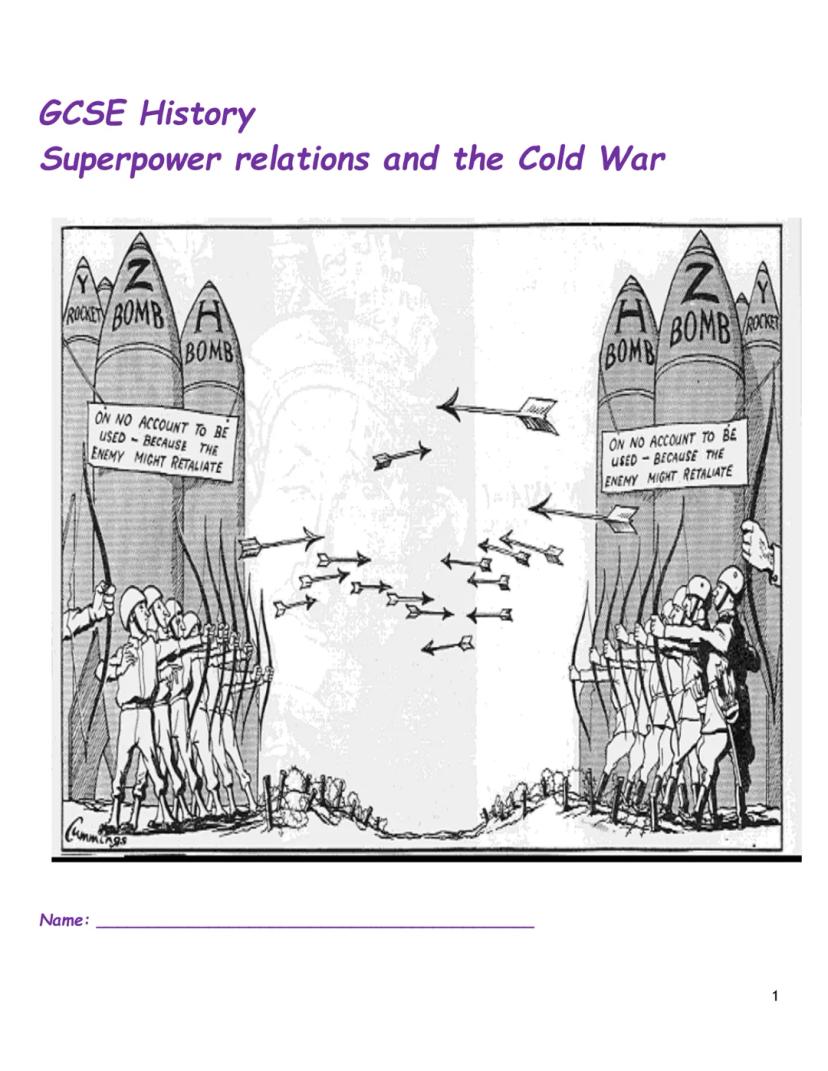
# GCSE History

Superpower relations and the Cold War

Z
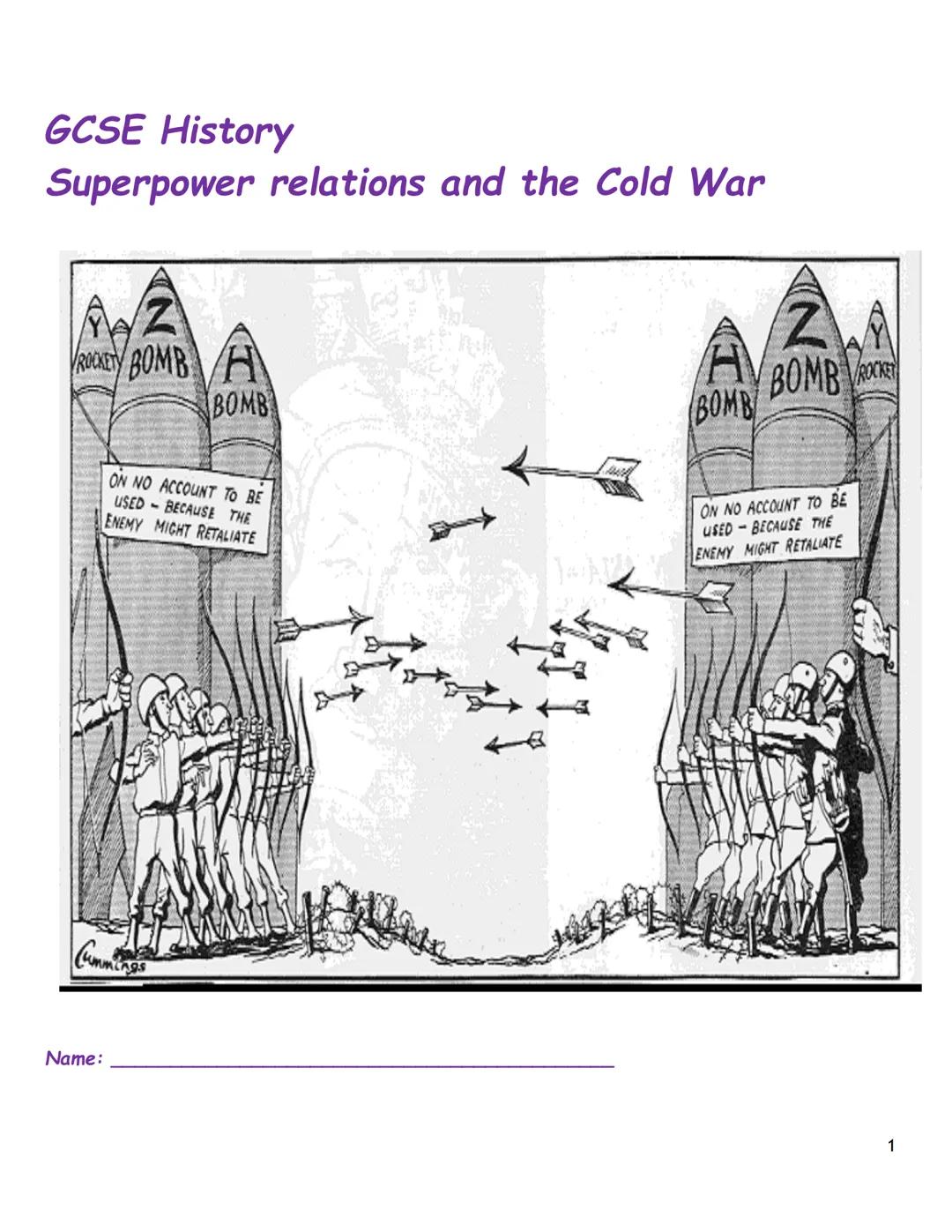
ROCKETY BOMBH
BOMB

ON NO ACCOUNT TO BE
USED BECAUSE THE
ENEMY MIGHT RETALIATE

A
Z

The Grand Alliance and Post-War Conferences

The Grand Alliance, formed during World War II, brought together the United States, Great Britain, and the Soviet Union against Nazi Germany. However, as the war neared its end, tensions began to emerge among the allies, particularly during key conferences held to shape the post-war world.

The Tehran Conference (1943)

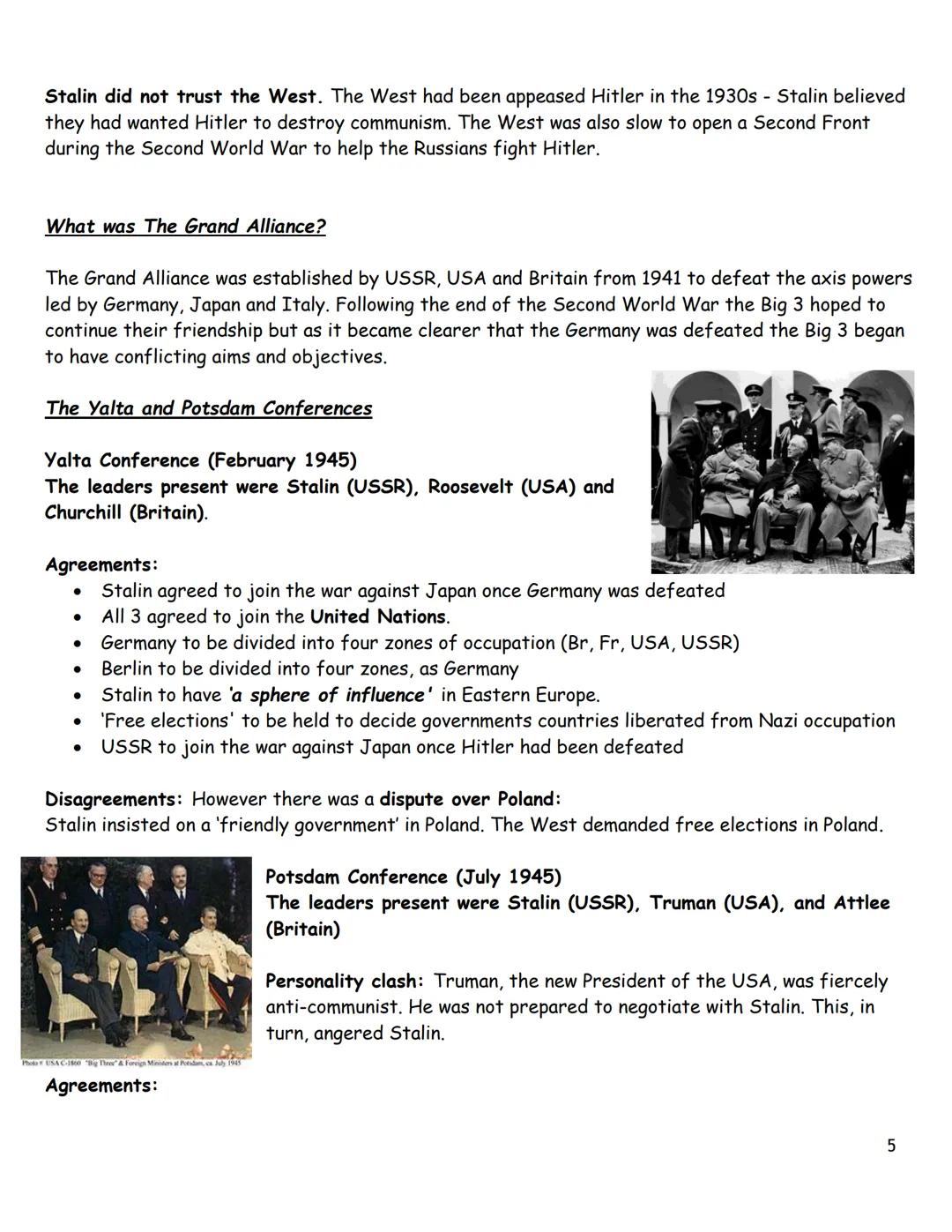
The first wartime meeting between the "Big Three" leaders - US President Franklin D. Roosevelt, British Prime Minister Winston Churchill, and Soviet leader Joseph Stalin - took place in Tehran, Iran.

Key outcomes:

  • Agreement on opening a second front in Western Europe DDayD-Day
  • Discussion of Poland's post-war borders
  • Soviet commitment to join the war against Japan after Germany's defeat

Highlight: The Tehran Conference marked the first face-to-face meeting of Roosevelt, Churchill, and Stalin, setting the stage for future negotiations on post-war Europe.

The Yalta Conference (February 1945)

As World War II neared its end in Europe, the Big Three met again in Yalta, Crimea, to discuss the post-war order.

Key decisions:

  • Division of Germany into occupied zones
  • Agreement on free elections in liberated European countries
  • Soviet participation in the United Nations
  • Soviet entry into the war against Japan in exchange for territorial concessions

Quote: "I think we have made a start on the road to a world of peace." - Franklin D. Roosevelt after the Yalta Conference

The Potsdam Conference JulyAugust1945July-August 1945

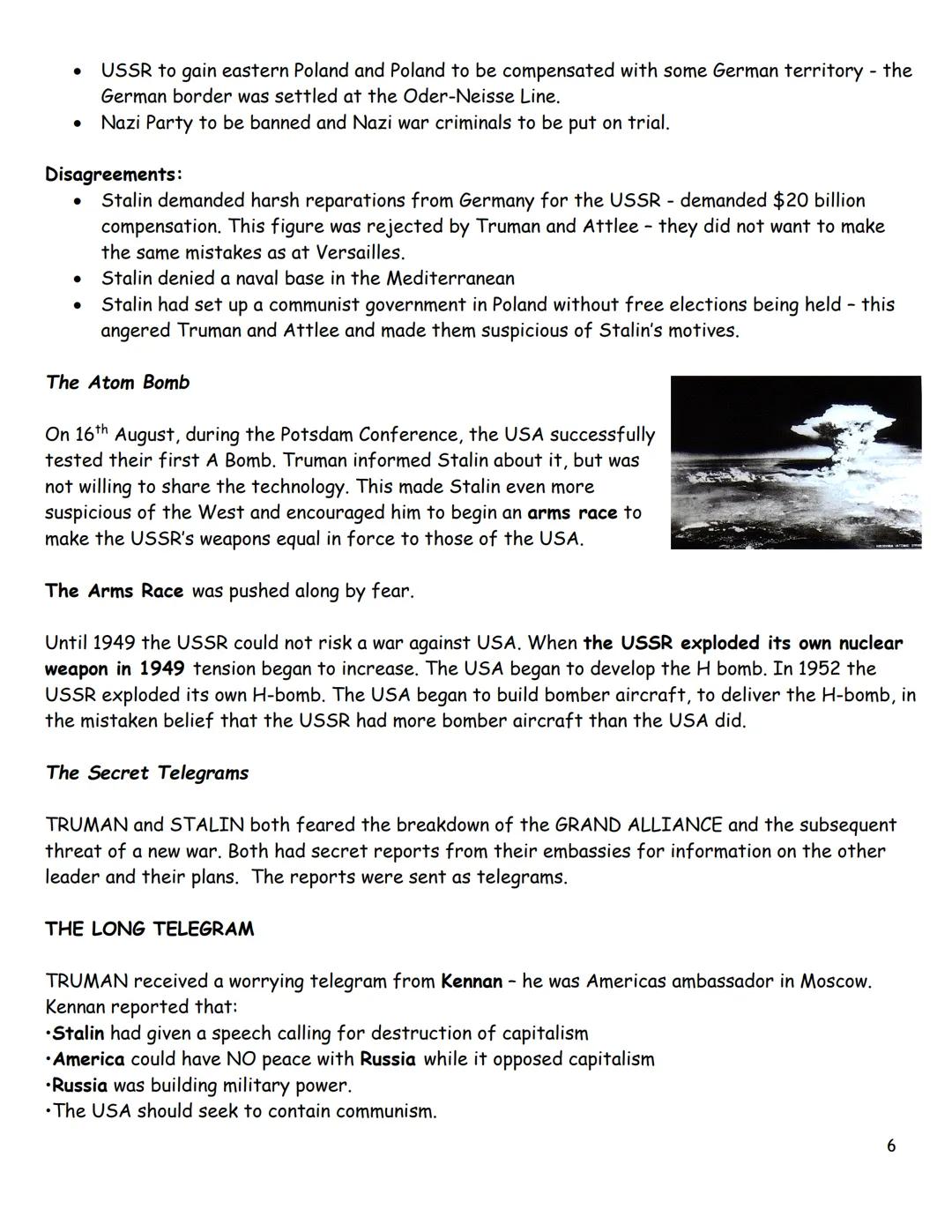
The final wartime conference took place in Potsdam, Germany, after Germany's surrender but before Japan's defeat. New leaders represented the US and UK: Harry Truman and Clement Attlee.

Key outcomes:

  • Confirmation of Germany's division into occupied zones
  • Establishment of the Allied Control Council for Germany
  • Agreement on war reparations
  • Discussion of Poland's western border

Highlight: The Potsdam Conference revealed growing tensions between the Western Allies and the Soviet Union, foreshadowing the coming Cold War.

Impact on US-Soviet Relations

These conferences had significant implications for the emerging Cold War:

  1. Revealed ideological differences and conflicting visions for post-war Europe
  2. Highlighted Stalin's determination to secure a sphere of influence in Eastern Europe
  3. Demonstrated the West's growing concern about Soviet expansionism
  4. Set the stage for future disagreements over the implementation of conference decisions

Example: The issue of free elections in Eastern Europe became a major point of contention, as the Soviet Union established communist governments in its occupied territories, contrary to Western expectations.

The outcomes of these conferences and the subsequent actions of both sides contributed to the deterioration of US-Soviet relations and the onset of the Cold War.

# GCSE History

Superpower relations and the Cold War

Z
ROCKETY BOMBH
BOMB

ON NO ACCOUNT TO BE
USED BECAUSE THE
ENEMY MIGHT RETALIATE

A
Z

Ideological Differences and Key Leaders

The Cold War was fundamentally rooted in the stark ideological divide between the capitalist United States and the communist Soviet Union. This section explores the core differences in their political and economic systems, as well as the attitudes of key leaders that shaped early Cold War relations.

Capitalist Democracy vs. Communist System

United States:

  • Democratic political system with free elections
  • Capitalist economic model based on private ownership and free markets
  • Emphasis on individual rights and freedoms
  • Free press and freedom of movement

Soviet Union:

  • One-party state under Communist Party rule
  • Centrally planned economy with state ownership of industry and agriculture
  • Collective interests prioritized over individual rights
  • Strict censorship and limited freedom of movement

Definition: Capitalism is an economic system based on private ownership of the means of production and their operation for profit, while communism advocates for a classless society with common ownership of property and resources.

Key Leaders and Their Attitudes

  1. Joseph Stalin (Soviet Union)
  • Deeply suspicious of Western intentions
  • Determined to create a buffer zone of friendly states in Eastern Europe
  • Prioritized Soviet security and the spread of communism
  1. Harry Truman (United States)
  • Adopted a tougher stance towards the Soviet Union than his predecessor
  • Implemented the Truman Doctrine to contain communist expansion
  • Authorized the development and use of atomic weapons
  1. Winston Churchill (United Kingdom)
  • Warned of the "Iron Curtain" descending across Europe
  • Advocated for a strong Western alliance to counter Soviet influence
  • Played a crucial role in shaping early Cold War rhetoric and policy

Quote: "From Stettin in the Baltic to Trieste in the Adriatic, an iron curtain has descended across the continent." - Winston Churchill, 1946

Impact on US-Soviet Relations

The ideological differences and leadership attitudes had profound effects on early Cold War dynamics:

  1. Mutual distrust and suspicion between the superpowers
  2. Competing efforts to spread their respective ideologies globally
  3. Formation of opposing military alliances (NATO vs. Warsaw Pact)
  4. Arms race, including the development of nuclear weapons
  5. Proxy conflicts in various parts of the world

Highlight: The ideological divide between capitalism and communism formed the core of the Cold War conflict, influencing political, economic, and military decisions on both sides.

The Role of Propaganda

Both superpowers used extensive propaganda to promote their ideologies and discredit the other side:

  • USA portrayed itself as the defender of freedom and democracy
  • USSR emphasized equality and workers' rights under communism
  • Each side demonized the other's political and economic system

Example: The United States Information Agency produced films, books, and radio broadcasts promoting American values and criticizing communism, while the Soviet Union used state-controlled media to glorify communist achievements and denounce capitalist "imperialism."

The stark ideological differences and the attitudes of key leaders like Stalin, Truman, and Churchill set the stage for decades of Cold War tensions, shaping global politics throughout the second half of the 20th century.

# GCSE History

Superpower relations and the Cold War

Z
ROCKETY BOMBH
BOMB

ON NO ACCOUNT TO BE
USED BECAUSE THE
ENEMY MIGHT RETALIATE

A
Z

The Impact of Atomic Weapons on US-Soviet Relations

The development and use of atomic weapons at the end of World War II had a profound impact on the emerging Cold War dynamics between the United States and the Soviet Union. This section explores how nuclear capabilities shaped the early years of the conflict.

The Manhattan Project and the First Atomic Bombs

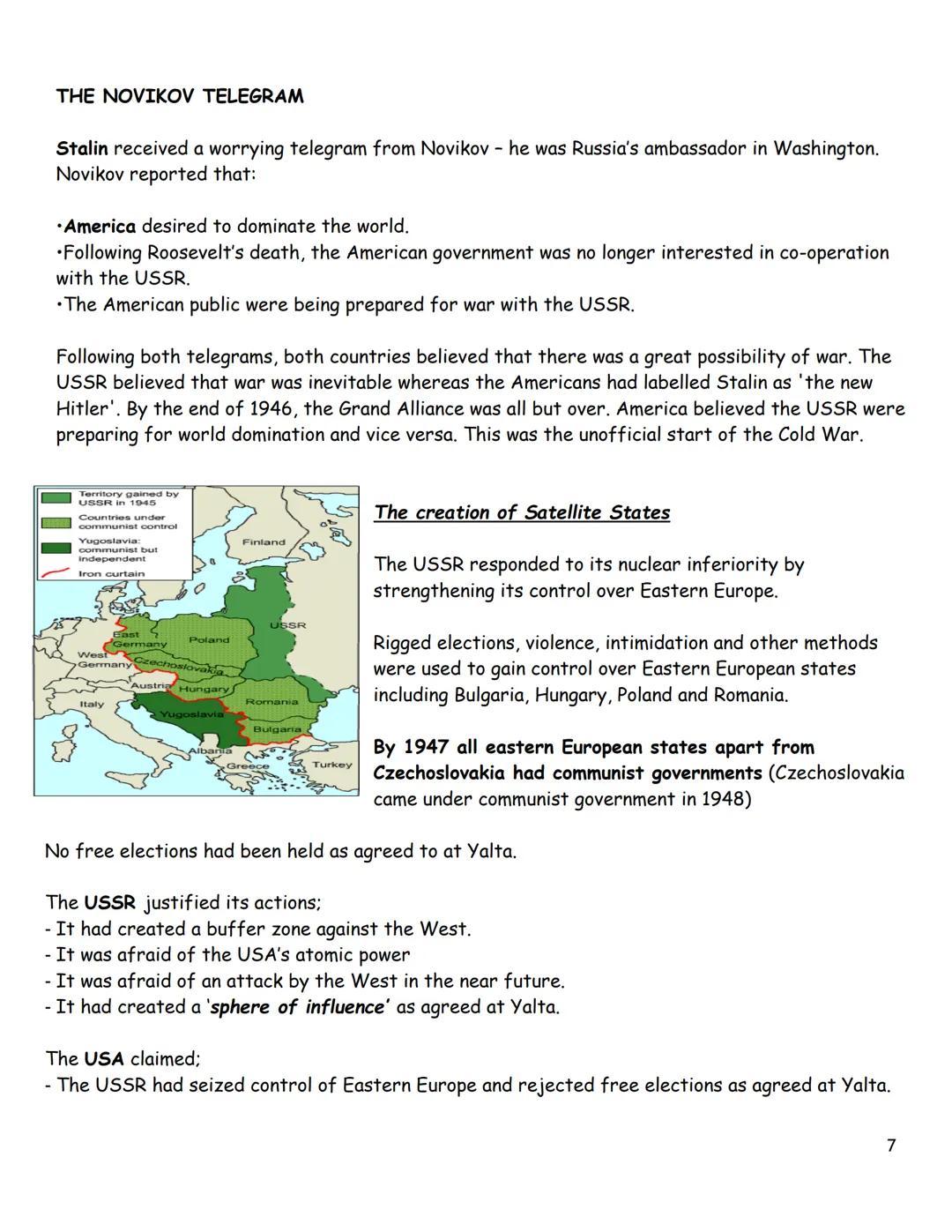
The United States, with support from the United Kingdom and Canada, developed the first atomic bombs through the top-secret Manhattan Project during World War II.

Key events:

  • July 16, 1945: First successful atomic bomb test (Trinity test) in New Mexico
  • August 6, 1945: Atomic bomb dropped on Hiroshima, Japan
  • August 9, 1945: Second atomic bomb dropped on Nagasaki, Japan

Highlight: The use of atomic weapons against Japan demonstrated the unprecedented destructive power of nuclear technology and ushered in a new era of global politics.

Impact on US-Soviet Relations

The advent of atomic weapons had several significant effects on the relationship between the superpowers:

  1. Shift in Balance of Power
  • The USA's monopoly on atomic weapons initially gave it a strategic advantage
  • Created a sense of vulnerability in the Soviet Union
  1. Intensified Arms Race
  • Soviet Union accelerated its own nuclear weapons program
  • Both sides devoted enormous resources to developing and expanding their nuclear arsenals
  1. Increased Tensions and Mistrust
  • US reluctance to share nuclear technology with the USSR deepened Soviet suspicions
  • Fear of nuclear attack influenced policy decisions on both sides
  1. Concept of Mutually Assured Destruction (MAD)
  • As both superpowers acquired nuclear capabilities, the threat of total annihilation served as a deterrent to direct conflict

Vocabulary: Mutually Assured Destruction (MAD) - A doctrine of military strategy in which a full-scale use of nuclear weapons by two opposing sides would result in the complete annihilation of both the attacker and the defender.

The Soviet Atomic Program

The Soviet Union, aware of the Manhattan Project through espionage, intensified its own nuclear weapons development after World War II:

  • August 29, 1949: First successful Soviet atomic bomb test
  • This event ended the US monopoly on nuclear weapons and escalated the arms race

Quote: "The balance of power is now destroyed... the world political situation has radically changed." - Soviet Foreign Minister Andrei Vyshinsky, 1949

Nuclear Diplomacy and Early Cold War Strategy

The possession of atomic weapons influenced diplomatic and strategic decisions:

  1. Atomic Diplomacy
  • The USA initially used its nuclear monopoly as leverage in negotiations with the USSR
  • This approach heightened Soviet determination to develop its own nuclear capabilities
  1. Nuclear Deterrence
  • As both sides acquired nuclear weapons, the threat of mutual destruction became a key factor in preventing direct conflict
  1. Proxy Wars and Limited Conflicts
  • The risk of nuclear escalation led superpowers to engage in indirect conflicts rather than direct confrontation

Example: During the Korean War (1950-1953), the fear of nuclear escalation influenced military strategies and ultimately contributed to the conflict ending in a stalemate.

Long-term Consequences

The impact of atomic weapons on US-Soviet relations had lasting effects throughout the Cold War:

  • Fueled an ongoing arms race and technological competition
  • Shaped military doctrines and strategic planning
  • Influenced international relations and diplomacy globally
  • Led to efforts for arms control and non-proliferation treaties in later decades

Highlight: The development of atomic weapons fundamentally altered the nature of international conflict, making the prospect of full-scale war between superpowers potentially catastrophic for humanity.

The introduction of nuclear weapons at the dawn of the Cold War created a new paradigm in international relations, where the threat of mutual annihilation became a central factor in the ongoing struggle between the United States and the Soviet Union.

# GCSE History

Superpower relations and the Cold War

Z
ROCKETY BOMBH
BOMB

ON NO ACCOUNT TO BE
USED BECAUSE THE
ENEMY MIGHT RETALIATE

A
Z

The Long and Novikov Telegrams

Two influential diplomatic communications, known as the Long Telegram and the Novikov Telegram, played crucial roles in shaping early Cold War perceptions and policies. These documents provided insights into the mindsets of both the United States and the Soviet Union, contributing to the growing mistrust between the superpowers.

The Long Telegram (February 1946)

Written by George F. Kennan, an American diplomat stationed in Moscow, the Long Telegram was a detailed analysis of Soviet foreign policy and motivations.

Key points:

  1. Soviet view of capitalism as inherently hostile to communism
  2. USSR's need for external threats to justify internal controls
  3. Soviet expansion as a combination of communist ideology and traditional Russian imperialism
  4. Recommendation for a policy of "containment" to counter Soviet influence

Quote: "World communism is like a malignant parasite which feeds only on diseased tissue." - George F. Kennan, The Long Telegram

Impact:

  • Shaped US perception of Soviet intentions
  • Influenced the development of the Truman Doctrine and containment policy
  • Contributed to the hardening of US attitudes towards the USSR

The Novikov Telegram (September 1946)

In response to the Long Telegram, Soviet Ambassador to the US Nikolai Novikov sent a similar analysis of American foreign policy to Moscow.

Key points:

  1. US pursuit of world domination through economic and military means
  2. American desire to maintain its monopoly on atomic weapons
  3. US efforts to create anti-Soviet blocs and alliances
  4. Capitalist motivations behind US foreign policy

Highlight: The Novikov Telegram reinforced Soviet suspicions of Western intentions and contributed to the Kremlin's defensive posture in international affairs.

Impact:

  • Reinforced Soviet leadership's mistrust of US intentions
  • Influenced Soviet foreign policy decisions and military strategy
  • Contributed to the Soviet Union's efforts to expand its sphere of influence

Comparison and Significance

Both telegrams reflected and reinforced the growing mutual suspicion between the superpowers:

  1. Ideological Lens: Each side interpreted the other's actions through the prism of their own ideology
  2. Security Concerns: Both emphasized the perceived threat posed by the other side
  3. Expansion and Influence: Each telegram warned of the other power's attempts to expand its global reach
  4. Policy Implications: The analyses in both documents influenced the formation of Cold War strategies

Example: The Long Telegram's recommendation for containment directly influenced the Truman Doctrine and Marshall Plan, while the Novikov Telegram reinforced Soviet efforts to establish a buffer zone in Eastern Europe.

Legacy and Impact on Cold War Dynamics

The Long and Novikov Telegrams had lasting effects on US-Soviet relations:

  1. Solidified mutual distrust and suspicion
  2. Contributed to the formulation of early Cold War policies on both sides
  3. Reinforced the perception of an ideological and strategic struggle between capitalism and communism
  4. Influenced intelligence assessments and diplomatic approaches throughout the Cold War

Vocabulary: Containment - The US foreign policy strategy aimed at stopping the spread of communism around the world, rather than trying to roll it back in existing communist states.

These diplomatic communications played a significant role in crystallizing the opposing worldviews that would define the Cold War era, setting the stage for decades of geopolitical tension and rivalry between the United States and the Soviet Union.

# GCSE History

Superpower relations and the Cold War

Z
ROCKETY BOMBH
BOMB

ON NO ACCOUNT TO BE
USED BECAUSE THE
ENEMY MIGHT RETALIATE

A
Z

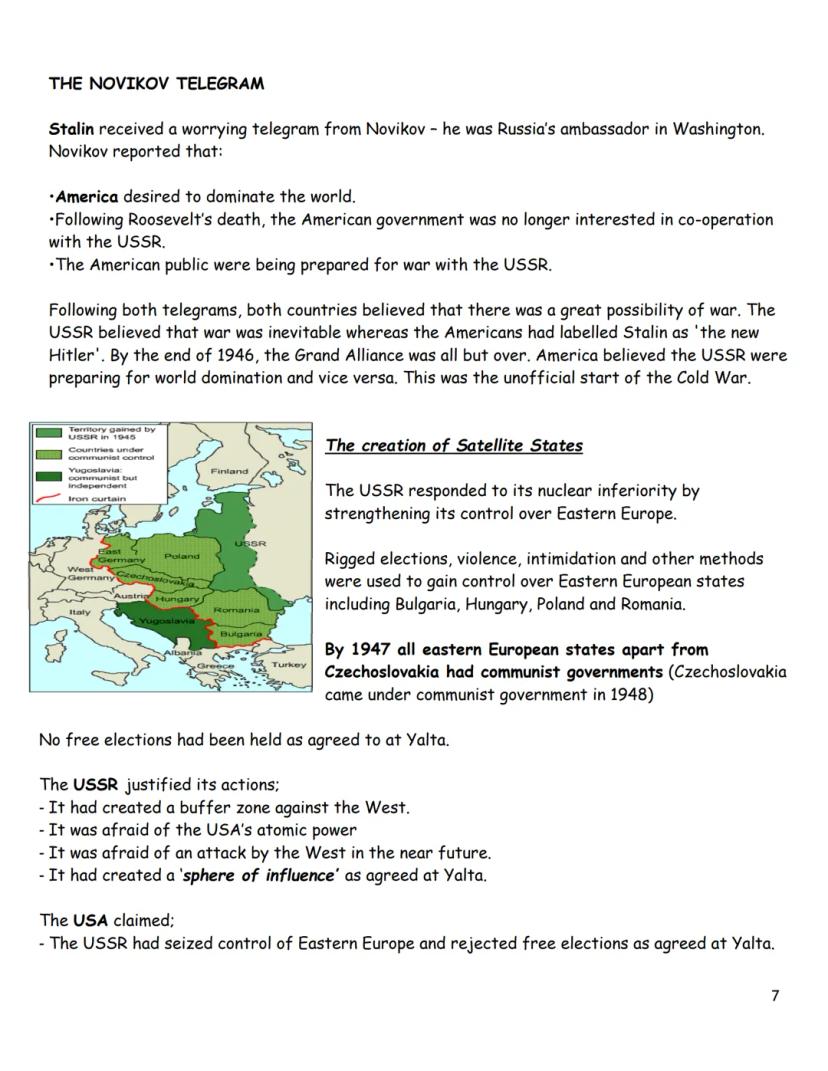
Soviet Satellite States in Eastern Europe

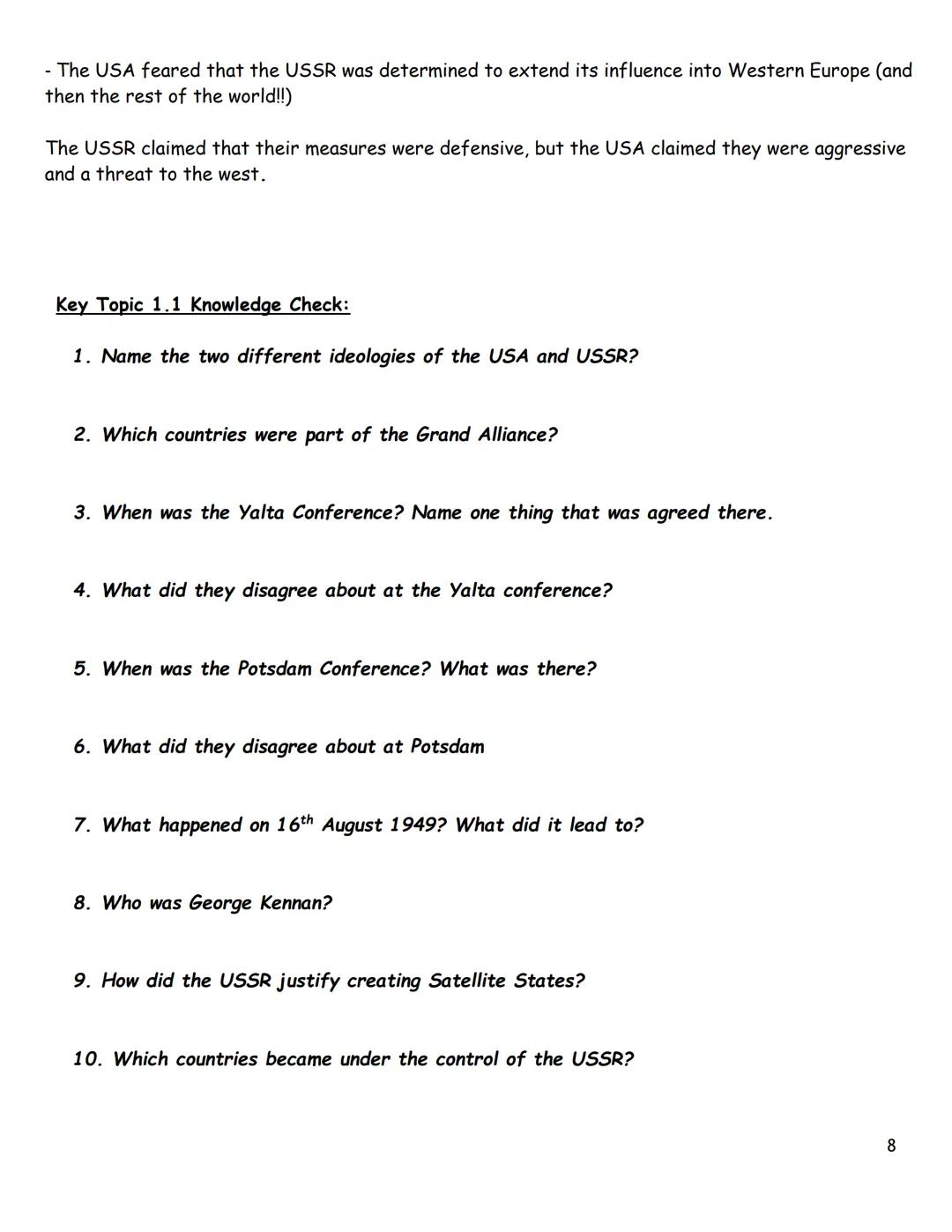
In the aftermath of World War II, the Soviet Union established a sphere of influence in Eastern Europe, creating a buffer zone of satellite states under communist control. This section examines the process of Soviet domination in these countries and its impact on Cold War relations.

Definition and Establishment of Satellite States

Soviet satellite states were countries in Eastern Europe that, while nominally independent, were effectively controlled by the Soviet Union through political, economic, and military means.

Key characteristics:

  • Communist governments aligned with Soviet policies
  • Economic integration with the Soviet bloc
  • Presence of Soviet military forces
  • Limited sovereignty and restricted foreign relations

Vocabulary: Satellite state - A country that is formally independent but under heavy political, economic, and military influence or control by another country.

The Process of Sovietization

The Soviet Union employed various methods to establish control over Eastern European countries:

  1. Installation of Communist Governments
  • Support for local communist parties
  • Rigged elections and political repression of opposition
  1. Economic Integration
  • Implementation of Soviet-style planned economies
  • Creation of Comecon (Council for Mutual Economic Assistance) in 1949
  1. Military Presence and Control
  • Stationing of Soviet troops in satellite states
  • Formation of the Warsaw Pact in 1955 as a counterbalance to NATO
  1. Cultural and Ideological Alignment
  • Promotion of Soviet culture and communist ideology
  • Censorship and control of media and education

Example: In Czechoslovakia, the communist takeover in 1948, known as the "Prague Coup," exemplified the Soviet method of gaining control through a combination of political pressure and manipulation.

Key Soviet Satellite States

The main countries that became Soviet satellites after World War II included:

  • Poland
  • East Germany (German Democratic Republic)
  • Czechoslovakia
  • Hungary
  • Romania
  • Bulgaria
  • Albania (until its break with the USSR in the 1960s)

Highlight: The division of Germany into East and West became a powerful symbol of the broader division of Europe during the Cold War.

Impact on Cold War Relations

The establishment of Soviet satellite states in Eastern Europe had significant consequences for the Cold War:

  1. Increased Tensions with the West
  • Western powers viewed Soviet actions as a violation of wartime agreements
  • Contributed to the perception of Soviet expansionism
  1. Formation of Opposing Blocs
  • Solidified the division of Europe into Eastern and Western spheres of influence
  • Led to the creation of opposing military alliances (NATO vs. Warsaw Pact)
  1. Ideological Battleground
  • Eastern Europe became a key arena in the ideological struggle between capitalism and communism
  • Sparked Western efforts to contain Soviet influence and promote democracy
  1. Source of Cold War Crises
  • Uprisings and reform movements in satellite states (e.g., Hungary 1956, Czechoslovakia 1968) became flashpoints in the Cold War

Quote: "From Stettin in the Baltic to Trieste in the Adriatic, an iron curtain has descended across the continent." - Winston Churchill, 1946, referring to the division of Europe

Long-term Consequences

The Soviet domination of Eastern Europe had lasting effects:

  • Shaped the geopolitical landscape of Europe for decades
  • Influenced economic development and social structures in satellite states
  • Created legacies that continued to affect these countries after the fall of communism

Highlight: The existence of Soviet satellite states in Eastern Europe was a defining feature of the Cold War, symbolizing the division of the continent and the global struggle between the superpowers.

The establishment and maintenance of Soviet satellite states in Eastern Europe played a crucial role in shaping Cold War dynamics, contributing to the atmosphere of mistrust and competition between the Eastern and Western blocs. The fate of these countries remained a central issue throughout the Cold War until the eventual collapse of communist regimes in 1989-1991.

# GCSE History

Superpower relations and the Cold War

Z
ROCKETY BOMBH
BOMB

ON NO ACCOUNT TO BE
USED BECAUSE THE
ENEMY MIGHT RETALIATE

A
Z

The Truman Doctrine and Marshall Plan (1947)

The Truman Doctrine and the Marshall Plan were two pivotal US foreign policy initiatives introduced in 1947 that significantly shaped the early years of the Cold War. These policies aimed to contain Soviet influence and support economic recovery in Europe, marking a decisive shift in US engagement with global affairs.

The Truman Doctrine

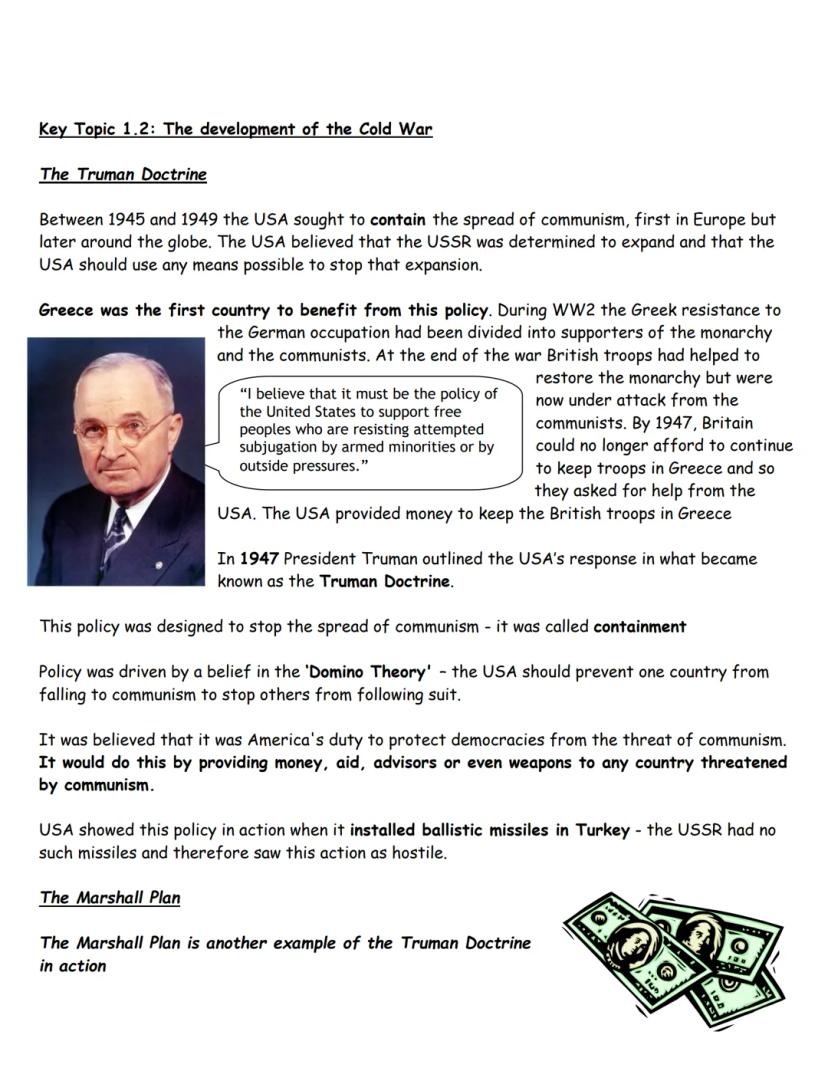
Announced by President Harry S. Truman on March 12, 1947, the Truman Doctrine was a foreign policy initiative aimed at countering Soviet expansionism.

Key aspects:

  1. Commitment to support free peoples resisting subjugation by armed minorities or outside pressures
  2. Immediate focus on providing aid to Greece and Turkey
  3. Broader implication of US willingness to intervene globally to contain communism

Quote: "I believe that it must be the policy of the United States to support free peoples who are resisting attempted subjugation by armed minorities or by outside pressures." - President Harry S. Truman, March 12, 1947

Significance:

  • Marked the formal adoption of the containment policy
  • Signaled a more active US role in global affairs
  • Intensified ideological confrontation with the Soviet Union

The Marshall Plan

Officially known as the European Recovery Program, the Marshall Plan was announced by Secretary of State George Marshall on June 5, 1947.

Key features:

  1. Large-scale economic aid program for European reconstruction
  2. Open to all European countries, including those under Soviet influence
  3. Aimed to stabilize Europe economically and politically to prevent the spread of communism

Highlight: The Marshall Plan provided over $13 billion (equivalent to about $140 billion in 2021) in economic assistance to Western European countries between 1948 and 1951.

Objectives:

  • Rebuild war-torn economies and infrastructure
  • Modernize industry and remove trade barriers
  • Promote European economic integration
  • Counter the appeal of communism by improving living standards

Impact on US-Soviet Relations

The Truman Doctrine and Marshall Plan had profound effects on the Cold War dynamics:

  1. Intensified Division of Europe
  • Soviet Union rejected Marshall Plan aid and pressured its satellites to do the same
  • Deepened the economic and political split between Eastern and Western Europe
  1. Escalation of Tensions
  • Soviets viewed these initiatives as American attempts to dominate Europe
  • Led to increased Soviet efforts to consolidate control in Eastern Europe
  1. Formation of Alliances
  • Contributed to the creation of NATO in 1949
  • Prompted the Soviet Union to form Comecon and later the Warsaw Pact
  1. Ideological Struggle
  • Reinforced the perception of a global contest between capitalism and communism
  • Influenced propaganda efforts on both sides

Example: The Soviet Union's rejection of Marshall Plan aid for itself and its satellite states highlighted the growing division of Europe into two opposing camps.

Long-term Consequences

The Truman Doctrine and Marshall Plan had lasting impacts:

  1. Economic Recovery of Western Europe
  • Contributed to rapid economic growth and modernization
  • Laid foundations for European economic integration
  1. Strengthened Trans-Atlantic Ties
  • Fostered closer political and economic relations between the US and Western Europe
  1. Cold War Framework
  • Established patterns of US foreign policy that persisted throughout the Cold War
  • Influenced subsequent US interventions and aid programs globally
  1. Soviet Reactions
  • Prompted the USSR to tighten control over its sphere of influence
  • Contributed to the Soviet decision to blockade Berlin in 1948-49

Vocabulary: Containment - The US foreign policy strategy aimed at stopping the spread of communism by diplomatic, economic, and military means.

Criticism and Debate

While generally successful in their aims, these policies were not without critics:

  • Some argued they unnecessarily antagonized the Soviet Union
  • Questions were raised about the long-term implications of US global commitments
  • Debates emerged over the effectiveness and motivations behind foreign aid programs

Highlight: The Truman Doctrine and Marshall Plan represented a significant shift in US foreign policy, moving from isolationism to active engagement in containing communism and shaping the post-war world order.

The Truman Doctrine and Marshall Plan were instrumental in defining the early Cold War era, solidifying the United States' role as a global superpower and setting the stage for decades of ideological and strategic competition with the Soviet Union. These policies not only shaped the recovery and alignment of post-war Europe but also established principles that would guide US foreign policy throughout the Cold War.

# GCSE History

Superpower relations and the Cold War

Z
ROCKETY BOMBH
BOMB

ON NO ACCOUNT TO BE
USED BECAUSE THE
ENEMY MIGHT RETALIATE

A
Z

Cominform, Comecon, and NATO

The formation of international organizations and alliances played a crucial role in shaping the Cold War landscape. This section examines three key organizations: Cominform, Comecon, and NATO, which represented the political, economic, and military dimensions of the emerging bipolar world order.

Cominform (1947)

The Communist Information Bureau (Cominform) was established by the Soviet Union in September 1947 as a response to the Truman Doctrine and Marshall Plan.

Key aspects:

  1. Purpose: To coordinate actions between Communist parties under Soviet direction
  2. Members: Communist parties from the USSR, Eastern European satellites, France, and Italy
  3. Activities: Propaganda, ideological alignment, and policy coordination

Vocabulary: Cominform - An abbreviation for Communist Information Bureau, it served as a tool for Soviet control over communist movements in Europe.

Significance:

  • Formalized Soviet control over communist parties in Eastern Europe
  • Intensified ideological confrontation with the West
  • Used to enforce conformity to Soviet policies among communist states

Comecon (1949)

The Council for Mutual Economic Assistance (Comecon) was established in January 1949 as the Soviet bloc's answer to the Marshall Plan and European economic integration.

Key features:

  1. Purpose: Economic cooperation and integration among communist countries
  2. Members: Soviet Union and its Eastern European satellites (later expanded to include other communist states)
  3. Activities: Trade coordination, economic planning, and technological cooperation

Highlight: Comecon aimed to create a socialist economic bloc to counter Western economic influence and integration.

Objectives:

  • Coordinate economic policies among member states
  • Promote specialization and division of labor within the bloc
  • Reduce economic dependence on the West

NATO (1949)

The North Atlantic Treaty Organization (NATO) was formed in April 1949 as a collective defense alliance among Western nations.

Key aspects:

  1. Purpose: Provide collective security against Soviet threat
  2. Original members: 12 countries including the USA, Canada, and Western European nations
  3. Core principle: An attack on one member is considered an attack on all (Article 5)

Quote: "The Parties agree that an armed attack against one or more of them in Europe or North America shall be considered an attack against them all." - Article 5 of the North Atlantic Treaty

Significance:

  • Formalized military cooperation between North America and Western Europe
  • Created a unified defense strategy against potential Soviet aggression
  • Served as a counterbalance to growing Soviet military power

Impact on Cold War Dynamics

The formation of these organizations had profound effects on the Cold War:

  1. Solidification of Blocs
  • Deepened the division between East and West
  • Formalized political, economic, and military alliances
  1. Escalation of Tensions
  • Increased perception of threat on both sides
  • Led to further militarization and arms race
  1. Ideological Reinforcement
  • Strengthened ideological cohesion within each bloc
  • Intensified propaganda efforts and competition for global influence
  1. Economic Consequences
  • Shaped patterns of trade and economic development
  • Influenced technological and industrial priorities

Example: The formation of NATO prompted the Soviet Union to create its own military alliance, the Warsaw Pact, in 1955, further cementing the division of Europe.

Long-term Consequences

These organizations had lasting impacts on the Cold War and beyond:

  1. Shaped Global Geopolitics
  • Influenced international relations and conflicts throughout the Cold War
  • NATO continues to play a significant role in global security post-Cold War
  1. Economic Legacy
  • Comecon's dissolution in 1991 left lasting economic challenges for former member states
  • Western economic integration, partly motivated by Cold War concerns, led to the formation of the European Union
  1. Ideological Impact
  • Cominform's activities contributed to the solidification of communist rule in Eastern Europe
  • NATO's existence reinforced Western unity and democratic values

Highlight: The formation of these organizations reflected and reinforced the bipolar nature of the Cold War world, creating structures that would define international relations for decades.

Criticism and Debates

Each organization faced criticism and debates:

  • Cominform was seen as a tool of Soviet domination, stifling independent communist movements
  • Comecon was criticized for inefficiencies and for reinforcing economic dependence on the USSR
  • NATO's expansion and operations, especially post-Cold War, have been subjects of controversy

The establishment of Cominform, Comecon, and NATO represented key institutional developments in the early Cold War period. These organizations embodied the political, economic, and military dimensions of the East-West divide, playing crucial roles in shaping the structure and dynamics of the Cold War for decades to come.

# GCSE History

Superpower relations and the Cold War

Z
ROCKETY BOMBH
BOMB

ON NO ACCOUNT TO BE
USED BECAUSE THE
ENEMY MIGHT RETALIATE

A
Z

The Berlin Crisis (1948-1949)

The Berlin Crisis of 1948-1949, also known as the Berlin Blockade, was one of the first major international crises of the Cold War. This confrontation over the divided city of Berlin highlighted the growing tensions between the Western Allies and the Soviet Union and set a precedent for future Cold War conflicts.

Background

After World War II, Germany and Berlin were divided into four occupation zones controlled by the United States, Great Britain, France, and the Soviet Union. Berlin, although located within the Soviet zone of Germany, was also divided among the four powers.

Key factors leading to the crisis:

  1. Disagreements over the economic and political future of Germany
  2. Western plans to merge their zones and introduce a new currency (Deutsche Mark)
  3. Soviet concerns about losing influence in their zone and in Berlin

Highlight: Berlin's unique status as a divided city within Soviet-controlled East Germany made it a focal point of Cold War tensions.

The Blockade

On June 24, 1948, the Soviet Union initiated a blockade of West Berlin:

  • Cut off all land and water access to the city
  • Blocked rail, road, and canal routes
  • Aimed to force the Western Allies out of Berlin

Soviet justification:

  • Claimed technical difficulties necessitated the closure of routes
  • Actually a response to the introduction of the new West German currency

Quote: "The Russians are not going to war. They're trying to force us out of Berlin. They think they can starve us out, but they can't." - General Lucius D. Clay, US Military Governor in Germany

The Berlin Airlift

In response to the blockade, the Western Allies organized a massive airlift to supply West Berlin:

  • Operation Plainfare (British) and Operation Vittles (American)
  • Lasted from June 26, 1948, to September 30, 1949
  • At its peak, a plane landed in Berlin every 30 seconds

Key statistics:

  • Over 2.3 million tons of supplies delivered
  • Nearly 278,000 flights completed
  • Supplies included food, fuel, and other essentials

Example: On Easter Sunday, 1949, the airlift delivered 13,000 tons of cargo, including the equivalent of 600 tons of coal for every Berlin family.

Impact and Significance

The Berlin Blockade and Airlift had several important consequences:

  1. Demonstrated Western Resolve
  • Showed the Allies' commitment to defending West Berlin
  • Boosted morale in West Berlin and Western Europe
  1. Increased Cold War Tensions
  • Further deteriorated relations between the Soviet Union and the West
  • Contributed to the formation of NATO in 1949
  1. Solidified the Division of Germany
  • Led to the formal establishment of two German states in 1949:
    • Federal Republic of Germany (West Germany)
    • German Democratic Republic (East Germany)
  1. Propaganda Victory for the West
  • The successful airlift was seen as a triumph of Western determination and logistics
  • Damaged Soviet prestige and highlighted the appeal of Western democracy

Vocabulary: Airlift - The transportation of cargo or passengers by aircraft, often in emergency situations or when normal transportation routes are unavailable.

Resolution and Aftermath

The Berlin Blockade ended on May 12, 1949, when the Soviet Union lifted the restrictions:

  • Negotiations through the United Nations helped resolve the crisis
  • The airlift continued for several months to build up reserves

Long-term effects:

  • Berlin remained a symbol of Cold War division
  • Set a pattern for future Cold War crises and confrontations
  • Influenced Western policies of containment and deterrence

Highlight: The Berlin Crisis demonstrated that the Cold War could be fought through non-military means and established Berlin as a key flashpoint in the East-West conflict.

Legacy

The Berlin Blockade and Airlift left a lasting legacy:

  1. Strengthened Western Alliance
  • Demonstrated the effectiveness of US-European cooperation
  • Contributed to the formation of West Germany as a key Western ally
  1. Cold War Symbolism
  • Berlin became a powerful symbol of the struggle between democracy and communism
  • Influenced future Cold War policies and strategies
  1. Humanitarian Achievement
  • The airlift is remembered as a remarkable logistical and humanitarian accomplishment
  • Memorials in Berlin and elsewhere commemorate the effort

Quote: "The Berlin Airlift is one of the greatest humanitarian efforts in history and probably the greatest aviation achievement." - General Hoyt Vandenberg, US Air Force Chief of Staff

The Berlin Crisis of 1948-1949 was a defining moment in the early Cold War, demonstrating the potential for conflict between the superpowers while also showing that such conflicts could be managed without resorting to direct military confrontation. It set important precedents for how Cold War crises would be handled and reinforced the symbolic importance of Berlin in the struggle between East and West.

# GCSE History

Superpower relations and the Cold War

Z
ROCKETY BOMBH
BOMB

ON NO ACCOUNT TO BE
USED BECAUSE THE
ENEMY MIGHT RETALIATE

A
Z

The Arms Race and the Warsaw Pact

The arms race between the United States and the Soviet Union, along with the formation of the Warsaw Pact, were key features of the intensifying Cold War in the 1950s. These developments significantly shaped the military and strategic landscape of the conflict.

The Arms Race

The arms race was a competition between the US and USSR to build up their military capabilities, particularly in nuclear weapons and delivery systems.

Key aspects:

  1. Nuclear Weapons Development
  • Rapid expansion of nuclear arsenals
  • Development of more powerful weapons (hydrogen bombs)
  • Miniaturization of nuclear warheads
  1. Delivery Systems
  • Intercontinental Ballistic Missiles (ICBMs)
  • Submarine-Launched Ballistic Missiles (SLBMs)
  • Strategic bombers
  1. Conventional Forces
  • Large standing armies
  • Advanced tanks, aircraft, and naval vessels

Vocabulary: ICBM (Intercontinental Ballistic Missile) - A guide

# GCSE History

Superpower relations and the Cold War

Z
ROCKETY BOMBH
BOMB

ON NO ACCOUNT TO BE
USED BECAUSE THE
ENEMY MIGHT RETALIATE

A
Z

The Origins of the Cold War (1941-1958)

The Cold War emerged in the aftermath of World War II as a prolonged struggle between two superpowers - the United States and the Soviet Union. This section examines the early tensions and key developments that shaped the origins of the Cold War from 1941 to 1958.

Definition of the Cold War

The term "Cold War" was first coined in 1947 to describe the conflict between the USA and USSR. Unlike traditional wars, the Cold War was characterized by:

  • A war of words, propaganda, and threats rather than direct military confrontation
  • Proxy wars where superpowers supported allies in conflicts without direct involvement
  • Ideological rivalry between capitalist democracy and communist systems

Definition: The Cold War refers to the state of geopolitical tension and rivalry between the United States and Soviet Union and their respective allies from the mid-1940s until the collapse of the Soviet Union in 1991.

Causes of the Cold War

Several key factors contributed to the emergence of the Cold War:

  1. Differing Ideologies: The fundamental ideological divide between the capitalist USA and communist USSR was a primary driver of conflict. Both superpowers believed their system was superior and sought to promote it globally.

Example: The USA championed free-market capitalism, democratic elections, and individual freedoms, while the USSR promoted state ownership, centrally planned economy, and one-party rule.

  1. Stalin's Suspicion of the West: Soviet leader Joseph Stalin harbored deep mistrust towards Western powers, fearing they sought to undermine and destroy communism.

  2. Western Fear of Communist Expansion: The USA and its allies were concerned about the spread of communism and Soviet influence across Europe and beyond.

Highlight: The ideological differences and mutual suspicion between the USA and USSR laid the foundation for decades of Cold War tensions.

Early Developments (1941-1958)

This period saw several crucial events and developments that shaped the early years of the Cold War:

  • Formation of the Grand Alliance during World War II
  • Outcomes of key conferences: Tehran, Yalta, and Potsdam
  • Development of atomic weapons by the USA
  • Creation of Soviet satellite states in Eastern Europe
  • Implementation of the Truman Doctrine and Marshall Plan
  • Formation of military alliances: NATO and the Warsaw Pact
  • Berlin Blockade and Airlift crisis
  • Arms race between the superpowers

Vocabulary: Satellite states - Countries that are formally independent but strongly influenced or controlled by another nation.

These events and policies contributed to the intensification of the Cold War and the solidification of opposing blocs led by the USA and USSR.


We thought you’d never ask...

What is the Knowunity AI companion?

Our AI Companion is a student-focused AI tool that offers more than just answers. Built on millions of Knowunity resources, it provides relevant information, personalised study plans, quizzes, and content directly in the chat, adapting to your individual learning journey.

Where can I download the Knowunity app?

You can download the app from Google Play Store and Apple App Store.

Is Knowunity really free of charge?

That's right! Enjoy free access to study content, connect with fellow students, and get instant help – all at your fingertips.

Most popular content: The Cold War

Most popular content in History

Most popular content

Can't find what you're looking for? Explore other subjects.

Students love us — and so will you.

4.6/5

App Store

4.7/5

Google Play

The app is very easy to use and well designed. I have found everything I was looking for so far and have been able to learn a lot from the presentations! I will definitely use the app for a class assignment! And of course it also helps a lot as an inspiration.

Stefan S

iOS user

This app is really great. There are so many study notes and help [...]. My problem subject is French, for example, and the app has so many options for help. Thanks to this app, I have improved my French. I would recommend it to anyone.

Samantha Klich

Android user

Wow, I am really amazed. I just tried the app because I've seen it advertised many times and was absolutely stunned. This app is THE HELP you want for school and above all, it offers so many things, such as workouts and fact sheets, which have been VERY helpful to me personally.

Anna

iOS user

Best app on earth! no words because it’s too good

Thomas R

iOS user

Just amazing. Let's me revise 10x better, this app is a quick 10/10. I highly recommend it to anyone. I can watch and search for notes. I can save them in the subject folder. I can revise it any time when I come back. If you haven't tried this app, you're really missing out.

Basil

Android user

This app has made me feel so much more confident in my exam prep, not only through boosting my own self confidence through the features that allow you to connect with others and feel less alone, but also through the way the app itself is centred around making you feel better. It is easy to navigate, fun to use, and helpful to anyone struggling in absolutely any way.

David K

iOS user

The app's just great! All I have to do is enter the topic in the search bar and I get the response real fast. I don't have to watch 10 YouTube videos to understand something, so I'm saving my time. Highly recommended!

Sudenaz Ocak

Android user

In school I was really bad at maths but thanks to the app, I am doing better now. I am so grateful that you made the app.

Greenlight Bonnie

Android user

very reliable app to help and grow your ideas of Maths, English and other related topics in your works. please use this app if your struggling in areas, this app is key for that. wish I'd of done a review before. and it's also free so don't worry about that.

Rohan U

Android user

I know a lot of apps use fake accounts to boost their reviews but this app deserves it all. Originally I was getting 4 in my English exams and this time I got a grade 7. I didn’t even know about this app three days until the exam and it has helped A LOT. Please actually trust me and use it as I’m sure you too will see developments.

Xander S

iOS user

THE QUIZES AND FLASHCARDS ARE SO USEFUL AND I LOVE Knowunity AI. IT ALSO IS LITREALLY LIKE CHATGPT BUT SMARTER!! HELPED ME WITH MY MASCARA PROBLEMS TOO!! AS WELL AS MY REAL SUBJECTS ! DUHHH 😍😁😲🤑💗✨🎀😮

Elisha

iOS user

This apps acc the goat. I find revision so boring but this app makes it so easy to organize it all and then you can ask the freeeee ai to test yourself so good and you can easily upload your own stuff. highly recommend as someone taking mocks now

Paul T

iOS user

The app is very easy to use and well designed. I have found everything I was looking for so far and have been able to learn a lot from the presentations! I will definitely use the app for a class assignment! And of course it also helps a lot as an inspiration.

Stefan S

iOS user

This app is really great. There are so many study notes and help [...]. My problem subject is French, for example, and the app has so many options for help. Thanks to this app, I have improved my French. I would recommend it to anyone.

Samantha Klich

Android user

Wow, I am really amazed. I just tried the app because I've seen it advertised many times and was absolutely stunned. This app is THE HELP you want for school and above all, it offers so many things, such as workouts and fact sheets, which have been VERY helpful to me personally.

Anna

iOS user

Best app on earth! no words because it’s too good

Thomas R

iOS user

Just amazing. Let's me revise 10x better, this app is a quick 10/10. I highly recommend it to anyone. I can watch and search for notes. I can save them in the subject folder. I can revise it any time when I come back. If you haven't tried this app, you're really missing out.

Basil

Android user

This app has made me feel so much more confident in my exam prep, not only through boosting my own self confidence through the features that allow you to connect with others and feel less alone, but also through the way the app itself is centred around making you feel better. It is easy to navigate, fun to use, and helpful to anyone struggling in absolutely any way.

David K

iOS user

The app's just great! All I have to do is enter the topic in the search bar and I get the response real fast. I don't have to watch 10 YouTube videos to understand something, so I'm saving my time. Highly recommended!

Sudenaz Ocak

Android user

In school I was really bad at maths but thanks to the app, I am doing better now. I am so grateful that you made the app.

Greenlight Bonnie

Android user

very reliable app to help and grow your ideas of Maths, English and other related topics in your works. please use this app if your struggling in areas, this app is key for that. wish I'd of done a review before. and it's also free so don't worry about that.

Rohan U

Android user

I know a lot of apps use fake accounts to boost their reviews but this app deserves it all. Originally I was getting 4 in my English exams and this time I got a grade 7. I didn’t even know about this app three days until the exam and it has helped A LOT. Please actually trust me and use it as I’m sure you too will see developments.

Xander S

iOS user

THE QUIZES AND FLASHCARDS ARE SO USEFUL AND I LOVE Knowunity AI. IT ALSO IS LITREALLY LIKE CHATGPT BUT SMARTER!! HELPED ME WITH MY MASCARA PROBLEMS TOO!! AS WELL AS MY REAL SUBJECTS ! DUHHH 😍😁😲🤑💗✨🎀😮

Elisha

iOS user

This apps acc the goat. I find revision so boring but this app makes it so easy to organize it all and then you can ask the freeeee ai to test yourself so good and you can easily upload your own stuff. highly recommend as someone taking mocks now

Paul T

iOS user


History

988

Updated Mar 11, 2026

33 pages

Explore the Cold War: Origins, Berlin Wall, and Cuban Missile Crisis for Kids

K

Kell

@kellceecharlesgrosvenor_leqg

Hey there! Dive into the exciting history of the Cold War from 1941 to 1991. Learn about the origins of the Cold War with a fun analysis from 1941 to 1958. Find out why the Berlin Wall was built and why it eventually fell. Discover key events like the Berlin Crisis of 1961 and the Cuban Missile Crisis, and what happened because of them. Get cool notes and PDFs, like GCSE History Cold War revision notes and Edexcel textbook materials. Perfect for school projects or just learning something awesome!

# GCSE History

Superpower relations and the Cold War

Z
ROCKETY BOMBH
BOMB

ON NO ACCOUNT TO BE
USED BECAUSE THE
ENEMY MIGHT RETALIATE

A
Z

Sign up to see the contentIt's free!

Access to all documents

Improve your grades

Join milions of students

The Grand Alliance and Post-War Conferences

The Grand Alliance, formed during World War II, brought together the United States, Great Britain, and the Soviet Union against Nazi Germany. However, as the war neared its end, tensions began to emerge among the allies, particularly during key conferences held to shape the post-war world.

The Tehran Conference (1943)

The first wartime meeting between the "Big Three" leaders - US President Franklin D. Roosevelt, British Prime Minister Winston Churchill, and Soviet leader Joseph Stalin - took place in Tehran, Iran.

Key outcomes:

  • Agreement on opening a second front in Western Europe DDayD-Day
  • Discussion of Poland's post-war borders
  • Soviet commitment to join the war against Japan after Germany's defeat

Highlight: The Tehran Conference marked the first face-to-face meeting of Roosevelt, Churchill, and Stalin, setting the stage for future negotiations on post-war Europe.

The Yalta Conference (February 1945)

As World War II neared its end in Europe, the Big Three met again in Yalta, Crimea, to discuss the post-war order.

Key decisions:

  • Division of Germany into occupied zones
  • Agreement on free elections in liberated European countries
  • Soviet participation in the United Nations
  • Soviet entry into the war against Japan in exchange for territorial concessions

Quote: "I think we have made a start on the road to a world of peace." - Franklin D. Roosevelt after the Yalta Conference

The Potsdam Conference JulyAugust1945July-August 1945

The final wartime conference took place in Potsdam, Germany, after Germany's surrender but before Japan's defeat. New leaders represented the US and UK: Harry Truman and Clement Attlee.

Key outcomes:

  • Confirmation of Germany's division into occupied zones
  • Establishment of the Allied Control Council for Germany
  • Agreement on war reparations
  • Discussion of Poland's western border

Highlight: The Potsdam Conference revealed growing tensions between the Western Allies and the Soviet Union, foreshadowing the coming Cold War.

Impact on US-Soviet Relations

These conferences had significant implications for the emerging Cold War:

  1. Revealed ideological differences and conflicting visions for post-war Europe
  2. Highlighted Stalin's determination to secure a sphere of influence in Eastern Europe
  3. Demonstrated the West's growing concern about Soviet expansionism
  4. Set the stage for future disagreements over the implementation of conference decisions

Example: The issue of free elections in Eastern Europe became a major point of contention, as the Soviet Union established communist governments in its occupied territories, contrary to Western expectations.

The outcomes of these conferences and the subsequent actions of both sides contributed to the deterioration of US-Soviet relations and the onset of the Cold War.

# GCSE History

Superpower relations and the Cold War

Z
ROCKETY BOMBH
BOMB

ON NO ACCOUNT TO BE
USED BECAUSE THE
ENEMY MIGHT RETALIATE

A
Z

Sign up to see the contentIt's free!

Access to all documents

Improve your grades

Join milions of students

Ideological Differences and Key Leaders

The Cold War was fundamentally rooted in the stark ideological divide between the capitalist United States and the communist Soviet Union. This section explores the core differences in their political and economic systems, as well as the attitudes of key leaders that shaped early Cold War relations.

Capitalist Democracy vs. Communist System

United States:

  • Democratic political system with free elections
  • Capitalist economic model based on private ownership and free markets
  • Emphasis on individual rights and freedoms
  • Free press and freedom of movement

Soviet Union:

  • One-party state under Communist Party rule
  • Centrally planned economy with state ownership of industry and agriculture
  • Collective interests prioritized over individual rights
  • Strict censorship and limited freedom of movement

Definition: Capitalism is an economic system based on private ownership of the means of production and their operation for profit, while communism advocates for a classless society with common ownership of property and resources.

Key Leaders and Their Attitudes

  1. Joseph Stalin (Soviet Union)
  • Deeply suspicious of Western intentions
  • Determined to create a buffer zone of friendly states in Eastern Europe
  • Prioritized Soviet security and the spread of communism
  1. Harry Truman (United States)
  • Adopted a tougher stance towards the Soviet Union than his predecessor
  • Implemented the Truman Doctrine to contain communist expansion
  • Authorized the development and use of atomic weapons
  1. Winston Churchill (United Kingdom)
  • Warned of the "Iron Curtain" descending across Europe
  • Advocated for a strong Western alliance to counter Soviet influence
  • Played a crucial role in shaping early Cold War rhetoric and policy

Quote: "From Stettin in the Baltic to Trieste in the Adriatic, an iron curtain has descended across the continent." - Winston Churchill, 1946

Impact on US-Soviet Relations

The ideological differences and leadership attitudes had profound effects on early Cold War dynamics:

  1. Mutual distrust and suspicion between the superpowers
  2. Competing efforts to spread their respective ideologies globally
  3. Formation of opposing military alliances (NATO vs. Warsaw Pact)
  4. Arms race, including the development of nuclear weapons
  5. Proxy conflicts in various parts of the world

Highlight: The ideological divide between capitalism and communism formed the core of the Cold War conflict, influencing political, economic, and military decisions on both sides.

The Role of Propaganda

Both superpowers used extensive propaganda to promote their ideologies and discredit the other side:

  • USA portrayed itself as the defender of freedom and democracy
  • USSR emphasized equality and workers' rights under communism
  • Each side demonized the other's political and economic system

Example: The United States Information Agency produced films, books, and radio broadcasts promoting American values and criticizing communism, while the Soviet Union used state-controlled media to glorify communist achievements and denounce capitalist "imperialism."

The stark ideological differences and the attitudes of key leaders like Stalin, Truman, and Churchill set the stage for decades of Cold War tensions, shaping global politics throughout the second half of the 20th century.

# GCSE History

Superpower relations and the Cold War

Z
ROCKETY BOMBH
BOMB

ON NO ACCOUNT TO BE
USED BECAUSE THE
ENEMY MIGHT RETALIATE

A
Z

Sign up to see the contentIt's free!

Access to all documents

Improve your grades

Join milions of students

The Impact of Atomic Weapons on US-Soviet Relations

The development and use of atomic weapons at the end of World War II had a profound impact on the emerging Cold War dynamics between the United States and the Soviet Union. This section explores how nuclear capabilities shaped the early years of the conflict.

The Manhattan Project and the First Atomic Bombs

The United States, with support from the United Kingdom and Canada, developed the first atomic bombs through the top-secret Manhattan Project during World War II.

Key events:

  • July 16, 1945: First successful atomic bomb test (Trinity test) in New Mexico
  • August 6, 1945: Atomic bomb dropped on Hiroshima, Japan
  • August 9, 1945: Second atomic bomb dropped on Nagasaki, Japan

Highlight: The use of atomic weapons against Japan demonstrated the unprecedented destructive power of nuclear technology and ushered in a new era of global politics.

Impact on US-Soviet Relations

The advent of atomic weapons had several significant effects on the relationship between the superpowers:

  1. Shift in Balance of Power
  • The USA's monopoly on atomic weapons initially gave it a strategic advantage
  • Created a sense of vulnerability in the Soviet Union
  1. Intensified Arms Race
  • Soviet Union accelerated its own nuclear weapons program
  • Both sides devoted enormous resources to developing and expanding their nuclear arsenals
  1. Increased Tensions and Mistrust
  • US reluctance to share nuclear technology with the USSR deepened Soviet suspicions
  • Fear of nuclear attack influenced policy decisions on both sides
  1. Concept of Mutually Assured Destruction (MAD)
  • As both superpowers acquired nuclear capabilities, the threat of total annihilation served as a deterrent to direct conflict

Vocabulary: Mutually Assured Destruction (MAD) - A doctrine of military strategy in which a full-scale use of nuclear weapons by two opposing sides would result in the complete annihilation of both the attacker and the defender.

The Soviet Atomic Program

The Soviet Union, aware of the Manhattan Project through espionage, intensified its own nuclear weapons development after World War II:

  • August 29, 1949: First successful Soviet atomic bomb test
  • This event ended the US monopoly on nuclear weapons and escalated the arms race

Quote: "The balance of power is now destroyed... the world political situation has radically changed." - Soviet Foreign Minister Andrei Vyshinsky, 1949

Nuclear Diplomacy and Early Cold War Strategy

The possession of atomic weapons influenced diplomatic and strategic decisions:

  1. Atomic Diplomacy
  • The USA initially used its nuclear monopoly as leverage in negotiations with the USSR
  • This approach heightened Soviet determination to develop its own nuclear capabilities
  1. Nuclear Deterrence
  • As both sides acquired nuclear weapons, the threat of mutual destruction became a key factor in preventing direct conflict
  1. Proxy Wars and Limited Conflicts
  • The risk of nuclear escalation led superpowers to engage in indirect conflicts rather than direct confrontation

Example: During the Korean War (1950-1953), the fear of nuclear escalation influenced military strategies and ultimately contributed to the conflict ending in a stalemate.

Long-term Consequences

The impact of atomic weapons on US-Soviet relations had lasting effects throughout the Cold War:

  • Fueled an ongoing arms race and technological competition
  • Shaped military doctrines and strategic planning
  • Influenced international relations and diplomacy globally
  • Led to efforts for arms control and non-proliferation treaties in later decades

Highlight: The development of atomic weapons fundamentally altered the nature of international conflict, making the prospect of full-scale war between superpowers potentially catastrophic for humanity.

The introduction of nuclear weapons at the dawn of the Cold War created a new paradigm in international relations, where the threat of mutual annihilation became a central factor in the ongoing struggle between the United States and the Soviet Union.

# GCSE History

Superpower relations and the Cold War

Z
ROCKETY BOMBH
BOMB

ON NO ACCOUNT TO BE
USED BECAUSE THE
ENEMY MIGHT RETALIATE

A
Z

Sign up to see the contentIt's free!

Access to all documents

Improve your grades

Join milions of students

The Long and Novikov Telegrams

Two influential diplomatic communications, known as the Long Telegram and the Novikov Telegram, played crucial roles in shaping early Cold War perceptions and policies. These documents provided insights into the mindsets of both the United States and the Soviet Union, contributing to the growing mistrust between the superpowers.

The Long Telegram (February 1946)

Written by George F. Kennan, an American diplomat stationed in Moscow, the Long Telegram was a detailed analysis of Soviet foreign policy and motivations.

Key points:

  1. Soviet view of capitalism as inherently hostile to communism
  2. USSR's need for external threats to justify internal controls
  3. Soviet expansion as a combination of communist ideology and traditional Russian imperialism
  4. Recommendation for a policy of "containment" to counter Soviet influence

Quote: "World communism is like a malignant parasite which feeds only on diseased tissue." - George F. Kennan, The Long Telegram

Impact:

  • Shaped US perception of Soviet intentions
  • Influenced the development of the Truman Doctrine and containment policy
  • Contributed to the hardening of US attitudes towards the USSR

The Novikov Telegram (September 1946)

In response to the Long Telegram, Soviet Ambassador to the US Nikolai Novikov sent a similar analysis of American foreign policy to Moscow.

Key points:

  1. US pursuit of world domination through economic and military means
  2. American desire to maintain its monopoly on atomic weapons
  3. US efforts to create anti-Soviet blocs and alliances
  4. Capitalist motivations behind US foreign policy

Highlight: The Novikov Telegram reinforced Soviet suspicions of Western intentions and contributed to the Kremlin's defensive posture in international affairs.

Impact:

  • Reinforced Soviet leadership's mistrust of US intentions
  • Influenced Soviet foreign policy decisions and military strategy
  • Contributed to the Soviet Union's efforts to expand its sphere of influence

Comparison and Significance

Both telegrams reflected and reinforced the growing mutual suspicion between the superpowers:

  1. Ideological Lens: Each side interpreted the other's actions through the prism of their own ideology
  2. Security Concerns: Both emphasized the perceived threat posed by the other side
  3. Expansion and Influence: Each telegram warned of the other power's attempts to expand its global reach
  4. Policy Implications: The analyses in both documents influenced the formation of Cold War strategies

Example: The Long Telegram's recommendation for containment directly influenced the Truman Doctrine and Marshall Plan, while the Novikov Telegram reinforced Soviet efforts to establish a buffer zone in Eastern Europe.

Legacy and Impact on Cold War Dynamics

The Long and Novikov Telegrams had lasting effects on US-Soviet relations:

  1. Solidified mutual distrust and suspicion
  2. Contributed to the formulation of early Cold War policies on both sides
  3. Reinforced the perception of an ideological and strategic struggle between capitalism and communism
  4. Influenced intelligence assessments and diplomatic approaches throughout the Cold War

Vocabulary: Containment - The US foreign policy strategy aimed at stopping the spread of communism around the world, rather than trying to roll it back in existing communist states.

These diplomatic communications played a significant role in crystallizing the opposing worldviews that would define the Cold War era, setting the stage for decades of geopolitical tension and rivalry between the United States and the Soviet Union.

# GCSE History

Superpower relations and the Cold War

Z
ROCKETY BOMBH
BOMB

ON NO ACCOUNT TO BE
USED BECAUSE THE
ENEMY MIGHT RETALIATE

A
Z

Sign up to see the contentIt's free!

Access to all documents

Improve your grades

Join milions of students

Soviet Satellite States in Eastern Europe

In the aftermath of World War II, the Soviet Union established a sphere of influence in Eastern Europe, creating a buffer zone of satellite states under communist control. This section examines the process of Soviet domination in these countries and its impact on Cold War relations.

Definition and Establishment of Satellite States

Soviet satellite states were countries in Eastern Europe that, while nominally independent, were effectively controlled by the Soviet Union through political, economic, and military means.

Key characteristics:

  • Communist governments aligned with Soviet policies
  • Economic integration with the Soviet bloc
  • Presence of Soviet military forces
  • Limited sovereignty and restricted foreign relations

Vocabulary: Satellite state - A country that is formally independent but under heavy political, economic, and military influence or control by another country.

The Process of Sovietization

The Soviet Union employed various methods to establish control over Eastern European countries:

  1. Installation of Communist Governments
  • Support for local communist parties
  • Rigged elections and political repression of opposition
  1. Economic Integration
  • Implementation of Soviet-style planned economies
  • Creation of Comecon (Council for Mutual Economic Assistance) in 1949
  1. Military Presence and Control
  • Stationing of Soviet troops in satellite states
  • Formation of the Warsaw Pact in 1955 as a counterbalance to NATO
  1. Cultural and Ideological Alignment
  • Promotion of Soviet culture and communist ideology
  • Censorship and control of media and education

Example: In Czechoslovakia, the communist takeover in 1948, known as the "Prague Coup," exemplified the Soviet method of gaining control through a combination of political pressure and manipulation.

Key Soviet Satellite States

The main countries that became Soviet satellites after World War II included:

  • Poland
  • East Germany (German Democratic Republic)
  • Czechoslovakia
  • Hungary
  • Romania
  • Bulgaria
  • Albania (until its break with the USSR in the 1960s)

Highlight: The division of Germany into East and West became a powerful symbol of the broader division of Europe during the Cold War.

Impact on Cold War Relations

The establishment of Soviet satellite states in Eastern Europe had significant consequences for the Cold War:

  1. Increased Tensions with the West
  • Western powers viewed Soviet actions as a violation of wartime agreements
  • Contributed to the perception of Soviet expansionism
  1. Formation of Opposing Blocs
  • Solidified the division of Europe into Eastern and Western spheres of influence
  • Led to the creation of opposing military alliances (NATO vs. Warsaw Pact)
  1. Ideological Battleground
  • Eastern Europe became a key arena in the ideological struggle between capitalism and communism
  • Sparked Western efforts to contain Soviet influence and promote democracy
  1. Source of Cold War Crises
  • Uprisings and reform movements in satellite states (e.g., Hungary 1956, Czechoslovakia 1968) became flashpoints in the Cold War

Quote: "From Stettin in the Baltic to Trieste in the Adriatic, an iron curtain has descended across the continent." - Winston Churchill, 1946, referring to the division of Europe

Long-term Consequences

The Soviet domination of Eastern Europe had lasting effects:

  • Shaped the geopolitical landscape of Europe for decades
  • Influenced economic development and social structures in satellite states
  • Created legacies that continued to affect these countries after the fall of communism

Highlight: The existence of Soviet satellite states in Eastern Europe was a defining feature of the Cold War, symbolizing the division of the continent and the global struggle between the superpowers.

The establishment and maintenance of Soviet satellite states in Eastern Europe played a crucial role in shaping Cold War dynamics, contributing to the atmosphere of mistrust and competition between the Eastern and Western blocs. The fate of these countries remained a central issue throughout the Cold War until the eventual collapse of communist regimes in 1989-1991.

# GCSE History

Superpower relations and the Cold War

Z
ROCKETY BOMBH
BOMB

ON NO ACCOUNT TO BE
USED BECAUSE THE
ENEMY MIGHT RETALIATE

A
Z

Sign up to see the contentIt's free!

Access to all documents

Improve your grades

Join milions of students

The Truman Doctrine and Marshall Plan (1947)

The Truman Doctrine and the Marshall Plan were two pivotal US foreign policy initiatives introduced in 1947 that significantly shaped the early years of the Cold War. These policies aimed to contain Soviet influence and support economic recovery in Europe, marking a decisive shift in US engagement with global affairs.

The Truman Doctrine

Announced by President Harry S. Truman on March 12, 1947, the Truman Doctrine was a foreign policy initiative aimed at countering Soviet expansionism.

Key aspects:

  1. Commitment to support free peoples resisting subjugation by armed minorities or outside pressures
  2. Immediate focus on providing aid to Greece and Turkey
  3. Broader implication of US willingness to intervene globally to contain communism

Quote: "I believe that it must be the policy of the United States to support free peoples who are resisting attempted subjugation by armed minorities or by outside pressures." - President Harry S. Truman, March 12, 1947

Significance:

  • Marked the formal adoption of the containment policy
  • Signaled a more active US role in global affairs
  • Intensified ideological confrontation with the Soviet Union

The Marshall Plan

Officially known as the European Recovery Program, the Marshall Plan was announced by Secretary of State George Marshall on June 5, 1947.

Key features:

  1. Large-scale economic aid program for European reconstruction
  2. Open to all European countries, including those under Soviet influence
  3. Aimed to stabilize Europe economically and politically to prevent the spread of communism

Highlight: The Marshall Plan provided over $13 billion (equivalent to about $140 billion in 2021) in economic assistance to Western European countries between 1948 and 1951.

Objectives:

  • Rebuild war-torn economies and infrastructure
  • Modernize industry and remove trade barriers
  • Promote European economic integration
  • Counter the appeal of communism by improving living standards

Impact on US-Soviet Relations

The Truman Doctrine and Marshall Plan had profound effects on the Cold War dynamics:

  1. Intensified Division of Europe
  • Soviet Union rejected Marshall Plan aid and pressured its satellites to do the same
  • Deepened the economic and political split between Eastern and Western Europe
  1. Escalation of Tensions
  • Soviets viewed these initiatives as American attempts to dominate Europe
  • Led to increased Soviet efforts to consolidate control in Eastern Europe
  1. Formation of Alliances
  • Contributed to the creation of NATO in 1949
  • Prompted the Soviet Union to form Comecon and later the Warsaw Pact
  1. Ideological Struggle
  • Reinforced the perception of a global contest between capitalism and communism
  • Influenced propaganda efforts on both sides

Example: The Soviet Union's rejection of Marshall Plan aid for itself and its satellite states highlighted the growing division of Europe into two opposing camps.

Long-term Consequences

The Truman Doctrine and Marshall Plan had lasting impacts:

  1. Economic Recovery of Western Europe
  • Contributed to rapid economic growth and modernization
  • Laid foundations for European economic integration
  1. Strengthened Trans-Atlantic Ties
  • Fostered closer political and economic relations between the US and Western Europe
  1. Cold War Framework
  • Established patterns of US foreign policy that persisted throughout the Cold War
  • Influenced subsequent US interventions and aid programs globally
  1. Soviet Reactions
  • Prompted the USSR to tighten control over its sphere of influence
  • Contributed to the Soviet decision to blockade Berlin in 1948-49

Vocabulary: Containment - The US foreign policy strategy aimed at stopping the spread of communism by diplomatic, economic, and military means.

Criticism and Debate

While generally successful in their aims, these policies were not without critics:

  • Some argued they unnecessarily antagonized the Soviet Union
  • Questions were raised about the long-term implications of US global commitments
  • Debates emerged over the effectiveness and motivations behind foreign aid programs

Highlight: The Truman Doctrine and Marshall Plan represented a significant shift in US foreign policy, moving from isolationism to active engagement in containing communism and shaping the post-war world order.

The Truman Doctrine and Marshall Plan were instrumental in defining the early Cold War era, solidifying the United States' role as a global superpower and setting the stage for decades of ideological and strategic competition with the Soviet Union. These policies not only shaped the recovery and alignment of post-war Europe but also established principles that would guide US foreign policy throughout the Cold War.

# GCSE History

Superpower relations and the Cold War

Z
ROCKETY BOMBH
BOMB

ON NO ACCOUNT TO BE
USED BECAUSE THE
ENEMY MIGHT RETALIATE

A
Z

Sign up to see the contentIt's free!

Access to all documents

Improve your grades

Join milions of students

Cominform, Comecon, and NATO

The formation of international organizations and alliances played a crucial role in shaping the Cold War landscape. This section examines three key organizations: Cominform, Comecon, and NATO, which represented the political, economic, and military dimensions of the emerging bipolar world order.

Cominform (1947)

The Communist Information Bureau (Cominform) was established by the Soviet Union in September 1947 as a response to the Truman Doctrine and Marshall Plan.

Key aspects:

  1. Purpose: To coordinate actions between Communist parties under Soviet direction
  2. Members: Communist parties from the USSR, Eastern European satellites, France, and Italy
  3. Activities: Propaganda, ideological alignment, and policy coordination

Vocabulary: Cominform - An abbreviation for Communist Information Bureau, it served as a tool for Soviet control over communist movements in Europe.

Significance:

  • Formalized Soviet control over communist parties in Eastern Europe
  • Intensified ideological confrontation with the West
  • Used to enforce conformity to Soviet policies among communist states

Comecon (1949)

The Council for Mutual Economic Assistance (Comecon) was established in January 1949 as the Soviet bloc's answer to the Marshall Plan and European economic integration.

Key features:

  1. Purpose: Economic cooperation and integration among communist countries
  2. Members: Soviet Union and its Eastern European satellites (later expanded to include other communist states)
  3. Activities: Trade coordination, economic planning, and technological cooperation

Highlight: Comecon aimed to create a socialist economic bloc to counter Western economic influence and integration.

Objectives:

  • Coordinate economic policies among member states
  • Promote specialization and division of labor within the bloc
  • Reduce economic dependence on the West

NATO (1949)

The North Atlantic Treaty Organization (NATO) was formed in April 1949 as a collective defense alliance among Western nations.

Key aspects:

  1. Purpose: Provide collective security against Soviet threat
  2. Original members: 12 countries including the USA, Canada, and Western European nations
  3. Core principle: An attack on one member is considered an attack on all (Article 5)

Quote: "The Parties agree that an armed attack against one or more of them in Europe or North America shall be considered an attack against them all." - Article 5 of the North Atlantic Treaty

Significance:

  • Formalized military cooperation between North America and Western Europe
  • Created a unified defense strategy against potential Soviet aggression
  • Served as a counterbalance to growing Soviet military power

Impact on Cold War Dynamics

The formation of these organizations had profound effects on the Cold War:

  1. Solidification of Blocs
  • Deepened the division between East and West
  • Formalized political, economic, and military alliances
  1. Escalation of Tensions
  • Increased perception of threat on both sides
  • Led to further militarization and arms race
  1. Ideological Reinforcement
  • Strengthened ideological cohesion within each bloc
  • Intensified propaganda efforts and competition for global influence
  1. Economic Consequences
  • Shaped patterns of trade and economic development
  • Influenced technological and industrial priorities

Example: The formation of NATO prompted the Soviet Union to create its own military alliance, the Warsaw Pact, in 1955, further cementing the division of Europe.

Long-term Consequences

These organizations had lasting impacts on the Cold War and beyond:

  1. Shaped Global Geopolitics
  • Influenced international relations and conflicts throughout the Cold War
  • NATO continues to play a significant role in global security post-Cold War
  1. Economic Legacy
  • Comecon's dissolution in 1991 left lasting economic challenges for former member states
  • Western economic integration, partly motivated by Cold War concerns, led to the formation of the European Union
  1. Ideological Impact
  • Cominform's activities contributed to the solidification of communist rule in Eastern Europe
  • NATO's existence reinforced Western unity and democratic values

Highlight: The formation of these organizations reflected and reinforced the bipolar nature of the Cold War world, creating structures that would define international relations for decades.

Criticism and Debates

Each organization faced criticism and debates:

  • Cominform was seen as a tool of Soviet domination, stifling independent communist movements
  • Comecon was criticized for inefficiencies and for reinforcing economic dependence on the USSR
  • NATO's expansion and operations, especially post-Cold War, have been subjects of controversy

The establishment of Cominform, Comecon, and NATO represented key institutional developments in the early Cold War period. These organizations embodied the political, economic, and military dimensions of the East-West divide, playing crucial roles in shaping the structure and dynamics of the Cold War for decades to come.

# GCSE History

Superpower relations and the Cold War

Z
ROCKETY BOMBH
BOMB

ON NO ACCOUNT TO BE
USED BECAUSE THE
ENEMY MIGHT RETALIATE

A
Z

Sign up to see the contentIt's free!

Access to all documents

Improve your grades

Join milions of students

The Berlin Crisis (1948-1949)

The Berlin Crisis of 1948-1949, also known as the Berlin Blockade, was one of the first major international crises of the Cold War. This confrontation over the divided city of Berlin highlighted the growing tensions between the Western Allies and the Soviet Union and set a precedent for future Cold War conflicts.

Background

After World War II, Germany and Berlin were divided into four occupation zones controlled by the United States, Great Britain, France, and the Soviet Union. Berlin, although located within the Soviet zone of Germany, was also divided among the four powers.

Key factors leading to the crisis:

  1. Disagreements over the economic and political future of Germany
  2. Western plans to merge their zones and introduce a new currency (Deutsche Mark)
  3. Soviet concerns about losing influence in their zone and in Berlin

Highlight: Berlin's unique status as a divided city within Soviet-controlled East Germany made it a focal point of Cold War tensions.

The Blockade

On June 24, 1948, the Soviet Union initiated a blockade of West Berlin:

  • Cut off all land and water access to the city
  • Blocked rail, road, and canal routes
  • Aimed to force the Western Allies out of Berlin

Soviet justification:

  • Claimed technical difficulties necessitated the closure of routes
  • Actually a response to the introduction of the new West German currency

Quote: "The Russians are not going to war. They're trying to force us out of Berlin. They think they can starve us out, but they can't." - General Lucius D. Clay, US Military Governor in Germany

The Berlin Airlift

In response to the blockade, the Western Allies organized a massive airlift to supply West Berlin:

  • Operation Plainfare (British) and Operation Vittles (American)
  • Lasted from June 26, 1948, to September 30, 1949
  • At its peak, a plane landed in Berlin every 30 seconds

Key statistics:

  • Over 2.3 million tons of supplies delivered
  • Nearly 278,000 flights completed
  • Supplies included food, fuel, and other essentials

Example: On Easter Sunday, 1949, the airlift delivered 13,000 tons of cargo, including the equivalent of 600 tons of coal for every Berlin family.

Impact and Significance

The Berlin Blockade and Airlift had several important consequences:

  1. Demonstrated Western Resolve
  • Showed the Allies' commitment to defending West Berlin
  • Boosted morale in West Berlin and Western Europe
  1. Increased Cold War Tensions
  • Further deteriorated relations between the Soviet Union and the West
  • Contributed to the formation of NATO in 1949
  1. Solidified the Division of Germany
  • Led to the formal establishment of two German states in 1949:
    • Federal Republic of Germany (West Germany)
    • German Democratic Republic (East Germany)
  1. Propaganda Victory for the West
  • The successful airlift was seen as a triumph of Western determination and logistics
  • Damaged Soviet prestige and highlighted the appeal of Western democracy

Vocabulary: Airlift - The transportation of cargo or passengers by aircraft, often in emergency situations or when normal transportation routes are unavailable.

Resolution and Aftermath

The Berlin Blockade ended on May 12, 1949, when the Soviet Union lifted the restrictions:

  • Negotiations through the United Nations helped resolve the crisis
  • The airlift continued for several months to build up reserves

Long-term effects:

  • Berlin remained a symbol of Cold War division
  • Set a pattern for future Cold War crises and confrontations
  • Influenced Western policies of containment and deterrence

Highlight: The Berlin Crisis demonstrated that the Cold War could be fought through non-military means and established Berlin as a key flashpoint in the East-West conflict.

Legacy

The Berlin Blockade and Airlift left a lasting legacy:

  1. Strengthened Western Alliance
  • Demonstrated the effectiveness of US-European cooperation
  • Contributed to the formation of West Germany as a key Western ally
  1. Cold War Symbolism
  • Berlin became a powerful symbol of the struggle between democracy and communism
  • Influenced future Cold War policies and strategies
  1. Humanitarian Achievement
  • The airlift is remembered as a remarkable logistical and humanitarian accomplishment
  • Memorials in Berlin and elsewhere commemorate the effort

Quote: "The Berlin Airlift is one of the greatest humanitarian efforts in history and probably the greatest aviation achievement." - General Hoyt Vandenberg, US Air Force Chief of Staff

The Berlin Crisis of 1948-1949 was a defining moment in the early Cold War, demonstrating the potential for conflict between the superpowers while also showing that such conflicts could be managed without resorting to direct military confrontation. It set important precedents for how Cold War crises would be handled and reinforced the symbolic importance of Berlin in the struggle between East and West.
# GCSE History

Superpower relations and the Cold War

Z
ROCKETY BOMBH
BOMB

ON NO ACCOUNT TO BE
USED BECAUSE THE
ENEMY MIGHT RETALIATE

A
Z

Sign up to see the contentIt's free!

Access to all documents

Improve your grades

Join milions of students

The Arms Race and the Warsaw Pact

The arms race between the United States and the Soviet Union, along with the formation of the Warsaw Pact, were key features of the intensifying Cold War in the 1950s. These developments significantly shaped the military and strategic landscape of the conflict.

The Arms Race

The arms race was a competition between the US and USSR to build up their military capabilities, particularly in nuclear weapons and delivery systems.

Key aspects:

  1. Nuclear Weapons Development
  • Rapid expansion of nuclear arsenals
  • Development of more powerful weapons (hydrogen bombs)
  • Miniaturization of nuclear warheads
  1. Delivery Systems
  • Intercontinental Ballistic Missiles (ICBMs)
  • Submarine-Launched Ballistic Missiles (SLBMs)
  • Strategic bombers
  1. Conventional Forces
  • Large standing armies
  • Advanced tanks, aircraft, and naval vessels

Vocabulary: ICBM (Intercontinental Ballistic Missile) - A guide

# GCSE History

Superpower relations and the Cold War

Z
ROCKETY BOMBH
BOMB

ON NO ACCOUNT TO BE
USED BECAUSE THE
ENEMY MIGHT RETALIATE

A
Z

Sign up to see the contentIt's free!

Access to all documents

Improve your grades

Join milions of students

The Origins of the Cold War (1941-1958)

The Cold War emerged in the aftermath of World War II as a prolonged struggle between two superpowers - the United States and the Soviet Union. This section examines the early tensions and key developments that shaped the origins of the Cold War from 1941 to 1958.

Definition of the Cold War

The term "Cold War" was first coined in 1947 to describe the conflict between the USA and USSR. Unlike traditional wars, the Cold War was characterized by:

  • A war of words, propaganda, and threats rather than direct military confrontation
  • Proxy wars where superpowers supported allies in conflicts without direct involvement
  • Ideological rivalry between capitalist democracy and communist systems

Definition: The Cold War refers to the state of geopolitical tension and rivalry between the United States and Soviet Union and their respective allies from the mid-1940s until the collapse of the Soviet Union in 1991.

Causes of the Cold War

Several key factors contributed to the emergence of the Cold War:

  1. Differing Ideologies: The fundamental ideological divide between the capitalist USA and communist USSR was a primary driver of conflict. Both superpowers believed their system was superior and sought to promote it globally.

Example: The USA championed free-market capitalism, democratic elections, and individual freedoms, while the USSR promoted state ownership, centrally planned economy, and one-party rule.

  1. Stalin's Suspicion of the West: Soviet leader Joseph Stalin harbored deep mistrust towards Western powers, fearing they sought to undermine and destroy communism.

  2. Western Fear of Communist Expansion: The USA and its allies were concerned about the spread of communism and Soviet influence across Europe and beyond.

Highlight: The ideological differences and mutual suspicion between the USA and USSR laid the foundation for decades of Cold War tensions.

Early Developments (1941-1958)

This period saw several crucial events and developments that shaped the early years of the Cold War:

  • Formation of the Grand Alliance during World War II
  • Outcomes of key conferences: Tehran, Yalta, and Potsdam
  • Development of atomic weapons by the USA
  • Creation of Soviet satellite states in Eastern Europe
  • Implementation of the Truman Doctrine and Marshall Plan
  • Formation of military alliances: NATO and the Warsaw Pact
  • Berlin Blockade and Airlift crisis
  • Arms race between the superpowers

Vocabulary: Satellite states - Countries that are formally independent but strongly influenced or controlled by another nation.

These events and policies contributed to the intensification of the Cold War and the solidification of opposing blocs led by the USA and USSR.

We thought you’d never ask...

What is the Knowunity AI companion?

Our AI Companion is a student-focused AI tool that offers more than just answers. Built on millions of Knowunity resources, it provides relevant information, personalised study plans, quizzes, and content directly in the chat, adapting to your individual learning journey.

Where can I download the Knowunity app?

You can download the app from Google Play Store and Apple App Store.

Is Knowunity really free of charge?

That's right! Enjoy free access to study content, connect with fellow students, and get instant help – all at your fingertips.

38

Smart Tools NEW

Transform this note into: ✓ 50+ Practice Questions ✓ Interactive Flashcards ✓ Full Mock Exam ✓ Essay Outlines

Mock Exam
Quiz
Flashcards
Essay

Most popular content: The Cold War

Most popular content in History

Most popular content

Can't find what you're looking for? Explore other subjects.

Students love us — and so will you.

4.6/5

App Store

4.7/5

Google Play

The app is very easy to use and well designed. I have found everything I was looking for so far and have been able to learn a lot from the presentations! I will definitely use the app for a class assignment! And of course it also helps a lot as an inspiration.

Stefan S

iOS user

This app is really great. There are so many study notes and help [...]. My problem subject is French, for example, and the app has so many options for help. Thanks to this app, I have improved my French. I would recommend it to anyone.

Samantha Klich

Android user

Wow, I am really amazed. I just tried the app because I've seen it advertised many times and was absolutely stunned. This app is THE HELP you want for school and above all, it offers so many things, such as workouts and fact sheets, which have been VERY helpful to me personally.

Anna

iOS user

Best app on earth! no words because it’s too good

Thomas R

iOS user

Just amazing. Let's me revise 10x better, this app is a quick 10/10. I highly recommend it to anyone. I can watch and search for notes. I can save them in the subject folder. I can revise it any time when I come back. If you haven't tried this app, you're really missing out.

Basil

Android user

This app has made me feel so much more confident in my exam prep, not only through boosting my own self confidence through the features that allow you to connect with others and feel less alone, but also through the way the app itself is centred around making you feel better. It is easy to navigate, fun to use, and helpful to anyone struggling in absolutely any way.

David K

iOS user

The app's just great! All I have to do is enter the topic in the search bar and I get the response real fast. I don't have to watch 10 YouTube videos to understand something, so I'm saving my time. Highly recommended!

Sudenaz Ocak

Android user

In school I was really bad at maths but thanks to the app, I am doing better now. I am so grateful that you made the app.

Greenlight Bonnie

Android user

very reliable app to help and grow your ideas of Maths, English and other related topics in your works. please use this app if your struggling in areas, this app is key for that. wish I'd of done a review before. and it's also free so don't worry about that.

Rohan U

Android user

I know a lot of apps use fake accounts to boost their reviews but this app deserves it all. Originally I was getting 4 in my English exams and this time I got a grade 7. I didn’t even know about this app three days until the exam and it has helped A LOT. Please actually trust me and use it as I’m sure you too will see developments.

Xander S

iOS user

THE QUIZES AND FLASHCARDS ARE SO USEFUL AND I LOVE Knowunity AI. IT ALSO IS LITREALLY LIKE CHATGPT BUT SMARTER!! HELPED ME WITH MY MASCARA PROBLEMS TOO!! AS WELL AS MY REAL SUBJECTS ! DUHHH 😍😁😲🤑💗✨🎀😮

Elisha

iOS user

This apps acc the goat. I find revision so boring but this app makes it so easy to organize it all and then you can ask the freeeee ai to test yourself so good and you can easily upload your own stuff. highly recommend as someone taking mocks now

Paul T

iOS user

The app is very easy to use and well designed. I have found everything I was looking for so far and have been able to learn a lot from the presentations! I will definitely use the app for a class assignment! And of course it also helps a lot as an inspiration.

Stefan S

iOS user

This app is really great. There are so many study notes and help [...]. My problem subject is French, for example, and the app has so many options for help. Thanks to this app, I have improved my French. I would recommend it to anyone.

Samantha Klich

Android user

Wow, I am really amazed. I just tried the app because I've seen it advertised many times and was absolutely stunned. This app is THE HELP you want for school and above all, it offers so many things, such as workouts and fact sheets, which have been VERY helpful to me personally.

Anna

iOS user

Best app on earth! no words because it’s too good

Thomas R

iOS user

Just amazing. Let's me revise 10x better, this app is a quick 10/10. I highly recommend it to anyone. I can watch and search for notes. I can save them in the subject folder. I can revise it any time when I come back. If you haven't tried this app, you're really missing out.

Basil

Android user

This app has made me feel so much more confident in my exam prep, not only through boosting my own self confidence through the features that allow you to connect with others and feel less alone, but also through the way the app itself is centred around making you feel better. It is easy to navigate, fun to use, and helpful to anyone struggling in absolutely any way.

David K

iOS user

The app's just great! All I have to do is enter the topic in the search bar and I get the response real fast. I don't have to watch 10 YouTube videos to understand something, so I'm saving my time. Highly recommended!

Sudenaz Ocak

Android user

In school I was really bad at maths but thanks to the app, I am doing better now. I am so grateful that you made the app.

Greenlight Bonnie

Android user

very reliable app to help and grow your ideas of Maths, English and other related topics in your works. please use this app if your struggling in areas, this app is key for that. wish I'd of done a review before. and it's also free so don't worry about that.

Rohan U

Android user

I know a lot of apps use fake accounts to boost their reviews but this app deserves it all. Originally I was getting 4 in my English exams and this time I got a grade 7. I didn’t even know about this app three days until the exam and it has helped A LOT. Please actually trust me and use it as I’m sure you too will see developments.

Xander S

iOS user

THE QUIZES AND FLASHCARDS ARE SO USEFUL AND I LOVE Knowunity AI. IT ALSO IS LITREALLY LIKE CHATGPT BUT SMARTER!! HELPED ME WITH MY MASCARA PROBLEMS TOO!! AS WELL AS MY REAL SUBJECTS ! DUHHH 😍😁😲🤑💗✨🎀😮

Elisha

iOS user

This apps acc the goat. I find revision so boring but this app makes it so easy to organize it all and then you can ask the freeeee ai to test yourself so good and you can easily upload your own stuff. highly recommend as someone taking mocks now

Paul T

iOS user