
Benzene undergoes various electrophilic substitution reactions, including nitration, halogenation, alkylation,...
 Chemistry201 views·Updated Jun 27, 2026·2 pages
Discovering Benzene Tricks: Nitration and Friedel-Crafts Fun

Aidan Brown@aidanbrown_ctyu
1
of 2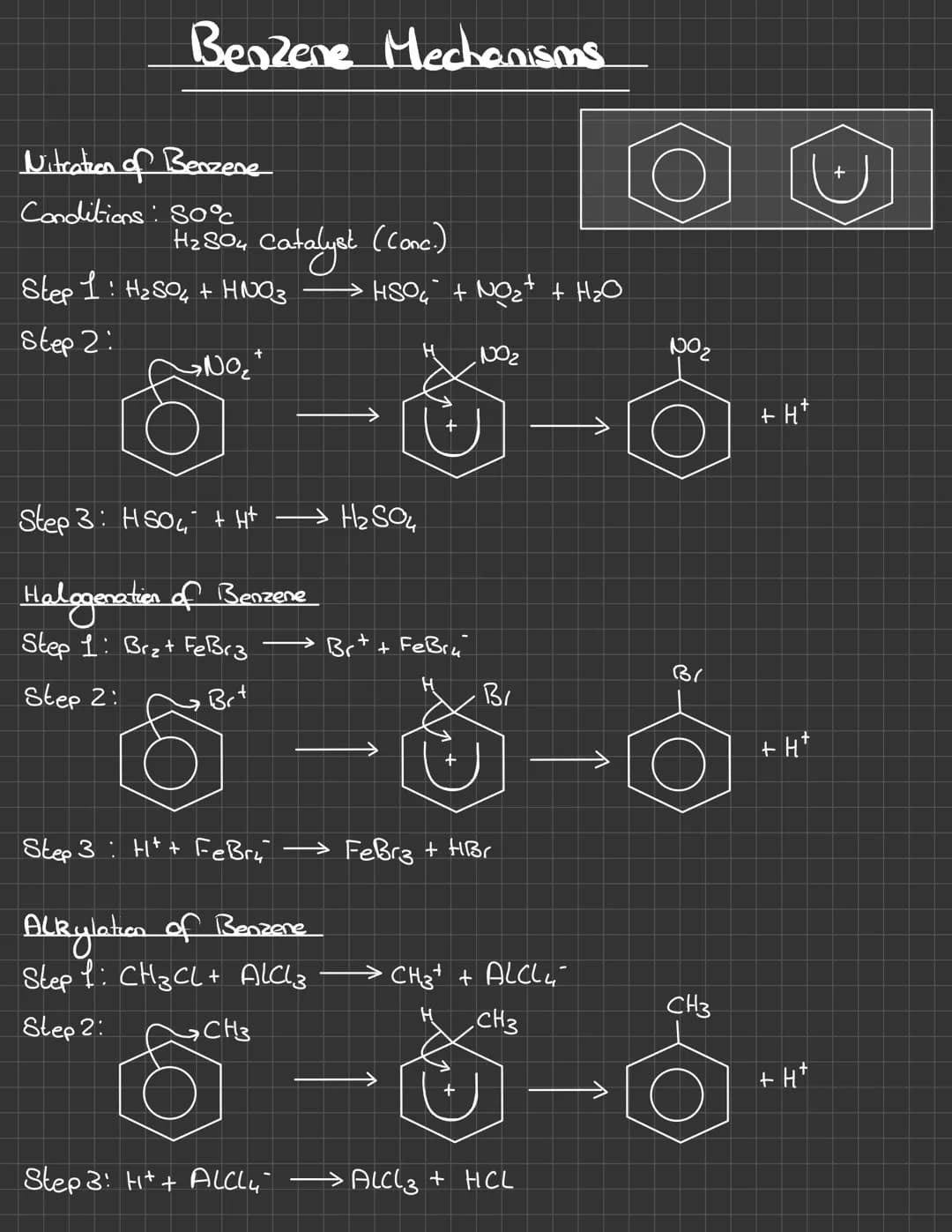
Acylation of Benzene
The acylation of benzene mechanism is another Friedel-Crafts reaction that introduces an acyl group onto the benzene ring. This reaction is crucial in the synthesis of aromatic ketones.
Vocabulary: Acylation - The process of introducing an acyl group into a compound.
The acylation of benzene conditions typically involve:
- An acyl chloride (e.g., CH₃COCl)
- A Lewis acid catalyst (e.g., AlCl₃)
- Anhydrous conditions
The mechanism proceeds as follows:
- Step 1: CH₃COCl + AlCl₃ → CH₃CO⁺ + AlCl₄⁻
- Step 2: The acylium ion (CH₃CO⁺) acts as the electrophile
- Step 3: Benzene attacks the electrophile, forming a resonance-stabilized carbocation
- Step 4: Loss of a proton restores aromaticity, yielding acetophenone
Highlight: The acylation of benzene product, such as acetophenone (C₆H₅COCH₃), is an important intermediate in the synthesis of pharmaceuticals and fragrances.
Example: Friedel-Crafts acylation of benzene with acetyl chloride produces acetophenone: C₆H₆ + CH₃COCl → C₆H₅COCH₃ + HCl
The difference between Friedel-Crafts alkylation and acylation lies in the nature of the electrophile and the reaction's tendency to undergo multiple substitutions:
- Alkylation uses alkyl halides and can lead to multiple substitutions due to the activating effect of the first alkyl group.
- Acylation uses acyl halides and typically stops after one substitution because the acyl group is deactivating.
Definition: The acyl benzene name for the simplest product of benzene acylation is acetophenone or phenyl methyl ketone.
Understanding these alkylation and acylation of benzene steps OCR QUI (Quick Understanding and Interpretation) is crucial for grasping the fundamentals of aromatic chemistry and its applications in organic synthesis.
2
of 2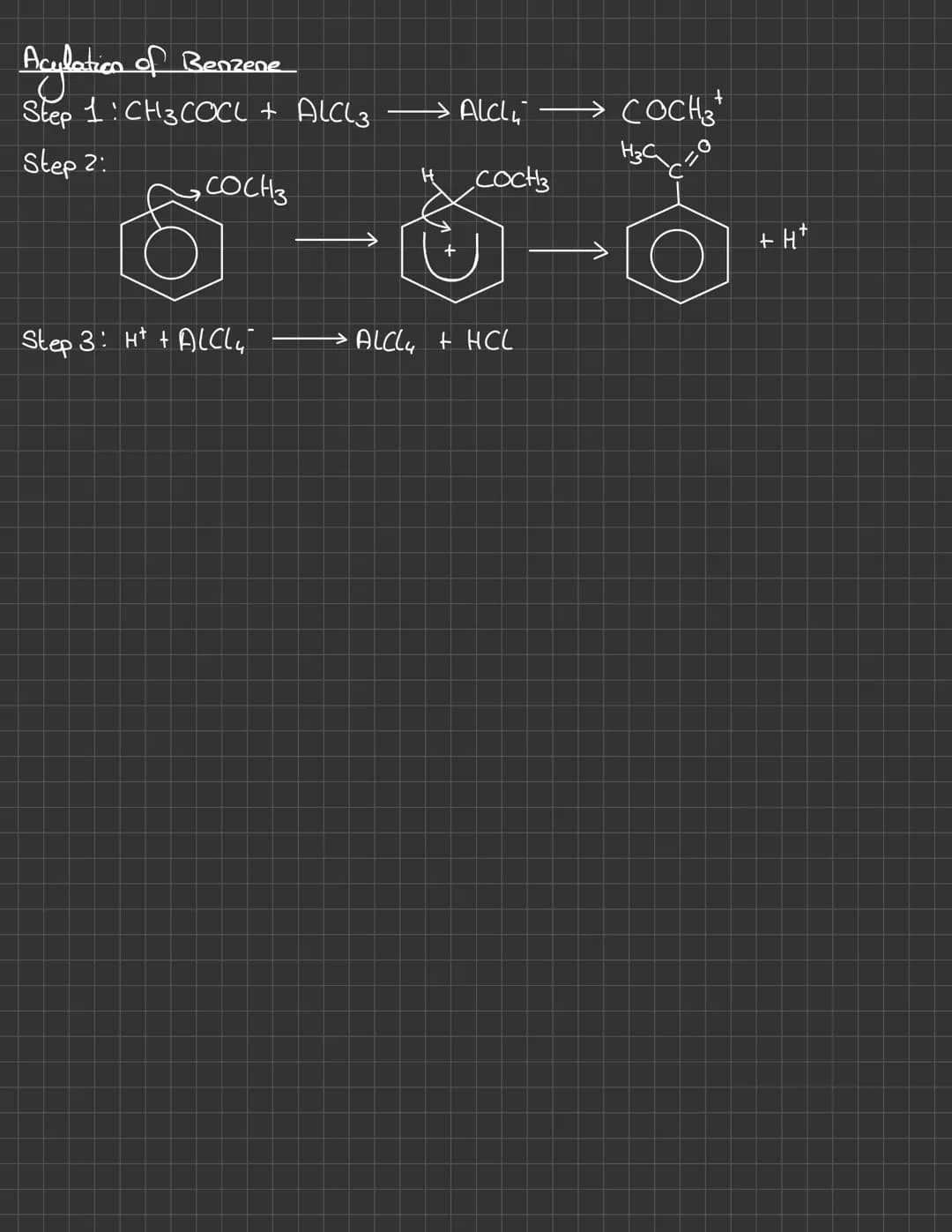
Nitration of Benzene
The nitration of benzene mechanism is a classic example of electrophilic aromatic substitution. This reaction produces nitrobenzene, an important intermediate in the synthesis of many organic compounds.
Vocabulary: Nitration - The process of introducing a nitro group into an organic compound.
The nitration of benzene equation can be summarized as:
C₆H₆ + HNO₃ → C₆H₅NO₂ + H₂O
The reaction conditions and mechanism are as follows:
-
Conditions:
- Concentrated sulfuric acid (H₂SO₄) acts as a catalyst
- Concentrated nitric acid (HNO₃) provides the nitro group
-
Mechanism Steps:
- Step 1: H₂SO₄ + HNO₃ → HSO₄⁻ + NO₂⁺ + H₂O
- Step 2: The nitronium ion (NO₂⁺) acts as the electrophile
- Step 3: Benzene attacks the electrophile, forming a resonance-stabilized carbocation
- Step 4: Loss of a proton restores aromaticity, yielding nitrobenzene
Highlight: The benzene HNO₃ H₂SO₄ mechanism showcases the importance of sulfuric acid as both a catalyst and a dehydrating agent, facilitating the formation of the nitronium ion.
Halogenation of Benzene
The halogenation of benzene mechanism involves the substitution of a hydrogen atom with a halogen (typically chlorine or bromine). This reaction is crucial in the synthesis of various aromatic compounds.
Example: The halogenation of benzene with FeBr₃ catalyst example demonstrates the role of Lewis acids in activating the halogen molecule.
The halogenation of benzene with FeBr₃ catalyst equation is:
C₆H₆ + Br₂ → C₆H₅Br + HBr
The mechanism proceeds as follows:
- Step 1: Br₂ + FeBr₃ → Br⁺ + FeBr₄⁻
- Step 2: The bromonium ion (Br⁺) acts as the electrophile
- Step 3: Benzene attacks the electrophile, forming a resonance-stabilized carbocation
- Step 4: Loss of a proton restores aromaticity, yielding bromobenzene
Highlight: The halogenation of benzene electrophilic substitution mechanism demonstrates the importance of Lewis acid catalysts in generating the electrophilic species.
Alkylation of Benzene
The alkylation of benzene is a Friedel-Crafts reaction that introduces an alkyl group onto the benzene ring. This reaction is vital in the synthesis of various alkylbenzenes.
The mechanism involves the following steps:
- Step 1: CH₃Cl + AlCl₃ → CH₃⁺ + AlCl₄⁻
- Step 2: The carbocation (CH₃⁺) acts as the electrophile
- Step 3: Benzene attacks the electrophile, forming a resonance-stabilized carbocation
- Step 4: Loss of a proton restores aromaticity, yielding methylbenzene (toluene)
Definition: Friedel-Crafts alkylation is a type of electrophilic aromatic substitution reaction used to alkylate aromatic rings using an alkyl halide and a Lewis acid catalyst.
We thought you’d never ask...
What is the Knowunity AI companion?
Our AI Companion is a student-focused AI tool that offers more than just answers. Built on millions of Knowunity resources, it provides relevant information, personalised study plans, quizzes, and content directly in the chat, adapting to your individual learning journey.
Where can I download the Knowunity app?
You can download the app from Google Play Store and Apple App Store.
Is Knowunity really free of charge?
That's right! Enjoy free access to study content, connect with fellow students, and get instant help – all at your fingertips.
Similar content
Most popular content: Reaction Mechanism
8ChemistryComprehensive Organic Mechanisms
Explore detailed mechanisms of organic reactions including nucleophilic substitution, radical substitution, and electrophilic addition. This summary covers key concepts such as alkenes, aromatic compounds, and carboxylic acids, providing essential insights for A-Level organic chemistry students.
121,90170
ChemistryOrganic Reaction Mechanisms
Explore detailed mechanisms of organic reactions including nucleophilic substitution, electrophilic addition, and elimination reactions. This comprehensive guide covers key concepts such as alkenes, amines, and reaction pathways, enhanced with color-coded diagrams for clarity. Ideal for AQA Chemistry students in Year 1 and 2.
1261528
ChemistryElectrophilic Substitution Mechanisms
Explore the mechanisms of electrophilic substitution in benzene, including nitration, halogenation, Friedel-Crafts alkylation, and acylation. This summary covers key reactions, catalysts, and general equations essential for understanding aromatic chemistry. Ideal for students studying organic chemistry.
121192
ChemistryAromatic Synthesis Mechanisms
Explore key mechanisms in aromatic chemistry, including electrophilic and nucleophilic substitution, Friedel-Crafts acylation, and reduction processes. This summary covers essential concepts for A-level organic chemistry, focusing on the synthesis routes of aromatic compounds and their transformations. Ideal for students preparing for exams or seeking to deepen their understanding of organic mechanisms.
125097
ChemistryBenzene & Carbonyl Mechanisms
Explore essential mechanisms in organic chemistry, focusing on the nitration of benzene and nucleophilic addition reactions involving aldehydes and ketones. This summary covers electrophilic substitution and nucleophilic substitution processes, providing key insights for A-level students. Ideal for exam preparation and understanding complex reactions.
121011
ChemistryNucleophilic Substitution in Halogenoalkanes
Explore the mechanisms of nucleophilic substitution in halogenoalkanes, including the formation of alcohols and amines. Understand the role of nucleophiles, the conditions for elimination reactions, and the impact of ozone depletion caused by CFCs. This summary covers key concepts such as halide ions, reaction mechanisms, and radical substitution, essential for AQA AS Chemistry students.
121538
ChemistryBenzene Reaction Mechanisms
Explore the key mechanisms of electrophilic and nucleophilic reactions in benzene, including Friedel-Crafts acylation and alkylation. This summary covers essential organic reactions and their mechanisms, tailored for A-Level Chemistry students, particularly those following the OCR B Salters syllabus.
122363
ChemistryBenzene Reaction Mechanisms
Explore the key electrophilic substitution reactions of benzene, including nitration, bromination, chlorination, alkylation, and acylation. This summary covers the mechanisms, catalysts, and products involved in each reaction, providing a clear understanding of benzene's reactivity in organic chemistry.
12722
Most popular content in Chemistry
9G
ChemistryGCSE AQA Chemistry Topic 1- The Atom
The Atom
101,2790
Chemistrychem paper 1
higher
112,07643
ChemistryA-level OCR A Chemistry summary sheets
Everything from snaprevise for OCR chemistry a-level
122,28579
C
Chemistrychem paper 1
Unlock the secrets of chemical reactions with this comprehensive flashcard set designed to help you conquer complex concepts and ace your Chemistry exams.
117251
ChemistryEssential Chemistry Practicals
Explore key AQA GCSE Chemistry practicals, including flame tests, titration, and gas identification. This resource covers essential techniques for analyzing ions, making salts, and understanding reaction kinetics. Perfect for students preparing for exams and practical assessments.
1011,972902
A
ChemistryAQA GCSE Chemistry 4.4 Chemical changes
4.4 Reactions of acids with bases or carbonates
97481
ChemistryChemistry paper 2
Chem paper 2 notes
1172114
F
ChemistryFundamentals of Atomic Structure
Practice identifying subatomic particles, calculating neutrons, and defining isotopes and atomic/mass numbers.
123460
A
ChemistryAtomic Mass and Atomic Number Calculations
Calculate the number of protons, neutrons, and electrons for different elements and isotopes.
S34940
Most popular content
9 Sociology
Sociology of Education Overview
Explore comprehensive A-Level Sociology notes on the education system, covering key theories, policies, and sociological perspectives. This resource includes insights on marketisation, gender roles, cultural deprivation, and educational inequalities, providing a thorough understanding of how education shapes social stratification and individual achievement. Ideal for exam preparation and in-depth study.
12102,8483,040
SociologySociology of Families: Comprehensive Revision
Dive into an extensive overview of family dynamics, perspectives, and patterns in sociology. This resource covers key concepts such as family diversity, gender roles, marriage, and the impact of social policies on family structures. Perfect for A-Level Sociology students preparing for Paper 2.
1273,6562,307
CriminologyCriminology: Crime & Punishment Overview
Comprehensive mindmaps covering key concepts in the Crime and Punishment topic for WJEC Criminology Unit 4. This resource includes detailed insights into the Criminal Justice System, crime prevention strategies, sentencing models, and the roles of various agencies. Ideal for A-Level revision, ensuring you grasp essential theories and legislative processes to excel in your exams.
1254,8691,059
SociologyComprehensive Crime & Deviance Overview
Explore an extensive revision of crime and deviance topics, including theories, types of crime, and the impact of media. This resource covers key concepts such as Marxism, functionalism, gender and crime, and the influence of globalization on criminal behavior. Ideal for students seeking a thorough understanding of criminology and its various theories. Type: Full Topic Revision.
1251,6521,399
C
 Biology
Cell Biology and Cell structure
cell structures
93,2410
 English Literature
An Inspector Calls: Character Insights
Explore in-depth analysis and key quotes for characters in J.B. Priestley's 'An Inspector Calls'. This resource covers Gerald Croft, Inspector Goole, Sheila Birling, Mrs. Birling, Eric Birling, and Eva Smith, focusing on themes of class, gender roles, and social responsibility. Ideal for students aiming for Grade 8 and above.
1025,428907
CriminologyWJEC Unit 4 Criminology
Criminology unit 4 detailed revision note
127,151125
CriminologyCriminology Theories Overview
Explore key criminology theories and their implications on crime and deviance. This comprehensive summary covers biological, psychological, and sociological perspectives, including labelling theory, right realism, and the impact of social campaigns on policy development. Ideal for A-Level criminology students seeking to understand the complexities of criminal behaviour and the factors influencing crime prevention strategies.
129,760210
English LiteratureRomeo and Juliet: Key themes
Key Romeo and Juliet themes and analysed quotes
106,707198
Can't find what you're looking for? Explore other subjects.
Students love us — and so will you.
4.6/5App Store
4.7/5Google Play
The app is very easy to use and well designed. I have found everything I was looking for so far and have been able to learn a lot from the presentations! I will definitely use the app for a class assignment! And of course it also helps a lot as an inspiration.
Stefan SiOS user
This app is really great. There are so many study notes and help [...]. My problem subject is French, for example, and the app has so many options for help. Thanks to this app, I have improved my French. I would recommend it to anyone.
Samantha KlichAndroid user
Wow, I am really amazed. I just tried the app because I've seen it advertised many times and was absolutely stunned. This app is THE HELP you want for school and above all, it offers so many things, such as workouts and fact sheets, which have been VERY helpful to me personally.
AnnaiOS user
Chemistry201 views·Updated Jun 27, 2026·2 pagesDiscovering Benzene Tricks: Nitration and Friedel-Crafts Fun
Aidan Brown@aidanbrown_ctyu
Benzene undergoes various electrophilic substitution reactions, including nitration, halogenation, alkylation, and acylation. These reactions involve the substitution of a hydrogen atom on the benzene ring with different functional groups. The mechanisms typically follow a three-step process: formation of an electrophile,...
1
of 2
Sign up to see the content. It's free!
- Access to all documents
- Improve your grades
- Join milions of students
Acylation of Benzene
The acylation of benzene mechanism is another Friedel-Crafts reaction that introduces an acyl group onto the benzene ring. This reaction is crucial in the synthesis of aromatic ketones.
Vocabulary: Acylation - The process of introducing an acyl group into a compound.
The acylation of benzene conditions typically involve:
- An acyl chloride (e.g., CH₃COCl)
- A Lewis acid catalyst (e.g., AlCl₃)
- Anhydrous conditions
The mechanism proceeds as follows:
- Step 1: CH₃COCl + AlCl₃ → CH₃CO⁺ + AlCl₄⁻
- Step 2: The acylium ion (CH₃CO⁺) acts as the electrophile
- Step 3: Benzene attacks the electrophile, forming a resonance-stabilized carbocation
- Step 4: Loss of a proton restores aromaticity, yielding acetophenone
Highlight: The acylation of benzene product, such as acetophenone (C₆H₅COCH₃), is an important intermediate in the synthesis of pharmaceuticals and fragrances.
Example: Friedel-Crafts acylation of benzene with acetyl chloride produces acetophenone: C₆H₆ + CH₃COCl → C₆H₅COCH₃ + HCl
The difference between Friedel-Crafts alkylation and acylation lies in the nature of the electrophile and the reaction's tendency to undergo multiple substitutions:
- Alkylation uses alkyl halides and can lead to multiple substitutions due to the activating effect of the first alkyl group.
- Acylation uses acyl halides and typically stops after one substitution because the acyl group is deactivating.
Definition: The acyl benzene name for the simplest product of benzene acylation is acetophenone or phenyl methyl ketone.
Understanding these alkylation and acylation of benzene steps OCR QUI (Quick Understanding and Interpretation) is crucial for grasping the fundamentals of aromatic chemistry and its applications in organic synthesis.
2
of 2Sign up to see the content. It's free!
- Access to all documents
- Improve your grades
- Join milions of students
Nitration of Benzene
The nitration of benzene mechanism is a classic example of electrophilic aromatic substitution. This reaction produces nitrobenzene, an important intermediate in the synthesis of many organic compounds.
Vocabulary: Nitration - The process of introducing a nitro group into an organic compound.
The nitration of benzene equation can be summarized as:
C₆H₆ + HNO₃ → C₆H₅NO₂ + H₂O
The reaction conditions and mechanism are as follows:
-
Conditions:
- Concentrated sulfuric acid (H₂SO₄) acts as a catalyst
- Concentrated nitric acid (HNO₃) provides the nitro group
-
Mechanism Steps:
- Step 1: H₂SO₄ + HNO₃ → HSO₄⁻ + NO₂⁺ + H₂O
- Step 2: The nitronium ion (NO₂⁺) acts as the electrophile
- Step 3: Benzene attacks the electrophile, forming a resonance-stabilized carbocation
- Step 4: Loss of a proton restores aromaticity, yielding nitrobenzene
Highlight: The benzene HNO₃ H₂SO₄ mechanism showcases the importance of sulfuric acid as both a catalyst and a dehydrating agent, facilitating the formation of the nitronium ion.
Halogenation of Benzene
The halogenation of benzene mechanism involves the substitution of a hydrogen atom with a halogen (typically chlorine or bromine). This reaction is crucial in the synthesis of various aromatic compounds.
Example: The halogenation of benzene with FeBr₃ catalyst example demonstrates the role of Lewis acids in activating the halogen molecule.
The halogenation of benzene with FeBr₃ catalyst equation is:
C₆H₆ + Br₂ → C₆H₅Br + HBr
The mechanism proceeds as follows:
- Step 1: Br₂ + FeBr₃ → Br⁺ + FeBr₄⁻
- Step 2: The bromonium ion (Br⁺) acts as the electrophile
- Step 3: Benzene attacks the electrophile, forming a resonance-stabilized carbocation
- Step 4: Loss of a proton restores aromaticity, yielding bromobenzene
Highlight: The halogenation of benzene electrophilic substitution mechanism demonstrates the importance of Lewis acid catalysts in generating the electrophilic species.
Alkylation of Benzene
The alkylation of benzene is a Friedel-Crafts reaction that introduces an alkyl group onto the benzene ring. This reaction is vital in the synthesis of various alkylbenzenes.
The mechanism involves the following steps:
- Step 1: CH₃Cl + AlCl₃ → CH₃⁺ + AlCl₄⁻
- Step 2: The carbocation (CH₃⁺) acts as the electrophile
- Step 3: Benzene attacks the electrophile, forming a resonance-stabilized carbocation
- Step 4: Loss of a proton restores aromaticity, yielding methylbenzene (toluene)
Definition: Friedel-Crafts alkylation is a type of electrophilic aromatic substitution reaction used to alkylate aromatic rings using an alkyl halide and a Lewis acid catalyst.
We thought you’d never ask...
What is the Knowunity AI companion?
Our AI Companion is a student-focused AI tool that offers more than just answers. Built on millions of Knowunity resources, it provides relevant information, personalised study plans, quizzes, and content directly in the chat, adapting to your individual learning journey.
Where can I download the Knowunity app?
You can download the app from Google Play Store and Apple App Store.
Is Knowunity really free of charge?
That's right! Enjoy free access to study content, connect with fellow students, and get instant help – all at your fingertips.
Similar content
Most popular content: Reaction Mechanism
8ChemistryComprehensive Organic Mechanisms
Explore detailed mechanisms of organic reactions including nucleophilic substitution, radical substitution, and electrophilic addition. This summary covers key concepts such as alkenes, aromatic compounds, and carboxylic acids, providing essential insights for A-Level organic chemistry students.
121,90170
ChemistryOrganic Reaction Mechanisms
Explore detailed mechanisms of organic reactions including nucleophilic substitution, electrophilic addition, and elimination reactions. This comprehensive guide covers key concepts such as alkenes, amines, and reaction pathways, enhanced with color-coded diagrams for clarity. Ideal for AQA Chemistry students in Year 1 and 2.
1261528
ChemistryElectrophilic Substitution Mechanisms
Explore the mechanisms of electrophilic substitution in benzene, including nitration, halogenation, Friedel-Crafts alkylation, and acylation. This summary covers key reactions, catalysts, and general equations essential for understanding aromatic chemistry. Ideal for students studying organic chemistry.
121192
ChemistryAromatic Synthesis Mechanisms
Explore key mechanisms in aromatic chemistry, including electrophilic and nucleophilic substitution, Friedel-Crafts acylation, and reduction processes. This summary covers essential concepts for A-level organic chemistry, focusing on the synthesis routes of aromatic compounds and their transformations. Ideal for students preparing for exams or seeking to deepen their understanding of organic mechanisms.
125097
ChemistryBenzene & Carbonyl Mechanisms
Explore essential mechanisms in organic chemistry, focusing on the nitration of benzene and nucleophilic addition reactions involving aldehydes and ketones. This summary covers electrophilic substitution and nucleophilic substitution processes, providing key insights for A-level students. Ideal for exam preparation and understanding complex reactions.
121011
ChemistryNucleophilic Substitution in Halogenoalkanes
Explore the mechanisms of nucleophilic substitution in halogenoalkanes, including the formation of alcohols and amines. Understand the role of nucleophiles, the conditions for elimination reactions, and the impact of ozone depletion caused by CFCs. This summary covers key concepts such as halide ions, reaction mechanisms, and radical substitution, essential for AQA AS Chemistry students.
121538
ChemistryBenzene Reaction Mechanisms
Explore the key mechanisms of electrophilic and nucleophilic reactions in benzene, including Friedel-Crafts acylation and alkylation. This summary covers essential organic reactions and their mechanisms, tailored for A-Level Chemistry students, particularly those following the OCR B Salters syllabus.
122363
ChemistryBenzene Reaction Mechanisms
Explore the key electrophilic substitution reactions of benzene, including nitration, bromination, chlorination, alkylation, and acylation. This summary covers the mechanisms, catalysts, and products involved in each reaction, providing a clear understanding of benzene's reactivity in organic chemistry.
12722
Most popular content in Chemistry
9G
ChemistryGCSE AQA Chemistry Topic 1- The Atom
The Atom
101,2790
Chemistrychem paper 1
higher
112,07643
ChemistryA-level OCR A Chemistry summary sheets
Everything from snaprevise for OCR chemistry a-level
122,28579
C
Chemistrychem paper 1
Unlock the secrets of chemical reactions with this comprehensive flashcard set designed to help you conquer complex concepts and ace your Chemistry exams.
117251
ChemistryEssential Chemistry Practicals
Explore key AQA GCSE Chemistry practicals, including flame tests, titration, and gas identification. This resource covers essential techniques for analyzing ions, making salts, and understanding reaction kinetics. Perfect for students preparing for exams and practical assessments.
1011,972902
A
ChemistryAQA GCSE Chemistry 4.4 Chemical changes
4.4 Reactions of acids with bases or carbonates
97481
ChemistryChemistry paper 2
Chem paper 2 notes
1172114
F
ChemistryFundamentals of Atomic Structure
Practice identifying subatomic particles, calculating neutrons, and defining isotopes and atomic/mass numbers.
123460
A
ChemistryAtomic Mass and Atomic Number Calculations
Calculate the number of protons, neutrons, and electrons for different elements and isotopes.
S34940
Most popular content
9SociologySociology of Education Overview
Explore comprehensive A-Level Sociology notes on the education system, covering key theories, policies, and sociological perspectives. This resource includes insights on marketisation, gender roles, cultural deprivation, and educational inequalities, providing a thorough understanding of how education shapes social stratification and individual achievement. Ideal for exam preparation and in-depth study.
12102,8483,040
SociologySociology of Families: Comprehensive Revision
Dive into an extensive overview of family dynamics, perspectives, and patterns in sociology. This resource covers key concepts such as family diversity, gender roles, marriage, and the impact of social policies on family structures. Perfect for A-Level Sociology students preparing for Paper 2.
1273,6562,307
CriminologyCriminology: Crime & Punishment Overview
Comprehensive mindmaps covering key concepts in the Crime and Punishment topic for WJEC Criminology Unit 4. This resource includes detailed insights into the Criminal Justice System, crime prevention strategies, sentencing models, and the roles of various agencies. Ideal for A-Level revision, ensuring you grasp essential theories and legislative processes to excel in your exams.
1254,8691,059
SociologyComprehensive Crime & Deviance Overview
Explore an extensive revision of crime and deviance topics, including theories, types of crime, and the impact of media. This resource covers key concepts such as Marxism, functionalism, gender and crime, and the influence of globalization on criminal behavior. Ideal for students seeking a thorough understanding of criminology and its various theories. Type: Full Topic Revision.
1251,6521,399
C
BiologyCell Biology and Cell structure
cell structures
93,2410
English LiteratureAn Inspector Calls: Character Insights
Explore in-depth analysis and key quotes for characters in J.B. Priestley's 'An Inspector Calls'. This resource covers Gerald Croft, Inspector Goole, Sheila Birling, Mrs. Birling, Eric Birling, and Eva Smith, focusing on themes of class, gender roles, and social responsibility. Ideal for students aiming for Grade 8 and above.
1025,428907
CriminologyWJEC Unit 4 Criminology
Criminology unit 4 detailed revision note
127,151125
CriminologyCriminology Theories Overview
Explore key criminology theories and their implications on crime and deviance. This comprehensive summary covers biological, psychological, and sociological perspectives, including labelling theory, right realism, and the impact of social campaigns on policy development. Ideal for A-Level criminology students seeking to understand the complexities of criminal behaviour and the factors influencing crime prevention strategies.
129,760210
English LiteratureRomeo and Juliet: Key themes
Key Romeo and Juliet themes and analysed quotes
106,707198
Can't find what you're looking for? Explore other subjects.
Students love us — and so will you.
4.6/5App Store
4.7/5Google Play
The app is very easy to use and well designed. I have found everything I was looking for so far and have been able to learn a lot from the presentations! I will definitely use the app for a class assignment! And of course it also helps a lot as an inspiration.
Stefan SiOS user
This app is really great. There are so many study notes and help [...]. My problem subject is French, for example, and the app has so many options for help. Thanks to this app, I have improved my French. I would recommend it to anyone.
Samantha KlichAndroid user
Wow, I am really amazed. I just tried the app because I've seen it advertised many times and was absolutely stunned. This app is THE HELP you want for school and above all, it offers so many things, such as workouts and fact sheets, which have been VERY helpful to me personally.
AnnaiOS user