
Christianity's relationship with gender and sexuality has evolved dramatically over...
 Religious Studies275 views·Updated Jun 17, 2026·6 pages
AQA RS - Christianity: Gender and Sexuality Notes

Poppy@poppy_vyjp
1 / 6
1
of 6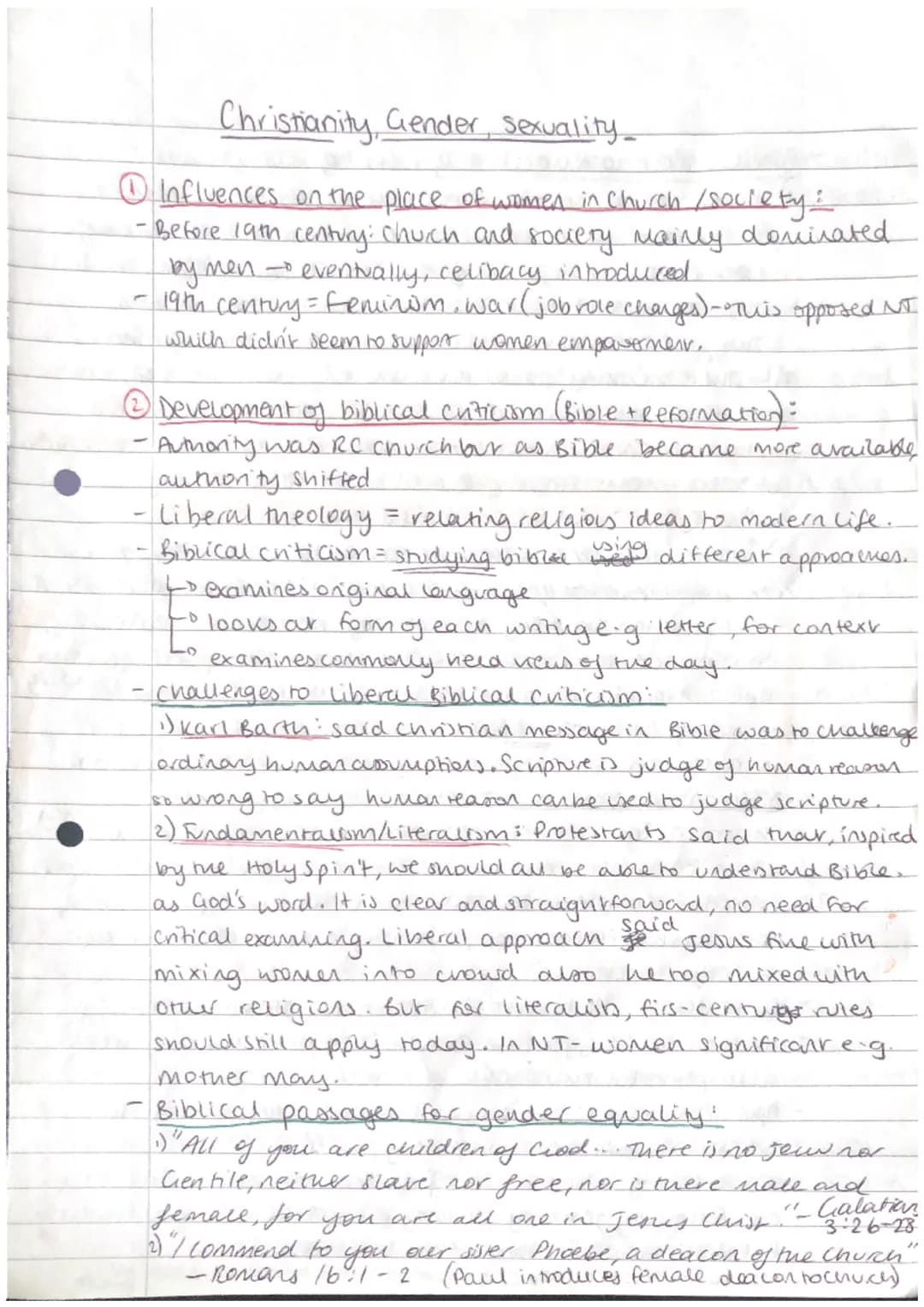
Historical Context and Biblical Criticism
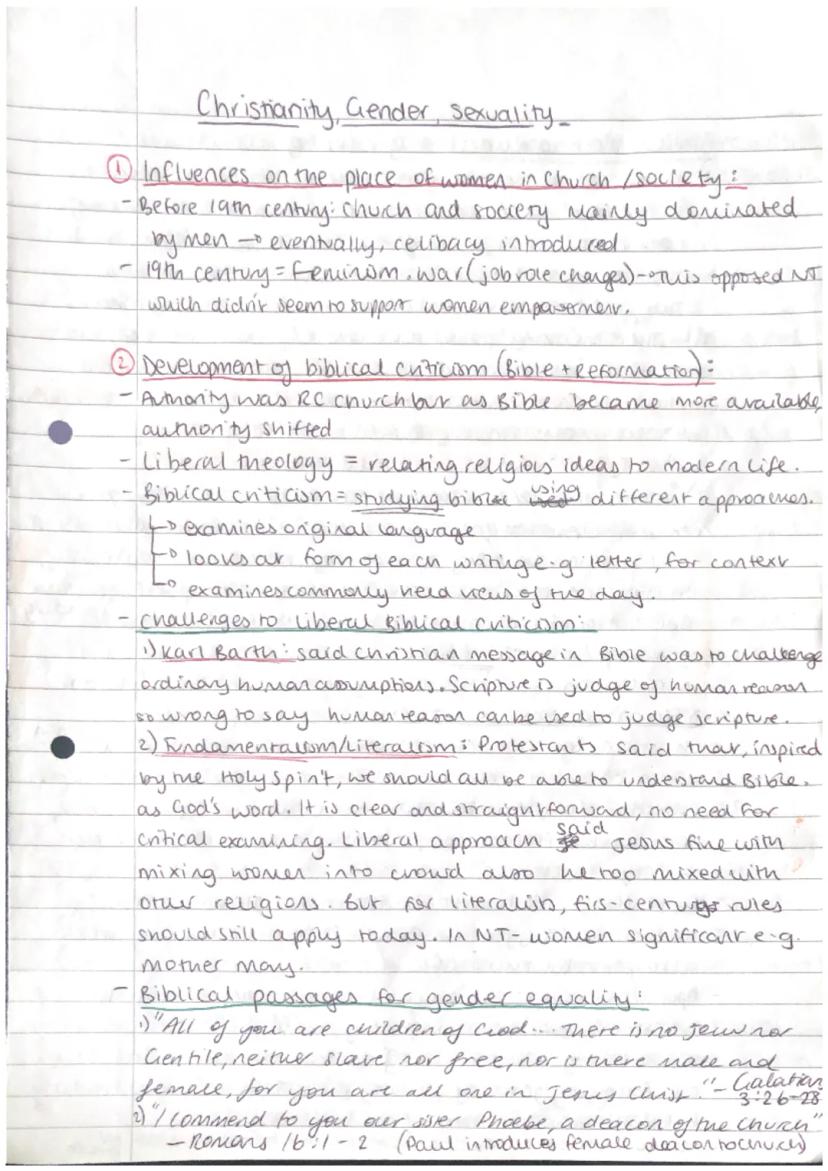
Christianity's approach to gender has transformed massively since the 19th century. Before then, male dominance in both church and society was largely unquestioned, with celibacy becoming the norm for religious leaders.
The rise of feminism and changing job roles during wartime challenged traditional interpretations of New Testament texts about women's roles. This sparked the development of biblical criticism - a method of studying scripture that examines original languages, literary forms, and historical context rather than taking everything at face value.
Liberal theology emerged, attempting to relate ancient religious ideas to modern life. However, this faced pushback from two directions: Karl Barth argued that human reason couldn't judge scripture, whilst fundamentalists insisted the Bible should be understood literally as God's clear, straightforward word.
Key Insight: The Bible contains seemingly contradictory messages about gender - Galatians 3:28 declares "there is neither male nor female" in Christ, whilst Romans 16:1-2 mentions Phoebe as a female deacon.
2
of 6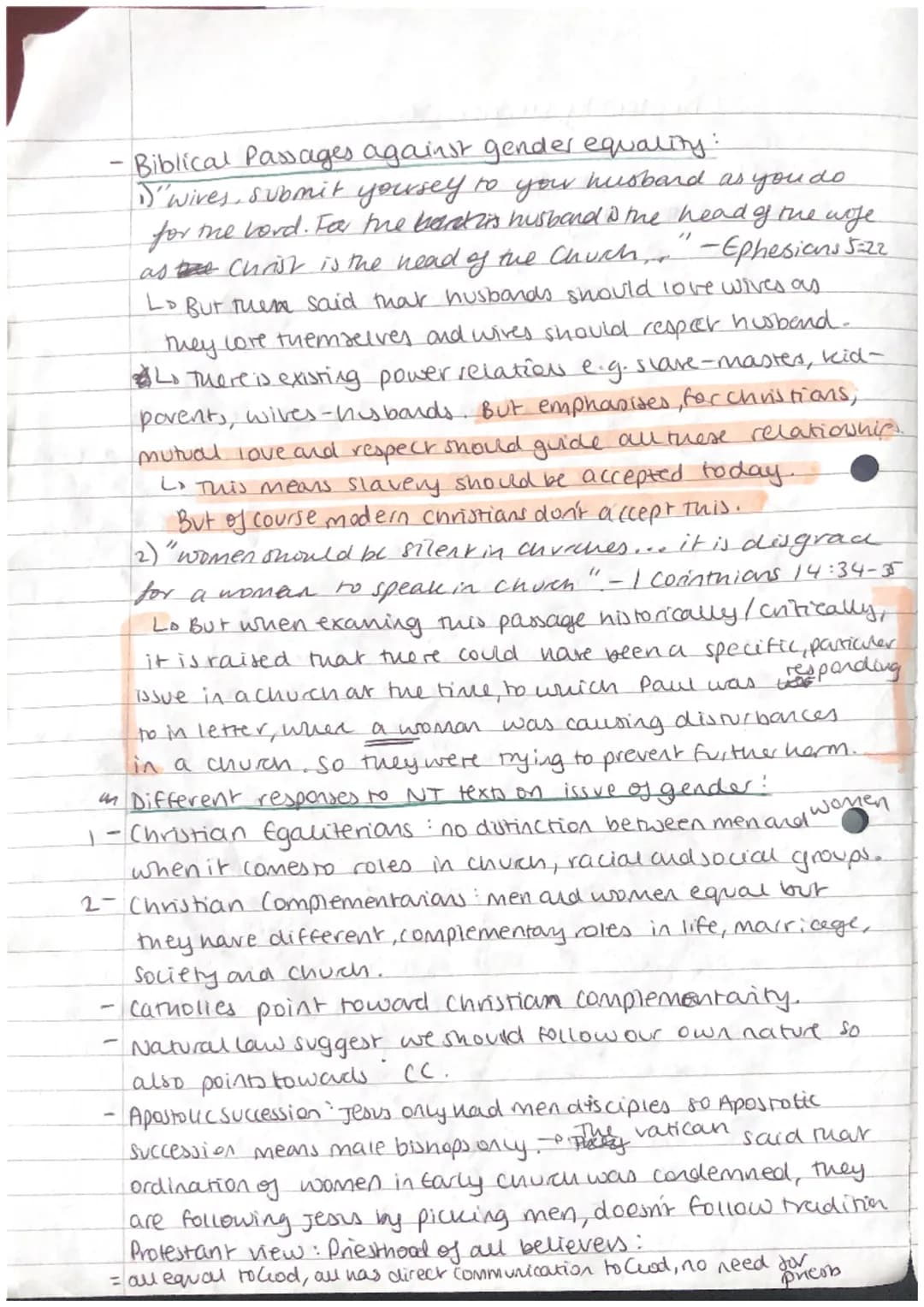
Conflicting Biblical Messages on Gender
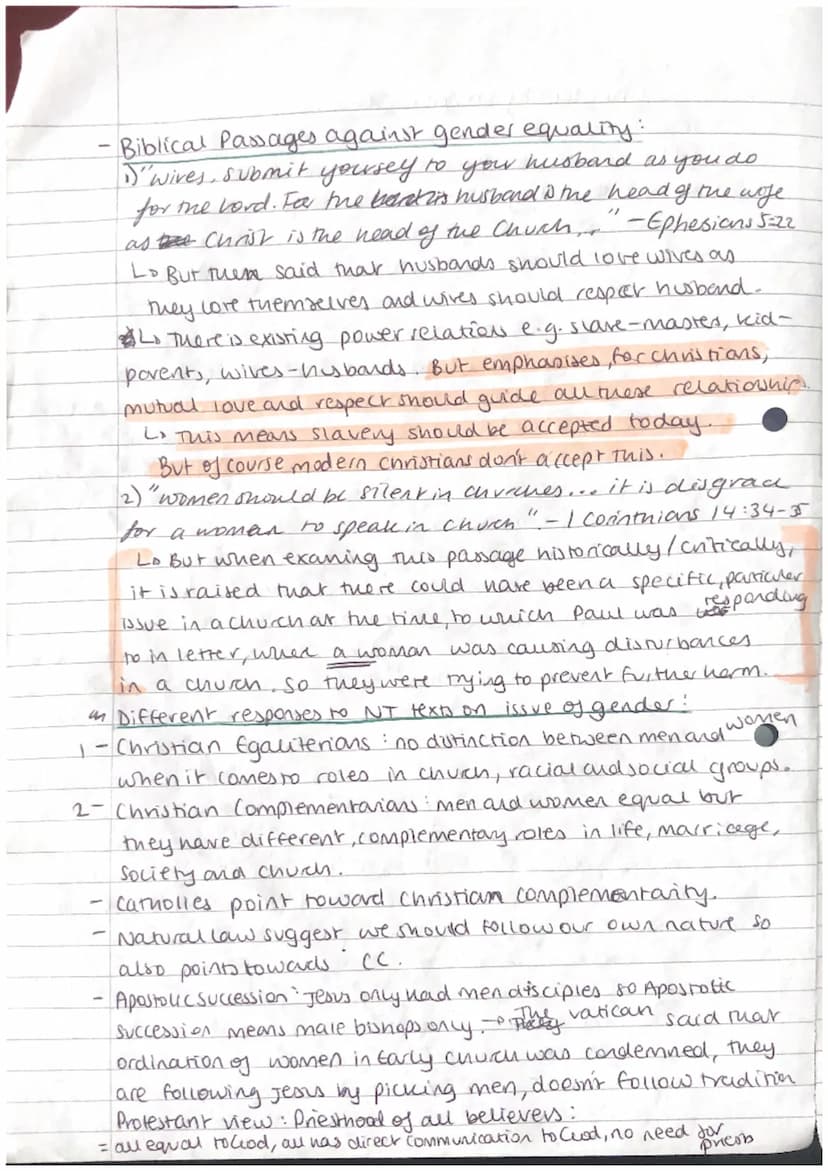
The New Testament presents a complex picture of women's roles that continues to divide Christians today. Ephesians 5:22 tells wives to "submit to your husbands," whilst 1 Corinthians 14:34-35 demands women remain "silent in churches."
However, these passages aren't as straightforward as they seem. The Ephesians text also emphasises mutual love and respect between spouses. The Corinthians passage might have addressed a specific disruption issue in one particular church, rather than establishing universal rules.
Modern Christians respond to these texts in two main ways. Christian Egalitarians see no distinction between men and women in church roles, believing gender equality reflects God's intent. Christian Complementarians argue men and women are equal but have different, complementary roles in life and church leadership.
Key Insight: Catholics point to apostolic succession - since Jesus chose only male disciples, they argue only men can become priests and bishops, maintaining this unbroken tradition.
The Protestant doctrine of "priesthood of all believers" suggests all Christians have equal access to God, potentially supporting greater gender equality in religious roles.
3
of 6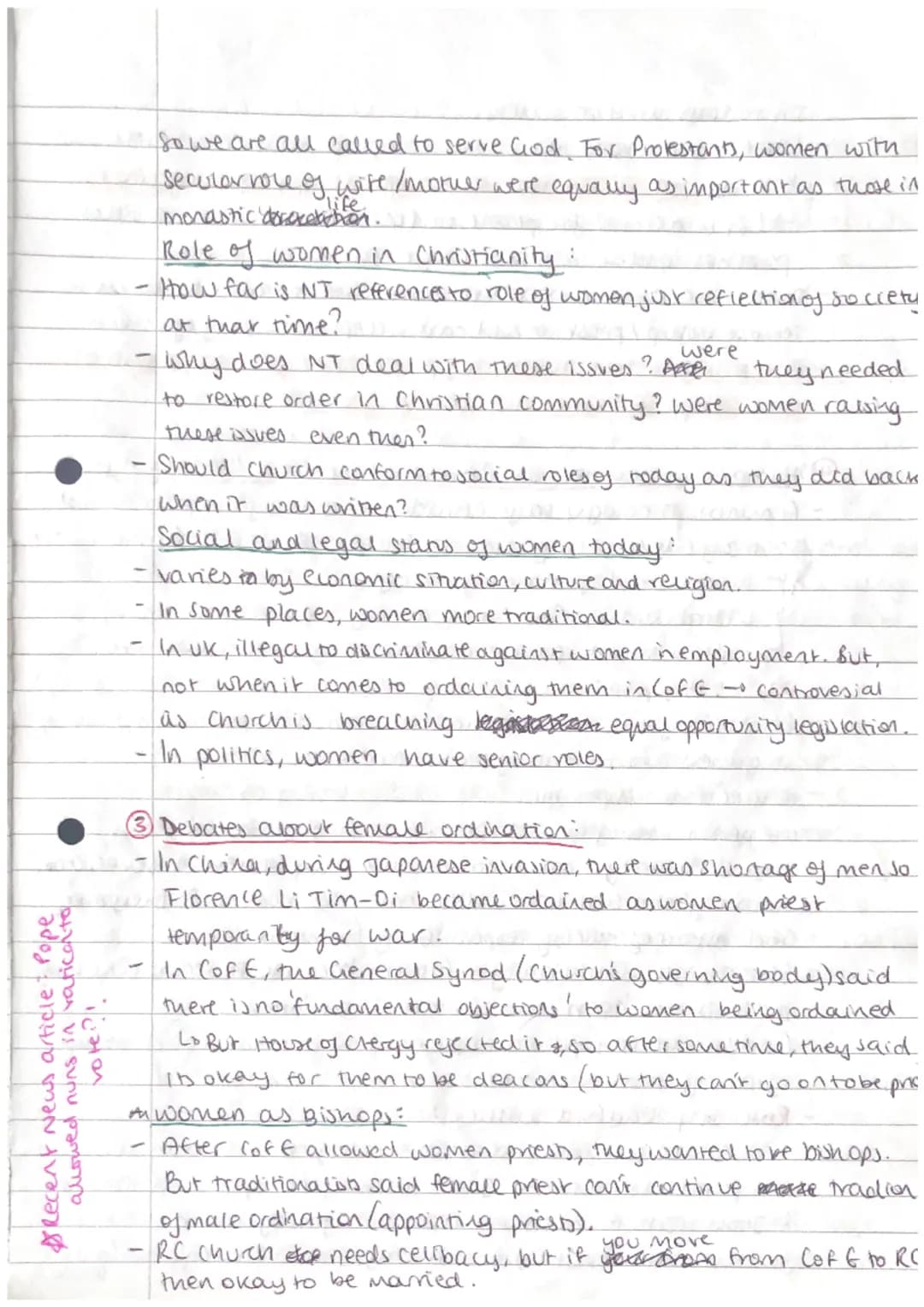
Women's Ordination and Modern Debates
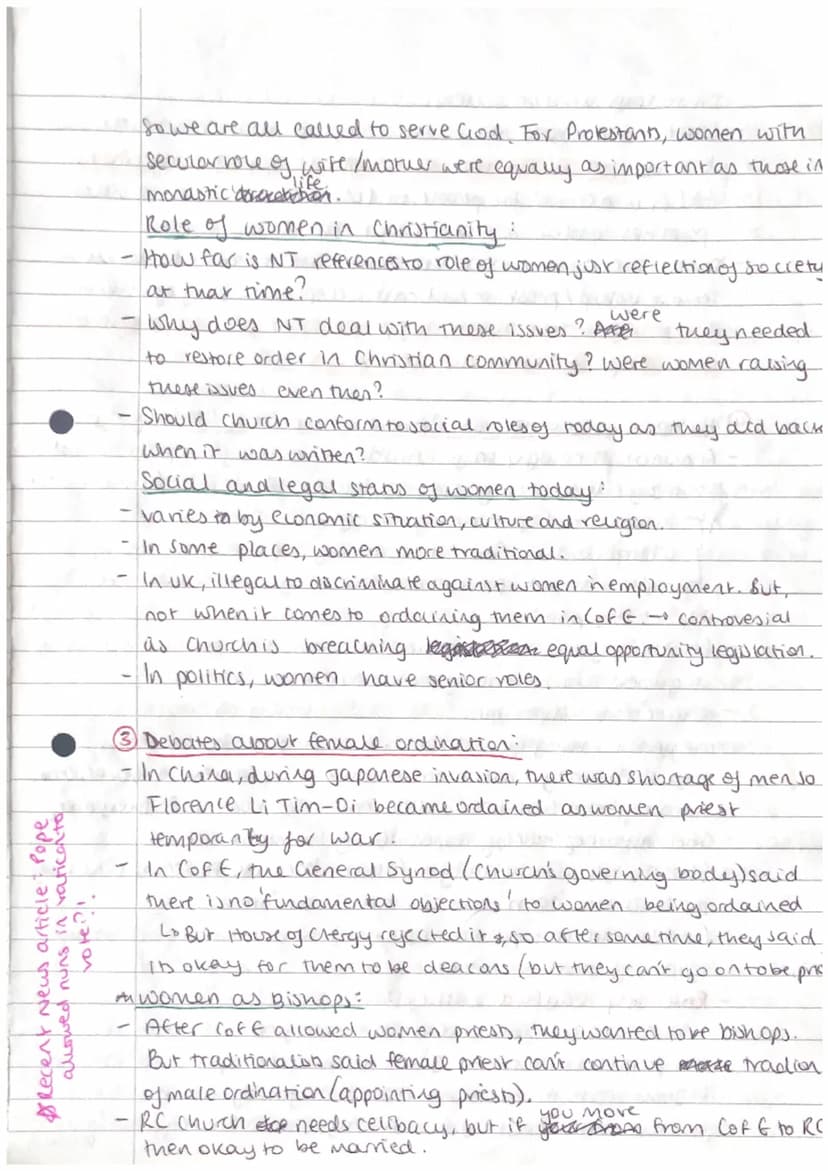
Understanding women's roles in Christianity requires examining whether New Testament references simply reflected first-century social norms. Were these teachings meant to restore order in early Christian communities, or do they establish permanent principles?
Today's social and legal status of women varies dramatically worldwide. In the UK, employment discrimination against women is illegal, yet the Church of England can still legally refuse to ordain women in certain roles, creating controversy about religious exemptions.
The ordination of women has followed a gradual path. Florence Li Tim-Oi became the first Anglican woman priest in China during wartime priest shortages. The Church of England's General Synod eventually approved women's ordination, though traditionalists argued female priests couldn't continue the apostolic tradition of male succession.
Key Insight: Even where women's ordination is officially accepted, individual communities may still resist, leading churches to provide alternative arrangements for those with conservative views.
Recent developments include the ordination of women as bishops, though this remains controversial. Interestingly, the Pope recently allowed nuns in the Vatican to vote - a small but significant step for the traditionally conservative Catholic Church.
4
of 6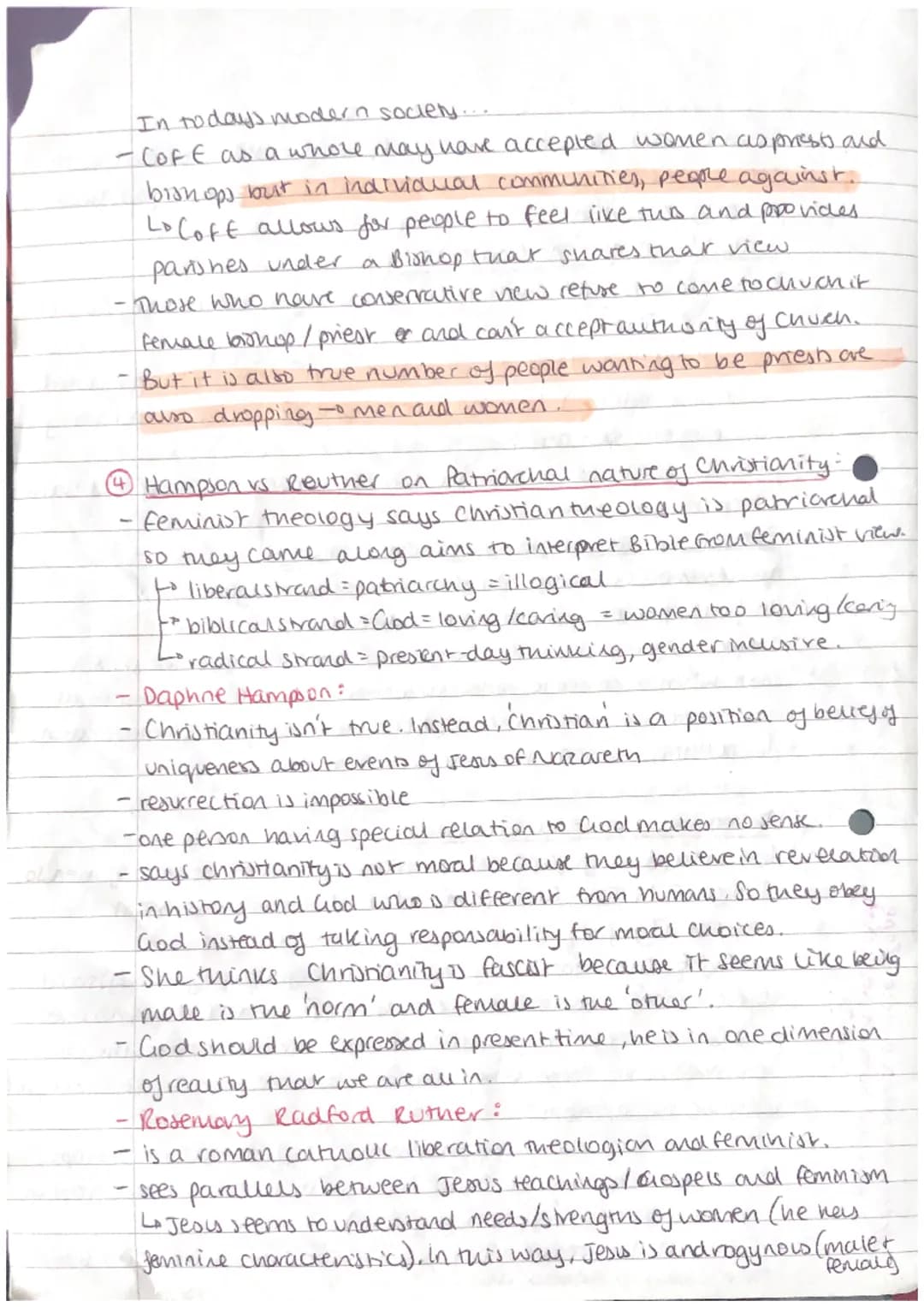
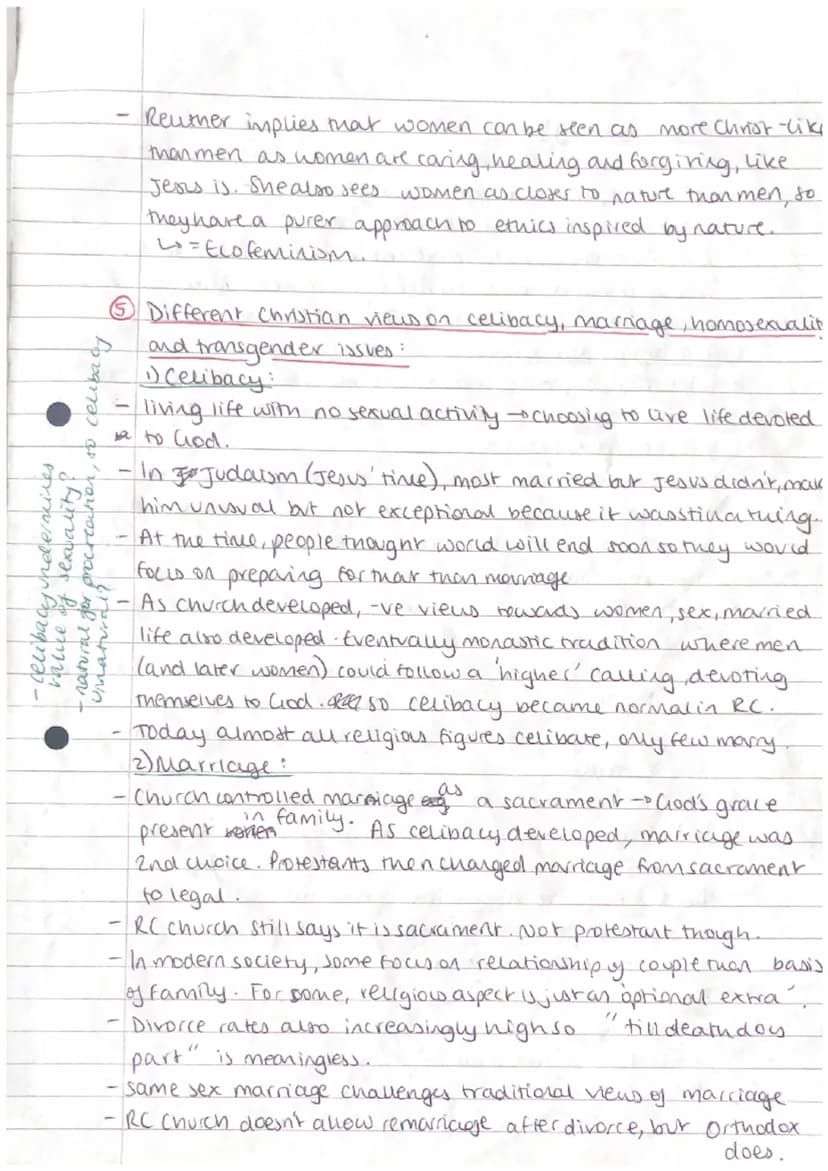
Feminist Theology: Hampson vs Ruether
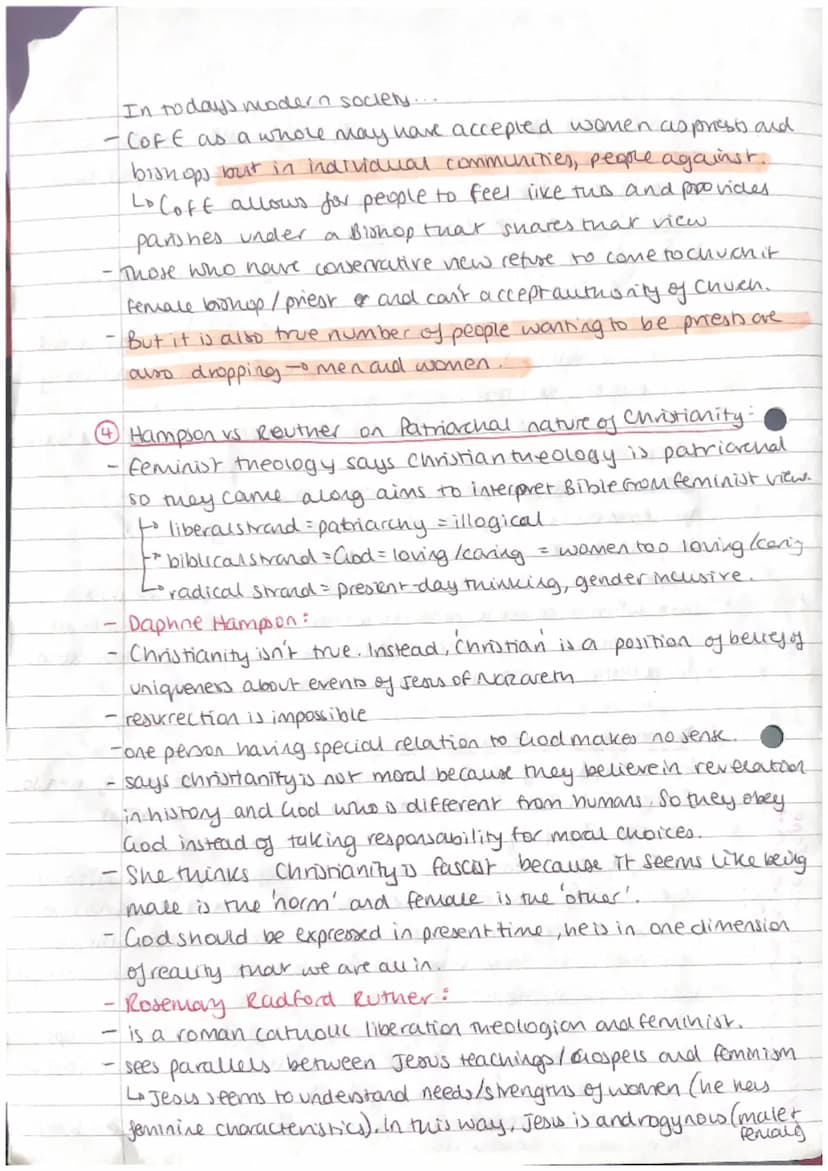
Feminist theology challenges Christianity's allegedly patriarchal nature, offering different approaches to interpreting scripture from women's perspectives. This movement includes liberal, biblical, and radical strands, each addressing gender inequality differently.
Daphne Hampson takes a radical stance, arguing Christianity itself is fundamentally flawed. She believes claims about Jesus's unique relationship with God are impossible, viewing resurrection as scientifically absurd. For Hampson, Christianity is "fascist" because it treats maleness as the norm and femaleness as "other."
Rosemary Radford Ruether offers a more hopeful perspective as a Catholic liberation theologian. She sees strong parallels between Jesus's teachings and feminist values, noting how Jesus displayed feminine characteristics like caring and healing. This makes Jesus androgynous - embodying both male and female qualities.
Key Insight: Ruether argues women might actually be more "Christ-like" than men because of their typically caring, healing, and forgiving nature - challenging traditional gender assumptions about religious leadership.
Ruether also connects feminism with environmental concerns through eco-feminism, suggesting women's closer relationship with nature gives them a purer ethical approach.
5
of 6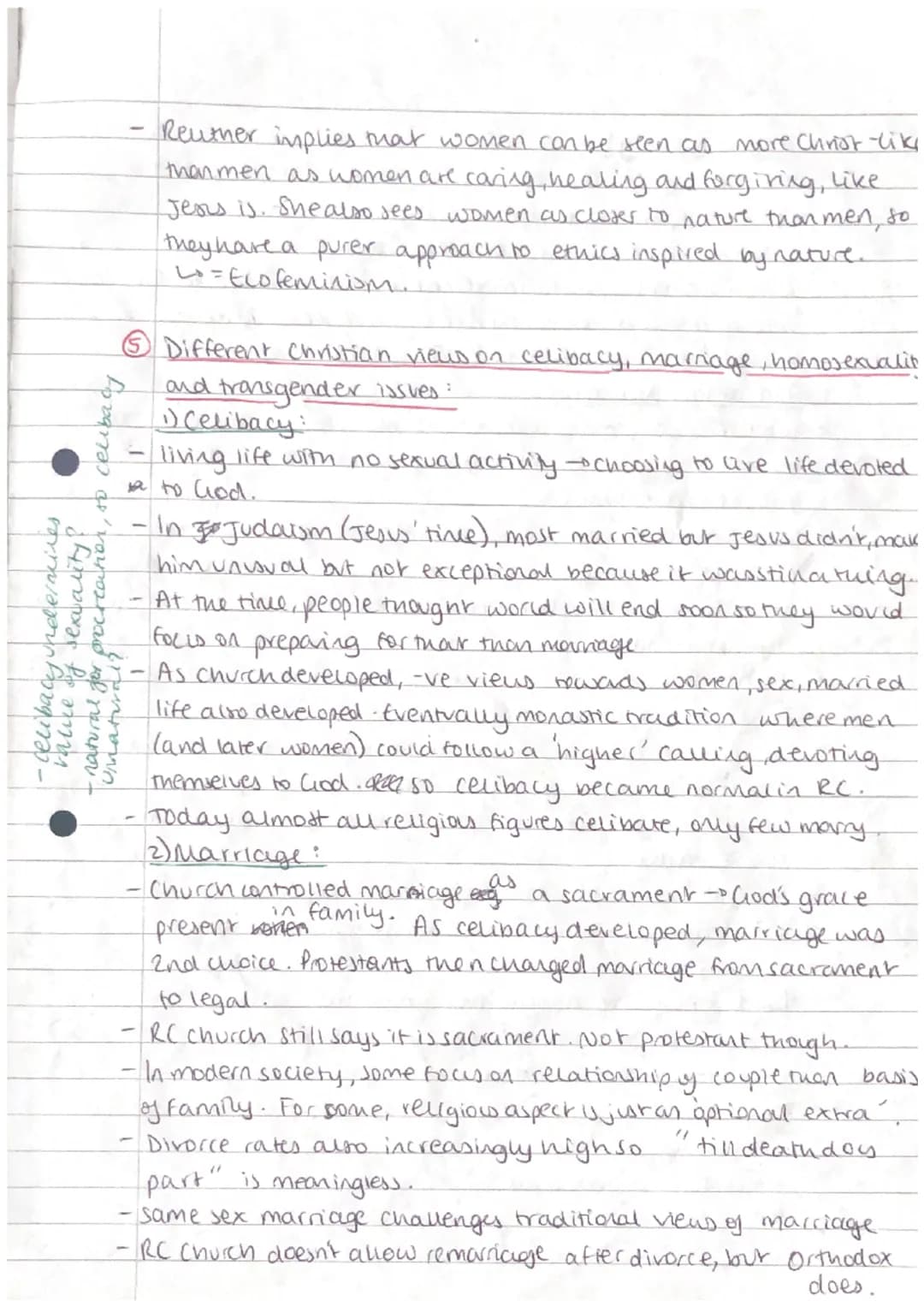
Marriage, Celibacy, and Changing Values
Christian attitudes toward celibacy and marriage have shifted dramatically throughout history. In Jesus's time, whilst most Jewish people married, remaining single to focus on spiritual matters wasn't unusual, especially when many believed the world would end soon.
As the church developed, increasingly negative views toward women, sex, and married life emerged. Monastic traditions established celibacy as a "higher calling," making it normal for Catholic religious figures whilst Protestants later elevated marriage from a legal contract to a sacred calling.
Modern society challenges traditional Christian marriage concepts. Divorce rates make "till death do us part" seem unrealistic to many, whilst same-sex marriage questions fundamental assumptions about family structure. The Catholic Church maintains marriage as a sacrament and prohibits remarriage after divorce, though Orthodox churches allow it.
Key Insight: Some modern Christians view marriage primarily as a relationship between two people, with religious aspects being merely "optional extras" rather than central to the institution.
These changing social attitudes force churches to reconsider whether their teachings should adapt to contemporary values or maintain traditional positions regardless of social pressure.
6
of 6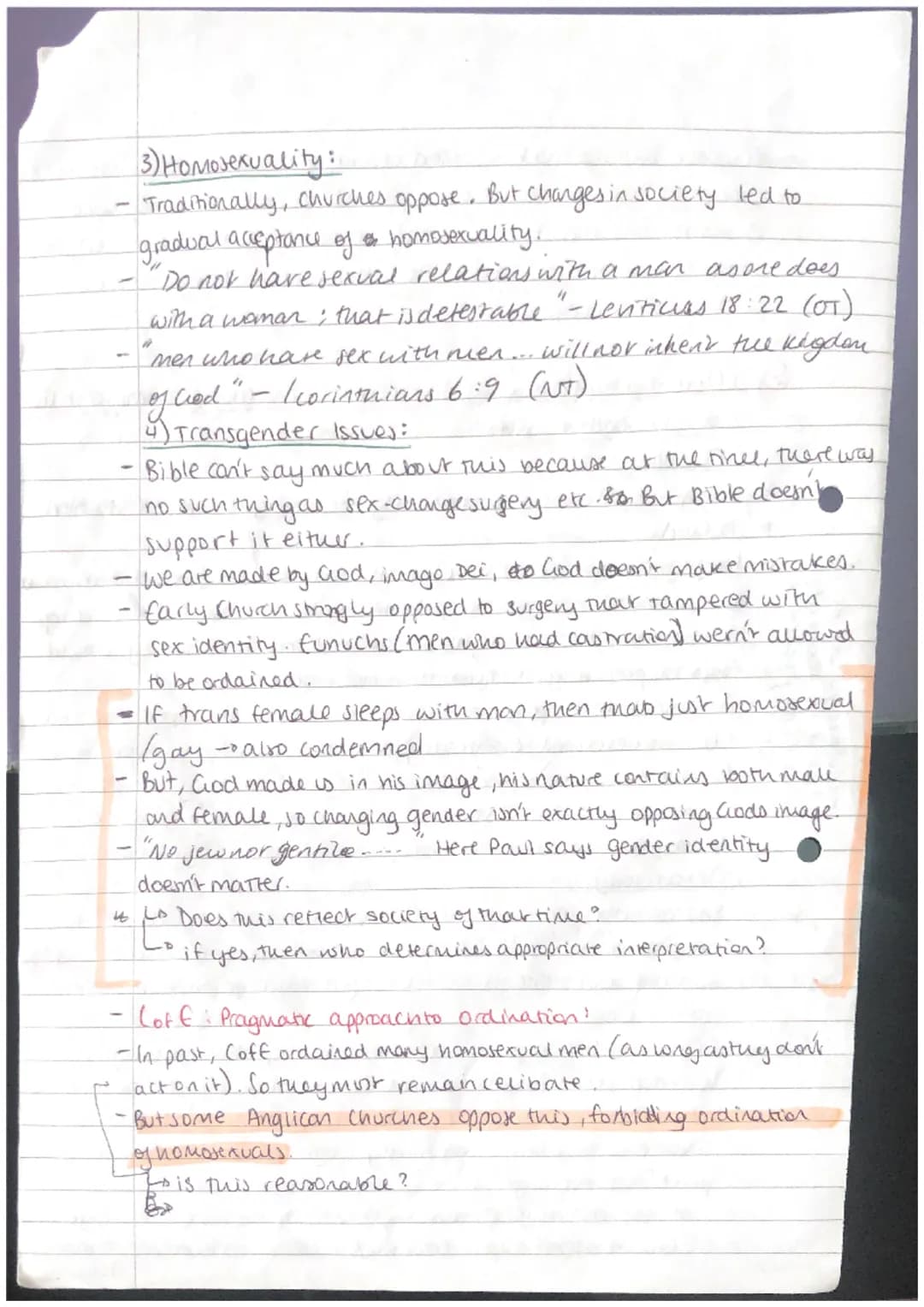
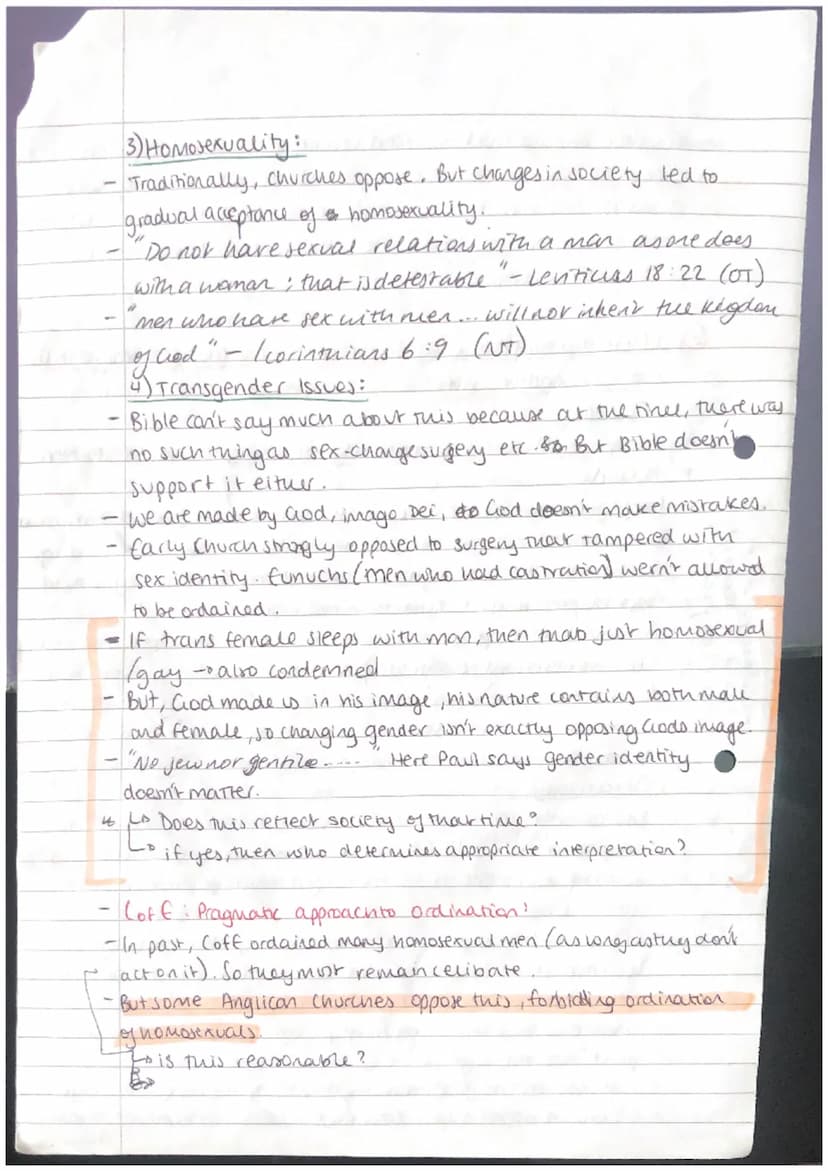
Contemporary Issues: Homosexuality and Transgender Questions
Traditional Christian churches have historically opposed homosexuality, citing Old Testament passages like Leviticus 18:22 calling male same-sex relations "detestable" and New Testament warnings about inheriting God's kingdom. However, social changes have led to gradual acceptance in some denominations.
Transgender issues present newer challenges since ancient texts couldn't address modern medical possibilities like gender transition surgery. Some Christians argue that being made "imago Dei" (in God's image) means God doesn't make mistakes about gender identity, whilst others note that God's nature contains both male and female characteristics.
The practical approach varies widely between denominations. The Church of England has historically ordained homosexual men who remain celibate, though some Anglican churches completely forbid homosexual ordination. This creates significant tensions within global Anglican communion.
Key Insight: Paul's declaration in Galatians that "there is neither Jew nor Gentile... neither male nor female" in Christ suggests gender identity might matter less than previously thought - but interpretation remains highly contested.
Churches must navigate between maintaining traditional teachings and responding to contemporary understanding of sexuality and gender identity, often leading to pragmatic compromises rather than clear theological positions.
We thought you’d never ask...
What is the Knowunity AI companion?
Our AI Companion is a student-focused AI tool that offers more than just answers. Built on millions of Knowunity resources, it provides relevant information, personalised study plans, quizzes, and content directly in the chat, adapting to your individual learning journey.
Where can I download the Knowunity app?
You can download the app from Google Play Store and Apple App Store.
Is Knowunity really free of charge?
That's right! Enjoy free access to study content, connect with fellow students, and get instant help – all at your fingertips.
Similar content
Most popular content: Christianity
9Religious StudiesReligious Perspectives on Relationships
Explore the intricate dynamics of relationships through the lens of religious teachings in this comprehensive study note. Covering key concepts such as family diversity, Christian and Islamic beliefs, ethics surrounding contraception and abortion, and the role of gender in faith, this resource is essential for understanding the moral philosophies that shape family life. Ideal for students preparing for the Eduqas Religious Studies exam.
974912
Religious StudiesRE - marriage and the family
Re marriage and the family
112096
Religious StudiesCore Christian Doctrines
Explore essential Christian beliefs including the Trinity, the nature of Jesus, the significance of the crucifixion, and concepts of salvation. This summary highlights key scripture references and theological insights, providing a comprehensive overview for students studying Christian teachings.
101,10917
Religious StudiesCore Christian Beliefs
Explore the foundational beliefs of Christianity, including the Trinity, salvation, and eschatology. This summary covers key concepts such as the life of Jesus, the significance of the Bible, and the moral teachings that guide Christian ethics. Ideal for students seeking a comprehensive overview of Christian doctrine and practices.
125547
Religious StudiesChristianity: Marriage & Divorce
Explore key concepts of marriage and divorce within Christianity, including teachings on adultery, roles of men and women, and the significance of monogamy. This mindmap provides essential quotes, definitions, and insights for Year 10 and 11 GCSE students, aiding in quick revision of Christian beliefs and teachings.
113,04932
Religious StudiesRelationships & Families Overview
Explore the key concepts of Relationships and Families in Christianity and Islam. This summary covers views on marriage, family structure, sexuality, and parental responsibilities, highlighting the differences and similarities between the two religions. Ideal for GCSE RS students studying AQA curriculum.
101,51415
Religious StudiesRelationships & Families Overview
Comprehensive revision notes covering key themes in Relationships and Families for AQA GCSE. Explore topics such as Human Sexuality, Marriage, Divorce, Contraception, Family Dynamics, and Gender Equality, along with relevant quotes for deeper understanding.
91,77446
Religious StudiesReligion, Justice & Environment
Explore the intersections of religion, justice, and environmental science in this comprehensive study note. Covering key concepts such as Just War Theory, Islamic teachings, crime and punishment, and the impact of human actions on the environment, this resource is essential for understanding the moral frameworks within Christianity and Islam. Ideal for students preparing for RE Paper 2.
113596
Religious StudiesCore Christian Beliefs
Explore essential Christian beliefs and teachings, including the nature of God, the Trinity, the significance of Jesus' crucifixion and resurrection, and concepts of sin, salvation, and the afterlife. This comprehensive summary is designed for students studying Christianity, providing clear insights into key doctrines and their implications for faith and practice.
960612
Most popular content in Religious Studies
9C
Religious StudiesChristianity keywords
Help, remember these keywords with this quiz
95371
 Humanities
Religious Studies Quote Bank
Christianity and Islam Paper 1 and Paper 2 Quotes.
1076213
I
Religious Studiesislam
you need to do this test supper easy and fun
73470
Religious StudiesChristianity: Core Beliefs
Explore essential Christian beliefs including the Nature of God, the Trinity, Creation, Incarnation, Crucifixion, Resurrection, and concepts of Heaven, Hell, and Salvation. This comprehensive summary provides key quotes and insights for AQA GCSE revision.
95,342184
E
Religious StudiesExploring World Religions: A Comprehensive Study Guide
Master the diverse beliefs, practices, and traditions of major world religions with this in-depth study guide for religious studies.
111930
R
Religious StudiesR.E Judaism questions quiz
Quiz on random Judaism R.E questions
92614
J
Religious StudiesJudaism ✡️
Key concepts in Judaism including the Covenant, Shekhinah, Messiah, and Torah for GCSE Religious Studies.
102370
Religious StudiesCore Islamic Practices
Explore the essential Islamic practices including the Five Pillars of Islam, the significance of Ramadan, Jihad, and the importance of Hajj. This summary provides insights into key beliefs, rituals, and festivals that shape the Muslim faith, tailored for AQA GCSE Religious Studies. Enhance your understanding of Islamic teachings and community values.
113,943144
C
Religious StudiesChristianity comp 2
Core Christian concepts including evangelism, sacraments, and the resurrection of Jesus.
111370
Most popular content
9 Sociology
Sociology of Education Overview
Explore comprehensive A-Level Sociology notes on the education system, covering key theories, policies, and sociological perspectives. This resource includes insights on marketisation, gender roles, cultural deprivation, and educational inequalities, providing a thorough understanding of how education shapes social stratification and individual achievement. Ideal for exam preparation and in-depth study.
12102,8113,040
SociologySociology of Families: Comprehensive Revision
Dive into an extensive overview of family dynamics, perspectives, and patterns in sociology. This resource covers key concepts such as family diversity, gender roles, marriage, and the impact of social policies on family structures. Perfect for A-Level Sociology students preparing for Paper 2.
1273,5592,306
CriminologyCriminology: Crime & Punishment Overview
Comprehensive mindmaps covering key concepts in the Crime and Punishment topic for WJEC Criminology Unit 4. This resource includes detailed insights into the Criminal Justice System, crime prevention strategies, sentencing models, and the roles of various agencies. Ideal for A-Level revision, ensuring you grasp essential theories and legislative processes to excel in your exams.
1254,8531,059
SociologyComprehensive Crime & Deviance Overview
Explore an extensive revision of crime and deviance topics, including theories, types of crime, and the impact of media. This resource covers key concepts such as Marxism, functionalism, gender and crime, and the influence of globalization on criminal behavior. Ideal for students seeking a thorough understanding of criminology and its various theories. Type: Full Topic Revision.
1251,6321,399
 English Literature
An Inspector Calls: Character Insights
Explore in-depth analysis and key quotes for characters in J.B. Priestley's 'An Inspector Calls'. This resource covers Gerald Croft, Inspector Goole, Sheila Birling, Mrs. Birling, Eric Birling, and Eva Smith, focusing on themes of class, gender roles, and social responsibility. Ideal for students aiming for Grade 8 and above.
1025,412907
CriminologyWJEC Unit 4 Criminology
Criminology unit 4 detailed revision note
127,146125
C
 Biology
Cell Biology and Cell structure
cell structures
93,1870
CriminologyCriminology Theories Overview
Explore key criminology theories and their implications on crime and deviance. This comprehensive summary covers biological, psychological, and sociological perspectives, including labelling theory, right realism, and the impact of social campaigns on policy development. Ideal for A-Level criminology students seeking to understand the complexities of criminal behaviour and the factors influencing crime prevention strategies.
129,754210
English LiteratureRomeo and Juliet: Key themes
Key Romeo and Juliet themes and analysed quotes
106,695198
Can't find what you're looking for? Explore other subjects.
Students love us — and so will you.
4.6/5App Store
4.7/5Google Play
The app is very easy to use and well designed. I have found everything I was looking for so far and have been able to learn a lot from the presentations! I will definitely use the app for a class assignment! And of course it also helps a lot as an inspiration.
Stefan SiOS user
This app is really great. There are so many study notes and help [...]. My problem subject is French, for example, and the app has so many options for help. Thanks to this app, I have improved my French. I would recommend it to anyone.
Samantha KlichAndroid user
Wow, I am really amazed. I just tried the app because I've seen it advertised many times and was absolutely stunned. This app is THE HELP you want for school and above all, it offers so many things, such as workouts and fact sheets, which have been VERY helpful to me personally.
AnnaiOS user
Religious Studies275 views·Updated Jun 17, 2026·6 pagesAQA RS - Christianity: Gender and Sexuality Notes
Poppy@poppy_vyjp
Christianity's relationship with gender and sexuality has evolved dramatically over the centuries. These changes reflect both theological developments and shifting social attitudes, creating ongoing debates about women's roles, ordination, marriage, and LGBTQ+ issues within different Christian traditions.
1
of 6
Sign up to see the content. It's free!
- Access to all documents
- Improve your grades
- Join milions of students
Historical Context and Biblical Criticism
Christianity's approach to gender has transformed massively since the 19th century. Before then, male dominance in both church and society was largely unquestioned, with celibacy becoming the norm for religious leaders.
The rise of feminism and changing job roles during wartime challenged traditional interpretations of New Testament texts about women's roles. This sparked the development of biblical criticism - a method of studying scripture that examines original languages, literary forms, and historical context rather than taking everything at face value.
Liberal theology emerged, attempting to relate ancient religious ideas to modern life. However, this faced pushback from two directions: Karl Barth argued that human reason couldn't judge scripture, whilst fundamentalists insisted the Bible should be understood literally as God's clear, straightforward word.
Key Insight: The Bible contains seemingly contradictory messages about gender - Galatians 3:28 declares "there is neither male nor female" in Christ, whilst Romans 16:1-2 mentions Phoebe as a female deacon.
2
of 6Sign up to see the content. It's free!
- Access to all documents
- Improve your grades
- Join milions of students
Conflicting Biblical Messages on Gender
The New Testament presents a complex picture of women's roles that continues to divide Christians today. Ephesians 5:22 tells wives to "submit to your husbands," whilst 1 Corinthians 14:34-35 demands women remain "silent in churches."
However, these passages aren't as straightforward as they seem. The Ephesians text also emphasises mutual love and respect between spouses. The Corinthians passage might have addressed a specific disruption issue in one particular church, rather than establishing universal rules.
Modern Christians respond to these texts in two main ways. Christian Egalitarians see no distinction between men and women in church roles, believing gender equality reflects God's intent. Christian Complementarians argue men and women are equal but have different, complementary roles in life and church leadership.
Key Insight: Catholics point to apostolic succession - since Jesus chose only male disciples, they argue only men can become priests and bishops, maintaining this unbroken tradition.
The Protestant doctrine of "priesthood of all believers" suggests all Christians have equal access to God, potentially supporting greater gender equality in religious roles.
3
of 6Sign up to see the content. It's free!
- Access to all documents
- Improve your grades
- Join milions of students
Women's Ordination and Modern Debates
Understanding women's roles in Christianity requires examining whether New Testament references simply reflected first-century social norms. Were these teachings meant to restore order in early Christian communities, or do they establish permanent principles?
Today's social and legal status of women varies dramatically worldwide. In the UK, employment discrimination against women is illegal, yet the Church of England can still legally refuse to ordain women in certain roles, creating controversy about religious exemptions.
The ordination of women has followed a gradual path. Florence Li Tim-Oi became the first Anglican woman priest in China during wartime priest shortages. The Church of England's General Synod eventually approved women's ordination, though traditionalists argued female priests couldn't continue the apostolic tradition of male succession.
Key Insight: Even where women's ordination is officially accepted, individual communities may still resist, leading churches to provide alternative arrangements for those with conservative views.
Recent developments include the ordination of women as bishops, though this remains controversial. Interestingly, the Pope recently allowed nuns in the Vatican to vote - a small but significant step for the traditionally conservative Catholic Church.
4
of 6Sign up to see the content. It's free!
- Access to all documents
- Improve your grades
- Join milions of students
Feminist Theology: Hampson vs Ruether
Feminist theology challenges Christianity's allegedly patriarchal nature, offering different approaches to interpreting scripture from women's perspectives. This movement includes liberal, biblical, and radical strands, each addressing gender inequality differently.
Daphne Hampson takes a radical stance, arguing Christianity itself is fundamentally flawed. She believes claims about Jesus's unique relationship with God are impossible, viewing resurrection as scientifically absurd. For Hampson, Christianity is "fascist" because it treats maleness as the norm and femaleness as "other."
Rosemary Radford Ruether offers a more hopeful perspective as a Catholic liberation theologian. She sees strong parallels between Jesus's teachings and feminist values, noting how Jesus displayed feminine characteristics like caring and healing. This makes Jesus androgynous - embodying both male and female qualities.
Key Insight: Ruether argues women might actually be more "Christ-like" than men because of their typically caring, healing, and forgiving nature - challenging traditional gender assumptions about religious leadership.
Ruether also connects feminism with environmental concerns through eco-feminism, suggesting women's closer relationship with nature gives them a purer ethical approach.
5
of 6Sign up to see the content. It's free!
- Access to all documents
- Improve your grades
- Join milions of students
Marriage, Celibacy, and Changing Values
Christian attitudes toward celibacy and marriage have shifted dramatically throughout history. In Jesus's time, whilst most Jewish people married, remaining single to focus on spiritual matters wasn't unusual, especially when many believed the world would end soon.
As the church developed, increasingly negative views toward women, sex, and married life emerged. Monastic traditions established celibacy as a "higher calling," making it normal for Catholic religious figures whilst Protestants later elevated marriage from a legal contract to a sacred calling.
Modern society challenges traditional Christian marriage concepts. Divorce rates make "till death do us part" seem unrealistic to many, whilst same-sex marriage questions fundamental assumptions about family structure. The Catholic Church maintains marriage as a sacrament and prohibits remarriage after divorce, though Orthodox churches allow it.
Key Insight: Some modern Christians view marriage primarily as a relationship between two people, with religious aspects being merely "optional extras" rather than central to the institution.
These changing social attitudes force churches to reconsider whether their teachings should adapt to contemporary values or maintain traditional positions regardless of social pressure.
6
of 6Sign up to see the content. It's free!
- Access to all documents
- Improve your grades
- Join milions of students
Contemporary Issues: Homosexuality and Transgender Questions
Traditional Christian churches have historically opposed homosexuality, citing Old Testament passages like Leviticus 18:22 calling male same-sex relations "detestable" and New Testament warnings about inheriting God's kingdom. However, social changes have led to gradual acceptance in some denominations.
Transgender issues present newer challenges since ancient texts couldn't address modern medical possibilities like gender transition surgery. Some Christians argue that being made "imago Dei" (in God's image) means God doesn't make mistakes about gender identity, whilst others note that God's nature contains both male and female characteristics.
The practical approach varies widely between denominations. The Church of England has historically ordained homosexual men who remain celibate, though some Anglican churches completely forbid homosexual ordination. This creates significant tensions within global Anglican communion.
Key Insight: Paul's declaration in Galatians that "there is neither Jew nor Gentile... neither male nor female" in Christ suggests gender identity might matter less than previously thought - but interpretation remains highly contested.
Churches must navigate between maintaining traditional teachings and responding to contemporary understanding of sexuality and gender identity, often leading to pragmatic compromises rather than clear theological positions.
We thought you’d never ask...
What is the Knowunity AI companion?
Our AI Companion is a student-focused AI tool that offers more than just answers. Built on millions of Knowunity resources, it provides relevant information, personalised study plans, quizzes, and content directly in the chat, adapting to your individual learning journey.
Where can I download the Knowunity app?
You can download the app from Google Play Store and Apple App Store.
Is Knowunity really free of charge?
That's right! Enjoy free access to study content, connect with fellow students, and get instant help – all at your fingertips.
Similar content
Most popular content: Christianity
9Religious StudiesReligious Perspectives on Relationships
Explore the intricate dynamics of relationships through the lens of religious teachings in this comprehensive study note. Covering key concepts such as family diversity, Christian and Islamic beliefs, ethics surrounding contraception and abortion, and the role of gender in faith, this resource is essential for understanding the moral philosophies that shape family life. Ideal for students preparing for the Eduqas Religious Studies exam.
974912
Religious StudiesRE - marriage and the family
Re marriage and the family
112096
Religious StudiesCore Christian Doctrines
Explore essential Christian beliefs including the Trinity, the nature of Jesus, the significance of the crucifixion, and concepts of salvation. This summary highlights key scripture references and theological insights, providing a comprehensive overview for students studying Christian teachings.
101,10917
Religious StudiesCore Christian Beliefs
Explore the foundational beliefs of Christianity, including the Trinity, salvation, and eschatology. This summary covers key concepts such as the life of Jesus, the significance of the Bible, and the moral teachings that guide Christian ethics. Ideal for students seeking a comprehensive overview of Christian doctrine and practices.
125547
Religious StudiesChristianity: Marriage & Divorce
Explore key concepts of marriage and divorce within Christianity, including teachings on adultery, roles of men and women, and the significance of monogamy. This mindmap provides essential quotes, definitions, and insights for Year 10 and 11 GCSE students, aiding in quick revision of Christian beliefs and teachings.
113,04932
Religious StudiesRelationships & Families Overview
Explore the key concepts of Relationships and Families in Christianity and Islam. This summary covers views on marriage, family structure, sexuality, and parental responsibilities, highlighting the differences and similarities between the two religions. Ideal for GCSE RS students studying AQA curriculum.
101,51415
Religious StudiesRelationships & Families Overview
Comprehensive revision notes covering key themes in Relationships and Families for AQA GCSE. Explore topics such as Human Sexuality, Marriage, Divorce, Contraception, Family Dynamics, and Gender Equality, along with relevant quotes for deeper understanding.
91,77446
Religious StudiesReligion, Justice & Environment
Explore the intersections of religion, justice, and environmental science in this comprehensive study note. Covering key concepts such as Just War Theory, Islamic teachings, crime and punishment, and the impact of human actions on the environment, this resource is essential for understanding the moral frameworks within Christianity and Islam. Ideal for students preparing for RE Paper 2.
113596
Religious StudiesCore Christian Beliefs
Explore essential Christian beliefs and teachings, including the nature of God, the Trinity, the significance of Jesus' crucifixion and resurrection, and concepts of sin, salvation, and the afterlife. This comprehensive summary is designed for students studying Christianity, providing clear insights into key doctrines and their implications for faith and practice.
960612
Most popular content in Religious Studies
9C
Religious StudiesChristianity keywords
Help, remember these keywords with this quiz
95371
HumanitiesReligious Studies Quote Bank
Christianity and Islam Paper 1 and Paper 2 Quotes.
1076213
I
Religious Studiesislam
you need to do this test supper easy and fun
73470
Religious StudiesChristianity: Core Beliefs
Explore essential Christian beliefs including the Nature of God, the Trinity, Creation, Incarnation, Crucifixion, Resurrection, and concepts of Heaven, Hell, and Salvation. This comprehensive summary provides key quotes and insights for AQA GCSE revision.
95,342184
E
Religious StudiesExploring World Religions: A Comprehensive Study Guide
Master the diverse beliefs, practices, and traditions of major world religions with this in-depth study guide for religious studies.
111930
R
Religious StudiesR.E Judaism questions quiz
Quiz on random Judaism R.E questions
92614
J
Religious StudiesJudaism ✡️
Key concepts in Judaism including the Covenant, Shekhinah, Messiah, and Torah for GCSE Religious Studies.
102370
Religious StudiesCore Islamic Practices
Explore the essential Islamic practices including the Five Pillars of Islam, the significance of Ramadan, Jihad, and the importance of Hajj. This summary provides insights into key beliefs, rituals, and festivals that shape the Muslim faith, tailored for AQA GCSE Religious Studies. Enhance your understanding of Islamic teachings and community values.
113,943144
C
Religious StudiesChristianity comp 2
Core Christian concepts including evangelism, sacraments, and the resurrection of Jesus.
111370
Most popular content
9SociologySociology of Education Overview
Explore comprehensive A-Level Sociology notes on the education system, covering key theories, policies, and sociological perspectives. This resource includes insights on marketisation, gender roles, cultural deprivation, and educational inequalities, providing a thorough understanding of how education shapes social stratification and individual achievement. Ideal for exam preparation and in-depth study.
12102,8113,040
SociologySociology of Families: Comprehensive Revision
Dive into an extensive overview of family dynamics, perspectives, and patterns in sociology. This resource covers key concepts such as family diversity, gender roles, marriage, and the impact of social policies on family structures. Perfect for A-Level Sociology students preparing for Paper 2.
1273,5592,306
CriminologyCriminology: Crime & Punishment Overview
Comprehensive mindmaps covering key concepts in the Crime and Punishment topic for WJEC Criminology Unit 4. This resource includes detailed insights into the Criminal Justice System, crime prevention strategies, sentencing models, and the roles of various agencies. Ideal for A-Level revision, ensuring you grasp essential theories and legislative processes to excel in your exams.
1254,8531,059
SociologyComprehensive Crime & Deviance Overview
Explore an extensive revision of crime and deviance topics, including theories, types of crime, and the impact of media. This resource covers key concepts such as Marxism, functionalism, gender and crime, and the influence of globalization on criminal behavior. Ideal for students seeking a thorough understanding of criminology and its various theories. Type: Full Topic Revision.
1251,6321,399
English LiteratureAn Inspector Calls: Character Insights
Explore in-depth analysis and key quotes for characters in J.B. Priestley's 'An Inspector Calls'. This resource covers Gerald Croft, Inspector Goole, Sheila Birling, Mrs. Birling, Eric Birling, and Eva Smith, focusing on themes of class, gender roles, and social responsibility. Ideal for students aiming for Grade 8 and above.
1025,412907
CriminologyWJEC Unit 4 Criminology
Criminology unit 4 detailed revision note
127,146125
C
BiologyCell Biology and Cell structure
cell structures
93,1870
CriminologyCriminology Theories Overview
Explore key criminology theories and their implications on crime and deviance. This comprehensive summary covers biological, psychological, and sociological perspectives, including labelling theory, right realism, and the impact of social campaigns on policy development. Ideal for A-Level criminology students seeking to understand the complexities of criminal behaviour and the factors influencing crime prevention strategies.
129,754210
English LiteratureRomeo and Juliet: Key themes
Key Romeo and Juliet themes and analysed quotes
106,695198
Can't find what you're looking for? Explore other subjects.
Students love us — and so will you.
4.6/5App Store
4.7/5Google Play
The app is very easy to use and well designed. I have found everything I was looking for so far and have been able to learn a lot from the presentations! I will definitely use the app for a class assignment! And of course it also helps a lot as an inspiration.
Stefan SiOS user
This app is really great. There are so many study notes and help [...]. My problem subject is French, for example, and the app has so many options for help. Thanks to this app, I have improved my French. I would recommend it to anyone.
Samantha KlichAndroid user
Wow, I am really amazed. I just tried the app because I've seen it advertised many times and was absolutely stunned. This app is THE HELP you want for school and above all, it offers so many things, such as workouts and fact sheets, which have been VERY helpful to me personally.
AnnaiOS user