
The document explains how to investigate current voltage graphsfor...
 Physics194 views·Updated May 28, 2026·2 pages
Easy Guide: Current-Voltage Graphs for Resistors, Bulbs, and Diodes
1
of 2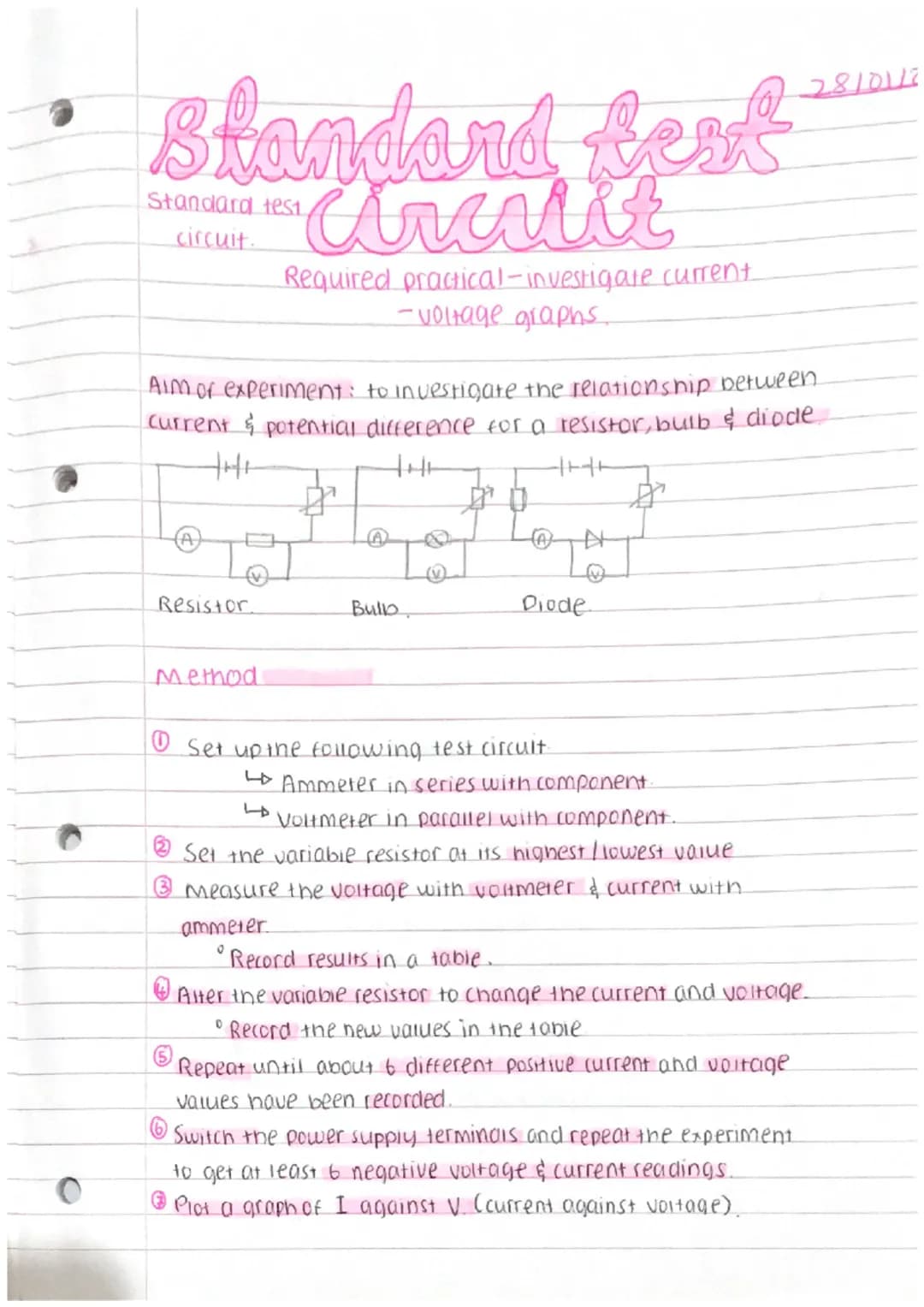
Analysis of Current-Voltage Graphs for Different Components
This page presents the current-voltage graphs for a resistor, filament lamp (bulb), and diode, along with evaluations of their characteristics.
For a resistor:
- The graph is a straight line passing through the origin.
- Potential difference is directly proportional to current, following Ohm's Law.
- Resistors are ohmic conductors with fixed resistance.
Definition: Ohm's Law states that the current through a conductor is directly proportional to the voltage across it, given that physical conditions remain constant.
For a filament lamp:
- The graph is curved, showing a non-linear relationship.
- As voltage increases, current increases at a decreasing rate.
- The lamp's resistance increases with temperature due to increased ion vibration and electron collisions.
Highlight: A filament lamp is not an ohmic conductor because its resistance changes with temperature.
For a diode:
- The graph shows current flow in only one direction.
- At low voltages, the diode has high resistance.
- Current begins to flow rapidly once a certain voltage threshold is reached.
Vocabulary: Safety resistor - A resistor used in a diode circuit to prevent excessive current flow.
Example: The diode graph shows zero current for negative voltages, illustrating its unidirectional conduction property.
2
of 2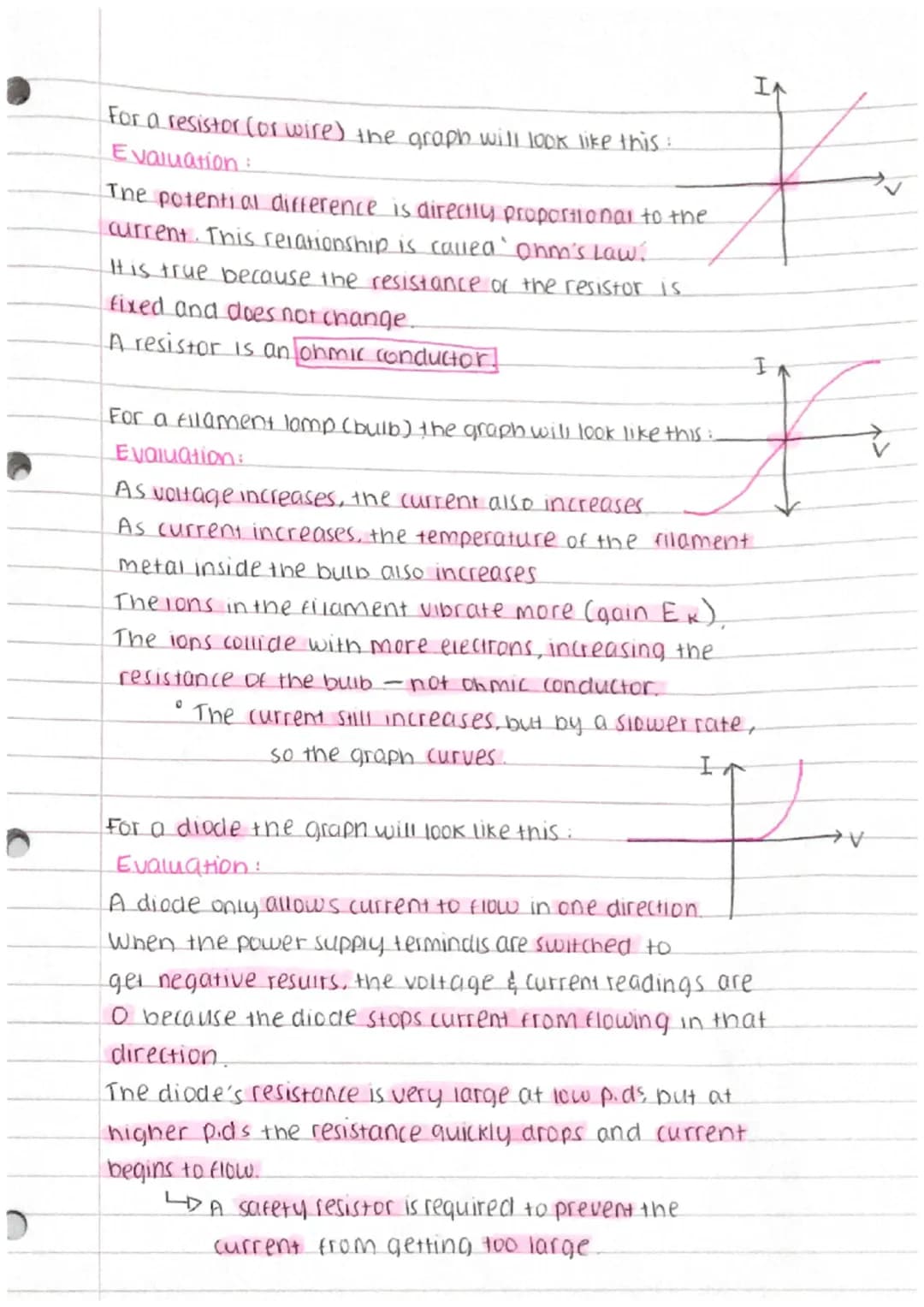
Investigating Current-Voltage Graphs for Resistors, Bulbs, and Diodes
This page outlines the experimental procedure for investigating the relationship between current and potential difference in various electrical components. The standard test circuit setup is described, along with the step-by-step method for conducting the experiment.
Definition: A standard test circuit is a setup used to measure the current and voltage characteristics of electrical components.
The method involves the following steps:
- Set up the test circuit with an ammeter in series and voltmeter in parallel with the component.
- Adjust the variable resistor to change current and voltage.
- Record measurements in a table.
- Collect both positive and negative readings by switching power supply terminals.
- Plot a graph of current against voltage.
Highlight: The experiment requires measuring and recording at least 6 different positive and negative current and voltage values for each component.
Vocabulary: Variable resistor - A resistor with an adjustable resistance value used to control current in a circuit.
Example: The circuit diagram shows the ammeter connected in series with the component being tested, while the voltmeter is connected in parallel.
We thought you’d never ask...
What is the Knowunity AI companion?
Our AI Companion is a student-focused AI tool that offers more than just answers. Built on millions of Knowunity resources, it provides relevant information, personalised study plans, quizzes, and content directly in the chat, adapting to your individual learning journey.
Where can I download the Knowunity app?
You can download the app from Google Play Store and Apple App Store.
Is Knowunity really free of charge?
That's right! Enjoy free access to study content, connect with fellow students, and get instant help – all at your fingertips.
Similar content
Most popular content: Ohm's Law
3Most popular content in Physics
9Most popular content
9Can't find what you're looking for? Explore other subjects.
Students love us — and so will you.
4.6/5App Store
4.7/5Google Play
The app is very easy to use and well designed. I have found everything I was looking for so far and have been able to learn a lot from the presentations! I will definitely use the app for a class assignment! And of course it also helps a lot as an inspiration.
Stefan SiOS user
This app is really great. There are so many study notes and help [...]. My problem subject is French, for example, and the app has so many options for help. Thanks to this app, I have improved my French. I would recommend it to anyone.
Samantha KlichAndroid user
Wow, I am really amazed. I just tried the app because I've seen it advertised many times and was absolutely stunned. This app is THE HELP you want for school and above all, it offers so many things, such as workouts and fact sheets, which have been VERY helpful to me personally.
AnnaiOS user
Physics194 views·Updated May 28, 2026·2 pagesEasy Guide: Current-Voltage Graphs for Resistors, Bulbs, and Diodes
The document explains how to investigate current voltage graphs for resistors, bulbs, and diodes in a standard test circuit. It covers the experimental setup, method, and evaluation of results for each component.
Key points:
- The experiment aims to explore the...
1
of 2
Sign up to see the content. It's free!
- Access to all documents
- Improve your grades
- Join milions of students
Analysis of Current-Voltage Graphs for Different Components
This page presents the current-voltage graphs for a resistor, filament lamp (bulb), and diode, along with evaluations of their characteristics.
For a resistor:
- The graph is a straight line passing through the origin.
- Potential difference is directly proportional to current, following Ohm's Law.
- Resistors are ohmic conductors with fixed resistance.
Definition: Ohm's Law states that the current through a conductor is directly proportional to the voltage across it, given that physical conditions remain constant.
For a filament lamp:
- The graph is curved, showing a non-linear relationship.
- As voltage increases, current increases at a decreasing rate.
- The lamp's resistance increases with temperature due to increased ion vibration and electron collisions.
Highlight: A filament lamp is not an ohmic conductor because its resistance changes with temperature.
For a diode:
- The graph shows current flow in only one direction.
- At low voltages, the diode has high resistance.
- Current begins to flow rapidly once a certain voltage threshold is reached.
Vocabulary: Safety resistor - A resistor used in a diode circuit to prevent excessive current flow.
Example: The diode graph shows zero current for negative voltages, illustrating its unidirectional conduction property.
2
of 2Sign up to see the content. It's free!
- Access to all documents
- Improve your grades
- Join milions of students
Investigating Current-Voltage Graphs for Resistors, Bulbs, and Diodes
This page outlines the experimental procedure for investigating the relationship between current and potential difference in various electrical components. The standard test circuit setup is described, along with the step-by-step method for conducting the experiment.
Definition: A standard test circuit is a setup used to measure the current and voltage characteristics of electrical components.
The method involves the following steps:
- Set up the test circuit with an ammeter in series and voltmeter in parallel with the component.
- Adjust the variable resistor to change current and voltage.
- Record measurements in a table.
- Collect both positive and negative readings by switching power supply terminals.
- Plot a graph of current against voltage.
Highlight: The experiment requires measuring and recording at least 6 different positive and negative current and voltage values for each component.
Vocabulary: Variable resistor - A resistor with an adjustable resistance value used to control current in a circuit.
Example: The circuit diagram shows the ammeter connected in series with the component being tested, while the voltmeter is connected in parallel.
We thought you’d never ask...
What is the Knowunity AI companion?
Our AI Companion is a student-focused AI tool that offers more than just answers. Built on millions of Knowunity resources, it provides relevant information, personalised study plans, quizzes, and content directly in the chat, adapting to your individual learning journey.
Where can I download the Knowunity app?
You can download the app from Google Play Store and Apple App Store.
Is Knowunity really free of charge?
That's right! Enjoy free access to study content, connect with fellow students, and get instant help – all at your fingertips.
Similar content
Most popular content: Ohm's Law
3Most popular content in Physics
9Most popular content
9Can't find what you're looking for? Explore other subjects.
Students love us — and so will you.
4.6/5App Store
4.7/5Google Play
The app is very easy to use and well designed. I have found everything I was looking for so far and have been able to learn a lot from the presentations! I will definitely use the app for a class assignment! And of course it also helps a lot as an inspiration.
Stefan SiOS user
This app is really great. There are so many study notes and help [...]. My problem subject is French, for example, and the app has so many options for help. Thanks to this app, I have improved my French. I would recommend it to anyone.
Samantha KlichAndroid user
Wow, I am really amazed. I just tried the app because I've seen it advertised many times and was absolutely stunned. This app is THE HELP you want for school and above all, it offers so many things, such as workouts and fact sheets, which have been VERY helpful to me personally.
AnnaiOS user