Base and Derived Units in Physics
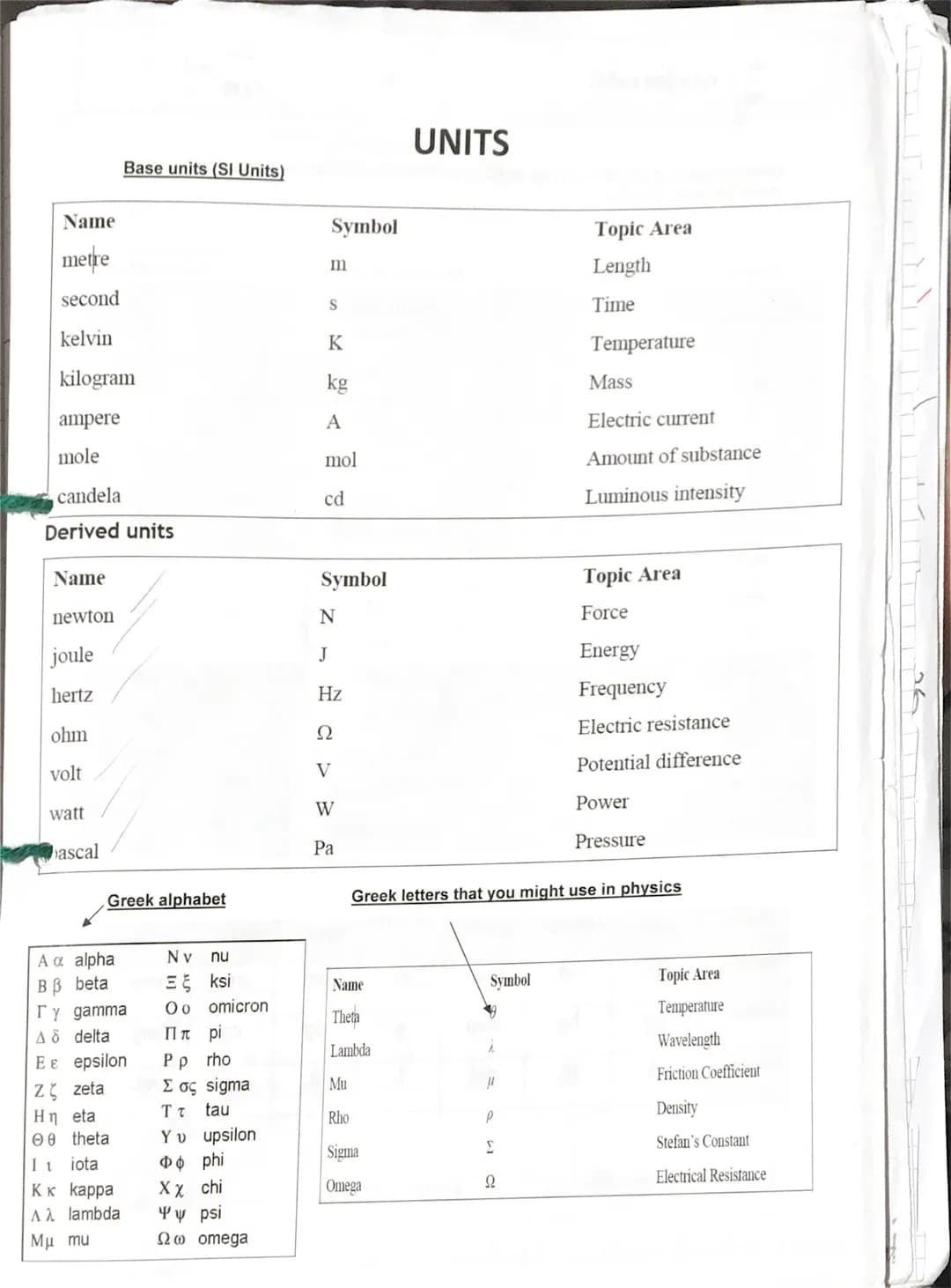
Physics revolves around seven base SI units that form the foundation of all measurements. These include metres for length, seconds for time, kilograms for mass, and kelvin for temperature - units you'll use constantly in calculations.
Derived units are combinations of base units that measure specific physical quantities. For instance, newtons measure force, joules measure energy, and watts measure power. Think of them as recipes made from the basic ingredients of base units.
The Greek alphabet isn't just ancient history - it's essential for physics! You'll encounter theta (θ) for angles, lambda (λ) for wavelength, and omega (Ω) for electrical resistance. Learning these symbols now will make your physics equations much clearer.
Quick Tip: Don't try to memorise all Greek letters at once - learn them as you encounter them in different physics topics!


 Physics
 Chemistry
 English Literature
 Sociology
 Biology