
These maths notes cover essential topics you'll need to master... Show more
 Maths76 views·Updated May 26, 2026·6 pages
High School Maths Study Notes
G
grace @grace_s0twp
1 / 6
1
of 6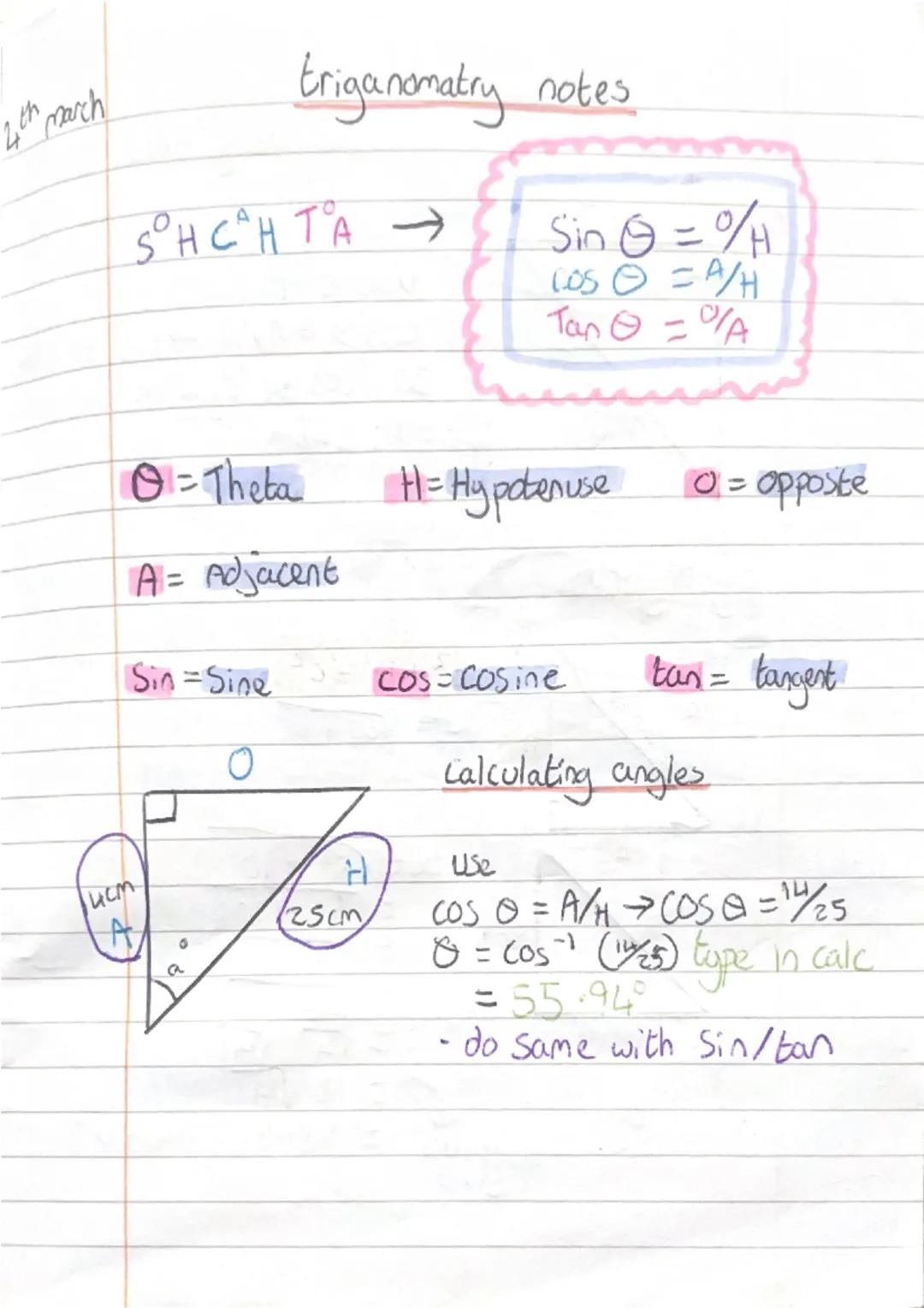
Trigonometry Basics
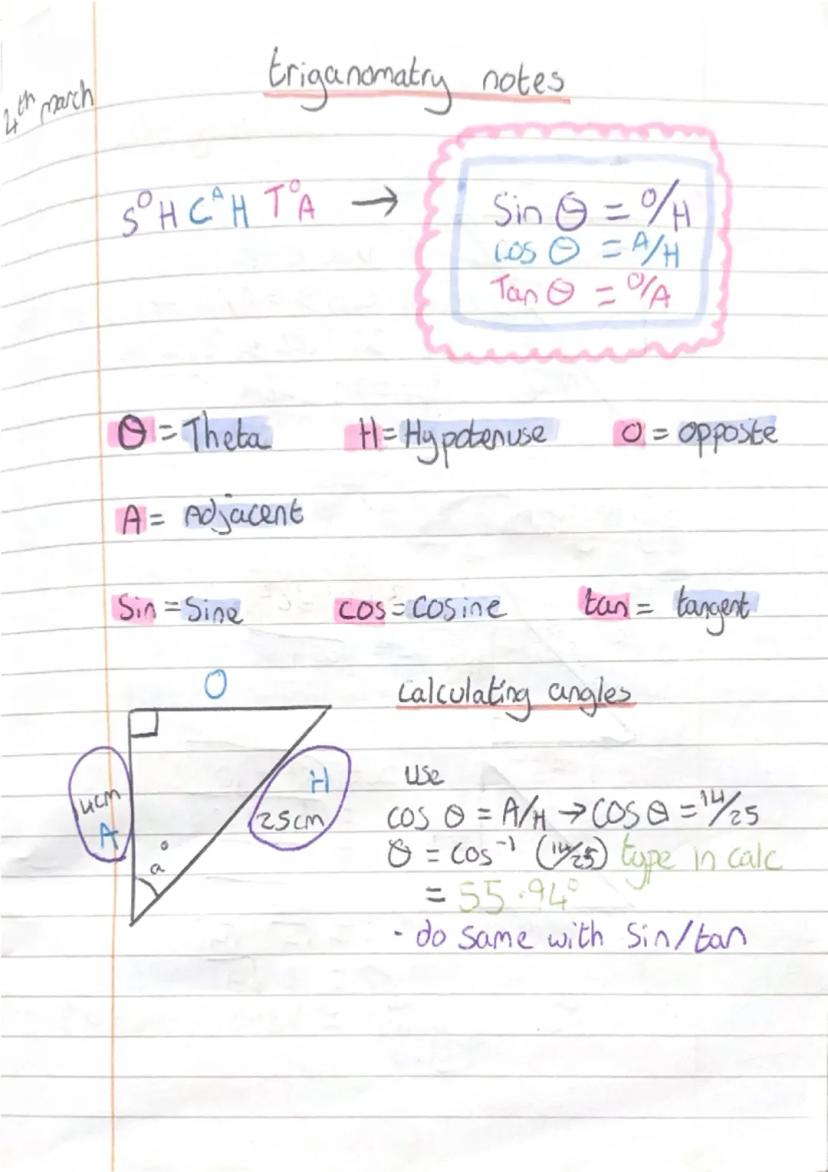
Understanding trigonometry starts with remembering SOHCAHTOA - it's your best mate for solving triangle problems! This handy acronym tells you that sine = opposite/hypotenuse, cosine = adjacent/hypotenuse, and tangent = opposite/adjacent.
When you're calculating angles, you'll use the inverse functions on your calculator. For example, if cos θ = 14/25, then θ = cos⁻¹(14/25) = 55.94°.
Quick Tip: Always check your calculator is in degree mode, not radians, unless the question specifically asks for radians!
The same method works for sin⁻¹ and tan⁻¹ - just make sure you're using the right ratio for the sides you know.
2
of 6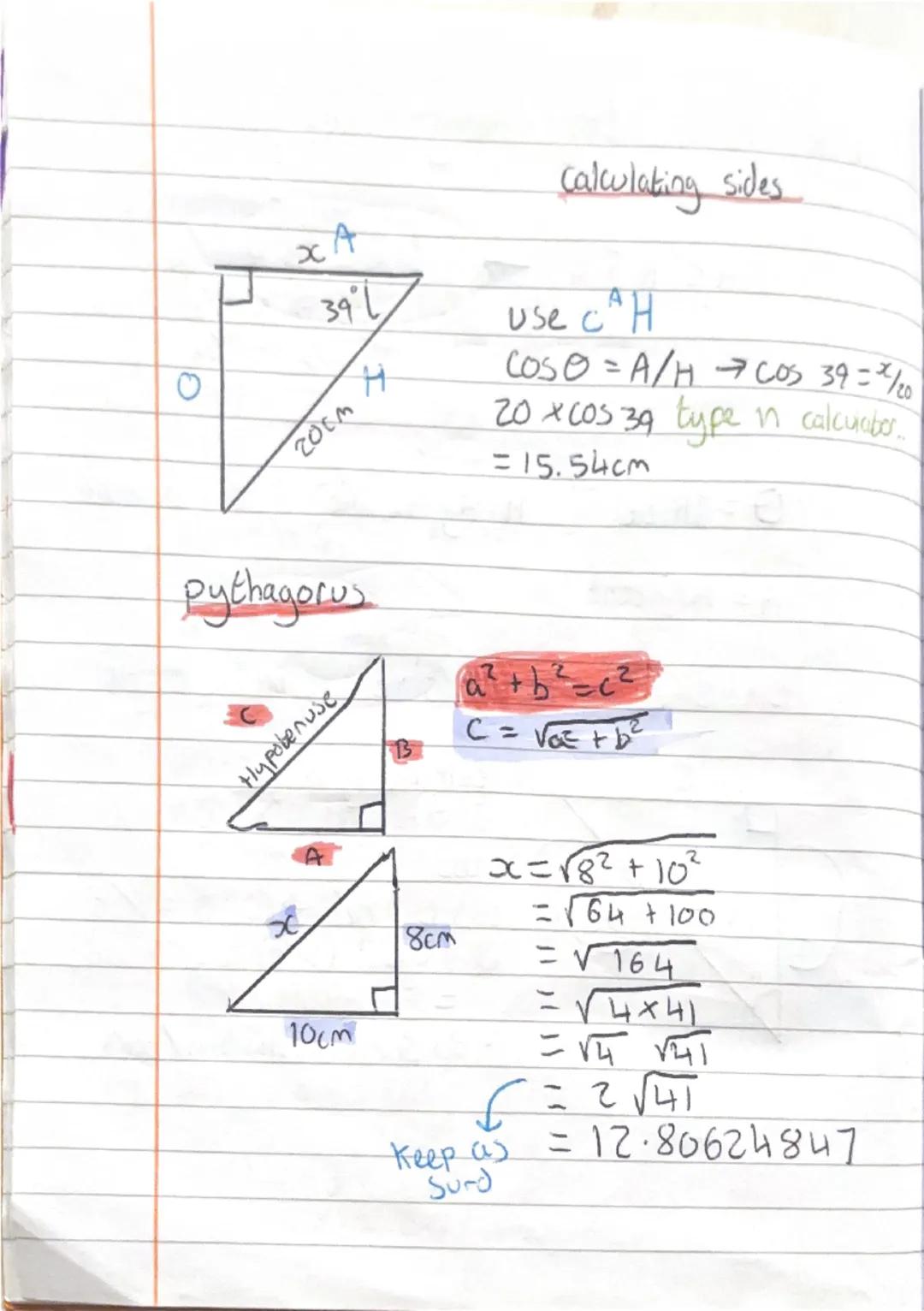
Calculating Sides and Pythagoras
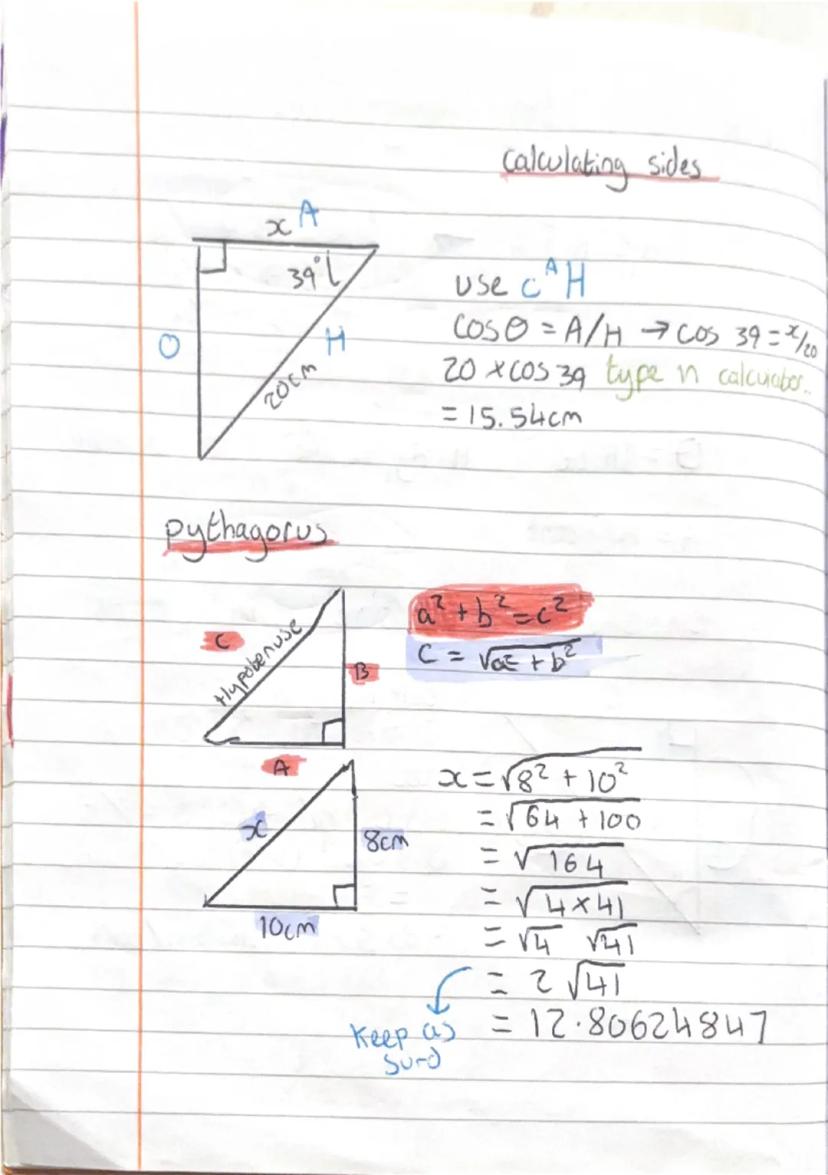
Once you know an angle and one side, finding other sides becomes straightforward using CAH. If you need the adjacent side and know the hypotenuse, rearrange cos θ = A/H to get A = H × cos θ.
Pythagoras' theorem is brilliant when you need to find the hypotenuse or when you don't know any angles. Remember that c is always the longest side - the hypotenuse.
Pro Tip: Sometimes it's better to leave answers as surds (like 2√41) rather than decimals, especially when the question asks for an exact answer.
Keep practicing both methods - trigonometry when you have angles, Pythagoras when you don't!
3
of 6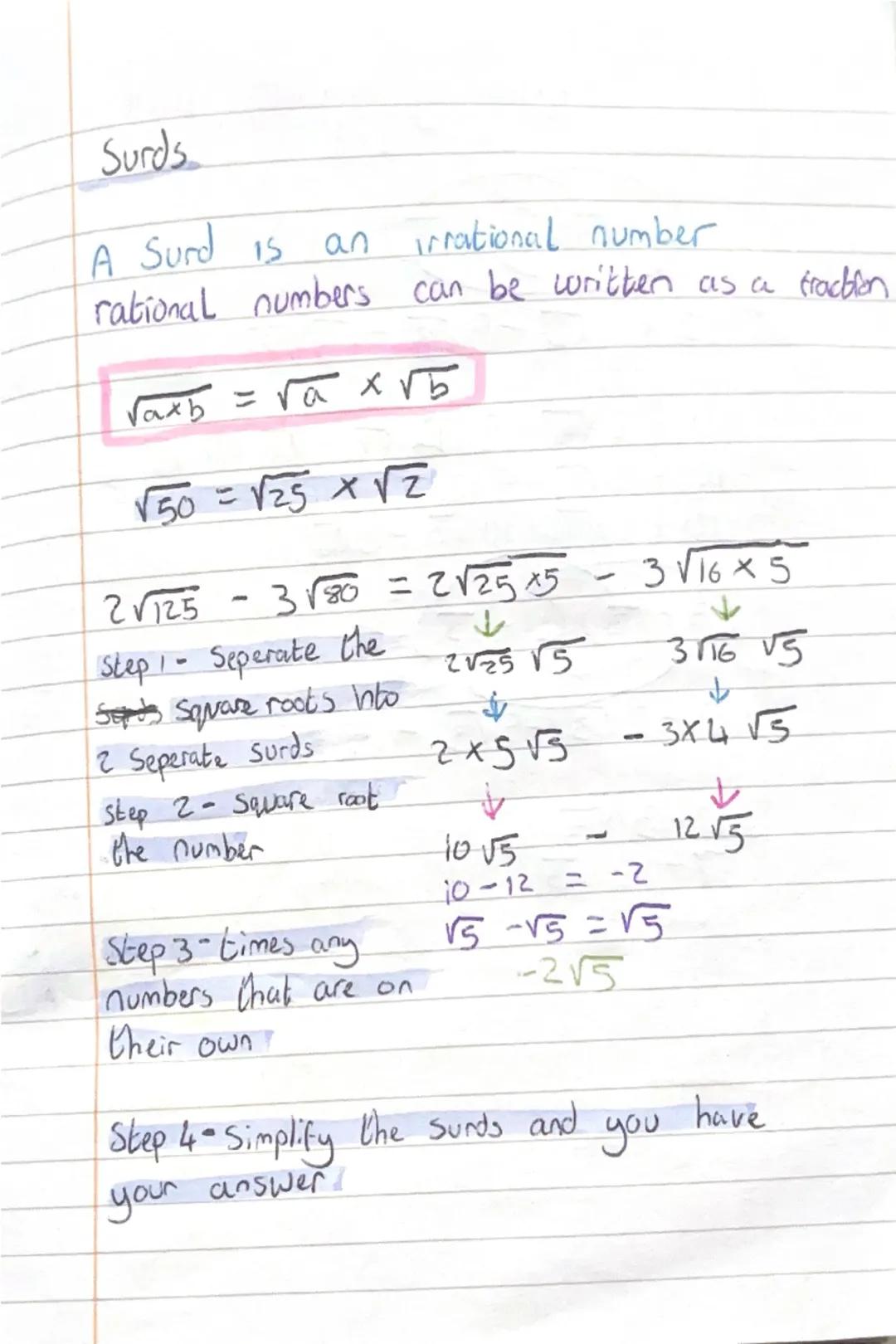
Understanding Surds
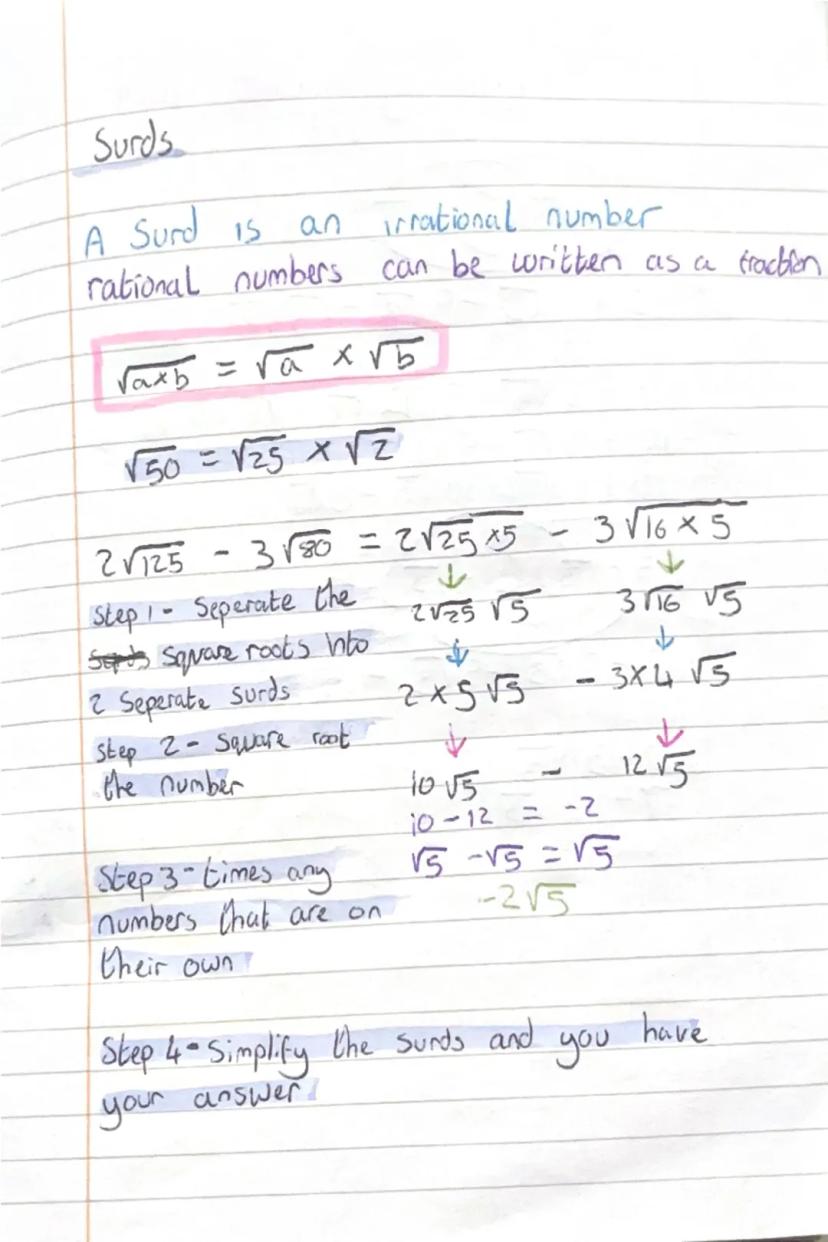
Surds are irrational numbers that can't be written as neat fractions - think √2 or √5. They're actually quite useful because they give you exact answers rather than messy decimals.
The key rule is √(a×b) = √a × √b, which lets you simplify surds by finding perfect square factors. For example, √50 = √(25×2) = 5√2.
When adding or subtracting surds, you can only combine like terms. So 2√125 - 3√80 becomes 10√5 - 12√5 = -2√5 after you've simplified each surd separately.
Remember: Always look for perfect square factors to simplify - it makes your final answer much neater and easier to work with.
4
of 6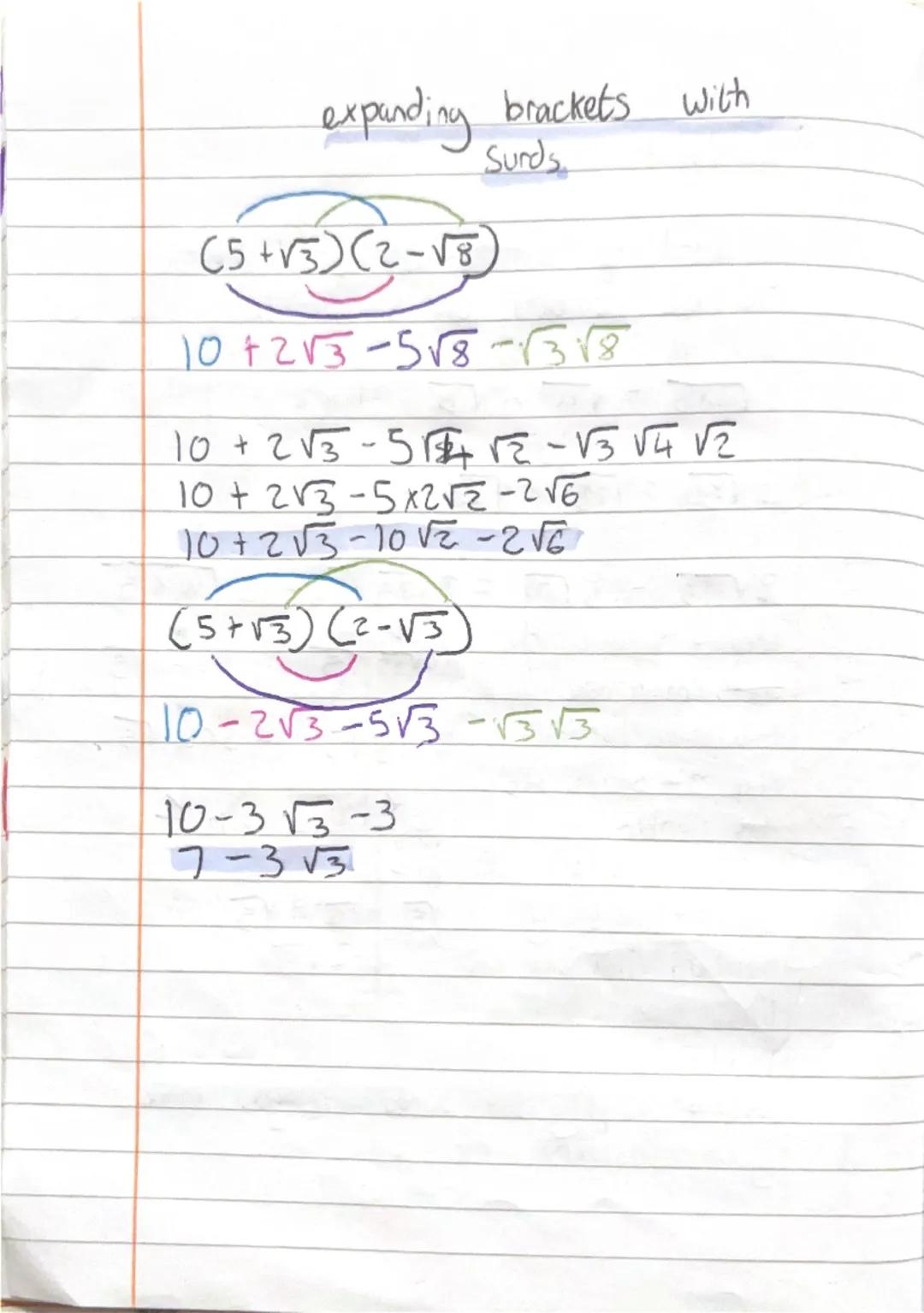
Expanding Brackets with Surds
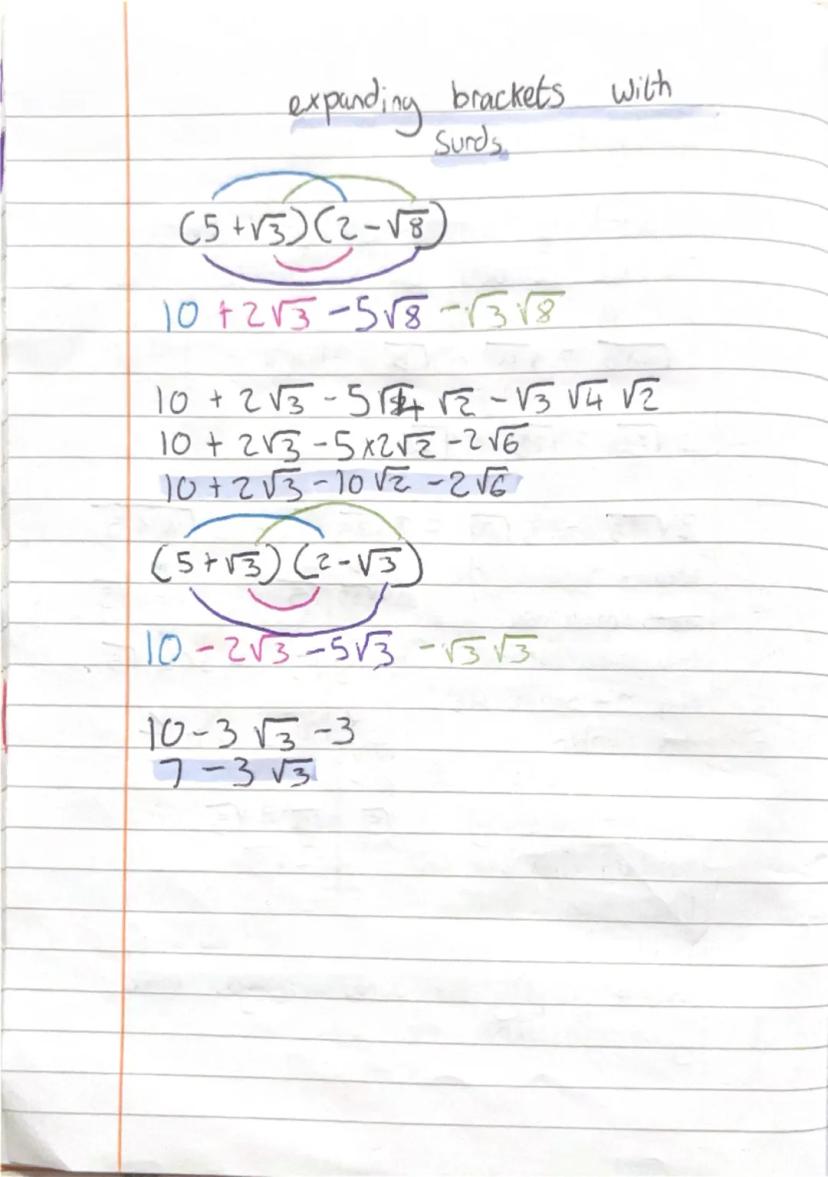
Expanding brackets with surds follows the same FOIL method you use with regular algebra, but you need to be extra careful with the surd multiplication. When you multiply surds together, √3 × √8 becomes √24, which you can then simplify further.
The trickiest bit is when surds multiply to give whole numbers. For instance, (5 + √3)(2 - √3) gives you √3 × √3 = 3, which simplifies your final answer significantly.
Watch Out: Always check if your surds can be simplified - √8 = 2√2, which makes your calculations much easier.
Take your time with these - one small mistake early on will mess up your entire answer!
5
of 6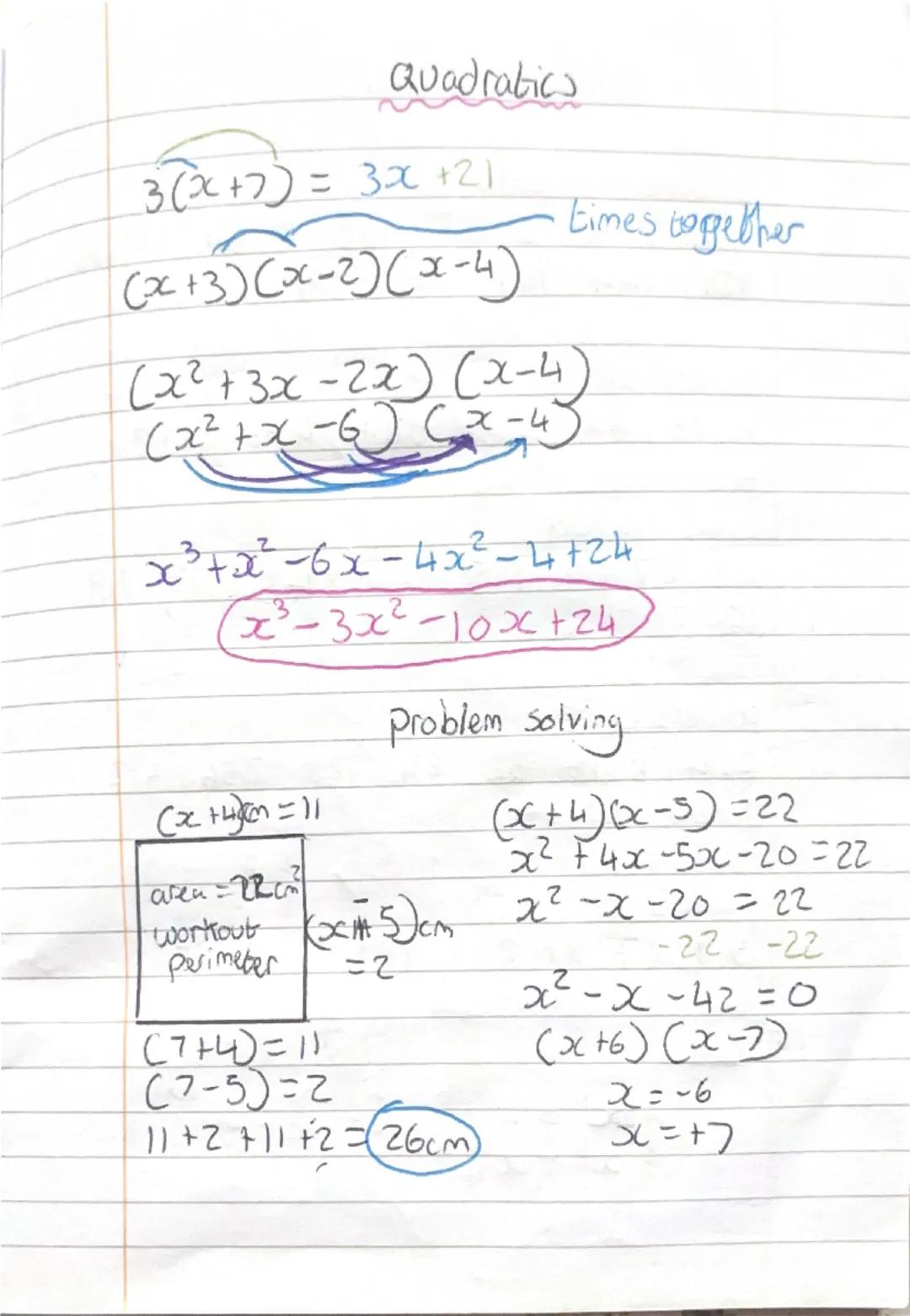
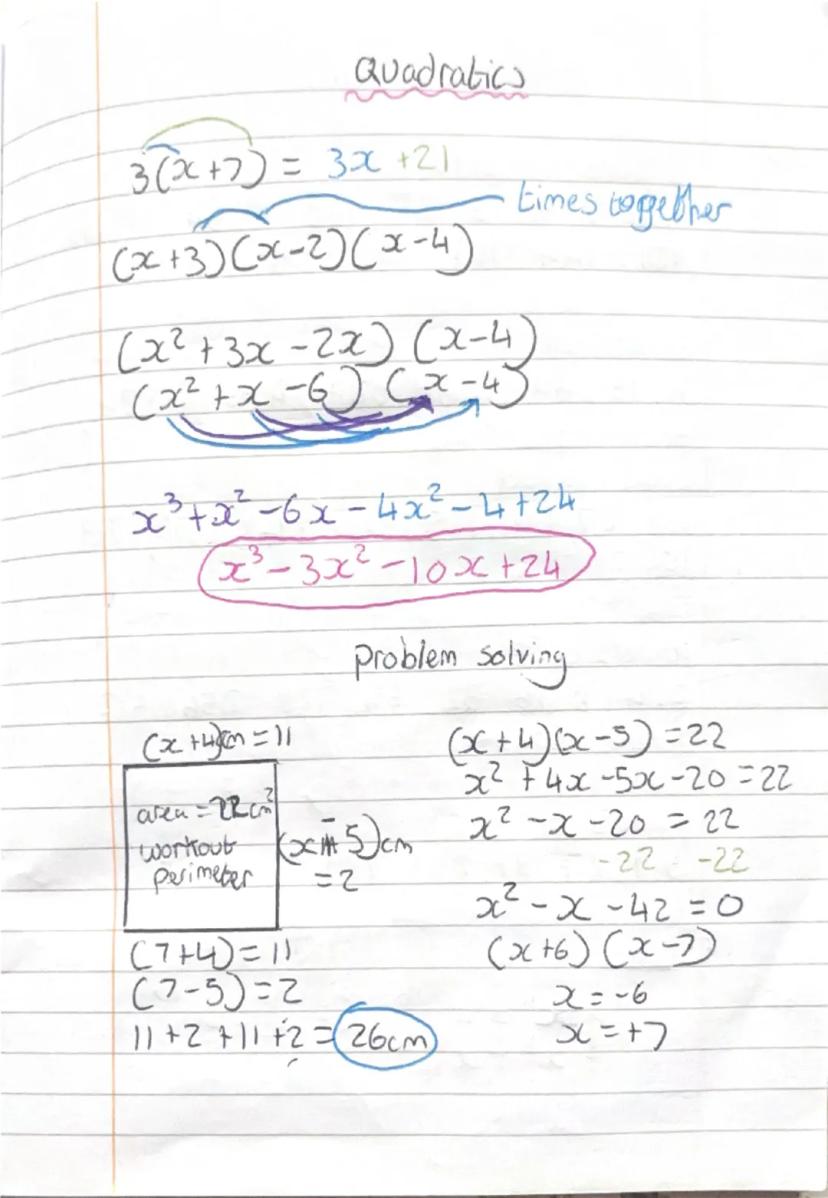
Quadratics and Problem Solving
Quadratic equations pop up everywhere, so getting comfortable with expanding and factorising is crucial. When expanding triple brackets like , do it in stages - expand two brackets first, then multiply by the third.
Problem solving with quadratics often involves setting up equations from real-world contexts. The key is translating the word problem into mathematical expressions, then solving as usual.
Strategy: Always check your answers make sense in the original context - negative lengths or impossible measurements are red flags!
Remember that quadratic equations usually have two solutions, but sometimes only one makes sense in the problem's context.
6
of 6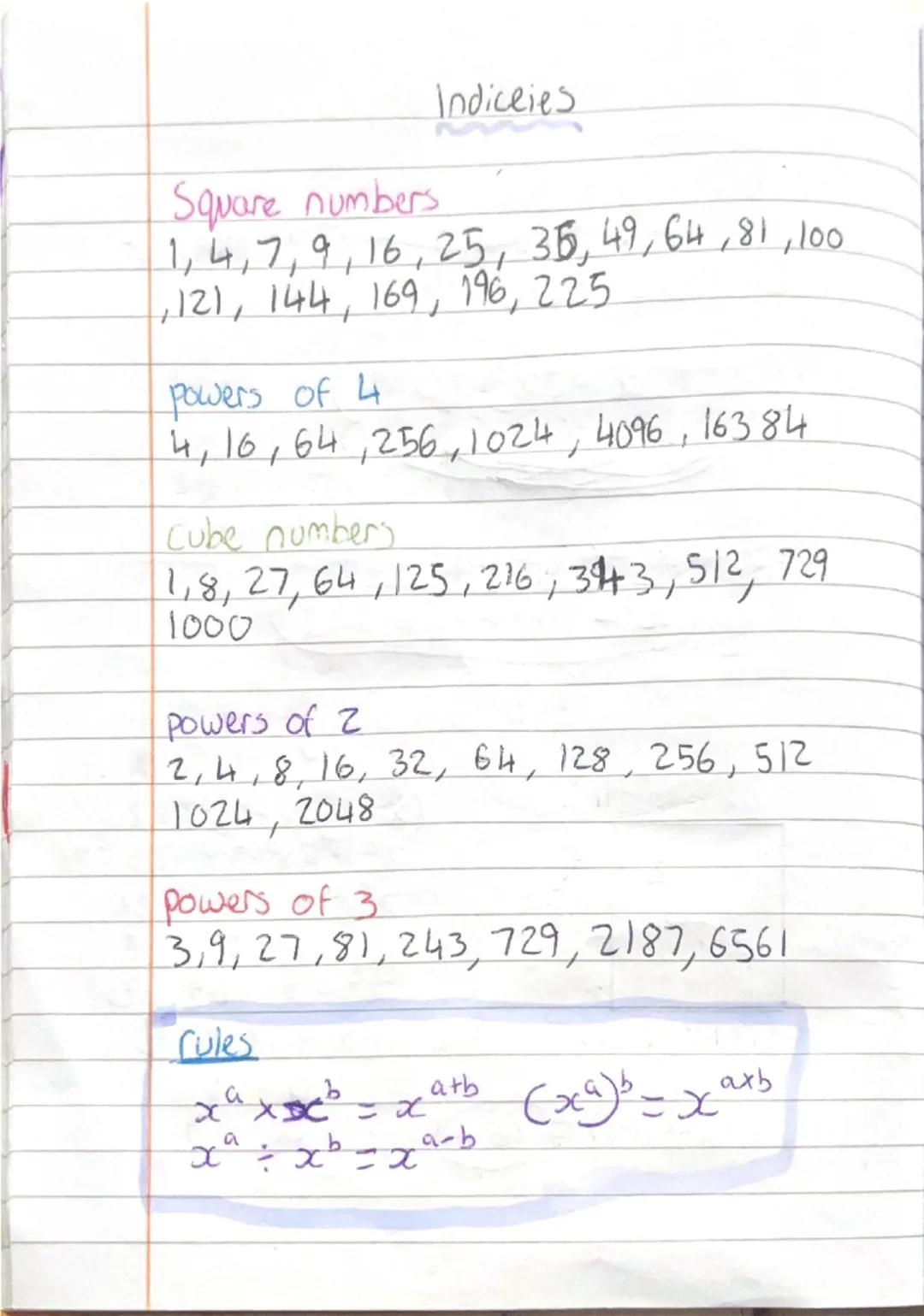
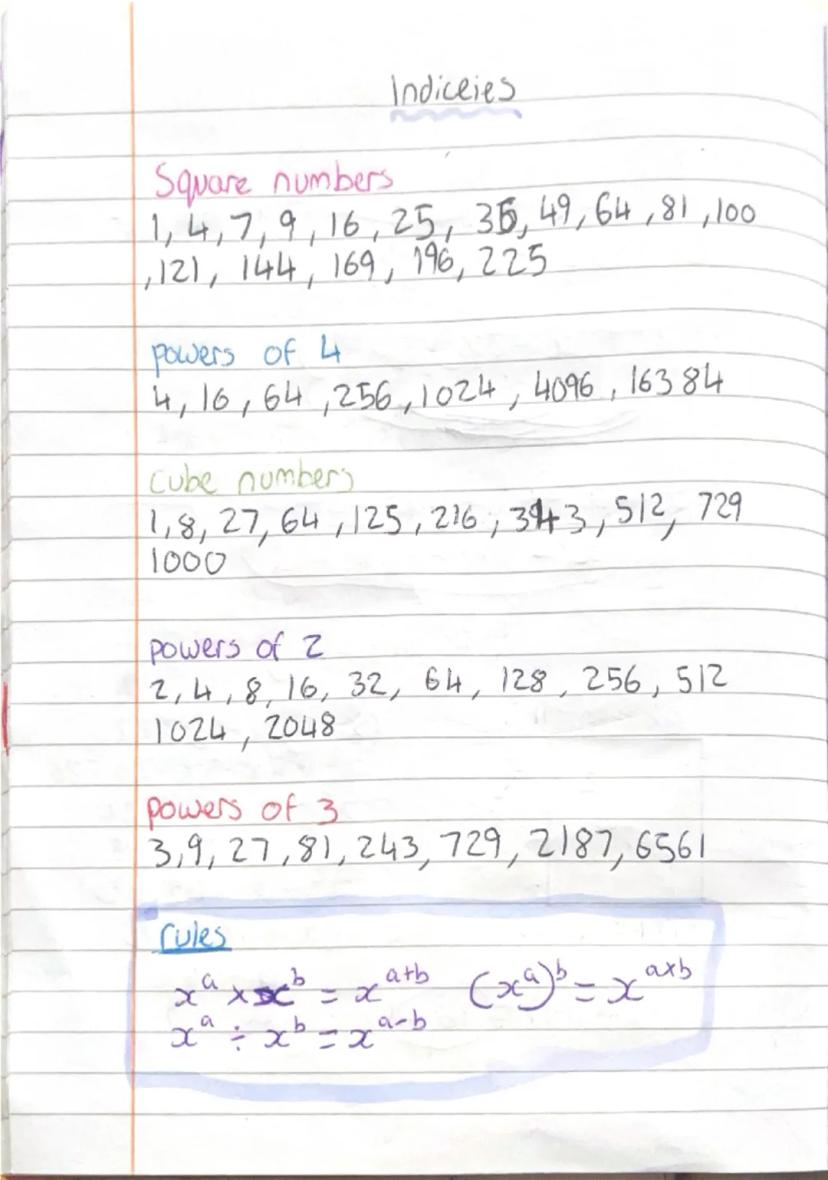
Indices and Powers
Memorising square numbers, cube numbers, and powers of small integers will save you tons of time in exams. Knowing that 144 = 12² or 243 = 3⁵ instantly makes calculations much faster.
The index laws are your toolkit for simplifying expressions: x^a × x^b = x^, x^a ÷ x^b = x^, and ^b = x^(ab). These rules work with any base, whether it's numbers or algebra.
Memory Trick: Practice these power sequences regularly - they'll become automatic and help you spot patterns in more complex problems.
Once you've got these basics down, you'll find that more advanced work with indices becomes much more manageable.
We thought you’d never ask...
What is the Knowunity AI companion?
Our AI Companion is a student-focused AI tool that offers more than just answers. Built on millions of Knowunity resources, it provides relevant information, personalised study plans, quizzes, and content directly in the chat, adapting to your individual learning journey.
Where can I download the Knowunity app?
You can download the app from Google Play Store and Apple App Store.
Is Knowunity really free of charge?
That's right! Enjoy free access to study content, connect with fellow students, and get instant help – all at your fingertips.
Most popular content in Maths
9MathsComprehensive Maths Concepts
Explore essential mathematical concepts including powers, geometry, statistics, and probability. This resource features 65 pages of detailed explanations, diagrams, and examples to enhance your understanding of topics such as right triangles, volume calculations, and data representation. Ideal for students seeking to strengthen their numeracy skills and grasp complex mathematical principles.
1079,7766,318
MathsGCSE Maths (Higher) // Revision Guide
The only GCSE maths (higher) revision guide you need to get a grade 9! Contains every topic, each with all potential question types and their solutions.
102,33054
M
MathsMedium Level alerbra
Master challenging maths concepts with this medium level flashcard set designed for grade 7/8 students. Strengthen your problem-solving skills and boost your confidence in maths!
75753
MathsComprehensive Maths Concepts
Explore essential mathematical concepts including polynomial theorems, logarithmic properties, trigonometric functions, and integration techniques. This resource covers everything from solving inequalities to understanding exponential functions, providing a solid foundation for A-level mathematics. Ideal for students aiming for top grades.
1221,9901,818
M
MathsMastering Maths: Essential Concepts for Grade 10
Boost your math skills with this comprehensive flashcard set covering key concepts for grade 10. Perfect for exam preparation and building a strong foundation in mathematics.
104261
M
MathsMastering Medium-Level Maths: Essential Flashcards for Grade 11 Students
Boost your Maths skills with this comprehensive set of flashcards designed specifically for Grade 11 students. Covering medium-level topics, these cards will help you ace your exams and build a solid foundation for advanced Maths.
118823
MathsComprehensive Maths Concepts
Explore essential higher mathematics concepts including calculus, trigonometry, polynomials, and vector analysis. This summary covers key topics such as differentiation, integration, quadratic equations, and the properties of circles, providing a solid foundation for exam preparation. Ideal for students seeking a concise yet thorough review of advanced mathematical principles.
S51,93757
P
MathsPercentage,fractions and decimals
how well do you know percentages,fractions and decimals
72703
M
Mathsmaths SOHCAHTOA
Trigonometric ratios SOHCAHTOA for calculating angles and sides in right-angled triangles.
111740
Most popular content
9 Sociology
Sociology of Education Overview
Explore comprehensive A-Level Sociology notes on the education system, covering key theories, policies, and sociological perspectives. This resource includes insights on marketisation, gender roles, cultural deprivation, and educational inequalities, providing a thorough understanding of how education shapes social stratification and individual achievement. Ideal for exam preparation and in-depth study.
12102,3893,038
CriminologyCriminology: Crime & Punishment Overview
Comprehensive mindmaps covering key concepts in the Crime and Punishment topic for WJEC Criminology Unit 4. This resource includes detailed insights into the Criminal Justice System, crime prevention strategies, sentencing models, and the roles of various agencies. Ideal for A-Level revision, ensuring you grasp essential theories and legislative processes to excel in your exams.
1254,8131,059
SociologySociology of Families: Comprehensive Revision
Dive into an extensive overview of family dynamics, perspectives, and patterns in sociology. This resource covers key concepts such as family diversity, gender roles, marriage, and the impact of social policies on family structures. Perfect for A-Level Sociology students preparing for Paper 2.
1273,2392,304
 English Literature
An Inspector Calls: Character Insights
Explore in-depth analysis and key quotes for characters in J.B. Priestley's 'An Inspector Calls'. This resource covers Gerald Croft, Inspector Goole, Sheila Birling, Mrs. Birling, Eric Birling, and Eva Smith, focusing on themes of class, gender roles, and social responsibility. Ideal for students aiming for Grade 8 and above.
1025,231901
CriminologyWJEC Unit 4 Criminology
Criminology unit 4 detailed revision note
127,120124
CriminologyCriminology Theories Overview
Explore key criminology theories and their implications on crime and deviance. This comprehensive summary covers biological, psychological, and sociological perspectives, including labelling theory, right realism, and the impact of social campaigns on policy development. Ideal for A-Level criminology students seeking to understand the complexities of criminal behaviour and the factors influencing crime prevention strategies.
129,746211
English LiteratureRomeo and Juliet: Key themes
Key Romeo and Juliet themes and analysed quotes
106,619197
C
 Biology
Cell Biology and Cell structure
cell structures
92,6740
English LiteratureMacbeth: Guilt and Ambition
Explore the complex themes of guilt and ambition in Shakespeare's 'Macbeth'. This analysis covers key characters, including Macbeth and Lady Macbeth, their moral dilemmas, and the tragic consequences of their ambition. Ideal for students studying character motivations, thematic elements, and the psychological impact of power. Includes insights on the natural order, manipulation, and the descent into madness.
918,818392
Can't find what you're looking for? Explore other subjects.
Students love us — and so will you.
4.6/5App Store
4.7/5Google Play
The app is very easy to use and well designed. I have found everything I was looking for so far and have been able to learn a lot from the presentations! I will definitely use the app for a class assignment! And of course it also helps a lot as an inspiration.
Stefan SiOS user
This app is really great. There are so many study notes and help [...]. My problem subject is French, for example, and the app has so many options for help. Thanks to this app, I have improved my French. I would recommend it to anyone.
Samantha KlichAndroid user
Wow, I am really amazed. I just tried the app because I've seen it advertised many times and was absolutely stunned. This app is THE HELP you want for school and above all, it offers so many things, such as workouts and fact sheets, which have been VERY helpful to me personally.
AnnaiOS user
Maths76 views·Updated May 26, 2026·6 pagesHigh School Maths Study Notes
G
grace @grace_s0twp
These maths notes cover essential topics you'll need to master for your GCSE exams. From trigonometry and surds to quadratics and indices, these concepts build on each other and form the foundation of advanced mathematics.
1
of 6Sign up to see the content. It's free!
- Access to all documents
- Improve your grades
- Join milions of students
Trigonometry Basics
Understanding trigonometry starts with remembering SOHCAHTOA - it's your best mate for solving triangle problems! This handy acronym tells you that sine = opposite/hypotenuse, cosine = adjacent/hypotenuse, and tangent = opposite/adjacent.
When you're calculating angles, you'll use the inverse functions on your calculator. For example, if cos θ = 14/25, then θ = cos⁻¹(14/25) = 55.94°.
Quick Tip: Always check your calculator is in degree mode, not radians, unless the question specifically asks for radians!
The same method works for sin⁻¹ and tan⁻¹ - just make sure you're using the right ratio for the sides you know.
2
of 6Sign up to see the content. It's free!
- Access to all documents
- Improve your grades
- Join milions of students
Calculating Sides and Pythagoras
Once you know an angle and one side, finding other sides becomes straightforward using CAH. If you need the adjacent side and know the hypotenuse, rearrange cos θ = A/H to get A = H × cos θ.
Pythagoras' theorem is brilliant when you need to find the hypotenuse or when you don't know any angles. Remember that c is always the longest side - the hypotenuse.
Pro Tip: Sometimes it's better to leave answers as surds (like 2√41) rather than decimals, especially when the question asks for an exact answer.
Keep practicing both methods - trigonometry when you have angles, Pythagoras when you don't!
3
of 6Sign up to see the content. It's free!
- Access to all documents
- Improve your grades
- Join milions of students
Understanding Surds
Surds are irrational numbers that can't be written as neat fractions - think √2 or √5. They're actually quite useful because they give you exact answers rather than messy decimals.
The key rule is √(a×b) = √a × √b, which lets you simplify surds by finding perfect square factors. For example, √50 = √(25×2) = 5√2.
When adding or subtracting surds, you can only combine like terms. So 2√125 - 3√80 becomes 10√5 - 12√5 = -2√5 after you've simplified each surd separately.
Remember: Always look for perfect square factors to simplify - it makes your final answer much neater and easier to work with.
4
of 6Sign up to see the content. It's free!
- Access to all documents
- Improve your grades
- Join milions of students
Expanding Brackets with Surds
Expanding brackets with surds follows the same FOIL method you use with regular algebra, but you need to be extra careful with the surd multiplication. When you multiply surds together, √3 × √8 becomes √24, which you can then simplify further.
The trickiest bit is when surds multiply to give whole numbers. For instance, (5 + √3)(2 - √3) gives you √3 × √3 = 3, which simplifies your final answer significantly.
Watch Out: Always check if your surds can be simplified - √8 = 2√2, which makes your calculations much easier.
Take your time with these - one small mistake early on will mess up your entire answer!
5
of 6Sign up to see the content. It's free!
- Access to all documents
- Improve your grades
- Join milions of students
Quadratics and Problem Solving
Quadratic equations pop up everywhere, so getting comfortable with expanding and factorising is crucial. When expanding triple brackets like , do it in stages - expand two brackets first, then multiply by the third.
Problem solving with quadratics often involves setting up equations from real-world contexts. The key is translating the word problem into mathematical expressions, then solving as usual.
Strategy: Always check your answers make sense in the original context - negative lengths or impossible measurements are red flags!
Remember that quadratic equations usually have two solutions, but sometimes only one makes sense in the problem's context.
6
of 6Sign up to see the content. It's free!
- Access to all documents
- Improve your grades
- Join milions of students
Indices and Powers
Memorising square numbers, cube numbers, and powers of small integers will save you tons of time in exams. Knowing that 144 = 12² or 243 = 3⁵ instantly makes calculations much faster.
The index laws are your toolkit for simplifying expressions: x^a × x^b = x^, x^a ÷ x^b = x^, and ^b = x^(ab). These rules work with any base, whether it's numbers or algebra.
Memory Trick: Practice these power sequences regularly - they'll become automatic and help you spot patterns in more complex problems.
Once you've got these basics down, you'll find that more advanced work with indices becomes much more manageable.
We thought you’d never ask...
What is the Knowunity AI companion?
Our AI Companion is a student-focused AI tool that offers more than just answers. Built on millions of Knowunity resources, it provides relevant information, personalised study plans, quizzes, and content directly in the chat, adapting to your individual learning journey.
Where can I download the Knowunity app?
You can download the app from Google Play Store and Apple App Store.
Is Knowunity really free of charge?
That's right! Enjoy free access to study content, connect with fellow students, and get instant help – all at your fingertips.
Most popular content in Maths
9MathsComprehensive Maths Concepts
Explore essential mathematical concepts including powers, geometry, statistics, and probability. This resource features 65 pages of detailed explanations, diagrams, and examples to enhance your understanding of topics such as right triangles, volume calculations, and data representation. Ideal for students seeking to strengthen their numeracy skills and grasp complex mathematical principles.
1079,7766,318
MathsGCSE Maths (Higher) // Revision Guide
The only GCSE maths (higher) revision guide you need to get a grade 9! Contains every topic, each with all potential question types and their solutions.
102,33054
M
MathsMedium Level alerbra
Master challenging maths concepts with this medium level flashcard set designed for grade 7/8 students. Strengthen your problem-solving skills and boost your confidence in maths!
75753
MathsComprehensive Maths Concepts
Explore essential mathematical concepts including polynomial theorems, logarithmic properties, trigonometric functions, and integration techniques. This resource covers everything from solving inequalities to understanding exponential functions, providing a solid foundation for A-level mathematics. Ideal for students aiming for top grades.
1221,9901,818
M
MathsMastering Maths: Essential Concepts for Grade 10
Boost your math skills with this comprehensive flashcard set covering key concepts for grade 10. Perfect for exam preparation and building a strong foundation in mathematics.
104261
M
MathsMastering Medium-Level Maths: Essential Flashcards for Grade 11 Students
Boost your Maths skills with this comprehensive set of flashcards designed specifically for Grade 11 students. Covering medium-level topics, these cards will help you ace your exams and build a solid foundation for advanced Maths.
118823
MathsComprehensive Maths Concepts
Explore essential higher mathematics concepts including calculus, trigonometry, polynomials, and vector analysis. This summary covers key topics such as differentiation, integration, quadratic equations, and the properties of circles, providing a solid foundation for exam preparation. Ideal for students seeking a concise yet thorough review of advanced mathematical principles.
S51,93757
P
MathsPercentage,fractions and decimals
how well do you know percentages,fractions and decimals
72703
M
Mathsmaths SOHCAHTOA
Trigonometric ratios SOHCAHTOA for calculating angles and sides in right-angled triangles.
111740
Most popular content
9SociologySociology of Education Overview
Explore comprehensive A-Level Sociology notes on the education system, covering key theories, policies, and sociological perspectives. This resource includes insights on marketisation, gender roles, cultural deprivation, and educational inequalities, providing a thorough understanding of how education shapes social stratification and individual achievement. Ideal for exam preparation and in-depth study.
12102,3893,038
CriminologyCriminology: Crime & Punishment Overview
Comprehensive mindmaps covering key concepts in the Crime and Punishment topic for WJEC Criminology Unit 4. This resource includes detailed insights into the Criminal Justice System, crime prevention strategies, sentencing models, and the roles of various agencies. Ideal for A-Level revision, ensuring you grasp essential theories and legislative processes to excel in your exams.
1254,8131,059
SociologySociology of Families: Comprehensive Revision
Dive into an extensive overview of family dynamics, perspectives, and patterns in sociology. This resource covers key concepts such as family diversity, gender roles, marriage, and the impact of social policies on family structures. Perfect for A-Level Sociology students preparing for Paper 2.
1273,2392,304
English LiteratureAn Inspector Calls: Character Insights
Explore in-depth analysis and key quotes for characters in J.B. Priestley's 'An Inspector Calls'. This resource covers Gerald Croft, Inspector Goole, Sheila Birling, Mrs. Birling, Eric Birling, and Eva Smith, focusing on themes of class, gender roles, and social responsibility. Ideal for students aiming for Grade 8 and above.
1025,231901
CriminologyWJEC Unit 4 Criminology
Criminology unit 4 detailed revision note
127,120124
CriminologyCriminology Theories Overview
Explore key criminology theories and their implications on crime and deviance. This comprehensive summary covers biological, psychological, and sociological perspectives, including labelling theory, right realism, and the impact of social campaigns on policy development. Ideal for A-Level criminology students seeking to understand the complexities of criminal behaviour and the factors influencing crime prevention strategies.
129,746211
English LiteratureRomeo and Juliet: Key themes
Key Romeo and Juliet themes and analysed quotes
106,619197
C
BiologyCell Biology and Cell structure
cell structures
92,6740
English LiteratureMacbeth: Guilt and Ambition
Explore the complex themes of guilt and ambition in Shakespeare's 'Macbeth'. This analysis covers key characters, including Macbeth and Lady Macbeth, their moral dilemmas, and the tragic consequences of their ambition. Ideal for students studying character motivations, thematic elements, and the psychological impact of power. Includes insights on the natural order, manipulation, and the descent into madness.
918,818392
Can't find what you're looking for? Explore other subjects.
Students love us — and so will you.
4.6/5App Store
4.7/5Google Play
The app is very easy to use and well designed. I have found everything I was looking for so far and have been able to learn a lot from the presentations! I will definitely use the app for a class assignment! And of course it also helps a lot as an inspiration.
Stefan SiOS user
This app is really great. There are so many study notes and help [...]. My problem subject is French, for example, and the app has so many options for help. Thanks to this app, I have improved my French. I would recommend it to anyone.
Samantha KlichAndroid user
Wow, I am really amazed. I just tried the app because I've seen it advertised many times and was absolutely stunned. This app is THE HELP you want for school and above all, it offers so many things, such as workouts and fact sheets, which have been VERY helpful to me personally.
AnnaiOS user