
Rational expressions are basically fractions with polynomials on top and... Show more
 Mathematics4 views·Updated May 25, 2026·6 pages
Mastering Rational Expressions: Simplify, Solve, and Operate
1 / 6
1
of 6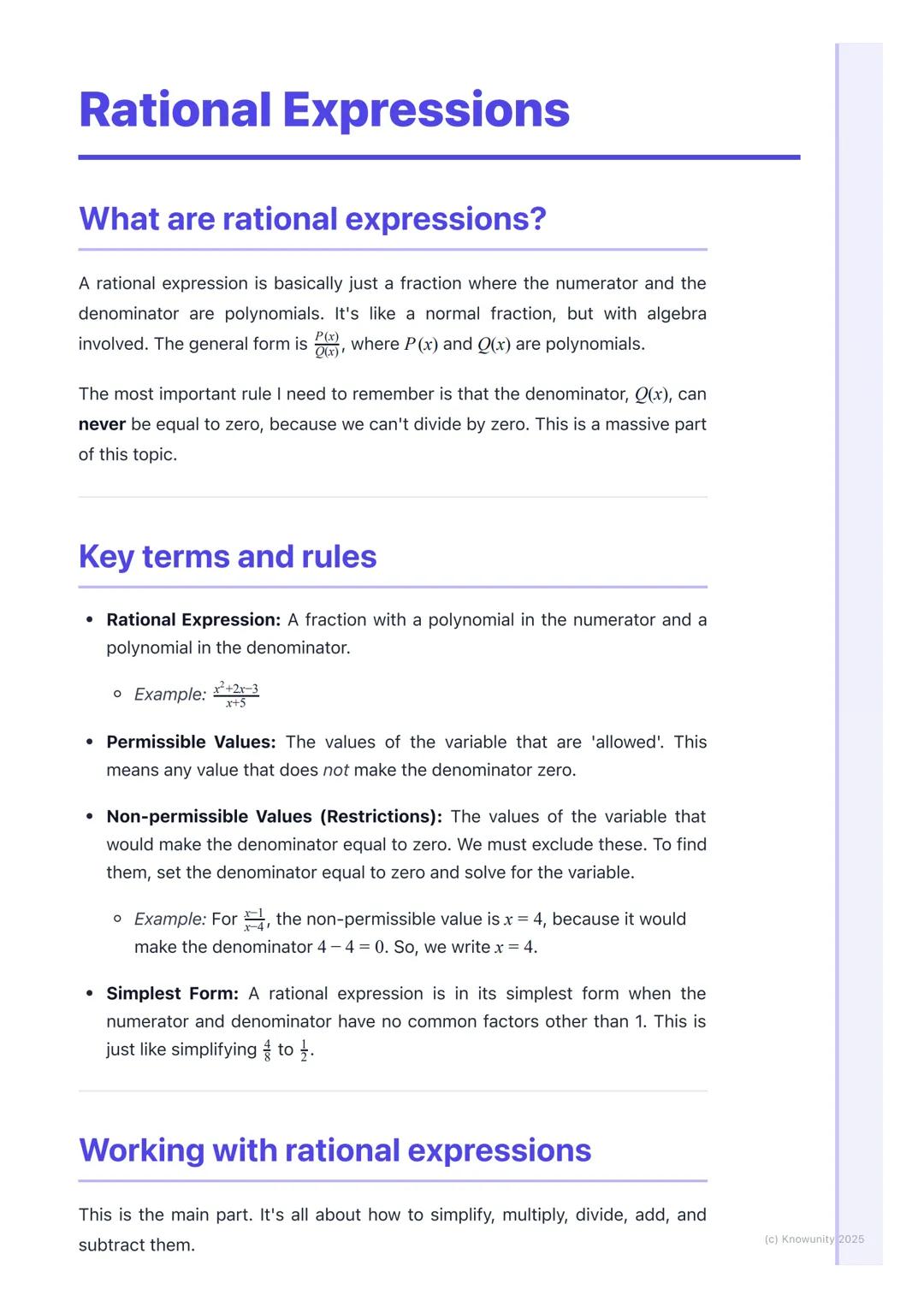
What Are Rational Expressions?
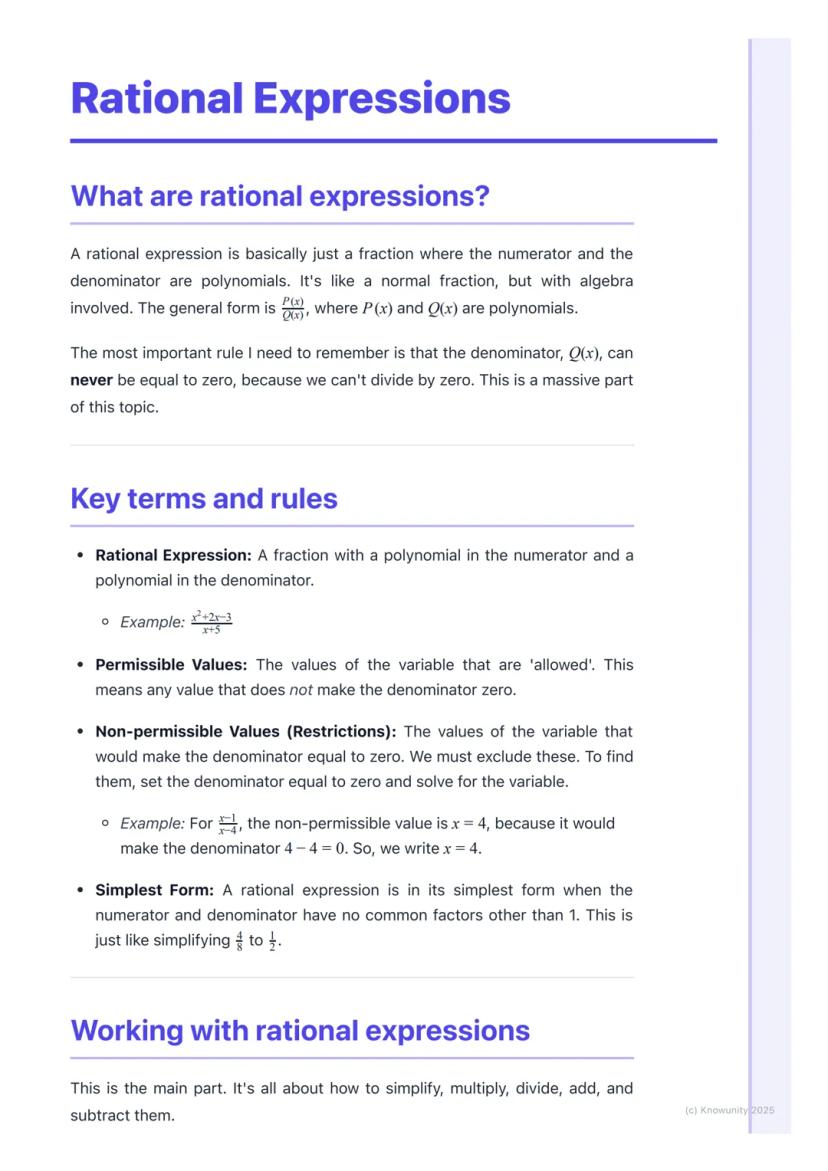
Ever wondered what happens when you mix fractions with algebra? You get rational expressions - fractions where both the numerator and denominator are polynomials, like .
The golden rule here is that the denominator can never equal zero because dividing by zero is mathematically impossible. This creates what we call restrictions or non-permissible values - basically the values of x that would make the denominator zero.
Finding restrictions is dead simple: set the denominator equal to zero and solve. For example, with , the restriction is x = 4 because that makes the bottom 4-4 = 0.
Pro tip: Always find your restrictions first - they'll be crucial when solving equations later on!
2
of 6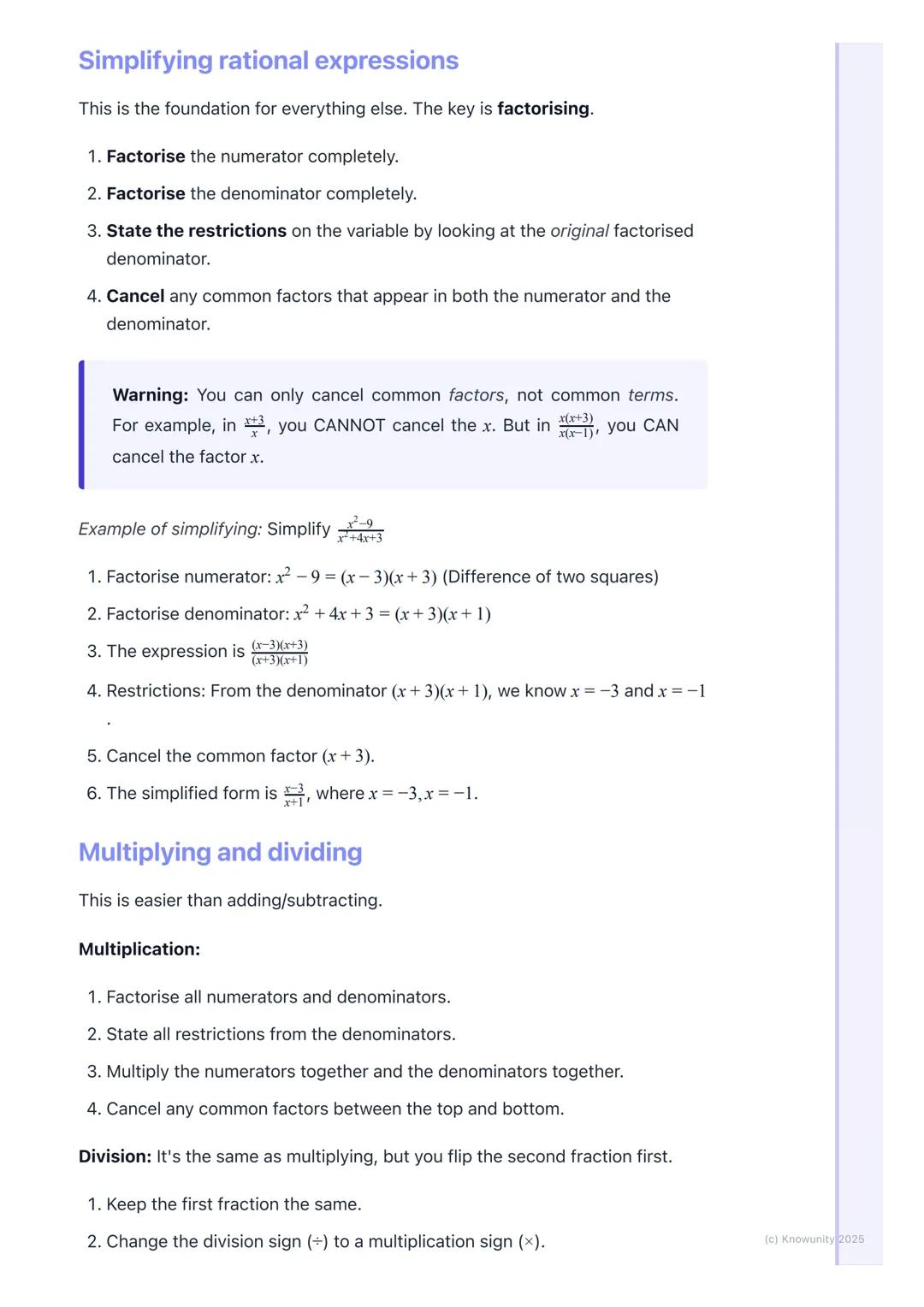
Simplifying Rational Expressions
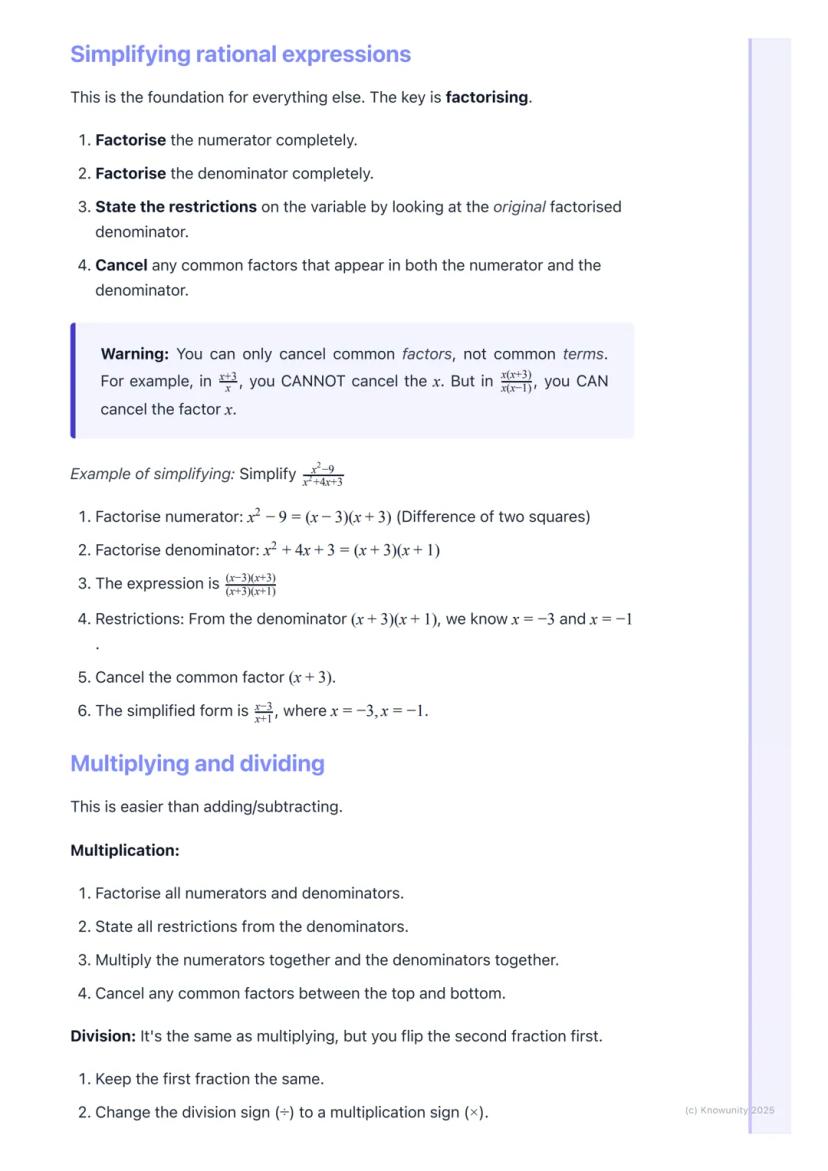
This is where factorising becomes your best mate. The process is straightforward: factorise everything, state your restrictions, then cancel common factors (not terms!).
Let's break down . First, factorise the top: using difference of two squares. Then the bottom: .
Now you can see the common factor and cancel it out, giving you with restrictions x ≠ -3, x ≠ -1.
Warning: You can only cancel factors, never terms. Don't try cancelling the x in - that's mathematically wrong!
3
of 6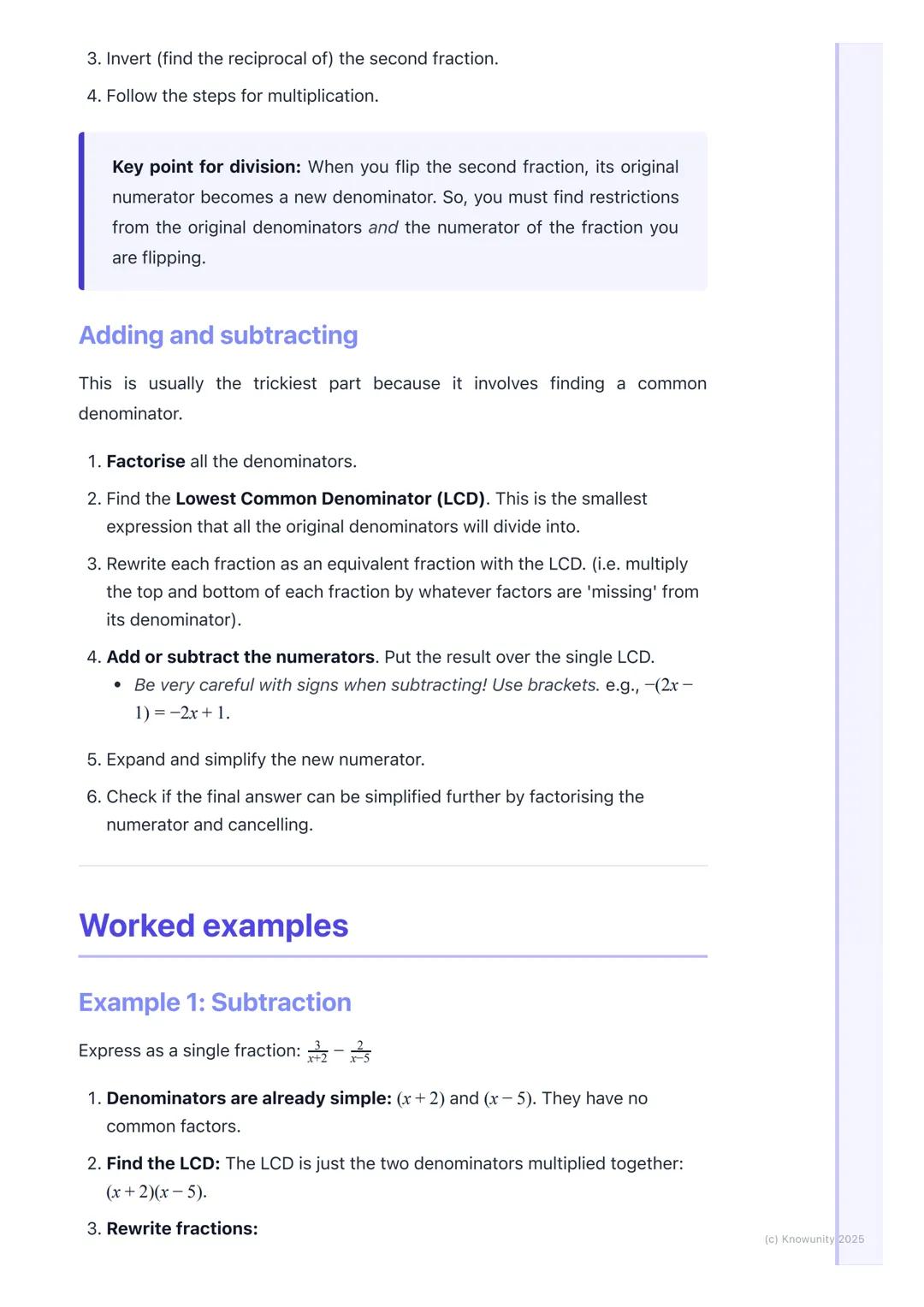
Multiplying and Dividing
Good news - this bit's actually easier than adding and subtracting! For multiplication, factorise everything first, then multiply tops together and bottoms together, and cancel any common factors.
Division follows the classic "keep, change, flip" rule. Keep the first fraction as is, change the division sign to multiplication, then flip the second fraction. Just remember that when you flip a fraction, its original numerator becomes a new denominator, so you need restrictions from there too.
The key is staying organised - write down all your restrictions from every denominator (including the one you flipped) before you start cancelling.
Remember: Division is just multiplication in disguise - flip that second fraction and you're sorted!
4
of 6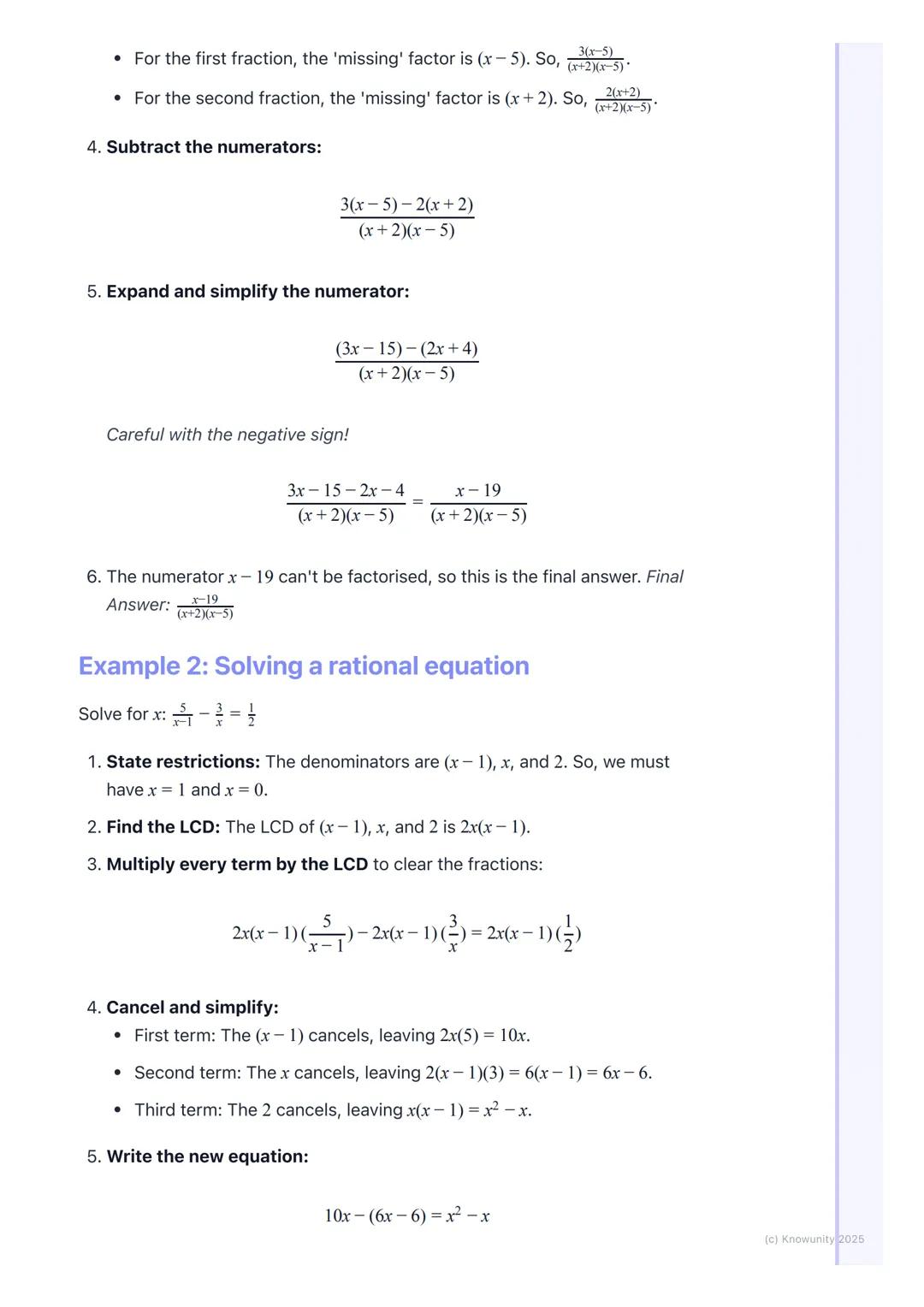
Adding and Subtracting
This is where things get properly tricky because you need a common denominator. Think of it like adding - you need a common bottom first.
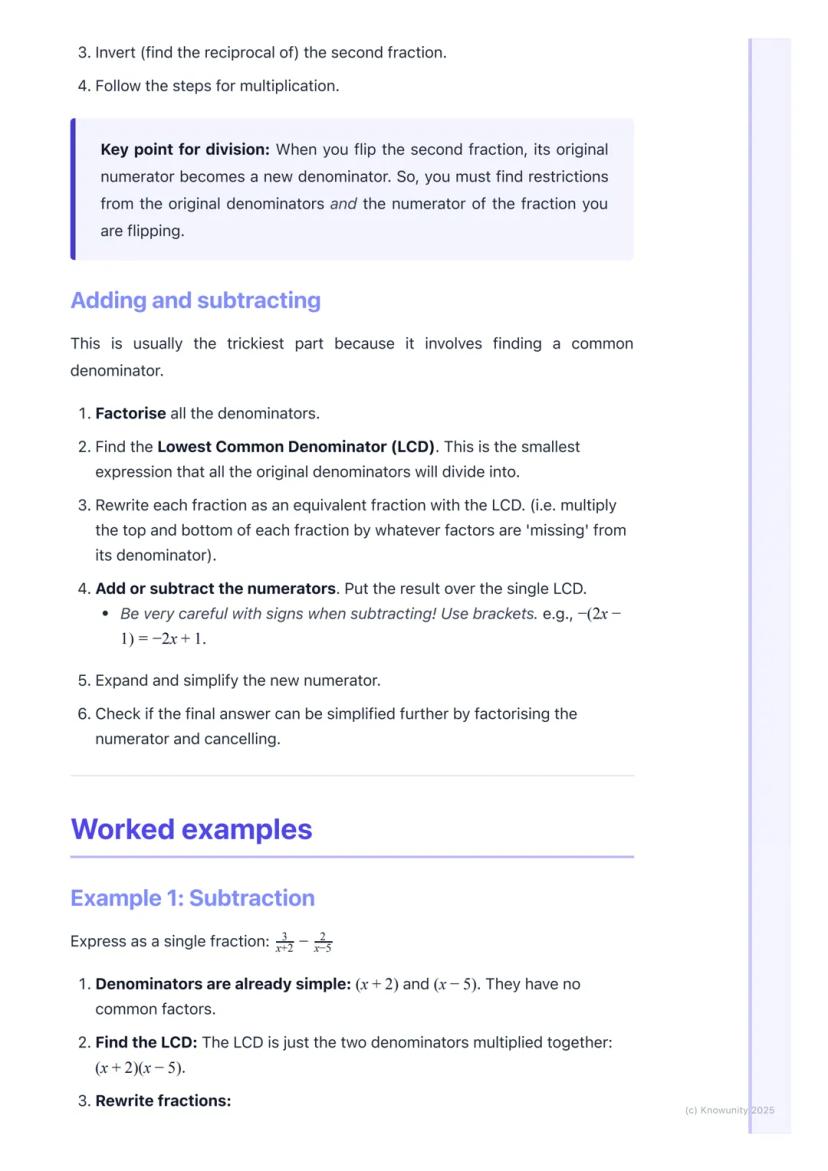
Here's the step-by-step: factorise all denominators, find the LCD (lowest common denominator), rewrite each fraction with the LCD, then add or subtract the numerators. Be extra careful with negative signs - use brackets like .
Let's try . The LCD is . Rewriting: . This gives us .
Top tip: When subtracting, always put brackets around the entire numerator you're subtracting to avoid sign errors!
5
of 6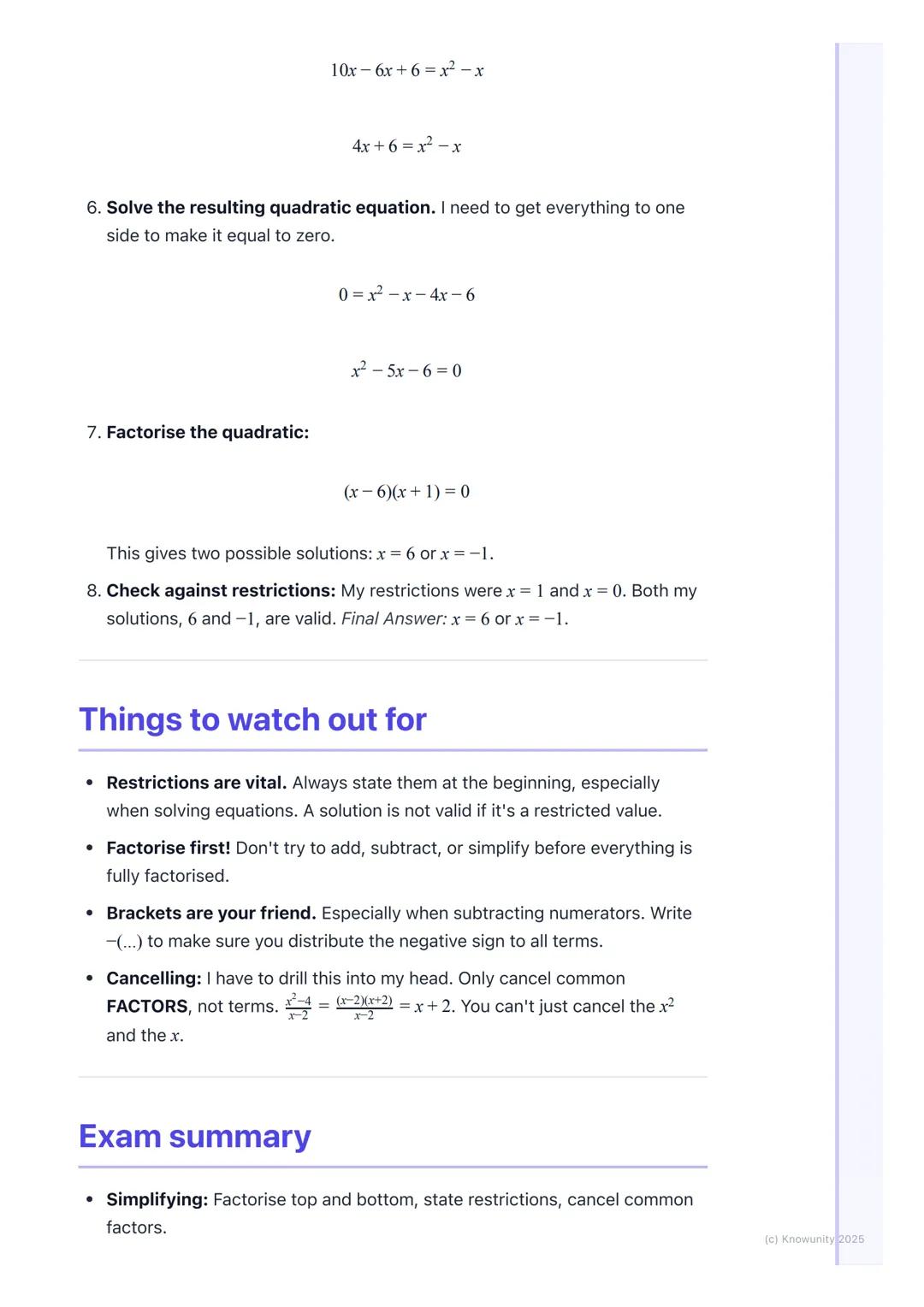
Solving Rational Equations
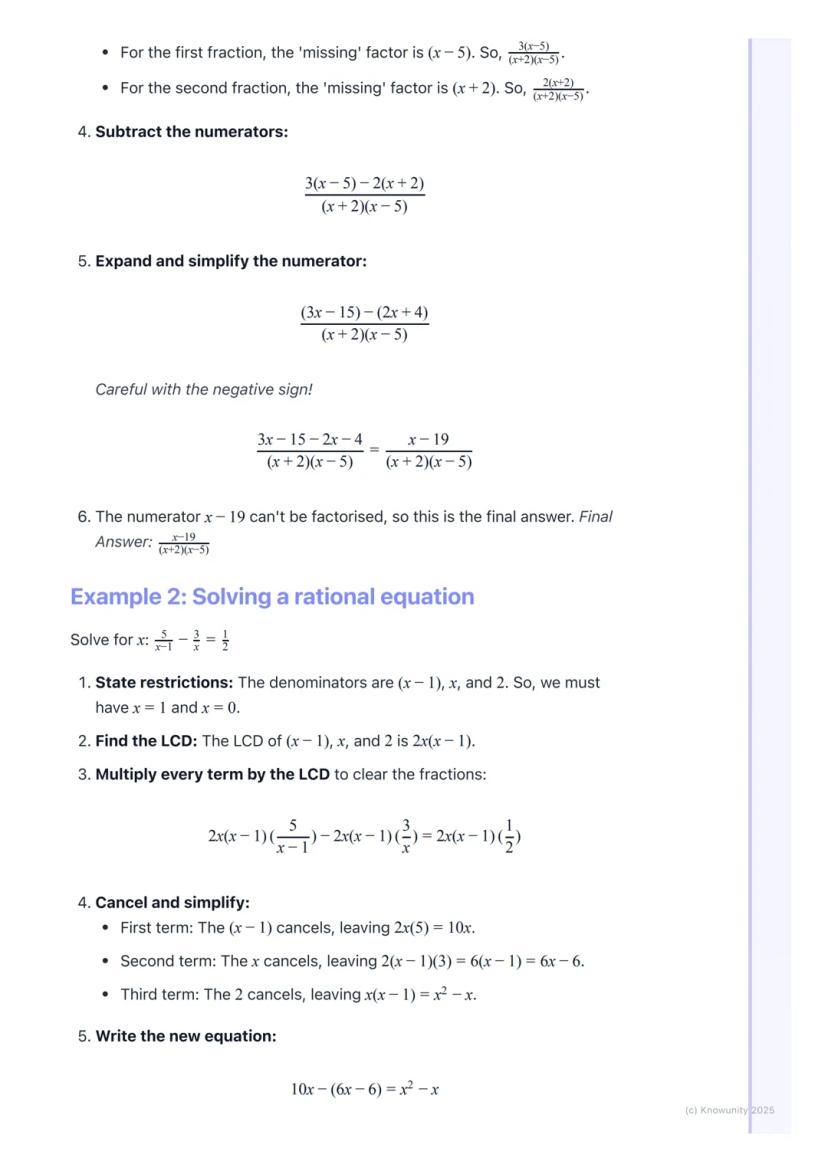
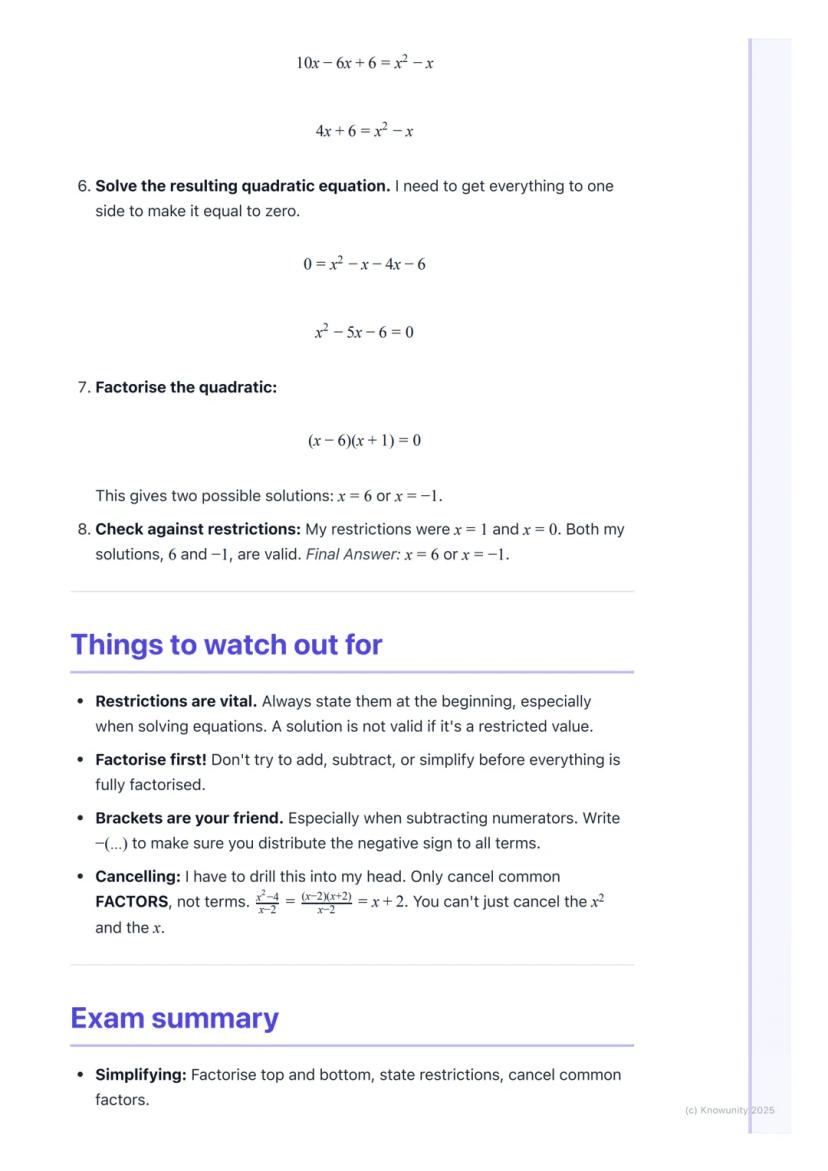
Now we're putting it all together! When solving equations like , your first job is stating all restrictions (x ≠ 1, x ≠ 0).
Next, find the LCD of all terms - here it's $2x10x - 6 = xx^2-5x-6=0$.
Factorising gives , so x = 6 or x = -1. Always check these solutions against your original restrictions - both are valid here since neither is 1 or 0.
Crucial step: Any solution that matches a restriction must be rejected - it's not a valid answer!
6
of 6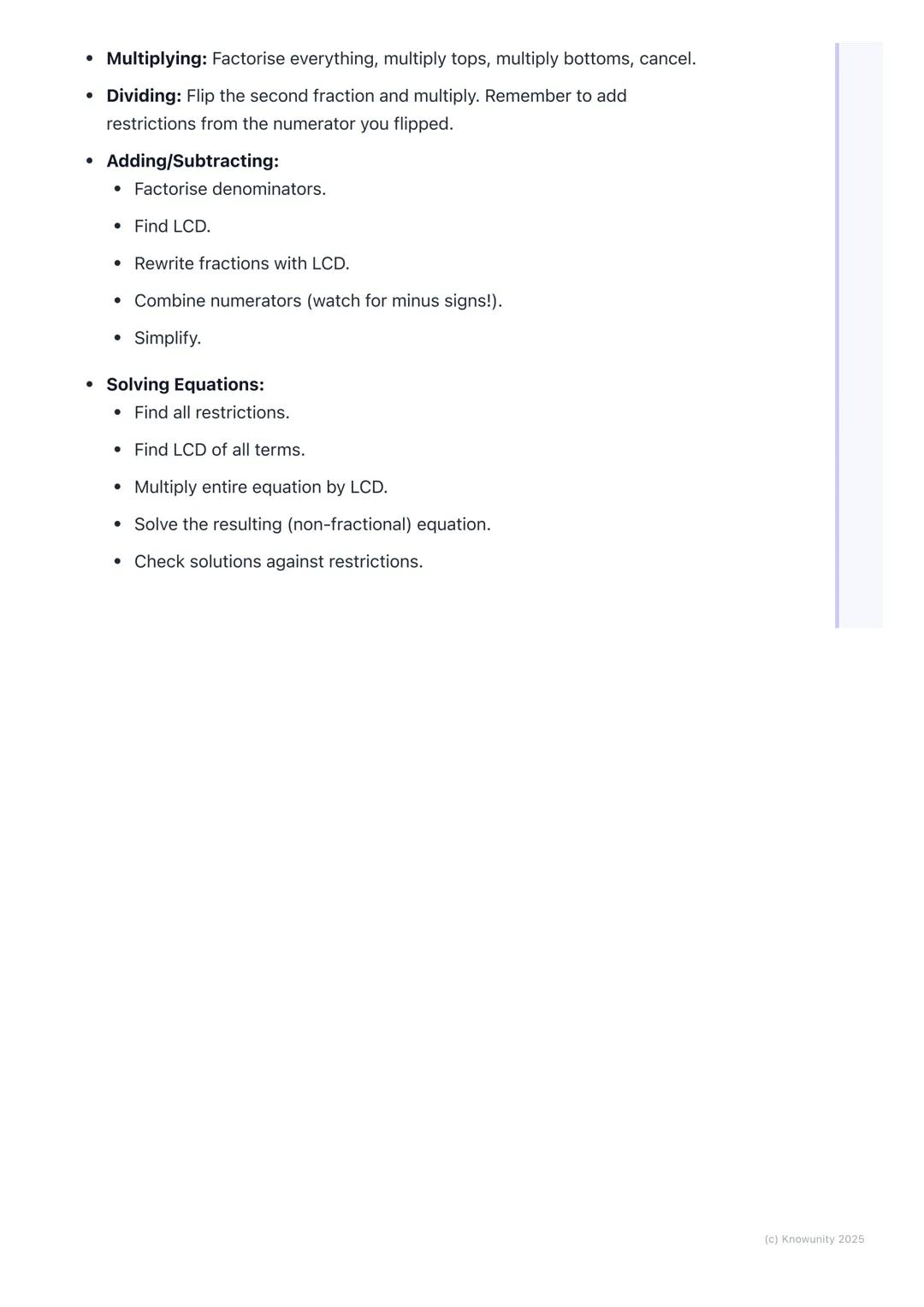
Exam Success Strategy
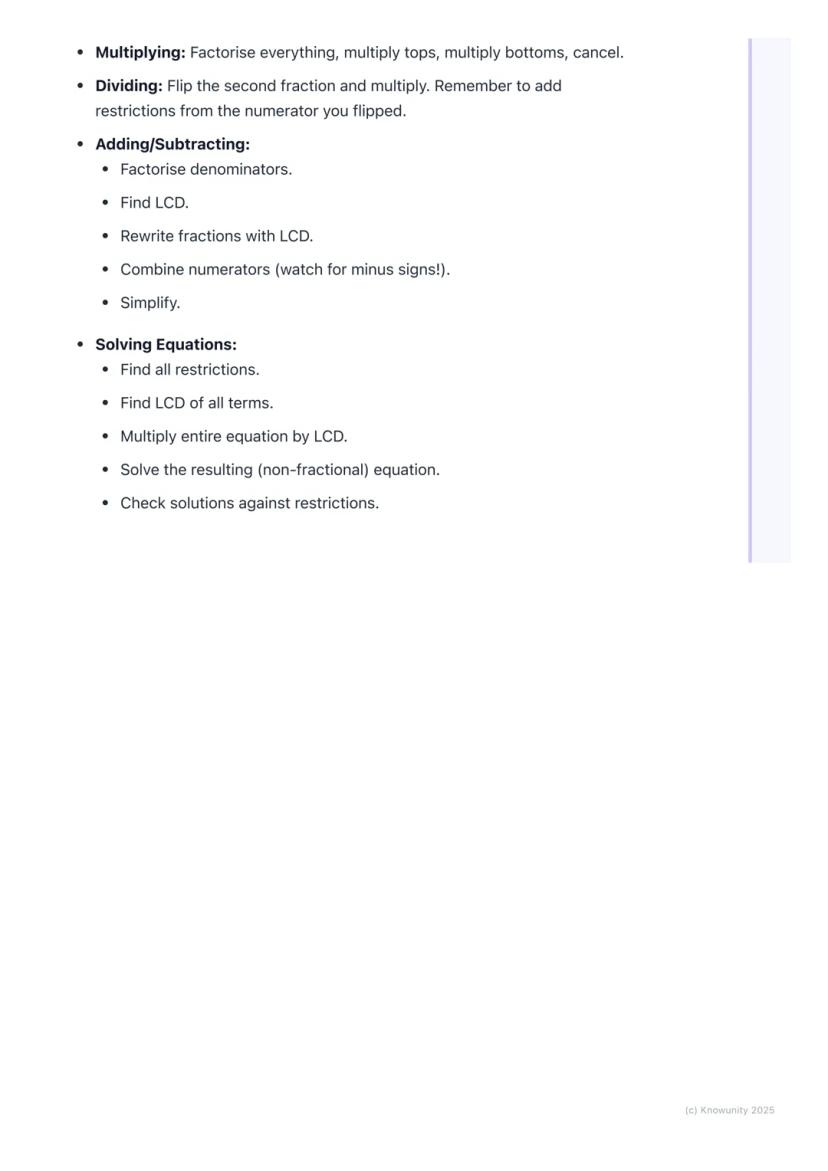
You've got this! Here's your quick reference for exam day: simplifying means factorise, state restrictions, then cancel factors. Multiplying is factorise everything, multiply across, then cancel. Dividing is flip and multiply.
For adding/subtracting, remember the mantra: factorise denominators, find LCD, rewrite fractions, combine carefully (watch those minus signs!), then simplify. Solving equations requires restrictions first, then clear fractions with the LCD.
The most common mistakes? Cancelling terms instead of factors, forgetting restrictions, and messing up signs when subtracting. Avoid these and you're golden.
Final reminder: Restrictions aren't just busy work - they'll save you from giving impossible answers that cost marks!
We thought you’d never ask...
What is the Knowunity AI companion?
Our AI Companion is a student-focused AI tool that offers more than just answers. Built on millions of Knowunity resources, it provides relevant information, personalised study plans, quizzes, and content directly in the chat, adapting to your individual learning journey.
Where can I download the Knowunity app?
You can download the app from Google Play Store and Apple App Store.
Is Knowunity really free of charge?
That's right! Enjoy free access to study content, connect with fellow students, and get instant help – all at your fingertips.
Most popular content in Mathematics
8MathematicsAlgebra
Algebra
5th Year91
MathematicsAlgebra 2
Algebra notes focusing on the factor theorem, completing the square, -b formula, graphs of polynomials
5th Year130
MathematicsSolving Equations
This section focuses on solving one-step and two-step linear equations to find the value of an unknown variable.
1st Year131
MathematicsIntroduction to Probability
This topic introduces basic probability concepts, including calculating the probability of simple events and understanding the difference between experimental and theoretical probability.
2nd Year81
MathematicsMaths jc algebra
Maths jc
1st Year230
MathematicsNatural Numbers and Integers
Students will learn about positive whole numbers, zero, and negative whole numbers, and how to add, subtract, multiply, and divide them correctly.
1st Year131
MathematicsDifferential Calculus
Calculus is a topic that comes up nearly everywhere on your maths LC. This is just starter notes that could be useful end of 5th year or start of 6th year
5th Year271
MathematicsArithmetic sequences and series
With examples
5th Year130
Most popular content
9 Irish
IrishIrish oral questions and answers
Questions and answers for the leaving cert oral
5th Year4264
IrishIrish oral questions
Outline of oral questions
5th Year2055
 English
Key Quotes : Sive
Key Quotes and explanations: Sive
6th Year2822
IrishIníon- le hÁine Durkin
Aine Durkin’s poem, Iníon: Themes & summary
5th Year850
IrishIrish poetry 2027
Iníon + Dínit an Bhróin
5th Year1133
IrishLC HL notes- Iníon (poem)
Includes poem in English and Irish, theme, key words & phrases
5th Year2284
IrishGaeilge Grammar Office
All the basics you need to know on Irish grammar.
6th Year1053
EnglishCultural Context : Shawshank Redemption : Sive : Small Things Like These
Comparative Study : Cultural Context : Shawshank Redemption, Sive and Small Things Like These
6th Year1420
IrishAn Gaeilge Aiste
Irish Language essay
6th Year1320
Can't find what you're looking for? Explore other subjects.
Students love us — and so will you.
4.6/5App Store
4.7/5Google Play
The app is very easy to use and well designed. I have found everything I was looking for so far and have been able to learn a lot from the presentations! I will definitely use the app for a class assignment! And of course it also helps a lot as an inspiration.
Stefan SiOS user
This app is really great. There are so many study notes and help [...]. My problem subject is French, for example, and the app has so many options for help. Thanks to this app, I have improved my French. I would recommend it to anyone.
Samantha KlichAndroid user
Wow, I am really amazed. I just tried the app because I've seen it advertised many times and was absolutely stunned. This app is THE HELP you want for school and above all, it offers so many things, such as workouts and fact sheets, which have been VERY helpful to me personally.
AnnaiOS user
Mathematics4 views·Updated May 25, 2026·6 pagesMastering Rational Expressions: Simplify, Solve, and Operate
Rational expressions are basically fractions with polynomials on top and bottom - think of them as regular fractions but with algebra thrown in. They're everywhere in maths, from solving real-world problems to advanced calculus, so getting comfortable with them now... Show more
1
of 6Sign up to see the content. It's free!
- Access to all documents
- Improve your grades
- Join milions of students
What Are Rational Expressions?
Ever wondered what happens when you mix fractions with algebra? You get rational expressions - fractions where both the numerator and denominator are polynomials, like .
The golden rule here is that the denominator can never equal zero because dividing by zero is mathematically impossible. This creates what we call restrictions or non-permissible values - basically the values of x that would make the denominator zero.
Finding restrictions is dead simple: set the denominator equal to zero and solve. For example, with , the restriction is x = 4 because that makes the bottom 4-4 = 0.
Pro tip: Always find your restrictions first - they'll be crucial when solving equations later on!
2
of 6Sign up to see the content. It's free!
- Access to all documents
- Improve your grades
- Join milions of students
Simplifying Rational Expressions
This is where factorising becomes your best mate. The process is straightforward: factorise everything, state your restrictions, then cancel common factors (not terms!).
Let's break down . First, factorise the top: using difference of two squares. Then the bottom: .
Now you can see the common factor and cancel it out, giving you with restrictions x ≠ -3, x ≠ -1.
Warning: You can only cancel factors, never terms. Don't try cancelling the x in - that's mathematically wrong!
3
of 6Sign up to see the content. It's free!
- Access to all documents
- Improve your grades
- Join milions of students
Multiplying and Dividing
Good news - this bit's actually easier than adding and subtracting! For multiplication, factorise everything first, then multiply tops together and bottoms together, and cancel any common factors.
Division follows the classic "keep, change, flip" rule. Keep the first fraction as is, change the division sign to multiplication, then flip the second fraction. Just remember that when you flip a fraction, its original numerator becomes a new denominator, so you need restrictions from there too.
The key is staying organised - write down all your restrictions from every denominator (including the one you flipped) before you start cancelling.
Remember: Division is just multiplication in disguise - flip that second fraction and you're sorted!
4
of 6Sign up to see the content. It's free!
- Access to all documents
- Improve your grades
- Join milions of students
Adding and Subtracting
This is where things get properly tricky because you need a common denominator. Think of it like adding - you need a common bottom first.
Here's the step-by-step: factorise all denominators, find the LCD (lowest common denominator), rewrite each fraction with the LCD, then add or subtract the numerators. Be extra careful with negative signs - use brackets like .
Let's try . The LCD is . Rewriting: . This gives us .
Top tip: When subtracting, always put brackets around the entire numerator you're subtracting to avoid sign errors!
5
of 6Sign up to see the content. It's free!
- Access to all documents
- Improve your grades
- Join milions of students
Solving Rational Equations
Now we're putting it all together! When solving equations like , your first job is stating all restrictions (x ≠ 1, x ≠ 0).
Next, find the LCD of all terms - here it's $2x10x - 6 = xx^2-5x-6=0$.
Factorising gives , so x = 6 or x = -1. Always check these solutions against your original restrictions - both are valid here since neither is 1 or 0.
Crucial step: Any solution that matches a restriction must be rejected - it's not a valid answer!
6
of 6Sign up to see the content. It's free!
- Access to all documents
- Improve your grades
- Join milions of students
Exam Success Strategy
You've got this! Here's your quick reference for exam day: simplifying means factorise, state restrictions, then cancel factors. Multiplying is factorise everything, multiply across, then cancel. Dividing is flip and multiply.
For adding/subtracting, remember the mantra: factorise denominators, find LCD, rewrite fractions, combine carefully (watch those minus signs!), then simplify. Solving equations requires restrictions first, then clear fractions with the LCD.
The most common mistakes? Cancelling terms instead of factors, forgetting restrictions, and messing up signs when subtracting. Avoid these and you're golden.
Final reminder: Restrictions aren't just busy work - they'll save you from giving impossible answers that cost marks!
We thought you’d never ask...
What is the Knowunity AI companion?
Our AI Companion is a student-focused AI tool that offers more than just answers. Built on millions of Knowunity resources, it provides relevant information, personalised study plans, quizzes, and content directly in the chat, adapting to your individual learning journey.
Where can I download the Knowunity app?
You can download the app from Google Play Store and Apple App Store.
Is Knowunity really free of charge?
That's right! Enjoy free access to study content, connect with fellow students, and get instant help – all at your fingertips.
Most popular content in Mathematics
8MathematicsAlgebra
Algebra
5th Year91
MathematicsAlgebra 2
Algebra notes focusing on the factor theorem, completing the square, -b formula, graphs of polynomials
5th Year130
MathematicsSolving Equations
This section focuses on solving one-step and two-step linear equations to find the value of an unknown variable.
1st Year131
MathematicsIntroduction to Probability
This topic introduces basic probability concepts, including calculating the probability of simple events and understanding the difference between experimental and theoretical probability.
2nd Year81
MathematicsMaths jc algebra
Maths jc
1st Year230
MathematicsNatural Numbers and Integers
Students will learn about positive whole numbers, zero, and negative whole numbers, and how to add, subtract, multiply, and divide them correctly.
1st Year131
MathematicsDifferential Calculus
Calculus is a topic that comes up nearly everywhere on your maths LC. This is just starter notes that could be useful end of 5th year or start of 6th year
5th Year271
MathematicsArithmetic sequences and series
With examples
5th Year130
Most popular content
9IrishIrish oral questions and answers
Questions and answers for the leaving cert oral
5th Year4264
IrishIrish oral questions
Outline of oral questions
5th Year2055
EnglishKey Quotes : Sive
Key Quotes and explanations: Sive
6th Year2822
IrishIníon- le hÁine Durkin
Aine Durkin’s poem, Iníon: Themes & summary
5th Year850
IrishIrish poetry 2027
Iníon + Dínit an Bhróin
5th Year1133
IrishLC HL notes- Iníon (poem)
Includes poem in English and Irish, theme, key words & phrases
5th Year2284
IrishGaeilge Grammar Office
All the basics you need to know on Irish grammar.
6th Year1053
EnglishCultural Context : Shawshank Redemption : Sive : Small Things Like These
Comparative Study : Cultural Context : Shawshank Redemption, Sive and Small Things Like These
6th Year1420
IrishAn Gaeilge Aiste
Irish Language essay
6th Year1320
Can't find what you're looking for? Explore other subjects.
Students love us — and so will you.
4.6/5App Store
4.7/5Google Play
The app is very easy to use and well designed. I have found everything I was looking for so far and have been able to learn a lot from the presentations! I will definitely use the app for a class assignment! And of course it also helps a lot as an inspiration.
Stefan SiOS user
This app is really great. There are so many study notes and help [...]. My problem subject is French, for example, and the app has so many options for help. Thanks to this app, I have improved my French. I would recommend it to anyone.
Samantha KlichAndroid user
Wow, I am really amazed. I just tried the app because I've seen it advertised many times and was absolutely stunned. This app is THE HELP you want for school and above all, it offers so many things, such as workouts and fact sheets, which have been VERY helpful to me personally.
AnnaiOS user