
Ever wondered why your bank balance can go negative or... Show more
 Mathematics13 views·Updated May 27, 2026·5 pages
Understanding Natural Numbers and Integers
1 / 5
1
of 5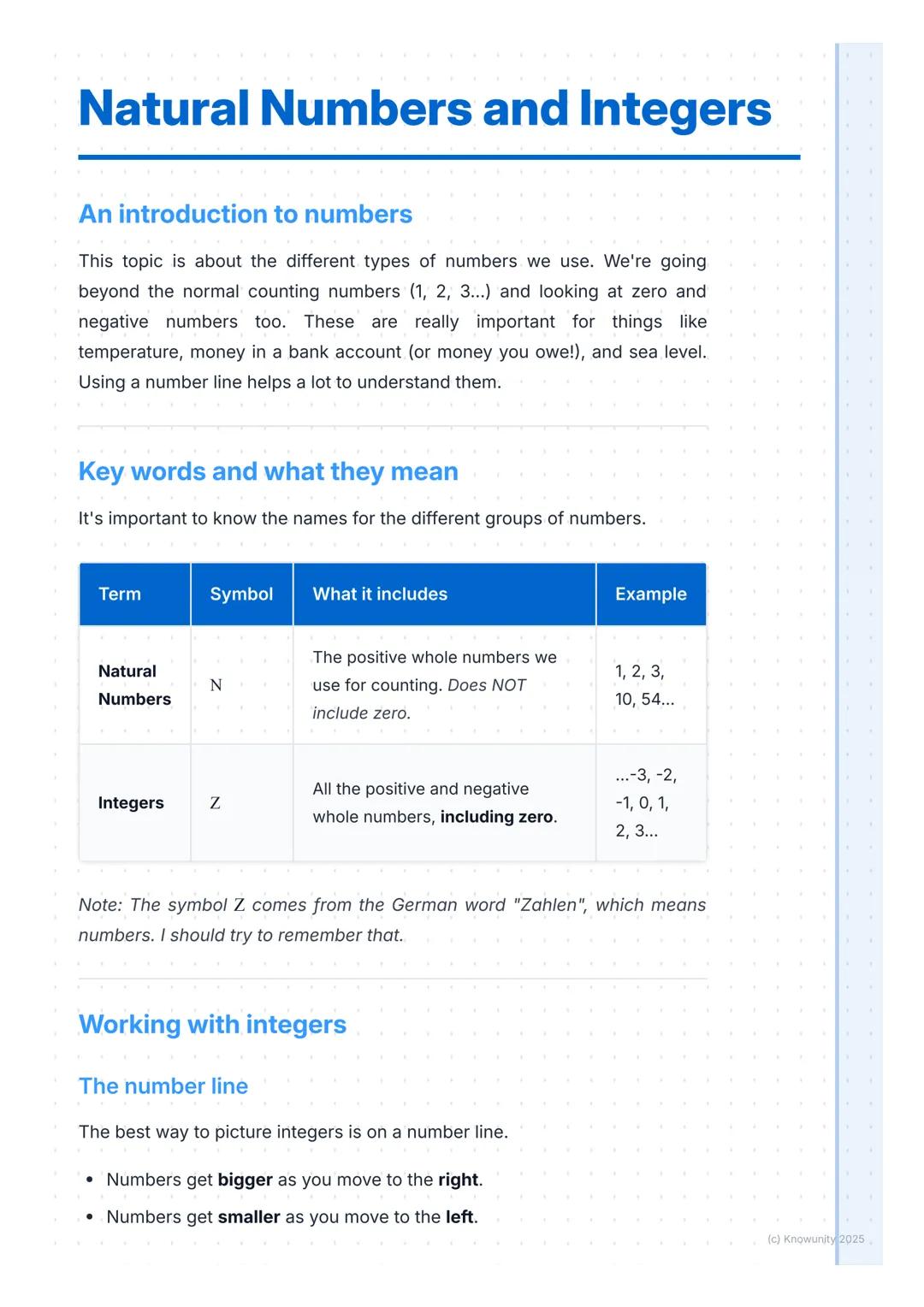
Natural Numbers and Integers - The Basics
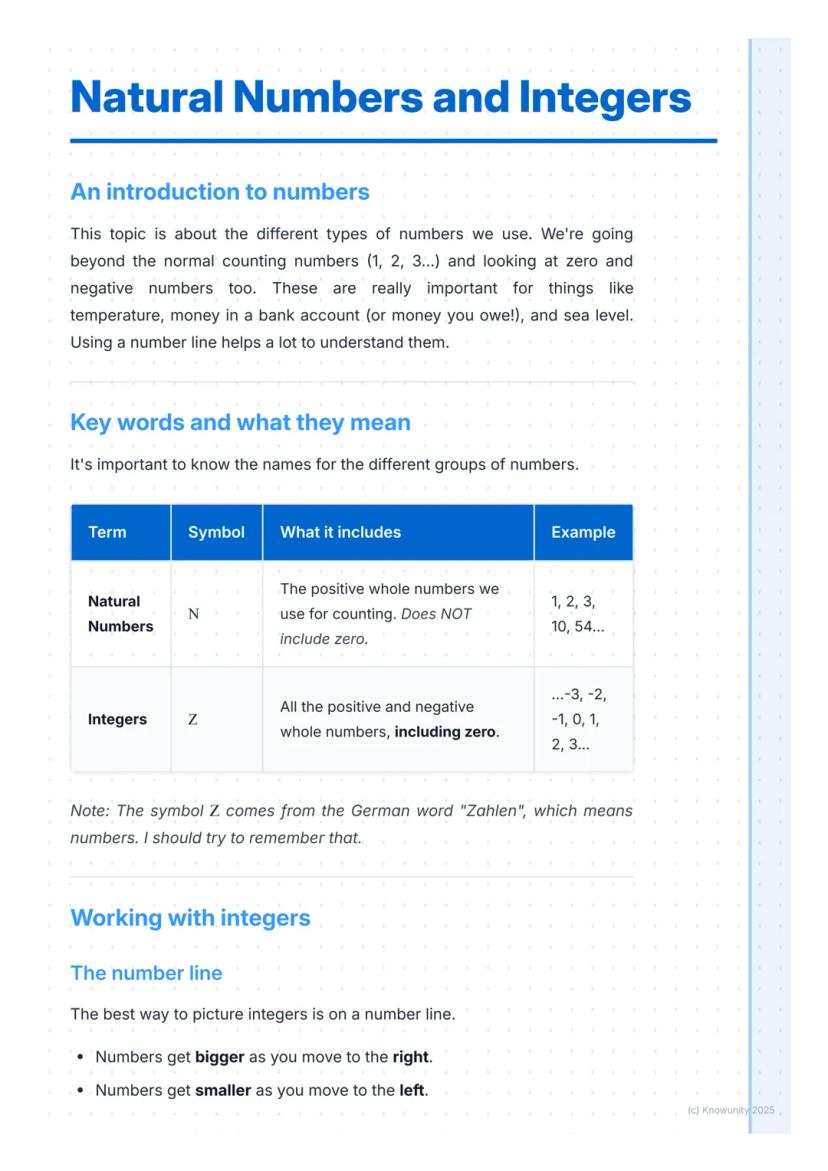
You've been using natural numbers your whole life without realising it! These are simply the counting numbers: 1, 2, 3, 4, and so on. They're called "natural" because they feel natural to use when counting objects.
Integers take things a step further by including zero and all the negative numbers too. Think of them as the complete family: ...-3, -2, -1, 0, 1, 2, 3... The symbol for integers is Z, which comes from the German word "Zahlen" meaning numbers.
Quick Tip: Remember that natural numbers don't include zero, but integers do! This catches lots of students out in tests.
The number line is your best friend here. Numbers get bigger as you move right and smaller as you move left. So -1 is actually bigger than -5 because it's further to the right!
2
of 5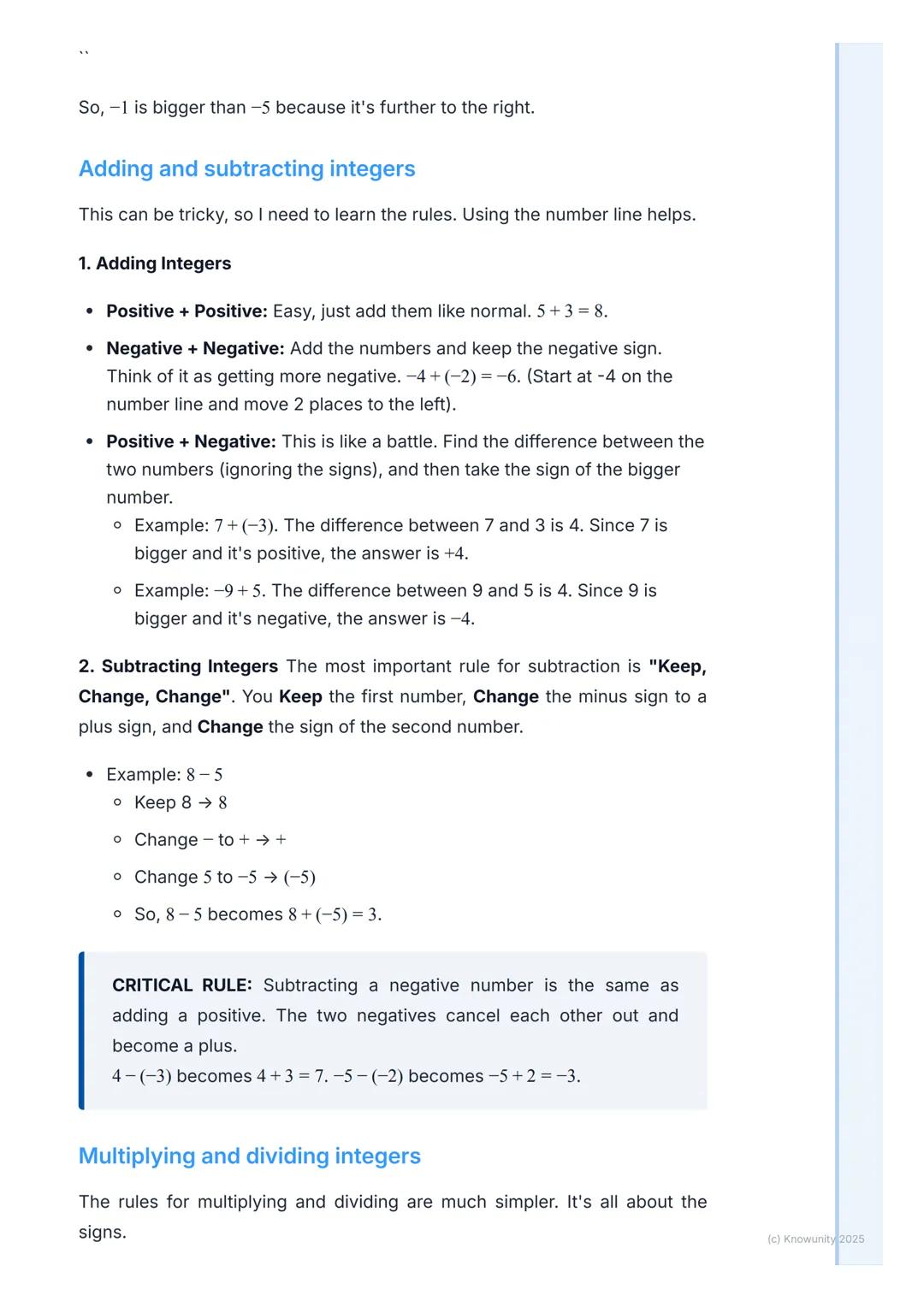
Adding and Subtracting Integers
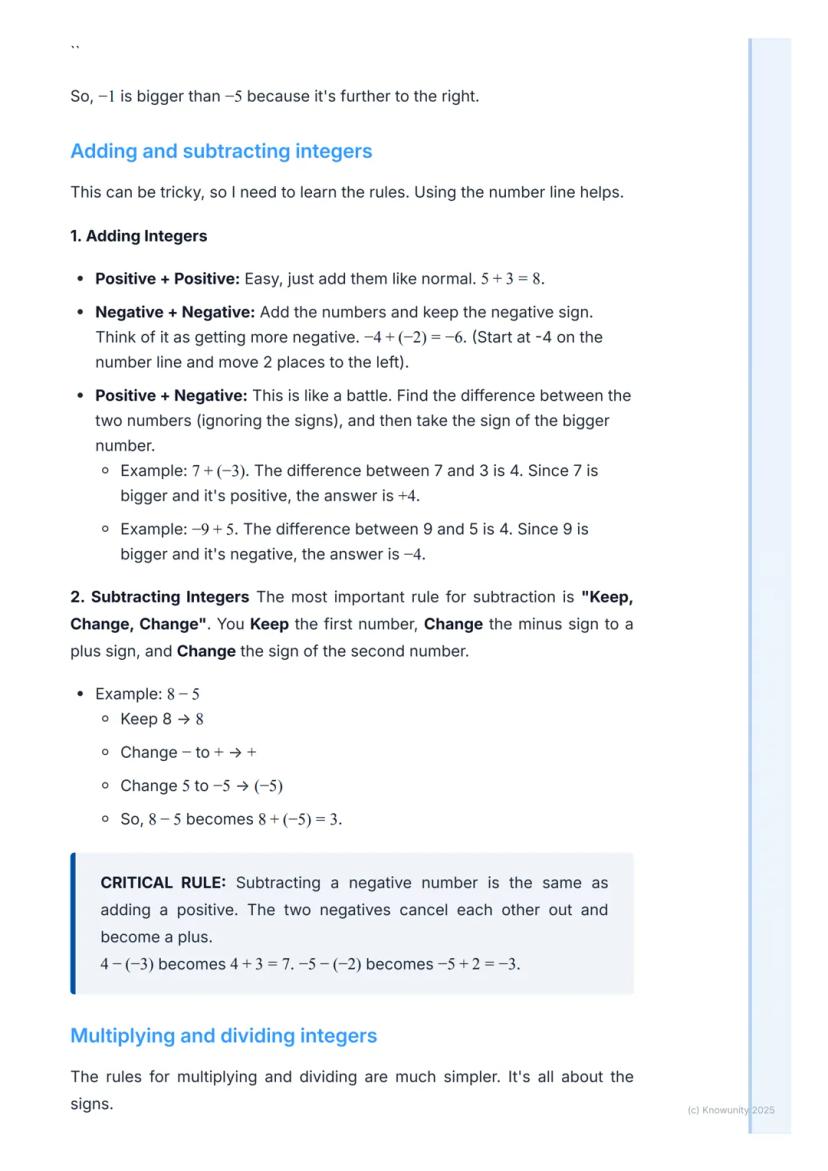
Adding integers might seem tricky at first, but there are simple patterns to follow. When you're adding two positive numbers, it's just normal addition. When adding two negative numbers, add them up and keep the negative sign - think of it as getting "more negative".
The interesting bit happens when you mix positive and negative numbers. Picture it like a battle between the numbers! Find the difference between them (ignore the signs), then use the sign of the bigger number. So 7 + (-3) = 4 because 7 is bigger and positive.
For subtraction, use the "Keep, Change, Change" rule. Keep the first number, change the minus to a plus, and change the sign of the second number. So 8 - 5 becomes 8 + (-5) = 3.
Remember: Subtracting a negative is the same as adding a positive! The two negatives cancel out: 4 - (-3) = 4 + 3 = 7.
3
of 5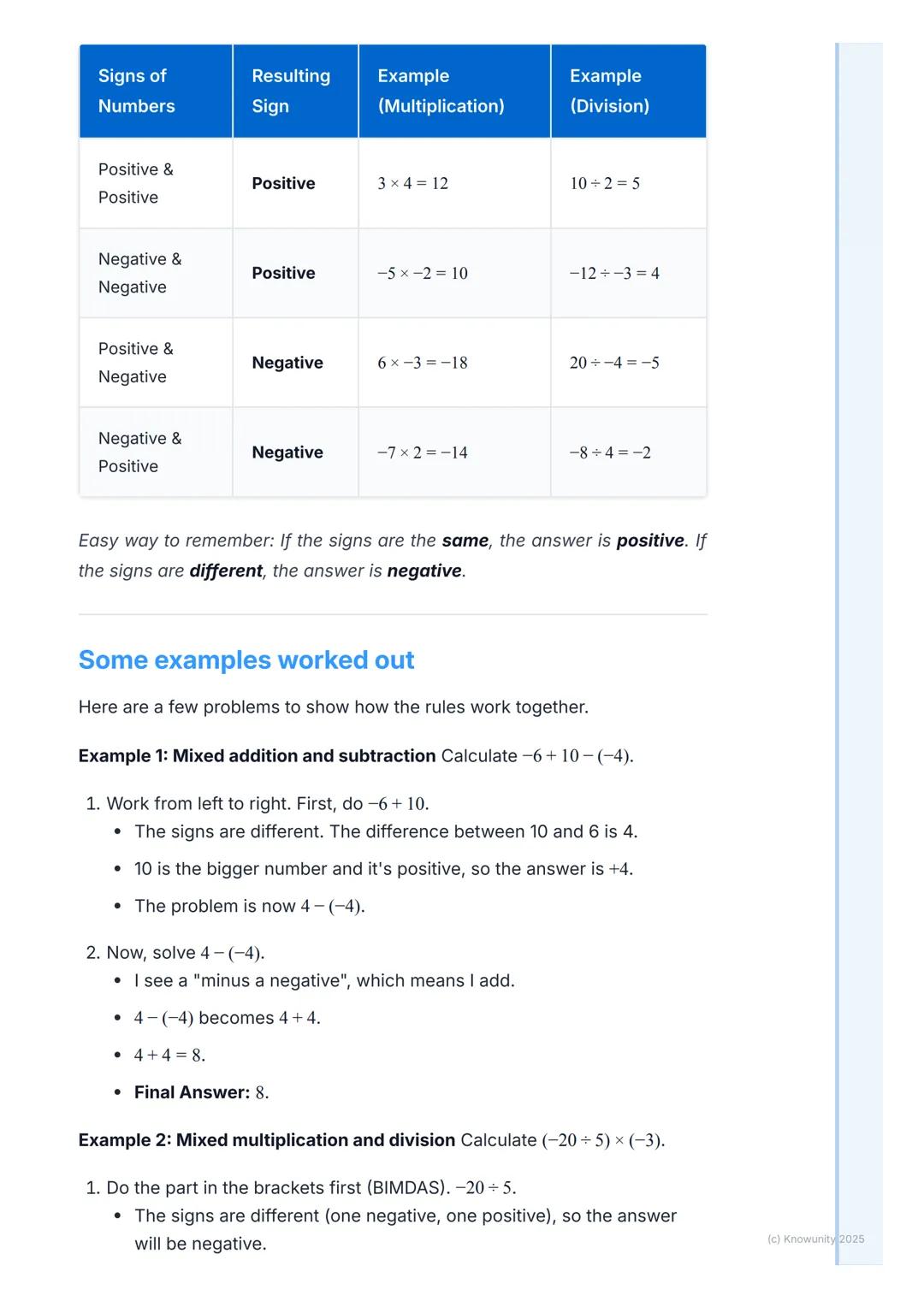
Multiplying and Dividing Integers
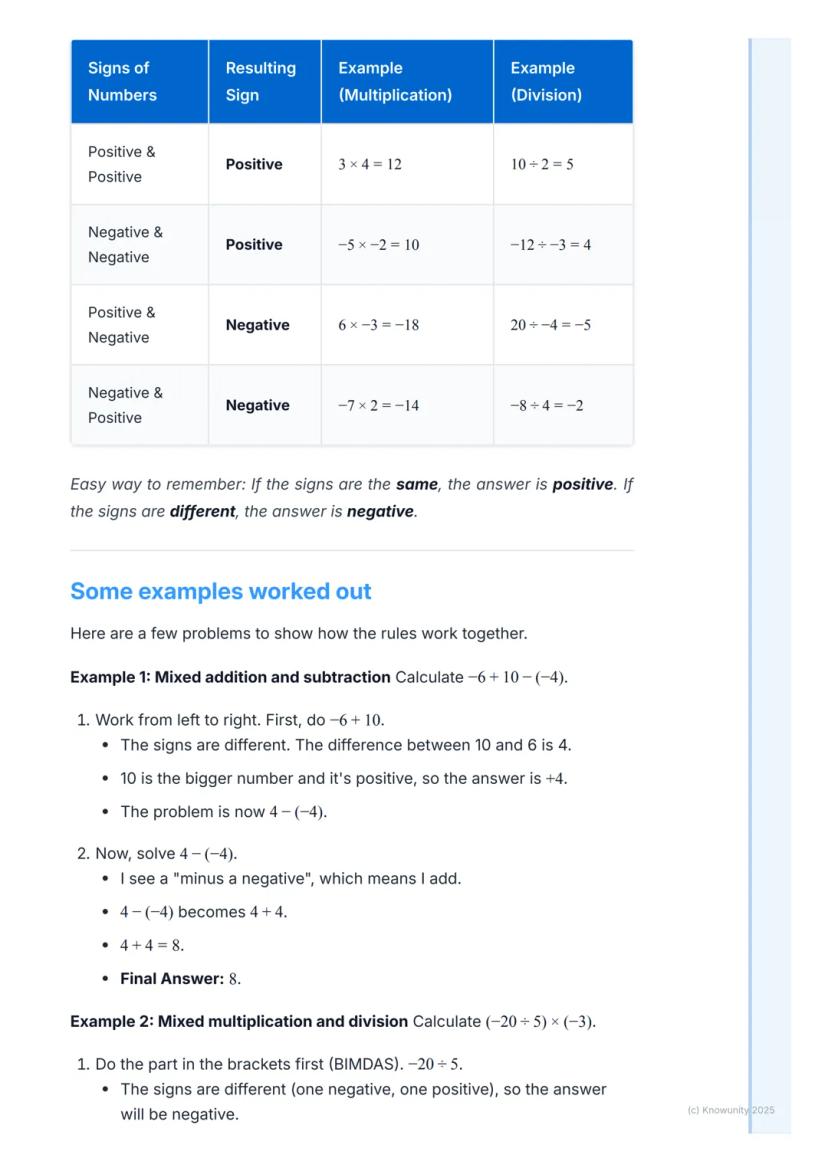
Good news - multiplying and dividing integers is much simpler than adding and subtracting! It's all about the signs, and there's just one rule to remember.
If the signs are the same (both positive or both negative), your answer is positive. If the signs are different (one positive, one negative), your answer is negative. So -5 × -2 = 10 , but 6 × -3 = -18 .
This works exactly the same for division. -12 ÷ -3 = 4 because both numbers are negative (same signs), while 20 ÷ -4 = -5 because the signs are different.
Memory Trick: Think "same = smiley face = positive" and "different = frowny face = negative"!
4
of 5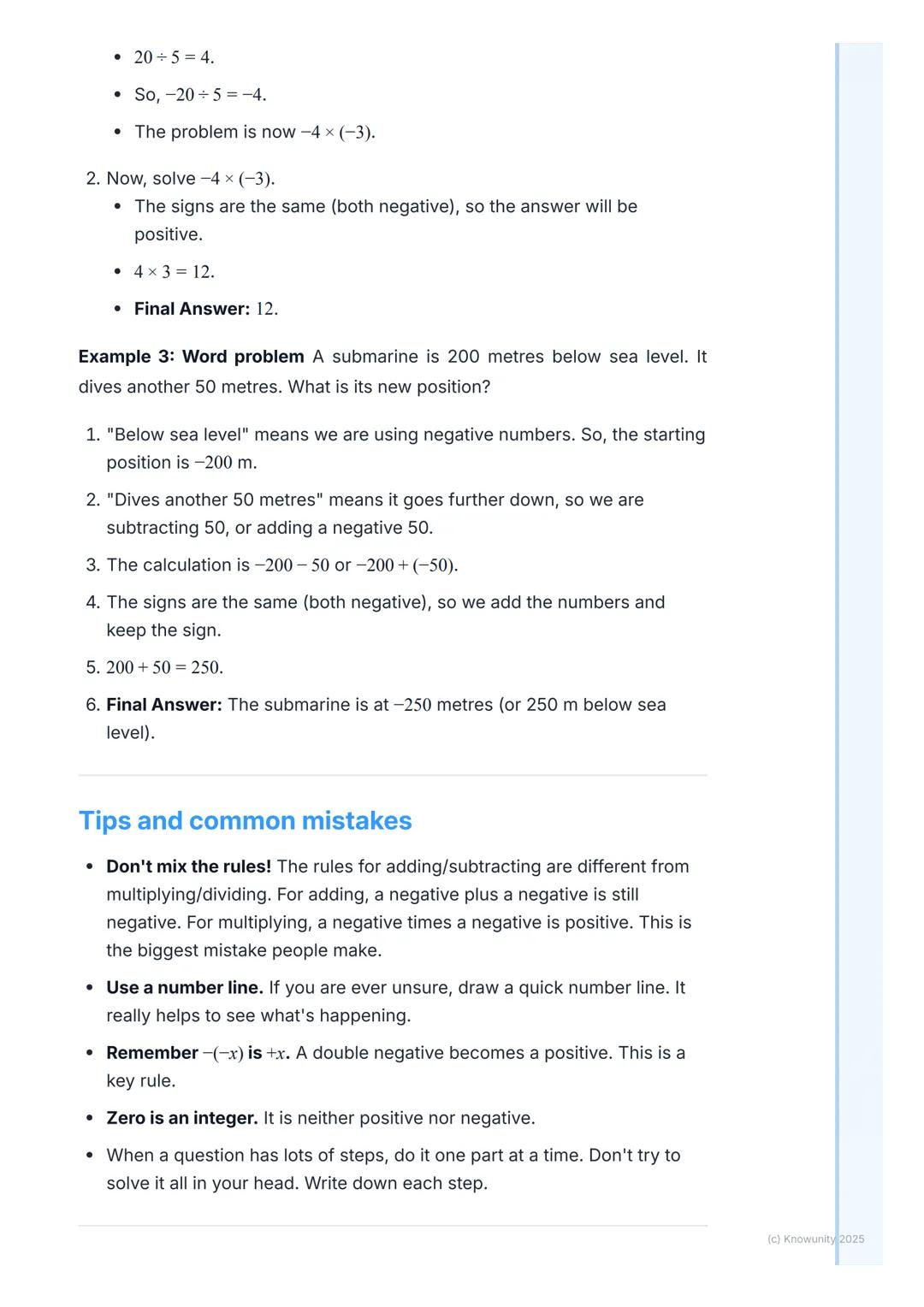
Working Through Examples
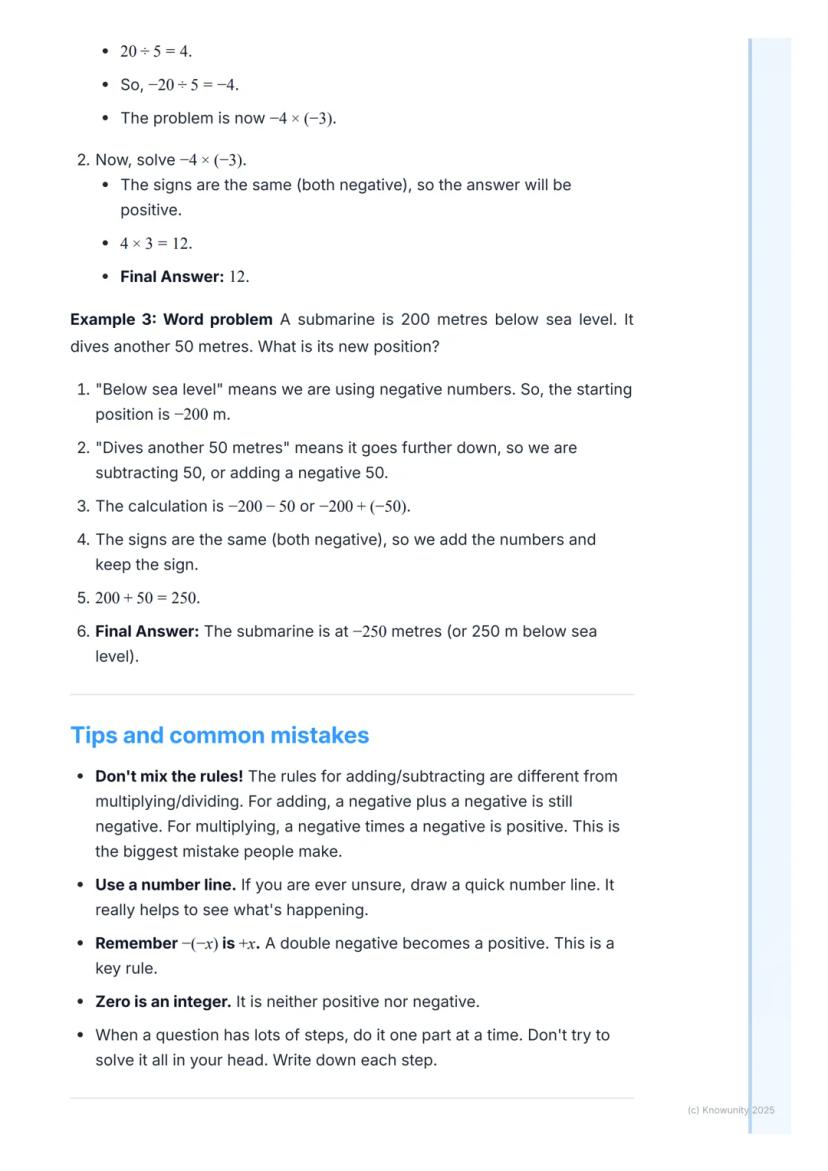
Let's tackle some real problems step by step. For -6 + 10 - (-4), work from left to right. First, -6 + 10 gives us 4 (different signs, so take the bigger number's sign). Then 4 - (-4) becomes 4 + 4 = 8.
Here's a practical example: A submarine starts 200 metres below sea level and dives another 50 metres. Since "below sea level" means negative, we calculate -200 + (-50) = -250m.
When you see brackets, always solve those first! For (-20 ÷ 5) × (-3), first work out -20 ÷ 5 = -4 . Then -4 × (-3) = 12 .
Pro Tip: Don't try to do everything in your head - write down each step. This prevents silly mistakes that cost marks!
5
of 5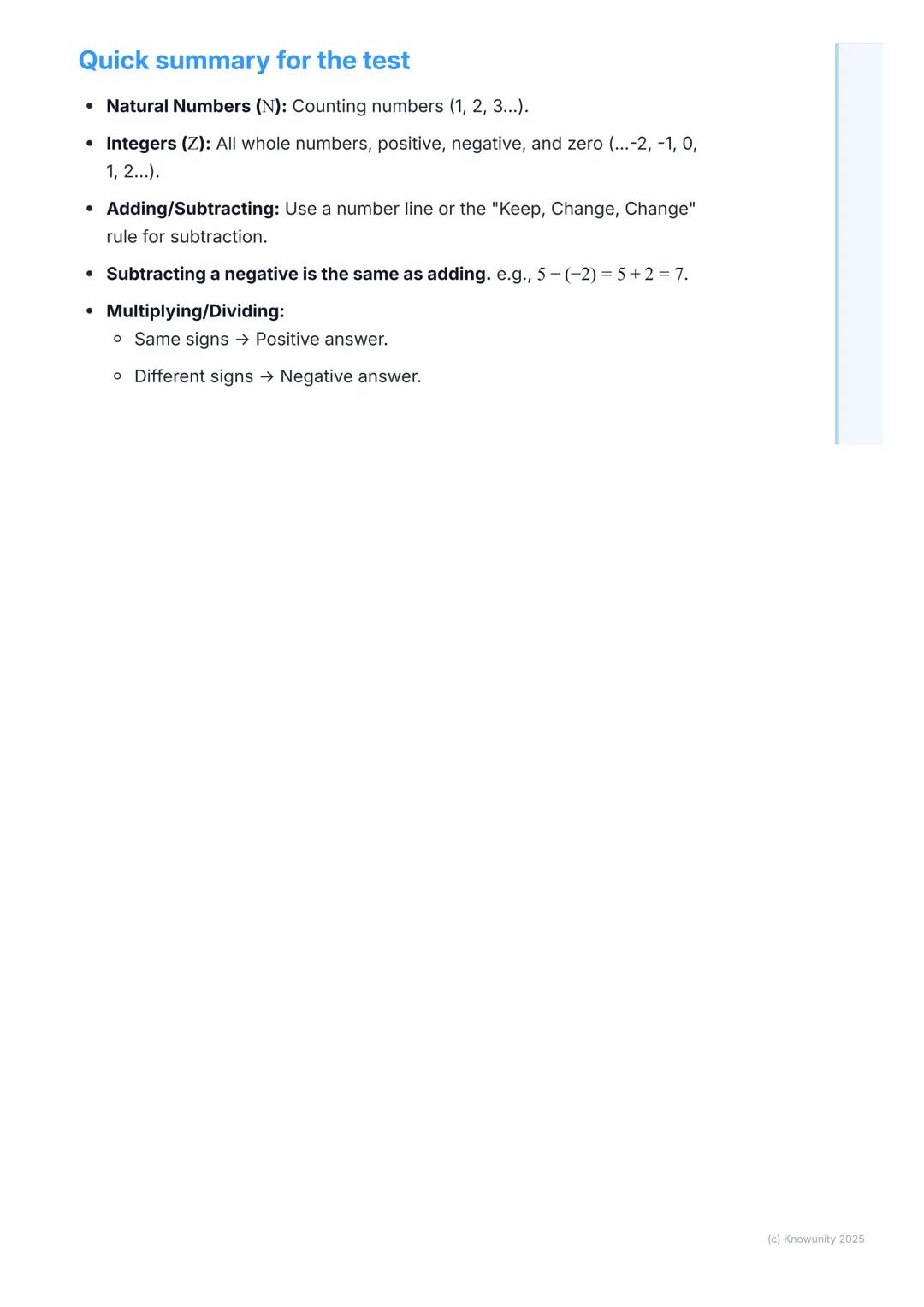
Quick Test Revision
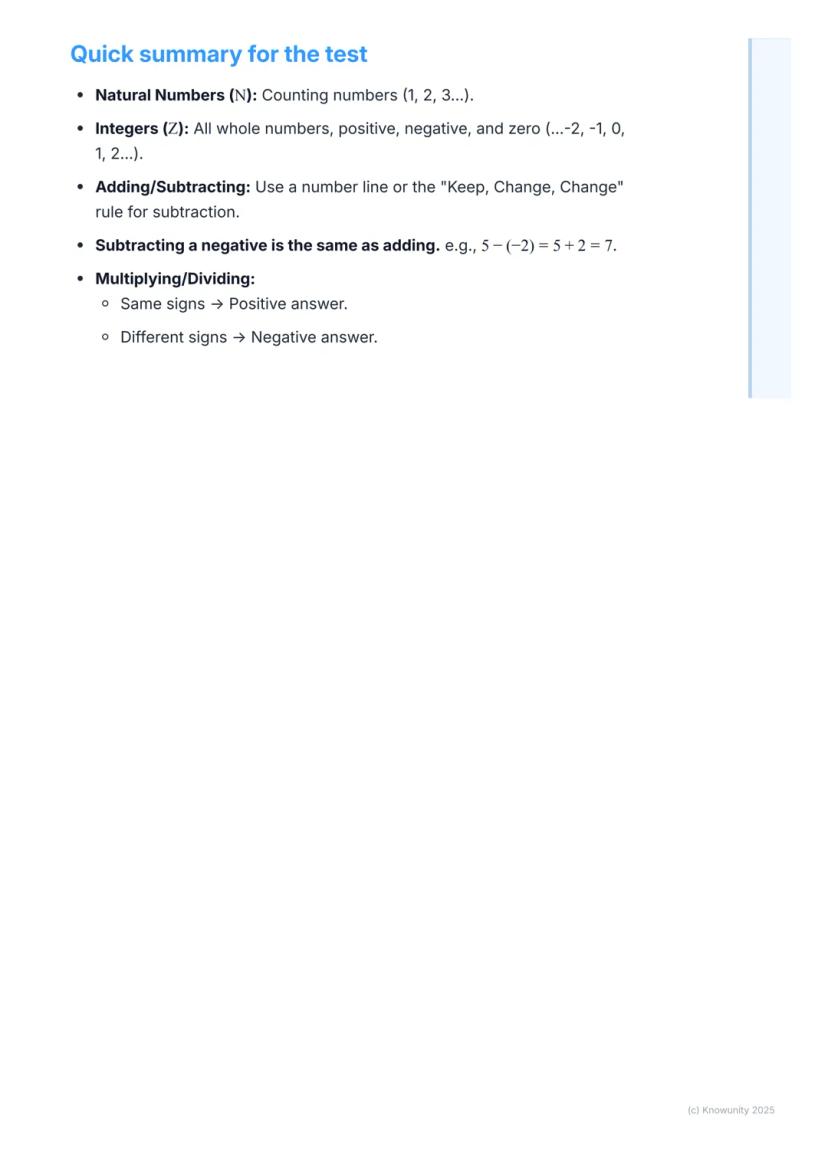
Here's everything you need for your test! Natural numbers are your basic counting numbers (1, 2, 3...), while integers include zero and all negative numbers too (...-2, -1, 0, 1, 2...).
For adding and subtracting, use the number line or remember that subtracting a negative equals adding a positive. The "Keep, Change, Change" rule is your friend for subtraction problems.
Multiplication and division follow one simple rule: same signs give positive answers, different signs give negative answers. Zero is an integer but it's neither positive nor negative.
Final Reminder: The biggest mistake students make is mixing up the rules for different operations. Adding two negatives stays negative, but multiplying two negatives becomes positive!
We thought you’d never ask...
What is the Knowunity AI companion?
Our AI Companion is a student-focused AI tool that offers more than just answers. Built on millions of Knowunity resources, it provides relevant information, personalised study plans, quizzes, and content directly in the chat, adapting to your individual learning journey.
Where can I download the Knowunity app?
You can download the app from Google Play Store and Apple App Store.
Is Knowunity really free of charge?
That's right! Enjoy free access to study content, connect with fellow students, and get instant help – all at your fingertips.
Most popular content in Mathematics
7Most popular content
9Can't find what you're looking for? Explore other subjects.
Students love us — and so will you.
4.6/5App Store
4.7/5Google Play
The app is very easy to use and well designed. I have found everything I was looking for so far and have been able to learn a lot from the presentations! I will definitely use the app for a class assignment! And of course it also helps a lot as an inspiration.
Stefan SiOS user
This app is really great. There are so many study notes and help [...]. My problem subject is French, for example, and the app has so many options for help. Thanks to this app, I have improved my French. I would recommend it to anyone.
Samantha KlichAndroid user
Wow, I am really amazed. I just tried the app because I've seen it advertised many times and was absolutely stunned. This app is THE HELP you want for school and above all, it offers so many things, such as workouts and fact sheets, which have been VERY helpful to me personally.
AnnaiOS user
Mathematics13 views·Updated May 27, 2026·5 pagesUnderstanding Natural Numbers and Integers
Ever wondered why your bank balance can go negative or how we measure temperatures below zero? Understanding natural numbers and integers is the key to making sense of these everyday situations. These number systems help us work with everything from... Show more
1
of 5Sign up to see the content. It's free!
- Access to all documents
- Improve your grades
- Join milions of students
Natural Numbers and Integers - The Basics
You've been using natural numbers your whole life without realising it! These are simply the counting numbers: 1, 2, 3, 4, and so on. They're called "natural" because they feel natural to use when counting objects.
Integers take things a step further by including zero and all the negative numbers too. Think of them as the complete family: ...-3, -2, -1, 0, 1, 2, 3... The symbol for integers is Z, which comes from the German word "Zahlen" meaning numbers.
Quick Tip: Remember that natural numbers don't include zero, but integers do! This catches lots of students out in tests.
The number line is your best friend here. Numbers get bigger as you move right and smaller as you move left. So -1 is actually bigger than -5 because it's further to the right!
2
of 5Sign up to see the content. It's free!
- Access to all documents
- Improve your grades
- Join milions of students
Adding and Subtracting Integers
Adding integers might seem tricky at first, but there are simple patterns to follow. When you're adding two positive numbers, it's just normal addition. When adding two negative numbers, add them up and keep the negative sign - think of it as getting "more negative".
The interesting bit happens when you mix positive and negative numbers. Picture it like a battle between the numbers! Find the difference between them (ignore the signs), then use the sign of the bigger number. So 7 + (-3) = 4 because 7 is bigger and positive.
For subtraction, use the "Keep, Change, Change" rule. Keep the first number, change the minus to a plus, and change the sign of the second number. So 8 - 5 becomes 8 + (-5) = 3.
Remember: Subtracting a negative is the same as adding a positive! The two negatives cancel out: 4 - (-3) = 4 + 3 = 7.
3
of 5Sign up to see the content. It's free!
- Access to all documents
- Improve your grades
- Join milions of students
Multiplying and Dividing Integers
Good news - multiplying and dividing integers is much simpler than adding and subtracting! It's all about the signs, and there's just one rule to remember.
If the signs are the same (both positive or both negative), your answer is positive. If the signs are different (one positive, one negative), your answer is negative. So -5 × -2 = 10 , but 6 × -3 = -18 .
This works exactly the same for division. -12 ÷ -3 = 4 because both numbers are negative (same signs), while 20 ÷ -4 = -5 because the signs are different.
Memory Trick: Think "same = smiley face = positive" and "different = frowny face = negative"!
4
of 5Sign up to see the content. It's free!
- Access to all documents
- Improve your grades
- Join milions of students
Working Through Examples
Let's tackle some real problems step by step. For -6 + 10 - (-4), work from left to right. First, -6 + 10 gives us 4 (different signs, so take the bigger number's sign). Then 4 - (-4) becomes 4 + 4 = 8.
Here's a practical example: A submarine starts 200 metres below sea level and dives another 50 metres. Since "below sea level" means negative, we calculate -200 + (-50) = -250m.
When you see brackets, always solve those first! For (-20 ÷ 5) × (-3), first work out -20 ÷ 5 = -4 . Then -4 × (-3) = 12 .
Pro Tip: Don't try to do everything in your head - write down each step. This prevents silly mistakes that cost marks!
5
of 5Sign up to see the content. It's free!
- Access to all documents
- Improve your grades
- Join milions of students
Quick Test Revision
Here's everything you need for your test! Natural numbers are your basic counting numbers (1, 2, 3...), while integers include zero and all negative numbers too (...-2, -1, 0, 1, 2...).
For adding and subtracting, use the number line or remember that subtracting a negative equals adding a positive. The "Keep, Change, Change" rule is your friend for subtraction problems.
Multiplication and division follow one simple rule: same signs give positive answers, different signs give negative answers. Zero is an integer but it's neither positive nor negative.
Final Reminder: The biggest mistake students make is mixing up the rules for different operations. Adding two negatives stays negative, but multiplying two negatives becomes positive!
We thought you’d never ask...
What is the Knowunity AI companion?
Our AI Companion is a student-focused AI tool that offers more than just answers. Built on millions of Knowunity resources, it provides relevant information, personalised study plans, quizzes, and content directly in the chat, adapting to your individual learning journey.
Where can I download the Knowunity app?
You can download the app from Google Play Store and Apple App Store.
Is Knowunity really free of charge?
That's right! Enjoy free access to study content, connect with fellow students, and get instant help – all at your fingertips.
Most popular content in Mathematics
7Most popular content
9Can't find what you're looking for? Explore other subjects.
Students love us — and so will you.
4.6/5App Store
4.7/5Google Play
The app is very easy to use and well designed. I have found everything I was looking for so far and have been able to learn a lot from the presentations! I will definitely use the app for a class assignment! And of course it also helps a lot as an inspiration.
Stefan SiOS user
This app is really great. There are so many study notes and help [...]. My problem subject is French, for example, and the app has so many options for help. Thanks to this app, I have improved my French. I would recommend it to anyone.
Samantha KlichAndroid user
Wow, I am really amazed. I just tried the app because I've seen it advertised many times and was absolutely stunned. This app is THE HELP you want for school and above all, it offers so many things, such as workouts and fact sheets, which have been VERY helpful to me personally.
AnnaiOS user