
Linear equations are mathematical puzzles where you need to find... Show more
 Mathematics58 views·Updated May 30, 2026·6 pages
Understanding Linear Equations Made Simple
1 / 6
1
of 6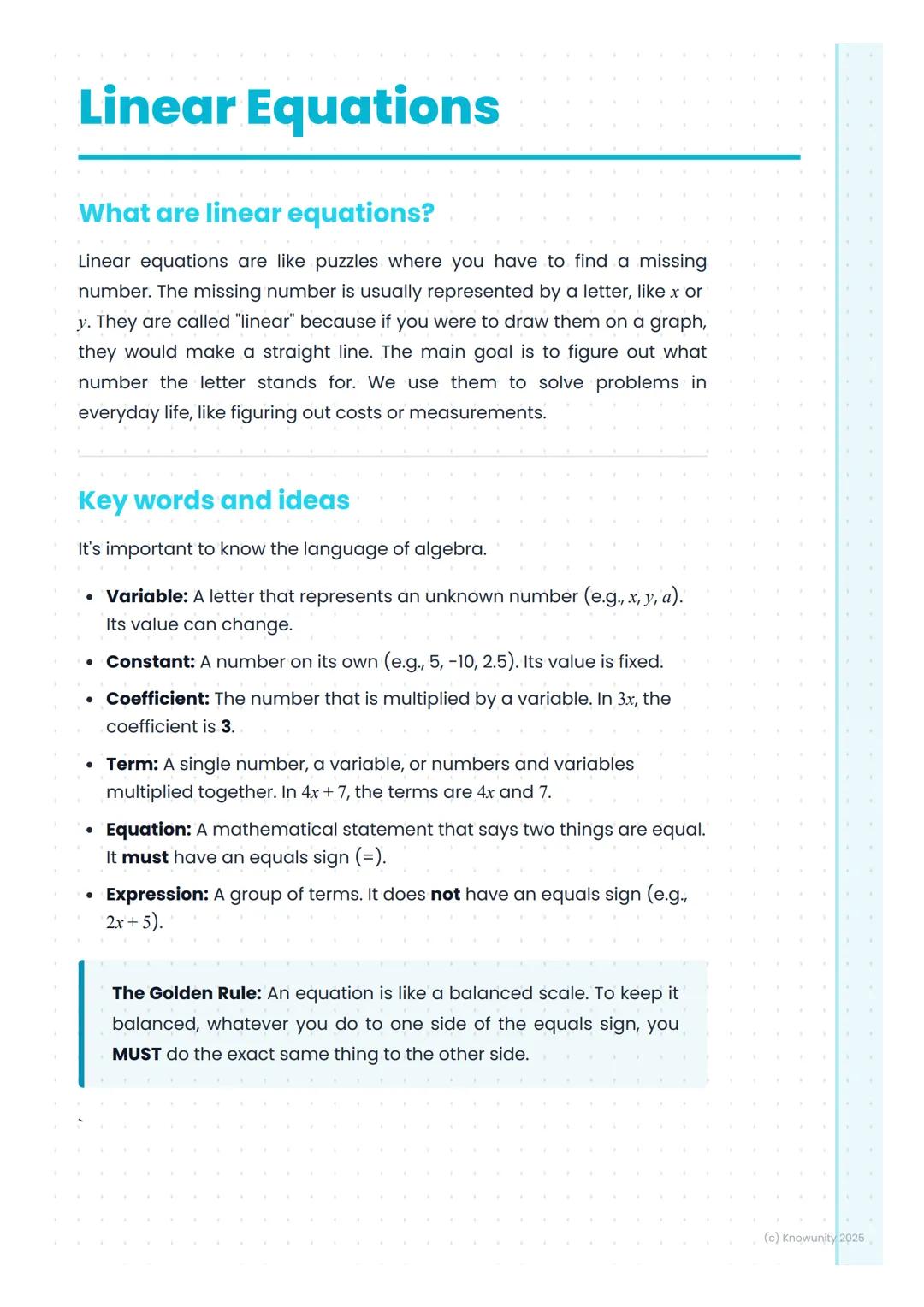
What are Linear Equations?
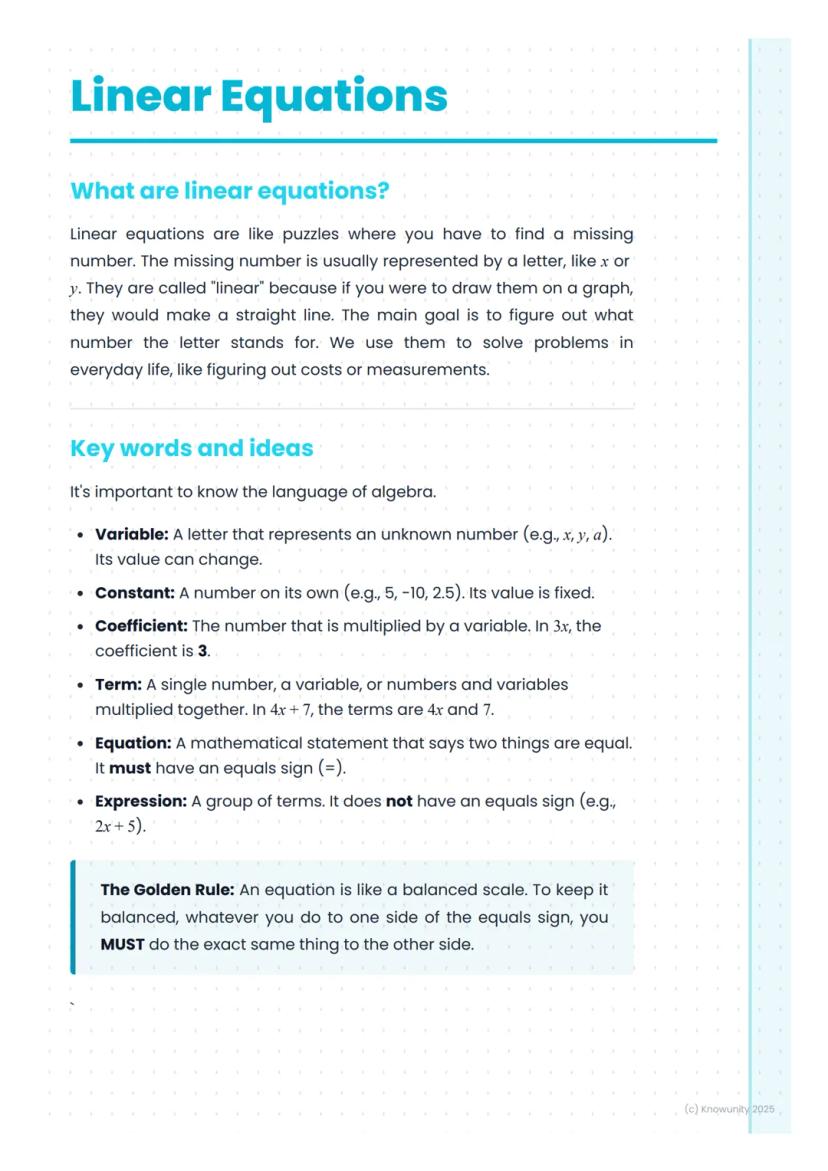
Think of linear equations as detective work - you're hunting for a mystery number that's hiding behind a letter! These equations are everywhere in real life, from calculating how much money you'll save each week to figuring out recipe measurements.
The key thing to remember is that these equations follow specific rules, just like a game. Once you learn the rules, solving them becomes much easier than you might think.
Variables are letters (like x, y, or a) that represent unknown numbers, whilst constants are just regular numbers that don't change. Coefficients are the numbers that multiply the variables - so in 3x, the coefficient is 3.
Remember: An equation is like a perfectly balanced scale - whatever you do to one side, you must do exactly the same to the other side to keep it balanced!
2
of 6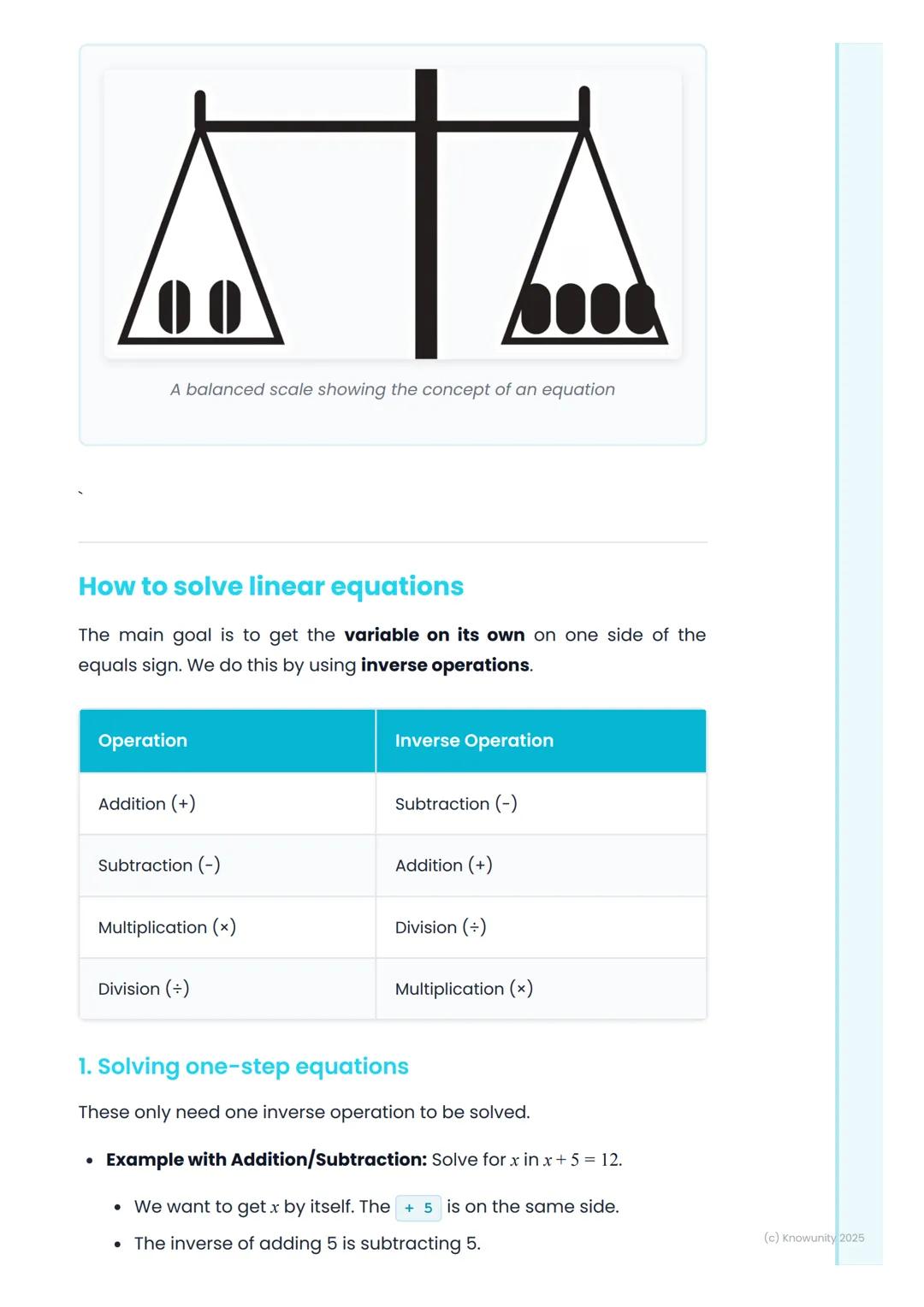
Solving One-Step Equations
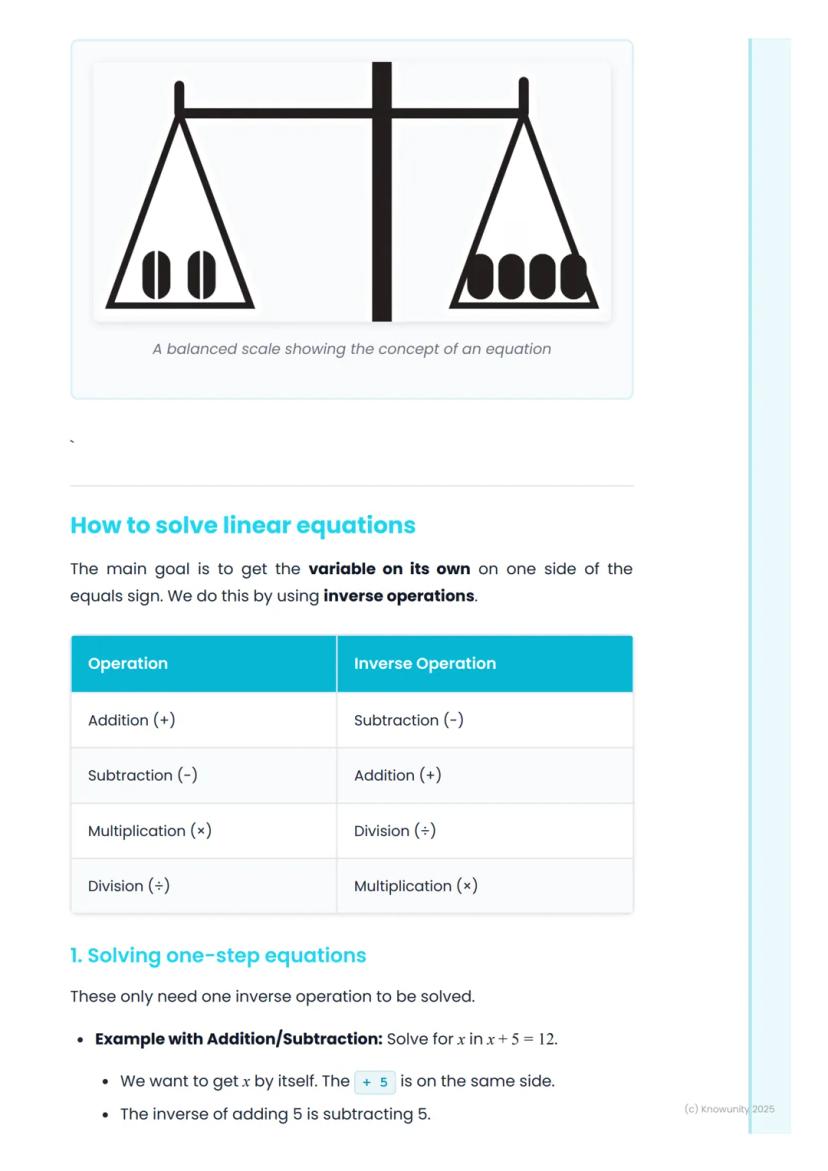
One-step equations are brilliant because they only need one inverse operation to solve them. Think of inverse operations as opposites that cancel each other out - addition cancels subtraction, and multiplication cancels division.
For addition/subtraction problems like x + 5 = 12, you simply subtract 5 from both sides to get x = 7. It's that straightforward! For multiplication/division like 4y = 20, you divide both sides by 4 to find y = 5.
The secret is identifying what's "attached" to your variable and then doing the opposite operation to both sides. This isolates your variable and gives you the answer.
Top tip: Always check your answer by substituting it back into the original equation - if both sides are equal, you've got it right!
3
of 6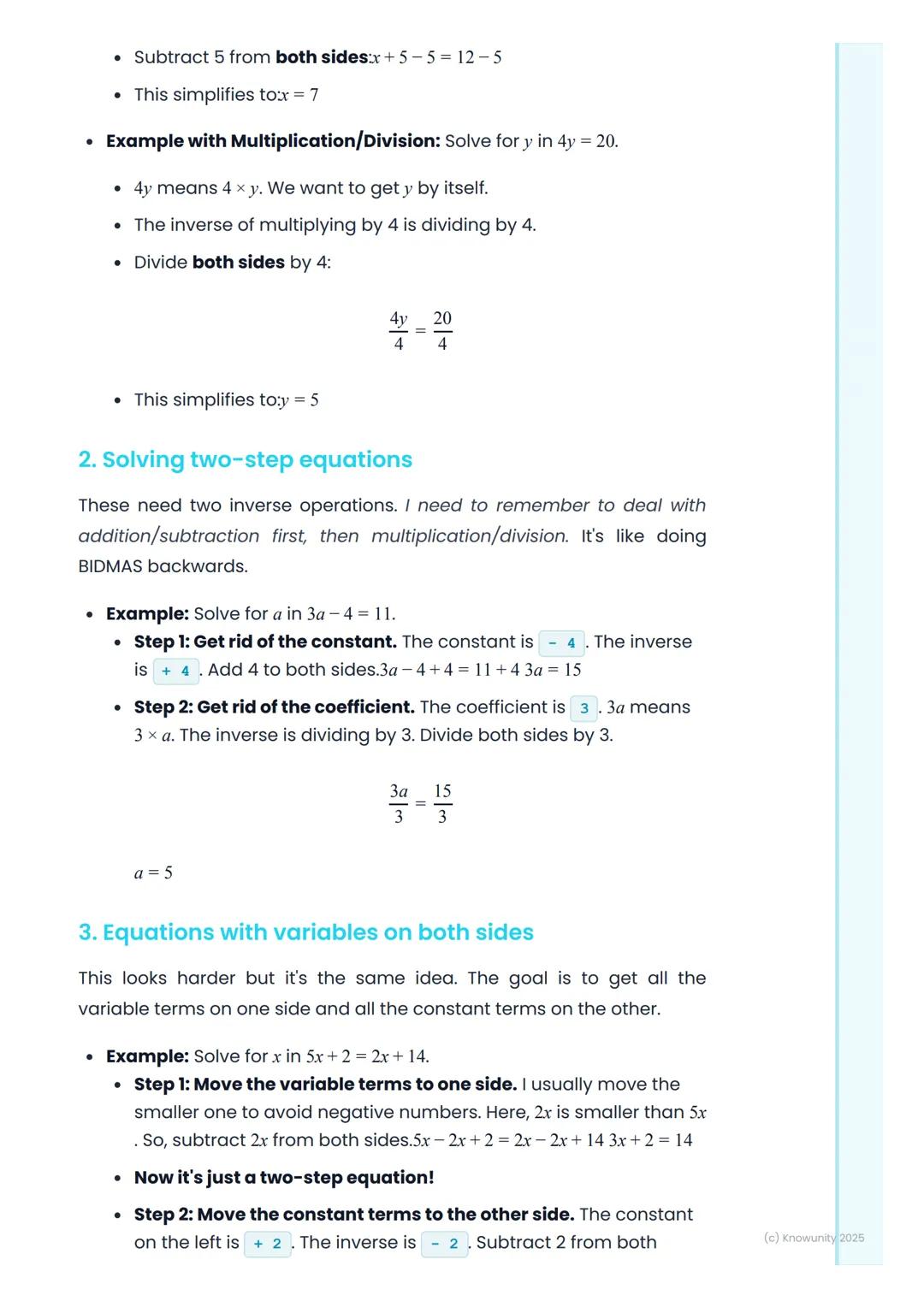
Two-Step Equations
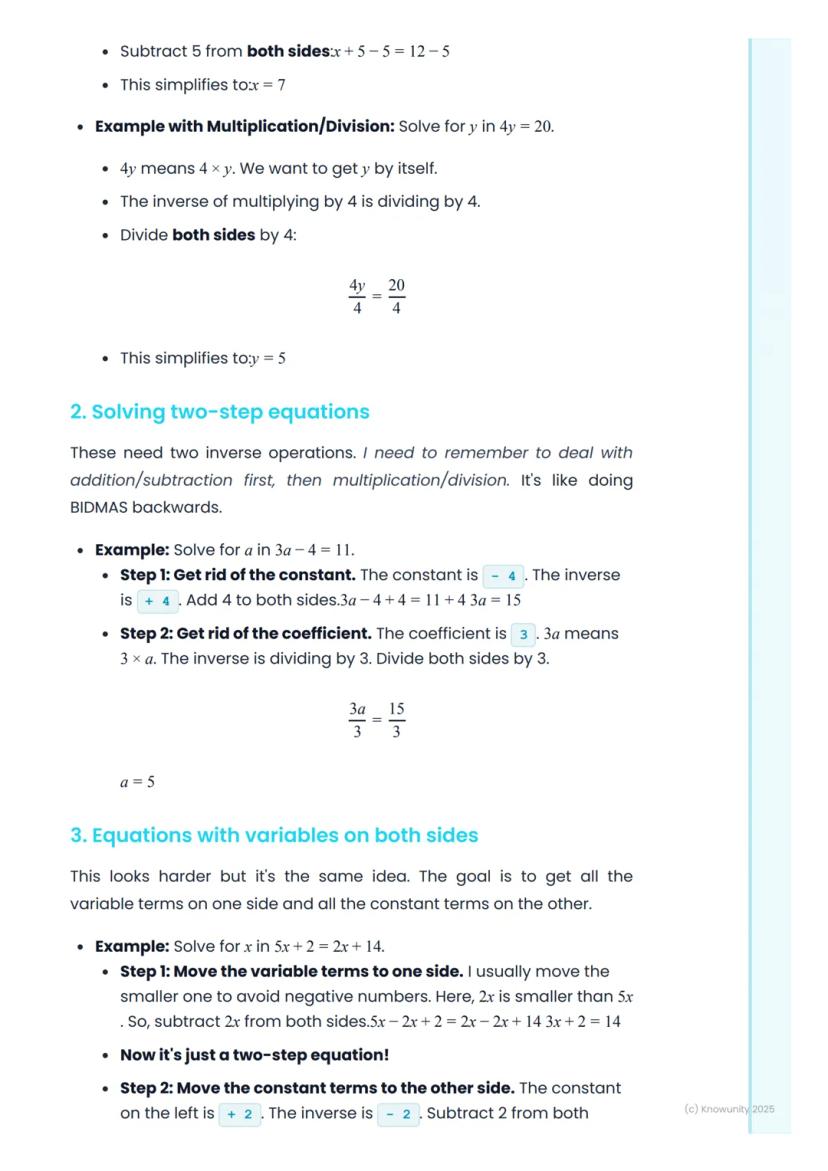
Two-step equations need exactly two operations to solve, and there's a specific order that makes them much easier. Always deal with addition or subtraction first, then handle multiplication or division - it's like doing BIDMAS backwards.
Take 3a - 4 = 11 as an example. First, add 4 to both sides to get 3a = 15. Then divide both sides by 3 to find a = 5. Following this order prevents confusion and helps you avoid mistakes.
The strategy never changes: get rid of the constant term first, then eliminate the coefficient. This systematic approach works every single time, so you can feel confident tackling any two-step equation.
Remember: Deal with addition/subtraction first, then multiplication/division - this order is your best friend!
4
of 6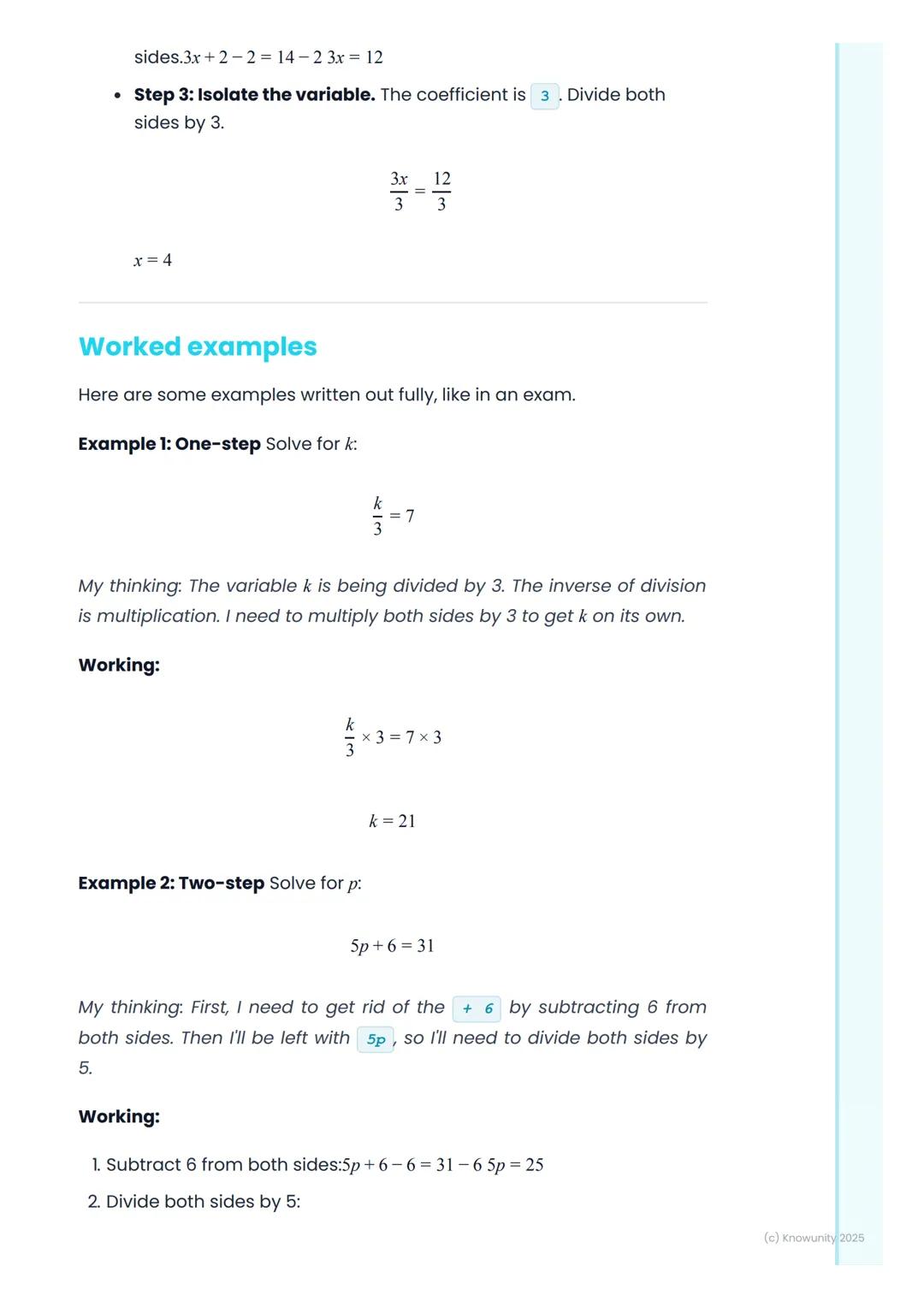
Variables on Both Sides
When you see variables on both sides like 5x + 2 = 2x + 14, don't panic - it's just an extra step before you get to a normal two-step equation! The goal is getting all variable terms on one side and all constants on the other.
Start by moving the smaller variable term to avoid negative numbers. Subtract 2x from both sides to get 3x + 2 = 14. Now you've got a regular two-step equation that you already know how to solve!
Continue with your normal method: subtract 2 from both sides , then divide by 3 . The key is staying organised and taking it one step at a time.
Pro strategy: Always move the smaller variable term to keep your numbers positive and your working cleaner!
5
of 6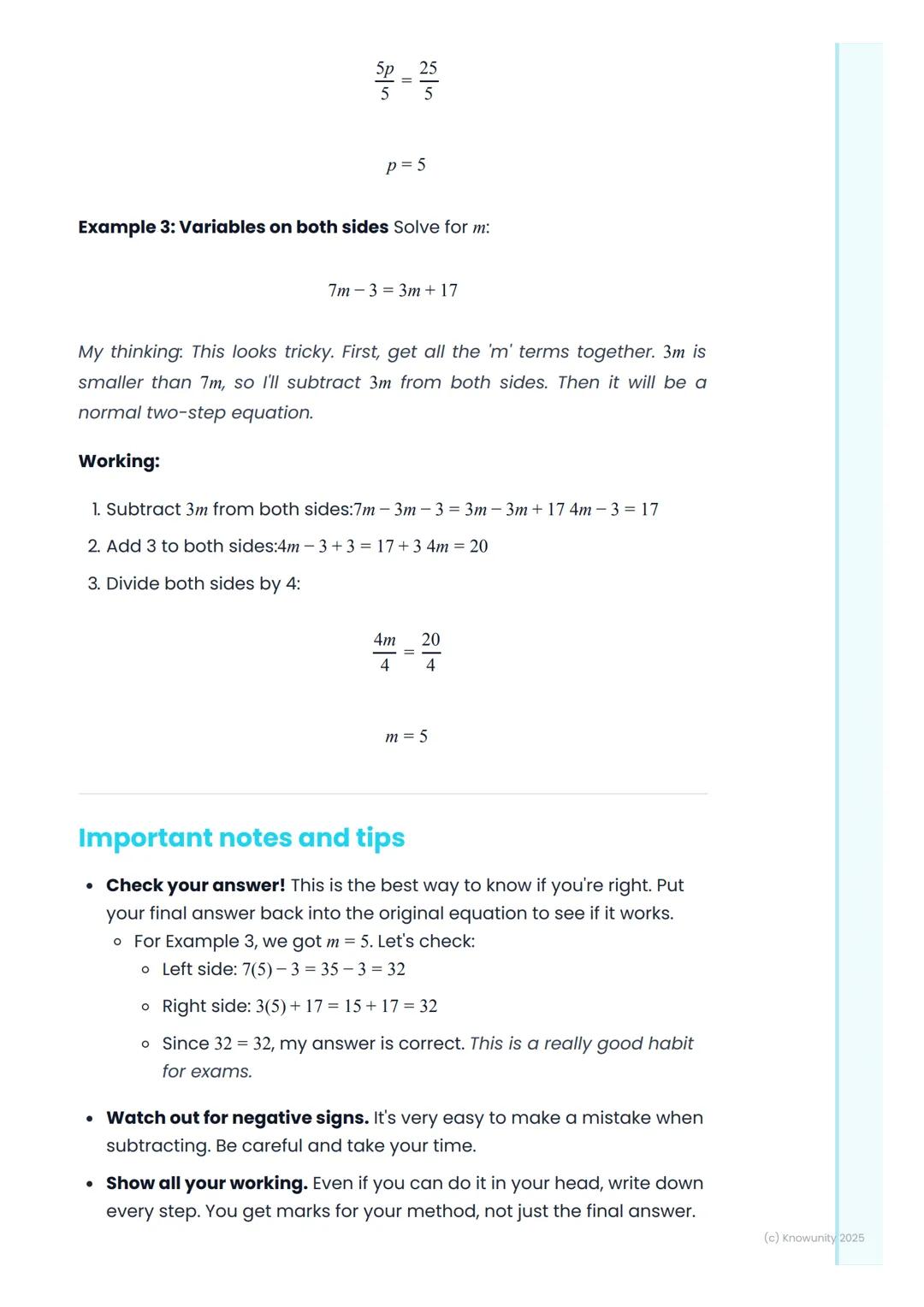
Worked Examples and Checking
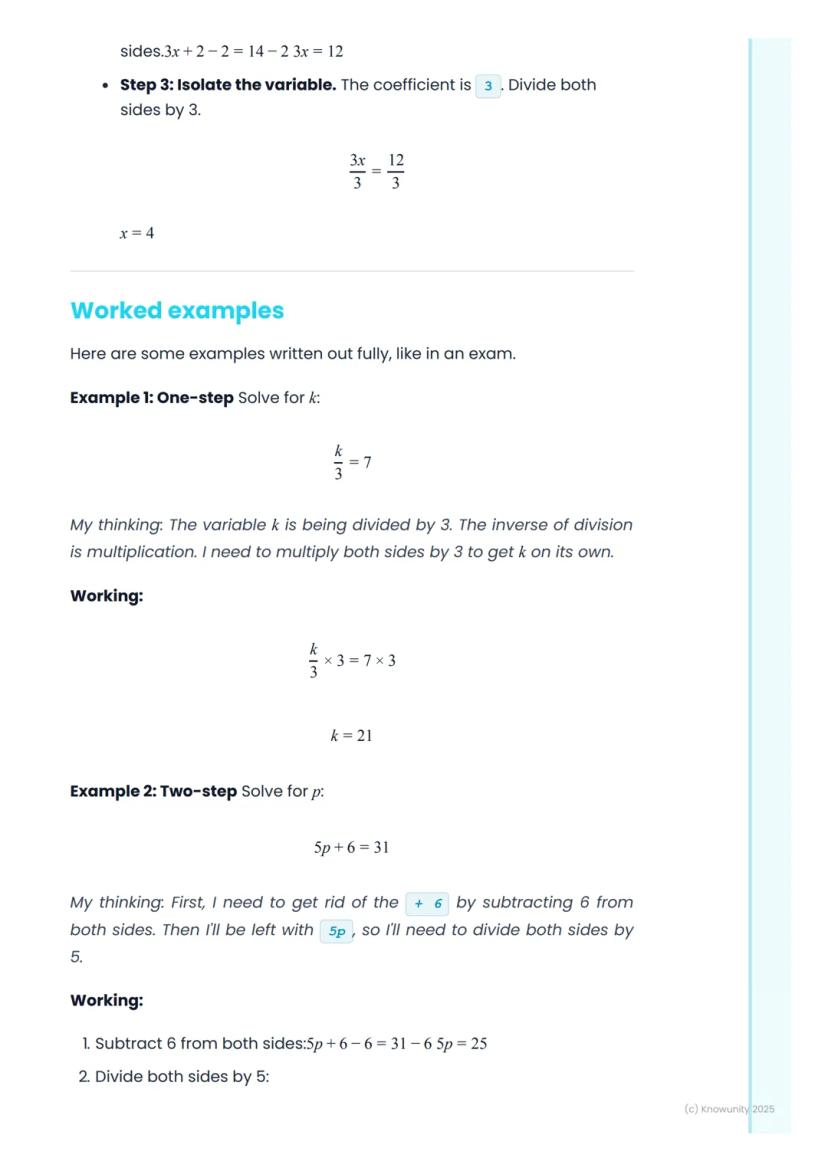
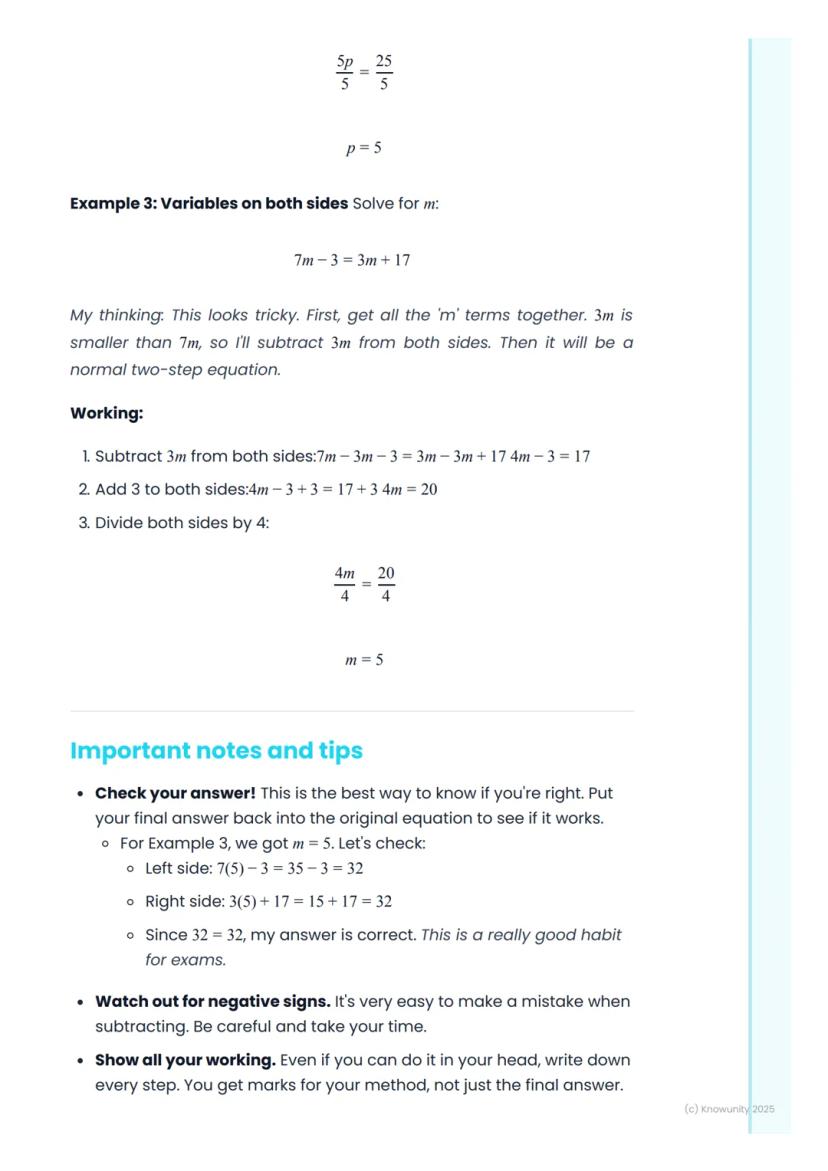
Let's see these methods in action with some proper examples. For k/3 = 7, multiply both sides by 3 to get k = 21. For 5p + 6 = 31, subtract 6 first , then divide by 5 .
Checking your answers is absolutely crucial and will save you marks in exams. Substitute your answer back into the original equation - if both sides equal the same number, you've solved it correctly.
For the equation 7m - 3 = 3m + 17 where we found m = 5: Left side gives 7(5) - 3 = 32, right side gives 3(5) + 17 = 32. Since both sides equal 32, our answer is definitely correct!
Golden rule: Always substitute your final answer back into the original equation to verify it's correct - this habit will boost your confidence and your marks!
6
of 6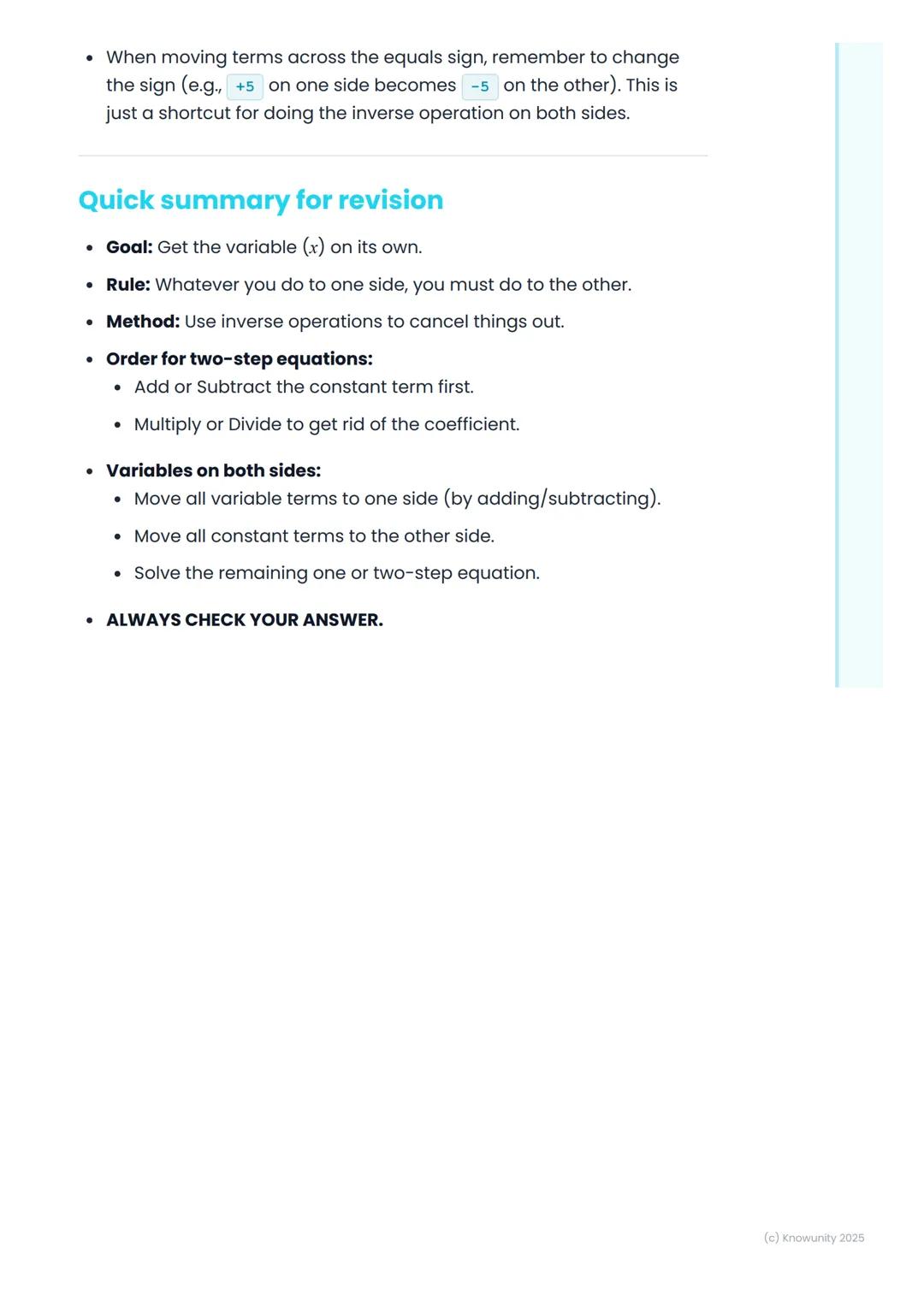
Quick Revision Summary
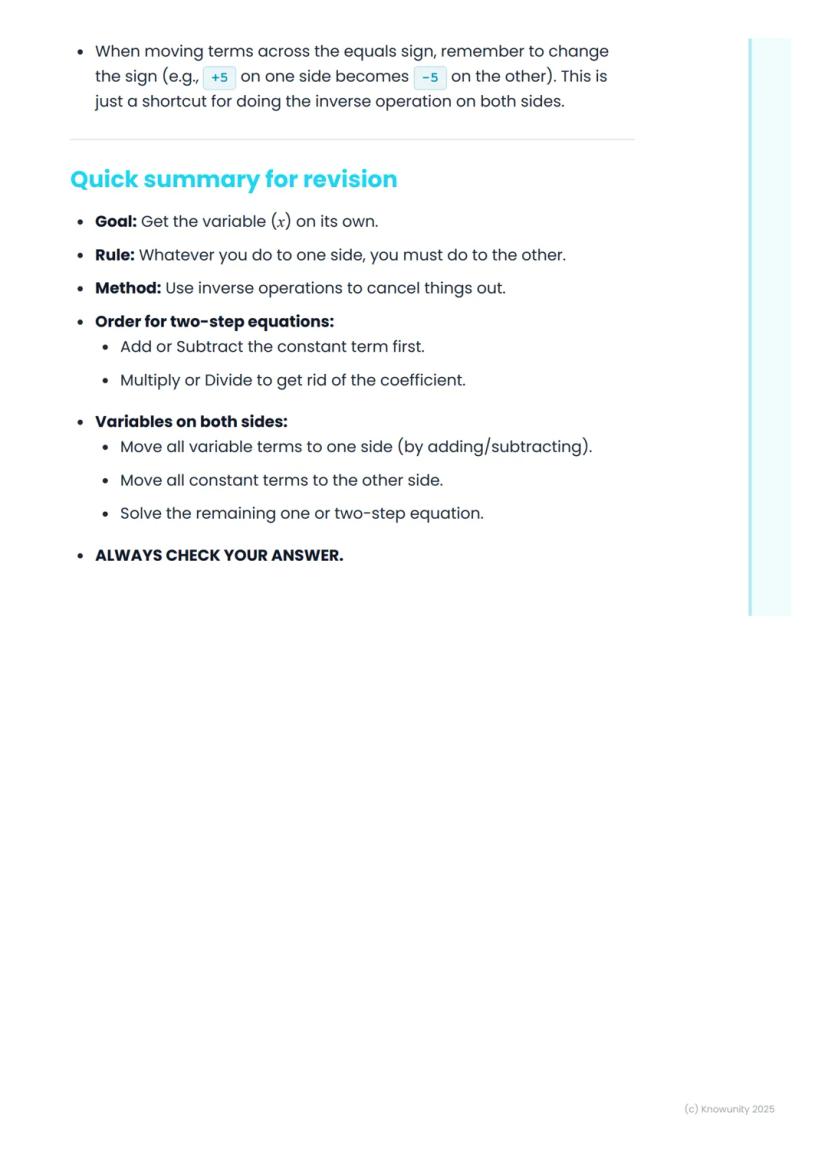
Your main goal is always the same: get the variable completely on its own on one side of the equation. Use inverse operations to cancel out unwanted numbers, and remember that whatever you do to one side must be done to the other.
For two-step equations, follow this order: deal with constants first , then handle coefficients . When variables appear on both sides, move all variable terms to one side and constants to the other before solving normally.
The most important habit you can develop is checking every answer by substituting it back into the original equation. This catches mistakes and builds your confidence for exams.
Success formula: Goal (isolate variable) + Method (inverse operations) + Order (constants first) + Checking = Linear equation mastery!
We thought you’d never ask...
What is the Knowunity AI companion?
Our AI Companion is a student-focused AI tool that offers more than just answers. Built on millions of Knowunity resources, it provides relevant information, personalised study plans, quizzes, and content directly in the chat, adapting to your individual learning journey.
Where can I download the Knowunity app?
You can download the app from Google Play Store and Apple App Store.
Is Knowunity really free of charge?
That's right! Enjoy free access to study content, connect with fellow students, and get instant help – all at your fingertips.
Most popular content in Mathematics
8Most popular content
9Can't find what you're looking for? Explore other subjects.
Students love us — and so will you.
4.6/5App Store
4.7/5Google Play
The app is very easy to use and well designed. I have found everything I was looking for so far and have been able to learn a lot from the presentations! I will definitely use the app for a class assignment! And of course it also helps a lot as an inspiration.
Stefan SiOS user
This app is really great. There are so many study notes and help [...]. My problem subject is French, for example, and the app has so many options for help. Thanks to this app, I have improved my French. I would recommend it to anyone.
Samantha KlichAndroid user
Wow, I am really amazed. I just tried the app because I've seen it advertised many times and was absolutely stunned. This app is THE HELP you want for school and above all, it offers so many things, such as workouts and fact sheets, which have been VERY helpful to me personally.
AnnaiOS user
Mathematics58 views·Updated May 30, 2026·6 pagesUnderstanding Linear Equations Made Simple
Linear equations are mathematical puzzles where you need to find the value of an unknown number (usually represented by a letter like x or y). They're called "linear" because when graphed, they create straight lines, and mastering them is essential... Show more
1
of 6Sign up to see the content. It's free!
- Access to all documents
- Improve your grades
- Join milions of students
What are Linear Equations?
Think of linear equations as detective work - you're hunting for a mystery number that's hiding behind a letter! These equations are everywhere in real life, from calculating how much money you'll save each week to figuring out recipe measurements.
The key thing to remember is that these equations follow specific rules, just like a game. Once you learn the rules, solving them becomes much easier than you might think.
Variables are letters (like x, y, or a) that represent unknown numbers, whilst constants are just regular numbers that don't change. Coefficients are the numbers that multiply the variables - so in 3x, the coefficient is 3.
Remember: An equation is like a perfectly balanced scale - whatever you do to one side, you must do exactly the same to the other side to keep it balanced!
2
of 6Sign up to see the content. It's free!
- Access to all documents
- Improve your grades
- Join milions of students
Solving One-Step Equations
One-step equations are brilliant because they only need one inverse operation to solve them. Think of inverse operations as opposites that cancel each other out - addition cancels subtraction, and multiplication cancels division.
For addition/subtraction problems like x + 5 = 12, you simply subtract 5 from both sides to get x = 7. It's that straightforward! For multiplication/division like 4y = 20, you divide both sides by 4 to find y = 5.
The secret is identifying what's "attached" to your variable and then doing the opposite operation to both sides. This isolates your variable and gives you the answer.
Top tip: Always check your answer by substituting it back into the original equation - if both sides are equal, you've got it right!
3
of 6Sign up to see the content. It's free!
- Access to all documents
- Improve your grades
- Join milions of students
Two-Step Equations
Two-step equations need exactly two operations to solve, and there's a specific order that makes them much easier. Always deal with addition or subtraction first, then handle multiplication or division - it's like doing BIDMAS backwards.
Take 3a - 4 = 11 as an example. First, add 4 to both sides to get 3a = 15. Then divide both sides by 3 to find a = 5. Following this order prevents confusion and helps you avoid mistakes.
The strategy never changes: get rid of the constant term first, then eliminate the coefficient. This systematic approach works every single time, so you can feel confident tackling any two-step equation.
Remember: Deal with addition/subtraction first, then multiplication/division - this order is your best friend!
4
of 6Sign up to see the content. It's free!
- Access to all documents
- Improve your grades
- Join milions of students
Variables on Both Sides
When you see variables on both sides like 5x + 2 = 2x + 14, don't panic - it's just an extra step before you get to a normal two-step equation! The goal is getting all variable terms on one side and all constants on the other.
Start by moving the smaller variable term to avoid negative numbers. Subtract 2x from both sides to get 3x + 2 = 14. Now you've got a regular two-step equation that you already know how to solve!
Continue with your normal method: subtract 2 from both sides , then divide by 3 . The key is staying organised and taking it one step at a time.
Pro strategy: Always move the smaller variable term to keep your numbers positive and your working cleaner!
5
of 6Sign up to see the content. It's free!
- Access to all documents
- Improve your grades
- Join milions of students
Worked Examples and Checking
Let's see these methods in action with some proper examples. For k/3 = 7, multiply both sides by 3 to get k = 21. For 5p + 6 = 31, subtract 6 first , then divide by 5 .
Checking your answers is absolutely crucial and will save you marks in exams. Substitute your answer back into the original equation - if both sides equal the same number, you've solved it correctly.
For the equation 7m - 3 = 3m + 17 where we found m = 5: Left side gives 7(5) - 3 = 32, right side gives 3(5) + 17 = 32. Since both sides equal 32, our answer is definitely correct!
Golden rule: Always substitute your final answer back into the original equation to verify it's correct - this habit will boost your confidence and your marks!
6
of 6Sign up to see the content. It's free!
- Access to all documents
- Improve your grades
- Join milions of students
Quick Revision Summary
Your main goal is always the same: get the variable completely on its own on one side of the equation. Use inverse operations to cancel out unwanted numbers, and remember that whatever you do to one side must be done to the other.
For two-step equations, follow this order: deal with constants first , then handle coefficients . When variables appear on both sides, move all variable terms to one side and constants to the other before solving normally.
The most important habit you can develop is checking every answer by substituting it back into the original equation. This catches mistakes and builds your confidence for exams.
Success formula: Goal (isolate variable) + Method (inverse operations) + Order (constants first) + Checking = Linear equation mastery!
We thought you’d never ask...
What is the Knowunity AI companion?
Our AI Companion is a student-focused AI tool that offers more than just answers. Built on millions of Knowunity resources, it provides relevant information, personalised study plans, quizzes, and content directly in the chat, adapting to your individual learning journey.
Where can I download the Knowunity app?
You can download the app from Google Play Store and Apple App Store.
Is Knowunity really free of charge?
That's right! Enjoy free access to study content, connect with fellow students, and get instant help – all at your fingertips.
Most popular content in Mathematics
8Most popular content
9Can't find what you're looking for? Explore other subjects.
Students love us — and so will you.
4.6/5App Store
4.7/5Google Play
The app is very easy to use and well designed. I have found everything I was looking for so far and have been able to learn a lot from the presentations! I will definitely use the app for a class assignment! And of course it also helps a lot as an inspiration.
Stefan SiOS user
This app is really great. There are so many study notes and help [...]. My problem subject is French, for example, and the app has so many options for help. Thanks to this app, I have improved my French. I would recommend it to anyone.
Samantha KlichAndroid user
Wow, I am really amazed. I just tried the app because I've seen it advertised many times and was absolutely stunned. This app is THE HELP you want for school and above all, it offers so many things, such as workouts and fact sheets, which have been VERY helpful to me personally.
AnnaiOS user