
Ever wondered how companies know what flavour of crisps to...
 Mathematics45 views·Updated Jun 10, 2026·6 pages
Understanding Data: Types and Collection Methods

1 / 6
1
of 6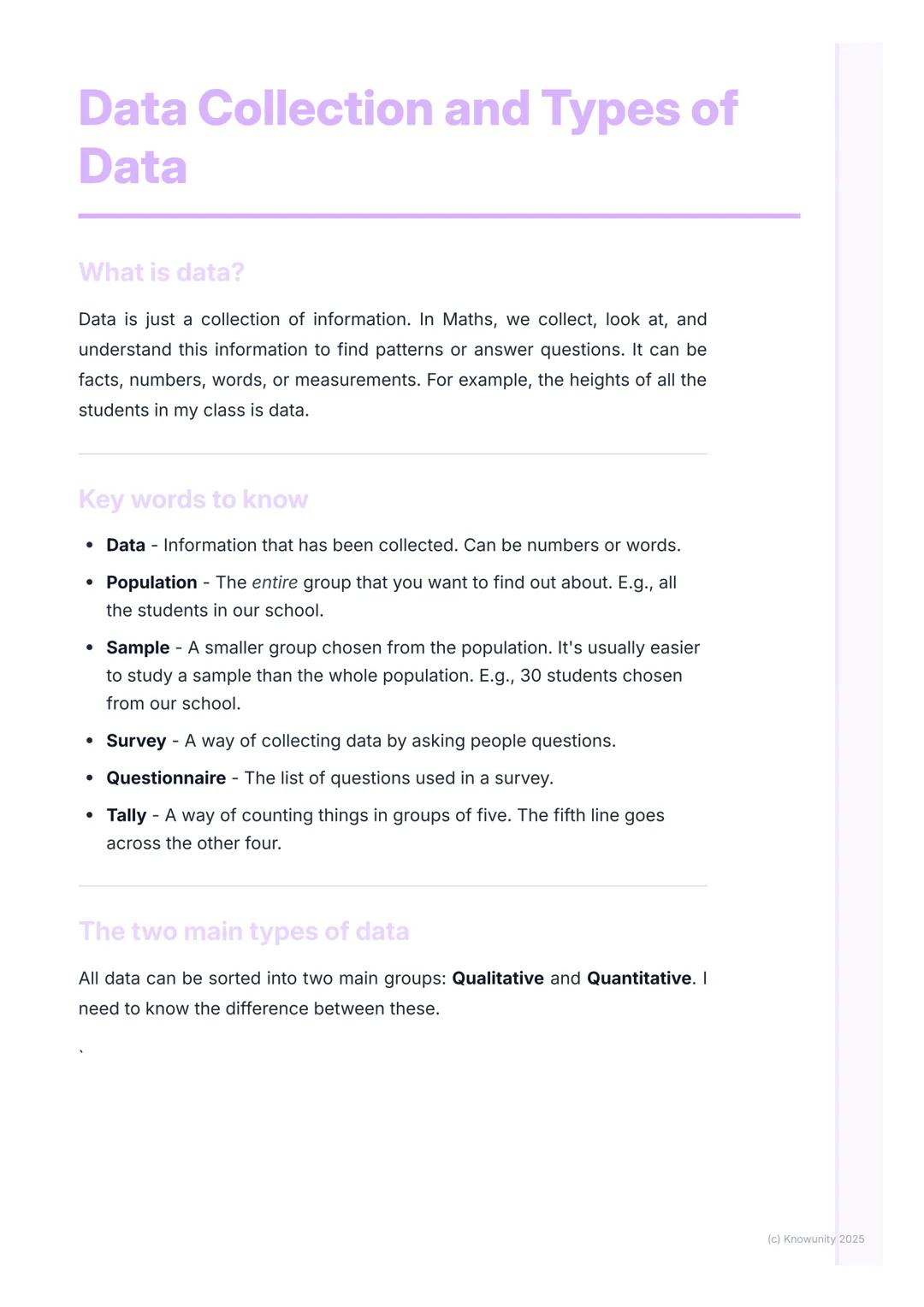
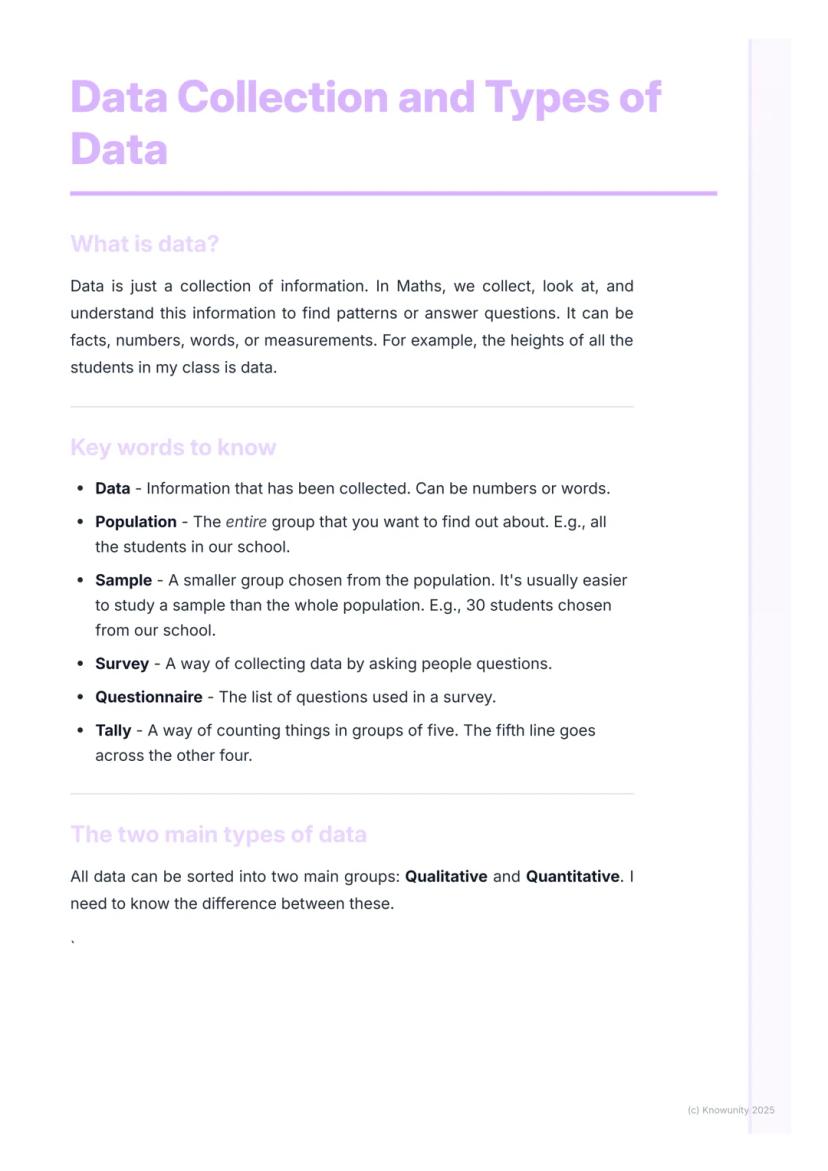
What is Data and Key Terms
Data is simply a collection of information that helps us answer questions or spot patterns. Think of it like detective work - you're gathering clues to solve a mystery!
When we talk about data collection, there are some crucial terms you need to know. The population is the entire group you want to learn about (like all students in your school), whilst a sample is just a smaller chunk of that group (maybe 30 students you actually ask). It's usually much easier to study a sample than bug everyone in the whole population!
A survey is how you collect information by asking people questions, and a questionnaire is your list of questions. You'll also use tally marks to count things in groups of five - remember, the fifth line goes diagonally across the other four.
Quick Tip: Think of data like ingredients for a recipe - you need the right information to cook up the perfect answer to your question!
2
of 6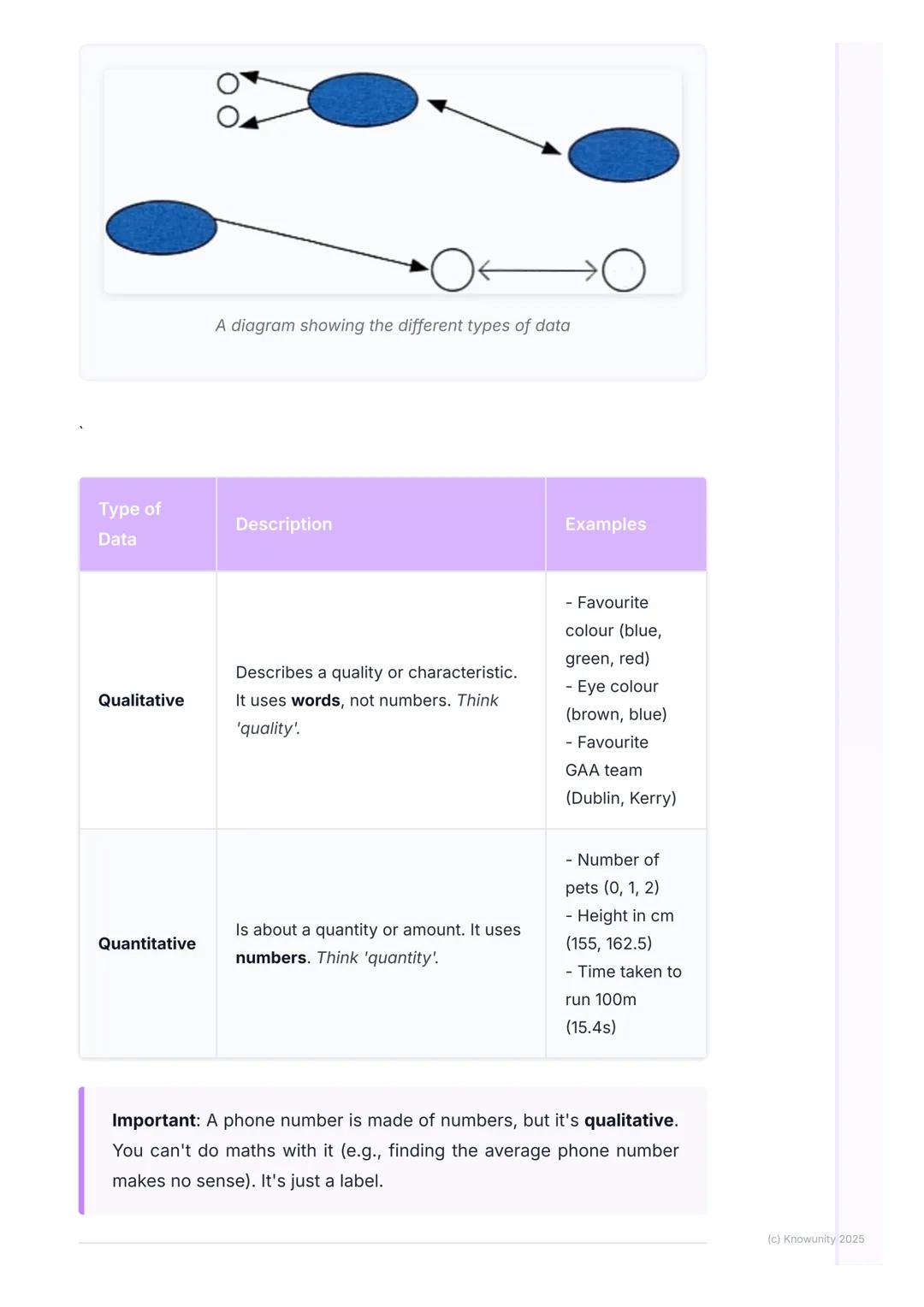
The Two Main Types of Data
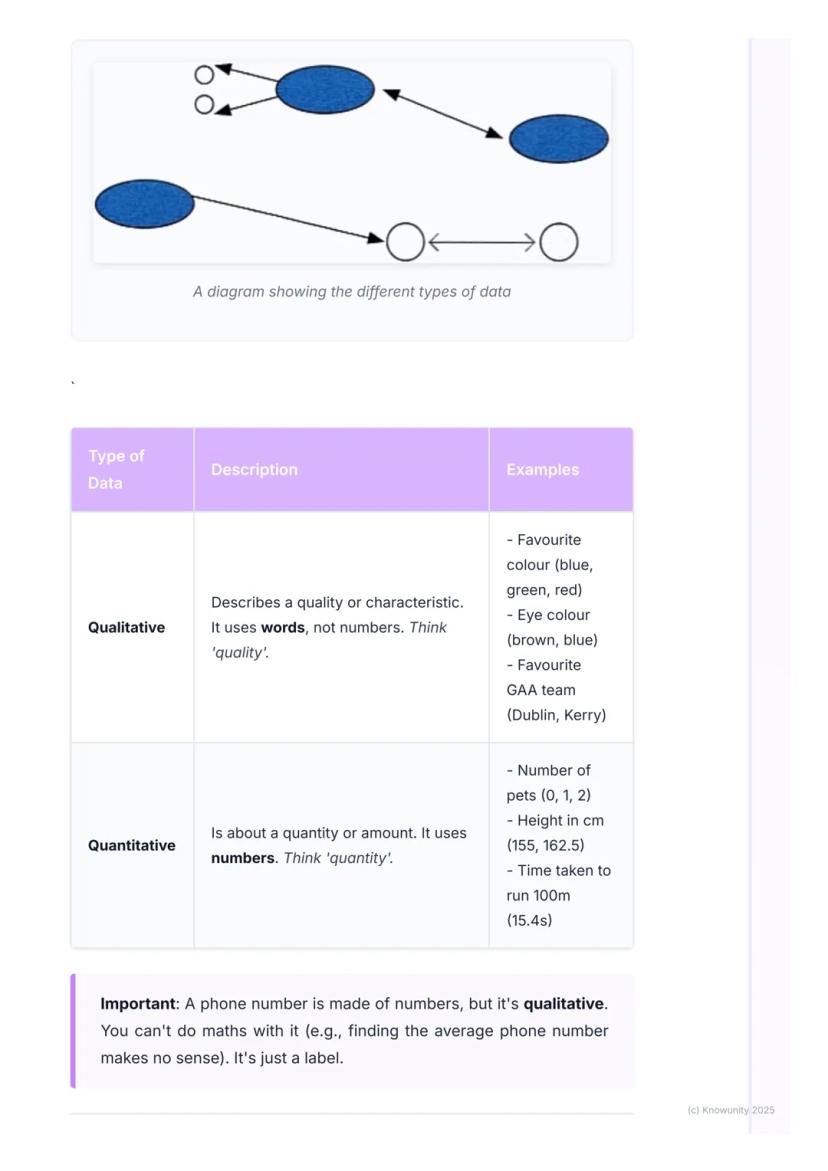
All data fits into two main categories, and knowing the difference is absolutely essential for your exams. Qualitative data describes qualities or characteristics using words - think "quality" to remember this one!
Examples of qualitative data include your favourite colour (blue, green, red), eye colour, or which GAA team you support. These answers use words, not numbers that you can do maths with.
Quantitative data is all about quantities and amounts - it uses numbers that you can actually calculate with. This includes things like the number of pets you have, your height in centimetres, or how long it takes you to run 100 metres.
Here's a sneaky exam trick: phone numbers look like numbers, but they're actually qualitative data! You can't find the average phone number or add them together - they're just labels made of digits.
Remember: Qualitative = Quality = Words, Quantitative = Quantity = Numbers you can calculate with!
3
of 6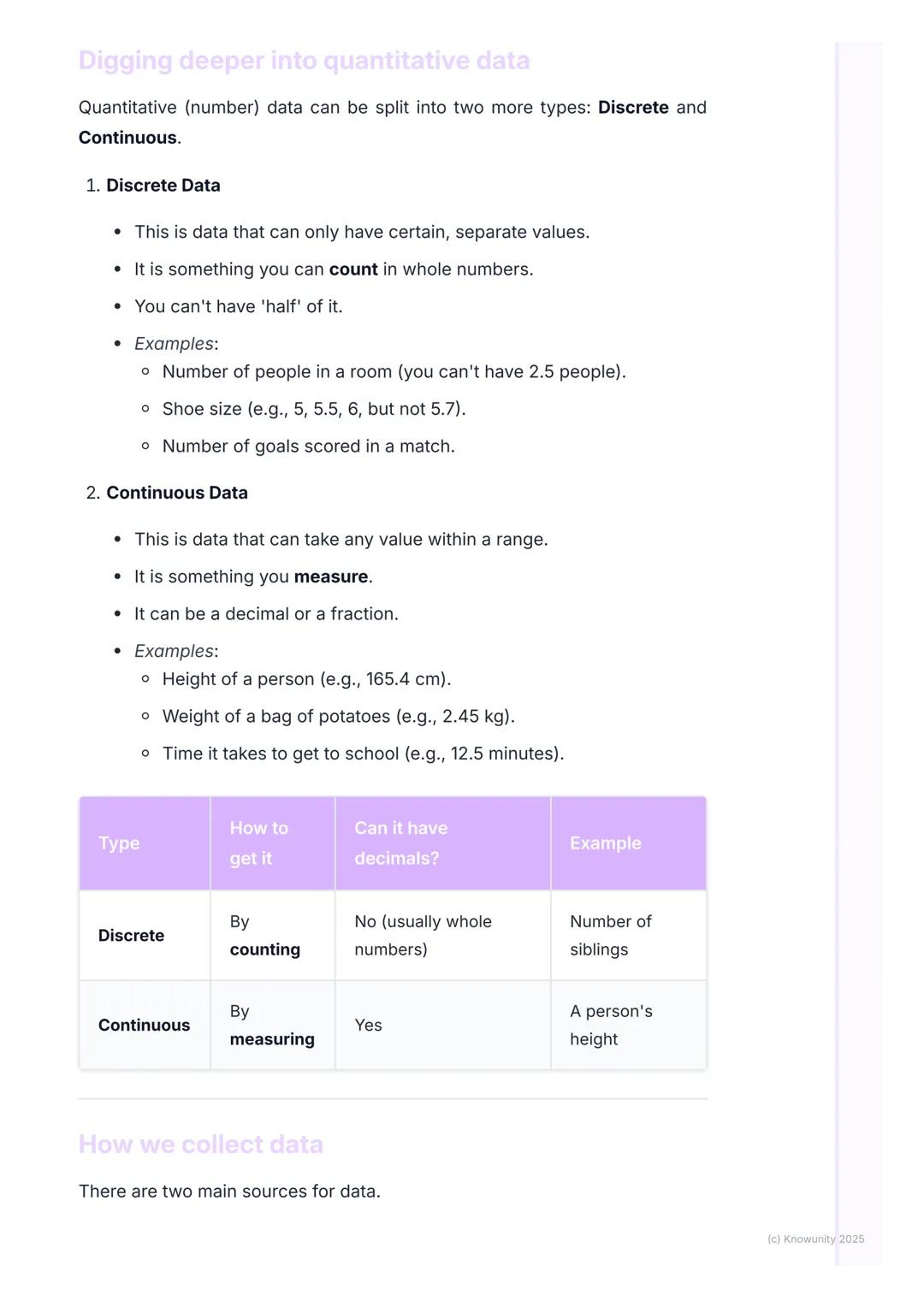
Discrete vs Continuous Data
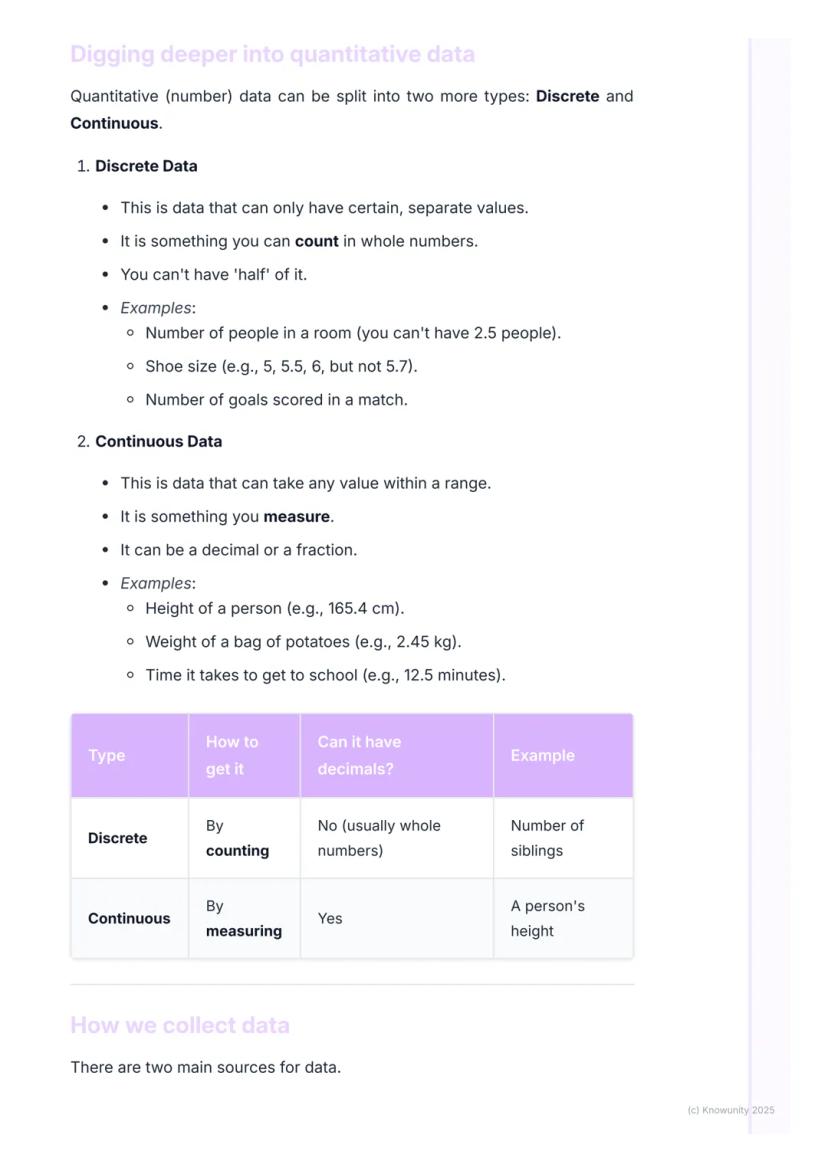
Quantitative data splits into two more types that'll definitely pop up in your tests. Discrete data can only have certain, separate values - you count it in whole numbers and can't have "half" of something.
Think about the number of people in a room (you can't have 2.5 people!) or goals scored in a match. Shoe sizes are discrete too - you might have size 5, 5.5, or 6, but never 5.7.
Continuous data can take any value within a range because you measure it rather than count it. Your height could be 165.4cm, a bag of potatoes might weigh 2.45kg, or your journey to school could take 12.5 minutes.
The easiest way to tell them apart: if you count it, it's discrete. If you measure it, it's continuous. Discrete data usually uses whole numbers, whilst continuous data often includes decimals.
Memory Trick: Discrete = Distinct separate values (count them), Continuous = Can continue with any decimal value (measure them)!
4
of 6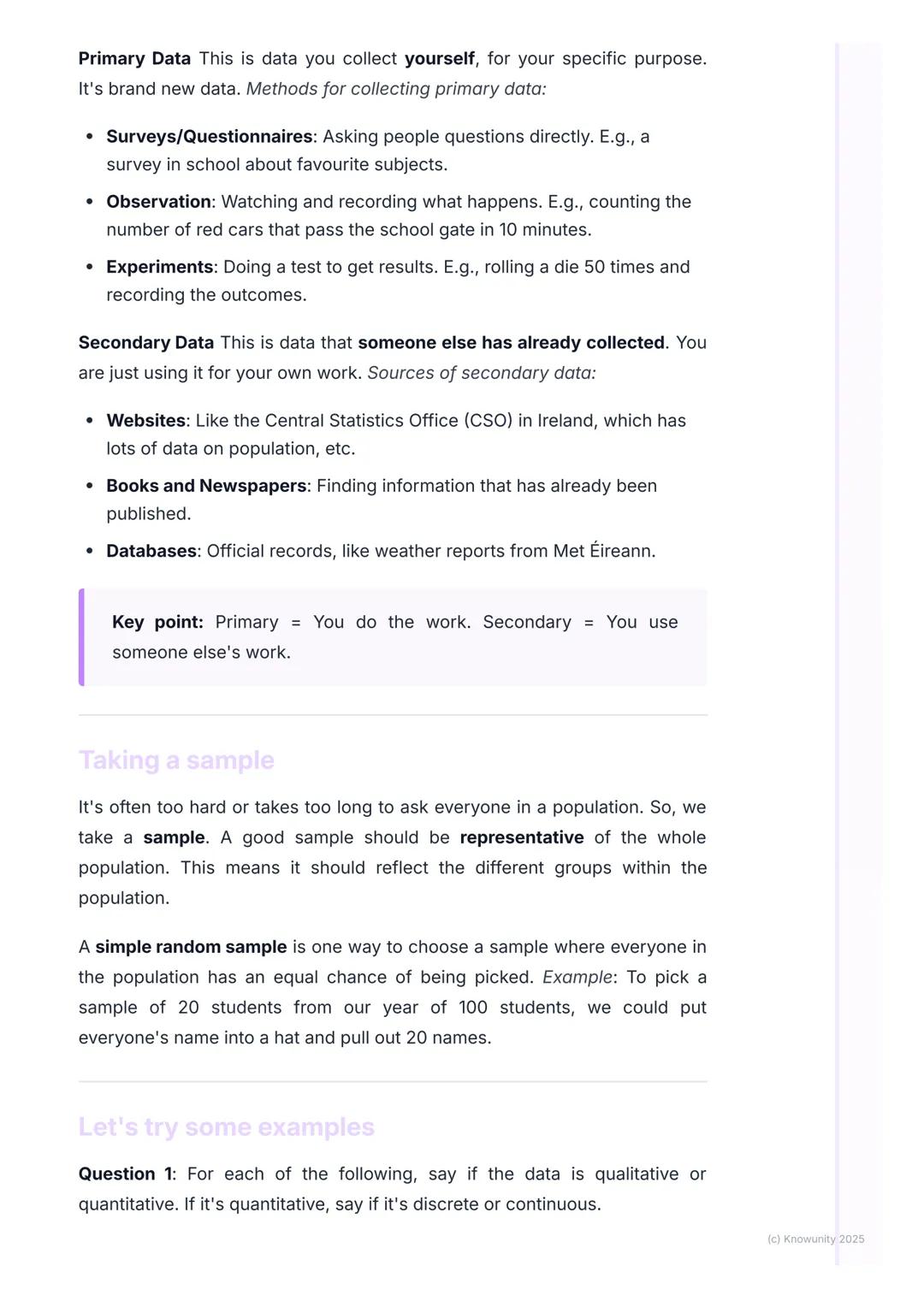
How We Collect Data
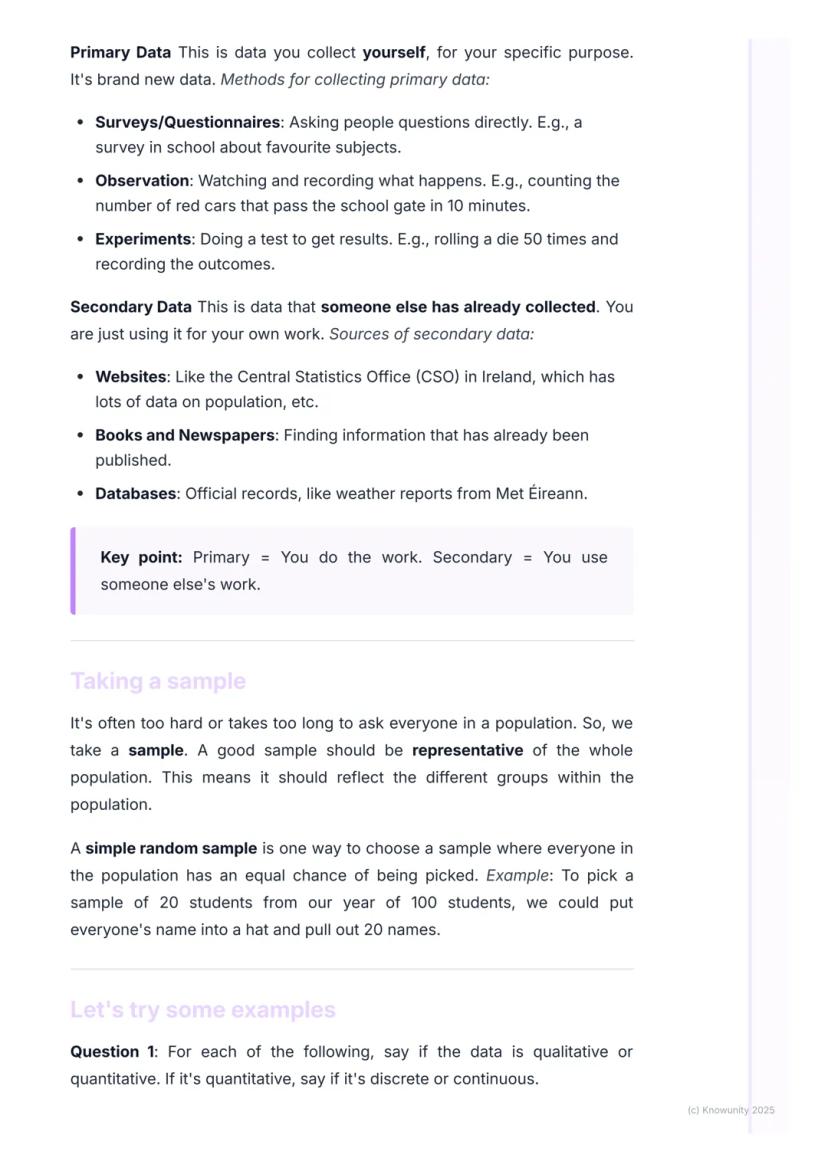
There are two main ways to get your hands on data, and you need to know both for your exams. Primary data is information you collect yourself for your specific project - it's brand new data that you've gathered first-hand.
You can collect primary data through surveys (asking people questions directly), observation (watching and recording what happens), or experiments (like rolling a dice 50 times). Think of yourself as the detective doing all the legwork!
Secondary data is information that someone else has already collected, and you're just borrowing it for your own work. You might find this on websites like the Central Statistics Office, in books and newspapers, or official databases like weather reports from Met Éireann.
Sampling is crucial because asking an entire population takes forever! A simple random sample gives everyone an equal chance of being picked - like pulling names from a hat. Your sample needs to be representative, meaning it reflects the different groups in your whole population.
Key Point: Primary = You do the detective work, Secondary = You use someone else's detective work!
5
of 6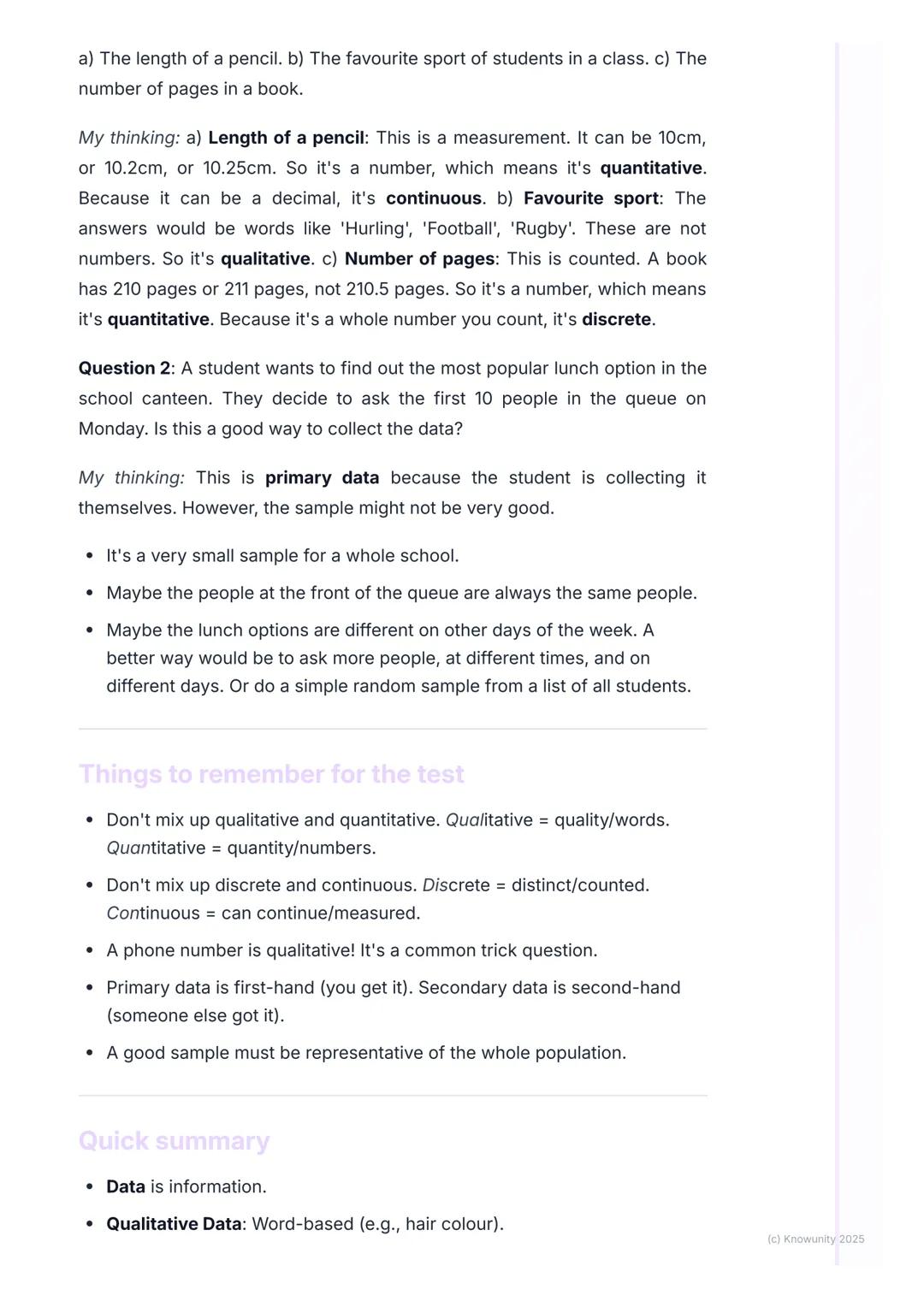
Worked Examples and Common Mistakes
Let's practice with some typical exam questions! For "length of a pencil" - this is measured and can be 10cm, 10.2cm, or 10.25cm, so it's quantitative and continuous. "Favourite sport" gives answers like hurling or rugby (words, not numbers), making it qualitative.
"Number of pages in a book" is counted in whole numbers - a book has 210 or 211 pages, never 210.5 pages. This makes it quantitative and discrete.
Watch out for sampling problems in exam questions! If someone asks only the first 10 people in Monday's lunch queue about favourite canteen food, that's problematic. The sample is tiny, might always be the same people, and only represents Monday's options.
A better approach would involve asking more people across different days and times, or doing a proper random sample. Remember, your sample must represent the whole population fairly, not just whoever's convenient to ask!
Exam Alert: Phone numbers are qualitative data - it's the classic trick question that catches loads of students out!
6
of 6
Quick Summary and Test Tips
Here's everything you need to remember for your test. Qualitative data uses words to describe qualities (hair colour, favourite team), whilst quantitative data uses numbers you can calculate with (age, height).
Discrete quantitative data is counted in whole numbers (number of cars), and continuous quantitative data is measured with possible decimals (your height). Primary data means you collect it yourself through surveys or experiments, whilst secondary data comes from existing sources like websites or books.
The population is your entire group of interest, but you'll usually study a smaller sample that represents the whole group fairly. A good sample gives everyone an equal chance of being selected.
Don't forget the classic exam tricks: phone numbers are qualitative (even though they look like numbers), and always check whether quantitative data is discrete (counted) or continuous (measured). You've got this!
Success Tip: Make flashcards for qualitative vs quantitative and discrete vs continuous - these definitions are exam gold!
We thought you’d never ask...
What is the Knowunity AI companion?
Our AI Companion is a student-focused AI tool that offers more than just answers. Built on millions of Knowunity resources, it provides relevant information, personalised study plans, quizzes, and content directly in the chat, adapting to your individual learning journey.
Where can I download the Knowunity app?
You can download the app from Google Play Store and Apple App Store.
Is Knowunity really free of charge?
That's right! Enjoy free access to study content, connect with fellow students, and get instant help – all at your fingertips.
Most popular content in Mathematics
8MathematicsAlgebra
Algebra
5th Year91
MathematicsAlgebra 2
Algebra notes focusing on the factor theorem, completing the square, -b formula, graphs of polynomials
5th Year130
MathematicsSolving Equations
This section focuses on solving one-step and two-step linear equations to find the value of an unknown variable.
1st Year131
MathematicsArithmetic sequences and series
With examples
5th Year130
MathematicsIntroduction to Probability
This topic introduces basic probability concepts, including calculating the probability of simple events and understanding the difference between experimental and theoretical probability.
2nd Year91
MathematicsMaths jc algebra
Maths jc
1st Year230
MathematicsNatural Numbers and Integers
Students will learn about positive whole numbers, zero, and negative whole numbers, and how to add, subtract, multiply, and divide them correctly.
1st Year131
MathematicsDifferential Calculus
Calculus is a topic that comes up nearly everywhere on your maths LC. This is just starter notes that could be useful end of 5th year or start of 6th year
5th Year271
Most popular content
9 Irish
IrishIrish oral questions and answers
Questions and answers for the leaving cert oral
5th Year4264
 English
Key Quotes : Sive
Key Quotes and explanations: Sive
6th Year2842
IrishIrish oral questions
Outline of oral questions
5th Year2055
IrishIníon- le hÁine Durkin
Aine Durkin’s poem, Iníon: Themes & summary
5th Year850
IrishIrish poetry 2027
Iníon + Dínit an Bhróin
5th Year1133
IrishLC HL notes- Iníon (poem)
Includes poem in English and Irish, theme, key words & phrases
5th Year2284
EnglishCultural Context : Shawshank Redemption : Sive : Small Things Like These
Comparative Study : Cultural Context : Shawshank Redemption, Sive and Small Things Like These
6th Year1430
IrishMo Ghrá-sa (Idir Lúibíní)
Notes on mo ghrá-sa
5th Year380
IrishAn Gaeilge Aiste
Irish Language essay
6th Year1320
Can't find what you're looking for? Explore other subjects.
Students love us — and so will you.
4.6/5App Store
4.7/5Google Play
The app is very easy to use and well designed. I have found everything I was looking for so far and have been able to learn a lot from the presentations! I will definitely use the app for a class assignment! And of course it also helps a lot as an inspiration.
Stefan SiOS user
This app is really great. There are so many study notes and help [...]. My problem subject is French, for example, and the app has so many options for help. Thanks to this app, I have improved my French. I would recommend it to anyone.
Samantha KlichAndroid user
Wow, I am really amazed. I just tried the app because I've seen it advertised many times and was absolutely stunned. This app is THE HELP you want for school and above all, it offers so many things, such as workouts and fact sheets, which have been VERY helpful to me personally.
AnnaiOS user
Mathematics45 views·Updated Jun 10, 2026·6 pagesUnderstanding Data: Types and Collection Methods
Ever wondered how companies know what flavour of crisps to make next, or how scientists discover new things? It all starts with data- basically just collecting information to answer questions. Learning about data types and collection methods will help...
1
of 6
Sign up to see the content. It's free!
- Access to all documents
- Improve your grades
- Join milions of students
What is Data and Key Terms
Data is simply a collection of information that helps us answer questions or spot patterns. Think of it like detective work - you're gathering clues to solve a mystery!
When we talk about data collection, there are some crucial terms you need to know. The population is the entire group you want to learn about (like all students in your school), whilst a sample is just a smaller chunk of that group (maybe 30 students you actually ask). It's usually much easier to study a sample than bug everyone in the whole population!
A survey is how you collect information by asking people questions, and a questionnaire is your list of questions. You'll also use tally marks to count things in groups of five - remember, the fifth line goes diagonally across the other four.
Quick Tip: Think of data like ingredients for a recipe - you need the right information to cook up the perfect answer to your question!
2
of 6Sign up to see the content. It's free!
- Access to all documents
- Improve your grades
- Join milions of students
The Two Main Types of Data
All data fits into two main categories, and knowing the difference is absolutely essential for your exams. Qualitative data describes qualities or characteristics using words - think "quality" to remember this one!
Examples of qualitative data include your favourite colour (blue, green, red), eye colour, or which GAA team you support. These answers use words, not numbers that you can do maths with.
Quantitative data is all about quantities and amounts - it uses numbers that you can actually calculate with. This includes things like the number of pets you have, your height in centimetres, or how long it takes you to run 100 metres.
Here's a sneaky exam trick: phone numbers look like numbers, but they're actually qualitative data! You can't find the average phone number or add them together - they're just labels made of digits.
Remember: Qualitative = Quality = Words, Quantitative = Quantity = Numbers you can calculate with!
3
of 6Sign up to see the content. It's free!
- Access to all documents
- Improve your grades
- Join milions of students
Discrete vs Continuous Data
Quantitative data splits into two more types that'll definitely pop up in your tests. Discrete data can only have certain, separate values - you count it in whole numbers and can't have "half" of something.
Think about the number of people in a room (you can't have 2.5 people!) or goals scored in a match. Shoe sizes are discrete too - you might have size 5, 5.5, or 6, but never 5.7.
Continuous data can take any value within a range because you measure it rather than count it. Your height could be 165.4cm, a bag of potatoes might weigh 2.45kg, or your journey to school could take 12.5 minutes.
The easiest way to tell them apart: if you count it, it's discrete. If you measure it, it's continuous. Discrete data usually uses whole numbers, whilst continuous data often includes decimals.
Memory Trick: Discrete = Distinct separate values (count them), Continuous = Can continue with any decimal value (measure them)!
4
of 6Sign up to see the content. It's free!
- Access to all documents
- Improve your grades
- Join milions of students
How We Collect Data
There are two main ways to get your hands on data, and you need to know both for your exams. Primary data is information you collect yourself for your specific project - it's brand new data that you've gathered first-hand.
You can collect primary data through surveys (asking people questions directly), observation (watching and recording what happens), or experiments (like rolling a dice 50 times). Think of yourself as the detective doing all the legwork!
Secondary data is information that someone else has already collected, and you're just borrowing it for your own work. You might find this on websites like the Central Statistics Office, in books and newspapers, or official databases like weather reports from Met Éireann.
Sampling is crucial because asking an entire population takes forever! A simple random sample gives everyone an equal chance of being picked - like pulling names from a hat. Your sample needs to be representative, meaning it reflects the different groups in your whole population.
Key Point: Primary = You do the detective work, Secondary = You use someone else's detective work!
5
of 6Sign up to see the content. It's free!
- Access to all documents
- Improve your grades
- Join milions of students
Worked Examples and Common Mistakes
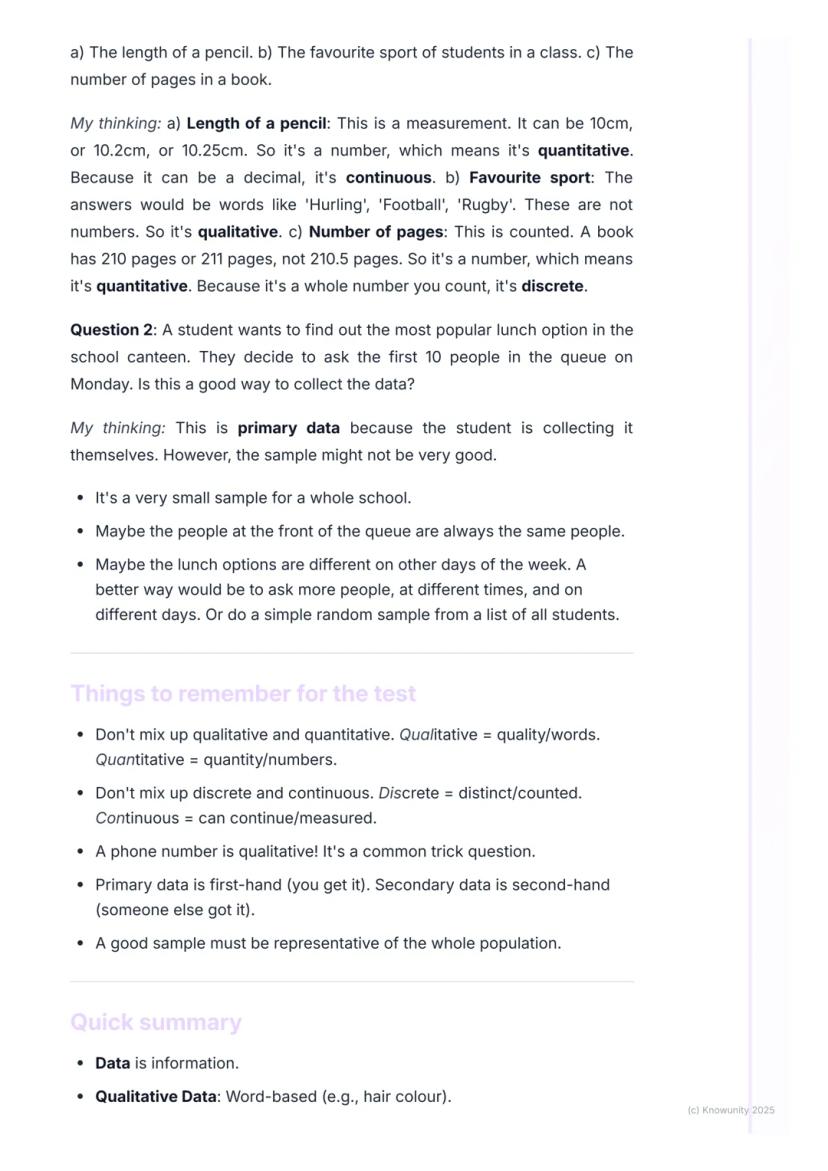
Let's practice with some typical exam questions! For "length of a pencil" - this is measured and can be 10cm, 10.2cm, or 10.25cm, so it's quantitative and continuous. "Favourite sport" gives answers like hurling or rugby (words, not numbers), making it qualitative.
"Number of pages in a book" is counted in whole numbers - a book has 210 or 211 pages, never 210.5 pages. This makes it quantitative and discrete.
Watch out for sampling problems in exam questions! If someone asks only the first 10 people in Monday's lunch queue about favourite canteen food, that's problematic. The sample is tiny, might always be the same people, and only represents Monday's options.
A better approach would involve asking more people across different days and times, or doing a proper random sample. Remember, your sample must represent the whole population fairly, not just whoever's convenient to ask!
Exam Alert: Phone numbers are qualitative data - it's the classic trick question that catches loads of students out!
6
of 6Sign up to see the content. It's free!
- Access to all documents
- Improve your grades
- Join milions of students
Quick Summary and Test Tips
Here's everything you need to remember for your test. Qualitative data uses words to describe qualities (hair colour, favourite team), whilst quantitative data uses numbers you can calculate with (age, height).
Discrete quantitative data is counted in whole numbers (number of cars), and continuous quantitative data is measured with possible decimals (your height). Primary data means you collect it yourself through surveys or experiments, whilst secondary data comes from existing sources like websites or books.
The population is your entire group of interest, but you'll usually study a smaller sample that represents the whole group fairly. A good sample gives everyone an equal chance of being selected.
Don't forget the classic exam tricks: phone numbers are qualitative (even though they look like numbers), and always check whether quantitative data is discrete (counted) or continuous (measured). You've got this!
Success Tip: Make flashcards for qualitative vs quantitative and discrete vs continuous - these definitions are exam gold!
We thought you’d never ask...
What is the Knowunity AI companion?
Our AI Companion is a student-focused AI tool that offers more than just answers. Built on millions of Knowunity resources, it provides relevant information, personalised study plans, quizzes, and content directly in the chat, adapting to your individual learning journey.
Where can I download the Knowunity app?
You can download the app from Google Play Store and Apple App Store.
Is Knowunity really free of charge?
That's right! Enjoy free access to study content, connect with fellow students, and get instant help – all at your fingertips.
Most popular content in Mathematics
8MathematicsAlgebra
Algebra
5th Year91
MathematicsAlgebra 2
Algebra notes focusing on the factor theorem, completing the square, -b formula, graphs of polynomials
5th Year130
MathematicsSolving Equations
This section focuses on solving one-step and two-step linear equations to find the value of an unknown variable.
1st Year131
MathematicsArithmetic sequences and series
With examples
5th Year130
MathematicsIntroduction to Probability
This topic introduces basic probability concepts, including calculating the probability of simple events and understanding the difference between experimental and theoretical probability.
2nd Year91
MathematicsMaths jc algebra
Maths jc
1st Year230
MathematicsNatural Numbers and Integers
Students will learn about positive whole numbers, zero, and negative whole numbers, and how to add, subtract, multiply, and divide them correctly.
1st Year131
MathematicsDifferential Calculus
Calculus is a topic that comes up nearly everywhere on your maths LC. This is just starter notes that could be useful end of 5th year or start of 6th year
5th Year271
Most popular content
9IrishIrish oral questions and answers
Questions and answers for the leaving cert oral
5th Year4264
EnglishKey Quotes : Sive
Key Quotes and explanations: Sive
6th Year2842
IrishIrish oral questions
Outline of oral questions
5th Year2055
IrishIníon- le hÁine Durkin
Aine Durkin’s poem, Iníon: Themes & summary
5th Year850
IrishIrish poetry 2027
Iníon + Dínit an Bhróin
5th Year1133
IrishLC HL notes- Iníon (poem)
Includes poem in English and Irish, theme, key words & phrases
5th Year2284
EnglishCultural Context : Shawshank Redemption : Sive : Small Things Like These
Comparative Study : Cultural Context : Shawshank Redemption, Sive and Small Things Like These
6th Year1430
IrishMo Ghrá-sa (Idir Lúibíní)
Notes on mo ghrá-sa
5th Year380
IrishAn Gaeilge Aiste
Irish Language essay
6th Year1320
Can't find what you're looking for? Explore other subjects.
Students love us — and so will you.
4.6/5App Store
4.7/5Google Play
The app is very easy to use and well designed. I have found everything I was looking for so far and have been able to learn a lot from the presentations! I will definitely use the app for a class assignment! And of course it also helps a lot as an inspiration.
Stefan SiOS user
This app is really great. There are so many study notes and help [...]. My problem subject is French, for example, and the app has so many options for help. Thanks to this app, I have improved my French. I would recommend it to anyone.
Samantha KlichAndroid user
Wow, I am really amazed. I just tried the app because I've seen it advertised many times and was absolutely stunned. This app is THE HELP you want for school and above all, it offers so many things, such as workouts and fact sheets, which have been VERY helpful to me personally.
AnnaiOS user