
Ever wondered why Irish seems to glue words together in... Show more
 Irish9 views·Updated Jun 14, 2026·6 pages
Réamhfhocail sa Ghaeilge: Bunghnéithe agus Samplaí
1 / 6
1
of 6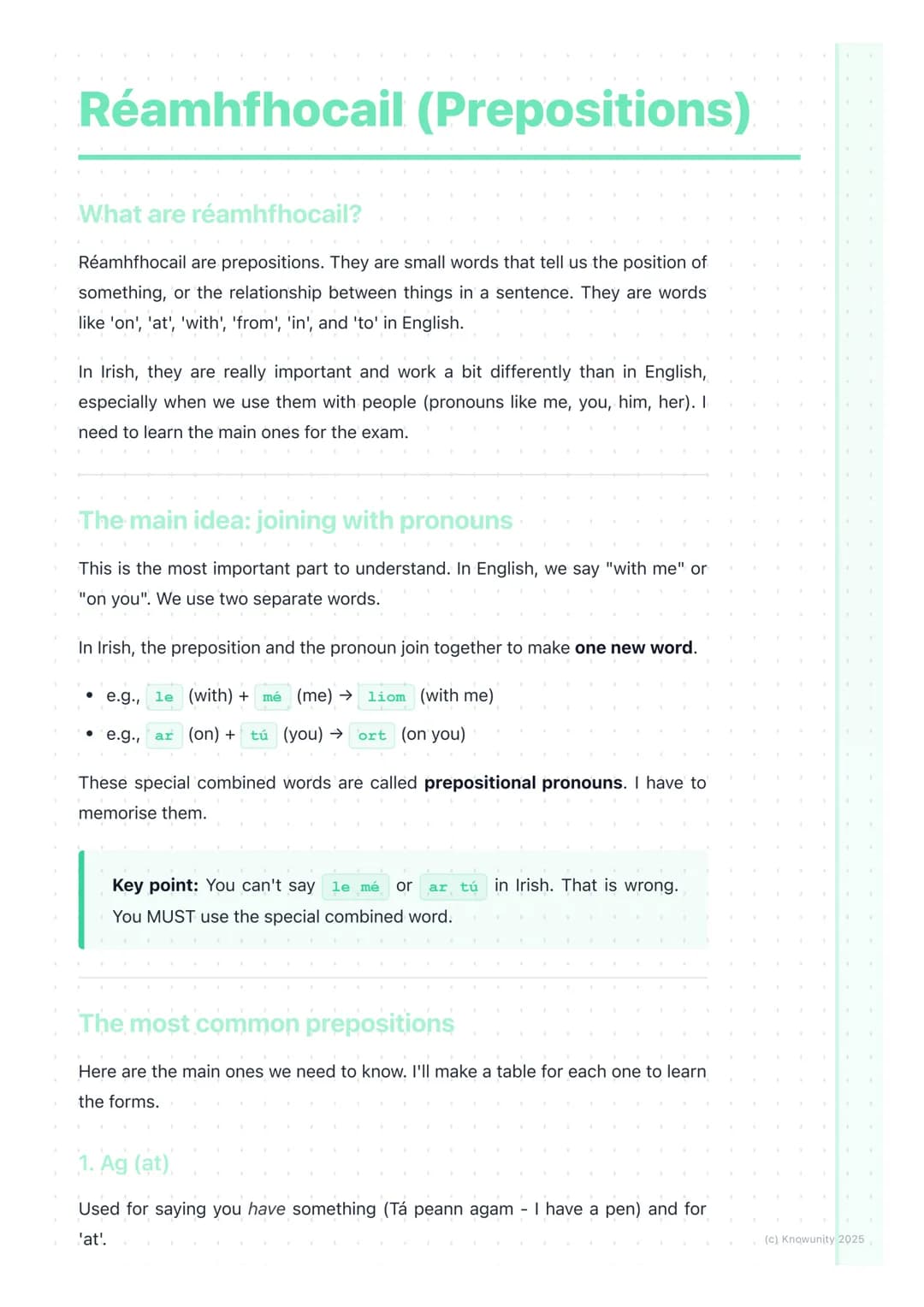
What Are Réamhfhocail?
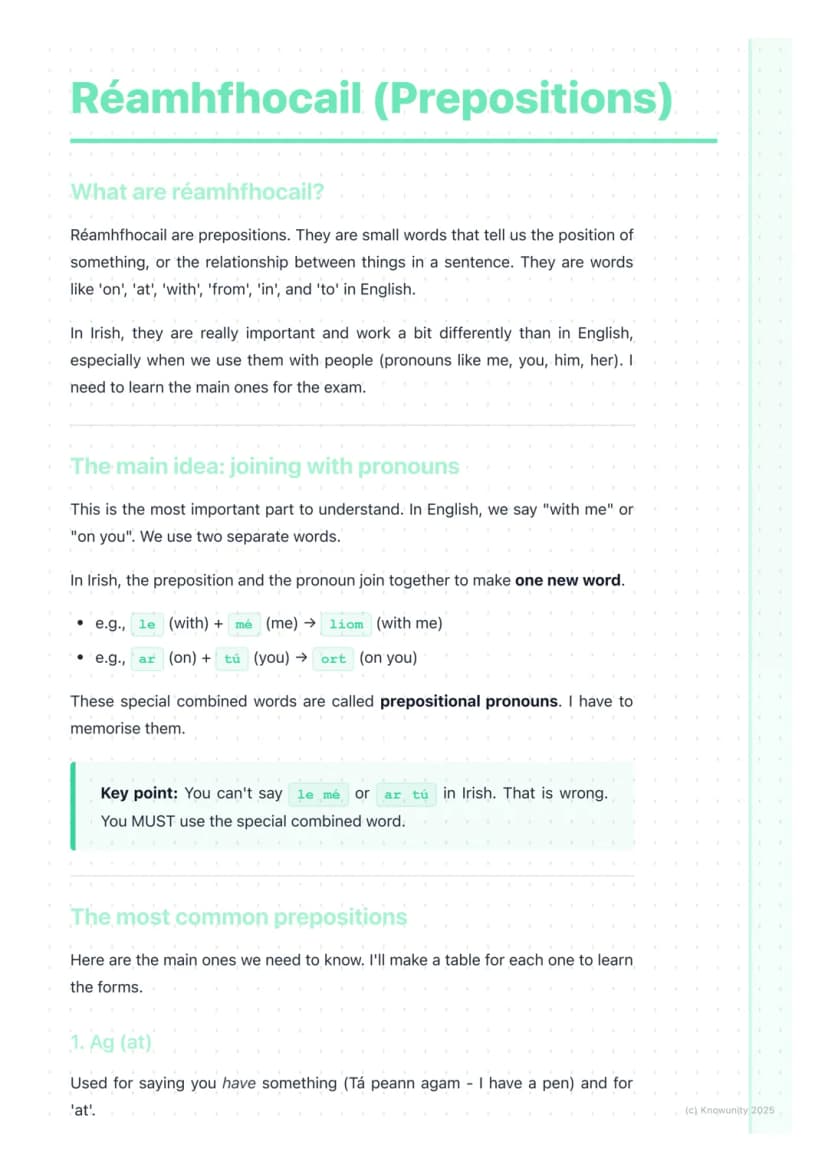
Think of prepositions as the glue words that show relationships between things - like 'on', 'with', 'from', and 'to' in English. In Irish, they're called réamhfhocail, and they work quite differently from English.
Here's the game-changer: in Irish, you can't say "with me" as two separate words like in English. Instead, the preposition le (with) and the pronoun mé (me) squash together to make one brand new word: liom (with me).
These special combined words are called prepositional pronouns, and you absolutely must memorise them. Writing le mé or ar tú is completely wrong in Irish - it's like wearing your shoes on the wrong feet!
Quick Tip: Think of prepositional pronouns as Irish's way of creating super-efficient combo words. Once you get the hang of it, it's actually quite clever!
2
of 6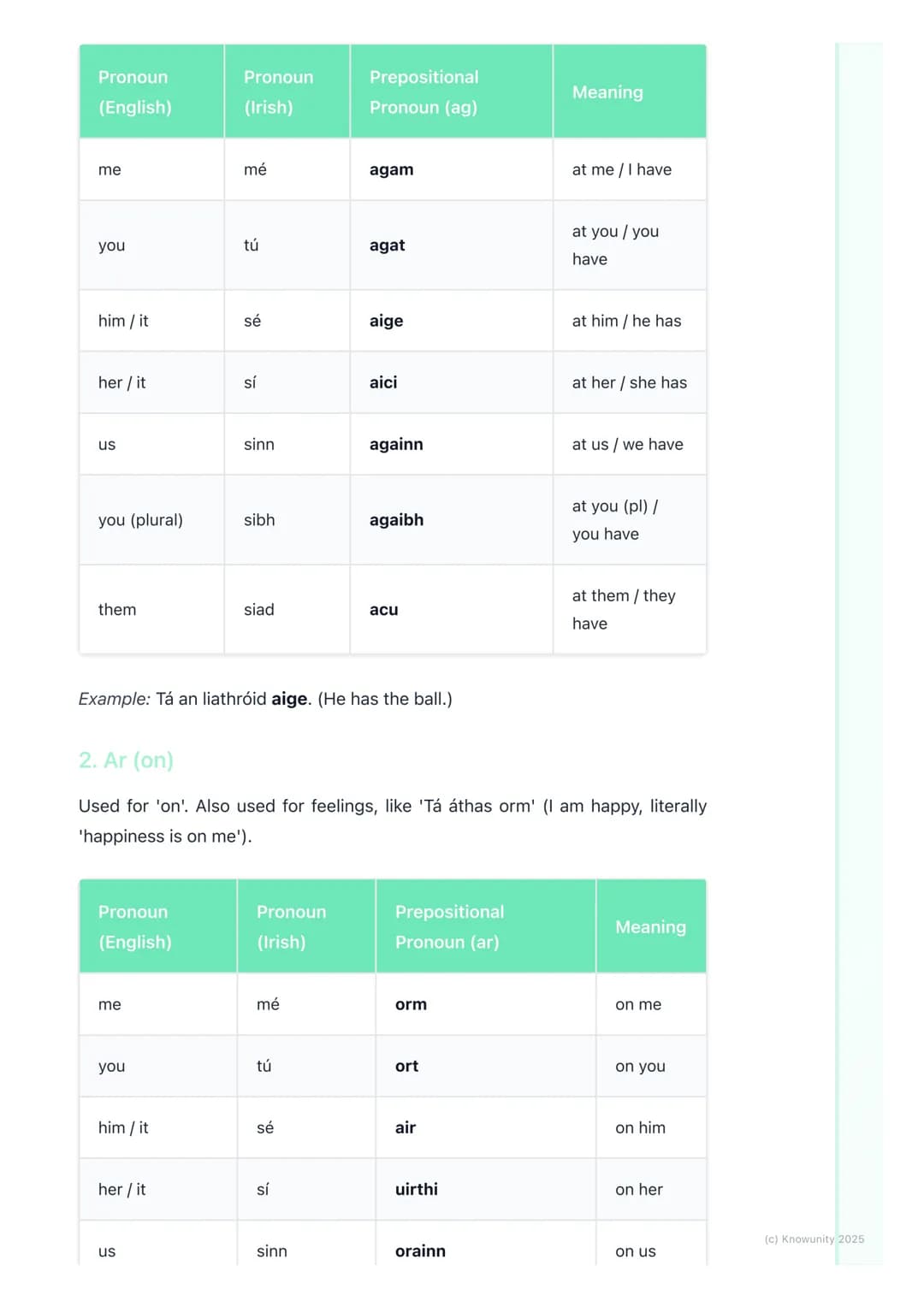
Ag (At) - The "Having" Preposition
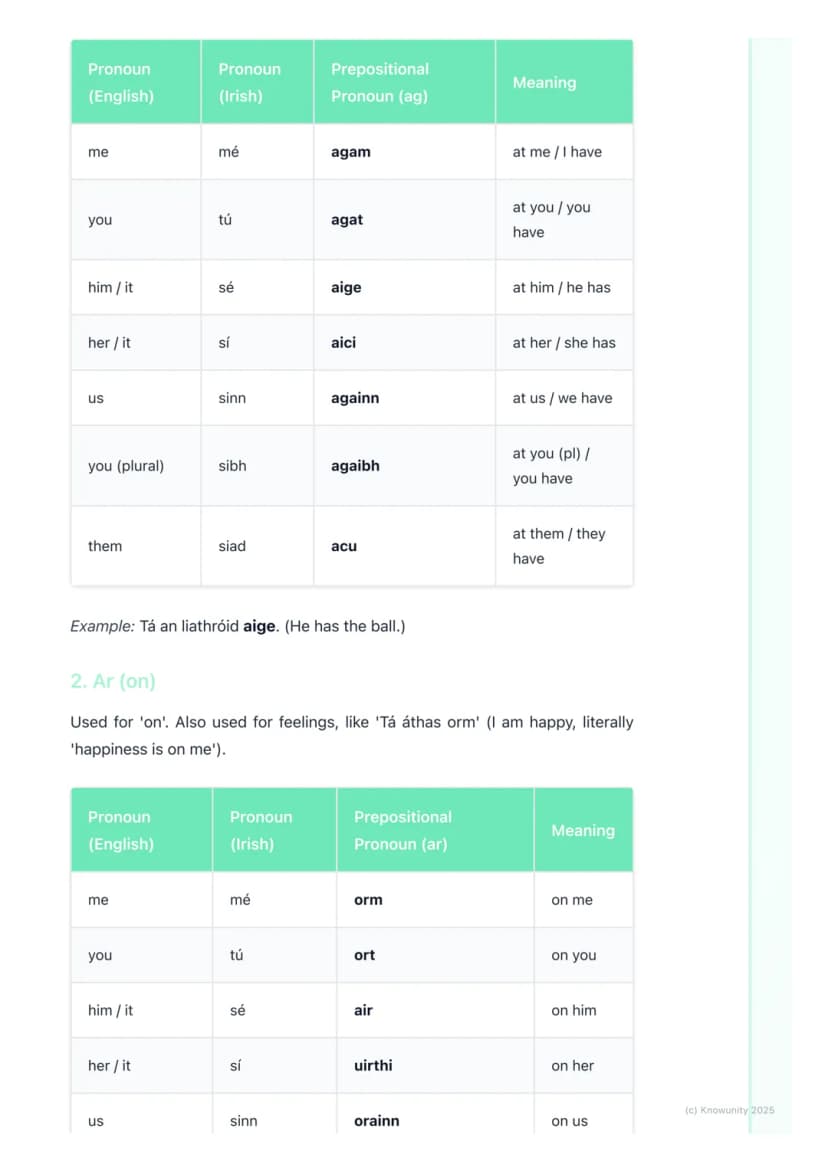
The preposition ag is your best friend for saying you have something. Instead of saying "I have a pen" literally, Irish says "A pen is at me" - which becomes Tá peann agam.
Here are the essential ag forms you need to know:
- Agam = I have
- Agat = you have
- Aige = he has
- Aici = she has
- Againn = we have
- Agaibh = you (plural) have
- Acu = they have
For example: Tá an liathróid aige means "He has the ball." Notice how aige replaces the English "he has" part completely.
Memory Trick: Start with the ones you'll use most - agam (I have) and agat (you have) - then build from there!
3
of 6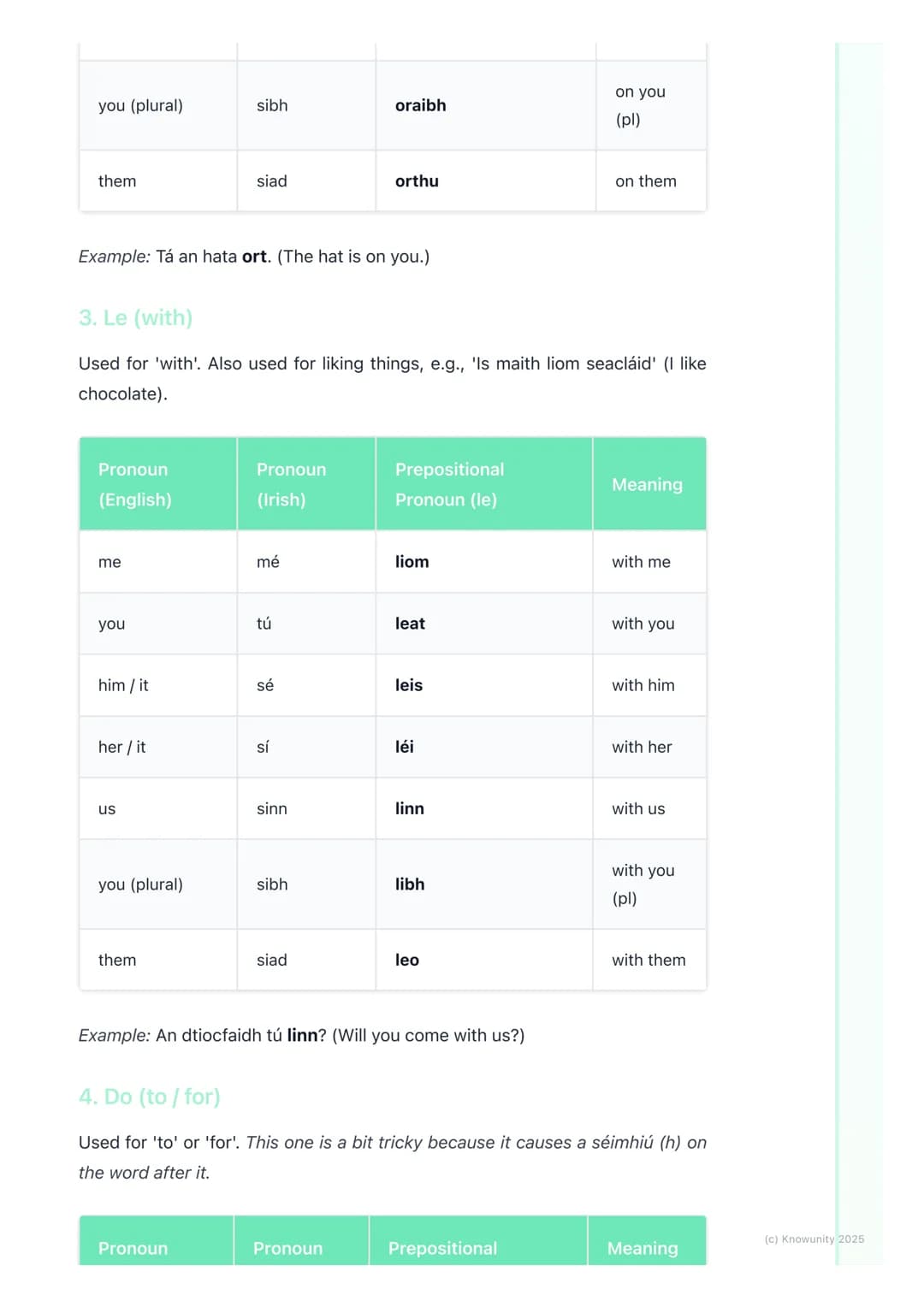
Ar (On) - Position and Feelings
The preposition ar means 'on', but it's also used for expressing feelings in Irish. When you say Tá áthas orm, you're literally saying "happiness is on me" - which means "I am happy."
Key ar combinations:
- Orm = on me
- Ort = on you
- Air = on him
- Uirthi = on her
- Orainn = on us
- Oraibh = on you (plural)
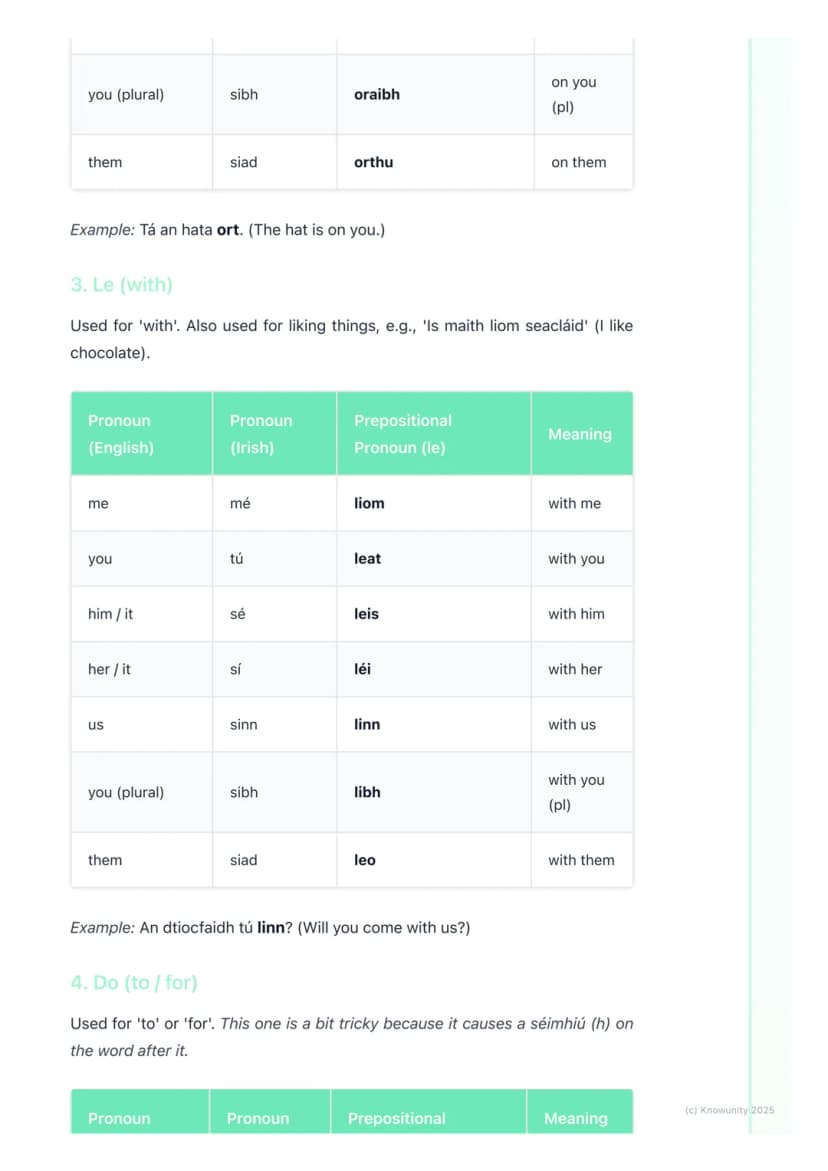
- Orthu = on them
Example: Tá an hata ort means "The hat is on you." Simple positioning, but remember - feelings work the same way in Irish!
Feeling Smart: Irish puts emotions "on" people rather than "in" them. So sadness, happiness, and anger are all "on" you in Irish!
4
of 6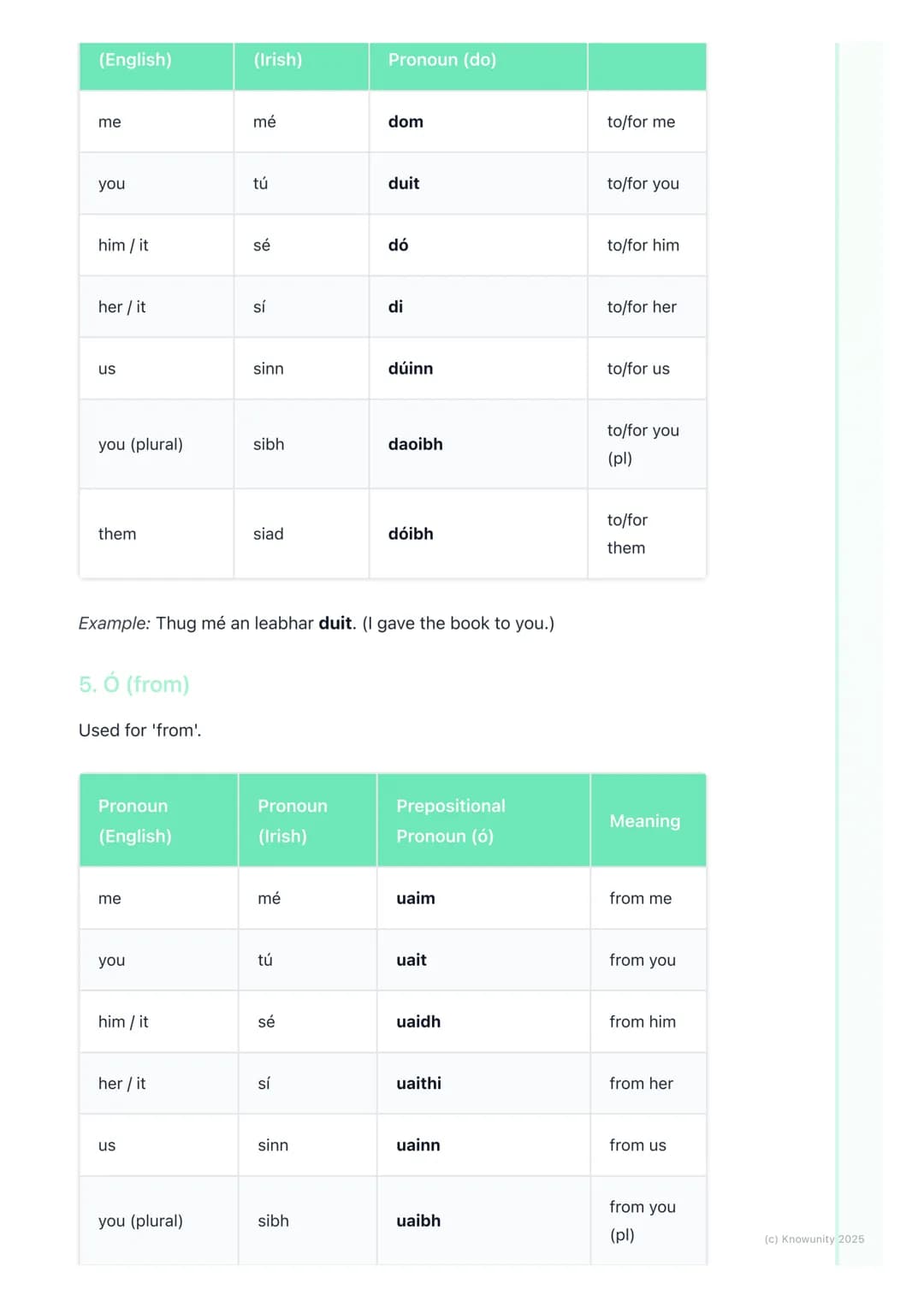
Le (With) and Do - Connection Words
Le (with) is perfect for showing who you're doing things with. It's also essential for expressing likes: Is maith liom means "I like" (literally "it is good with me").
Le combinations:
- Liom = with me
- Leat = with you
- Leis = with him
- Léi = with her
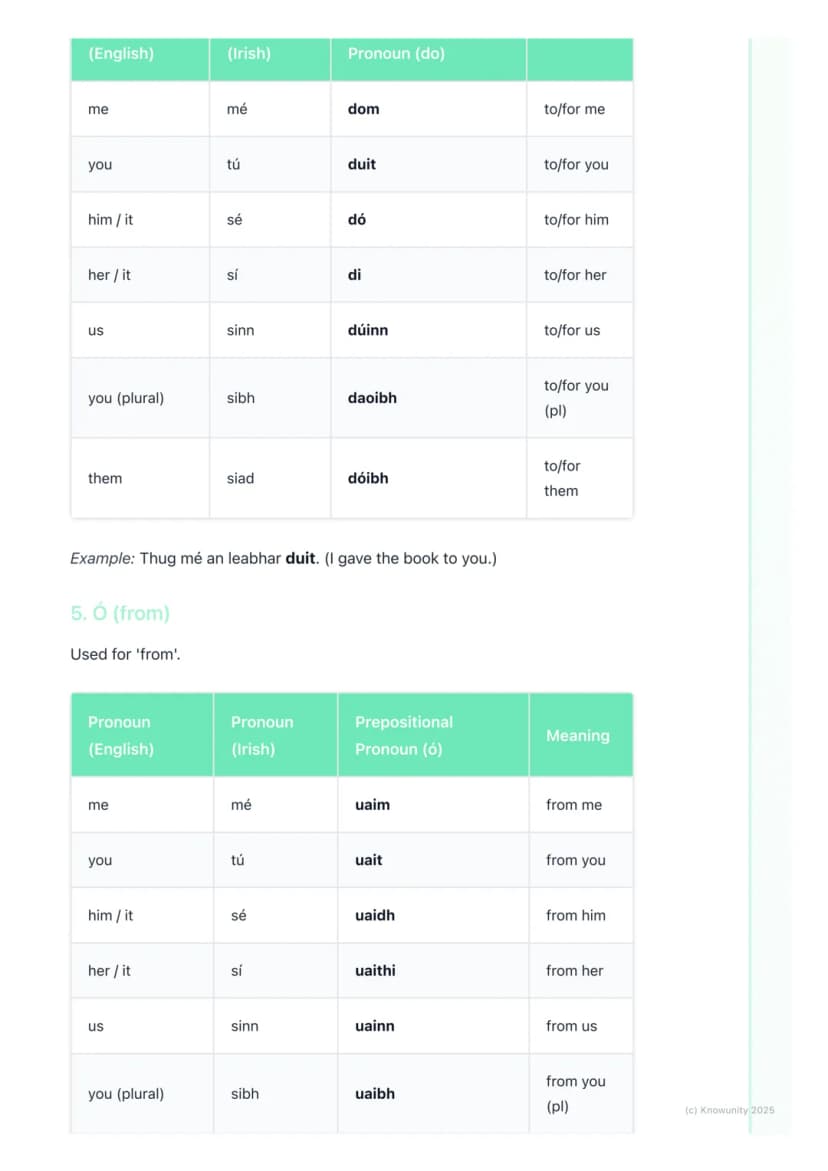
Do shows direction or purpose. Watch out though - do causes a séimhiú (adds an 'h') to words that follow it!
Do combinations:
- Dom = to/for me
- Duit = to/for you
- Dó = to/for him
- Di = to/for her
Example: Thug mé an leabhar duit means "I gave the book to you."
Pro Tip: The do preposition is sneaky - it changes the spelling of words that come after it, so always double-check!
5
of 6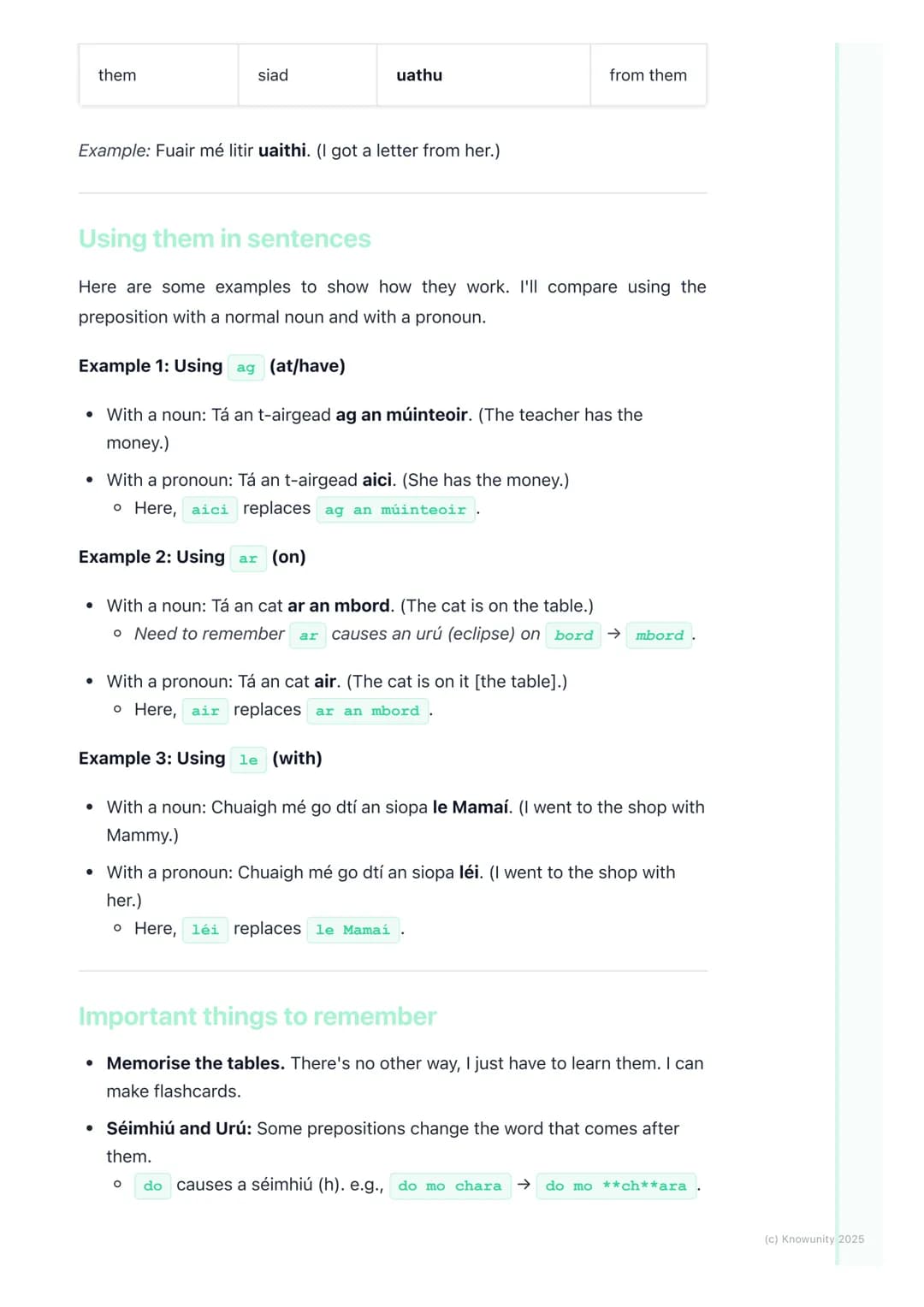
Ó (From) and Using Them in Real Sentences
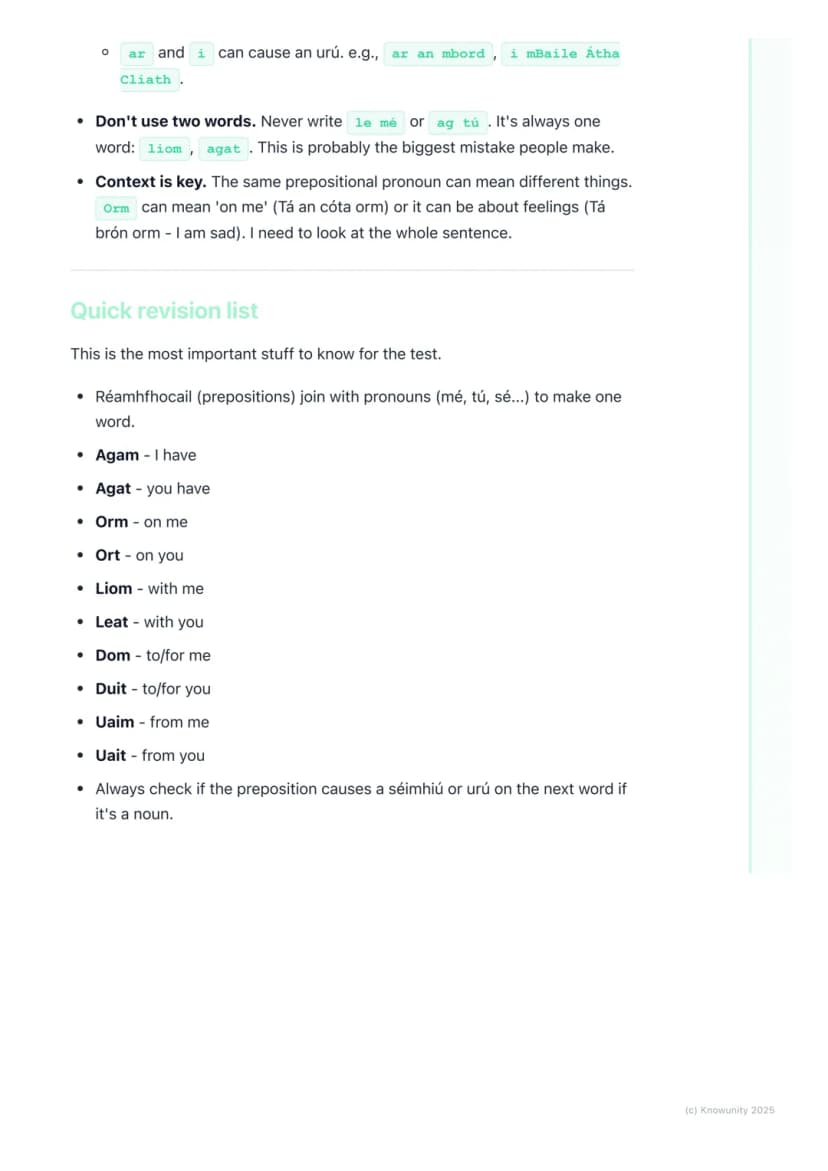
Ó means 'from' and follows the same pattern as the others. Key forms include uaim (from me), uait (from you), and uaidh (from him).
Here's how to use these in actual sentences:
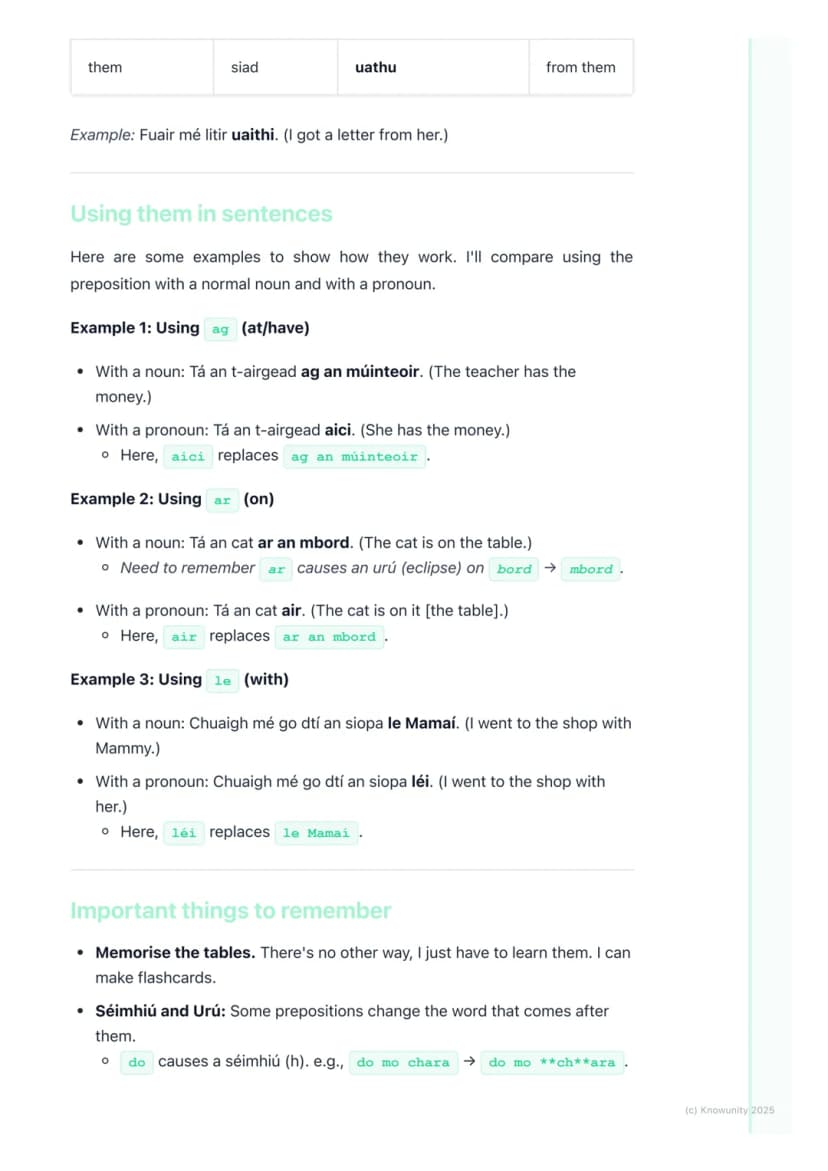
- With nouns: Tá an t-airgead ag an múinteoir (The teacher has the money)
- With pronouns: Tá an t-airgead aici (She has the money)
Notice how aici completely replaces ag an múinteoir. This is the magic of prepositional pronouns - they make Irish much more streamlined once you know them.
The same pattern works for all prepositions. Chuaigh mé go dtí an siopa le Mamaí becomes Chuaigh mé go dtí an siopa léi when you replace the person with a pronoun.
Context Clue: The same word can mean different things - orm can mean "on me" (like wearing clothes) or be part of expressing emotions!
6
of 6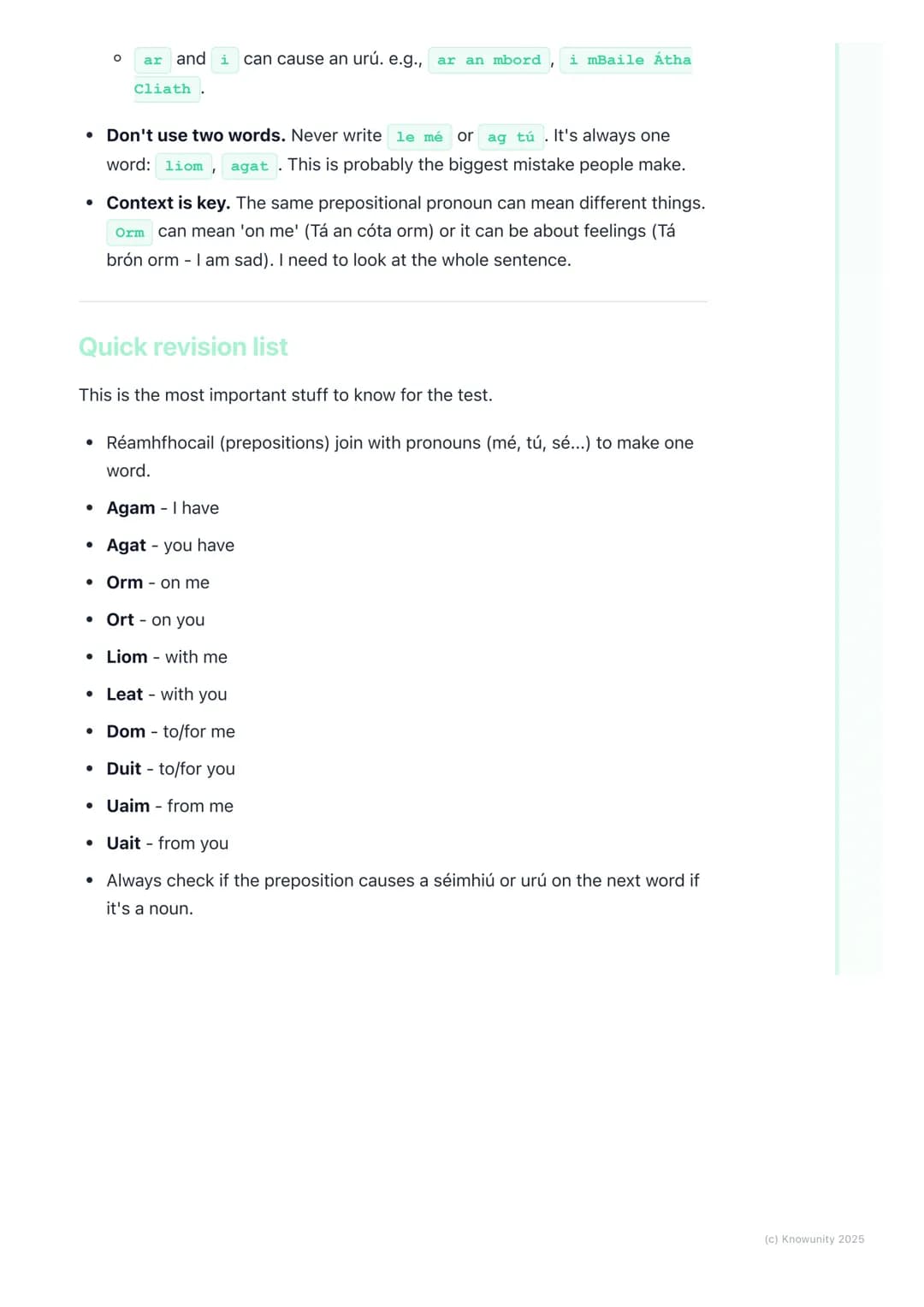
Key Rules and Exam Essentials
Remember these crucial points for your exams: never write prepositions and pronouns as separate words. Le mé is completely wrong - it must be liom.
Some prepositions change the words that follow them:
- Do causes séimhiú (adds 'h')
- Ar and i can cause urú (eclipse)
Quick revision essentials:
- Agam/agat = I have/you have
- Orm/ort = on me/on you
- Liom/leat = with me/with you
- Dom/duit = to me/to you
- Uaim/uait = from me/from you
These prepositional pronouns appear constantly in Irish, so mastering them will instantly boost your confidence in reading, writing, and speaking.
Exam Success: Focus on the most common forms first - agam, agat, orm, ort, liom, leat. Once these are automatic, the rest become much easier!
We thought you’d never ask...
What is the Knowunity AI companion?
Our AI Companion is a student-focused AI tool that offers more than just answers. Built on millions of Knowunity resources, it provides relevant information, personalised study plans, quizzes, and content directly in the chat, adapting to your individual learning journey.
Where can I download the Knowunity app?
You can download the app from Google Play Store and Apple App Store.
Is Knowunity really free of charge?
That's right! Enjoy free access to study content, connect with fellow students, and get instant help – all at your fingertips.
Most popular content in Irish
9IrishIrish oral questions and answers
Questions and answers for the leaving cert oral
5th Year4264
IrishIrish oral questions
Outline of oral questions
5th Year2055
IrishIrish poetry 2027
Iníon + Dínit an Bhróin
5th Year1133
IrishIníon- le hÁine Durkin
Aine Durkin’s poem, Iníon: Themes & summary
5th Year850
IrishLC HL notes- Iníon (poem)
Includes poem in English and Irish, theme, key words & phrases
5th Year2284
IrishMo Ghrá-sa (Idir Lúibíní)
Notes on mo ghrá-sa
5th Year380
IrishGaeilge Grammar Office
All the basics you need to know on Irish grammar.
6th Year1063
IrishAn Gaeilge Aiste
Irish Language essay
6th Year1320
IrishMé Féin & Mo Chlann (Myself & My Family)
Students will learn vocabulary to describe themselves, their family members, and daily routines. This helps in personal introductions and discussions.
TY291
Most popular content
9IrishIrish oral questions and answers
Questions and answers for the leaving cert oral
5th Year4264
 English
Key Quotes : Sive
Key Quotes and explanations: Sive
6th Year2842
IrishIrish oral questions
Outline of oral questions
5th Year2055
IrishIníon- le hÁine Durkin
Aine Durkin’s poem, Iníon: Themes & summary
5th Year850
IrishIrish poetry 2027
Iníon + Dínit an Bhróin
5th Year1133
IrishLC HL notes- Iníon (poem)
Includes poem in English and Irish, theme, key words & phrases
5th Year2284
EnglishCultural Context : Shawshank Redemption : Sive : Small Things Like These
Comparative Study : Cultural Context : Shawshank Redemption, Sive and Small Things Like These
6th Year1430
IrishMo Ghrá-sa (Idir Lúibíní)
Notes on mo ghrá-sa
5th Year380
IrishAn Gaeilge Aiste
Irish Language essay
6th Year1320
Can't find what you're looking for? Explore other subjects.
Students love us — and so will you.
4.6/5App Store
4.7/5Google Play
The app is very easy to use and well designed. I have found everything I was looking for so far and have been able to learn a lot from the presentations! I will definitely use the app for a class assignment! And of course it also helps a lot as an inspiration.
Stefan SiOS user
This app is really great. There are so many study notes and help [...]. My problem subject is French, for example, and the app has so many options for help. Thanks to this app, I have improved my French. I would recommend it to anyone.
Samantha KlichAndroid user
Wow, I am really amazed. I just tried the app because I've seen it advertised many times and was absolutely stunned. This app is THE HELP you want for school and above all, it offers so many things, such as workouts and fact sheets, which have been VERY helpful to me personally.
AnnaiOS user
Irish9 views·Updated Jun 14, 2026·6 pagesRéamhfhocail sa Ghaeilge: Bunghnéithe agus Samplaí
Ever wondered why Irish seems to glue words together in weird ways? Réamhfhocail (prepositions) are those sneaky little words that join with pronouns to create completely new words - and they're absolutely crucial for your Irish exams!
1
of 6Sign up to see the content. It's free!
- Access to all documents
- Improve your grades
- Join milions of students
What Are Réamhfhocail?
Think of prepositions as the glue words that show relationships between things - like 'on', 'with', 'from', and 'to' in English. In Irish, they're called réamhfhocail, and they work quite differently from English.
Here's the game-changer: in Irish, you can't say "with me" as two separate words like in English. Instead, the preposition le (with) and the pronoun mé (me) squash together to make one brand new word: liom (with me).
These special combined words are called prepositional pronouns, and you absolutely must memorise them. Writing le mé or ar tú is completely wrong in Irish - it's like wearing your shoes on the wrong feet!
Quick Tip: Think of prepositional pronouns as Irish's way of creating super-efficient combo words. Once you get the hang of it, it's actually quite clever!
2
of 6Sign up to see the content. It's free!
- Access to all documents
- Improve your grades
- Join milions of students
Ag (At) - The "Having" Preposition
The preposition ag is your best friend for saying you have something. Instead of saying "I have a pen" literally, Irish says "A pen is at me" - which becomes Tá peann agam.
Here are the essential ag forms you need to know:
- Agam = I have
- Agat = you have
- Aige = he has
- Aici = she has
- Againn = we have
- Agaibh = you (plural) have
- Acu = they have
For example: Tá an liathróid aige means "He has the ball." Notice how aige replaces the English "he has" part completely.
Memory Trick: Start with the ones you'll use most - agam (I have) and agat (you have) - then build from there!
3
of 6Sign up to see the content. It's free!
- Access to all documents
- Improve your grades
- Join milions of students
Ar (On) - Position and Feelings
The preposition ar means 'on', but it's also used for expressing feelings in Irish. When you say Tá áthas orm, you're literally saying "happiness is on me" - which means "I am happy."
Key ar combinations:
- Orm = on me
- Ort = on you
- Air = on him
- Uirthi = on her
- Orainn = on us
- Oraibh = on you (plural)
- Orthu = on them
Example: Tá an hata ort means "The hat is on you." Simple positioning, but remember - feelings work the same way in Irish!
Feeling Smart: Irish puts emotions "on" people rather than "in" them. So sadness, happiness, and anger are all "on" you in Irish!
4
of 6Sign up to see the content. It's free!
- Access to all documents
- Improve your grades
- Join milions of students
Le (With) and Do - Connection Words
Le (with) is perfect for showing who you're doing things with. It's also essential for expressing likes: Is maith liom means "I like" (literally "it is good with me").
Le combinations:
- Liom = with me
- Leat = with you
- Leis = with him
- Léi = with her
Do shows direction or purpose. Watch out though - do causes a séimhiú (adds an 'h') to words that follow it!
Do combinations:
- Dom = to/for me
- Duit = to/for you
- Dó = to/for him
- Di = to/for her
Example: Thug mé an leabhar duit means "I gave the book to you."
Pro Tip: The do preposition is sneaky - it changes the spelling of words that come after it, so always double-check!
5
of 6Sign up to see the content. It's free!
- Access to all documents
- Improve your grades
- Join milions of students
Ó (From) and Using Them in Real Sentences
Ó means 'from' and follows the same pattern as the others. Key forms include uaim (from me), uait (from you), and uaidh (from him).
Here's how to use these in actual sentences:
- With nouns: Tá an t-airgead ag an múinteoir (The teacher has the money)
- With pronouns: Tá an t-airgead aici (She has the money)
Notice how aici completely replaces ag an múinteoir. This is the magic of prepositional pronouns - they make Irish much more streamlined once you know them.
The same pattern works for all prepositions. Chuaigh mé go dtí an siopa le Mamaí becomes Chuaigh mé go dtí an siopa léi when you replace the person with a pronoun.
Context Clue: The same word can mean different things - orm can mean "on me" (like wearing clothes) or be part of expressing emotions!
6
of 6Sign up to see the content. It's free!
- Access to all documents
- Improve your grades
- Join milions of students
Key Rules and Exam Essentials
Remember these crucial points for your exams: never write prepositions and pronouns as separate words. Le mé is completely wrong - it must be liom.
Some prepositions change the words that follow them:
- Do causes séimhiú (adds 'h')
- Ar and i can cause urú (eclipse)
Quick revision essentials:
- Agam/agat = I have/you have
- Orm/ort = on me/on you
- Liom/leat = with me/with you
- Dom/duit = to me/to you
- Uaim/uait = from me/from you
These prepositional pronouns appear constantly in Irish, so mastering them will instantly boost your confidence in reading, writing, and speaking.
Exam Success: Focus on the most common forms first - agam, agat, orm, ort, liom, leat. Once these are automatic, the rest become much easier!
We thought you’d never ask...
What is the Knowunity AI companion?
Our AI Companion is a student-focused AI tool that offers more than just answers. Built on millions of Knowunity resources, it provides relevant information, personalised study plans, quizzes, and content directly in the chat, adapting to your individual learning journey.
Where can I download the Knowunity app?
You can download the app from Google Play Store and Apple App Store.
Is Knowunity really free of charge?
That's right! Enjoy free access to study content, connect with fellow students, and get instant help – all at your fingertips.
Most popular content in Irish
9IrishIrish oral questions and answers
Questions and answers for the leaving cert oral
5th Year4264
IrishIrish oral questions
Outline of oral questions
5th Year2055
IrishIrish poetry 2027
Iníon + Dínit an Bhróin
5th Year1133
IrishIníon- le hÁine Durkin
Aine Durkin’s poem, Iníon: Themes & summary
5th Year850
IrishLC HL notes- Iníon (poem)
Includes poem in English and Irish, theme, key words & phrases
5th Year2284
IrishMo Ghrá-sa (Idir Lúibíní)
Notes on mo ghrá-sa
5th Year380
IrishGaeilge Grammar Office
All the basics you need to know on Irish grammar.
6th Year1063
IrishAn Gaeilge Aiste
Irish Language essay
6th Year1320
IrishMé Féin & Mo Chlann (Myself & My Family)
Students will learn vocabulary to describe themselves, their family members, and daily routines. This helps in personal introductions and discussions.
TY291
Most popular content
9IrishIrish oral questions and answers
Questions and answers for the leaving cert oral
5th Year4264
EnglishKey Quotes : Sive
Key Quotes and explanations: Sive
6th Year2842
IrishIrish oral questions
Outline of oral questions
5th Year2055
IrishIníon- le hÁine Durkin
Aine Durkin’s poem, Iníon: Themes & summary
5th Year850
IrishIrish poetry 2027
Iníon + Dínit an Bhróin
5th Year1133
IrishLC HL notes- Iníon (poem)
Includes poem in English and Irish, theme, key words & phrases
5th Year2284
EnglishCultural Context : Shawshank Redemption : Sive : Small Things Like These
Comparative Study : Cultural Context : Shawshank Redemption, Sive and Small Things Like These
6th Year1430
IrishMo Ghrá-sa (Idir Lúibíní)
Notes on mo ghrá-sa
5th Year380
IrishAn Gaeilge Aiste
Irish Language essay
6th Year1320
Can't find what you're looking for? Explore other subjects.
Students love us — and so will you.
4.6/5App Store
4.7/5Google Play
The app is very easy to use and well designed. I have found everything I was looking for so far and have been able to learn a lot from the presentations! I will definitely use the app for a class assignment! And of course it also helps a lot as an inspiration.
Stefan SiOS user
This app is really great. There are so many study notes and help [...]. My problem subject is French, for example, and the app has so many options for help. Thanks to this app, I have improved my French. I would recommend it to anyone.
Samantha KlichAndroid user
Wow, I am really amazed. I just tried the app because I've seen it advertised many times and was absolutely stunned. This app is THE HELP you want for school and above all, it offers so many things, such as workouts and fact sheets, which have been VERY helpful to me personally.
AnnaiOS user