
As orações relativas em inglês são usadas para adicionar informações...
 Inglês365 views·Updated Jun 18, 2026·3 pages
Guia Completo: Orações Relativas em Inglês
1 / 3
1
of 3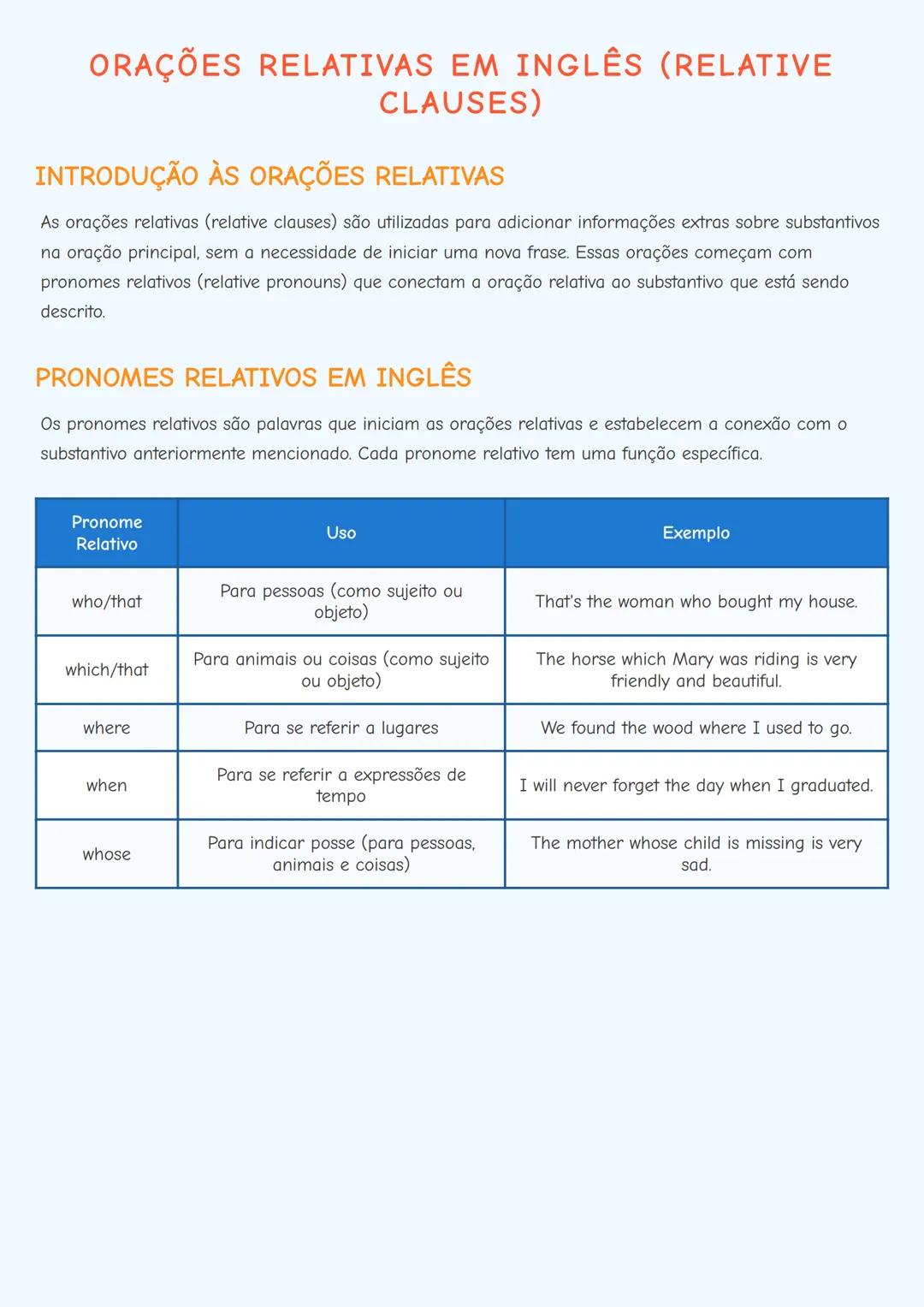
Introdução às Orações Relativas
Quando queremos dar mais detalhes sobre algo ou alguém sem começar uma frase nova, usamos as orações relativas. Elas são super úteis para enriquecer suas frases em inglês!
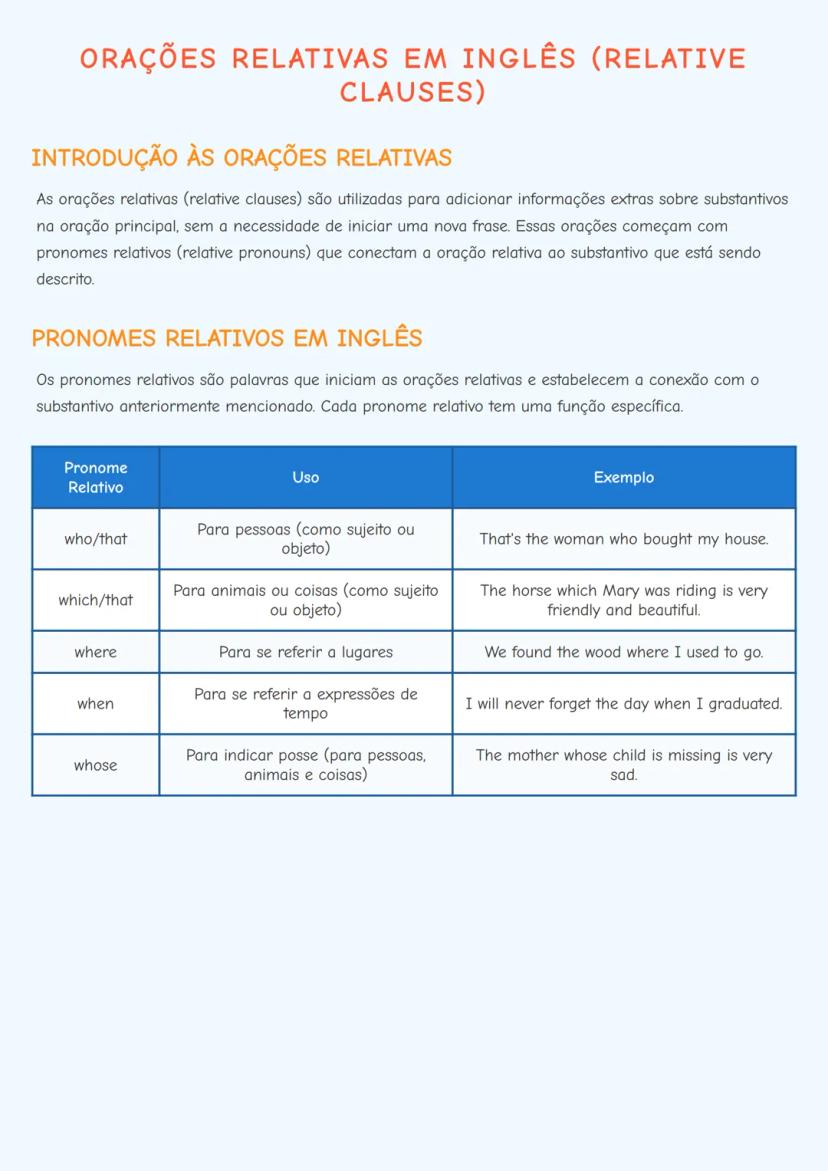
Os pronomes relativos são as palavras mágicas que iniciam essas orações. Cada um tem sua função específica: who/that usamos para pessoas, which/that para animais ou coisas, where para lugares, when para tempo, e whose para mostrar posse.
Por exemplo, em "That's the woman who bought my house", o pronome "who" conecta a informação adicional (ela comprou minha casa) à pessoa mencionada (a mulher).
💡 Dica prática: Pense nos pronomes relativos como "conectores de informação" - eles ajudam você a dizer mais sobre algo sem precisar criar várias frases curtas e repetitivas.
2
of 3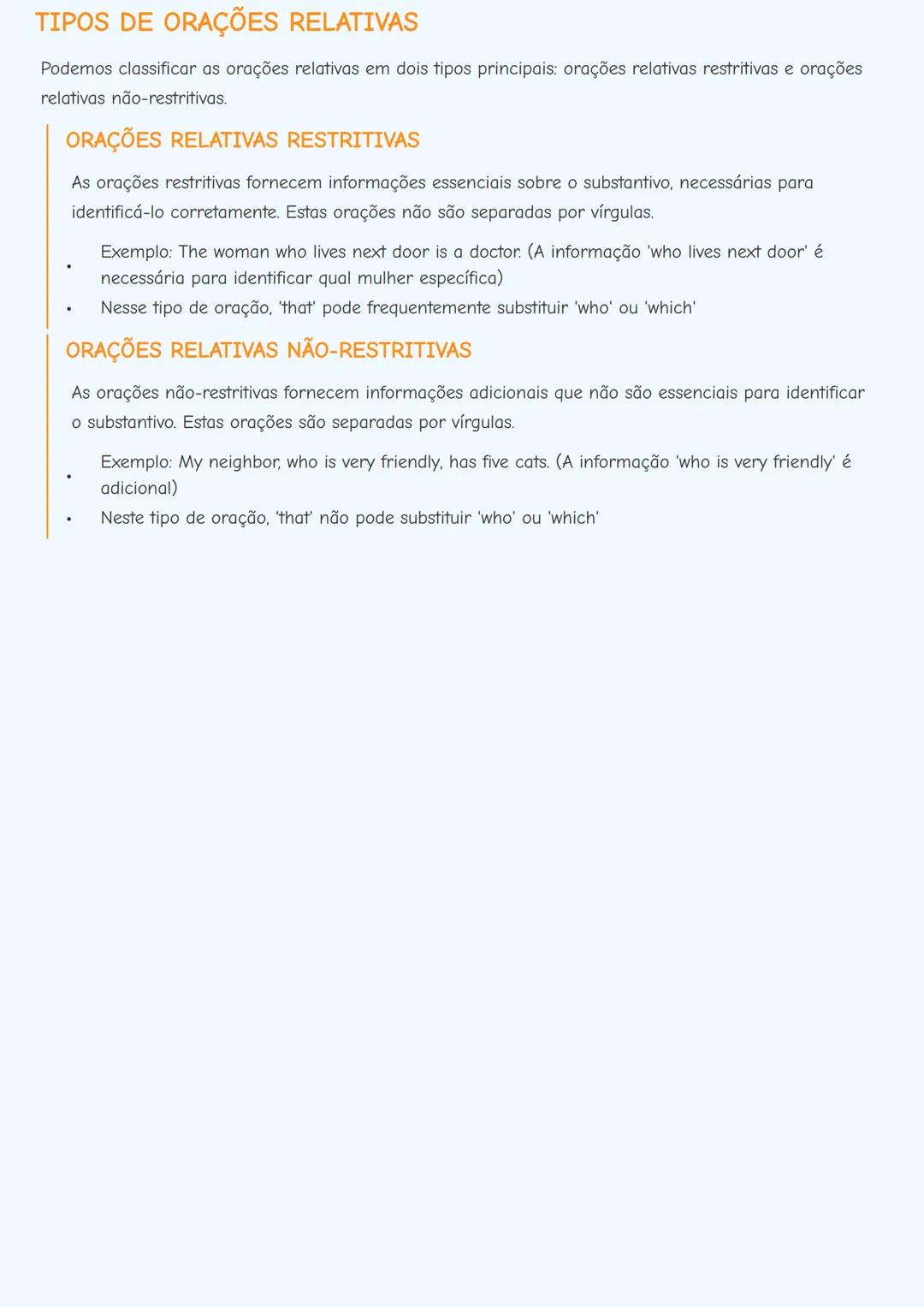
Tipos de Orações Relativas
Existem dois tipos principais de orações relativas que você precisa conhecer para se comunicar melhor em inglês. A diferença entre elas está na importância da informação e no uso das vírgulas.
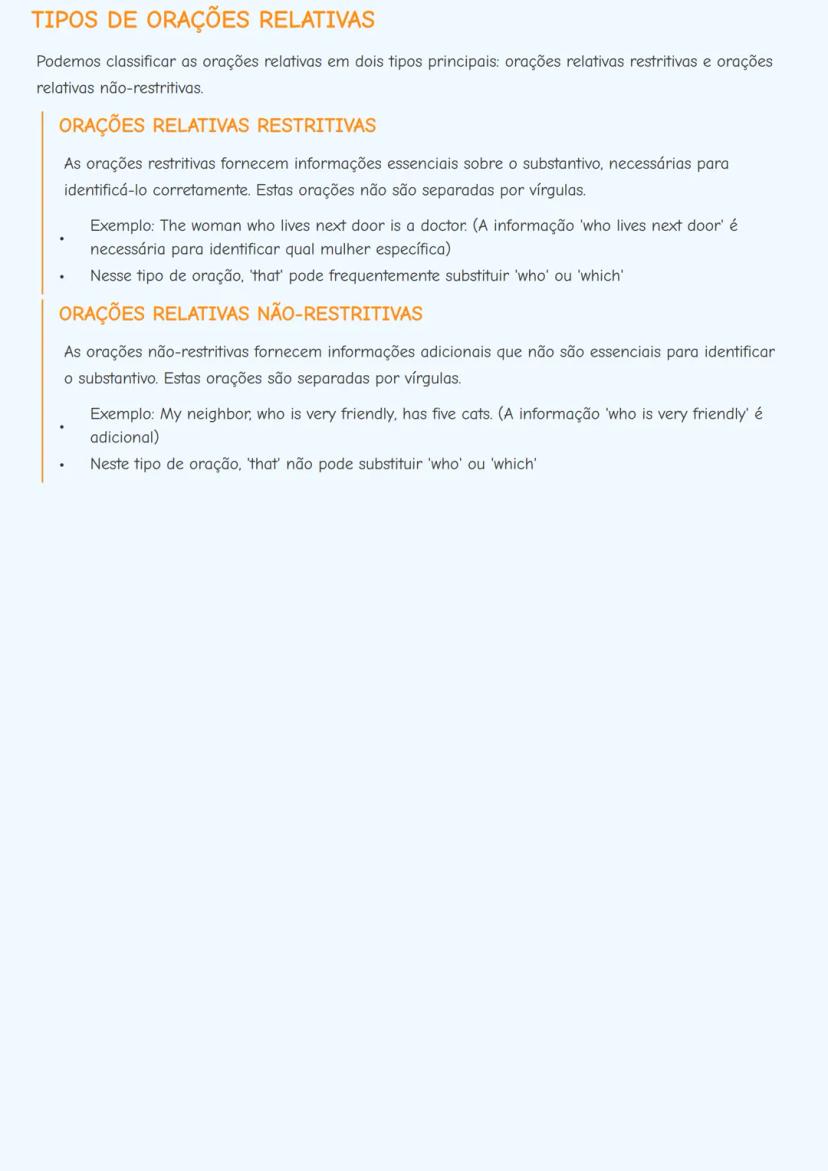
As orações relativas restritivas fornecem informações essenciais para identificar corretamente o substantivo. Não usamos vírgulas neste caso! Por exemplo: "The woman who lives next door is a doctor" - precisamos da informação "who lives next door" para saber exatamente de qual mulher estamos falando.
Já as orações relativas não-restritivas oferecem informações extras, não essenciais para identificação. Sempre usamos vírgulas aqui! Como em: "My neighbor, who is very friendly, has five cats" - a informação entre vírgulas é apenas um detalhe adicional sobre o vizinho.
🔑 Lembre-se: Nas orações restritivas (sem vírgulas), você pode substituir 'who' ou 'which' por 'that'. Mas nas não-restritivas (com vírgulas), nunca use 'that'!
3
of 3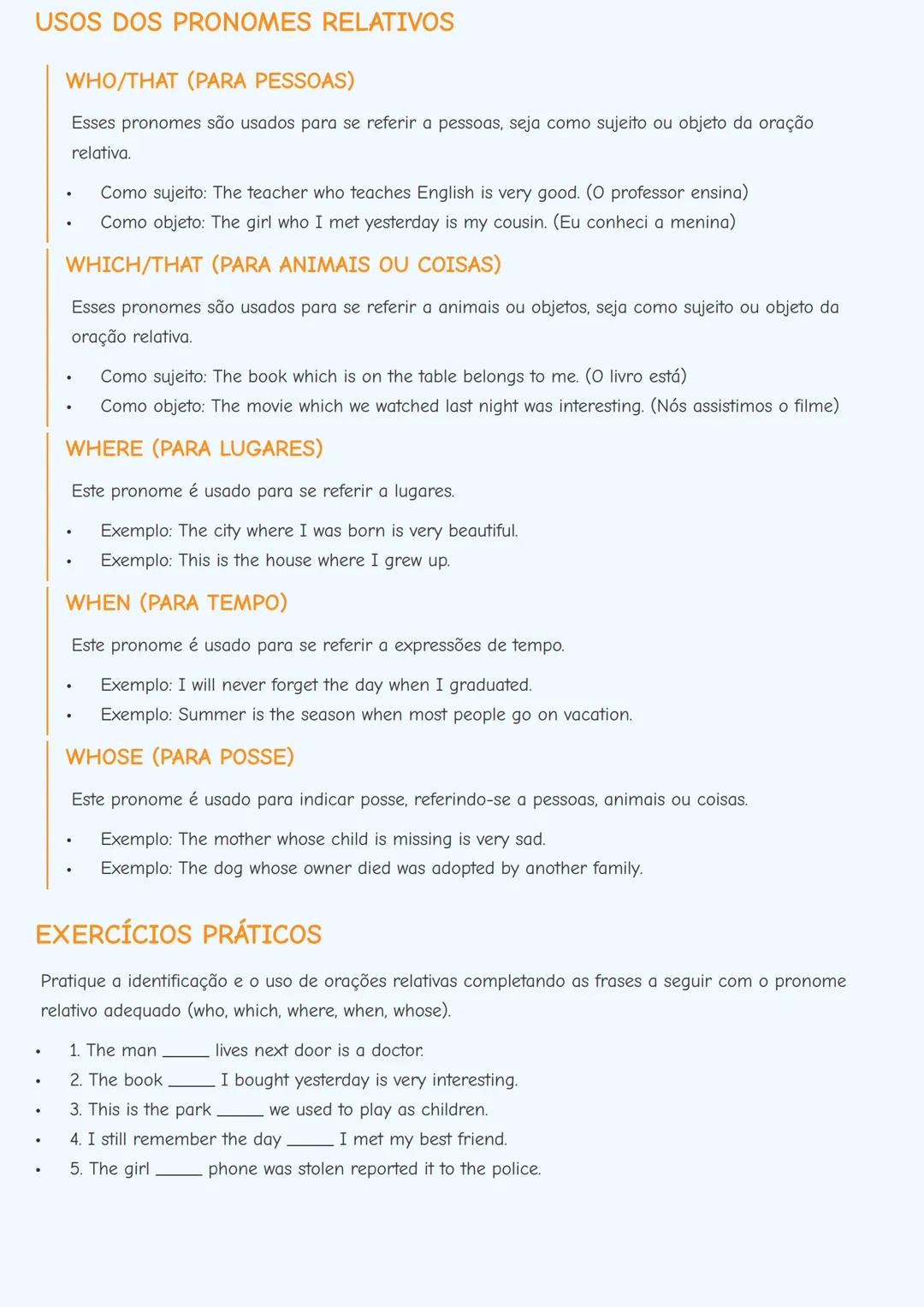
Usos dos Pronomes Relativos
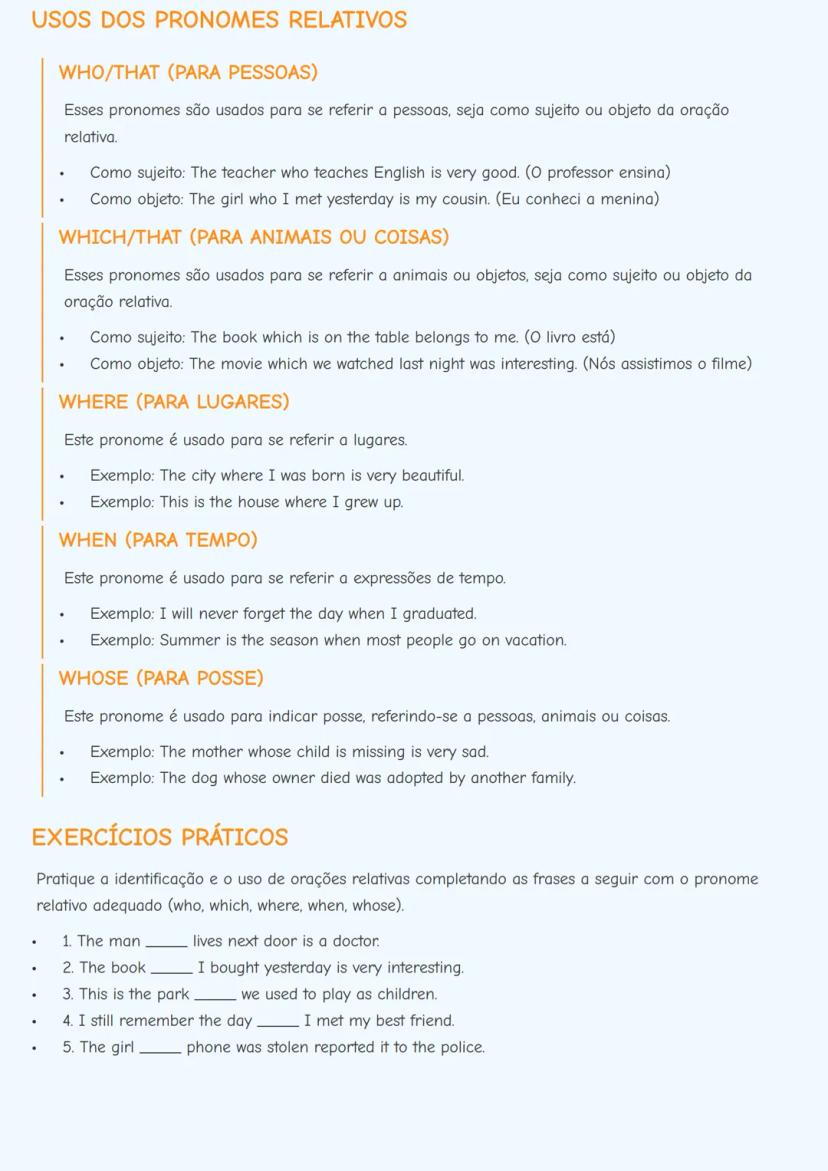
Os pronomes who/that são usados para pessoas, tanto como sujeito ("The teacher who teaches English is very good") quanto como objeto ("The girl who I met yesterday is my cousin").
Para animais e objetos, usamos which/that, também funcionando como sujeito ou objeto nas frases. Exemplo: "The book which is on the table belongs to me" ou "The movie which we watched last night was interesting".
Quando falamos de lugares, o pronome where é perfeito: "The city where I was born is very beautiful". Para expressões de tempo, when é a escolha certa: "I will never forget the day when I graduated". E para indicar posse, usamos whose: "The mother whose child is missing is very sad".
🏆 Desafio: Tente criar suas próprias frases usando cada um dos pronomes relativos. Isso vai ajudar você a fixar o conteúdo e se preparar para usar essas estruturas naturalmente em conversas e provas!
We thought you’d never ask...
What is the Knowunity AI companion?
Our AI Companion is a student-focused AI tool that offers more than just answers. Built on millions of Knowunity resources, it provides relevant information, personalised study plans, quizzes, and content directly in the chat, adapting to your individual learning journey.
Where can I download the Knowunity app?
You can download the app from Google Play Store and Apple App Store.
Is Knowunity really free of charge?
That's right! Enjoy free access to study content, connect with fellow students, and get instant help – all at your fingertips.
Most popular content: Relative Pronoun
1Most popular content in Inglês
9InglêsVerbo to be
Aqui vc aprende
8°1,99173
InglêsVerbo to be
resumo sobre verbo to be
1°EM2,07537
InglêsSimple past e past continuous
Características
8°85215
Inglêspronomes pessoais em inglês
resumo sobre pronomes pessoais em inglês!🇺🇸
1°EM1,32024
InglêsTempos Verbais em Inglês
resumo sobre tempos verbais em inglês
1°EM1,96339
InglêsFuturo simples "going to"
Formas: interrogativa, negativa e afirmativa. O que ele expressa em um contexto; como dar respostas curtas em uma frase, e as junções com o verbo to be
8°50714
InglêsSimple present
Formas afirmativa, negativa e interrogativa, quando utilizar e casos especiais de uso
6°4878
InglêsPresent simple
Inglês né mãe
6°3013
Inglêsinglês vocabulário
vocabulário
9°2870
Most popular content
9 História
primeira guerra mundial
Teste seus conhecimentos sobre a primeira guerra mundial, causas da primeira guerra mundial e consequências da Primeira Guerra Mundial, fases da primeira guerra mundial
9°2,7640
Históriailuminismo e pensadores iluministas
Teste seus conhecimentos sobre o Iluminismo e seus principais pensadores, explorando suas ideias e impacto histórico.
8°9990
 Matematica
Potenciação
Resumo de potenciação - matemática
9°9,292205
HistóriaPrimeira Guerra Mundial
Resumo sobre a primeira guerra mundial
6°4,670122
 Português
Como fazer uma redação ENEM
Redação ENEM estrutura
Univ.6,485220
MatematicaRadiciação
Radiciação
8°9570
MatematicaRadiciação
Resumo sobre radiciação, com propriedades, operações com radicais potenciação e etc.
9°6,59491
E
Matematicaestudos de raízes
para você estudar um pouco sobre raizes na matemática
8°7740
HistóriaIluminismo
Sobre iluminismo
7°6,506322
Can't find what you're looking for? Explore other subjects.
Students love us — and so will you.
4.6/5App Store
4.7/5Google Play
The app is very easy to use and well designed. I have found everything I was looking for so far and have been able to learn a lot from the presentations! I will definitely use the app for a class assignment! And of course it also helps a lot as an inspiration.
Stefan SiOS user
This app is really great. There are so many study notes and help [...]. My problem subject is French, for example, and the app has so many options for help. Thanks to this app, I have improved my French. I would recommend it to anyone.
Samantha KlichAndroid user
Wow, I am really amazed. I just tried the app because I've seen it advertised many times and was absolutely stunned. This app is THE HELP you want for school and above all, it offers so many things, such as workouts and fact sheets, which have been VERY helpful to me personally.
AnnaiOS user
Inglês365 views·Updated Jun 18, 2026·3 pagesGuia Completo: Orações Relativas em Inglês
As orações relativas em inglês são usadas para adicionar informações extras sobre substantivos, conectando ideias de forma mais fluida e natural. Elas começam com pronomes relativos específicos que ligam a informação adicional ao substantivo que está sendo descrito.
1
of 3
Sign up to see the content. It's free!
- Access to all documents
- Improve your grades
- Join milions of students
Introdução às Orações Relativas
Quando queremos dar mais detalhes sobre algo ou alguém sem começar uma frase nova, usamos as orações relativas. Elas são super úteis para enriquecer suas frases em inglês!
Os pronomes relativos são as palavras mágicas que iniciam essas orações. Cada um tem sua função específica: who/that usamos para pessoas, which/that para animais ou coisas, where para lugares, when para tempo, e whose para mostrar posse.
Por exemplo, em "That's the woman who bought my house", o pronome "who" conecta a informação adicional (ela comprou minha casa) à pessoa mencionada (a mulher).
💡 Dica prática: Pense nos pronomes relativos como "conectores de informação" - eles ajudam você a dizer mais sobre algo sem precisar criar várias frases curtas e repetitivas.
2
of 3Sign up to see the content. It's free!
- Access to all documents
- Improve your grades
- Join milions of students
Tipos de Orações Relativas
Existem dois tipos principais de orações relativas que você precisa conhecer para se comunicar melhor em inglês. A diferença entre elas está na importância da informação e no uso das vírgulas.
As orações relativas restritivas fornecem informações essenciais para identificar corretamente o substantivo. Não usamos vírgulas neste caso! Por exemplo: "The woman who lives next door is a doctor" - precisamos da informação "who lives next door" para saber exatamente de qual mulher estamos falando.
Já as orações relativas não-restritivas oferecem informações extras, não essenciais para identificação. Sempre usamos vírgulas aqui! Como em: "My neighbor, who is very friendly, has five cats" - a informação entre vírgulas é apenas um detalhe adicional sobre o vizinho.
🔑 Lembre-se: Nas orações restritivas (sem vírgulas), você pode substituir 'who' ou 'which' por 'that'. Mas nas não-restritivas (com vírgulas), nunca use 'that'!
3
of 3Sign up to see the content. It's free!
- Access to all documents
- Improve your grades
- Join milions of students
Usos dos Pronomes Relativos
Os pronomes who/that são usados para pessoas, tanto como sujeito ("The teacher who teaches English is very good") quanto como objeto ("The girl who I met yesterday is my cousin").
Para animais e objetos, usamos which/that, também funcionando como sujeito ou objeto nas frases. Exemplo: "The book which is on the table belongs to me" ou "The movie which we watched last night was interesting".
Quando falamos de lugares, o pronome where é perfeito: "The city where I was born is very beautiful". Para expressões de tempo, when é a escolha certa: "I will never forget the day when I graduated". E para indicar posse, usamos whose: "The mother whose child is missing is very sad".
🏆 Desafio: Tente criar suas próprias frases usando cada um dos pronomes relativos. Isso vai ajudar você a fixar o conteúdo e se preparar para usar essas estruturas naturalmente em conversas e provas!
We thought you’d never ask...
What is the Knowunity AI companion?
Our AI Companion is a student-focused AI tool that offers more than just answers. Built on millions of Knowunity resources, it provides relevant information, personalised study plans, quizzes, and content directly in the chat, adapting to your individual learning journey.
Where can I download the Knowunity app?
You can download the app from Google Play Store and Apple App Store.
Is Knowunity really free of charge?
That's right! Enjoy free access to study content, connect with fellow students, and get instant help – all at your fingertips.
Most popular content: Relative Pronoun
1Most popular content in Inglês
9InglêsVerbo to be
Aqui vc aprende
8°1,99173
InglêsVerbo to be
resumo sobre verbo to be
1°EM2,07537
InglêsSimple past e past continuous
Características
8°85215
Inglêspronomes pessoais em inglês
resumo sobre pronomes pessoais em inglês!🇺🇸
1°EM1,32024
InglêsTempos Verbais em Inglês
resumo sobre tempos verbais em inglês
1°EM1,96339
InglêsFuturo simples "going to"
Formas: interrogativa, negativa e afirmativa. O que ele expressa em um contexto; como dar respostas curtas em uma frase, e as junções com o verbo to be
8°50714
InglêsSimple present
Formas afirmativa, negativa e interrogativa, quando utilizar e casos especiais de uso
6°4878
InglêsPresent simple
Inglês né mãe
6°3013
Inglêsinglês vocabulário
vocabulário
9°2870
Most popular content
9Históriaprimeira guerra mundial
Teste seus conhecimentos sobre a primeira guerra mundial, causas da primeira guerra mundial e consequências da Primeira Guerra Mundial, fases da primeira guerra mundial
9°2,7640
Históriailuminismo e pensadores iluministas
Teste seus conhecimentos sobre o Iluminismo e seus principais pensadores, explorando suas ideias e impacto histórico.
8°9990
MatematicaPotenciação
Resumo de potenciação - matemática
9°9,292205
HistóriaPrimeira Guerra Mundial
Resumo sobre a primeira guerra mundial
6°4,670122
PortuguêsComo fazer uma redação ENEM
Redação ENEM estrutura
Univ.6,485220
MatematicaRadiciação
Radiciação
8°9570
MatematicaRadiciação
Resumo sobre radiciação, com propriedades, operações com radicais potenciação e etc.
9°6,59491
E
Matematicaestudos de raízes
para você estudar um pouco sobre raizes na matemática
8°7740
HistóriaIluminismo
Sobre iluminismo
7°6,506322
Can't find what you're looking for? Explore other subjects.
Students love us — and so will you.
4.6/5App Store
4.7/5Google Play
The app is very easy to use and well designed. I have found everything I was looking for so far and have been able to learn a lot from the presentations! I will definitely use the app for a class assignment! And of course it also helps a lot as an inspiration.
Stefan SiOS user
This app is really great. There are so many study notes and help [...]. My problem subject is French, for example, and the app has so many options for help. Thanks to this app, I have improved my French. I would recommend it to anyone.
Samantha KlichAndroid user
Wow, I am really amazed. I just tried the app because I've seen it advertised many times and was absolutely stunned. This app is THE HELP you want for school and above all, it offers so many things, such as workouts and fact sheets, which have been VERY helpful to me personally.
AnnaiOS user