
Ever wonder how Ireland went from worshipping nature spirits to...
 History21 views·Updated Jun 14, 2026·7 pages
Christianity in Ireland: Monasteries, Art, and St. Patrick
1 / 7
1
of 7
The Arrival of Christianity
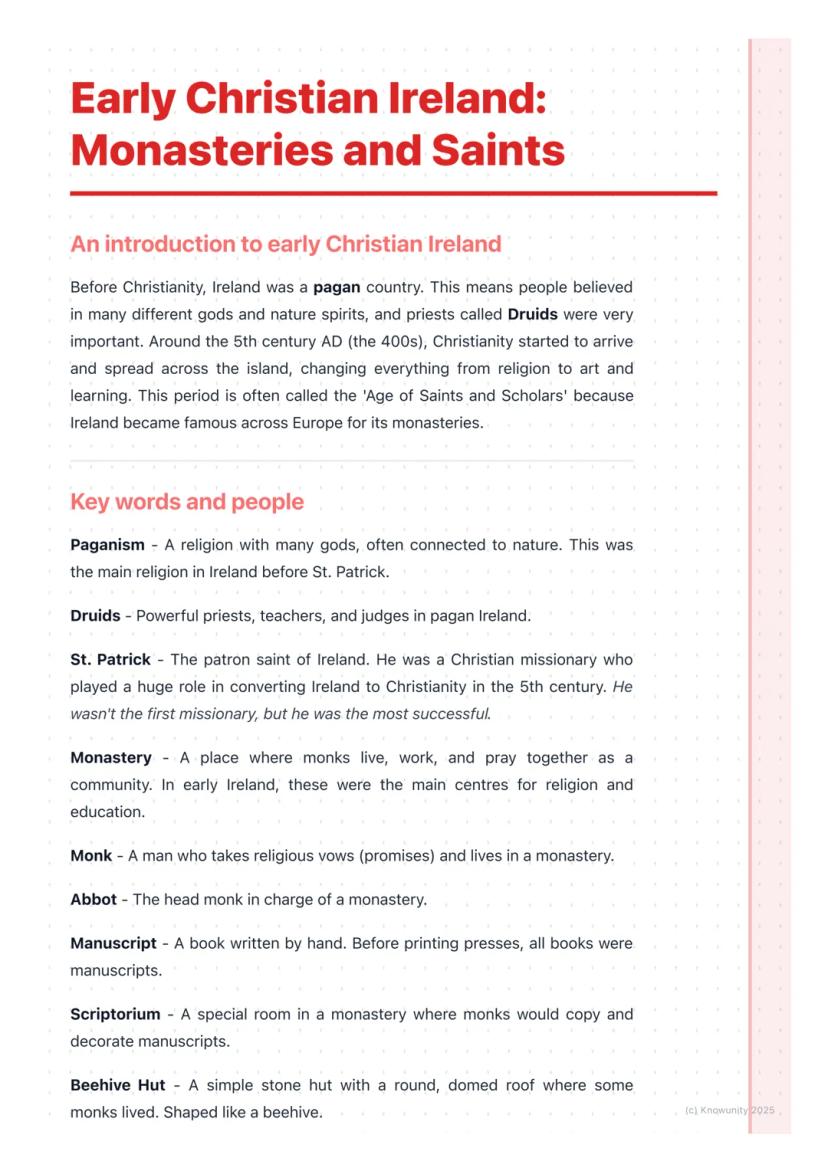
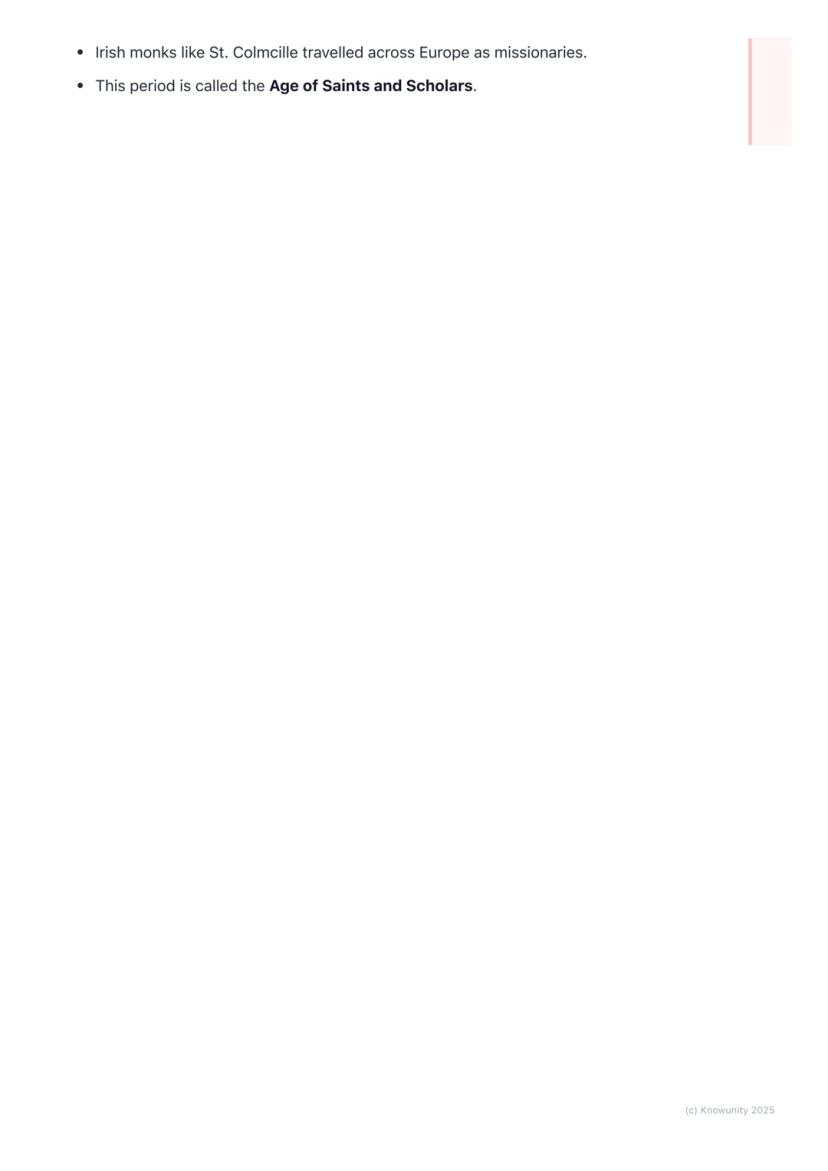
Before Christianity arrived, Ireland was a pagan country where people worshipped many different gods and nature spirits. Druids - powerful priests who also worked as teachers and judges - held massive influence over daily life.
Everything changed when Christian missionaries started arriving in the 5th century. Palladius was actually the first missionary sent by the Pope in 431 AD, but he didn't have much success. St. Patrick came later and became the real game-changer.
Patrick had a personal connection to Ireland - he'd been captured as a teenager from Roman Britain and worked here as a slave before escaping. When he returned as a priest, he was brilliant at explaining Christian ideas using things the Irish already understood, like using the shamrock to explain the Holy Trinity.
Fun Fact: St. Patrick wasn't actually the first Christian missionary to Ireland, just the most successful one!
2
of 7
Monastic Life and Buildings
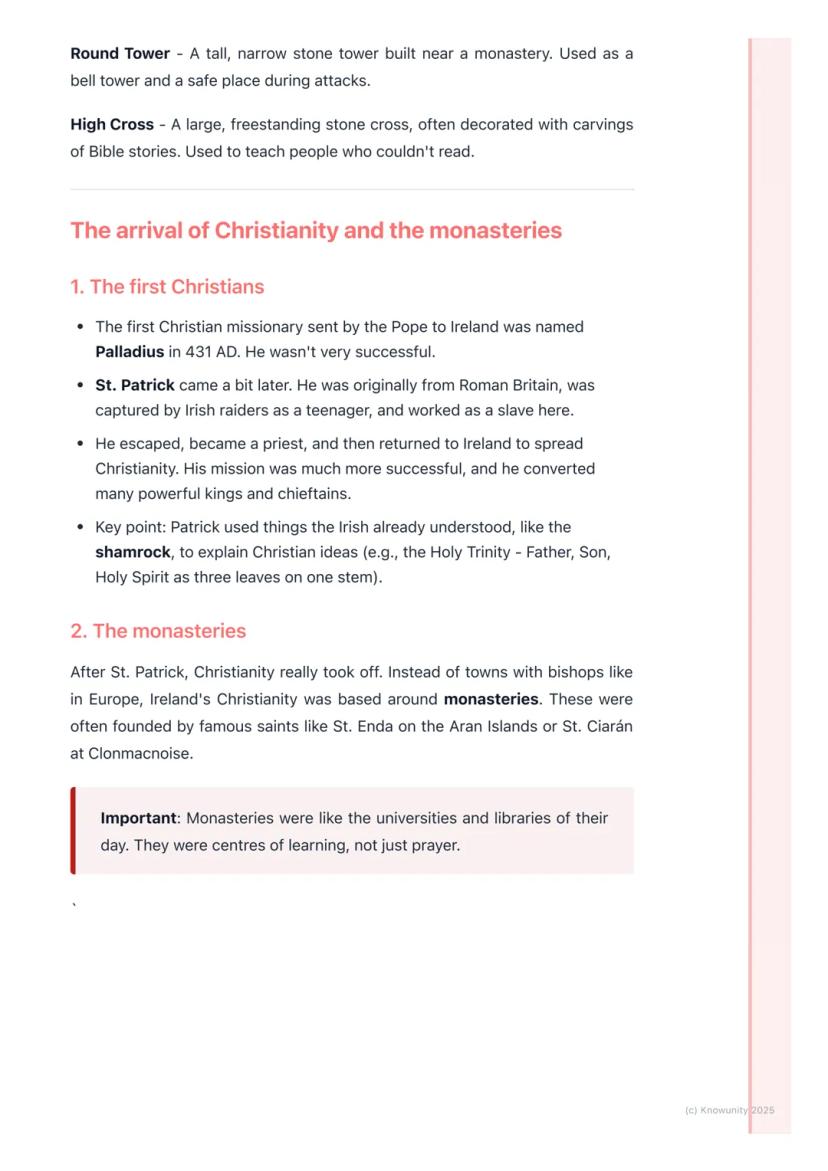
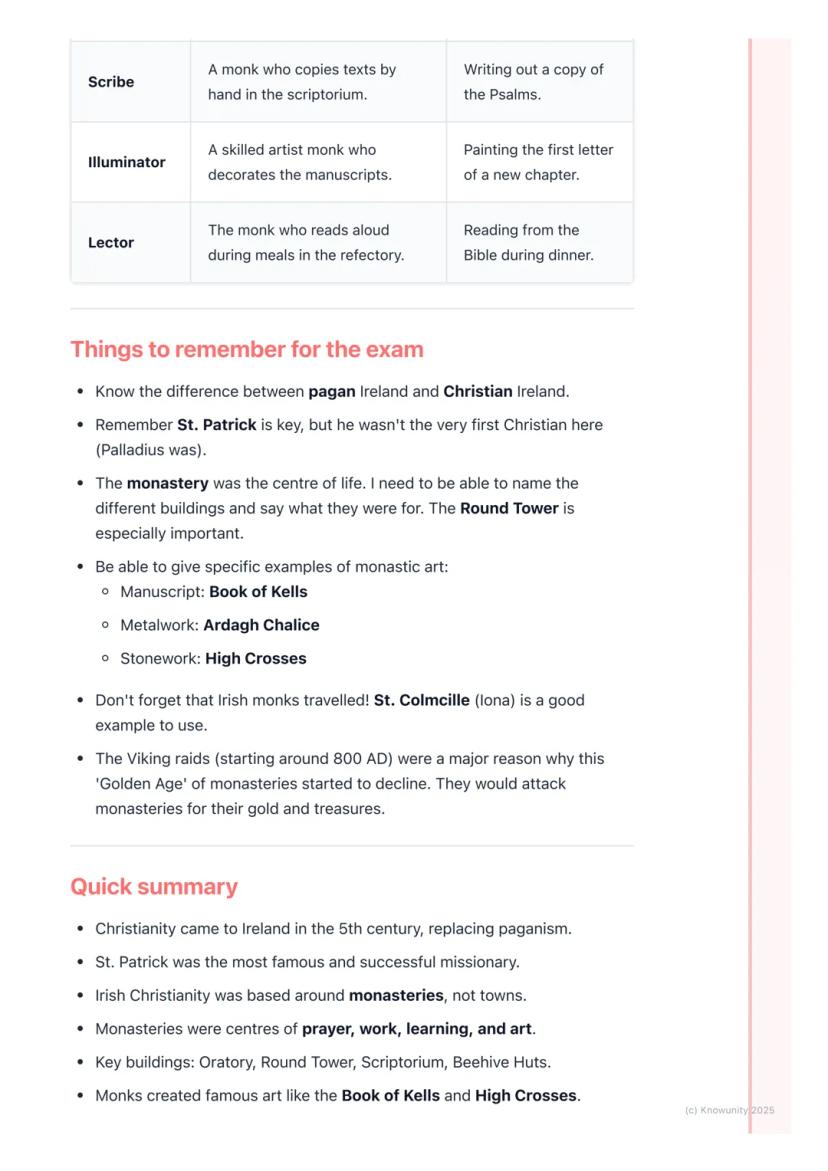
After St. Patrick's success, Ireland's Christianity developed differently from the rest of Europe. Instead of towns with bishops, Irish Christianity was built around monasteries - communities where monks lived, worked, and prayed together under an abbot.
These monasteries were like the universities and libraries of their time. Famous saints like St. Enda and St. Ciarán founded monasteries that became centres of learning, not just prayer. Each monastery had specific buildings for different purposes.
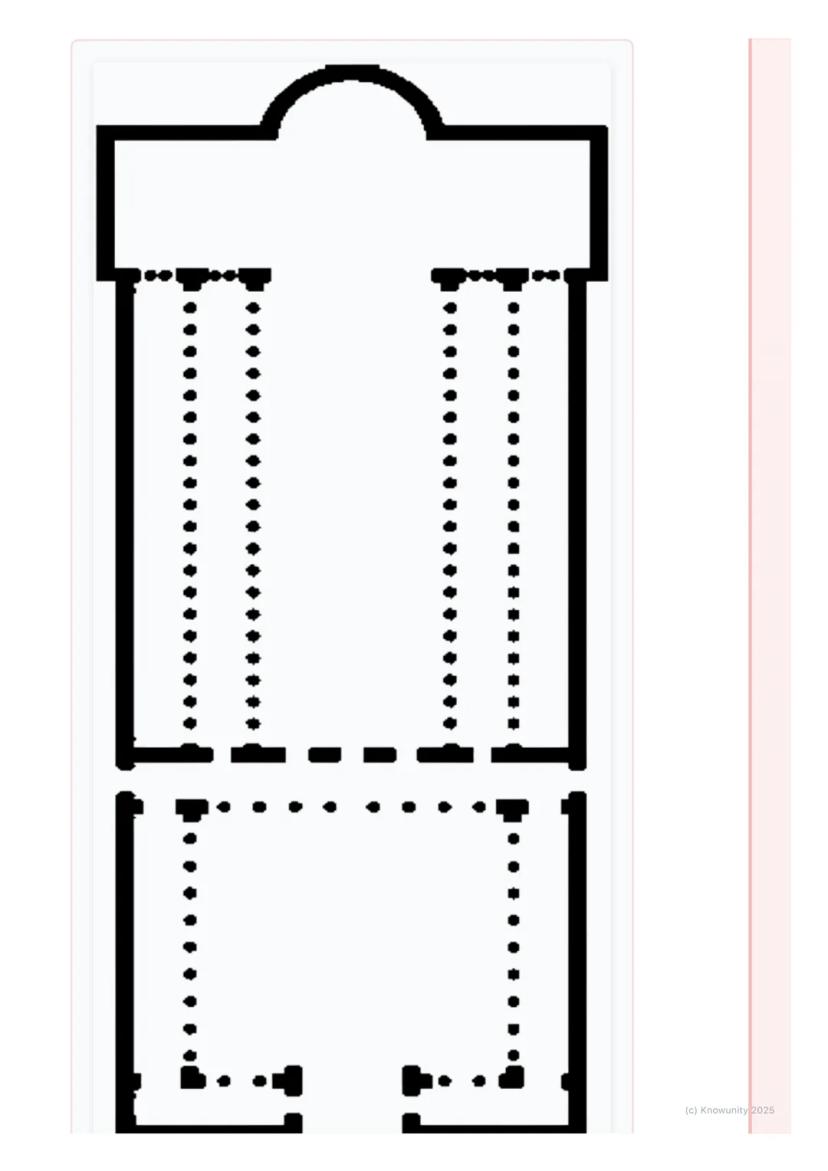
The oratory was the small church for prayer, whilst the refectory served as the dining hall. Beehive huts (called clocháns) were simple stone cells where monks slept. The scriptorium was perhaps the most important room - this was where monks copied and decorated manuscripts.
Round towers were the most distinctive feature. These tall, narrow stone towers served as bell towers, lookout posts for Viking raids, and safe storage for treasures. The door was built high off the ground so you needed a ladder to get in!
Remember This: Monasteries weren't just about religion - they were Ireland's centres of education, art, and culture.
3
of 7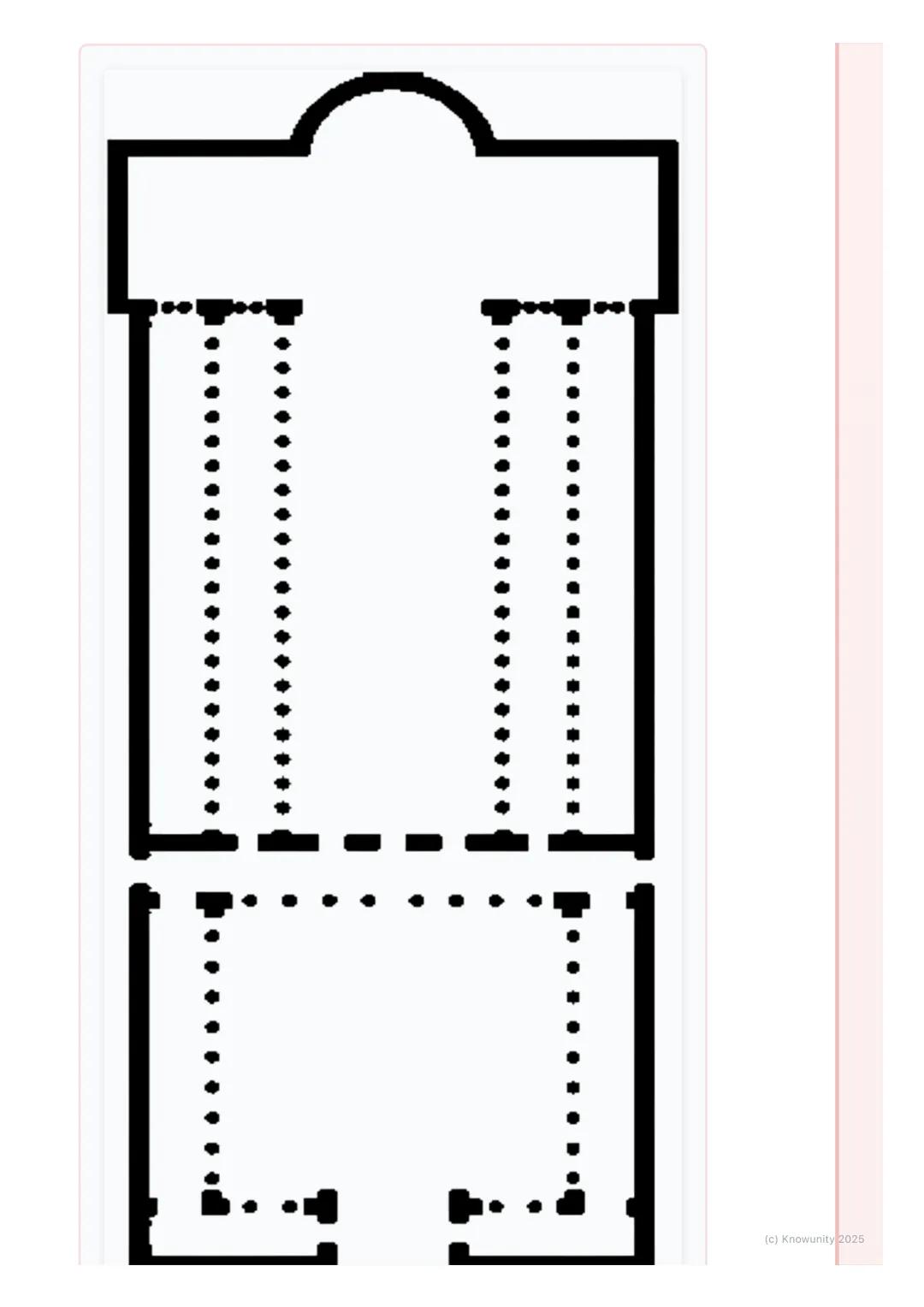
Monastic Art and Manuscripts
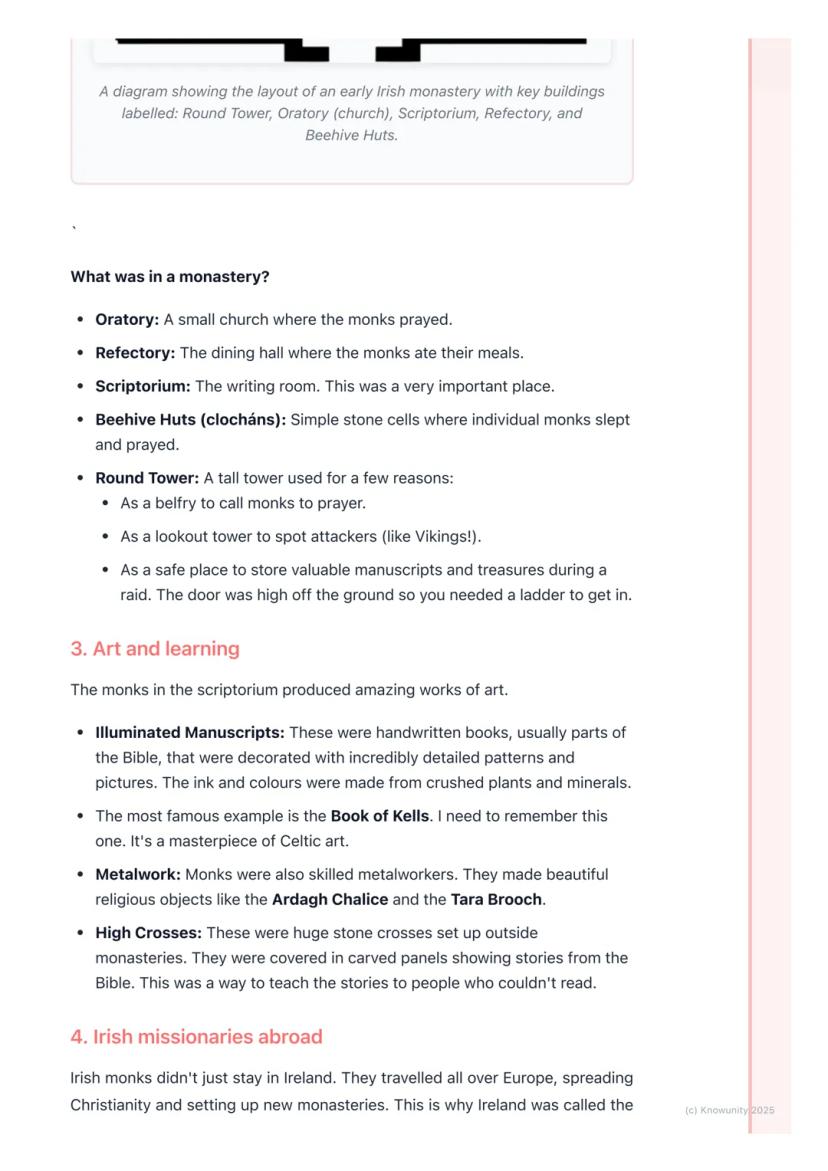
Irish monks created some of the most stunning artwork in medieval Europe. In the scriptorium, skilled monks produced illuminated manuscripts - handwritten books decorated with incredibly detailed patterns and pictures using inks made from crushed plants and minerals.
The Book of Kells is the most famous example - it's a masterpiece of Celtic art that still amazes people today. Monks weren't just scribes though; they were also talented metalworkers who created beautiful religious objects like the Ardagh Chalice and the Tara Brooch.
High Crosses were another brilliant innovation. These massive stone crosses stood outside monasteries, covered in carved panels showing Bible stories. Since most people couldn't read, these were like medieval comic strips that taught Christianity through pictures.
Exam Tip: Always mention specific examples - Book of Kells for manuscripts, Ardagh Chalice for metalwork, and High Crosses for stonework!
4
of 7
Daily Life of a Monk
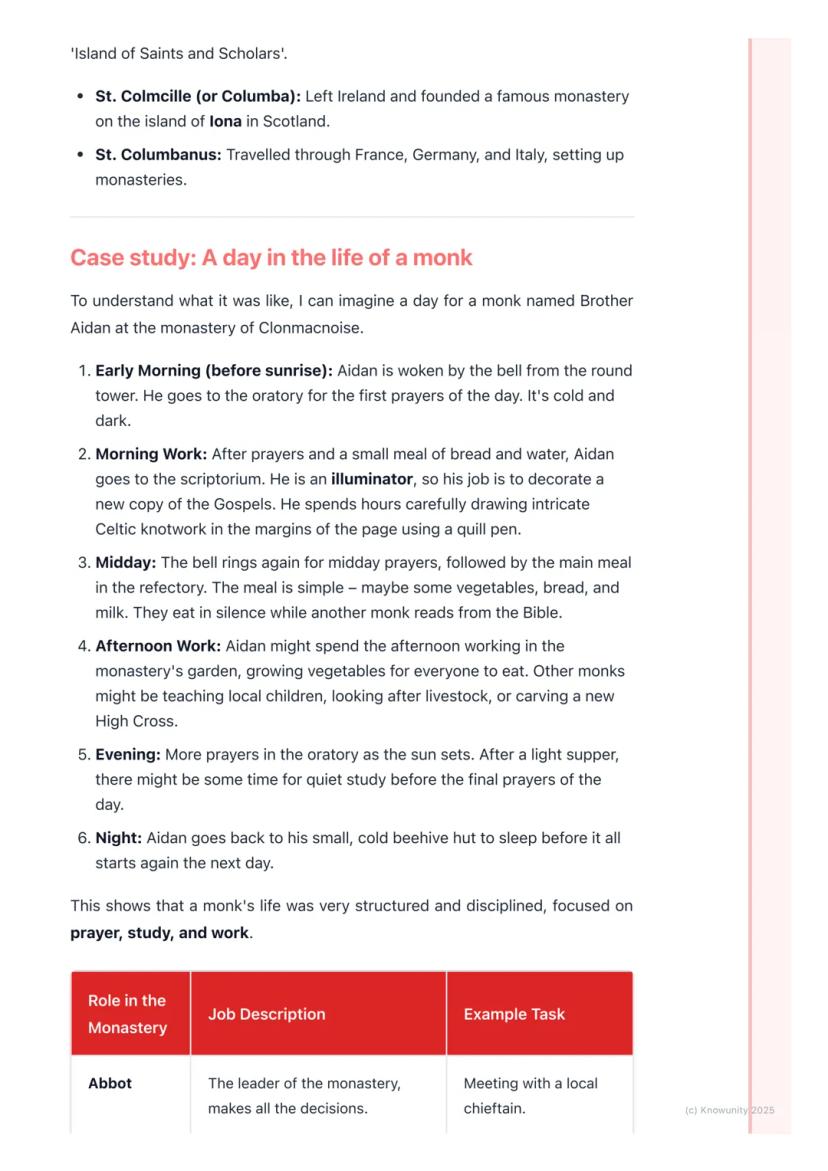
A monk's day was incredibly structured and disciplined. Brother Aidan at Clonmacnoise would be woken before sunrise by the round tower bell for morning prayers in the cold, dark oratory.
After a simple breakfast of bread and water, he'd spend hours in the scriptorium as an illuminator, carefully drawing intricate Celtic knotwork with a quill pen. Midday brought more prayers and the main meal in the refectory, eaten in silence whilst another monk read from the Bible.
Afternoons meant practical work - gardening, teaching local children, or carving stone crosses. Evening prayers marked the day's end before Aidan returned to his small, cold beehive hut to sleep.
This routine shows how monks balanced prayer, study, and physical work. Different monks had specific roles - scribes copied texts, illuminators decorated them, lectors read during meals, and the abbot ran everything.
Think About It: Imagine living this disciplined lifestyle every single day - no wonder these monks became so skilled at their crafts!
5
of 7
Irish Missionaries Abroad
Irish monks didn't just stay in Ireland - they became Europe's travelling teachers! This is why Ireland earned the nickname 'Island of Saints and Scholars'. These missionaries spread Christianity and learning across the continent, setting up new monasteries everywhere they went.
St. Colmcille (also called Columba) left Ireland and founded a famous monastery on the island of Iona in Scotland. St. Columbanus was even more adventurous, travelling through France, Germany, and Italy to establish monasteries.
These Irish monks preserved classical learning during the so-called 'Dark Ages' when much of Europe was struggling with invasions and political chaos. They copied ancient texts, maintained libraries, and kept education alive.
However, this golden age started declining around 800 AD when Viking raids began targeting monasteries for their gold and treasures. The round towers suddenly became much more important as defensive structures!
Key Point: Irish monks didn't just receive Christianity - they transformed it and shared their unique version with the rest of Europe.
6
of 7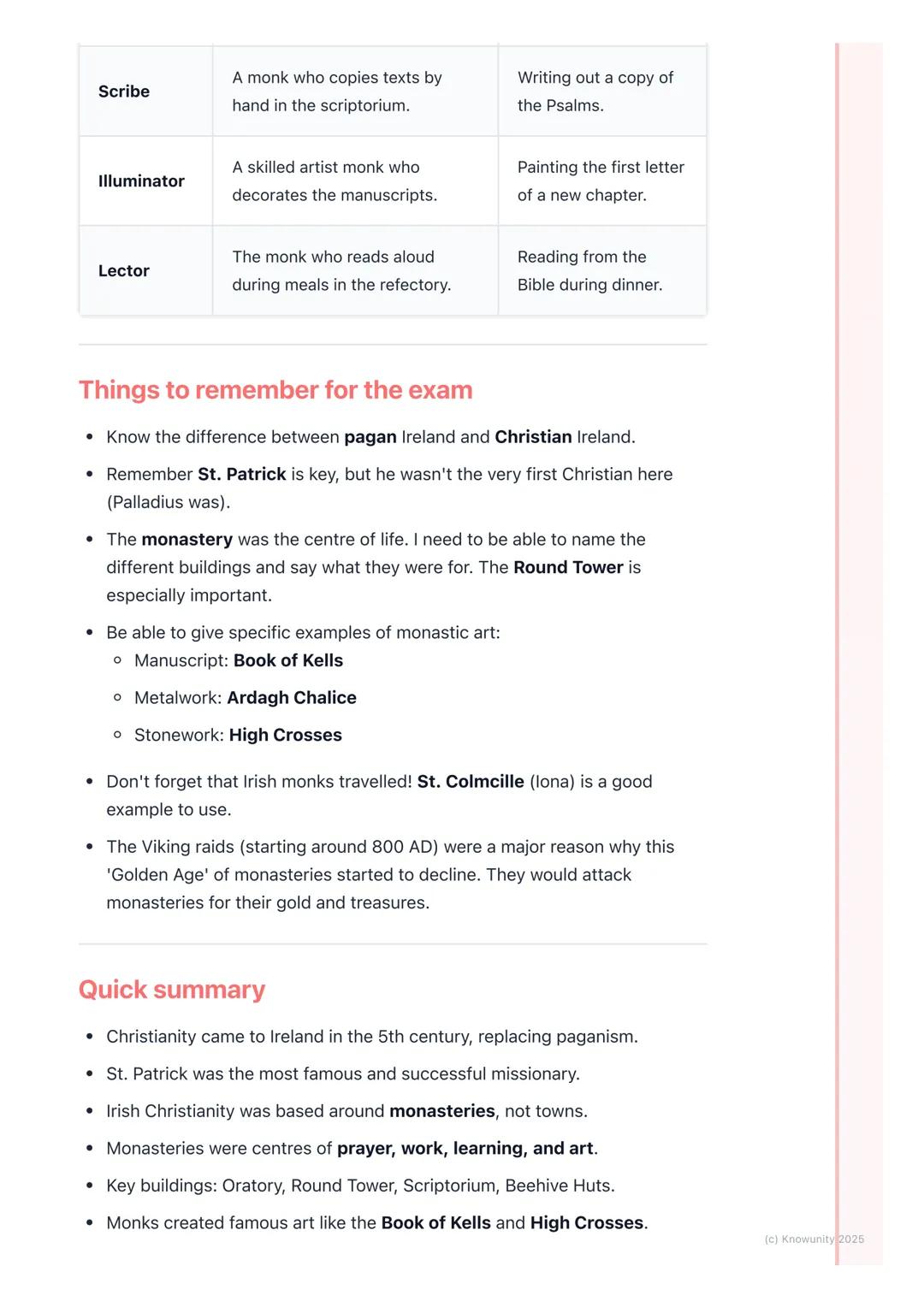
Legacy and Importance
The Age of Saints and Scholars left Ireland with an incredible legacy that still influences us today. The monasteries created a unique form of Christianity that blended Irish culture with Christian beliefs, producing art and learning that was admired across medieval Europe.
This period established Ireland's reputation as a centre of education and culture. The manuscripts, metalwork, and stone crosses created by Irish monks remain some of the finest examples of medieval art in the world.
The transformation from pagan Ireland with its Druids to Christian Ireland with its monasteries represents one of the most significant cultural changes in Irish history. It connected Ireland to the wider Christian world whilst maintaining its distinctive Celtic character.
Understanding this period helps explain how Ireland developed its strong religious traditions and its reputation for learning and scholarship that continues today.
Bottom Line: Early Christian Ireland shows how a society can embrace new ideas whilst keeping its own unique identity and culture.
7
of 7
We thought you’d never ask...
What is the Knowunity AI companion?
Our AI Companion is a student-focused AI tool that offers more than just answers. Built on millions of Knowunity resources, it provides relevant information, personalised study plans, quizzes, and content directly in the chat, adapting to your individual learning journey.
Where can I download the Knowunity app?
You can download the app from Google Play Store and Apple App Store.
Is Knowunity really free of charge?
That's right! Enjoy free access to study content, connect with fellow students, and get instant help – all at your fingertips.
Most popular content in History
9HistoryThe Great Famine (An Gorta Mór)
Students will learn about the causes, devastating impact, and long-term consequences of the potato famine on Irish population and society.
2nd Year282
HistoryThe renaissance
junior cert renaissance summary
1st Year361
HistoryCauses and Consequences of World War II
This subtopic covers the origins of the Second World War, its global scale, and its devastating human and political consequences, including the atomic bomb.
3rd Year152
HistoryThe 1798 Rebellion in Ireland
Learning about the causes, events, and aftermath of the United Irishmen's rebellion against British rule, inspired by revolutionary ideals.
3rd Year211
HistoryAmerican revolution
junior cert american revolution summary
1st Year442
HistoryThe Great Famine (An Gorta Mór)
This critical subtopic examines the causes, devastating impact, and long-term consequences of the potato famine on Irish society, population, and emigration.
3rd Year140
HistoryThe Renaissance
Students will learn about a time of 'rebirth' in Europe, where new ideas in art, science, and literature flourished.
1st Year140
History1916 Rising Revison Sheet
revision sheet
3rd Year211
HistoryThe Reformation in Europe
Students will learn about the causes and key figures of the Protestant Reformation and its impact on European society and politics.
3rd Year110
Most popular content
9 Irish
IrishIrish oral questions and answers
Questions and answers for the leaving cert oral
5th Year4264
 English
Key Quotes : Sive
Key Quotes and explanations: Sive
6th Year2842
IrishIrish oral questions
Outline of oral questions
5th Year2055
IrishIníon- le hÁine Durkin
Aine Durkin’s poem, Iníon: Themes & summary
5th Year850
IrishIrish poetry 2027
Iníon + Dínit an Bhróin
5th Year1133
IrishLC HL notes- Iníon (poem)
Includes poem in English and Irish, theme, key words & phrases
5th Year2284
EnglishCultural Context : Shawshank Redemption : Sive : Small Things Like These
Comparative Study : Cultural Context : Shawshank Redemption, Sive and Small Things Like These
6th Year1430
IrishMo Ghrá-sa (Idir Lúibíní)
Notes on mo ghrá-sa
5th Year380
IrishAn Gaeilge Aiste
Irish Language essay
6th Year1320
Can't find what you're looking for? Explore other subjects.
Students love us — and so will you.
4.6/5App Store
4.7/5Google Play
The app is very easy to use and well designed. I have found everything I was looking for so far and have been able to learn a lot from the presentations! I will definitely use the app for a class assignment! And of course it also helps a lot as an inspiration.
Stefan SiOS user
This app is really great. There are so many study notes and help [...]. My problem subject is French, for example, and the app has so many options for help. Thanks to this app, I have improved my French. I would recommend it to anyone.
Samantha KlichAndroid user
Wow, I am really amazed. I just tried the app because I've seen it advertised many times and was absolutely stunned. This app is THE HELP you want for school and above all, it offers so many things, such as workouts and fact sheets, which have been VERY helpful to me personally.
AnnaiOS user
History21 views·Updated Jun 14, 2026·7 pagesChristianity in Ireland: Monasteries, Art, and St. Patrick
Ever wonder how Ireland went from worshipping nature spirits to becoming Europe's centre of Christian learning? Around the 5th century, Christianity arrived and completely transformed Irish society, creating the famous 'Age of Saints and Scholars' that made Ireland legendary across...
1
of 7
Sign up to see the content. It's free!
- Access to all documents
- Improve your grades
- Join milions of students
The Arrival of Christianity
Before Christianity arrived, Ireland was a pagan country where people worshipped many different gods and nature spirits. Druids - powerful priests who also worked as teachers and judges - held massive influence over daily life.
Everything changed when Christian missionaries started arriving in the 5th century. Palladius was actually the first missionary sent by the Pope in 431 AD, but he didn't have much success. St. Patrick came later and became the real game-changer.
Patrick had a personal connection to Ireland - he'd been captured as a teenager from Roman Britain and worked here as a slave before escaping. When he returned as a priest, he was brilliant at explaining Christian ideas using things the Irish already understood, like using the shamrock to explain the Holy Trinity.
Fun Fact: St. Patrick wasn't actually the first Christian missionary to Ireland, just the most successful one!
2
of 7Sign up to see the content. It's free!
- Access to all documents
- Improve your grades
- Join milions of students
Monastic Life and Buildings
After St. Patrick's success, Ireland's Christianity developed differently from the rest of Europe. Instead of towns with bishops, Irish Christianity was built around monasteries - communities where monks lived, worked, and prayed together under an abbot.
These monasteries were like the universities and libraries of their time. Famous saints like St. Enda and St. Ciarán founded monasteries that became centres of learning, not just prayer. Each monastery had specific buildings for different purposes.
The oratory was the small church for prayer, whilst the refectory served as the dining hall. Beehive huts (called clocháns) were simple stone cells where monks slept. The scriptorium was perhaps the most important room - this was where monks copied and decorated manuscripts.
Round towers were the most distinctive feature. These tall, narrow stone towers served as bell towers, lookout posts for Viking raids, and safe storage for treasures. The door was built high off the ground so you needed a ladder to get in!
Remember This: Monasteries weren't just about religion - they were Ireland's centres of education, art, and culture.
3
of 7Sign up to see the content. It's free!
- Access to all documents
- Improve your grades
- Join milions of students
Monastic Art and Manuscripts
Irish monks created some of the most stunning artwork in medieval Europe. In the scriptorium, skilled monks produced illuminated manuscripts - handwritten books decorated with incredibly detailed patterns and pictures using inks made from crushed plants and minerals.
The Book of Kells is the most famous example - it's a masterpiece of Celtic art that still amazes people today. Monks weren't just scribes though; they were also talented metalworkers who created beautiful religious objects like the Ardagh Chalice and the Tara Brooch.
High Crosses were another brilliant innovation. These massive stone crosses stood outside monasteries, covered in carved panels showing Bible stories. Since most people couldn't read, these were like medieval comic strips that taught Christianity through pictures.
Exam Tip: Always mention specific examples - Book of Kells for manuscripts, Ardagh Chalice for metalwork, and High Crosses for stonework!
4
of 7Sign up to see the content. It's free!
- Access to all documents
- Improve your grades
- Join milions of students
Daily Life of a Monk
A monk's day was incredibly structured and disciplined. Brother Aidan at Clonmacnoise would be woken before sunrise by the round tower bell for morning prayers in the cold, dark oratory.
After a simple breakfast of bread and water, he'd spend hours in the scriptorium as an illuminator, carefully drawing intricate Celtic knotwork with a quill pen. Midday brought more prayers and the main meal in the refectory, eaten in silence whilst another monk read from the Bible.
Afternoons meant practical work - gardening, teaching local children, or carving stone crosses. Evening prayers marked the day's end before Aidan returned to his small, cold beehive hut to sleep.
This routine shows how monks balanced prayer, study, and physical work. Different monks had specific roles - scribes copied texts, illuminators decorated them, lectors read during meals, and the abbot ran everything.
Think About It: Imagine living this disciplined lifestyle every single day - no wonder these monks became so skilled at their crafts!
5
of 7Sign up to see the content. It's free!
- Access to all documents
- Improve your grades
- Join milions of students
Irish Missionaries Abroad
Irish monks didn't just stay in Ireland - they became Europe's travelling teachers! This is why Ireland earned the nickname 'Island of Saints and Scholars'. These missionaries spread Christianity and learning across the continent, setting up new monasteries everywhere they went.
St. Colmcille (also called Columba) left Ireland and founded a famous monastery on the island of Iona in Scotland. St. Columbanus was even more adventurous, travelling through France, Germany, and Italy to establish monasteries.
These Irish monks preserved classical learning during the so-called 'Dark Ages' when much of Europe was struggling with invasions and political chaos. They copied ancient texts, maintained libraries, and kept education alive.
However, this golden age started declining around 800 AD when Viking raids began targeting monasteries for their gold and treasures. The round towers suddenly became much more important as defensive structures!
Key Point: Irish monks didn't just receive Christianity - they transformed it and shared their unique version with the rest of Europe.
6
of 7Sign up to see the content. It's free!
- Access to all documents
- Improve your grades
- Join milions of students
Legacy and Importance
The Age of Saints and Scholars left Ireland with an incredible legacy that still influences us today. The monasteries created a unique form of Christianity that blended Irish culture with Christian beliefs, producing art and learning that was admired across medieval Europe.
This period established Ireland's reputation as a centre of education and culture. The manuscripts, metalwork, and stone crosses created by Irish monks remain some of the finest examples of medieval art in the world.
The transformation from pagan Ireland with its Druids to Christian Ireland with its monasteries represents one of the most significant cultural changes in Irish history. It connected Ireland to the wider Christian world whilst maintaining its distinctive Celtic character.
Understanding this period helps explain how Ireland developed its strong religious traditions and its reputation for learning and scholarship that continues today.
Bottom Line: Early Christian Ireland shows how a society can embrace new ideas whilst keeping its own unique identity and culture.
7
of 7Sign up to see the content. It's free!
- Access to all documents
- Improve your grades
- Join milions of students
We thought you’d never ask...
What is the Knowunity AI companion?
Our AI Companion is a student-focused AI tool that offers more than just answers. Built on millions of Knowunity resources, it provides relevant information, personalised study plans, quizzes, and content directly in the chat, adapting to your individual learning journey.
Where can I download the Knowunity app?
You can download the app from Google Play Store and Apple App Store.
Is Knowunity really free of charge?
That's right! Enjoy free access to study content, connect with fellow students, and get instant help – all at your fingertips.
Most popular content in History
9HistoryThe Great Famine (An Gorta Mór)
Students will learn about the causes, devastating impact, and long-term consequences of the potato famine on Irish population and society.
2nd Year282
HistoryThe renaissance
junior cert renaissance summary
1st Year361
HistoryCauses and Consequences of World War II
This subtopic covers the origins of the Second World War, its global scale, and its devastating human and political consequences, including the atomic bomb.
3rd Year152
HistoryThe 1798 Rebellion in Ireland
Learning about the causes, events, and aftermath of the United Irishmen's rebellion against British rule, inspired by revolutionary ideals.
3rd Year211
HistoryAmerican revolution
junior cert american revolution summary
1st Year442
HistoryThe Great Famine (An Gorta Mór)
This critical subtopic examines the causes, devastating impact, and long-term consequences of the potato famine on Irish society, population, and emigration.
3rd Year140
HistoryThe Renaissance
Students will learn about a time of 'rebirth' in Europe, where new ideas in art, science, and literature flourished.
1st Year140
History1916 Rising Revison Sheet
revision sheet
3rd Year211
HistoryThe Reformation in Europe
Students will learn about the causes and key figures of the Protestant Reformation and its impact on European society and politics.
3rd Year110
Most popular content
9IrishIrish oral questions and answers
Questions and answers for the leaving cert oral
5th Year4264
EnglishKey Quotes : Sive
Key Quotes and explanations: Sive
6th Year2842
IrishIrish oral questions
Outline of oral questions
5th Year2055
IrishIníon- le hÁine Durkin
Aine Durkin’s poem, Iníon: Themes & summary
5th Year850
IrishIrish poetry 2027
Iníon + Dínit an Bhróin
5th Year1133
IrishLC HL notes- Iníon (poem)
Includes poem in English and Irish, theme, key words & phrases
5th Year2284
EnglishCultural Context : Shawshank Redemption : Sive : Small Things Like These
Comparative Study : Cultural Context : Shawshank Redemption, Sive and Small Things Like These
6th Year1430
IrishMo Ghrá-sa (Idir Lúibíní)
Notes on mo ghrá-sa
5th Year380
IrishAn Gaeilge Aiste
Irish Language essay
6th Year1320
Can't find what you're looking for? Explore other subjects.
Students love us — and so will you.
4.6/5App Store
4.7/5Google Play
The app is very easy to use and well designed. I have found everything I was looking for so far and have been able to learn a lot from the presentations! I will definitely use the app for a class assignment! And of course it also helps a lot as an inspiration.
Stefan SiOS user
This app is really great. There are so many study notes and help [...]. My problem subject is French, for example, and the app has so many options for help. Thanks to this app, I have improved my French. I would recommend it to anyone.
Samantha KlichAndroid user
Wow, I am really amazed. I just tried the app because I've seen it advertised many times and was absolutely stunned. This app is THE HELP you want for school and above all, it offers so many things, such as workouts and fact sheets, which have been VERY helpful to me personally.
AnnaiOS user