
Ever wondered how to say "I am" or "you are"... Show more
 German6 views·Updated May 30, 2026·4 pages
Mastering the German Verb 'sein' - Conjugation Made Simple
1 / 4
1
of 4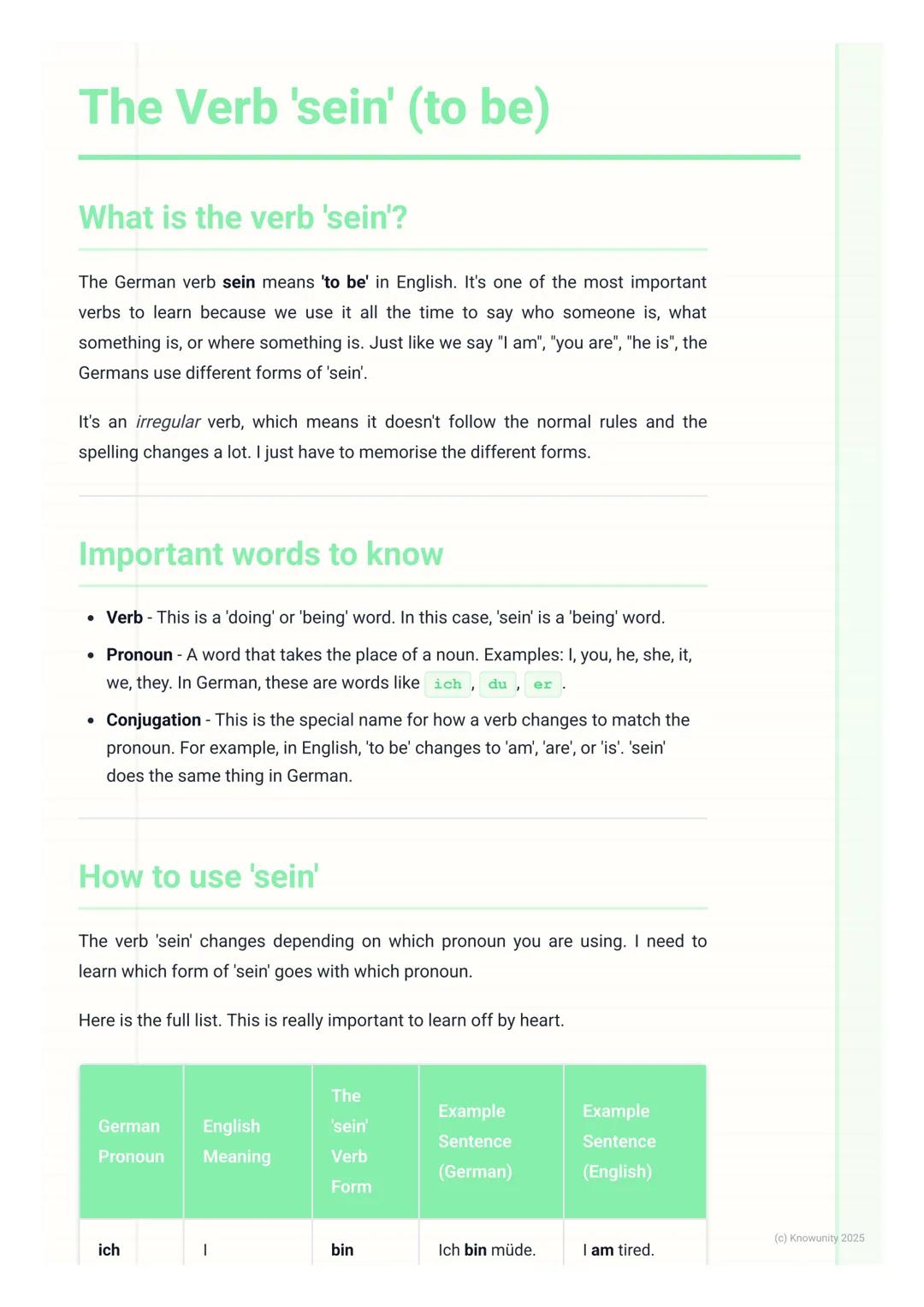
Understanding the Verb 'sein'
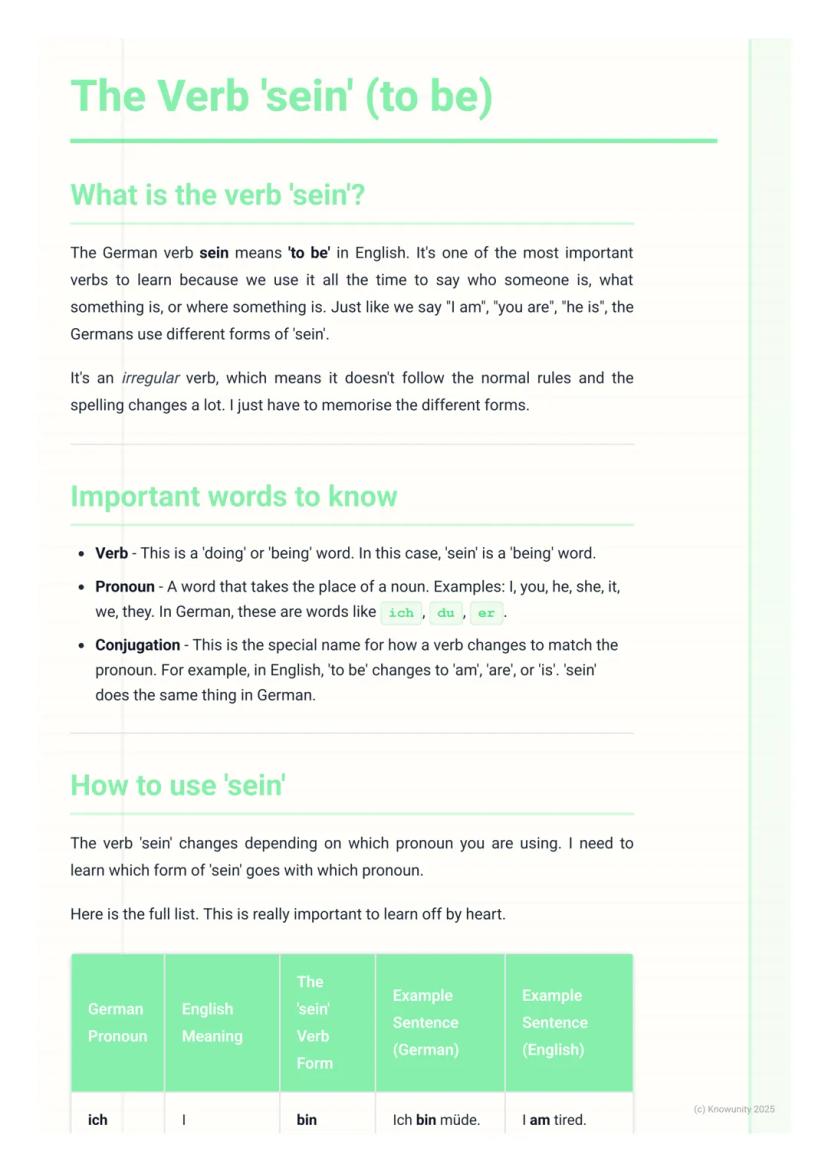
Think of sein as the building block of German - you'll use it constantly to describe yourself, others, and everything around you. Just like English changes "to be" into "am", "are", and "is", German does the same thing with sein, but with its own special patterns.
Here's the tricky bit: sein is an irregular verb, which means it doesn't follow normal rules and changes quite dramatically. There's no clever shortcut here - you've got to memorise each form, but once you do, you'll be chatting away in German!
💡 Quick tip: Don't worry about understanding why the forms change so much - even native German speakers just memorise them as children. Focus on learning the patterns rather than the grammar rules.
The key terms you need to know are conjugation (how verbs change to match different people) and pronouns (words like "I", "you", "he" that replace names).
2
of 4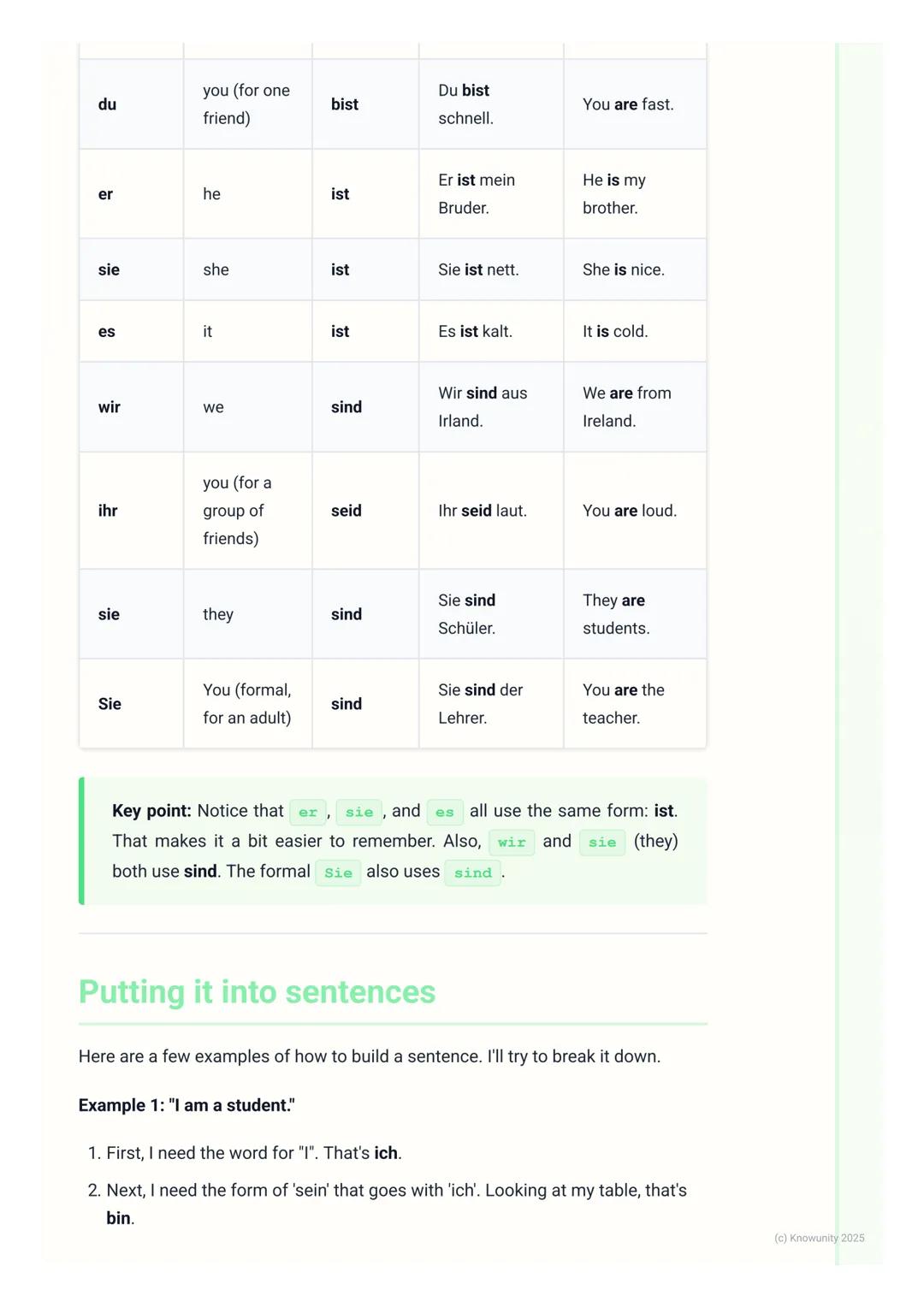
The Complete sein Table
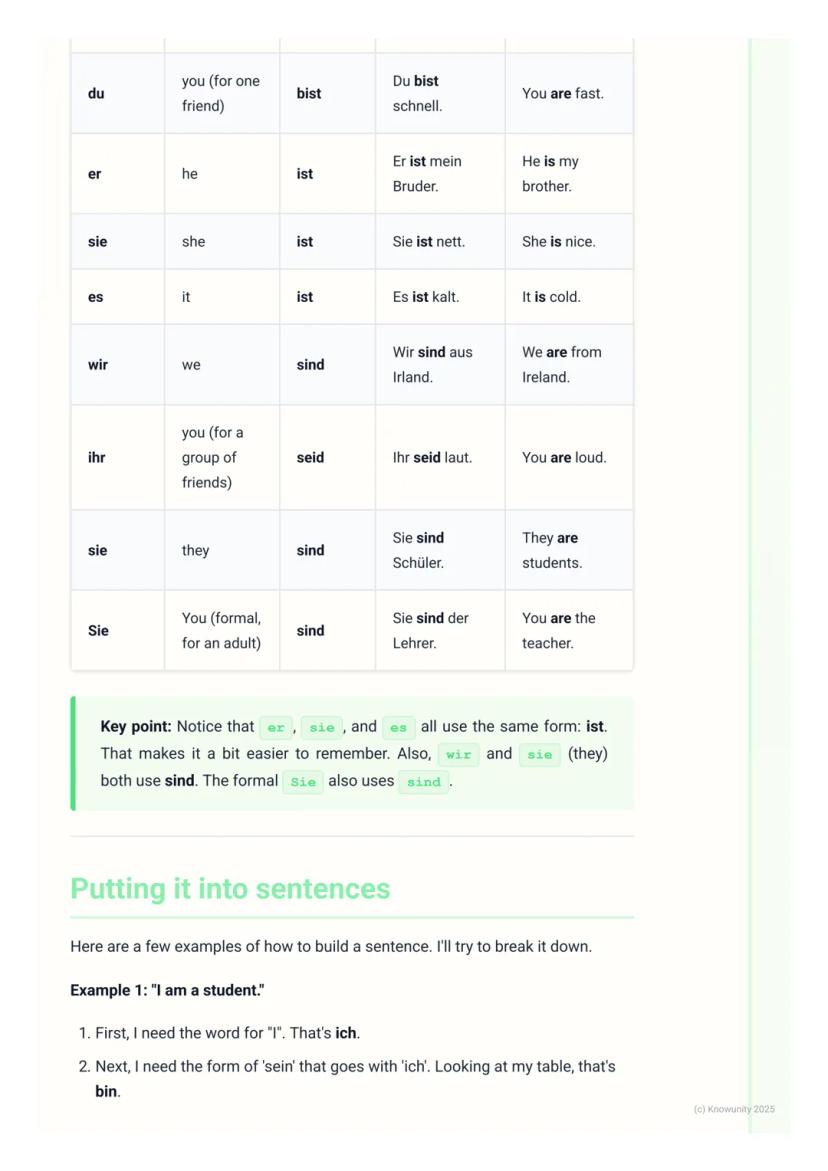
Here's the essential table you need to memorise - think of it as your German survival kit! Each German pronoun pairs with its specific form of sein, and there's no wiggling around this.
The good news? There are some helpful patterns hidden in the chaos. Notice that er, sie, and es all use ist - that's three pronouns sorted with one word. Similarly, wir and sie (they) both use sind, making your memorisation job a bit easier.
💡 Remember this: The formal Sie (for adults) also uses sind and always has a capital S, so you can spot it easily in writing.
Watch out for the trickiest pair: sind vs seid. Most students mix these up, but here's the secret - sind goes with "we" and "they", whilst seid is only for groups of friends (ihr).
3
of 4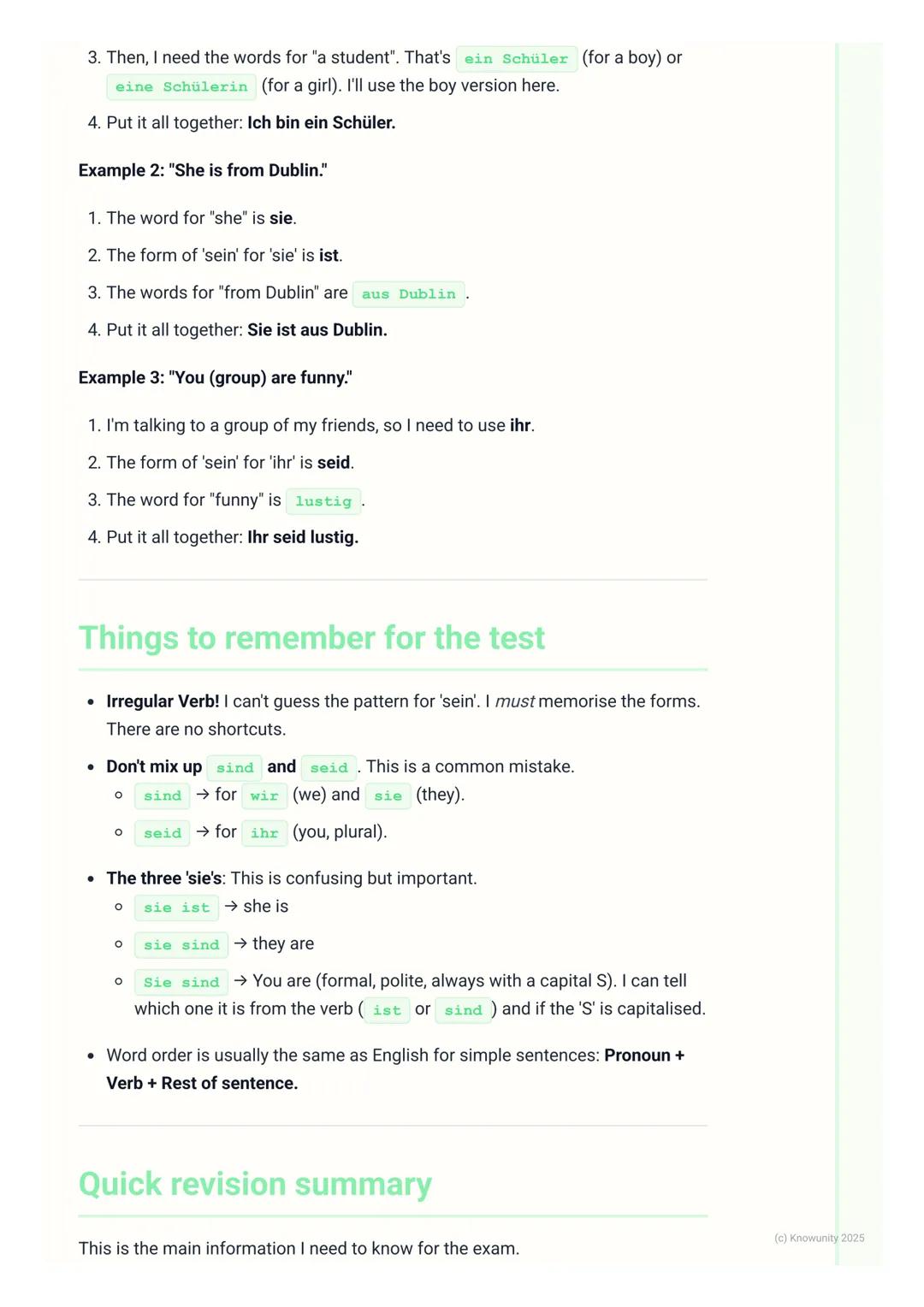
Building Your First German Sentences
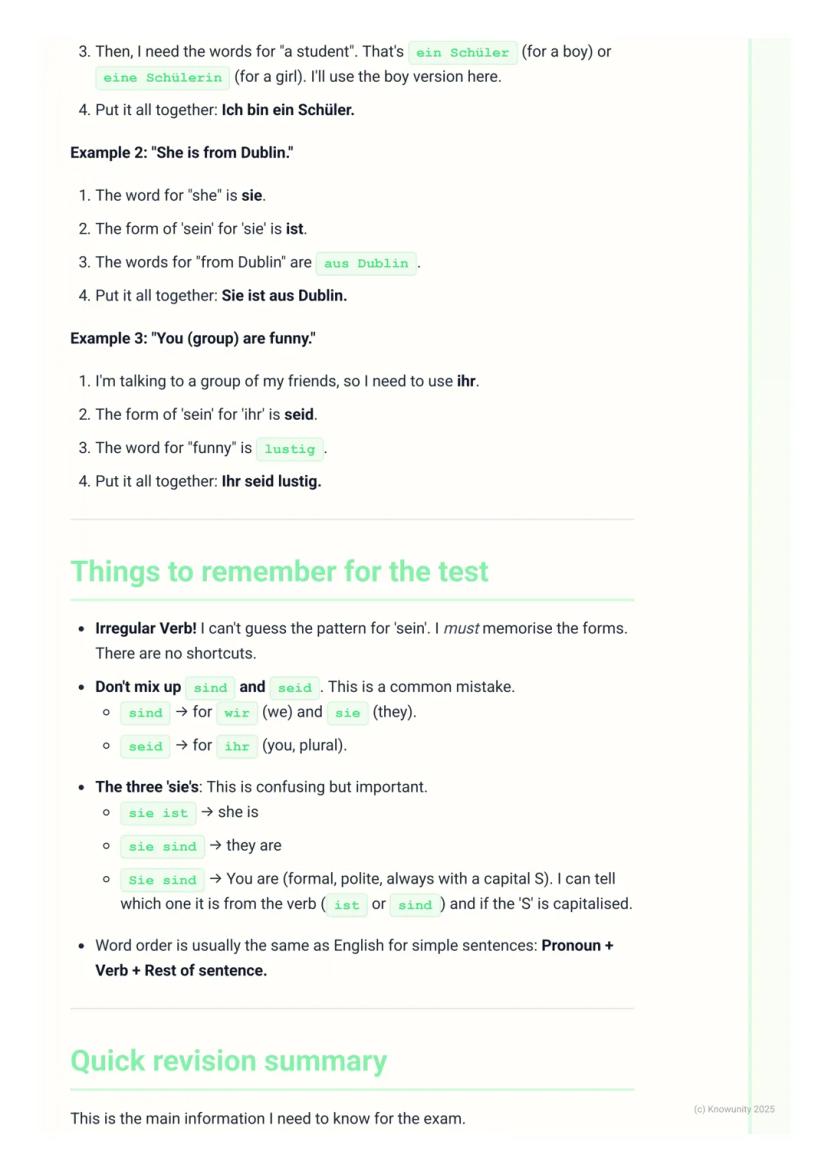
Now comes the fun part - putting your knowledge into action! German sentence structure follows the same pattern as English for basic sentences: pronoun + verb + rest of sentence.
Let's break down "Ich bin müde" (I am tired). Start with ich (I), add the matching form bin, then finish with müde (tired). See how straightforward that is?
For "Sie ist aus Dublin" (She is from Dublin), you follow the same pattern: sie (she) + ist (the form for she) + aus Dublin (from Dublin). Once you know the sein forms, sentence building becomes quite logical.
💡 Pro tip: Practice with simple sentences first. Don't worry about complex grammar yet - master the basic pattern and you'll gain confidence quickly.
4
of 4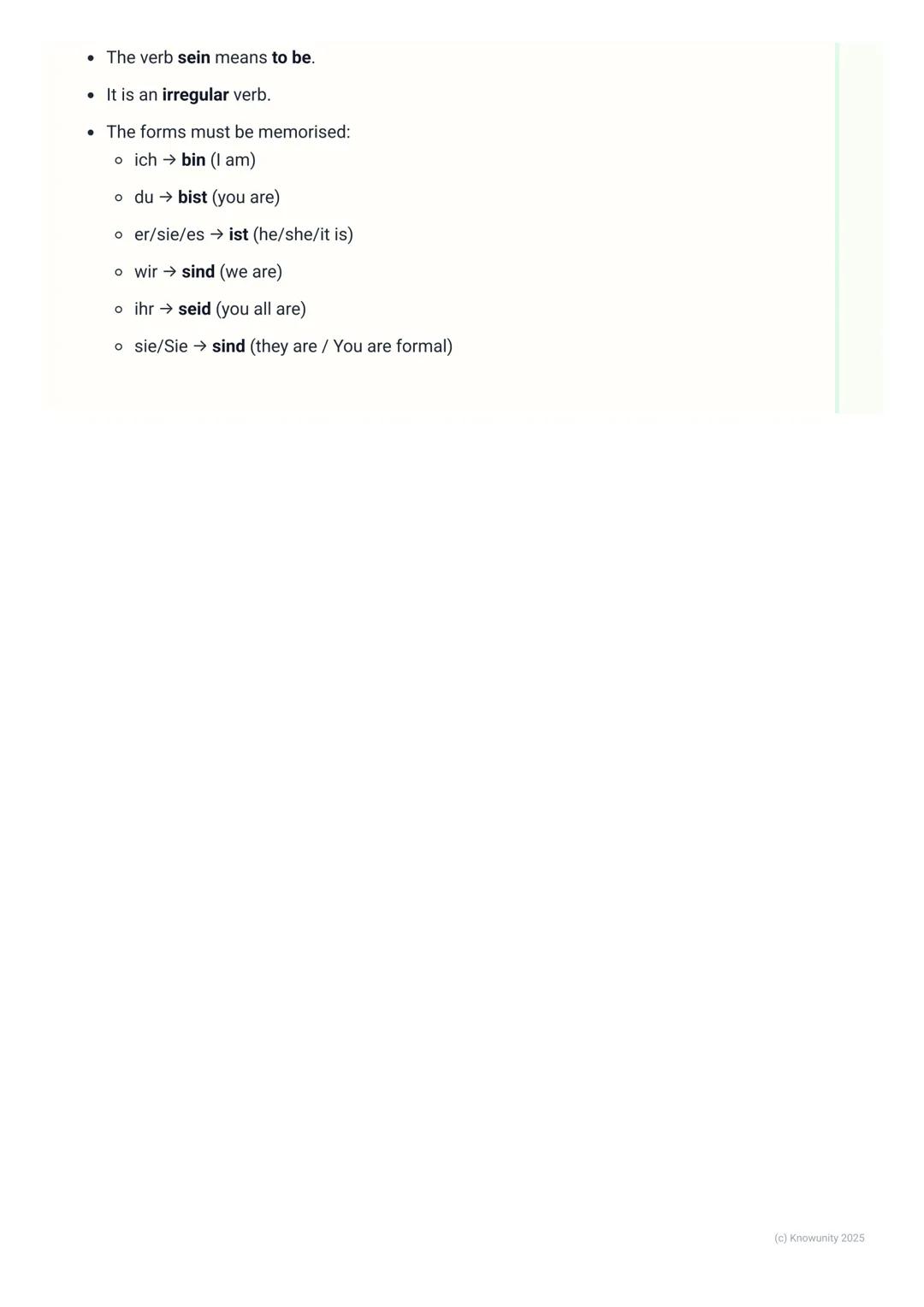
Test Success Strategies
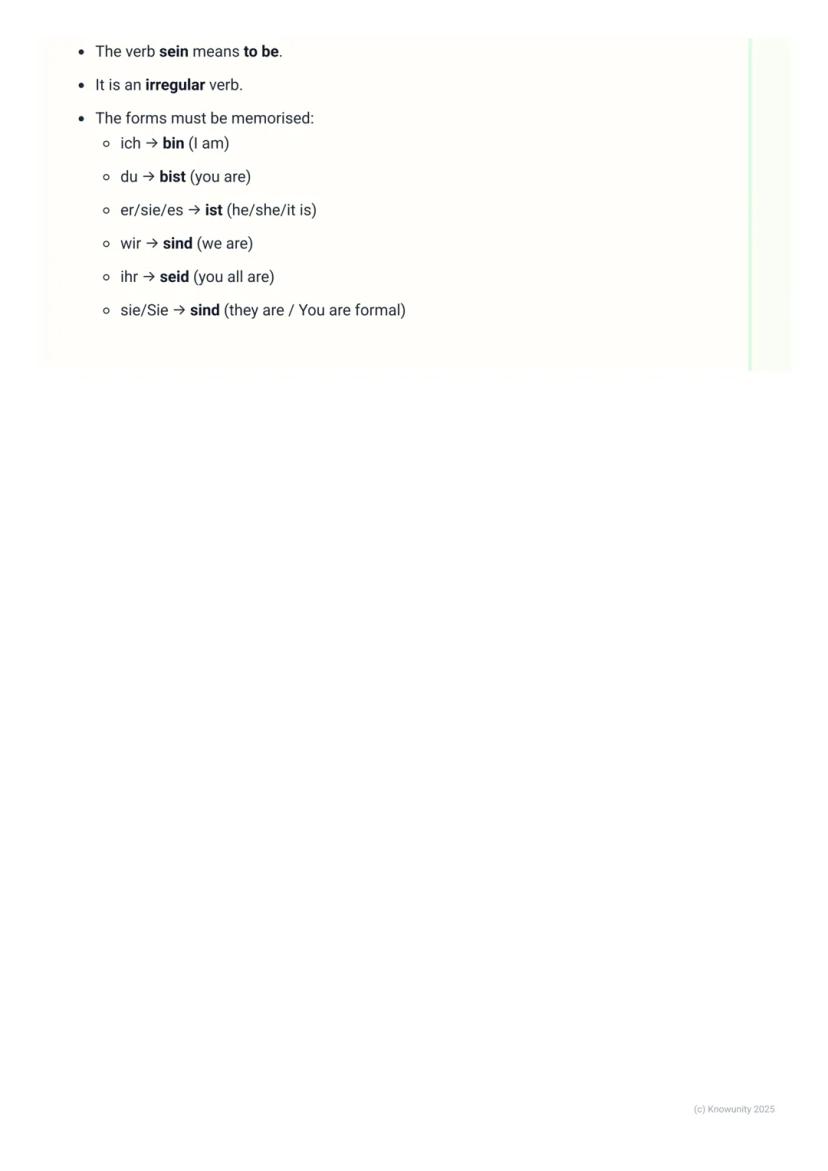
Your exam success depends on memorising those sein forms perfectly - there's simply no way around it. Create flashcards, practice daily, or make up silly songs, but make sure you know ich bin, du bist, er/sie/es ist, wir sind, ihr seid, sie/Sie sind by heart.
The biggest test trap is confusing the different meanings of sie. Remember: sie ist means "she is", sie sind means "they are", and Sie sind (capital S) means "You are" in formal situations.
💡 Final reminder: Don't panic if this feels overwhelming at first. Every German speaker has mastered these forms, and with consistent practice, you absolutely can too. Focus on one pronoun at a time and build up gradually.
Word order in basic sentences mirrors English, so you're already halfway there!
We thought you’d never ask...
What is the Knowunity AI companion?
Our AI Companion is a student-focused AI tool that offers more than just answers. Built on millions of Knowunity resources, it provides relevant information, personalised study plans, quizzes, and content directly in the chat, adapting to your individual learning journey.
Where can I download the Knowunity app?
You can download the app from Google Play Store and Apple App Store.
Is Knowunity really free of charge?
That's right! Enjoy free access to study content, connect with fellow students, and get instant help – all at your fingertips.
Most popular content in German
2Most popular content
9Can't find what you're looking for? Explore other subjects.
Students love us — and so will you.
4.6/5App Store
4.7/5Google Play
The app is very easy to use and well designed. I have found everything I was looking for so far and have been able to learn a lot from the presentations! I will definitely use the app for a class assignment! And of course it also helps a lot as an inspiration.
Stefan SiOS user
This app is really great. There are so many study notes and help [...]. My problem subject is French, for example, and the app has so many options for help. Thanks to this app, I have improved my French. I would recommend it to anyone.
Samantha KlichAndroid user
Wow, I am really amazed. I just tried the app because I've seen it advertised many times and was absolutely stunned. This app is THE HELP you want for school and above all, it offers so many things, such as workouts and fact sheets, which have been VERY helpful to me personally.
AnnaiOS user
German6 views·Updated May 30, 2026·4 pagesMastering the German Verb 'sein' - Conjugation Made Simple
Ever wondered how to say "I am" or "you are" in German? The verb sein (to be) is your gateway to building basic German sentences and it's absolutely essential for any conversation.
1
of 4Sign up to see the content. It's free!
- Access to all documents
- Improve your grades
- Join milions of students
Understanding the Verb 'sein'
Think of sein as the building block of German - you'll use it constantly to describe yourself, others, and everything around you. Just like English changes "to be" into "am", "are", and "is", German does the same thing with sein, but with its own special patterns.
Here's the tricky bit: sein is an irregular verb, which means it doesn't follow normal rules and changes quite dramatically. There's no clever shortcut here - you've got to memorise each form, but once you do, you'll be chatting away in German!
💡 Quick tip: Don't worry about understanding why the forms change so much - even native German speakers just memorise them as children. Focus on learning the patterns rather than the grammar rules.
The key terms you need to know are conjugation (how verbs change to match different people) and pronouns (words like "I", "you", "he" that replace names).
2
of 4Sign up to see the content. It's free!
- Access to all documents
- Improve your grades
- Join milions of students
The Complete sein Table
Here's the essential table you need to memorise - think of it as your German survival kit! Each German pronoun pairs with its specific form of sein, and there's no wiggling around this.
The good news? There are some helpful patterns hidden in the chaos. Notice that er, sie, and es all use ist - that's three pronouns sorted with one word. Similarly, wir and sie (they) both use sind, making your memorisation job a bit easier.
💡 Remember this: The formal Sie (for adults) also uses sind and always has a capital S, so you can spot it easily in writing.
Watch out for the trickiest pair: sind vs seid. Most students mix these up, but here's the secret - sind goes with "we" and "they", whilst seid is only for groups of friends (ihr).
3
of 4Sign up to see the content. It's free!
- Access to all documents
- Improve your grades
- Join milions of students
Building Your First German Sentences
Now comes the fun part - putting your knowledge into action! German sentence structure follows the same pattern as English for basic sentences: pronoun + verb + rest of sentence.
Let's break down "Ich bin müde" (I am tired). Start with ich (I), add the matching form bin, then finish with müde (tired). See how straightforward that is?
For "Sie ist aus Dublin" (She is from Dublin), you follow the same pattern: sie (she) + ist (the form for she) + aus Dublin (from Dublin). Once you know the sein forms, sentence building becomes quite logical.
💡 Pro tip: Practice with simple sentences first. Don't worry about complex grammar yet - master the basic pattern and you'll gain confidence quickly.
4
of 4Sign up to see the content. It's free!
- Access to all documents
- Improve your grades
- Join milions of students
Test Success Strategies
Your exam success depends on memorising those sein forms perfectly - there's simply no way around it. Create flashcards, practice daily, or make up silly songs, but make sure you know ich bin, du bist, er/sie/es ist, wir sind, ihr seid, sie/Sie sind by heart.
The biggest test trap is confusing the different meanings of sie. Remember: sie ist means "she is", sie sind means "they are", and Sie sind (capital S) means "You are" in formal situations.
💡 Final reminder: Don't panic if this feels overwhelming at first. Every German speaker has mastered these forms, and with consistent practice, you absolutely can too. Focus on one pronoun at a time and build up gradually.
Word order in basic sentences mirrors English, so you're already halfway there!
We thought you’d never ask...
What is the Knowunity AI companion?
Our AI Companion is a student-focused AI tool that offers more than just answers. Built on millions of Knowunity resources, it provides relevant information, personalised study plans, quizzes, and content directly in the chat, adapting to your individual learning journey.
Where can I download the Knowunity app?
You can download the app from Google Play Store and Apple App Store.
Is Knowunity really free of charge?
That's right! Enjoy free access to study content, connect with fellow students, and get instant help – all at your fingertips.
Most popular content in German
2Most popular content
9Can't find what you're looking for? Explore other subjects.
Students love us — and so will you.
4.6/5App Store
4.7/5Google Play
The app is very easy to use and well designed. I have found everything I was looking for so far and have been able to learn a lot from the presentations! I will definitely use the app for a class assignment! And of course it also helps a lot as an inspiration.
Stefan SiOS user
This app is really great. There are so many study notes and help [...]. My problem subject is French, for example, and the app has so many options for help. Thanks to this app, I have improved my French. I would recommend it to anyone.
Samantha KlichAndroid user
Wow, I am really amazed. I just tried the app because I've seen it advertised many times and was absolutely stunned. This app is THE HELP you want for school and above all, it offers so many things, such as workouts and fact sheets, which have been VERY helpful to me personally.
AnnaiOS user