
Rivers are constantly reshaping our landscape through three main jobs:...
 Geography4 views·Updated Jun 8, 2026·7 pages
Understanding River Landforms and Their Processes

1 / 7
1
of 7
The Work of Rivers
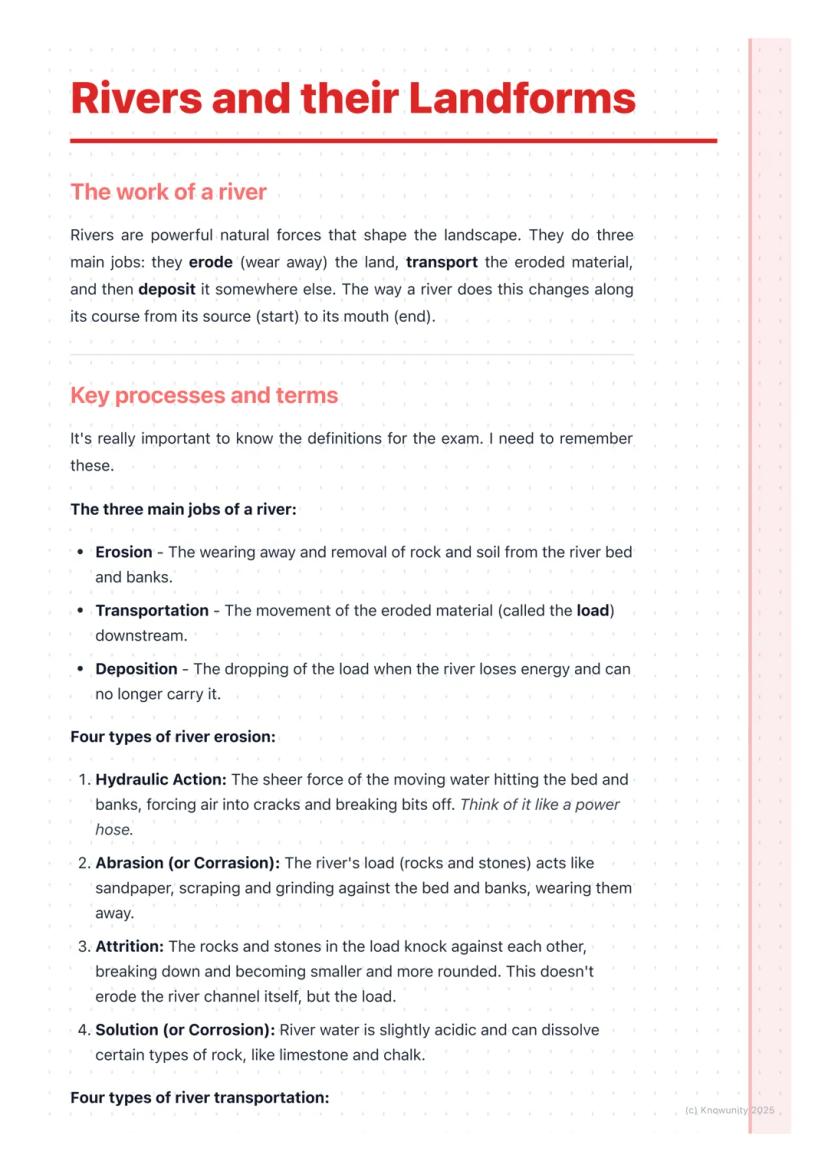
Ever wondered how rivers carve out valleys and create the landscapes you see around Ireland? Rivers are like nature's bulldozers, constantly changing the land through erosion, transportation, and deposition. These three processes work together as the river flows from its source in the mountains to its mouth at the sea.
Erosion wears away rock and soil from the river bed and banks. There are four types you need to know: hydraulic action (water force hitting banks), abrasion (rocks scraping like sandpaper), attrition (rocks hitting each other), and solution (acidic water dissolving limestone).
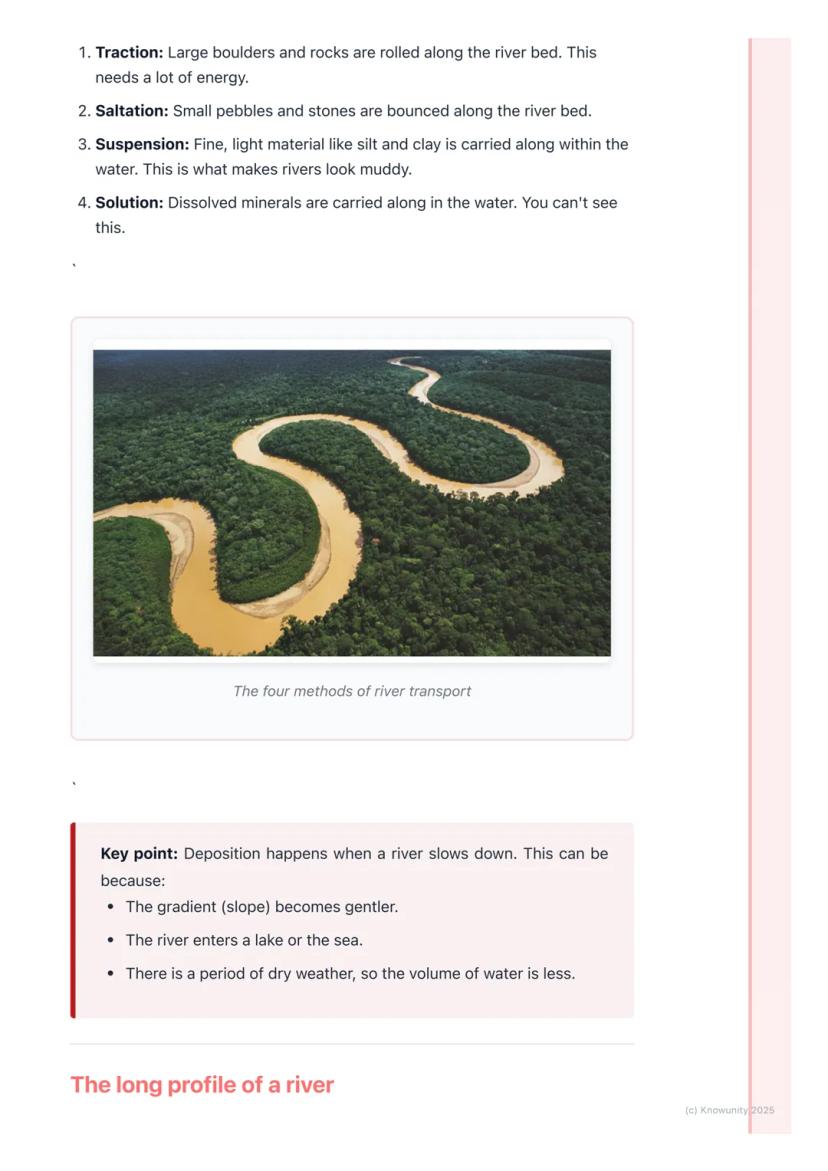
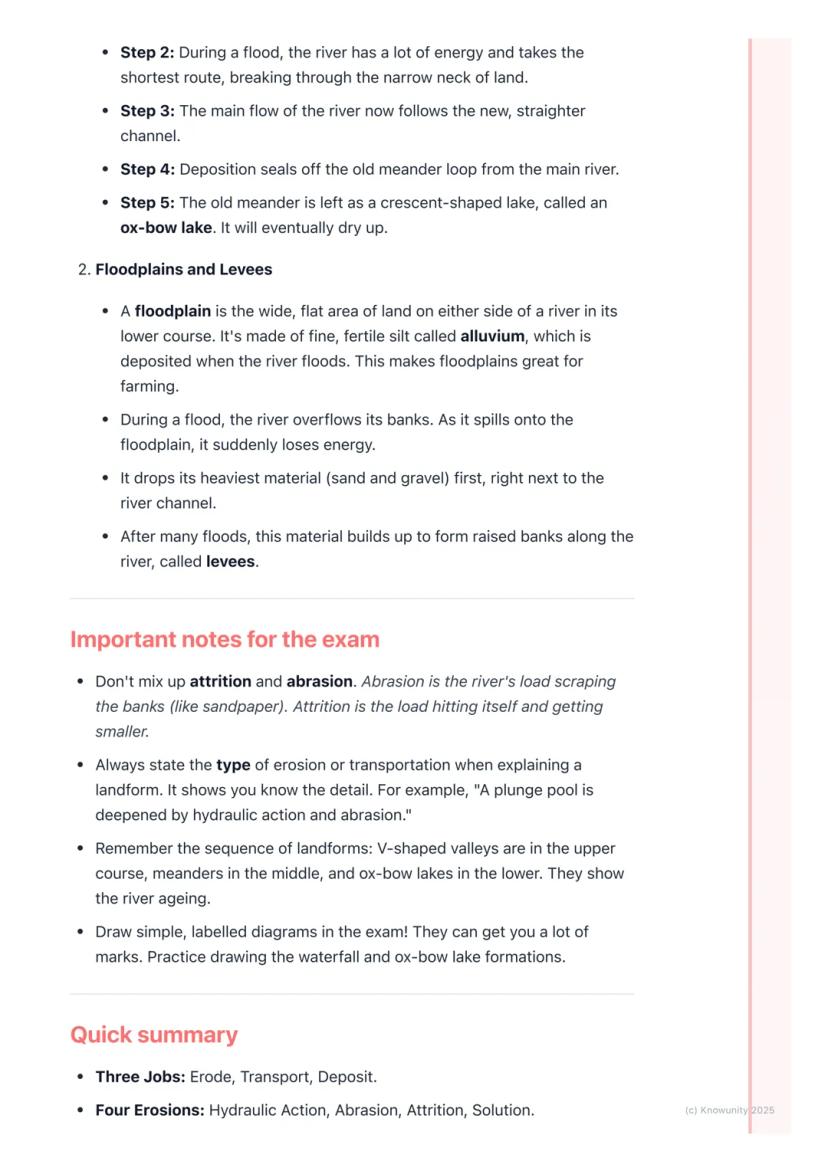
Once material is eroded, transportation moves it downstream through traction (rolling boulders), saltation (bouncing pebbles), suspension (muddy silt in water), and solution (dissolved minerals you can't see).
💡 Remember: Deposition happens when rivers slow down - think of when a stream enters a lake or during dry weather when there's less water flow.
2
of 7
River Courses and Characteristics
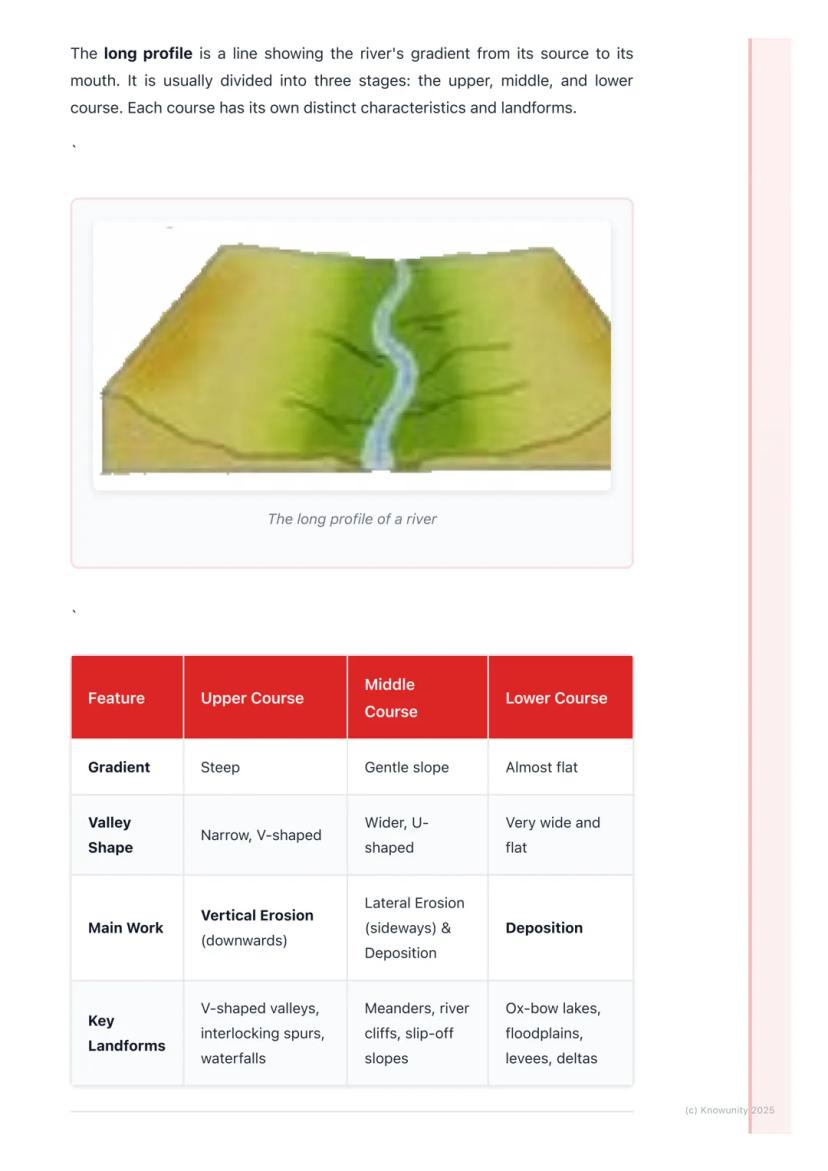
Picture a river's journey like a person's life - it has distinct stages with different personalities. The long profile shows how a river changes from its steep mountain source to its flat coastal mouth, and each section creates different landforms.
In the upper course, rivers are young and energetic with steep gradients. They focus on vertical erosion, cutting deep V-shaped valleys. The water rushes downhill with tremendous force, but isn't strong enough to cut through hard rock ridges, so it winds around them creating interlocking spurs.
The middle course has a gentler slope where rivers mature and start lateral erosion (sideways cutting). Here you'll find wider valleys and the beginning of those classic S-shaped bends called meanders.
By the lower course, rivers are almost flat and focus mainly on deposition. These elderly rivers create wide floodplains perfect for farming, especially in places like the Shannon valley.
💡 Exam Tip: Always mention the specific type of erosion when explaining landforms - it shows you understand the detailed processes!
3
of 7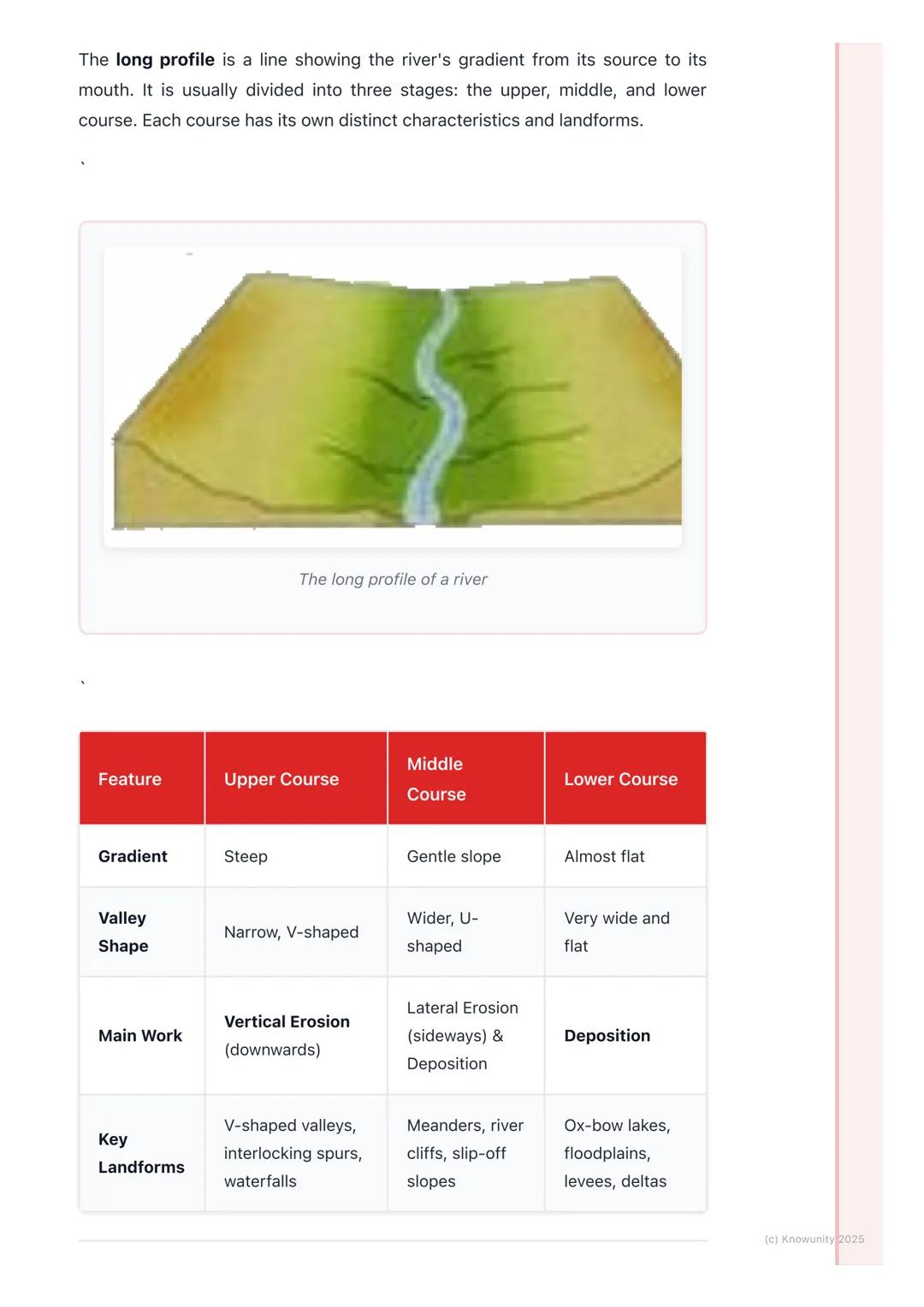
Upper Course Landforms
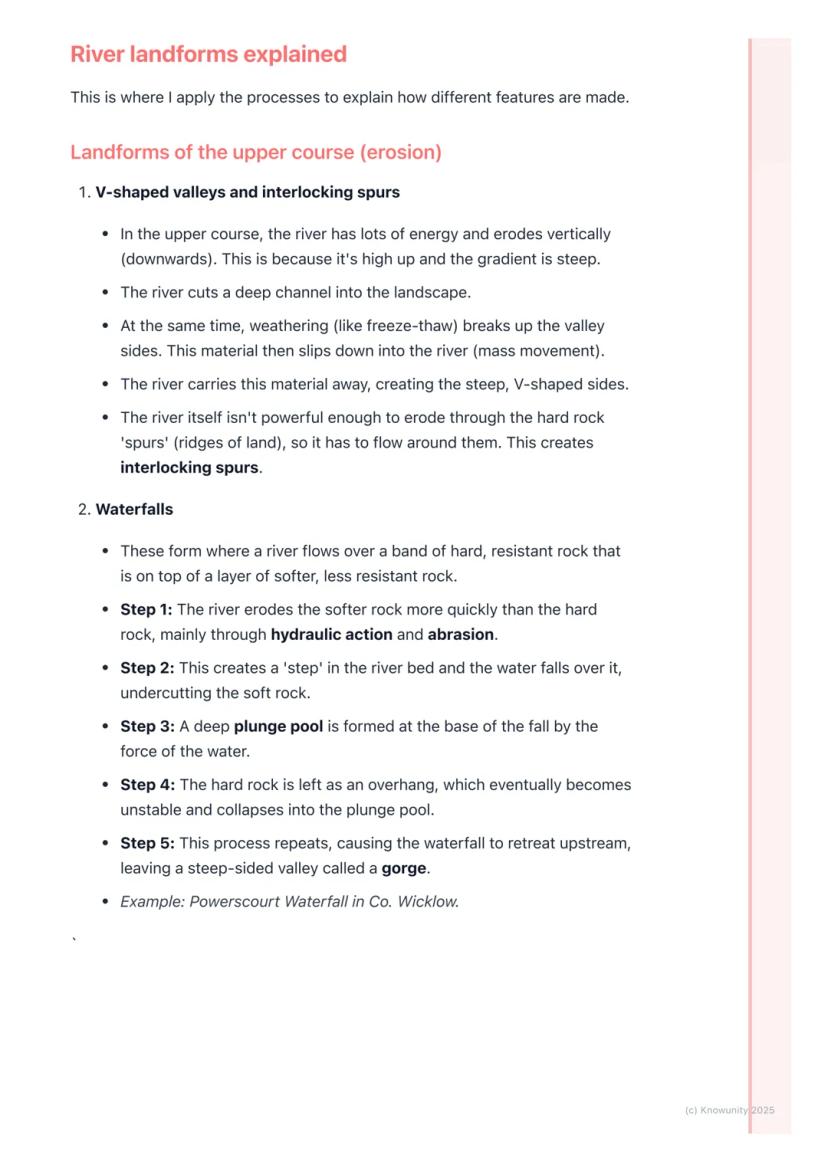
Those dramatic V-shaped valleys you see in Wicklow didn't form overnight - they're the result of powerful vertical erosion combined with weathering. As the river cuts down through the landscape, freeze-thaw weathering breaks up the valley sides, and this loose material slides into the river and gets carried away.
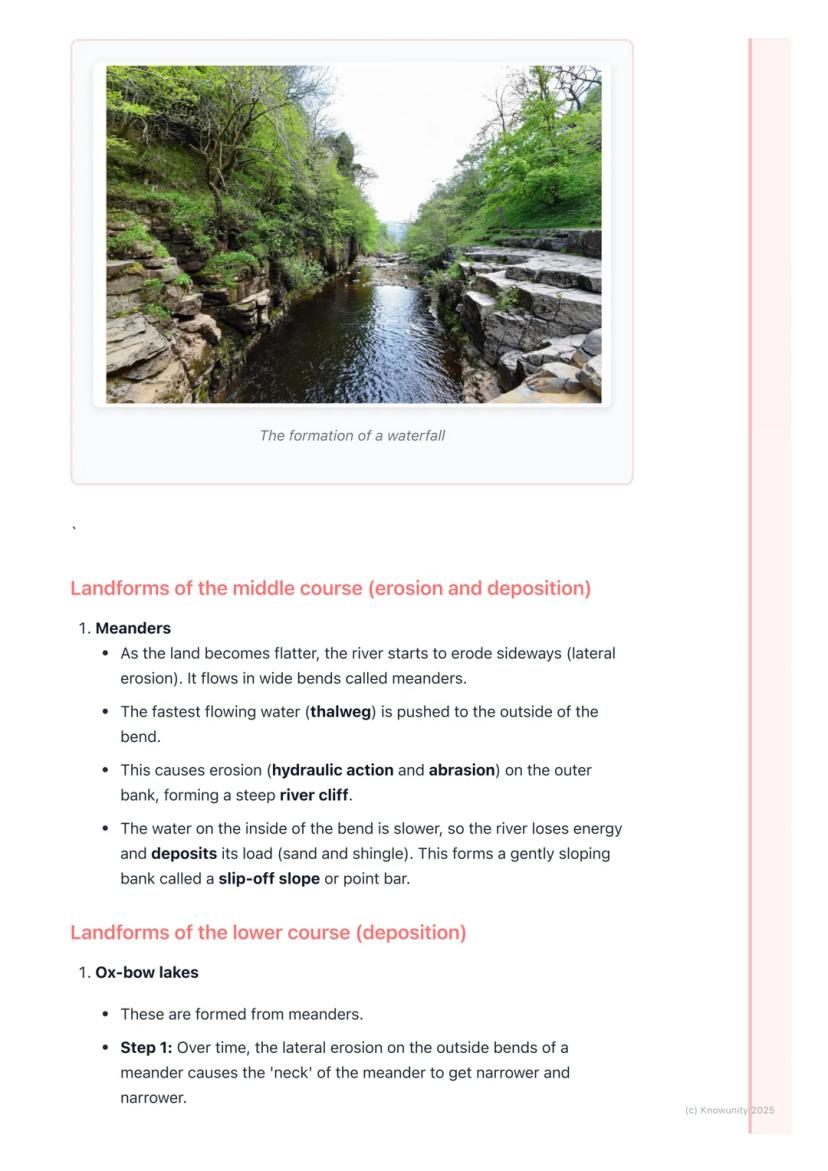
Waterfalls like Powerscourt are geography in action! They form when rivers flow over hard, resistant rock sitting on top of softer rock. The river erodes the soft rock faster, creating a step that eventually becomes a dramatic drop.
The formation process is brilliant: water crashes into the plunge pool below, using hydraulic action and abrasion to undercut the soft rock. Eventually, the hard rock overhang becomes unstable and collapses. This process repeats, causing the waterfall to slowly retreat upstream and carve out a gorge.
Understanding waterfall formation shows you how different rock types create Ireland's most spectacular landscapes.
💡 Draw it: Practice sketching waterfall formation diagrams - they're worth loads of marks in exams and help you visualise the process!
4
of 7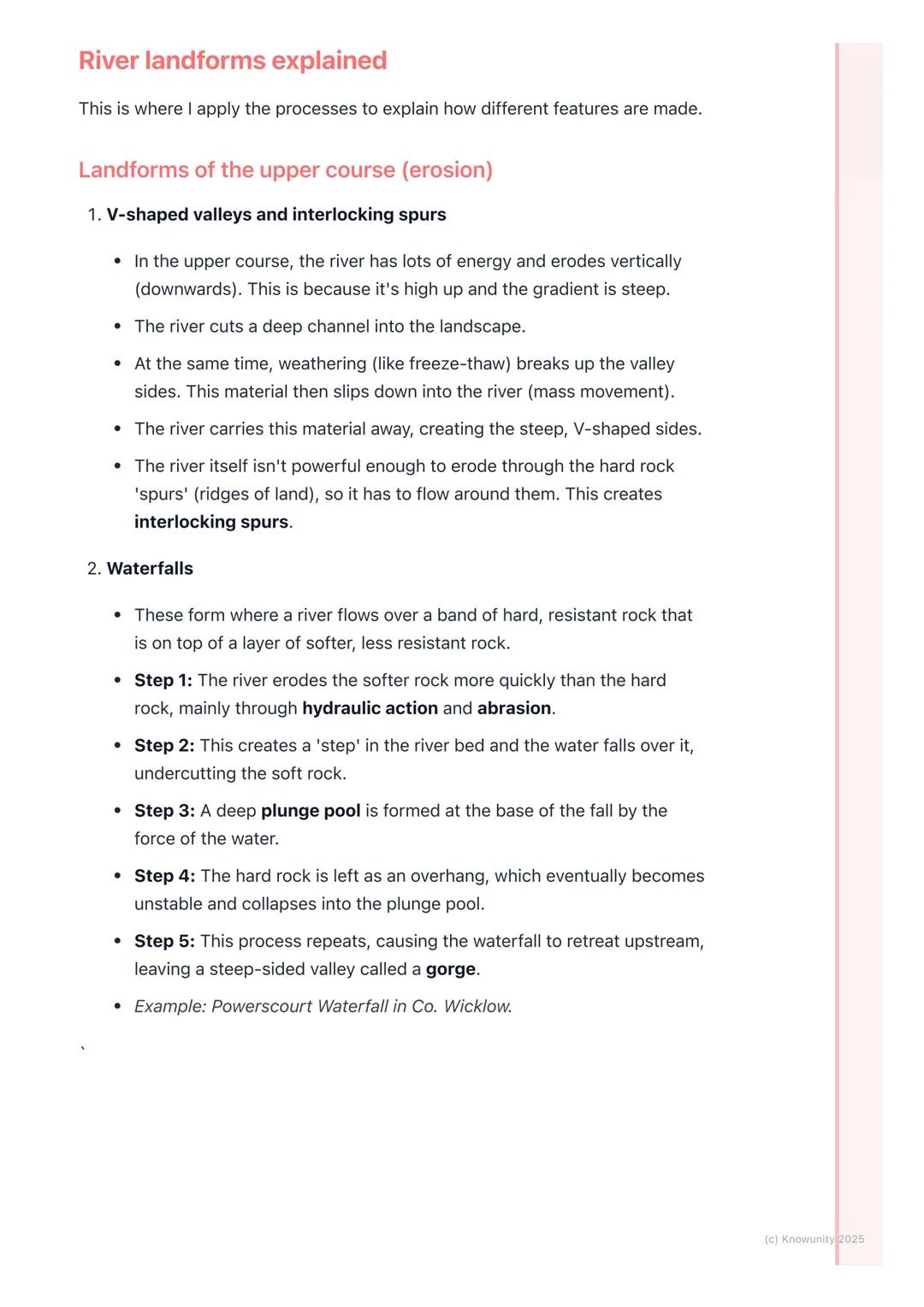
Middle and Lower Course Landforms
When rivers reach flatter ground, they start creating those graceful S-shaped meanders that make our countryside so beautiful. The fastest water (called the thalweg) swings to the outside of each bend, eroding a steep river cliff. Meanwhile, the slower inside water deposits sand and gravel, forming a gentle slip-off slope.
Over time, meanders can create one of geography's coolest features: ox-bow lakes. As the outside bends erode closer together, the river eventually cuts through during a flood, abandoning the old loop. The cut-off meander becomes a crescent-shaped lake that will eventually dry up.
In the lower course, rivers create floodplains - those flat, fertile areas perfect for farming that you see along the Shannon. When rivers flood, they dump fine alluvium across these plains, making them incredibly productive.
Levees form naturally as the heaviest material gets dumped first when floodwater spills over the banks, building up raised edges along the river channel.
💡 Real World: Next time you're in the countryside, look for these features - Ireland's rivers are textbook examples of these processes!
5
of 7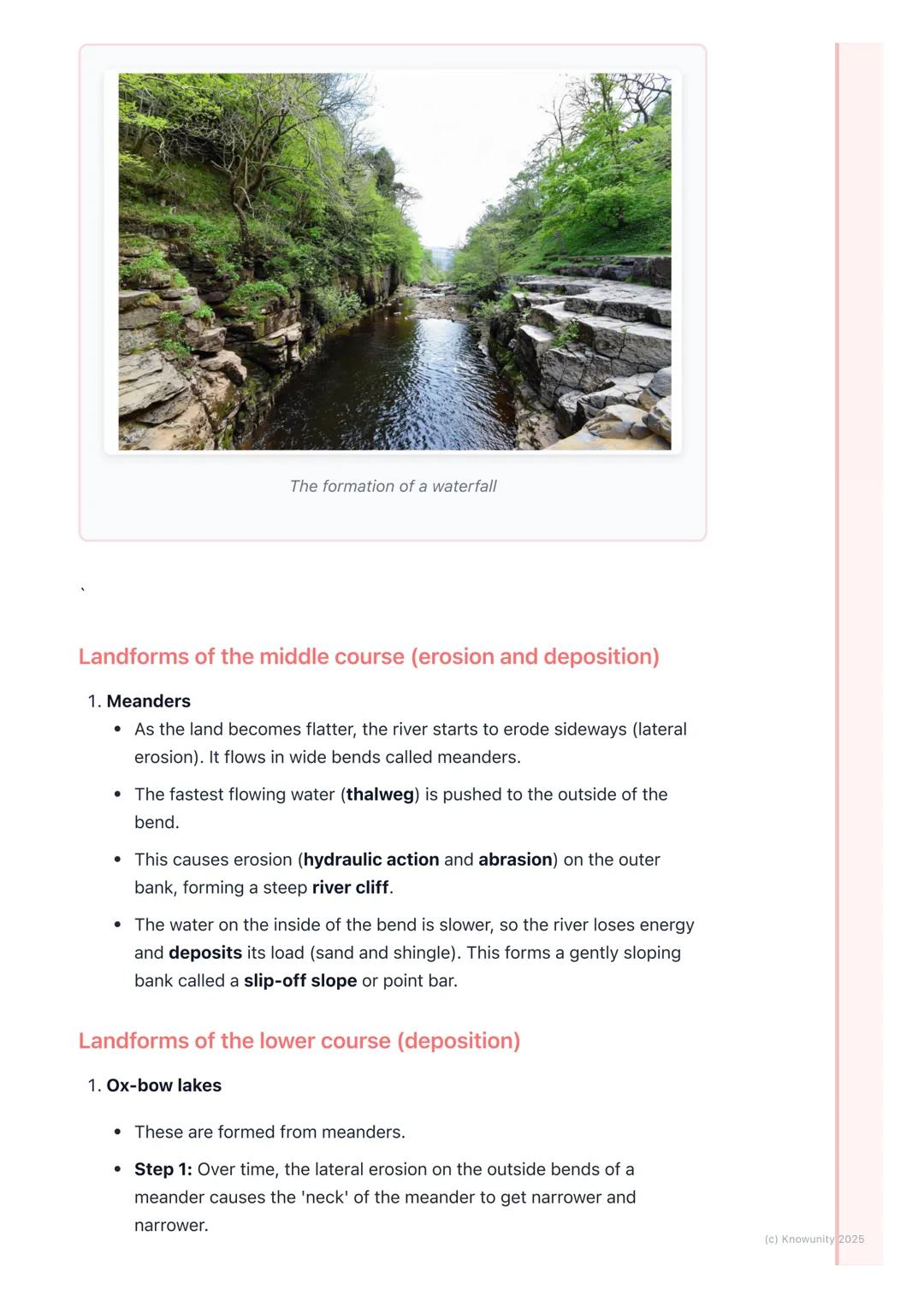
6
of 7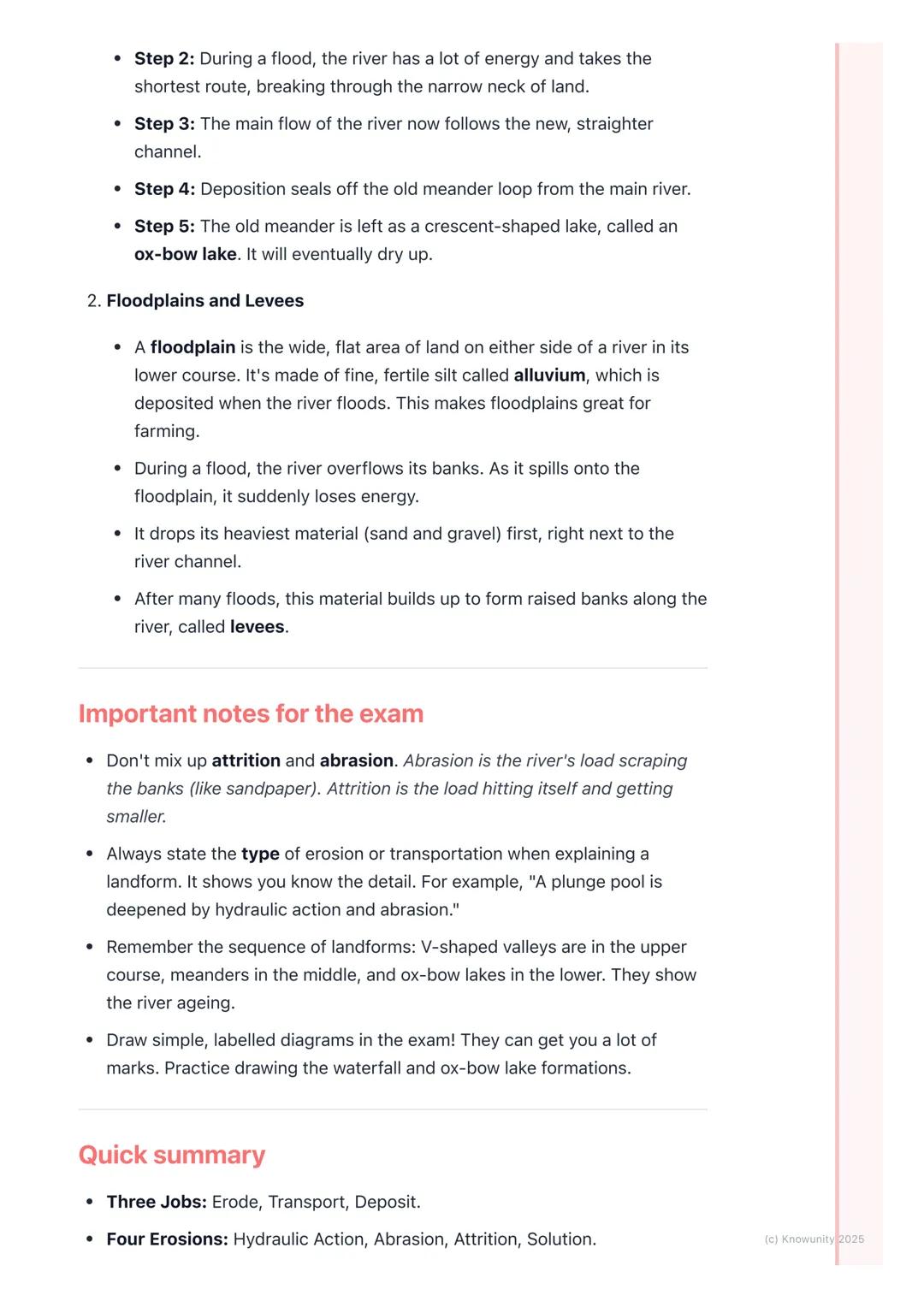
7
of 7
We thought you’d never ask...
What is the Knowunity AI companion?
Our AI Companion is a student-focused AI tool that offers more than just answers. Built on millions of Knowunity resources, it provides relevant information, personalised study plans, quizzes, and content directly in the chat, adapting to your individual learning journey.
Where can I download the Knowunity app?
You can download the app from Google Play Store and Apple App Store.
Is Knowunity really free of charge?
That's right! Enjoy free access to study content, connect with fellow students, and get instant help – all at your fingertips.
Most popular content in Geography
9GeographyGeography notes on rocks
Includes types of rocks,uses of rocks, case studies
1st Year341
GeographyEarthquakes revision notes
Notes on earthquakes with diagrams
1st Year110
GeographyPopulation Change and Migration
This covers factors that cause populations to grow or shrink, including birth rates, death rates, and the reasons people migrate.
2nd Year90
GeographyRock notes geography
Geography
5th Year250
GeographyThe sea
Jc Geography
1st Year230
GeographyGeography notes On the sea
Includes costal erosion, sea cliffs, longshore drift etc.
1st Year160
GeographyInside the Earth
Students will learn about the basic layers of the Earth: the crust, mantle, and core, understanding that our planet is made up of different parts.
1st Year51
GeographyGeography notes on glaciation
Includes diagrams, erosion, deposition, transportation
1st Year210
GeographyGeography notes on weather
Includes instruments, diagrams, how to read weather
1st Year120
Most popular content
9 Irish
IrishIrish oral questions and answers
Questions and answers for the leaving cert oral
5th Year4264
 English
Key Quotes : Sive
Key Quotes and explanations: Sive
6th Year2842
IrishIrish oral questions
Outline of oral questions
5th Year2055
IrishIníon- le hÁine Durkin
Aine Durkin’s poem, Iníon: Themes & summary
5th Year890
IrishIrish poetry 2027
Iníon + Dínit an Bhróin
5th Year1153
IrishLC HL notes- Iníon (poem)
Includes poem in English and Irish, theme, key words & phrases
5th Year2304
EnglishCultural Context : Shawshank Redemption : Sive : Small Things Like These
Comparative Study : Cultural Context : Shawshank Redemption, Sive and Small Things Like These
6th Year1430
IrishMo Ghrá-sa (Idir Lúibíní)
Notes on mo ghrá-sa
5th Year380
IrishAn Gaeilge Aiste
Irish Language essay
6th Year1320
Can't find what you're looking for? Explore other subjects.
Students love us — and so will you.
4.6/5App Store
4.7/5Google Play
The app is very easy to use and well designed. I have found everything I was looking for so far and have been able to learn a lot from the presentations! I will definitely use the app for a class assignment! And of course it also helps a lot as an inspiration.
Stefan SiOS user
This app is really great. There are so many study notes and help [...]. My problem subject is French, for example, and the app has so many options for help. Thanks to this app, I have improved my French. I would recommend it to anyone.
Samantha KlichAndroid user
Wow, I am really amazed. I just tried the app because I've seen it advertised many times and was absolutely stunned. This app is THE HELP you want for school and above all, it offers so many things, such as workouts and fact sheets, which have been VERY helpful to me personally.
AnnaiOS user
Geography4 views·Updated Jun 8, 2026·7 pagesUnderstanding River Landforms and Their Processes
Rivers are constantly reshaping our landscape through three main jobs: eroding rock and soil, transporting this material downstream, and depositing it in new locations. Understanding how rivers work and the landforms they create is essential for your geography studies and...
1
of 7
Sign up to see the content. It's free!
- Access to all documents
- Improve your grades
- Join milions of students
The Work of Rivers
Ever wondered how rivers carve out valleys and create the landscapes you see around Ireland? Rivers are like nature's bulldozers, constantly changing the land through erosion, transportation, and deposition. These three processes work together as the river flows from its source in the mountains to its mouth at the sea.
Erosion wears away rock and soil from the river bed and banks. There are four types you need to know: hydraulic action (water force hitting banks), abrasion (rocks scraping like sandpaper), attrition (rocks hitting each other), and solution (acidic water dissolving limestone).
Once material is eroded, transportation moves it downstream through traction (rolling boulders), saltation (bouncing pebbles), suspension (muddy silt in water), and solution (dissolved minerals you can't see).
💡 Remember: Deposition happens when rivers slow down - think of when a stream enters a lake or during dry weather when there's less water flow.
2
of 7Sign up to see the content. It's free!
- Access to all documents
- Improve your grades
- Join milions of students
River Courses and Characteristics
Picture a river's journey like a person's life - it has distinct stages with different personalities. The long profile shows how a river changes from its steep mountain source to its flat coastal mouth, and each section creates different landforms.
In the upper course, rivers are young and energetic with steep gradients. They focus on vertical erosion, cutting deep V-shaped valleys. The water rushes downhill with tremendous force, but isn't strong enough to cut through hard rock ridges, so it winds around them creating interlocking spurs.
The middle course has a gentler slope where rivers mature and start lateral erosion (sideways cutting). Here you'll find wider valleys and the beginning of those classic S-shaped bends called meanders.
By the lower course, rivers are almost flat and focus mainly on deposition. These elderly rivers create wide floodplains perfect for farming, especially in places like the Shannon valley.
💡 Exam Tip: Always mention the specific type of erosion when explaining landforms - it shows you understand the detailed processes!
3
of 7Sign up to see the content. It's free!
- Access to all documents
- Improve your grades
- Join milions of students
Upper Course Landforms
Those dramatic V-shaped valleys you see in Wicklow didn't form overnight - they're the result of powerful vertical erosion combined with weathering. As the river cuts down through the landscape, freeze-thaw weathering breaks up the valley sides, and this loose material slides into the river and gets carried away.
Waterfalls like Powerscourt are geography in action! They form when rivers flow over hard, resistant rock sitting on top of softer rock. The river erodes the soft rock faster, creating a step that eventually becomes a dramatic drop.
The formation process is brilliant: water crashes into the plunge pool below, using hydraulic action and abrasion to undercut the soft rock. Eventually, the hard rock overhang becomes unstable and collapses. This process repeats, causing the waterfall to slowly retreat upstream and carve out a gorge.
Understanding waterfall formation shows you how different rock types create Ireland's most spectacular landscapes.
💡 Draw it: Practice sketching waterfall formation diagrams - they're worth loads of marks in exams and help you visualise the process!
4
of 7Sign up to see the content. It's free!
- Access to all documents
- Improve your grades
- Join milions of students
Middle and Lower Course Landforms
When rivers reach flatter ground, they start creating those graceful S-shaped meanders that make our countryside so beautiful. The fastest water (called the thalweg) swings to the outside of each bend, eroding a steep river cliff. Meanwhile, the slower inside water deposits sand and gravel, forming a gentle slip-off slope.
Over time, meanders can create one of geography's coolest features: ox-bow lakes. As the outside bends erode closer together, the river eventually cuts through during a flood, abandoning the old loop. The cut-off meander becomes a crescent-shaped lake that will eventually dry up.
In the lower course, rivers create floodplains - those flat, fertile areas perfect for farming that you see along the Shannon. When rivers flood, they dump fine alluvium across these plains, making them incredibly productive.
Levees form naturally as the heaviest material gets dumped first when floodwater spills over the banks, building up raised edges along the river channel.
💡 Real World: Next time you're in the countryside, look for these features - Ireland's rivers are textbook examples of these processes!
5
of 7Sign up to see the content. It's free!
- Access to all documents
- Improve your grades
- Join milions of students
6
of 7Sign up to see the content. It's free!
- Access to all documents
- Improve your grades
- Join milions of students
7
of 7Sign up to see the content. It's free!
- Access to all documents
- Improve your grades
- Join milions of students
We thought you’d never ask...
What is the Knowunity AI companion?
Our AI Companion is a student-focused AI tool that offers more than just answers. Built on millions of Knowunity resources, it provides relevant information, personalised study plans, quizzes, and content directly in the chat, adapting to your individual learning journey.
Where can I download the Knowunity app?
You can download the app from Google Play Store and Apple App Store.
Is Knowunity really free of charge?
That's right! Enjoy free access to study content, connect with fellow students, and get instant help – all at your fingertips.
Most popular content in Geography
9GeographyGeography notes on rocks
Includes types of rocks,uses of rocks, case studies
1st Year341
GeographyEarthquakes revision notes
Notes on earthquakes with diagrams
1st Year110
GeographyPopulation Change and Migration
This covers factors that cause populations to grow or shrink, including birth rates, death rates, and the reasons people migrate.
2nd Year90
GeographyRock notes geography
Geography
5th Year250
GeographyThe sea
Jc Geography
1st Year230
GeographyGeography notes On the sea
Includes costal erosion, sea cliffs, longshore drift etc.
1st Year160
GeographyInside the Earth
Students will learn about the basic layers of the Earth: the crust, mantle, and core, understanding that our planet is made up of different parts.
1st Year51
GeographyGeography notes on glaciation
Includes diagrams, erosion, deposition, transportation
1st Year210
GeographyGeography notes on weather
Includes instruments, diagrams, how to read weather
1st Year120
Most popular content
9IrishIrish oral questions and answers
Questions and answers for the leaving cert oral
5th Year4264
EnglishKey Quotes : Sive
Key Quotes and explanations: Sive
6th Year2842
IrishIrish oral questions
Outline of oral questions
5th Year2055
IrishIníon- le hÁine Durkin
Aine Durkin’s poem, Iníon: Themes & summary
5th Year890
IrishIrish poetry 2027
Iníon + Dínit an Bhróin
5th Year1153
IrishLC HL notes- Iníon (poem)
Includes poem in English and Irish, theme, key words & phrases
5th Year2304
EnglishCultural Context : Shawshank Redemption : Sive : Small Things Like These
Comparative Study : Cultural Context : Shawshank Redemption, Sive and Small Things Like These
6th Year1430
IrishMo Ghrá-sa (Idir Lúibíní)
Notes on mo ghrá-sa
5th Year380
IrishAn Gaeilge Aiste
Irish Language essay
6th Year1320
Can't find what you're looking for? Explore other subjects.
Students love us — and so will you.
4.6/5App Store
4.7/5Google Play
The app is very easy to use and well designed. I have found everything I was looking for so far and have been able to learn a lot from the presentations! I will definitely use the app for a class assignment! And of course it also helps a lot as an inspiration.
Stefan SiOS user
This app is really great. There are so many study notes and help [...]. My problem subject is French, for example, and the app has so many options for help. Thanks to this app, I have improved my French. I would recommend it to anyone.
Samantha KlichAndroid user
Wow, I am really amazed. I just tried the app because I've seen it advertised many times and was absolutely stunned. This app is THE HELP you want for school and above all, it offers so many things, such as workouts and fact sheets, which have been VERY helpful to me personally.
AnnaiOS user