
Die Erde: Eine Übersicht über Landmassen und Ozeane
Die Erdoberfläche... Show more
Chat
Subjects
Triangle Congruence and Similarity Theorems
Triangle Properties and Classification
Linear Equations and Graphs
Geometric Angle Relationships
Trigonometric Functions and Identities
Equation Solving Techniques
Circle Geometry Fundamentals
Division Operations and Methods
Basic Differentiation Rules
Exponent and Logarithm Properties
Show all topics
Human Organ Systems
Reproductive Cell Cycles
Biological Sciences Subdisciplines
Cellular Energy Metabolism
Autotrophic Energy Processes
Inheritance Patterns and Principles
Biomolecular Structure and Organization
Cell Cycle and Division Mechanics
Cellular Organization and Development
Biological Structural Organization
Show all topics
Chemical Sciences and Applications
Atomic Structure and Composition
Molecular Electron Structure Representation
Atomic Electron Behavior
Matter Properties and Water
Mole Concept and Calculations
Gas Laws and Behavior
Periodic Table Organization
Chemical Thermodynamics Fundamentals
Chemical Bond Types and Properties
Show all topics
European Renaissance and Enlightenment
European Cultural Movements 800-1920
American Revolution Era 1763-1797
American Civil War 1861-1865
Global Imperial Systems
Mongol and Chinese Dynasties
U.S. Presidents and World Leaders
Historical Sources and Documentation
World Wars Era and Impact
World Religious Systems
Show all topics
Classic and Contemporary Novels
Literary Character Analysis
Rhetorical Theory and Practice
Classic Literary Narratives
Reading Analysis and Interpretation
Narrative Structure and Techniques
English Language Components
Influential English-Language Authors
Basic Sentence Structure
Narrative Voice and Perspective
Show all topics
 Geographie/Erdkunde1,013 views·Updated Jun 13, 2026·1 page
Die Erde: Eine Übersicht über Landmassen und Ozeane
Die Erdoberfläche... Show more
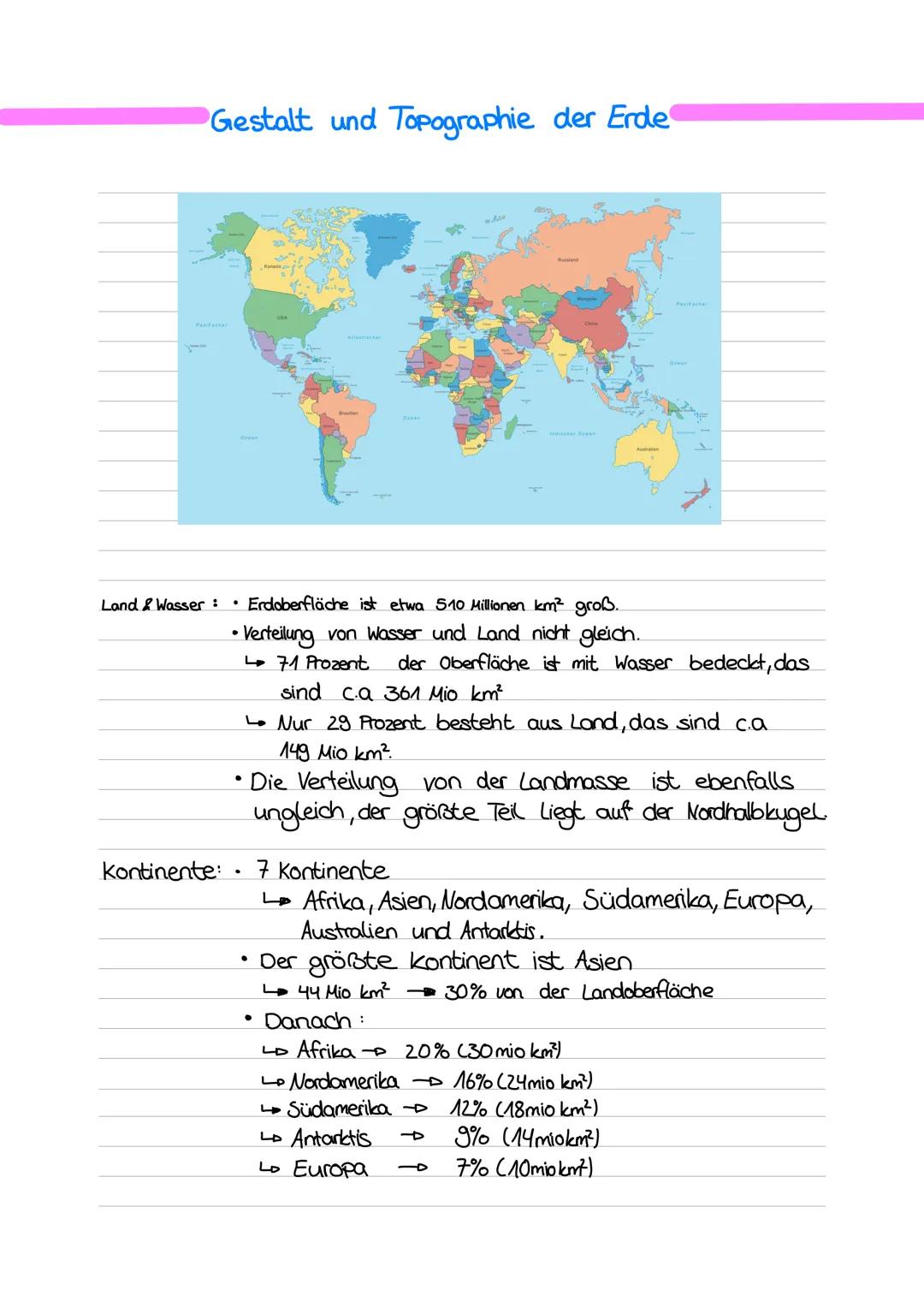
Die Erde, unser Heimatplanet, weist eine faszinierende Verteilung von Land und Wasser auf. Die gesamte Erdoberfläche erstreckt sich über etwa 510 Millionen Quadratkilometer, wobei die Wasserfläche der Erde in km² etwa 361 Millionen beträgt. Dies bedeutet, dass 71 Prozent der Erde mit Wasser bedeckt sind, während die Landfläche der Erde in Prozent nur 29 ausmacht, was etwa 149 Millionen Quadratkilometern entspricht.
Highlight: Die Verteilung von Wasser und Land auf der Erde ist nicht gleichmäßig. Der größte Teil der Landmasse befindet sich auf der Nordhalbkugel.
Die Erde ist in sieben Kontinente unterteilt: Afrika, Asien, Nordamerika, Südamerika, Europa, Australien und Antarktis. Diese Einteilung beantwortet die Frage "Wie viele Kontinente gibt es" und zeigt, dass die Debatte "5 oder 7 Kontinente" zugunsten von sieben entschieden wurde.
Definition: Kontinente sind große, zusammenhängende Landmassen, die durch Ozeane voneinander getrennt sind.
Bei der Betrachtung der Kontinente nach Größe ergibt sich folgende Reihenfolge:
Example: Asien, der größte Kontinent, ist fast viermal so groß wie Europa.
Diese Verteilung zeigt deutlich, dass Asien nicht nur der größte Kontinent ist, sondern auch, dass Afrika der 2 größte Kontinent ist. Die Frage "Was ist der 2 größte Kontinent" lässt sich also eindeutig mit Afrika beantworten.
Die Ozeane, die die Kontinente umgeben und voneinander trennen, sind der Pazifische Ozean (der größte), der Atlantische Ozean und der Indische Ozean. Diese gewaltigen Wassermassen tragen maßgeblich dazu bei, dass ein so großer Teil der Erdoberfläche von Wasser bedeckt ist.
Vocabulary: Topographie - die Beschreibung und Darstellung der Oberflächenformen der Erde.
Die ungleiche Verteilung der Landmassen, mit dem Großteil auf der Nordhalbkugel, hat bedeutende Auswirkungen auf Klima, Ökosysteme und menschliche Zivilisationen. Dies erklärt auch, warum die meisten Länder auf der Nordhalbkugel Deutschland und andere europäische Staaten einschließen, während die Südhalbkugel Länder wie Australien, große Teile Afrikas und Südamerika umfasst.
Our AI Companion is a student-focused AI tool that offers more than just answers. Built on millions of Knowunity resources, it provides relevant information, personalised study plans, quizzes, and content directly in the chat, adapting to your individual learning journey.
You can download the app from Google Play Store and Apple App Store.
That's right! Enjoy free access to study content, connect with fellow students, and get instant help – all at your fingertips.
The app is very easy to use and well designed. I have found everything I was looking for so far and have been able to learn a lot from the presentations! I will definitely use the app for a class assignment! And of course it also helps a lot as an inspiration.
This app is really great. There are so many study notes and help [...]. My problem subject is French, for example, and the app has so many options for help. Thanks to this app, I have improved my French. I would recommend it to anyone.
Wow, I am really amazed. I just tried the app because I've seen it advertised many times and was absolutely stunned. This app is THE HELP you want for school and above all, it offers so many things, such as workouts and fact sheets, which have been VERY helpful to me personally.
Geographie/Erdkunde1,013 views·Updated Jun 13, 2026·1 pageDie Erde: Eine Übersicht über Landmassen und Ozeane
Die Erdoberfläche beträgt etwa 510 Millionen Quadratkilometer, wobei 71 Prozent der Erde mit Wasser bedeckt sind. Die Verteilung von Land und Wasser ist ungleichmäßig, mit dem Großteil der Landmasse auf der Nordhalbkugel.... Show more
Die Erde, unser Heimatplanet, weist eine faszinierende Verteilung von Land und Wasser auf. Die gesamte Erdoberfläche erstreckt sich über etwa 510 Millionen Quadratkilometer, wobei die Wasserfläche der Erde in km² etwa 361 Millionen beträgt. Dies bedeutet, dass 71 Prozent der Erde mit Wasser bedeckt sind, während die Landfläche der Erde in Prozent nur 29 ausmacht, was etwa 149 Millionen Quadratkilometern entspricht.
Highlight: Die Verteilung von Wasser und Land auf der Erde ist nicht gleichmäßig. Der größte Teil der Landmasse befindet sich auf der Nordhalbkugel.
Die Erde ist in sieben Kontinente unterteilt: Afrika, Asien, Nordamerika, Südamerika, Europa, Australien und Antarktis. Diese Einteilung beantwortet die Frage "Wie viele Kontinente gibt es" und zeigt, dass die Debatte "5 oder 7 Kontinente" zugunsten von sieben entschieden wurde.
Definition: Kontinente sind große, zusammenhängende Landmassen, die durch Ozeane voneinander getrennt sind.
Bei der Betrachtung der Kontinente nach Größe ergibt sich folgende Reihenfolge:
Example: Asien, der größte Kontinent, ist fast viermal so groß wie Europa.
Diese Verteilung zeigt deutlich, dass Asien nicht nur der größte Kontinent ist, sondern auch, dass Afrika der 2 größte Kontinent ist. Die Frage "Was ist der 2 größte Kontinent" lässt sich also eindeutig mit Afrika beantworten.
Die Ozeane, die die Kontinente umgeben und voneinander trennen, sind der Pazifische Ozean (der größte), der Atlantische Ozean und der Indische Ozean. Diese gewaltigen Wassermassen tragen maßgeblich dazu bei, dass ein so großer Teil der Erdoberfläche von Wasser bedeckt ist.
Vocabulary: Topographie - die Beschreibung und Darstellung der Oberflächenformen der Erde.
Die ungleiche Verteilung der Landmassen, mit dem Großteil auf der Nordhalbkugel, hat bedeutende Auswirkungen auf Klima, Ökosysteme und menschliche Zivilisationen. Dies erklärt auch, warum die meisten Länder auf der Nordhalbkugel Deutschland und andere europäische Staaten einschließen, während die Südhalbkugel Länder wie Australien, große Teile Afrikas und Südamerika umfasst.
Our AI Companion is a student-focused AI tool that offers more than just answers. Built on millions of Knowunity resources, it provides relevant information, personalised study plans, quizzes, and content directly in the chat, adapting to your individual learning journey.
You can download the app from Google Play Store and Apple App Store.
That's right! Enjoy free access to study content, connect with fellow students, and get instant help – all at your fingertips.
The app is very easy to use and well designed. I have found everything I was looking for so far and have been able to learn a lot from the presentations! I will definitely use the app for a class assignment! And of course it also helps a lot as an inspiration.
This app is really great. There are so many study notes and help [...]. My problem subject is French, for example, and the app has so many options for help. Thanks to this app, I have improved my French. I would recommend it to anyone.
Wow, I am really amazed. I just tried the app because I've seen it advertised many times and was absolutely stunned. This app is THE HELP you want for school and above all, it offers so many things, such as workouts and fact sheets, which have been VERY helpful to me personally.