
If you've ever felt overwhelmed by those massive French texts...
 French2 views·Updated Jun 13, 2026·5 pages
Mastering Skimming and Scanning Techniques for Quick Reading
1 / 5
1
of 5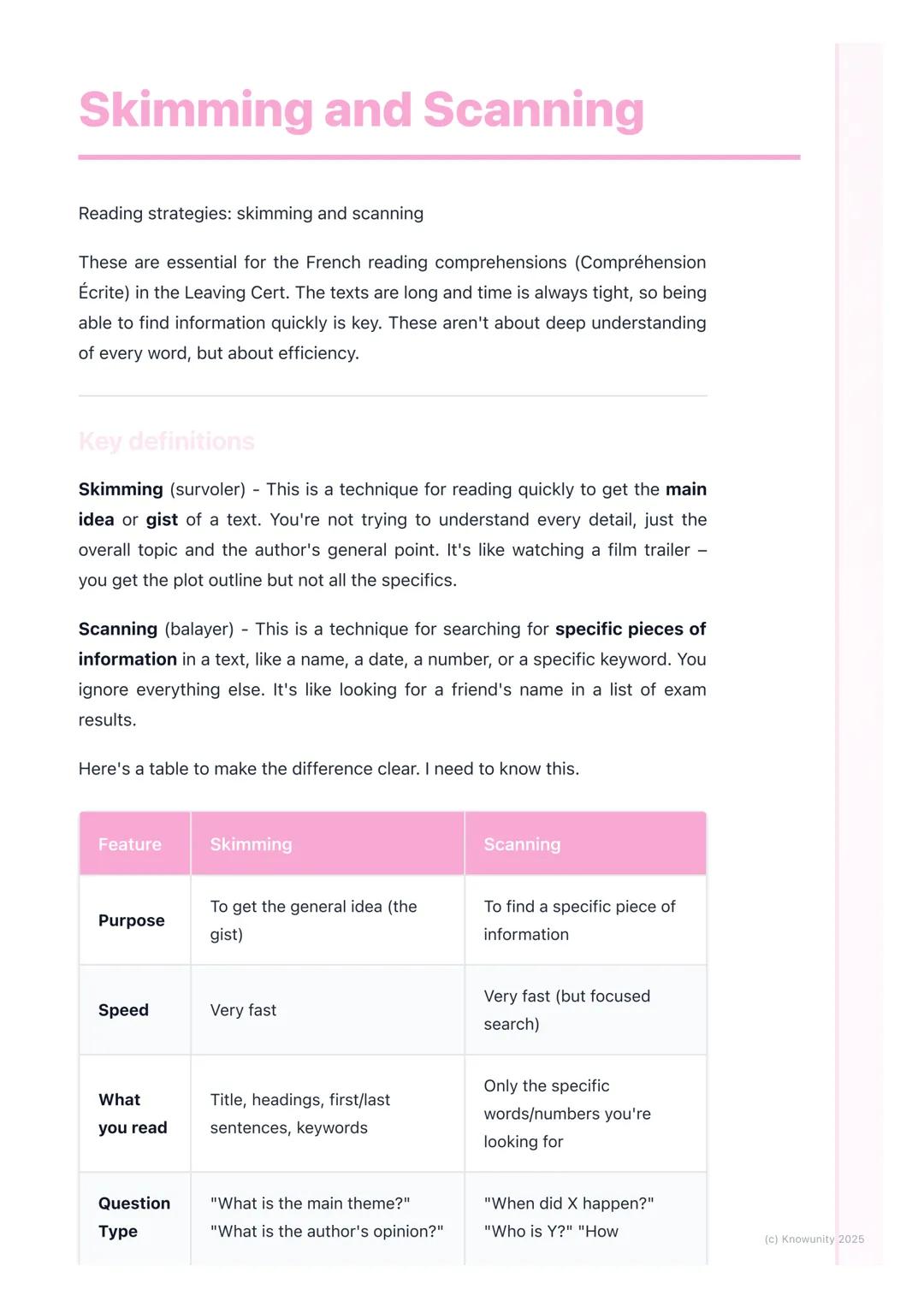
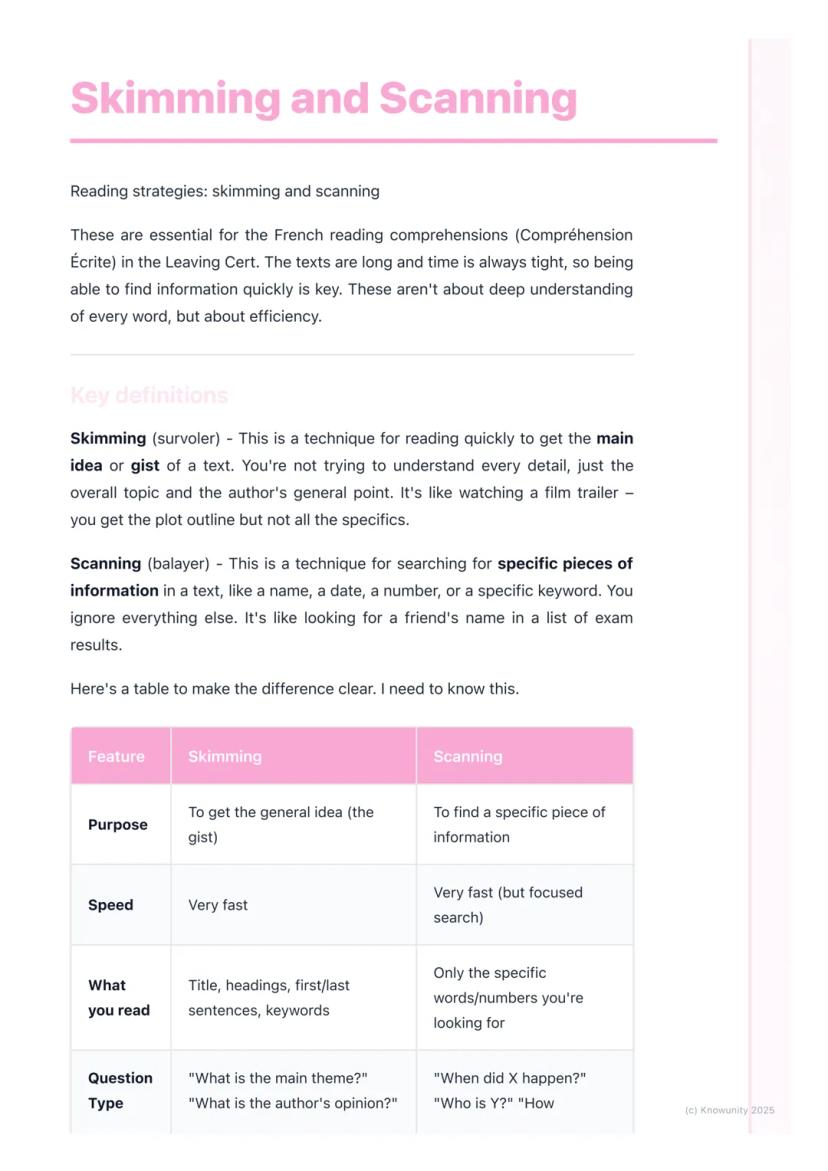
Understanding Skimming and Scanning
Think of skimming like watching a movie trailer - you get the main plot without all the details. It's about reading quickly to grasp the general idea of a text rather than getting bogged down in specifics. When you skim, you're looking for the overall topic and the author's main point.
Scanning, on the other hand, is like searching for your mate's name on an exam results list. You ignore everything else and hunt for one specific piece of information - a date, name, number, or keyword. Your eyes move fast, but they're laser-focused on finding exactly what you need.
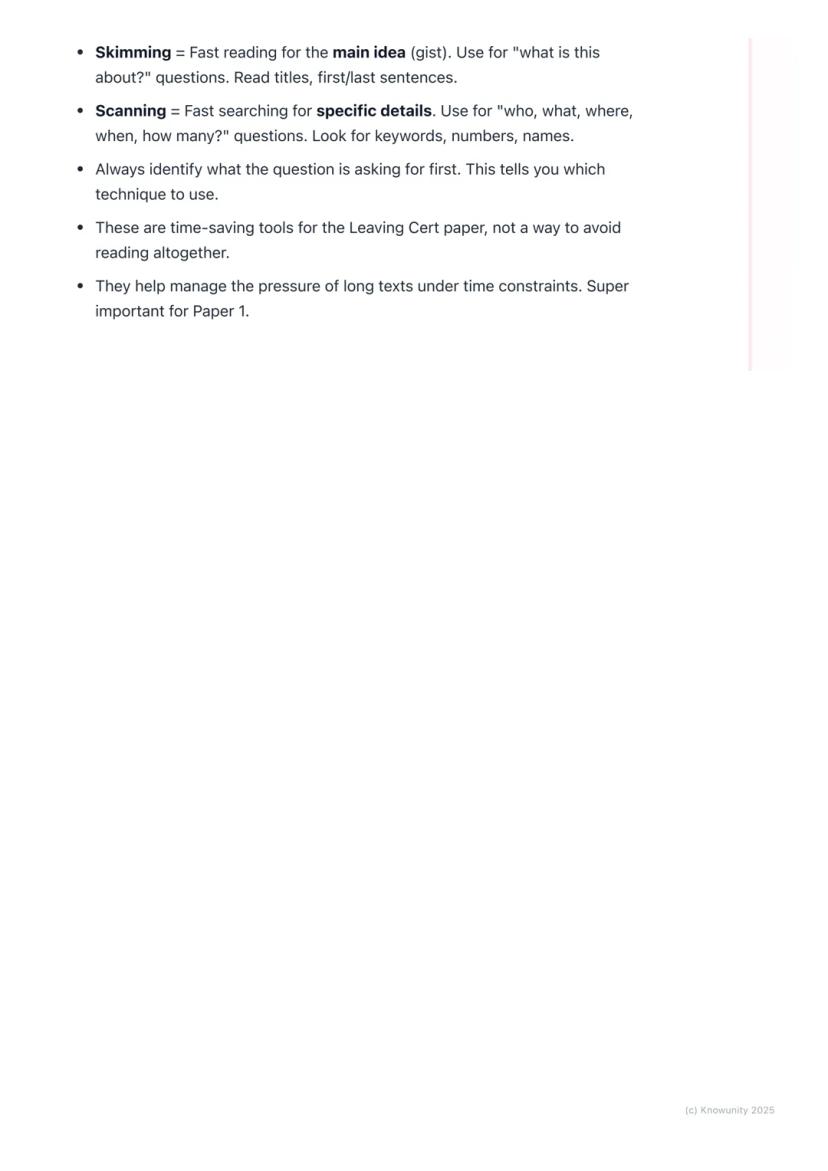
The key difference? Skimming answers "What's this about?" whilst scanning answers "Where's that specific detail?" Both techniques are absolutely essential for managing those lengthy French texts under exam pressure.
Quick Tip: Always read the question first to know whether you need to skim for the main idea or scan for specific details!
2
of 5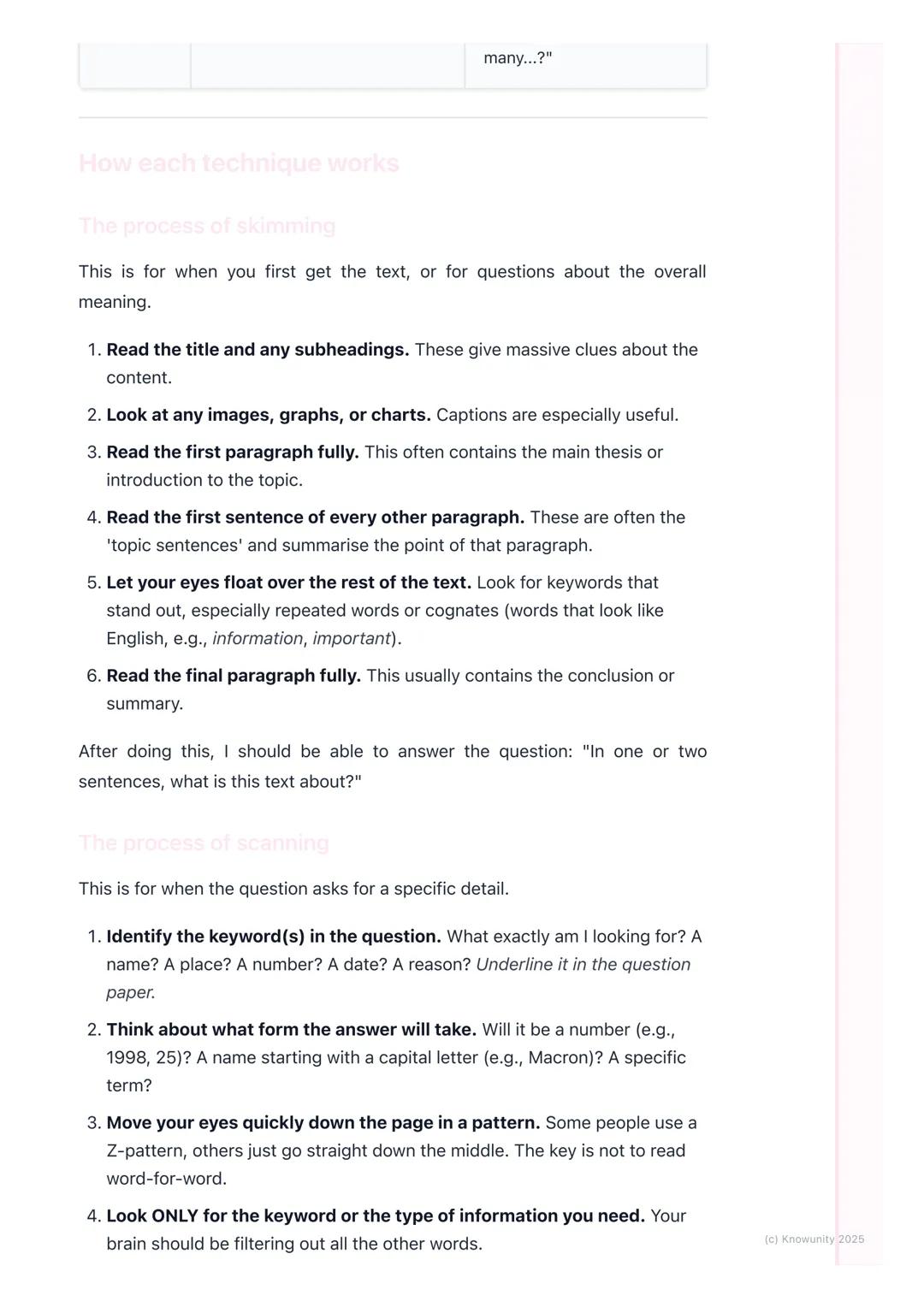
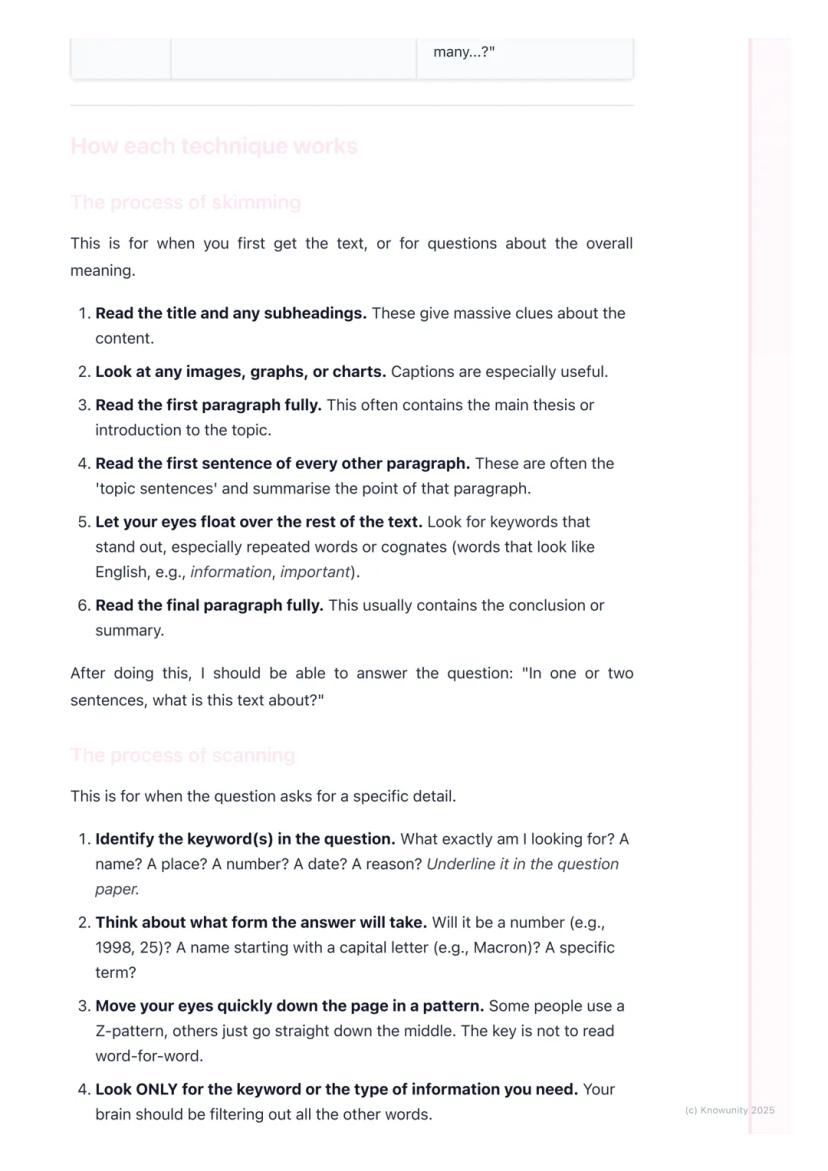
How to Skim Like a Pro
When you need to understand the gist of a text, follow this step-by-step approach that'll save you precious minutes. Start by reading the title and any subheadings - these give you massive clues about what's coming up.
Next, read the first paragraph completely and the first sentence of every other paragraph. These topic sentences usually contain the main point of each section. Let your eyes float over the rest, picking up repeated words or cognates (words that look like English, such as 'information' or 'important').
Always finish by reading the final paragraph fully, as this typically contains the conclusion or summary. After this quick process, you should be able to explain the text's main theme in one or two sentences.
Pro Move: Look for images, graphs, or charts too - their captions often contain key information that makes everything clearer!
3
of 5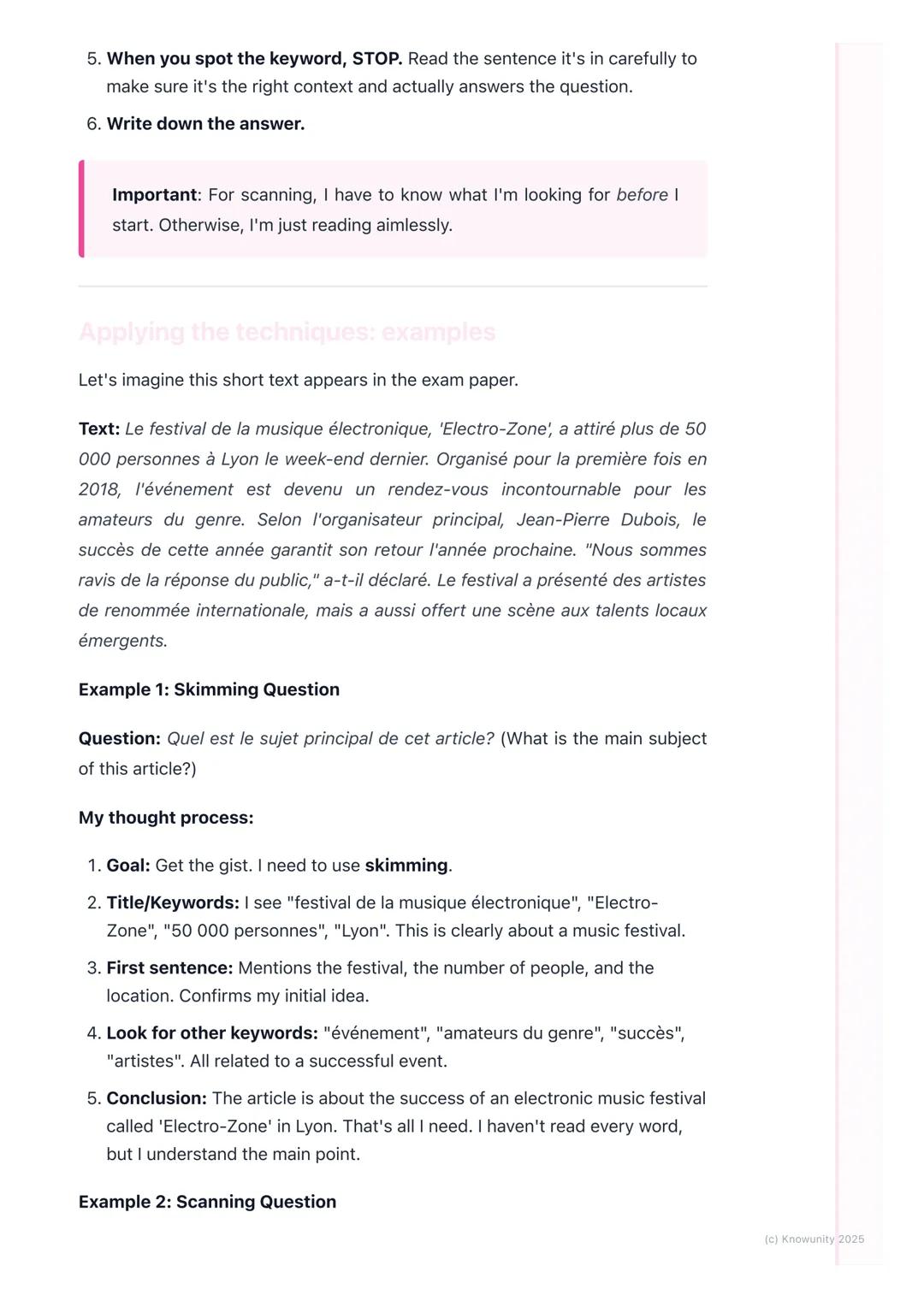
Mastering the Scanning Technique
Scanning is all about having a clear target before you start hunting. First, identify exactly what you're looking for in the question - underline the keywords. Are you searching for a year, a person's name, a reason, or a quantity?
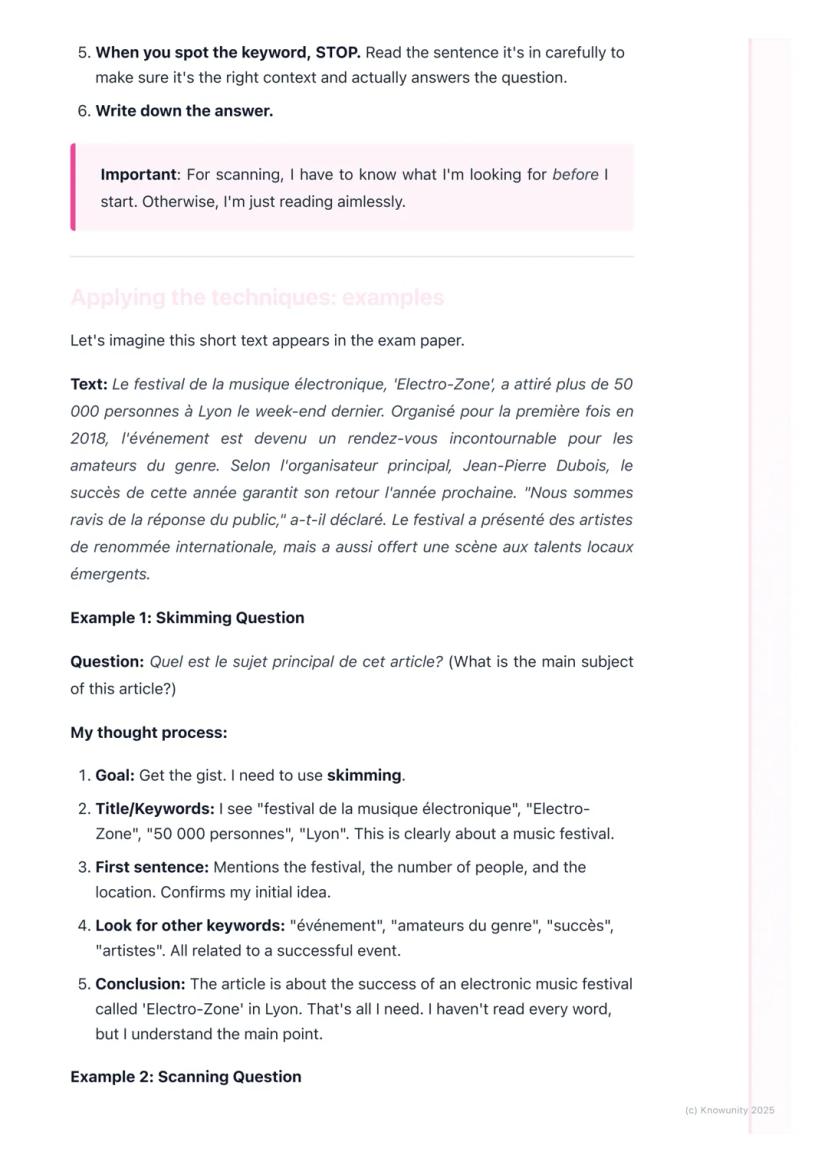
Think about what form your answer will take. A year will be four digits starting with 19 or 20, whilst names start with capital letters. Move your eyes quickly down the page in a pattern - some people prefer zigzag, others go straight down the middle.
The crucial bit is to ignore everything else except your target information. When you spot your keyword, stop immediately and read that sentence carefully to ensure it's the right context and actually answers the question.
Remember: If you don't know what you're looking for before you start, you're just reading aimlessly and wasting time!
4
of 5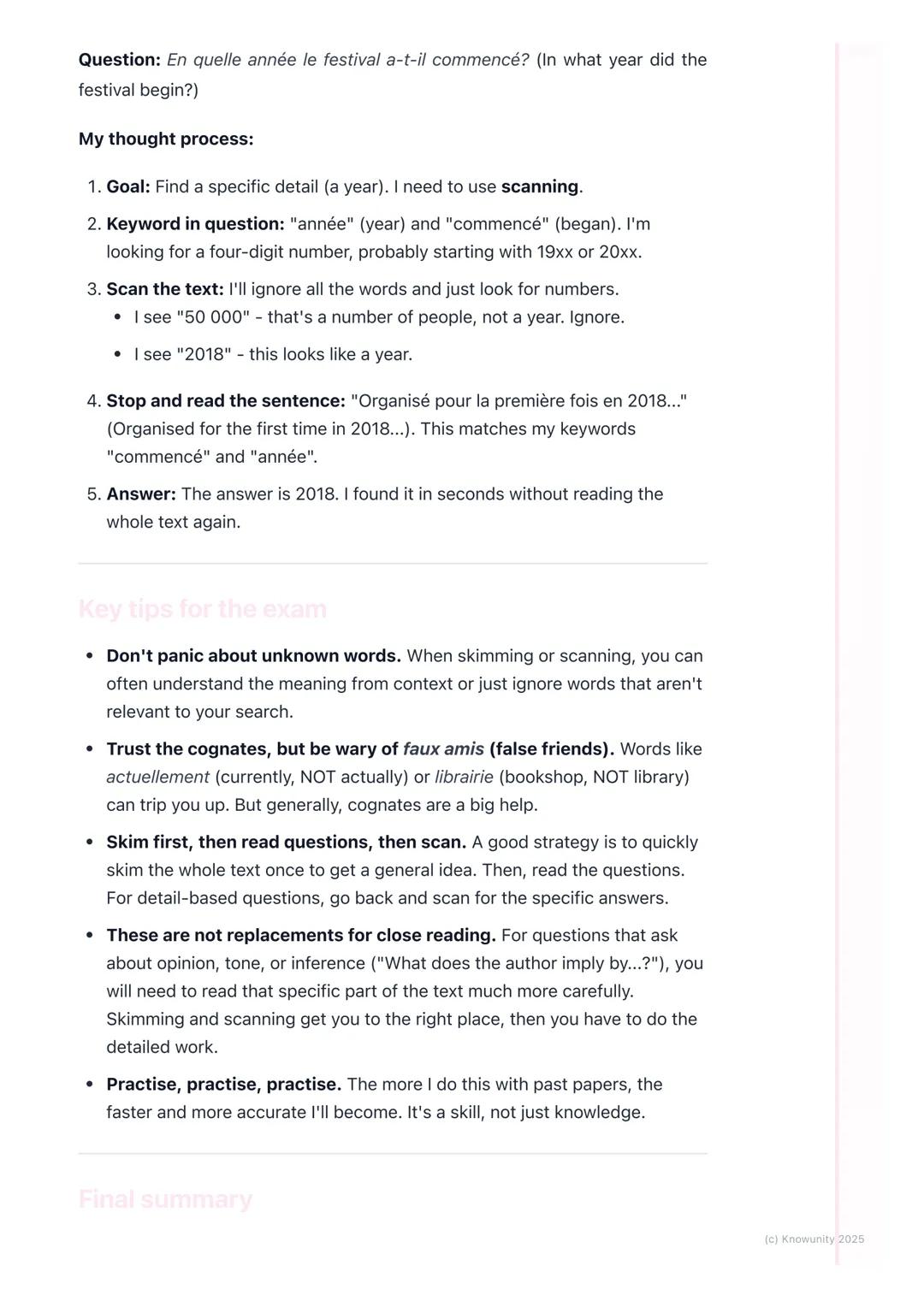
Putting It All Together
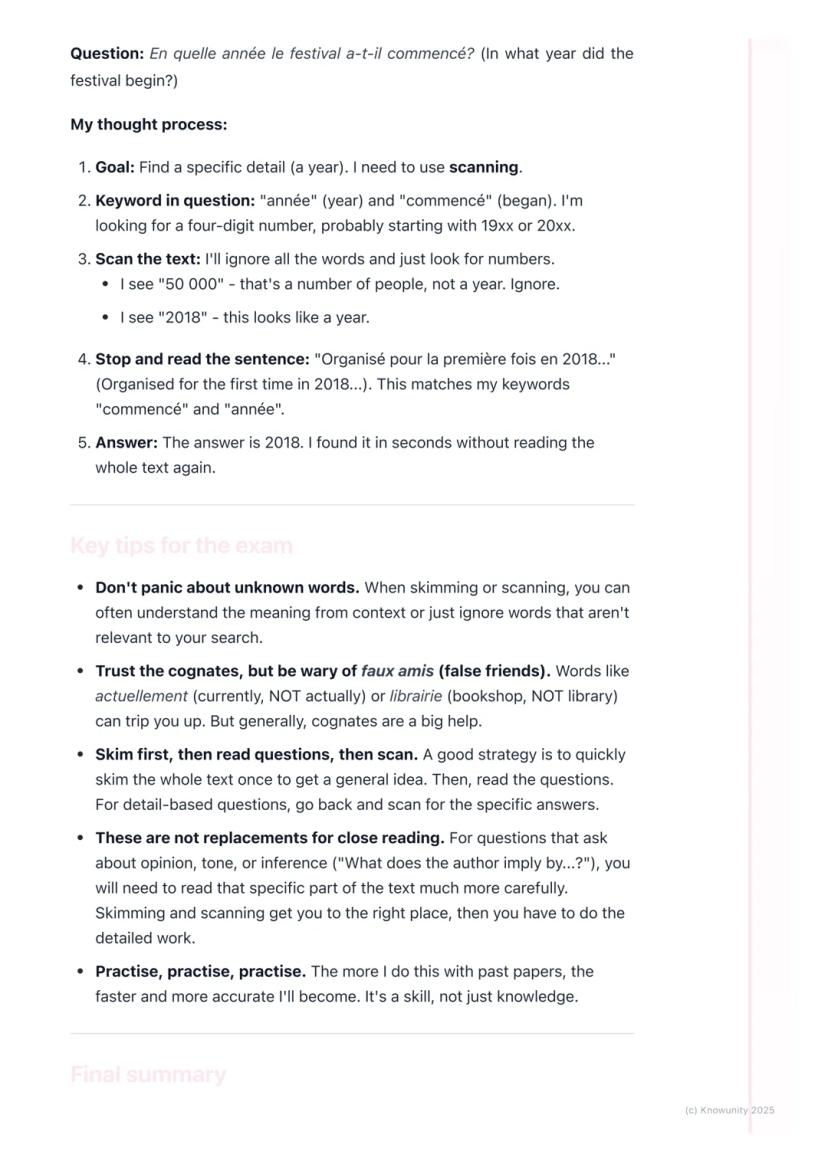
Let's say you're asked "What year did the festival begin?" about a French text. You'd scan for a four-digit number, ignoring everything else until you spot "2018" next to "pour la première fois" (for the first time). That's your answer - job done in seconds!
For skimming questions like "What's the main subject?", you'd quickly read the title, first paragraph, and key sentences to understand it's about a successful electronic music festival. You don't need every detail, just the overall theme.
Trust the cognates but watch out for false friends like "actuellement" (currently, not actually). Generally though, words that look English-ish are your friends and will help you navigate the text more confidently.
Exam Strategy: Skim the whole text first for context, then read the questions, then scan back for specific answers. This three-step approach maximises your efficiency.
5
of 5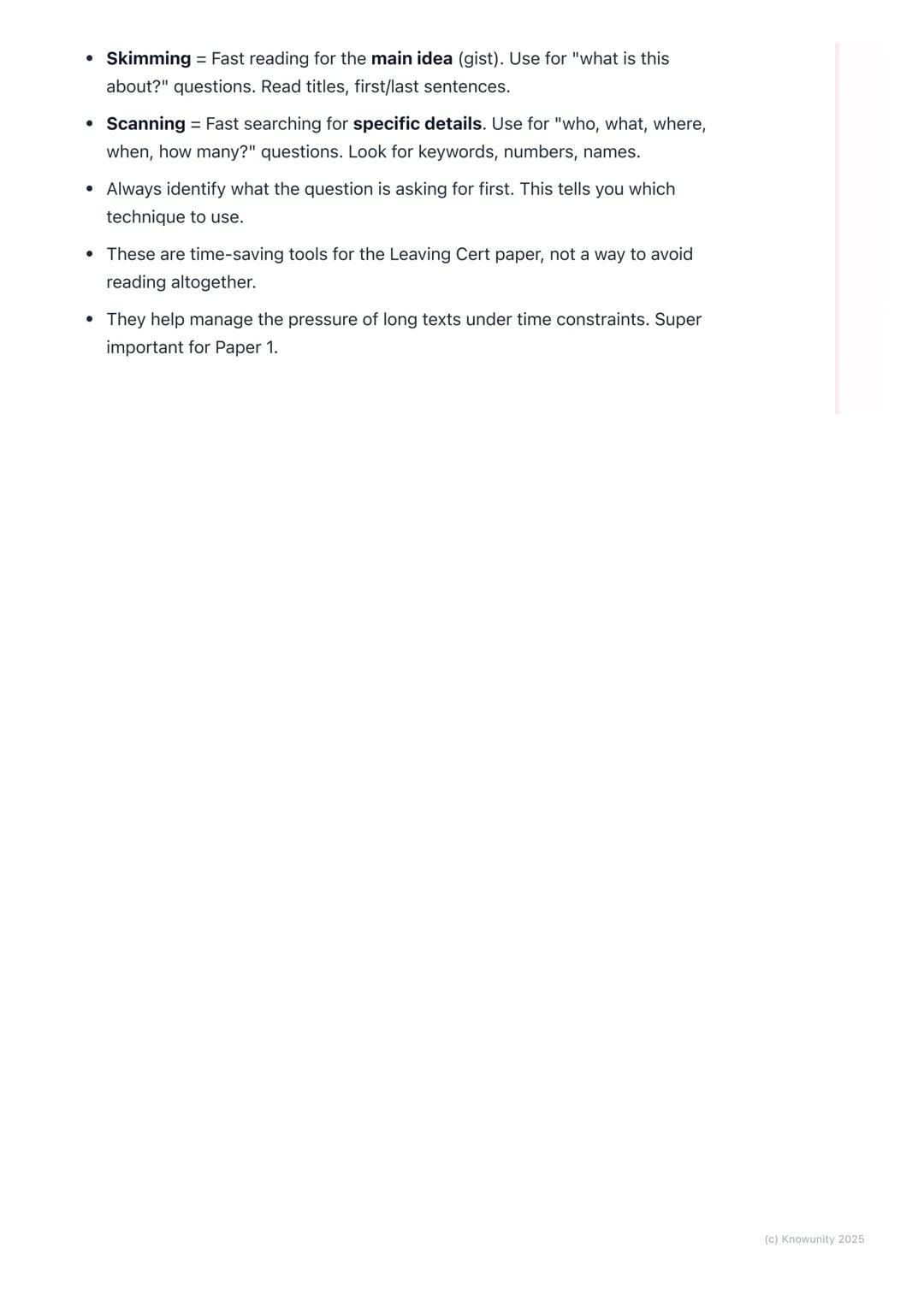
Your Exam Success Strategy
Remember that these techniques are time-saving tools, not shortcuts to avoid reading altogether. For complex questions about tone, opinion, or inference, you'll still need to read carefully - but skimming and scanning get you to the right section quickly.
The more you practise with past papers, the faster and more accurate you'll become. Start timing yourself and you'll be amazed at how much quicker you can work through those intimidating French texts.
Skimming gets you the big picture for "what's this about?" questions, whilst scanning hunts down specific details for "who, when, where?" questions. Always identify what the question wants first - this tells you which technique to use and sets you up for success.
Final Reminder: These skills are absolute lifesavers for managing long texts under exam pressure - they're your secret weapons for Paper 1!
We thought you’d never ask...
What is the Knowunity AI companion?
Our AI Companion is a student-focused AI tool that offers more than just answers. Built on millions of Knowunity resources, it provides relevant information, personalised study plans, quizzes, and content directly in the chat, adapting to your individual learning journey.
Where can I download the Knowunity app?
You can download the app from Google Play Store and Apple App Store.
Is Knowunity really free of charge?
That's right! Enjoy free access to study content, connect with fellow students, and get instant help – all at your fingertips.
Most popular content in French
2Most popular content
9 Irish
IrishIrish oral questions and answers
Questions and answers for the leaving cert oral
5th Year4264
 English
Key Quotes : Sive
Key Quotes and explanations: Sive
6th Year2842
IrishIrish oral questions
Outline of oral questions
5th Year2055
IrishIníon- le hÁine Durkin
Aine Durkin’s poem, Iníon: Themes & summary
5th Year850
IrishIrish poetry 2027
Iníon + Dínit an Bhróin
5th Year1133
IrishLC HL notes- Iníon (poem)
Includes poem in English and Irish, theme, key words & phrases
5th Year2284
EnglishCultural Context : Shawshank Redemption : Sive : Small Things Like These
Comparative Study : Cultural Context : Shawshank Redemption, Sive and Small Things Like These
6th Year1430
IrishMo Ghrá-sa (Idir Lúibíní)
Notes on mo ghrá-sa
5th Year380
IrishAn Gaeilge Aiste
Irish Language essay
6th Year1320
Can't find what you're looking for? Explore other subjects.
Students love us — and so will you.
4.6/5App Store
4.7/5Google Play
The app is very easy to use and well designed. I have found everything I was looking for so far and have been able to learn a lot from the presentations! I will definitely use the app for a class assignment! And of course it also helps a lot as an inspiration.
Stefan SiOS user
This app is really great. There are so many study notes and help [...]. My problem subject is French, for example, and the app has so many options for help. Thanks to this app, I have improved my French. I would recommend it to anyone.
Samantha KlichAndroid user
Wow, I am really amazed. I just tried the app because I've seen it advertised many times and was absolutely stunned. This app is THE HELP you want for school and above all, it offers so many things, such as workouts and fact sheets, which have been VERY helpful to me personally.
AnnaiOS user
French2 views·Updated Jun 13, 2026·5 pagesMastering Skimming and Scanning Techniques for Quick Reading
If you've ever felt overwhelmed by those massive French texts in your Leaving Cert exam, you're not alone! The good news is that you don't need to understand every single word to ace the reading comprehension section. These two game-changing...
1
of 5
Sign up to see the content. It's free!
- Access to all documents
- Improve your grades
- Join milions of students
Understanding Skimming and Scanning
Think of skimming like watching a movie trailer - you get the main plot without all the details. It's about reading quickly to grasp the general idea of a text rather than getting bogged down in specifics. When you skim, you're looking for the overall topic and the author's main point.
Scanning, on the other hand, is like searching for your mate's name on an exam results list. You ignore everything else and hunt for one specific piece of information - a date, name, number, or keyword. Your eyes move fast, but they're laser-focused on finding exactly what you need.
The key difference? Skimming answers "What's this about?" whilst scanning answers "Where's that specific detail?" Both techniques are absolutely essential for managing those lengthy French texts under exam pressure.
Quick Tip: Always read the question first to know whether you need to skim for the main idea or scan for specific details!
2
of 5Sign up to see the content. It's free!
- Access to all documents
- Improve your grades
- Join milions of students
How to Skim Like a Pro
When you need to understand the gist of a text, follow this step-by-step approach that'll save you precious minutes. Start by reading the title and any subheadings - these give you massive clues about what's coming up.
Next, read the first paragraph completely and the first sentence of every other paragraph. These topic sentences usually contain the main point of each section. Let your eyes float over the rest, picking up repeated words or cognates (words that look like English, such as 'information' or 'important').
Always finish by reading the final paragraph fully, as this typically contains the conclusion or summary. After this quick process, you should be able to explain the text's main theme in one or two sentences.
Pro Move: Look for images, graphs, or charts too - their captions often contain key information that makes everything clearer!
3
of 5Sign up to see the content. It's free!
- Access to all documents
- Improve your grades
- Join milions of students
Mastering the Scanning Technique
Scanning is all about having a clear target before you start hunting. First, identify exactly what you're looking for in the question - underline the keywords. Are you searching for a year, a person's name, a reason, or a quantity?
Think about what form your answer will take. A year will be four digits starting with 19 or 20, whilst names start with capital letters. Move your eyes quickly down the page in a pattern - some people prefer zigzag, others go straight down the middle.
The crucial bit is to ignore everything else except your target information. When you spot your keyword, stop immediately and read that sentence carefully to ensure it's the right context and actually answers the question.
Remember: If you don't know what you're looking for before you start, you're just reading aimlessly and wasting time!
4
of 5Sign up to see the content. It's free!
- Access to all documents
- Improve your grades
- Join milions of students
Putting It All Together
Let's say you're asked "What year did the festival begin?" about a French text. You'd scan for a four-digit number, ignoring everything else until you spot "2018" next to "pour la première fois" (for the first time). That's your answer - job done in seconds!
For skimming questions like "What's the main subject?", you'd quickly read the title, first paragraph, and key sentences to understand it's about a successful electronic music festival. You don't need every detail, just the overall theme.
Trust the cognates but watch out for false friends like "actuellement" (currently, not actually). Generally though, words that look English-ish are your friends and will help you navigate the text more confidently.
Exam Strategy: Skim the whole text first for context, then read the questions, then scan back for specific answers. This three-step approach maximises your efficiency.
5
of 5Sign up to see the content. It's free!
- Access to all documents
- Improve your grades
- Join milions of students
Your Exam Success Strategy
Remember that these techniques are time-saving tools, not shortcuts to avoid reading altogether. For complex questions about tone, opinion, or inference, you'll still need to read carefully - but skimming and scanning get you to the right section quickly.
The more you practise with past papers, the faster and more accurate you'll become. Start timing yourself and you'll be amazed at how much quicker you can work through those intimidating French texts.
Skimming gets you the big picture for "what's this about?" questions, whilst scanning hunts down specific details for "who, when, where?" questions. Always identify what the question wants first - this tells you which technique to use and sets you up for success.
Final Reminder: These skills are absolute lifesavers for managing long texts under exam pressure - they're your secret weapons for Paper 1!
We thought you’d never ask...
What is the Knowunity AI companion?
Our AI Companion is a student-focused AI tool that offers more than just answers. Built on millions of Knowunity resources, it provides relevant information, personalised study plans, quizzes, and content directly in the chat, adapting to your individual learning journey.
Where can I download the Knowunity app?
You can download the app from Google Play Store and Apple App Store.
Is Knowunity really free of charge?
That's right! Enjoy free access to study content, connect with fellow students, and get instant help – all at your fingertips.
Most popular content in French
2Most popular content
9IrishIrish oral questions and answers
Questions and answers for the leaving cert oral
5th Year4264
EnglishKey Quotes : Sive
Key Quotes and explanations: Sive
6th Year2842
IrishIrish oral questions
Outline of oral questions
5th Year2055
IrishIníon- le hÁine Durkin
Aine Durkin’s poem, Iníon: Themes & summary
5th Year850
IrishIrish poetry 2027
Iníon + Dínit an Bhróin
5th Year1133
IrishLC HL notes- Iníon (poem)
Includes poem in English and Irish, theme, key words & phrases
5th Year2284
EnglishCultural Context : Shawshank Redemption : Sive : Small Things Like These
Comparative Study : Cultural Context : Shawshank Redemption, Sive and Small Things Like These
6th Year1430
IrishMo Ghrá-sa (Idir Lúibíní)
Notes on mo ghrá-sa
5th Year380
IrishAn Gaeilge Aiste
Irish Language essay
6th Year1320
Can't find what you're looking for? Explore other subjects.
Students love us — and so will you.
4.6/5App Store
4.7/5Google Play
The app is very easy to use and well designed. I have found everything I was looking for so far and have been able to learn a lot from the presentations! I will definitely use the app for a class assignment! And of course it also helps a lot as an inspiration.
Stefan SiOS user
This app is really great. There are so many study notes and help [...]. My problem subject is French, for example, and the app has so many options for help. Thanks to this app, I have improved my French. I would recommend it to anyone.
Samantha KlichAndroid user
Wow, I am really amazed. I just tried the app because I've seen it advertised many times and was absolutely stunned. This app is THE HELP you want for school and above all, it offers so many things, such as workouts and fact sheets, which have been VERY helpful to me personally.
AnnaiOS user