
Writing about the supernatural in Macbeth can seem daunting, but...
 English Literature5,565 views·Updated Jun 9, 2026·4 pages
Exploring Supernatural Themes in Macbeth - Essay Plan
R
REVISION TIPS@revision_help556
1 / 4
1
of 4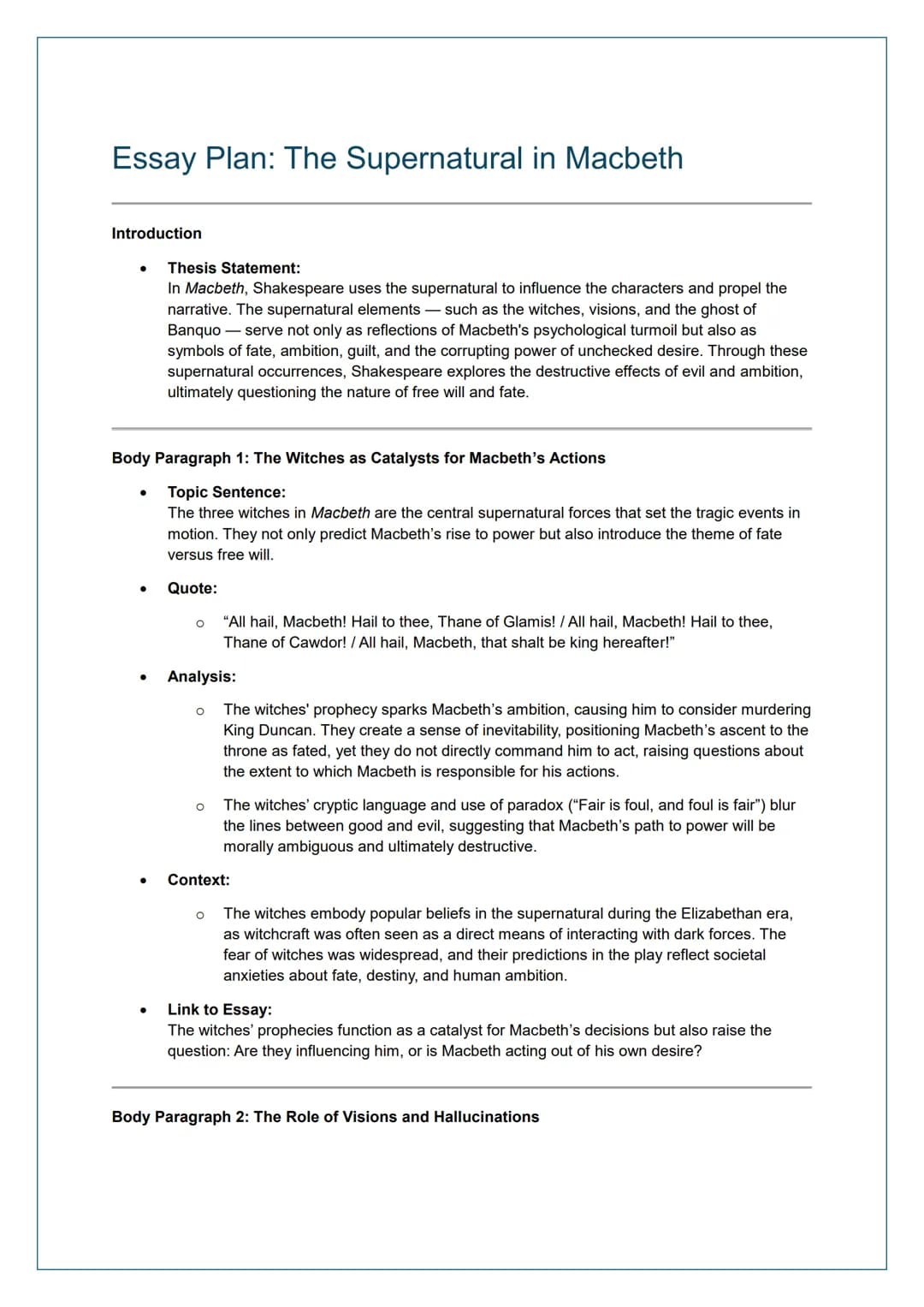
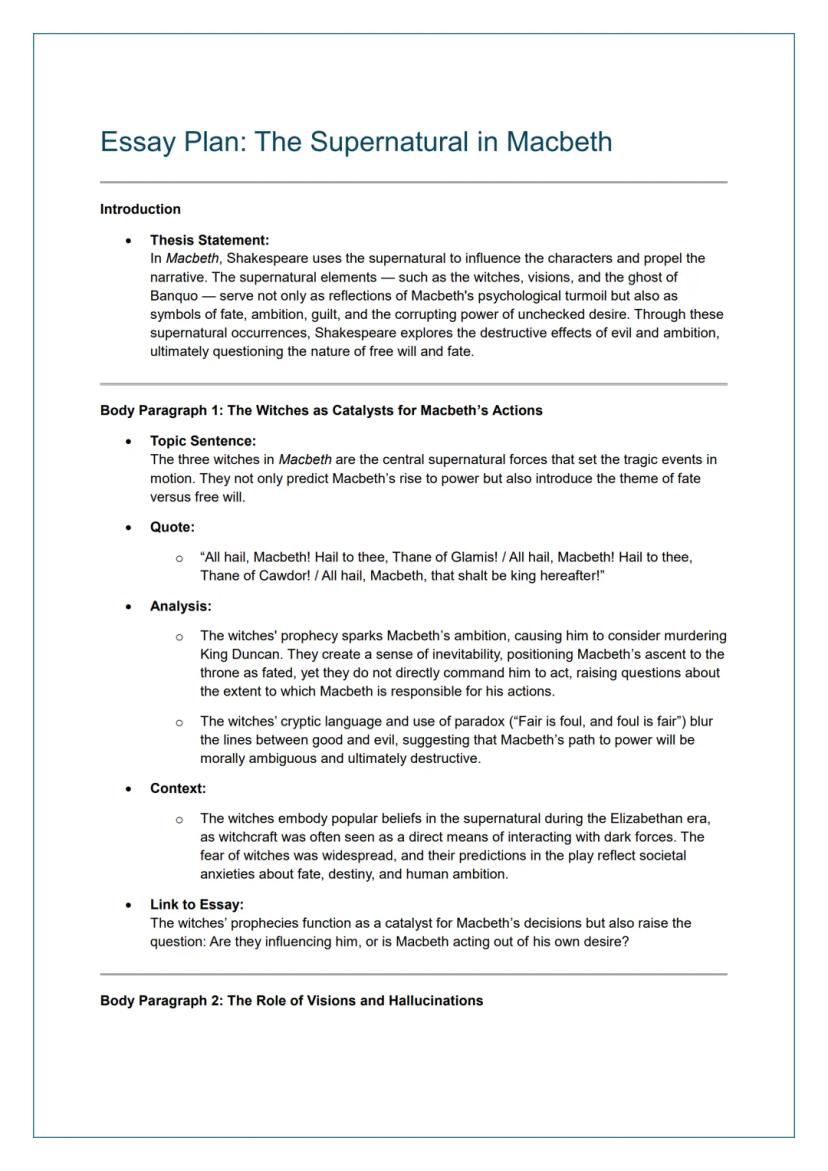
Essay Structure and The Witches
Your thesis statement should focus on how Shakespeare uses supernatural elements as both plot drivers and symbols of Macbeth's inner turmoil. Think of the supernatural as a mirror reflecting his psychological state whilst questioning whether fate or free will controls our actions.
The three witches are your starting point - they're the spark that ignites Macbeth's deadly ambition. Their famous prophecy "All hail, Macbeth, that shalt be king hereafter!" doesn't force him to kill Duncan, but it plants the seed of possibility. This is crucial for your analysis: do the witches control Macbeth, or do they simply reveal what he already desires?
Their paradoxical language like "Fair is foul, and foul is fair" perfectly captures how they blur moral boundaries. In Shakespeare's time, witches represented real fears about dark forces influencing human behaviour, making them particularly powerful symbols for audiences.
Quick Tip: Always link the witches back to the central question - are they influencing Macbeth or simply revealing his existing ambition? This tension drives your entire essay.
2
of 4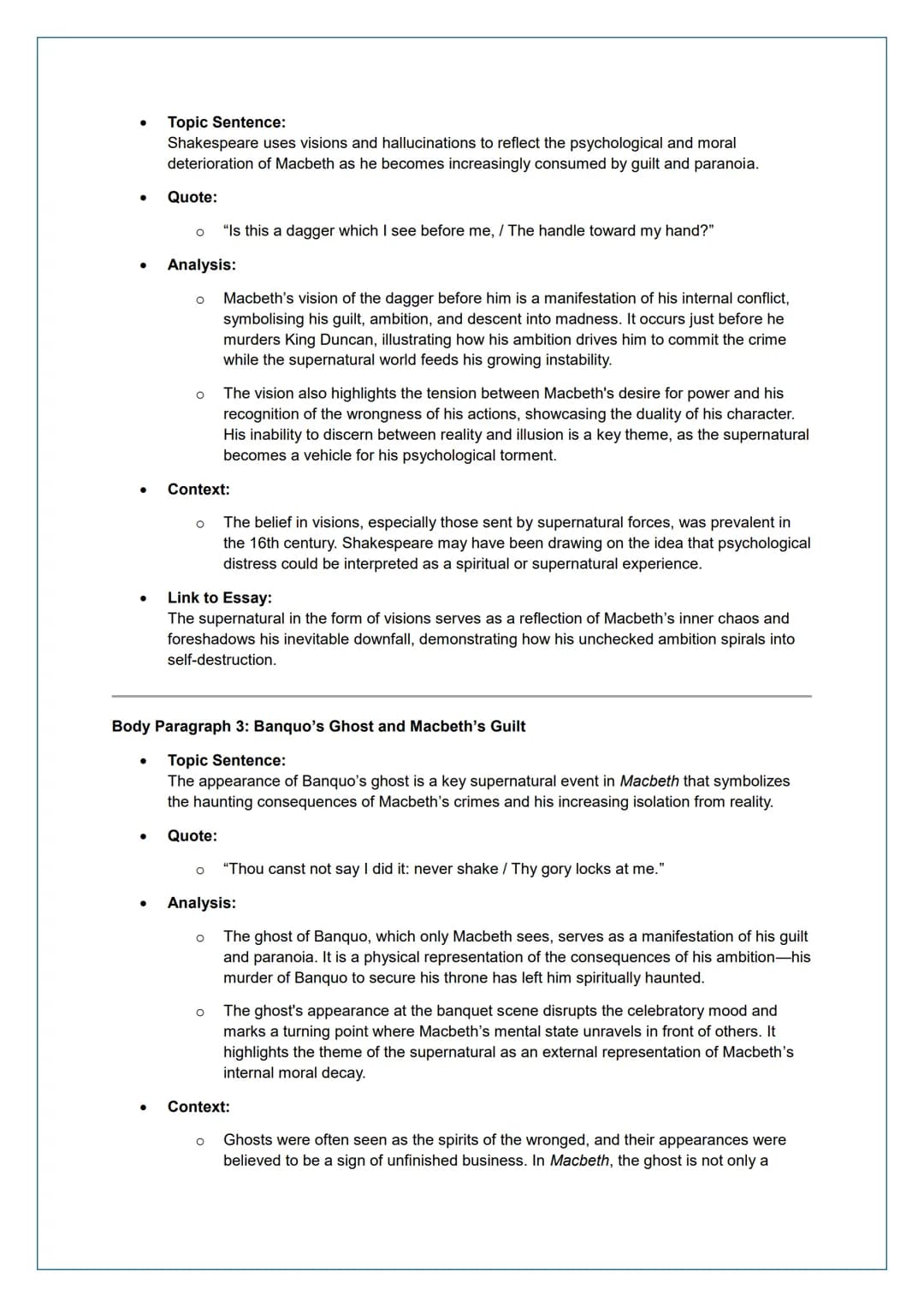
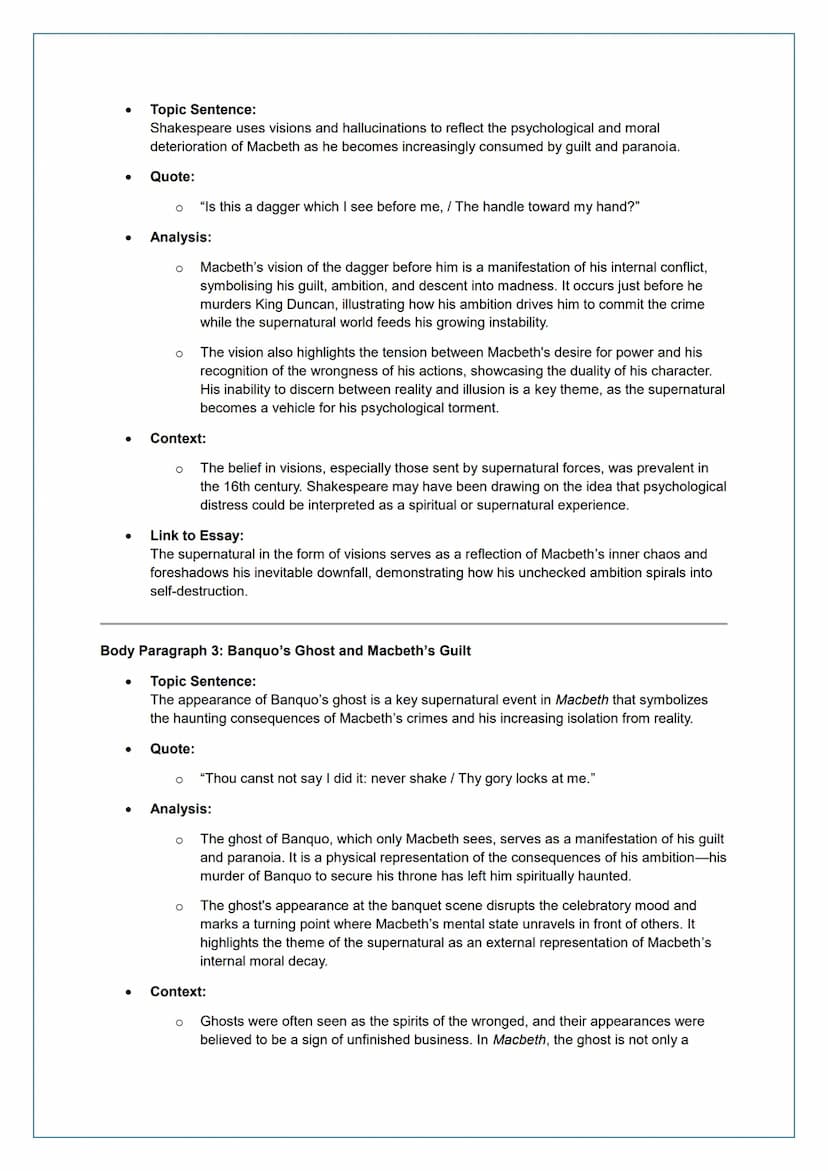
Visions and Hallucinations
Macbeth's supernatural visions reveal his crumbling mental state as guilt and paranoia consume him. The most famous example is his hallucination of a dagger before murdering Duncan: "Is this a dagger which I see before me, / The handle toward my hand?"
This floating dagger isn't just spooky imagery - it's Shakespeare showing us Macbeth's internal conflict made visible. He's torn between his burning ambition and his knowledge that murder is wrong. The fact he can't tell if the dagger is real reflects how he's losing his grip on reality.
These visions work brilliantly as psychological symbols. As Macbeth's crimes pile up, his supernatural experiences become more frequent and disturbing. Shakespeare understood that extreme guilt and stress can manifest as hallucinations, making the supernatural feel genuinely terrifying rather than just theatrical.
Remember: The visions aren't random - they directly reflect Macbeth's emotional state and foreshadow his downfall. Use them to show his psychological journey from conflicted nobleman to paranoid tyrant.
3
of 4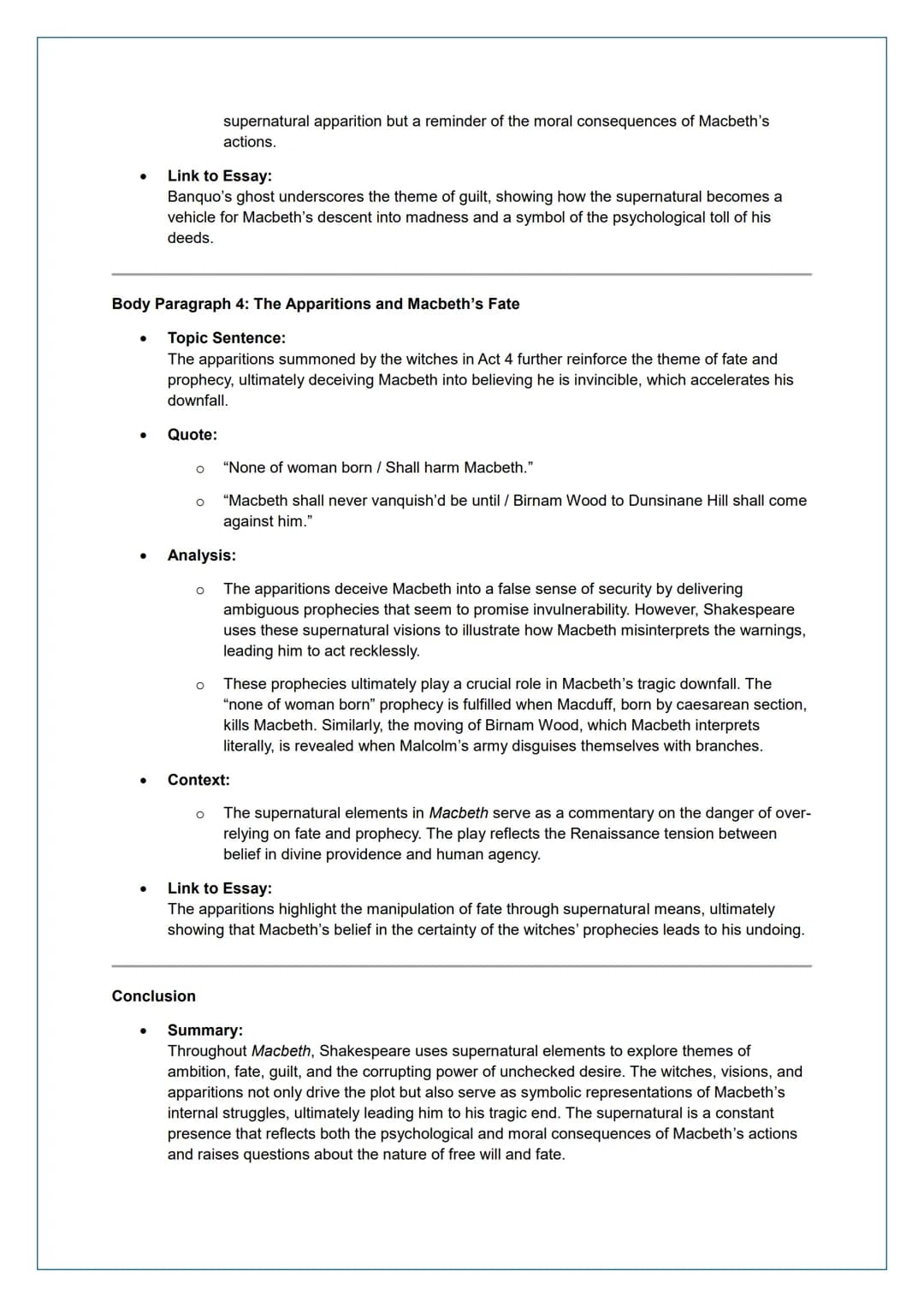
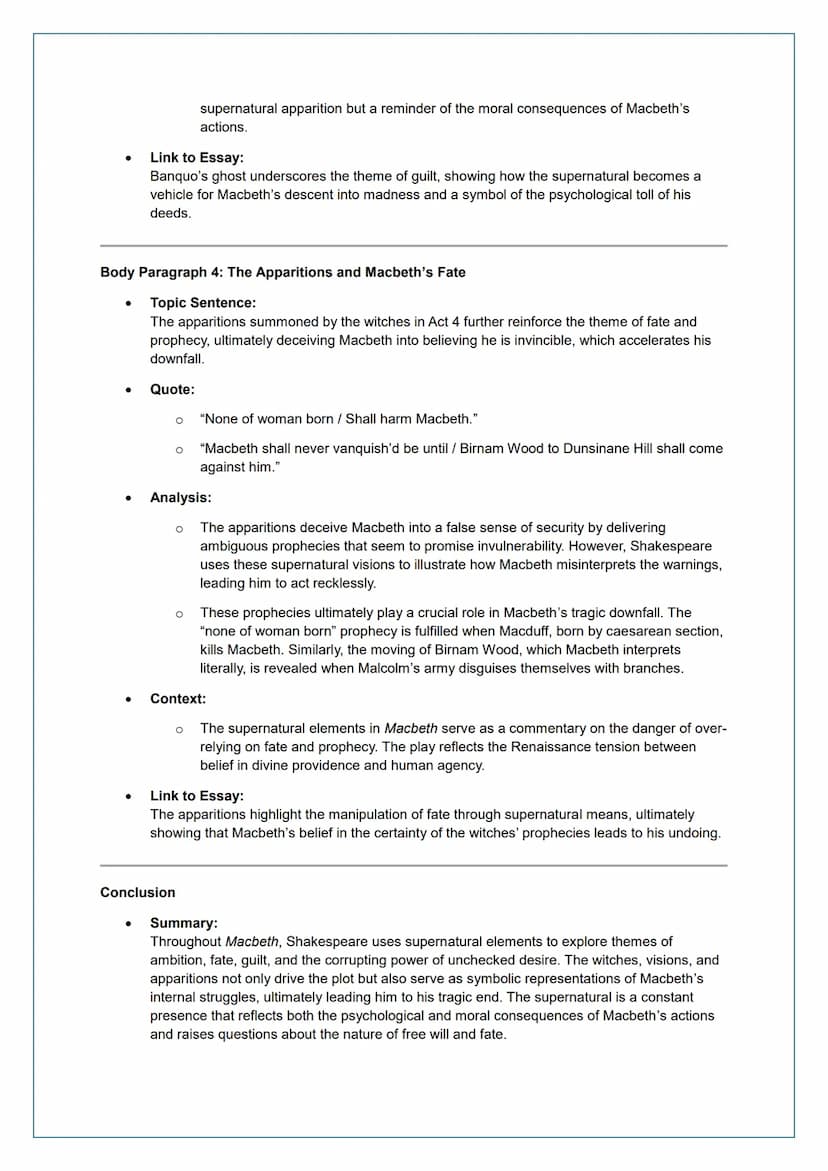
Banquo's Ghost and The Apparitions
Banquo's ghost represents the ultimate consequence of Macbeth's murderous ambition. Only Macbeth can see his former friend's "gory locks," which makes the banquet scene brilliantly dramatic. The ghost embodies his guilt made manifest - a constant reminder of his betrayal and moral corruption.
What makes this supernatural encounter particularly effective is how it isolates Macbeth. Whilst his guests see nothing, he's terrified by what his conscience has conjured. This marks the point where his mental deterioration becomes public, destroying his carefully maintained royal facade.
The apparitions in Act 4 deliver the final supernatural deception. Their prophecies about "none of woman born" and Birnam Wood moving seem to promise Macbeth invincibility, but they're cleverly ambiguous. Shakespeare uses these to show how desperately Macbeth clings to false hope, misinterpreting warnings that actually seal his fate.
These supernatural elements reflect Renaissance anxieties about relying too heavily on prophecy rather than moral action. The apparitions don't lie - they simply tell truths that Macbeth interprets incorrectly, leading directly to his destruction.
Key Insight: The supernatural becomes increasingly deceptive as the play progresses, mirroring Macbeth's growing self-deception about the consequences of his actions.
4
of 4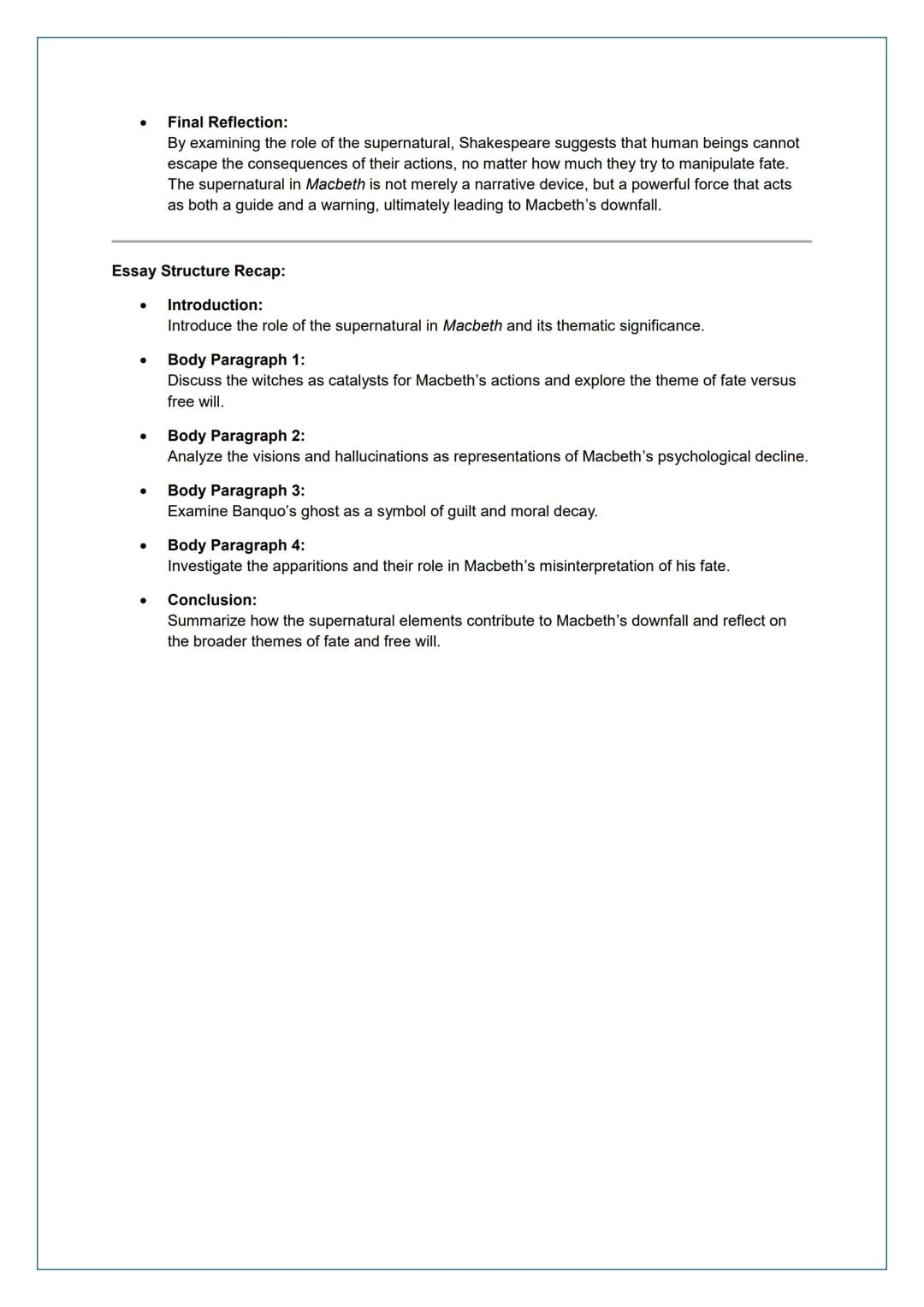
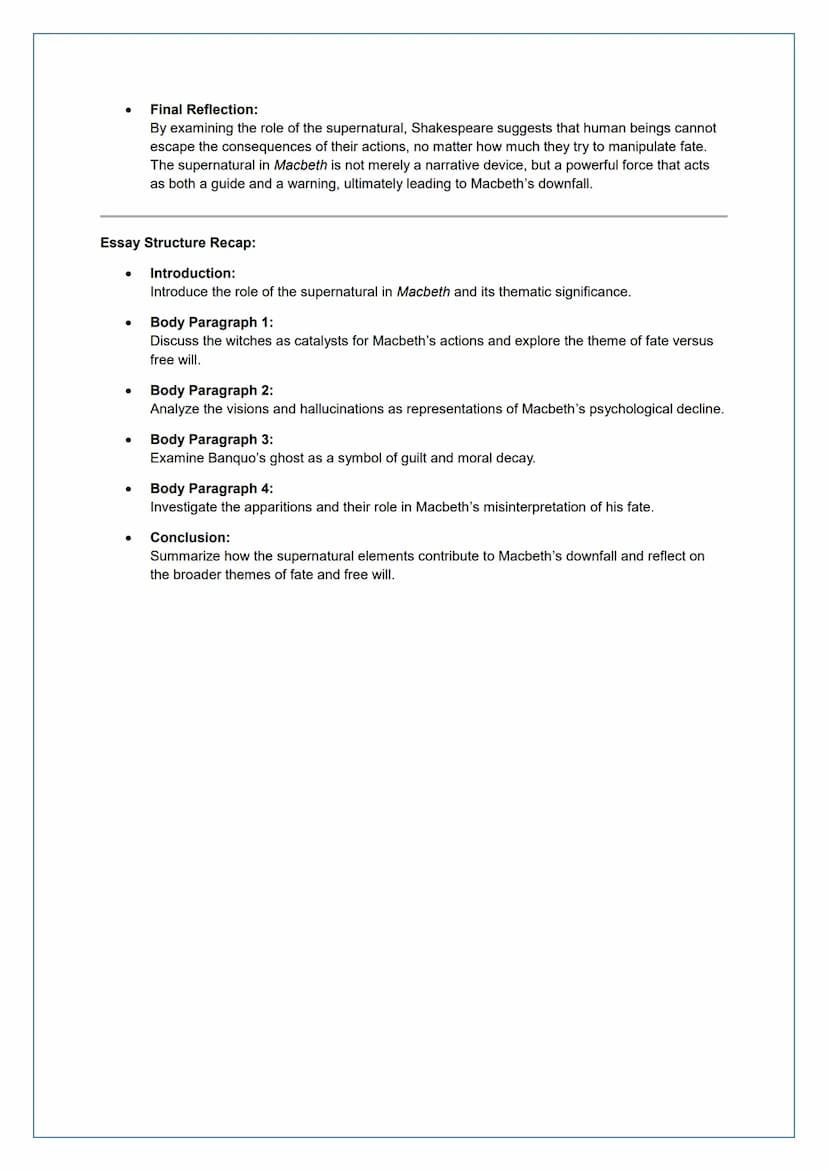
Bringing It All Together
Your conclusion should emphasise how Shakespeare uses supernatural elements as both external forces and internal reflections. The witches, visions, ghost, and apparitions aren't just plot devices - they're sophisticated tools for exploring human psychology and moral consequences.
The supernatural in Macbeth ultimately serves as both guide and warning. It reveals character, drives plot, and explores whether we shape our destiny or are shaped by forces beyond our control. Shakespeare suggests that whilst supernatural forces might influence us, we're ultimately responsible for our moral choices.
Your essay structure should flow logically: start with the witches as catalysts, move through visions showing psychological decline, examine Banquo's ghost as guilt manifestation, then conclude with apparitions revealing self-deception. Each paragraph should connect supernatural events to Macbeth's internal journey.
Remember that Shakespeare wrote for audiences who genuinely believed in witches and supernatural forces. This wasn't fantasy - it was psychological realism exploring how ambition, guilt, and fear can literally drive someone mad.
Final Tip: Always connect supernatural elements to larger themes. Don't just describe what happens - analyse what it reveals about human nature, ambition, and the consequences of moral corruption.
We thought you’d never ask...
What is the Knowunity AI companion?
Our AI Companion is a student-focused AI tool that offers more than just answers. Built on millions of Knowunity resources, it provides relevant information, personalised study plans, quizzes, and content directly in the chat, adapting to your individual learning journey.
Where can I download the Knowunity app?
You can download the app from Google Play Store and Apple App Store.
Is Knowunity really free of charge?
That's right! Enjoy free access to study content, connect with fellow students, and get instant help – all at your fingertips.
Most popular content: Writing Skills
9English LiteratureGrade 9 Macbeth Kingship Essay
Grade 9, full mark 30/30 essay on how Shakespeare presents Kingship in Macbeth. Marked as full marks by a Head of English and AQA examiner.
111,76225
English LiteratureMacbeth Rough Essay Plans
Themes supernatural, ambition and guilt
101,28710
English LanguageEnglish language paper 1 and 2
English language notes and guides to both papers
95315
English LiteratureMacbeth: Essay Plan For Guilt
Shakespeare Macbeth. GCSE.
94075
English LanguageCreative Writing Techniques
Enhance your imaginative writing skills with this comprehensive revision booklet. Explore essential techniques for character and setting creation, sensory descriptions, and narrative structure tailored for the English Language GCSE. Includes examples and strategies to engage readers effectively.
107,876167
 Drama
DramaKing Lear Act 1, Scene 1
King Lear Act 1 Scene 1. Quotes and analysis of language/structure
121992
English LiteratureAQA A-Level English Literature: A* Essays Paper 1
:)
123585
English LanguageEnglish language paper 1 Eduqas
A guide on how to answer questions and what to do on paper 1 english language (gcse) (eduqas mark scheme only)
1060117
English LanguageGCSE AQA English Language Paper One Question Four
Includes a guide on how to answer AQA GCSE English Language Question 4, Paper 1
102252
Most popular content in English Literature
9English LiteratureAn Inspector Calls: Character Insights
Explore in-depth analysis and key quotes for characters in J.B. Priestley's 'An Inspector Calls'. This resource covers Gerald Croft, Inspector Goole, Sheila Birling, Mrs. Birling, Eric Birling, and Eva Smith, focusing on themes of class, gender roles, and social responsibility. Ideal for students aiming for Grade 8 and above.
1025,415907
English LiteratureRomeo and Juliet: Key themes
Key Romeo and Juliet themes and analysed quotes
106,696198
English LiteratureMacbeth: Guilt and Ambition
Explore the complex themes of guilt and ambition in Shakespeare's 'Macbeth'. This analysis covers key characters, including Macbeth and Lady Macbeth, their moral dilemmas, and the tragic consequences of their ambition. Ideal for students studying character motivations, thematic elements, and the psychological impact of power. Includes insights on the natural order, manipulation, and the descent into madness.
919,066397
E
English LiteratureExplore the World of English Literature
Master the key concepts and works of English literature with this comprehensive flashcard set designed for grade 10 students.
112,0841
I
English LiteratureInspector Calls Quiz (YR 10 MOCKS)
for YR 10 GCSE mock on Inspector Calls
102,1261
English LiteratureExploring Macbeth's Themes
Dive into the intricate themes of Shakespeare's Macbeth, including the supernatural, ambition, guilt, and kingship. This analysis features key quotes and insights that reveal how these themes intertwine to shape the characters and the narrative. Ideal for students seeking a deeper understanding of the play's moral complexities and psychological depth.
1015,846524
English LiteraturePower & Conflict Poetry Analysis
Explore in-depth analyses of key poems for GCSE English Literature, including Ozymandias, Storm on the Island, London, My Last Duchess, and more. This resource covers themes, structure, and key quotes to enhance your understanding of war and conflict in poetry. Ideal for exam preparation and comparative studies.
1050,0132,921
E
English LiteratureExploring 'A Christmas Carol': Themes, Characters, and Lessons
Delve into the main themes, key characters, and valuable lessons in Charles Dickens' 'A Christmas Carol'. Discover the impact of Scrooge's transformation and the significance of love, redemption, and the true meaning of Christmas.
101,2440
English LiteratureDuality in Jekyll and Hyde
Explore the intricate themes of duality, repression, and morality in 'Dr. Jekyll and Mr. Hyde' through key quotes and in-depth analysis. This summary highlights the contrasting personas of Jekyll and Hyde, the struggle between good and evil, and the societal implications of secrecy and identity. Ideal for students studying Robert Louis Stevenson's classic work.
1010,547275
Most popular content
9 Sociology
Sociology of Education Overview
Explore comprehensive A-Level Sociology notes on the education system, covering key theories, policies, and sociological perspectives. This resource includes insights on marketisation, gender roles, cultural deprivation, and educational inequalities, providing a thorough understanding of how education shapes social stratification and individual achievement. Ideal for exam preparation and in-depth study.
12102,8353,040
SociologySociology of Families: Comprehensive Revision
Dive into an extensive overview of family dynamics, perspectives, and patterns in sociology. This resource covers key concepts such as family diversity, gender roles, marriage, and the impact of social policies on family structures. Perfect for A-Level Sociology students preparing for Paper 2.
1273,6002,306
CriminologyCriminology: Crime & Punishment Overview
Comprehensive mindmaps covering key concepts in the Crime and Punishment topic for WJEC Criminology Unit 4. This resource includes detailed insights into the Criminal Justice System, crime prevention strategies, sentencing models, and the roles of various agencies. Ideal for A-Level revision, ensuring you grasp essential theories and legislative processes to excel in your exams.
1254,8561,059
SociologyComprehensive Crime & Deviance Overview
Explore an extensive revision of crime and deviance topics, including theories, types of crime, and the impact of media. This resource covers key concepts such as Marxism, functionalism, gender and crime, and the influence of globalization on criminal behavior. Ideal for students seeking a thorough understanding of criminology and its various theories. Type: Full Topic Revision.
1251,6361,399
English LiteratureAn Inspector Calls: Character Insights
Explore in-depth analysis and key quotes for characters in J.B. Priestley's 'An Inspector Calls'. This resource covers Gerald Croft, Inspector Goole, Sheila Birling, Mrs. Birling, Eric Birling, and Eva Smith, focusing on themes of class, gender roles, and social responsibility. Ideal for students aiming for Grade 8 and above.
1025,415907
CriminologyWJEC Unit 4 Criminology
Criminology unit 4 detailed revision note
127,146125
C
 Biology
Cell Biology and Cell structure
cell structures
93,1990
CriminologyCriminology Theories Overview
Explore key criminology theories and their implications on crime and deviance. This comprehensive summary covers biological, psychological, and sociological perspectives, including labelling theory, right realism, and the impact of social campaigns on policy development. Ideal for A-Level criminology students seeking to understand the complexities of criminal behaviour and the factors influencing crime prevention strategies.
129,756210
English LiteratureRomeo and Juliet: Key themes
Key Romeo and Juliet themes and analysed quotes
106,696198
Can't find what you're looking for? Explore other subjects.
Students love us — and so will you.
4.6/5App Store
4.7/5Google Play
The app is very easy to use and well designed. I have found everything I was looking for so far and have been able to learn a lot from the presentations! I will definitely use the app for a class assignment! And of course it also helps a lot as an inspiration.
Stefan SiOS user
This app is really great. There are so many study notes and help [...]. My problem subject is French, for example, and the app has so many options for help. Thanks to this app, I have improved my French. I would recommend it to anyone.
Samantha KlichAndroid user
Wow, I am really amazed. I just tried the app because I've seen it advertised many times and was absolutely stunned. This app is THE HELP you want for school and above all, it offers so many things, such as workouts and fact sheets, which have been VERY helpful to me personally.
AnnaiOS user
English Literature5,565 views·Updated Jun 9, 2026·4 pagesExploring Supernatural Themes in Macbeth - Essay Plan
R
REVISION TIPS@revision_help556
Writing about the supernatural in Macbeth can seem daunting, but it's actually one of the most exciting aspects of the play! This essay plan breaks down how Shakespeare uses witches, ghosts, and visions to explore deep themes like ambition, guilt,...
1
of 4
Sign up to see the content. It's free!
- Access to all documents
- Improve your grades
- Join milions of students
Essay Structure and The Witches
Your thesis statement should focus on how Shakespeare uses supernatural elements as both plot drivers and symbols of Macbeth's inner turmoil. Think of the supernatural as a mirror reflecting his psychological state whilst questioning whether fate or free will controls our actions.
The three witches are your starting point - they're the spark that ignites Macbeth's deadly ambition. Their famous prophecy "All hail, Macbeth, that shalt be king hereafter!" doesn't force him to kill Duncan, but it plants the seed of possibility. This is crucial for your analysis: do the witches control Macbeth, or do they simply reveal what he already desires?
Their paradoxical language like "Fair is foul, and foul is fair" perfectly captures how they blur moral boundaries. In Shakespeare's time, witches represented real fears about dark forces influencing human behaviour, making them particularly powerful symbols for audiences.
Quick Tip: Always link the witches back to the central question - are they influencing Macbeth or simply revealing his existing ambition? This tension drives your entire essay.
2
of 4Sign up to see the content. It's free!
- Access to all documents
- Improve your grades
- Join milions of students
Visions and Hallucinations
Macbeth's supernatural visions reveal his crumbling mental state as guilt and paranoia consume him. The most famous example is his hallucination of a dagger before murdering Duncan: "Is this a dagger which I see before me, / The handle toward my hand?"
This floating dagger isn't just spooky imagery - it's Shakespeare showing us Macbeth's internal conflict made visible. He's torn between his burning ambition and his knowledge that murder is wrong. The fact he can't tell if the dagger is real reflects how he's losing his grip on reality.
These visions work brilliantly as psychological symbols. As Macbeth's crimes pile up, his supernatural experiences become more frequent and disturbing. Shakespeare understood that extreme guilt and stress can manifest as hallucinations, making the supernatural feel genuinely terrifying rather than just theatrical.
Remember: The visions aren't random - they directly reflect Macbeth's emotional state and foreshadow his downfall. Use them to show his psychological journey from conflicted nobleman to paranoid tyrant.
3
of 4Sign up to see the content. It's free!
- Access to all documents
- Improve your grades
- Join milions of students
Banquo's Ghost and The Apparitions
Banquo's ghost represents the ultimate consequence of Macbeth's murderous ambition. Only Macbeth can see his former friend's "gory locks," which makes the banquet scene brilliantly dramatic. The ghost embodies his guilt made manifest - a constant reminder of his betrayal and moral corruption.
What makes this supernatural encounter particularly effective is how it isolates Macbeth. Whilst his guests see nothing, he's terrified by what his conscience has conjured. This marks the point where his mental deterioration becomes public, destroying his carefully maintained royal facade.
The apparitions in Act 4 deliver the final supernatural deception. Their prophecies about "none of woman born" and Birnam Wood moving seem to promise Macbeth invincibility, but they're cleverly ambiguous. Shakespeare uses these to show how desperately Macbeth clings to false hope, misinterpreting warnings that actually seal his fate.
These supernatural elements reflect Renaissance anxieties about relying too heavily on prophecy rather than moral action. The apparitions don't lie - they simply tell truths that Macbeth interprets incorrectly, leading directly to his destruction.
Key Insight: The supernatural becomes increasingly deceptive as the play progresses, mirroring Macbeth's growing self-deception about the consequences of his actions.
4
of 4Sign up to see the content. It's free!
- Access to all documents
- Improve your grades
- Join milions of students
Bringing It All Together
Your conclusion should emphasise how Shakespeare uses supernatural elements as both external forces and internal reflections. The witches, visions, ghost, and apparitions aren't just plot devices - they're sophisticated tools for exploring human psychology and moral consequences.
The supernatural in Macbeth ultimately serves as both guide and warning. It reveals character, drives plot, and explores whether we shape our destiny or are shaped by forces beyond our control. Shakespeare suggests that whilst supernatural forces might influence us, we're ultimately responsible for our moral choices.
Your essay structure should flow logically: start with the witches as catalysts, move through visions showing psychological decline, examine Banquo's ghost as guilt manifestation, then conclude with apparitions revealing self-deception. Each paragraph should connect supernatural events to Macbeth's internal journey.
Remember that Shakespeare wrote for audiences who genuinely believed in witches and supernatural forces. This wasn't fantasy - it was psychological realism exploring how ambition, guilt, and fear can literally drive someone mad.
Final Tip: Always connect supernatural elements to larger themes. Don't just describe what happens - analyse what it reveals about human nature, ambition, and the consequences of moral corruption.
We thought you’d never ask...
What is the Knowunity AI companion?
Our AI Companion is a student-focused AI tool that offers more than just answers. Built on millions of Knowunity resources, it provides relevant information, personalised study plans, quizzes, and content directly in the chat, adapting to your individual learning journey.
Where can I download the Knowunity app?
You can download the app from Google Play Store and Apple App Store.
Is Knowunity really free of charge?
That's right! Enjoy free access to study content, connect with fellow students, and get instant help – all at your fingertips.
Most popular content: Writing Skills
9English LiteratureGrade 9 Macbeth Kingship Essay
Grade 9, full mark 30/30 essay on how Shakespeare presents Kingship in Macbeth. Marked as full marks by a Head of English and AQA examiner.
111,76225
English LiteratureMacbeth Rough Essay Plans
Themes supernatural, ambition and guilt
101,28710
English LanguageEnglish language paper 1 and 2
English language notes and guides to both papers
95315
English LiteratureMacbeth: Essay Plan For Guilt
Shakespeare Macbeth. GCSE.
94075
English LanguageCreative Writing Techniques
Enhance your imaginative writing skills with this comprehensive revision booklet. Explore essential techniques for character and setting creation, sensory descriptions, and narrative structure tailored for the English Language GCSE. Includes examples and strategies to engage readers effectively.
107,876167
DramaKing Lear Act 1, Scene 1
King Lear Act 1 Scene 1. Quotes and analysis of language/structure
121992
English LiteratureAQA A-Level English Literature: A* Essays Paper 1
:)
123585
English LanguageEnglish language paper 1 Eduqas
A guide on how to answer questions and what to do on paper 1 english language (gcse) (eduqas mark scheme only)
1060117
English LanguageGCSE AQA English Language Paper One Question Four
Includes a guide on how to answer AQA GCSE English Language Question 4, Paper 1
102252
Most popular content in English Literature
9English LiteratureAn Inspector Calls: Character Insights
Explore in-depth analysis and key quotes for characters in J.B. Priestley's 'An Inspector Calls'. This resource covers Gerald Croft, Inspector Goole, Sheila Birling, Mrs. Birling, Eric Birling, and Eva Smith, focusing on themes of class, gender roles, and social responsibility. Ideal for students aiming for Grade 8 and above.
1025,415907
English LiteratureRomeo and Juliet: Key themes
Key Romeo and Juliet themes and analysed quotes
106,696198
English LiteratureMacbeth: Guilt and Ambition
Explore the complex themes of guilt and ambition in Shakespeare's 'Macbeth'. This analysis covers key characters, including Macbeth and Lady Macbeth, their moral dilemmas, and the tragic consequences of their ambition. Ideal for students studying character motivations, thematic elements, and the psychological impact of power. Includes insights on the natural order, manipulation, and the descent into madness.
919,066397
E
English LiteratureExplore the World of English Literature
Master the key concepts and works of English literature with this comprehensive flashcard set designed for grade 10 students.
112,0841
I
English LiteratureInspector Calls Quiz (YR 10 MOCKS)
for YR 10 GCSE mock on Inspector Calls
102,1261
English LiteratureExploring Macbeth's Themes
Dive into the intricate themes of Shakespeare's Macbeth, including the supernatural, ambition, guilt, and kingship. This analysis features key quotes and insights that reveal how these themes intertwine to shape the characters and the narrative. Ideal for students seeking a deeper understanding of the play's moral complexities and psychological depth.
1015,846524
English LiteraturePower & Conflict Poetry Analysis
Explore in-depth analyses of key poems for GCSE English Literature, including Ozymandias, Storm on the Island, London, My Last Duchess, and more. This resource covers themes, structure, and key quotes to enhance your understanding of war and conflict in poetry. Ideal for exam preparation and comparative studies.
1050,0132,921
E
English LiteratureExploring 'A Christmas Carol': Themes, Characters, and Lessons
Delve into the main themes, key characters, and valuable lessons in Charles Dickens' 'A Christmas Carol'. Discover the impact of Scrooge's transformation and the significance of love, redemption, and the true meaning of Christmas.
101,2440
English LiteratureDuality in Jekyll and Hyde
Explore the intricate themes of duality, repression, and morality in 'Dr. Jekyll and Mr. Hyde' through key quotes and in-depth analysis. This summary highlights the contrasting personas of Jekyll and Hyde, the struggle between good and evil, and the societal implications of secrecy and identity. Ideal for students studying Robert Louis Stevenson's classic work.
1010,547275
Most popular content
9SociologySociology of Education Overview
Explore comprehensive A-Level Sociology notes on the education system, covering key theories, policies, and sociological perspectives. This resource includes insights on marketisation, gender roles, cultural deprivation, and educational inequalities, providing a thorough understanding of how education shapes social stratification and individual achievement. Ideal for exam preparation and in-depth study.
12102,8353,040
SociologySociology of Families: Comprehensive Revision
Dive into an extensive overview of family dynamics, perspectives, and patterns in sociology. This resource covers key concepts such as family diversity, gender roles, marriage, and the impact of social policies on family structures. Perfect for A-Level Sociology students preparing for Paper 2.
1273,6002,306
CriminologyCriminology: Crime & Punishment Overview
Comprehensive mindmaps covering key concepts in the Crime and Punishment topic for WJEC Criminology Unit 4. This resource includes detailed insights into the Criminal Justice System, crime prevention strategies, sentencing models, and the roles of various agencies. Ideal for A-Level revision, ensuring you grasp essential theories and legislative processes to excel in your exams.
1254,8561,059
SociologyComprehensive Crime & Deviance Overview
Explore an extensive revision of crime and deviance topics, including theories, types of crime, and the impact of media. This resource covers key concepts such as Marxism, functionalism, gender and crime, and the influence of globalization on criminal behavior. Ideal for students seeking a thorough understanding of criminology and its various theories. Type: Full Topic Revision.
1251,6361,399
English LiteratureAn Inspector Calls: Character Insights
Explore in-depth analysis and key quotes for characters in J.B. Priestley's 'An Inspector Calls'. This resource covers Gerald Croft, Inspector Goole, Sheila Birling, Mrs. Birling, Eric Birling, and Eva Smith, focusing on themes of class, gender roles, and social responsibility. Ideal for students aiming for Grade 8 and above.
1025,415907
CriminologyWJEC Unit 4 Criminology
Criminology unit 4 detailed revision note
127,146125
C
BiologyCell Biology and Cell structure
cell structures
93,1990
CriminologyCriminology Theories Overview
Explore key criminology theories and their implications on crime and deviance. This comprehensive summary covers biological, psychological, and sociological perspectives, including labelling theory, right realism, and the impact of social campaigns on policy development. Ideal for A-Level criminology students seeking to understand the complexities of criminal behaviour and the factors influencing crime prevention strategies.
129,756210
English LiteratureRomeo and Juliet: Key themes
Key Romeo and Juliet themes and analysed quotes
106,696198
Can't find what you're looking for? Explore other subjects.
Students love us — and so will you.
4.6/5App Store
4.7/5Google Play
The app is very easy to use and well designed. I have found everything I was looking for so far and have been able to learn a lot from the presentations! I will definitely use the app for a class assignment! And of course it also helps a lot as an inspiration.
Stefan SiOS user
This app is really great. There are so many study notes and help [...]. My problem subject is French, for example, and the app has so many options for help. Thanks to this app, I have improved my French. I would recommend it to anyone.
Samantha KlichAndroid user
Wow, I am really amazed. I just tried the app because I've seen it advertised many times and was absolutely stunned. This app is THE HELP you want for school and above all, it offers so many things, such as workouts and fact sheets, which have been VERY helpful to me personally.
AnnaiOS user