
Giuseppe is a haunting poem that transforms a seemingly innocent... Show more
 English Literature119 views·Updated May 23, 2026·5 pages
Analysis of Giuseppe (Poems of the Decade) by Roderick Ford

millie@millie_xmtr
1 / 5
1
of 5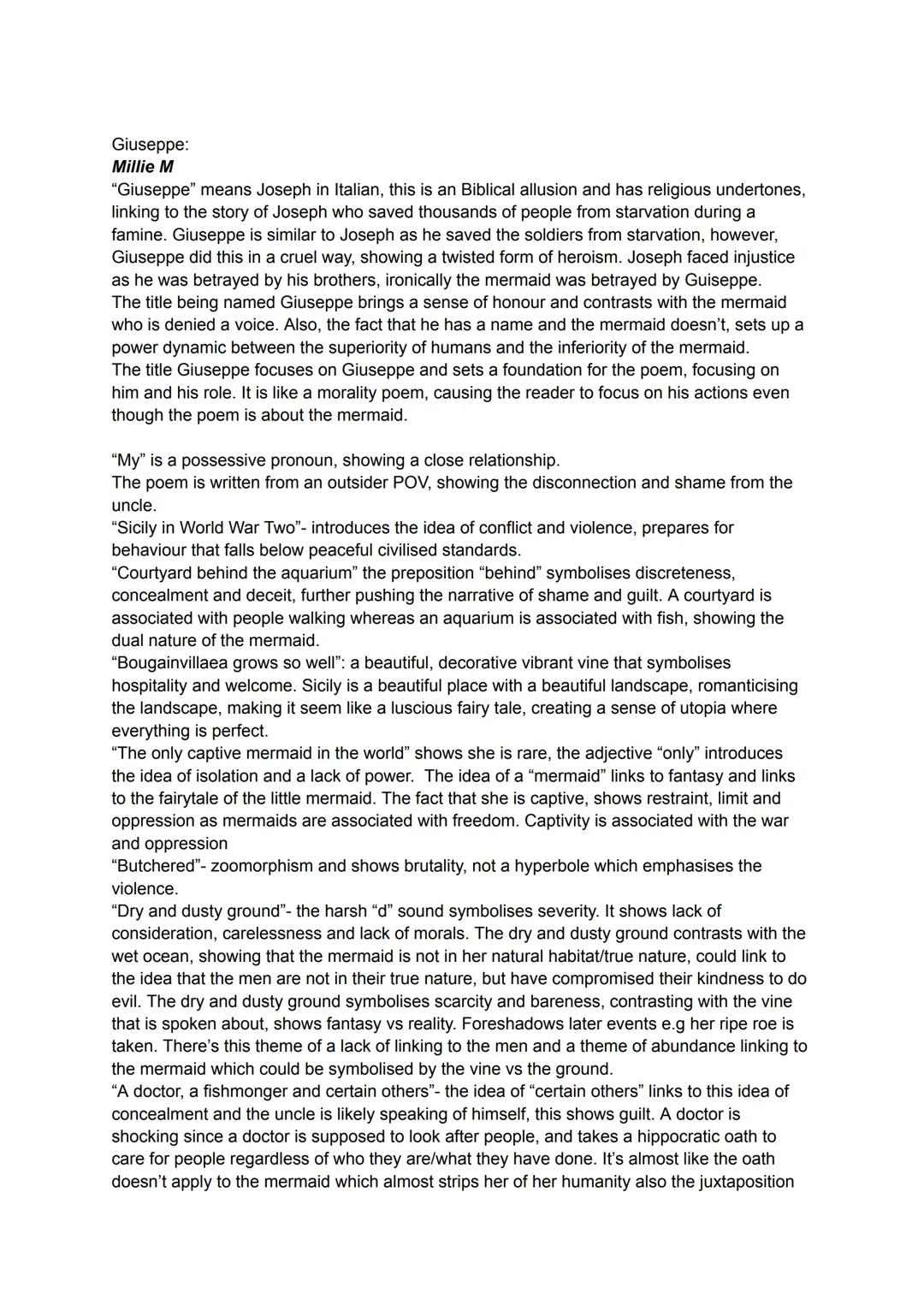
Title Analysis and Setting
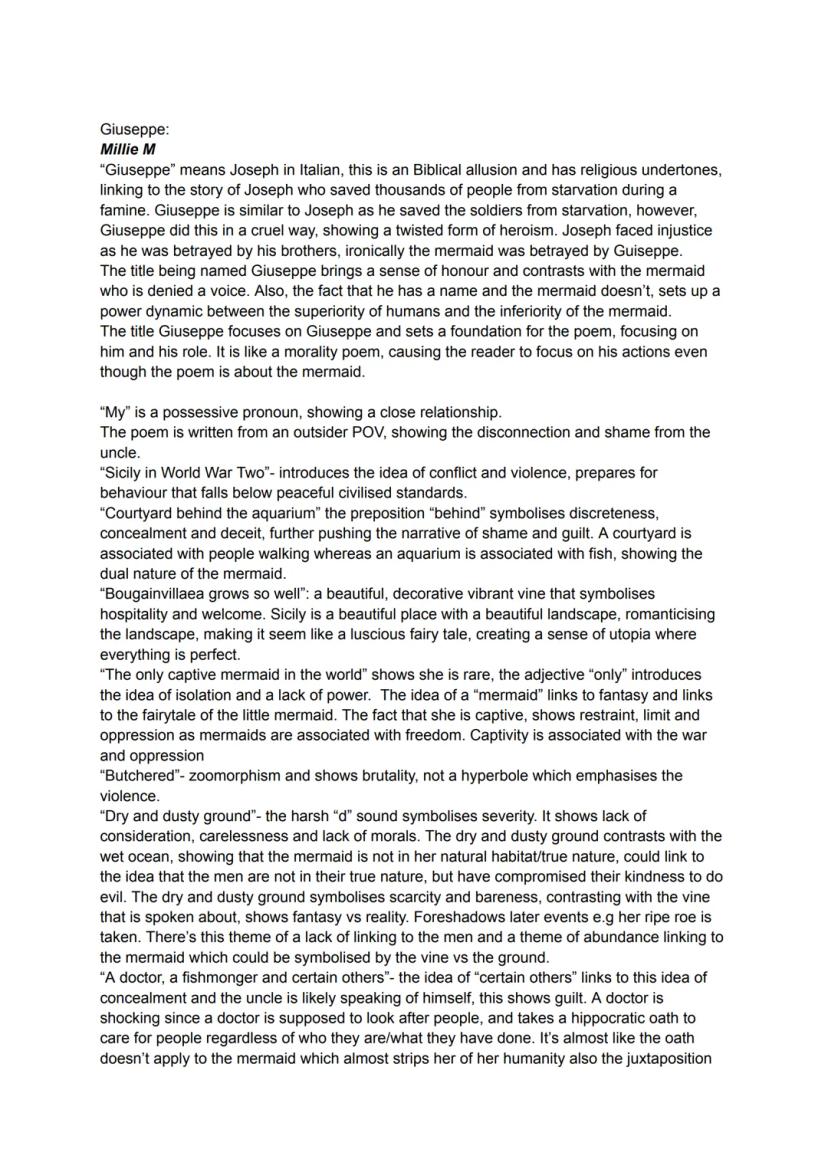
The poem's title Giuseppe (Italian for Joseph) creates a brilliant biblical parallel that sets up the entire moral framework. Just like the Biblical Joseph who saved people from famine, Giuseppe feeds starving soldiers - but through twisted, cruel means that pervert the original story of heroism.
The setting immediately signals conflict and moral breakdown. Sicily in World War Two prepares us for behaviour that falls below civilised standards, while the courtyard behind the aquarium suggests secrecy and shame. The beautiful bougainvillaea creates a fairy-tale atmosphere that sharply contrasts with the horror to come.
The captive mermaid represents ultimate powerlessness - she's the "only" one in the world, emphasising her isolation and vulnerability. Mermaids traditionally symbolise freedom and enchanting voices, making her captivity and silence particularly tragic. The men who decide her fate include a doctor and fishmonger, representing the duality between healing/harming and human/animal treatment.
Key insight: The shifting pronouns from "she" to "it" reveal Giuseppe's psychological struggle between recognising the mermaid's humanity and objectifying her to justify his actions.
2
of 5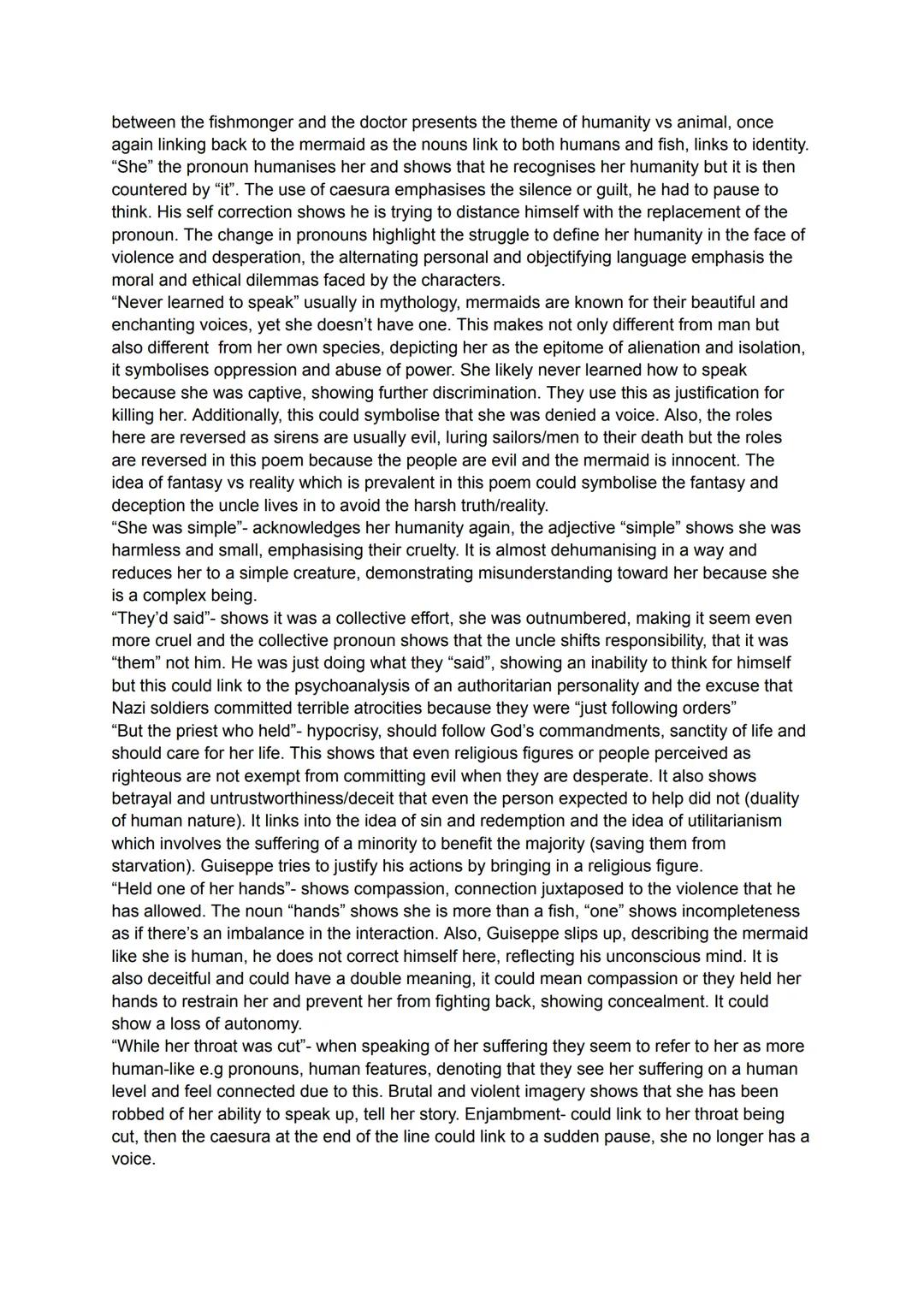
The Mermaid's Humanity and Silencing
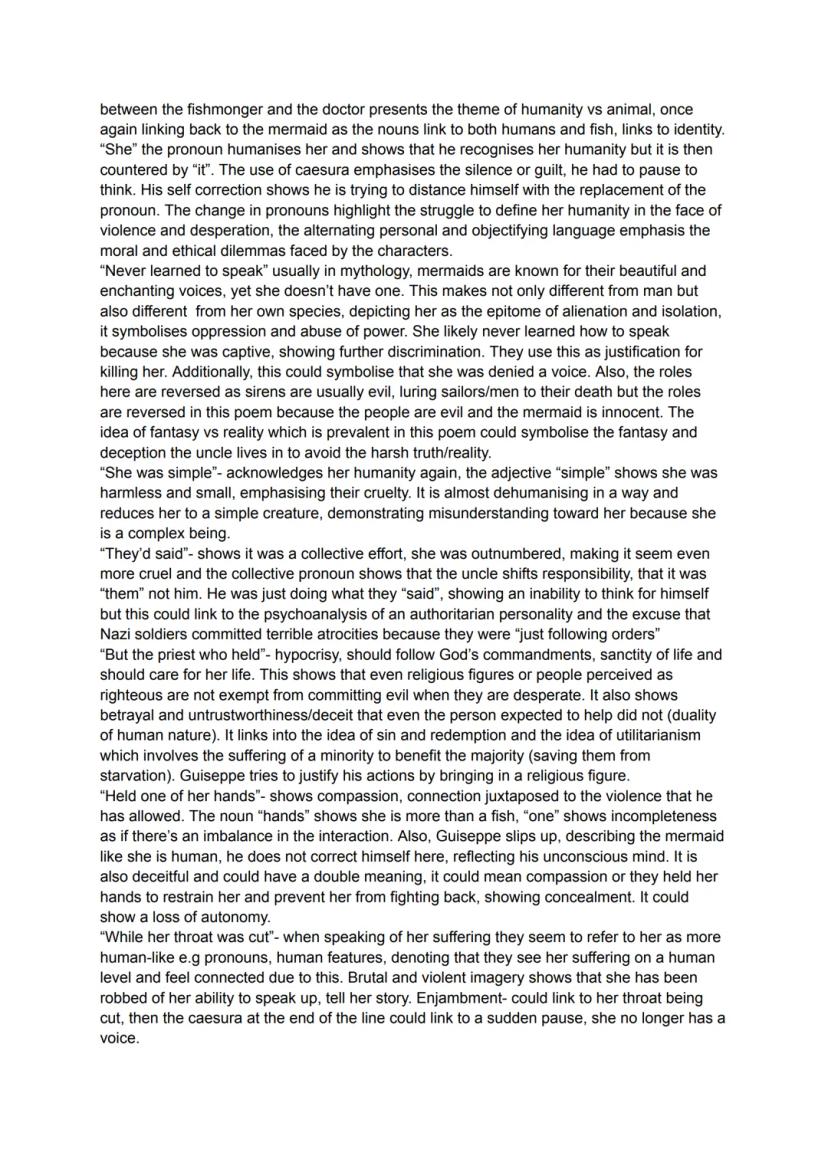
The most tragic aspect of the mermaid is that she "never learned to speak" - completely reversing the traditional mythology where mermaids lure sailors with beautiful voices. This silencing represents the ultimate oppression, denying her any agency or ability to defend herself.
Giuseppe's language constantly shifts between humanising and dehumanising her. When he says "she was simple", he acknowledges her harmless nature whilst simultaneously reducing her complexity. The collective decision-making ("they'd said") shows how Giuseppe shifts responsibility onto the group, echoing the dangerous psychology of "just following orders."
Even the priest's involvement adds layers of hypocrisy and betrayal. Rather than protecting the vulnerable, this supposed moral authority participates in her destruction. The detail that he "held one of her hands" while her throat was cut shows the disturbing combination of false compassion with brutal violence.
Key insight: The alternating use of human and animal terminology reveals the characters' internal conflict - they recognise her humanity most clearly when describing her suffering.
3
of 5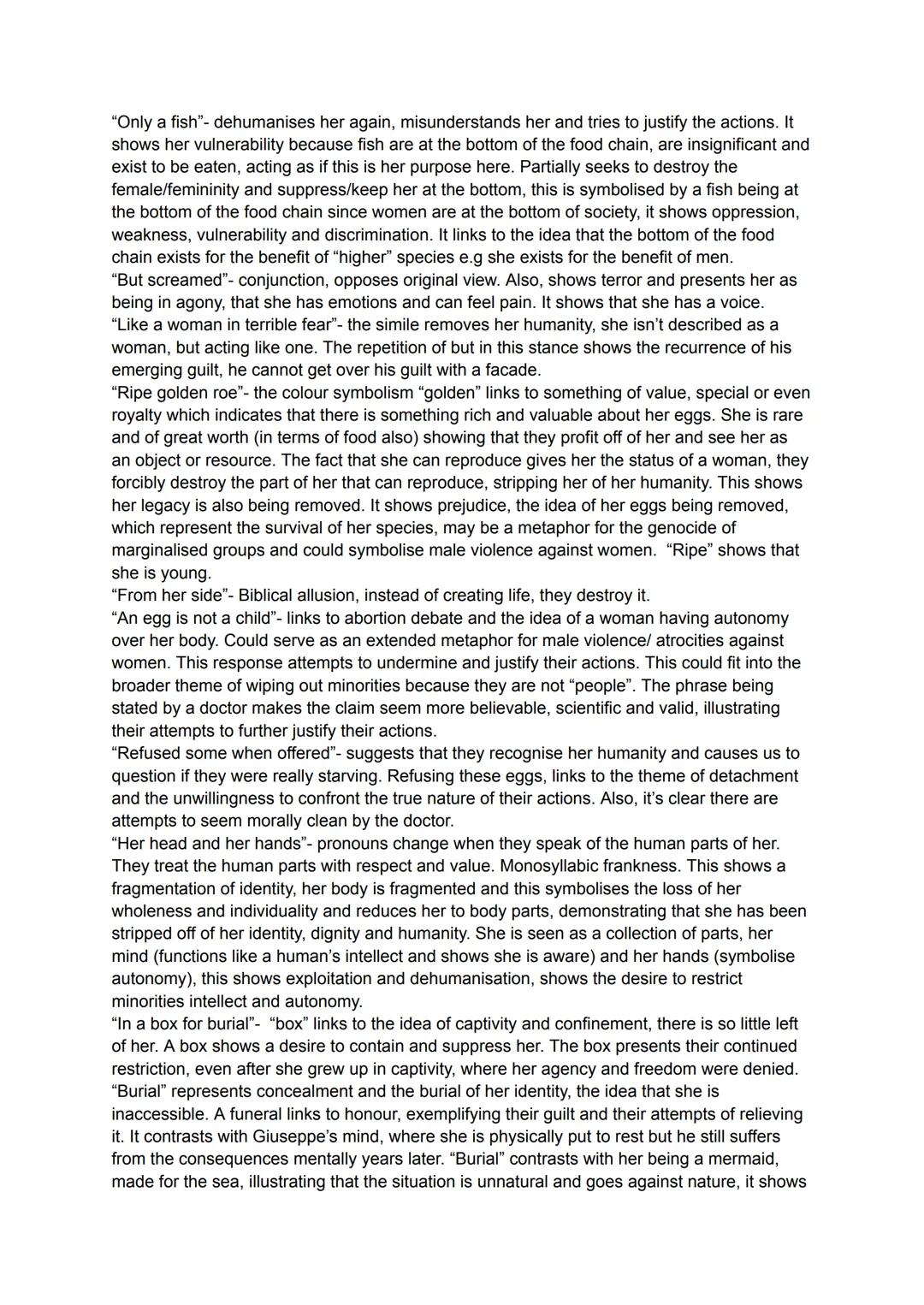
Violence and Dehumanisation
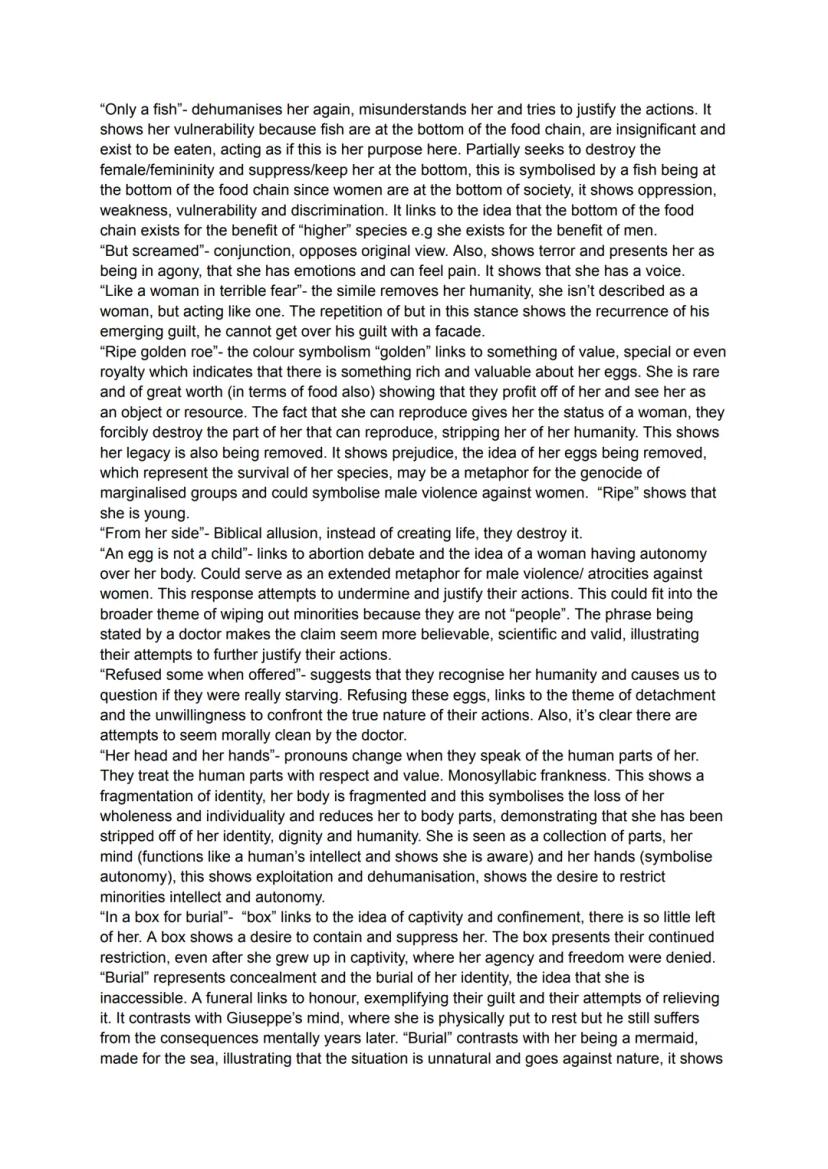
The brutal descriptions reveal how the men psychologically manage their guilt through dehumanisation. They insist she's "only a fish" yet she "screamed like a woman in terrible fear" - the simile actually removes her humanity even whilst acknowledging her human-like suffering.
Her "ripe golden roe" becomes a symbol of exploitation - the golden colour suggests something precious and royal, yet they're stealing her reproductive potential and future. This connects to broader themes about male violence against women and the destruction of minority groups' ability to survive and continue.
The fragmentation of her body into "her head and her hands" shows how they've reduced her to useful parts rather than seeing her as a whole being. Ironically, they show respect for these human-like parts whilst consuming the rest, revealing their distorted moral compass.
Key insight: The imagery of her eggs being removed references both abortion debates and genocidal practices - the systematic destruction of a group's ability to reproduce and survive.
4
of 5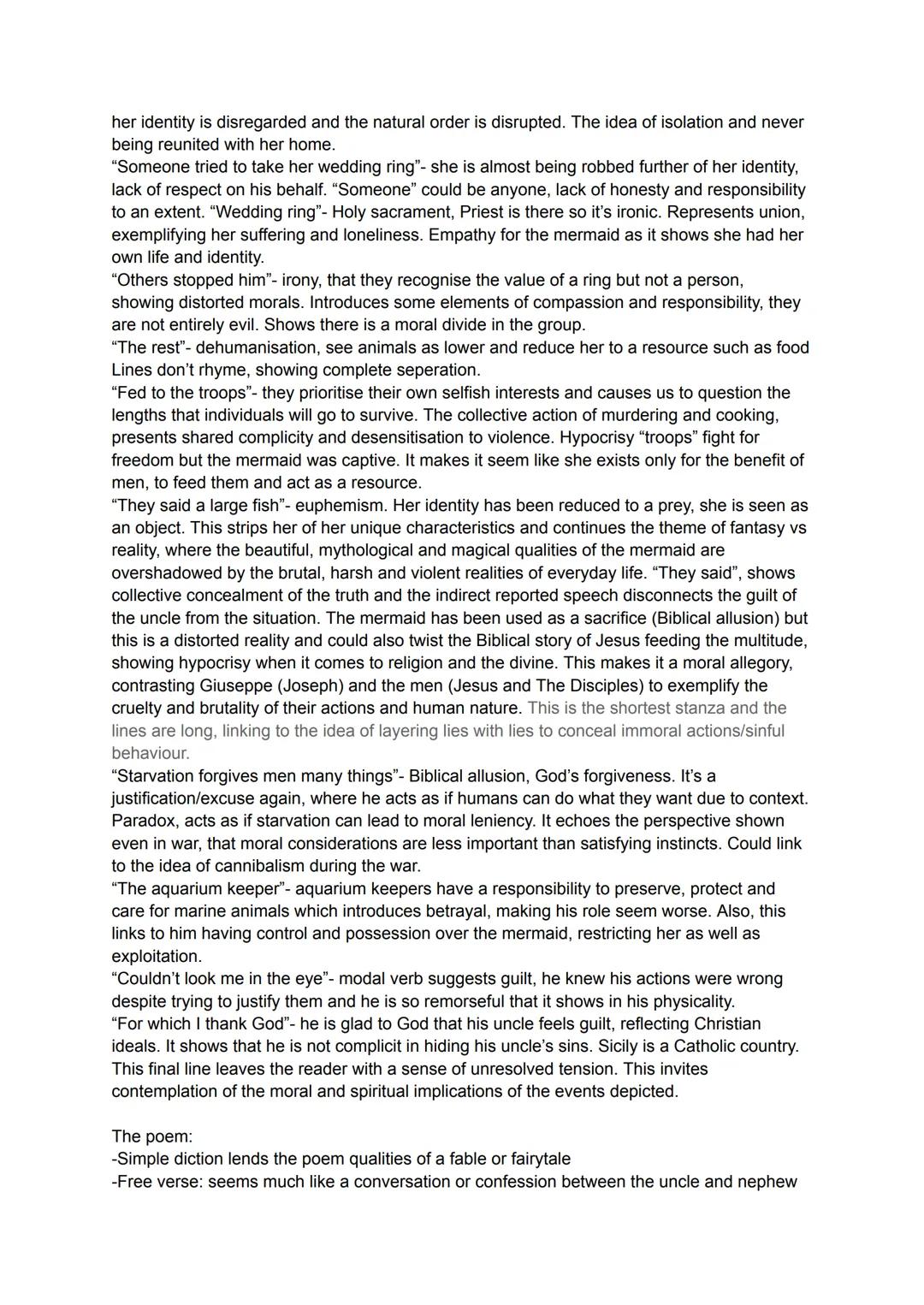
Burial, Consumption and Justification
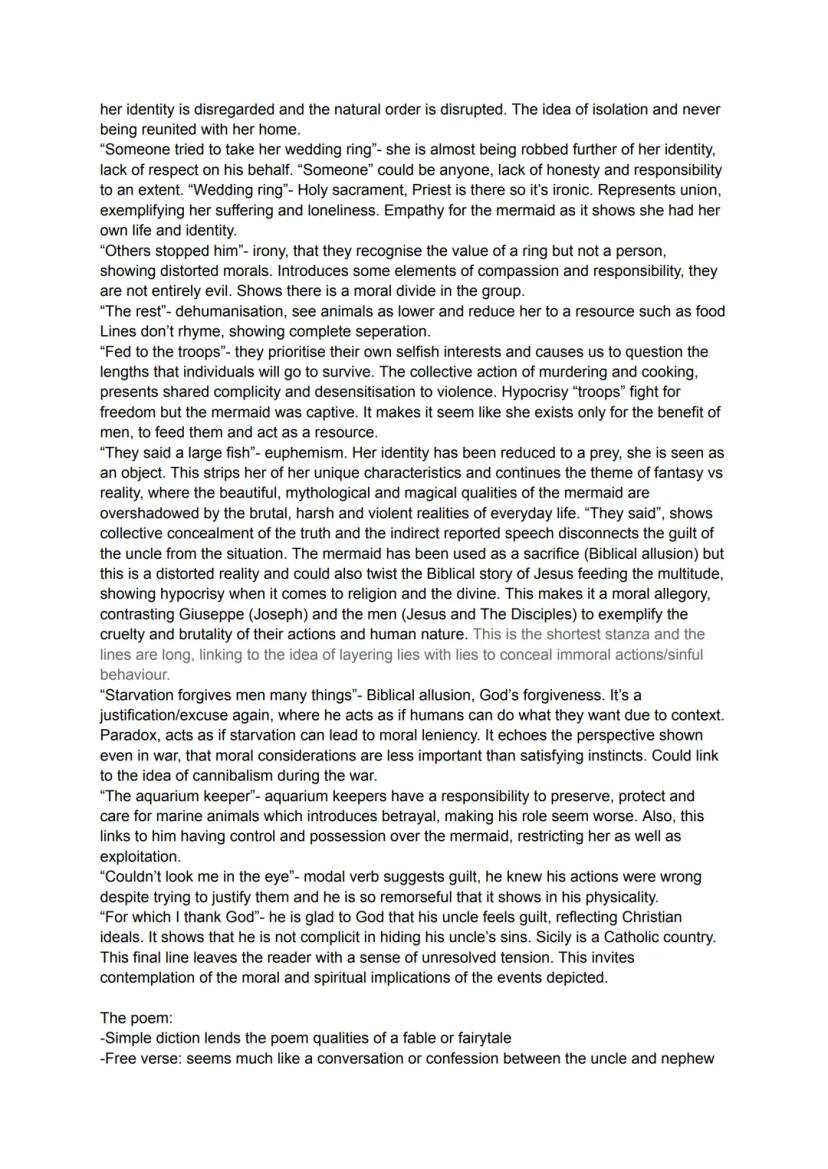
The burial in a box represents multiple layers of containment and concealment. Even in death, she's confined rather than returned to her natural ocean home. The attempted theft of her wedding ring shows how exploitation continues even after death, though some men's intervention reveals moral divisions within the group.
When her remains are "fed to the troops" under the lie of being "a large fish", the dehumanisation becomes complete. This euphemism allows everyone to participate without confronting the truth, showing how collective lies enable atrocities.
Giuseppe's final justification that "starvation forgives men many things" attempts to use survival as moral absolution. Yet the aquarium keeper's inability to look him in the eye reveals the persistent guilt that no rationalisation can erase.
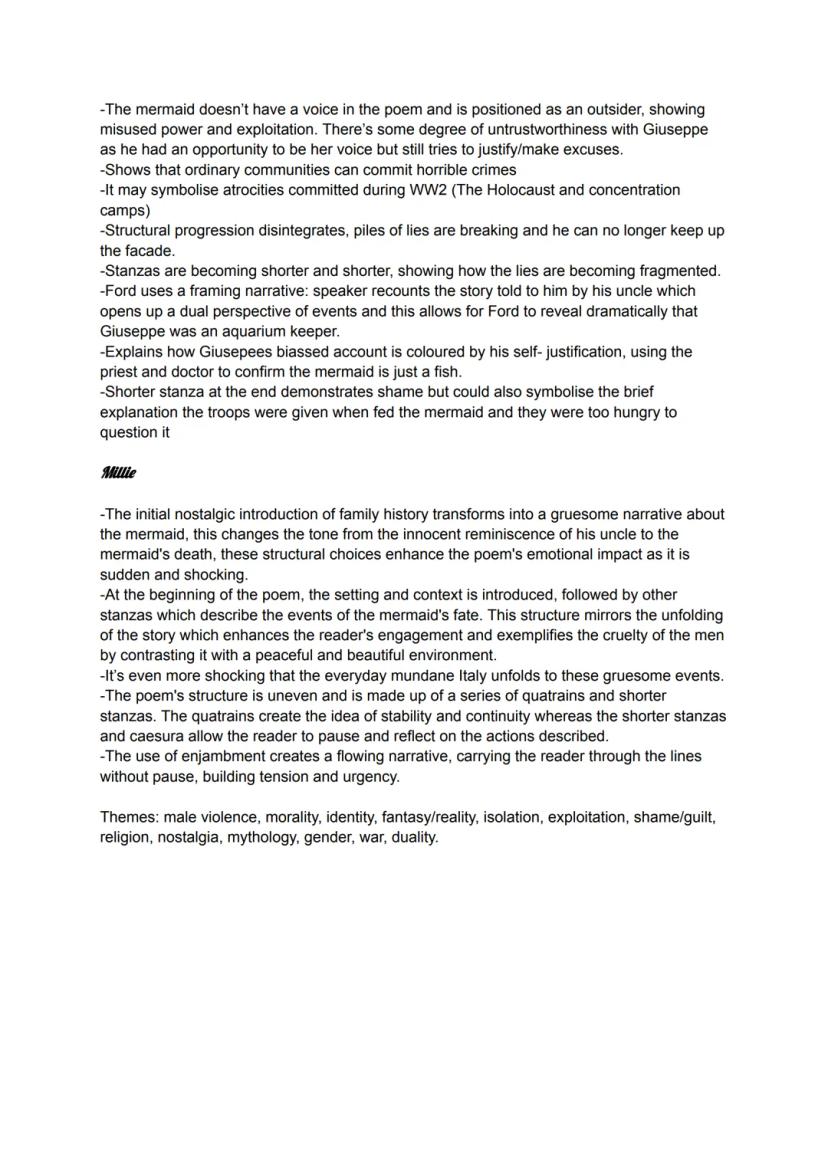
Key insight: The poem's structure mirrors its content - shorter, more fragmented stanzas reflect how lies and justifications are breaking down under the weight of guilt.
5
of 5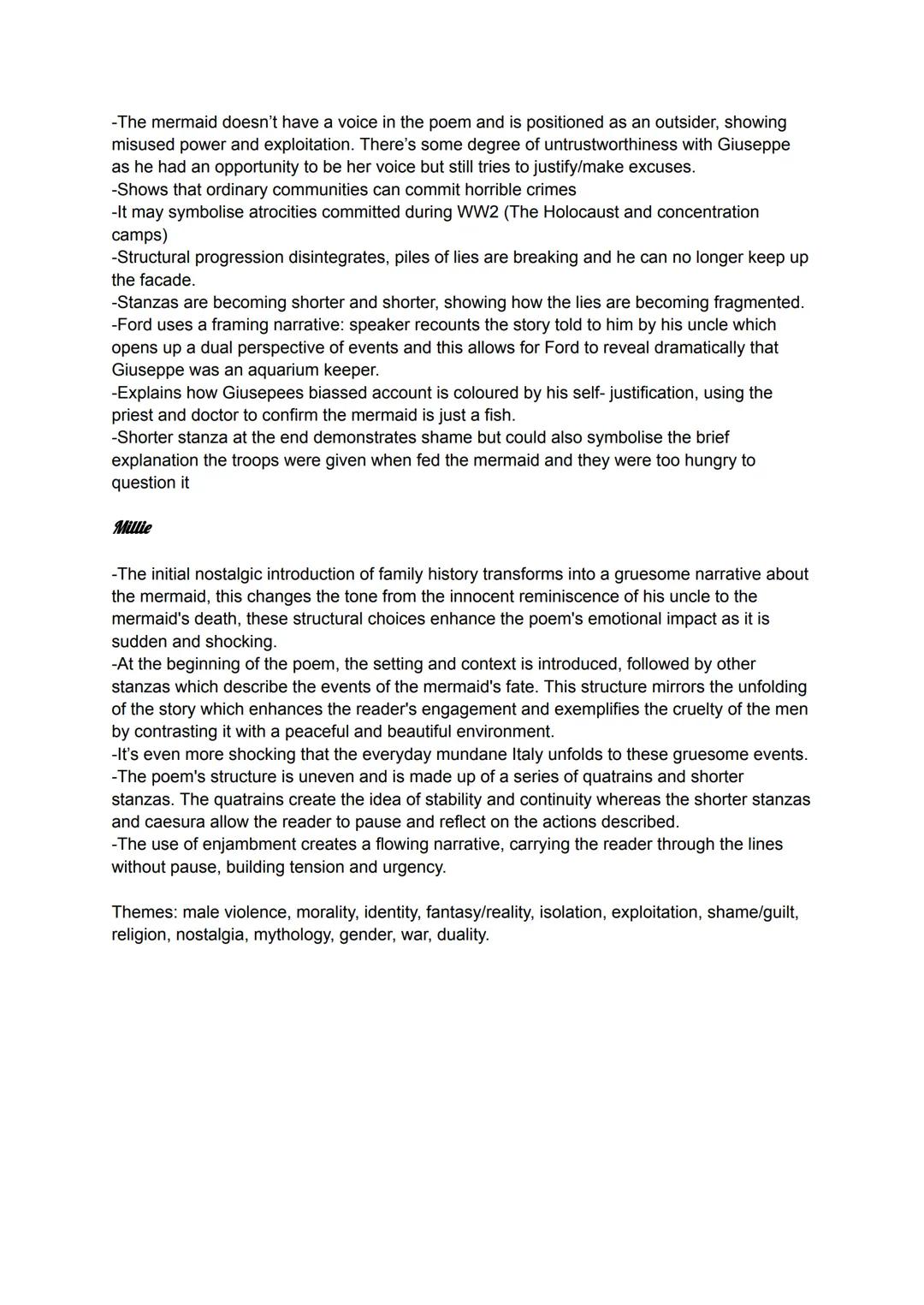
Structure, Themes and Lasting Impact
The poem's free verse structure creates the feeling of a confession or guilty reminiscence. The framing narrative allows Ford to show Giuseppe's bias whilst revealing the shocking truth that he was the aquarium keeper - the very person responsible for her protection.
The disintegrating stanza structure reflects Giuseppe's crumbling psychological defences. As the poem progresses, the neat justifications give way to shorter, more fragmented attempts at rationalisation, showing how guilt ultimately breaks through denial.
Key themes include moral compromise during wartime, the dehumanisation of vulnerable groups, male violence, and the power of collective responsibility to enable atrocities. The mermaid becomes a powerful metaphor for anyone deemed "other" and expendable by those in power.
The poem's final line - "for which I thank God" - shows the narrator's relief that some guilt remains, suggesting hope that moral conscience can never be completely destroyed, even in the darkest circumstances.
Key insight: Giuseppe serves as both a historical reflection on WWII atrocities and a timeless warning about how ordinary people can become complicit in terrible acts when they prioritise survival over moral courage.
We thought you’d never ask...
What is the Knowunity AI companion?
Our AI Companion is a student-focused AI tool that offers more than just answers. Built on millions of Knowunity resources, it provides relevant information, personalised study plans, quizzes, and content directly in the chat, adapting to your individual learning journey.
Where can I download the Knowunity app?
You can download the app from Google Play Store and Apple App Store.
Is Knowunity really free of charge?
That's right! Enjoy free access to study content, connect with fellow students, and get instant help – all at your fingertips.
Most popular content in English Literature
9English LiteratureAn Inspector Calls: Character Insights
Explore in-depth analysis and key quotes for characters in J.B. Priestley's 'An Inspector Calls'. This resource covers Gerald Croft, Inspector Goole, Sheila Birling, Mrs. Birling, Eric Birling, and Eva Smith, focusing on themes of class, gender roles, and social responsibility. Ideal for students aiming for Grade 8 and above.
1025,231901
English LiteratureRomeo and Juliet: Key themes
Key Romeo and Juliet themes and analysed quotes
106,619197
English LiteratureMacbeth: Guilt and Ambition
Explore the complex themes of guilt and ambition in Shakespeare's 'Macbeth'. This analysis covers key characters, including Macbeth and Lady Macbeth, their moral dilemmas, and the tragic consequences of their ambition. Ideal for students studying character motivations, thematic elements, and the psychological impact of power. Includes insights on the natural order, manipulation, and the descent into madness.
918,818392
E
English LiteratureExplore the World of English Literature
Master the key concepts and works of English literature with this comprehensive flashcard set designed for grade 10 students.
111,9401
I
English LiteratureInspector Calls Quiz (YR 10 MOCKS)
for YR 10 GCSE mock on Inspector Calls
101,8121
English LiteratureExploring Macbeth's Themes
Dive into the intricate themes of Shakespeare's Macbeth, including the supernatural, ambition, guilt, and kingship. This analysis features key quotes and insights that reveal how these themes intertwine to shape the characters and the narrative. Ideal for students seeking a deeper understanding of the play's moral complexities and psychological depth.
1115,798523
English LiteraturePower & Conflict Poetry Analysis
Explore in-depth analyses of key poems for GCSE English Literature, including Ozymandias, Storm on the Island, London, My Last Duchess, and more. This resource covers themes, structure, and key quotes to enhance your understanding of war and conflict in poetry. Ideal for exam preparation and comparative studies.
1049,9232,920
English LiteratureGrade 9 English Literature Insights
Explore comprehensive model answers for Grade 9 English Literature, focusing on key themes, character analysis, and writer's methods across various texts. This resource provides detailed insights into the works of Dickens, Shakespeare, and contemporary poets, helping students enhance their understanding and analytical skills. Ideal for exam preparation and improving essay writing techniques.
119,130763
English LiteratureMacbeth Key Themes Essay Plans
Essay plans for key themes in macbeth - guilt, supernatural & ambition
115,122145
Most popular content
9 Sociology
Sociology of Education Overview
Explore comprehensive A-Level Sociology notes on the education system, covering key theories, policies, and sociological perspectives. This resource includes insights on marketisation, gender roles, cultural deprivation, and educational inequalities, providing a thorough understanding of how education shapes social stratification and individual achievement. Ideal for exam preparation and in-depth study.
12102,3893,038
CriminologyCriminology: Crime & Punishment Overview
Comprehensive mindmaps covering key concepts in the Crime and Punishment topic for WJEC Criminology Unit 4. This resource includes detailed insights into the Criminal Justice System, crime prevention strategies, sentencing models, and the roles of various agencies. Ideal for A-Level revision, ensuring you grasp essential theories and legislative processes to excel in your exams.
1254,8131,059
SociologySociology of Families: Comprehensive Revision
Dive into an extensive overview of family dynamics, perspectives, and patterns in sociology. This resource covers key concepts such as family diversity, gender roles, marriage, and the impact of social policies on family structures. Perfect for A-Level Sociology students preparing for Paper 2.
1273,2392,304
English LiteratureAn Inspector Calls: Character Insights
Explore in-depth analysis and key quotes for characters in J.B. Priestley's 'An Inspector Calls'. This resource covers Gerald Croft, Inspector Goole, Sheila Birling, Mrs. Birling, Eric Birling, and Eva Smith, focusing on themes of class, gender roles, and social responsibility. Ideal for students aiming for Grade 8 and above.
1025,231901
CriminologyWJEC Unit 4 Criminology
Criminology unit 4 detailed revision note
127,120124
CriminologyCriminology Theories Overview
Explore key criminology theories and their implications on crime and deviance. This comprehensive summary covers biological, psychological, and sociological perspectives, including labelling theory, right realism, and the impact of social campaigns on policy development. Ideal for A-Level criminology students seeking to understand the complexities of criminal behaviour and the factors influencing crime prevention strategies.
129,746211
English LiteratureRomeo and Juliet: Key themes
Key Romeo and Juliet themes and analysed quotes
106,619197
C
 Biology
Cell Biology and Cell structure
cell structures
92,6740
English LiteratureMacbeth: Guilt and Ambition
Explore the complex themes of guilt and ambition in Shakespeare's 'Macbeth'. This analysis covers key characters, including Macbeth and Lady Macbeth, their moral dilemmas, and the tragic consequences of their ambition. Ideal for students studying character motivations, thematic elements, and the psychological impact of power. Includes insights on the natural order, manipulation, and the descent into madness.
918,818392
Can't find what you're looking for? Explore other subjects.
Students love us — and so will you.
4.6/5App Store
4.7/5Google Play
The app is very easy to use and well designed. I have found everything I was looking for so far and have been able to learn a lot from the presentations! I will definitely use the app for a class assignment! And of course it also helps a lot as an inspiration.
Stefan SiOS user
This app is really great. There are so many study notes and help [...]. My problem subject is French, for example, and the app has so many options for help. Thanks to this app, I have improved my French. I would recommend it to anyone.
Samantha KlichAndroid user
Wow, I am really amazed. I just tried the app because I've seen it advertised many times and was absolutely stunned. This app is THE HELP you want for school and above all, it offers so many things, such as workouts and fact sheets, which have been VERY helpful to me personally.
AnnaiOS user
English Literature119 views·Updated May 23, 2026·5 pagesAnalysis of Giuseppe (Poems of the Decade) by Roderick Ford
millie@millie_xmtr
Giuseppe is a haunting poem that transforms a seemingly innocent family story into a disturbing tale of moral compromise during wartime. Set in Sicily during World War Two, it explores how ordinary people justify terrible actions when faced with desperate... Show more
1
of 5Sign up to see the content. It's free!
- Access to all documents
- Improve your grades
- Join milions of students
Title Analysis and Setting
The poem's title Giuseppe (Italian for Joseph) creates a brilliant biblical parallel that sets up the entire moral framework. Just like the Biblical Joseph who saved people from famine, Giuseppe feeds starving soldiers - but through twisted, cruel means that pervert the original story of heroism.
The setting immediately signals conflict and moral breakdown. Sicily in World War Two prepares us for behaviour that falls below civilised standards, while the courtyard behind the aquarium suggests secrecy and shame. The beautiful bougainvillaea creates a fairy-tale atmosphere that sharply contrasts with the horror to come.
The captive mermaid represents ultimate powerlessness - she's the "only" one in the world, emphasising her isolation and vulnerability. Mermaids traditionally symbolise freedom and enchanting voices, making her captivity and silence particularly tragic. The men who decide her fate include a doctor and fishmonger, representing the duality between healing/harming and human/animal treatment.
Key insight: The shifting pronouns from "she" to "it" reveal Giuseppe's psychological struggle between recognising the mermaid's humanity and objectifying her to justify his actions.
2
of 5Sign up to see the content. It's free!
- Access to all documents
- Improve your grades
- Join milions of students
The Mermaid's Humanity and Silencing
The most tragic aspect of the mermaid is that she "never learned to speak" - completely reversing the traditional mythology where mermaids lure sailors with beautiful voices. This silencing represents the ultimate oppression, denying her any agency or ability to defend herself.
Giuseppe's language constantly shifts between humanising and dehumanising her. When he says "she was simple", he acknowledges her harmless nature whilst simultaneously reducing her complexity. The collective decision-making ("they'd said") shows how Giuseppe shifts responsibility onto the group, echoing the dangerous psychology of "just following orders."
Even the priest's involvement adds layers of hypocrisy and betrayal. Rather than protecting the vulnerable, this supposed moral authority participates in her destruction. The detail that he "held one of her hands" while her throat was cut shows the disturbing combination of false compassion with brutal violence.
Key insight: The alternating use of human and animal terminology reveals the characters' internal conflict - they recognise her humanity most clearly when describing her suffering.
3
of 5Sign up to see the content. It's free!
- Access to all documents
- Improve your grades
- Join milions of students
Violence and Dehumanisation
The brutal descriptions reveal how the men psychologically manage their guilt through dehumanisation. They insist she's "only a fish" yet she "screamed like a woman in terrible fear" - the simile actually removes her humanity even whilst acknowledging her human-like suffering.
Her "ripe golden roe" becomes a symbol of exploitation - the golden colour suggests something precious and royal, yet they're stealing her reproductive potential and future. This connects to broader themes about male violence against women and the destruction of minority groups' ability to survive and continue.
The fragmentation of her body into "her head and her hands" shows how they've reduced her to useful parts rather than seeing her as a whole being. Ironically, they show respect for these human-like parts whilst consuming the rest, revealing their distorted moral compass.
Key insight: The imagery of her eggs being removed references both abortion debates and genocidal practices - the systematic destruction of a group's ability to reproduce and survive.
4
of 5Sign up to see the content. It's free!
- Access to all documents
- Improve your grades
- Join milions of students
Burial, Consumption and Justification
The burial in a box represents multiple layers of containment and concealment. Even in death, she's confined rather than returned to her natural ocean home. The attempted theft of her wedding ring shows how exploitation continues even after death, though some men's intervention reveals moral divisions within the group.
When her remains are "fed to the troops" under the lie of being "a large fish", the dehumanisation becomes complete. This euphemism allows everyone to participate without confronting the truth, showing how collective lies enable atrocities.
Giuseppe's final justification that "starvation forgives men many things" attempts to use survival as moral absolution. Yet the aquarium keeper's inability to look him in the eye reveals the persistent guilt that no rationalisation can erase.
Key insight: The poem's structure mirrors its content - shorter, more fragmented stanzas reflect how lies and justifications are breaking down under the weight of guilt.
5
of 5Sign up to see the content. It's free!
- Access to all documents
- Improve your grades
- Join milions of students
Structure, Themes and Lasting Impact
The poem's free verse structure creates the feeling of a confession or guilty reminiscence. The framing narrative allows Ford to show Giuseppe's bias whilst revealing the shocking truth that he was the aquarium keeper - the very person responsible for her protection.
The disintegrating stanza structure reflects Giuseppe's crumbling psychological defences. As the poem progresses, the neat justifications give way to shorter, more fragmented attempts at rationalisation, showing how guilt ultimately breaks through denial.
Key themes include moral compromise during wartime, the dehumanisation of vulnerable groups, male violence, and the power of collective responsibility to enable atrocities. The mermaid becomes a powerful metaphor for anyone deemed "other" and expendable by those in power.
The poem's final line - "for which I thank God" - shows the narrator's relief that some guilt remains, suggesting hope that moral conscience can never be completely destroyed, even in the darkest circumstances.
Key insight: Giuseppe serves as both a historical reflection on WWII atrocities and a timeless warning about how ordinary people can become complicit in terrible acts when they prioritise survival over moral courage.
We thought you’d never ask...
What is the Knowunity AI companion?
Our AI Companion is a student-focused AI tool that offers more than just answers. Built on millions of Knowunity resources, it provides relevant information, personalised study plans, quizzes, and content directly in the chat, adapting to your individual learning journey.
Where can I download the Knowunity app?
You can download the app from Google Play Store and Apple App Store.
Is Knowunity really free of charge?
That's right! Enjoy free access to study content, connect with fellow students, and get instant help – all at your fingertips.
Most popular content in English Literature
9English LiteratureAn Inspector Calls: Character Insights
Explore in-depth analysis and key quotes for characters in J.B. Priestley's 'An Inspector Calls'. This resource covers Gerald Croft, Inspector Goole, Sheila Birling, Mrs. Birling, Eric Birling, and Eva Smith, focusing on themes of class, gender roles, and social responsibility. Ideal for students aiming for Grade 8 and above.
1025,231901
English LiteratureRomeo and Juliet: Key themes
Key Romeo and Juliet themes and analysed quotes
106,619197
English LiteratureMacbeth: Guilt and Ambition
Explore the complex themes of guilt and ambition in Shakespeare's 'Macbeth'. This analysis covers key characters, including Macbeth and Lady Macbeth, their moral dilemmas, and the tragic consequences of their ambition. Ideal for students studying character motivations, thematic elements, and the psychological impact of power. Includes insights on the natural order, manipulation, and the descent into madness.
918,818392
E
English LiteratureExplore the World of English Literature
Master the key concepts and works of English literature with this comprehensive flashcard set designed for grade 10 students.
111,9401
I
English LiteratureInspector Calls Quiz (YR 10 MOCKS)
for YR 10 GCSE mock on Inspector Calls
101,8121
English LiteratureExploring Macbeth's Themes
Dive into the intricate themes of Shakespeare's Macbeth, including the supernatural, ambition, guilt, and kingship. This analysis features key quotes and insights that reveal how these themes intertwine to shape the characters and the narrative. Ideal for students seeking a deeper understanding of the play's moral complexities and psychological depth.
1115,798523
English LiteraturePower & Conflict Poetry Analysis
Explore in-depth analyses of key poems for GCSE English Literature, including Ozymandias, Storm on the Island, London, My Last Duchess, and more. This resource covers themes, structure, and key quotes to enhance your understanding of war and conflict in poetry. Ideal for exam preparation and comparative studies.
1049,9232,920
English LiteratureGrade 9 English Literature Insights
Explore comprehensive model answers for Grade 9 English Literature, focusing on key themes, character analysis, and writer's methods across various texts. This resource provides detailed insights into the works of Dickens, Shakespeare, and contemporary poets, helping students enhance their understanding and analytical skills. Ideal for exam preparation and improving essay writing techniques.
119,130763
English LiteratureMacbeth Key Themes Essay Plans
Essay plans for key themes in macbeth - guilt, supernatural & ambition
115,122145
Most popular content
9SociologySociology of Education Overview
Explore comprehensive A-Level Sociology notes on the education system, covering key theories, policies, and sociological perspectives. This resource includes insights on marketisation, gender roles, cultural deprivation, and educational inequalities, providing a thorough understanding of how education shapes social stratification and individual achievement. Ideal for exam preparation and in-depth study.
12102,3893,038
CriminologyCriminology: Crime & Punishment Overview
Comprehensive mindmaps covering key concepts in the Crime and Punishment topic for WJEC Criminology Unit 4. This resource includes detailed insights into the Criminal Justice System, crime prevention strategies, sentencing models, and the roles of various agencies. Ideal for A-Level revision, ensuring you grasp essential theories and legislative processes to excel in your exams.
1254,8131,059
SociologySociology of Families: Comprehensive Revision
Dive into an extensive overview of family dynamics, perspectives, and patterns in sociology. This resource covers key concepts such as family diversity, gender roles, marriage, and the impact of social policies on family structures. Perfect for A-Level Sociology students preparing for Paper 2.
1273,2392,304
English LiteratureAn Inspector Calls: Character Insights
Explore in-depth analysis and key quotes for characters in J.B. Priestley's 'An Inspector Calls'. This resource covers Gerald Croft, Inspector Goole, Sheila Birling, Mrs. Birling, Eric Birling, and Eva Smith, focusing on themes of class, gender roles, and social responsibility. Ideal for students aiming for Grade 8 and above.
1025,231901
CriminologyWJEC Unit 4 Criminology
Criminology unit 4 detailed revision note
127,120124
CriminologyCriminology Theories Overview
Explore key criminology theories and their implications on crime and deviance. This comprehensive summary covers biological, psychological, and sociological perspectives, including labelling theory, right realism, and the impact of social campaigns on policy development. Ideal for A-Level criminology students seeking to understand the complexities of criminal behaviour and the factors influencing crime prevention strategies.
129,746211
English LiteratureRomeo and Juliet: Key themes
Key Romeo and Juliet themes and analysed quotes
106,619197
C
BiologyCell Biology and Cell structure
cell structures
92,6740
English LiteratureMacbeth: Guilt and Ambition
Explore the complex themes of guilt and ambition in Shakespeare's 'Macbeth'. This analysis covers key characters, including Macbeth and Lady Macbeth, their moral dilemmas, and the tragic consequences of their ambition. Ideal for students studying character motivations, thematic elements, and the psychological impact of power. Includes insights on the natural order, manipulation, and the descent into madness.
918,818392
Can't find what you're looking for? Explore other subjects.
Students love us — and so will you.
4.6/5App Store
4.7/5Google Play
The app is very easy to use and well designed. I have found everything I was looking for so far and have been able to learn a lot from the presentations! I will definitely use the app for a class assignment! And of course it also helps a lot as an inspiration.
Stefan SiOS user
This app is really great. There are so many study notes and help [...]. My problem subject is French, for example, and the app has so many options for help. Thanks to this app, I have improved my French. I would recommend it to anyone.
Samantha KlichAndroid user
Wow, I am really amazed. I just tried the app because I've seen it advertised many times and was absolutely stunned. This app is THE HELP you want for school and above all, it offers so many things, such as workouts and fact sheets, which have been VERY helpful to me personally.
AnnaiOS user