
Ever wondered why your phone isn't made of concrete or...
 Engineering2 views·Updated Jun 14, 2026·7 pages
Types of Engineering Materials Explained
1 / 7
1
of 7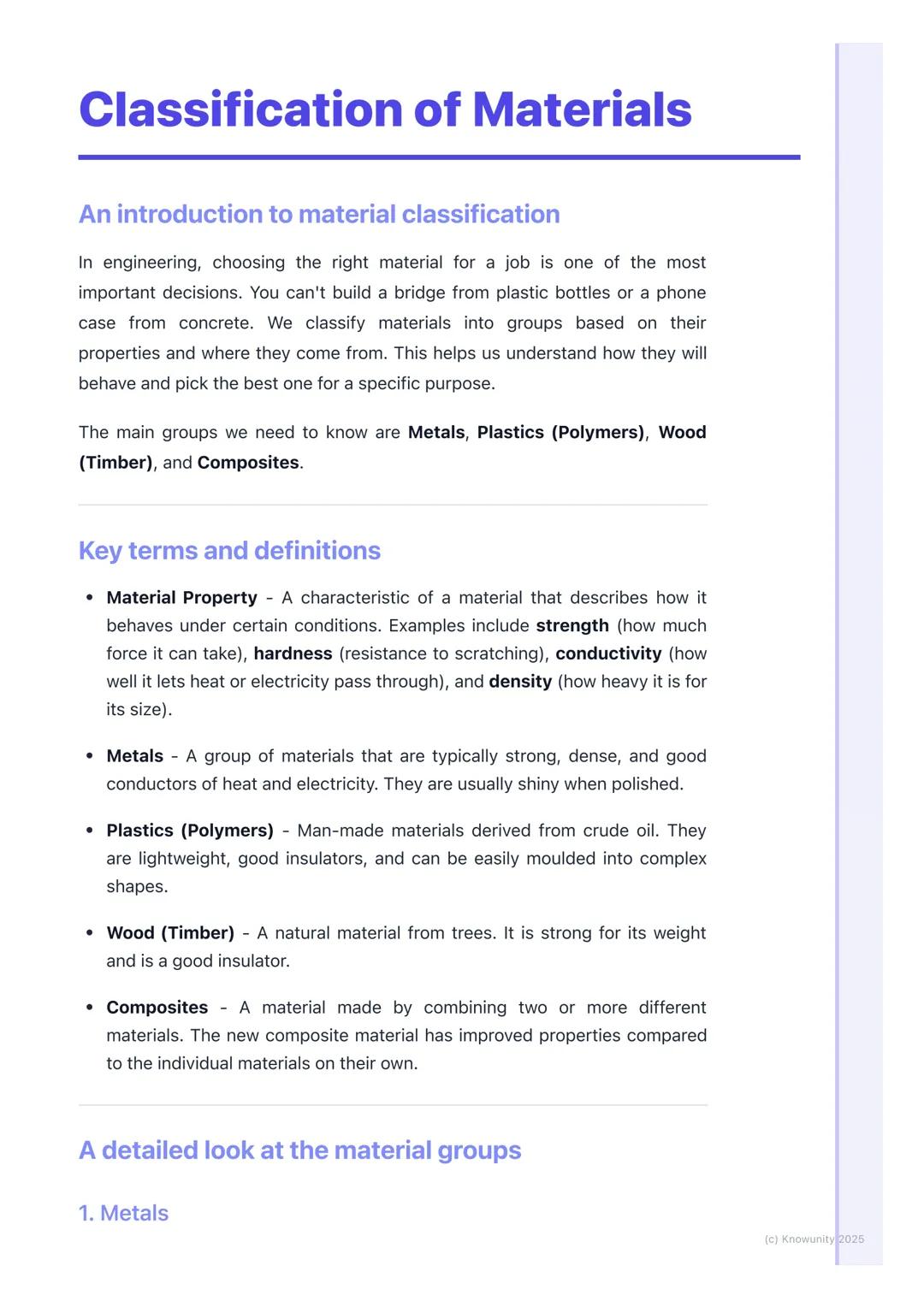
Material Classification Basics
Materials are everywhere around you, and engineers group them based on their properties and origins to make smart choices. Think of properties as a material's personality - how strong it is, whether it conducts electricity, or how heavy it feels.
The four main groups you need to master are metals, plastics (polymers), wood (timber), and composites. Each group has unique characteristics that make them perfect for different jobs.
Material properties are the key to understanding why certain materials work better than others. Strength tells you how much force something can handle, whilst conductivity shows how well heat or electricity passes through it.
Remember: Every material choice in engineering comes down to matching the right properties to the job requirements!
2
of 7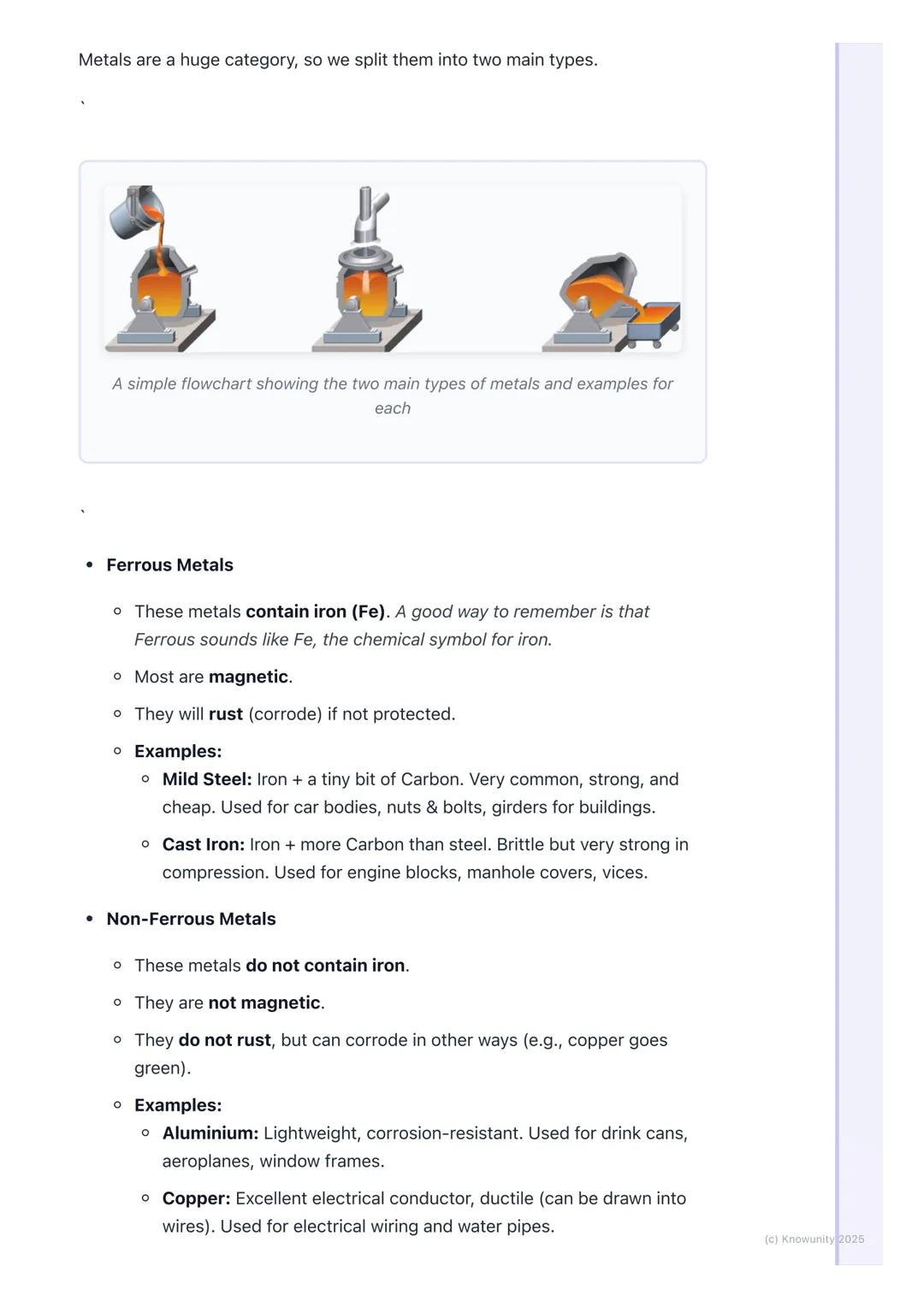
Metals: The Workhorses of Engineering
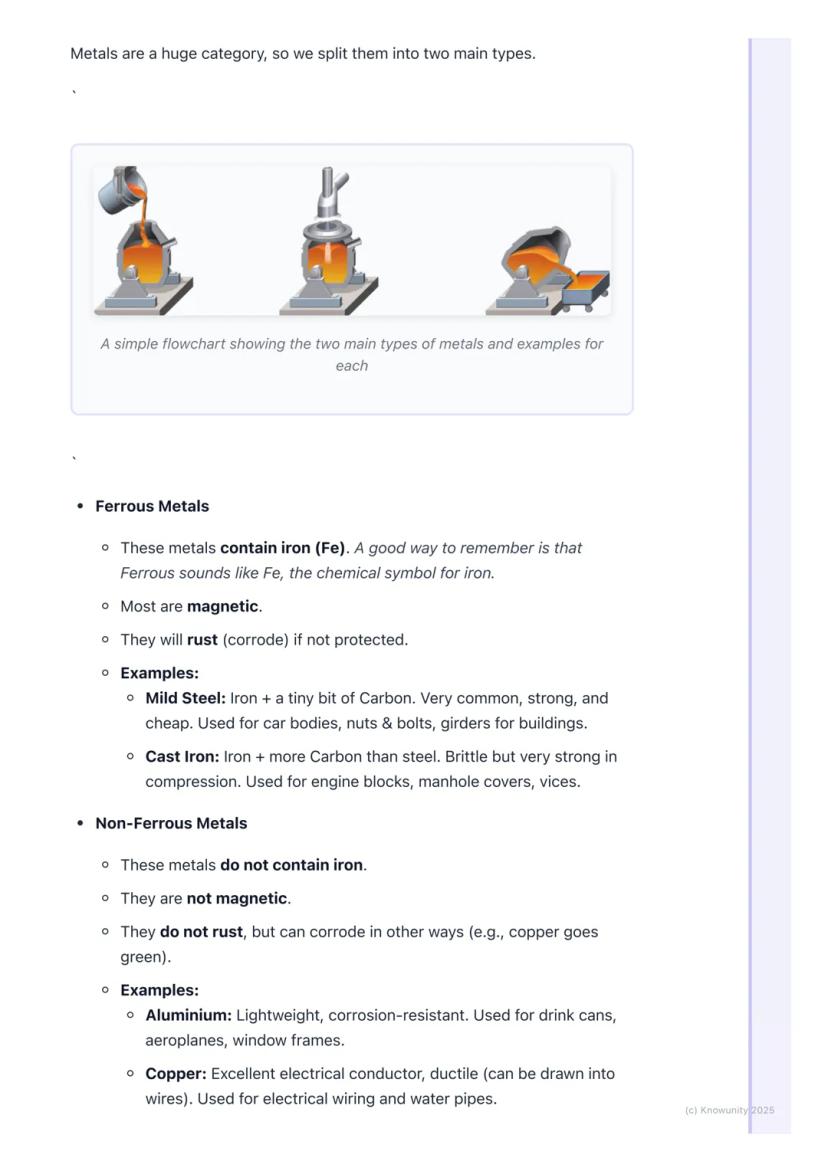
Metals dominate construction and manufacturing because they're typically strong, dense, and excellent conductors. But not all metals are created equal - we split them into two main camps.
Ferrous metals contain iron (Fe) and are usually magnetic. The downside? They rust if you don't protect them. Mild steel is the superstar here - it's iron with a tiny bit of carbon, making it strong, cheap, and perfect for car bodies and building frames. Cast iron has more carbon, making it brilliant for engine blocks but quite brittle.
Non-ferrous metals don't contain iron, so they won't stick to magnets and don't rust (though they can corrode differently). Aluminium is your go-to for lightweight applications like drink cans and aeroplanes, whilst copper excels at conducting electricity in wiring.
Alloys are where things get interesting - they're mixtures of metals designed to get better properties. Brass is harder than pure copper and looks brilliant in musical instruments.
Quick Test: Use a magnet! If it sticks, you've got a ferrous metal with iron in it.
3
of 7
Plastics: The Shape-Shifters
Plastics are polymers - long chains of molecules that give them incredible versatility. You see them everywhere because they're lightweight, great insulators, and can be moulded into virtually any shape.
Thermoplastics are the environmentally friendly option because they can be reheated and reshaped multiple times, making them recyclable. PET makes your clear drinks bottles, PVC creates everything from window frames to cable insulation, and HDPE gives you strong milk cartons and pipes.
Thermosetting plastics are the opposite - once they're heated and set, that's it forever. No reshaping, no recycling. But they're incredibly hard and brilliant heat insulators. Epoxy resin creates super-strong adhesives, whilst urea formaldehyde keeps you safe in electrical plugs because it won't conduct electricity.
The key difference? Think of thermoplastics like ice - heat them up and they melt, cool them down and they solidify again. Thermosets are like baking a cake - once it's baked, there's no going back!
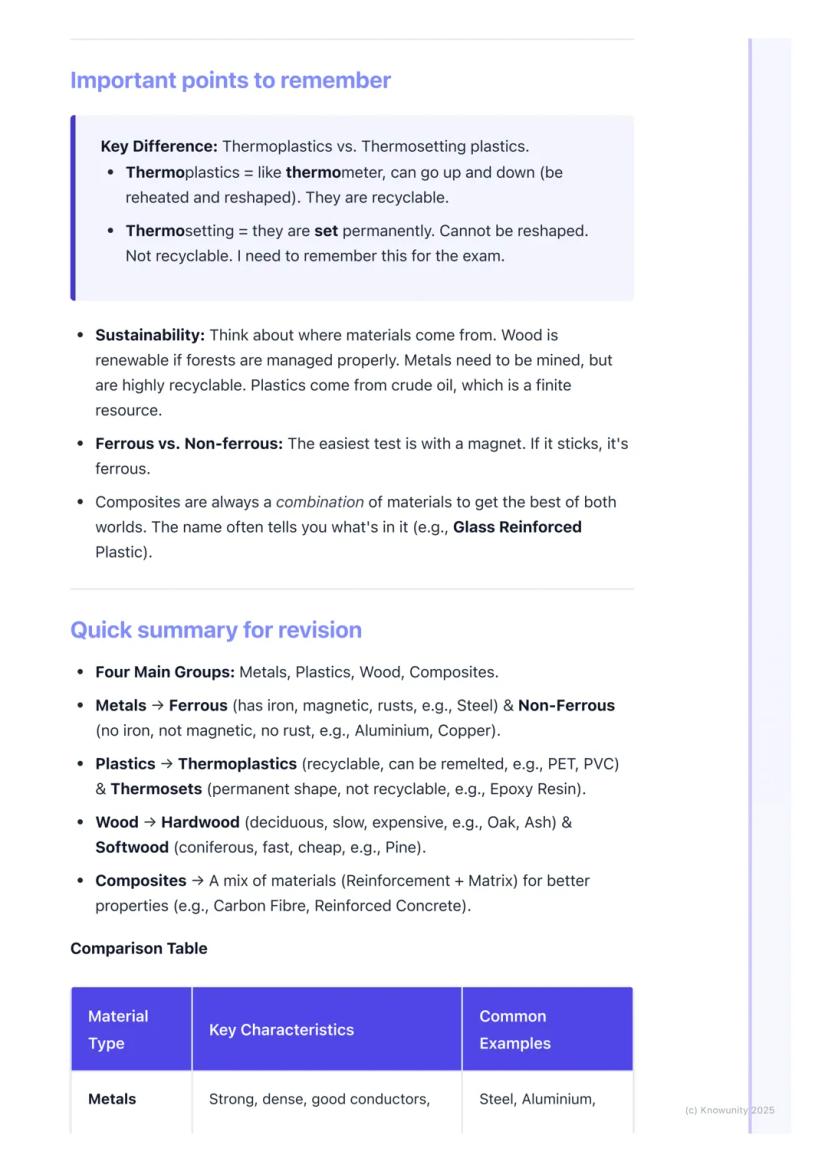
Memory Tip: Thermoplastics = like a thermometer, temperature can go up and down. Thermosets = permanently set!
4
of 7
Wood: Nature's Engineering Material
Wood is brilliant because it's natural, renewable, and surprisingly strong for its weight. The type of tree makes all the difference in the properties you get.
Hardwoods come from deciduous trees (the ones that lose their leaves in winter). They grow slowly, creating dense, expensive timber. Oak is incredibly strong and durable for high-quality furniture, ash is tough and flexible (perfect for hurleys!), and mahogany has that gorgeous reddish-brown colour.
Softwoods come from coniferous trees with needles and cones. They grow quickly, making them cheaper but less dense. Pine is easy to work with and relatively cheap for construction, whilst spruce offers a great strength-to-weight ratio.
Man-made boards like MDF and plywood solve wood's biggest problem - it's not always available in the sizes you need. These engineered products give you large, stable sheets at reasonable prices.
Fun Fact: Hardwood and softwood names can be misleading - some softwoods are actually harder than some hardwoods!
5
of 7
Composites: Designer Materials
Composites are the ultimate engineering hack - combine two or more materials to create something with superpowers that neither could achieve alone. They always have a reinforcement (provides strength) and a matrix (holds everything together).
Carbon fibre reinforced polymer (CFRP) is the premium choice - carbon fibres in polymer resin create something incredibly strong yet lightweight. Racing cars and high-end sports equipment use it, though it's expensive.
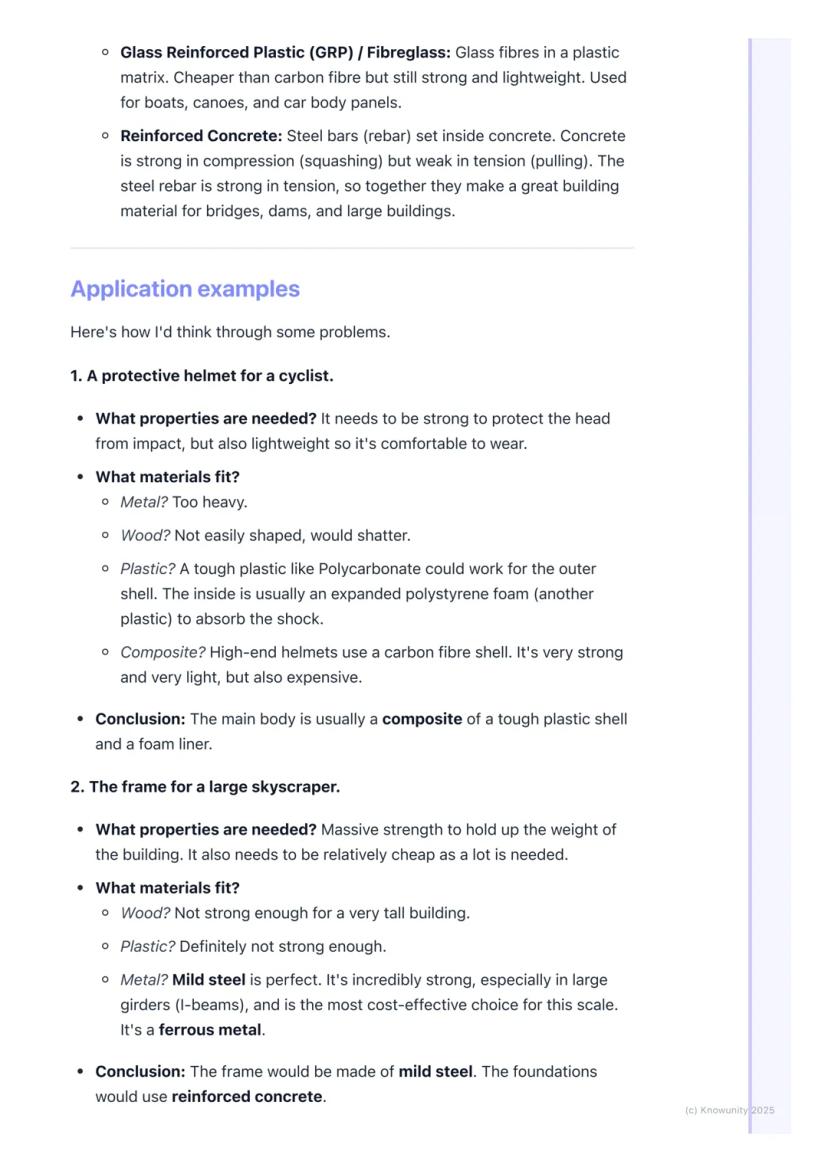
Glass reinforced plastic (GRP), also called fibreglass, gives you similar benefits at lower cost. Perfect for boats, canoes, and car body panels. Reinforced concrete might surprise you as a composite, but steel rebar inside concrete creates the backbone of modern construction.
Think of composites as teamwork - concrete is brilliant at being squashed but terrible at being stretched. Steel is excellent at both. Together, they're unstoppable for bridges and skyscrapers.
Real World: Next time you see a racing bike or sports car, you're probably looking at carbon fibre composites!
6
of 7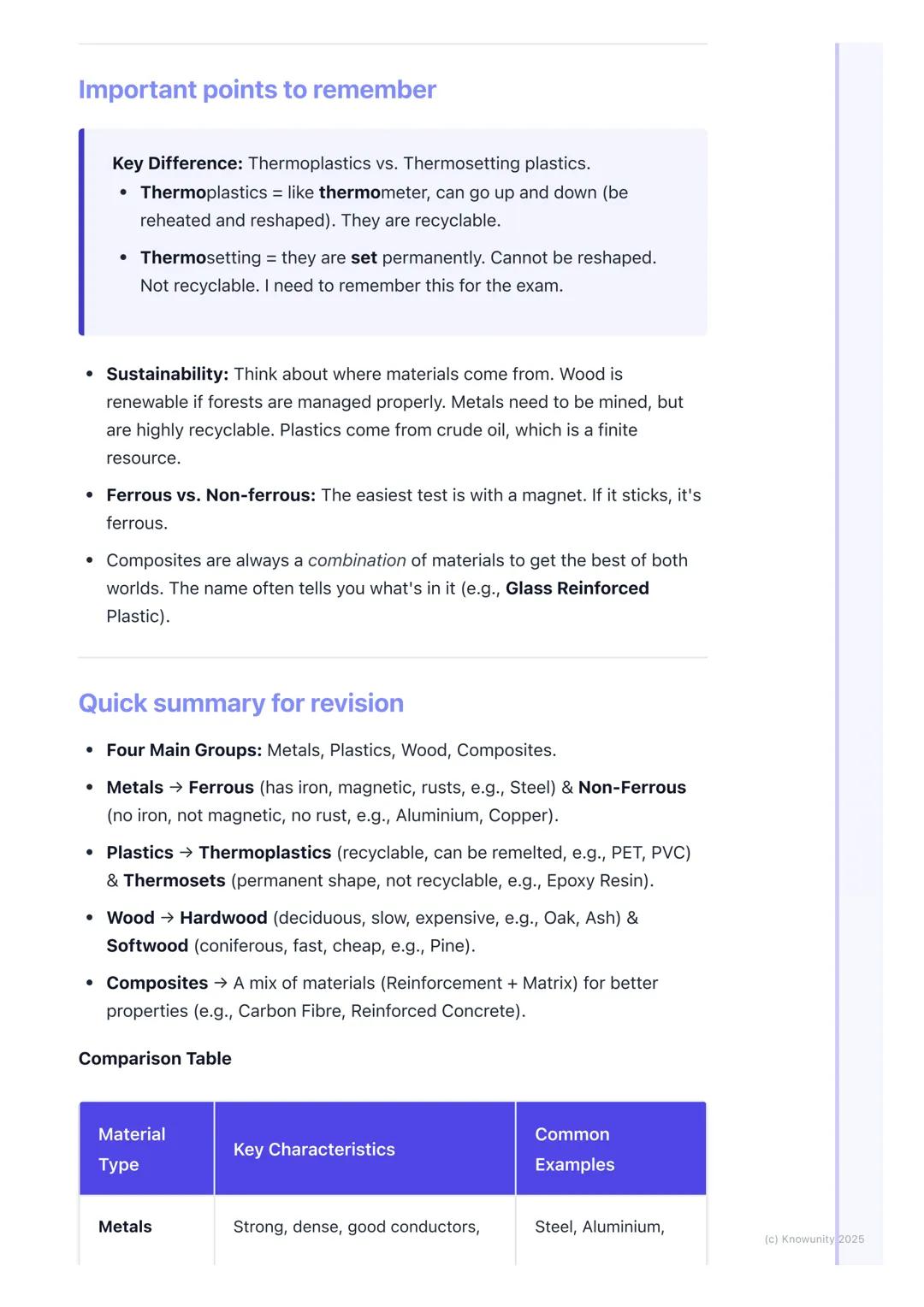
Putting It All Together
Now you can think like an engineer when choosing materials. For a cyclist's helmet, you need strength and lightness - a tough plastic shell with foam liner works perfectly, or carbon fibre if money's no object.
For a skyscraper frame, you need massive strength at reasonable cost. Mild steel girders are perfect because they're incredibly strong and cost-effective at scale, with reinforced concrete for the foundations.
Sustainability matters more than ever. Wood is renewable with proper forest management, metals are highly recyclable despite needing mining, and plastics come from finite oil resources but offer incredible durability.
The ferrous vs non-ferrous test is simple - use a magnet. Thermoplastic vs thermosetting comes down to whether you can remelt and reshape them. Composites always combine materials for better properties than either could achieve alone.
Exam Success: Remember the magnet test for metals and the recycling difference for plastics - these often come up in questions!
7
of 7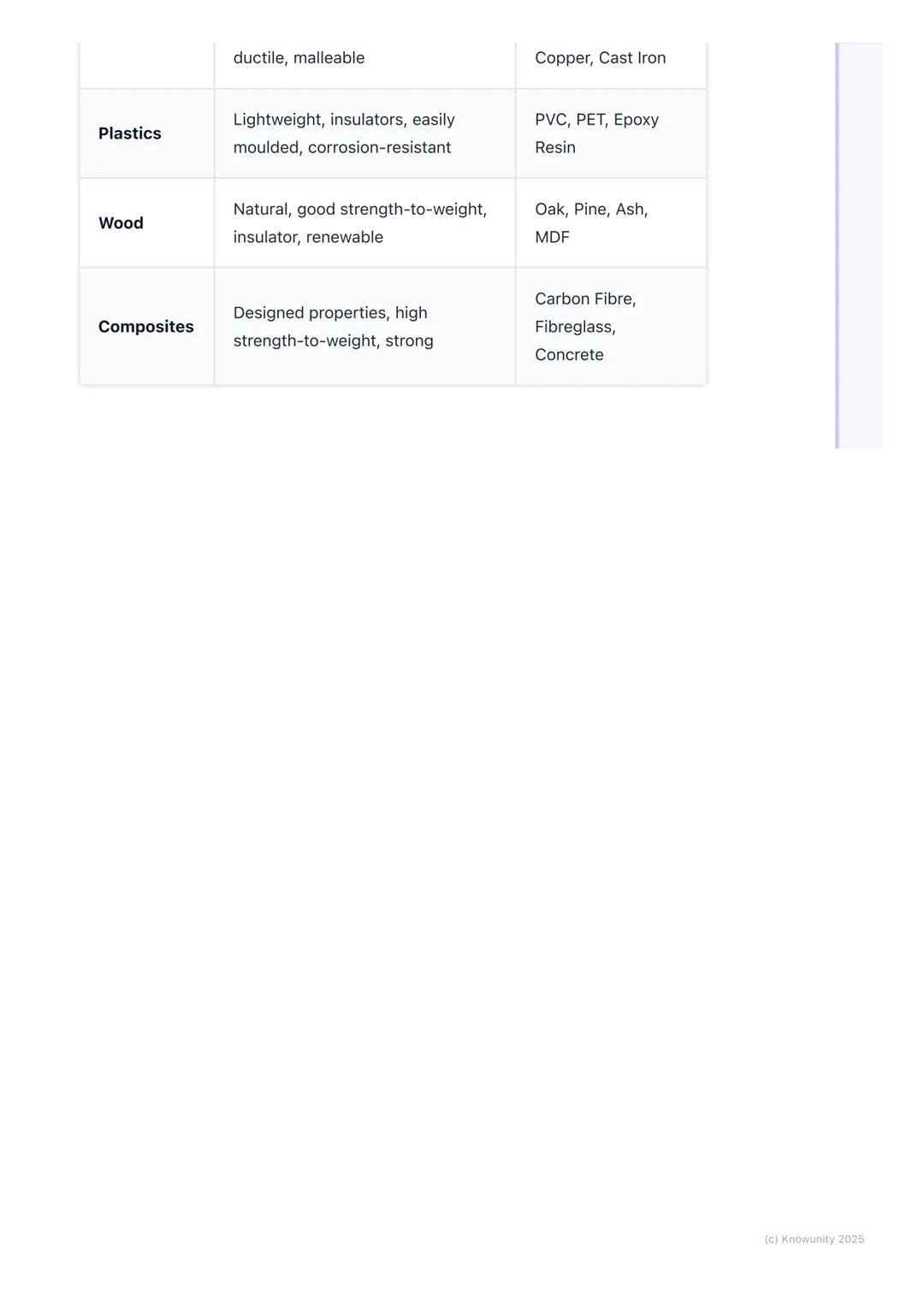
Quick Reference Summary
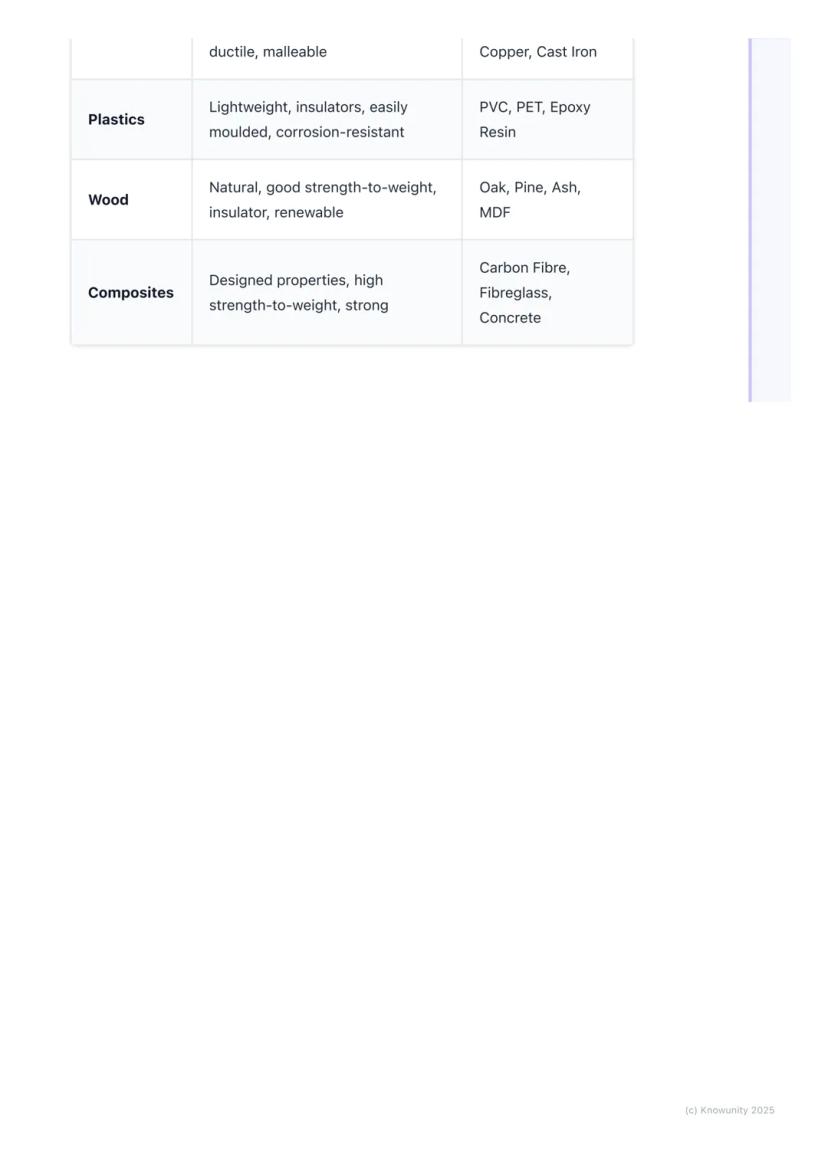
Master these four groups and you'll ace any materials question. Metals split into ferrous like steel, and non-ferrous like aluminium and copper.
Plastics divide into thermoplastics (recyclable, can remelt) like PET and PVC, versus thermosets like epoxy resin. Wood separates into hardwoods like oak, and softwoods like pine.
Composites always combine reinforcement with matrix for enhanced properties - think carbon fibre for performance or reinforced concrete for construction. Each material group has its perfect applications based on matching properties to requirements.
Remember: successful engineering is all about picking the right material for the job, considering strength, cost, sustainability, and performance requirements.
Final Tip: Practice identifying materials around you - your phone case, desk, window frame. Ask yourself which group each belongs to and why it was chosen!
We thought you’d never ask...
What is the Knowunity AI companion?
Our AI Companion is a student-focused AI tool that offers more than just answers. Built on millions of Knowunity resources, it provides relevant information, personalised study plans, quizzes, and content directly in the chat, adapting to your individual learning journey.
Where can I download the Knowunity app?
You can download the app from Google Play Store and Apple App Store.
Is Knowunity really free of charge?
That's right! Enjoy free access to study content, connect with fellow students, and get instant help – all at your fingertips.
Most popular content in Engineering
1Most popular content
9 Irish
IrishIrish oral questions and answers
Questions and answers for the leaving cert oral
5th Year4264
 English
Key Quotes : Sive
Key Quotes and explanations: Sive
6th Year2842
IrishIrish oral questions
Outline of oral questions
5th Year2055
IrishIníon- le hÁine Durkin
Aine Durkin’s poem, Iníon: Themes & summary
5th Year890
IrishIrish poetry 2027
Iníon + Dínit an Bhróin
5th Year1153
IrishLC HL notes- Iníon (poem)
Includes poem in English and Irish, theme, key words & phrases
5th Year2304
EnglishCultural Context : Shawshank Redemption : Sive : Small Things Like These
Comparative Study : Cultural Context : Shawshank Redemption, Sive and Small Things Like These
6th Year1430
IrishMo Ghrá-sa (Idir Lúibíní)
Notes on mo ghrá-sa
5th Year380
IrishAn Gaeilge Aiste
Irish Language essay
6th Year1320
Can't find what you're looking for? Explore other subjects.
Students love us — and so will you.
4.6/5App Store
4.7/5Google Play
The app is very easy to use and well designed. I have found everything I was looking for so far and have been able to learn a lot from the presentations! I will definitely use the app for a class assignment! And of course it also helps a lot as an inspiration.
Stefan SiOS user
This app is really great. There are so many study notes and help [...]. My problem subject is French, for example, and the app has so many options for help. Thanks to this app, I have improved my French. I would recommend it to anyone.
Samantha KlichAndroid user
Wow, I am really amazed. I just tried the app because I've seen it advertised many times and was absolutely stunned. This app is THE HELP you want for school and above all, it offers so many things, such as workouts and fact sheets, which have been VERY helpful to me personally.
AnnaiOS user
Engineering2 views·Updated Jun 14, 2026·7 pagesTypes of Engineering Materials Explained
Ever wondered why your phone isn't made of concrete or why bridges aren't built from plastic bottles? In engineering, picking the right material can make or break your design. Understanding how materials are classified helps you choose the perfect one...
1
of 7
Sign up to see the content. It's free!
- Access to all documents
- Improve your grades
- Join milions of students
Material Classification Basics
Materials are everywhere around you, and engineers group them based on their properties and origins to make smart choices. Think of properties as a material's personality - how strong it is, whether it conducts electricity, or how heavy it feels.
The four main groups you need to master are metals, plastics (polymers), wood (timber), and composites. Each group has unique characteristics that make them perfect for different jobs.
Material properties are the key to understanding why certain materials work better than others. Strength tells you how much force something can handle, whilst conductivity shows how well heat or electricity passes through it.
Remember: Every material choice in engineering comes down to matching the right properties to the job requirements!
2
of 7Sign up to see the content. It's free!
- Access to all documents
- Improve your grades
- Join milions of students
Metals: The Workhorses of Engineering
Metals dominate construction and manufacturing because they're typically strong, dense, and excellent conductors. But not all metals are created equal - we split them into two main camps.
Ferrous metals contain iron (Fe) and are usually magnetic. The downside? They rust if you don't protect them. Mild steel is the superstar here - it's iron with a tiny bit of carbon, making it strong, cheap, and perfect for car bodies and building frames. Cast iron has more carbon, making it brilliant for engine blocks but quite brittle.
Non-ferrous metals don't contain iron, so they won't stick to magnets and don't rust (though they can corrode differently). Aluminium is your go-to for lightweight applications like drink cans and aeroplanes, whilst copper excels at conducting electricity in wiring.
Alloys are where things get interesting - they're mixtures of metals designed to get better properties. Brass is harder than pure copper and looks brilliant in musical instruments.
Quick Test: Use a magnet! If it sticks, you've got a ferrous metal with iron in it.
3
of 7Sign up to see the content. It's free!
- Access to all documents
- Improve your grades
- Join milions of students
Plastics: The Shape-Shifters
Plastics are polymers - long chains of molecules that give them incredible versatility. You see them everywhere because they're lightweight, great insulators, and can be moulded into virtually any shape.
Thermoplastics are the environmentally friendly option because they can be reheated and reshaped multiple times, making them recyclable. PET makes your clear drinks bottles, PVC creates everything from window frames to cable insulation, and HDPE gives you strong milk cartons and pipes.
Thermosetting plastics are the opposite - once they're heated and set, that's it forever. No reshaping, no recycling. But they're incredibly hard and brilliant heat insulators. Epoxy resin creates super-strong adhesives, whilst urea formaldehyde keeps you safe in electrical plugs because it won't conduct electricity.
The key difference? Think of thermoplastics like ice - heat them up and they melt, cool them down and they solidify again. Thermosets are like baking a cake - once it's baked, there's no going back!
Memory Tip: Thermoplastics = like a thermometer, temperature can go up and down. Thermosets = permanently set!
4
of 7Sign up to see the content. It's free!
- Access to all documents
- Improve your grades
- Join milions of students
Wood: Nature's Engineering Material
Wood is brilliant because it's natural, renewable, and surprisingly strong for its weight. The type of tree makes all the difference in the properties you get.
Hardwoods come from deciduous trees (the ones that lose their leaves in winter). They grow slowly, creating dense, expensive timber. Oak is incredibly strong and durable for high-quality furniture, ash is tough and flexible (perfect for hurleys!), and mahogany has that gorgeous reddish-brown colour.
Softwoods come from coniferous trees with needles and cones. They grow quickly, making them cheaper but less dense. Pine is easy to work with and relatively cheap for construction, whilst spruce offers a great strength-to-weight ratio.
Man-made boards like MDF and plywood solve wood's biggest problem - it's not always available in the sizes you need. These engineered products give you large, stable sheets at reasonable prices.
Fun Fact: Hardwood and softwood names can be misleading - some softwoods are actually harder than some hardwoods!
5
of 7Sign up to see the content. It's free!
- Access to all documents
- Improve your grades
- Join milions of students
Composites: Designer Materials
Composites are the ultimate engineering hack - combine two or more materials to create something with superpowers that neither could achieve alone. They always have a reinforcement (provides strength) and a matrix (holds everything together).
Carbon fibre reinforced polymer (CFRP) is the premium choice - carbon fibres in polymer resin create something incredibly strong yet lightweight. Racing cars and high-end sports equipment use it, though it's expensive.
Glass reinforced plastic (GRP), also called fibreglass, gives you similar benefits at lower cost. Perfect for boats, canoes, and car body panels. Reinforced concrete might surprise you as a composite, but steel rebar inside concrete creates the backbone of modern construction.
Think of composites as teamwork - concrete is brilliant at being squashed but terrible at being stretched. Steel is excellent at both. Together, they're unstoppable for bridges and skyscrapers.
Real World: Next time you see a racing bike or sports car, you're probably looking at carbon fibre composites!
6
of 7Sign up to see the content. It's free!
- Access to all documents
- Improve your grades
- Join milions of students
Putting It All Together
Now you can think like an engineer when choosing materials. For a cyclist's helmet, you need strength and lightness - a tough plastic shell with foam liner works perfectly, or carbon fibre if money's no object.
For a skyscraper frame, you need massive strength at reasonable cost. Mild steel girders are perfect because they're incredibly strong and cost-effective at scale, with reinforced concrete for the foundations.
Sustainability matters more than ever. Wood is renewable with proper forest management, metals are highly recyclable despite needing mining, and plastics come from finite oil resources but offer incredible durability.
The ferrous vs non-ferrous test is simple - use a magnet. Thermoplastic vs thermosetting comes down to whether you can remelt and reshape them. Composites always combine materials for better properties than either could achieve alone.
Exam Success: Remember the magnet test for metals and the recycling difference for plastics - these often come up in questions!
7
of 7Sign up to see the content. It's free!
- Access to all documents
- Improve your grades
- Join milions of students
Quick Reference Summary
Master these four groups and you'll ace any materials question. Metals split into ferrous like steel, and non-ferrous like aluminium and copper.
Plastics divide into thermoplastics (recyclable, can remelt) like PET and PVC, versus thermosets like epoxy resin. Wood separates into hardwoods like oak, and softwoods like pine.
Composites always combine reinforcement with matrix for enhanced properties - think carbon fibre for performance or reinforced concrete for construction. Each material group has its perfect applications based on matching properties to requirements.
Remember: successful engineering is all about picking the right material for the job, considering strength, cost, sustainability, and performance requirements.
Final Tip: Practice identifying materials around you - your phone case, desk, window frame. Ask yourself which group each belongs to and why it was chosen!
We thought you’d never ask...
What is the Knowunity AI companion?
Our AI Companion is a student-focused AI tool that offers more than just answers. Built on millions of Knowunity resources, it provides relevant information, personalised study plans, quizzes, and content directly in the chat, adapting to your individual learning journey.
Where can I download the Knowunity app?
You can download the app from Google Play Store and Apple App Store.
Is Knowunity really free of charge?
That's right! Enjoy free access to study content, connect with fellow students, and get instant help – all at your fingertips.
Most popular content in Engineering
1Most popular content
9IrishIrish oral questions and answers
Questions and answers for the leaving cert oral
5th Year4264
EnglishKey Quotes : Sive
Key Quotes and explanations: Sive
6th Year2842
IrishIrish oral questions
Outline of oral questions
5th Year2055
IrishIníon- le hÁine Durkin
Aine Durkin’s poem, Iníon: Themes & summary
5th Year890
IrishIrish poetry 2027
Iníon + Dínit an Bhróin
5th Year1153
IrishLC HL notes- Iníon (poem)
Includes poem in English and Irish, theme, key words & phrases
5th Year2304
EnglishCultural Context : Shawshank Redemption : Sive : Small Things Like These
Comparative Study : Cultural Context : Shawshank Redemption, Sive and Small Things Like These
6th Year1430
IrishMo Ghrá-sa (Idir Lúibíní)
Notes on mo ghrá-sa
5th Year380
IrishAn Gaeilge Aiste
Irish Language essay
6th Year1320
Can't find what you're looking for? Explore other subjects.
Students love us — and so will you.
4.6/5App Store
4.7/5Google Play
The app is very easy to use and well designed. I have found everything I was looking for so far and have been able to learn a lot from the presentations! I will definitely use the app for a class assignment! And of course it also helps a lot as an inspiration.
Stefan SiOS user
This app is really great. There are so many study notes and help [...]. My problem subject is French, for example, and the app has so many options for help. Thanks to this app, I have improved my French. I would recommend it to anyone.
Samantha KlichAndroid user
Wow, I am really amazed. I just tried the app because I've seen it advertised many times and was absolutely stunned. This app is THE HELP you want for school and above all, it offers so many things, such as workouts and fact sheets, which have been VERY helpful to me personally.
AnnaiOS user