

The law of definite proportions and law of multiple proportions...
 Chemistry1,451 views·Updated Jun 17, 2026·21 pages
Honors Chemistry 1 Final Study Guide PDF - Free 2021 Exam Tips!



1 / 10
1
of 10
Understanding Measurement and Significant Figures in Chemistry
The foundation of chemistry relies on precise measurements and understanding significant figures. When conducting measurements, accuracy refers to how close a value is to the accepted value, while precision indicates how close repeated measurements are to each other. A critical formula in determining measurement accuracy is percent error = / true × 100.
Proper measurement techniques require recording one decimal place beyond the smallest marked increment on measuring tools. For volume measurements, graduated cylinders provide the most accurate results compared to beakers or flasks. Temperature measurements in chemistry utilize Celsius or Kelvin scales exclusively.
Significant figures represent measurement precision through specific rules. All nonzero integers are always significant, while zeros follow three classifications: leading zeros (never significant), captive zeros (always significant), and trailing zeros (significant only with decimal points). When performing calculations, multiplication and division results should have the same number of significant figures as the least precise measurement, while addition and subtraction results are limited by the least number of decimal places.
Definition: Significant figures are digits in a number that carry meaning and represent the precision of a measurement.
2
of 10
Laws of Chemical Composition and Matter Classification
Laws of definite and multiple proportions form fundamental principles in chemistry. The law of definite proportions states that compounds always contain elements in fixed mass ratios. The law of multiple proportions explains that when elements form multiple compounds, the mass ratios of these elements will be small whole numbers.
Matter classification involves understanding different types of mixtures and pure substances. Heterogeneous mixtures show visible boundaries between components, while homogeneous solutions appear uniform throughout. Various separation techniques exist for mixtures:
- Decanting separates solids from liquids
- Filtration separates particles of different sizes
- Chromatography separates components based on absorption rates
- Distillation separates liquids with different boiling points
Example: In water (H₂O), hydrogen and oxygen always combine in a 1:8 mass ratio, demonstrating the law of definite proportions.
3
of 10
Atomic Structure and Historical Developments
The modern understanding of atomic structure evolved through numerous scientific discoveries. Dalton's atomic theory proposed indivisible atoms, while Thomson's cathode ray experiments revealed electrons. Rutherford's gold foil experiment demonstrated the nucleus's existence, and Bohr introduced electron energy levels.
Atomic structure fundamentals include:
- Atomic number equals proton count
- Mass number represents total protons and neutrons
- Isotopes differ in neutron count but maintain identical chemical properties
Highlight: The stability of atomic nuclei depends on the neutron-to-proton ratio, with heavier elements requiring more neutrons for stability.
4
of 10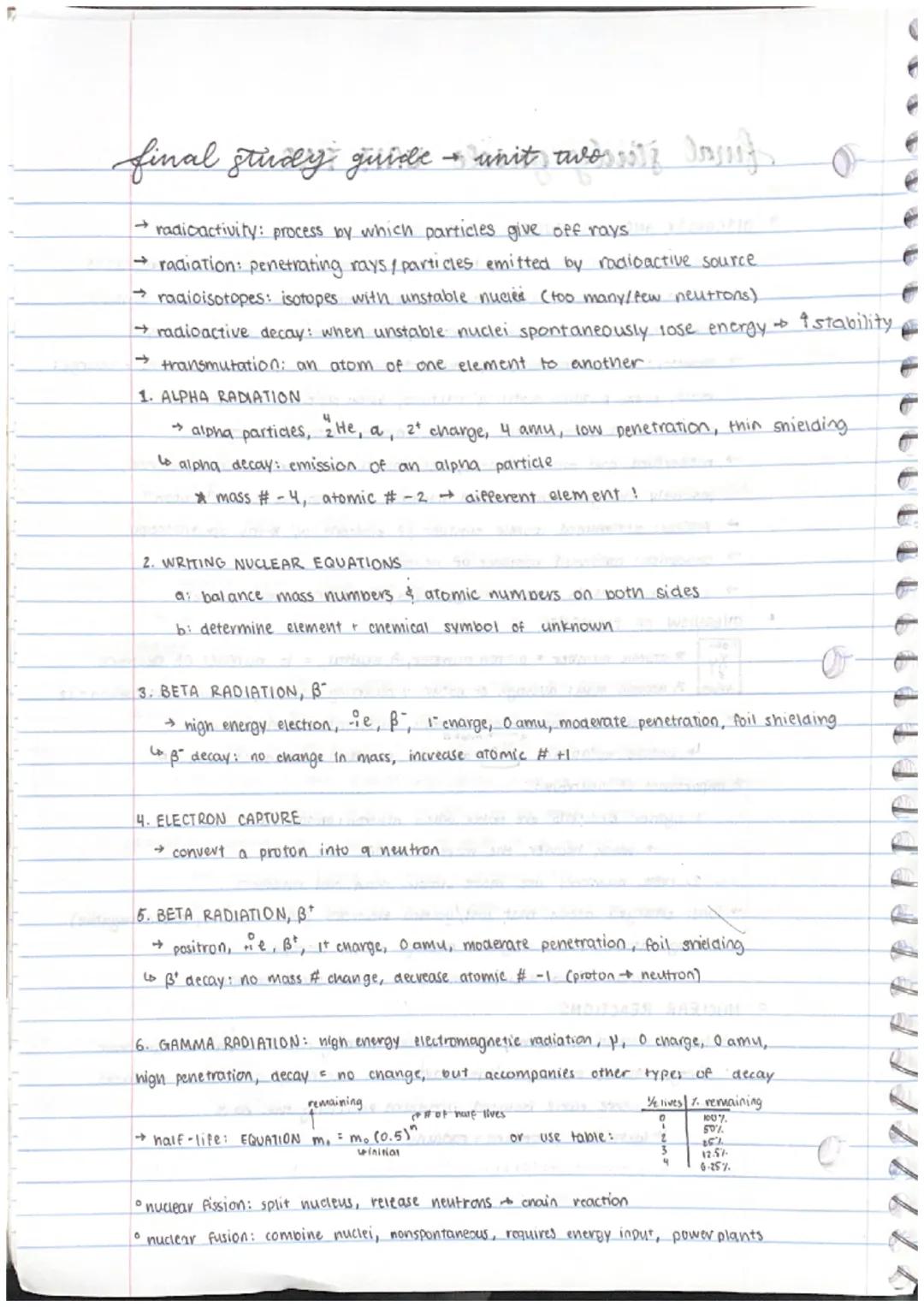
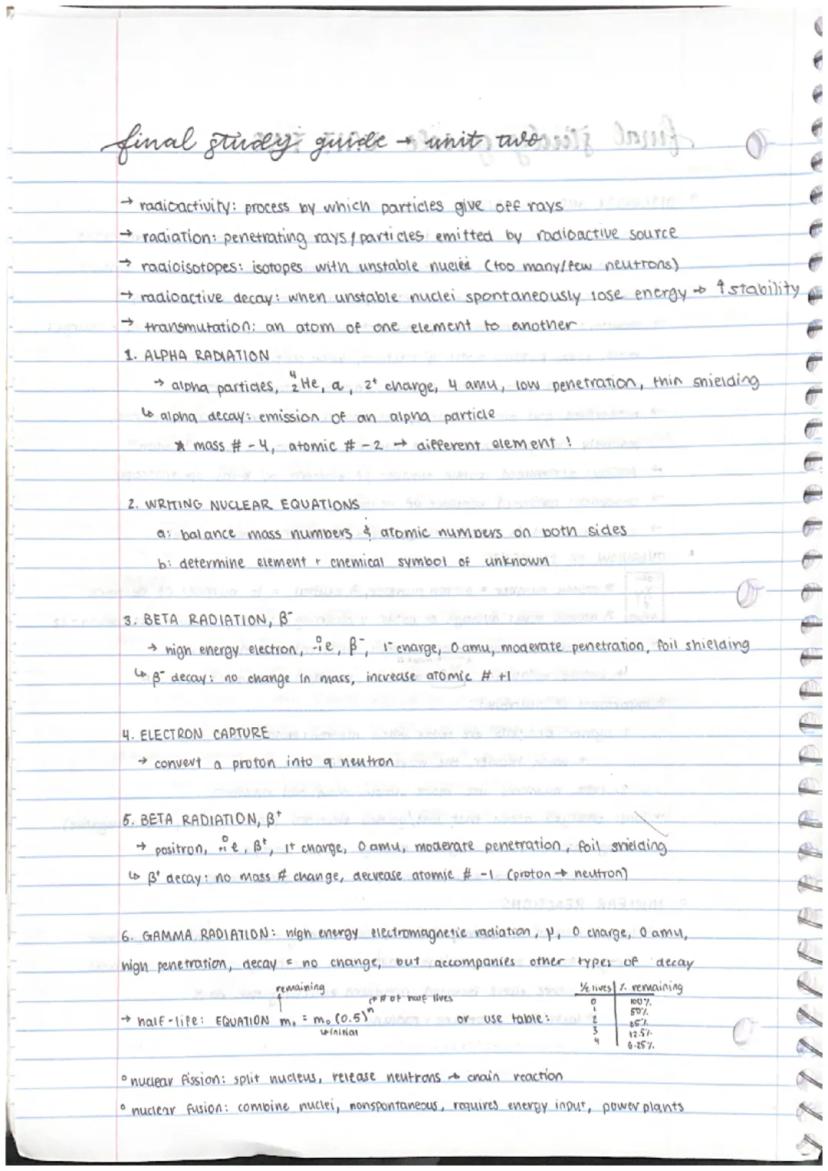
Nuclear Chemistry and Radioactive Decay
Nuclear chemistry explores atomic nucleus changes through radioactive decay and nuclear reactions. Different types of radiation include alpha particles (helium nuclei), beta particles (electrons or positrons), and gamma rays (electromagnetic radiation).
Radioactive decay processes follow predictable patterns measured by half-life, which is the time required for half of a radioactive sample to decay. The equation m(remaining) = m(initial)(0.5)^n calculates remaining mass after n half-lives.
Nuclear reactions include:
- Fission: splitting heavy nuclei
- Fusion: combining light nuclei
- Transmutation: converting one element to another
Vocabulary: Radioisotopes are unstable atomic nuclei that undergo spontaneous decay to achieve stability.
5
of 10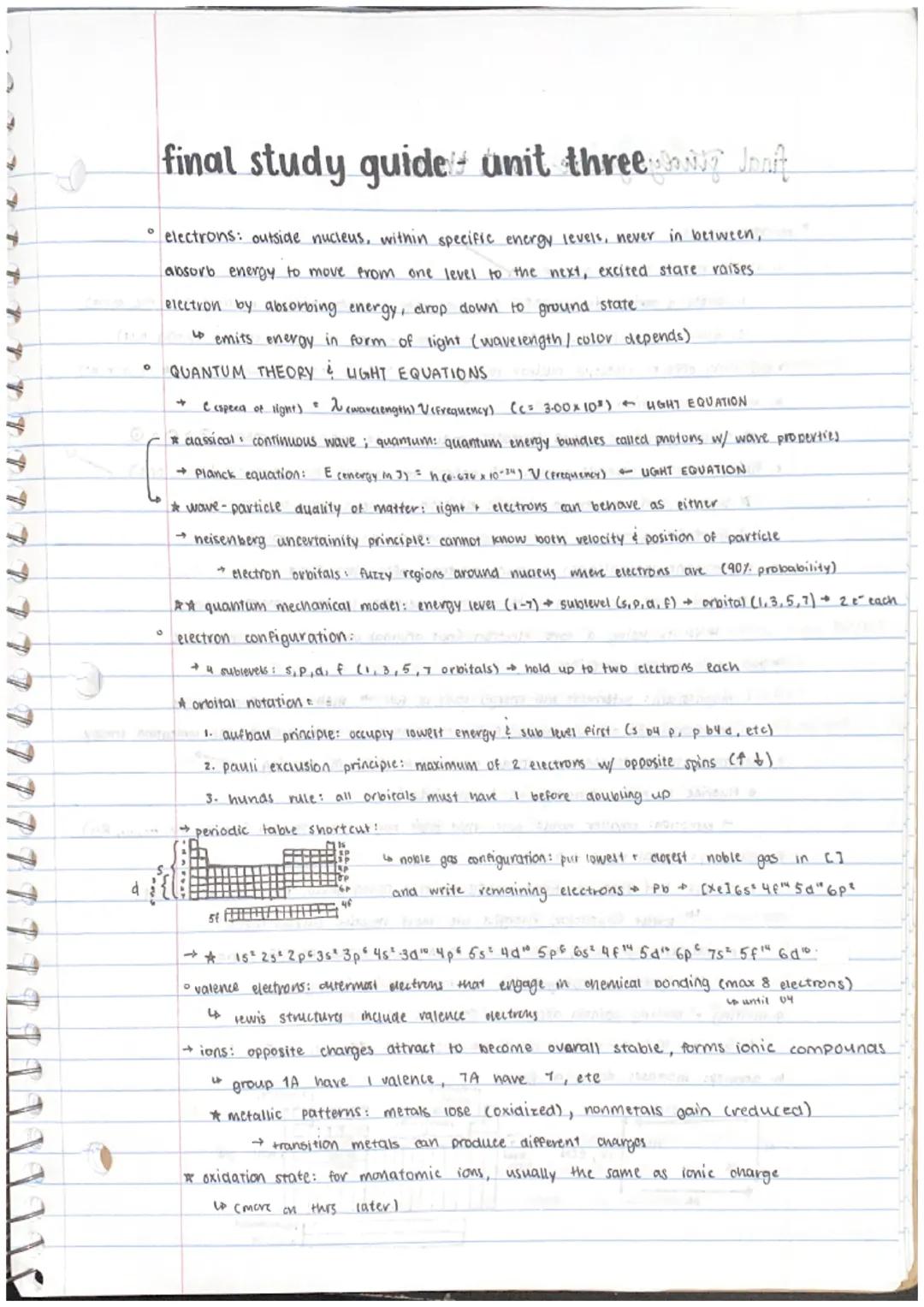
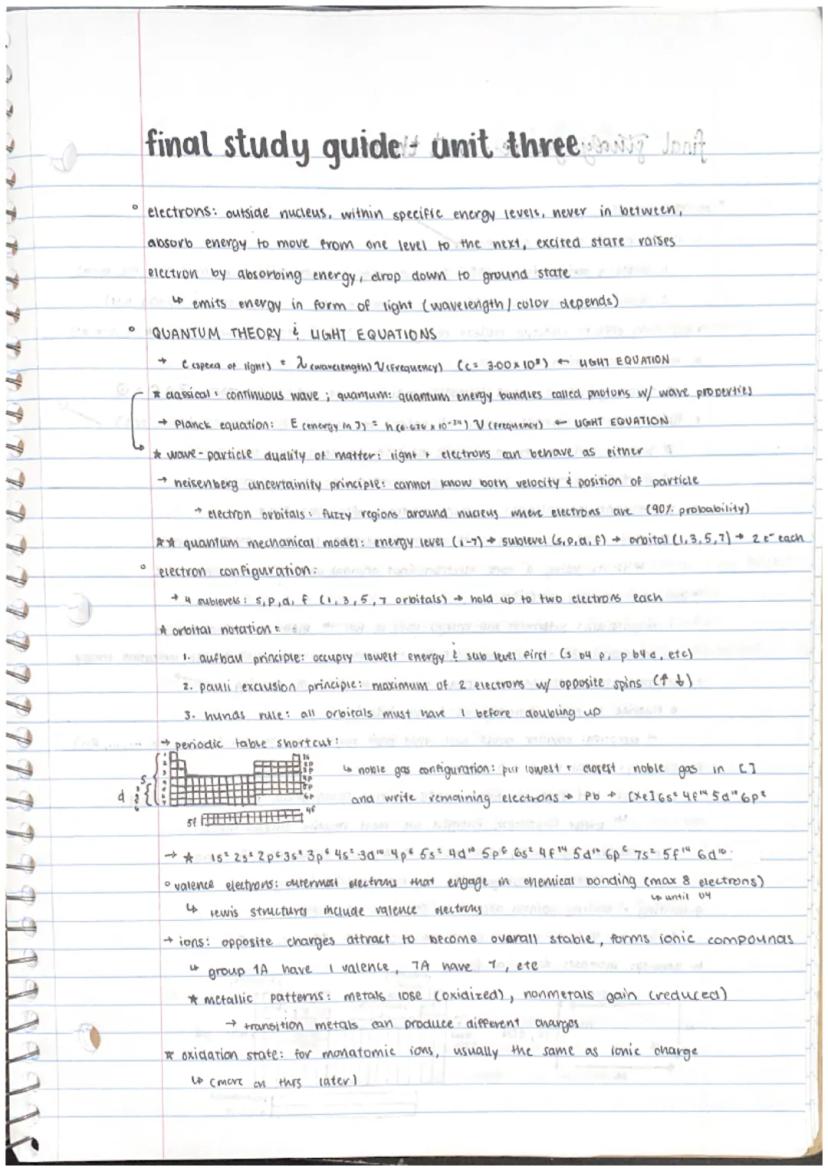
Understanding Quantum Theory and Electronic Structure
The quantum mechanical model explains how electrons behave within atoms, providing crucial insights into atomic structure and chemical bonding. Electrons exist in specific energy levels around the nucleus, never occupying the space between levels. When electrons absorb energy, they become excited and jump to higher energy states. Upon returning to their ground state, they release energy in the form of light with specific wavelengths.
Definition: Quantum theory describes energy as discrete packets called photons that exhibit both wave and particle properties. This wave-particle duality applies to both light and electrons, as demonstrated by the Heisenberg Uncertainty Principle.
The arrangement of electrons follows specific rules governed by quantum numbers. Electron orbitals represent probability regions where electrons are likely found, organized into energy levels (1-7) and sublevels (s, p, d, f). Each orbital can hold a maximum of two electrons with opposite spins, following the Pauli Exclusion Principle. The Aufbau Principle dictates that electrons fill lower energy levels first, while Hund's Rule states that electrons in orbitals of the same energy must be unpaired before pairing begins.
Valence electrons, found in the outermost shell, are particularly important as they participate in chemical bonding. These electrons determine an atom's chemical properties and how it forms ionic or covalent bonds. Understanding electron configuration helps predict chemical behavior and explains periodic trends. For transition metals, multiple oxidation states are possible due to their unique electron arrangements in d-orbitals.
6
of 10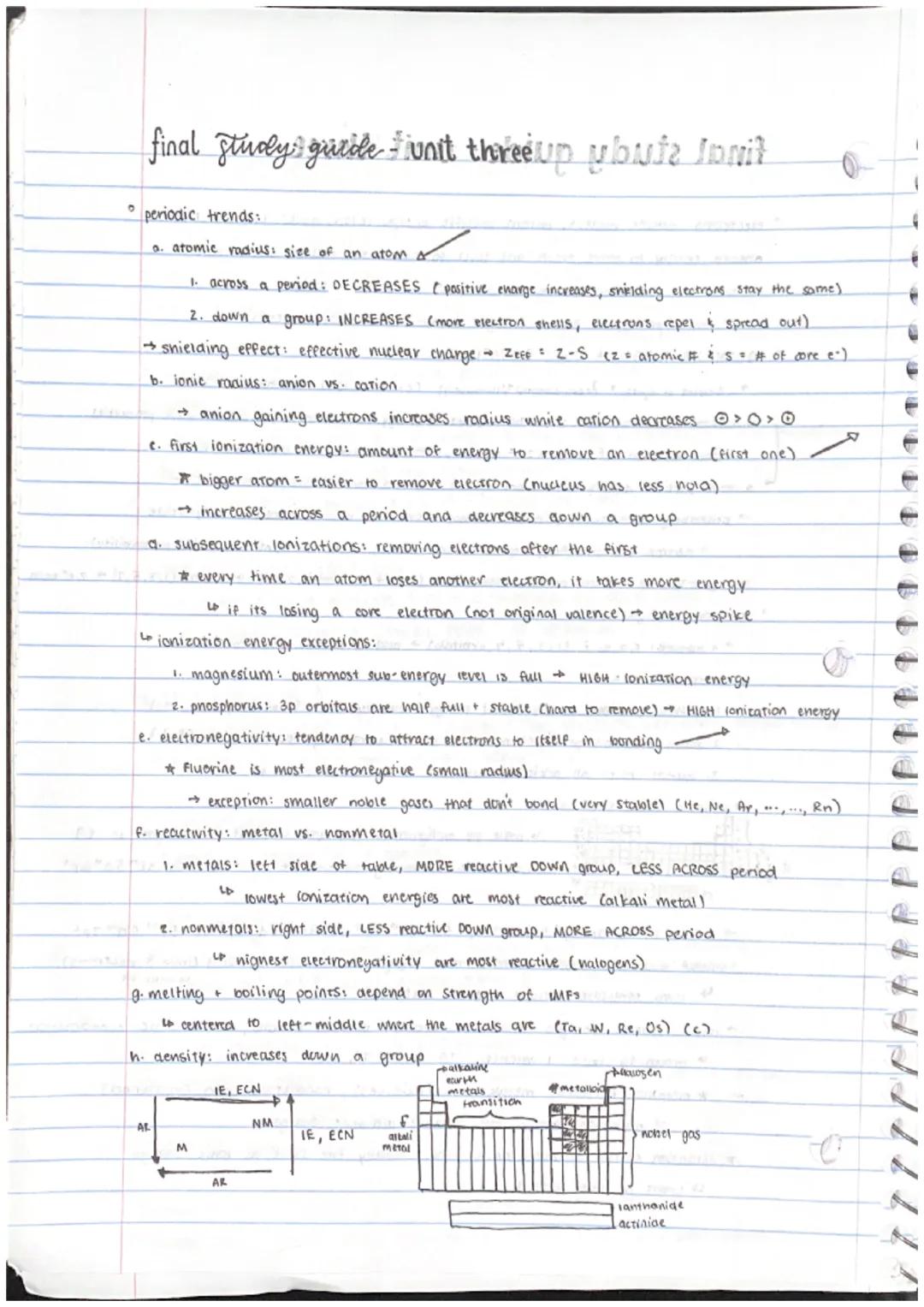
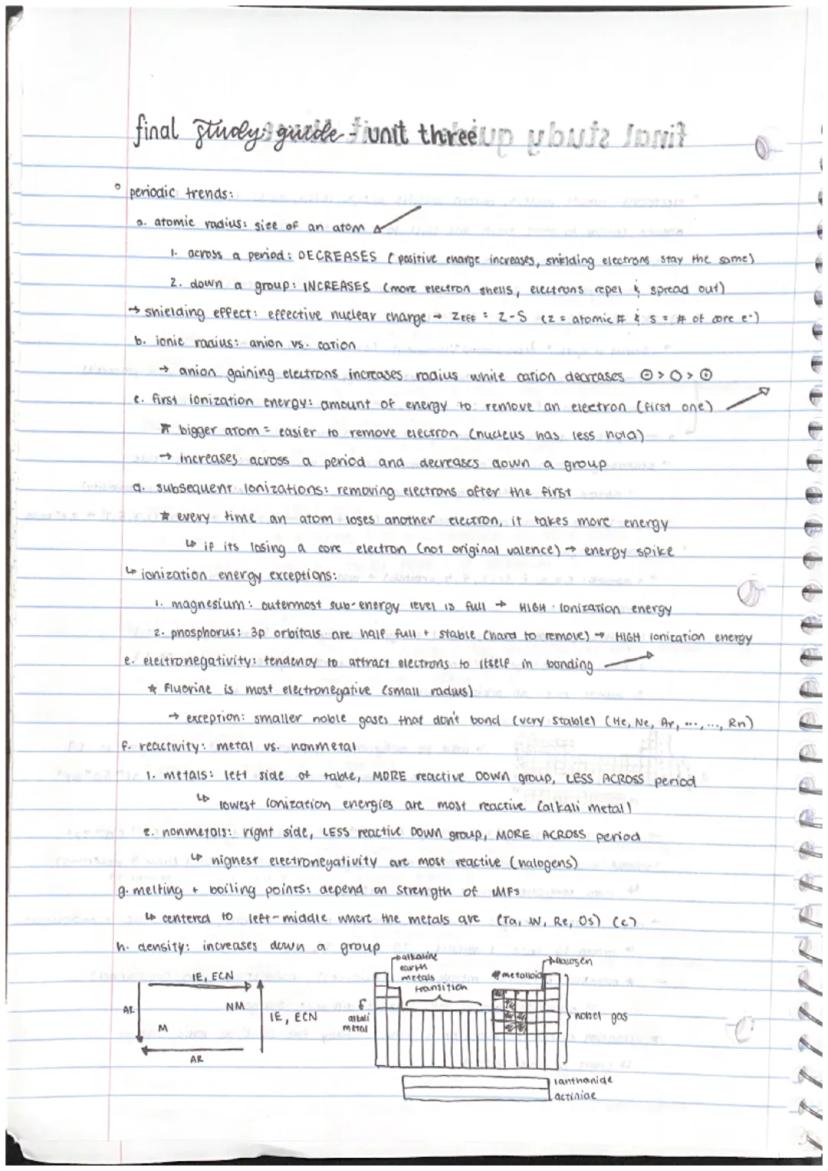
Periodic Trends and Atomic Properties
Atomic properties follow systematic trends across the periodic table, providing valuable insights into chemical behavior. Atomic radius generally decreases across periods due to increasing nuclear charge, while it increases down groups as additional electron shells are added. The shielding effect, described by effective nuclear charge (Zeff), influences these trends by reducing the attraction between outer electrons and the nucleus.
Highlight: Electronegativity, the tendency to attract electrons in bonds, generally increases across periods and decreases down groups. Fluorine is the most electronegative element due to its small size and high nuclear charge.
Ionization energy, the energy required to remove an electron, shows interesting patterns and exceptions. It typically increases across periods and decreases down groups. Notable exceptions occur with magnesium (due to its full subshell) and phosphorus , which show unexpectedly high ionization energies. Subsequent ionizations require progressively more energy, with sharp increases when removing core electrons.
Physical properties like melting points, boiling points, and density also follow periodic trends. Metals generally become more reactive down groups but less reactive across periods, while nonmetals show opposite trends. These patterns arise from electronic structure and help predict chemical behavior and reactivity patterns.
7
of 10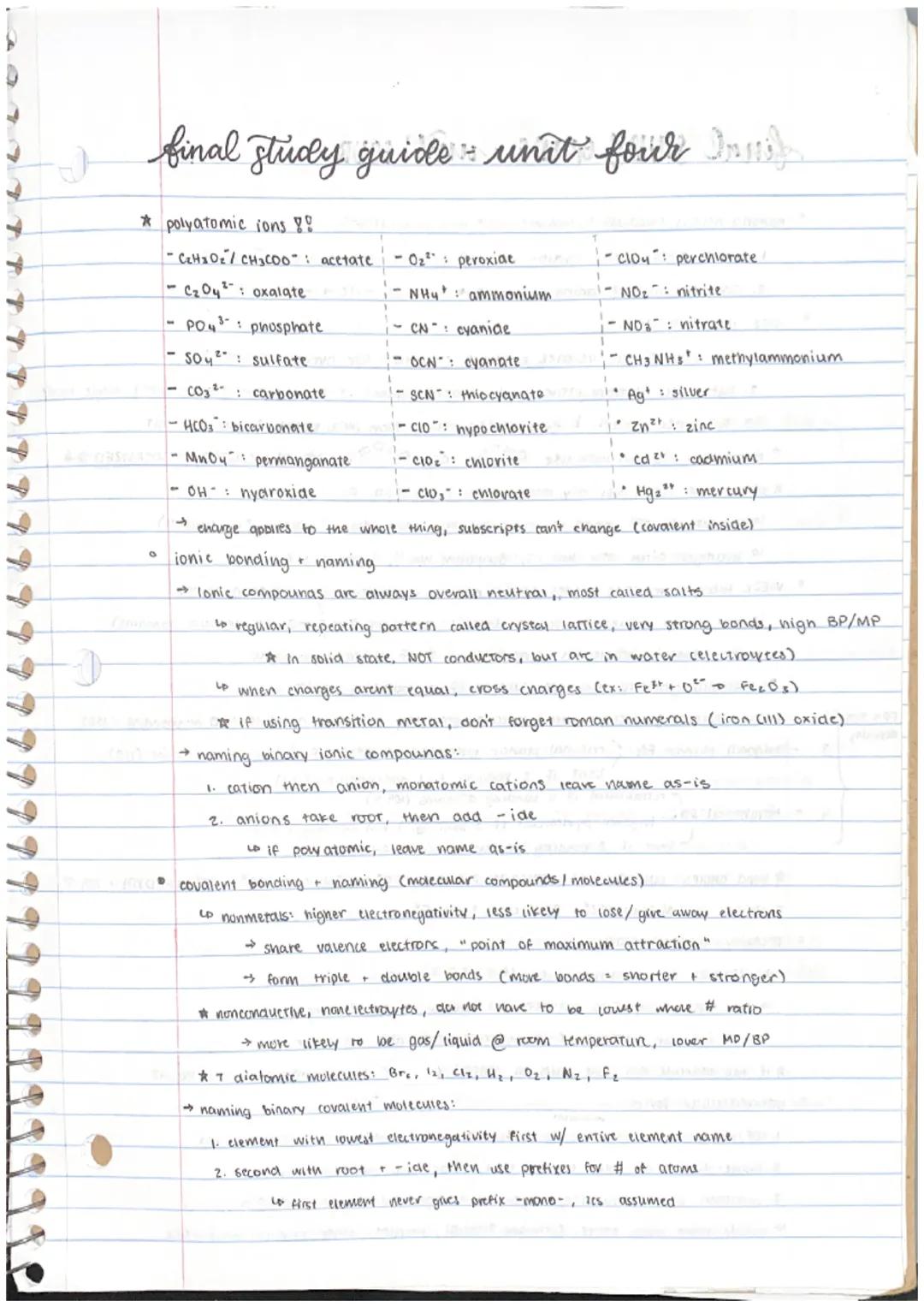
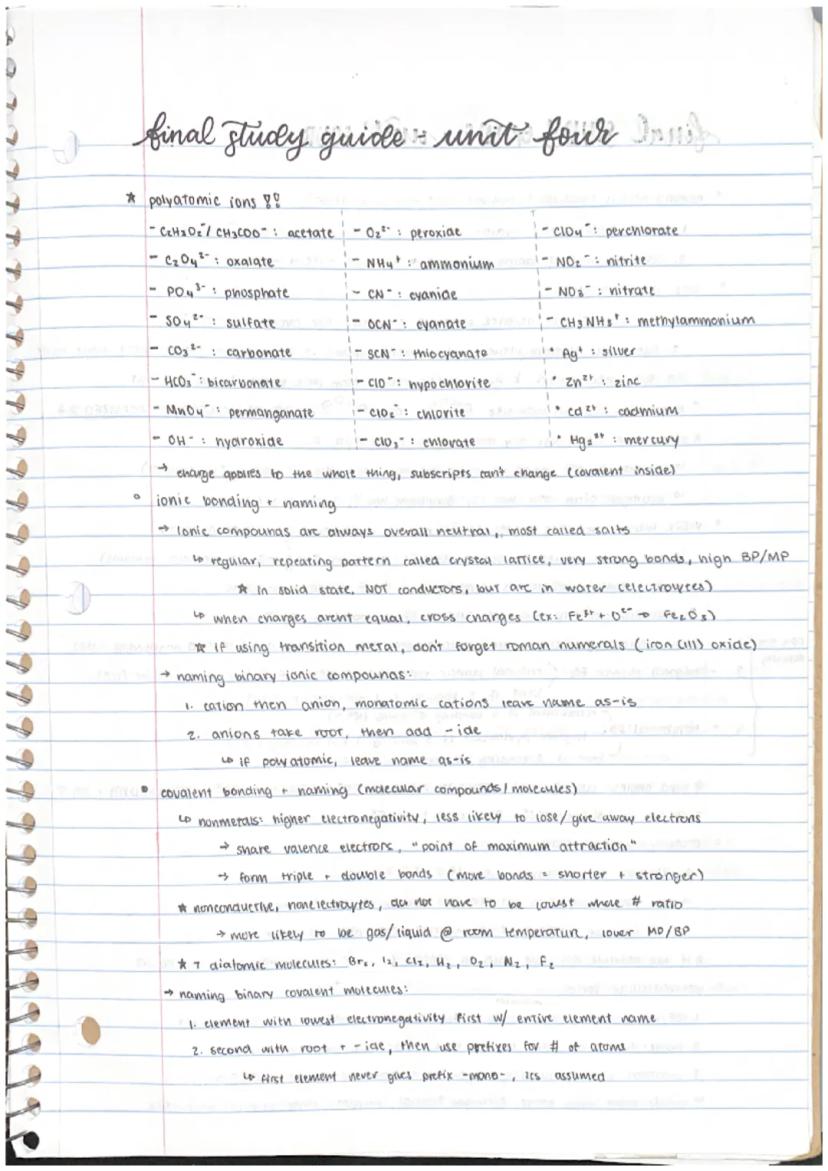
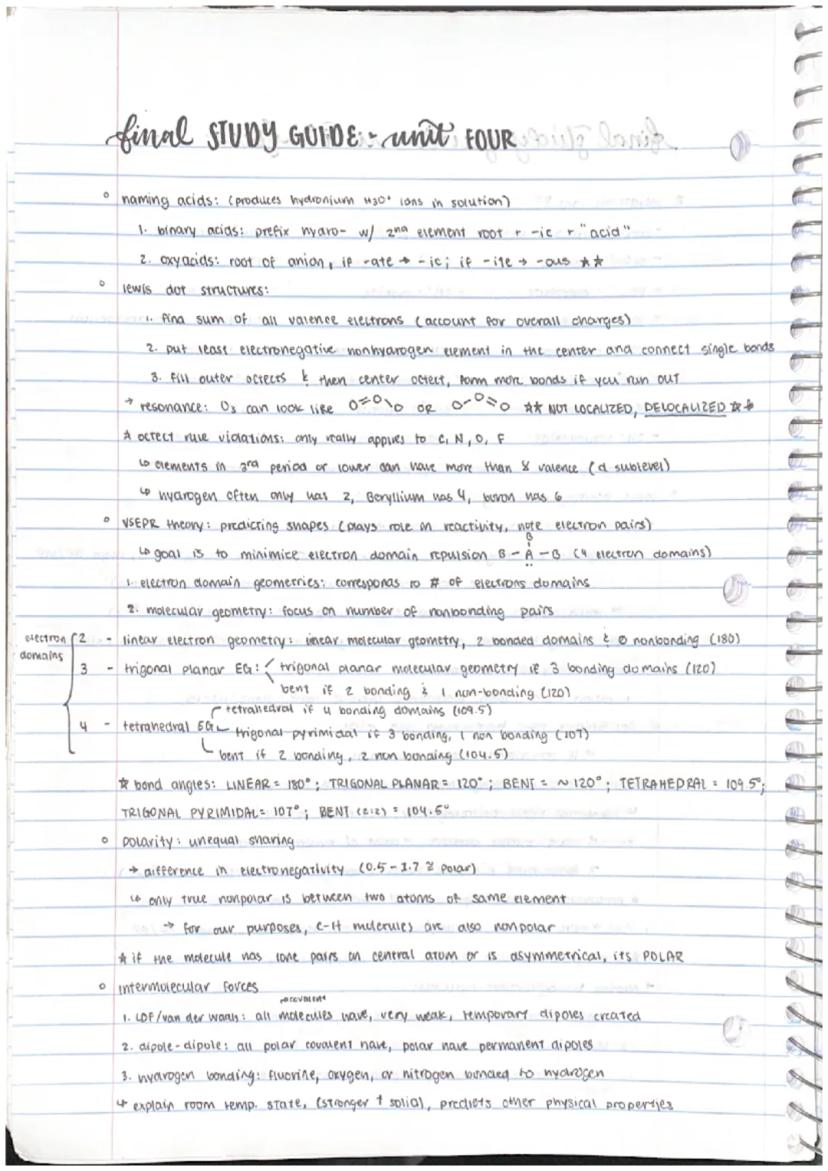
Chemical Bonding and Molecular Structure
Understanding chemical bonding requires knowledge of both ionic and covalent interactions. Ionic bonds form between metals and nonmetals through electron transfer, creating charged particles called ions. These compounds form crystal lattices with high melting and boiling points, and conduct electricity when dissolved in water as electrolytes.
Example: In Fe₂O₃ (iron(III) oxide), iron loses electrons to become Fe³⁺ while oxygen gains electrons to become O²⁻, forming a stable ionic compound through charge balance.
Covalent bonds form between nonmetals through electron sharing, creating molecular compounds with distinct properties. These compounds typically have lower melting and boiling points than ionic compounds and don't conduct electricity. The strength and characteristics of covalent bonds depend on electronegativity differences between atoms and the number of shared electron pairs.
Lewis structures help visualize electron arrangements in molecules, following the octet rule for main group elements. Some elements can violate this rule, particularly those in period 3 and below. VSEPR theory predicts molecular geometry based on electron domain arrangements, considering both bonding and nonbonding electron pairs. These geometric arrangements influence molecular polarity and chemical reactivity.
8
of 10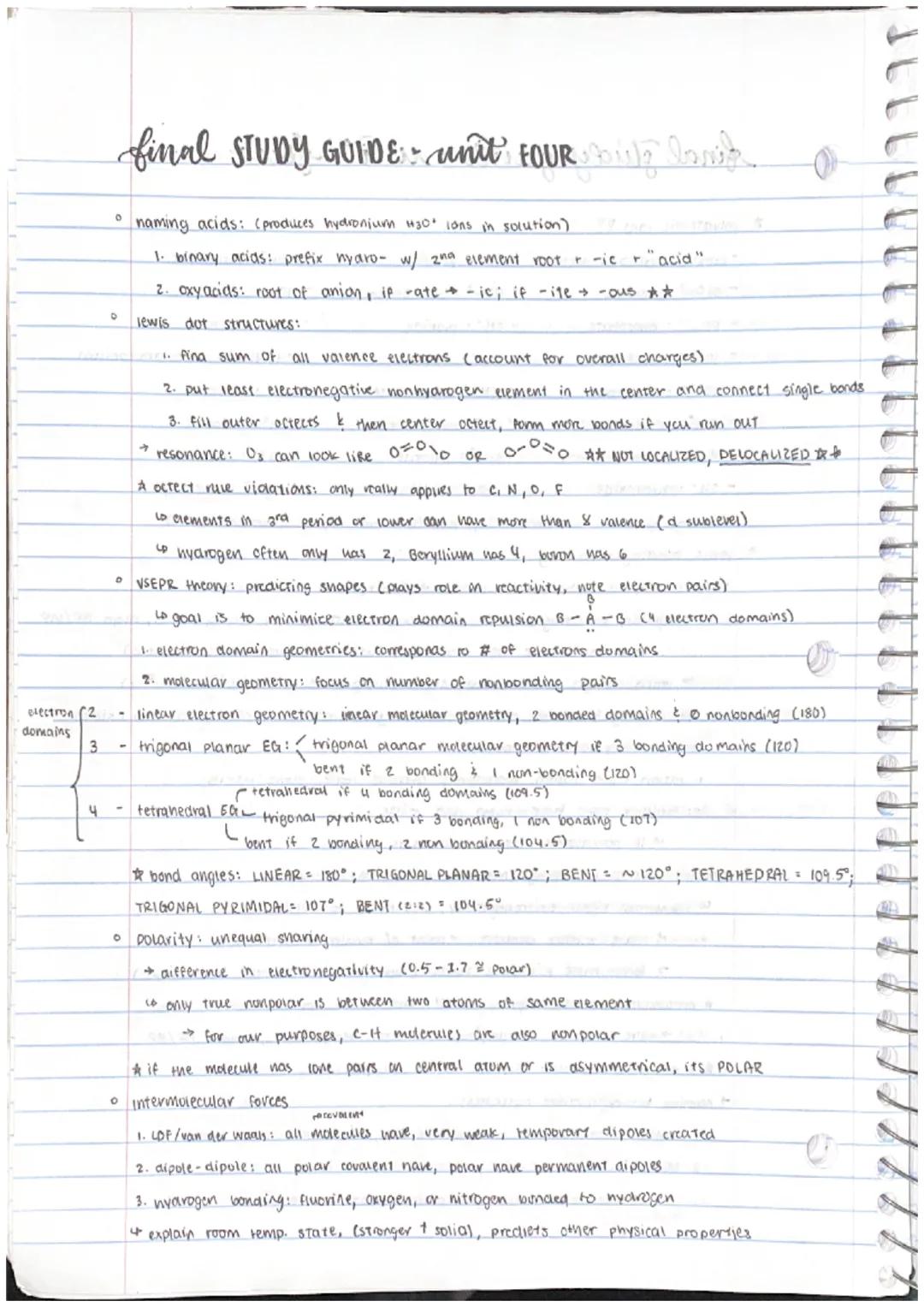
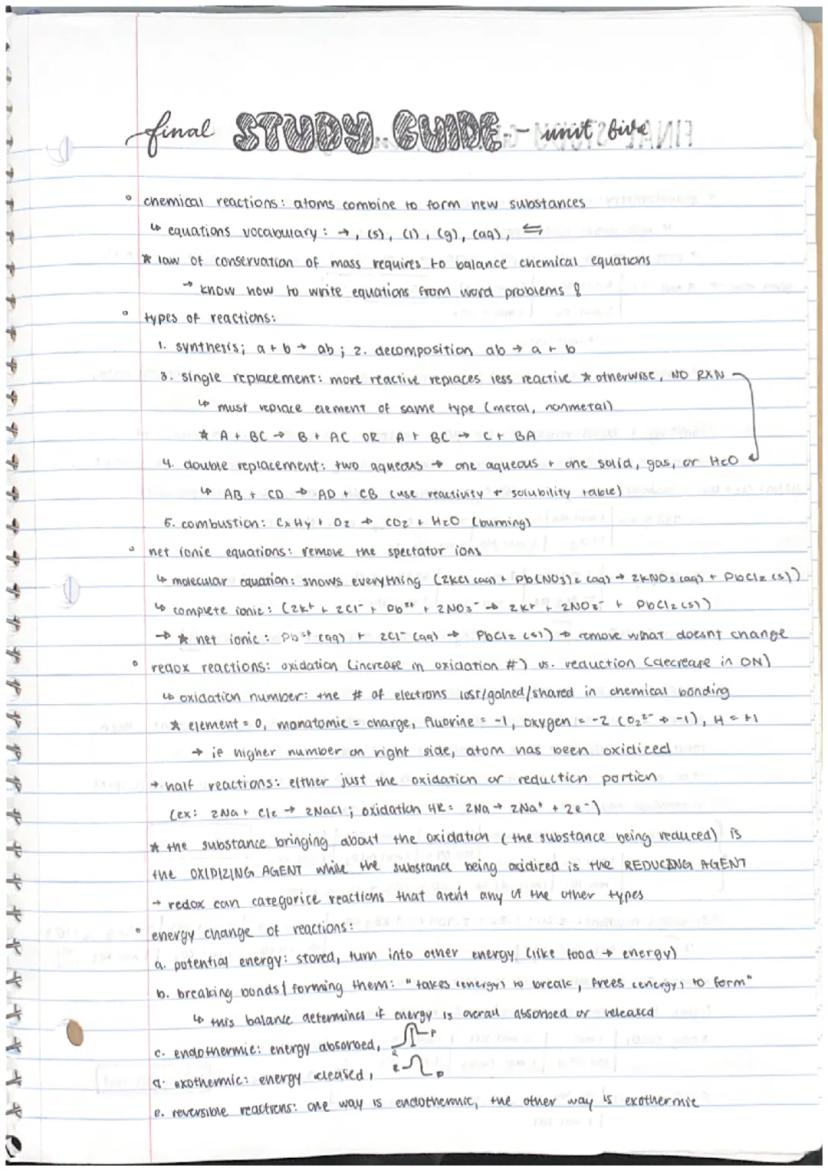
Chemical Reactions and Energy Changes
Chemical reactions involve the rearrangement of atoms to form new substances, following the law of conservation of mass. Different types of reactions include synthesis, decomposition, single replacement, double replacement, and combustion. Each type follows specific patterns and can be predicted using activity series and solubility rules.
Vocabulary: Redox reactions involve electron transfer, where oxidation represents electron loss (increase in oxidation number) and reduction represents electron gain (decrease in oxidation number).
Net ionic equations show the essential components of reactions by removing spectator ions that don't participate in the chemical change. Understanding oxidation numbers helps identify redox reactions and determine oxidizing and reducing agents. The substance being reduced acts as the oxidizing agent, while the substance being oxidized serves as the reducing agent.
Energy changes in reactions involve both bond breaking (endothermic) and bond formation (exothermic). The overall energy change depends on the balance between these processes. Endothermic reactions absorb energy from the surroundings, while exothermic reactions release energy. Reversible reactions demonstrate how one direction can be endothermic while the reverse is exothermic, highlighting the relationship between reaction direction and energy changes.
9
of 10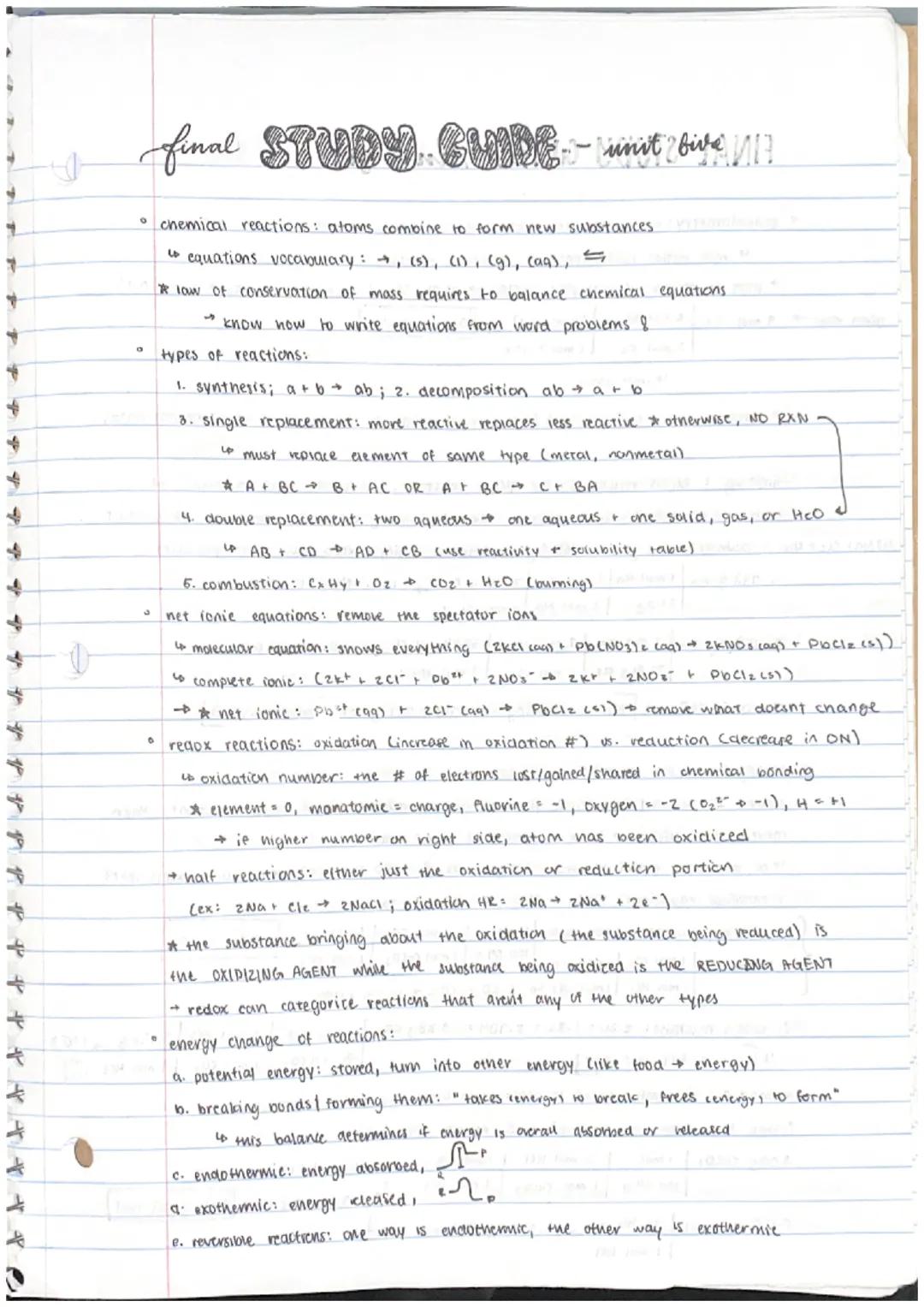
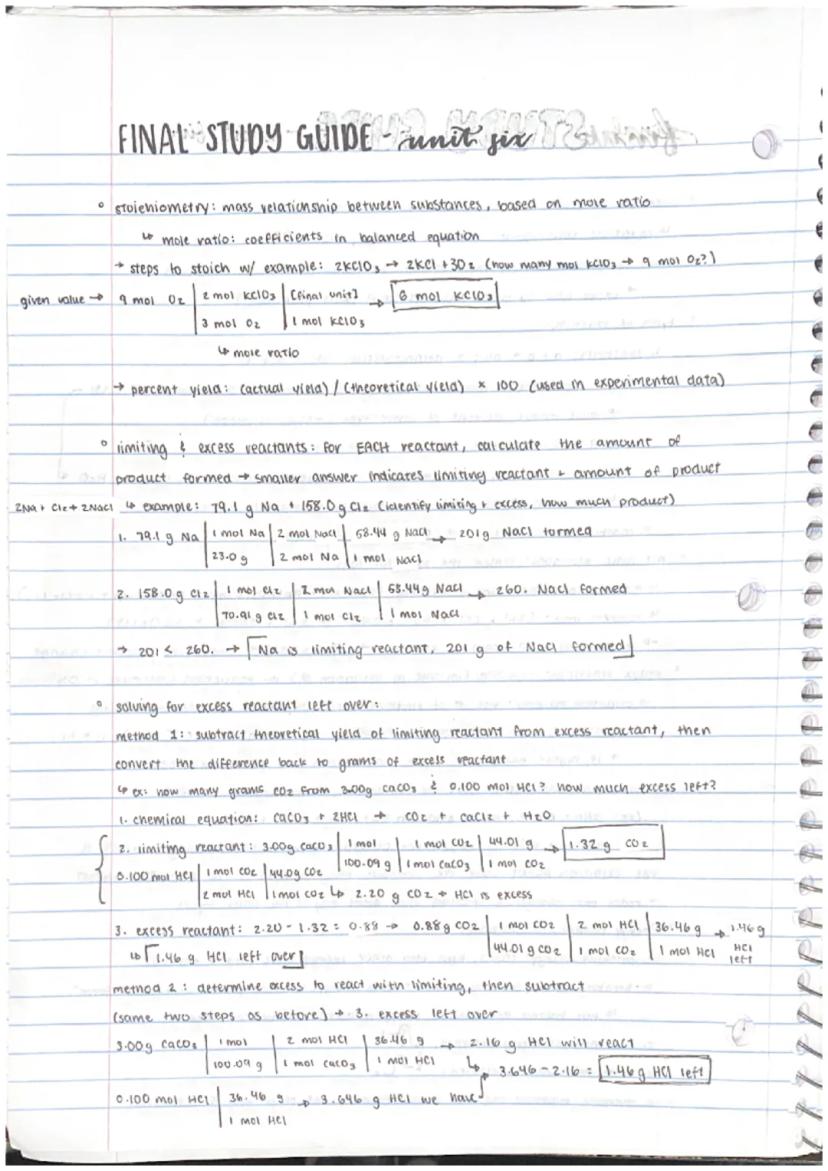
Understanding Stoichiometry and Limiting Reactants in Chemistry
The foundation of chemical calculations lies in stoichiometry, which governs the quantitative relationships between reactants and products in chemical reactions. This essential concept helps chemists predict reaction outcomes and optimize industrial processes.
Definition: Stoichiometry is the mathematical study of the mass relationships between reactants and products in a chemical reaction, based on balanced equations and mole ratios.
Understanding limiting reactants is crucial for accurately predicting reaction yields. When two or more reactants are present, the limiting reactant determines the maximum amount of product that can form. Consider the reaction between sodium and chlorine gas: 2Na + Cl₂ → 2NaCl. If we have 79.1g Na and 158.0g Cl₂, we must calculate which reactant limits product formation.
Let's break down the process of identifying limiting reactants:
- Convert all given masses to moles
- Compare the molar ratios from the balanced equation
- Calculate theoretical yield from each reactant
- The smaller yield indicates the limiting reactant
Example: In the sodium chloride formation reaction:
- From Na: 79.1g Na × × × = 201g NaCl
- From Cl₂: 158.0g Cl₂ × × × = 260g NaCl
10
of 10
Calculating Excess Reactants and Percent Yield
When working with limiting reactants, determining the amount of excess reactant remaining is equally important. Two methods can be used to calculate excess reactant quantities, providing valuable information for reaction optimization and cost analysis.
Highlight: Percent yield compares actual experimental results to theoretical calculations using the formula: × 100
The first method for calculating excess reactant involves:
- Calculate theoretical yield from limiting reactant
- Subtract this from the initial amount of excess reactant
- Convert the difference back to grams of excess reactant
Example: Consider the reaction CaCO₃ + 2HCl → CO₂ + CaCl₂ + H₂O With 3.00g CaCO₃ and 0.100 mol HCl:
- Calculate limiting reactant yields
- Determine excess HCl remaining
- Final calculation shows 1.46g HCl excess
This comprehensive understanding of stoichiometry, limiting reactants, and excess calculations is fundamental for honors chemistry final exam preparation and practical laboratory work. These concepts form the backbone of quantitative chemistry and are essential for honors chemistry semester 1 final exam success.
We thought you’d never ask...
What is the Knowunity AI companion?
Our AI Companion is a student-focused AI tool that offers more than just answers. Built on millions of Knowunity resources, it provides relevant information, personalised study plans, quizzes, and content directly in the chat, adapting to your individual learning journey.
Where can I download the Knowunity app?
You can download the app from Google Play Store and Apple App Store.
Is Knowunity really free of charge?
That's right! Enjoy free access to study content, connect with fellow students, and get instant help – all at your fingertips.
Similar content
Most popular content: Acid-base Chemistry
2Most popular content in Chemistry
9ChemistryAcids and Bases
This tackles the general properties of acids and bases, their examples and pH concept.
2621
ChemistryMass-to-Mass Stoichiometry: Calculating Grams to Grams
Learn how to perform mass-to-mass stoichiometric calculations. This guide covers the steps to convert grams of a reactant or product to grams of another substance using mole ratios and molar mass.
9th1993
ChemistryPhysical and Chemical Changes, with Examples
Learn about the properties of chemical and physical changes, with examples and explanations.
11th603
ChemistryPhysical and Chemical Changes
Learn about physical and chemical changes, properties, and examples in this informative article.
10th612
ChemistryGENERAL CHEMISTRY 11 S1 Q1
general chemistry grade 11 full handouts
11th1150
ChemistryUnderstanding Atomic and Mass Numbers (Z and A)
Learn the definitions of atomic number (Z) and mass number (A). Understand how these numbers relate to protons, neutrons, and isotopes in an atom's nucleus.
9th522
ChemistryCarbon Chem - Organic VS Inorganic, Hydrocarbons, Molecular/Structural/Empirical Formula, Functionnal Groups
Review Organic VS Inorganic compounds, learn about Hydrocarbons, Understanding the differences between molecular, structure, and empirical formulas, Prefixes/Suffixes, Functional Groups of carbon.
9th1277
ChemistryMolecular Geometry
Chemistry notes
10th1410
ChemistryThermochemistry Notes 🥵🔥
Unit 10 of Chemistry Honors (Inorganic)
10th87352
Most popular content
9O
 AP US History
Origins and Dynamics of the Columbian Exchange
Analyze the ecological and economic motivations behind the initial transfer of goods, people, and diseases between the Old and New Worlds.
9th3,1280
I
AP US HistoryIntroduction to Early Cultural Interactions
Analyze the initial social and religious encounters between Europeans, Africans, and Indigenous peoples in the colonial Americas.
9th2,7730
O
 AP World History
Origins of Ancient River Civilizations
Analyze the environmental factors and technological innovations that led to the rise of early states in Mesopotamia, Egypt, and the Indus Valley.
9th3,1870
M
AP US HistoryMotivations for European Exploration
Analyze the economic, religious, and political factors that drove European powers to the Americas during the 15th and 16th centuries.
9th1,7780
F
 AP Psychology
Foundations of Ethical Guidelines in Research
Practice the core principles of the APA ethical code including informed consent, debriefing, and the role of Institutional Review Boards.
9th1,3360
I
AP US HistoryIntroduction to Native American Societies
Examine the diverse social, political, and economic structures of North American indigenous groups prior to European contact.
9th1,1100
I
 AP Biology
Introduction to Biological Elements of Life
Practice identifying the essential elements including carbon, nitrogen, phosphorus, and sulfur that compose biological macromolecules.
9th1,7390
I
AP US HistoryIntroduction to the Spanish Encomienda System
Explore the fundamental economic and social structures of the Spanish colonial system, focusing on the encomienda and the casta social hierarchy.
9th8890
O
AP World HistoryOrigins and Continuity of the Byzantine Empire
Analyze the political and cultural transitions from the Roman Empire to the Byzantine Empire, focusing on the reign of Justinian I and his code.
9th1,6320
Can't find what you're looking for? Explore other subjects.
Students love us — and so will you.
4.6/5App Store
4.7/5Google Play
The app is very easy to use and well designed. I have found everything I was looking for so far and have been able to learn a lot from the presentations! I will definitely use the app for a class assignment! And of course it also helps a lot as an inspiration.
Stefan SiOS user
This app is really great. There are so many study notes and help [...]. My problem subject is French, for example, and the app has so many options for help. Thanks to this app, I have improved my French. I would recommend it to anyone.
Samantha KlichAndroid user
Wow, I am really amazed. I just tried the app because I've seen it advertised many times and was absolutely stunned. This app is THE HELP you want for school and above all, it offers so many things, such as workouts and fact sheets, which have been VERY helpful to me personally.
AnnaiOS user
Chemistry1,451 views·Updated Jun 17, 2026·21 pagesHonors Chemistry 1 Final Study Guide PDF - Free 2021 Exam Tips!
The law of definite proportions and law of multiple proportions are fundamental principles in chemistry that explain how elements combine to form compounds. These laws were crucial in developing our modern understanding of atomic theory and chemical bonding.
According to...
1
of 10
Sign up to see the content. It's free!
- Access to all documents
- Improve your grades
- Join milions of students
Understanding Measurement and Significant Figures in Chemistry
The foundation of chemistry relies on precise measurements and understanding significant figures. When conducting measurements, accuracy refers to how close a value is to the accepted value, while precision indicates how close repeated measurements are to each other. A critical formula in determining measurement accuracy is percent error = / true × 100.
Proper measurement techniques require recording one decimal place beyond the smallest marked increment on measuring tools. For volume measurements, graduated cylinders provide the most accurate results compared to beakers or flasks. Temperature measurements in chemistry utilize Celsius or Kelvin scales exclusively.
Significant figures represent measurement precision through specific rules. All nonzero integers are always significant, while zeros follow three classifications: leading zeros (never significant), captive zeros (always significant), and trailing zeros (significant only with decimal points). When performing calculations, multiplication and division results should have the same number of significant figures as the least precise measurement, while addition and subtraction results are limited by the least number of decimal places.
Definition: Significant figures are digits in a number that carry meaning and represent the precision of a measurement.
2
of 10Sign up to see the content. It's free!
- Access to all documents
- Improve your grades
- Join milions of students
Laws of Chemical Composition and Matter Classification
Laws of definite and multiple proportions form fundamental principles in chemistry. The law of definite proportions states that compounds always contain elements in fixed mass ratios. The law of multiple proportions explains that when elements form multiple compounds, the mass ratios of these elements will be small whole numbers.
Matter classification involves understanding different types of mixtures and pure substances. Heterogeneous mixtures show visible boundaries between components, while homogeneous solutions appear uniform throughout. Various separation techniques exist for mixtures:
- Decanting separates solids from liquids
- Filtration separates particles of different sizes
- Chromatography separates components based on absorption rates
- Distillation separates liquids with different boiling points
Example: In water (H₂O), hydrogen and oxygen always combine in a 1:8 mass ratio, demonstrating the law of definite proportions.
3
of 10Sign up to see the content. It's free!
- Access to all documents
- Improve your grades
- Join milions of students
Atomic Structure and Historical Developments
The modern understanding of atomic structure evolved through numerous scientific discoveries. Dalton's atomic theory proposed indivisible atoms, while Thomson's cathode ray experiments revealed electrons. Rutherford's gold foil experiment demonstrated the nucleus's existence, and Bohr introduced electron energy levels.
Atomic structure fundamentals include:
- Atomic number equals proton count
- Mass number represents total protons and neutrons
- Isotopes differ in neutron count but maintain identical chemical properties
Highlight: The stability of atomic nuclei depends on the neutron-to-proton ratio, with heavier elements requiring more neutrons for stability.
4
of 10Sign up to see the content. It's free!
- Access to all documents
- Improve your grades
- Join milions of students
Nuclear Chemistry and Radioactive Decay
Nuclear chemistry explores atomic nucleus changes through radioactive decay and nuclear reactions. Different types of radiation include alpha particles (helium nuclei), beta particles (electrons or positrons), and gamma rays (electromagnetic radiation).
Radioactive decay processes follow predictable patterns measured by half-life, which is the time required for half of a radioactive sample to decay. The equation m(remaining) = m(initial)(0.5)^n calculates remaining mass after n half-lives.
Nuclear reactions include:
- Fission: splitting heavy nuclei
- Fusion: combining light nuclei
- Transmutation: converting one element to another
Vocabulary: Radioisotopes are unstable atomic nuclei that undergo spontaneous decay to achieve stability.
5
of 10Sign up to see the content. It's free!
- Access to all documents
- Improve your grades
- Join milions of students
Understanding Quantum Theory and Electronic Structure
The quantum mechanical model explains how electrons behave within atoms, providing crucial insights into atomic structure and chemical bonding. Electrons exist in specific energy levels around the nucleus, never occupying the space between levels. When electrons absorb energy, they become excited and jump to higher energy states. Upon returning to their ground state, they release energy in the form of light with specific wavelengths.
Definition: Quantum theory describes energy as discrete packets called photons that exhibit both wave and particle properties. This wave-particle duality applies to both light and electrons, as demonstrated by the Heisenberg Uncertainty Principle.
The arrangement of electrons follows specific rules governed by quantum numbers. Electron orbitals represent probability regions where electrons are likely found, organized into energy levels (1-7) and sublevels (s, p, d, f). Each orbital can hold a maximum of two electrons with opposite spins, following the Pauli Exclusion Principle. The Aufbau Principle dictates that electrons fill lower energy levels first, while Hund's Rule states that electrons in orbitals of the same energy must be unpaired before pairing begins.
Valence electrons, found in the outermost shell, are particularly important as they participate in chemical bonding. These electrons determine an atom's chemical properties and how it forms ionic or covalent bonds. Understanding electron configuration helps predict chemical behavior and explains periodic trends. For transition metals, multiple oxidation states are possible due to their unique electron arrangements in d-orbitals.
6
of 10Sign up to see the content. It's free!
- Access to all documents
- Improve your grades
- Join milions of students
Periodic Trends and Atomic Properties
Atomic properties follow systematic trends across the periodic table, providing valuable insights into chemical behavior. Atomic radius generally decreases across periods due to increasing nuclear charge, while it increases down groups as additional electron shells are added. The shielding effect, described by effective nuclear charge (Zeff), influences these trends by reducing the attraction between outer electrons and the nucleus.
Highlight: Electronegativity, the tendency to attract electrons in bonds, generally increases across periods and decreases down groups. Fluorine is the most electronegative element due to its small size and high nuclear charge.
Ionization energy, the energy required to remove an electron, shows interesting patterns and exceptions. It typically increases across periods and decreases down groups. Notable exceptions occur with magnesium (due to its full subshell) and phosphorus , which show unexpectedly high ionization energies. Subsequent ionizations require progressively more energy, with sharp increases when removing core electrons.
Physical properties like melting points, boiling points, and density also follow periodic trends. Metals generally become more reactive down groups but less reactive across periods, while nonmetals show opposite trends. These patterns arise from electronic structure and help predict chemical behavior and reactivity patterns.
7
of 10Sign up to see the content. It's free!
- Access to all documents
- Improve your grades
- Join milions of students
Chemical Bonding and Molecular Structure
Understanding chemical bonding requires knowledge of both ionic and covalent interactions. Ionic bonds form between metals and nonmetals through electron transfer, creating charged particles called ions. These compounds form crystal lattices with high melting and boiling points, and conduct electricity when dissolved in water as electrolytes.
Example: In Fe₂O₃ (iron(III) oxide), iron loses electrons to become Fe³⁺ while oxygen gains electrons to become O²⁻, forming a stable ionic compound through charge balance.
Covalent bonds form between nonmetals through electron sharing, creating molecular compounds with distinct properties. These compounds typically have lower melting and boiling points than ionic compounds and don't conduct electricity. The strength and characteristics of covalent bonds depend on electronegativity differences between atoms and the number of shared electron pairs.
Lewis structures help visualize electron arrangements in molecules, following the octet rule for main group elements. Some elements can violate this rule, particularly those in period 3 and below. VSEPR theory predicts molecular geometry based on electron domain arrangements, considering both bonding and nonbonding electron pairs. These geometric arrangements influence molecular polarity and chemical reactivity.
8
of 10Sign up to see the content. It's free!
- Access to all documents
- Improve your grades
- Join milions of students
Chemical Reactions and Energy Changes
Chemical reactions involve the rearrangement of atoms to form new substances, following the law of conservation of mass. Different types of reactions include synthesis, decomposition, single replacement, double replacement, and combustion. Each type follows specific patterns and can be predicted using activity series and solubility rules.
Vocabulary: Redox reactions involve electron transfer, where oxidation represents electron loss (increase in oxidation number) and reduction represents electron gain (decrease in oxidation number).
Net ionic equations show the essential components of reactions by removing spectator ions that don't participate in the chemical change. Understanding oxidation numbers helps identify redox reactions and determine oxidizing and reducing agents. The substance being reduced acts as the oxidizing agent, while the substance being oxidized serves as the reducing agent.
Energy changes in reactions involve both bond breaking (endothermic) and bond formation (exothermic). The overall energy change depends on the balance between these processes. Endothermic reactions absorb energy from the surroundings, while exothermic reactions release energy. Reversible reactions demonstrate how one direction can be endothermic while the reverse is exothermic, highlighting the relationship between reaction direction and energy changes.
9
of 10Sign up to see the content. It's free!
- Access to all documents
- Improve your grades
- Join milions of students
Understanding Stoichiometry and Limiting Reactants in Chemistry
The foundation of chemical calculations lies in stoichiometry, which governs the quantitative relationships between reactants and products in chemical reactions. This essential concept helps chemists predict reaction outcomes and optimize industrial processes.
Definition: Stoichiometry is the mathematical study of the mass relationships between reactants and products in a chemical reaction, based on balanced equations and mole ratios.
Understanding limiting reactants is crucial for accurately predicting reaction yields. When two or more reactants are present, the limiting reactant determines the maximum amount of product that can form. Consider the reaction between sodium and chlorine gas: 2Na + Cl₂ → 2NaCl. If we have 79.1g Na and 158.0g Cl₂, we must calculate which reactant limits product formation.
Let's break down the process of identifying limiting reactants:
- Convert all given masses to moles
- Compare the molar ratios from the balanced equation
- Calculate theoretical yield from each reactant
- The smaller yield indicates the limiting reactant
Example: In the sodium chloride formation reaction:
- From Na: 79.1g Na × × × = 201g NaCl
- From Cl₂: 158.0g Cl₂ × × × = 260g NaCl
10
of 10Sign up to see the content. It's free!
- Access to all documents
- Improve your grades
- Join milions of students
Calculating Excess Reactants and Percent Yield
When working with limiting reactants, determining the amount of excess reactant remaining is equally important. Two methods can be used to calculate excess reactant quantities, providing valuable information for reaction optimization and cost analysis.
Highlight: Percent yield compares actual experimental results to theoretical calculations using the formula: × 100
The first method for calculating excess reactant involves:
- Calculate theoretical yield from limiting reactant
- Subtract this from the initial amount of excess reactant
- Convert the difference back to grams of excess reactant
Example: Consider the reaction CaCO₃ + 2HCl → CO₂ + CaCl₂ + H₂O With 3.00g CaCO₃ and 0.100 mol HCl:
- Calculate limiting reactant yields
- Determine excess HCl remaining
- Final calculation shows 1.46g HCl excess
This comprehensive understanding of stoichiometry, limiting reactants, and excess calculations is fundamental for honors chemistry final exam preparation and practical laboratory work. These concepts form the backbone of quantitative chemistry and are essential for honors chemistry semester 1 final exam success.
We thought you’d never ask...
What is the Knowunity AI companion?
Our AI Companion is a student-focused AI tool that offers more than just answers. Built on millions of Knowunity resources, it provides relevant information, personalised study plans, quizzes, and content directly in the chat, adapting to your individual learning journey.
Where can I download the Knowunity app?
You can download the app from Google Play Store and Apple App Store.
Is Knowunity really free of charge?
That's right! Enjoy free access to study content, connect with fellow students, and get instant help – all at your fingertips.
Similar content
Most popular content: Acid-base Chemistry
2Most popular content in Chemistry
9ChemistryAcids and Bases
This tackles the general properties of acids and bases, their examples and pH concept.
2621
ChemistryMass-to-Mass Stoichiometry: Calculating Grams to Grams
Learn how to perform mass-to-mass stoichiometric calculations. This guide covers the steps to convert grams of a reactant or product to grams of another substance using mole ratios and molar mass.
9th1993
ChemistryPhysical and Chemical Changes, with Examples
Learn about the properties of chemical and physical changes, with examples and explanations.
11th603
ChemistryPhysical and Chemical Changes
Learn about physical and chemical changes, properties, and examples in this informative article.
10th612
ChemistryGENERAL CHEMISTRY 11 S1 Q1
general chemistry grade 11 full handouts
11th1150
ChemistryUnderstanding Atomic and Mass Numbers (Z and A)
Learn the definitions of atomic number (Z) and mass number (A). Understand how these numbers relate to protons, neutrons, and isotopes in an atom's nucleus.
9th522
ChemistryCarbon Chem - Organic VS Inorganic, Hydrocarbons, Molecular/Structural/Empirical Formula, Functionnal Groups
Review Organic VS Inorganic compounds, learn about Hydrocarbons, Understanding the differences between molecular, structure, and empirical formulas, Prefixes/Suffixes, Functional Groups of carbon.
9th1277
ChemistryMolecular Geometry
Chemistry notes
10th1410
ChemistryThermochemistry Notes 🥵🔥
Unit 10 of Chemistry Honors (Inorganic)
10th87352
Most popular content
9O
AP US HistoryOrigins and Dynamics of the Columbian Exchange
Analyze the ecological and economic motivations behind the initial transfer of goods, people, and diseases between the Old and New Worlds.
9th3,1280
I
AP US HistoryIntroduction to Early Cultural Interactions
Analyze the initial social and religious encounters between Europeans, Africans, and Indigenous peoples in the colonial Americas.
9th2,7730
O
AP World HistoryOrigins of Ancient River Civilizations
Analyze the environmental factors and technological innovations that led to the rise of early states in Mesopotamia, Egypt, and the Indus Valley.
9th3,1870
M
AP US HistoryMotivations for European Exploration
Analyze the economic, religious, and political factors that drove European powers to the Americas during the 15th and 16th centuries.
9th1,7780
F
AP PsychologyFoundations of Ethical Guidelines in Research
Practice the core principles of the APA ethical code including informed consent, debriefing, and the role of Institutional Review Boards.
9th1,3360
I
AP US HistoryIntroduction to Native American Societies
Examine the diverse social, political, and economic structures of North American indigenous groups prior to European contact.
9th1,1100
I
AP BiologyIntroduction to Biological Elements of Life
Practice identifying the essential elements including carbon, nitrogen, phosphorus, and sulfur that compose biological macromolecules.
9th1,7390
I
AP US HistoryIntroduction to the Spanish Encomienda System
Explore the fundamental economic and social structures of the Spanish colonial system, focusing on the encomienda and the casta social hierarchy.
9th8890
O
AP World HistoryOrigins and Continuity of the Byzantine Empire
Analyze the political and cultural transitions from the Roman Empire to the Byzantine Empire, focusing on the reign of Justinian I and his code.
9th1,6320
Can't find what you're looking for? Explore other subjects.
Students love us — and so will you.
4.6/5App Store
4.7/5Google Play
The app is very easy to use and well designed. I have found everything I was looking for so far and have been able to learn a lot from the presentations! I will definitely use the app for a class assignment! And of course it also helps a lot as an inspiration.
Stefan SiOS user
This app is really great. There are so many study notes and help [...]. My problem subject is French, for example, and the app has so many options for help. Thanks to this app, I have improved my French. I would recommend it to anyone.
Samantha KlichAndroid user
Wow, I am really amazed. I just tried the app because I've seen it advertised many times and was absolutely stunned. This app is THE HELP you want for school and above all, it offers so many things, such as workouts and fact sheets, which have been VERY helpful to me personally.
AnnaiOS user