
Atomic structure might seem complicated at first, but it's actually... Show more
 Chemistry48 views·Updated May 29, 2026·1 page
Understanding Atomic Structure: The Basics of Atoms
_
_6afwt@_6afwt
1
of 1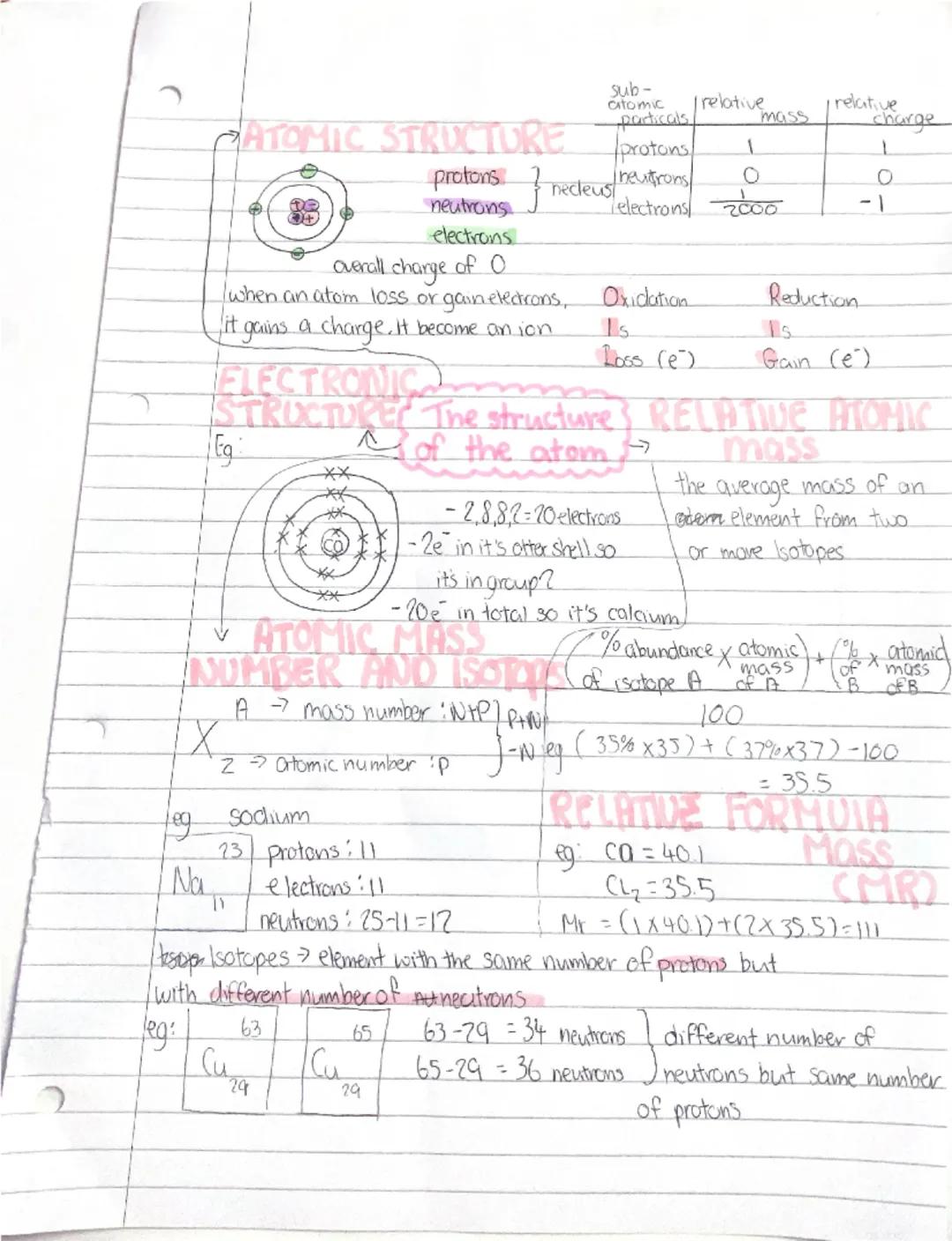
Atomic Structure and Electronic Configuration
Every atom is made up of three subatomic particles: protons (positive charge), neutrons (no charge), and electrons (negative charge). The protons and neutrons hang out in the nucleus at the centre, while electrons zoom around in shells.
When atoms lose or gain electrons, they become ions with an overall charge. This happens because the number of positive protons no longer matches the number of negative electrons.
Electronic structure tells you how electrons are arranged in shells around the nucleus. For example, calcium has 20 electrons arranged as 2,8,8,2. Since it has 2 electrons in its outer shell, calcium sits in group 2 of the periodic table.
Quick Tip: The number of electrons in the outer shell determines which group an element belongs to on the periodic table!
Mass Numbers and Isotopes
The mass number (A) equals the total number of protons plus neutrons, whilst the atomic number (Z) just counts the protons. Think of isotopes as different versions of the same element - they have identical numbers of protons but different numbers of neutrons.
Relative atomic mass is the average mass of an element's isotopes, calculated using their abundance percentages. For chlorine: (35% × 35) + (65% × 37) ÷ 100 = 35.5.
Relative formula mass (Mr) adds up all the atomic masses in a compound. For example, CO₂ = (1 × 12) + (2 × 16) = 44.
Remember: OIL RIG - Oxidation Is Loss (of electrons), Reduction Is Gain (of electrons). This will save you in chemistry exams!
We thought you’d never ask...
What is the Knowunity AI companion?
Our AI Companion is a student-focused AI tool that offers more than just answers. Built on millions of Knowunity resources, it provides relevant information, personalised study plans, quizzes, and content directly in the chat, adapting to your individual learning journey.
Where can I download the Knowunity app?
You can download the app from Google Play Store and Apple App Store.
Is Knowunity really free of charge?
That's right! Enjoy free access to study content, connect with fellow students, and get instant help – all at your fingertips.
Most popular content in Chemistry
9Most popular content
9Can't find what you're looking for? Explore other subjects.
Students love us — and so will you.
4.6/5App Store
4.7/5Google Play
The app is very easy to use and well designed. I have found everything I was looking for so far and have been able to learn a lot from the presentations! I will definitely use the app for a class assignment! And of course it also helps a lot as an inspiration.
Stefan SiOS user
This app is really great. There are so many study notes and help [...]. My problem subject is French, for example, and the app has so many options for help. Thanks to this app, I have improved my French. I would recommend it to anyone.
Samantha KlichAndroid user
Wow, I am really amazed. I just tried the app because I've seen it advertised many times and was absolutely stunned. This app is THE HELP you want for school and above all, it offers so many things, such as workouts and fact sheets, which have been VERY helpful to me personally.
AnnaiOS user
Chemistry48 views·Updated May 29, 2026·1 pageUnderstanding Atomic Structure: The Basics of Atoms
_
_6afwt@_6afwt
Atomic structure might seem complicated at first, but it's actually just about understanding the building blocks that make up everything around you. Once you grasp the basics of protons, neutrons, and electrons, you'll be able to tackle everything from ions... Show more
1
of 1Sign up to see the content. It's free!
- Access to all documents
- Improve your grades
- Join milions of students
Atomic Structure and Electronic Configuration
Every atom is made up of three subatomic particles: protons (positive charge), neutrons (no charge), and electrons (negative charge). The protons and neutrons hang out in the nucleus at the centre, while electrons zoom around in shells.
When atoms lose or gain electrons, they become ions with an overall charge. This happens because the number of positive protons no longer matches the number of negative electrons.
Electronic structure tells you how electrons are arranged in shells around the nucleus. For example, calcium has 20 electrons arranged as 2,8,8,2. Since it has 2 electrons in its outer shell, calcium sits in group 2 of the periodic table.
Quick Tip: The number of electrons in the outer shell determines which group an element belongs to on the periodic table!
Mass Numbers and Isotopes
The mass number (A) equals the total number of protons plus neutrons, whilst the atomic number (Z) just counts the protons. Think of isotopes as different versions of the same element - they have identical numbers of protons but different numbers of neutrons.
Relative atomic mass is the average mass of an element's isotopes, calculated using their abundance percentages. For chlorine: (35% × 35) + (65% × 37) ÷ 100 = 35.5.
Relative formula mass (Mr) adds up all the atomic masses in a compound. For example, CO₂ = (1 × 12) + (2 × 16) = 44.
Remember: OIL RIG - Oxidation Is Loss (of electrons), Reduction Is Gain (of electrons). This will save you in chemistry exams!
We thought you’d never ask...
What is the Knowunity AI companion?
Our AI Companion is a student-focused AI tool that offers more than just answers. Built on millions of Knowunity resources, it provides relevant information, personalised study plans, quizzes, and content directly in the chat, adapting to your individual learning journey.
Where can I download the Knowunity app?
You can download the app from Google Play Store and Apple App Store.
Is Knowunity really free of charge?
That's right! Enjoy free access to study content, connect with fellow students, and get instant help – all at your fingertips.
Most popular content in Chemistry
9Most popular content
9Can't find what you're looking for? Explore other subjects.
Students love us — and so will you.
4.6/5App Store
4.7/5Google Play
The app is very easy to use and well designed. I have found everything I was looking for so far and have been able to learn a lot from the presentations! I will definitely use the app for a class assignment! And of course it also helps a lot as an inspiration.
Stefan SiOS user
This app is really great. There are so many study notes and help [...]. My problem subject is French, for example, and the app has so many options for help. Thanks to this app, I have improved my French. I would recommend it to anyone.
Samantha KlichAndroid user
Wow, I am really amazed. I just tried the app because I've seen it advertised many times and was absolutely stunned. This app is THE HELP you want for school and above all, it offers so many things, such as workouts and fact sheets, which have been VERY helpful to me personally.
AnnaiOS user