
Corporate strategy is all about how businesses plan their future... Show more
 Business154 views·Updated May 12, 2026·9 pages
A-Level Edexcel Business Unit 3.1: Objectives and Strategy
L
Leah Hurley@hurleah


1 / 9
1
of 9
Business A-Level Introduction
Welcome to corporate strategy - one of the most practical areas of business studies that you'll actually see companies using in the real world. This section covers how businesses set their direction and make strategic decisions.
Understanding these concepts will help you analyse any company's approach and explain why some businesses succeed whilst others struggle. The tools you'll learn are used by everyone from small startups to massive corporations.
2
of 9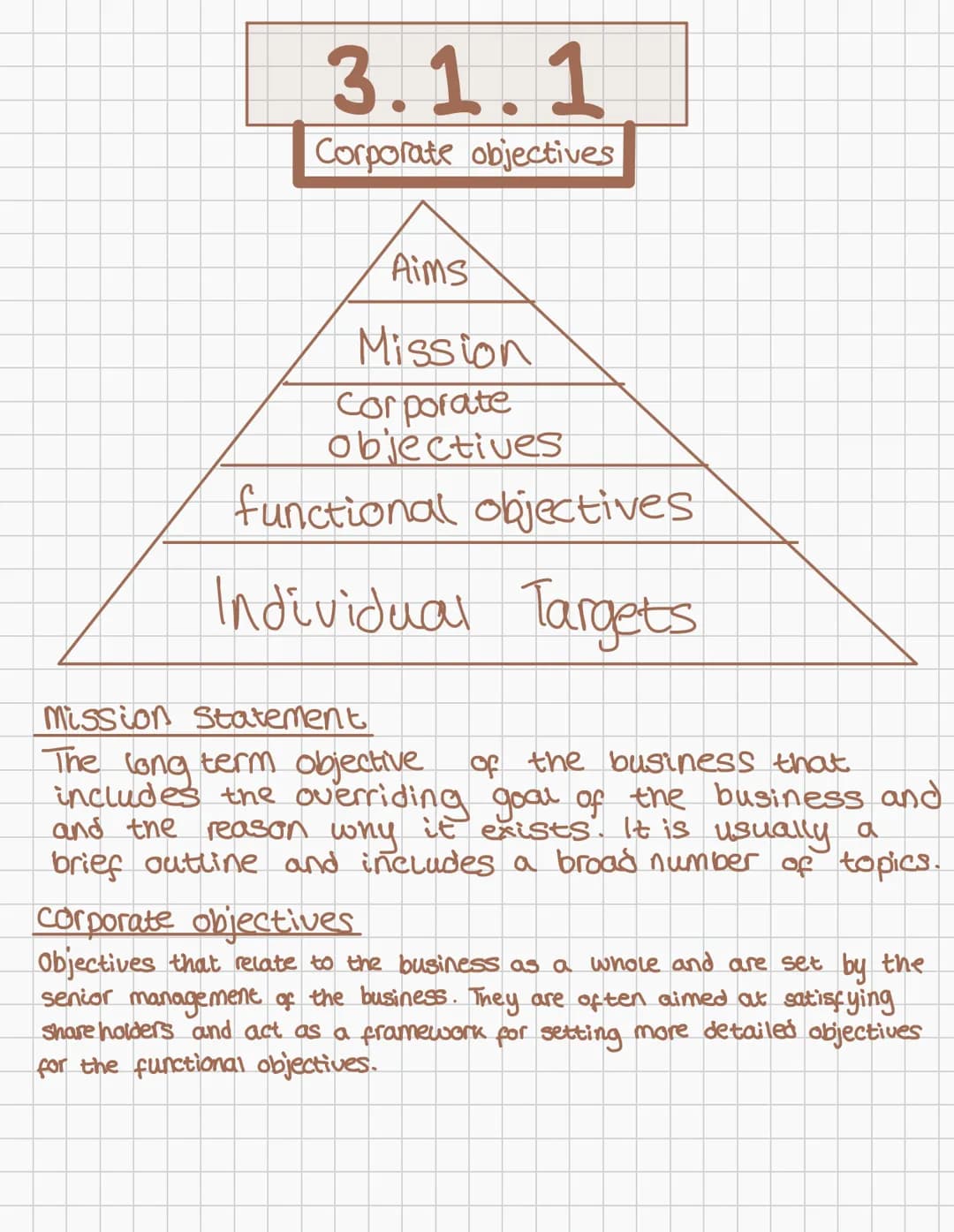
Corporate Objectives and Mission Statements
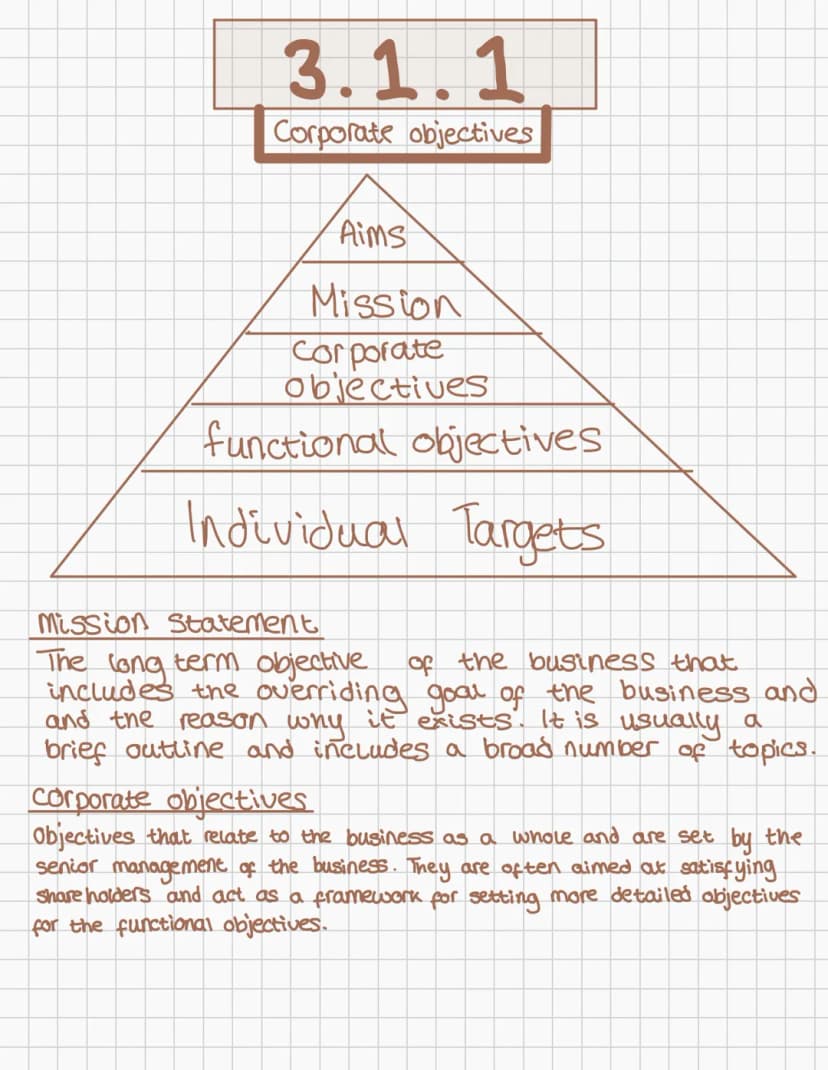
Think of mission statements as a company's "why" - they explain the business's long-term purpose and reason for existing. These broad statements then flow down into more specific targets.
Corporate objectives are set by senior management and focus on keeping shareholders happy. They provide the big-picture goals that guide everything else the company does.
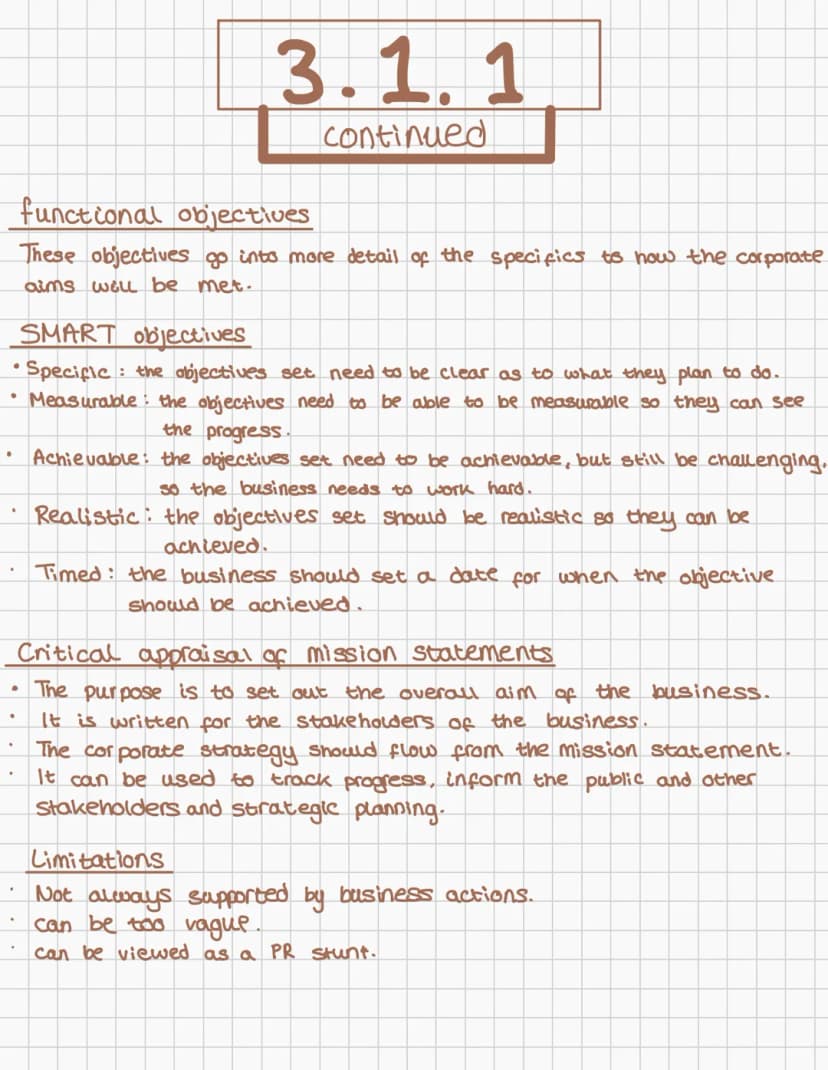
Functional objectives get much more specific about how the corporate aims will actually be achieved. Each department uses these to know exactly what they need to accomplish.
Key Point: The hierarchy flows from mission → corporate objectives → functional objectives → individual targets, getting more specific at each level.
3
of 9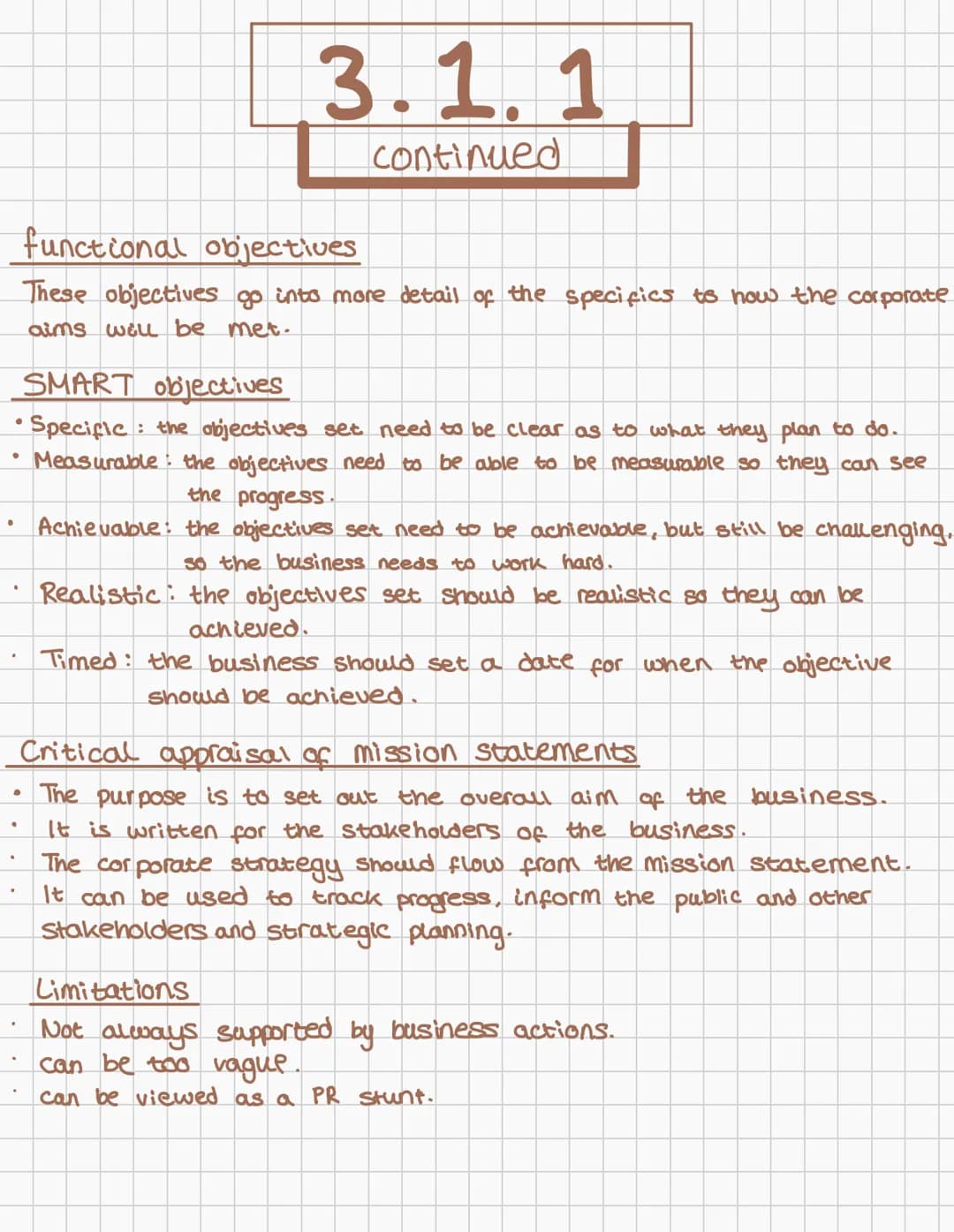
SMART Objectives and Mission Statement Analysis
SMART objectives ensure targets are actually useful rather than wishful thinking. They must be Specific, Measurable, Achievable, Realistic, and Timed - without these criteria, objectives become meaningless.
Mission statements serve several purposes: they communicate with stakeholders, guide corporate strategy, and help track progress. However, they're not perfect tools.
The main limitations include being too vague, not matching actual business actions, or coming across as just a PR exercise. You'll often see companies with impressive mission statements that don't reflect their real priorities.
Critical Thinking: Always question whether a company's actions actually match their stated mission - this gap is a common exam topic.
4
of 9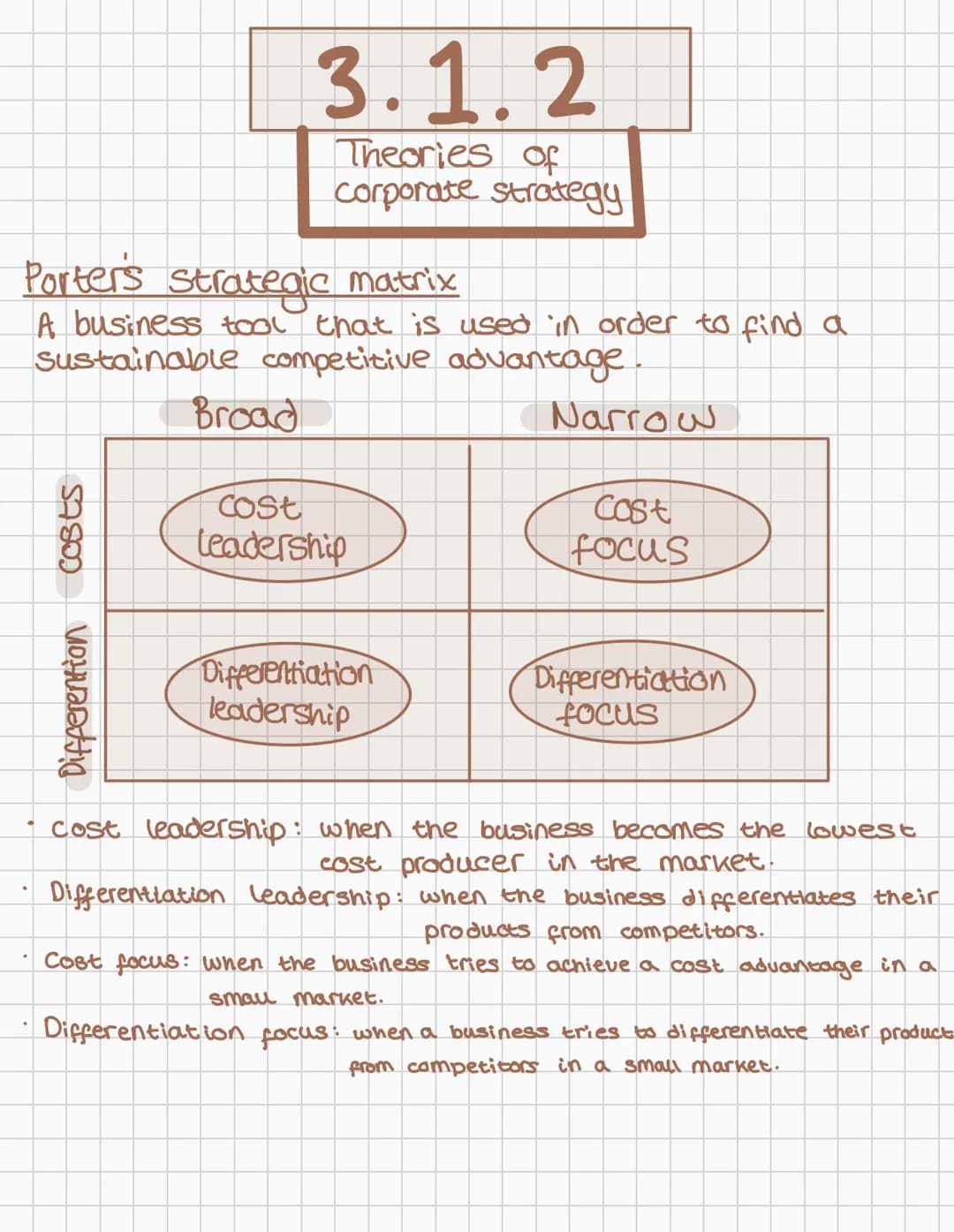
Porter's Strategic Matrix
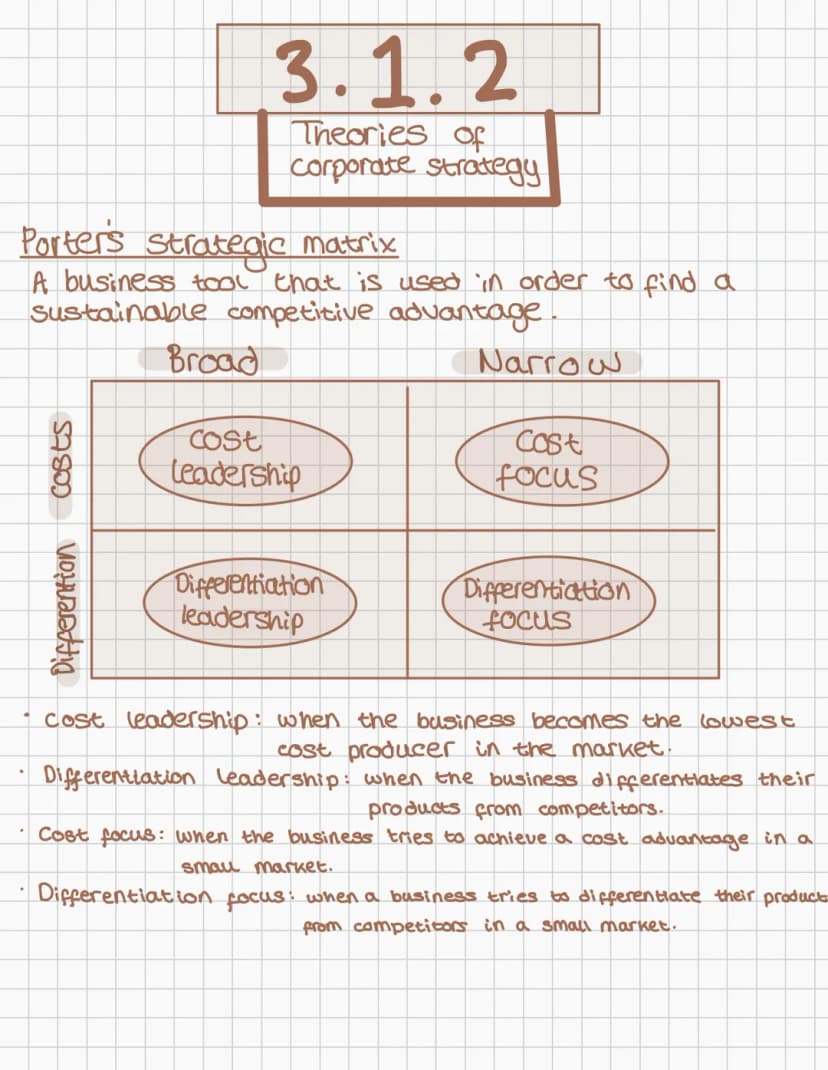
Porter's Strategic Matrix helps businesses find their sustainable competitive advantage by choosing between cost and differentiation strategies across broad or narrow markets.
Cost leadership means becoming the cheapest producer in the whole market. Differentiation leadership focuses on making your product stand out from competitors through unique features or quality.
The "focus" strategies do the same thing but target smaller, niche markets instead. Cost focus aims for the lowest prices in a specific segment, whilst differentiation focus creates unique products for that particular group.
Exam Tip: Companies often struggle when they try to be both low-cost AND differentiated - Porter argues you need to pick one clear strategy.
5
of 9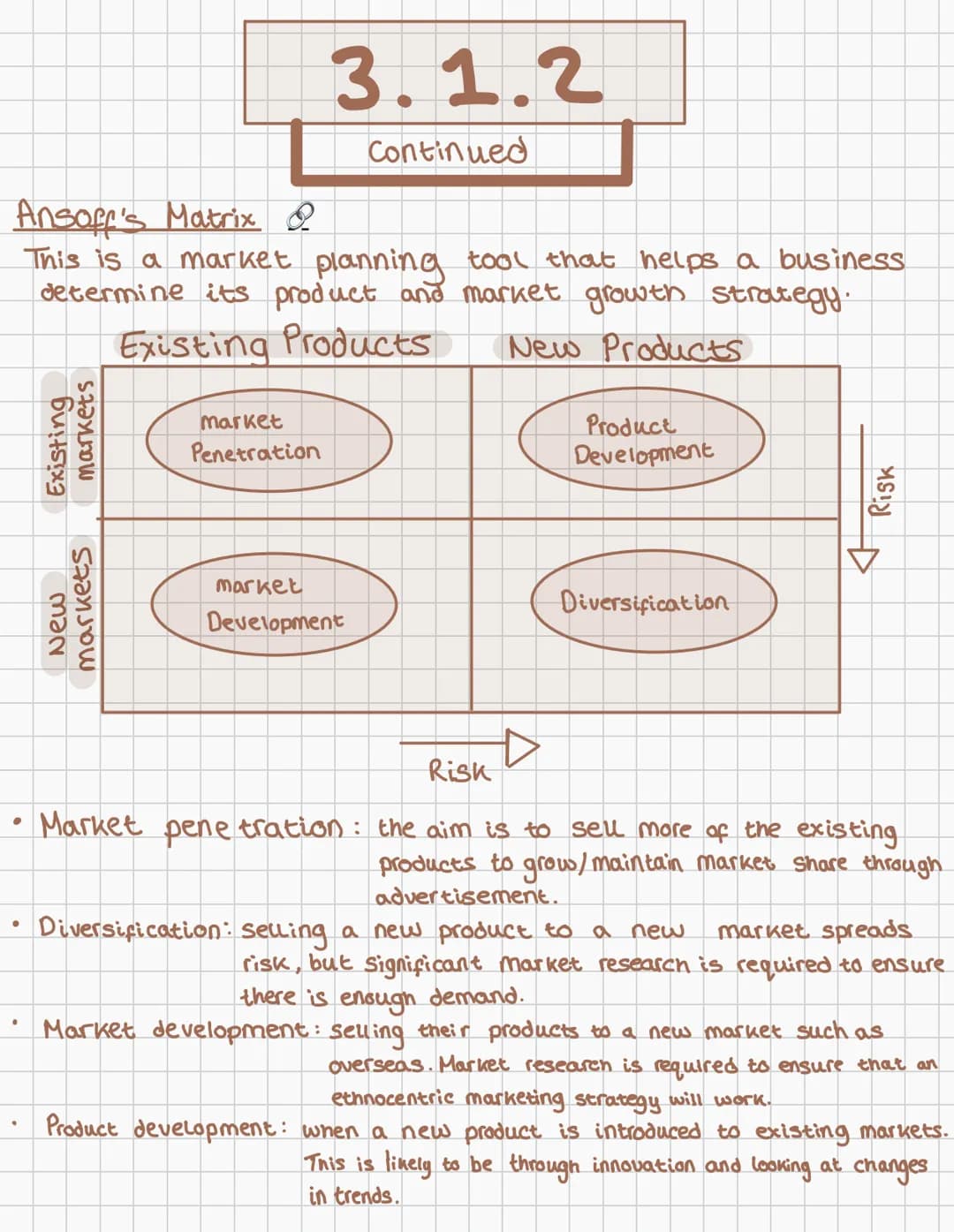
Ansoff's Matrix
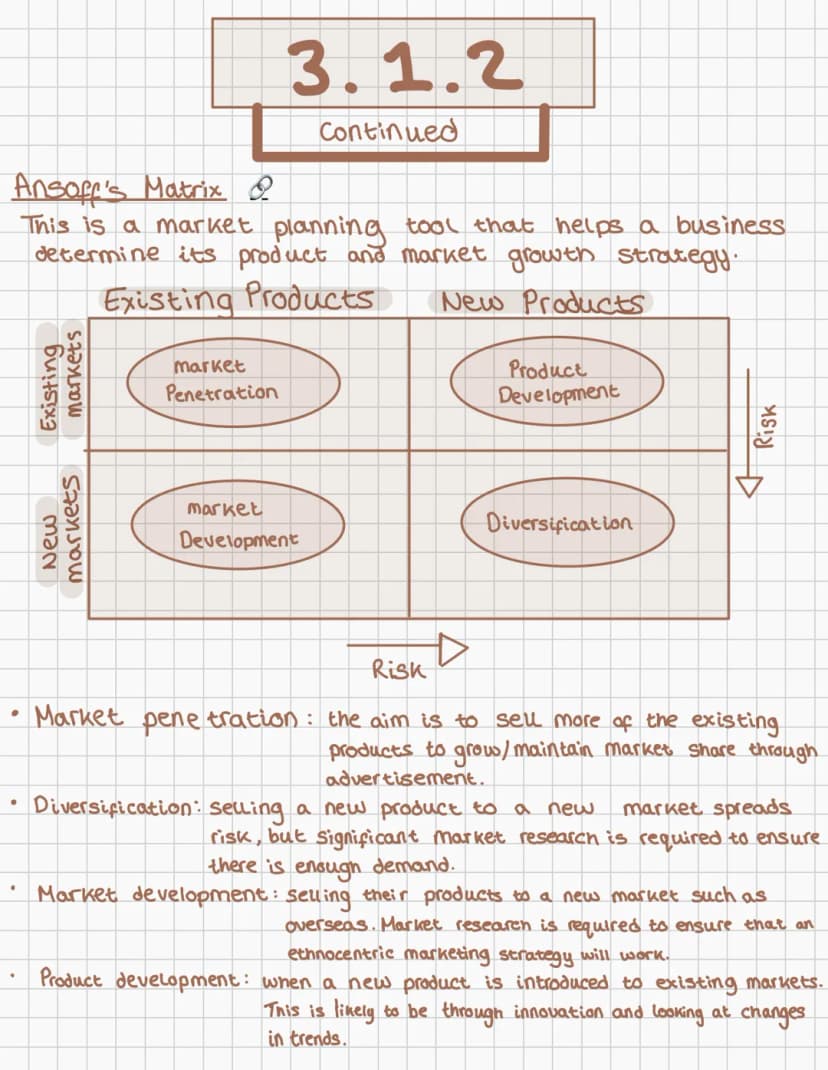
Ansoff's Matrix is brilliant for understanding how risky different growth strategies are. It plots existing vs new products against existing vs new markets.
Market penetration (existing products, existing markets) is the safest option - just sell more to current customers through better advertising. Product development introduces new products to your current customers.
Market development takes current products to new markets, often internationally. Diversification is the riskiest strategy, involving completely new products for completely new markets, but it spreads risk across different areas.
Strategic Insight: Risk increases as you move away from what you know - diversification requires serious market research but offers the greatest protection against market changes.
6
of 9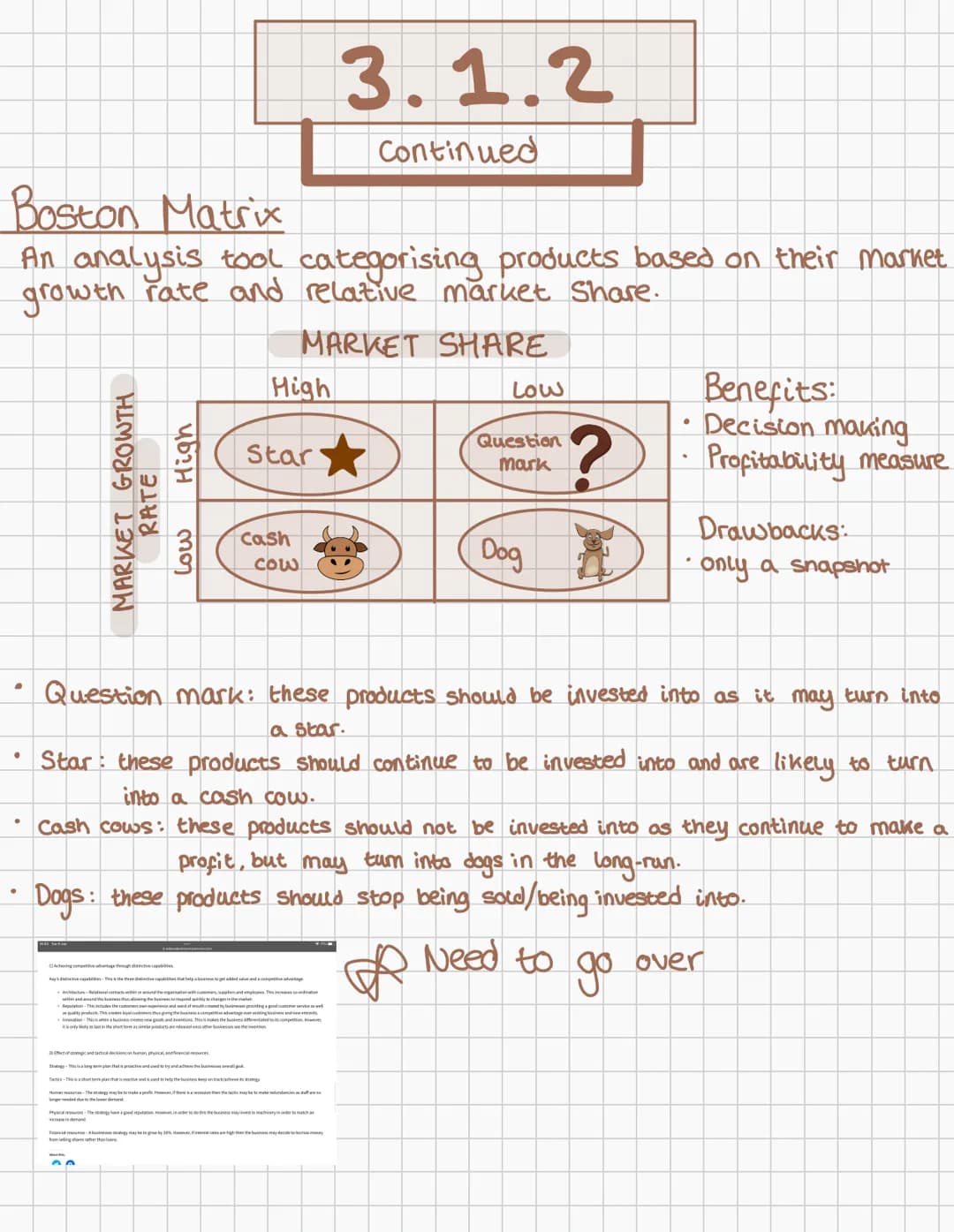
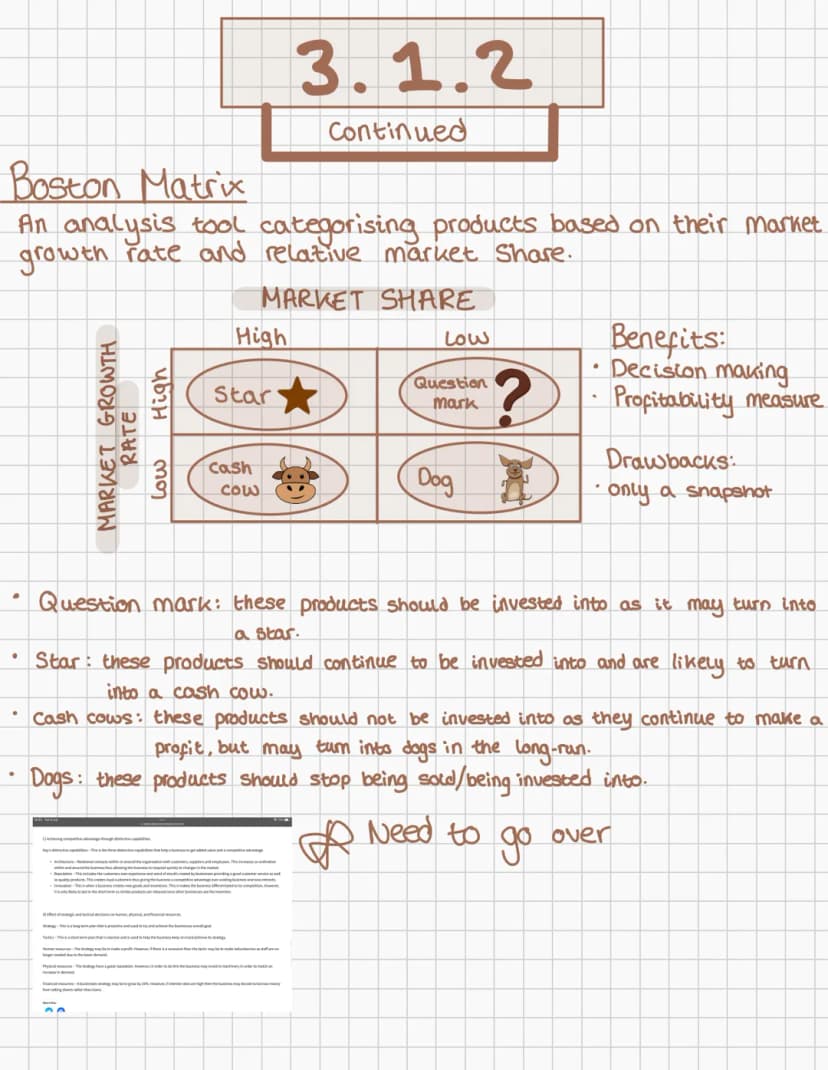
Boston Matrix
The Boston Matrix categorises products based on market growth rate and market share, creating four distinct categories that need different treatment.
Stars (high growth, high share) need continued investment and often become tomorrow's cash generators. Cash cows (low growth, high share) generate steady profits without needing much investment.
Question marks (high growth, low share) require careful analysis - invest if they could become stars, or abandon them. Dogs (low growth, low share) usually need to be discontinued as they drain resources.
Business Reality: This is just a snapshot in time - products move between categories as markets change, so regular analysis is essential.
7
of 9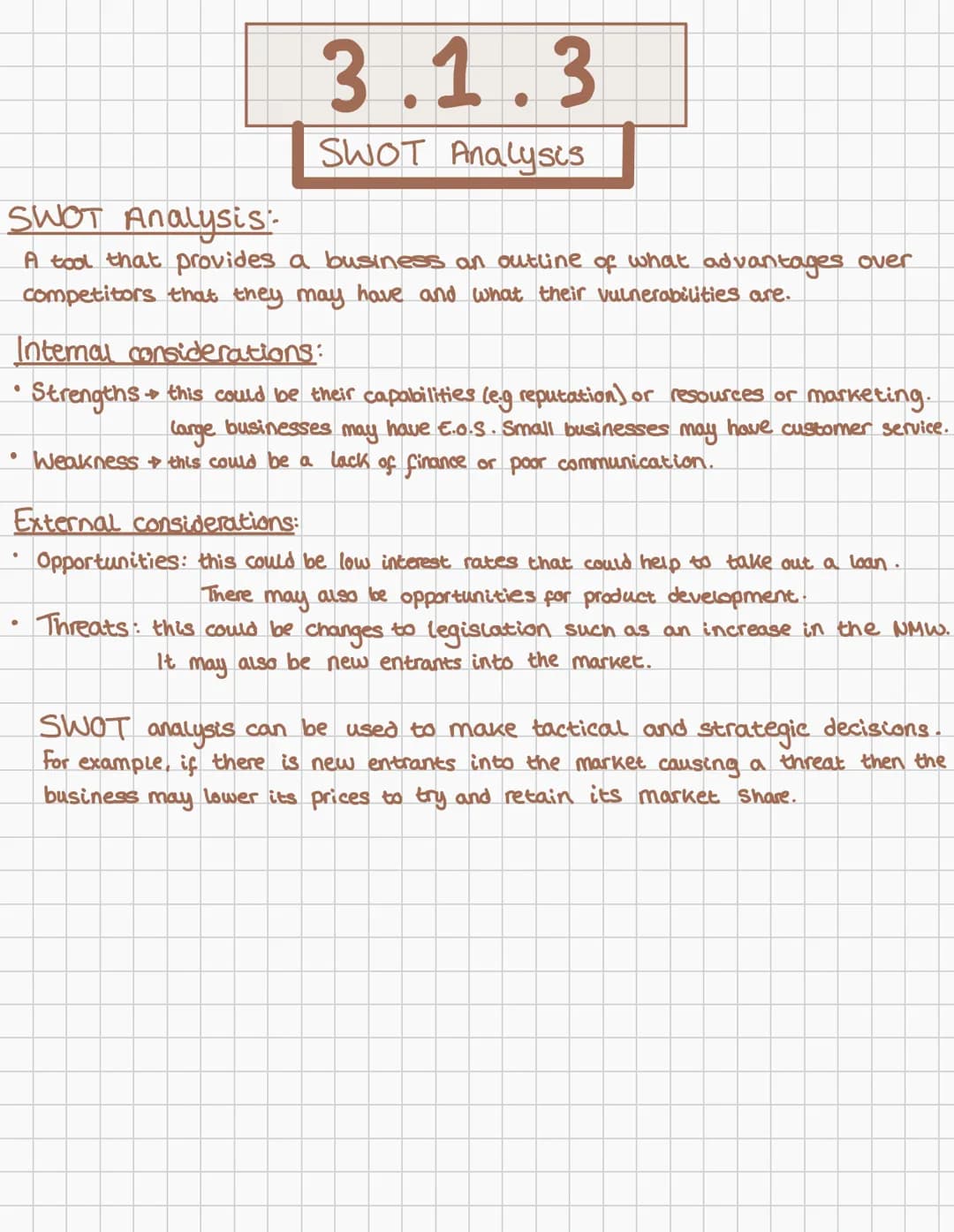
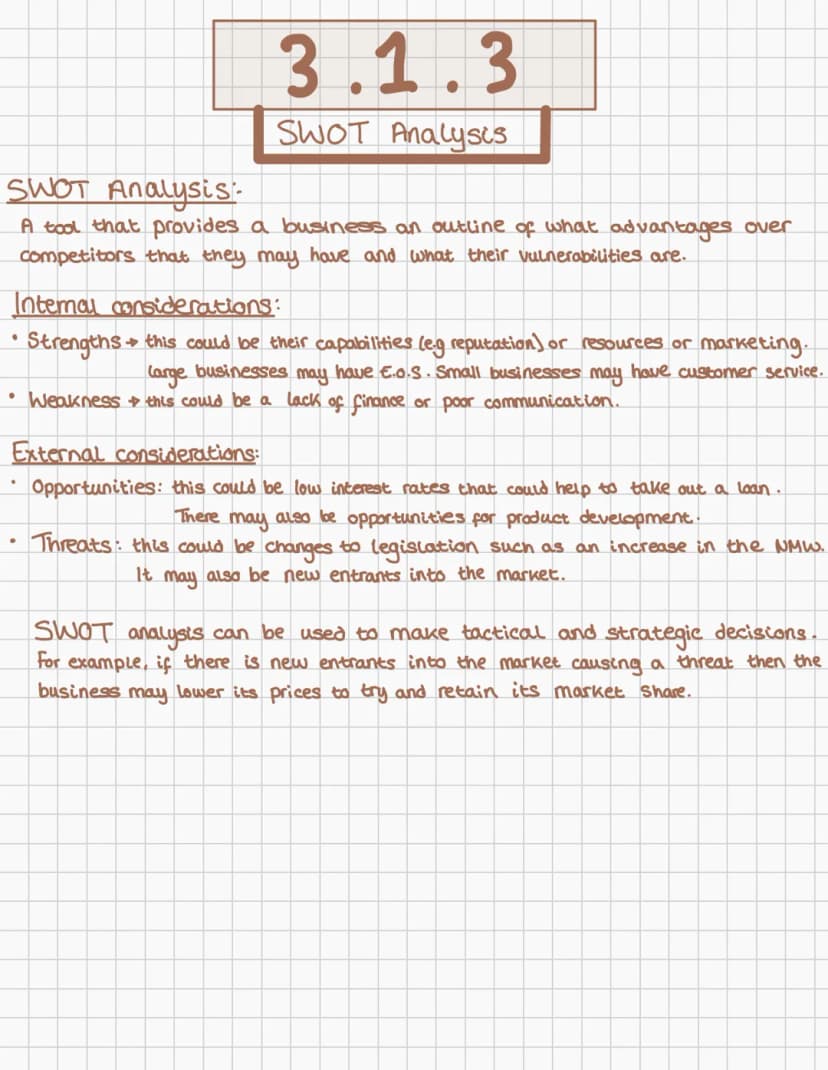
SWOT Analysis
SWOT Analysis gives businesses a clear picture of their competitive position by examining internal and external factors that could affect success.
Strengths and weaknesses are internal - things like reputation, resources, finance, or communication systems that the business can control. Large firms might have economies of scale, whilst small businesses often excel at customer service.
Opportunities and threats are external factors beyond the company's direct control. Opportunities might include low interest rates or gaps in the market, whilst threats could be new legislation or competitors entering the market.
Strategic Application: SWOT analysis helps make both tactical decisions (like price changes) and long-term strategic planning by matching internal capabilities with external conditions.
8
of 9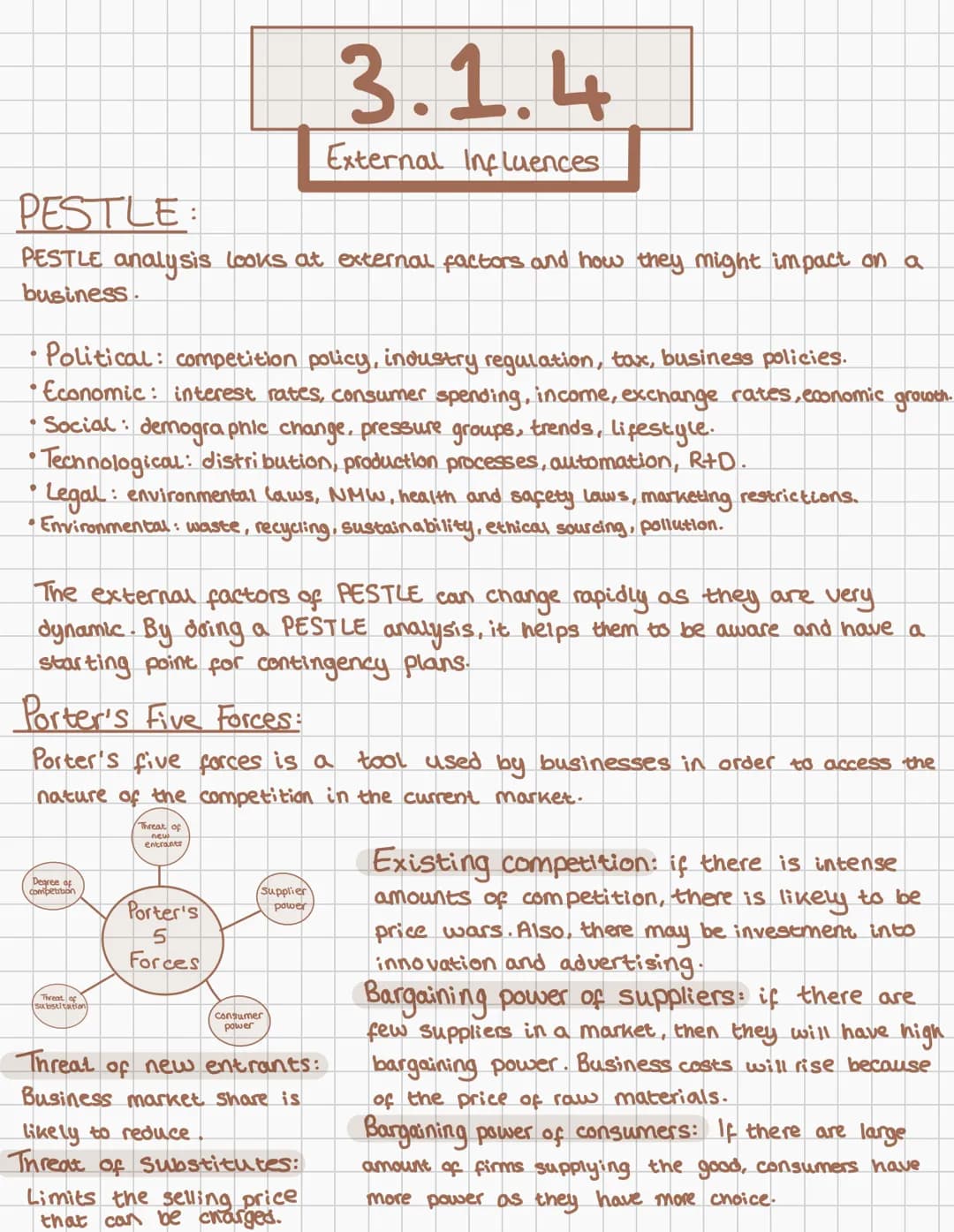
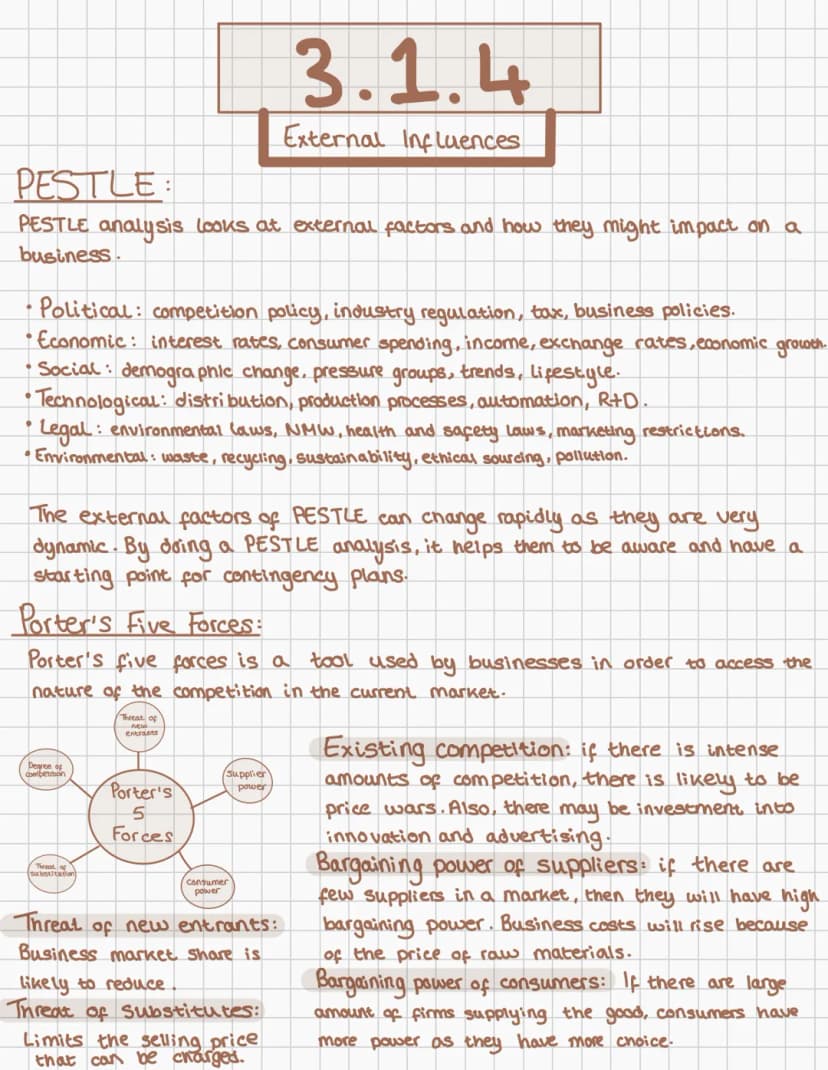
External Influences: PESTLE and Porter's Five Forces
PESTLE analysis examines six external factors that can rapidly impact businesses: Political, Economic, Social, Technological, Legal, and Environmental. These factors are dynamic and can change quickly, so regular monitoring is essential.
Examples include government tax policies, interest rate changes, demographic shifts, new technology, minimum wage legislation, and environmental regulations. Smart businesses use PESTLE to spot changes early and prepare contingency plans.
Porter's Five Forces focuses specifically on competitive threats. It examines existing competition, threat of new entrants, threat of substitutes, supplier bargaining power, and consumer bargaining power to assess how attractive a market really is.
Competitive Reality: High competition usually leads to price wars and increased spending on innovation and advertising - understanding these forces helps predict industry profitability.
9
of 9
We thought you’d never ask...
What is the Knowunity AI companion?
Our AI Companion is a student-focused AI tool that offers more than just answers. Built on millions of Knowunity resources, it provides relevant information, personalised study plans, quizzes, and content directly in the chat, adapting to your individual learning journey.
Where can I download the Knowunity app?
You can download the app from Google Play Store and Apple App Store.
Is Knowunity really free of charge?
That's right! Enjoy free access to study content, connect with fellow students, and get instant help – all at your fingertips.
Most popular content in Business
9BusinessGCSE Business Theme 1 Overview
Comprehensive summary of Pearson Edexcel GCSE Business Theme 1, covering key concepts such as entrepreneurship, market research, business structures, and external influences. Ideal for exam preparation and understanding core business principles. Includes links to original slides for further study.
1011,177266
BusinessGCSE Business Revision Essentials
Comprehensive study material covering key concepts in AQA GCSE Business, including human resource management, financial accounting, market research, business planning, and more. Perfect for exam preparation and understanding business fundamentals. This resource includes insights on business ownership, production types, cash flow management, and marketing strategies.
918,533484
BusinessEdexcel GCSE Business Theme 2 Overview
This comprehensive guide covers all essential topics for the Pearson Edexcel GCSE Business Theme 2, including business growth, marketing decisions, operational strategies, financial management, and human resource practices. Ideal for exam preparation, this resource provides insights into key concepts such as product life cycle, pricing strategies, and organizational structures. Access the original slides for further details: https://docs.google.com/presentation/d/1hEHT-G6Rp8hLvCz3JA7Hg4WCKOZu9O9EnmQfAsKnvG4/edit?usp=sharing.
107,367220
G
BusinessGCSE business paper 1 quiz.
This quiz simply goes through the quick things in which you can speak about in your exam ( in particular the case study) and these things are also mentioned in paper 2 so that’s why it’s good to know it very well. Any questions feel free to ask me!
118435
BusinessGCSE Business Revision Essentials
Comprehensive study guide covering key concepts in GCSE Business, including entrepreneurship, business planning, marketing mix, and human resource management. Ideal for AQA exam preparation, this resource helps students understand business activities, ownership structures, and stakeholder impacts. Enhance your revision with insights into market segmentation, pricing strategies, and employee recruitment.
99,176254
L
Businessliability
a mini business quiz asking about easy things you should learn early on in the course !
93430
BusinessAQA GCSE Business Essentials
Comprehensive revision notes covering key concepts in AQA GCSE Business, including operations, marketing, finance, and human resources. Perfect for exam preparation and understanding core business principles.
92,76941
BusinessBusiness Fundamentals Overview
Explore key concepts in Business Studies with this comprehensive summary covering business growth, ownership structures, stakeholder impacts, and environmental considerations. Ideal for GCSE students, this resource provides insights into business dynamics, aims and objectives, and effective planning strategies.
101,22129
BusinessUnit 1 - AQA A level business
2024 spec
1295732
Most popular content
9 Sociology
Sociology of Education Overview
Explore comprehensive A-Level Sociology notes on the education system, covering key theories, policies, and sociological perspectives. This resource includes insights on marketisation, gender roles, cultural deprivation, and educational inequalities, providing a thorough understanding of how education shapes social stratification and individual achievement. Ideal for exam preparation and in-depth study.
12101,9373,035
SociologySociology of Families: Comprehensive Revision
Dive into an extensive overview of family dynamics, perspectives, and patterns in sociology. This resource covers key concepts such as family diversity, gender roles, marriage, and the impact of social policies on family structures. Perfect for A-Level Sociology students preparing for Paper 2.
1271,4942,280
 English Literature
An Inspector Calls: Character Insights
Explore in-depth analysis and key quotes for characters in J.B. Priestley's 'An Inspector Calls'. This resource covers Gerald Croft, Inspector Goole, Sheila Birling, Mrs. Birling, Eric Birling, and Eva Smith, focusing on themes of class, gender roles, and social responsibility. Ideal for students aiming for Grade 8 and above.
1025,046896
CriminologyCriminology: Crime & Punishment Overview
Comprehensive mindmaps covering key concepts in the Crime and Punishment topic for WJEC Criminology Unit 4. This resource includes detailed insights into the Criminal Justice System, crime prevention strategies, sentencing models, and the roles of various agencies. Ideal for A-Level revision, ensuring you grasp essential theories and legislative processes to excel in your exams.
1251,6341,024
CriminologyWJEC Unit 4 Criminology
Criminology unit 4 detailed revision note
126,369118
CriminologyCriminology Theories Overview
Explore key criminology theories and their implications on crime and deviance. This comprehensive summary covers biological, psychological, and sociological perspectives, including labelling theory, right realism, and the impact of social campaigns on policy development. Ideal for A-Level criminology students seeking to understand the complexities of criminal behaviour and the factors influencing crime prevention strategies.
129,732211
English LiteratureRomeo and Juliet: Key themes
Key Romeo and Juliet themes and analysed quotes
106,561193
English LiteratureMacbeth: Guilt and Ambition
Explore the complex themes of guilt and ambition in Shakespeare's 'Macbeth'. This analysis covers key characters, including Macbeth and Lady Macbeth, their moral dilemmas, and the tragic consequences of their ambition. Ideal for students studying character motivations, thematic elements, and the psychological impact of power. Includes insights on the natural order, manipulation, and the descent into madness.
918,650387
 Biology
AQA Biology: Key Concepts
Explore essential AQA Biology topics including Photosynthesis, Respiration, Homeostasis, Genetics, and Ecology. This comprehensive knowledge organizer covers key concepts such as energy transfer, hormonal control, and genetic variation, providing a solid foundation for your studies. Ideal for exam preparation and understanding biological processes.
108,320295
Can't find what you're looking for? Explore other subjects.
Students love us — and so will you.
4.6/5App Store
4.7/5Google Play
The app is very easy to use and well designed. I have found everything I was looking for so far and have been able to learn a lot from the presentations! I will definitely use the app for a class assignment! And of course it also helps a lot as an inspiration.
Stefan SiOS user
This app is really great. There are so many study notes and help [...]. My problem subject is French, for example, and the app has so many options for help. Thanks to this app, I have improved my French. I would recommend it to anyone.
Samantha KlichAndroid user
Wow, I am really amazed. I just tried the app because I've seen it advertised many times and was absolutely stunned. This app is THE HELP you want for school and above all, it offers so many things, such as workouts and fact sheets, which have been VERY helpful to me personally.
AnnaiOS user
Business154 views·Updated May 12, 2026·9 pagesA-Level Edexcel Business Unit 3.1: Objectives and Strategy
L
Leah Hurley@hurleah
Corporate strategy is all about how businesses plan their future and stay competitive. You'll discover the key frameworks and tools that help companies make smart decisions about their products, markets, and overall direction.
1
of 9Sign up to see the content. It's free!
- Access to all documents
- Improve your grades
- Join milions of students
Business A-Level Introduction
Welcome to corporate strategy - one of the most practical areas of business studies that you'll actually see companies using in the real world. This section covers how businesses set their direction and make strategic decisions.
Understanding these concepts will help you analyse any company's approach and explain why some businesses succeed whilst others struggle. The tools you'll learn are used by everyone from small startups to massive corporations.
2
of 9Sign up to see the content. It's free!
- Access to all documents
- Improve your grades
- Join milions of students
Corporate Objectives and Mission Statements
Think of mission statements as a company's "why" - they explain the business's long-term purpose and reason for existing. These broad statements then flow down into more specific targets.
Corporate objectives are set by senior management and focus on keeping shareholders happy. They provide the big-picture goals that guide everything else the company does.
Functional objectives get much more specific about how the corporate aims will actually be achieved. Each department uses these to know exactly what they need to accomplish.
Key Point: The hierarchy flows from mission → corporate objectives → functional objectives → individual targets, getting more specific at each level.
3
of 9Sign up to see the content. It's free!
- Access to all documents
- Improve your grades
- Join milions of students
SMART Objectives and Mission Statement Analysis
SMART objectives ensure targets are actually useful rather than wishful thinking. They must be Specific, Measurable, Achievable, Realistic, and Timed - without these criteria, objectives become meaningless.
Mission statements serve several purposes: they communicate with stakeholders, guide corporate strategy, and help track progress. However, they're not perfect tools.
The main limitations include being too vague, not matching actual business actions, or coming across as just a PR exercise. You'll often see companies with impressive mission statements that don't reflect their real priorities.
Critical Thinking: Always question whether a company's actions actually match their stated mission - this gap is a common exam topic.
4
of 9Sign up to see the content. It's free!
- Access to all documents
- Improve your grades
- Join milions of students
Porter's Strategic Matrix
Porter's Strategic Matrix helps businesses find their sustainable competitive advantage by choosing between cost and differentiation strategies across broad or narrow markets.
Cost leadership means becoming the cheapest producer in the whole market. Differentiation leadership focuses on making your product stand out from competitors through unique features or quality.
The "focus" strategies do the same thing but target smaller, niche markets instead. Cost focus aims for the lowest prices in a specific segment, whilst differentiation focus creates unique products for that particular group.
Exam Tip: Companies often struggle when they try to be both low-cost AND differentiated - Porter argues you need to pick one clear strategy.
5
of 9Sign up to see the content. It's free!
- Access to all documents
- Improve your grades
- Join milions of students
Ansoff's Matrix
Ansoff's Matrix is brilliant for understanding how risky different growth strategies are. It plots existing vs new products against existing vs new markets.
Market penetration (existing products, existing markets) is the safest option - just sell more to current customers through better advertising. Product development introduces new products to your current customers.
Market development takes current products to new markets, often internationally. Diversification is the riskiest strategy, involving completely new products for completely new markets, but it spreads risk across different areas.
Strategic Insight: Risk increases as you move away from what you know - diversification requires serious market research but offers the greatest protection against market changes.
6
of 9Sign up to see the content. It's free!
- Access to all documents
- Improve your grades
- Join milions of students
Boston Matrix
The Boston Matrix categorises products based on market growth rate and market share, creating four distinct categories that need different treatment.
Stars (high growth, high share) need continued investment and often become tomorrow's cash generators. Cash cows (low growth, high share) generate steady profits without needing much investment.
Question marks (high growth, low share) require careful analysis - invest if they could become stars, or abandon them. Dogs (low growth, low share) usually need to be discontinued as they drain resources.
Business Reality: This is just a snapshot in time - products move between categories as markets change, so regular analysis is essential.
7
of 9Sign up to see the content. It's free!
- Access to all documents
- Improve your grades
- Join milions of students
SWOT Analysis
SWOT Analysis gives businesses a clear picture of their competitive position by examining internal and external factors that could affect success.
Strengths and weaknesses are internal - things like reputation, resources, finance, or communication systems that the business can control. Large firms might have economies of scale, whilst small businesses often excel at customer service.
Opportunities and threats are external factors beyond the company's direct control. Opportunities might include low interest rates or gaps in the market, whilst threats could be new legislation or competitors entering the market.
Strategic Application: SWOT analysis helps make both tactical decisions (like price changes) and long-term strategic planning by matching internal capabilities with external conditions.
8
of 9Sign up to see the content. It's free!
- Access to all documents
- Improve your grades
- Join milions of students
External Influences: PESTLE and Porter's Five Forces
PESTLE analysis examines six external factors that can rapidly impact businesses: Political, Economic, Social, Technological, Legal, and Environmental. These factors are dynamic and can change quickly, so regular monitoring is essential.
Examples include government tax policies, interest rate changes, demographic shifts, new technology, minimum wage legislation, and environmental regulations. Smart businesses use PESTLE to spot changes early and prepare contingency plans.
Porter's Five Forces focuses specifically on competitive threats. It examines existing competition, threat of new entrants, threat of substitutes, supplier bargaining power, and consumer bargaining power to assess how attractive a market really is.
Competitive Reality: High competition usually leads to price wars and increased spending on innovation and advertising - understanding these forces helps predict industry profitability.
9
of 9Sign up to see the content. It's free!
- Access to all documents
- Improve your grades
- Join milions of students
We thought you’d never ask...
What is the Knowunity AI companion?
Our AI Companion is a student-focused AI tool that offers more than just answers. Built on millions of Knowunity resources, it provides relevant information, personalised study plans, quizzes, and content directly in the chat, adapting to your individual learning journey.
Where can I download the Knowunity app?
You can download the app from Google Play Store and Apple App Store.
Is Knowunity really free of charge?
That's right! Enjoy free access to study content, connect with fellow students, and get instant help – all at your fingertips.
Most popular content in Business
9BusinessGCSE Business Theme 1 Overview
Comprehensive summary of Pearson Edexcel GCSE Business Theme 1, covering key concepts such as entrepreneurship, market research, business structures, and external influences. Ideal for exam preparation and understanding core business principles. Includes links to original slides for further study.
1011,177266
BusinessGCSE Business Revision Essentials
Comprehensive study material covering key concepts in AQA GCSE Business, including human resource management, financial accounting, market research, business planning, and more. Perfect for exam preparation and understanding business fundamentals. This resource includes insights on business ownership, production types, cash flow management, and marketing strategies.
918,533484
BusinessEdexcel GCSE Business Theme 2 Overview
This comprehensive guide covers all essential topics for the Pearson Edexcel GCSE Business Theme 2, including business growth, marketing decisions, operational strategies, financial management, and human resource practices. Ideal for exam preparation, this resource provides insights into key concepts such as product life cycle, pricing strategies, and organizational structures. Access the original slides for further details: https://docs.google.com/presentation/d/1hEHT-G6Rp8hLvCz3JA7Hg4WCKOZu9O9EnmQfAsKnvG4/edit?usp=sharing.
107,367220
G
BusinessGCSE business paper 1 quiz.
This quiz simply goes through the quick things in which you can speak about in your exam ( in particular the case study) and these things are also mentioned in paper 2 so that’s why it’s good to know it very well. Any questions feel free to ask me!
118435
BusinessGCSE Business Revision Essentials
Comprehensive study guide covering key concepts in GCSE Business, including entrepreneurship, business planning, marketing mix, and human resource management. Ideal for AQA exam preparation, this resource helps students understand business activities, ownership structures, and stakeholder impacts. Enhance your revision with insights into market segmentation, pricing strategies, and employee recruitment.
99,176254
L
Businessliability
a mini business quiz asking about easy things you should learn early on in the course !
93430
BusinessAQA GCSE Business Essentials
Comprehensive revision notes covering key concepts in AQA GCSE Business, including operations, marketing, finance, and human resources. Perfect for exam preparation and understanding core business principles.
92,76941
BusinessBusiness Fundamentals Overview
Explore key concepts in Business Studies with this comprehensive summary covering business growth, ownership structures, stakeholder impacts, and environmental considerations. Ideal for GCSE students, this resource provides insights into business dynamics, aims and objectives, and effective planning strategies.
101,22129
BusinessUnit 1 - AQA A level business
2024 spec
1295732
Most popular content
9SociologySociology of Education Overview
Explore comprehensive A-Level Sociology notes on the education system, covering key theories, policies, and sociological perspectives. This resource includes insights on marketisation, gender roles, cultural deprivation, and educational inequalities, providing a thorough understanding of how education shapes social stratification and individual achievement. Ideal for exam preparation and in-depth study.
12101,9373,035
SociologySociology of Families: Comprehensive Revision
Dive into an extensive overview of family dynamics, perspectives, and patterns in sociology. This resource covers key concepts such as family diversity, gender roles, marriage, and the impact of social policies on family structures. Perfect for A-Level Sociology students preparing for Paper 2.
1271,4942,280
English LiteratureAn Inspector Calls: Character Insights
Explore in-depth analysis and key quotes for characters in J.B. Priestley's 'An Inspector Calls'. This resource covers Gerald Croft, Inspector Goole, Sheila Birling, Mrs. Birling, Eric Birling, and Eva Smith, focusing on themes of class, gender roles, and social responsibility. Ideal for students aiming for Grade 8 and above.
1025,046896
CriminologyCriminology: Crime & Punishment Overview
Comprehensive mindmaps covering key concepts in the Crime and Punishment topic for WJEC Criminology Unit 4. This resource includes detailed insights into the Criminal Justice System, crime prevention strategies, sentencing models, and the roles of various agencies. Ideal for A-Level revision, ensuring you grasp essential theories and legislative processes to excel in your exams.
1251,6341,024
CriminologyWJEC Unit 4 Criminology
Criminology unit 4 detailed revision note
126,369118
CriminologyCriminology Theories Overview
Explore key criminology theories and their implications on crime and deviance. This comprehensive summary covers biological, psychological, and sociological perspectives, including labelling theory, right realism, and the impact of social campaigns on policy development. Ideal for A-Level criminology students seeking to understand the complexities of criminal behaviour and the factors influencing crime prevention strategies.
129,732211
English LiteratureRomeo and Juliet: Key themes
Key Romeo and Juliet themes and analysed quotes
106,561193
English LiteratureMacbeth: Guilt and Ambition
Explore the complex themes of guilt and ambition in Shakespeare's 'Macbeth'. This analysis covers key characters, including Macbeth and Lady Macbeth, their moral dilemmas, and the tragic consequences of their ambition. Ideal for students studying character motivations, thematic elements, and the psychological impact of power. Includes insights on the natural order, manipulation, and the descent into madness.
918,650387
BiologyAQA Biology: Key Concepts
Explore essential AQA Biology topics including Photosynthesis, Respiration, Homeostasis, Genetics, and Ecology. This comprehensive knowledge organizer covers key concepts such as energy transfer, hormonal control, and genetic variation, providing a solid foundation for your studies. Ideal for exam preparation and understanding biological processes.
108,320295
Can't find what you're looking for? Explore other subjects.
Students love us — and so will you.
4.6/5App Store
4.7/5Google Play
The app is very easy to use and well designed. I have found everything I was looking for so far and have been able to learn a lot from the presentations! I will definitely use the app for a class assignment! And of course it also helps a lot as an inspiration.
Stefan SiOS user
This app is really great. There are so many study notes and help [...]. My problem subject is French, for example, and the app has so many options for help. Thanks to this app, I have improved my French. I would recommend it to anyone.
Samantha KlichAndroid user
Wow, I am really amazed. I just tried the app because I've seen it advertised many times and was absolutely stunned. This app is THE HELP you want for school and above all, it offers so many things, such as workouts and fact sheets, which have been VERY helpful to me personally.
AnnaiOS user