
Diving into science can be both exciting and challenging. This... Show more
 Physics
 Sociology
 English Literature
Sign up to see the contentIt's free!
Access to all documents
Improve your grades
Join milions of students
Knowunity AI
Subjects
Triangle Congruence and Similarity Theorems
Triangle Properties and Classification
Linear Equations and Graphs
Geometric Angle Relationships
Trigonometric Functions and Identities
Equation Solving Techniques
Circle Geometry Fundamentals
Division Operations and Methods
Basic Differentiation Rules
Exponent and Logarithm Properties
Show all topics
Human Organ Systems
Reproductive Cell Cycles
Biological Sciences Subdisciplines
Cellular Energy Metabolism
Autotrophic Energy Processes
Inheritance Patterns and Principles
Biomolecular Structure and Organization
Cell Cycle and Division Mechanics
Cellular Organization and Development
Biological Structural Organization
Show all topics
Chemical Sciences and Applications
Atomic Structure and Composition
Molecular Electron Structure Representation
Atomic Electron Behavior
Matter Properties and Water
Mole Concept and Calculations
Gas Laws and Behavior
Periodic Table Organization
Chemical Thermodynamics Fundamentals
Chemical Bond Types and Properties
Show all topics
European Renaissance and Enlightenment
European Cultural Movements 800-1920
American Revolution Era 1763-1797
American Civil War 1861-1865
Global Imperial Systems
Mongol and Chinese Dynasties
U.S. Presidents and World Leaders
Historical Sources and Documentation
World Wars Era and Impact
World Religious Systems
Show all topics
Classic and Contemporary Novels
Literary Character Analysis
Rhetorical Theory and Practice
Classic Literary Narratives
Reading Analysis and Interpretation
Narrative Structure and Techniques
English Language Components
Influential English-Language Authors
Basic Sentence Structure
Narrative Voice and Perspective
Show all topics
1,070
•
Updated Mar 24, 2026
•
jaeden
@jaedenc08
Diving into science can be both exciting and challenging. This... Show more
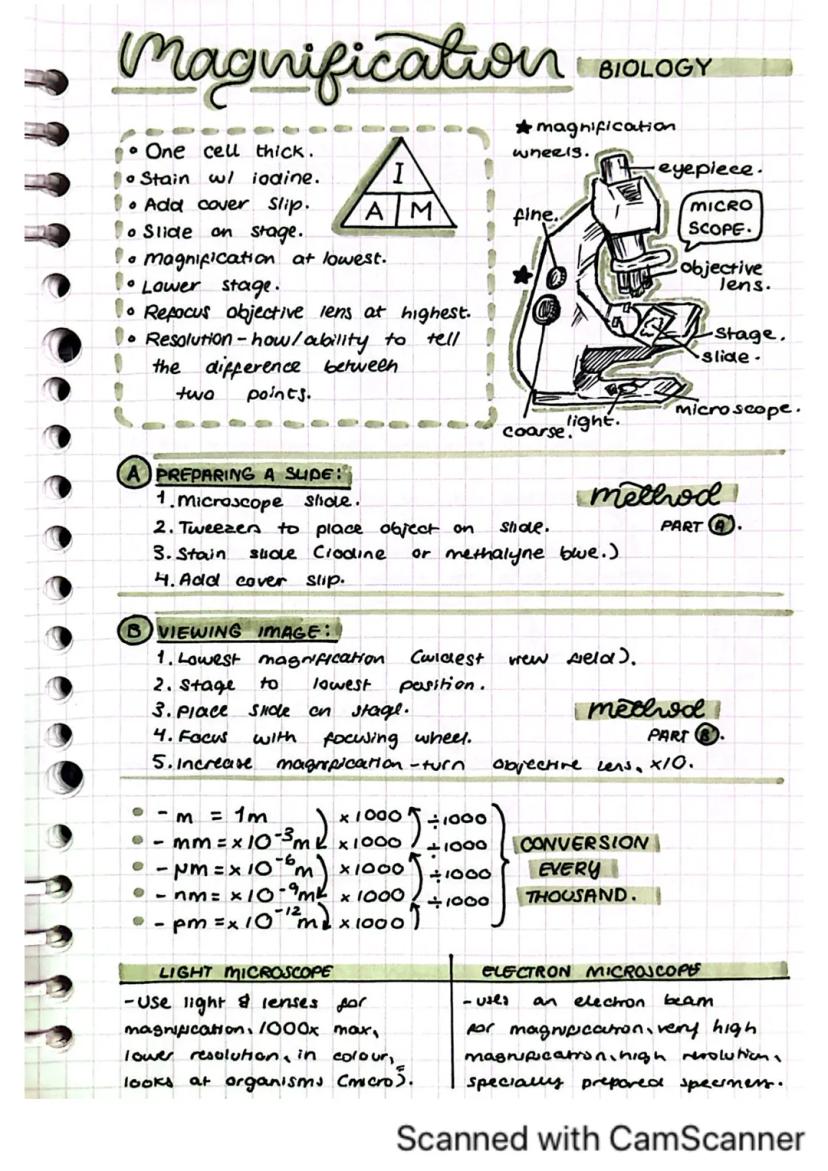

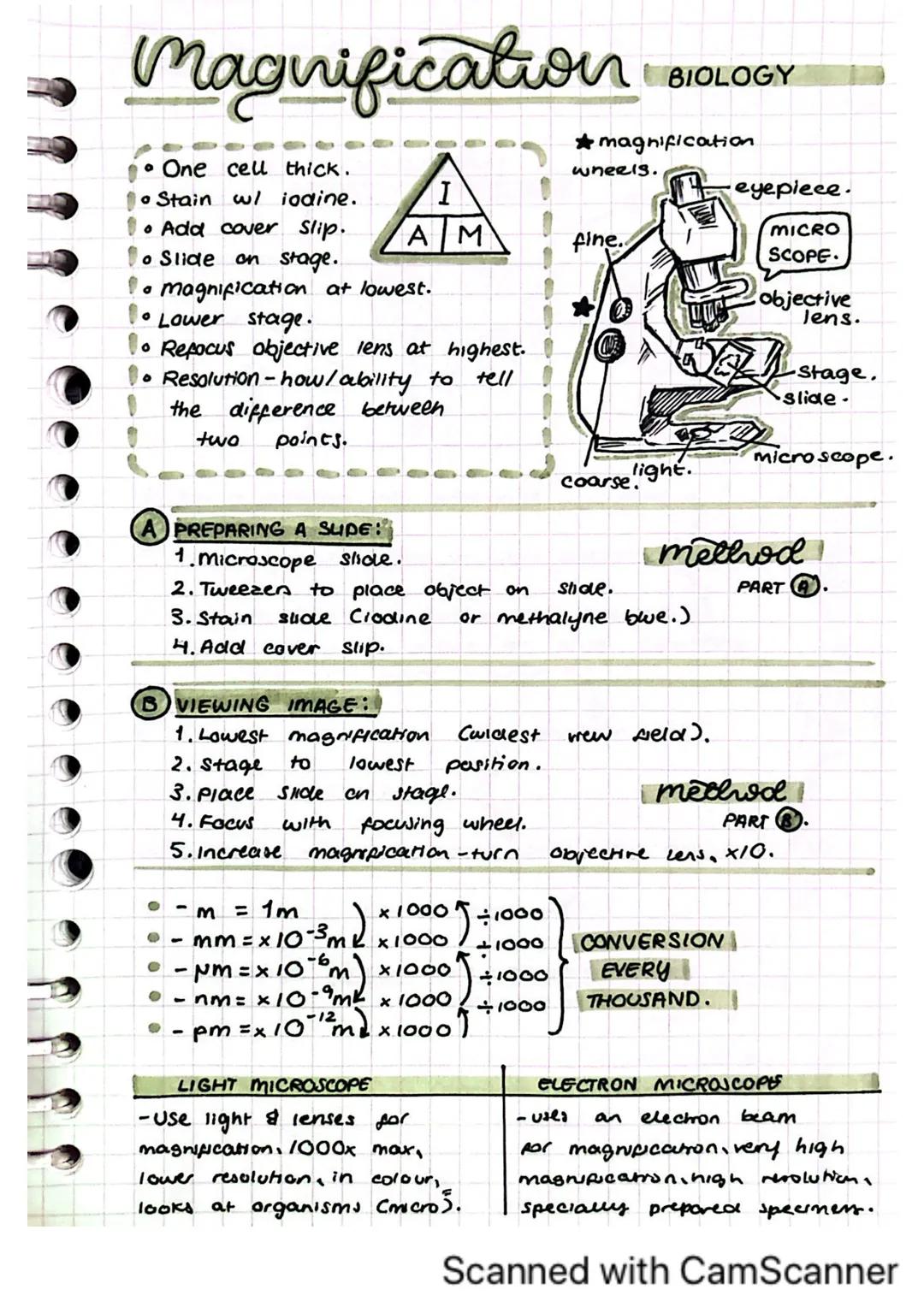
Microscopes let you see the tiny world that's invisible to our eyes. Knowing how to use one properly is a crucial lab skill you'll use throughout your science education.
To prepare a slide properly, place your specimen on a microscope slide, add a stain like iodine or methylene blue, and carefully place a cover slip on top. This creates a thin, viewable sample that's just one cell thick.
When viewing your sample, always start with the lowest magnification. Place your slide on the stage, lower it to its lowest position, and focus using the coarse adjustment wheel first, then the fine adjustment for clearer detail.
Quick Tip: Remember the scale conversions: 1mm = 10⁻³m, 1μm = 10⁻⁶m, 1nm = 10⁻⁹m. Each step is 1,000 times smaller than the previous!
Light microscopes use light and lenses for magnification (up to 1000×) and show specimens in colour. Electron microscopes use electron beams for much higher magnification and resolution, though images are not in colour and require specially prepared specimens.

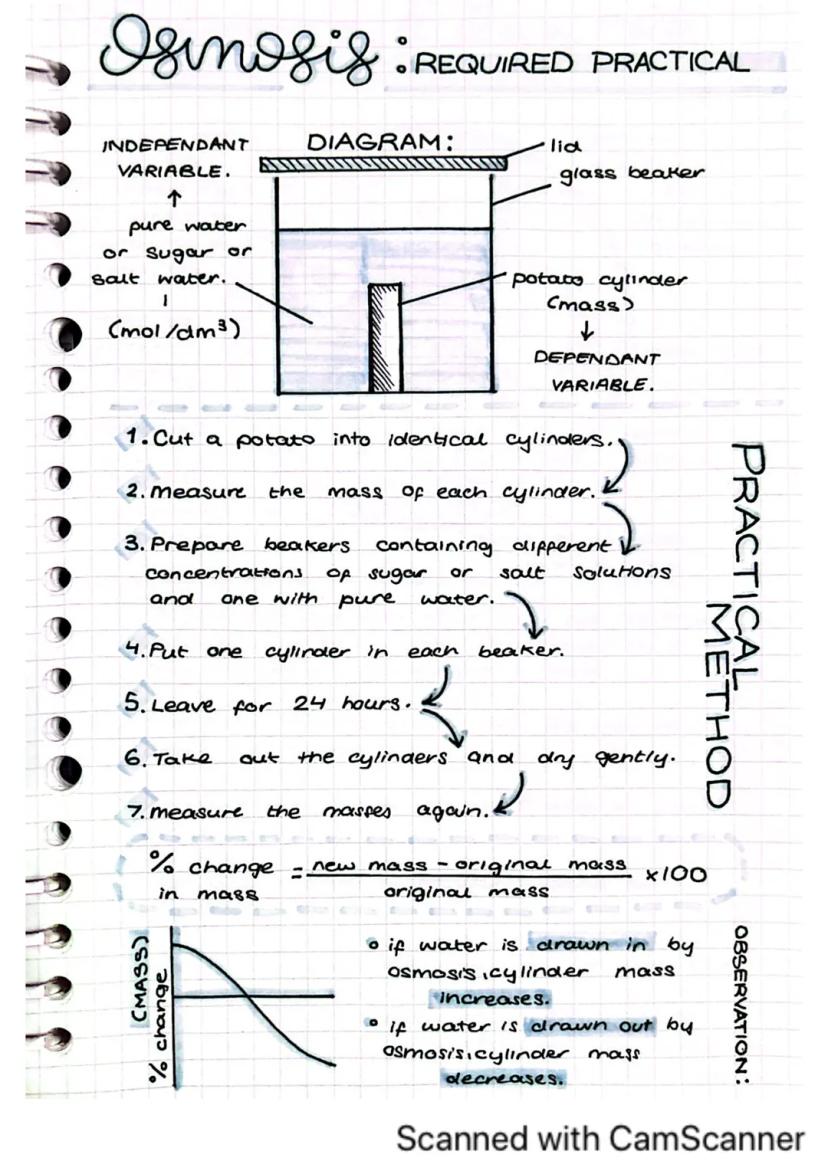
Osmosis is the movement of water molecules across a partially permeable membrane. This practical helps you see this process in action using potato cylinders.
The method is straightforward: cut identical potato cylinders, weigh them, and place them in beakers containing different concentrations of sugar or salt solutions (plus one with pure water). After 24 hours, remove the cylinders, dry them gently, and weigh them again to calculate the percentage change in mass.
When water moves into a potato cylinder by osmosis, its mass increases. Conversely, when water moves out of the cylinder, the mass decreases. This change tells you about the direction of water movement.
Remember: The percentage change in mass is calculated using the formula: % change = ÷ original mass × 100
In this experiment, the concentration of solution is your independent variable, while the percentage change in mass is your dependent variable. This practical demonstrates how osmosis works in real biological tissues.
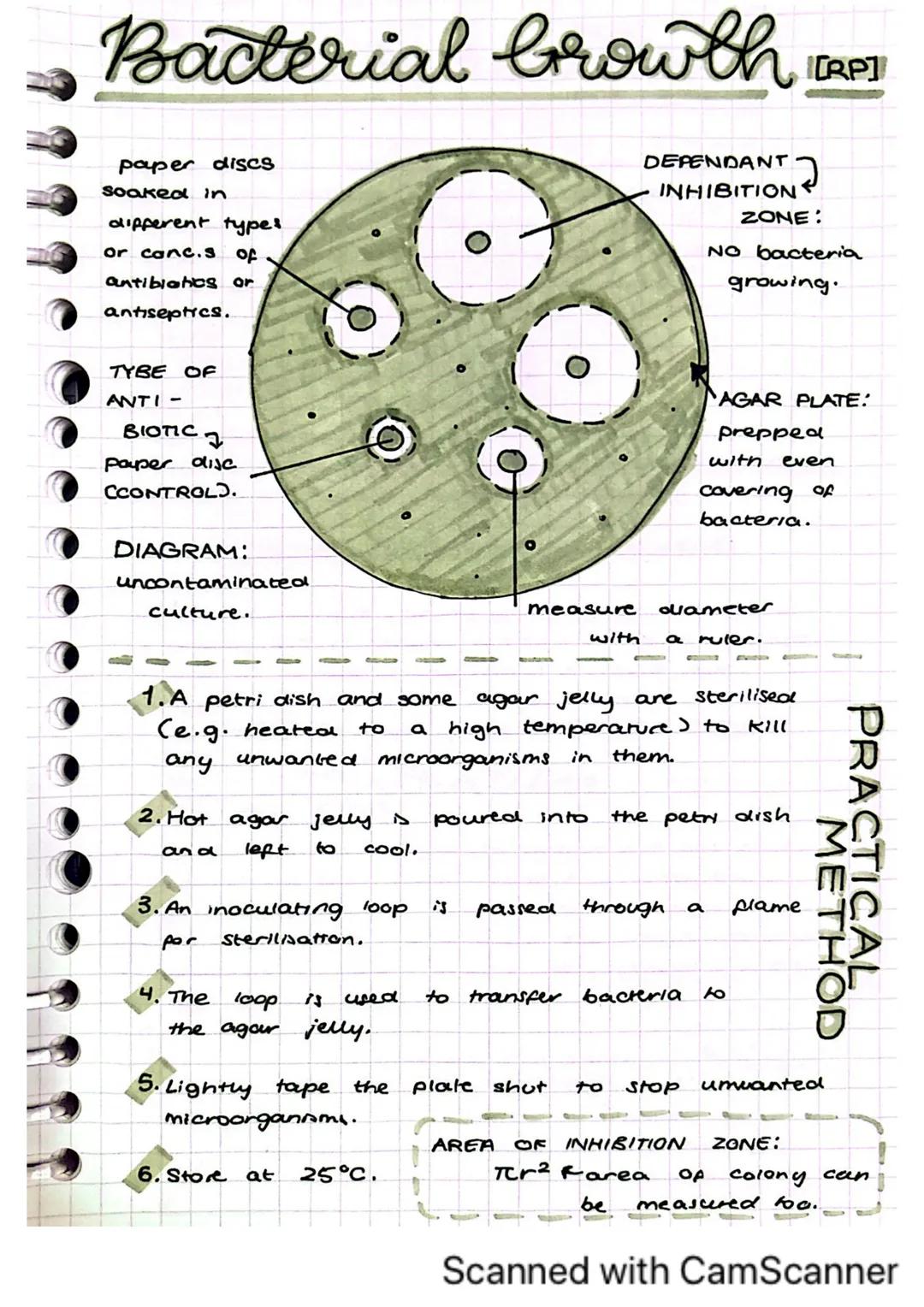
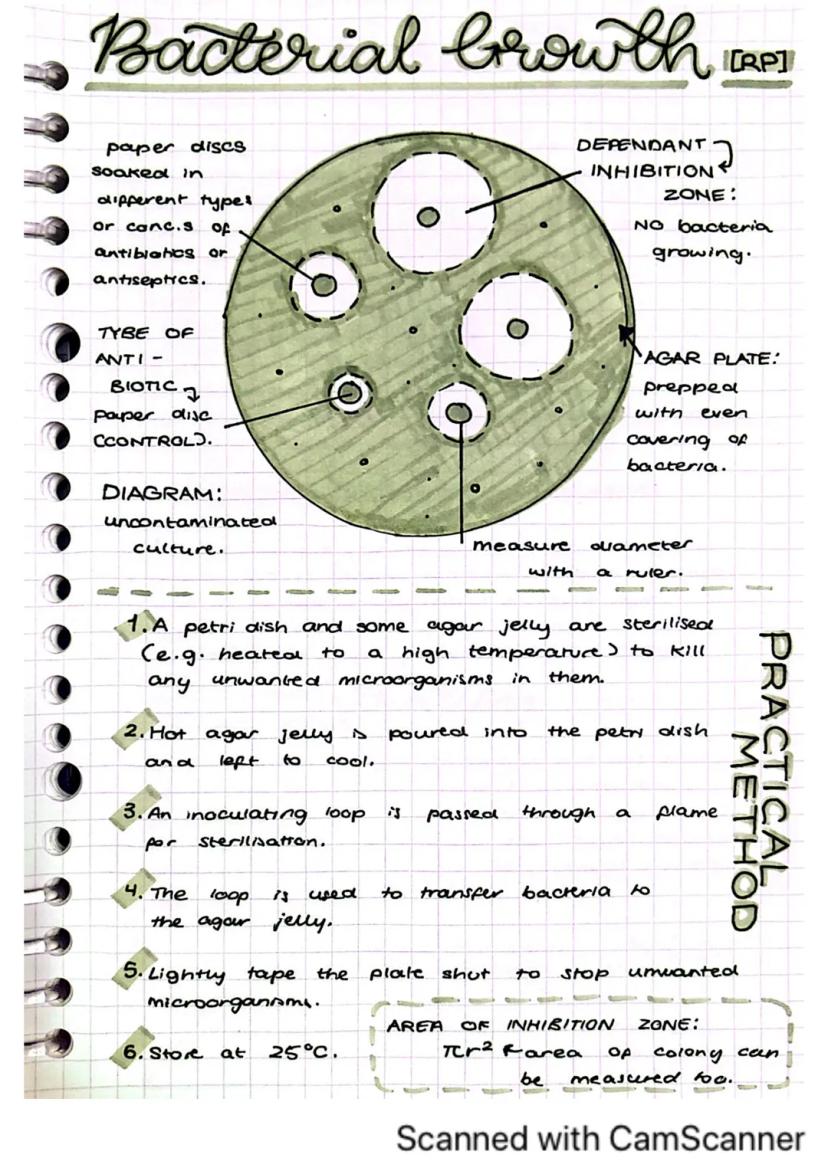
This practical helps you understand how antibiotics and antiseptics affect bacterial growth, which is essential knowledge for medicine and health.
The setup involves an agar plate prepared with an even coverage of bacteria. Paper discs soaked in different types or concentrations of antibiotics or antiseptics are placed on the plate. The plate is then sealed and incubated at 25°C.
After incubation, you'll observe zones of inhibition around the paper discs where bacteria couldn't grow. The larger this clear zone, the more effective the antibiotic is against the bacteria. You can measure the diameter of these zones with a ruler.
Did you know? You can calculate the area of the inhibition zone using πr² (where r is the radius), which gives a more accurate measurement of antibiotic effectiveness than just measuring the diameter.
This practical requires careful sterile technique to avoid contamination. The type of antibiotic is your independent variable, while the size of the inhibition zone is your dependent variable.
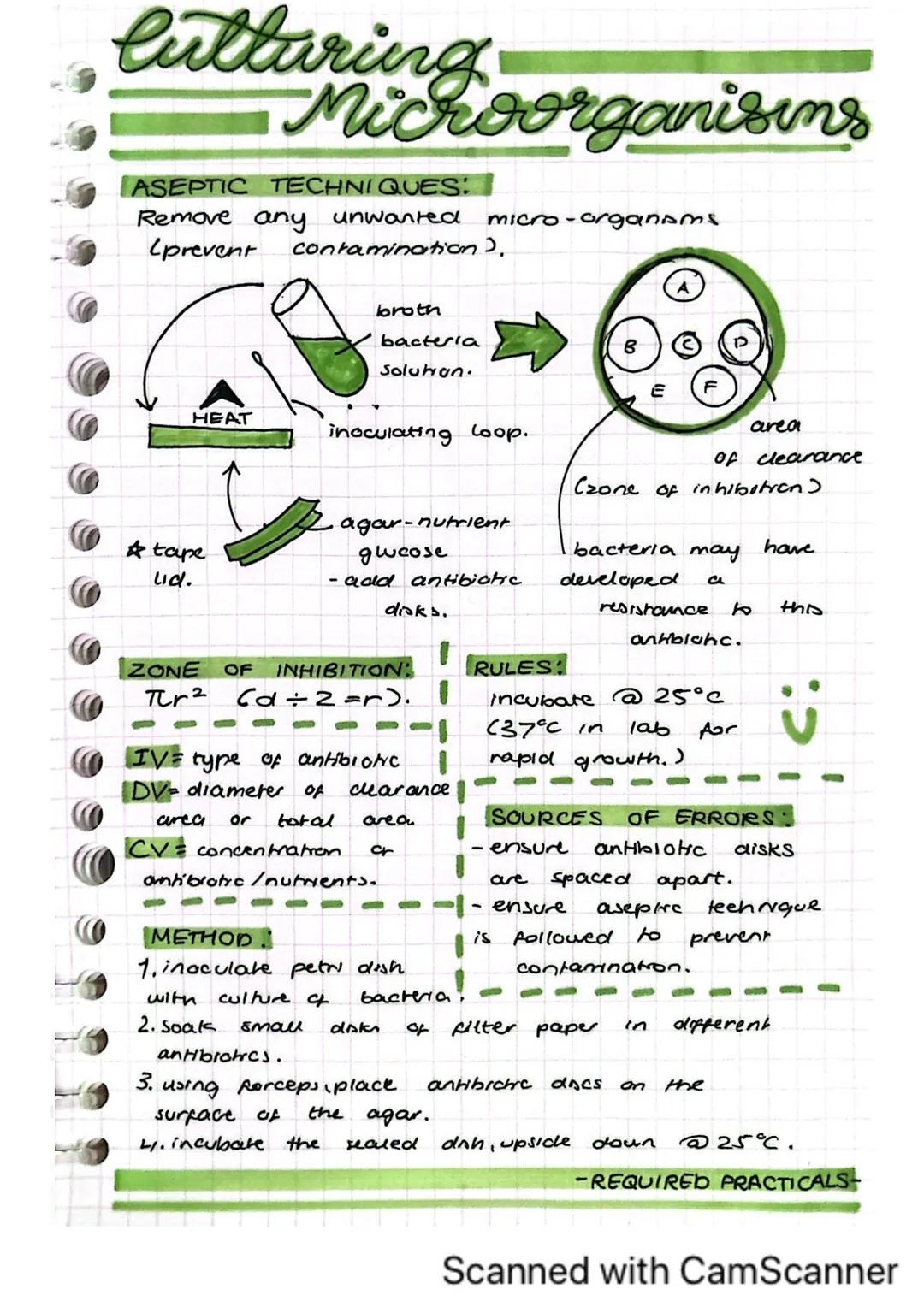
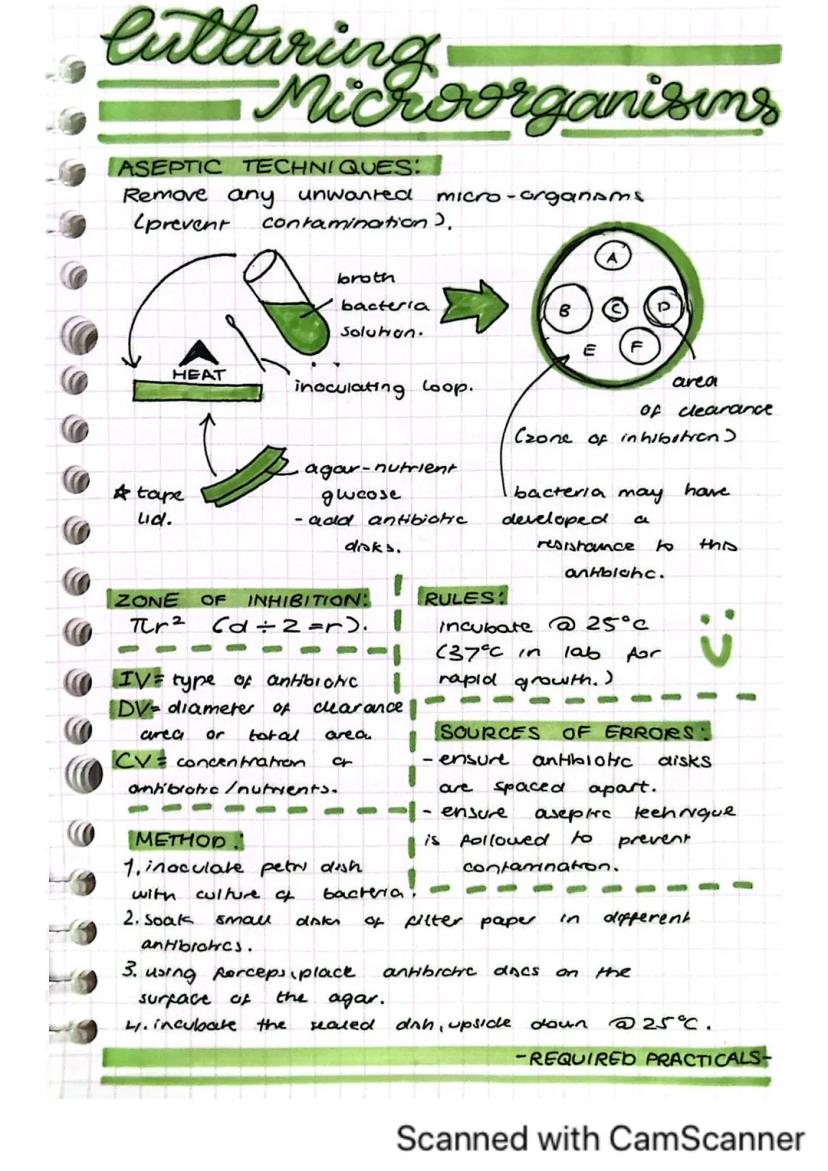
Learning to culture microorganisms safely is a fundamental skill in microbiology. It allows you to study bacteria and test treatments against them.
Aseptic techniques are essential to prevent unwanted microorganisms from contaminating your culture. This includes sterilizing equipment by heating (like passing an inoculating loop through a flame) before use. Your culture medium typically contains agar with nutrients and glucose to feed the bacteria.
When testing antibiotics, you'll observe zones of inhibition where bacteria can't grow. A larger zone indicates a more effective antibiotic. If there's no zone, the bacteria may have developed resistance to that antibiotic.
Lab Safety: Always incubate your cultures at 25°C (or 37°C in labs for more rapid growth) and keep the petri dishes sealed and upside down to prevent contamination.
Common sources of error include improper spacing of antibiotic disks and contamination from poor aseptic technique. Remember your variables: independent (type of antibiotic), dependent (size of the inhibition zone), and controlled .
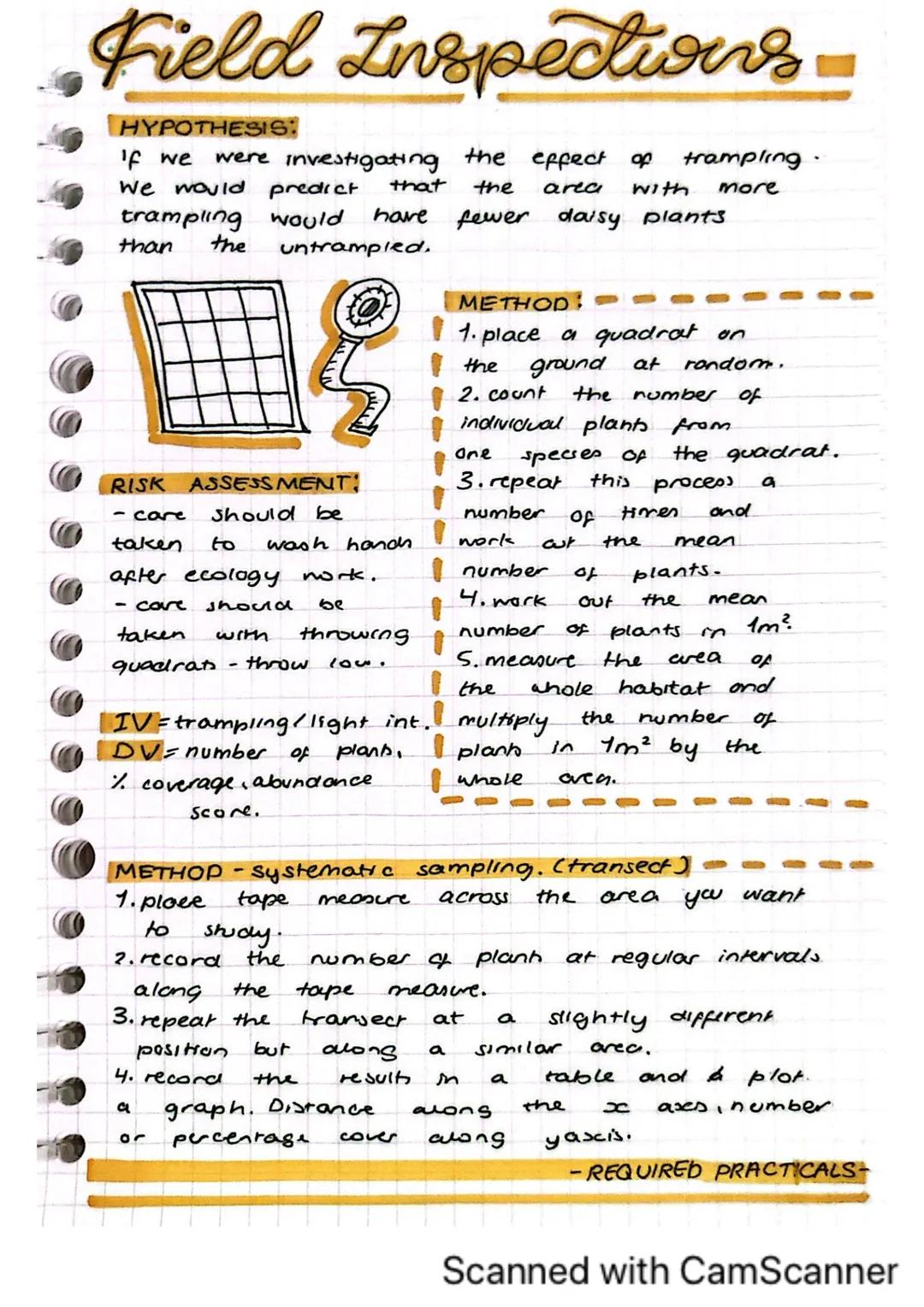
Ecological field work lets you study organisms in their natural environment. It's a hands-on way to understand how living things interact with their surroundings.
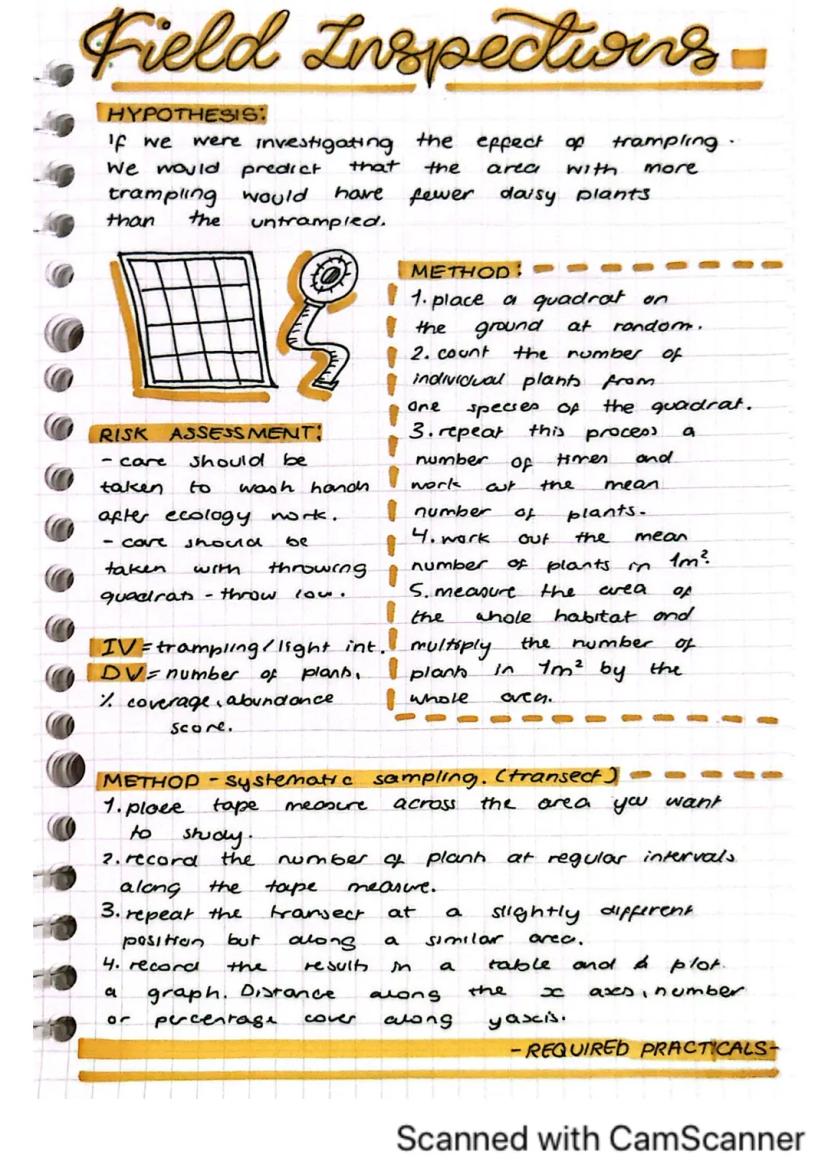
When investigating something like the effect of trampling on plant growth, you might form a hypothesis: "Areas with more trampling will have fewer daisy plants than untrampled areas." To test this, you'd use a quadrat (a square frame) placed randomly on the ground to count plants within that area.
For systematic sampling, you can use a transect - a line across an area where measurements are taken at regular intervals. This is great for studying changes across boundaries, like from a footpath to untrampled grass.
Safety First: Always wash your hands after ecology work, and when throwing quadrats, throw them low to avoid accidents.
Remember to identify your variables clearly: independent variable , dependent variable (number of plants, percentage coverage, abundance score). Repeat your sampling multiple times to calculate reliable means and eliminate bias from your results.

Chemical reactions happen at different speeds depending on certain conditions. Understanding reaction rates is crucial for controlling chemical processes in industry and research.
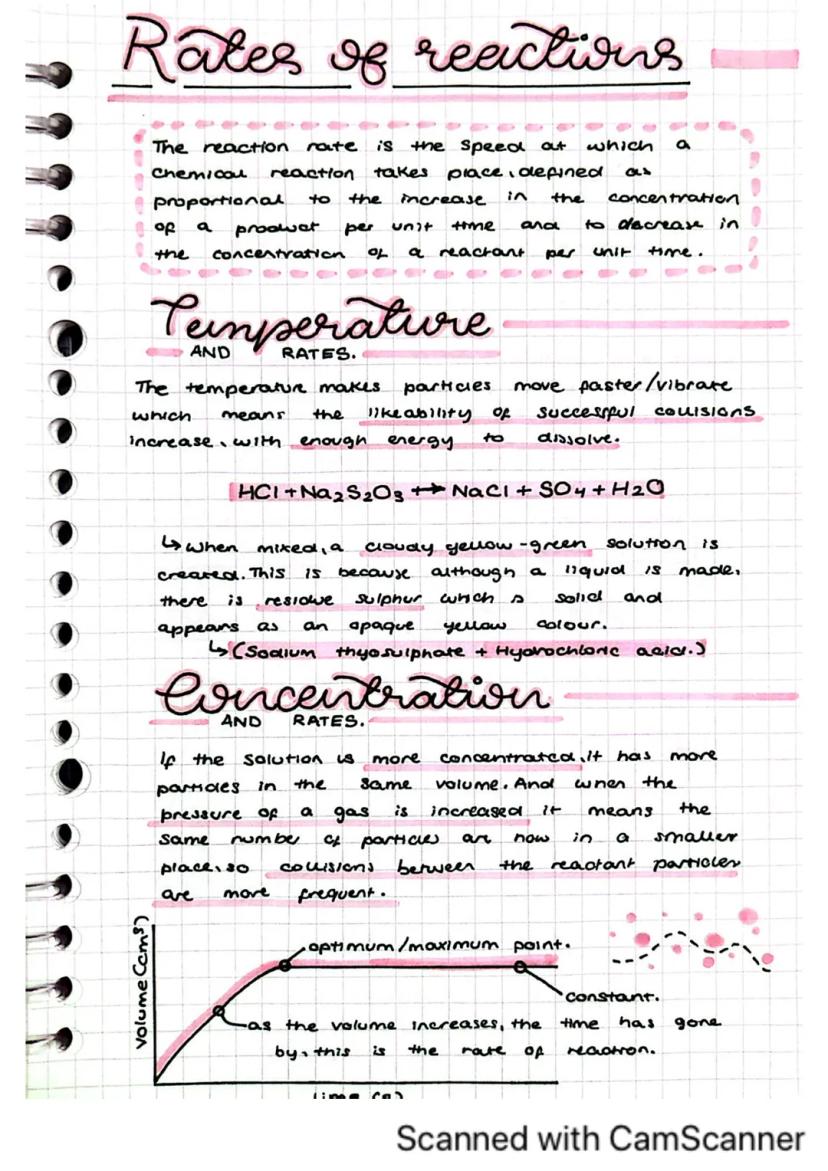
Temperature significantly affects reaction rates. When you increase temperature, particles move faster and vibrate more energetically, leading to more frequent and more energetic collisions. This increases the likelihood of successful collisions with enough energy to cause a reaction.
Concentration also plays a vital role in reaction rates. A more concentrated solution has more particles in the same volume, resulting in more frequent collisions between reactant particles. Similarly, increasing gas pressure means particles are closer together, also increasing collision frequency.
Try This: In the reaction between sodium thiosulphate and hydrochloric acid , you can observe the rate by timing how long it takes for the solution to turn cloudy yellow-green due to sulphur formation.
As a reaction progresses, you can measure how the volume or mass changes over time. The rate of these changes indicates the reaction rate - faster changes mean faster reactions.
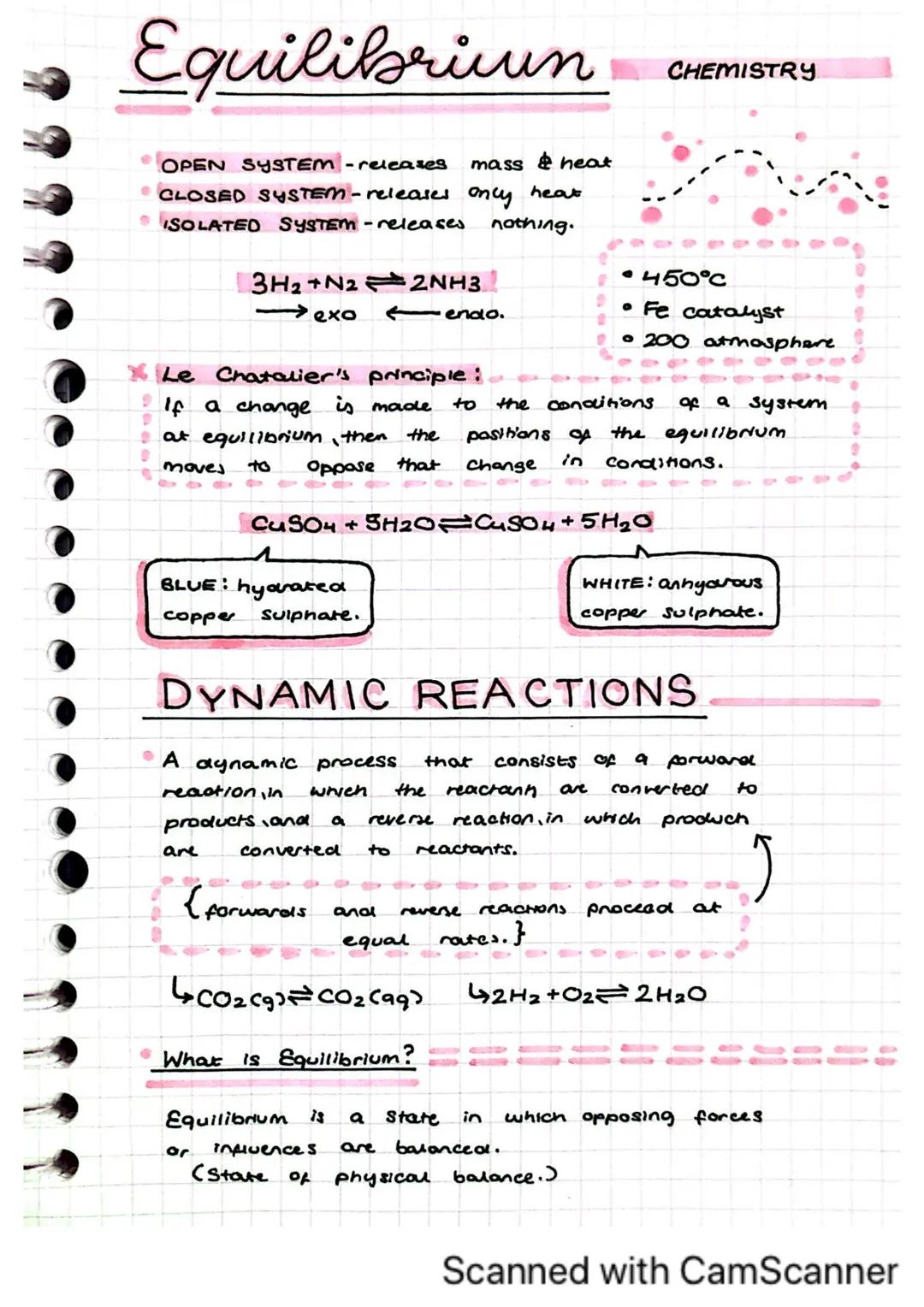
Chemical equilibrium is a fascinating state where forward and reverse reactions occur at exactly the same rate. It's like a chemical tug-of-war that results in a perfect balance.
There are different types of systems in chemistry: open systems release both mass and heat, closed systems release only heat, and isolated systems release nothing at all. Most equilibrium reactions we study occur in closed systems.
Le Chatelier's principle is crucial to understand: if a change is made to a system at equilibrium, the equilibrium position will shift to oppose that change. For example, if you add more reactants, the equilibrium shifts to use them up; if you remove products, it shifts to make more.
Visual Example: Hydrated copper sulphate (blue) and anhydrous copper sulphate (white) exist in equilibrium. Adding water shifts to the blue form; heating shifts to the white form.
In a dynamic equilibrium, the forward and reverse reactions continue to occur at equal rates, so there's no overall change in the amounts of reactants and products. This happens in reactions like CO₂(g) ⇌ CO₂(aq) and 2H₂ + O₂ ⇌ 2H₂O.
Electrolysis is a fascinating process that uses electrical current to drive chemical reactions that wouldn't happen spontaneously. It's how we extract reactive metals and produce many chemicals industrially.
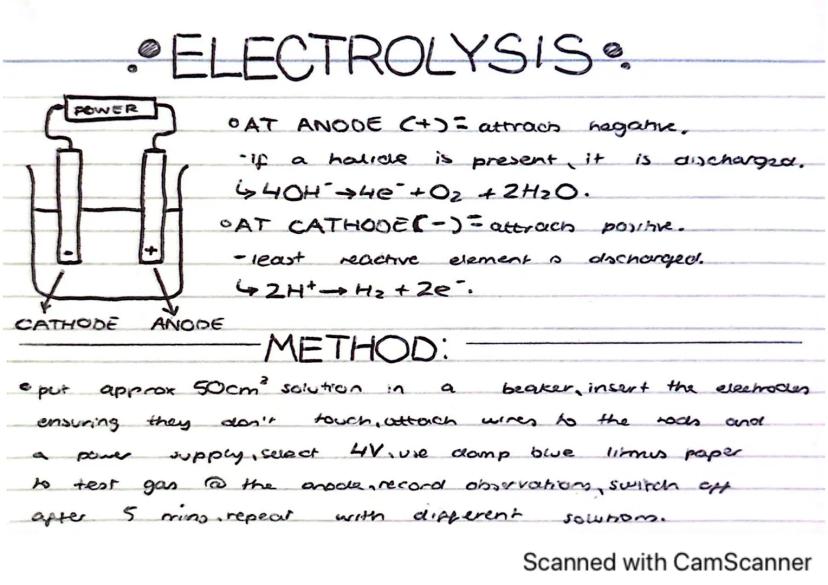
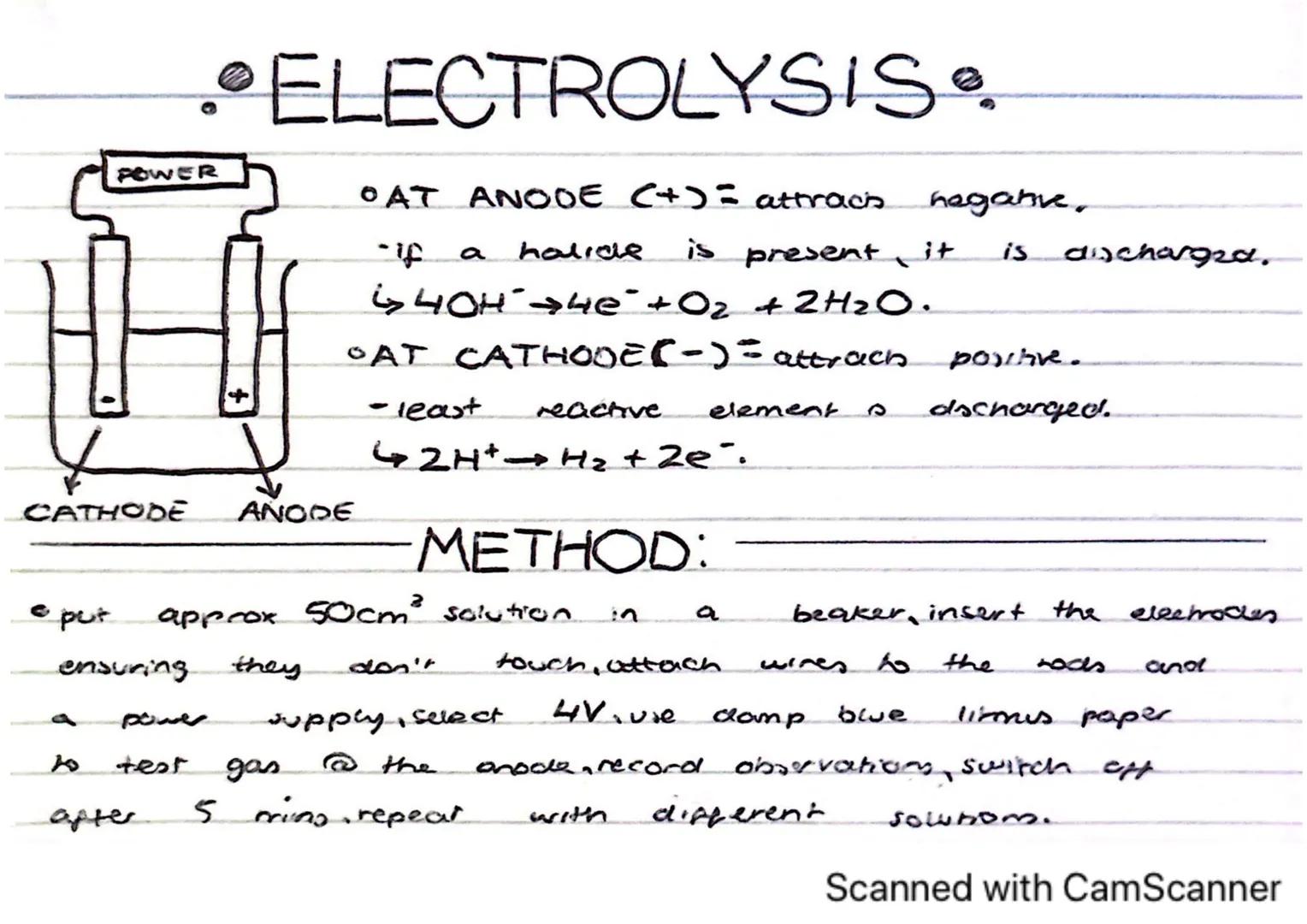
At the anode (positive electrode), negatively charged ions are attracted and discharged. If halide ions (like chloride) are present, they're discharged. Otherwise, hydroxide ions (OH⁻) are discharged following the reaction: 4OH⁻ → 4e⁻ + O₂ + 2H₂O.
At the cathode (negative electrode), positively charged ions are attracted. The least reactive element will be discharged first. In solutions with hydrogen ions, you'll see: 2H⁺ + 2e⁻ → H₂.
Practical Tip: You can test for oxygen gas produced at the anode using damp blue litmus paper - it will bleach in the presence of oxygen.
To perform electrolysis, pour about 50cm³ of solution into a beaker, insert electrodes making sure they don't touch, connect to a 4V power supply, and run for about 5 minutes while making observations. Repeat with different solutions to compare results.
Transformers are clever devices that can change the voltage of alternating current electricity without wasting much energy. They're essential for our national electricity grid.
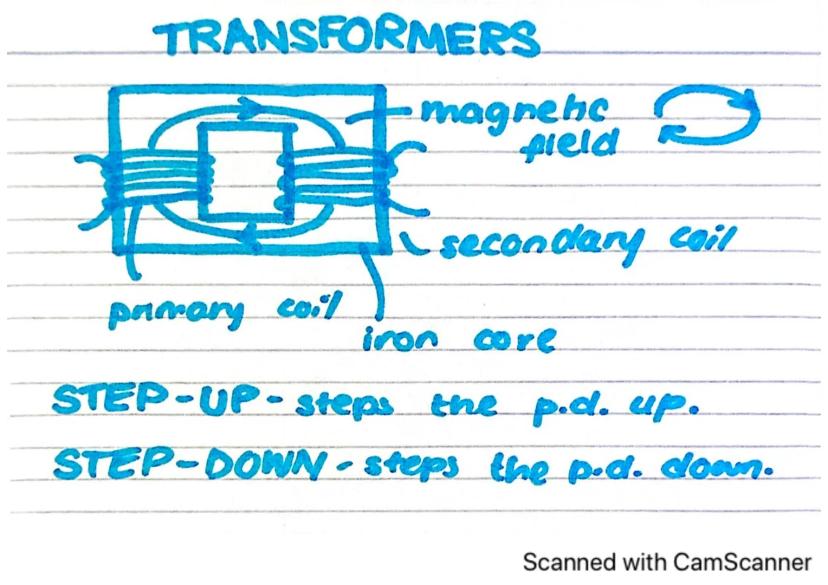
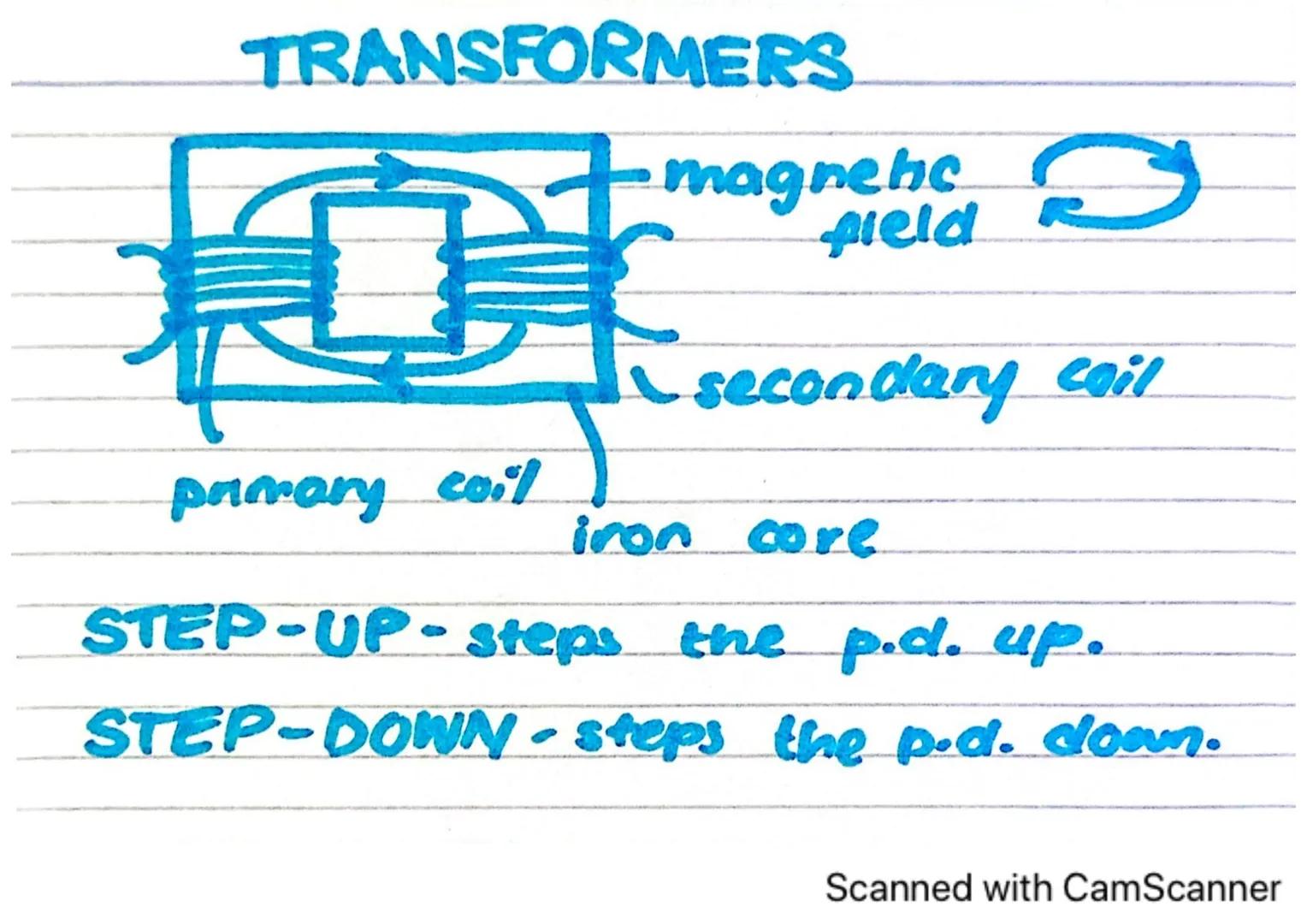
A transformer consists of two coils of wire (primary and secondary) wrapped around an iron core. When alternating current flows through the primary coil, it creates a changing magnetic field in the iron core. This changing field then induces a voltage in the secondary coil.
There are two main types of transformers: step-up transformers increase the voltage, while step-down transformers decrease it. The relationship between the voltages depends on the number of turns in each coil.
Remember: Transformers only work with alternating current (AC), never with direct current (DC), because you need a changing magnetic field to induce voltage in the secondary coil.
Transformers are based on electromagnetic induction, discovered by Michael Faraday. This principle is used throughout our electrical distribution system to efficiently deliver power to homes and businesses.
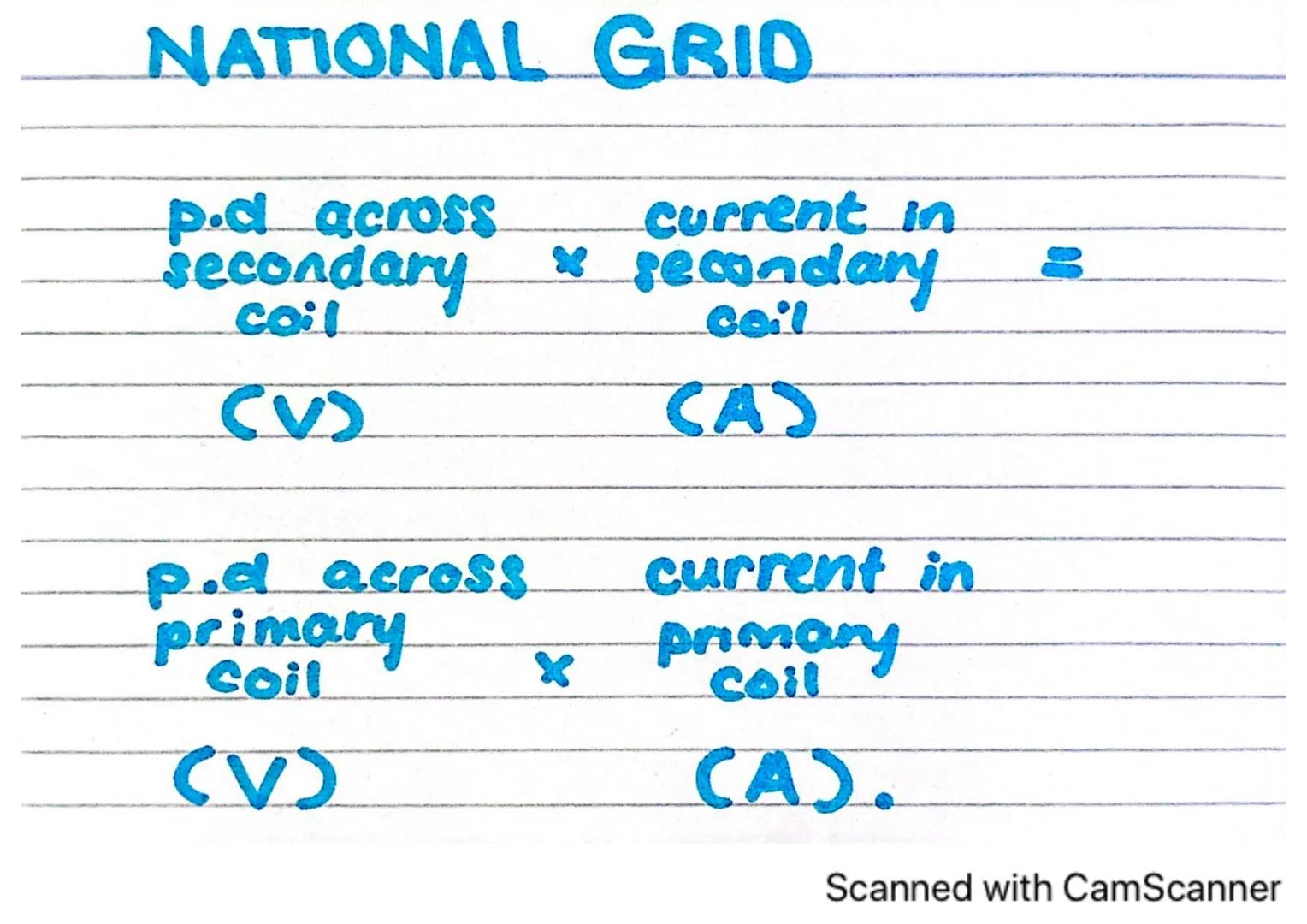
The National Grid is the network that distributes electricity across the country. It relies heavily on transformers to work efficiently.
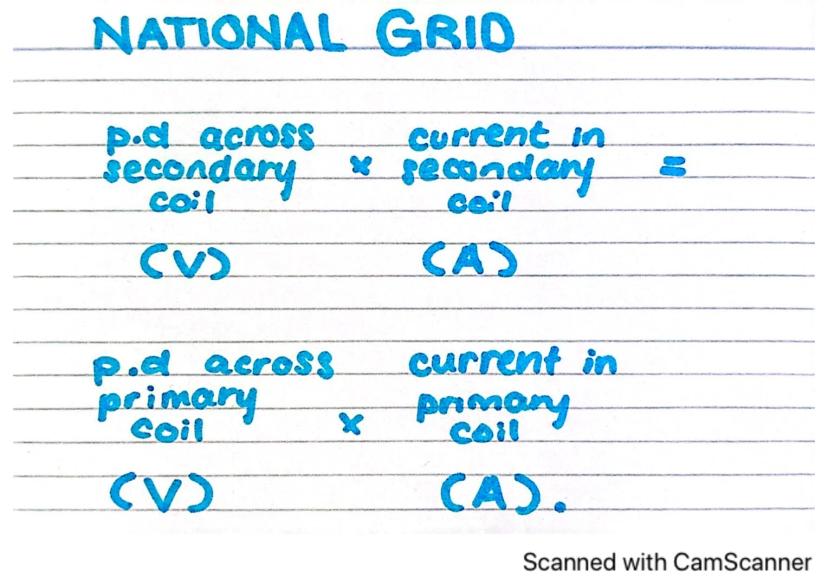
Transformers in the National Grid follow a simple mathematical relationship: the ratio of voltages equals the inverse ratio of currents. If we increase the voltage across the secondary coil compared to the primary coil, we decrease the current in the secondary coil proportionally.
This relationship is crucial for efficient power transmission. By stepping up the voltage to very high levels for transmission over long distances, we reduce the current, which dramatically reduces energy losses due to heating in the wires.
Power Fact: The voltage in the National Grid's transmission lines can be as high as 400,000 volts, but this is stepped down in stages before reaching the 230V used in UK homes.
Near power stations, step-up transformers increase voltage for transmission. Then, step-down transformers at substations gradually reduce the voltage as electricity gets closer to homes and businesses, making it safe for domestic use.
Our AI Companion is a student-focused AI tool that offers more than just answers. Built on millions of Knowunity resources, it provides relevant information, personalised study plans, quizzes, and content directly in the chat, adapting to your individual learning journey.
You can download the app from Google Play Store and Apple App Store.
That's right! Enjoy free access to study content, connect with fellow students, and get instant help – all at your fingertips.
App Store
Google Play
The app is very easy to use and well designed. I have found everything I was looking for so far and have been able to learn a lot from the presentations! I will definitely use the app for a class assignment! And of course it also helps a lot as an inspiration.
Stefan S
iOS user
This app is really great. There are so many study notes and help [...]. My problem subject is French, for example, and the app has so many options for help. Thanks to this app, I have improved my French. I would recommend it to anyone.
Samantha Klich
Android user
Wow, I am really amazed. I just tried the app because I've seen it advertised many times and was absolutely stunned. This app is THE HELP you want for school and above all, it offers so many things, such as workouts and fact sheets, which have been VERY helpful to me personally.
Anna
iOS user
Best app on earth! no words because it’s too good
Thomas R
iOS user
Just amazing. Let's me revise 10x better, this app is a quick 10/10. I highly recommend it to anyone. I can watch and search for notes. I can save them in the subject folder. I can revise it any time when I come back. If you haven't tried this app, you're really missing out.
Basil
Android user
This app has made me feel so much more confident in my exam prep, not only through boosting my own self confidence through the features that allow you to connect with others and feel less alone, but also through the way the app itself is centred around making you feel better. It is easy to navigate, fun to use, and helpful to anyone struggling in absolutely any way.
David K
iOS user
The app's just great! All I have to do is enter the topic in the search bar and I get the response real fast. I don't have to watch 10 YouTube videos to understand something, so I'm saving my time. Highly recommended!
Sudenaz Ocak
Android user
In school I was really bad at maths but thanks to the app, I am doing better now. I am so grateful that you made the app.
Greenlight Bonnie
Android user
very reliable app to help and grow your ideas of Maths, English and other related topics in your works. please use this app if your struggling in areas, this app is key for that. wish I'd of done a review before. and it's also free so don't worry about that.
Rohan U
Android user
I know a lot of apps use fake accounts to boost their reviews but this app deserves it all. Originally I was getting 4 in my English exams and this time I got a grade 7. I didn’t even know about this app three days until the exam and it has helped A LOT. Please actually trust me and use it as I’m sure you too will see developments.
Xander S
iOS user
THE QUIZES AND FLASHCARDS ARE SO USEFUL AND I LOVE Knowunity AI. IT ALSO IS LITREALLY LIKE CHATGPT BUT SMARTER!! HELPED ME WITH MY MASCARA PROBLEMS TOO!! AS WELL AS MY REAL SUBJECTS ! DUHHH 😍😁😲🤑💗✨🎀😮
Elisha
iOS user
This apps acc the goat. I find revision so boring but this app makes it so easy to organize it all and then you can ask the freeeee ai to test yourself so good and you can easily upload your own stuff. highly recommend as someone taking mocks now
Paul T
iOS user
The app is very easy to use and well designed. I have found everything I was looking for so far and have been able to learn a lot from the presentations! I will definitely use the app for a class assignment! And of course it also helps a lot as an inspiration.
Stefan S
iOS user
This app is really great. There are so many study notes and help [...]. My problem subject is French, for example, and the app has so many options for help. Thanks to this app, I have improved my French. I would recommend it to anyone.
Samantha Klich
Android user
Wow, I am really amazed. I just tried the app because I've seen it advertised many times and was absolutely stunned. This app is THE HELP you want for school and above all, it offers so many things, such as workouts and fact sheets, which have been VERY helpful to me personally.
Anna
iOS user
Best app on earth! no words because it’s too good
Thomas R
iOS user
Just amazing. Let's me revise 10x better, this app is a quick 10/10. I highly recommend it to anyone. I can watch and search for notes. I can save them in the subject folder. I can revise it any time when I come back. If you haven't tried this app, you're really missing out.
Basil
Android user
This app has made me feel so much more confident in my exam prep, not only through boosting my own self confidence through the features that allow you to connect with others and feel less alone, but also through the way the app itself is centred around making you feel better. It is easy to navigate, fun to use, and helpful to anyone struggling in absolutely any way.
David K
iOS user
The app's just great! All I have to do is enter the topic in the search bar and I get the response real fast. I don't have to watch 10 YouTube videos to understand something, so I'm saving my time. Highly recommended!
Sudenaz Ocak
Android user
In school I was really bad at maths but thanks to the app, I am doing better now. I am so grateful that you made the app.
Greenlight Bonnie
Android user
very reliable app to help and grow your ideas of Maths, English and other related topics in your works. please use this app if your struggling in areas, this app is key for that. wish I'd of done a review before. and it's also free so don't worry about that.
Rohan U
Android user
I know a lot of apps use fake accounts to boost their reviews but this app deserves it all. Originally I was getting 4 in my English exams and this time I got a grade 7. I didn’t even know about this app three days until the exam and it has helped A LOT. Please actually trust me and use it as I’m sure you too will see developments.
Xander S
iOS user
THE QUIZES AND FLASHCARDS ARE SO USEFUL AND I LOVE Knowunity AI. IT ALSO IS LITREALLY LIKE CHATGPT BUT SMARTER!! HELPED ME WITH MY MASCARA PROBLEMS TOO!! AS WELL AS MY REAL SUBJECTS ! DUHHH 😍😁😲🤑💗✨🎀😮
Elisha
iOS user
This apps acc the goat. I find revision so boring but this app makes it so easy to organize it all and then you can ask the freeeee ai to test yourself so good and you can easily upload your own stuff. highly recommend as someone taking mocks now
Paul T
iOS user
jaeden
@jaedenc08
Diving into science can be both exciting and challenging. This summary covers key practical methods, concepts, and techniques from biology, chemistry, and physics that you'll need to understand for your coursework and exams. Each section provides essential information in bite-sized... Show more
Access to all documents
Improve your grades
Join milions of students
Microscopes let you see the tiny world that's invisible to our eyes. Knowing how to use one properly is a crucial lab skill you'll use throughout your science education.
To prepare a slide properly, place your specimen on a microscope slide, add a stain like iodine or methylene blue, and carefully place a cover slip on top. This creates a thin, viewable sample that's just one cell thick.
When viewing your sample, always start with the lowest magnification. Place your slide on the stage, lower it to its lowest position, and focus using the coarse adjustment wheel first, then the fine adjustment for clearer detail.
Quick Tip: Remember the scale conversions: 1mm = 10⁻³m, 1μm = 10⁻⁶m, 1nm = 10⁻⁹m. Each step is 1,000 times smaller than the previous!
Light microscopes use light and lenses for magnification (up to 1000×) and show specimens in colour. Electron microscopes use electron beams for much higher magnification and resolution, though images are not in colour and require specially prepared specimens.
Access to all documents
Improve your grades
Join milions of students
Osmosis is the movement of water molecules across a partially permeable membrane. This practical helps you see this process in action using potato cylinders.
The method is straightforward: cut identical potato cylinders, weigh them, and place them in beakers containing different concentrations of sugar or salt solutions (plus one with pure water). After 24 hours, remove the cylinders, dry them gently, and weigh them again to calculate the percentage change in mass.
When water moves into a potato cylinder by osmosis, its mass increases. Conversely, when water moves out of the cylinder, the mass decreases. This change tells you about the direction of water movement.
Remember: The percentage change in mass is calculated using the formula: % change = ÷ original mass × 100
In this experiment, the concentration of solution is your independent variable, while the percentage change in mass is your dependent variable. This practical demonstrates how osmosis works in real biological tissues.
Access to all documents
Improve your grades
Join milions of students
This practical helps you understand how antibiotics and antiseptics affect bacterial growth, which is essential knowledge for medicine and health.
The setup involves an agar plate prepared with an even coverage of bacteria. Paper discs soaked in different types or concentrations of antibiotics or antiseptics are placed on the plate. The plate is then sealed and incubated at 25°C.
After incubation, you'll observe zones of inhibition around the paper discs where bacteria couldn't grow. The larger this clear zone, the more effective the antibiotic is against the bacteria. You can measure the diameter of these zones with a ruler.
Did you know? You can calculate the area of the inhibition zone using πr² (where r is the radius), which gives a more accurate measurement of antibiotic effectiveness than just measuring the diameter.
This practical requires careful sterile technique to avoid contamination. The type of antibiotic is your independent variable, while the size of the inhibition zone is your dependent variable.
Access to all documents
Improve your grades
Join milions of students
Learning to culture microorganisms safely is a fundamental skill in microbiology. It allows you to study bacteria and test treatments against them.
Aseptic techniques are essential to prevent unwanted microorganisms from contaminating your culture. This includes sterilizing equipment by heating (like passing an inoculating loop through a flame) before use. Your culture medium typically contains agar with nutrients and glucose to feed the bacteria.
When testing antibiotics, you'll observe zones of inhibition where bacteria can't grow. A larger zone indicates a more effective antibiotic. If there's no zone, the bacteria may have developed resistance to that antibiotic.
Lab Safety: Always incubate your cultures at 25°C (or 37°C in labs for more rapid growth) and keep the petri dishes sealed and upside down to prevent contamination.
Common sources of error include improper spacing of antibiotic disks and contamination from poor aseptic technique. Remember your variables: independent (type of antibiotic), dependent (size of the inhibition zone), and controlled .
Access to all documents
Improve your grades
Join milions of students
Ecological field work lets you study organisms in their natural environment. It's a hands-on way to understand how living things interact with their surroundings.
When investigating something like the effect of trampling on plant growth, you might form a hypothesis: "Areas with more trampling will have fewer daisy plants than untrampled areas." To test this, you'd use a quadrat (a square frame) placed randomly on the ground to count plants within that area.
For systematic sampling, you can use a transect - a line across an area where measurements are taken at regular intervals. This is great for studying changes across boundaries, like from a footpath to untrampled grass.
Safety First: Always wash your hands after ecology work, and when throwing quadrats, throw them low to avoid accidents.
Remember to identify your variables clearly: independent variable , dependent variable (number of plants, percentage coverage, abundance score). Repeat your sampling multiple times to calculate reliable means and eliminate bias from your results.
Access to all documents
Improve your grades
Join milions of students
Chemical reactions happen at different speeds depending on certain conditions. Understanding reaction rates is crucial for controlling chemical processes in industry and research.
Temperature significantly affects reaction rates. When you increase temperature, particles move faster and vibrate more energetically, leading to more frequent and more energetic collisions. This increases the likelihood of successful collisions with enough energy to cause a reaction.
Concentration also plays a vital role in reaction rates. A more concentrated solution has more particles in the same volume, resulting in more frequent collisions between reactant particles. Similarly, increasing gas pressure means particles are closer together, also increasing collision frequency.
Try This: In the reaction between sodium thiosulphate and hydrochloric acid , you can observe the rate by timing how long it takes for the solution to turn cloudy yellow-green due to sulphur formation.
As a reaction progresses, you can measure how the volume or mass changes over time. The rate of these changes indicates the reaction rate - faster changes mean faster reactions.
Access to all documents
Improve your grades
Join milions of students
Chemical equilibrium is a fascinating state where forward and reverse reactions occur at exactly the same rate. It's like a chemical tug-of-war that results in a perfect balance.
There are different types of systems in chemistry: open systems release both mass and heat, closed systems release only heat, and isolated systems release nothing at all. Most equilibrium reactions we study occur in closed systems.
Le Chatelier's principle is crucial to understand: if a change is made to a system at equilibrium, the equilibrium position will shift to oppose that change. For example, if you add more reactants, the equilibrium shifts to use them up; if you remove products, it shifts to make more.
Visual Example: Hydrated copper sulphate (blue) and anhydrous copper sulphate (white) exist in equilibrium. Adding water shifts to the blue form; heating shifts to the white form.
In a dynamic equilibrium, the forward and reverse reactions continue to occur at equal rates, so there's no overall change in the amounts of reactants and products. This happens in reactions like CO₂(g) ⇌ CO₂(aq) and 2H₂ + O₂ ⇌ 2H₂O.
Access to all documents
Improve your grades
Join milions of students
Electrolysis is a fascinating process that uses electrical current to drive chemical reactions that wouldn't happen spontaneously. It's how we extract reactive metals and produce many chemicals industrially.
At the anode (positive electrode), negatively charged ions are attracted and discharged. If halide ions (like chloride) are present, they're discharged. Otherwise, hydroxide ions (OH⁻) are discharged following the reaction: 4OH⁻ → 4e⁻ + O₂ + 2H₂O.
At the cathode (negative electrode), positively charged ions are attracted. The least reactive element will be discharged first. In solutions with hydrogen ions, you'll see: 2H⁺ + 2e⁻ → H₂.
Practical Tip: You can test for oxygen gas produced at the anode using damp blue litmus paper - it will bleach in the presence of oxygen.
To perform electrolysis, pour about 50cm³ of solution into a beaker, insert electrodes making sure they don't touch, connect to a 4V power supply, and run for about 5 minutes while making observations. Repeat with different solutions to compare results.
Access to all documents
Improve your grades
Join milions of students
Transformers are clever devices that can change the voltage of alternating current electricity without wasting much energy. They're essential for our national electricity grid.
A transformer consists of two coils of wire (primary and secondary) wrapped around an iron core. When alternating current flows through the primary coil, it creates a changing magnetic field in the iron core. This changing field then induces a voltage in the secondary coil.
There are two main types of transformers: step-up transformers increase the voltage, while step-down transformers decrease it. The relationship between the voltages depends on the number of turns in each coil.
Remember: Transformers only work with alternating current (AC), never with direct current (DC), because you need a changing magnetic field to induce voltage in the secondary coil.
Transformers are based on electromagnetic induction, discovered by Michael Faraday. This principle is used throughout our electrical distribution system to efficiently deliver power to homes and businesses.
Access to all documents
Improve your grades
Join milions of students
The National Grid is the network that distributes electricity across the country. It relies heavily on transformers to work efficiently.
Transformers in the National Grid follow a simple mathematical relationship: the ratio of voltages equals the inverse ratio of currents. If we increase the voltage across the secondary coil compared to the primary coil, we decrease the current in the secondary coil proportionally.
This relationship is crucial for efficient power transmission. By stepping up the voltage to very high levels for transmission over long distances, we reduce the current, which dramatically reduces energy losses due to heating in the wires.
Power Fact: The voltage in the National Grid's transmission lines can be as high as 400,000 volts, but this is stepped down in stages before reaching the 230V used in UK homes.
Near power stations, step-up transformers increase voltage for transmission. Then, step-down transformers at substations gradually reduce the voltage as electricity gets closer to homes and businesses, making it safe for domestic use.
Our AI Companion is a student-focused AI tool that offers more than just answers. Built on millions of Knowunity resources, it provides relevant information, personalised study plans, quizzes, and content directly in the chat, adapting to your individual learning journey.
You can download the app from Google Play Store and Apple App Store.
That's right! Enjoy free access to study content, connect with fellow students, and get instant help – all at your fingertips.
45
Smart Tools NEW
Transform this note into: ✓ 50+ Practice Questions ✓ Interactive Flashcards ✓ Full Mock Exam ✓ Essay Outlines
Explore key concepts in cell biology, including active transport, cell specialization, and microscopy techniques. This summary covers essential processes like osmosis, diffusion, and the cell cycle, providing a comprehensive overview for AQA Combined Science students. Ideal for exam preparation and understanding fundamental biological principles.
 Biology
Explore the process of osmosis, including the movement of water across partially permeable membranes, and the effects on plant and animal cells in different solutions. This summary covers key concepts such as hypertonic and hypotonic solutions, plasmolysis, and the structural differences between plant and animal cells. Ideal for biology students preparing for exams.
Biologybiology paper 1 higher topic B1 (cell structure and transport)
BiologyExplore key concepts in GCSE AQA Biology, focusing on human and plant systems. This summary covers the circulatory system, blood components, digestive enzymes, and plant transport mechanisms, including xylem and phloem. Ideal for exam preparation, it includes essential diagrams and detailed explanations of cardiovascular treatments and plant tissue organization.
BiologyExplore essential biology practicals including enzyme activity, osmosis, and food tests. This resource covers step-by-step procedures for experiments on pH effects on enzymes, microbial growth, and photosynthesis rates. Ideal for students preparing for Biology Paper 1, it includes key concepts, potential errors, and calculation methods for accurate results.
BiologyExplore key exam questions and concepts related to cell structure, including human and plant cells, cellular processes, and the roles of organelles like ribosomes and mitochondria. This summary covers essential topics for understanding cellular organization and function, ideal for exam preparation.
BiologyApp Store
Google Play
The app is very easy to use and well designed. I have found everything I was looking for so far and have been able to learn a lot from the presentations! I will definitely use the app for a class assignment! And of course it also helps a lot as an inspiration.
Stefan S
iOS user
This app is really great. There are so many study notes and help [...]. My problem subject is French, for example, and the app has so many options for help. Thanks to this app, I have improved my French. I would recommend it to anyone.
Samantha Klich
Android user
Wow, I am really amazed. I just tried the app because I've seen it advertised many times and was absolutely stunned. This app is THE HELP you want for school and above all, it offers so many things, such as workouts and fact sheets, which have been VERY helpful to me personally.
Anna
iOS user
Best app on earth! no words because it’s too good
Thomas R
iOS user
Just amazing. Let's me revise 10x better, this app is a quick 10/10. I highly recommend it to anyone. I can watch and search for notes. I can save them in the subject folder. I can revise it any time when I come back. If you haven't tried this app, you're really missing out.
Basil
Android user
This app has made me feel so much more confident in my exam prep, not only through boosting my own self confidence through the features that allow you to connect with others and feel less alone, but also through the way the app itself is centred around making you feel better. It is easy to navigate, fun to use, and helpful to anyone struggling in absolutely any way.
David K
iOS user
The app's just great! All I have to do is enter the topic in the search bar and I get the response real fast. I don't have to watch 10 YouTube videos to understand something, so I'm saving my time. Highly recommended!
Sudenaz Ocak
Android user
In school I was really bad at maths but thanks to the app, I am doing better now. I am so grateful that you made the app.
Greenlight Bonnie
Android user
very reliable app to help and grow your ideas of Maths, English and other related topics in your works. please use this app if your struggling in areas, this app is key for that. wish I'd of done a review before. and it's also free so don't worry about that.
Rohan U
Android user
I know a lot of apps use fake accounts to boost their reviews but this app deserves it all. Originally I was getting 4 in my English exams and this time I got a grade 7. I didn’t even know about this app three days until the exam and it has helped A LOT. Please actually trust me and use it as I’m sure you too will see developments.
Xander S
iOS user
THE QUIZES AND FLASHCARDS ARE SO USEFUL AND I LOVE Knowunity AI. IT ALSO IS LITREALLY LIKE CHATGPT BUT SMARTER!! HELPED ME WITH MY MASCARA PROBLEMS TOO!! AS WELL AS MY REAL SUBJECTS ! DUHHH 😍😁😲🤑💗✨🎀😮
Elisha
iOS user
This apps acc the goat. I find revision so boring but this app makes it so easy to organize it all and then you can ask the freeeee ai to test yourself so good and you can easily upload your own stuff. highly recommend as someone taking mocks now
Paul T
iOS user
The app is very easy to use and well designed. I have found everything I was looking for so far and have been able to learn a lot from the presentations! I will definitely use the app for a class assignment! And of course it also helps a lot as an inspiration.
Stefan S
iOS user
This app is really great. There are so many study notes and help [...]. My problem subject is French, for example, and the app has so many options for help. Thanks to this app, I have improved my French. I would recommend it to anyone.
Samantha Klich
Android user
Wow, I am really amazed. I just tried the app because I've seen it advertised many times and was absolutely stunned. This app is THE HELP you want for school and above all, it offers so many things, such as workouts and fact sheets, which have been VERY helpful to me personally.
Anna
iOS user
Best app on earth! no words because it’s too good
Thomas R
iOS user
Just amazing. Let's me revise 10x better, this app is a quick 10/10. I highly recommend it to anyone. I can watch and search for notes. I can save them in the subject folder. I can revise it any time when I come back. If you haven't tried this app, you're really missing out.
Basil
Android user
This app has made me feel so much more confident in my exam prep, not only through boosting my own self confidence through the features that allow you to connect with others and feel less alone, but also through the way the app itself is centred around making you feel better. It is easy to navigate, fun to use, and helpful to anyone struggling in absolutely any way.
David K
iOS user
The app's just great! All I have to do is enter the topic in the search bar and I get the response real fast. I don't have to watch 10 YouTube videos to understand something, so I'm saving my time. Highly recommended!
Sudenaz Ocak
Android user
In school I was really bad at maths but thanks to the app, I am doing better now. I am so grateful that you made the app.
Greenlight Bonnie
Android user
very reliable app to help and grow your ideas of Maths, English and other related topics in your works. please use this app if your struggling in areas, this app is key for that. wish I'd of done a review before. and it's also free so don't worry about that.
Rohan U
Android user
I know a lot of apps use fake accounts to boost their reviews but this app deserves it all. Originally I was getting 4 in my English exams and this time I got a grade 7. I didn’t even know about this app three days until the exam and it has helped A LOT. Please actually trust me and use it as I’m sure you too will see developments.
Xander S
iOS user
THE QUIZES AND FLASHCARDS ARE SO USEFUL AND I LOVE Knowunity AI. IT ALSO IS LITREALLY LIKE CHATGPT BUT SMARTER!! HELPED ME WITH MY MASCARA PROBLEMS TOO!! AS WELL AS MY REAL SUBJECTS ! DUHHH 😍😁😲🤑💗✨🎀😮
Elisha
iOS user
This apps acc the goat. I find revision so boring but this app makes it so easy to organize it all and then you can ask the freeeee ai to test yourself so good and you can easily upload your own stuff. highly recommend as someone taking mocks now
Paul T
iOS user