
Ever wondered what happens to rainwater after it hits the...
 Biology326 views·Updated 5 Jul 2026·7 pages
Comprehensive Guide to the Hydrological Cycle and Drainage Basins in Higher Geography

Sushi@sausage_roll




1 / 7
1
of 7
The Water Cycle and Drainage Basins
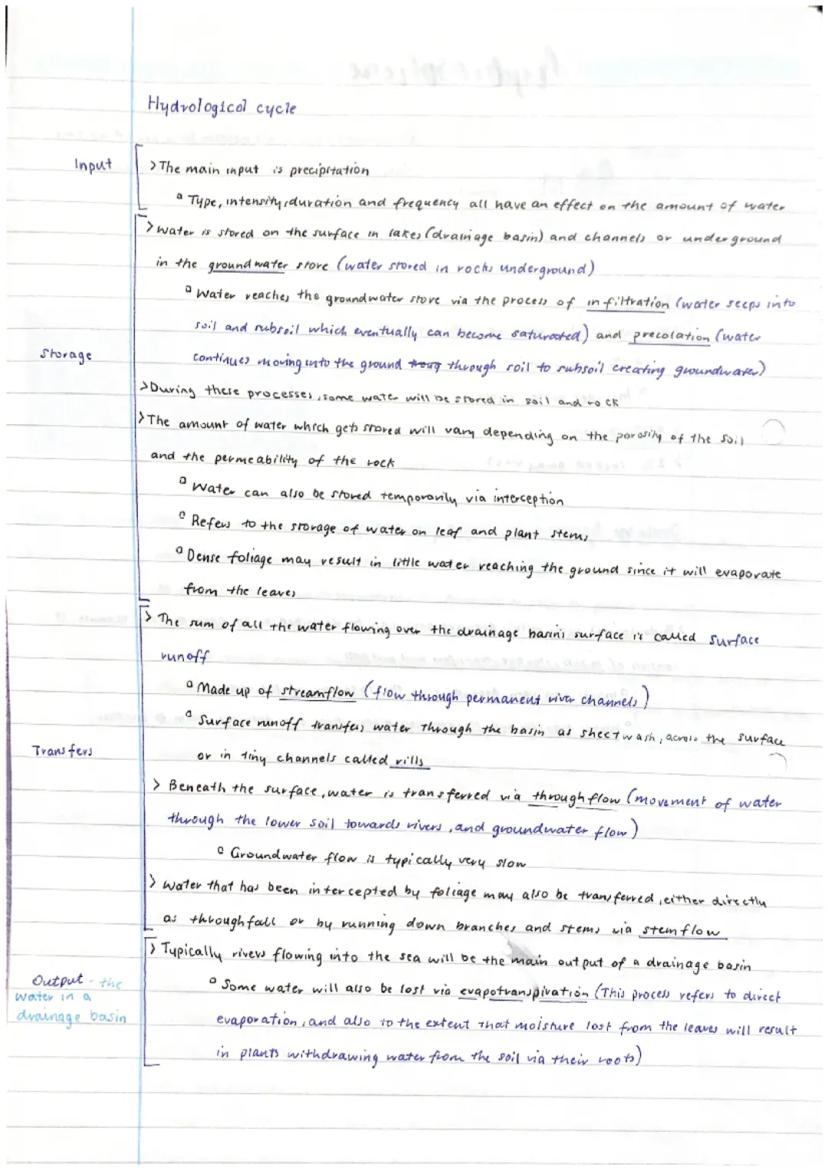
Think of a drainage basin as nature's catchment area - it's the region where a river and its tributaries collect water from both above and below ground. This system works like a giant funnel, gathering rainfall and channelling it towards the sea.
When rain falls, it doesn't just disappear. Some water infiltrates into the soil, slowly making its way down to the water table - that's the level where soil becomes completely saturated with water. During dry periods, this water table drops as evaporation removes moisture from the surface.
A drainage basin functions as an open system because it has clear inputs (mainly precipitation), storage areas (lakes, soil, underground rocks), transfers (water movement), and outputs (rivers flowing to the sea). The key landmarks include the source (where the river starts), tributaries (smaller streams joining the main river), confluence (where rivers meet), and the mouth (where it reaches the sea).
Quick Tip: Only 1% of Earth's water is actively cycling through this system - 97% sits in oceans and 2% is locked away as ice!
2
of 7
How Water Moves Through the System
Precipitation is the main input that kicks everything off. The type, intensity and duration of rainfall massively affects how much water enters the system. Once it arrives, water gets stored in various places - on the surface in lakes and river channels, or underground in the groundwater store.
Getting underground isn't instant though. Water first goes through infiltration (seeping into soil) then percolation (continuing deeper to create groundwater). How much gets stored depends on soil porosity and rock permeability - basically how many gaps there are and how well connected they are.
Interception happens when vegetation catches rainwater on leaves and stems before it hits the ground. Dense forest canopy can stop loads of water reaching the soil because it evaporates straight from the leaves instead.
Water moves around the basin through surface runoff (flowing over the ground), throughflow (moving through upper soil layers), and groundwater flow (very slow movement through rocks). Eventually, most water exits through rivers reaching the sea, though some escapes via evapotranspiration - that's direct evaporation plus moisture lost through plant leaves.
Remember: Groundwater flow is incredibly slow compared to surface runoff - it can take years to reach a river!
3
of 7
The Complete Cycle in Action
Picture the whole system working together: evaporation from the sea creates water vapour that forms clouds through condensation. Advection (cloud movement by wind) brings these clouds over land where they release precipitation.
This creates a continuous loop where water constantly moves between different stores and transfers. Some gets temporarily held by interception on vegetation, some flows as surface runoff, whilst other water infiltrates down to join groundwater flow systems.
The beauty of this system is that it's self-sustaining. Solar energy drives evaporation and transpiration, gravity pulls water downhill, and the whole cycle keeps repeating. Each drainage basin has its own unique characteristics depending on local climate, geology, and vegetation.
Understanding this helps explain why some areas flood whilst others suffer droughts, and why protecting watersheds is crucial for water security.
Key Point: This is an open system because water can enter from outside (precipitation) and leave the basin (rivers to sea, evapotranspiration to atmosphere).
4
of 7
Reading River Patterns with Hydrographs
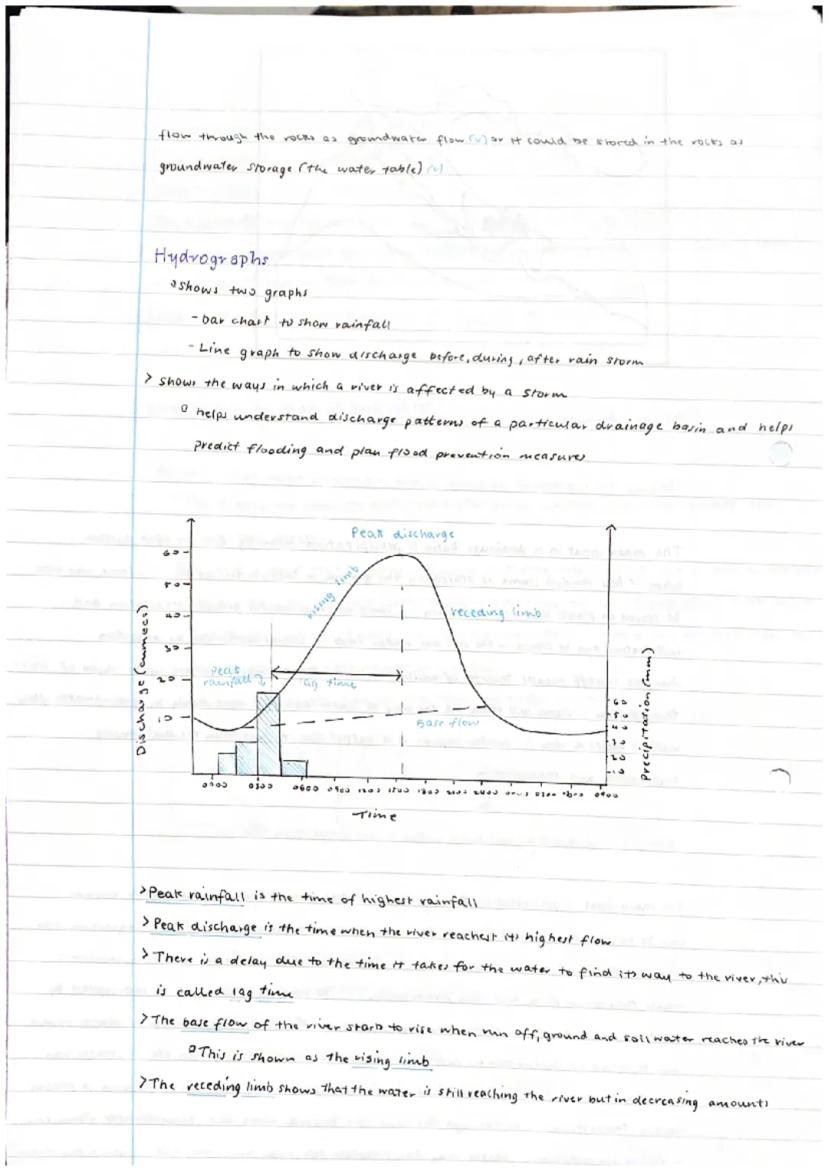
Hydrographs are like the river's medical chart - they show exactly how a river responds to rainfall events. You'll see a bar chart showing precipitation alongside a line graph tracking discharge (water flow measured in cumecs).
The pattern is fairly predictable: peak rainfall happens first, followed by peak discharge after a delay called lag time. This delay exists because water takes time to travel from where it falls to the river channel.
The rising limb shows discharge increasing as runoff and groundwater reach the river. Base flow is the river's normal level, which starts climbing as more water arrives. After peak discharge, the receding limb shows water levels dropping as the storm's effects wear off.
These graphs are incredibly useful for predicting floods and planning defences. By understanding how quickly a river responds to rainfall, authorities can issue warnings and take protective measures.
Practical Use: Hydrographs help predict flooding timing - crucial for emergency planning and evacuation procedures.
5
of 7
What Shapes a River's Response?
Several factors determine whether a river has a steep, dramatic response or a gentle, delayed reaction to rainfall. Relief (slope steepness) is massive - steep slopes mean faster overland flow, creating a steeper rising limb and shorter lag time. Gentle slopes allow more infiltration, slowing the response.
Vegetation acts like nature's speed bump. Trees and plants intercept rainfall and slow overland flow, creating a gentler rising limb with longer lag time. Plus, plants absorb water for growth, reducing the peak flow altogether.
Drainage density (how many tributaries exist) affects speed too. Lots of tributaries mean more opportunities for fast overland flow, whilst fewer tributaries force more water through slower throughflow systems.
Basin size creates a trade-off: larger basins collect more water (higher peak flow) but take longer to respond (greater lag time) because water has further to travel.
Study Tip: Remember the acronym BSSORV - Basin size, Surface type, Soil type, Organisation (drainage density), Relief, Vegetation - covers all the key factors!
6
of 7
Surface Types and Soil Characteristics
Surface type dramatically affects how quickly water reaches rivers. Impermeable surfaces like concrete or solid rock create rapid runoff, leading to steeper rising limbs and shorter lag times. Permeable surfaces like deep soils allow infiltration, slowing the response through throughflow.
Soil type matters just as much. Deeper soils can absorb more water before becoming saturated. Soils with larger particle sizes (like those from weathered sandstone) have greater infiltration capacity - they can soak up water faster.
Urban areas typically show dramatic hydrograph responses because of all the impermeable concrete and tarmac. Rural areas with deep, permeable soils show much gentler responses because water takes time to move through the ground.
This explains why cities flood more readily than countryside during heavy rainfall - there's nowhere for the water to go except straight into drainage systems and rivers.
Real-world Application: Urban planners use this knowledge to design sustainable drainage systems (SUDS) that mimic natural infiltration processes.
7
of 7
Analysing Flood Hydrographs
When tackling hydrograph questions, don't just describe what you see - explain why the pattern exists using those key factors. Always include specific timings (like "lag time of 3 hours from 14:00 to 17:00") and measurements (such as "peak rainfall of 15mm between 13:00-14:00").
Link the hydrograph shape to probable causes. A short lag time suggests impermeable surfaces, steep slopes, or limited vegetation. A long lag time indicates permeable geology, gentle relief, or dense forest cover.
Use the BSSORV factors to build your explanations: Basin size, Surface type, Soil type, Organisation (drainage density), Relief, and Vegetation. Each factor affects the speed and volume of water reaching the river differently.
Remember that real drainage basins usually show combinations of these factors, creating unique response patterns. Urban basins might have impermeable surfaces but also storm drains (high drainage density), whilst rural basins might have gentle slopes but thin soils over impermeable rock.
Exam Success: Always support descriptions with specific data from the graph and clear explanations using geographical processes and factors.
We thought you’d never ask...
Our AI Companion is a student-focused AI tool that offers more than just answers. Built on millions of Knowunity resources, it provides relevant information, personalised study plans, quizzes, and content directly in the chat, adapting to your individual learning journey.
You can download the app from Google Play Store and Apple App Store.
That's right! Enjoy free access to study content, connect with fellow students, and get instant help – all at your fingertips.
Similar content
Most popular content in Biology
9T
 Biology
The functions of subcellular structures - B1 Biology
Flashcards on the different functions of subcellular structures: cell membrane, nucleus, mitochondria, ribosomes, cytoplasm, permant vacuole, chloroplasts and cell wall.
102,8215
B
BiologyBiology Paper 1 quiz
this is a simple quiz on key knowledge needed for paper 1
102,7795
BiologyBiology Paper 1 Overview
Comprehensive study notes covering key concepts in cellular biology, human digestion, respiration, photosynthesis, and the circulatory system. This resource includes detailed explanations of cell structures, enzyme functions, nutrient absorption, and the impact of environmental factors on biological processes. Ideal for students preparing for Biology Paper 1 exams.
1115,233384
E
Biologyeukaryotic & prokaryotic
quiz for eukaryotic & prokaryotic. fairly easy.
114470
P
Biologyplants
flash cards
124570
C
Biologycombined science quiz
biology quiz
91,3863
P
Biologyparts of a cell
.
82351
C
Biologycells structure quiz
all about the cells structures
92450
BiologyUnderstanding Osmosis
Explore the concept of osmosis, including definitions, key differences between plant and animal cells, and the effects of various solutions on cell structure. This summary includes essential diagrams and questions to enhance your understanding of water movement across membranes, crucial for biology exams.
1221,0661,387
Most popular content
9 Sociology
Sociology of Education Overview
Explore comprehensive A-Level Sociology notes on the education system, covering key theories, policies, and sociological perspectives. This resource includes insights on marketisation, gender roles, cultural deprivation, and educational inequalities, providing a thorough understanding of how education shapes social stratification and individual achievement. Ideal for exam preparation and in-depth study.
12102,9243,041
SociologySociology of Families: Comprehensive Revision
Dive into an extensive overview of family dynamics, perspectives, and patterns in sociology. This resource covers key concepts such as family diversity, gender roles, marriage, and the impact of social policies on family structures. Perfect for A-Level Sociology students preparing for Paper 2.
1273,7142,307
CriminologyCriminology: Crime & Punishment Overview
Comprehensive mindmaps covering key concepts in the Crime and Punishment topic for WJEC Criminology Unit 4. This resource includes detailed insights into the Criminal Justice System, crime prevention strategies, sentencing models, and the roles of various agencies. Ideal for A-Level revision, ensuring you grasp essential theories and legislative processes to excel in your exams.
1254,8851,059
SociologyComprehensive Crime & Deviance Overview
Explore an extensive revision of crime and deviance topics, including theories, types of crime, and the impact of media. This resource covers key concepts such as Marxism, functionalism, gender and crime, and the influence of globalization on criminal behavior. Ideal for students seeking a thorough understanding of criminology and its various theories. Type: Full Topic Revision.
1251,6661,400
C
BiologyCell Biology and Cell structure
cell structures
93,2670
CriminologyWJEC Unit 4 Criminology
Criminology unit 4 detailed revision note
127,168125
 English Literature
An Inspector Calls: Character Insights
Explore in-depth analysis and key quotes for characters in J.B. Priestley's 'An Inspector Calls'. This resource covers Gerald Croft, Inspector Goole, Sheila Birling, Mrs. Birling, Eric Birling, and Eva Smith, focusing on themes of class, gender roles, and social responsibility. Ideal for students aiming for Grade 8 and above.
1025,444907
CriminologyCriminology Theories Overview
Explore key criminology theories and their implications on crime and deviance. This comprehensive summary covers biological, psychological, and sociological perspectives, including labelling theory, right realism, and the impact of social campaigns on policy development. Ideal for A-Level criminology students seeking to understand the complexities of criminal behaviour and the factors influencing crime prevention strategies.
129,768210
SociologySociological Theories Overview
Comprehensive revision of key sociological theories including Functionalism, Marxism, Feminism, and Interpretivism. Explore concepts like value freedom, identity formation, and the critique of social control. Ideal for AQA A-Level Sociology students preparing for exams. This summary covers essential theories and their implications in sociology, providing a clear understanding of each perspective.
1231,471846
Students love us — and so will you.
4.6/5App Store
4.7/5Google Play
The app is very easy to use and well designed. I have found everything I was looking for so far and have been able to learn a lot from the presentations! I will definitely use the app for a class assignment! And of course it also helps a lot as an inspiration.
Stefan SiOS user
This app is really great. There are so many study notes and help [...]. My problem subject is French, for example, and the app has so many options for help. Thanks to this app, I have improved my French. I would recommend it to anyone.
Samantha KlichAndroid user
Wow, I am really amazed. I just tried the app because I've seen it advertised many times and was absolutely stunned. This app is THE HELP you want for school and above all, it offers so many things, such as workouts and fact sheets, which have been VERY helpful to me personally.
AnnaiOS user
Biology326 views·Updated 5 Jul 2026·7 pagesComprehensive Guide to the Hydrological Cycle and Drainage Basins in Higher Geography
Sushi@sausage_roll
Ever wondered what happens to rainwater after it hits the ground? The water cycle within a drainage basinis like nature's recycling system - water moves through different stages from rainfall to rivers to the sea and back again. Understanding...
1
of 7
Sign up to see the content. It's free!
- Access to all documents
- Improve your grades
- Join milions of students
By signing up you accept Terms of Service and Privacy Policy
The Water Cycle and Drainage Basins
Think of a drainage basin as nature's catchment area - it's the region where a river and its tributaries collect water from both above and below ground. This system works like a giant funnel, gathering rainfall and channelling it towards the sea.
When rain falls, it doesn't just disappear. Some water infiltrates into the soil, slowly making its way down to the water table - that's the level where soil becomes completely saturated with water. During dry periods, this water table drops as evaporation removes moisture from the surface.
A drainage basin functions as an open system because it has clear inputs (mainly precipitation), storage areas (lakes, soil, underground rocks), transfers (water movement), and outputs (rivers flowing to the sea). The key landmarks include the source (where the river starts), tributaries (smaller streams joining the main river), confluence (where rivers meet), and the mouth (where it reaches the sea).
Quick Tip: Only 1% of Earth's water is actively cycling through this system - 97% sits in oceans and 2% is locked away as ice!
2
of 7Sign up to see the content. It's free!
- Access to all documents
- Improve your grades
- Join milions of students
By signing up you accept Terms of Service and Privacy Policy
How Water Moves Through the System
Precipitation is the main input that kicks everything off. The type, intensity and duration of rainfall massively affects how much water enters the system. Once it arrives, water gets stored in various places - on the surface in lakes and river channels, or underground in the groundwater store.
Getting underground isn't instant though. Water first goes through infiltration (seeping into soil) then percolation (continuing deeper to create groundwater). How much gets stored depends on soil porosity and rock permeability - basically how many gaps there are and how well connected they are.
Interception happens when vegetation catches rainwater on leaves and stems before it hits the ground. Dense forest canopy can stop loads of water reaching the soil because it evaporates straight from the leaves instead.
Water moves around the basin through surface runoff (flowing over the ground), throughflow (moving through upper soil layers), and groundwater flow (very slow movement through rocks). Eventually, most water exits through rivers reaching the sea, though some escapes via evapotranspiration - that's direct evaporation plus moisture lost through plant leaves.
Remember: Groundwater flow is incredibly slow compared to surface runoff - it can take years to reach a river!
3
of 7Sign up to see the content. It's free!
- Access to all documents
- Improve your grades
- Join milions of students
By signing up you accept Terms of Service and Privacy Policy
The Complete Cycle in Action
Picture the whole system working together: evaporation from the sea creates water vapour that forms clouds through condensation. Advection (cloud movement by wind) brings these clouds over land where they release precipitation.
This creates a continuous loop where water constantly moves between different stores and transfers. Some gets temporarily held by interception on vegetation, some flows as surface runoff, whilst other water infiltrates down to join groundwater flow systems.
The beauty of this system is that it's self-sustaining. Solar energy drives evaporation and transpiration, gravity pulls water downhill, and the whole cycle keeps repeating. Each drainage basin has its own unique characteristics depending on local climate, geology, and vegetation.
Understanding this helps explain why some areas flood whilst others suffer droughts, and why protecting watersheds is crucial for water security.
Key Point: This is an open system because water can enter from outside (precipitation) and leave the basin (rivers to sea, evapotranspiration to atmosphere).
4
of 7Sign up to see the content. It's free!
- Access to all documents
- Improve your grades
- Join milions of students
By signing up you accept Terms of Service and Privacy Policy
Reading River Patterns with Hydrographs
Hydrographs are like the river's medical chart - they show exactly how a river responds to rainfall events. You'll see a bar chart showing precipitation alongside a line graph tracking discharge (water flow measured in cumecs).
The pattern is fairly predictable: peak rainfall happens first, followed by peak discharge after a delay called lag time. This delay exists because water takes time to travel from where it falls to the river channel.
The rising limb shows discharge increasing as runoff and groundwater reach the river. Base flow is the river's normal level, which starts climbing as more water arrives. After peak discharge, the receding limb shows water levels dropping as the storm's effects wear off.
These graphs are incredibly useful for predicting floods and planning defences. By understanding how quickly a river responds to rainfall, authorities can issue warnings and take protective measures.
Practical Use: Hydrographs help predict flooding timing - crucial for emergency planning and evacuation procedures.
5
of 7Sign up to see the content. It's free!
- Access to all documents
- Improve your grades
- Join milions of students
By signing up you accept Terms of Service and Privacy Policy
What Shapes a River's Response?
Several factors determine whether a river has a steep, dramatic response or a gentle, delayed reaction to rainfall. Relief (slope steepness) is massive - steep slopes mean faster overland flow, creating a steeper rising limb and shorter lag time. Gentle slopes allow more infiltration, slowing the response.
Vegetation acts like nature's speed bump. Trees and plants intercept rainfall and slow overland flow, creating a gentler rising limb with longer lag time. Plus, plants absorb water for growth, reducing the peak flow altogether.
Drainage density (how many tributaries exist) affects speed too. Lots of tributaries mean more opportunities for fast overland flow, whilst fewer tributaries force more water through slower throughflow systems.
Basin size creates a trade-off: larger basins collect more water (higher peak flow) but take longer to respond (greater lag time) because water has further to travel.
Study Tip: Remember the acronym BSSORV - Basin size, Surface type, Soil type, Organisation (drainage density), Relief, Vegetation - covers all the key factors!
6
of 7Sign up to see the content. It's free!
- Access to all documents
- Improve your grades
- Join milions of students
By signing up you accept Terms of Service and Privacy Policy
Surface Types and Soil Characteristics
Surface type dramatically affects how quickly water reaches rivers. Impermeable surfaces like concrete or solid rock create rapid runoff, leading to steeper rising limbs and shorter lag times. Permeable surfaces like deep soils allow infiltration, slowing the response through throughflow.
Soil type matters just as much. Deeper soils can absorb more water before becoming saturated. Soils with larger particle sizes (like those from weathered sandstone) have greater infiltration capacity - they can soak up water faster.
Urban areas typically show dramatic hydrograph responses because of all the impermeable concrete and tarmac. Rural areas with deep, permeable soils show much gentler responses because water takes time to move through the ground.
This explains why cities flood more readily than countryside during heavy rainfall - there's nowhere for the water to go except straight into drainage systems and rivers.
Real-world Application: Urban planners use this knowledge to design sustainable drainage systems (SUDS) that mimic natural infiltration processes.
7
of 7Sign up to see the content. It's free!
- Access to all documents
- Improve your grades
- Join milions of students
By signing up you accept Terms of Service and Privacy Policy
Analysing Flood Hydrographs
When tackling hydrograph questions, don't just describe what you see - explain why the pattern exists using those key factors. Always include specific timings (like "lag time of 3 hours from 14:00 to 17:00") and measurements (such as "peak rainfall of 15mm between 13:00-14:00").
Link the hydrograph shape to probable causes. A short lag time suggests impermeable surfaces, steep slopes, or limited vegetation. A long lag time indicates permeable geology, gentle relief, or dense forest cover.
Use the BSSORV factors to build your explanations: Basin size, Surface type, Soil type, Organisation (drainage density), Relief, and Vegetation. Each factor affects the speed and volume of water reaching the river differently.
Remember that real drainage basins usually show combinations of these factors, creating unique response patterns. Urban basins might have impermeable surfaces but also storm drains (high drainage density), whilst rural basins might have gentle slopes but thin soils over impermeable rock.
Exam Success: Always support descriptions with specific data from the graph and clear explanations using geographical processes and factors.
We thought you’d never ask...
Our AI Companion is a student-focused AI tool that offers more than just answers. Built on millions of Knowunity resources, it provides relevant information, personalised study plans, quizzes, and content directly in the chat, adapting to your individual learning journey.
You can download the app from Google Play Store and Apple App Store.
That's right! Enjoy free access to study content, connect with fellow students, and get instant help – all at your fingertips.
Similar content
Most popular content in Biology
9T
BiologyThe functions of subcellular structures - B1 Biology
Flashcards on the different functions of subcellular structures: cell membrane, nucleus, mitochondria, ribosomes, cytoplasm, permant vacuole, chloroplasts and cell wall.
102,8215
B
BiologyBiology Paper 1 quiz
this is a simple quiz on key knowledge needed for paper 1
102,7795
BiologyBiology Paper 1 Overview
Comprehensive study notes covering key concepts in cellular biology, human digestion, respiration, photosynthesis, and the circulatory system. This resource includes detailed explanations of cell structures, enzyme functions, nutrient absorption, and the impact of environmental factors on biological processes. Ideal for students preparing for Biology Paper 1 exams.
1115,233384
E
Biologyeukaryotic & prokaryotic
quiz for eukaryotic & prokaryotic. fairly easy.
114470
P
Biologyplants
flash cards
124570
C
Biologycombined science quiz
biology quiz
91,3863
P
Biologyparts of a cell
.
82351
C
Biologycells structure quiz
all about the cells structures
92450
BiologyUnderstanding Osmosis
Explore the concept of osmosis, including definitions, key differences between plant and animal cells, and the effects of various solutions on cell structure. This summary includes essential diagrams and questions to enhance your understanding of water movement across membranes, crucial for biology exams.
1221,0661,387
Most popular content
9SociologySociology of Education Overview
Explore comprehensive A-Level Sociology notes on the education system, covering key theories, policies, and sociological perspectives. This resource includes insights on marketisation, gender roles, cultural deprivation, and educational inequalities, providing a thorough understanding of how education shapes social stratification and individual achievement. Ideal for exam preparation and in-depth study.
12102,9243,041
SociologySociology of Families: Comprehensive Revision
Dive into an extensive overview of family dynamics, perspectives, and patterns in sociology. This resource covers key concepts such as family diversity, gender roles, marriage, and the impact of social policies on family structures. Perfect for A-Level Sociology students preparing for Paper 2.
1273,7142,307
CriminologyCriminology: Crime & Punishment Overview
Comprehensive mindmaps covering key concepts in the Crime and Punishment topic for WJEC Criminology Unit 4. This resource includes detailed insights into the Criminal Justice System, crime prevention strategies, sentencing models, and the roles of various agencies. Ideal for A-Level revision, ensuring you grasp essential theories and legislative processes to excel in your exams.
1254,8851,059
SociologyComprehensive Crime & Deviance Overview
Explore an extensive revision of crime and deviance topics, including theories, types of crime, and the impact of media. This resource covers key concepts such as Marxism, functionalism, gender and crime, and the influence of globalization on criminal behavior. Ideal for students seeking a thorough understanding of criminology and its various theories. Type: Full Topic Revision.
1251,6661,400
C
BiologyCell Biology and Cell structure
cell structures
93,2670
CriminologyWJEC Unit 4 Criminology
Criminology unit 4 detailed revision note
127,168125
English LiteratureAn Inspector Calls: Character Insights
Explore in-depth analysis and key quotes for characters in J.B. Priestley's 'An Inspector Calls'. This resource covers Gerald Croft, Inspector Goole, Sheila Birling, Mrs. Birling, Eric Birling, and Eva Smith, focusing on themes of class, gender roles, and social responsibility. Ideal for students aiming for Grade 8 and above.
1025,444907
CriminologyCriminology Theories Overview
Explore key criminology theories and their implications on crime and deviance. This comprehensive summary covers biological, psychological, and sociological perspectives, including labelling theory, right realism, and the impact of social campaigns on policy development. Ideal for A-Level criminology students seeking to understand the complexities of criminal behaviour and the factors influencing crime prevention strategies.
129,768210
SociologySociological Theories Overview
Comprehensive revision of key sociological theories including Functionalism, Marxism, Feminism, and Interpretivism. Explore concepts like value freedom, identity formation, and the critique of social control. Ideal for AQA A-Level Sociology students preparing for exams. This summary covers essential theories and their implications in sociology, providing a clear understanding of each perspective.
1231,471846
Students love us — and so will you.
4.6/5App Store
4.7/5Google Play
The app is very easy to use and well designed. I have found everything I was looking for so far and have been able to learn a lot from the presentations! I will definitely use the app for a class assignment! And of course it also helps a lot as an inspiration.
Stefan SiOS user
This app is really great. There are so many study notes and help [...]. My problem subject is French, for example, and the app has so many options for help. Thanks to this app, I have improved my French. I would recommend it to anyone.
Samantha KlichAndroid user
Wow, I am really amazed. I just tried the app because I've seen it advertised many times and was absolutely stunned. This app is THE HELP you want for school and above all, it offers so many things, such as workouts and fact sheets, which have been VERY helpful to me personally.
AnnaiOS user