
Ecology is all about understanding how living things interact with... Show more
 English Literature
 Sociology
Sign up to see the contentIt's free!
Access to all documents
Improve your grades
Join milions of students
Knowunity AI
Subjects
Triangle Congruence and Similarity Theorems
Triangle Properties and Classification
Linear Equations and Graphs
Geometric Angle Relationships
Trigonometric Functions and Identities
Equation Solving Techniques
Circle Geometry Fundamentals
Division Operations and Methods
Basic Differentiation Rules
Exponent and Logarithm Properties
Show all topics
Human Organ Systems
Reproductive Cell Cycles
Biological Sciences Subdisciplines
Cellular Energy Metabolism
Autotrophic Energy Processes
Inheritance Patterns and Principles
Biomolecular Structure and Organization
Cell Cycle and Division Mechanics
Cellular Organization and Development
Biological Structural Organization
Show all topics
Chemical Sciences and Applications
Atomic Structure and Composition
Molecular Electron Structure Representation
Atomic Electron Behavior
Matter Properties and Water
Mole Concept and Calculations
Gas Laws and Behavior
Periodic Table Organization
Chemical Thermodynamics Fundamentals
Chemical Bond Types and Properties
Show all topics
European Renaissance and Enlightenment
European Cultural Movements 800-1920
American Revolution Era 1763-1797
American Civil War 1861-1865
Global Imperial Systems
Mongol and Chinese Dynasties
U.S. Presidents and World Leaders
Historical Sources and Documentation
World Wars Era and Impact
World Religious Systems
Show all topics
Classic and Contemporary Novels
Literary Character Analysis
Rhetorical Theory and Practice
Classic Literary Narratives
Reading Analysis and Interpretation
Narrative Structure and Techniques
English Language Components
Influential English-Language Authors
Basic Sentence Structure
Narrative Voice and Perspective
Show all topics
343
•
Updated Mar 11, 2026
•

Tallula Walker
@tawkforvoiceless
Ecology is all about understanding how living things interact with... Show more
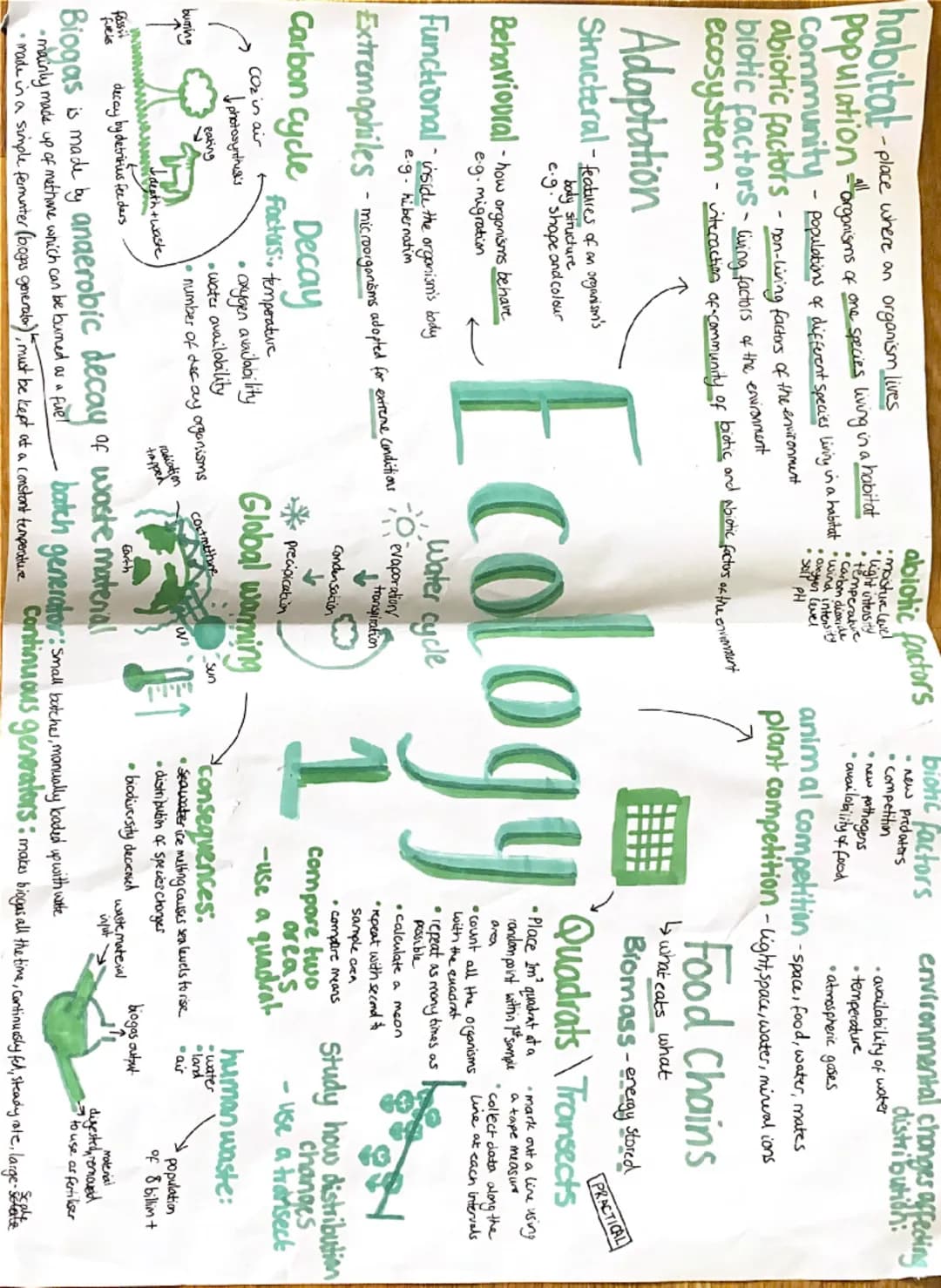
Your habitat is basically your address in nature - it's where an organism calls home. Within that habitat, you'll find populations (groups of the same species) that form communities when different species live together.
Every ecosystem is shaped by abiotic factors and biotic factors (living influences like predators, competition, and food availability). When environmental changes occur - whether it's temperature shifts or new predators moving in - species distribution can change dramatically.
Adaptations help organisms survive these challenges. Structural adaptations involve body features (like a polar bear's thick fur), behavioural adaptations involve actions (like bird migration), and functional adaptations happen inside the body (like hibernation). Extremophiles are the ultimate survivors - microorganisms that thrive in conditions that would kill most other life forms.
Key Insight: Competition drives evolution - animals compete for space, food, water and mates, whilst plants battle for light, space, water and mineral ions.
The carbon cycle keeps our planet's carbon moving between the atmosphere, living things, and fossil fuels through photosynthesis, respiration, decay, and burning. Meanwhile, the water cycle moves H₂O through evaporation, transpiration, condensation, and precipitation.
Global warming is reshaping our world's ecosystems. Rising sea levels from melting ice, changing species distribution, and decreased biodiversity are real consequences we're seeing today. The good news? We can create biogas from waste through anaerobic decay, producing methane that burns as clean fuel.
Understanding food chains helps us see energy flow in nature. Biomass represents stored energy that transfers between organisms, though energy is lost at each level through waste, heat, and inedible materials.
Practical Tip: Use quadrats for comparing species numbers between areas, and transects for studying how distribution changes across different zones.
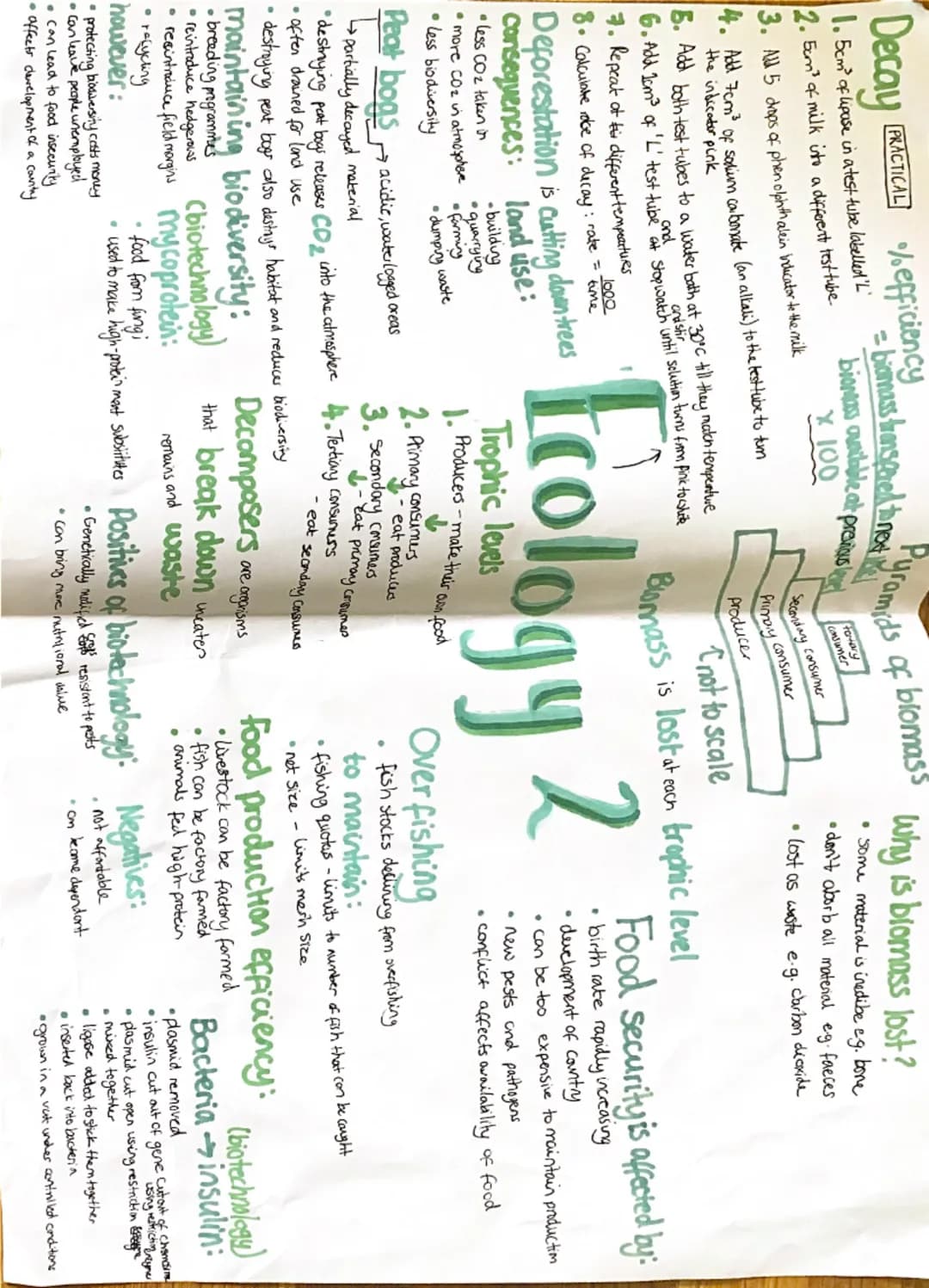
Trophic levels show nature's feeding hierarchy - from producers making their own food, through primary consumers (herbivores), secondary consumers, and up to tertiary consumers at the top. Decomposers are the unsung heroes, breaking down dead material and waste to recycle nutrients back into the ecosystem.
Pyramids of biomass reveal why food chains rarely exceed four levels. Energy efficiency between levels is typically only 10% because organisms lose biomass through inedible parts (bones), unabsorbed material (faeces), and metabolic waste (carbon dioxide and heat).
Understanding these transfers helps explain why there are fewer top predators than producers in any ecosystem. Each level supports less biomass than the one below it.
Remember: Biomass lost = energy that can't support the next trophic level up.
Deforestation creates a double problem - less CO₂ absorption and more atmospheric carbon. Combined with land use for building, farming, and waste disposal, we're dramatically altering natural habitats. Peat bogs destruction is particularly harmful because these waterlogged areas store massive amounts of carbon.
Food security faces growing challenges from increasing birth rates, development needs, expensive production, new pests and pathogens, and conflicts. Overfishing threatens marine ecosystems, but solutions like fishing quotas and net size regulations help maintain fish stocks.
Biotechnology offers hope through factory farming, genetically modified crops resistant to pests, and mycoprotein from fungi as meat substitutes. Scientists can even engineer bacteria to produce human insulin by inserting our insulin gene into bacterial plasmids using restriction enzymes and ligase.
Balance Point: Protecting biodiversity costs money and can affect jobs and development, but the long-term benefits usually outweigh short-term economic concerns.
Our AI Companion is a student-focused AI tool that offers more than just answers. Built on millions of Knowunity resources, it provides relevant information, personalised study plans, quizzes, and content directly in the chat, adapting to your individual learning journey.
You can download the app from Google Play Store and Apple App Store.
That's right! Enjoy free access to study content, connect with fellow students, and get instant help – all at your fingertips.
App Store
Google Play
The app is very easy to use and well designed. I have found everything I was looking for so far and have been able to learn a lot from the presentations! I will definitely use the app for a class assignment! And of course it also helps a lot as an inspiration.
Stefan S
iOS user
This app is really great. There are so many study notes and help [...]. My problem subject is French, for example, and the app has so many options for help. Thanks to this app, I have improved my French. I would recommend it to anyone.
Samantha Klich
Android user
Wow, I am really amazed. I just tried the app because I've seen it advertised many times and was absolutely stunned. This app is THE HELP you want for school and above all, it offers so many things, such as workouts and fact sheets, which have been VERY helpful to me personally.
Anna
iOS user
Best app on earth! no words because it’s too good
Thomas R
iOS user
Just amazing. Let's me revise 10x better, this app is a quick 10/10. I highly recommend it to anyone. I can watch and search for notes. I can save them in the subject folder. I can revise it any time when I come back. If you haven't tried this app, you're really missing out.
Basil
Android user
This app has made me feel so much more confident in my exam prep, not only through boosting my own self confidence through the features that allow you to connect with others and feel less alone, but also through the way the app itself is centred around making you feel better. It is easy to navigate, fun to use, and helpful to anyone struggling in absolutely any way.
David K
iOS user
The app's just great! All I have to do is enter the topic in the search bar and I get the response real fast. I don't have to watch 10 YouTube videos to understand something, so I'm saving my time. Highly recommended!
Sudenaz Ocak
Android user
In school I was really bad at maths but thanks to the app, I am doing better now. I am so grateful that you made the app.
Greenlight Bonnie
Android user
very reliable app to help and grow your ideas of Maths, English and other related topics in your works. please use this app if your struggling in areas, this app is key for that. wish I'd of done a review before. and it's also free so don't worry about that.
Rohan U
Android user
I know a lot of apps use fake accounts to boost their reviews but this app deserves it all. Originally I was getting 4 in my English exams and this time I got a grade 7. I didn’t even know about this app three days until the exam and it has helped A LOT. Please actually trust me and use it as I’m sure you too will see developments.
Xander S
iOS user
THE QUIZES AND FLASHCARDS ARE SO USEFUL AND I LOVE Knowunity AI. IT ALSO IS LITREALLY LIKE CHATGPT BUT SMARTER!! HELPED ME WITH MY MASCARA PROBLEMS TOO!! AS WELL AS MY REAL SUBJECTS ! DUHHH 😍😁😲🤑💗✨🎀😮
Elisha
iOS user
This apps acc the goat. I find revision so boring but this app makes it so easy to organize it all and then you can ask the freeeee ai to test yourself so good and you can easily upload your own stuff. highly recommend as someone taking mocks now
Paul T
iOS user
The app is very easy to use and well designed. I have found everything I was looking for so far and have been able to learn a lot from the presentations! I will definitely use the app for a class assignment! And of course it also helps a lot as an inspiration.
Stefan S
iOS user
This app is really great. There are so many study notes and help [...]. My problem subject is French, for example, and the app has so many options for help. Thanks to this app, I have improved my French. I would recommend it to anyone.
Samantha Klich
Android user
Wow, I am really amazed. I just tried the app because I've seen it advertised many times and was absolutely stunned. This app is THE HELP you want for school and above all, it offers so many things, such as workouts and fact sheets, which have been VERY helpful to me personally.
Anna
iOS user
Best app on earth! no words because it’s too good
Thomas R
iOS user
Just amazing. Let's me revise 10x better, this app is a quick 10/10. I highly recommend it to anyone. I can watch and search for notes. I can save them in the subject folder. I can revise it any time when I come back. If you haven't tried this app, you're really missing out.
Basil
Android user
This app has made me feel so much more confident in my exam prep, not only through boosting my own self confidence through the features that allow you to connect with others and feel less alone, but also through the way the app itself is centred around making you feel better. It is easy to navigate, fun to use, and helpful to anyone struggling in absolutely any way.
David K
iOS user
The app's just great! All I have to do is enter the topic in the search bar and I get the response real fast. I don't have to watch 10 YouTube videos to understand something, so I'm saving my time. Highly recommended!
Sudenaz Ocak
Android user
In school I was really bad at maths but thanks to the app, I am doing better now. I am so grateful that you made the app.
Greenlight Bonnie
Android user
very reliable app to help and grow your ideas of Maths, English and other related topics in your works. please use this app if your struggling in areas, this app is key for that. wish I'd of done a review before. and it's also free so don't worry about that.
Rohan U
Android user
I know a lot of apps use fake accounts to boost their reviews but this app deserves it all. Originally I was getting 4 in my English exams and this time I got a grade 7. I didn’t even know about this app three days until the exam and it has helped A LOT. Please actually trust me and use it as I’m sure you too will see developments.
Xander S
iOS user
THE QUIZES AND FLASHCARDS ARE SO USEFUL AND I LOVE Knowunity AI. IT ALSO IS LITREALLY LIKE CHATGPT BUT SMARTER!! HELPED ME WITH MY MASCARA PROBLEMS TOO!! AS WELL AS MY REAL SUBJECTS ! DUHHH 😍😁😲🤑💗✨🎀😮
Elisha
iOS user
This apps acc the goat. I find revision so boring but this app makes it so easy to organize it all and then you can ask the freeeee ai to test yourself so good and you can easily upload your own stuff. highly recommend as someone taking mocks now
Paul T
iOS user
Tallula Walker
@tawkforvoiceless
Ecology is all about understanding how living things interact with each other and their environment - from the smallest bacteria to entire ecosystems. This topic covers everything from food chains and carbon cycles to modern challenges like global warming and... Show more
Access to all documents
Improve your grades
Join milions of students
Your habitat is basically your address in nature - it's where an organism calls home. Within that habitat, you'll find populations (groups of the same species) that form communities when different species live together.
Every ecosystem is shaped by abiotic factors and biotic factors (living influences like predators, competition, and food availability). When environmental changes occur - whether it's temperature shifts or new predators moving in - species distribution can change dramatically.
Adaptations help organisms survive these challenges. Structural adaptations involve body features (like a polar bear's thick fur), behavioural adaptations involve actions (like bird migration), and functional adaptations happen inside the body (like hibernation). Extremophiles are the ultimate survivors - microorganisms that thrive in conditions that would kill most other life forms.
Key Insight: Competition drives evolution - animals compete for space, food, water and mates, whilst plants battle for light, space, water and mineral ions.
The carbon cycle keeps our planet's carbon moving between the atmosphere, living things, and fossil fuels through photosynthesis, respiration, decay, and burning. Meanwhile, the water cycle moves H₂O through evaporation, transpiration, condensation, and precipitation.
Global warming is reshaping our world's ecosystems. Rising sea levels from melting ice, changing species distribution, and decreased biodiversity are real consequences we're seeing today. The good news? We can create biogas from waste through anaerobic decay, producing methane that burns as clean fuel.
Understanding food chains helps us see energy flow in nature. Biomass represents stored energy that transfers between organisms, though energy is lost at each level through waste, heat, and inedible materials.
Practical Tip: Use quadrats for comparing species numbers between areas, and transects for studying how distribution changes across different zones.
Access to all documents
Improve your grades
Join milions of students
Trophic levels show nature's feeding hierarchy - from producers making their own food, through primary consumers (herbivores), secondary consumers, and up to tertiary consumers at the top. Decomposers are the unsung heroes, breaking down dead material and waste to recycle nutrients back into the ecosystem.
Pyramids of biomass reveal why food chains rarely exceed four levels. Energy efficiency between levels is typically only 10% because organisms lose biomass through inedible parts (bones), unabsorbed material (faeces), and metabolic waste (carbon dioxide and heat).
Understanding these transfers helps explain why there are fewer top predators than producers in any ecosystem. Each level supports less biomass than the one below it.
Remember: Biomass lost = energy that can't support the next trophic level up.
Deforestation creates a double problem - less CO₂ absorption and more atmospheric carbon. Combined with land use for building, farming, and waste disposal, we're dramatically altering natural habitats. Peat bogs destruction is particularly harmful because these waterlogged areas store massive amounts of carbon.
Food security faces growing challenges from increasing birth rates, development needs, expensive production, new pests and pathogens, and conflicts. Overfishing threatens marine ecosystems, but solutions like fishing quotas and net size regulations help maintain fish stocks.
Biotechnology offers hope through factory farming, genetically modified crops resistant to pests, and mycoprotein from fungi as meat substitutes. Scientists can even engineer bacteria to produce human insulin by inserting our insulin gene into bacterial plasmids using restriction enzymes and ligase.
Balance Point: Protecting biodiversity costs money and can affect jobs and development, but the long-term benefits usually outweigh short-term economic concerns.
Our AI Companion is a student-focused AI tool that offers more than just answers. Built on millions of Knowunity resources, it provides relevant information, personalised study plans, quizzes, and content directly in the chat, adapting to your individual learning journey.
You can download the app from Google Play Store and Apple App Store.
That's right! Enjoy free access to study content, connect with fellow students, and get instant help – all at your fingertips.
7
Smart Tools NEW
Transform this note into: ✓ 50+ Practice Questions ✓ Interactive Flashcards ✓ Full Mock Exam ✓ Essay Outlines
Explore the intricate processes of the Carbon Cycle, including photosynthesis, respiration, and combustion. This summary highlights how carbon is cycled through the environment, detailing the roles of plants, animals, and decomposers in maintaining ecological balance. Ideal for students studying biogeochemical cycles and environmental science.
 Biology
cell biology flash cards for gsce!
BiologyExplore essential food tests for identifying nutrients such as reducing sugars, starch, proteins, and lipids. This summary provides step-by-step procedures and expected results for each test, making it a valuable resource for biology students studying nutrients and digestion.
BiologyExplore the Nitrogen Cycle's key processes, including nitrogen fixation, the role of natural and artificial fertilizers, and methods for restoring soil fertility. This summary covers essential concepts for GCSE Biology, focusing on nutrient cycles, plant nutrition, and the impact of fertilizers on agriculture and the environment.
BiologyComprehensive summary of AQA GCSE Combined Science Biology Paper 1, covering key concepts such as cellular structures, mitosis, respiration, osmosis, and the immune response. Ideal for quick revision and understanding of plant and animal biology, including non-communicable diseases and transport systems.
BiologyExplore the key differences between exothermic and endothermic reactions, including definitions, examples like combustion and hand warmers, and their effects on surrounding temperatures. This summary provides a clear understanding of energy transfer in chemical processes.
BiologyApp Store
Google Play
The app is very easy to use and well designed. I have found everything I was looking for so far and have been able to learn a lot from the presentations! I will definitely use the app for a class assignment! And of course it also helps a lot as an inspiration.
Stefan S
iOS user
This app is really great. There are so many study notes and help [...]. My problem subject is French, for example, and the app has so many options for help. Thanks to this app, I have improved my French. I would recommend it to anyone.
Samantha Klich
Android user
Wow, I am really amazed. I just tried the app because I've seen it advertised many times and was absolutely stunned. This app is THE HELP you want for school and above all, it offers so many things, such as workouts and fact sheets, which have been VERY helpful to me personally.
Anna
iOS user
Best app on earth! no words because it’s too good
Thomas R
iOS user
Just amazing. Let's me revise 10x better, this app is a quick 10/10. I highly recommend it to anyone. I can watch and search for notes. I can save them in the subject folder. I can revise it any time when I come back. If you haven't tried this app, you're really missing out.
Basil
Android user
This app has made me feel so much more confident in my exam prep, not only through boosting my own self confidence through the features that allow you to connect with others and feel less alone, but also through the way the app itself is centred around making you feel better. It is easy to navigate, fun to use, and helpful to anyone struggling in absolutely any way.
David K
iOS user
The app's just great! All I have to do is enter the topic in the search bar and I get the response real fast. I don't have to watch 10 YouTube videos to understand something, so I'm saving my time. Highly recommended!
Sudenaz Ocak
Android user
In school I was really bad at maths but thanks to the app, I am doing better now. I am so grateful that you made the app.
Greenlight Bonnie
Android user
very reliable app to help and grow your ideas of Maths, English and other related topics in your works. please use this app if your struggling in areas, this app is key for that. wish I'd of done a review before. and it's also free so don't worry about that.
Rohan U
Android user
I know a lot of apps use fake accounts to boost their reviews but this app deserves it all. Originally I was getting 4 in my English exams and this time I got a grade 7. I didn’t even know about this app three days until the exam and it has helped A LOT. Please actually trust me and use it as I’m sure you too will see developments.
Xander S
iOS user
THE QUIZES AND FLASHCARDS ARE SO USEFUL AND I LOVE Knowunity AI. IT ALSO IS LITREALLY LIKE CHATGPT BUT SMARTER!! HELPED ME WITH MY MASCARA PROBLEMS TOO!! AS WELL AS MY REAL SUBJECTS ! DUHHH 😍😁😲🤑💗✨🎀😮
Elisha
iOS user
This apps acc the goat. I find revision so boring but this app makes it so easy to organize it all and then you can ask the freeeee ai to test yourself so good and you can easily upload your own stuff. highly recommend as someone taking mocks now
Paul T
iOS user
The app is very easy to use and well designed. I have found everything I was looking for so far and have been able to learn a lot from the presentations! I will definitely use the app for a class assignment! And of course it also helps a lot as an inspiration.
Stefan S
iOS user
This app is really great. There are so many study notes and help [...]. My problem subject is French, for example, and the app has so many options for help. Thanks to this app, I have improved my French. I would recommend it to anyone.
Samantha Klich
Android user
Wow, I am really amazed. I just tried the app because I've seen it advertised many times and was absolutely stunned. This app is THE HELP you want for school and above all, it offers so many things, such as workouts and fact sheets, which have been VERY helpful to me personally.
Anna
iOS user
Best app on earth! no words because it’s too good
Thomas R
iOS user
Just amazing. Let's me revise 10x better, this app is a quick 10/10. I highly recommend it to anyone. I can watch and search for notes. I can save them in the subject folder. I can revise it any time when I come back. If you haven't tried this app, you're really missing out.
Basil
Android user
This app has made me feel so much more confident in my exam prep, not only through boosting my own self confidence through the features that allow you to connect with others and feel less alone, but also through the way the app itself is centred around making you feel better. It is easy to navigate, fun to use, and helpful to anyone struggling in absolutely any way.
David K
iOS user
The app's just great! All I have to do is enter the topic in the search bar and I get the response real fast. I don't have to watch 10 YouTube videos to understand something, so I'm saving my time. Highly recommended!
Sudenaz Ocak
Android user
In school I was really bad at maths but thanks to the app, I am doing better now. I am so grateful that you made the app.
Greenlight Bonnie
Android user
very reliable app to help and grow your ideas of Maths, English and other related topics in your works. please use this app if your struggling in areas, this app is key for that. wish I'd of done a review before. and it's also free so don't worry about that.
Rohan U
Android user
I know a lot of apps use fake accounts to boost their reviews but this app deserves it all. Originally I was getting 4 in my English exams and this time I got a grade 7. I didn’t even know about this app three days until the exam and it has helped A LOT. Please actually trust me and use it as I’m sure you too will see developments.
Xander S
iOS user
THE QUIZES AND FLASHCARDS ARE SO USEFUL AND I LOVE Knowunity AI. IT ALSO IS LITREALLY LIKE CHATGPT BUT SMARTER!! HELPED ME WITH MY MASCARA PROBLEMS TOO!! AS WELL AS MY REAL SUBJECTS ! DUHHH 😍😁😲🤑💗✨🎀😮
Elisha
iOS user
This apps acc the goat. I find revision so boring but this app makes it so easy to organize it all and then you can ask the freeeee ai to test yourself so good and you can easily upload your own stuff. highly recommend as someone taking mocks now
Paul T
iOS user